I started my journalism career 57 years ago this month, when as a freshman wrote a news story for the college paper. There is a bigger point to this than reminiscing about my college days, so stick with it.
In 1969, Purdue University had a dress code to get into the dinner line at my dorm. Your shirt had to have a collar, shoes had to come with socks, sandals were not allowed, and no slacks with the seam on the outside, which was a clever way of saying no jeans at dinner.
This wasn’t some upscale, urban private school where students own suits; Purdue is an agriculture and engineering school in the middle of Indiana farm country. The dress code seemed as out of place as a veggie burger at a steakhouse.
Since it was the ‘60s and a lot of us at the dorm didn’t see why we had to dress up for dinner to eat corn fritters, cornbread or creamed corn, I figured everyone on campus should know about it. Besides, I was getting tired of heating up canned soup for dinner in the popcorn popper stashed on the windowsill in my dorm room.
So, I went to the office of the college newspaper — called the Exponent,remember it is an engineering school — and volunteered to embark on a newswriting career with a story about the unpopular dress code.
I saw my byline in print for the first time, as did school officials. For that, and admittedly for other infractions deemed contrary to the established rule book of life at the dorm, I was told I would not be allowed back into university housing for my sophomore year.
Regardless of needing to find new housing, I found a new career and lifelong friends with that first newspaper story.
The work and the people I met at the Exponent office filled a lot of gaps in my life. It provided me with a purpose, which was to learn, write and share with the community. It felt good to pound out the words at a manual typewriter, one finger at a time.
It provided me with a new major, journalism, saving me from my freshman enrollment in organic chemistry, of which I was failing.
And it introduced me to colleagues who became friends, dear friends who shared lives for the next six decades. The personal stories that no one else knows.
We also shared a belief that journalism could make a difference. It could right the wrongs of our communities, make people laugh at the fun stories and cry at the sadness, get up and vote and get out and work with their neighbors.
It’s been hard sometimes over the years to convince myself that it’s doing any good, that newspapers make a difference. But among my college friendsI found strength in knowing they were with me.
Then last week, the best editor I had at the Exponent died after losing a fight to cancer. Stephanie Salter taught me it’s about people and their lives and what matters to them.
During her years as a columnist for the San Francisco Chronicle, she had a city map on the wall in her office. She would throw a dart at the map, randomly, even blindly. Wherever it hit, she would go to that street corner and talk with people, telling their stories.
She never lost interest in talking with people, never lost her curiosity.
Never stopped wanting to make the world better by reporting the news.
The Alaska State Capitol in Juneau is seen on Apr. 24, 2026. (Photo by Claire Stremple/Alaska Beacon)
It’s down to the final weeks of the second legislative session of the 34th Legislature. There will be a joint legislative session on Monday to consider an override vote of Gov. Dunleavy’s veto of a bipartisan elections reform bill.
The draft budgets for next fiscal year are taking shape, lawmakers are considering governor’s appointees for various boards and commissions, and bills are reaching final votes — and a lot will happen in the final days.
This is the Alaska Beacon’s list of where we’re putting our attention in the coming week. There’s always more news than there are people to report it.
Every Thursday, the Alaska Legislature publishes its committee schedule for the coming week. Public notices alert us to meetings and events. The governor’s office occasionally lets us know ahead of time that something’s coming down the pike, too.
Here’s what we know about for the coming week. If you know of something that’s coming up that you should think we should pay attention to, email us at info@alaskabeacon.com.
We can’t cover everything on this list, but we’re interested in them and we think you should know about them in case you’re interested in them, too.
This list is ripped from our notebooks, and it is likely to change over the course of the week. We’ll update it when we can.
Are you trying to keep track of when to testify on a bill? The Legislature has a website for that.
Monday, May 4
Joint legislative session to vote on whether to override the governor’s veto of SB 64, a bipartisan elections reform bill – 11 a.m.
8 a.m. – House Education considers a governor’s nominee for the Alaska State Board of Education: Joy Cogburn-Smith, a bill to establish an Alaska Native Languages Task Force, and another bill to ban food dyes in school meals, already passed by the Senate
9 a.m. – House Finance continues consideration of the capital budget, and a bill to enact a fisheries production tax credit
1 p.m. House Judiciary considers the governor’s nominee and invites public testimony for Attorney General: Stephen Cox
1 p.m. – House Resources continues hearing a bill related to property taxes for the proposed Alaska LNG gas line project
1 p.m. – House Finance considers a bill that would redefine how school districts calculate student counts for budgeting
1:30 p.m. – Senate Finance considers a bill that would establish an Alaska Invasive Species Council and considers a governor’s appointee to the State Assessment Review Board: Jana Weltzin
3:30 p.m. – Senate Education considers a governor’s nominee for the Alaska State Board of Education: Joy Cogburn-Smith, and a bill that would provide one-time additional funding for residential schools
3:30 p.m. – Senate Resources continues considering the proposed Alaska LNG gas line project
Tuesday, May 5
Central Council of the Tlingit and Haida Indian Tribes of Alaska holds a march to Elizabeth Peratrovich Hall for Missing and Murdered Indigenous People’s Day at 5 p.m. in Juneau
House/Senate floor sessions in the morning
8 a.m. – House Resources considers the governor’s nominees to the Board of Game: Stanley Hoffman, Jr., Jacob Fletcher, and David Lorring, the Big Game Commercial Services Board: Rudy Martinez, and the State Assessment Review Board: Jana Weltzin
9 a.m. – House Finance considers a bill that would allow communities to borrow up to $1.5 million from the state’s bulk fuel loan program to help offset rising fuel costs
9 a.m. – Senate Resources continues considering the proposed Alaska LNG gas line project
10 a.m. – House Fisheries considers governor’s appointees for the Commercial Fisheries Entry Commission: Tracy Welch, and the Board of Fisheries: Paul Cyr, Blair Hickson, and Mike Wood
3:15 p.m. – House Health and Social Services considers governor’s appointees to the State Medical Board: Hannah Mielke and Robert Skala
3:30 p.m. – Senate Health and Social Services considers State Medical Board nominees
3:30 p.m. – Senate State Affairs considers a governor’s nominee for the Alaska Police Standards Council
Wednesday, May 6
8 a.m. – House Education continues hearing a bill to establish an Alaska Native Languages Task Force
9 a.m. – Senate Finance considers two bills related to strengthening state oversight of minors in psychiatric treatment, including foster children, that passed the House1 p.m. – House Resources continues hearing a bill related to property taxes for the proposed Alaska LNG gas line project
1 p.m. – House Finance continues consideration of a governor’s nominee to the State Assessment Review Board: Jana Weltzin
3:30 p.m. – Senate Resources considers a bill to enact tougher standards for residential licenses for hunting and fishing, already passed by the House
Thursday, May 7
9 a.m. – House Finance continues consideration of the capital budget, and a bill to enact a statewide spay and neuter assistance program
9 a.m. – Senate Finance considers a bill to address the state’s late grant payment for contracts with non-profits, already passed by the House
1 p.m. – House Finance continues consideration of the capital budget, and a bill that would establish a paid parental leave program
3:30 p.m. – Senate State Affairs considers a bill to establish a toll on the Dalton Highway at Deadhorse to help pay for road maintenance and repairs
Friday, May 8
8 a.m. – Joint Armed Services Committee hears a presentation from officials from the U.S. Navy and U.S. Coast Guard for the Arctic District and Alaska Command
9 a.m. – House Finance hears a bill to set civics education requirements for all high school graduates, and continues consideration of the capital budget
1 p.m. – House Judiciary hears a bill to maintain the legal relationship between siblings in foster care through the process of adoption, and to prioritize placement together in foster care
1 p.m. – House Finance considers a House bill related to taxes for the proposed Alaska LNG gas line, pending referral
1:30 p.m. – Senate Labor and Commerce considers a bill to enact a state license for mobile sports betting
3:30 p.m. – House Labor and Commerce considers governor’s nominees for the Board of Marine Pilots: Angel Holbrook and Colin Maynard
3:30 p.m. – Senate Resources considers governor’s nominees to a variety of boards related to fisheries and game
Saturday, May 9
Hearings on various bills are scheduled to continue in Senate Finance, House Finance, House Health and Social Services and Senate State Affairs
Michael Ulroan and other members of the Qissunamiut Yurartet Dancers of Chevak lead participants in a walk along Providence Drive in the University of Alaska Anchorage campus on April 30, 2026, to call attention to Indigenous crime victims. They were participating in the third annual Walk for Missing and Murdered Indigenous People hosted held at UAA and hosted by the Alaska Native Science and Engineering Program. (Photo by Yereth Rosen/Alaska Beacon)
Participants walk along Providence Drive in the Univeristy of Alaska Anchorage campus on April 30, 2026, to call attention to Indigenous crime victims. They were participating in the third annual Walk for Missing and Murdered Indigenous People hosted held at UAA and hosted by the Alaska Native Science and Engineering Program. (Photo by Yereth Rosen/Alaska Beacon)
Relatives and friends of murdered and missing Indigenous Alaskans took their grief to the streets of Midtown Anchorage on Thursday.
Sweatshirts at the April 30, 2026, Walk for Missing and Murdered Indigenous People bear a message. The event was hosted by the Alaska Native Science and Engineering Program at the University of Alaska Anchorage. (Photo by Yereth Rosen/Alaska Beacon)
Led by members of the Qissunamiut Yurartet Dancers of Chevak, participants walked along Providence Drive, in the heart of the UAA campus. Many held photos of their lost loved ones and signs with their names. Many participants also had painted red handprints across their mouths; the image is the symbol of Indigenous victims who have been silenced.
Scotty Barr was among them. His 10-year-old daughter, Ashley Johnson-Barr, was abducted while walking to a park in Kotzebue and murdered in 2018. Her killer was convicted and sentenced in 2021 to a 198-year prison term.
Barr wore a baseball cap emblazoned with his daughter’s name, birth date and the date of her death. The grieving family has since moved to Anchorage, he said.
Participating in the ANSEP walk was important, Barr said.
Scotty Barr, father of 10-year-old murder victim Ashley Johnson-Barr, takes part in a memorial walk organized to bring attention to Alaska’s murdered and missing Indigenouose people. His hat bears Ashey’s name and dates of birth and death. His face is marked with the red hand that symbolizes the victims. The event was the third annual Walk for Missing nad Murdered Indigenous People, hosted by the Alaska Native Science and Engineering Program at the University of Alaska Anchorage. (Photo by Yereth Rosen/Alaska Beacon)
“We do live with a lot of evil in the world,” he said. “These kinds of activities and actions we can do for our future generation will help a lot.”
Tatiana Ticknor, program coordinator for the organization Data for Indigenous Justice, kicked off the event with an update of Alaska case numbers and resources for family members and friends. The organization is keeping its own tally of outstanding and unsolved cases, which differs somewhat from official state reports. Names of victims whose cases were being tracked by Data for Indigenous Justice were displayed on a screen in the meeting room where the group assembled before and after the walk.
Ticknor, who is Dena’inan, Deg Hit’an, and Lingit with family from Telida, Nondalton, and Sitka, said the cause is personal for her. Her cousin, Louis Palo, was shot and killed in 2023; the perpetrator has not been arrested, she said.
She pointed to a display of victims’ photographs and biographical information that had been assembled for the event. “It’s just a good way to remember who they were instead of how they passed away,” she said.
Tatiana Ticknor, program coordinator at Data for Indigenous Justice, looks at a photo of her murdered cousin during a ceremony on April 30, 2026, about Alaska Native victims of crime. The event was the third annual Walk for Missing and Murdered Indigenous People, held at the Alaska Native Science and Engineering Program building at the University of Alaska Anchorage campus. (Photo by Yereth Rosen/Alaska Beacon)
Antonia Commack, the resource coordinator for Data for Indigenous Justice, was among the speakers who closed the event with a call to action.
Commack said her advocacy began after two of her friends were murdered in separate crimes: Robin Gray in 2017 and Kristen Huntington in 2020.
“They’re the reason that I have the strength to do what I do. Unlike a lot of families in this room, their perpetrators were caught and they are in jail,” she said.
But in too many cases, perpetrators are not brought to justice, said Commack, who is Inupiaq and from Shungnak but now living in Wasilla.
Antonia Commack of Data for Indigenous Justice points toward photos of missing and murdered Alaskans at an April 30, 2026, event intended to call attention to Indigenous crime victims. The event was the third annual Walk for Missing and Murdered Indigenous People hosted by the Alaska Native Science and Engineering Program. (Photo by Yereth Rosen/Alaska Beacon)
“I know more than probably a lot of you how much justice Alaska Natives don’t get in the state of Alaska,” she said. Of the people whose photos were displayed, “a large chunk of their murderers have not been caught,” she said.
She urged attendees to keep up their activism, despite their weighty grief.
“I just ask that you try to take care of yourselves because we have to keep going, you have to fight for justice,” she said.
The ANSEP event was held in advance of Tuesday’s National Day of Awareness for Missing and Murdered Indigenous Women, Girls, and Two-Spirit People. It is also known asRed Dress Day, for the red color that has become associated with the cause.
Scotty Barr, father of Ashley Johnson-Barr, takes a photo on April 30, 2026. of the lined-up posters of missing and murdered Indigenous Alaskans. His daughter is among the featured victims. She was 10 years old when she was abducted and killed in Kotzebue in 2018. The photos were displayed at the third annual Walk for Missing and Murdered Indigenous People, hosted by the Alaska Native Science and Engineering Program at the University of Alaska Anchorage. (Photo by Yereth Rosen/Alaska Beacon)Members of the Qissunamiut Yurartet Dancers of Chevak perform at a ceremony on April 30, 2026, following a walk at the University of Alaska Campus to bring attention to Indigenous crime victims. The event was the Alaska Native Science and Engineering Program’s third annual Walk for Missing and Murdered Indigenous People. (Photo by Yereth Rosen/Alaska Beacon)Participants walk along Providence Drive in the Univeristy of Alaska Anchorage campus on April 30, 2026, to call attention to Indigenous crime victims. They were participating in the third annual Walk for Missing and Murdered Indigenous People hosted held at UAA and hosted by the Alaska Native Science and Engineering Program. (Photo by Yereth Rosen/Alaska Beacon)
Brig. Gen. Blake Gettys has his stars pinned on by loved ones during a promotion ceremony at the Arctic Warrior Events Center here Sept. 24, 2016. Gettys was also awarded the Legion of Merit Medal. (Air National Guard photo by Maj. John Callahan/ Released)
Blake Gettys, a retired U.S. Air Force brigadier general, will run for lieutenant governor alongside Republican gubernatorial candidate Shelley Hughes, the duo announced Thursday in Anchorage.
Incumbent Alaska Gov. Mike Dunleavy, a Republican, is term-limited after serving from 2018 to 2026. Hughes is one of 18 candidates for Alaska governor.
Blake Gettys, 60, of Eagle River, grew up in Ohio and has lived in Alaska since 1994. He retired from the Air Force in August 2018 as a brigadier general. He most recently was the director of Kids Outdoor Zone, a Christian youth ministry of Alliance Christian Fellowship Church in Eagle River, and a commercial airline pilot.
Gettys attended the Air Force Academy where he played football. He was the director of joint staff for the Joint Force Headquarters at Joint Base Elmendorf-Richardson and commanded the 176th Wing, Alaska Air National Guard, at JBER.
At a campaign event in Anchorage Thursday, Gettys said that he believes deeply in Hughes’ mission and he is grateful for the opportunity to serve Alaska. Gettys is a registered Republican.
“The state gave me opportunities to learn, to lead, to serve and to solve problems that mattered. It gave me purpose. The state helped shape me into the man of faith I am today,” he said Thursday. “If elected I promise to serve Alaska with humility, discipline, gratitude and integrity. That’s the least I can do for a state that has given me so much.”
As lieutenant governor, Gettys said that he would ensure the integrity of Alaska’s elections, oversee a government automation and modernization program, advocate for the return of federal lands to the state and eliminate redundancy and waste.
Hughes said Thursday that Gettys has “integrity and character.”
“When you have a solid foundation you can raise up strong leaders, but it can go the other way. Sometimes we need strong leaders to help rebuild that strong foundation, and that is what I’m offering to you,” she said.
Hughes is the fifth candidate for governor to name a running mate. Former Republican Senator Click Bishop chose Greta Schuerch of Kiana, Republican Bernadette Wilson picked former Republican Senator Mike Shower of Wasilla and former Republican Anchorage Mayor Dave Bronson picked Josh Church.
Matt Cooper, newly appointed to be the University of Alaska president, is seen in an undated photo. (Photo courtesy of the University of Alaska)
The University of Alaska Board of Regents announced Matt Cooper as the new university president on Friday, after a closed-door, confidential hiring search.
Cooper is a Fairbanks-based attorney, and formerly served as legal representation for the university starting in 2011 and later as general counsel to the university from 2021 to 2024.
He will replace Pat Pitney, who announced her retirement in November, after 30 years of public service and five years as university president. She is planning to step down later this month. The regents said Cooper will begin his term on August 3.
The board appointed Michelle Rizk, vice president of university relations and chief strategy, planning and budget officer, to serve as interim president during the transition period from May 22 to August.
Following an executive session Friday, the board voted unanimously to select Cooper. Board of Regents Chair Scott Jepsen said after the vote that Copper was selected from among 50 candidates.
The University of Alaska Board of Regents and UA President Pat Pitney are seen on a web call, following the announcement of the new UA president, Matt Cooper on May 1, 2026. (Screenshot of web call)
“I think he brings a management style to university, which will help us be collaborative and work as a team to achieve the goals that we have set for the university,” Jepsen said. “We have a lot of challenges in front of us, and it’s going to take a skill set that has good interpersonal skills, understands the university, understands Alaska, and has that vision of where we want to go.”
UA President Pat Pitney told board members she was pleased with the selection.
“I’ve had the pleasure to work with Matt over the years, and he is a genuine leader. He looks for win-win solutions. He’s worked on numerous issues and opportunities for the university at all levels. So he knows he knows our institution, he knows the people he’s just going to bring a really strong energy and strong leadership to our university,” she said.
Cooper has been practicing law in Alaska since 2003. He is leaving a position with the law firm Davis Wright Tremaine, LLP where he focused on real estate and land use issues in Alaska, Washington state and other areas, according to the firm’s website.
He received a law degree from the University of Washington School of Law, and a bachelor’s degree at the University of Puget Sound.
Cooper will be charged with the chief executive role overseeing the state’s public university system across three university campuses, 13 community campuses and over 500 in-person and online degree programs, as well as a wide range of research initiatives. Currently, roughly 20,000 students are enrolled this year.
Cooper will continue to live in Fairbanks. He will earn a base salary of $420,000, with a total compensation package of $429,600 excluding benefits, according to the university.
That’s a slight increase from Pitney’s total compensation package of $427,565, which included a housing stipend and excluded benefits.
In a statement following the announcement, Cooper said he was grateful for the appointment.
“I’ve seen firsthand how UA empowers our communities and state, and I believe strongly that the future on our horizon is bright,” he said. “I look forward to building on the strong foundation President Pitney has established, and to working with the Board and university leadership and governance to support and advance the university’s long-term vision and goals.”
University changes hiring process
Cooper was one of three finalists for the top university position. Regents and university officials opted to conduct a closed-door, confidential hiring process that began last winter, instead of holding public forums and interviews of finalists.
The change in process was at the recommendation of a Texas-based hiring consultant, Wietkeffer, to protect candidates’ confidentiality and potentially draw from a larger applicant pool, said Jepsen in a Feb. 16 letter.
“In recent years, highly qualified candidates – especially sitting presidents and chancellors – have declined to participate in searches with a fully public evaluation process for finalists due to concerns about professional risk if they are not selected for the role,” he wrote. “Adopting a representative model helps ensure UA can attract and seriously consider the strongest possible candidates while still incorporating meaningful stakeholder input.”
The university’s hiring committee — made up of three regents, industry leaders, and university, city and education officials — narrowed the list down to six semifinalists, then three finalists.
Finalists made campus visits and met with select “constituent groups” this spring that included faculty, staff and student representatives from across the university system, according to a presidential search update. Each participant was required to sign a non-disclosure agreement, or NDA.
The groups submitted input to the Board of Regents, who made the final decision to select Cooper.
Correction: This story has been updated to clarify Michelle Rizk currently serves as the vice president of relations for the University of Alaska, and to reflect that the university’s candidate search narrowed down to three finalists from six semifinalists.
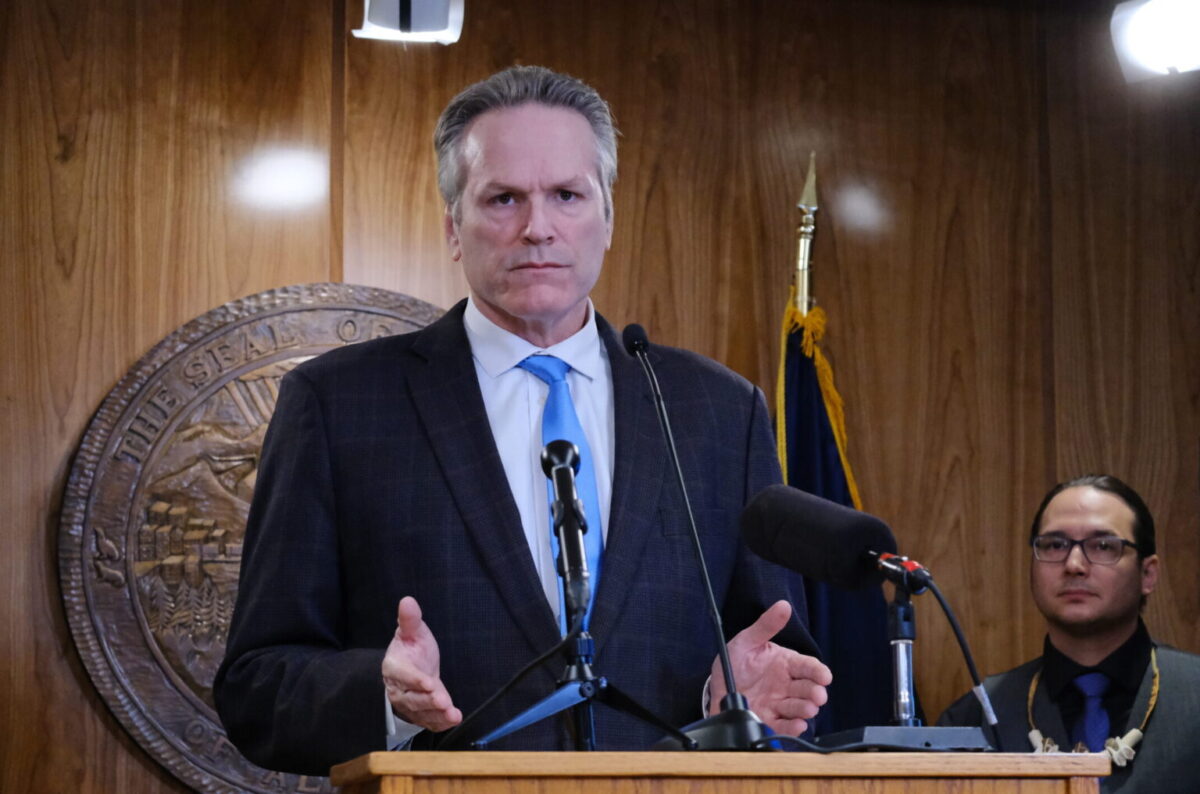
Gov. Mike Dunleavy discusses proposed education legislation at a news conference on Jan. 31, 2025. (Photo by Corinne Smith/Alaska Beacon)
Alaska Gov. Mike Dunleavy vetoed a bipartisan bill aimed at streamlining the state’s elections process on Thursday, just seven months ahead of high-stakes state and federal elections in November.
Leaders with the multipartisan House Majority caucus said there will be a joint legislative veto override vote within the next few days.
In a prepared statement announcing the veto, Dunleavy said while there are many provisions in the bills he supports, the bill contained “legal and operational challenges and could jeopardize the election process.” He told lawmakers his two main issues with the bill are related to when it would go into effect and voters’ signature verification.
“The Division of Elections warns such changes would be extremely difficult if not impossible, to implement securely and reliably in advance of the 2026 elections,” he wrote in a transmittal letter to the Legislature. He said the Division needs sufficient time to make necessary changes.
The Alaska House passed the bill in March along caucus lines, following passage by the Senate last year. It contained a variety of changes to the state’s elections system, which supporters say is years overdue and needed to update and strengthen the elections process and expand voter access.
The governor said that the bill would impose “significant operational hurdles” for the Alaska Division of Elections in administering state and federal elections in November.
Sen. Bill Wielechowski, D-Anchorage, who carried the legislation in the Senate, condemned the decision in a written statement following the announcement.
“Governor Dunleavy has said, by his veto, that Alaska’s elections are secure enough,” Wielechowski said. “Unfortunately, they are not, and even his supporters confirm that. Our voter rolls stood at 114% of the voting-age population in 2022. Ballots are being rejected over technical errors. Tampering with a voting machine is not explicitly a crime under current law. This bill addressed every one of those concerns. The Governor had every reason to sign it.”
The bill would have authorized checks to update Alaska’s voter rolls. Officials have said managing an updated voter registration list is a continuous challenge with Alaska’s transitional environment and many residents moving in and out of state, resulting in the number of registered voters currently outnumbering actual eligible voters in state.
The bill would also have enacted a new ballot tracking system, provided paid postage for all absentee mail-in ballots, strengthened security protocols, and implemented provisions for faster elections results, among others.
The Legislature has five days to convene in a joint session to consider an override of Dunleavy’s veto. A majority of 40 votes of the Legislature’s 60 members are needed for an override.
“There will be a veto override vote. I don’t think it will come as a surprise to the governor,” said House Speaker Rep. Bryce Edgmon, I-Dillingham, in a call Thursday evening.
On Thursday afternoon, members of the House Majority caucus slammed the decision Thursday following the announcement, saying in a joint statement the veto is “a significant setback for election integrity and a direct blow to voting access for Alaskans living in rural and off-road communities.”
Edgmon called the decision “deeply disappointing.”
“This was a bipartisan effort to address the real challenges of voting in a state as vast, rural and remote as Alaska. We worked in good faith to improve access, strengthen transparency, and maintain the integrity of our elections,” Edgmon said. “Alaskans deserve a system that reflects our unique geography, not one that ignores it. This veto does exactly that.”
Rep. Nellie Unangiq Jimmie, D-Toksook Bay, said that rural Alaska “is the hardest place in the state” to vote.
“Everyone who has looked at the data knows that. We passed a bill to clean up our rolls and remove barriers. It will not become law today,” she said. “My people have been patient with systems that were not built for us, distances that were not considered, delays inevitable in rural areas beyond our control. So today, the problem doesn’t go away. Neither do we.”
Dunleavy also took issue with provisions to establish a ballot tracking system and to allow voters to fix mistakes on their ballot — a process called ballot curing — by requiring the division to contact the voter by phone or email within 24 hours. Under the bill, voters would have been allowed to return a form to correct the ballot with a copy of identification by email or by mail within 10 days of the election for their ballot to be counted.
“The ballot-tracking and ballot-curing provisions are especially problematic,” Dunleavy wrote. “The ballot-curing provisions create tension with Alaska’s witness requirement by allowing a voter to cure a missing witness signature after the ballot has already been returned, even though Alaska’s absentee-ballot framework requires the voters certificate to be signed in the presence of a qualified attesting official or witness.”
The governor sent a letter following a meeting with presiding officers of the Legislature on Thursday with technical changes he’d like to see in legislation for fixing ballots, evaluating and verifying signatures.
Dunleavy said the potential Alaska gas line is his main priority, but he’s open to continuing negotiations on the elections bill this session.
“While the Alaska gas line bill is the most important bill this session, I am open to a conversation with lawmakers on how we can address the legal and operational issues this session.”
Other provisions in the now vetoed bill would have included:
Require all absentee ballots to be received within 10 days of Election Day;
Establish a new rural community liaison position within the Division of Elections to support rural districts, including recruitment and training of poll workers;
Require the Permanent Fund Dividend Division to share data to improve the accuracy of the voter rolls’
Require the state to develop a cybersecurity program, and notify the public if there is a data breach;
Require the division to publish results for all rankings in the precinct results.
Require presidential ballots to include a line for write-in votes for president and vice president
Updates crimes of unlawful interference with an election, ballot tampering and election official misconduct
Dunleavy said he applauded the Legislature’s efforts, but said the state needs more time to make changes to the state’s elections system.
“I appreciate the efforts made to improve Alaska’s elections. Going forward, I encourage those who wish to continue this work to use this bill as a starting point; ensure that any proposed changes comply with state and federal law; and pass any election legislation on a timeline that allows the Division of Elections to implement the necessary systems properly,” he said.
Edgmon said that the issues Dunleavy raised were “highly subjective” and lawmakers had heard from the division and the lieutenant governor, who is charged with overseeing state elections, that the timeline for implementing the bill was doable.
Edgmon said it’s unclear if there are the votes to override.
“You never know until the votes are tallied. You just never know,” he said. “And I know there will be plenty of votes. Will there be enough? I’m not going to hazard a guess at this point, because I’ve been proven wrong before.”
The Alaska House of Representatives advanced two bills relating to certified nurse aide training and home health care workers this week in an effort to support Alaska’s growing senior population.
The bills aim to regulate Alaska’s health care by setting training standards for CNAs and regulating wages and conditions for caregivers.
HB 244, sponsored by Rep. Jubilee Underwood, R-Wasilla, would establish eleven standards of a CNA training program at no cost to the state to ensure that patients receive competent health care. The bill passed with 39 yes votes. Rep. David Nelson, R-0Anchorage was excused absent.
“It simply says through regulation, CNA training should reflect the real job, communicating with patients, recognizing behavioral changes, supporting dignity and independence and properly caring for people with cognitive conditions,” Underwood said.
The House also advanced HB 96, sponsored by Rep. Mike Prax, R-North Pole, which would establish a Home Care Employment Standards Advisory Board to investigate and provide a biennial report on wages, workforce and working conditions for home care personnel. The board would be required to meet at least three times annually. The bill also ensures that 70% of Medicaid funding to agencies providing home and community-based services will go directly to employees and benefits.
“The home care industry has kind of developed organically if you will and there are no professional licensing requirements at this time, but they do need to set up some recognizable standard to organize the industry for purposes of pay and services,” Prax said.
The bill passed 35-5 in the House Monday and advanced to the Senate for consideration.
Alexis Rodich, director of Alaska and Montana SEIU 775, a union representing long-term care workers, said in April that the bill is a solution to a caregiver workforce crisis and provides accountability for Medicaid dollars.
The Health Department stated in the fiscal note that it would cost approximately $378,900 annually and would require the department to hire two full-time health program managers.
Rep. Jamie Allard, R-Eagle River, voted against the bill. She said Monday that she supports the need for home care employment positions but suggested consolidating the duties of the Home Care Employment Standards Advisory Board into another Health Department board.
Rep. Zack Fields, D-Anchorage, supported the bill and said that it is in the state’s best financial interest to maintain a functioning home health care work force.
“It both minimizes our long-term expenses for long-term care while keeping our elders in the place they prefer to stay, which is in their home with their family,” he said.
According to Rodich, personal care services are 45-90% less costly than nursing facilities or Alaska pioneer homes.
Shanah Kinison, a caregiver for a child with disabilities, wrote that she sees caregivers leaving the state and the bill could support caregivers, clients and their families.
“I support HB96 because it will address the shortage of caregivers in Alaska, the disparity in wages & training, and resolve other issues facing caregivers & their clients,” Kinison said.
Vanessa Liston, a caregiver for one of her children, supported the bill in a letter to legislators and said that the bill could improve her son’s life.
“This bill could upgrade the caregivers and give capability to hire strong caregivers that have pride in their job!! This is so important to the folks with disabilities and would be a game changer for growth for the future!!” she wrote.
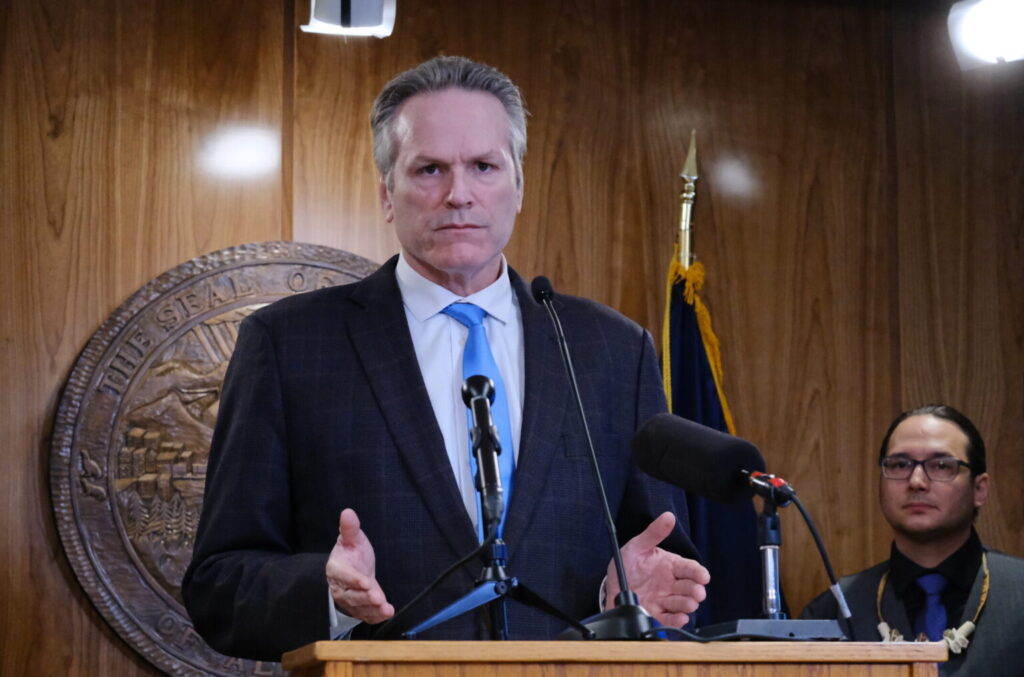
Gov. Mike Dunleavy discusses proposed education legislation at a news conference on Jan. 31, 2025. (Photo by Corinne Smith/Alaska Beacon)
Alaska Gov. Mike Dunleavy vetoed a bipartisan bill aimed at streamlining the state’s elections process on Thursday, just seven months ahead of high-stakes state and federal elections in November.
Leaders with the multipartisan House Majority caucus said there will be a joint legislative veto override vote within the next few days.
In a prepared statement announcing the veto, Dunleavy said while there are many provisions in the bills he supports, the bill contained “legal and operational challenges and could jeopardize the election process.” He told lawmakers his two main issues with the bill are related to when it would go into effect and voters’ signature verification.
“The Division of Elections warns such changes would be extremely difficult if not impossible, to implement securely and reliably in advance of the 2026 elections,” he wrote in a transmittal letter to the Legislature. He said the Division needs sufficient time to make necessary changes.
The Alaska House passed the bill in March along caucus lines, following passage by the Senate last year. It contained a variety of changes to the state’s elections system, which supporters say is years overdue and needed to update and strengthen the elections process and expand voter access.
The governor said that the bill would impose “significant operational hurdles” for the Alaska Division of Elections in administering state and federal elections in November.
Sen. Bill Wielechowski, D-Anchorage, who carried the legislation in the Senate, condemned the decision in a written statement following the announcement.
“Governor Dunleavy has said, by his veto, that Alaska’s elections are secure enough,” Wielechowski said. “Unfortunately, they are not, and even his supporters confirm that. Our voter rolls stood at 114% of the voting-age population in 2022. Ballots are being rejected over technical errors. Tampering with a voting machine is not explicitly a crime under current law. This bill addressed every one of those concerns. The Governor had every reason to sign it.”
The bill would have authorized checks to update Alaska’s voter rolls. Officials have said managing an updated voter registration list is a continuous challenge with Alaska’s transitional environment and many residents moving in and out of state, resulting in the number of registered voters currently outnumbering actual eligible voters in state.
The bill would also have enacted a new ballot tracking system, provided paid postage for all absentee mail-in ballots, strengthened security protocols, and implemented provisions for faster elections results, among others.
The Legislature has five days to convene in a joint session to consider an override of Dunleavy’s veto. A majority of 40 votes of the Legislature’s 60 members are needed for an override.
“There will be a veto override vote. I don’t think it will come as a surprise to the governor,” said House Speaker Rep. Bryce Edgmon, I-Dillingham, in a call Thursday evening.
On Thursday afternoon, members of the House Majority caucus slammed the decision Thursday following the announcement, saying in a joint statement the veto is “a significant setback for election integrity and a direct blow to voting access for Alaskans living in rural and off-road communities.”
Edgmon called the decision “deeply disappointing.”
“This was a bipartisan effort to address the real challenges of voting in a state as vast, rural and remote as Alaska. We worked in good faith to improve access, strengthen transparency, and maintain the integrity of our elections,” Edgmon said. “Alaskans deserve a system that reflects our unique geography, not one that ignores it. This veto does exactly that.”
Rep. Nellie Unangiq Jimmie, D-Toksook Bay, said that rural Alaska “is the hardest place in the state” to vote.
“Everyone who has looked at the data knows that. We passed a bill to clean up our rolls and remove barriers. It will not become law today,” she said. “My people have been patient with systems that were not built for us, distances that were not considered, delays inevitable in rural areas beyond our control. So today, the problem doesn’t go away. Neither do we.”
Dunleavy also took issue with provisions to establish a ballot tracking system and to allow voters to fix mistakes on their ballot — a process called ballot curing — by requiring the division to contact the voter by phone or email within 24 hours. Under the bill, voters would have been allowed to return a form to correct the ballot with a copy of identification by email or by mail within 10 days of the election for their ballot to be counted.
“The ballot-tracking and ballot-curing provisions are especially problematic,” Dunleavy wrote. “The ballot-curing provisions create tension with Alaska’s witness requirement by allowing a voter to cure a missing witness signature after the ballot has already been returned, even though Alaska’s absentee-ballot framework requires the voters certificate to be signed in the presence of a qualified attesting official or witness.”
The governor sent a letterfollowing a meeting with presiding officers of the Legislature on Thursday with technical changes he’d like to see in legislation for fixing ballots, evaluating and verifying signatures.
Dunleavy said the potential Alaska gas line is his main priority, but he’s open to continuing negotiations on the elections bill this session.
“While the Alaska gas line bill is the most important bill this session, I am open to a conversation with lawmakers on how we can address the legal and operational issues this session.”
Other provisions in the now vetoed bill would have included:
Require all absentee ballots to be received within 10 days of Election Day;
Establish a new rural community liaison position within the Division of Elections to support rural districts, including recruitment and training of poll workers;
Require the Permanent Fund Dividend Division to share data to improve the accuracy of the voter rolls’
Require the state to develop a cybersecurity program, and notify the public if there is a data breach;
Require the division to publish results for all rankings in the precinct results.
Require presidential ballots to include a line for write-in votes for president and vice president
Updates crimes of unlawful interference with an election, ballot tampering and election official misconduct
Dunleavy said he applauded the Legislature’s efforts, but said the state needs more time to make changes to the state’s elections system.
“I appreciate the efforts made to improve Alaska’s elections. Going forward, I encourage those who wish to continue this work to use this bill as a starting point; ensure that any proposed changes comply with state and federal law; and pass any election legislation on a timeline that allows the Division of Elections to implement the necessary systems properly,” he said.
Edgmon said that the issues Dunleavy raised were “highly subjective” and lawmakers had heard from the division and the lieutenant governor, who is charged with overseeing state elections, that the timeline for implementing the bill was doable.
Edgmon said it’s unclear if there are the votes to override.
“You never know until the votes are tallied. You just never know,” he said. “And I know there will be plenty of votes. Will there be enough? I’m not going to hazard a guess at this point, because I’ve been proven wrong before.”
A promotional photo from the new season of “Alaska State Troopers” premiering in January shows a Palmer Police squad car. (Photo courtesy of A&E)
An Alaska woman is accusing the Alaska Department of Public Safety, two Alaska State Troopers and the A&E Television Network of compromising her privacy and safety as a confidential informant after they filmed an arrest without her consent.
The woman, identified in the filings as Jane Doe, says that she received death threats after she was a confidential informant whose information led to an arrest that was filmed and later aired on the Alaska State Troopers reality show.
The woman’s attorney, Jeff Barber, declined to comment on the case and said that he plans to file a motion to make the case confidential for her safety.
In court filings, Barber argued that the defendants had a duty to protect the confidential informant from harm. Barber wrote, “the defendants were motivated by fame, fortune or financial gain,” and they exploited Jane Doe’s “life and safety for profit and/or personal gain.”
The television show followed troopers in the Matanuska-Susitna Valley, Fairbanks, Western Alaska and Valdez in 2025. A&E Television Network aired nine episodes of the show between January and March 2026.
The lawsuit names Alaska State Troopers Scott McAfee and Lucas Altepeter, the Alaska Department of Public Safety, the show’s executive producer Anna Rodzinski and her company Anusia Films LLC, and A&E Television Networks LLC as defendants. Jane Doe is suing each defendant for $100,000.
According to a complaint filed in state court on April 23, Jane Doe assisted the Alaska State Troopers as a confidential informant in 2025 and was later threatened by a person who suspected her of being a confidential informant. She assisted troopers for a second time in 2025 and a film crew filmed troopers arresting the person who suspected Doe.
Jane Doe told McAfee, a trooper, that she objected to A&E filming the arrest, and court documents say troopers relayed Doe’s objection to the film crew. According to the filing, the film crew filmed the arrest anyway. This caused Jane Doe “severe emotional distress and harm.”
In the lawsuit, Jane Doe’s attorneys claim that the crew filmed the episode in a way that could reveal Jane Doe’s identity and involvement. After the episode aired, Jane Doe received hostile communications and death threats.
Jane Doe suffered “medical expense, pain, anxiety, suffering, severe emotional distress, inconvenience, security and privacy expenses,” Barber wrote in the filing.
The case alleges that McAfee and Altepeter’s negligence and recklessness breached their duty and created danger to Jane Doe.
Barber accused the defendants of violating Jane Doe’s right to privacy and right to due process, and their actions inflicted intentional emotional distress.
Austin McDaniel, communications director for the Department of Public Safety, told the Alaska Beacon by email Wednesday that DPS had not been formally served with the lawsuit yet and will respond in court.
“We take the safety of all Alaskans extremely seriously and reject any suggestion that DPS personnel would knowingly endanger anyone’s life,” McDaniel stated.
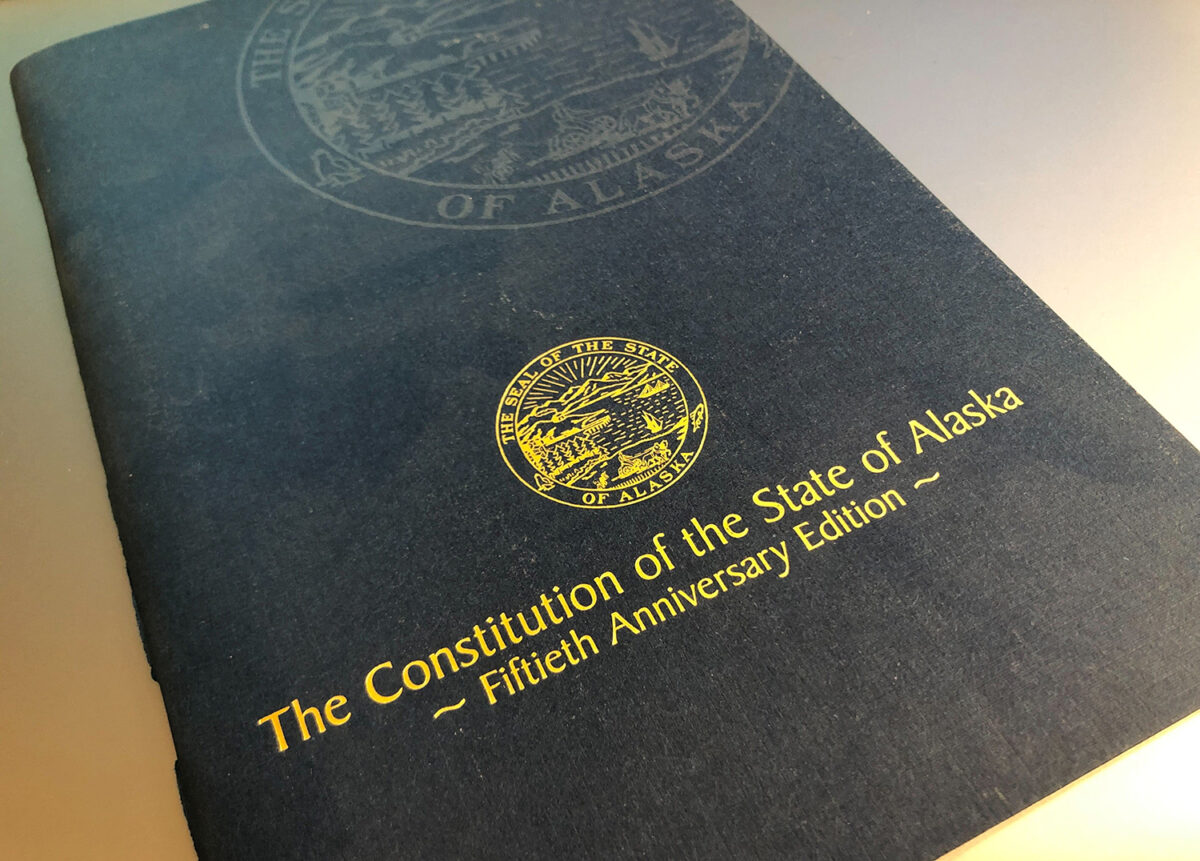
A copy of the Alaska Constitution is seen on Thursday, July 28, 2022. (Photo by James Brooks/Alaska Beacon)
By: Corinne Smith, Alaska Beacon
A copy of the Alaska Constitution is seen on Thursday, July 28, 2022. (Photo by James Brooks/Alaska Beacon)
A proposal to create civics education requirements for all Alaska high school students is advancing in the Legislature, amid a deepening decline in public trust in government nationwide.
Senate President Gary Stevens, R-Kodiak, sponsored Senate Bill 23, which would require high school students to take a semester of civics curriculum, pass a civics exam or complete a project-based assessment in order to graduate. The bill is under consideration in House committees after it passed the Senate in March.
Senate President Gary Stevens, R-Kodiak, talks to fellow legislators shortly before the Alaska Senate adjourned for the year on Tuesday, May 20, 2025. (Photo by James Brooks/Alaska Beacon)
Stevens, a longtime legislator and former University of Alaska professor, told House members at a hearing on March 18 the goal is to inspire students to be more engaged with their government and civic affairs.
“What we hope to do is to rekindle the spirit within our education system to help foster citizenship and voting and community engagement, which is really a fundamental purpose, I think, of public education,” Stevens said.
Civics education is the study of how local, state and federal government works in the constitutional democracy of the United States. That includes our government’s laws and history, the rights of citizens and structures of power.
Stevens said in an interview Wednesday that he sees expanding civics education as a way to combat growing distrust or misunderstanding of government.
“Certainly, I think there’s just a lack of understanding. I have talked to a lot of kids who just have no idea that there is a state government and there is a federal government. There’s a difference between the two,” he said, adding that each governments’ roles and responsibilities are important to understand.
Stevens said Alaska’s students should know that, states are responsible for administering public schools and running elections. “I think kids need to know that, and I think they’re interested in it.”
The bill would direct the Alaska State Board of Education to provide open access, no-cost educational resources to districts covering 14 areas of government, politics and public affairs. Those 14 areas include the founding principles of the United States, the Alaska and U.S. Constitutions, federalism, civil liberties and civil rights, political parties, campaigns and elections, comparative systems of government including by Alaska Native tribes, and others.
If enacted, students would have three options to fulfill the graduation requirement: take and pass a semester-long comparative government and civics course, pass a civics exam — with an option e-take the exam if they did not pass — or opt to complete a civics-related project.
In the second term of the Trump administration, public distrust and political polarization has continued to decline in the U.S. A survey completed in September by the Pew Research Center found public trust in government at one of the lowest points since 1958 — just 17% of respondents said they trust the federal government to do what is right. That’s down from 22% in 2024, and reported trust in government has not been higher than 30% since 2007.
Another 2025 survey by the center found that 8 in 10 U.S. adults said that on important issues facing the country, Republican and Democrat voters not only disagree on policy and plans, but also can’t agree on basic facts.
Shawn Healy with iCivics, a nonpartisan advocacy organization founded by former Supreme Court Justice Sandra Day O’Connor to promote civics learning, testified in support of the bill. He said many states across the country are taking steps to bolster civics education.
“Just since 2021, 33 states have adopted at least 51 policies to strengthen civics education, and just this spring, we’re following 218 bills in 40 states, including Senate Bill 23, that seek to strengthen civic education,” he said.
Healy told lawmakers that often people do not understand where to go to solve problems in their communities. He said supporting civics education in schools and dialogue on public issues — across political divides — can help address polarization.
“What we know actually, is when we have conversations across difference, that that’s actually a moderating force, that brings us close together, at least creates an opportunity for us to compromise and develop consensus. And classrooms are great venues for that.” he said.
Researchers with iCivics found that young people who experience civics education are more likely to vote, go to college, be confident in public speaking and volunteer and work on community issues. He said the growing interest in advancing civics education is an investment in future generations.
“We’re not sentenced to this current predicament in our country, where there’s widespread civic ignorance, there’s deep distrust of institutions and one another, and toxic levels of political polarization,” he said. “States across the country are embracing civic learning as a means of strengthening and sustaining our constitutional democracy.”
Many Alaska school districts, including Cordova, Haines, Kodiak and the Aleutian Region School District reported they already offer civics education, according to a survey conducted by the Alaska Council of School Administrators on the impacts of the bill.
Other districts, including Nome, Lower Kuskokwim and Petersburg school districts noted that implementation would require costs for training teachers and purchasing curriculum. As a result, the bill was revised to require Alaska Department of Education and Early Development to develop open, no-cost curriculum resources for districts.
Susan Nedza, superintendent of Hoonah City School District, testified to lawmakers she was initially concerned about the cost and now supports the revised bill.
“While there is often much debate about the reason schools exist and what schools should teach, it is my opinion that civics education is vitally important in preparing youth for the future as community members and citizens,” she said. “I have in the past been concerned about cost and about tests creating a barrier for school and students. The version before you offers pathways that eliminate my concerns.”
The revised bill now estimates a state cost of $40,000 for educator stipends to support a working group to evaluate the curriculum and education resources for districts to list on the DEED website. It estimates $12,000 for the initial design, printing and shipping of a civic education seal for all high school graduates, and $5,000 each year going forward.
Stevens has sponsored previous bills to strengthen civics education that were approved by the Senate in 2024 and 2022, but they were unsuccessful in gaining support and stalled before reaching a vote on the House floor.
Stevens said some of the past opposition was related to a concern the state would be imposing an unfunded mandate for schools, but that is addressed in the current bill, which requires the state to provide with the open, no-cost educational resources. Other concerns were related to what critics called a “high stakes” test requirement to graduate. He said those are addressed by having three options for meeting the requirement in the bill.
The civics education bill was advanced by the House Education Committee earlier this month and is now referred to the House Finance Committee for consideration. It has not yet been scheduled.
Civics curriculum in SB 23 would include:
the founding history of the United States, including foundational documents and the principles of government of the United States;
federalism, including the role and operations of local, state, and national governments;
the institutions of the United States government, including the responsibilities of the executive, legislative, and judicial branches;
the rights and responsibilities of United States citizenship;
civil liberties and civil rights;
the Constitution of the State of Alaska and the Constitution of the United States;
political parties and interest groups;
campaigns and elections;
the United States Congress;
domestic policy;
foreign policy;
comparative systems of governments used globally and by Alaska Natives;
international relations; and
major issues facing local, state, and the United States governments.