Categories
Alaska News Featured Juneau News juneau Juneau Local Juneau Local Ketchikan Local News Feeds Sitka Local

Peltola unveils ‘affordability’ campaign as she challenges incumbent U.S. Sen. Dan Sullivan

By: James Brooks, Alaska Beacon

Mary Peltola speaks to a crowd of supporters for her candidacy for U.S. Senate at a campaign kick off event in Juneau on Jan. 23, 2026 (Photo by Corinne Smith/Alaska Beacon)

The leading challenger to Republican incumbent U.S. Sen. Dan Sullivan is proposing to eliminate income taxes for Alaskans earning less than $92,000 per year, the state’s median household income.

Democratic candidate Mary Peltola introduced the idea Monday as part of a newly expanded platform of campaign ideas.

Among some of the other ideas: a federally subsidized “Essential Freight Service” for air cargo to small communities, a renewal of the federal Expanded Child Tax Credit, tax credits for renters and child care facilities, and price controls and limits on corporate mergers.

There are relatively few seats in the U.S. Senate that could be won by either a Republican or a Democrat this year. In a recent analysis, NPR dubbed Alaska’s seat the “majority maker.” National Democrats are hoping that Peltola can beat Sullivan and help them take control of the Senate, which currently has a 54-46 Republican edge. 

To that end, they’ve donated millions of dollars to her campaign. 

Meanwhile, Sullivan has continued to strengthen a network of connections within the state. He’s already received endorsements from the United Fishermen of Alaska — the state’s largest commercial fishing organization — and last week was endorsed by the ANCSA Regional Association, a group representing the state’s largest Alaska Native corporations. 

Both groups represent constituencies that have previously favored Peltola. 

Statewide opinion polls have found economic issues are at the top of Alaskans’ minds, and many Alaskans have an extraordinarily pessimistic view of the state’s financial health and their own financial situation.

Many residents believe that any economic improvements won’t trickle down to them, said Matt Larkin, a leading pollster, in a recent interview.

That’s the environment in which Peltola is launching her new economic campaign. 

“Affordability — it’s on everyone’s mind,” she said in an interview ahead of the launch.

Peltola, who lives part of the year in rural Alaska, said she believes the high cost of heating fuel and stove fuel has created a crisis.

“I feel like we’re in a dire situation that I have never experienced,” she said, explaining that her monthly fuel bill now exceeds her mortgage.

During a recent visit to St. Mary’s, on the Yukon River in southwest Alaska, she talked to people who are currently paying $10 per gallon for fuel. They’re expecting prices to go up by 40-50%, she said.

If they can’t afford fuel, “that means there’s no electricity, there’s no heat, there’s no gas for hunting and fishing. This is dire. And I, you know, I just think we’ve got to get really serious about how to bring down prices for everyday Alaskans, for everyday households.”

Peltola drew a direct line between the American war on Iran and those high prices. Sullivan has been a staunch supporter of the war. Peltola believes Congress needs to intervene, though she stopped short of outright opposing it.

“There is a need for the War Powers Act. I do not believe that any President should be making these kinds of substantive decisions unilaterally,” she said.

Peltola’s call for an “Essential Freight Service” mirrors her support for Bypass Mail and the Essential Air Service, two existing subsidy programs that support flights to rural Alaska and other parts of rural America.

She said the exact scope of the freight program still needs to be worked out. Alaska is essentially “six states within a state,” and “and every single region is so unique, and I think it would have to be unique approaches in every region and every community.”

Monday’s announcement is the second significant policy launch by Peltola since she announced in January that she would challenge Sullivan for Senate.

In late March, she announced her support for Congressional term limits, a ban on stock trading by members of Congress and her support for a Constitutional amendment to overturn the U.S. Supreme Court case known as Citizens United.

That case allows third-party groups to spend unlimited amounts of money on political campaigns as long as they do not coordinate with candidates.

Speaking Friday, Peltola said anti-corruption and affordability are complementary issues.

“I think we’re all going to be looking at where the price gouging is and where we can halt corporate greed and inflation,” she said.

Categories
Alaska News

Alaska Beacon celebrates four years of state coverage

The Alaska State Capitol in Juneau is seen on April 24, 2026. (Photo by Claire Stremple/Alaska Beacon)

The Alaska State Capitol in Juneau is seen on Apr. 24, 2026. (Photo by Claire Stremple/Alaska Beacon)

The Alaska Beacon launched four years ago today, with a mission to connect Alaskans to their state government. 

Since then, we have covered four legislative sessions from the Alaska State Capitol in Juneau. We have written 5,670 articles. And our reporting has won 44 awards — including the Society of Professional Journalists’ General Excellence award, an A-Mark Investigative Journalism award and five Alaska Press Club awards this year.

The Alaska Beacon is a four person team: one editor and three reporters. Our stories have and will continue to investigate how state policies affect specific areas, like the economy, environment, health and education.

Yereth Rosen covers health and the environment from Anchorage, but her reporting takes her all over the state. She’s in Juneau this week for the end of the legislative session, but she’s also racked up trips to Nome, Sitka, Homer, Seward and Whittier. Most of that travel has been supported by a fellowship grant through USC Annenberg’s Center for Health Journalism. Yereth has been with the Alaska Beacon since its inception.

James Brooks covers government and politics from Juneau. He’s back in the halls of the state house after taking some leave to bring twin sons into his family this year. In the coming weeks, he will be following how state lawmakers decide to spend a projected increase in state revenue and the fate of various proposals to incentivize the developers of the potential Alaska LNG project. He has been with the Alaska Beacon since its inception.

Corinne Smith joined the Alaska Beacon in 2024, reporting on the education and justice beats. After award-winning coverage of the education funding and policy debates last year, she is monitoring the effects of that policy — and whether lawmakers address education policy again before they gavel out next week.

I rejoined the Alaska Beacon as its editor in late 2025 after several years as the education and justice reporter and a year-long departure to lead the newsroom at KTOO in Juneau. While I still contribute news stories from time to time, my main focus is leading our three-person team in coverage that centers how state politics and policy affect your life.

In the coming year, we plan to continue our coverage with a major focus on the upcoming November elections. You can look forward to our Voter Guide launching in the coming months, and elections coverage in partnership with other Alaska newsrooms, including the state’s public radio network and the Anchorage Daily News.

Thank you for reading the Alaska Beacon over the last four years. In the years to come, we’re looking forward to earning your continued readership, trust and support.

SUPPORT: YOU MAKE OUR WORK POSSIBLE

Categories
Alaska News

Dalton Highway toll proposal stalls in Alaska Senate committee

The trans-Alaska pipeline and Dalton Highway are seen on July 4, 2014, in the Brooks Range area near the pipeline's Pump Station 4, about 270 miles south of Prudhoe Bay. (Photo by Bob Wick/U.S. Bureau of Land Management)

The trans-Alaska pipeline and Dalton Highway are seen on July 4, 2014, in the Brooks Range area near the pipeline’s Pump Station 4, about 270 miles south of Prudhoe Bay. (Photo by Bob Wick/U.S. Bureau of Land Management)

A bill that would impose a toll on oil and gas vehicles using the Dalton Highway was set aside by state lawmakers on Thursday after the public voiced concern that it would target a single industry and raise costs for Alaskans.

Senator Scott Kawasaki, D-Fairbanks and the sponsor of SB 286, introduced the bill in an effort to offset maintenance costs of the 414-mile long highway that runs from Livengood, north of Fairbanks, the the oilfields of Prudhoe Bay.

“We are trying to find ways to balance this budget where the cost causers are the cost payers,” he said Tuesday.

The Alaska Department of Transportation and Public Facilities invests approximately $16.5 million in maintenance on the Dalton Highway each year, with approximately one-third of that funding coming from the federal government.

The bill would set up a toll on two miles of the highway near Deadhorse for vehicles transporting personnel or goods for oil and gas companies. The Alyeska Pipeline Service Company, the company that operates the 800-mile long Trans-Alaska Pipeline System between Prudhoe Bay and Valdez, would be exempted from the toll. The bill would require oil and gas companies to reimburse operators who pay the toll within 30 days of a request for reimbursement.

Alaska Trucking Association President Jamie Benson said that while she supports infrastructure investment, the bill would single out the trucking industry and could increase costs for all Alaskans.

“While it’s framed as a maintenance solution, it functions as a targeted fee on a single industry and its supply chain, including Alaska-based trucking companies,” she told legislators Thursday afternoon.

While the bill aims to raise funds to maintain the Dalton Highway, funds raised from the toll would go into the general fund and be subject to appropriations by the legislature annually.

Members of the trucking, oil and gas industries voiced their opposition during a committee meeting on Thursday.

Robb Christenson, director of sales and pricing at Sourdough Express, expressed concerns about government overreach.

“If we begin carving out small sections of public infrastructure and charging users based on industry, where does it stop? Today it’s two miles on the Dalton Highway, tomorrow it’s roads that access mining, timber or other resource development,” he said.

Cody Hyce, owner of Specialized Transport and Rigging in Wasilla, told legislators that the economic, legal and operational hurdles created by the bill would outweigh the benefits to the state.

“We should be looking for efficiencies in our transportation budget, not nickel and diming the very workers and resources that ensure the state’s energy independence,” he said.

According to Andy Mills, legislative liaison to the Department of Transportation and Public Facilities, Alaska does not currently have authorization from the federal government to establish a toll facility on the highway. The Senate State Affairs committee set the bill aside.

Senator Robert Myers, R-North Pole, told legislators that he understands the issue that they’re trying to fix, but he does not see a toll as the right solution.

Myers, who is a truck driver and travels the Dalton Highway, said that the bill poses legal issues since the highway is being rebuilt using federal funds, an equal protection issue by exempting the Alyeska Pipeline Service Company and operational issues for trucking companies.

SUBSCRIBE: GET THE MORNING HEADLINES DELIVERED TO YOUR INBOX

Categories
Alaska News Featured Juneau News juneau Juneau Local Juneau Local Ketchikan Local News Feeds Sitka Local

Alaskans are more pessimistic about the state’s economy now than they were in 2020

By: James Brooks, Alaska Beacon

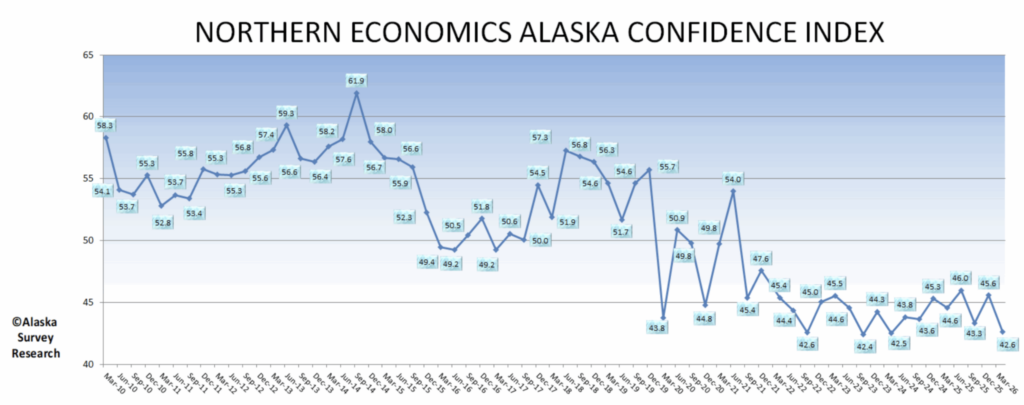
This chart by Alaska Survey Research shows Alaskans’ views of the economy, as based on a 0-100 point scale, over the past 16 years. (Photo by Alaska Survey Research)

New statewide polling shows Alaskans have near-record negative views of the state’s economy, with opinions more pessimistic than they were during the 2020 COVID-19 pandemic emergency.

Those views, which mirror national trends, were published this week by Alaska Survey Research and analyst Ivan Moore.

On a scale of 0-100, Alaskans give the state economy a score of 42.6, two-tenths of a point above a record low recorded in fall 2023.

Moore has been asking Alaskans the same six economic questions regularly since spring 2010.

“I wish that we were living up right now to the old adage that how the economy goes in the United States, we do the reverse,” he said on Thursday when asked about the results.

The survey’s score peaked in 2014, when Alaska oil prices were near record highs, government spending was up and the Permanent Fund dividend was large.

When oil prices plunged in 2014 and 2015, so did public opinion. Opinions rebounded in late 2017 and early 2018 but tumbled again during the COVID-19 pandemic emergency, then fell again when inflation spiked after the emergency ended.

“In the 3.5 years since, even though Covid is reasonably a thing of the past, and the inflation rate is back to normal, the index has not recovered,” Moore wrote in his latest analysis. “Alaskans are as pessimistic about economic conditions in Alaska today as they were in the depths of the worst winter Covid months.”

Speaking by phone, he said that “even though the inflation rate is back to normal, it doesn’t mean that things aren’t still shockingly expensive. The war in Iran is creating uncertainty. The price of gas has gone through the roof.”

National surveys report similar findings. Last month, the University of Michigan — which measures American consumer sentiment monthly — reported results on par with 2022, when opinions were at their lowest in decades.

Moore isn’t the only person who’s finding low opinions among Alaskans about the economy.

At Dittman Research, Matt Larkin regularly polls state residents on behalf of the Alaska Chamber of Commerce and other clients.

“I’ve been doing this 15 years,” Larkin said. “In my opinion, I’ve not seen the economic concern worse than it is now.”

This year’s survey, conducted in March, found 60% of respondents saying Alaska’s economy was either pretty bad or “not too good.”

That was an increase of eight percentage points from 2025.

Two-thirds of respondents said the state of Alaska is on the wrong track, continuing a streak that began in March 2016. The last time more Alaskans said the state was headed in the right direction than the wrong direction was in January 2015. 

Larkin also said that his survey found that many Alaskans were likely to believe that even if economic conditions improve, the improvements would not benefit them personally.

While both Moore and Larkin said their polls are a good barometer to check on public opinion, they also said that the results may be an indicator for this fall’s election campaigns.

“It strikes me that, with all the political races this year, I think the candidates that can best understand and appear to be offering real solutions are going to likely do well in that environment,” Larkin said.

“I think that’s the challenge for all these campaigns: How do they speak to a voter base that’s very, very down right now about the economic prospects for their personal lives, but also the state in general?”

Categories
Alaska News

Alaskans are more pessimistic about the state’s economy now than they were in 2020

This chart by Alaska Survey Research shows Alaskans’ views of the economy, as based on a 0-100 point scale, over the past 16 years. (Graphic/Courtesy by Alaska Survey Research)

New statewide polling shows Alaskans have near-record negative views of the state’s economy, with opinions more pessimistic than they were during the 2020 COVID-19 pandemic emergency.

Those views, which mirror national trends, were published this week by Alaska Survey Research and analyst Ivan Moore.

On a scale of 0-100, Alaskans give the state economy a score of 42.6, two-tenths of a point above a record low recorded in fall 2023.

Moore has been asking Alaskans the same six economic questions regularly since spring 2010.

“I wish that we were living up right now to the old adage that how the economy goes in the United States, we do the reverse,” he said on Thursday when asked about the results.

The survey’s score peaked in 2014, when Alaska oil prices were near record highs, government spending was up and the Permanent Fund dividend was large.

When oil prices plunged in 2014 and 2015, so did public opinion. Opinions rebounded in late 2017 and early 2018 but tumbled again during the COVID-19 pandemic emergency, then fell again when inflation spiked after the emergency ended.

“In the 3.5 years since, even though Covid is reasonably a thing of the past, and the inflation rate is back to normal, the index has not recovered,” Moore wrote in his latest analysis. “Alaskans are as pessimistic about economic conditions in Alaska today as they were in the depths of the worst winter Covid months.”

Speaking by phone, he said that “even though the inflation rate is back to normal, it doesn’t mean that things aren’t still shockingly expensive. The war in Iran is creating uncertainty. The price of gas has gone through the roof.”

National surveys report similar findings. Last month, the University of Michigan — which measures American consumer sentiment monthly — reported results on par with 2022, when opinions were at their lowest in decades.

Moore isn’t the only person who’s finding low opinions among Alaskans about the economy.

At Dittman Research, Matt Larkin regularly polls state residents on behalf of the Alaska Chamber of Commerce and other clients.

“I’ve been doing this 15 years,” Larkin said. “In my opinion, I’ve not seen the economic concern worse than it is now.”

This year’s survey, conducted in March, found 60% of respondents saying Alaska’s economy was either pretty bad or “not too good.”

That was an increase of eight percentage points from 2025.

Two-thirds of respondents said the state of Alaska is on the wrong track, continuing a streak that began in March 2016. The last time more Alaskans said the state was headed in the right direction than the wrong direction was in January 2015. 

Larkin also said that his survey found that many Alaskans were likely to believe that even if economic conditions improve, the improvements would not benefit them personally.

While both Moore and Larkin said their polls are a good barometer to check on public opinion, they also said that the results may be an indicator for this fall’s election campaigns.

“It strikes me that, with all the political races this year, I think the candidates that can best understand and appear to be offering real solutions are going to likely do well in that environment,” Larkin said.

“I think that’s the challenge for all these campaigns: How do they speak to a voter base that’s very, very down right now about the economic prospects for their personal lives, but also the state in general?”

The post Alaskans are more pessimistic about the state’s economy now than they were in 2020 appeared first on Chilkat Valley News.

Categories
Alaska News

Legislature approves extra legal help for Alaskans who can’t afford attorneys

After four years of effort, the Alaska Legislature has passed a bill offering additional support for the underfunded organization that offers free legal help to Alaskans facing civil lawsuits.

“We’re so excited,” said Maggie Humm, executive director of the Alaska Legal Services Corporation. 

ALSC is the state’s largest provider of free legal assistance for survivors of domestic violence and abuse. It generally supports Alaskans who are unable to afford an attorney on their own.

Under state law, Alaska must provide criminal defendants with a defense attorney. No such mandate exists in civil cases, so the work falls to the ALSC, a nonprofit that lacks the budget to take on every request for help.

On Wednesday, the state Senate voted 17-3 to pass House Bill 48 and give the corporation 25% of all state court filing fees, up from 10%. The change is worth an extra $400,000 to the corporation.

The change does not affect funding for the Alaska Court System; the fees are otherwise used for general purposes, not the courts specifically.

Humm said earlier this year that ALSC provided legal help to roughly 6,200 Alaskans in 2024. By email on Wednesday, she said she expects another 800-850 people will be helped by the additional money.

Because the House passed HB 48 on a 27-13 vote in February, the Senate’s action on Wednesday will send the bill to Gov. Mike Dunleavy for final approval or veto.

Sen. Forrest Dunbar, D-Anchorage, proposed an identical bill in 2023, and while that bill passed the Senate, it never received a vote in the House before the 33rd Alaska Legislature expired in 2024.

That left Sara Hannan, D-Juneau, to reintroduce the bill last year and restart the legislative process. 

By email, Humm said that if signed into law, the bill “helps to ensure that more low-income Alaskans facing issues such as domestic violence, elder fraud, and access to earned benefits receive the legal help they need to protect their safety, stability, and dignity. Investing in legal services benefits all Alaskans by helping resolve problems early, before they become more serious and costly challenges for both individuals and our communities.”

ALSC has been trying since 2011 to pass a bill that reserves 25% of the state’s court fees for the corporation. In 2018, the Legislature passed a measure allocating 10%. 

The post Legislature approves extra legal help for Alaskans who can’t afford attorneys appeared first on Chilkat Valley News.

Categories
Alaska News

Kodiak fisherman will plead guilty to stealing trees from Alaska’s Tongass National Forest

Yellow cedar trees are seen in this Creative Commons-licensed photo by Richard Droker on Oct. 24, 2015. (Courtesy/Richard Droker)

A commercial fisherman in Kodiak will plead guilty to stealing 16 yellow cedar trees from the Tongass National Forest in Southeast Alaska.

Mitchell Keplinger, charged with theft of government property in April, was scheduled to appear in U.S. District Court for the District of Alaska on Wednesday for his formal arraignment.

Keplinger signed a plea deal the day after he was charged. Under the terms of the deal, he will avoid jail time but will pay $85,682.17 in restitution and be on probation for three years, a term that may later be reduced to no less than 18 months.

That would be significantly lower than the maximum penalty for theft of government property, which can be punished by up to 10 years in prison and a fine of up to $250,000.

Keplinger’s attorney did not return a phone call seeking comment on Wednesday.

According to the text of the plea deal, Keplinger and his boat, the 54-foot seiner Alinchak, were working in the Sitka herring seine fishery in late March and early April 2024. After the fishery closed, Keplinger used his boat and crew “to harvest Alaska yellow cedar trees on U.S. Forest Service lands near Sawmill Creek, Sugarloaf Mountain and in and around Sitka Sound.”

The plea deal states that Keplinger knew that a permit was required to cut the trees and knew that he did not have that permit.

“Keplinger’s crew, who were cutting the trees at his direction, had covered one of the stumps with moss to conceal the theft,” the plea deal states.

Paul Robbins, a spokesman for the U.S. Forest Service in the Tongass, said by email that yellow cedar “is important culturally, ecologically, and economically. Its strength is seen in durable wood products from canoe paddles to engineered timber frames and the unique rot-resistant chemistry of its heartwood allows it to live for over 1000 years and to persist long after death as sequestered carbon.”

The 16 trees allegedly taken by Keplinger yielded 22 logs, “belonging to the United States, with a market value of $4,476.25,” according to the plea deal.

Keplinger then used his boat to take the logs to Kodiak, the plea deal states. The restitution required under the plea deal includes the cost of transporting the logs back to Sitka and the Forest Service.

“Timber theft by individuals is not common on the Tongass National Forest,” Robbins said.

Court documents do not state why Keplinger took the trees or how the theft was discovered. A spokesperson for the U.S. Attorney’s Office in Alaska declined to talk about anything not covered by public court documents, as did Robbins with the Forest Service.

The post Kodiak fisherman will plead guilty to stealing trees from Alaska’s Tongass National Forest appeared first on Chilkat Valley News.

Categories
Alaska News

Peltola unveils ‘affordability’ campaign as she challenges incumbent U.S. Sen. Dan Sullivan

Mary Peltola speaks to a crowd of supporters for her candidacy for U.S. Senate at a campaign kick off event in Juneau on Jan. 23, 2026 (Photo by Corinne Smith/Alaska Beacon)

Mary Peltola speaks to a crowd of supporters for her candidacy for U.S. Senate at a campaign kick off event in Juneau on Jan. 23, 2026 (Photo by Corinne Smith/Alaska Beacon)

The leading challenger to Republican incumbent U.S. Sen. Dan Sullivan is proposing to eliminate income taxes for Alaskans earning less than $92,000 per year, the state’s median household income.

Democratic candidate Mary Peltola introduced the idea Monday as part of a newly expanded platform of campaign ideas.

Among some of the other ideas: a federally subsidized “Essential Freight Service” for air cargo to small communities, a renewal of the federal Expanded Child Tax Credit, tax credits for renters and child care facilities, and price controls and limits on corporate mergers.

There are relatively few seats in the U.S. Senate that could be won by either a Republican or a Democrat this year. In a recent analysis, NPR dubbed Alaska’s seat the “majority maker.” National Democrats are hoping that Peltola can beat Sullivan and help them take control of the Senate, which currently has a 54-46 Republican edge. 

To that end, they’ve donated millions of dollars to her campaign. 

Meanwhile, Sullivan has continued to strengthen a network of connections within the state. He’s already received endorsements from the United Fishermen of Alaska — the state’s largest commercial fishing organization — and last week was endorsed by the ANCSA Regional Association, a group representing the state’s largest Alaska Native corporations. 

Both groups represent constituencies that have previously favored Peltola. 

Statewide opinion polls have found economic issues are at the top of Alaskans’ minds, and many Alaskans have an extraordinarily pessimistic view of the state’s financial health and their own financial situation.

Many residents believe that any economic improvements won’t trickle down to them, said Matt Larkin, a leading pollster, in a recent interview.

That’s the environment in which Peltola is launching her new economic campaign. 

“Affordability — it’s on everyone’s mind,” she said in an interview ahead of the launch.

Peltola, who lives part of the year in rural Alaska, said she believes the high cost of heating fuel and stove fuel has created a crisis.

“I feel like we’re in a dire situation that I have never experienced,” she said, explaining that her monthly fuel bill now exceeds her mortgage.

During a recent visit to St. Mary’s, on the Yukon River in southwest Alaska, she talked to people who are currently paying $10 per gallon for fuel. They’re expecting prices to go up by 40-50%, she said.

If they can’t afford fuel, “that means there’s no electricity, there’s no heat, there’s no gas for hunting and fishing. This is dire. And I, you know, I just think we’ve got to get really serious about how to bring down prices for everyday Alaskans, for everyday households.”

Peltola drew a direct line between the American war on Iran and those high prices. Sullivan has been a staunch supporter of the war. Peltola believes Congress needs to intervene, though she stopped short of outright opposing it.

“There is a need for the War Powers Act. I do not believe that any President should be making these kinds of substantive decisions unilaterally,” she said.

Peltola’s call for an “Essential Freight Service” mirrors her support for Bypass Mail and the Essential Air Service, two existing subsidy programs that support flights to rural Alaska and other parts of rural America.

She said the exact scope of the freight program still needs to be worked out. Alaska is essentially “six states within a state,” and “and every single region is so unique, and I think it would have to be unique approaches in every region and every community.”

Monday’s announcement is the second significant policy launch by Peltola since she announced in January that she would challenge Sullivan for Senate.

In late March, she announced her support for Congressional term limits, a ban on stock trading by members of Congress and her support for a Constitutional amendment to overturn the U.S. Supreme Court case known as Citizens United.

That case allows third-party groups to spend unlimited amounts of money on political campaigns as long as they do not coordinate with candidates.

Speaking Friday, Peltola said anti-corruption and affordability are complementary issues.

“I think we’re all going to be looking at where the price gouging is and where we can halt corporate greed and inflation,” she said.

SUPPORT: YOU MAKE OUR WORK POSSIBLE

Categories
Alaska News

Juneau Empire shuts office where 8 people worked a few years ago; now appears to be seeking 1 salesperson

The Juneau Empire last week shut down its office in the Jordan Creek Center and relocated to what’s reportedly a single-desk space at Vintage Business Park. The masthead in Saturday’s print edition lists no staff, aside from an obituaries/legal notice person based outside Juneau — and the only job opening is for a general sales manager.

For weeks the only byline on local stories has been “Juneau Empire staff” and virtually all of those stories — generally two or three per twice-weekly issue — have been rewritten press releases. The rest is filled with “wire” copy from sources such as the Alaska Beacon, plus local and “wire” opinion submissions. The Empire is continuing to publish opinion and other reader-contributed items such as religion features by local residents.

The print edition of the Empire on Wednesday was a single section with six pages and last Saturday a single section with eight pages. It still costs the same $2 as editions published a year ago when the editions were twice that size and filled almost entirely with local staff content.

At the Peninsula Clarion and Homer News, the other two newspapers in Alaska owned by Carpenter Media Group, there appears to be a single person in Homer doing newsroom work.

The Juneau Empire’s former office in the Jordan Creek Center on Monday, May 4, 2026. (Mark Sabbatini / Juneau Independent)

No help wanted listings for reporters at any of those publications have been seen recently at journalismjobs.com or Poynter’s jobs site, two of the most common places to look. The Empire’s website, in the “careers” section of its website that’s accessed through a submenu, does list an opening for a “full-time general reporter” that was posted Feb. 3.

The listed contact for the position is Mary Kemmis, senior vice president and group publisher of Carpenter’s Canadian Division. She did not respond to email inquiries about the company’s plans for its Alaska papers. During a teleconferenced meeting I took part in a year ago, she asserted that community newspapers can attract local readers with content not produced by local reporters.

“I don’t think there’s any problem with having stories that are regional or statewide,” she said. “We’ve never had that problem anywhere else. I don’t happen to think Americans are that much different from Canadians. And I don’t happen to think Alaskans are that much different from Albertans.”

Carpenter’s cost-cutting at publications nationwide is well-documented and it’s hardly surprising the company would take such actions when it purchased the Empire’s parent company, Black Press Media (owner of Sound Publishing), after bankruptcy/creditor protection filings by Canada-based BPM. When I returned to the Empire in April of 2022 (I had also worked there between 1995 and 2006), for the first two years I heard constantly the paper couldn’t keep publishing if it kept losing money.

Also, Black Press/Sound Publishing did plenty of cost cuts prior to Carpenter’s takeover. When I joined in 2022 the Empire’s newsroom had an editor and three full-time reporters, a publisher, and there was also an ad manager, subscription manager and a receptionist — not to mention papers were still printed locally five times a week, which required pressroom and delivery employees.

While the Caprenter’s newsroom practices have been heavily denounced by journalists and some readers, the company may be in a strong position to argue it is achieving its goal of improving the financial standing of its publications in Alaska. It comes down to the simple math of it the company has been able to dramatically cuts costs while retaining most of its readers.

A comparison of the Empire’s readership and financial figures now versus a year ago isn’t readily available. However, a year ago as editor of the Empire I was told the paper was among the relative few owned by Carpenter that had made a profit during the previous 12 months. But the profit wasn’t high enough to meet their “best practices” goals, which was among the reasons they were planning to impose cost-cutting as well as newsroom coverage changes.

Online readership also surged upward significantly during the five months before I departed, but I can’t say if that included any new subscribers or just the same subscribers reading more articles. Again, though, if the site still has most of its subscribers then the number of web clicks isn’t overly relevant other than for marketing/advertising purposes.

As noted in the disclaimer above, the intent here is to report the closure of the Empire’s former office and current staffing status, not to criticize it (or promote the Independent — which a critic could fairly note has operated at a loss during most months since launching nearly a year ago). As I’ve stated on various occasions in this space and elsewhere, readers can make their own judgements about how well they feel local media outlets are fulfilling their roles.

The post Juneau Empire shuts office where 8 people worked a few years ago; now appears to be seeking 1 salesperson appeared first on Chilkat Valley News.

Categories
Alaska News

Quick Shop reopens to crowds, fanfare

A little over a year and a half after it burned down, the Quick Shop is back: bigger, and better — many at the grand opening said on Friday. 

“The only place in town you can get beer, butter, and bullets,” is what emcee Dan Mahoney said, as he welcomed the first throng through the entryway of the new store Friday afternoon.

The ribbon cutting and door opening drew long lines and filled parking lots around the building. 

The first into the new shop were largely kids, and the store’s candy section was heavily thinned out within seconds of opening. 

Jordan Kinison makes his first purchase at the new shop. Friday, May 8, 2026. (Will Steinfeld/Chilkat Valley News)

Axel Stickler claimed to be the first customer of the new store, after he bought a bag of skittles. While the claim was not disputed by his friends in line, it could not be independently verified. 

Other purchases, by adults, included Joanie Wagner, with a new pair of Xtratufs. 

“I’ve been waiting months to buy new gardening boots,” Wagner said, adding that she prefers to buy from brick and mortar stores, where she can support locals and try on shoes before purchasing. 

The number of people gathered was one indication of the connection many residents had with the old Quick Shop when it burned down in October 2024;  Charlie DeWitt said it outright as he looked around the new store: “You have to give (owner Mike Ward) a lot of credit,” DeWitt said. “He could’ve just quit. This took commitment and it shows.” 

Ward, for his part, said the opening was even bigger than he expected. 

“I didn’t realize, until the old place burned down, the connection people had to it. It’s gratifying to see people back,” he said.   

Michael T. Ward prepares to raise the American Flag outside the new Quick Shop. Friday, May 8, 2026. (Will Steinfeld/Chilkat Valley News)

The post Quick Shop reopens to crowds, fanfare appeared first on Chilkat Valley News.