Categories
Alaska News

Alaska legislators advance stopgap spending bill intended to address construction and disasters

Members of the bicameral conference committee charged with writing a compromise supplemental budget sign the final documents on Monday, March 23, 2026, at the Alaska Capitol in Juneau. (James Brooks photo/Alaska Beacon)

Members of the bicameral conference committee charged with writing a compromise supplemental budget sign the final documents on Monday, March 23, 2026, at the Alaska Capitol in Juneau. (James Brooks photo/Alaska Beacon)

The Alaska Legislature is preparing to re-vote on a key spending bill that will cover millions of dollars in disaster response and construction projects in the current fiscal year.

On Monday, a bicameral conference committee voted 5-1 to send an amended version of the bill to final votes in the House and Senate. Those votes may take place Wednesday.

The state’s fast-track supplemental budget contains $449.3 million in spending — expenses accrued since legislators and Gov. Mike Dunleavy adopted the state budget last year.

Legislators are separately working on a budget for the next fiscal year, which begins July 1. A vote on that is expected at the end of the legislative session in May. 

The supplemental budget bill includes $70.2 million to unlock grant-funded construction projects principally paid for by the federal government — a major lobbying priority for the state’s construction industry.

It also includes tens of millions for the state response to last year’s wildfire season and millions more as a down payment for the state’s response to ex-Typhoon Halong, which devastated Western Alaska last fall.

The new spending would largely be paid for with new revenue the state expects because of higher oil prices caused by the Iran war. 

As long as prices remain high through June 30, the end of the fiscal year, legislators expect there will be enough general-purpose money to cover the expenses, plus a smaller package of budget amendments already proposed by Dunleavy. 

Those amendments arrived too late to be added to the supplemental bill. 

If oil prices don’t match expectations, the bill contains language that would allow the state to use the Constitutional Budget Reserve, the state’s principal savings account, to cover the difference plus $20 million in “headroom.” 

That clause may run into problems in the House, where the 19-person House Republican minority caucus has voted several times against spending from the reserve.

It takes 30 votes in the House and 15 in the Senate to spend from the reserve; while the Senate has met that threshold and is expected to do so again this week, it isn’t clear whether the House will do so.

The 21-person, predominantly Democratic coalition that controls the House would need to attract at least nine minority votes, and in earlier votes, it was unable to do so — something that forced the bill into a bicameral conference committee for further negotiations.

Rep. Will Stapp, R-Fairbanks and the minority’s negotiator on the conference committee, was the only lawmaker to vote against the revised bill on Monday, saying he doesn’t believe any kind of spending from the reserve is necessary at this point.

Members of the House majority have argued that allowing reserve spending — if necessary — would provide surety for construction businesses making summer plans. 

They have also argued that time is of the essence: Delaying action on the bill would mean those companies might have to defer purchasing and hiring decisions ahead of the summer construction season.

Members of the House minority argued that as previously written, the bill would have allowed members of the majority to direct the spending of hundreds of millions from the reserve, even if it wasn’t needed to balance the supplemental budget.

That version was cut to less than $375 million in spending, an attempt to attract minority votes, but while that approach worked in the Senate, it did not succeed in the House.

When the House failed to pass the reserve vote, lawmakers there sent the bill to the conference committee for further work.

While that committee was able to finalize a draft compromise, it won’t be clear until later whether that compromise can pass out of the Legislature.

SUPPORT: YOU MAKE OUR WORK POSSIBLE

Categories
Alaska News

This Week in History: Average Haines age, extreme ski contest and border relocation

10 years ago

After a drop of 84 people in 2013 and an increase of 21 in 2014, the population of Haines has reverted to a downward trend, dropping 58 people in the last year to a total of 2,493, according to state statistics.

The town is also continuing to get older, maturing from a median age of 46.6 in 2012, to 48 in 2013, 48.5 in 2014, and 49.3 last year, according to the Department of Labor and Workforce Development.

That means the Haines Borough will retain its position as the oldest borough in Alaska, said state demographer Eddie Hunsinger.

Keeping with the town’s recent trend of no growth through natural increase, births and deaths matched each other last year. In 2014, two more people died than were born here, and in 2013, eight more people died than were born.

According to a news release put out by the Department of Labor and Workforce Development, among the state’s six economic regions, Anchorage/Mat-Su gained the most over the period (343) followed by Northern (277), and Gulf Coast (220). Southwest (-232), Interior (-172) and Southeast (-165) regions each had small losses.

Of Alaska’s 29 boroughs and census areas, 11 grew between 2014 and 2015. The largest population increases were in the Mat-Su Borough (1,801) and Kenai Peninsula Borough (348). The Municipality of Anchorage lost the most people over the period (-1,458).

Hunsinger said the state primarily uses census information and Permanent Fund Dividend applications to make annual population estimates.

24 years ago – March 21, 2002

The season’s centerpiece extreme skiing event begins Friday when two dozen skiers and photographers arrive for the second annual Red Bull Snow Thrill of Alaska.

The eight-day event begins with a downtown open house Friday evening to meet participants, and ends with a day-long competition on a ridge above the Chilkat River that should be visible from town.

Event coordinator Ryan Ernst said the Red Bull Freeskiing World Championship will be held around March 29 on “Telemark Ridge,” above Haska Creek on the west side of the Chilkat.

“It’s so weather dependent. I wish we could have it on a set day. When it looks like we can hold it, we’ll call around and make sure people know so they can get out and watch with binoculars,” Ernst said. A similar event was canceled last year due to poor weather conditions.

Ernst is leading a group of six event organizers who are spending the week scouting locations for the main event — a skiing photography contest to take place on mountain peaks near the Canadian border.

The event pits 12 teams of one skier and one photographer to create the best photos in six categories: best action and feature story sequence, air, fly-on-the-wall, Alaska lifestyles, and powder turns. Each team gets a limited amount of helicopter time to get their shots. Peer judging will be held over the Internet.

Ernst said the event will be based at 33 Mile Haines Highway and will employ three or four helicopters to haul participants and gear. The Telemark Ridge finale will be based at the Haines airport.

It’s the third year logistics coordinator Jim Conway has organized ski days in the upper valley. Conway said Haines has ideal mountains and snow conditions for high-country skiing. 

“It’s the best we’ve found, and I’m from Salt Lake. In coastal mountains, you get wetter snow than in the Interior and there’s way better stability. When it’s clear here, you really get the best of both worlds. It’s a treat to come here.”

But snow conditions aren’t that great this week, according to ski guide Shawn McNamara. McNamara, who’s helping organize the Red Bull event, said high winds during the past two weeks have polished and hardened the snow cover. “It’s been blowing a lot. There are pockets of soft snow, and there’s enough to hold the contest, but it’s not ideal.”

Conway said Outside skiers enjoy Haines’ rural atmosphere. “It’s a great town. People don’t come to Alaska for a five-star hotel. Haines is a nice comfortable town with its own character, and people enjoy that.” Haines local heliski outfitters and guides will be involved in the event, Conway said.

An open house sponsored by the Haines Chamber of Commerce, the Convention and Visitors’ Bureau, and local businesses will allow residents to meet skiers, photographers and guides particıpating in the competition. The reception, which will include a welcome from city mayor Dave Black and a presentation by Ellen Winkler of Mountain Sports International, will begin at 6 p.m. Friday at the Sheldon Museum.

Tourism director Michelle Glass said skiing and snowboarding enthusiasts should be sure to turn out. “They’ll have posters to autograph and we’ll all get to meet each other.” The Pioneer Bar is holding a welcoming party following the open house with music by the Truffles.

53 years ago – March 5, 1973

A petition requesting the relocation of the U.S. Customs and Immigration station from Haines to adjacent to the Canadian border station is making the rounds.

According to Dorothy Fossman of Klukwan, writer of the document, she was able to get “25 signatures in 15 minutes” and is confident of getting a majority of area residents to go along.

The recent waiver of “phone in” privileges for Haines Highway residents returning to Alaska from Canada has gotten several persons mad — namely those that must drive all the way into Haines to check in before driving all the way out to homes along the road. The “no stopping” rule has hurt businesses situated along the highway. The rule effectively bars inbound traffic from stopping to buy gas or eat a meal this side of the border. The owners of businesses along the road are not overjoyed with the setup.

“This may be in violation of the United States Constitution,” Fossman said. “This is an interruption of the free enterprise system.”

The petition, addressed to the Commissioner of Customs in Washington, D.C., requests that “adequate and up-to-standard facilities” be constructed adjacent to the Canadian facilities at the border. Attachments to the petition call attention to past requests along the same line that have had negligible response,” Fossman says.

“Even with a gate (which has been eliminated as a proposal), the basic problem remains,” Fossman said. “Persons would still have to drive clear into town without stopping. The rules simply were not designed to fit a case where such great distances between stations exist.”

Locations in town where petitions will be placed will be announced this week on TV, Fossman said.

The post This Week in History: Average Haines age, extreme ski contest and border relocation appeared first on Chilkat Valley News.

Categories
Alaska News

One dead in an avalanche near Pleasant Camp

One person died Sunday afternoon in an avalanche near the Canadian border in British Columbia.

Atlin Royal Canadian Mounted Police received a Garmin SOS alert from a remote location near the Klehini River and Pleasant Camp, according to a news release. When they got the call, one person was reported unconscious and receiving CPR. Atlin Search and Rescue responded with a helicopter and flew out four people who were uninjured, and a fifth who had died.  

RCMP spokesperson Sgt. Vanessa Munn did not share more details Monday but said the accident happened on the Canadian side of the border.

According to Avalanche Canada, the risk is “considerable” in the Haines Pass and by the border. Haines Avalanche Center director Jeff Moskowitz reaffirmed this saying that human-triggered avalanches are likely.

Moskowitz said recent snowfall created sensitive layers in the upper snowpack with winds redistributing the snow. In addition to winds affecting the snowpack, solar radiation can lead to instability and trigger avalanches or increase the likelihood of human-triggered avalanches.

Moskowitz said that “when we get these really cold temperatures,” weak layers are created in the snowpack that get buried with successive snowfall. Additional risks Moskowitz said to keep an eye out for are cornices, or overhanging shelves of snow, as they can “trigger layers deeper in the snowpack,” leading to an avalanche.

Moskowitz said he has seen shooting cracks — a visible fracture in the top of the snowpack — while out in the backcountry. Shooting cracks occur due to weight from above, often caused by skiers traveling on the surface. He has also gotten reports of human-triggered whumpfing sounds, or collapsing, which occurs when the snowpack drops with weight from above. 

Moskowitz said that the strong-over-weak layering is “fairly widespread.” Such layering occurs when stiff snow, often from snow drifts, sits on top of a layer of sugary snow – or snowflakes that don’t stick together well.

For those traveling into the backcountry, Moskowitz advises to “make conservative terrain choices while the snowpack adjusts, and that could include sticking to slopes less than 30 degrees.” Additionally, he said skiers should assess conditions and layers before committing to steeper slopes.

Since 2012, eight people have died because of avalanches around Haines, in addition to an avalanche partially burying one person.

The post One dead in an avalanche near Pleasant Camp appeared first on Chilkat Valley News.

Categories
Alaska News

Alaska youth and advocates urge support for suicide prevention, state funding for 988 crisis line

Brothers Johnny Nicolai and Jacob Nicolai of Toksook Bay speak at a rally with advocates at the Alaska State Capitol to raise awareness around suicide and urge state support for the 988 crisis line on Mar. 19, 2026. (Photo by Corinne Smith/Alaska Beacon)

Brothers Johnny Nicolai and Jacob Nicolai of Toksook Bay speak at a news conference with advocates at the Alaska State Capitol to raise awareness around suicide and urge state support for the 988 crisis line on Mar. 19, 2026. (Photo by Corinne Smith/Alaska Beacon)

Toksook Bay youth joined advocates at the Alaska State Capitol as survivors of suicide loss to raise awareness for suicide prevention, and urge state support for funding mental health services, including the state’s 988 crisis line.

“I’ve lost a couple people to suicide. It made me feel like my family was broken,” said Jacob Nicolai, a 20-year-old from Toksook Bay in Western Alaska. “Losing a loved one through suicide is hard. It can feel like a part of you is gone too. It takes a long time to forgive and accept.”

A pair of bills now in the Alaska House and Senate, House Bill 138 and Senate Bill 196, would implement a $0.98 surcharge per month on all phone lines in Alaska to go toward a behavioral health crisis services fund. The surcharge is expected to generate $6 to $8 million toward the fund, which would be administered by the Alaska Department of Health and go to support the 988 crisis line, support services, training for at-risk communities and public awareness campaigns around suicide prevention.

Alaska has the highest rates of suicide of any state in the nation — more than double the national rate — a trend that has remained consistent for decades. In 2024, the most recent year of publicly available data, 222 Alaskans died by suicide, with boys and men making up the large majority of suicide deaths at 83% of those deaths. However, more women and girls are hospitalized each year due to suicide attempts.

Alaska youth ages 15 to 24 continue to have the highest rates of any age group, with roughly 48 deaths per 100,000 people in 2024. 

“Suicide prevention is important to me because I believe all of us are here for a reason,” Nicolai said. “We’re here to live and show our loved ones what we are capable of. We are here because we matter. Sometimes people forget how much they matter. So it’s our job, all of us, to check in with our co-workers, family and friends, and ask how they are feeling.”

He was among the youth, advocates and lawmakers that held a news conference on the steps of the Capitol on Thursday to urge passage of legislation in the Alaska House and Senate in part to provide state funding for the 988 Suicide & Crisis Lifeline – a 24/7 free, confidential hotline for not only suicidal ideation, but for anyone in need of resources or support for depression, relationships or mental health issues.

“I’ve lost relatives and friends and seen the after effects of suicide in my community,” said Johnny Nicolai, his younger brother, an 18-year-old junior at Nelson Island School in Toksook Bay. “That’s why it is important for me and my friends to see people happy and supported. I want people to know that they’re not alone.”

Nicole Bick, an Alaska advocate with the national non-profit Inseparable, which focuses on improving mental health, said one life is lost to suicide every two days in Alaska. “One life lost to suicide is one too many,” she said. “Each loss sends shock waves through families, communities and classrooms.”

Jennifer Johnson-Sahaba, site administrator for Nelson Island School in Toksook Bay, spoke about the shock and grief of losing her seventh grade student to suicide last year.

Jennifer Johnson-Sahaba, site administrator for Nelson Island School in Toksook Bay, speaks at a news conference on suicide prevention at the Alaska State Capitol on Mar. 19, 2026. (Photo by Corinne Smith/Alaska Beacon)

“Thirteen years old, a life with so many unwritten chapters, so many possibilities, so many moments that will never come to pass. His laughter, his future, the person he might have become, all gone far too soon. His loss is something that I carry with me every single day,” she said.

Johnson-Sahaba said she feels a renewed sense of responsibility to listen and care for her students, to ensure that no one feels so alone.  

“I never want another child to feel that kind of loneliness, despair and darkness that leads them to believe that their life does not matter. I never want another student to feel so unseen, so unheard and so overwhelmed that they believe there’s no way forward. Our children deserve more than that. They deserve to feel safe. They deserve to feel loved,” she said.

Rep. Genevieve Mina, D-Anchorage, is sponsoring the legislation in the House and spoke about losing her father to suicide.

Rep. Genevieve Mina, D-Anchorage speaks at a news conference on suicide prevention at the Alaska State Capitol on Mar. 19, 2026. (Photo by Corinne Smith/Alaska Beacon)
Rep. Genevieve Mina, D-Anchorage speaks at a news conference with youth, advocates and lawmakers on suicide prevention at the Alaska State Capitol on Mar. 19, 2026. (Photo by Corinne Smith/Alaska Beacon)

“Although my family was aware that he was struggling, he never asked for help. He was ashamed to talk about his struggles, and maybe it was guilt or shame from culture or stigma, but he never talked about it,” she said. She said she didn’t talk about it much either, until many years later.

Mina said the state should be doing more to provide support, but stable funding for the crisis line is a start. 

“When we don’t treat mental health conditions, they worsen in our emergency rooms. They also impact our families… There are far too many Alaskans that are experiencing this isolation and that are dealing with these struggles. We need a better and more stable support network,” she said.

In 2022, the Biden administration established the national 988 crisis line following legislation passed by the U.S. Congress. In Alaska, the crisis line is based in Fairbanks, and has seen a growing number of calls in the years since. Last year, the state crisis line received nearly 44,000 calls from Alaskans. 

Alaska Native residents experience the highest rates of suicide in the state. Rural communities have seen much higher suicide rates per capita, according to state data, with the highest rates in the Yukon-Kuskokwim Delta region. The lowest suicide rates in 2024 were seen in the Kenai Peninsula region. 

The Nicolai brothers said they have been volunteering with suicide prevention efforts with the American Foundation of Suicide Prevention Alaska chapter in their community for the last several years, which holds events focused on Alaska Native community and culture to raise awareness and promote healing for those who’ve experienced suicide loss.

“Open healing is a week long event in our community where we remember those we’ve lost to suicides,” said Johnny Nicolai. “We start off with our traditional blessing song, then we listen to elders talk about life lessons and stories. After that, we separate classes into groups and they do cultural activities. Hope and healing brings people together and reminds us that our culture and community can help us.”

SUBSCRIBE: GET THE MORNING HEADLINES DELIVERED TO YOUR INBOX

Categories
Alaska News

Rough draft of revised Tongass plan envisioning more resource development released for public comment

An early look at Tongass National Forest management plan revisions intended to suit the Trump administration shows, as pledged, a focus on expanding timber and other natural resource development.

A 117-page document referred to as “Preliminary Draft Plan Content” was released Monday by the U.S. Forest Service. Among its extensive recommendations are expanding second-growth timber harvesting activity, allowing “a projected timber sale quantity increasing to 72 million board feet per year in the next decade, due to more young growth reaching harvestable age.”

“The volume of young growth as part of the yearly offer increases annually until young growth is the dominant portion of what is offered,” the draft adds.

The official plan last updated in 2016 calls for an average harvest of 46 million board feet annually. The draft released Monday notes the Forest Service is conducting a new long-term timber demand analysis as part of the revised management plan.

Another major recommendation in the draft is reducing the number of management areas and “simplifying” regulations in those areas.

The document released Monday “is not a complete Draft Forest Plan,” the U.S. Forest Service noted at its website.

“It is a starting point meant to elicit feedback, and will likely change by the time this goes out as a complete Draft Forest Plan,” the website states.

The release also marks the beginning of a public comment period scheduled through May 6, with online and in-person meetings scheduled throughout Southeast starting this week. Those include an online town hall from 5:30-6:30 p.m. Wednesday when “an overview of the recently released preliminary draft plan materials” will be presented and an in-person meeting in Juneau from 5-7 p.m. April 15 at the Juneau Ranger District office.

“This feedback period is meant to focus primarily on the preliminary content,” the Forest Service website notes. “At this time, public feedback will be used to refine a proposed action, help develop alternatives, and determine which substantive issues will be analyzed in detail in the Environmental Impact Statement. Your feedback on plan content would be most helpful if it focused on these goals.”

Areas where an “overarching need to change” exists, according to the draft:

• “Update and modernize the plan consistent with the 2012 Planning Rule by simplifying, clarifying, reorganizing, and reducing the number of management areas for concise, easy to follow direction.”

• “Prioritize local and regional prosperity of Southeast Alaska by contributing to timber, minerals, tourism, recreation, and other important economic drivers.”

• “Incorporate strategies to address significant changes in recreation and tourism, including the increase in cruise ship visitation.”

• “Include plan content that encourages collaboration and shared stewardship with a variety of partners in pursuit of common objectives. These partners can include local, state, and tribal governments; Alaska Native Corporations; industry stakeholders; and other non-governmental organizations.”

• “Consider needs for subsistence uses such as hunting, fishing and gathering when developing the revised plan.”

• “Consider indigenous knowledge related to land stewardship, cultural issues, and culturally significant sites.”

The Forest Service just completed another comment period on the revised plan Friday. Nearly 600 comments were submitted between Feb. 17 and March 20. The agency prior to that comment period made it clear President Donald Trump’s goal of expanding natural resource industries in Alaska would be a goal of the revision.

A press release issued by the Forest Service at that time spells out the past and new parameters that will be considered in the revised draft.

“Public comments will help identify changes that are needed to the current plan, adopted in 1997, to align with best available science, as well as laws and regulations, including President Trump’s Executive Order 14225 – Immediate Expansion of American Timber Production to support American economies and improve forest health and Executive Order 14153 Unleash Alaska’s Extraordinary Resource Potential, benefitting the Nation and the American citizens who call Alaska home,” the Forest Service announcement in February stated.

Notably, the draft does include recommendations to mitigate impacts caused by climate change, which Trump has called a hoax and sought to eliminate as a factor from a wide range of federal policymaking. Among the references in the Tongass report published Monday are ensuring “winter trails and trailheads” and “watersheds and associated aquatic ecosystems” are resilient to climate change, along with factoring climate into timber-related reforestation efforts.

The Forest Service’s timeline, as of Monday, calls for a draft Environmental Impact Statement by August of this year, a final EIS by May of 2027, a decision by October of 2027 and implementation of the revised plan by November of 2027.

This story was originally published by the Juneau Independent.

The post Rough draft of revised Tongass plan envisioning more resource development released for public comment appeared first on Chilkat Valley News.

Categories
Alaska News

Listen: Assembly to consider accessory dwelling units, bulk ore containerization and a contentious heliport permit decision

Chilkat Valley News reporter Will Steinfeld sat down with KHNS news director Melinda Munson to talk about the upcoming Haines Borough Assembly meeting.

Melinda Munson: Will, let’s start by talking about what you’re doing in Juneau right now.

Will Steinfeld: I’ll be here for a month, and I’m covering the state legislature while they’re in session. So I’ll be still writing for the Chilkat Valley News but bringing you some coverage from the capital.

It is a hefty agenda for the meeting this Tuesday. There’s just no other way to describe it. Is this going to be the second hearing for the bulk ore containerization ordinance?

This is. We have the second hearing for bulk ore. And then, kind of related, we have a first public hearing for severance tax. And both of these are regulations that are kind of dealing with trying to regulate heavy industry in some way. So if industries like logging or mining come to the valley, the Assembly is trying to get on the books some way to get money back from that, or put in environmental protections. Otherwise, be prepared as the assembly members have put it.

And then that leads into the other hefty agenda item, which is a “Safety Belt” ordinance. Which again is a – what is the word I’m looking for –  preemptive ordinance. Tell us about that.

All of a sudden there’s this whole spate of these types of regulations. And what I’m watching here is the severance tax and the Safety Belt are actually advancing on kind of separate tracks. 

So the severance tax comes from the Assembly’s Commerce Committee, and then the Safety Belt comes from Assembly Members Forster and Thomas. They have overlap. Safety Belt has a payment in lieu of tax. Safety Belt discusses some of the things that severance tax would do. So, there’s a chance that maybe they’ll decide to fold these together, or drop one and keep the other. It’s unclear right now, so we’ll see what they decide to do, or maybe they’ll advance with both. 

The accessory dwelling unit ordinance is up for a second hearing. Can you give me an idea of the public feedback it received last time?

There hasn’t been too much public feedback yet on this, especially compared to the last time this issue was heard in front of the Assembly last year. In fact, last year the feedback was so great from residents of Mud Bay in particular, that the borough’s decision makers at the Planning Commission actually decided to exempt Lutak and Mud Bay from this.

…This time, Lutak and Mud Bay are back in there. If this passes, then accessory dwelling units would be generally allowed in both neighborhoods. So we’ll see if that gets people out to public comment.

And what are the parameters that are being proposed in this updated ADU ordinance?

As it stands right now, you’re allowed to have an accessory apartment, which is basically a small apartment on your property. It would replace that with an accessory dwelling unit, which you can rent out. It has slightly different parameters. 

The purpose of this is to allow people to have these small units in their backyards or attached to their homes, to increase the housing supply. 

This version of the bill has introduced a lot of stipulations that address some of the concerns that came up last year. You would have to have at least one off-road parking spot, if you were to build one of these. There’s a max height limit. You would have to get a conditional use permit if your lot is very small, if it’s under 10,000 square feet.

And I imagine a large portion of Tuesday’s meeting will be taken up with the Campbell appeal. Why don’t you give us a rundown of what that could look like?

The mayor last meeting was issuing ominous warnings about this potentially being a two day meeting, so it could go long, in large part because of this appeal. The Assembly is going to be reviewing a Planning Commission decision where the Planning Commission denied a new conditional use permit for George and Lynette Campbell’s helicopter use at their airstrip at 26 Mile. 

So what the Assembly can do here, at least according to the borough manager, is they can confirm the Planning Commission’s decision, they can overturn it, or they could change specific conditions for this permit. 

The Campbell’s dispute that. They say that according to past litigation, court decisions, the borough’s own decisions, what the Assembly should be doing is only reviewing permit conditions. And they say they should have permission to land helicopters at their property.

Will, thanks for joining us, and we’ll see you back in Haines soon.

Yep, can’t wait. Thanks for having me. 

The post Listen: Assembly to consider accessory dwelling units, bulk ore containerization and a contentious heliport permit decision appeared first on Chilkat Valley News.

Categories
Alaska News

Duly Noted: Carving, Canada, Snowboarding and more

Joe Aultman-Moore found himself on a homestead a couple of hours outside of Rio de Janeiro doing chores, building custom shelves and discovering the spectacular birds of the southern rainforest. He spent a week hiking on a jungle island, and dodging rattlesnakes and Armadeira spiders. Aultman-Moore went on to spend about a month riding riverboats down the Amazon from Colombia to Belem, with a long stop in Manaus to see the famous opera house. He says that he lost 10 pounds with the famous “açaí and Giardia diet,” but in the end gained the weight back in New Orleans.

Local artist Charlotte Martin was enjoying beachcombing in town when she found a perfect sea glass marble. Martin says that this is a real hot find for anyone who loves sea glass. She recently returned from a trip to Portugal and said she was very inspired by the mosaics on the trip. This handsome sea glass marble will likely end up as a fish eye in an upcoming piece of art. 

Mayor Tom Morphet visited Haines Junction and Whitehorse, Yukon, to share goodwill with neighboring Canadian municipalities. Morphet joined Haines Junction Mayor Diane Strand in judging the snow sculpture competition at the fourth Annual Glacier Nights Snow Festival. He shared gifts from Haines donated to the festival’s community service auction. Alaska Sport Shop, Port Chilkoot Distillery, Parts Place, Haines Brewing, the Haines Chamber of Commerce, and Haines Visitors Center were among the donors.The winning snow sculpture was a wrestler with a competitor in a headlock titled, “Frosty Freeze vs. Dairy Queen.” The sculptors were Dylan Hodinski, Michael Pealow, and Hailie Pealow. In Whitehorse, Morphet gifted a bottle of local bourbon to Mayor Kirk Cameron. 

Local master carver  Jim Heaton “carved out” a bit of time for 10 Colorado Springs students visiting Haines for an experience-centered seminar. Students from the school visited Haines in 2006 for a similar seminar and Heaton has visited their school, teaching beading and carving each time. Pastor Al Giddings and the Klukwan Assembly of God Church hosted the students. While they were staying at the church they would carve and play the piano or violin while community members stopped by to bring frybread, fish and locally harvested treasures. Heaton says most, if not all of the students were in a musical production of “Mean Girls.” They practiced enough that Heaton is now very familiar with the musical score. 

Ted Hart celebrated his birthday with James Hart, Zack Wentzel, and Zack James in Japan. They rented a very tiny car and loaded equipment for a 10-day snowboarding road trip. Along the way, they ran into Logan Simpson, who also enjoyed snowboarding. The vacation highlights were snowboarding, soaking in beautiful places and remarkably good 7-Eleven food. 

MAGIC Las Vegas is a twice-yearly fashion trade show held in Las Vegas. Chrissie White and Wildhaven Wools owner Julia Billings had the opportunity to attend the events and meet with industry professionals and soak up all things fashion in Vegas. White says that she and Billings broke away from fashion for a bit and saw the Cirque du Soleil show, O. White and Billings were both blown away by the show, with world-class acrobats, flaming clowns and flying ships.  

The Haines Borough Public Library was named as one of the recipients of the 2025 National Medal for Library Services. The library was selected for its community impact and is recognized for its partnership with the Chilkoot Indian Association to expand Tlingit-focused collections and the library’s outdoor program.  

Two new trailers are set to make recycling a little bit more convenient. Craig Franke, owner of CWS, recently added a pair of mobile recycling trailers designed to help collect and sort recyclable materials at events and community locations. Each trailer is outfitted with 10 clearly marked bins to separate cardboard, aluminum, plastics and glass and can be moved with a standard pickup. 

The post Duly Noted: Carving, Canada, Snowboarding and more appeared first on Chilkat Valley News.

Categories
Alaska News

Turn today’s oil boom into tomorrow’s energy security

Container ships are lined up at the Port of Alaska in Anchorage on Oct. 11, 2020. The port and Sandia National Laboratories are teaming up to evaluate Cook Inlet renewable energy resources to potentially fuel a planned microgrid. (Photo by Erik Hill/Port of Alaska)

Container ships are lined up at the Port of Alaska in Anchorage on Oct. 11, 2020. The port and Sandia National Laboratories are teaming up to evaluate Cook Inlet renewable energy resources to potentially fuel a planned microgrid. (Photo by Erik Hill/Port of Alaska)

Alaska is once again riding high on the strength of oil revenues, with an additional $545 million flowing into state coffers. This is welcome news for policymakers and residents alike. But it also presents a familiar and uncomfortable paradox: the very forces boosting state revenue are poised to inflict serious economic pain on many Alaskans, particularly those in rural communities.

As oil prices rise, so too will the cost of energy across much of rural Alaska, which continues to depend heavily on diesel-fired generation of electricity. While there may be a lag before these increases reach consumers because of older oil product inventory that reflects earlier, lower prices, the direction is clear. Households and small businesses in remote communities like Kotlik, Nome, Allakaket, Gambell, and Atka — already paying some of the highest energy costs in the nation — will soon face another wave of price shocks. These will not be minor fluctuations, but the kind of sustained cost pressures that can destabilize family budgets, strain local economies and deepen inequities between urban and rural Alaska.

For years, the Power Cost Equalization program has served as a critical buffer, helping to offset high electricity costs in eligible communities by subsidizing them in Alaska. But that buffer is now stretched to its limits. Even before oil prices surged, the fund was operating at the ceiling of its annual payout. It currently lacks the capacity to absorb another surge in costs. In short, the safety net is still there, but it will not stretch any further.

This moment calls for more than short-term patchwork. It calls for foresight.

The Renewable Energy Fund, a competitive grant fund to support renewable energy projects, offers a path to stability. Designed to support projects that reduce long-term energy costs and increase local resilience, the REF has already helped bring hydro, wind, solar and other innovations to communities across the state. These investments are not just environmentally sound; they are economically prudent and subject to third-party verification by the Alaska Energy Authority’s energy engineering and finance professionals. By reducing dependence on imported diesel, REF projects insulate communities from the very volatility we are now confronting.

The fiscal case for continued investment is compelling. Per the Alaska Energy Authority’s website, REF-funded projects currently offset an estimated 13 million gallons of diesel each year. Valued at an extremely conservative rate of $4 per gallon, that equates to approximately $52 million in avoided fuel cost statewide. That cost-savings figure exceeds the current annual payout capacity of the Power Cost Equalization Endowment and is more than a 5% annual draw on a $1 billion fund.

The question, then, is not whether Alaska can afford to invest more in the REF; it is whether we can afford not to.

There are $41.2 million in total Renewable Energy Fund requests this year that have been successfully vetted by the Alaska Energy Authority. Allocating a portion of the $545 million in additional revenue to the REF would be a strategic use of windfall funds. It would convert short-term gains into long-term stability, and recurring cost-savings. It would acknowledge that while the state may benefit from high oil prices today, many of its residents will pay the price tomorrow.

Alaska has been here before — caught between boom and bust, between revenue and risk. The difference now is that we have better tools and clearer investment opportunities. We can continue to react to crises as they unfold, or we can invest in solutions that reduce the severity of those crises in the first place.

Dedicating a portion of this unexpected revenue to the Renewable Energy Fund would not solve every challenge overnight. But it would mark a meaningful step toward a more stable, more equitable energy future for rural Alaska.

The state is benefiting tremendously from volatility. It should also help protect those who are most vulnerable to it.

SUBSCRIBE: GET THE MORNING HEADLINES DELIVERED TO YOUR INBOX


Categories
Alaska News Featured Juneau News juneau Juneau Local Juneau Local Ketchikan Local News Feeds Sitka Local

Alaska House backs resolution urging waiver for $100k visa fee for international teachers

By: Corinne Smith, Alaska Beacon

The Alaska House of Representatives passes a resolution to urge the Trump administration waive a $100,000 visa fee for international teachers on Mar. 20, 2026. (Photo by Corinne Smith/Alaska Beacon)

The Alaska House of Representatives approved a resolution urging the Trump administration to waive a steep visa fee for international teachers. The vote comes amid a growing teacher shortage throughout the state. 

Lawmakers are calling for the Trump administration to waive the fee for teachers hired through the H-1B visa program, which allows employers to recruit highly-skilled workers from overseas. The federal government raised the fee from $5,000 to $100,000 for each new applicant to the H-1B visa program in September.

The House passed the resolution by a 38-0 vote on Friday, with Reps. Bill Elam, R-Kenai, and David Nelson, R-Anchorage, absent. 

Rep. Alyse Galvin, I-Anchorage, sponsored the resolution. The former teacher said the cost is impossible for Alaska school districts.

Rep. Alyse Galvin, I-Anchorage, speaks on the House floor on Mar. 20, 2026. (Photo by Corinne Smith/Alaska Beacon)

“We know it’s a deep concern,” Galvin said on the House floor Friday. “In Alaska, in particular, in our rural areas, we are desperate for more teachers, qualified teachers in the classroom before our students. We have a true need here that can be met, and this is one tool that I hope all of us will raise our voice together and send to our federal delegation so they can use it.”

Rep. Ted Eischeid, D-Anchorage, a former science teacher, noted international teachers are also employed in urban districts like Anchorage.

​​”At last count, we had 66 teachers that work for the Anchorage School District providing critical education,” Edischied said, referring to the number of international teachers. “So if the most important educational reform is to have a highly qualified teacher in front of kids every day, this resolution moves us in that direction. So I support this.”

Rep. Nellie Jimmie, D-Toksook Bay, said 60% of teachers in the Kuspuk School District in her district are international hires. “The Kuspuk district cannot recruit teachers fast enough off the road system. You can’t train somebody to be a teacher overnight,” she said. “Ten teachers at a $100,000 rate visa, that’s a million dollars. Do we have a million dollars in our budget to spare for these teachers? I don’t think so.” 

Jennifer Schmitz is director of the Alaska Center for Recruitment and Retention, a division of the Alaska Council for School Administrators, which supports districts in recruiting and hiring teachers and staff. After the vote, Schmitz said she was glad to hear legislators’ support because districts are hiring now. 

“I’m thrilled that it passed, especially that it was unanimous,” Schmitz said. “Legislators all seem to understand that this is an issue and that they’re supportive of helping our international teachers get here more easily.”

There are nearly 600 teachers in Alaska hired through the H-1B visa program, which lasts for five years. Despite that, Schmitz said the center’s job board has over 700 job openings across the state, including for teachers, administration, para-professionals and staff.

“Special education is always at the top and then often harder to fill,” Schmitz said. “Positions can be secondary specialties like math, science, and chemistry, those higher level classes, those are often harder to fill and harder to find qualified candidates. But we have openings in every possible position.”

Schmitz said the center recently held several job fairs, including connecting University of Alaska students with education jobs as well as recruiting from around the United States and internationally.

“We are hopeful that people can find teachers from that. But we’re just really at a standstill,” she said for international hiring because of the visa fee. “And our attorney is looking at ways around that and other kinds of visas, but we just don’t know if they’re going to work… And we need to get their paperwork going now if we want them here by fall.”

The resolution now goes to the Senate where it is expected to garner support. The initiative backs federal action in the U.S. Congress, where Alaska Republican U.S. Sens. Lisa Murkowski and Dan Sullivan are cosponsoring a bill in the Senate to waive the $100,000 visa fee for all public school employees. A similar bill in the U.S. House is urging the Trump administration to waive the visa fee for health care workers.

Categories
Alaska News

Alaska House backs resolution urging waiver for $100k visa fee for international teachers

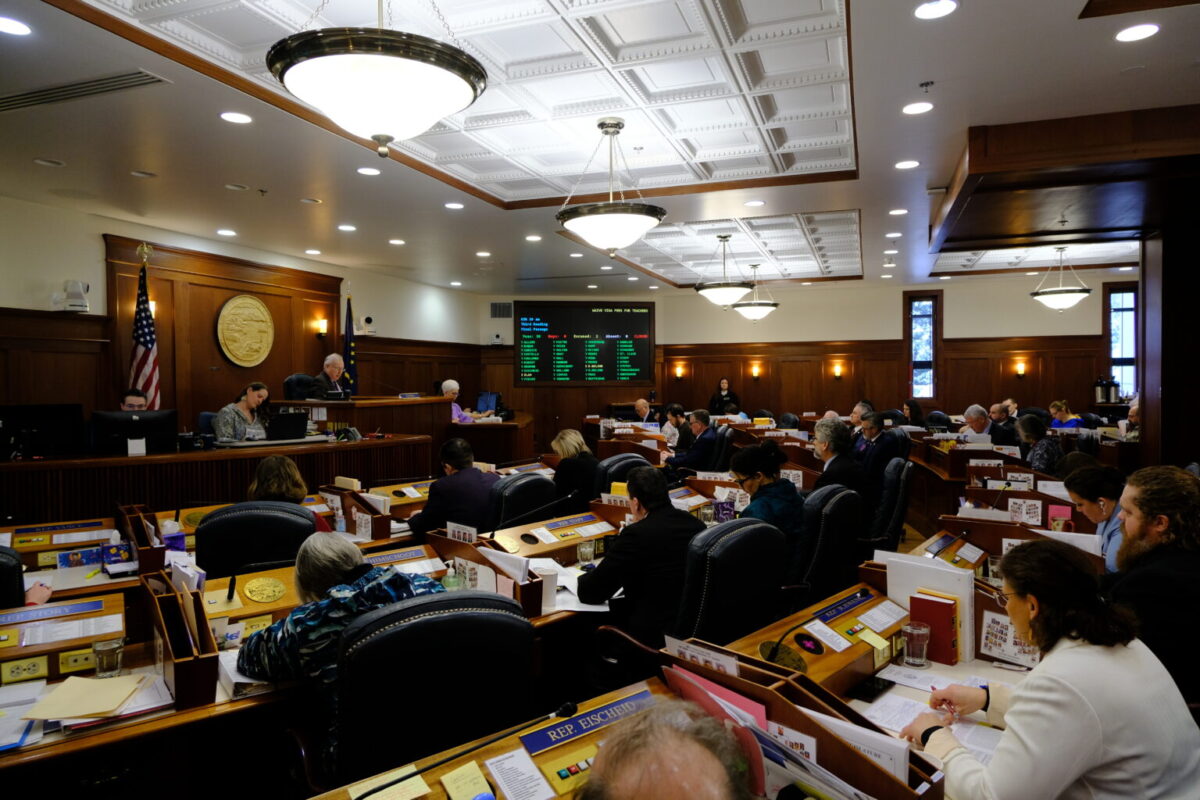
The Alaska House of Representatives passes a resolution to urge the Trump administration waive a $100,000 visa fee for international teachers on Mar. 20, 2026. (Photo by Corinne Smith/Alaska Beacon)

The Alaska House of Representatives passes a resolution to urge the Trump administration waive a $100,000 visa fee for international teachers on Mar. 20, 2026. (Photo by Corinne Smith/Alaska Beacon)

The Alaska House of Representatives approved a resolution urging the Trump administration to waive a steep visa fee for international teachers. The vote comes amid a growing teacher shortage throughout the state. 

Lawmakers are calling for the Trump administration to waive the fee for teachers hired through the H-1B visa program, which allows employers to recruit highly-skilled workers from overseas. The federal government raised the fee from $5,000 to $100,000 for each new applicant to the H-1B visa program in September.

The House passed the resolution by a 38-0 vote on Friday, with Reps. Bill Elam, R-Kenai, and David Nelson, R-Anchorage, absent. 

Rep. Alyse Galvin, I-Anchorage, sponsored the resolution. The former teacher said the cost is impossible for Alaska school districts.

Rep. Alyse Galvin, I-Anchorage, speaks on the House floor on Mar. 20, 2026. (Photo by Corinne Smith/Alaska Beacon)

“We know it’s a deep concern,” Galvin said on the House floor Friday. “In Alaska, in particular, in our rural areas, we are desperate for more teachers, qualified teachers in the classroom before our students. We have a true need here that can be met, and this is one tool that I hope all of us will raise our voice together and send to our federal delegation so they can use it.”

Rep. Ted Eischeid, D-Anchorage, a former science teacher, noted international teachers are also employed in urban districts like Anchorage.

​​”At last count, we had 66 teachers that work for the Anchorage School District providing critical education,” Edischied said, referring to the number of international teachers. “So if the most important educational reform is to have a highly qualified teacher in front of kids every day, this resolution moves us in that direction. So I support this.”

Rep. Nellie Jimmie, D-Toksook Bay, said 60% of teachers in the Kuspuk School District in her district are international hires. “The Kuspuk district cannot recruit teachers fast enough off the road system. You can’t train somebody to be a teacher overnight,” she said. “Ten teachers at a $100,000 rate visa, that’s a million dollars. Do we have a million dollars in our budget to spare for these teachers? I don’t think so.” 

Jennifer Schmitz is director of the Alaska Center for Recruitment and Retention, a division of the Alaska Council for School Administrators, which supports districts in recruiting and hiring teachers and staff. After the vote, Schmitz said she was glad to hear legislators’ support because districts are hiring now. 

“I’m thrilled that it passed, especially that it was unanimous,” Schmitz said. “Legislators all seem to understand that this is an issue and that they’re supportive of helping our international teachers get here more easily.”

There are nearly 600 teachers in Alaska hired through the H-1B visa program, which lasts for five years. Despite that, Schmitz said the center’s job board has over 700 job openings across the state, including for teachers, administration, para-professionals and staff.

“Special education is always at the top and then often harder to fill,” Schmitz said. “Positions can be secondary specialties like math, science, and chemistry, those higher level classes, those are often harder to fill and harder to find qualified candidates. But we have openings in every possible position.”

Schmitz said the center recently held several job fairs, including connecting University of Alaska students with education jobs as well as recruiting from around the United States and internationally.

“We are hopeful that people can find teachers from that. But we’re just really at a standstill,” she said for international hiring because of the visa fee. “And our attorney is looking at ways around that and other kinds of visas, but we just don’t know if they’re going to work… And we need to get their paperwork going now if we want them here by fall.”

The resolution now goes to the Senate where it is expected to garner support. The initiative backs federal action in the U.S. Congress, where Alaska Republican U.S. Sens. Lisa Murkowski and Dan Sullivan are cosponsoring a bill in the Senate to waive the $100,000 visa fee for all public school employees. A similar bill in the U.S. House is urging the Trump administration to waive the visa fee for health care workers.

SUPPORT: YOU MAKE OUR WORK POSSIBLE