The latest news and information from your Alaska news station.









The latest news and information from your Alaska news station.

The latest news and information from your Alaska news station.

Kim Durnin prepares to field a grounder for Wichita State. He committed to the Shockers out of high school and spent two years there before transferring to Mizzou.

UPDATE: Anchorage police say the crash involved four vehicles after a Ford F-150 crossed the median into southbound traffic. Two people were killed and one child was taken to a local hospital with life-threatening injuries. Fatal crash shuts down Glenn…
NOTN- Local, tribal, state and federal officials say Juneau is better protected but still at risk as the community braces for another glacial lake outburst flood from Suicide Basin in early August.
City Manager Katie Koester at a media briefing this morning, emphasized to reporters and media outlets that the purpose of the meeting as well as upcoming community events surrounding flood protection work is all about keeping residents informed and prepared ahead of this year’s Glacial Lake Outburst Flood, or GLOF.
She said the key takeaway however, was the need to evacuate during the event.
“We’ve done a lot to prepare for this event and we really appreciate the partnership with the Army Corps of Engineers in installing essentially between the city and the Army Corps $45 million worth of protective infrastructure for this year.” Koester said, “Nevertheless, it’s an unpredictable event, and if we have a breach, it will be a flash flood, and it will be very dangerous.”
The National Weather Service says Suicide Basin water levels are tracking close to 2024. Senior service hydrologist Aaron Jacobs said the basin is about 90 feet below the spillway and is most likely to fill between Aug. 1 and Aug. 9.
Forecasts point to a major flood similar to last year if the basin releases at full volume.
“We’re very close to the levels that we were seeing in 2024 and typically we’ll see about a three foot rise in normal inflow into the basin, and so right now we are about 90 feet below that spillway.” Jacobs said, “Right now that’s about 30 days out before we could see a full basin, and on our monitoring page we do update the conditions weekly, and if we see any other conditions change, we will update it more frequently.”
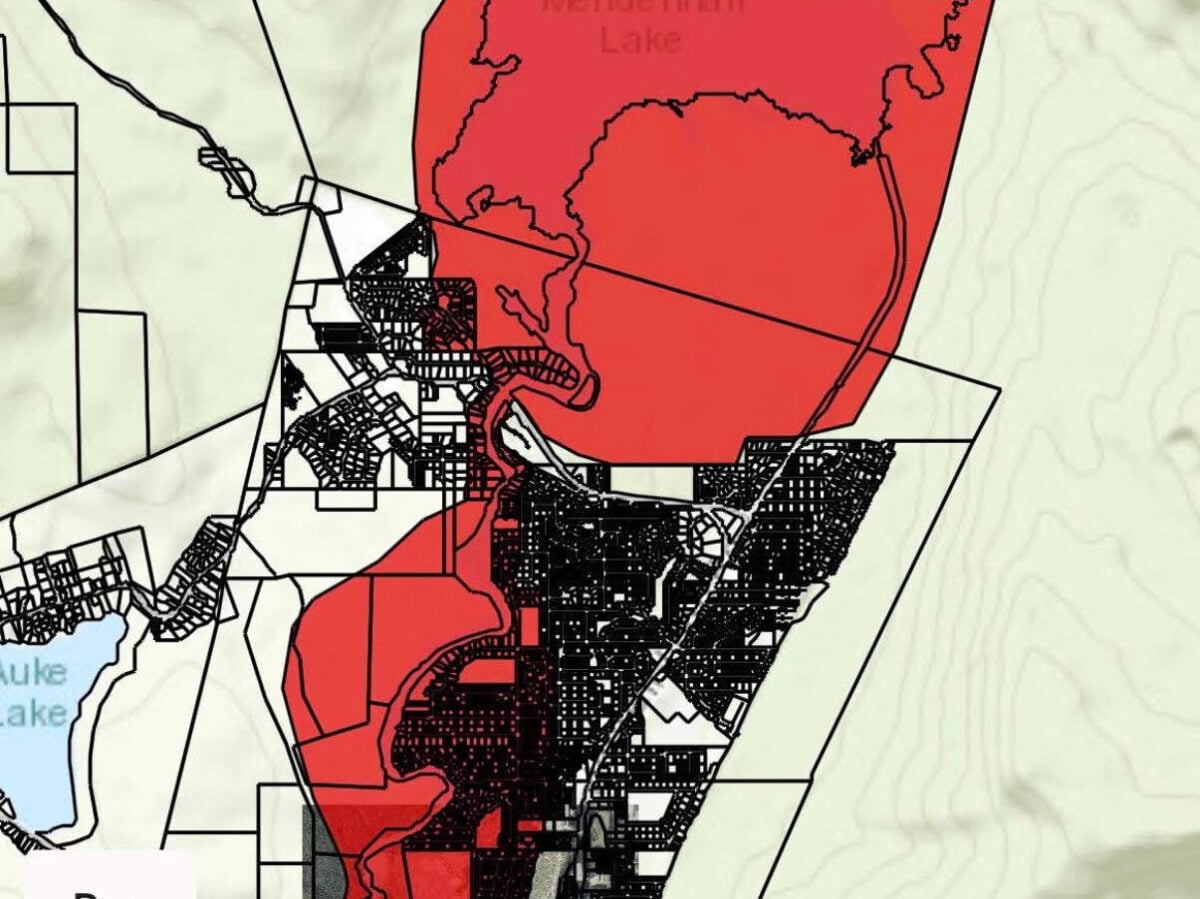
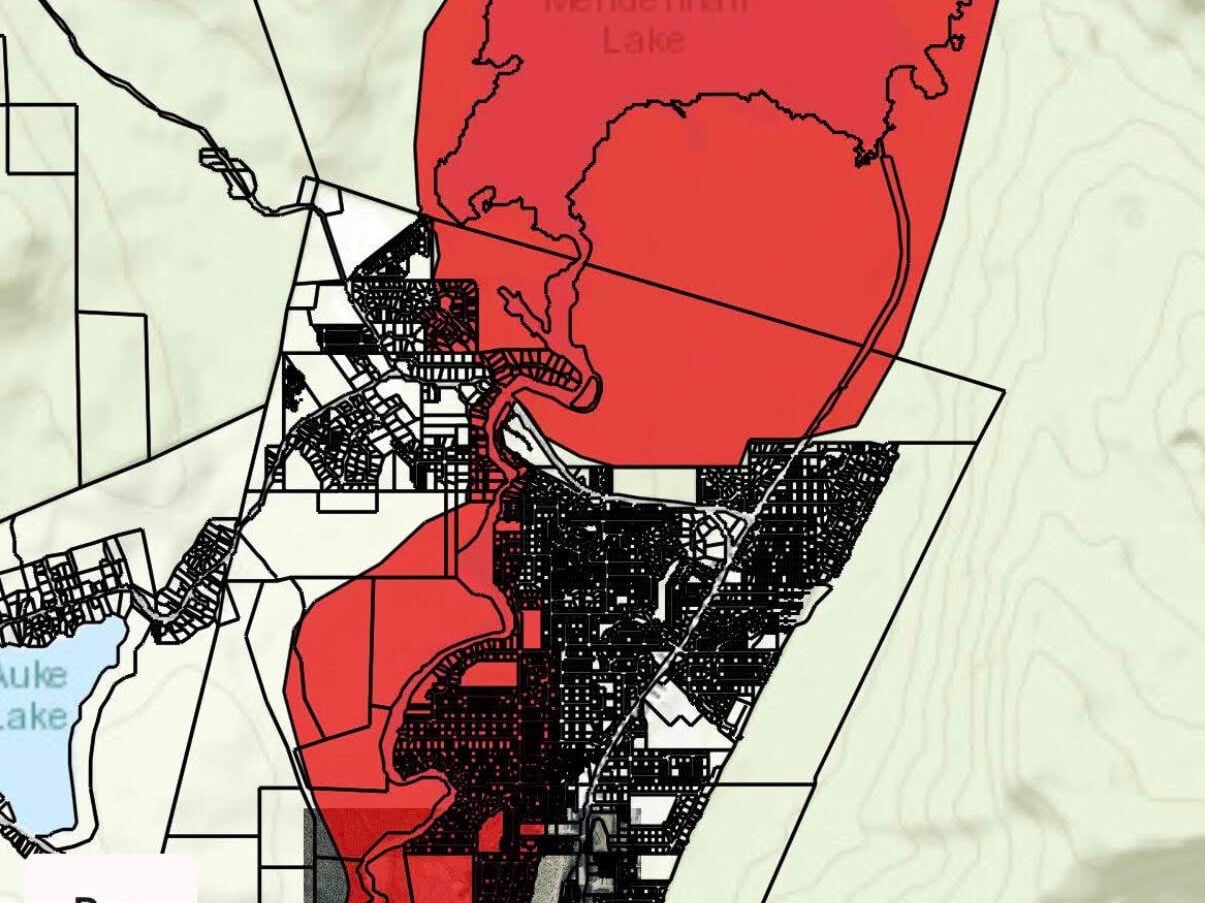
The City and Borough of Juneau has expanded its evacuation advisory zone to cover just over 1,900 residences, up from about 1,000 last year, based on new evacuation maps that account for blocked roads and responder access. Residents will be guided through a “ready, set, go” framework with Wireless Emergency Alerts, siren-style phone notifications and door hangers in affected neighborhoods.
“In years past, the CBJ and Unified Command have used inundation maps to communicate the risk from from potential flooding and the need to evacuate this year.” Said Emergency Programs Manager Ryan O’Shaughnessy, “We’ve worked really closely with all of our partners to plan for all scenarios, including the potential failure of the HESCO system. Our evacuation map this year, you’ll notice, has a lot more straight lines than an inundation map, and is generally aligned with streets and infrastructure, and the reason for that is we wanted to include areas that may not be directly inundated, but where access or travel, including by first responders, may be compromised. So in other words, if we wouldn’t be able to get to you during a breach scenario, or if you may not be able to get to safety, we are recommending that you evacuate.”
Engineers say roughly $45 million in temporary flood protection including HESCO barriers and a large pump system is now in place along the river through a partnership between the city and the U.S. Army Corps of Engineers.
“We have a very high level of confidence in the HESCO barriers, but this is a dynamic event… we really want to stress for folks to evacuate during this event,” said O’Shaughnessy.
Information on evacuation maps, sandbag events, and alerts is available on the Juneau Flood Ready page at juneau.gov.

A U.S. Geological Survey worker views the flooding Mendenhall River from the Brotherhood Bridge following the glacial outburst event on Aug. 13, 2025. (Photo by Corinne Smith/Alaska Beacon)
Officials and residents in Alaska’s capital city are preparing for what has become an annual summer glacial outburst flooding event that threatens the densely-populated Mendenhall Valley. Similar to past years, flooding is expected in early August.
Federal, state, tribal and local agencies are closely monitoring the Mendehall Glacier, where an ice-dammed lake known as Suicide Basin fills annually with glacial melt that eventually bursts and releases billions of gallons of flood water down the valley through the Mendenhall River.
The City and Borough of Juneau is partnering with the Central Council of Tlingit and Haida Indian Tribes of Alaska, as well as state and federal partners in preparations, then monitoring and responding to the flooding event.
Last year, the river flooded to a record-breaking 16.65 feet on Aug. 13, but nearby neighborhoods were mostly spared and damage was minimal due to close monitoring, early warnings and semipermanent flood barriers installed along the riverfront.

This year, crews with the U.S. Army Corps of Engineers and the City and Borough of Juneau have fortified and built up the flood barriers to withstand a flood about 30% larger than last summer. Crews are also installing industrial pumps in the next few weeks to pump out water that seeps through the barriers and to prevent flooding through city storm drains.
Officials estimate the basin will be full sometime between Aug. 1 through 9. Historically, there have been one to six days from the time the water level in the basin peaks to when it begins to release, officials said.
Updates on the filling Suicide Basin, forecasting, flood levels and evacuation maps will be available on a public Juneau Glacial Flood Dashboard. Officials are asking Mendenhall Valley residents to make a plan to voluntarily evacuate. A wireless cell phone alert will be issued to all area residents when the flooding begins.
Officials have planned for an evacuation advisory for roughly double the number of homes advised last year — roughly 1,900 residences compared to 1,000 residences, as well as businesses, schools and transportation corridors.

Ryan O’Shaughnessy, the emergency program manager with the City and Borough of Juneau said in an online media briefing on Thursday the evacuation advisory is to prepare for a potential scenario where flood waters breach the flood barriers, known as HESCO barriers.
“We wanted to include areas that may not be directly inundated, but where access or travel, including by first responders, may be compromised. So, in other words, if we wouldn’t be able to get to you during a breach scenario, or if you may not be able to get to safety, we are recommending that you evacuate,” he said.
O’Shaughnessy said officials have modeled many scenarios at different flood levels, and there will be frequent public alerts as flood waters rise.
“We have a very high level of confidence in the HESCO barriers, but this is a dynamic event,” he said. “It’s a natural disaster, and we can’t predict every element of it, and to help us protect the rest of the community, our first responders, and everyone involved, we’d really like to ask the community to evacuate.”
Evacuation will be advised and not mandatory, unless Gov. Mike Dunleavy authorizes mandatory evacuation, O’Shaughnessy said.
He said the City and Borough of Juneau have requested the governor issue a preemptive disaster declaration, like last year, and Dunleavy’s office is currently reviewing the request.
Public flood preparedness events are taking place every Saturday in July, where residents can review flood maps, get emergency tips, and collect free sandbags to fortify their homes against flooding. The next event is July 11 from 11 a.m. to 3 p.m. at Dimond Park Field House.
Residents can monitor Suicide Basin through a National Weather Service monitoring page. Officials recommend signing up for emergency alerts and reviewing Mendenhall River inundation maps. KTOO Public Media has set up several livestreams to monitor the flooding event. An emergency shelter hosted by the Red Cross will be set up, like last year, at the former Floyd Dryden Middle School site.
SUBSCRIBE: GET THE MORNING HEADLINES DELIVERED TO YOUR INBOX.

A long-discussed tribal casino near Eaglecrest Ski Area celebrated its official grand opening Wednesday, with stakeholders and customers toasting its payoff potential as a visitor attraction and local economic stimulant with little mention of pending legal issues.
Two Coppers Casino, operated by the Central Council of the Tlingit and Haida Indian Tribes of Alaska, debuted with a “soft opening” in early June, when some functions such as plumbing were not completed. Wednesday’s hour-long grand opening featured a ribbon-cutting, Alaska Native dancers, and speeches by several dignitaries to more than 100 attendees who then filled the chairs at the slot-like machines inside the gaming hall (which now has functional plumbing).
“I think it’s an opportunity; it’s definitely going to expand (Tlingit and Haida),” said Travis Woodbury, a member of a family that owns the land the casino is on, after guiding his uncle, Gabe George, to one of the chairs. “I just see it prospering, and making everything better for the tribe and the people who work here.”
Noting that much of the space in the new building and on the lot remains to be developed, Woodbury added “it creates jobs and this is just the beginning.”
Two Coppers is a Class II gaming establishment authorized to offer slot-like machines where payouts come from a pool of competing players (much like bingo), non-house-banked card games, bingo and pull-tabs. Games like poker, blackjack and traditional slot machines are not allowed.
The distinction between gaming machine types was a non-factor for Henry Howard and his wife, Dorothy Webster, who were seated before a “Triple Fortune Dragon Unleashed” machine once the doors to the casino opened Wednesday. Without much knowledge of any rules, the couple inserted a $20 bill and began a series of digital spins that saw them win two early payoffs totalling $60, then quickly lose everything in perhaps a dozen more spins. But after inserting more money they were up more than $100 minutes later.
“I kind of like it,” said Henry Howard, a lifetime Douglas resident. “Juneau needs some kind of entertainment.”
Gabe George was singled out during the ceremony by Tlingit and Haida President Chalyee Éesh Richard Peterson as one of the key people during the early stages of discussion about a casino who helped to make it it a reality.
“Twelve years ago when I became president one of my first meetings was with Gabe George,” Peterson said. “And he came in and he told me about his parents, Jimmy and Lydia George, and he talked about this allotment, and how his parents had a dream for their children and grandchildren, and on and on, that there would be a legacy of support for their family.”
The George family obtained a 220-acre parcel on Fish Creek Road — about three miles uphill from the intersection with North Douglas Highway — in a land swap with the U.S. Forest Service in 2002. The USFS in exchange got property on Admiralty Island that Jimmie George, a patriarch of the Tlingit Killer Whale Clan who died in 1990, received via the 1971 Alaska Native Claims Settlement Act.
Tlingit and Haida has been leasing 20 of the Fish Creek acres from Jimmie George’s heirs since 2015 and speculation that land would be used as a casino circulated for years until construction began in 2025.
There are, however, unresolved issues about the casino’s ability to legally operate involving federal and state officials, as well as some of the 14 members of the George family that are part of the lease agreement with the tribe.
The Trump administration last September reversed a Biden-era ruling that essentially authorized the casino. However, Deputy Interior Secretary Katharine MacGregor stated decisions affected by that ruling would need to be re-reviewed, and the one specific to Tlingit and Haida is still pending.
The administration’s reversal was prompted by a similar gaming facility the Native Village of Eklutna opened in January of 2025. The state of Alaska filed a lawsuit in February of that year to shut down the casino, but it is still operating. An Alaska Department of Law spokesman said last month the state “is deferring to the federal government as that review process plays out” before determining if a similar lawsuit will challenge the Two Coppers Casino.
The casino is also facing a shutdown demand from some George family members who have filed objections with the tribe, federal Bureau of Indian Affairs and National Indian Gaming Commission.
“Our family continues to be deeply concerned that Tlingit & Haida is building a facility our family did not authorize, at a location our family did not approve, and for an intended use our family did not approve,” Jimmy George Jr. wrote in a June 8 letter on behalf of three of signatories to federal gaming officials. The letter asserts unlicensed gaming is occurring at a casino that is a “public health and safety hazard.”
Jimmy George Jr., in other statements, asserts “what has been built and opened is materially different from the earlier development concepts reviewed during the 2015 to 2019 period, and that nothing since then has been reviewed or approved by the family.” He also expressed concerns about safety issues such as the casino’s initial opening period without plumbing facilities and the storage of fireworks on the property by the tribe, which sells them at a nearby stand before the July 4 holiday.
There were 10 seats reserved for George family members during Wednesday’s grand opening, six of which were occupied by Gabe George, his nephew and others. Two of them interviewed by the Independent — Woodbury and Rhonda Guest, said Jimmy George Jr.’s complaints don’t represent the family as a whole.
Guest said she’s been to the casino multiple times since the soft opening and “I think it’s great.”
“They don’t serve alcohol, they’re promoting education, (a) civic center, everything that my grandfather wanted, that my family wanted to do,” she said.
While Peterson talked about the economic and other benefits the casino will provide the tribe and its citizens, he said “we also want to be good community partners in a community” that includes addressing gambling-related concerns about the facility.
“We made a commitment to the community of Juneau that this is going to be a benefit and not that poison pill for our community,” he said. “We’re working on programs that will support behavioral health and things around addiction, and what could happen. We’re going to do our very best to make sure this is a healthy, fun, positive experience for not only those who enjoy gaming, but for the community and our communities beyond.”
The post Two Coppers Casino grand opening celebrates payoff for years of effort by tribal officials and family appeared first on Chilkat Valley News.
Eaglecrest Ski Area’s new general manager is returning to a familiar place, but far from a familiar situation.
Julie Jackson Piper, a former ski instructor and supervisor at the ski area between 2009 and 2015, was unanimously appointed to its top position Tuesday by Eaglecrest’s board of directors. She was also the aquatics manager at Juneau’s two public pools from 2015 to 2018, and has been recreation manager for the City of Richland, Washington, since 2018.
“I would say really the love of the mountain and the challenge that it poses” are the reasons for seeking the job, she told the board of directors during an interview last Thursday at City Hall. “I feel like I’m uniquely prepared for this challenge, having ski industry experience, a degree in business, which is related to ski area business management…so I have that mindset, even inside of a bureaucracy that is a public entity.”
Piper is scheduled to start her new job Aug. 31 at an annual salary of $134,014.40, with her contract also calling for a $5,000 sign-on bonus and up to $10,000 in relocation expenses. Her predecessor, Craig Cimmons, hired two years ago at an initial salary of $121,222, announced his resignation in January.
Erin Lupro, Eaglecrest’s director of snowsports school, rental, retail and repair, has served as the interim general manager for the past few months. She declined to seek the permanent position.
Piper was the only finalist interviewed by the full board. Fourteen applicants went through a human resources screening interview and five were interviewed by Eaglecrest’s Human Resources Committee before Piper was recommended as the finalist.
The board’s interview of Piper occurred at the same meeting where members also talked about the possibility of Goldbelt Inc. taking over operations of the city-owned ski area that is facing major questions about its financial sustainability. The resort has lost money for many years, is facing many millions in costs to upgrade aging infrastructure, and some city leaders are suggesting a private operator would have the resources to develop year-round mass tourism facilities.
However, board member Jim Calvin said at the meeting that “it’s a conversation and nothing more, and any kind of formal arrangement is frankly probably years away.”
Piper, who’s been assessing the ski area during her visit and was on the mountain when her hiring was announced Tuesday, stated in a text message to the Juneau Independent she will approach her new job with that mindset.
“From what was shared at last week’s board meeting it seems early informal conversations are being scheduled and in very early stages,” she wrote. “Partnerships of that magnitude can take years to dial in. As for how it will impact my short and long-term decision-making, I’ll know more as I jump into the work later this summer.”
When asked during the board interview how Eaglecrest can achieve greater financial stability and community support, Piper said talking with Goldbelt and other partners is a worthwhile endeavor, as is seeking grants and other significant funding sources.
“As far as increased community support, it’s really tapping into those relationships that may or may not have been utilized, possibly ignored, maybe overlooked and unappreciated,” she said, “and just ensuring that we’re not doing any of those things, and having a more global view as a board, as a staff, not just in what our singular operations are, but kind of pulling our heads up and looking around, and having that at every level of the organization.”
Piper said she remembers getting in spirited discussions about Eaglecrest with residents in town who recognized her when she was a ski instructor. A key thing she remembers from such encounters is “when someone’s even yelling at you and so upset about something there’s something in that that we can both relate to, is we both love Eaglecrest, we love the ski area.”
Among the short-term challenges Piper said she expects to confront are the poor snow seasons that have affected the ski area in recent years and are predicted to be a problem in the future. One specific possibility she discussed with the board is “making a plan and surveying the community to see if they’re ready to rally behind the Black Bear (chairlift)” that has been closed the past two seasons due to major maintenance needs.
“It can give you access to the upper mountain on a low snow year, like the year (of) the winter that wasn’t where there was a ribbon of snow and it was a bit of a gauntlet to get from even the top of Hooter down,” she said. “I mean, that saved our bacon in quite a few years and it’s just a priority.”
Cimmons and Eaglecrest’s board decided a year ago to permanently shut down Black Bear because repairs were deemed too expensive. A number of major decisions affecting the ski area have been made by city and Eaglecrest leaders since — most significantly abandoning plans to install a gondola that was seen as the foundation of an expansion into year-round operations when its installation cost turned out to be far higher than initially predicted.
Piper was one of two finalists interviewed for Eaglecrest’s general manager job two years ago when Cimmons was selected. She told the Juneau Independent it doesn’t make much sense to think about what might have been different now had she gotten the job then.
“It’s hard to say specifically what I would’ve done differently two years ago and not sure if it’s worth much to spend time thinking about that,” she wrote. “Instead the staff, the board and I are looking forward to a positive path into improved sustainability.”
The post Julie Jackson Piper named Eaglecrest’s new GM as city-owned ski area ponders private takeover of operations appeared first on Chilkat Valley News.
The federal government has agreed to permanently loosen rules for oil and gas lease sales in the Arctic National Wildlife Refuge, according to a draft settlement agreement filed this week in the U.S. District Court for the District of Alaska.
Adam Gustafson, an attorney with the U.S. Department of Justice, said in a statement that the agreement “means more oil leasing, more domestic energy, and more independence from foreign sources of energy.”
The document filed this week would settle lawsuits filed by the state of Alaska and its investment bank over the 2025 Arctic National Wildlife Refuge oil lease sale that drew no bids.
That sale, mandated by a 2017 law, took place after the Biden administration restricted the available acreage. The Alaska Industrial Development and Export Authority and the state of Alaska sued over the Biden-era limits.
This week’s agreement states in part that the federal government will not limit oil and gas leasing in ANWR until oil and gas equipment covers at least 2,000 acres in the refuge’s coastal plain.
“The 2017 Tax Act does not authorize (the Bureau of Land Management) to deny or unreasonably limit development of production and support facilities to the Coastal Plain until 2,000 surface acres are covered by production and support facilities,” it states in part.
That’s a small fraction of the size of the leases being put up for sale but could represent a significant length of pipeline and a large number of drilling pads.
AIDEA and the state remain in court against the federal government over the result of a 2021 ANWR lease sale. AIDEA won leases during that sale, but the Biden administration canceled those leases, then attempted to re-sell the affected land during the 2025 sale.
The ANWR leasing program overall has been challenged by a coalition of environmental groups, and that case also remains in court.
By email on Tuesday, an AIDEA spokesperson said it would be accurate to call the new agreement a victory for AIDEA and Alaska because it “includes a clear admission that the … Lease Sale ‘violated the 2017 Tax Act by preventing meaningful leasing, exploration, and development of oil and gas on the Coastal Plain, as Congress mandated.’”
Through a spokesman, acting Alaska attorney general Cori Mills noted that while Alaska’s attention has recently focused on a successful lease sale in the National Petroleum Reserve-Alaska to the west of the Prudhoe Bay oil field, the state continues to be interested in ANWR, which is to the east.
The new settlement agreement increases the odds that ANWR will stay open to drilling even when a new president comes after Trump.
“While the State is ecstatic about the progress in the NPR-A, we cannot lose sight of the potential in ANWR. The problem is not a lack of potential or even lack of infrastructure; it is the lack of a stable investment climate without burdensome and unnecessary strings attached,” Mills said by email.
“The last administration did everything they could to shut down development in ANWR that our congressional delegation and numerous state administrations had fought long and hard for. But that doesn’t have to be the future. We are grateful that the federal government recognizes the unlawful actions taken previously and was willing to enter into the settlement and essentially admit the error,” she said. “There is still hope that ANWR can provide economic prosperity and crucial resources for local communities, the state, and the nation.”
The post Under new agreement, federal government limits obstacles to oil leasing in Alaska’s Arctic refuge appeared first on Chilkat Valley News.

A mother bear known as Bear 402 and her cubs are seen on Sept. 26, 2018, below a viewing platform at Brooks Camp in Katmai National Park and Preserve. The Brooks Camp site, at the salmon-rich Brooks River, is a world-famous destination for bear viewing. Bears that arrive at the river’s waterfall area each year include those roaming the habitat used by the Mulchatna caribou herd. (Photo by R. Taylor/National Park Service)
With the Board of Game’s consent, the Alaska Department of Fish and Game is again killing large numbers of bears and wolves, most of them brown bears, this time to grow the Mulchatna Caribou Herd so its members can again be hunted by people living in the area. Or so the argument goes.
While combing through some writings of mine from years ago, I recently came across a piece I’d written for the Anchorage Daily News in 2006, when Frank Murkowski was governor and the state was once again expanding its predator-control efforts. In the commentary’s headline, I posed the question: “Where’s the outrage?”
Though angered and discouraged by the state’s intensifying campaign to kill wolves and bears, I was equally disheartened by the public’s apparent apathy. Most people didn’t seem to care, or weren’t paying attention. Or they’d grown numb to the carnage. Or they too readily accepted the state’s claims at face value.
Two decades and many predator-kill programs later, it seems not much has changed. In some ways, things are worse than ever, particularly in Southwest Alaska.
This state-run slaughter of brown bears—and what else can you call it?—is unprecedented, in multiple ways.
We might begin with the number of dead brown bears, which now exceeds 250 animals gunned down by department staff or hired killers since 2023. Or the fact that this has been the most brutal sort of bear-kill program, the animals terrorized by helicopter gunships before they’re killed; and even moms with cubs, and the cubs themselves, targeted for death. This is so despite abundant evidence that bears are not the problem and their killing not the solution.
I have written about this cruel, immoral slaughter several times, most recently in a commentary headlined “In defense of bears.”
Following its publication, a good friend texted me, “I just read your ADN article. Your scathing comments are remarks that people like me need to hear. Apparently folks go about their daily lives mostly unaware, or only vaguely conscious, of deceptive public commentary and downright evil Alaska policies/actions.
“I do encourage you to write more, but I also wonder if the public is listening or cares about an issue so unconnected to their daily activities. Somehow I feel an ADN article is more of a whisper when a bullhorn is needed. . . .”
His assessment appears all too true. I know many Alaskans who consider themselves progressive and “green” but are too busy or distracted or focused on other issues to care much about the killing of bears and wolves. Sadly, most of my friends fit into that category.
Even more infuriating is that most of the state’s conservation or environmental groups have largely stayed silent, the most notable exception—and too often the only exception—being the Alaska Wildlife Alliance.
Yes, those groups have their reasons, their priorities. But at some point, as we all know, silence becomes complicity.
It is frustrating and, yes, discouraging, to those of us who are passionate wildlife advocates to not only witness regressive and inhumane policies and practices not only continue, but in notable ways worsen, without a public uprising.
I know, I know: many of the people in my circles of friends—and those representing advocacy groups—who pay little or no attention to our state’s “wildlife politics” have their own passionate causes. I also realize I live in a “red” state and that many residents don’t share my views. And that many rural Alaskans, including Alaska’s Indigenous peoples, have different perspectives than mine.
But I also know this: If most Alaskans better understood the deception that underlies much of Alaska’s predator-kill programs, they would oppose what our state’s wildlife managers are perpetrating.
Our state’s system of wildlife management has been broken for far too long. A groundswell of opposition is needed.
There was a time when Alaskans pushed through citizen initiatives to right some of the state’s wrongs. But citizen revolts are most likely when “we the people” can see or read first-hand accounts of what’s happening. I think of the physician-hunter Jack Frost and his “mechanical predation” of wolves in the 1980s, or biologist-activist Gordon Haber’s snared-wolf video in the nineties.
In other words, people are most likely pushed into action by something visceral. And for more than a quarter century, the despicable nature of Alaska’s predator-kill programs has remained largely out of sight, and therefore out of mind.
But that may be changing, thanks largely to the Alaska Wildlife Alliance and increased media coverage of the Mulchatna bear slaughter, particularly by the Daily News. The AWA’s recent images of state-killed bears left to rot on the tundra, accompanying an ADN article, have already made some difference. And now the Daily News has begun a series of articles that takes a much-needed, in-depth look at the state’s Mulchatna bear-kill effort.
I’m hopeful this will make a difference: stir things up, get more Alaskans involved, ignite the start of significant change. Provoke some outrage.
Something else that gives me hope: the looming election.
Under Gov. Mike Dunleavy, our state’s mismanagement of wildlife—particularly the state-run killing of bears and wolves—has been more egregious than any I’ve witnessed in the 40 or so years I’ve covered Alaska’s wildlife politics.
But the push for extreme predator-control programs began long before Dunleavy took office and is intimately connected to our state’s unbalanced system of wildlife management, starting with the so-called “intensive management” law passed in the 1990s. And by the Board of Game.
The last time that seven-member board had any semblance of balance was during Tony Knowles’ term as governor nearly a quarter century ago. Since then, things have gotten progressively worse, as both BOG members and Department of Fish and Game officials have been appointed by Republican governors — and approved by legislators of both major parties — who have emphasized ever-more-extreme “intensive management,” predator-kill strategies to benefit human hunters, the large majority of them urban “sport hunters” and guided non-residents.
Over the years, the BOG and F&G have discovered they can do just about anything they want, without significant public or political backlash. That has emboldened their outrageous behaviors.
It’s long past time to return to more balanced—and yes, more progressive—wildlife management policies and priorities. This is the way Alaskans can have the most immediate impact: elect a governor and legislators who will ensure that ALL of Alaska’s wildlife are managed in a respectful, humane manner. It’s the least that we can do, outraged or not.
SUBSCRIBE: GET THE MORNING HEADLINES DELIVERED TO YOUR INBOX.