The UK’s multi-billion-pound fleet of F-35 fast jets can only perform all its required missions one third of the time because of a lack of engineers, spare parts and unexpectedly high corrosion at sea, an official report has revealed.The Latest News from the UK and Around the World | Sky News
A Palestinian activist who was detained for over three months in a US immigration jail after protesting against Israel is suing Donald Trump’s administration for $20m (£15m) in damages.The Latest News from the UK and Around the World | Sky News
Three police officers, who have been voted Britain’s bravest officers, have described confronting, disarming and arresting the Southport killer Axel Rudakubana.The Latest News from the UK and Around the World | Sky News
The bromance between Sir Keir Starmer and President Macron is so apparent – embraces all around.The Latest News from the UK and Around the World | Sky News
The dark granite block in a children’s cemetery in Bristol tells an incomplete story: “Trelissa Whitbread, born 3rd of Feb 1988. She lived 2 hours.”The Latest News from the UK and Around the World | Sky News
For the second consecutive year, student reading scores in Alaska have risen, a trend state officials attribute to the success of the Alaska Reads Act.
According to new data from the Department of Education and Early Development, the percentage of students reading at or above average increased from 41% at the beginning of the 2023–2024 school year to 57% by year’s end.
In the 2024–2025 school year, that percentage rose again, starting at 44% and climbing to 60% by the end of the year, an increase which outpaces the national average for growth.
“This is promising evidence for our Alaskan students and their teachers as all the hard work and focus they have put in is coming to fruition,” said Education Commissioner Deena Bishop. “This achievement shows that the Alaska Reads Act was the right policy direction for our state, and more importantly, for our youngest learners. Congratulations!”
The Alaska Reads Act was signed into law in 2022 by Governor Mike Dunleavy with the goal of ensuring all students can read at grade level by the end of third grade. The legislation focuses on evidence-based instruction, early intervention, and high teaching standards.
“These results show why it’s critical to tie clear goals and strong commitments to education policy,” said Governor Dunleavy. “The Alaska Reads Act proves that coupling funding with real reform works. We made the right decision, and students across Alaska are seeing the benefits.”
However, despite those gains, the governor has made deep cuts to education funding in the newly signed state budget.
Dunleavy vetoed more than $122 million from Alaska’s annual budget, including over $50 million from the state’s per-student education funding formula and tens of millions meant for major school maintenance projects. It marks the first time in state history that a governor has failed to fully fund the education formula.
While the rise in student reading scores is being celebrated, many educators and lawmakers warn that continued progress may be at risk without sustained investment.
The governor will hold a special legislative session on August 2, with one of the topics being education reform.
Harlequin Beach on Amchitka Island is seen in this undated photo. The island, now part of the Alaska Maritime National Wildlife Refuge, was the site of atomic weapons tests in 1965, 1969 and 1971. (Photo provided by the U.S. Fish and Wildlife Service)
By: Yereth Rosen, Alaska Beacon
People who might have been exposed to radiation from atomic weapons tests conducted in the Aleutians half a century ago have extra time to apply for compensation from a federal program, under the sweeping tax and budget bill passed by Congress and signed into law last week.
The bill, which was signed by President Donald Trump on July 4, includes a provision reviving the Radiation Compensation Exposure Act, which was enacted in 1990.
The act’s compensation system distributed one-time payments to people who were exposed to radiation from the weapons tests and who later were diagnosed with certain types of cancer. The program has distributed about $2.7 billion to date, according to the U.S. Department of Justice.
While most of the tests covered by the act were conducted in Nevada, the program also covers health damages from underground weapons tests conducted on Alaska’s Amchitka Island in 1965, 1969 and 1971.
The program covers former uranium mine workers, as well, many of whom were Navajo Nation members.
The compensation program had been on track to expire, with a previous deadline of June 10, 2024, for any new claims.
The budget bill extends the deadline for new claims to Dec. 31, 2027, and it sets a Dec. 31, 2028, sunset date for the trust fund that administers the claims.
The bill also raises compensation amounts. For “downwinders,” people who were not on site at the time of the tests but may have been exposed to radiation carried by the wind, the compensation is hiked from $50,000 to $100,000. For on-site workers, the compensation is raised from $75,000 to $100,000.
Of the Alaska weapons tests, the third — called Cannikin — was the most controversial.
It was the biggest underground nuclear test ever conducted by the United States. The tested bomb was 5 megatons, about 250 times as powerful as the bomb dropped on Hiroshima, Japan, in 1945. There was widespread opposition to the project, including from environmentalists who later founded the organization Greenpeace.
Legal opposition to the test went all the way to the U.S. Supreme Court, which ultimately allowed the project to proceed.
The test created what was the equivalent of a magnitude 7 earthquake, killing up to 2,000 sea otters and thousands of fish.
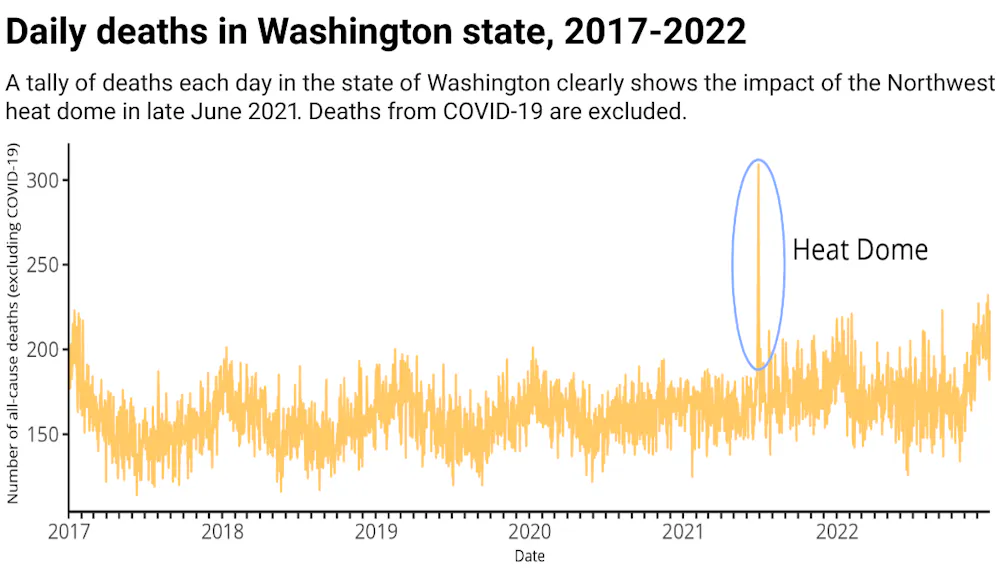
As the heat lingered for over a week, 19 people died in Spokane County and about 300 visited hospitals with signs of heat-related illnesses.
Scientists say it’s not a matter of if, but when, another deadly heat wave descends on the region. To help save lives, the city teamed up with my university, Gonzaga, to start preparing for a hotter future.
A chart of all deaths, excluding COVID-19, shows the extraordinary impact the 2021 heat dome had in Washington. ‘In the Hot Seat’ report, 2022
We were excited and relieved when the community was awarded a US$19.9 million grant from the Environmental Protection Agency to help it take concrete steps to adapt to climate change and boost the local economy in the process. The grant would help establish resilience hubs with microgrids and help residents without air conditioning install energy-efficient cooling systems. The city doesn’t have the means to make these improvements on its own, even if they would save lives and money in the long run.
Spokane’s grant wasn’t the only one eliminated – about 350 similar grants that had been awarded to help communities across the country manage climate changes, from extreme heat and wildfire smoke to rising seas and flooding, were also terminated on the grounds that they don’t meet the White House’s priorities. Many other grants to help communities have also been terminated.
Like many communities in the American West, Spokane was founded in the late 19th century on wealth from railroads and resource extraction, especially gold, silver and timber.
Today, it is a city of 230,000 in a metro area of a half-million people, the largest on the I-90 corridor between Minneapolis and Seattle. In many ways, Spokane could be on the cusp of a renaissance.
In January 2025, the U.S. Department of Commerce announced a $48 million grant to develop a tech hub that could put the Inland Northwest on a path to become a global leader in advanced aerospace materials. But then, in May, the Trump administration rescinded that grant as well.
The lost grants left the economy – and Spokane’s ability to adapt fast enough to keep up with climate changes – uncertain.
This is not a wealthy area. The median household income is nearly $30,000 less than the state average. More than 13 out of every 100 people in Spokane live in poverty, above the national average, and over 67% of the children are eligible for free or reduced lunch.
Half the $19.9 million award was for outfitting five resilience hubs in existing libraries and community centers with solar arrays and battery backup microgrids, allowing them to continue providing a safe, cool space during a heat wave if the power shuts down.
Another $8 million in grant funding was meant to provide 300 low- to moderate-income homeowners with new high-efficiency electric heat pump heating, ventilation and air conditioning systems, providing more affordable utility bills while improving their ability to cool their homes and reducing fossil fuel emissions.
Communities are left with few options
Now, this and other work is at risk in Spokane and cities and towns like it around the country that also lost funding.
A class action lawsuit was recently filed over the termination of the grants by a coalition that includes Earth Justice and the Southern Environmental Law Center. If the case is successful, Spokane could see its funding restored.
Meanwhile, the city and my team know we have to move fast, with whatever money and other resources we can find, to help Spokane prepare for worsening heat. We formed the Spokane Community Resilience Collaborative – a partnership between community organizations, health officials and the city – as one way to advance planning for and responding to climate hazards such as extreme heat and wildfire smoke.
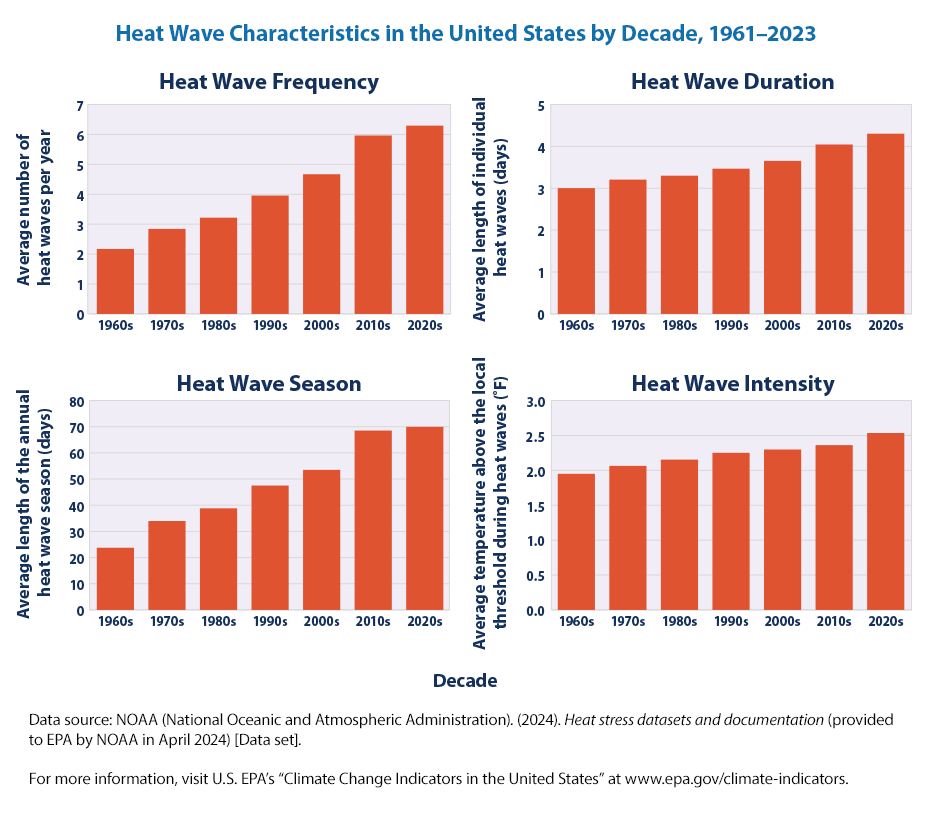
As concentrations of heat-trapping gasses accumulate in the atmosphere, both the frequency and severity of heat waves increase. It is only a matter of time before another deadly heat dome arrives.
Brian G. Henning receives funding from the Environmental Protection Agency.
As someone who has taken roughly a dozen polygraphs during my 27-year career with the CIA, I read this development with some skepticism.
Polygraphs carry an ominous, almost mythological reputation among Americans. The more familiar and unofficial term – lie detector tests – likely fuels that perception. Television crime dramas have done their part, too, often portraying the device as an oracle for uncovering the truth when conventional methods fail.
In those portrayals, the polygraph is not merely a tool – it’s a window into the soul.
Among those entering government service, especially in national security, the greater anxiety is not the background check but passing the polygraph. My advice is always the same: Don’t lie.
Polygraphs are “pseudo-scientific” in that they measure physiological responses such as heart rate, blood pressure and perspiration. The assumption is that liars betray themselves through spikes in those signals. But this presumes a kind of psychological transparency that simply doesn’t hold up. A person might sweat and tremble simply from fear, anger or frustration – not deceit.
Accordingly, polygraph results are not generally admissible in U.S. courts. Only a handful of states – such as Georgia, Arizona and California – permit their use even under limited conditions. And they typically require that both parties agree to admission and a judge to approve it. Unconditional admissibility remains the exception, not the rule.
And yet, inside many national security agencies, polygraphs remain central to the clearance process – a fact I observed firsthand during my time overseeing personnel vetting and analytic hiring within the intelligence community.
While not treated as conclusive, polygraph results often serve as a filter. A candidate’s visible discomfort – or the examiner’s subjective judgment that a response seems evasive – can stall or end the hiring process. For instance, I know that government agencies have halted clearances after an examiner flagged elevated reactions to questions about past drug use or foreign contacts, even when no disqualifying behavior was ultimately documented.
The FBI’s J. Edgar Hoover headquarters building in Washington in 2016. AP Photo/Cliff Owen
In some cases, an examiner’s suggestion that a chart shows an anomaly has led otherwise strong applicants to volunteer details they hadn’t planned to share – such as minor security infractions, undeclared relationships, or casual drug use from decades earlier – that, while not disqualifying on their own, reshape how their trustworthiness is perceived.
The polygraph’s power lies in creating the conditions under which deception is confessed.
A predictable pattern
No administration has been immune to the impulse to investigate leaks. The reflex is bipartisan and familiar: An embarrassing disclosure appears in the press – contradicting official statements or exposing internal dissent – and the White House vows to identify and punish the source. Polygraphs are often part of this ritual.
Recent policies at the Pentagon now restrict unescorted press access, revoke office space for major outlets and favor ideologically aligned networks. The line between legitimate leak prevention and the surveillance or sidelining of critical press coverage has grown increasingly blurred.
Not all leaks are treated the same. Disclosures that align with official narratives or offer strategic advantage may be quietly tolerated, even if unauthorized. Others, especially those that embarrass senior officials or reveal dysfunction, are more likely to prompt formal investigation.
Lewis Libby, Vice President Dick Cheney’s chief of staff, rides in the backseat of a limousine on Oct. 27, 2005, in McLean, Va. Win McNamee/Getty Images
Leaks involving classified material draw the sharpest response when they challenge presidential authority or expose internal disputes. That was the case in 2010 with Chelsea Manning, whose disclosure of diplomatic cables and battlefield reports embarrassed senior officials and sparked global backlash. Government reaction often depends less on what was disclosed than on who disclosed it – and to what effect.
A narrow set of disclosures, such as those involving espionage or operational compromise, elicit broad consensus as grounds for prosecution. But most leaks fall outside that category. Most investigations fade quietly. The public rarely learns what became of them. Occasionally, there is a vague resignation, but direct accountability is rare.
What the future holds
Trump’s polygraph campaign is not likely to eliminate leaks to the press. But they may have a chilling effect that discourages internal candor while diverting investigative energy away from core security priorities.
Even if such campaigns succeed in reducing unauthorized disclosures, they may come at the cost of institutional resilience. Historically, aggressive internal enforcement has been associated with declining morale and reduced information flow – factors that can hinder adaptation to complex threats.
Some researchers have suggested that artificial intelligence may eventually offer reliable tools for detecting deception. One recent assessment raised the possibility, while cautioning that the technology is nowhere near operational readiness.
For now, institutions will have to contend with the tools they have – imperfect, imprecise and more performative than predictive.
As a former US intelligence officer, I am required to submit any written draft, before sharing it with other persons, for prepublication review. I submitted this draft to CIA’s Prepublication Review Board, which responded on 11 June: “No classified information was identified. Therefore, no changes are required for publication or sharing with others.”
King Charles never runs out of new, exciting ways to snub Prince Harry.
This time, it came in the form of a tribute to his most special boy, William.
It’s no secret that William despises Harry. Their ailing monarch father seems to have written off his youngest son, too.
If Charles wanted to reconcile with Harry, he could. Instead, he pulls painful stunts like this.
King Charles III departs after receiving treatment for an enlarged prostate at The London Clinic on January 29, 2024. (Photo Credit: Carl Court/Getty Images)
King Charles has much to say about Prince William, but not Harry
On Tuesday, July 8, King Charles praised his beloved son, Prince William, without even mentioning his other son, Harry.
This was not an idle conversation. This was a speech extolling the virtues of William during an elaborate state banquet at Windsor Castle.
Yes, a state banquet. Charles is not the head of government, but he is a ceremonial head of state.
This means that French President Emmanuel Macron and his wife, Brigitte Macron, had to sit politely and witness this alongside about 150 other special guests.
Britain’s King Charles III and Britain’s Prince Harry, Duke of Sussex walk behind the coffin of Queen Elizabeth II, adorned with a Royal Standard and the Imperial State Crown and pulled by a Gun Carriage of The King’s Troop Royal Horse Artillery, during a procession from Buckingham Palace to the Palace of Westminster, in London on September 14, 2022. (Photo Credit: VENANCE/AFP via Getty Images)
Speeches are a somewhat rare thing from Charles these days.
However, during the state banquet, he stood up and began to list off William’s alleged positive traits.
Of particular interest was William and Kate establishing Windsor as their family home, as the castle — which is nearly 1,000 years old.
The beginnings of that castle came from William the Conquerer, who shares a name with the less distinguished Prince of Wales.
Prince Charles, Prince of Wales visits Tretower Court on July 5, 2018. (Photo Credit: Chris Jackson/Getty Images)
The snubs are no longer surprising, but they remain deliberate and hurtful
While King Charles gassed up Prince William and spoke warmly of the UK’s relationship with France, there remained one glaring, royal omission.
He has an entire other son.
To hear the king of England speak, he has only one son, and no one other than William and Kate and their children seemed even worth mentioning.
Prince Harry and Prince Charles, Prince of Wales arrive to attend the ‘International Year of The Reef’ 2018 meeting at Fishmongers Hall on February 14, 2018. (Photo Credit: Matt Dunham – WPA Pool/Getty Images)
In 2020, after years of intense tabloid media harassment towards Meghan Markle (with seemingly no meaningful action by the royal firm to protect her as it protected Kate), Prince Harry took his wife and son and left the UK.
They stepped down from their formal royal roles — a role into which Harry was born, through no fault or choice of his own — and chose to prioritize their lives and their family.
Harry leaving formal royal appearances did not mean that he left or did not love his family.
But, especially after the passing of Queen Elizabeth II, it seemed that some powerful voices within his family felt otherwise.
King Charles visits Glasgow Central Station to view two alternative fuel, green trains as part of Network Rail’s “Green Trains @ COP26” event on November 5, 2021. (Photo Credit: Jane Barlow-WPA Pool/Getty Images)
Charles and William have made a bitter choice
Since moving to the United States, Prince Harry and Meghan Markle have continued to endure the same attacks from which King Charles and the royal firm failed to protect them.
However, they no longer have to play second fiddle to Charles’ special boy William.
And they are no longer the convenient scapegoats to distract from actual royal scandals that they once were.
Also, Meghan’s lifestyle brand is a success. They’re building their own lives on their own terms.
It’s clear that King Charles still expects Prince Harry’s devotion. But what has he done to earn that?