Courtney Stodden announced plans to undergo a breast reduction.
Naturally, her comments were inundated with extremely weird takes, including people “mourning” her bust — as if breasts were people, but Courtney herself were not.
She’s going through with it, undeterred. How much of a change is she making?
Courtney Stodden attends as Lifetime celebrates summer on July 16, 2025. (Photo Credit: Randy Shropshire/Getty Images for A+E Global Media)
As a child bride, she was treated ‘like the scandal instead of the victim’
Fifteen years ago, Courtney rose to fame as a child bride.
She was 16 years old. Her new husband at the time, Doug Hutchison, was 51.
“15 years ago today, a 16 year old girl was married off to a man 35 years older than her,” Courtney reflected in an Instagram post on Wednesday, May 20.
“And the world treated her like the scandal instead of the victim,” she accurately assessed.
“I was a virgin,” Courtney described. “Emotionally still a child. And too young to understand what was about to happen to me behind closed doors for years.”
“Just because a child says ‘I do’ does not mean she understands consent,” Courtney reasoned.
“Tomorrow,” she continued, “I’m downsizing my breasts.”
This was not her first announcement on the topic.
“And for the first time in my life,” Courtney remarked, “my body feels like it belongs to me instead of the public that consumed it before I even became a woman.”
She affirmed: “A child bride is not a love story. She’s a child surviving adult trauma in plain sight.”
15 years after becoming a child bride, Courtney Stodden reflected upon her trauma ahead of undergoing a breast reduction. (Image Credit: Instagram)
She originally got the implants to feel like an adult
Courtney received her implants in 2013 — when she turned 18.
She was newly an adult, but had been a wife for a couple of years already.
To be clear, she has shared that she is only going down by a size.
Courtney has shared this to reassure — or, at least, to reason with — people having pity parties in her comments on social media.
We want to emphasize that, like everyone else, Courtney has every right to do wit her body as she wishes. If she wanted to stop having breasts entirely, that would be solely her business. As it is, this will simply be a mild reduction.
Courtney even shared a video roasting some of the men who had the unfathomable gall to complain about her plans to go under the knife.
Most of the time, her advocacy centers upon broad topics — from animal welfare to, of course, child marriage.
Only a dozen or so US states have taken the step to actually outlaw child marriage. Attempts to ban it are sometimes thwarted by conservative legislators, some of whom argue that keeping child marriage as a legal loophole is preferable to the alternatives — like abortion or child single parents if an adult impregnates them.
No, child marriage is not the preferable alternative. Voters need to oust politicians who fight to keep child marriage enshrined in lawbooks.
Right now, however, Courtney is advocating for herself. We wish her a smooth and healthy recovery.
Mindy Kaling doesn’t see weight loss in the same light as her younger self. Instead of being motivated by vanity, she says this is what keeps her going.
Health Digest – Health News, Wellness, Expert Insights
I’m a historian of race and nationalism and author of “Blood, Oil and the Axis,” a book about World War II and nationalism in Iraq and Syria. I’ve studied how fascist regimes fight. At its core, fascism is ultranationalism fused with a cult of masculine strength, racial hierarchy, paranoia about socialism and contempt for democracy. It also has a theory of war: Victory belongs to the ruthless and the ideologically pure. Rules are for the weak.
Nazi Germany, fascist Italy and Imperial Japan all built their military strategies on some version of this ideology in the run-up to the Second World War. And in each case, the strategy failed, undone by its own contradictions.
What distinguishes fascist powers from democracies is their contempt for rules based on their sense of superiority. In 1933, Adolf Hitler’s propaganda minister Joseph Goebbels announced that the Nazis would claim the absolute right to override democratic constraints. “This contemptible parliamentarianism … is gone,” he said.
Italian dictator Benito Mussolini said it more bluntly in 1936: “We do not argue with those who disagree with us, we destroy them.”
But rules of engagement function as a control system that ties tactical decisions to strategy, law and the risk of escalation. Discarding them tends to produce the atrocities and strategic blowback that lose wars.
Democratic procedure does similar work: Political scientists who studied 197 conflicts from 1816 to 1987 found that democracies won about 76% of their conflicts and non-democracies 46%, in large part because accountable leaders and public access to information force a government to notice when a plan isn’t working.
A fascist regime that treats democratic constraints as obstacles is likely to decide inconvenient information is an obstacle too. Because of this, in fascist governments, loyalists rank higher than experts. Fascist systems don’t remove people for being wrong; they remove them for insufficient loyalty. The man who tells the leader what he wants to hear rises. The man whose report contradicts the leader’s views endangers himself.
Benito Mussolini, Adolf Hitler, King Victor Emmanuel III and Queen Elena watch a parade held in Hitler’s honor in 1938. Behind them, from left: Joachim von Ribbentrop, Galeazzo Ciano, Joseph Goebbels and Rudolf Hess. Bettmann/Getty Images
Before becoming Hitler’s foreign minister, he was a wine salesman whose years in Canada became his qualification for understanding America. He attached himself to Hitler and was rewarded with a top seat in his government, where Ribbentrop’s signature contribution was overruling the diplomats who warned that Americans would fight if pushed too far by the Axis.
The Nazi view prevailed: Americans were too racially mixed, too soft, too consumed by money to be dangerous. When Germany declared war on the U.S. four days after Pearl Harbor, it did so partly on that disdain for what Hitler called a “mongrel nation.” Ribbentrop was among the most consequentially wrong foreign ministers in modern history – he’d also misjudged Britain’s willingness to join the war over the invasion of Poland – still, he kept his job.
Attempting to match Hitler’s conquests and assert dominance over the Mediterranean, Mussolini invaded Greece in October 1940 with shorthanded divisions, in mountain terrain and at the start of winter, because he believed Italian spirit would overwhelm Greek resistance in two weeks. His generals had doubts, but many did not express them. The Greeks counterattacked, but Mussolini blamed his generals’ “insufficient will,” the only kind of failure his theory allowed. Germany had to intervene.
What the leader said happened
Connected to the fascist superiority complex is a contempt for feedback, creating a closed information system that can’t register failure, tolerate disagreement or revise a plan. Strategy requires accurate reporting, even when the news is bad, and the willingness to be wrong. Fascist regimes punish the first and refuse the second.
German high command was still reporting a controlled advance in November 1942 when its 6th Army, some 330,000 soldiers, was being encircled at Stalingrad. Hitler had declared the city practically taken; the press never reported the Soviet counteroffensive that surrounded it. When the remnants finally surrendered on Feb. 2, 1943, it was a turning point in the war – Germany’s first catastrophic defeat on the Eastern Front, from which the Wehrmacht never recovered.
Mussolini bragged about his mighty army of 8 million soldiers while 3.5 million – the real number – were being routed on three fronts in as many years.
In that environment, officers had every incentive to lie up the chain of command when reality on the ground did not match what leaders wanted to hear. For example, after the Battle of Midway, a catastrophic defeat for Japan in June 1942, naval headquarters filed reports that bore little resemblance to what happened. Later that year, the Imperial Navy told Tokyo they had sunk twelve American ships near today’s Taiwan when they had merely damaged two.
Two years of retreat later, the kamikaze program – which sent some 3,900 pilots to their deaths in suicidal crashes against Allied ships – was the logical conclusion: Let pilots prove their loyalty by dying.
John Broich does not work for, consult, own shares in or receive funding from any company or organization that would benefit from this article, and has disclosed no relevant affiliations beyond their academic appointment.
The fund, the result of a settlement of legal claims by Donald Trump and his family against the IRS, aims to compensate those who “suffered weaponization and lawfare” at the hands of the federal government. It has already been called a “slush fund” by the New York Times editorial board, which noted – as many have – that it’s likely to pay much of its US$1.8 billion funding to Trump allies who rioted at the U.S. Capitol on Jan. 6, 2021.
What is the Judgment Fund, and why was it created?
The Judgment Fund is a permanent, indefinite appropriation that Congress established to pay most judgments and settlements against the federal government. Prior to 1956, whenever a judgment or settlement was agreed upon or finalized, Congress would have to appropriate money to pay it. That meant the administration and Congress would have to go through kind of a karaoke: “Here’s a new settlement, here’s why it should be approved.” “OK, we approve it.” And it took up a lot of time and didn’t produce much good effect.
So the old General Accounting Office recommended that Congress set up a system that would pay some claims automatically, and in 1956, Congress established the Judgment Fund. It allows payment of settlements and judgments if those payments were final and not authorized or provided for by some other legally available appropriation.
Congress essentially handed over responsibility for paying for settlements and judgments, which was taking up a lot of time, to the executive branch?
Yes, the Department of Justice would do the paperwork and say this is final, or this is an appropriate settlement, send that to Treasury, Treasury then certifies that it was properly documented, and then orders the payment.
From the constitutional perspective, it appears that Congress was getting rid of an annoying thing that it had to do, but wasn’t it also giving away its power of the purse?
Yes, but only in a limited way to begin with. When the Judgment Fund was first established, any settlement or judgment that could go through the process had to be less than US$100,000. That worked so well that Congress increased the amount a couple of times, and then ultimately in 1977 said there’s no cap. It’s a permanent indefinite appropriation, and once it was established, nobody ever has to go back to Congress to ask that it be updated or refilled. It works automatically.
The administration’s Todd Blanche, acting head of DOJ, and Vice President JD Vance are grilled on May 19, 2026, over the $1.8 billion fund.
You’ve written and given testimony about concerns you have with the Judgment Fund, over quite a few years and spanning several administrations. What are those concerns?
The concern is that under our system, Congress should be responsible for – and is responsible for – appropriating money.
The Obama administration also went much further in litigation involving claims of civil rights violations by the Department of Agriculture.
The Obama administration’s use of the Judgment Fund in class action suits for discrimination in Department of Agriculture civil loan programs struck me as really bad policy. After class action suits by Hispanic and female farmers had largely failed, the Obama administration announced that it had created a new program, the Hispanic or women farmers and ranchers claims process. This new program was funded with $1.3 billion from the Judgment Fund and open to people who had not been involved in the litigation. It was unilaterally created without congressional input or an appropriation. It wasn’t illegal, but it was using the Judgment Fund in a way that Congress had certainly never anticipated.
When that happened, my antenna went up, because for many years I was at the Department of Justice defending cases involving the Judgment Fund in cases alleging wrongful acts or omissions by federal employees. I defended suits brought against the government for auto accidents, medical malpractice, flood cases, wild animals, a wide range of things. Seeing the potential for abuse, I started suggesting that Congress amend the Judgment Fund to cap any settlement at $500 million. Above that cap, you’d have to go to Congress.
That hasn’t happened.
Donald Trump-aligned rioters take over the steps of the Capitol on Jan. 6, 2021, as Congress works to certify the Electoral College votes. Bill Clark/CQ-Roll Call, Inc via Getty Images
What did you think when you first heard about the establishment of this $1.776 billion pot, using the Judgment Fund, to compensate the so-called victims of lawfare?
I was surprised. I always expected someone would do this kind of a thing again, but I had not foreseen this one coming. And then I thought I was right: We should have amended the Judgment Fund.
The Obama administration had manipulated the fund to create the Women and Hispanic Farmers and Ranchers Claims Process without congressional input or approval. Having seen that blueprint, the Trump administration has similarly manipulated the fund to create the Anti-Weaponization Fund without congressional input or approval.
In each case, the administration believes that the people that are being compensated are worthy and should get compensation, even though they would have a lot more difficulty getting it without the creation of such a thing.
Now that it’s been used twice, unless Congress steps in, I have no doubt this scheme will be used again by another administration. It’s bad government; it’s not how our system was set up. Congress has the power of the purse. Congress, rather than the executive, has the authority to create and fund programs. The executive branch should not have it own source of funds. The Judgment Fund should not be used as an executive branch piggy bank.
Has it occurred to you to say I told you so?
Yes. I called my daughter – she appreciates certain gallows humor – and I told her that just what I’d predicted had happened. She said, “Well, aren’t you happy about that?” and I said, “Well, I’m not happy that it happened, but I’m happy that I saw it and have been out preaching about it – with remarkable lack of success.”
Paul Figley does not work for, consult, own shares in or receive funding from any company or organization that would benefit from this article, and has disclosed no relevant affiliations beyond their academic appointment.
Guy Fieri has made a name for himself in the food industry, branching out into products like wine, but this California community has pushed back against him.
Mashed – Fast Food, Celebrity Chefs, Grocery, Reviews
House Speaker Bryce Edgmon, I-Dillingham, stands to applaud the House pages, staff and clerks at the end of the 34th Legislative session on May 20, 2026. (Corinne Smith/Alaska Beacon)
An Alaska Legislature defined by its conflicts with Gov. Mike Dunleavy came to an end at 9:43 p.m. Wednesday night as legislators officially adjourned their second regular session.
Lawmakers will return to work Thursday as they open a special session focused on the planned trans-Alaska natural gas pipeline. As with other topics, the Legislature and the governor appear far apart on the issue.
“I would say farewell, except I get to see you at 10 a.m.,” said Speaker of the House Bryce Edgmon, I-Dillingham, shortly before final adjournment.
Before adjourning, the 34th Alaska State Legislature passed a large, multi-part crime bill that raises the state’s age of consent and criminalizes the act of using AI to create child sexual abuse material. Lawmakers voted to ban foam food containers, named the giant cabbage the state vegetable, approved a fast lane through airport security and passed dozens of small bills that were priorities for local communities and individuals across Alaska.
Bills that fail to pass before adjournment die and must be reintroduced at the start of the next Legislature. Among this year’s casualties were a proposal to offer paid leave for new parents, a bill to stabilize public school budgets, a right-to-repair bill, and all of the proposed constitutional amendments.
This fall is an election year and many incumbents are retiring, which means that when lawmakers return next year, the House and Senate will include many new faces. They also will work with a new governor: Because of term limits, Dunleavy may not run for re-election.
The Alaska Legislature is the only one in the United States controlled by multipartisan coalitions in both the House and Senate.
“The Senate majority and the House majority have worked extremely well together. We’ve been on the same page through this entire two years,” said Senate President Gary Stevens, R-Kodiak.
Senate President Gary Stevens, R-Kodiak, Sens. Cathy Giessel, R-Anchorage, and Bill Wielechowski, D-Anchorage are seen at a news conference after the Senate adjourned on May 20, 2026. (Photo by Corinne Smith/Alaska Beacon)
In their two-year term, the 34th Legislature passed 111 bills, on par with the 33rd Legislature, which passed 101 bills, and the 32nd Legislature, which passed 112.
Of the 111 bills passed by the 34th Legislature, Dunleavy has vetoed 12, including one he vetoed less than three hours before lawmakers adjourned on Wednesday.
Dunleavy is vetoing bills at a higher rate than any governor since statehood. Though other governors have issued more vetoes, Dunleavy’s represent a higher proportion of the number of bills passed through the Capitol.
At the start of the 34th Legislature, the House and Senate majority coalitions set education funding as their top priority.
Last year, they voted to permanently increase the core of the state’s public school funding formula, putting themselves at odds with the governor and setting up a historic set of veto override votes with the help of some Republicans from the House and Senate minority caucuses.
This year, the majorities passed a significantly less ambitious package of education policy reforms but also approved $144 million in one-time bonus payments to public schools and millions more in funding for maintenance and construction projects across the state. Some of the bonus payments are contingent on oil prices remaining high through July 1.
Rep. Andy Josephson, D-Anchorage, thanks his staff and colleagues in remarks on the House floor acknowledging he will retire from the Legislature this year and not seek reelection on May 20, 2026. (Photo by Corinne Smith/Alaska Beacon)
They were less successful with other stated priorities, including pension legislation. Alaska has been without a public pension program since 2006, and the 34th Legislature was the first since then to pass a bill creating a new pension plan.
The governor’s veto came after legislators failed to reach agreement with him on one of their other stated priorities, energy.
Dunleavy has urged lawmakers to cut the state’s petroleum property tax in order to incentivize the proposed trans-Alaska natural gas pipeline. Building the pipeline, the governor has said, is critical for lowering energy prices and improving the state’s economy.
Many legislators are skeptical of those claims.
This week, Dunleavy and House Majority Leader Chuck Kopp, R-Anchorage, had negotiated a deal in which the governor would allow the pension bill to become law if legislators approved a gas pipeline bill that aligned with his vision.
The Senate Majority also prioritized elections reform and passed a bill on the topic earlier this year, but Dunleavy vetoed it.
Legislators fell two votes short of an override because two Republican supporters flip-flopped and voted to sustain the governor’s choice. They had previously voted in favor of the bill.
“We passed the bills, and that’s all we can really get. It’s out of our hands at that point,” said Senate Majority Leader Bill Wielechowski, D-Anchorage.
The House Majority’s fourth priority was balancing the state’s budget, and while lawmakers successfully did so this year, the budget was balanced on the back of high oil prices caused by the Iran war, not because of a particular legislative action.
“In the beginning, we were worried about just keeping the (Permanent Fund dividend) alive and getting a balanced budget,” said Sen. Bert Stedman, R-Sitka, “and talking about how long our (Constitutional Budget Reserve) is going to last. Then, within a period of a couple of months, things totally changed, and the revenue forecast jumped up.”
When oil prices recede, legislators expect the state will again face major budget deficits.
“Next year will be a very, very difficult session,” Wielechowski said.
In the meantime, the state treasury is reaping wartime rewards, and lawmakers were able to balance the budget without spending from savings.
“Folks, this is what we accomplished, and we accomplished it on time and under budget,” said Rep. Andy Josephson, D-Anchorage, as he presented the final version of the operating budget bill on the House floor.
Members of the Republican House minority criticized the adopted budget for not spending more wartime oil revenue on the dividend.
“My primary objection to this budget is that in FY26, the state is absolutely swimming in money,” said Rep. Will Stapp, R-Fairbanks.
“We should have waterfalled that extra money into the Permanent Fund dividend,” he said.
Both the operating budget and the capital budget are subject to the governor’s line-item veto powers. The governor can eliminate or reduce individual items, but he cannot add or increase them.
Kopp gave the majority coalition a “B” for its performance. Senate President Gary Stevens, R-Kodiak, thought the majority coalition there warranted an “A,” while Senate Minority Leader Mike Cronk, R-Tok, thought the Legislature overall merited a “B”.
The last day of the session saw several lawmakers offer their goodbyes, including some who had not previously announced their retirement.
“I am not planning on being back here for the 35th Alaska Legislature,” said Rep. Dan Saddler, R-Eagle River. Saddler has served for 12 nonconsecutive years in the House.
Rep. Dan Saddler, R-Eagle River, tears up after an emotional speech announcing his retirement from the Legislature and declining to run for re-election, on the House floor at the conclusion of the 34th Legislature on May 20, 2026. (Photo by Corinne Smith/Alaska Beacon)
Rep. Andy Josephson, D-Anchorage, is retiring after 14 years in the House and received multiple rounds of applause. Rep. Louise Stutes, R-Kodiak, is leaving the House as well, but for a state Senate run rather than retirement.
Speaker of the House Bryce Edgmon, I-Dillingham, has not announced plans to leave the House, but he has been repeatedly named as a possible replacement for Sen. Lyman Hoffman, D-Bethel. Hoffman is retiring as the longest-serving state legislator in Alaska history.
Senate President Gary Stevens, R-Kodiak and the oldest member of the Legislature, is also retiring. The Legislature’s youngest member is also leaving — Rep. David Nelson, R-Anchorage, is getting married this summer.
After the final gavel fell, staff and legislators cheered and filed out of the chambers.
Within an hour, Saddler was leading a group of them in songs that echoed up and down the Capitol’s stairwell.
Corinne Smith contributed reporting from Juneau.
Rep. Dan Saddler, R-Eagle River, serenades legislators and staff in the Capitol stairwell shortly after the 34th Legislature adjourned on May 20, 2026. (Photo by Corinne Smith/Alaska Beacon)
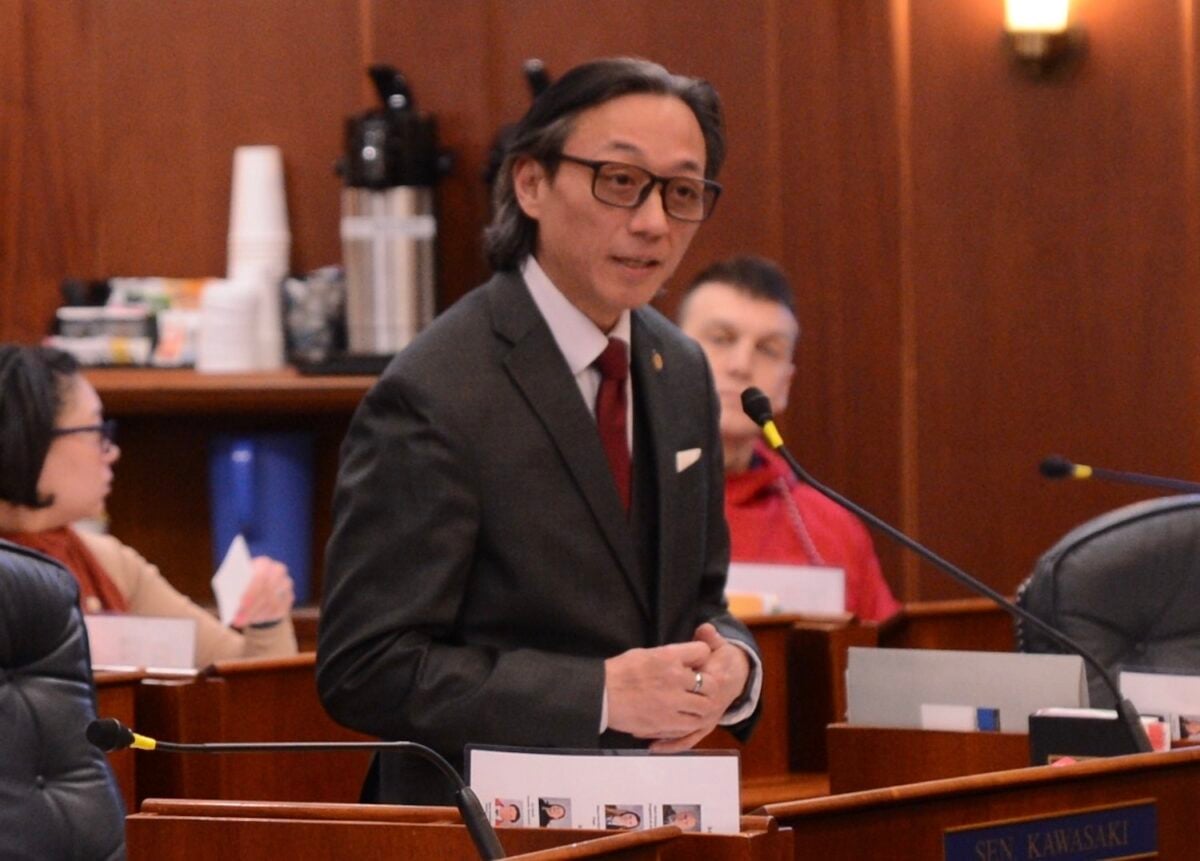
Sen. Scott Kawasaki, D-Fairbanks, speaks Friday, Feb. 7, 2025, on the floor of the Alaska Senate. (Photo by James Brooks/Alaska Beacon)
By James Brooks, Alaska Beacon
Sen. Scott Kawasaki, D-Fairbanks, speaks Friday, Feb. 7, 2025, on the floor of the Alaska Senate. (Photo by James Brooks/Alaska Beacon)
The Alaska Legislature has approved a state driver’s license data-sharing bill that would allow some travelers to speed through security at airports in Alaska.
On Wednesday, the Alaska Senate voted unanimously to approve Senate Bill 237, from Sen. Scott Kawasaki, D-Fairbanks. Because the House voted to pass the bill 40-0 on Tuesday, the Senate’s vote sends the bill to Gov. Mike Dunleavy for final approval or veto.
As originally drafted by Kawasaki, SB 237 would have only allowed the state Division of Motor Vehicles to share driver’s license information with “a nonprofit organization, governmental, or tribal entity.”
Alaska is the only state that does not allow residents to get a replacement card online.
In the House, Rep. Steve St. Clair, R-Wasilla, proposed an amendment that would allow the state to share driver’s license data with “an entity participating in the Transportation Security Administration’s Registered Traveler Programs.”
That includes CLEAR, a for-profit company that offers fast-lane service at airport security checkpoints across the country.
“There’s actually a contract between CLEAR and the (Anchorage) airport right now, they just can’t do anything or share data until we pass legislation saying that they can,” St. Clair said.
House lawmakers approved that amendment unanimously.
At the urging of Rep. Andrew Gray, D-Anchorage, lawmakers also amended the bill with a section that will allow Alaskans to store digital copies of their driver’s licenses on their smartphones.
If a police officer performs a traffic stop, that digital copy would be valid ID.
That amendment was originally a separate bill, House Bill 180, from the Office of the Governor.
“For anyone who lives their life on their phone, this would be a wonderful convenience that the administration would like to offer,” Gray said.
That amendment passed the House by a 38-2 vote, and SB 237 proceeded toward a final vote in the Legislature without opposition.