Anthony Bourdain’s legacy lives on through this TikToker, who’s so convincing, he’ll have you believing he’s tapped into the late celeb’s soul.

Mashed – Fast Food, Celebrity Chefs, Grocery, Reviews










Anthony Bourdain’s legacy lives on through this TikToker, who’s so convincing, he’ll have you believing he’s tapped into the late celeb’s soul.
Mashed – Fast Food, Celebrity Chefs, Grocery, Reviews

The trans-Alaska pipeline threads along the Dalton Highway in northern Alaska. (Nathaniel Herz/Northern Journal)
Is the value of the trans-Alaska pipeline system $2.8 billion, or $10.3 billion? Or is it $20 billion?
This week, a state review board will hold a formal hearing to determine which figure is the right one — with major financial implications for state government and the three municipalities along the pipeline system’s route.
At stake are hundreds of millions of dollars in property taxes, equal to 2% of the pipeline system’s value, that its oil company owners could owe each year to the state, the North Slope and Fairbanks boroughs and the city of Valdez.
The pipeline’s value had been set at $8 billion by a five-year settlement reached in 2016, which the parties extended through the end of 2025. But before that, the municipalities and the system’s owners spent a decade feuding over annual assessments in the courts — with appeals to the Alaska Supreme Court and one trial that lasted more than two months.
The pipeline system property taxes, in past years, have represented more than half of Valdez’s regular recurring revenue, according to city budget documents, as well as a significant contribution to the state’s yearly unrestricted revenues.
A decision setting the system’s value at the municipalities’ preferred value of at least $20.083 billion would result in pipeline owners paying at least $400 million a year in property taxes — compared to the $56 million that would be owed if the value is set at $2.8 billion, the value favored by the owners.
This week’s hearing, before the governor-appointed State Assessment Review Board, is unlikely to be the last word on the matter. While the board can consider arguments from all sides, its decisions are ultimately appealable to the courts.
The pipeline system’s owners include affiliates of ConocoPhillips, ExxonMobil and Hilcorp, the North Slope’s major oil-producing companies.
With the expiration of the settlement at the end of 2025, the state Department of Revenue’s assessment for 2026 — based on the estimated cost to replace the system, minus depreciation — actually boosted the pipeline system’s value from the settled figure, to $10.3 billion.
Discussions had been underway about a new settlement, Fairbanks finance officials wrote in a letter to borough policymakers in January. But no such deal has been announced.

A spokesperson for Alyeska Pipeline Service Co., which operates the pipeline system for the owners, declined to comment on those companies’ behalf, citing the pending review by the state board. A spokesperson for the Department of Revenue also declined to comment.
Robin Brena, a longtime Alaska attorney who for decades has represented the municipalities in their fights over the pipeline system’s value, said he hopes that the parties can mediate their differences and strike a new agreement.
He stressed that historically, the pipeline system’s owners have argued for aggressively low valuations of the property that the courts have rejected. In 2006, the owners argued for an $850 million valuation, before the Alaska Supreme Court ultimately affirmed a lower court judge’s ruling that the value was actually $9.98 billion.
Brena’s clients, the municipalities, wrote in their recent appeal to the board that the state revenue department made a legal mistake in its $10.3 billion valuation by ignoring updated estimates from the municipalities that say replacing the pipeline system today would cost some $40 billion.
Instead, the municipalities say, the state relied on a court decision that set the 2009 replacement cost of the system at $19.1 billion, then made inflation adjustments to produced a 2026 replacement cost of $28.6 billion.
The courts and the state assessment board have preferred new cost estimates to inflation adjustments, the municipalities said, because they better capture updates in the pipeline system’s designs and allow mistakes to be corrected.
A second major error by the revenue department, the municipalities said, was that it used an inappropriate new technique to calculate depreciation: comparing the current flow of oil through the pipeline system, some 460,000 barrels a day, to its peak flow of 2 million barrels, which came in the late 1980s.
That depreciation technique, the municipalities argued, ignores legal precedent that says the calculation should account for the quantity of oil not just actively flowing from, but also available for future production at, Alaska’s big oil fields — a figure known as proven reserves.
A calculation based only on current production neglects the value contained in two huge new oil fields, Willow and Pikka, that are still under construction, according to Brena. Those fields are set to help boost the daily flow through the pipeline system to some 650,000 barrels at a new peak in 2034, according to state projections.
“The department’s calculation completely ignores proven reserves that are not in production,” Brena said.
The oil companies, meanwhile, say in their appeal that the pipeline system is a “depreciating asset” with a value that declines each year. The state, they say, is now proposing to assess a higher value for the pipeline than the $9.25 billion the Alaska Supreme Court affirmed for the 2009 tax year.
“It is fundamentally unreasonable to conclude that a pipeline that is now 17 years older — with 17 fewer years of proven reserves to transport and 17 years of additional depreciation — has an assessed value significantly greater than the value assessed in tax year 2009,” the oil companies wrote.
The companies also say that the state’s assessment fails to account for “operational and economic realities” of the pipeline system — including that the flow of oil is eventually projected to resume its longstanding decline after a “short-term spike.”
The revenue department, the companies said, also ignored the companies’ own “comprehensive” report on the pipeline system’s replacement cost that they shared for the 2026 tax year.
“The owners furnished the department with a significant volume of information relevant to the proper assessment of the subject property,” the companies said. “The department’s assessment ignores all of it in favor of reliance on a 17-year-old appraisal report that is outdated, unsupportable, and fundamentally flawed.”
The board’s hearing on the pipeline system’s value is set to begin Wednesday and finish by the end of the week. Decisions are expected within seven days afterward, according to the board’s support staff.
Nathaniel Herz welcomes tips at natherz@gmail.com or (907) 793-0312. This article was originally published in Northern Journal, a newsletter from Herz. Subscribe at this link.
By: Corinne Smith, Alaska Beacon

Lawmakers in the Alaska House passed a bill that aims to stabilize budgets for Alaska school districts by redefining how they calculate their student counts. The student count makes up the base of the state’s education funding formula.
Lawmakers passed House Bill 261 by a 31 to 9 vote, with bipartisan support, on Tuesday. Under the new calculation of the student count, the bill would provide an additional $143 million in state funding to school districts next year.
But with competing education funding and policy proposals in the Legislature — and just seven days left in the legislative session — the bill heads to the Alaska Senate for consideration and its future is uncertain.

The legislation, sponsored by Rep. Andi Story, D-Juneau, would allow school districts to make their student counts and budget estimates earlier in the year. Currently, schools make an estimated student count in October, and revise it in the spring. Under the proposed legislation, districts would use the previous three-year average of their student count — or the previous year’s count, if it is more than 5% higher.
Story described the change as a way for school districts to get off a budgeting “rollercoaster” and allow districts to have firmer budget estimates, including more certainty in offering contracts to teachers and staff in the spring.
“This is such a policy change that would so help Alaska stabilize education and get more relief and more certainty, and less stress for our families,” she said Tuesday, after the vote.
Alaska school districts are grappling with major budget deficits and rising costs, which have them planning cuts and teacher and staff layoffs across the state — at least 11 schools are slated for closure — amid years of ongoing debates among legislators and Gov. Mike Dunleavy on how much the state should fund education.
School districts currently estimate their student counts in October and draft budget estimates in the spring, and sometimes up to the first day of school in the fall. But with declining enrollment and other changes among student populations, those budget estimates can change, leaving districts uncertain about what staff or programs will be offered in the fall — as well as how much state funding they will receive. Under the new legislation, districts would instead have a solid student count number to budget off of in the year ahead.
Additionally, the bill would change how districts count students who receive intensive special education services. Districts could use the previous year’s count, or the current year’s count in October or in February.
“And what’s great about smoothing is it can help them plan for their educational programs when they are in a climate of declining enrollment,” Story said. “Other states are doing this, and they don’t have the volatility that we do. Because our process, our funding process timeline, is messed up, it really is.”
Alaska has seen a steady decline in enrollment in public schools in recent years, with more students and families opting to enroll in homeschool programs and private schools, or leaving the state altogether. When student numbers decline sharply, the state has a “hold harmless” provision which protects districts from funding dropping dramatically, and phases funding down over three years. Proponents of the legislation say the more predictable student counts and budgeting will help districts with long term stability, their ability to retain teachers and attract new students.
The adjusted student count would have varying effects on school districts statewide — a state fiscal analysis projects the Anchorage School District would receive $31 million more next year. Sitka would see $2 million more, and Yukon-Koyukuk would see $3.8 million in additional funding. But several districts would see less funding under the new calculation, like the state-run boarding school Mt. Edgecumbe High School.
Members of the Alaska House debated and passed an amendment to the bill which would also change the calculation for local municipalities’ contribution to school districts in the state’s complex funding formula, known as the local contribution.
Rep. Justin Ruffridge, R-Soldotna, sponsored the amendment that would cap municipalities’ contribution at a fixed increase of 2% annually, which would relieve boroughs seeing rapidly rising property assessments — those assessments inform how much they contribute to their local schools. Ruffridge said large boroughs like the Kenai Peninsula, Matanuska-Susitna and Anchorage, which are seeing rising property values, are shouldering education funding that should be placed on the state. The adjustment is estimated to cost the state $30 million next year.

“What you’re seeing in a lot of districts with high increases to property assessment values is their required local contribution is going up and up,” Ruffridge said in an interview on Wednesday. “As a result, they’re being required to pay a significantly higher portion, so to the state it looks like the state funding to schools is going down. That’s what it looks like. And on the municipal side they’re being asked to pay more and more and more.”
The amendment passed by a 24 to 16 vote, with Story among those opposing. After the vote she called it a “significant change” and said she had concerns about capping funding for education.
The prospects of the bill are uncertain. Sen. Löki Tobin, D-Anchorage, who chairs the Senate Education committee said Tuesday the policy changes will need to be vetted by the Senate with just days left in the session.

“Bringing everybody along while we are also trying to deal with property tax bills and sales tax proposals and a Rural Health Transformation Fund and all these different healthcare compacts, along with the omnibus crime bill, and of course, the budgets, it might just be too much for us to take that large of a bite,” Tobin said. “But I do believe that components of House Bill 261 will end up in the final package.”
“I’m not trying to be a future teller by saying what is and is not going to continue to be considered by this body,” she added, and said that it’s likely the policy changes will be taken up by the Task Force on Education Funding. “This could be a part of that overall package you see introduced in the 35th Legislature.”
The draft bill redefining districts’ student counts would cost an estimated $113 million, plus additional provisions, for a total of roughly $143 million.
Meanwhile, the Senate is in the process of considering another “mini-bus” education bill, also originally authored by Story, which would fund an additional $82 million for schools, including targeted funding for transportation, energy relief, reading instruction and career and technical education programs.
A draft budget passed by the Senate includes up to $100 million in one-time funding for schools, if oil prices remain high. The House drafted a budget with nearly $158 million in one-time education funding — the two proposals are currently being negotiated and compiled by a conference committee of three senators and three representatives over the next few days.
The bill is subject to a reconsideration vote on Wednesday at the request of House Minority Leader Rep. DeLena Johnson, R-Palmer, which delays the bill’s transmittal to the Senate.

If you want a Whopper from Burger King, but you want to shake things up a bit, never fear! The fast food chain claims you can customize it in 200,000 ways.

Food Republic – Restaurants, Reviews, Recipes, Cooking Tips

 Travis Kelce and Colin Jost know exactly how to fit into the lives of their showgirls.
And the NFL star and Saturday Night Live cast member are able to shake it off when it comes to being compared…
E! Online (US) – Top Stories

 Tayler Holder is taking time for himself.
The “Dyin’ Flame” singer announced that he would be canceling the remainder of his When No One’s Around Tour, which originally kicked off in Commerce,…
E! Online (US) – Top Stories

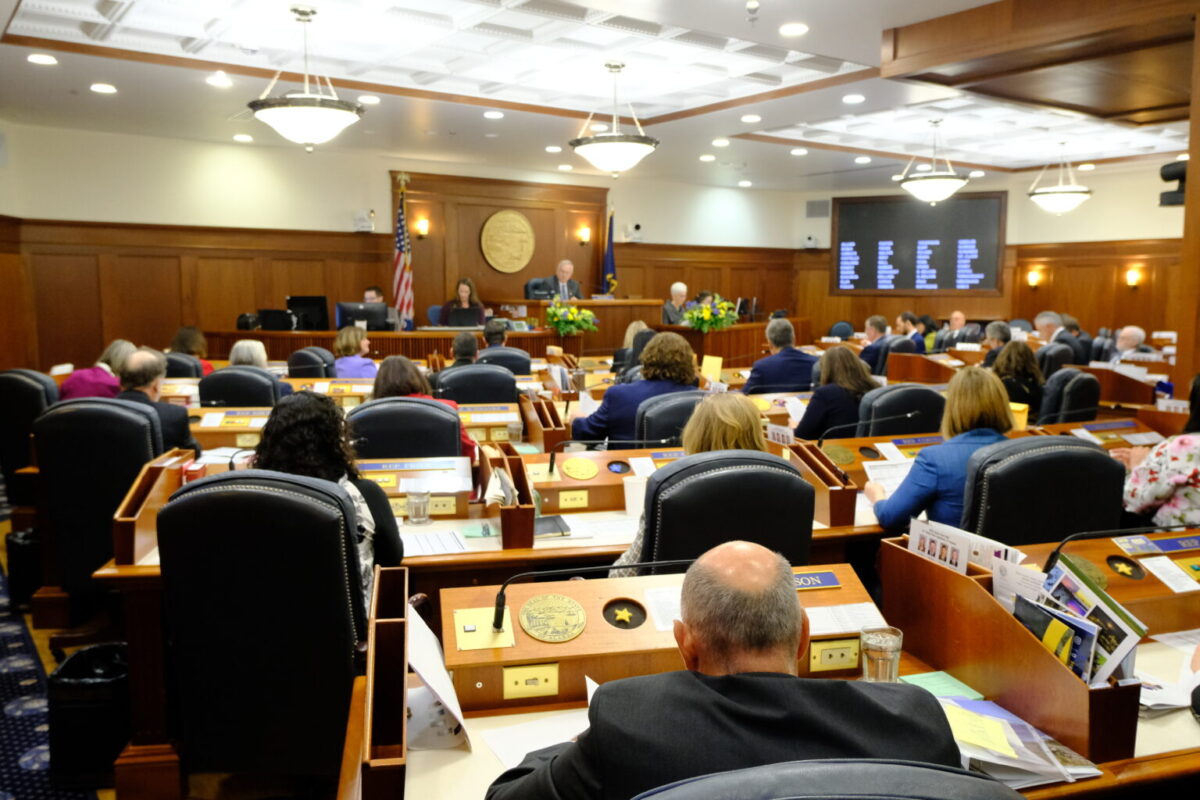
Members of the Alaska House of Representatives convene on the first day of the second session of the 34th Alaska State Legislature on Jan. 20, 2026 (Photo by Corinne Smith/Alaska Beacon)
Lawmakers in the Alaska House passed a bill that aims to stabilize budgets for Alaska school districts by redefining how they calculate their student counts. The student count makes up the base of the state’s education funding formula.
Lawmakers passed House Bill 261 by a 31 to 9 vote, with bipartisan support, on Tuesday. Under the new calculation of the student count, the bill would provide an additional $143 million in state funding to school districts next year.
But with competing education funding and policy proposals in the Legislature — and just seven days left in the legislative session — the bill heads to the Alaska Senate for consideration and its future is uncertain.
The legislation, sponsored by Rep. Andi Story, D-Juneau, would allow school districts to make their student counts and budget estimates earlier in the year. Currently, schools make an estimated student count in October, and revise it in the spring. Under the proposed legislation, districts would use the previous three-year average of their student count — or the previous year’s count, if it is more than 5% higher.
Story described the change as a way for school districts to get off a budgeting “rollercoaster” and allow districts to have firmer budget estimates, including more certainty in offering contracts to teachers and staff in the spring.
“This is such a policy change that would so help Alaska stabilize education and get more relief and more certainty, and less stress for our families,” she said Tuesday, after the vote.
Alaska school districts are grappling with major budget deficits and rising costs, which have them planning cuts and teacher and staff layoffs across the state — at least 11 schools are slated for closure — amid years of ongoing debates among legislators and Gov. Mike Dunleavy on how much the state should fund education.
School districts currently estimate their student counts in October and draft budget estimates in the spring, and sometimes up to the first day of school in the fall. But with declining enrollment and other changes among student populations, those budget estimates can change, leaving districts uncertain about what staff or programs will be offered in the fall — as well as how much state funding they will receive. Under the new legislation, districts would instead have a solid student count number to budget off of in the year ahead.
Additionally, the bill would change how districts count students who receive intensive special education services. Districts could use the previous year’s count, or the current year’s count in October or in February.
“And what’s great about smoothing is it can help them plan for their educational programs when they are in a climate of declining enrollment,” Story said. “Other states are doing this, and they don’t have the volatility that we do. Because our process, our funding process timeline, is messed up, it really is.”
Alaska has seen a steady decline in enrollment in public schools in recent years, with more students and families opting to enroll in homeschool programs and private schools, or leaving the state altogether. When student numbers decline sharply, the state has a “hold harmless” provision which protects districts from funding dropping dramatically, and phases funding down over three years. Proponents of the legislation say the more predictable student counts and budgeting will help districts with long term stability, their ability to retain teachers and attract new students.
The adjusted student count would have varying effects on school districts statewide — a state fiscal analysis projects the Anchorage School District would receive $31 million more next year. Sitka would see $2 million more, and Yukon-Koyukuk would see $3.8 million in additional funding. But several districts would see less funding under the new calculation, like the state-run boarding school Mt. Edgecumbe High School.
Members of the Alaska House debated and passed an amendment to the bill which would also change the calculation for local municipalities’ contribution to school districts in the state’s complex funding formula, known as the local contribution.
Rep. Justin Ruffridge, R-Soldotna, sponsored the amendment that would cap municipalities’ contribution at a fixed increase of 2% annually, which would relieve boroughs seeing rapidly rising property assessments — those assessments inform how much they contribute to their local schools. Ruffridge said large boroughs like the Kenai Peninsula, Matanuska-Susitna and Anchorage, which are seeing rising property values, are shouldering education funding that should be placed on the state. The adjustment is estimated to cost the state $30 million next year.
“What you’re seeing in a lot of districts with high increases to property assessment values is their required local contribution is going up and up,” Ruffridge said in an interview on Wednesday. “As a result, they’re being required to pay a significantly higher portion, so to the state it looks like the state funding to schools is going down. That’s what it looks like. And on the municipal side they’re being asked to pay more and more and more.”
The amendment passed by a 24 to 16 vote, with Story among those opposing. After the vote she called it a “significant change” and said she had concerns about capping funding for education.
The prospects of the bill are uncertain. Sen. Löki Tobin, D-Anchorage, who chairs the Senate Education committee said Tuesday the policy changes will need to be vetted by the Senate with just days left in the session.
“Bringing everybody along while we are also trying to deal with property tax bills and sales tax proposals and a Rural Health Transformation Fund and all these different healthcare compacts, along with the omnibus crime bill, and of course, the budgets, it might just be too much for us to take that large of a bite,” Tobin said. “But I do believe that components of House Bill 261 will end up in the final package.”
“I’m not trying to be a future teller by saying what is and is not going to continue to be considered by this body,” she added, and said that it’s likely the policy changes will be taken up by the Task Force on Education Funding. “This could be a part of that overall package you see introduced in the 35th Legislature.”
The draft bill redefining districts’ student counts would cost an estimated $113 million, plus additional provisions, for a total of roughly $143 million.
Meanwhile, the Senate is in the process of considering another “mini-bus” education bill, also originally authored by Story, which would fund an additional $82 million for schools, including targeted funding for transportation, energy relief, reading instruction and career and technical education programs.
A draft budget passed by the Senate includes up to $100 million in one-time funding for schools, if oil prices remain high. The House drafted a budget with nearly $158 million in one-time education funding — the two proposals are currently being negotiated and compiled by a conference committee of three senators and three representatives over the next few days.
The bill is subject to a reconsideration vote on Wednesday at the request of House Minority Leader Rep. DeLena Johnson, R-Palmer, which delays the bill’s transmittal to the Senate.
SUBSCRIBE: GET THE MORNING HEADLINES DELIVERED TO YOUR INBOX.

 Kouri Richins has learned her fate two months after being convicted of killing her husband Eric Richins.
On May 13, the children’s author was sentenced to life in prison without the possibility of…
E! Online (US) – Top Stories

The country is full of good pizzerias, but Dave Portnoy has declared this New England pizza joint that serves bar-style, hand-made pizzas as the best.

Mashed – Fast Food, Celebrity Chefs, Grocery, Reviews

Dodger Stadium (Los Angeles) — Weeks of frustration turned into a sense of relief and, finally, a moment of levity Tuesday for Shohei Ohtani, who jokingly asked his teammates in the dugout for the home-run ball after he went deep for the first time since April 28. Lately, even brief spurts of joy and frivolity have come sparingly for the Los Angeles Dodgers during their extended offensive funk. On Tuesday, those moments were fleeting again as the Dodgers lost for the fourth straight day and the ninth time in their last 13 games. But Ohtani, who entered the night 4-for-38 over his past 11 games, reached base three times and ended his long-ball drought. Leading off the third inning, he took a sinker off the outer edge from San Francisco Giants starter Adrian Houser the other way with a 105.9 mph liner off the bat for a 398-foot home run. Amid the offense’s larger struggles, manager Dave Roberts felt like it might have been a turning point for his scuffling slugger, even if Ohtani couldn’t stop the spiral for the rest of a dormant lineup that has scored two runs or fewer over the past 13 games. If the two-way superstar hopes to build on his encouraging performance at the plate, though, it will have to wait. The Dodgers plan to give the four-time MVP a breather, holding him out of the lineup for the next two games amid his prolonged slump. “The pros are, taking the hitting part off his plate, letting his body recover a little bit as far as being a two-way player for a couple days, playing more of the longer view, potentially giving him a reset on the offensive side,” Roberts explained Tuesday afternoon, before Ohtani’s breakout night. “The con is just not being able to write his name in the lineup at the top of the order.” After already informing the player of his plan, Roberts wasn’t swayed by Ohtani’s slump-busting two-hit game. “I don’t like the bait and switch,” Roberts said. “To go back on a pact, a decision, that we came upon, or I came upon, I don’t like that.” The plan is for Ohtani to only pitch on Wednesday, marking the fourth time in his last five starts on the mound that he won’t be in the lineup. Ohtani is then expected to get Thursday off, too. When or if that happens, it will be the first time in Ohtani’s tenure with the Dodgers that he’ll be held out of the lineup in consecutive games despite being available to play. Ohtani is expected to be available to pinch-hit late on Thursday, but Roberts hopes that the superstar takes advantage of the extra rest and shows up a little later to the field. “For me, with any hitter, when the quality of at-bat starts to go down consistently, I think that’s a telling sign there needs to be a break,” Roberts said. Roberts told me that Ohtani hasn’t expressed that he’s dealing with fatigue, but it seems like it might be a factor in his at-bats of late as he assumes full two-way duties for the first time since 2023. Beyond the dip in surface-level numbers, Ohtani’s bat speed is down a tick from last season. He’s posting his lowest hard-hit rate since 2020, and his chase rate is the highest it’s been in the past six years. “I think the fatigue is bleeding into the mechanics,” Roberts said. “I think that most players get that towards the end of the summer. And now I’m learning, managing Shohei, it has probably shown itself a little earlier as far as the tax on pitching and all that comes with it to the hitting, too.” Dodgers pitching coach Aaron Bates told me that if Ohtani is dealing with any fatigue, it might be more mental than physical. If Ohtani is tired, Bates reasoned, he wouldn’t still be trying to steal bases, as he has done four times in his past 14 games. Bates believes Ohtani is capable of handling this workload. Roberts maintains that he is, too, but also acknowledged that the plan the Dodgers had for Ohtani before the season is “fluid” and requires reading and reacting. “We have an opportunity to do things the way we feel are best for him,” Roberts said. “So, no one thought it was gonna be easy. No one thought it was gonna be linear.” On the mound, Ohtani looks like a Cy Young contender. He has a 0.97 ERA and has gone at least six innings in each of his six starts. At the plate, Ohtani’s downturn is one of many problems for a Dodgers’ offense that ranks 18th in runs scored, 20th in home runs and 21st in slugging since April 18, a span of 23 games. But it’s a significant one. Even after his two-hit performance Tuesday, Ohtani is batting just .200 with two home runs over his last 17 games. His .796 OPS is the lowest it’s been through his team’s first 42 games since 2022. After going hitless in just 25.9% of his games last year, he has done so in 41% of his games this season. His 17 RBIs are also his fewest ever to this point of a season, and his seven home runs are his fewest through his team’s first 42 games since 2020. Often, Bates said, Ohtani’s misses are the same as they were last year, where he’s chasing balls in the dirt or hitting them too far out front and rolling over. “He would just mix in the homers between the misses,” Bates explained. “So, when you’re not necessarily hitting the homers, the rockets, the doubles, and you have the same misses, it looks probably worse than it is.” Ohtani has been adamant that he doesn’t think his pitching is impacting his hitting, but he has acknowledged that it’s more difficult in this current role to devote the time necessary to fix his swing when something is off. He has to keep his health at the forefront, which means balancing his workload and monitoring his repetitions while also trying to perform his Herculean tasks. Over the past week, for instance, he has hit on the field multiple times before games, a tactic he only tries when he’s searching for something at the plate. But he has had to work that batting practice around his bullpen sessions in preparation for his start on Wednesday. “It’s always a juggling act,” Bates said. “It’s just bandwidth, I think, pitching and hitting full season now. And also last year, he was doing really well when he started layering the pitching in, so you kind of had the hitting on, not autopilot, but he knew where he was at and what he wanted to do. I think this year, combining both those with the shortened spring training and the WBC, it’s been a lot of factors.” Tuesday was a giant step in the right direction, but it didn’t alter the Dodgers’ strategy. They still plan to hold him out of the lineup the next two games, according to Roberts, who did not express any concern that the decision might halt Ohtani’s positive momentum. “I just can’t take for granted what’s on his plate, so I’m trying to be sensitive to that,” Roberts said. “I’m learning that you have to be proactive because he’s always going to want to do more. He always has that sense of responsibility to his teammates that he wants to be out there both ways.”Latest Sports News from FOX Sports