Now, new photos taken by first responders have been released, and they paint a chilling portrait of a life that ended in despair.
We have new information about the final hours of Food Network star Anne Burrell. (YouTube/Food Network)
Photos obtained by Page Six show pills and several empty medicine bottles scattered through Burrell’s home, a discovery that is now at the center of law enforcement’s ongoing investigation into her death.
While medical examiners believe Burrell committed suicide, police have yet to publicly announce what, if any, role the pills might have played in Burrell’s death.
Her cause of death is officially listed as “acute intoxication due to the combined effects of diphenhydramine, ethanol, cetirizine, and amphetamine.”
Representatives for the chef’s family have declined to comment on the newly released photos or what they may mean.
Burrell had spent decades building a high-profile career as a chef, television personality, and mentor to up-and-coming culinary talent.
Prior to her death in 2025, Anne Burrell appeared on several Food Network shows. (YouTube/Food Network)
Her sense of humor and culinary expertise made her a familiar face to fans of cooking shows across networks.
In the wake of her death, tributes have poured in from colleagues, friends, and fans, many of them offering warm memories of her generous spirit and passion for food.
With these new photos now circulating publicly, the focus has turned even more sharply to uncovering the full circumstances surrounding her passing.
At this stage, investigators have not provided explanations about the pills or medicine bottles photographed inside the home.
Prior to her tragic death, Anne Burrell was one of the Food Network’s brightest stars. (YouTube/Food Network)
After launching the Food Network’s Worst Cooks In America in 2010, Burrell was not asked back to host the show’s 27th season in 2023.
She made a brief return for the show’s 29th season, just months before her death.
As authorities continue their work, what’s clear is that this is a deeply sad and complicated situation, one that has left loved ones and fans seeking answers in the midst of profound grief.
While photos taken at the scene of Burrell’s death have shed new light on the circumstances of her final hours, they still don’t tell the whole story.
We’ll have further updates on this developing story as new information becomes available.
Fishing vessels are seen in Homer’s harbor on Oct. 22, 2025. A resolution passed by state lawmakers urges federal officials to extend the ban on Russian seafood imports. Russian fish competes for market share with Alaska’s fish. (Photo by Yereth Rosen/Alaska Beacon)
A legislative resolution urging a continued and better-enforced ban on Russian seafood in the United States is headed to Gov. Mike Dunleavy.
Part of a series of actions by Alaska lawmakers to try to shore up the state’s ailing seafood industry, House Joint Resolution 29 won final passage last week and was transferred to the governor on Monday.
The resolution calls for continuation of the ban on Russian seafood imports imposed in 2022, after that country’s invasion of Ukraine. The ban was expanded in 2023 to cover imports of Russian seafood to the U.S. through a third-party country, usually China, where fish are processed.
The import ban is set to expire later this year. That makes the resolution timely, supporters aid.
Among the supporters is Jeremy Woodrow, executive director of the Alaska Seafood Marketing Institute.
Woodrow, in testimony to the Senate Resources Committee on Feb. 27, said a stockpile of Russian fish that was in the U.S. before the ban went into full effect is just now being depleted.
“We need more time to really capture the U.S. marketplace. Our industry has not recovered yet,” Woodrow said. Even though last year’s fishing season was better, it was still one of the worst years in the last 20 years, he said.
“This is one measure that will help our fishermen. We’re starting to see the fruits of this ban coming into play, but we need more time to provide stability to our industry. We need more time to see it come to fruition,” he told the committee.
In addition to seeking an extension of the import ban, the resolution calls for stronger monitoring and enforcement to “ensure fair trade, protect the state’s seafood industry, and promote sustainable and ethical seafood production.”
Legislative resolutions do not have the power of law, but they can influence actions by Congress, the federal executive branch or other institutions.
The Russian seafood import ban resolution was not among the measures introduced by the Joint Legislative Task Force Evaluating Alaska’s Seafood Industry, formed in 2024. However, it addresses an aspect of international trade, one of the issues raised by the task force. The task force’s report recommended an update to a Russia-focused resolution passed by the legislature in 2022, Senate Joint Resolution 16.
Russian king crab is displayed at a Costco in Anchorage on Nov. 14, 2022. The crab, from the Barent Sea, was distributed by Arctic Seafoods of San Francisco, and was part of inventory stockpiled before the U.S. government banned fish imports from Russia. (Photo by Yereth Rosen/Alaska Beacon)
The eight-member task force, comprising Senate and House members from fishery-dependent districts, issued its recommendation report in January 2025, at the start of last year’s session. Recommendations for action resulted in the introduction of a series of bills intended to help the industry, which has struggled with low fish prices, glutted international markets, high costs and other challenges.
Other bills focus on tax credits and revenues
One of the task force’s bills, aimed at encouraging seafood product development and diversification, is headed for a vote in the Senate this week.
That measure, Senate Bill 130, concerns the state’s fisheries product development tax credit system. Currently, seafood companies are allowed to deduct the cost of new equipment used to develop value-added products from salmon, herring, pollock, sablefish and Pacific cod. The bill would expand that to all fish species, including shellfish. That is in line with the recommendation in the task force report, which identifies arrowtooth flounder, fish meal and crab shells as examples of some underused or discarded products that could be processed into something marketable.
The bill, in the amended form before the Senate, also seeks to expand the range of technology for which investment would qualify for credits, and it would extend the sunset date for the credit to 2037. Currently, the tax credit is due to expire next year.
The revenue impact of the bill, if it wins final passage, is difficult to determine because there are several unknown variables, said the fiscal note prepared by the state Alaska Department of Revenue. Estimated annual revenues losses to the state would range from $1 million to nearly $4 million, according to the fiscal note.
Another task force bill, aimed at helping fishery-dependent local governments, had not moved out of the Senate Finance Committee as of Tuesday. That measure, Senate Bill 135, would allow municipalities to increase their share of fisheries business tax and fishery resource landing tax revenues. Currently, the state and local governments split those tax revenues equally. The bill would allow local governments to get up to 75% of the tax revenues.
The legislature passed two seafood task force bills last year, each of which had wide support. However, Dunleavy vetoed one of the bills.
The bill that escaped the governor’s veto, House Bill 116, allows for the formation and operation of member-owned commercial fishing insurance cooperatives. Such cooperativesexist in other states and were used by some Alaska fishers. The bill passed unanimously.
The vetoed bill, Senate Bill 156, would have transferred $3.69 million from a defunct state loan fund to the Alaska Commercial Fishing and Agriculture Bank. The state-owned bank needed the boost to keep serving the seafood industry, bill supporters argued. But Dunleavy argued that the cost of the action was too great for the state budget to bear.
The world’s best sporting event – the 2026 FIFA World Cup — is coming this summer, and it’s going to be bigger and better than ever. But which 48 fanbases will be the loudest? The most fun and the most passionate? Vote in our 2026 FIFA World Cup Ultimate Fanbase, sponsored by Lay’s! How It Works? This bracket consists of all 48 qualified teams for the 2026 FIFA World Cup. Those teams are separated into four quadrants consisting of three of the current World Cup groups in each: – Region 1 has Groups A/B/C- Region 2 has Groups D/E/F- Region 3 has Groups G/H/I- Region 4 has Groups J/K/L Here’s the kicker! The teams are then seeded by each of their combined social media followings – including Facebook, Instagram, TikTok, X, and YouTube. And some of these times have some big-time followings. We’ve given the top four seeds (Brazil, USA, France, and Argentina) byes in the bracket. How To Vote? Easy! All voting takes place across the @FOXSoccer social accounts. So if you don’t already follow FOX Soccer, do so now! You’ll be able to vote on: – Instagram- Facebook- YouTube – X Or check out the polls below. Vote on your platform of choice and it will count! Voting will take place over the entire month of April with a winner announced on the last day of the month! The winners will get an official billboard touting your nation as the best FIFA 2026 World Cup fans in front of your team’s training facility! Today’s Matchups: Bracket A/B/C – First Round Canada Fans vs. Switzerland Fans As one of the three co-host nations, Canada will be awash in red and maple leaves during the summer as Les Rouges fans cheer on their home team. In this matchup, they take on Switzerland fans who are among the most well-traveled fan bases across Europe. Scotland Fans vs. Bosnia & Herzegovina Fans Scottish fans, adorned in kilts and sporrans, will be in full force singing “The Flower of Scotland” before World Cup games. Bosnia & Herzegonvina supporters will look to bring the passion they had when their side ousted Italy from World Cup contention. Qatar Fans vs. Czechia Fans Qataris were gracious hosts at the 2022 World Cup and will now look to build on their legacy this summer. Meanwhile, Czechia fans are relishing the moment of having reached the tournament for the first time since 2006. South Africa Fans vs. Haiti Fans Song, dance and vuvuzelas. The passion and support for the Bafana Bafana (as the South Africa team is affectionately known) is well known. Haiti fans will also have plenty to cheer about as well – the country returns to the World Cup for the first time since 1974. 2026 FIFA World Cup: How To Watch The World Cup will run from June 11–July 19, 2026. Spread across three countries, the tournament will culminate with the final on July 19 at New York New Jersey Stadium in East Rutherford, New Jersey. All 104 tournament matches will air live across FOX (70) and FS1 (34) with every match streaming live and on-demand within both the FOX One and the FOX Sports apps. A record 40 matches, more than one-third of the tournament, will air in primetime across FOX (21) and FS1 (19).Latest Sports News from FOX Sports
Members of the House and Senate voted to sustain Gov. Mike Dunleavy’s veto of SB 113, a corporate income tax bill tied to education funding by a vote of 45 to 16. 46 votes were needed to override the veto on Jan. 22, 2026 (Photo by Corinne Smith/Alaska Beacon)
The Alaska Senate on Tuesday advanced a constitutional amendment that would lower the threshold for veto overrides of spending decisions.
The Alaska Constitution currently has two thresholds to override a governor’s vetoes: it takes two-thirds of legislators to override a veto of a policy bill and three-quarters of lawmakers to override a budget veto or a veto of legislation that spends money.
Anchorage Democratic Sen. Matt Claman’s proposed the constitutional amendment that would reduce vetoes of spending decisions to the same two-thirds threshold.
Sen. Matt Claman, D-Anchorage, speaks at a March 19, 2024, news conference held by the Senate majority caucus. (Photo by Yereth Rosen/Alaska Beacon)
Claman’s resolution passed the Senate along caucus lines on a 14-6 vote. All 14 members of the bipartisan Senate majority voted for the resolution while each member of the all-Republican Senate minority voted no.
At least 14 of Alaska’s 20 Senators are needed to reach the two-thirds threshold to advance a constitutional amendment. Twenty-seven of the 40 House members would need to approve Claman’s resolution for the proposed amendment to appear on November’s ballot.
The last time the Alaska Constitution was amended was in 2004.
Claman, a Democratic candidate for governor, said the drafters of the Alaska Constitution intended to create a strong executive branch. But the high hurdle to override a veto on spending decisions had “undermined the balance of power between the Legislature and the executive,” he said.
Alaska is the only state with a three-quarter veto override threshold for spending decisions.
In a statement following the vote on Tuesday, minority Senate Republicans said the governor’s veto power was one of few tools to curb the Legislature’s wide-reaching power. Members of the caucus stated that Gov. Mike Dunleavy had used that authority to veto tax bills, among other measures.
“The framers of our Constitution saw the wisdom in giving the governor considerable power to reduce state spending,” said Tok Republican Sen. Mike Cronk, the Senate minority leader. “The fiscal override threshold is high for a reason.”
While the Legislature has voted to override a governor on 40 occasions for policy bills since statehood, veto overrides for spending decisions have only occurred five times, Claman said.
The most recent override of a spending veto occurred last August in a special session Lawmakers voted to reject Dunleavy’s veto of more than $50 million in public school funding. The vote was 45-14, the minimum number of lawmakers needed to override a budget veto.
If approved by the House, the constitutional amendment would appear on the ballot at the Nov. 3 election. If approved by a majority of voters, the constitutional threshold for budget vetoes would then be lowered starting in 2027, also the beginning of a new governor’s term.
Unlike legislation, an Alaska governor cannot veto a constitutional amendment.
Cheese is great on its own, but paired with the ideal cracker, it becomes heavenly. These delicious combinations are the very best for your cheese board.
HOUSTON — Global energy leaders have convened here this week, spiffed up in dark suits and polished shoes, to discuss the industry’s most pressing issues: war in the Middle East, Venezuela, artificial intelligence.
But behind the scenes at this annual conference of industry executives — known formally as CERAWeek by S&P Global but nicknamed the “Super Bowl of energy” — a big story about Alaska oil is unfolding.
It involves a massive lease sale in the Arctic, a remarkable show of interest from global oil giants that had faded from Alaska’s frontlines and an emerging race to find deposits potentially worth billions of dollars. Industry proponents say a flood of crude from the largely undeveloped western Arctic, if companies can locate and produce it, could open a new era for the state’s industry.
In what was by far the highest-value federal lease sale in the vast National Petroleum Reserve–Alaska in more than two decades, oil companies last week snatched up more than 1 million acres across the western Arctic.
The scale of interest, with 11 companies participating and a record $163 million spent on bids, was itself notable. But so were the identities of some of the bidders. Two, in particular, surprised even industry insiders: ExxonMobil and Shell.
Both supermajors have a history in Alaska.
ExxonMobil still owns shares of existing Arctic oil fields and the trans-Alaska pipeline. But Shell no longer operates in the state and hasn’t drilled a well in Alaska since its failed offshore exploration campaign more than a decade ago. And ExxonMobil hadn’t bid on leases in years.
Energy historian Dan Yergin, left, speaks with Wael Sawan, chief executive of Shell, at the CERAWeek oil industry conference in Houston this week. (Grant Miller Photography/CERAWeek by S&P Global)
Their renewed interest — along with continued investment from established players like ConocoPhillips and Colorado-based wildcatter Bill Armstrong — accelerates an industry revival that was already playing out on the North Slope.
Just a few years ago, new production and investment in the region lagged as some companies struggled to raise money and even pulled out of Alaska amid successful advocacy campaigns against Arctic drilling.
But major geologic discoveries by Armstrong — and a pair of big new oil fields now under construction — have made the North Slope a more attractive investment. And the industry also has political tailwinds coming from a Trump administration keen to boost resource extraction in Alaska.
“This sale absolutely shows the world the potential for Alaska,” Armstrong, one of the primary bidders, said in an interview at CERAWeek. “This could be a game-changer for the state.”
Bill Armstrong (Max Graham/Northern Journal)
The region still faces obstacles to development, like high costs and competition from other basins where drilling is cheaper.
And the lease sale is just a preliminary step, far from an assurance of future production: No new wells have been drilled yet, and companies often spend years doing exploratory work before deciding whether to start pumping oil.
Conservation groups, meanwhile, continue to fight the industry’s expansion in the reserve — where, they note, federal law instructs policymakers to not only to oversee oil development but also to protect the environment and cultural values. Multiple lawsuits are challenging the Trump administration’s oil-friendly policies in the Arctic, and advocates have asked a judge to invalidate leases set to be awarded after last week’s sale.
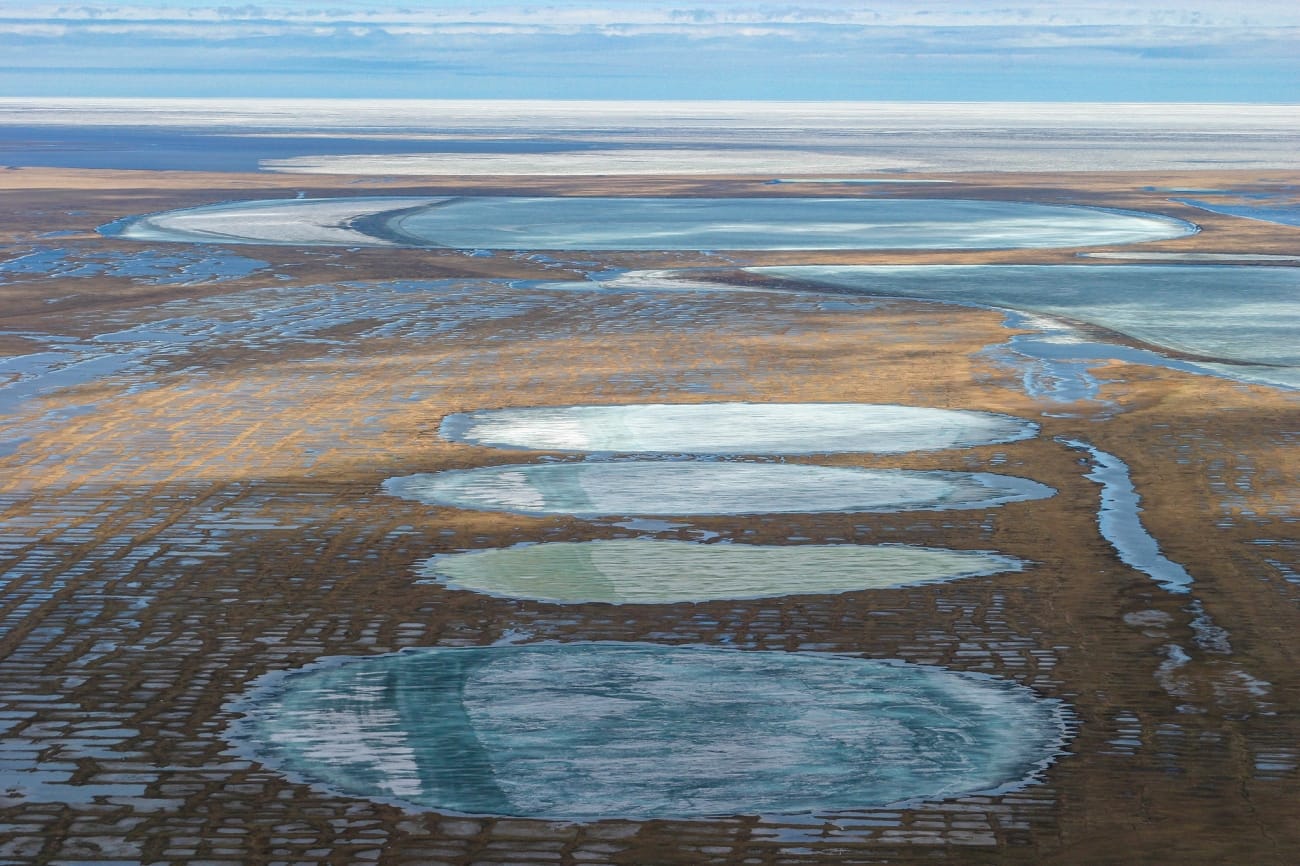
Four small lakes sit on the northwestern side of Teshekpuk Lake, a key wildlife habitat within the National Petroleum Reserve – Alaska that’s also seen interest from oil companies. (Craig McCaa/U.S. Bureau of Land Management)
“What we saw last week were companies pushing into some of the most sensitive areas of the reserve,” said Suzanne Bostrom, an attorney with a conservation-focused Anchorage law firm, Trustees for Alaska, that represents some of the organizations suing the administration. “We and the groups that we work with are going to continue to fight for this area, and fight for the protections that it deserves,” Bostrom added.
But even amid the pending legal questions, the sale’s results are still a step toward new development; further investment and competition in the petroleum reserve are likely to follow, conference participants told Northern Journal in Houston this week.
A surprising sale
Leading up to the sale, there were signs that oil companies could show up in force.
It was the first auction in NPR-A in seven years, and more acreage was up for grabs than in many previous sales. The offerings included large swaths of tundra and wetlands that Democratic administrations had designated off-limits to drilling.
And after years of comparatively tepid industry interest, recent oil discoveries have expanded the known resources on the North Slope, said Bob Fryklund, a top oil and gas analyst at S&P Global Energy, a research firm.
“It’s kind of been a sleeper basin,” he said.
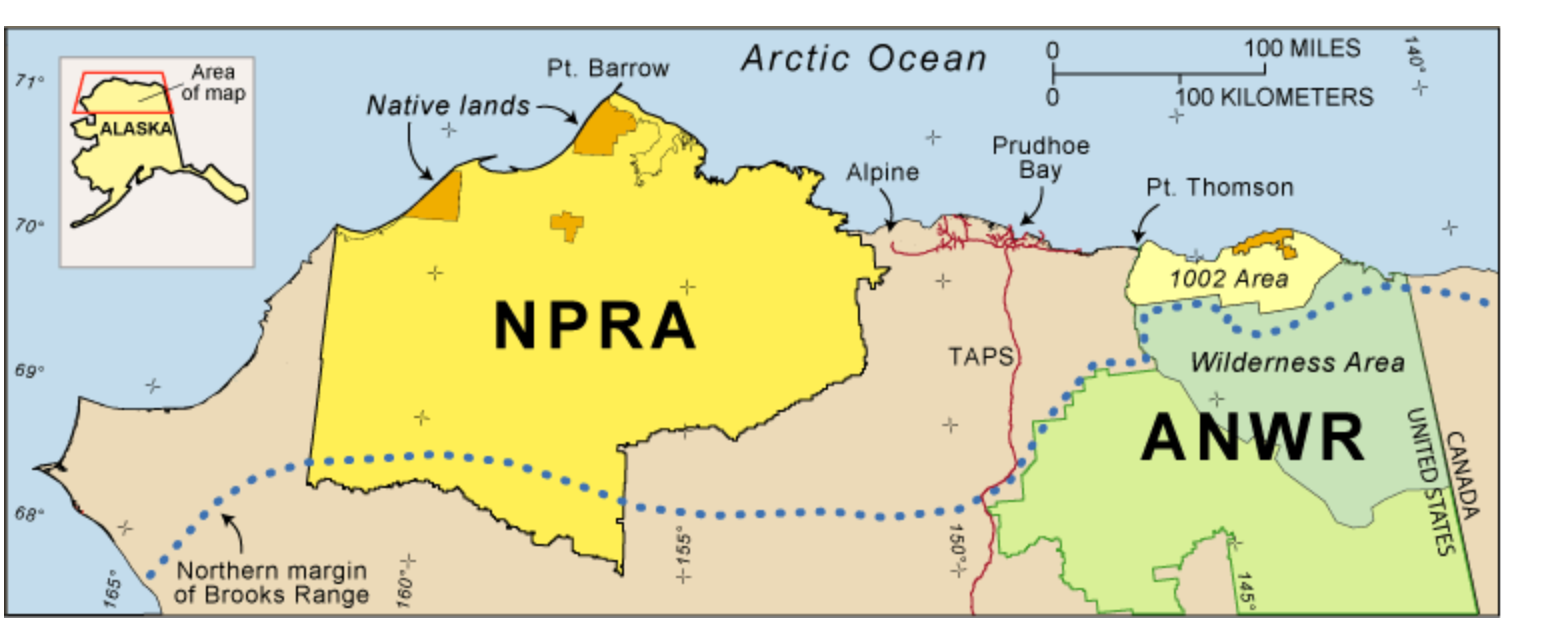
This map of Alaska’s North Slope shows the National Petroleum Reserve – Alaska and the Arctic National Wildlife Refuge. Two oil companies are building large developments near the reserve’s eastern edge, and a major lease sale recently auctioned off land deeper into the reserve. Prudhoe Bay is the hub of existing North Slope development.
A decade ago, the petroleum reserve was beyond the western edge of the North Slope’s oil infrastructure, making it more expensive to bring in equipment and drill.
But the industry has been moving in its direction: Construction is now underway at two big new oil fields in the area — ConocoPhillips’ Willow project and Santos’ Pikka project. Both will tap into a long-overlooked oil-rich geologic formation, known as the Nanushuk, that Armstrong initially discovered near the reserve’s eastern boundary.
It was no surprise, then, that ConocoPhillips, Santos and Armstrong all showed up at the recent auction, analysts said.
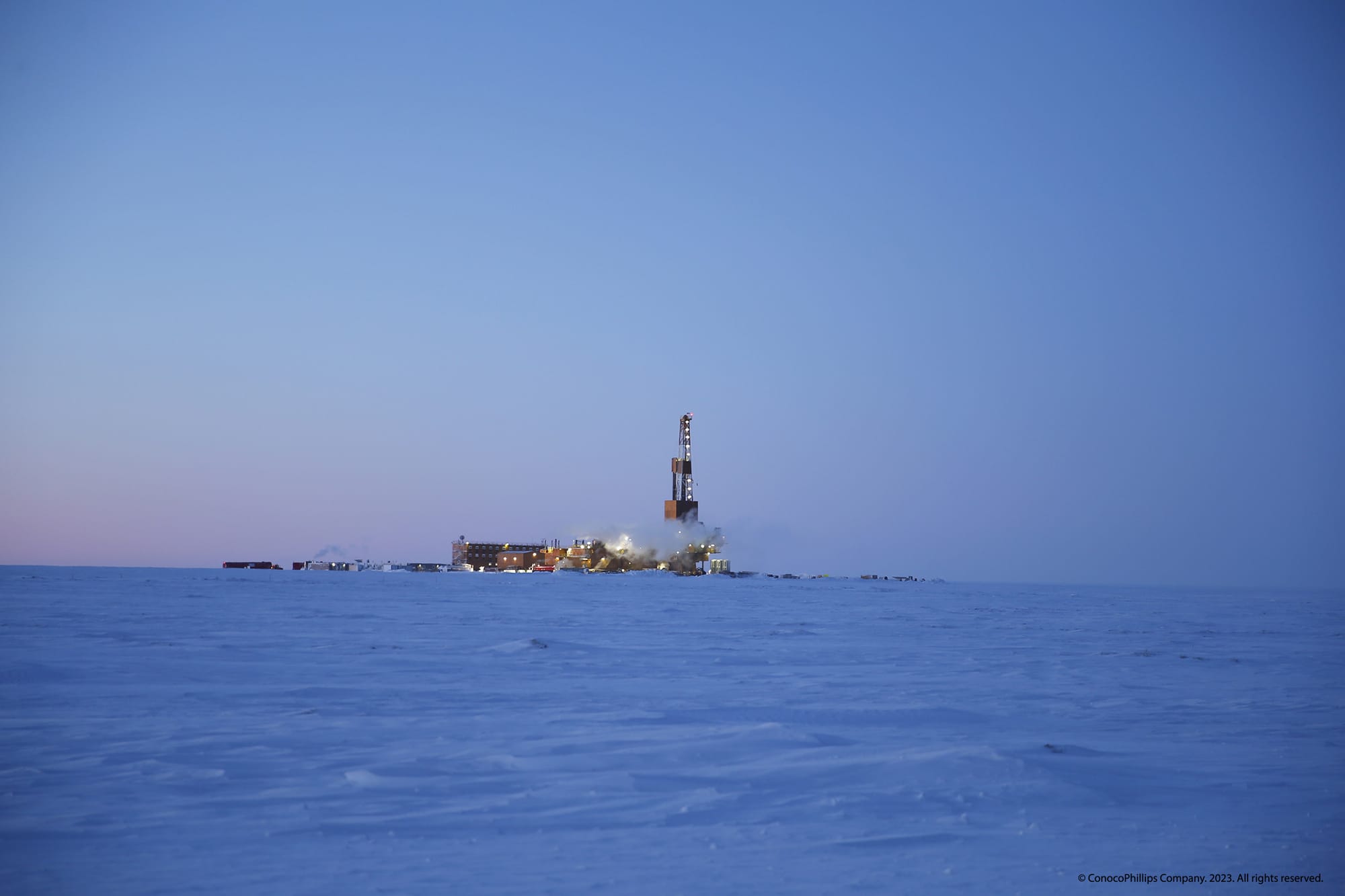
An exploration rig drills for oil at ConocoPhillips’ Willow prospect in the National Petroleum Reserve – Alaska. (ConocoPhillips)
Few people, however, predicted that so many other companies would put in bids, or that major corporations like ExxonMobil and Shell would participate.
ExxonMobil, committing more than $7 million on some 138,000 acres, came as a particularly big surprise.
That company, headquartered in Houston, owns shares in the existing Point Thomson and Prudhoe Bay oil fields on the North Slope. But it doesn’t manage either field, and the company has not been active in exploration and new development in the state: Until last week, ExxonMobil had not bid on a federal or state oil and gas lease in Alaska in more than a decade, according to data provided by Welligence, an industry research firm.
Meanwhile, Shell, in a partnership with a Spanish company, Repsol, submitted some of the highest bids. The two companies offered more than $2 million on many individual tracts, and committed more than $90 million in total.
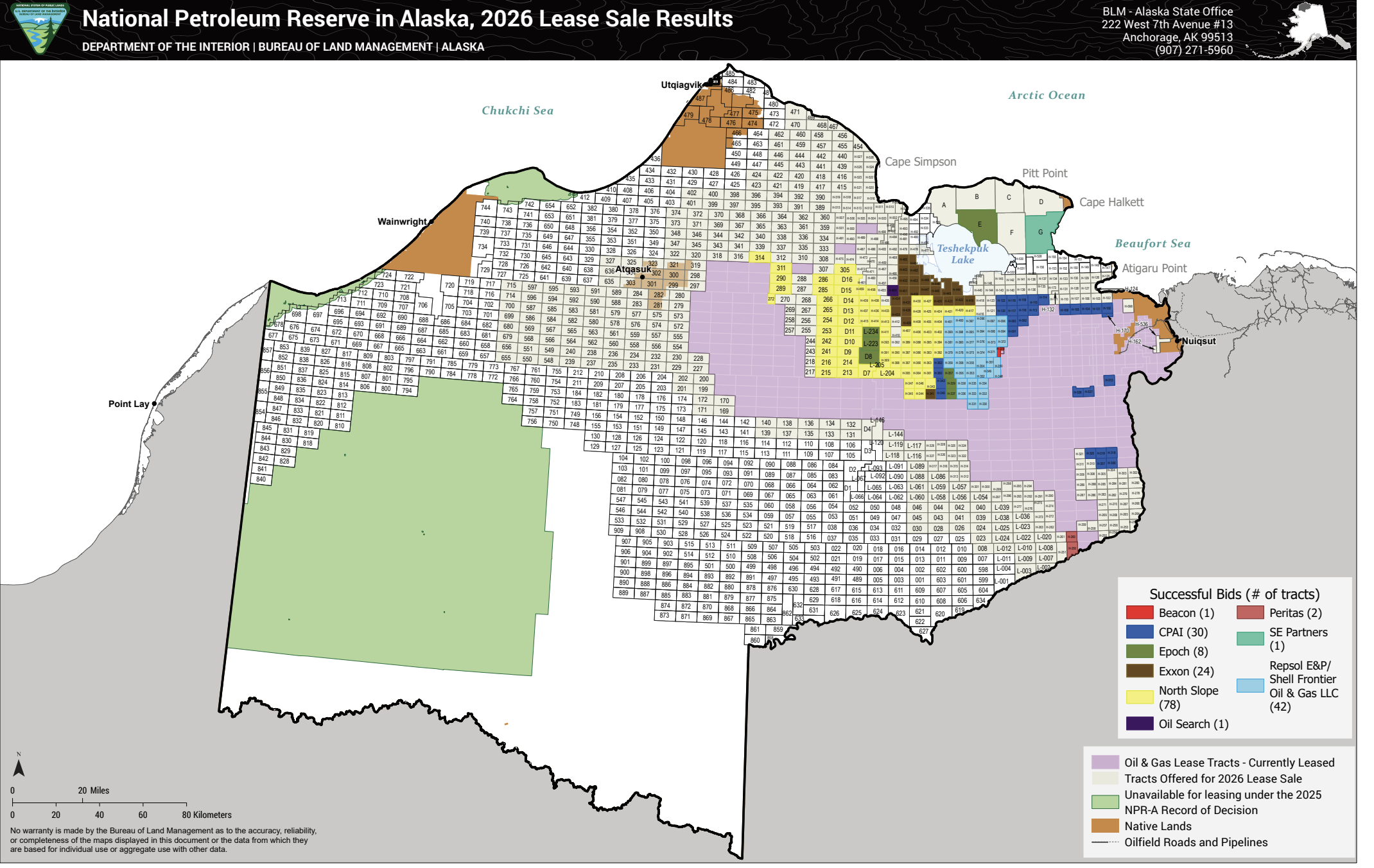
A map produced by the U.S. Bureau of Land Management shows winning bids from last week’s lease sale.
Experts said the return of those players was likely influenced by the ongoing development in the area.
Although neither the Willow nor Pikka project is producing yet, the multibillion-dollar investments by ConocoPhillips and Santos may have given other companies more faith in the surrounding geology and the ability to pump oil in the area, analysts said.
“What you saw Shell do, and even Exxon, was validation of the work done by other players on the North Slope in recent years,” an oil company executive said in Houston, speaking on the condition of anonymity because he was not authorized to speak publicly.
Industry headwinds subside
Shell’s interest represents a reversal from its announcement a decade ago that it was pulling out of Alaska. The company had spent some $7 billion on its failed effort to drill for oil offshore in the Chukchi Sea, citing Obama administration policies and high costs when it departed the state.
In 2020, another major, BP, also pulled out of Alaska, selling its assets to Hilcorp, a privately owned Texas business.
Those decisions both seemed like signals of the industry’s decline in the state, as the daily flow through the trans-Alaska pipeline shrank to 500,000 barrels from a high of 2 million decades earlier. An era of oil giants spending freely on big new projects was giving way to one of smaller companies wringing the last drops of crude out of aging fields.
An oil and gas rig drills at a Hilcorp development in the Cook Inlet basin in Southcentral Alaska. (Nathaniel Herz/Northern Journal)
At the time, companies were contending not only with the usual impediments to drilling in Alaska, like high costs and opposition from environmental groups, but also with growing political pressure from climate-minded shareholders and activists opposed to expanding fossil fuel production. Even oil executives acknowledged that advocacy against the oil industry, which is a major driver of climate change, was deterring investment in Alaska.
But even as the burning of fossil fuels continues to warm the planet, global demand for oil remains high — and industry confidence in the North Slope’s potential appears only to be growing.
The newly discovered oil deposits there “have proven that Alaska is not over,” Fryklund said.
ConocoPhillips, ExxonMobil and Santos declined to make officials available for on-record interviews. Shell did not respond to a request for comment.
“This marks an important step in our continued commitment to responsible energy development in Alaska and the U.S.,” an Exxon spokesperson said in an emailed statement.
Once the company’s leases are finalized, ExxonMobil will work with the state and local communities as it evaluates “potential next steps for the area,” the statement said.
“I wish I were 30 years younger”
For those who work in the oil industry, the central plank of Alaska’s economy, the sale stirred excitement, and some relief: New activity in the federal reserve could bring more gigs for contractors that have long wondered if there would be enough development on the North Slope to sustain their businesses.
“We’ve all had this little worry of, ‘Well, what’s next?’” said Greg Miller, vice president of operations at Cruz Construction, a Palmer-based company with oil-related contracts on the Slope. “Now, there’s a little bit of reason to be a little bit more hopeful and positive about the next 10, 20 years.”
The sale won’t lead to immediate growth for Miller’s business, he said. But new exploration activity, if and when it happens, will create jobs: A single project can provide a year’s worth of wages for as many as 100 employees at Cruz, Miller added.
For the president of another Alaska oil services company, Kevin Durling, the hype around the petroleum reserve is reminiscent of the boom days when oil started flowing through the trans-Alaska pipeline, in the 1970s and 1980s.
The trans-Alaska oil pipeline pumps some 500,000 barrels a day. (Nathaniel Herz/Northern Journal)
“I wish I was 30 years younger,” he said.
The state’s conservation community, meanwhile, has reacted with disappointment, and concern for the western Arctic ecosystem.
The vast, largely undeveloped region contains important habitat for migratory birds, and it sustains tens of thousands of caribou, some of which calve around Teshekpuk Lake, a major water body in the northern part of the petroleum reserve.
“I’ve had better weeks at work. No question about that,” said Andy Moderow, senior policy director at Alaska Wilderness League, one of the environmental groups suing the Trump administration. But, he added: “The war is still well in front of us.”
One potential hurdle for development is a legally disputed conservation area around Teshekpuk Lake. The protections, across about 1 million acres, were set aside by the Biden administration for the nearby Iñupiaq village of Nuiqsut, where many people still depend on caribou and other wildlife for food.
The Trump administration canceled the protections late last year, touting the area’s oil and gas potential and aiming to authorize leasing there. Nuiqsut’s leaders then sued, saying the move violated a prior agreement and threatened the village’s subsistence traditions.
Two days before the lease sale results were announced, a federal judge restored the Teshekpuk protections while the lawsuit played out.
But the area still attracted bids from a few companies — including ExxonMobil.
The administration has not said whether it plans to award leases in the disputed area to high bidders — or how, exactly, it intends to navigate the apparent conflict between the sale results and the court ruling.
Nathaniel Herz contributed reporting from Anchorage.
Ashley Monroe is turning heads with her surprise album Dear Nashville and its brutally honest track “I Hate Nashville,” which serves as a letter to the city she calls home, detailing the complicated love/hate relationship she has with the place that has both lifted her dreams and, at times, broken them.
She first teased the concept album with an open letter shared on Instagram, reflecting on her 23+ year journey in Music City. In it, she revisited the highs and lows of her career, from being signed and later dropped by multiple labels to earning two No. 1 songs and three GRAMMY nominations.
Ashley Monroe; Photo by Becky Fluke
In the deeply personal message, Monroe opened up about feeling “underestimated” and “let down,” while pinpointing a moment that shifted her perspective: “Last fall after attending an industry event, it hit me so hard it took my breath away…’They’re never gonna see me…’ In that moment, I finally let myself feel how sad that makes me.”
Her vulnerability quickly struck a chord across the industry, with fellow artists flooding the comments section in support.
“I’ve looked up to you for so long.Your voice. Your songwriting…. Your daringness to say things that some people wouldn’t. 🔥 so ready for this song and next chapter! Continue to prove them wrong,” Priscilla Block wrote.
“This is the most honest thing I’ve read in the longest time. I feel this on the deepest level. I can’t wait to hear,” Lauren Alaina shared.
Artists including Martina McBride, Sara Evans, LeAnn Rimes, and Ashley McBryde were also among those who filled the comments with messages of encouragement.
Days later, Monroe unveiled the project, co-produced with Luke Laird, who also co-wrote each of the album’s eight tracks alongside her.
Monroe says “I Hate Nashville” served as the starting point for the project. The track offers a raw look at the frustrations that come with chasing a career in country music, highlighting how exhausting and discouraging the journey can be at times. At the same time, she acknowledges her deep love for the genre and everything it’s given her, ultimately admitting she “would do it all again.”
Monroe’s pure country vocals shine throughout the record, with “I Hate Nashville” standing out as a prime example of story-driven country music and a reminder of what she brings to the genre.
“I had a writing session on the books with Luke and I’d woken up that morning with a storm in my heart, like, ‘My gosh, have I done this all for nothing?’” Monroe explains. “When I got to Luke’s house that day, I knew I had to address my hurt feelings and get it out of my system. I told him the idea of ‘I Hate Nashville’ and he loved it. That song put everything into motion. We felt the window of all the muses open, and decided that I’m going to say what I feel and make it a whole project.”
“This album started with Ashley bringing the title, “I Hate Nashville,” to the room one day,” Luke Laird added. “The music is what brings most songwriters to this town – but when it comes to the business, that’s when people can get burned out. So Ashley and I talked that day about our love for country music, the songs and the people – we had such a good day talking about all of our favorite Nashville memories and what led us both here. I love how honest Ashley is in her writing and just how pure her singing is. She really is the triple threat: artist, songwriter, and producer. We had so much fun making this record. No rules… just what felt right.”
At its heart, Dear Nashville goes beyond Monroe’s career in the city and leans into a broader, more intimate theme of unrequited love. As she shares, “The bottom line of the album is, I wish you loved me like I love you.”
A widely-circulating social media post claims to have proof that Jason Aldean has renounced his longtime public support for Pres. Donald Trump. But is it true? Continue reading…The Boot – Country Music News, Music Videos and Songs
A widely-circulating social media post claims to have proof that Jason Aldean has renounced his longtime public support for Pres. Donald Trump. But is it true? Continue reading…Country Music News – Taste of Country
A grisly crime has left even seasoned investigators at a loss for words.
Authorities have arrested a woman after the brutal stabbing death of her 10-month-old.
So much of this case is bewildering to investigators.
She’s facing first-degree murder charges. And, if convicted, she may face the death penalty.
34-year-old Ciara Frederick appears in this mugshot after allegedly stabbing her 10-month-old baby to death. (Photo Credit: Buncombe County Sheriff’s Department)
Barnardsville has a population of just a little over 500
Last week, a horror story unfolded in an extremely small community in Western North Carolina.
Buncombe County is one of the more populous and oft-visited of NC’s 100 counties.
Each year, even after the devastation of Hurricane Helene, thousands of people flock to Asheville and surrounding towns for tourist attractions, restaurants, and more.
About 20 miles away, in a remote region of the same county, is Barnardsville, a small community east of Flat Creek, which has a population of hundreds.
On Thursday, March 26, just after 2 PM, the sheriff’s office responded to a call — reporting an unthinkable stabbing on Rocala Drive. County EMS and the local fire department also responded.
WLOS footage shows the home on Rocala Drive in Barnardsville where the fateful stabbing took place. (Image Credit: WLOS)
On the scene, first responders found 10-month-old Enoch Chappell suffering from fatal stab wounds.
EMS rushed the infant to Mission Hospital.
Unfortunately, doctors were unable to save his life. He was pronounced dead.
The baby’s mother, 34-year-old Ciara Frederick, was arrested.
She is charged with first-degree murder and two counts of assault with a deadly weapon.
If convicted, she could face the death penalty
The murder charge and one of the counts of assault with a deadly weapon stem from the brutal stabbing death of her baby.
The second charge of assault with a deadly weapon, WLOS reports, stem from allegedly assaulting a man with a fixed blade.
Frederick allegedly chased him down the driveway of the property on Rocala Drive.
Without knowing the context, one can only infer that the assaults are related in some way. We do not know the precise order of events.
She is now in custody at the Buncombe County Detention Facility and, in light of the level of violence and her potential sentence (the judge warned her that she may face the death penalty), she is being held without bond.
The residence on Rocala Drive is now surrounded by police tape to preserve grisly evidence. (Image Credit: WLOS)
Obviously, there are numerous aspects of this crime that remain unknown.
Stabbings are as old as knives. Infanticides predate humanity itself.
But it is rare for infanticides to be the result of a stabbing. Perhaps 5% of of homicides against newborns and babies involve any kind of sharp implement.
We do not know who the man whom Frederick allegedly assaulted is, or what the course of events was on that fateful Thursday.
Speculation about her mental health — a notorious factor in infanticides — and possible motives would simply be irresponsible until we know more.
Horrified by the findings in Barnardsville, Buncombe County Sheriff Quentin Miller discusses the tragic murder. (Image Credit: WLOS)
‘Our hearts are broken’
“Our hearts and thoughts are with everyone impacted by this tragedy,” Buncombe County Sheriff Quentin Miller announced.
“Members of the Barnardsville Fire Department and Buncombe County EMS did everything they could to save this child’s life,” he praised.
“And for that,” he affirmed, “we are grateful.”
Sheriff Miller expressed: “Our hearts are broken.”
This is only the second homicide that the Buncombe County sheriff’s office has investigated in 2026.