Luke Combs is taking a stand against the industry’s networking game, prioritizing family over awards and fame. What does this mean for his future in country music? Continue reading…Country Music News – Taste of Country









Luke Combs is taking a stand against the industry’s networking game, prioritizing family over awards and fame. What does this mean for his future in country music? Continue reading…Country Music News – Taste of Country
By: James Brooks, Alaska Beacon
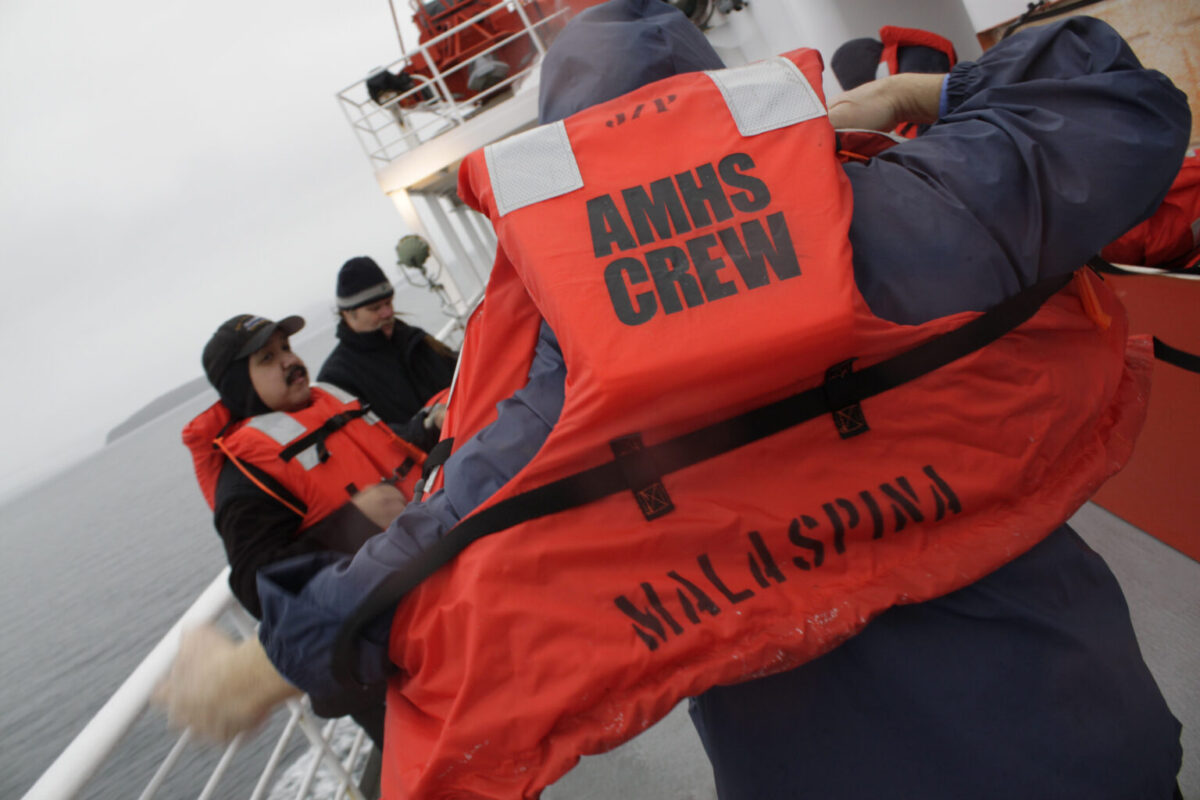
The state of Alaska is looking for someone to take the Matanuska, one of the first three ships built as part of the Alaska Marine Highway System after statehood.
In a public notice published Friday afternoon, the Alaska Department of Transportation and Public Facilities said it is now looking for “interested parties regarding the opportunities to dispose of the vessel in a manner that honors its historic significance while allowing it to continue serving Alaska in new innovative ways.”
DOT is primarily looking for people or groups interested in operating the Matanuska “as a museum vessel, maritime training ship, tourism or hospitality venue, community facility, research platform, heritage site, or other maritime or public-serving use,” according to a detailed document accompanying the public notice.
Any applicant would have to demonstrate that they have the financial resources necessary to take care of the ship.
Retired ferries are notoriously expensive to operate, and idealistic plans for other ships have repeatedly fallen apart. The former Washington state ferry Kalakala was turned into a cannery in Kodiak, recovered and towed back to Washington, but fell derelict and almost sank into a canal before being scrapped in 2015.
The Alaska ferry Taku was intended for use as a hotel after its retirement, but it ultimately ended up being scrapped in India.
The ferry Malaspina was retired by the Alaska Marine Highway System in 2022 and is now being used as housing at a cruise ship terminal in Ketchikan. The business partners behind that effort are now fighting in court over a variety of issues.
Built in 1963, the Matanuska served as an active ferry for almost 60 years and still has a gold-painted funnel indicating its status as the “Queen of the Fleet,” the oldest operating ship in state service.
Despite that honor, the Matanuska has been out of regular service for at least three years, and has been laid up in Ketchikan for use as a “hotel ship” by the ferry system. Last year, DOT officials said the ferry system lacked the money needed to return the ship to service, and they recommended fully retiring it.
Proposals for the Matanuska’s future are due to DOT by 2 p.m. April 14.
“Letters of interest proposing scrapping, dismantling, or scuttling the vessel may be submitted for informational purposes,” the agency said, but for the time being, it’s looking at ideas to reuse the ship.

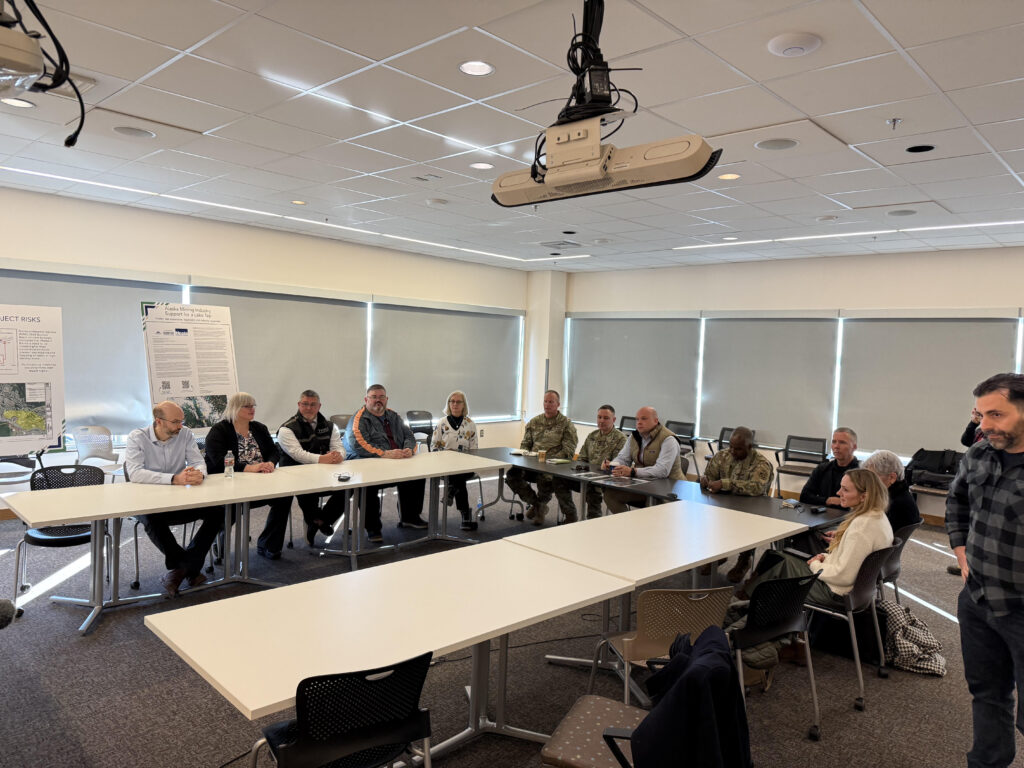
NOTN- Juneau is hosting the U.S. Army Corps of Engineers this week as the community presses for answers on long-term protections against glacial lake outburst flooding.
Mayor Beth Weldon said the Corps arrived in Juneau Monday afternoon, taking a helicopter tour to inspect the basin area and visiting the city’s HESCO barrier installations before holding formal meetings today.
At a Committee of the Whole meeting in February, City and Borough of Juneau leaders detailed new modeling that shows a worst-case glacial lake outburst flood could send an estimated 118,000 cubic feet per second of water down the Mendenhall River, far beyond anything the city has experienced.
Maps presented at the meeting showed that a maximum event could push water beyond the Central valley, crossing Riverside Drive and Mendenhall Loop Road, affecting neighborhoods on both sides of the river.
Scientists from the University of Alaska Southeast, the National Weather Service, the U.S. Forest Service, and Tribal representatives from Tlingit and Haida identified a “lake tap” of Suicide Basin as the preferred enduring solution.
During a press conference this morning, U.S. Army Corps of Engineers leaders outlined plans to expand and reinforce temporary flood barriers along the Mendenhall River while continuing to study more permanent solutions to GLOFs.
“We’re here today because we wanted to make sure that we are in tight, close communication with the local government here, ahead of the 2026 glacial outburst flood that we expect.” Said Assistant Secretary of the Army Office for Civil Works, “This is something that when I was a nominee for this position and going through Senate confirmation, Senator Sullivan called me into his office, and he very effectively impressed upon me the criticality of this issue to this community. Every time I’ve spoken about this publicly, including in a public hearing in September, and most recently in a public hearing last month, I’ve said we have to look at this short term, medium term and long term. And I’ve consistently conveyed that from the very first time I’ve ever spoken about this issue until now, short term, medium and long term. And we’ve had an outstanding discussion this morning with our Senate offices, local community leaders, and then all four levels of our Corps of Engineers organization to make sure that we’re all on the same page in terms of what we’re doing to address this challenge. And so we’ll get into some of that as the questions come but that’s really the reason we’re here.”
Officials said immediate work for 2026 includes raising existing HESCO barriers by 1 to 2 feet and extending the system by roughly 4 to 4.5 miles along both sides of the river, officials also the Corp is adding more armoring along the riverbanks and deploying pumps and technical experts to manage any water that gets behind the barriers.
Telle also mentioned a ‘Medium’ term solution, and here is what he said when asked the clarify.
“In the medium term, we’re looking at more permanent and more survivable barriers that can be implemented, as well as continuing to look at potential channel modifications. Those are all on the turn on the table for the short, medium term, we’re obviously continuing to look at long term options that will require significant technical analysis and engineering. We’re getting down that path every single day.” He said, “In my view, we can’t wait a decade to deliver, or six years, or 15 years, we can’t wait that long to deliver results for the citizens in this community, and so we’re tackling short medium with the same aggression that we’re tackling
long.”
Those potential channel modifications could look like dredging or reshaping.
“There’s been conversation within the community for years about straightening the channel. This can be done relatively quickly and for low cost. The question is, does that straightening actually just move the risk to a different part of the community? And so we want to be very careful about that. We’ve got extensive modeling underway right now.” Telle said.
The long-term solution remains under study.
“This is, I’ll just say, glacial outburst flooding is a unique challenge here in Juneau. This phenomenon that we have here is unique to the Corps of Engineers entire portfolio. I think with that uniqueness comes a lot of uncertainty from an engineering and technical perspective, and we’re trying to really reduce that uncertainty as fast as we can.” Telle said.
Telle said that among the “big universe of options” for a long-term solution, a tunnel or lake tap “at this moment appears to be the most viable technically” Still, he emphasized that no option has been taken off the table and that significant technical and cost uncertainties remain.
When asked by The Juneau Independent’s Mark Sabbatini what had changed since last month’s announcement suggesting the Army Corps had “pulled back” from the lake tap solution, officials said their position had remained consistent, saying “nothing has changed other than the reporting.”
“That’s one of the reasons we appreciate the Secretary and the Generals and the Colonel for coming here face to face.” Said Mayor Beth Weldon, “There’s not going to be a miscommunication problem at all. We appreciate their enthusiasm and dedication to a short, medium and long term solution.”
“You know, the HESCO barriers are exactly what needed to happen. They showed they were, but they also showed they were just a triage method.” Said President Richard J. Peterson of Tlingit and Haida, “We’re trying to make sure we come together. We had a charrette last year, we came together all unanimously on an enduring solution, but in the meantime, they have to do their job and look at all solutions. And I think that might have been where the miscommunication came in. It wasn’t pivoting away from this, but the messaging was, ‘we’re doing our due diligence to look at everything’. We have to turn to them. And this meeting was that opportunity for us to understand where we’re at.”
Authorities say they are mindful of the clock the community is under, and said coordination between federal agencies, the City and Borough of Juneau and tribal partners will continue as preparations accelerate in the months ahead.
And for those wondering, despite our recent poor weather, work on flood-protection infrastructure has continued.
Brotherhood Bridge has officially closed starting today for installation of Phase 2 HESCO barriers.
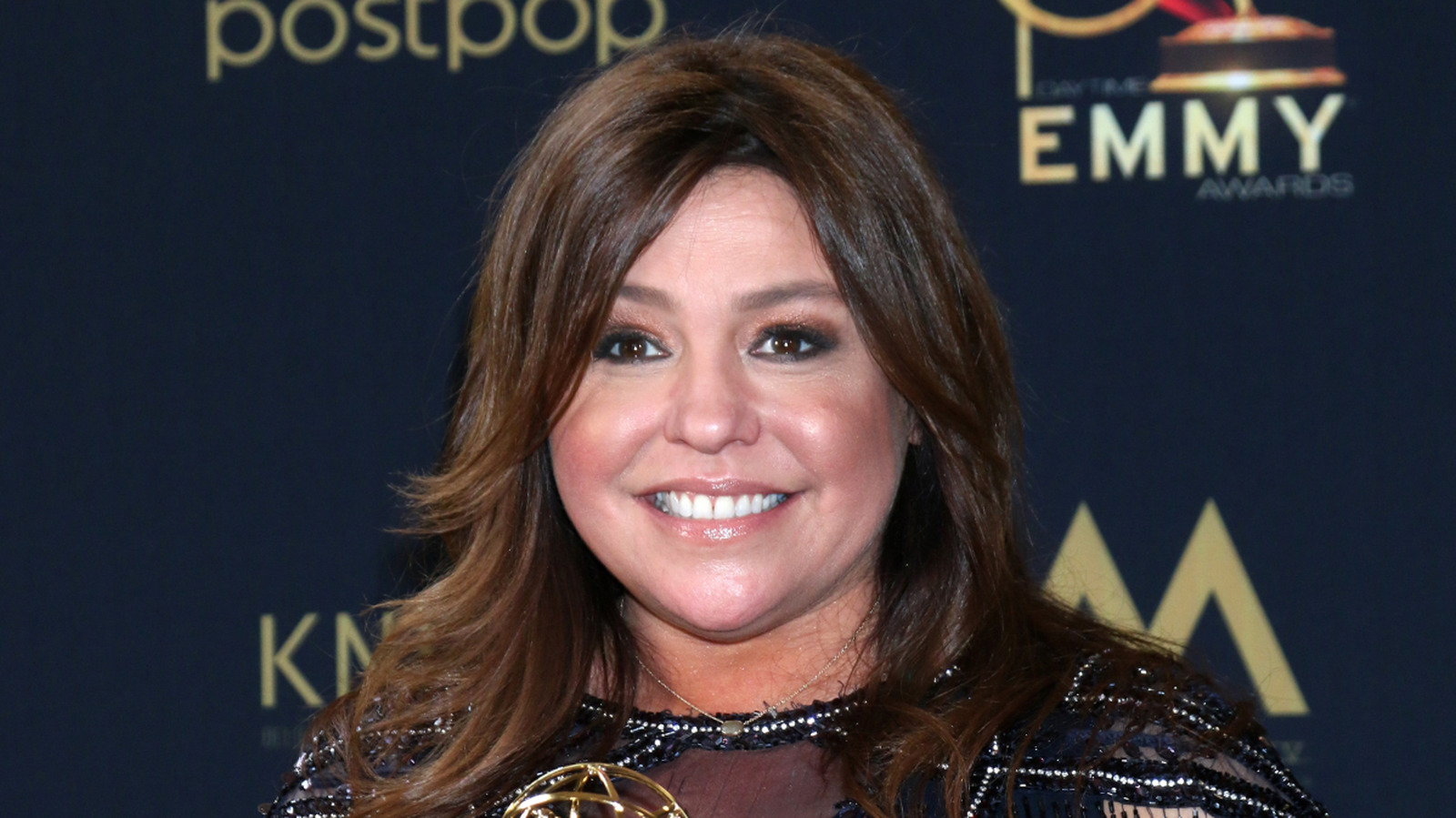
Rachael Ray is many people’s favorite celebrity T.V. chefs, but there’s a lot you don’t see on camera. This is the shadier side of celebrity Rachael Ray.

Mashed – Fast Food, Celebrity Chefs, Grocery, Reviews

Reading Time: 2 minutes
It’s time once again for the annual Sports Illustrated Swimsuit Issue.
And as usual, this year’s installment will feature some surprise cameos from celebrities who don’t typically work as beachwear models.
One such guest star is reality icon Bethenny Frankel, who is making her Sports Illustrated debut at the age of 55.
Frankel shared photos from the shoot on social media, where she looked radiant in swimwear on a sun-drenched beach backdrop.
Alongside the images, she wrote simply:
“Never too late to jump.”
Her caption quickly racked up likes and supportive comments from followers, many of whom applauded her confidence and celebrated her “powerful” and “inspiring” energy.
Celebrities and followers flooded the comments with praise:
“You’re a queen,” one fan wrote. “This is the best thing,” another added.
Others noted what Frankel’s inclusion in the issue means:
“Love seeing 50+ women in SI!” one excited commenter chimed in.
Bethenny began her relationship with Sports Illustrated when she walked the runway for their annual Swimsuit Issue runway show last summer.

But now, she’s making history by modeling for the magazine.
Frankel’s journey to this moment has been years in the making — from making a name for herself as onr of Bravo’s biggest stars to rebranding as a margarita mogul.
Stepping into the SI spotlight is a move she probably wouldn’t have predicted, but it’s also one she seems genuinely proud of.
Frankel’s appearance isn’t just a magazine feature — it’s a statement about confidence, age, and visibility in spaces that have historically skewed younger.
For many supporters, seeing her celebrated in this way is more than just a photo op, it’s a reminder that self-esteem doesn’t come with an expiration date.
Bethenny’s hot takes might make her a controversial figure on social media. But we think everyone can agree that her physique and her confidence are both worthy of admiration.
Bethenny Frankel Makes Sports Illustrated Swimsuit Issue Debut at 55 was originally published on The Hollywood Gossip.
The Hollywood Gossip

There are plenty of reasons a person might want to drink oat milk. However, one of its most-touted advantages isn’t the sure bet you may think it is.

Mashed – Fast Food, Celebrity Chefs, Grocery, Reviews

Even the strongest women have moments of doubt and fear, something that Ella Langley and Jo Dee Messina proved during their candid conversation at this year’s Country Radio Seminar (CRS). For Messina, one of her most vulnerable moments came in 2017, when she was a single mom battling cancer, longing for someone to hold her through the uncertainty.
“People are like, ‘Oh, you’re a strong woman. You’re such a strong woman.’ And I was like, ‘That doesn’t mean that mean I don’t want to be taken care of,” she told the crowd sitting quietly in the transformed ballroom space.
She went on to describe the nights she would sit on the edge of her bed, overwhelmed by loneliness the distress of going through something so difficult and wishing for someone to share the burden with. Instead, she had to dig deep, push her fears aside and be strong for her young kids.
“People were like, ‘You’re just so strong going through this.’ And I was like, I would cry and be like, ‘Jesus, I wish you had arms. I just want somebody to hold me because this is scary and lonely.’ Then people are like, ‘You’re so strong’ and I’m like, ‘You didn’t see me last night.’ I was sitting on the side of my bed going, ‘I wish somebody would go through this with me,’” she shared honestly.
This experience proves that even though from the outside, Messina might have looked tough, putting on that strong front was just her way of coping, a survival instinct born from that hardship.
“I think sometimes it’s like having to push through, people see it as, ‘oh, you want to push through and you want to push everybody away.’ And it’s like, no, actually this is a survival thing. This is how I survive,” she added.
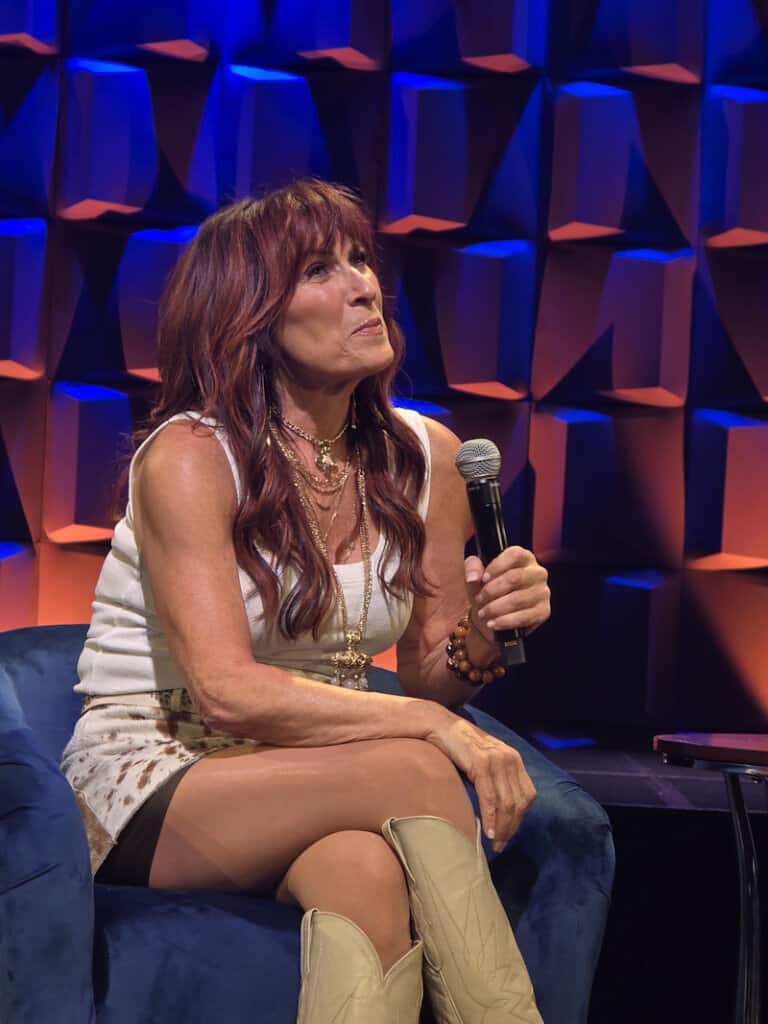
Ella Langley said she can relate to having a “tough” image, as she is often seen that way despite facing her own struggles behind the fame and success that many assume would bring only happiness. That simply is not always the reality of life in the spotlight.
“It was kind of the same thing when I moved to town. When I would come to these writes and they had an idea of who I was and wanted to write it that way and I was like, ‘Well don’t you think about stuff that way,’” she recalled. “I guess my toughness comes from more life type of things and…I don’t view myself as that way all the time. I kind of view myself as pretty goofy and weird. So it’s odd. I think so many people share their opinion about what they think of you. You’re like, ‘What? I got to work on my face,” Langley added, earning a few laughs.
She later went on to open up about her longtime mental health battles that reached an all-time low last year, forcing her to take a step back from the road for a few weeks. Both women have found different ways to cope with the hardship and a large part of that is leaning into their faith to find that true strength.
The “You Look Like You Love Me” singer noted that she is “grateful” for the journey that her faith has led her down because it has made her the person she is today.
“Last year, every day I started to read my Bible. I pulled my Bible out, had dust all over it. I had looked for it for two days and every day I was just in the word and I’m still doing that and I’m still growing it. And that’s the thing, I think with all these questions like, ‘How are you getting through this?’ It’s that. It is truly that. That is the thing that saved my life last year,” she admitted.
Once she realized that she was put here for a reason, Langley felt confident that even though there have been high highs and low lows, she is exactly where she is supposed to be in life and it’s all because she listened to that calling from above.
Messina also leaned on her faith through difficult times.
The post Jo Dee Messina Gets Vulnerable About Past Battle With Cancer During Candid Conversation with Ella Langley at CRS appeared first on Country Now.
Country Now

Taylor Sheridan captured the emotions of tragedy with unthinkable precision. That might be the problem. Continue reading…The Boot – Country Music News, Music Videos and Songs
Taylor Sheridan captured the emotions of tragedy with unthinkable precision. That might be the problem. Continue reading…Country Music News – Taste of Country

After resigning from her work with the federal government, the author sailed through the Northwest Passage with her family to conduct in-person research for a forthcoming book about wildlife response to climate change. (Photograph by Caroline Van Hemert)
A stocky brown-and-white shorebird scurried along the beach, pausing midstride to probe the mud for tiny pink clams that are a lifeline for rock sandipers and many other species that call Alaska home. Nearby, my friend and former colleague Dan Ruthrauff collected observations to enter into eBird, a public reporting platform, recording data as diligently as he had during the months we’d worked together in the field. The bird’s delicately painted breast and long, slender beak belied its remarkable hardiness; during his PhD research, Ruthrauff had shown me photographs of overwintering rock sandpipers waiting out a cold snap, their feathers ruffled and their legs encased in ice like tiny popsicle sticks. Now, while he tracked the sandpiper’s movements, I took pictures of several seabird carcasses that had washed up on the beach, documenting another of the growing number of wildlife mortality events that I’d been studying for the past decade.
We’d arrived by sailboat to this rain-drenched cove in the Shumagin Islands of southwestern Alaska, where fields of eelgrass nudged crumbling sea stacks and black-legged kittiwakes perched on steep rock walls. We weren’t there in our official capacity as biologists, but we’re always on the job when it comes to paying attention to the ecosystems and species we’ve long studied and cared for. Until recently, Ruthrauff and I were research biologists for the U.S. Geological Survey in Alaska, with more than 50 years of experience between us. Ruthrauff was a shorebird and waterfowl specialist; I focused largely on wildlife and environmental health.

We left our respective positions in April 2025 as the Trump administration’s assault on federal science reached its initial climax. This was not an easy departure, but it felt untenable to stay in the climate of hostility and uncertainty that was building at USGS and other federal agencies. My decision was cemented when I heard Doug Burgum, a billionaire businessman who had recently been appointed Secretary of the Interior, describe the country’s public lands as a “balance sheet,” with the explicit desire to profit from their development and exploitation. The Department of the Interior oversees USGS, and thus Burgum had become our highest-level boss. In his “welcome” speech, he revealed both the depths of his team’s scientific ignorance and its intent to dismantle key components of our research, with severe implications for not only our careers but the nation’s wildlife, lands, and waters.
On top of what many of my colleagues and I saw as the administration’s pro-extraction, anti-science agenda, we faced another onslaught. Over the preceding weeks, we’d received threatening emails instructing us to “turn in” our colleagues for any suspected promotion of diversity and equity initiatives, including benign programs intended to support women or underrepresented groups in science. We were informed, on a near-daily basis, that we were likely to lose our jobs and all programmatic funding, and were advised to prepare a statement to send to partners in other agencies in case we faced sudden termination. Such messages were often routed through fabricated email addresses and used demeaning, unprofessional language.
The effect was both disheartening and chilling. The federal employees I worked alongside were not rabble-rousers but committed public servants, focused on providing unbiased scientific information to help manage species and ecosystems and protect human safety. Among our collective roles, we forecasted earthquakes and other natural hazards, measured toxin levels in subsistence foods, gauged streamflow that boaters and aquatic life depend on, mitigated human-wildlife conflicts, and provided early warning for infectious diseases like avian influenza. Far from being elite academics, my colleagues worked directly for the benefit of others. In Southeast Alaska, for example, USGS scientists used decades of mapping data to identify deadly landslide hazards as the warming climate brings more intense rainfall. On the Yukon River, my colleagues investigated the crash of chinook salmon stocks that left Alaska Native communities without a critical food source and brought the commercial fishing industry to a standstill.

By spring of 2025, however, our workplace felt less like a top-tier public science institution and more like an environment intended to cultivate submission via intimidation. We were fearful of losing our jobs, or worse. As a writer and concerned citizen, I knew my ability to speak out would be compromised. And as a researcher, I couldn’t, in good conscience, abandon the scientific transparency and conservation ethics that had formed the backbone of my training.
Federal employees like me were thus left with two impossible options: stay and tolerate whatever abuse and forced complicity came next, or leave and forfeit an entire career. Some of my colleagues simply could not leave: They had hospitalized children who couldn’t risk a break in health care, single-income mortgages to pay, or elderly family members to support. Others believed that the system of law would ultimately prevail. Most did not have a second career option at the ready, yet many nonetheless lost their jobs—sometimes with a few hours’ notice, and other times with no notice at all.
Ruthrauff and I were fortunate: He was eligible for early retirement, and I had a second job as a freelance writer to fall back on, with a new book contract in the works. Still, it was a decision neither of us wanted to make. We were given less than a week to collect our belongings, sign off from projects that were years in the making, and archive as much data as we could before permanently losing access to our email.

We are among the estimated 352,000 employees who have so far been fired or left the federal workforce in response to the Trump administration’s policies. Science has been hit especially hard, with climate, environment, health, and wildlife budgets specifically targeted. Some 7,800 research grants have been frozen or terminated, and further proposed cuts could result in additional losses to programs and personnel. And although Congress is pushing back, much of the damage has already been done. With programs and staff gone and employee morale tanked, it’s simply not possible to pick up where we left off.
For all of its promised cost savings, the Trump administration’s chaotic cuts over the past year haven’t actually saved taxpayers money. The federal budget grew by $220 billion in the first hundred days of the administration compared to the same period the prior year—yet our nation has lost more than many people realize. We have long relied on weather and natural hazard forecasting for our safety; we have trusted that our national parks will be sustained in perpetuity; we have hunted, fished, and recreated with the assurance that someone is looking after our natural resources. That someone might have been me, or Dan Ruthrauff, or any of my other colleagues who took an oath of public service only to find that they were no longer able to deliver on their promises—not because they weren’t qualified or didn’t care, but because the current government has failed us all.
After resigning, I took the opportunity to sail with my husband and 9- and 11-year-old sons on our small expedition sailboat through the Northwest Passage, a goal we’d been working toward for years. The same passions that drew me to my work as a biologist have long dovetailed with my personal interests. I’d walked, paddled, skied, and sailed across much of my home state; the four-month-long sailing trip was a chance to connect the dots across the broader Arctic and to report on what I’d witnessed. Along the way, I conducted in-person research for my forthcoming book about wildlife response to climate change.
Our route passed many places familiar to me from my work as a federal biologist. I glimpsed the snow-covered peaks of the Brooks Range backing up to the Arctic Coastal Plain, where I’d lived out of a tent while studying the effects of climate-driven storm surge on nesting common eiders. We stopped in communities where I’d partnered with local residents to document the risks to wildlife and people from harmful algal blooms, an emerging environmental health issue. The landscape had changed dramatically in the two decades since I began my career. Barrier islands where I’d done fieldwork were now routinely battered by what had once been described as hundred-year storms; hungry polar bears had become regular summer visitors; and sea ice had given way to large areas of open water. We saw historical sites that had flooded and seawalls that had been breached. It was impossible not to worry about how the isolated communities in this part of the world will feel the loss of federal support when salmon fail to return or wildfires rip through boreal forests or permafrost slumps into the sea.
Ruthrauff joined us for the 800-mile sailing leg from Nome to Sand Point, both in Alaska, offering an extra set of hands and an endless source of bird facts for my curious 9-year-old. It was our first reunion since we’d exchanged hasty goodbyes while packing up our USGS offices five months earlier.
Initially, as we scanned the horizon with binoculars and washed dishes with seawater, it felt as though we’d just stepped into another field stint. Only later, as we sailed past stretches of coastline where we’d each worked did we discuss our departure. I learned that a multiyear project to investigate the impacts of climate change on Arctic-nesting geese that Ruthrauff helped organize had been halted. The research I’d been doing on harmful algal blooms no longer had a program lead or a budget. Long-term monitoring studies—on caribou, polar bears, walruses, fishes, and birds—that provide basic population inventories necessary for endangered species assessments, sustainable hunting limits, and other applications had been shelved indefinitely. Meanwhile, employees were prohibited from speaking to the media, including about topics such as avian influenza and other issues that pertain to animal and human health. Our remaining colleagues and their expertise had been effectively silenced.
Other federal programs, such as those that focused on weather forecasting, were losing funds so quickly they couldn’t perform essential public services. Those gaps would soon become evident.
We had ventured into the Bering Sea at a time when the weather gods were smiling, but before long the mood would change, with disastrous effects. Far to our west, the anomalously warm waters of the North Pacific were stirring up trouble. Three weeks later, after we’d continued south and out of harm’s way, a Category 4 storm called Typhoon Halong hit the coastal villages of Kipnuk and Kwigillingok, changing course so quickly residents weren’t able to evacuate. Survivors, many of whom are now temporarily living in my hometown of Anchorage nearly 500 miles away, have become not only climate refugees, but victims of federal funding cuts: A $20 million coastal resilience grant was canceled in the months prior to the storm, at the same time that federal weather balloons were grounded and forecasting budgets were slashed.
Though no amount of preparation could have changed the storm’s track or severity, the lack of resources and information made a bad situation worse. Rick Thoman, a longtime Alaska meteorologist, wrote that while it’s not entirely clear whether the lack of weather balloons affected the forecast, “it seems likely that that had some effect on the model performance.” Emergency funding intended to help communities respond to extreme weather events, meanwhile, is no longer available under the Trump administration. That makes the future even more uncertain for the people of Kipnuk and Kwigillingok, many of whom are attempting to maintain their cultural roots while living out of temporary accommodations in the state’s biggest city.
These are not scientists or disgruntled employees, but real people feeling the real effects of a federal workforce in crisis. It doesn’t take a PhD to recognize that these and other losses will reverberate for decades to come, and that the true price of dismantling our federal science programs is far higher than any supposed cost-cutting measures have saved.
On the last day before we dropped Ruthrauff in the Unangax̂ community of Sand Point, where I’d spent one frigid December chasing sea ducks as a USGS employee, we did a final eBird survey. It was a drizzly afternoon with fickle sailing conditions, gusty one minute, dead calm the next. Ruthrauff sat in the cockpit with binoculars trained on the jumpy horizon; I held onto an overhead rail and steered through the waves.
As we called out our sightings—sooty shearwater, common murre, black-legged kittiwake—we knew that these observations were nothing more than lone data points in a sea of information needs. But we also knew that even the most seemingly mundane reports, taken together, can provide valuable insight. Public data platforms such as eBird will never replace detailed monitoring studies, but in the absence of federal support, having extra eyes on the water, in the sky, and in the trees might help fill some of the gaps.
Turning our collective attention to the natural world also offers the sort of inspiration we need in a time of crisis. From hardy rock sandpipers waiting out a deep freeze to the millions of seabirds that survived Typhoon Halong, we need look no farther than our own backyards to find examples of resilience. We, too, must find a way to weather this storm.
This commentary was originally published in BioGraphic Magazine and is republished here with Permission.
SUBSCRIBE: GET THE MORNING HEADLINES DELIVERED TO YOUR INBOX