NOTN- Juneau is hosting the U.S. Army Corps of Engineers this week as the community presses for answers on long-term protections against glacial lake outburst flooding.
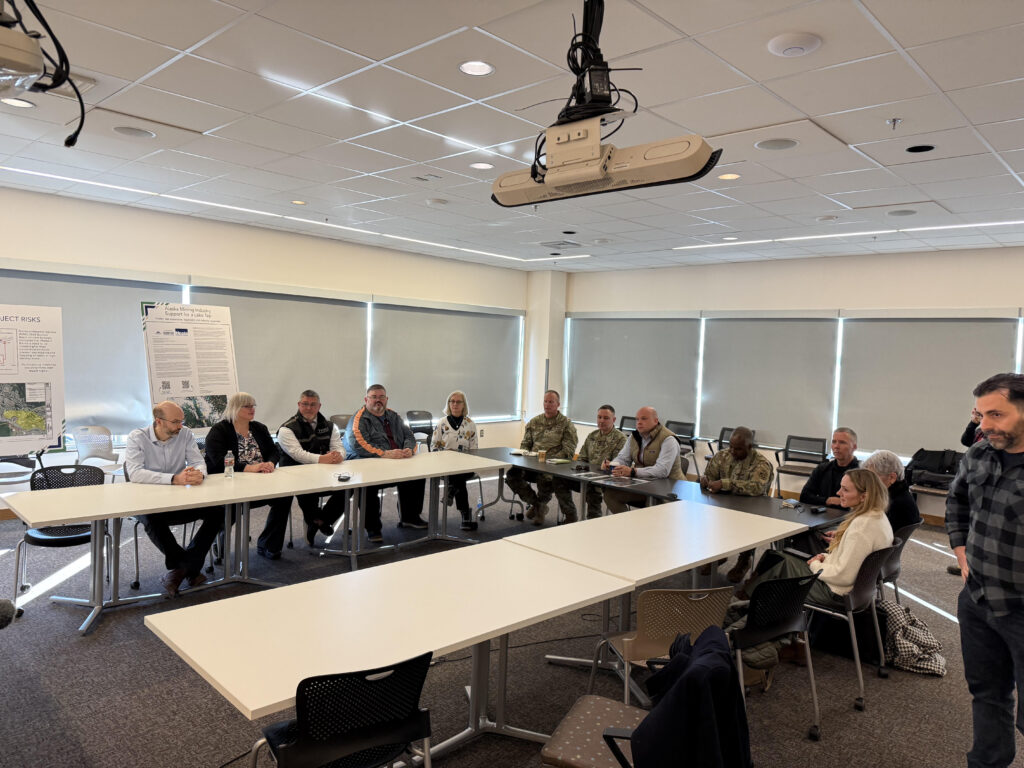
Mayor Beth Weldon said the Corps arrived in Juneau Monday afternoon, taking a helicopter tour to inspect the basin area and visiting the city’s HESCO barrier installations before holding formal meetings today.
At a Committee of the Whole meeting in February, City and Borough of Juneau leaders detailed new modeling that shows a worst-case glacial lake outburst flood could send an estimated 118,000 cubic feet per second of water down the Mendenhall River, far beyond anything the city has experienced.
Maps presented at the meeting showed that a maximum event could push water beyond the Central valley, crossing Riverside Drive and Mendenhall Loop Road, affecting neighborhoods on both sides of the river.
Scientists from the University of Alaska Southeast, the National Weather Service, the U.S. Forest Service, and Tribal representatives from Tlingit and Haida identified a “lake tap” of Suicide Basin as the preferred enduring solution.
During a press conference this morning, U.S. Army Corps of Engineers leaders outlined plans to expand and reinforce temporary flood barriers along the Mendenhall River while continuing to study more permanent solutions to GLOFs.
“We’re here today because we wanted to make sure that we are in tight, close communication with the local government here, ahead of the 2026 glacial outburst flood that we expect.” Said Assistant Secretary of the Army Office for Civil Works, “This is something that when I was a nominee for this position and going through Senate confirmation, Senator Sullivan called me into his office, and he very effectively impressed upon me the criticality of this issue to this community. Every time I’ve spoken about this publicly, including in a public hearing in September, and most recently in a public hearing last month, I’ve said we have to look at this short term, medium term and long term. And I’ve consistently conveyed that from the very first time I’ve ever spoken about this issue until now, short term, medium and long term. And we’ve had an outstanding discussion this morning with our Senate offices, local community leaders, and then all four levels of our Corps of Engineers organization to make sure that we’re all on the same page in terms of what we’re doing to address this challenge. And so we’ll get into some of that as the questions come but that’s really the reason we’re here.”
Officials said immediate work for 2026 includes raising existing HESCO barriers by 1 to 2 feet and extending the system by roughly 4 to 4.5 miles along both sides of the river, officials also the Corp is adding more armoring along the riverbanks and deploying pumps and technical experts to manage any water that gets behind the barriers.
Telle also mentioned a ‘Medium’ term solution, and here is what he said when asked the clarify.
“In the medium term, we’re looking at more permanent and more survivable barriers that can be implemented, as well as continuing to look at potential channel modifications. Those are all on the turn on the table for the short, medium term, we’re obviously continuing to look at long term options that will require significant technical analysis and engineering. We’re getting down that path every single day.” He said, “In my view, we can’t wait a decade to deliver, or six years, or 15 years, we can’t wait that long to deliver results for the citizens in this community, and so we’re tackling short medium with the same aggression that we’re tackling
long.”
Those potential channel modifications could look like dredging or reshaping.
“There’s been conversation within the community for years about straightening the channel. This can be done relatively quickly and for low cost. The question is, does that straightening actually just move the risk to a different part of the community? And so we want to be very careful about that. We’ve got extensive modeling underway right now.” Telle said.
The long-term solution remains under study.
“This is, I’ll just say, glacial outburst flooding is a unique challenge here in Juneau. This phenomenon that we have here is unique to the Corps of Engineers entire portfolio. I think with that uniqueness comes a lot of uncertainty from an engineering and technical perspective, and we’re trying to really reduce that uncertainty as fast as we can.” Telle said.
Telle said that among the “big universe of options” for a long-term solution, a tunnel or lake tap “at this moment appears to be the most viable technically” Still, he emphasized that no option has been taken off the table and that significant technical and cost uncertainties remain.
When asked by The Juneau Independent’s Mark Sabbatini what had changed since last month’s announcement suggesting the Army Corps had “pulled back” from the lake tap solution, officials said their position had remained consistent, saying “nothing has changed other than the reporting.”
“That’s one of the reasons we appreciate the Secretary and the Generals and the Colonel for coming here face to face.” Said Mayor Beth Weldon, “There’s not going to be a miscommunication problem at all. We appreciate their enthusiasm and dedication to a short, medium and long term solution.”
“You know, the HESCO barriers are exactly what needed to happen. They showed they were, but they also showed they were just a triage method.” Said President Richard J. Peterson of Tlingit and Haida, “We’re trying to make sure we come together. We had a charrette last year, we came together all unanimously on an enduring solution, but in the meantime, they have to do their job and look at all solutions. And I think that might have been where the miscommunication came in. It wasn’t pivoting away from this, but the messaging was, ‘we’re doing our due diligence to look at everything’. We have to turn to them. And this meeting was that opportunity for us to understand where we’re at.”
Authorities say they are mindful of the clock the community is under, and said coordination between federal agencies, the City and Borough of Juneau and tribal partners will continue as preparations accelerate in the months ahead.
And for those wondering, despite our recent poor weather, work on flood-protection infrastructure has continued.
Brotherhood Bridge has officially closed starting today for installation of Phase 2 HESCO barriers.