An investigation has been launched into the “unexplained” death of an 11-year-old girl.The Latest News from the UK and Around the World | Sky News










An investigation has been launched into the “unexplained” death of an 11-year-old girl.The Latest News from the UK and Around the World | Sky News

A man who inflicted “life-changing” injuries on a neighbour in a savage knife attack amid a row over a parking space has been jailed for more than seven years.The Latest News from the UK and Around the World | Sky News

A bill that would force the US Justice Department to release all of its files on Jeffrey Epstein will be sent to the desk of Donald Trump after both houses of Congress gave it the all-clear.The Latest News from the UK and Around the World | Sky News
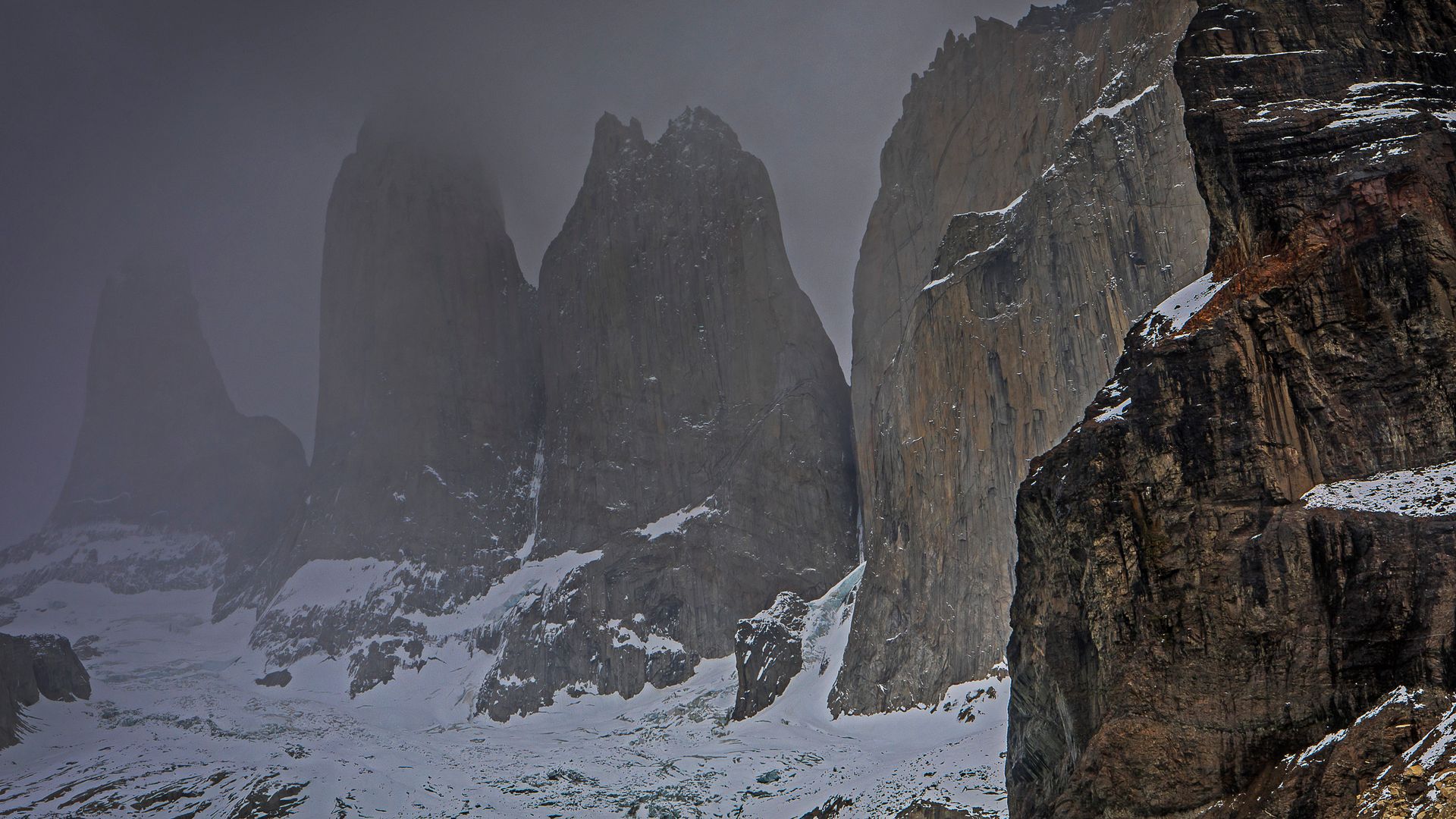
A British woman is among five people who died after severe weather struck Chile’s Patagonia region, officials have confirmed. The Latest News from the UK and Around the World | Sky News

A man has been charged with further offences following a mass train stabbing in Huntingdon earlier this month.The Latest News from the UK and Around the World | Sky News

The rate of inflation has eased to 3.6%, according to official figures that make for better reading for the economy and chancellor ahead of the budget.The Latest News from the UK and Around the World | Sky News

Amber and yellow weather warnings for snow and ice are in place across the country, with some parts already hit by freezing temperatures and heavy snowfall.The Latest News from the UK and Around the World | Sky News


NOTN- The Juneau Man who was knocked unconscious during an arrest in July is now suing the city and Former JPD Officer Brandon LeBlanc, alleging he used excessive force.
The case was opened November 13, and assigned to Judge Amanda Browning according to court documents.
Christopher Williams Jr. is represented by attorney Jeffrey Barber.
No response from the City and Borough of Juneau or Brandon LeBlanc has been filed in the publicly available record as of November 18.
The video of the arrest was posted to social media, prompting widespread public outcry, from city leaders, Tlingit and Haida, and even prompting peaceful protest as well as policy and training reforms within the Juneau Police Department.
Williams was medevaced to Anchorage after being taken to the ground outside the Douglas Library.
A GoFundMe was set up for Williams’ recovery in August and raised $4,692.
LeBlanc resigned from the department a day before the body camera footage was released, and the state office of special prosecutions did not file criminal charges.
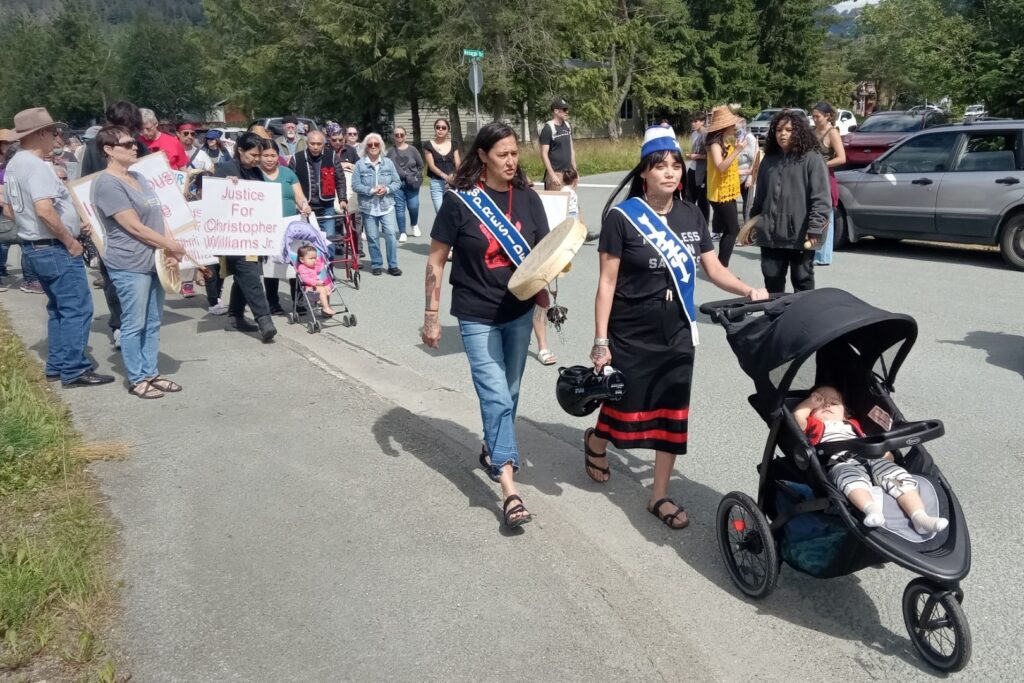
Nearly 100 protesters peacefully called for accountability and systemic police reform following his arrest with organizer Jamiann S’eiltin saying the incident reflects a broader pattern of violence against Indigenous people.
“This isn’t something new,” S’eiltin said in July. “This has been going on since almost time immemorial, since the arrival of Western European settlers. So, just want to put that out there that we are brutally attacked 10 times more than the national average.”

NOTN- City Officials said the next Juneau Assembly meeting on Monday featured lively discussion on ranked choice voting, a proposal that has drawn significant public comment.
The ordinance was discussed back in August and residents have been vocal about the topic.
Ranked choice voting allows voters to rank candidates in order of preference rather than selecting just one. “If your top choice doesn’t win, your vote still counts for your second choice,” said Deputy City Manager Robert Barr, “That’s the argument for ranked choice voting.”
Mayor Beth Weldon said Tuesday that the city will not move forward with adopting ranked-choice voting for municipal elections, following significant public testimony and a divided response from residents.
Although last night’s agenda was relatively light, Weldon said the proposed voting change drew the most attention.
“Ultimately, Ms. Atkinson tabled this indefinitely, which in one sense kind of kills it for a while,” Weldon said. “There are reasons for and against in in our emails that we got, there’s definitely people on both sides.”
Residents opposed to adopting ranked-choice voting cited concerns about cost, delays in results, and a desire to maintain what they described as a simpler system. Those who supported the change argued that it encourages more candidates to run and reduces fears of splitting the vote.
Juneau will continue using its current municipal voting system, while Alaska’s statewide ranked-choice system remains in effect, though repeal efforts are ongoing.
By: Corinne Smith, Alaska Beacon

Alaska legislators with the state Joint Armed Services Committee are raising concerns that a federal directive to prepare the Alaska National Guard to deploy domestically for civil unrest could divert service members from disaster relief efforts.
In October, the Pentagon ordered all states to prepare the National Guard to be trained for “civil disturbance operations,” according to an internal directive first reported by the Guardian.
A spokesperson said the Alaska National Guard has received the directive to prepare a 350 member “quick reaction force” by Jan. 1, but said the state’s National Guard has not begun any specific training outside typical readiness training.
“This mission requirement does not impact our support to ongoing Typhoon Halong response operations, and we continue to meet all state and federal mission requirements,” said Dana Rosso, a public affairs officer for the Alaska National Guard, via email.
Rep. Andrew Gray, D-Anchorage, is co-chair of the Alaska Joint Armed Services Committee, and a veteran of the Alaska National Guard. He said he’s concerned about the possibility of a quick response force being used to quell “civil unrest” in Alaska and across the country.
“The fear is, of course, that when you have a tool, an expensive tool, at your disposal, that you’re going to find a reason to use it. And so I think the fear about having this quick response force locked and loaded is that they could be used when it’s inappropriate to use them,” he said. “Peaceful protest would be the perfect example.”
The federal directive said National Guard members should be training in crowd management and riot control, including the use of batons, body shields, Tasers and pepper spray.
Lawsuits, protests and federal courts have repeatedly challenged and barred the Trump administration deploying National Guard troops to American cities to assist police and immigration enforcement, asserting it is illegal and an abuse of executive powers.
Additionally, an estimated 200 Alaska service members are now deployed to assist with disaster relief efforts one month after the devastation of Typhoon Halong, officials said. It’s deemed the largest off-the-road system response by the National Guard in the state’s history.


Gray and committee co-chair Sen. Scott Kawasaki, D-Fairbanks, sent a letter expressing concerns to Maj. Gen. Torrence Saxe, Adjutant General of the Alaska National Guard, who is also Commissioner of the Alaska Department of Military and Veterans Affairs.
“The broad and vague nature of this mandate raises serious questions about its intent and implications, particularly regarding the potential use of these forces in domestic law enforcement situations,” the letter said, in part.
Gray published an op-ed in the Anchorage Daily News on Monday saying the committee has yet to receive a response from Maj. Gen. Saxe about the Alaska National Guard’s plans.
Gray served for nine years in the Alaska Army National Guard as a medical provider, and deployed to Kosovo in 2019. He commended the agency’s work and unprecedented disaster relief effort.
“I don’t want to disregard the enormous amount of stress and pressure on them right now for this particular disaster response,” Gray said. “That may very well be a valid reason why they haven’t been able to meet to discuss this issue. But that would be really good and reassuring information for the public.”
Gray said he’s requested a meeting with the leadership of Alaska National Guard for an update, but so far his questions have not been answered.
“Most importantly,” he said, “under what circumstances does our leadership in Alaska expect to be utilizing this force?”
Leaders with the Alaska National Guard declined repeated interview requests. Gov. Mike Dunleavy’s office also did not respond to questions about what circumstances would trigger the deployment of the quick response force, whether in Alaska or nationally, or the concerns raised in the legislators’ letter to Commissioner Saxe.
In an email, Rosso said that preparing a reaction force is not a new mission for the National Guard. “It has existed for two decades as a rapid-response capability designed to assist civil authorities when requested by a governor. Each state’s NGRF (National Guard Reaction Force) is organized as a temporary task force under state control and can respond quickly to protect lives, property, and critical infrastructure,” he wrote.
Rosso said the Alaska National Guard has not begun any specific training, but that some readiness tasks “such as security operations and initial protective equipment training,” are already part of the National Guard’s ongoing training. He said they are conducting an inventory on equipment and weapons listed in the memo, like Tasers, batons and pepper spray.

“Many units already use authorized protective equipment and training devices as part of their annual readiness training. Before making any new equipment purchases, we are assessing what capabilities already exist,” he wrote.
Rosso said the Alaska National Guard had no further communication from the Pentagon on the mission of the National Guard response force. “We have not received any official taskings for NGRF support or deployment,” he said.
The Oct. 8 memo signed by Maj. Gen. Ronald Burkett, the director of operations for the Pentagon’s National Guard Bureau, orders all states to prepare National Guard forces, totaling 23,500 troops nationwide, to be ready within a 24 hour notice. The memo cites Trump’s executive order to address the “crime emergency” in Washington D.C., which has come under intense criticism and legal challenges, which has continued as more troops were mobilized to Los Angeles, Memphis, Portland and Chicago.
Retired Lt. Colonel Daniel Maurer, a veteran active-duty Army officer and former Judge Advocate General, testified on the topic to the Alaska Joint Armed Services Committee on Wednesday. He is now an associate professor of law at Northern Ohio University.
But Maurer said none of the Trump administration’s justifications for the order are legally accurate, because he says they’re not based on credible, factual evidence.
The Trump administration has claimed illegal immigration is a national security threat, and troops are needed in U.S. cities for illegal immigration enforcement, as well as to combat protesters accused of being part of “Antifa” or a “domestic terrorist threat.”
“As a result, the military is being ordered in situations where they lack sufficient training and sensitivity to the constitutional rights and protections of those civilian protesters,” he said. “It puts soldiers in terribly awkward positions where they must act like police, and police fellow Americans on American civil streets.”
The remarks were part of a broader discussion at the committee hearing on constitutional concerns and politicization of the U.S. Department of Defense policies and actions in 2025.
The military is prohibited from enforcing civilian law under the Posse Comitatus Act, unless authorized by Congress or by the U.S. Constitution. Only under the Insurrection Act can the president deploy the military to suppress an insurrection.
Maurer said there is no evidence of such a need. “It is extreme, especially what is predicated on flat out lies. The triggers that these laws are based on aren’t being triggered. They’re just not happening on the ground. Court after court after court have said it’s not,” he said, adding that troops are being used to intimidate protesters.
“There was no problem to fix with the military,” Maurer said. “It is simply an effort to show force — muscular, robust camouflage, armed force — to show protests, because this president does not like protests.”
Gray said he’s also worried about the National Guard intimidating voters around the 2026 midterm elections, including in Alaska. He pointed to Trump’s criticism of recent elections won by Democrats, and a social media post falsely calling California’s elections approving redistricting by mail-in voting “rigged.” There’s no evidence the National Guard was involved or used to intimidate voters in recent elections this month, and the memo does not call for such use.

Gray said he’s also concerned that the National Guard would assist in immigration enforcement operations in Alaska like it already has in other parts of the country, especially as the Trump administration has revoked protections and legal status for refugees, like Ukrainians fleeing from war.
“People are afraid to leave their homes. We’ve heard these stories about folks who have to have food brought to them. You know, they won’t even go to the grocery store because they see things happen, like what happened in Fairbanks with the woman literally going to the grocery store and being picked up off the street by ICE,” he said, referring to a Fairbanks woman and mother of six detained by ICE for two months over her immigration status, and recently released.
Gray said based on his own National Guard experience, he also questions whether 350 Alaska service members will be available for rapid deployment. He said in 2019 Alaska was not able to coordinate the 220 service members called on to deploy to Kosovo, so he said others were recruited from Wyoming. “So I’m curious about how easy it would be to do 350 at a moment’s notice,” he said. “Without having it have an impact on folks, families, jobs, etc.”
But his main concern is for transparency about where, when and why Alaska service members could be called to respond to civil unrest.
“Again, we need to be able to ask those questions,” Gray said. “We need to find out what our leaders in Alaska’s interpretation of the use of that quick reaction force is. How will it be used here? How will it not be used here?”
