The boss of the communications regulator fears sport will lose out on female stars because of online abuse – and is urging social media companies to adopt recommendations to clean up their platforms.The Latest News from the UK and Around the World | Sky News
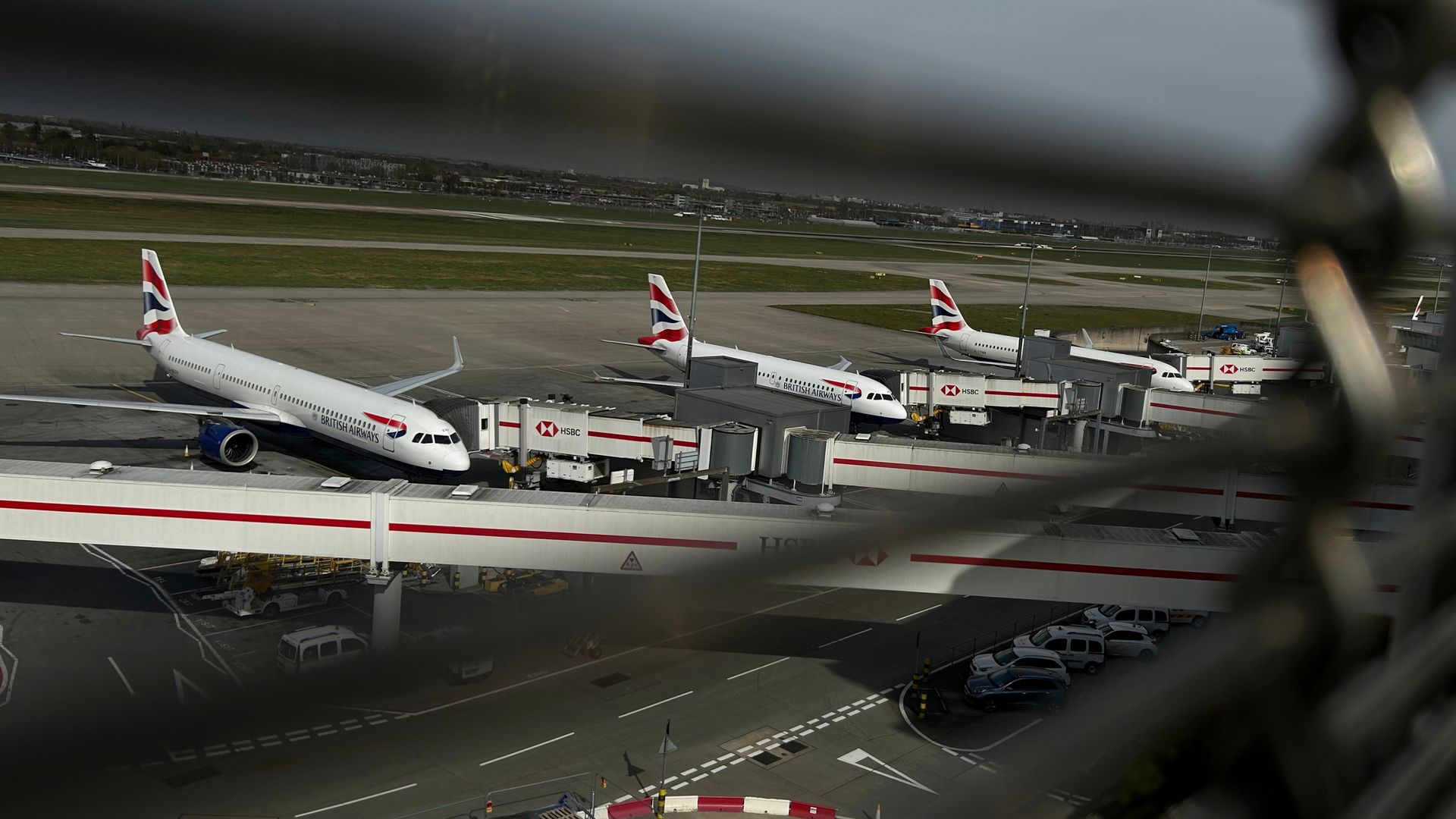
Heathrow’s £33bn plan for a third runway has been chosen as the plan to expand the airport, Transport Secretary Heidi Alexander has announced.The Latest News from the UK and Around the World | Sky News
The Gaza Humanitarian Foundation (GHF), a controversial US and Israeli-backed aid distribution group, has said it will permanently cease operations.The Latest News from the UK and Around the World | Sky News
The boss of British Gas’s parent company has said he would be happy to pay more tax as he called for levies on bills to be removed and transferred to general taxation.The Latest News from the UK and Around the World | Sky News
Father Ted creator Graham Linehan has been cleared of harassment against a trans activist but guilty of criminal damage to their phone.The Latest News from the UK and Around the World | Sky News
The offices of the Alaska Permanent Fund Corp. are seen Monday, June 6, 2022 in Juneau, Alaska. (Photo by James Brooks/Alaska Beacon)
Craig Richards, a longtime member of the board in charge of the Alaska Permanent Fund Corporation, has been replaced.
On Monday afternoon, Gov. Mike Dunleavy announced he had selected Ralph Samuels, a former state legislator, businessman and tourism expert, to serve on the board in a public seat formerly occupied by Richards, whose term was slated to expire this year.
The board directs Alaska’s $85 billion Permanent Fund, whose investments are the source of more than 60% of the state’s general-purpose revenue. That money is used annually for services and the annual Permanent Fund dividend.
Richards had served on the board since 2015, first under then-Gov. Bill Walker, and then under Dunleavy, who appointed him to a four-year term as a public member of the board in 2021.
Richards did not immediately answer a message left on his cellphone. It was not immediately clear whether he had sought another term but was passed over by the governor.
Samuels also did not immediately answer a message left on his cellphone.
A statement announcing Samuels’ appointment did not include a comment from Richards or note his departure.
Of Samuels, the governor said, “He is a lifelong Alaskan with an innate understanding of our state’s business and political landscape. As a Trustee he will bring that experience and insight to managing Alaska’s sovereign wealth fund not only for today, but for future generations of Alaskans.”
Under Richards, who chaired the Board of Trustees from 2018 through 2022, the board launched a controversial in-state investment program that has yet to deliver positive results.
The board in recent years has also intensified its warnings about the threat that the fund may run out of spendable money in the coming years.
An analysis paper commissioned during Richards’ time on the board suggests that a constitutional amendment may be needed to change the Permanent Fund’s structure to firmly cap the amount of money that may be spent from the fund and to consolidate the fund’s current two-account structure.
U.S. Coast Guard Cutter Healy (WAGB-20) arrives at Pier 46 on Coast Guard Base Seattle, Oct. 26, 2025. The crew of the Healy transited over 20,000 miles, supporting Operation Arctic West Summer and Operation Frontier Sentinel, protecting U.S. sovereign rights and territory, and promoting national security in the Arctic. (U.S. Coast Guard photo by Lieutenant Christopher Butters)
On a dreary November day in Seattle, the U.S. Coast Guard put its past and future on display.
Within sight of the Space Needle, three eye-catching red icebreakers towered over Pier 36. It was the first time since 2006 that the Coast Guard has had three active icebreakers in the same place at the same time.
In the coming years, that scene will become more common, and not just in Seattle. After years of underfunding, the Coast Guard’s icebreaker fleet is undergoing a massive expansion, with almost $9 billion for new ships.
On Tuesday, the U.S. government signed the Icebreaker Collaboration Effort — or ICE Pact — a three-nation agreement with Finland and Canada that will see some of those ships built in Finland, whose shipyards will train Americans to build more.
“It’s an exciting time to be a polar icebreaker sailor,” said Capt. Jeff Rasnake, commanding officer of the Polar Star, America’s only heavy icebreaker.
So many ships are about to join the Coast Guard’s fleet that the agency isn’t yet sure where it will put them all. The Coast Guard has earmarked millions for a port expansion in Seattle to accommodate three heavy icebreakers, plus another $300 million for Juneau to serve as a port for a medium icebreaker.
More space will be needed on top of that, and Sen. Dan Sullivan, R-Alaska, said his intent is to have as many of the new ships based in Alaska as possible.
“We want home port decisions on these icebreakers sometime in early 2026,” he said. “That is my goal.”
Eric Boget, a research engineer aboard the U.S. Coast Guard Cutter Healy (WAGB 20), prepares to throw a grappling hook to recover an Arctic Mobile Observing System (AMOS) mooring while Healy operating in the Arctic Ocean, July 21, 2025. Boget is a member of the scientific research team recovering data from the AMOS moorings. (U.S. Coast Guard Photo by Petty Officer 3rd Class Chris Sappey)
The need for new icebreakers is clear: As the Earth warms amid climate change, no place is warming faster than the Arctic. Melting ice is opening new routes for shipping, places to mine and drill, and seas to fish or view from the deck of a cruise ship.
In many cases, control of those new routes is being disputed among nations.
“Right now, things are heating up in the Arctic, and not just on the ice,” said Capt. Kristen Serumgard of the icebreaker Healy.
Russia is expanding its military presence in the Arctic, including with icebreakers, and as NATO confronts Russian aggression in Europe, there’s been international concern that the United States and NATO should be prepared to match Russia in the Arctic as well.
China is operating significant numbers of icebreakers in the Arctic, as are European nations, each interested in maintaining their right to access the area.
“It’s a geopolitical hotbed up there,” Serumgard said.
Rasnake, who typically works in the comparatively calm Antarctic, said that “with lines being drawn and a lot of different contested (seafloor) land claims, it’s — I wouldn’t say the wild, wild West, but maybe the wild, wild North.”
Shipping traffic through the Arctic Ocean is on the rise, with more ships traveling Russia’s Northern Sea Route and the Canadian-American Northwest Passage each summer.
As yet, the Northwest Passage isn’t regularly used by commercial shipping, said Steve White, executive director of the Marine Exchange of Alaska, which monitors the area for safety risks.
While that’s the case, “we are seeing a trend of more and more traffic, though, going through the Bering Straits, both on the US side and on the Russian side,” he said.
With more ships comes more risk. On Sept. 6, the Dutch cargo ship Thamesborg ran aground in Franklin Strait, part of the Northwest Passage. The accident didn’t release any pollution and no one was injured, but it took 33 days for the ship to be freed and sent on its way.
The Northwest Passage and the Northern Sea Route each funnel through the Bering Strait, which is split between American and Russian control.
“The reason this is so important for people to understand is that the Bering Strait — you’ve only got about (51) miles between the US and Russia, and you have the biodiversity, the wildlife that’s there,” White said. “This comes at a time where we’re getting more storms, the communities are struggling up there with food security and the top priority, the salmon returns … the fabric of our Alaskan communities up there is under threat, and it’s under threat from what’s going on with the weather changing and increased traffic.”
The U.S. Coast Guard is the federal government’s nautical Swiss Army knife — it performs rescue operations, enforces fishing laws, stops drug smugglers, runs border patrols, performs safety inspections, anti-pollution patrols, counter-piracy patrols, and enforces America’s maritime laws.
The U.S. Navy runs submarines under the Arctic ice, but it doesn’t operate icebreakers. It leaves the Coast Guard to do that — on the Great Lakes, on American rivers, and in the Arctic and Antarctic.
But for years, the national icebreaker fleet has been underfunded.
When Nome, home to the endpoint of the Iditarod Trail Sled Dog Race, ran short of fuel in 2012, the U.S. Coast Guard struggled to muster a single icebreaker, the Healy, to escort a Russian icebreaking tanker to the town.
At the time, the Healy was the Coast Guard’s lone operating icebreaker. Soon afterward, it reactivated the Polar Star, which had been mothballed because it was old and needed maintenance.
While both ships continue to operate, they’re less capable than modern ships and have suffered mechanical breakdowns, some significant.
Last year, the Healy caught fire and had to abbreviate its summer patrol. While it returned to service in the fall and went on to discover a volcano-like mountain on the Arctic seafloor, it’s now due for an extended period of maintenance.
“She’s 25 years old and been breaking ice for 25 years, right? That is hard on a ship,” Serumgard said.
The U.S. Coast Guard Cutter Storis uses dynamic positioning to maintain its position near the Johns Hopkins Glacier in Glacier Bay National Park and Preserve, Alaska, Aug. 5, 2025. (U.S. Coast Guard photo by Petty Officer 3rd Class Ashly Murphy)
Two American icebreakers in the Arctic Ocean in 2025
If America’s icebreaking fleet is near a low ebb, this summer saw the first steps toward the planned resurgence.
As a stopgap until new ships arrive, Congress last year ordered the purchase of the Aiviq, an oilfield services ship designed to work in the Arctic Ocean.
Eight years ago, following a disaster that saw the Aiviq lose control of a drilling rig during a storm, the Coast Guard deemed the ship “not suitable for military service without substantial refit.”
Since then, the ship has been overhauled and the Coast Guard’s opinion has changed.
After Congress appropriated the money, the Coast Guard purchased the Aiviq, quickly converted it, and in August this year, commissioned it as the icebreaker Storis.
At the time of that commissioning, commanding officer Capt. Corey Kerns said the ship and its crew would “need to learn to crawl” before they could get fully up and running.
In addition, there were unanswered questions about how well the Storis would handle the kinds of storms that troubled the Aiviq.
In October, Kerns sat down for another interview after returning from the Arctic.
“One of the things that kind of surprised me was that it went smoother than maybe I would have expected,” he said.
“She was able to perform, get through the whole thing without any major issues,” Kerns said of the ship’s first patrol.
As a result, Kerns felt confident enough to guide the Storis into the Arctic Ocean, where it worked with the icebreaker Healy to shadow two Chinese research ships in parts of the ocean that the United States claims.
If China and Russia are present in the region, it behooves the United States to be there too, Kerns said in August.
“The ability to be present guarantees your ability to to maintain sovereignty. And that’s what we’re trying to get at here in the Arctic. We need more icebreakers to be present in our waters and be clear what is our waters,” he said.
The Coast Guard cutter Waesche, a “thin-hulled” ship, also monitored the Chinese ships. Both it and the Storis participated in Arctic Edge 2025, a military training operation near the Russian border that also included Canadian forces.
Coast Guard Chief Petty Officer Kevin Rambo gives a demo of a machine gun aboard the Coast Guard icebreaker Storis on Nov. 12, 2025, in Seattle. Four were mounted on the new Coast Guard icebreaker after its acquisition from a private offshore oilfield services company. (Photo by Tom Banse/For the Alaska Beacon)
There’s still work to be done with the Storis, Kerns said. It hasn’t been certified to host Coast Guard helicopters yet, and it hasn’t done a full icebreaking test.
“We got into the ice and we showed that she could break flat ice to some extent, at certain speeds, but … probably not a fully worthy test of capability in the ice, so we’re discussing that now,” he said.
Thirteen years ago, the Aiviq lost control of the drilling rig Kulluk, causing it to run aground on Kodiak Island. That disaster took place after rough seas flooded the Aiviq’s fuel tanks and caused it to lose power.
This summer, as the Storis sailed across the Gulf of Alaska, it again encountered rough seas.
“There were a few nights where you didn’t sleep as well, but it was perfectly safe,” Kerns said.
He said his crew are already overhauling equipment and preparing for next summer in the Arctic, working in conjunction with the Healy.
“We know more about the surface of the moon than we know about the seafloors, so it’s kind of a really amazing area of exploration,” Serumgard said.
En route back to Seattle, the Healy was diverted to help search and rescue efforts in Southwest Alaska following Typhoon Halong, which devastated the region and left hundreds of people homeless.
In Seattle, the Polar Star was preparing to leave on a five-month roundtrip to Antarctica, where it will help supply research outposts across that continent.
Rasnake said he believes the Polar Star is in the best shape it’s been since being reactivated in 2013, and he looks forward to it possibly breaking the record of the most Antarctic missions by any Coast Guard icebreaker. That would come — if all goes well — in December 2026 or January 2027.
The U.S. Coast Guard icebreaker Polar Star is seen in Seattle on Nov. 12, 2025. (Photo by Tom Banse/For the Alaska Beacon)
A huge expansion of the fleet is on the horizon
If the Polar Star does break that record, it may not have many opportunities to expand on it. The Coast Guard’s first new heavy icebreaker since the Polar Star is now under construction in Mississippi.
Named the Polar Sentinel, it’s expected to be complete by 2030. The Republican-backed budget plan that President Donald Trump nicknamed the “Big Beautiful Bill” includes funding for two other heavy icebreakers after the Sentinel.
Thirteen other icebreakers were funded in that bill, said Sullivan, the Alaska senator.
“There’s funding for three to four Arctic Security mediums. Those are the target ones for our state. And then there’s 10 light icebreakers. Those are smaller. Those do work in the Great Lakes and other things like that,” he said.
The medium icebreakers, known as “Arctic Security Cutters,” are among 11 planned ships being built by two separate industry groups. Canada’s Davie Shipbuilding is planning to build five ships — two in Finland, and then three at a to-be-expanded Texas shipyard.
The second group, which includes American, Canadian and Finnish firms, will build two ships in Finland and a third simultaneously in the United States, then build three others in the United States.
The first five ships are expected to be delivered to the Coast Guard within 36 months of a contract being signed, meaning they could be patrolling the Arctic Ocean before the end of the decade.
The newly commissioned Storis will also need upgrades to complete its conversion from a civilian ship. First on the docket may be additional military communications gear, but Kerns said the Coast Guard is also considering how to fit more crew aboard.
In the longer term, Kerns — who has a nautical engineering background — is working with his crew on plans for a deeper refit that could allow the Storis to serve as a kind of “logistics ship.”
As currently built, it carries several large holds originally intended for drilling mud and other materials needed for oil wells at sea. Those could be repurposed, he said this month, and his crew is coming up with ideas for the ship’s first major refit, expected sometime after summer 2026.
The new ships and the changes to the Storis are only part of the Coast Guard’s plan in the coming years. Each ship will also need people and equipment ashore for maintenance and support. The Coast Guard is involved in an ongoing struggle to acquire acreage to expand its Seattle base, which the port authority is reluctant to cede.
Pier space at the Coast Guard’s Alameda base, in California, is also constrained.
“We’re looking for space in all possible areas,” said Capt. Brian Krautler, chief of operations for the Coast Guard’s Pacific Area.
The Big Beautiful Bill included $300 million to build a base in Juneau to host the Storis. Other places in Alaska — Seward, Kodiak, Nome, or Dutch Harbor — might also accommodate one or more of the new Arctic Security Cutters. Kodiak is home to the largest Coast Guard base in the country.
Speaking this week at the signing of the so-called ICE Pact, Secretary of Homeland Security Kristi Noem said that the Trump administration sees the expansion of the icebreaker fleet as a top priority.
“Today is a major milestone in the race to secure the Arctic for all of our countries,” she said. “The Arctic is the world’s last, most wild frontier, and our adversaries are racing to claim its strategic position and its rich natural resources for their own. If we give up that high ground, then we will condemn future generations to permanent insecurity, and we’re not going to let that happen on our watch.”
We’ve got another Real Housewives of New York City cast shake-up.
On November 21, Jenna Lyons announced she will not be returning for to the franchise for its possible upcoming 16th season.
She explained as much in an emotional Instagram post this weekend.
Jenna Lyons attends the 2025 CFDA Awards at The American Museum of Natural History on November 3, 2025 in New York City. (Photo by Dimitrios Kambouris/Getty Images)
“The rumors …..Are true,” the former J. Crew Creative Director wrote to fans and followers.
“I was grateful to be asked to join season 16 of RHONY ‘as a friend of ‘- knowing my personal life was not really available to be filmed, we agreed that made sense.”
The fashion icon — who joined the Bravo program for season 14 in 2022 — went on to say that she eventually realized being a supporting cast member simply wasn’t for her.
“After thinking it through I have made the difficult decision not return to the show,” she continued. “I would be the oldest and only openly gay woman on the show and feel like this is an opportunity for a new dynamic to emerge.”
Jenna Lyons attends the Marie Claire and Who What Wear Friends & Family Dinner at The Corner Store on September 8, 2025 in New York City. (Photo by Dave Kotinsky/Getty Images for Marie Claire and Who What Wear)
“We’re trying to figure that show out,” said an insider to Page Six back then of the future of this franchise. “We want to figure it out. We think there’s still life in it.”
That may be debatable.
But if the show does go on, Lyons will not be a part of it.
Jenna Lyons attends the Marc Jacobs 2025 Runway Show at New York Public Library on February 3, 2025 in New York City. (Photo by Dimitrios Kambouris/Getty Images for Marc Jacobs)
In her latest message, Lyons made a point profess her love and gratitude for costars Erin Lichy, Jessel Taank, Sai De Silva, Ubah Hassan and Racquel Chevremont.
“I have so much respect and gratitude to the Entire BRAVO team who produced the show with grace and care,” she shared. “I am so grateful to @bravoandy for the opportunity and support.”
Concluded the 57-year old:
And most importantly to all the fans who have said hi on the street, asked for a photo, supported me here on instagram. THANK YOU THANK YOU THANK YOU !!!!- it’s so incredibly meaningful. I will be watching and bitching from the sidelines with love and outfit judgement.
Following a polarizing season 15, Brynn Whitfield announced her departure in June after serious drama with Ubah… while newcomer Rebecca Minkoff walked away four months prior after receiving mixed reviews from fans.