According to the proposed ordinance, when an officer-involved shooting occurs that causes death or serious injury to an officer or someone else, Juneau Police Department would release body-worn camera footage no later than 30 days after the incident. (Photo courtesy City & Borough of Juneau website)
(Photo courtesy City & Borough of Juneau website)
NOTN- The Juneau Man who was knocked unconscious during an arrest in July is now suing the city and Former JPD Officer Brandon LeBlanc, alleging he used excessive force.
The case was opened November 13, and assigned to Judge Amanda Browning according to court documents.
Christopher Williams Jr. is represented by attorney Jeffrey Barber.
No response from the City and Borough of Juneau or Brandon LeBlanc has been filed in the publicly available record as of November 18.
The video of the arrest was posted to social media, prompting widespread public outcry, from city leaders, Tlingit and Haida, and even prompting peaceful protest as well as policy and training reforms within the Juneau Police Department.
Williams was medevaced to Anchorage after being taken to the ground outside the Douglas Library.
A GoFundMe was set up for Williams’ recovery in August and raised $4,692.
LeBlanc resigned from the department a day before the body camera footage was released, and the state office of special prosecutions did not file criminal charges.
Nearly 100 protesters peacefully called for accountability and systemic police reform following his arrest with organizer Jamiann S’eiltin saying the incident reflects a broader pattern of violence against Indigenous people.
“This isn’t something new,” S’eiltin said in July. “This has been going on since almost time immemorial, since the arrival of Western European settlers. So, just want to put that out there that we are brutally attacked 10 times more than the national average.”
NOTN- City Officials said the next Juneau Assembly meeting on Monday featured lively discussion on ranked choice voting, a proposal that has drawn significant public comment.
The ordinance was discussed back in August and residents have been vocal about the topic.
Ranked choice voting allows voters to rank candidates in order of preference rather than selecting just one. “If your top choice doesn’t win, your vote still counts for your second choice,” said Deputy City Manager Robert Barr, “That’s the argument for ranked choice voting.”
Mayor Beth Weldon said Tuesday that the city will not move forward with adopting ranked-choice voting for municipal elections, following significant public testimony and a divided response from residents.
Although last night’s agenda was relatively light, Weldon said the proposed voting change drew the most attention.
“Ultimately, Ms. Atkinson tabled this indefinitely, which in one sense kind of kills it for a while,” Weldon said. “There are reasons for and against in in our emails that we got, there’s definitely people on both sides.”
Residents opposed to adopting ranked-choice voting cited concerns about cost, delays in results, and a desire to maintain what they described as a simpler system. Those who supported the change argued that it encourages more candidates to run and reduces fears of splitting the vote.
Juneau will continue using its current municipal voting system, while Alaska’s statewide ranked-choice system remains in effect, though repeal efforts are ongoing.
Alaska Air National Guard C-17 Globemaster III aircrew, assigned to the 176th Wing, offload gear and supplies at Bethel, Alaska, while supporting storm recovery operations following Typhoon Halong, Oct. 15, 2025. (Alaska National Guard photo by Staff Sgt. Joseph Moon)
Alaska legislators with the state Joint Armed Services Committee are raising concerns that a federal directive to prepare the Alaska National Guard to deploy domestically for civil unrest could divert service members from disaster relief efforts.
A spokesperson said the Alaska National Guard has received the directive to prepare a 350 member “quick reaction force” by Jan. 1, but said the state’s National Guard has not begun any specific training outside typical readiness training.
“This mission requirement does not impact our support to ongoing Typhoon Halong response operations, and we continue to meet all state and federal mission requirements,” said Dana Rosso, a public affairs officer for the Alaska National Guard, via email.
Rep. Andrew Gray, D-Anchorage, is co-chair of the Alaska Joint Armed Services Committee, and a veteran of the Alaska National Guard. He said he’s concerned about the possibility of a quick response force being used to quell “civil unrest” in Alaska and across the country.
“The fear is, of course, that when you have a tool, an expensive tool, at your disposal, that you’re going to find a reason to use it. And so I think the fear about having this quick response force locked and loaded is that they could be used when it’s inappropriate to use them,” he said. “Peaceful protest would be the perfect example.”
The federal directive said National Guard members should be training in crowd management and riot control, including the use of batons, body shields, Tasers and pepper spray.
Lawsuits, protests and federal courts have repeatedly challenged and barred the Trump administration deploying National Guard troops to American cities to assist police and immigration enforcement, asserting it is illegal and an abuse of executive powers.
Additionally, an estimated 200 Alaska service members are now deployed to assist with disaster relief efforts one month after the devastation of Typhoon Halong, officials said. It’s deemed the largest off-the-road system response by the National Guard in the state’s history.
Members of the Alaska Air and Army National Guard, Alaska Naval Militia, and Alaska State Defense Force work together to load plywood onto a CH-47 Chinook helicopter, in Bethel, Alaska, on Nov. 2, 2025, bound for the villages of Napaskiak, Tuntutuliak, and Napakiak. The materials will help residents rebuild homes and restore community spaces damaged by past storms. (U.S. Army National Guard photo by Spc. Ericka Gillespie)Alaska Organized Militia members, assigned to Task Force Bethel, arrive at Tuntutuliak, Alaska, for post-storm clean-up efforts during Operation Halong Response, on Oct. 25, 2025. (Alaska National Guard photo by Capt. Balinda O’Neal)
Gray and committee co-chair Sen. Scott Kawasaki, D-Fairbanks, sent a letter expressing concerns to Maj. Gen. Torrence Saxe, Adjutant General of the Alaska National Guard, who is also Commissioner of the Alaska Department of Military and Veterans Affairs.
“The broad and vague nature of this mandate raises serious questions about its intent and implications, particularly regarding the potential use of these forces in domestic law enforcement situations,” the letter said, in part.
Gray published an op-ed in the Anchorage Daily News on Monday saying the committee has yet to receive a response from Maj. Gen. Saxe about the Alaska National Guard’s plans.
Gray served for nine years in the Alaska Army National Guard as a medical provider, and deployed to Kosovo in 2019. He commended the agency’s work and unprecedented disaster relief effort.
“I don’t want to disregard the enormous amount of stress and pressure on them right now for this particular disaster response,” Gray said. “That may very well be a valid reason why they haven’t been able to meet to discuss this issue. But that would be really good and reassuring information for the public.”
Gray said he’s requested a meeting with the leadership of Alaska National Guard for an update, but so far his questions have not been answered.
“Most importantly,” he said, “under what circumstances does our leadership in Alaska expect to be utilizing this force?”
Leaders with the Alaska National Guard declined repeated interview requests. Gov. Mike Dunleavy’s office also did not respond to questions about what circumstances would trigger the deployment of the quick response force, whether in Alaska or nationally, or the concerns raised in the legislators’ letter to Commissioner Saxe.
In an email, Rosso said that preparing a reaction force is not a new mission for the National Guard. “It has existed for two decades as a rapid-response capability designed to assist civil authorities when requested by a governor. Each state’s NGRF (National Guard Reaction Force) is organized as a temporary task force under state control and can respond quickly to protect lives, property, and critical infrastructure,” he wrote.
Rosso said the Alaska National Guard has not begun any specific training, but that some readiness tasks “such as security operations and initial protective equipment training,” are already part of the National Guard’s ongoing training. He said they are conducting an inventory on equipment and weapons listed in the memo, like Tasers, batons and pepper spray.
Col. Christopher Stutz, commander of the Alaska Army National Guard’s 297th Regional Support Group, addresses members of the Alaska Organized Militia’s Task Force Bethel at Bethel, Alaska, on Oct. 19, 2025, as part of the response to ex-Typhoon Halong. (Alaska National Guard photo by Staff Sgt. Joseph Moon)
“Many units already use authorized protective equipment and training devices as part of their annual readiness training. Before making any new equipment purchases, we are assessing what capabilities already exist,” he wrote.
Rosso said the Alaska National Guard had no further communication from the Pentagon on the mission of the National Guard response force. “We have not received any official taskings for NGRF support or deployment,” he said.
The Oct. 8 memo signed by Maj. Gen. Ronald Burkett, the director of operations for the Pentagon’s National Guard Bureau, orders all states to prepare National Guard forces, totaling 23,500 troops nationwide, to be ready within a 24 hour notice. The memo cites Trump’s executive order to address the “crime emergency” in Washington D.C., which has come under intense criticism and legal challenges, which has continued as more troops were mobilized to Los Angeles, Memphis, Portland and Chicago.
Retired Lt. Colonel Daniel Maurer, a veteran active-duty Army officer and former Judge Advocate General, testified on the topic to the Alaska Joint Armed Services Committee on Wednesday. He is now an associate professor of law at Northern Ohio University.
But Maurer said none of the Trump administration’s justifications for the order are legally accurate, because he says they’re not based on credible, factual evidence.
The Trump administration has claimed illegal immigration is a national security threat, and troops are needed in U.S. cities for illegal immigration enforcement, as well as to combat protesters accused of being part of “Antifa” or a “domestic terrorist threat.”
“As a result, the military is being ordered in situations where they lack sufficient training and sensitivity to the constitutional rights and protections of those civilian protesters,” he said. “It puts soldiers in terribly awkward positions where they must act like police, and police fellow Americans on American civil streets.”
The remarks were part of a broader discussion at the committee hearing on constitutional concerns and politicization of the U.S. Department of Defense policies and actions in 2025.
The military is prohibited from enforcing civilian law under the Posse Comitatus Act, unless authorized by Congress or by the U.S. Constitution. Only under the Insurrection Act can the president deploy the military to suppress an insurrection.
Maurer said there is no evidence of such a need. “It is extreme, especially what is predicated on flat out lies. The triggers that these laws are based on aren’t being triggered. They’re just not happening on the ground. Court after court after court have said it’s not,” he said, adding that troops are being used to intimidate protesters.
“There was no problem to fix with the military,” Maurer said. “It is simply an effort to show force — muscular, robust camouflage, armed force — to show protests, because this president does not like protests.”
Gray said he’s also worried about the National Guard intimidating voters around the 2026 midterm elections, including in Alaska. He pointed to Trump’s criticism of recent elections won by Democrats, and a social media post falsely calling California’s elections approving redistricting by mail-in voting “rigged.” There’s no evidence the National Guard was involved or used to intimidate voters in recent elections this month, and the memo does not call for such use.
Rep. Andrew Gray, D-Anchorage, speaks Friday, April 26, 2024, on the floor of the Alaska House of Representatives. (Photo by James Brooks/Alaska Beacon)
Gray said he’s also concerned that the National Guard would assist in immigration enforcement operations in Alaska like it already has in other parts of the country, especially as the Trump administration has revoked protections and legal status for refugees, like Ukrainians fleeing from war.
“People are afraid to leave their homes. We’ve heard these stories about folks who have to have food brought to them. You know, they won’t even go to the grocery store because they see things happen, like what happened in Fairbanks with the woman literally going to the grocery store and being picked up off the street by ICE,” he said, referring to a Fairbanks woman and mother of six detained by ICE for two months over her immigration status, and recently released.
Gray said based on his own National Guard experience, he also questions whether 350 Alaska service members will be available for rapid deployment. He said in 2019 Alaska was not able to coordinate the 220 service members called on to deploy to Kosovo, so he said others were recruited from Wyoming. “So I’m curious about how easy it would be to do 350 at a moment’s notice,” he said. “Without having it have an impact on folks, families, jobs, etc.”
But his main concern is for transparency about where, when and why Alaska service members could be called to respond to civil unrest.
“Again, we need to be able to ask those questions,” Gray said. “We need to find out what our leaders in Alaska’s interpretation of the use of that quick reaction force is. How will it be used here? How will it not be used here?”
Members of the Alaska Organized Militia board an Alaska Army National Guard CH-47 Chinook helicopter, assigned to the 207th Aviation Troop Command, while traveling from Bethel to Tuntutuliak, Alaska, during storm response operations, Oct. 23, 2025. (Courtesy photo)
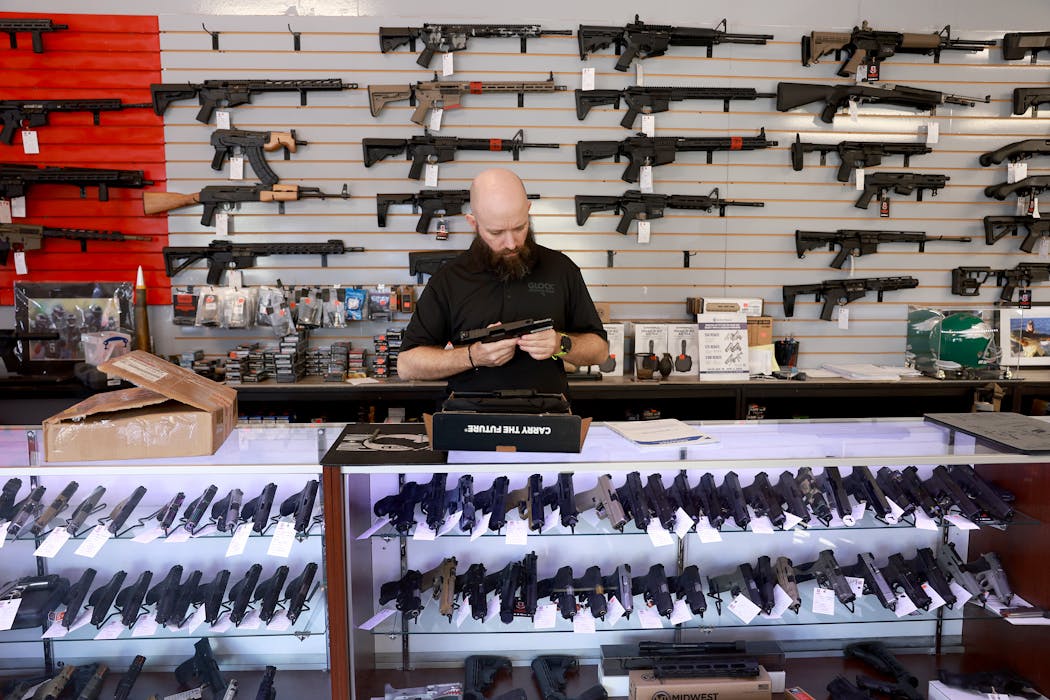
I’m a historian who has studied the roots of stand your ground laws. I published a book on the subject in 2017. My ongoing investigation of the laws suggests that, 20 years on, they have not made communities any safer, nor have they helped prevent crime. In fact, there is reliable evidence they have done just the opposite.
In the past 20 years, stand your ground has spread to 38 states.
Florida’s attorney general, James Uthmeier, quickly announced that open carry is now “the law of the state,” directing law enforcement not to arrest people who display handguns in public.
In my view, this combination of stand your ground, open carry and permitless carry is likely to make the Sunshine State far less safe.
Let’s look at the evidence.
What ‘stand your ground’ means
Under traditional self-defense law, a person had a duty to retreat – to try to avoid a violent confrontation if they could safely do so – before resorting to deadly force.
The main exception to the duty to retreat was known as the castle doctrine, whereby people could defend themselves, with force if necessary, if they were attacked in their own homes.
Stand your ground laws effectively expand the boundaries of the castle doctrine to the wider world, removing the duty to retreat and allowing people to use lethal force anywhere they have a legal right to be, as long as they believe it’s necessary to prevent death or serious harm.
While supporters of these laws claim they mitigate crime and make people safer, evidence shows the opposite. The nonpartisan RAND Corp. discovered that states adopting stand your ground laws experienced significant increases in homicide, typically between 8% and 11% higher than before the laws took effect.
While the language of stand your ground laws is race-neutral, their enforcement is not. Data from the Urban Institute and the U.S. Commission on Civil Rights show that in states with stand your ground laws, homicides are far more likely to be deemed “justified” when the shooter is white and the victim is Black.
I’ve found that these laws have redefined not only when force is justified but who is justified in using force.
In my assessment, these laws don’t create racial bias. Rather, they magnify the biases already present in our criminal legal system. They give broader discretion to a legal system in which law enforcement officers, judges, prosecutors and juries often hold unacknowledged biases that associate Black men with criminality, while perceiving white people who say they were defending themselves as credible.
Seventeen-year-old Trayvon Martin was unarmed when George Zimmerman shot and killed him on March 20, 2012, in Sanford, Fla. Zimmerman claimed he killed Martin in self-defense and was acquitted by a jury. Gerardo Mora/Getty Images News
Each instance illustrates how stand your ground transforms ordinary mistakes or misunderstandings into lethal outcomes, and how armed citizens’ claims of “reasonable fear” often reflect racial stereotypes more than objective threats.
Combined with the removal of licensing procedures and training requirements, laws that broaden the right to use deadly force create a permissive environment for opportunistic violence.
When everyone is visibly armed, every encounter can look like a potential threat. And when the law tells you that you don’t have to back down, that perception can turn lethal in seconds.
National implications: ‘Reciprocity’ and expansion
Two decades later, stand your ground laws have spread, in various forms, to 38 states. While 30 states have legislatively enacted stand your ground statutes like Florida’s, eight others implement stand your ground through case law and jury instructions that effectively remove the duty to retreat.
On top of this, 29 states have enacted laws allowing permitless carry, and 47 technically allow open carry, though restrictions vary across the states.
President Donald Trump has made clear he wants to take this deregulatory approach nationwide. While on the campaign trail, he promised to sign a “concealed-carry reciprocity” law, which would require all states to allow people from states with permissive laws to exercise those rights in all 50. “Your Second Amendment does not end at the state line,” he announced in a 2023 video.
If that vision becomes reality, it would mean the most permissive state laws will set the standard for the entire country. National reciprocity would allow Floridians, and other gun owners from permitless carry states, to carry their firearms – and potentially claim stand your ground immunity – in any other state, including those with stricter rules and lower rates of firearm death and injury.
This prospect raises deep questions about states’ rights, safety and justice. Research shows that stand your ground laws increase homicide and exacerbate racial disparities. National reciprocity would export those effects nationwide.
In my view, the convergence of stand your ground, open carry and national reciprocity marks the culmination of a 20-year experiment in armed citizenship. The results are clear: more people armed, more shootings and more deaths “justified.”
The question now is whether the rest of the nation will follow Florida’s lead.
Read more stories from The Conversation about Florida.
Caroline Light is affiliated with GVPedia and collaborates with Giffords.
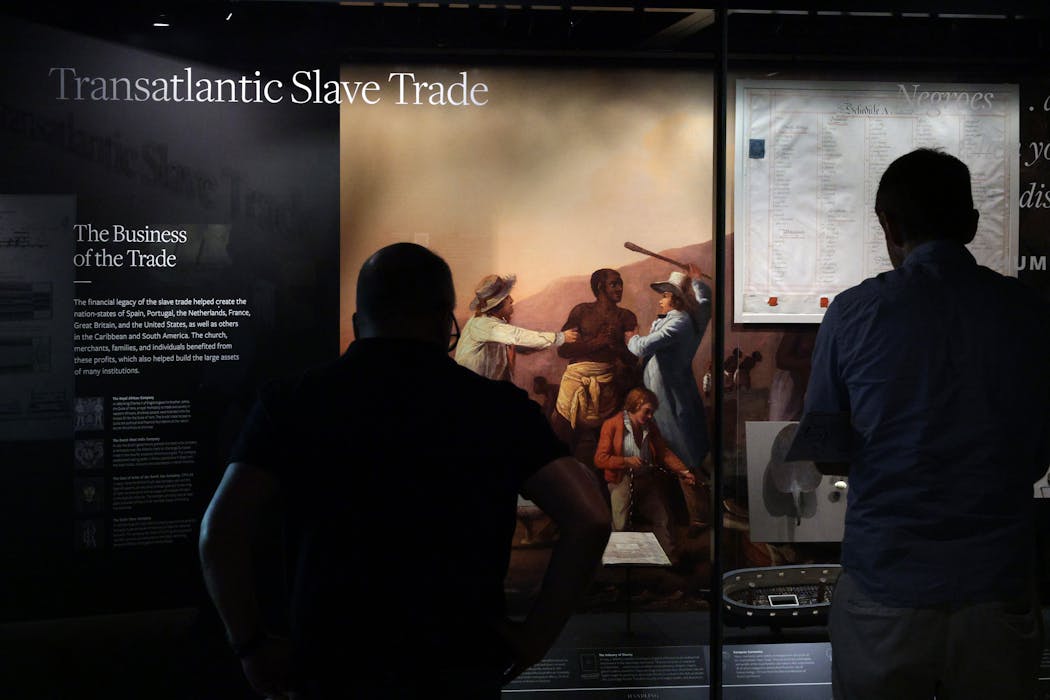
On the other side, opponents of slavery painted a picture of violence, injustice and the hypocrisy of professed Christians defending the sin of slavery.
But to the abolitionists, it became crucial to transcend mere rhetoric. They wanted to show Americans uncomfortable truths about the practice of slavery – a strategy that is happening again as activists and citizens fight modern-day attempts at historical whitewashing.
As a media scholar who has studied the history of abolitionist journalism, I hear echoes of that two-century-old narrative battle in President Donald Trump’s effort to purge public memorials and markers honoring the suffering and heroism of the enslaved as well as those who championed their freedom.
Among the materials reportedly flagged for removal from history museums, national parks and other government facilities is a disturbing but powerful photograph known as “The Scourged Back.”
The 1863 image depicts a formerly enslaved man, his back horrifically scarred by whipping. It’s certainly hard to look at, yet to look away or try to forget it means to ignore what it has to say about the complicated and often brutal history of the nation.
In Trump’s view, these memorials are “revisionist” and “driven by ideology rather than truth.” In an executive order named Restoring Truth and Sanity to American History, Trump said public materials should “focus on the greatness of the achievements and progress of the American people.”
Essentially, the president appears to want a history that celebrates American achievement rather than being forced to look at “The Scourged Back” and other historical realities that document aspects of the American story that don’t warrant celebration.
Combating ignorance of slavery’s horrors
Thinking back to the decades leading up to the Civil War, facts were the weapon abolitionists wielded in their fight against the distortions of pro-slavery forces. It was an uphill battle in the face of indifference by many in the North. After a visit to Massachusetts in 1830, abolitionist writer William Lloyd Garrison blamed such attitudes on “exceeding ignorance of the horrors of slavery.”
It is not surprising that in the early 19th century many Americans would have had limited knowledge of slavery. Travel was arduous, time-consuming and expensive, and most Northerners had little firsthand exposure to slave societies. Abolitionists argued that those who did visit the South were often shielded from the harsher realities of slavery. This extended to the media ecosystem, which lacked any real national news organizations.
Moreover, Southern plantation owners carried out a robust propaganda effort to extol the beneficence of their economic system. In letters, pamphlets and books, they argued that slavery was beneficial to all and that the enslaved were happy and well-treated. They also attacked their opponents as evil and dishonest.
As abolitionist Lydia Maria Child wrote in 1838: “The apologists of Southern slavery are accustomed to brand every picture of slavery and its fruits as exaggeration or calumny.”
Don’t look away
Thus, the challenge for abolitionists was to show slavery as it really was – and to compel people to look. An emphasis on hard evidence took firm hold in the wave of abolitionism in the 1830s.
“Until the pictures of the slave’s sufferings were drawn up and held up to public gaze, no Northerner had any idea of the cruelty of the system,” abolitionist Angelina Grimké wrote in her famous “Appeal to the Christian Women of the South” in 1836.
“It never entered their minds that such abominations could exist in Christian, Republican America; they never suspected that many of the gentlemen and ladies who came from the South to spend the summer months in travelling among them, were petty tyrants at home,” Grimké wrote.
In pamphlets and newspapers, Grimké and others laid down a documentary record of the abuses of slavery, naming names and emphasizing legal evidence of their claims. In my research, I have argued that while abolitionists didn’t invent the journalistic exposé, they did develop the first fully articulated methodology for confronting abuses of power through carefully documented facts – laying the groundwork for later generations of investigative reporters and fact-checkers.
Most critically, what they did is point a finger at injustice and demand that America not look away. In its first issue, in 1835, the newspaper Human Rights emphasized “the importance of first settling what slavery really is.” Inside, it included a series of advertisements documenting slave sales and rewards for runaways reprinted from Southern newspapers.
Angelina Grimké was an American journalist, teacher, playwright and poet who documented slavery’s cruelties. Interim Archives/Getty Images
One of the most remarkable efforts in this abolitionist campaign was a 233-page pamphlet called “American Slavery As It Is: Testimony of a Thousand Witnesses.” Published in 1839 by Theodore Dwight Weld along with his wife, Angelina Grimké, and her sister, it was an exhaustively documented exposé of floggings, torture, killings, overwork and undernourishment.
One example involved a wealthy tobacconist who whipped a 15-year-old girl to death: “While he was whipping her, his wife heated a smoothing iron, put it on her body in various places, and burned her severely. The verdict of the coroner’s inquest was, ‘Died of excessive whipping.’ He was tried in Richmond and acquitted.”
It is difficult reading, to be sure, and certainly the kind of material that might foster “a national sense of shame,” as Trump’s executive order claims. But getting rid of the evils of slavery meant first acknowledging them. And the second part – critical to avoiding the mistakes of the past – is remembering them.
‘Consciences shocked’
So how effective was this abolitionist campaign to lay bare the terrible facts about slavery?
At least some readers of “American Slavery As It Is” had their consciences shocked. One New Hampshire newspaper reacted this way: “We thought we knew something of the horrid character of slavery before, but upon looking over the pages of this book, we find that we had no adequate idea of the number and enormity of the cruelties which are constantly being perpetrated under this system of all abominations.”
The 1830s reflected the height of the abolitionist movement in books, pamphlets and newspapers. While the activism continued in the 1840s and 1850s, ultimately it took secession and civil war to finally end slavery. But, of course, it didn’t take long for the country to fall into a prolonged period of formal and informal segregation in both the North and the South, many vestiges of which remain.
That reality of a history that doesn’t proceed along a straight path to justice underscores the importance of preserving, remembering and teaching difficult parts of the past such as “The Scourged Back.”
On the title page of “American Slavery As It Is,” Weld and the Grimkés printed a quote from the biblical book of Ezekiel: “Behold the wicked abominations that they do.” It was a command to the nation to look without flinching at what it was, and it is as pertinent today as it was then.
Gerry Lanosga does not work for, consult, own shares in or receive funding from any company or organization that would benefit from this article, and has disclosed no relevant affiliations beyond their academic appointment.
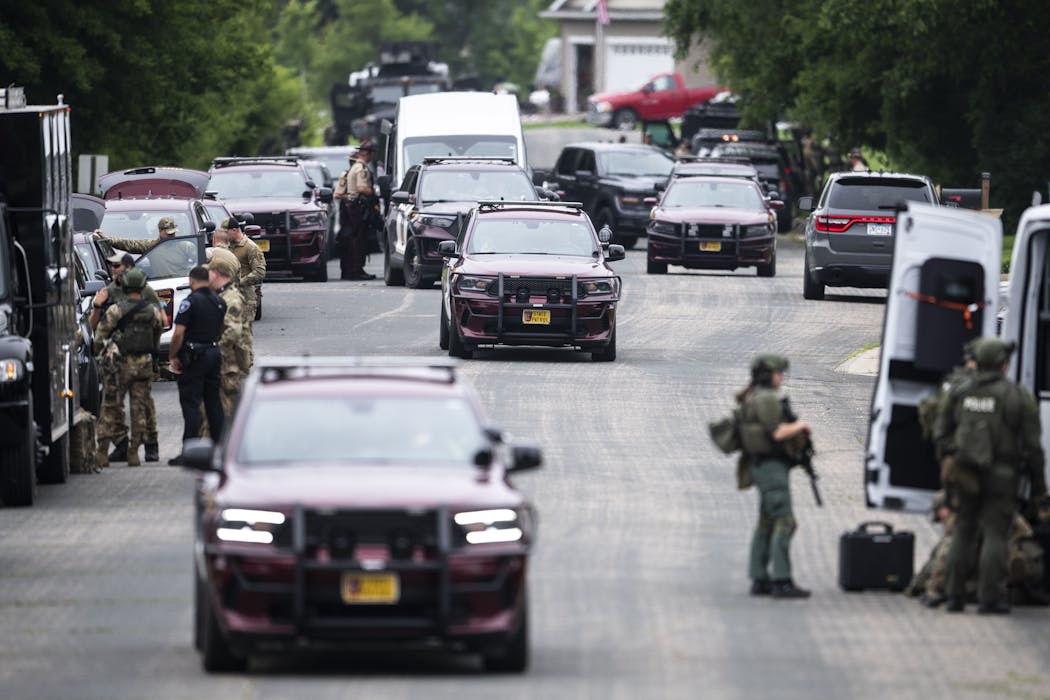
Law enforcement set up in Green Isle, Minn., on June 15, 2025, as they search for a suspect in the killing of state Rep. Melissa Hortman and her husband, Mark. Stephen Maturen/Getty Images
Political violence among rival partisans has been a deadly and destabilizing force throughout history and across the globe. It has claimed countless lives, deepened social divisions and even led to the collapse of democratic systems.
In recent history, political violence and its deadly consequences were seen in Italy after World War I when thousands of fascist supporters marched on Rome, the capital, threatening to overthrow the government unless Benito Mussolini was appointed prime minister. That kind of violence and its effects were also seen in 1930s Germany, where Adolf Hitler suppressed opposition and suspended civil liberties amid widespread unrest and factional violence.
Today, many scholars, journalists, commentators and elected officials across the political spectrum have voiced alarm over escalating acts of violence in the United States, drawing parallels to Europe’s authoritarian past. Reports of politically motivated violence are distressingly common – ranging from mass shootings, car-ramming attacks and assaults at demonstrations to assassination attempts, kidnappings and threats targeting mayors, governors, political activists and members of Congress.
For example, threats of violence against members of Congress increased by more than 1,400%, from 902 in 2016 to an estimated 14,000 by the end of 2025, according to U.S. Capitol Police reports.
Political violence is certainly not new in American society, but current patterns differ in key ways. We found that, today, white nationalism is a key driver of support for political violence – a sign that white nationalism poses substantial danger to U.S. political stability.
In the 1970s, violence was political theater, aimed at drawing government and public attention to specific policies. Today, it’s personal and deadly, driven by a desire to annihilate.
Page 5 and envelope of a letter received by The Associated Press in Washington D.C., on March 2, 1971, signed by ‘Weather Underground,’ which claims responsibility for the March 1 bombing of the U.S. Capitol building. AP Photo
Changing targets
In the 1970s, radical left-wing groups often targeted government property to send political messages.
This resurgence of political violence has prompted intense academic and journalistic scrutiny. Numerous public opinion surveys have sought to gauge Americans’ approval of, or concern about, using violence against the government or political adversaries.
Initial estimates suggested nearly 1 in 4 Americans support political violence. But later studies identified flaws in the questions used to measure support for violence. Simply asking about violence in general or the use of force leaves too much room for interpretation.
Using more sophisticated questioning techniques results in lower estimates of public support for political violence.
Understanding what drives individuals to endorse political violence is essential for developing effective strategies to prevent it. As public opinion researchers who have studied Americans’ attitudes toward ideological extremism, political polarization and counterterrorism policy, we sought to advance our understanding of the factors underlying public support for political violence in the United States.
We aimed to do this in two ways: by using more specific questioning techniques and by identifying the factors associated with increased support for violence.
We asked a national sample of 1,300 Americans how justified or unjustified it would be “to take violent action against the U.S. government” in response to a range of government actions. This approach captures both approval of the use of violence and its political motivation.
We included nonpartisan government actions such as “the government violated or took away citizens’ rights and freedoms” and “the government violated the U.S. Constitution” along with hypothetical actions reflecting right or left-wing political causes. For example, a right-wing action would be to ban all abortions while a left-wing action would be to legalize all abortions.
Analyses revealed substantial support for violence against the government in response to the nonpartisan government actions. Half of the respondents indicated that violence would be justified if the government violated citizens’ rights, and 55% supported the use of violence as a response if the U.S. government committed unlawful violence against citizens. Nearly 40% said that violence would be justified if the government censored the news.
When we examined the factors behind these attitudes, a belief in white nationalism stood out above all others. But what, precisely, is white nationalism? It is more than simply identifying as white. Indeed, white nationalism is a sentiment found among some nonwhite Americans as well.
White nationalists are concerned about the increasing diversity of the American population and want to ensure that white citizens maintain a predominant influence in the country. To them, white citizens’ social, cultural and political values are superior to those of nonwhite citizens and immigrants. The perceived need to protect and propagate these values serves as a call to action.
This ideology has motivated several recent acts of mass violence, from synagogue shootings to racially targeted attacks.
Our data revealed that a belief in white nationalism predicted support for political violence as well. In response to both nonpartisan government actions and those that would benefit left-wing causes, the stronger a person’s white nationalist sentiment, the more strongly that individual believed that violence would be justified.
Out of all the variables in our statistical models, including political views and demographic characteristics, white nationalism was the strongest predictor of support for violence in these circumstances.
It did not, however, significantly influence support for violence when the government actions would benefit right-wing causes.
Growing threat to US democracy
Most people who voice support for political violence will never commit violent acts themselves.
Active white nationalist groups operate in all but two U.S. states, Alaska and Vermont. Decentralized groups, such as Active Clubs, where white nationalists train and network, are also on the rise.
Many more individuals hold white nationalist sentiments without belonging to organized groups. Indeed, in our national sample, one quarter of respondents agreed with the statement “although people won’t admit it, White Americans and their culture are what made America great in the first place.”
The fact that white nationalism is gaining prominence in the U.S., combined with the association between holding white nationalist views and supporting political violence found in our study, indicates that white nationalism poses a serious threat to U.S. political stability.
The authors do not work for, consult, own shares in or receive funding from any company or organization that would benefit from this article, and have disclosed no relevant affiliations beyond their academic appointment.
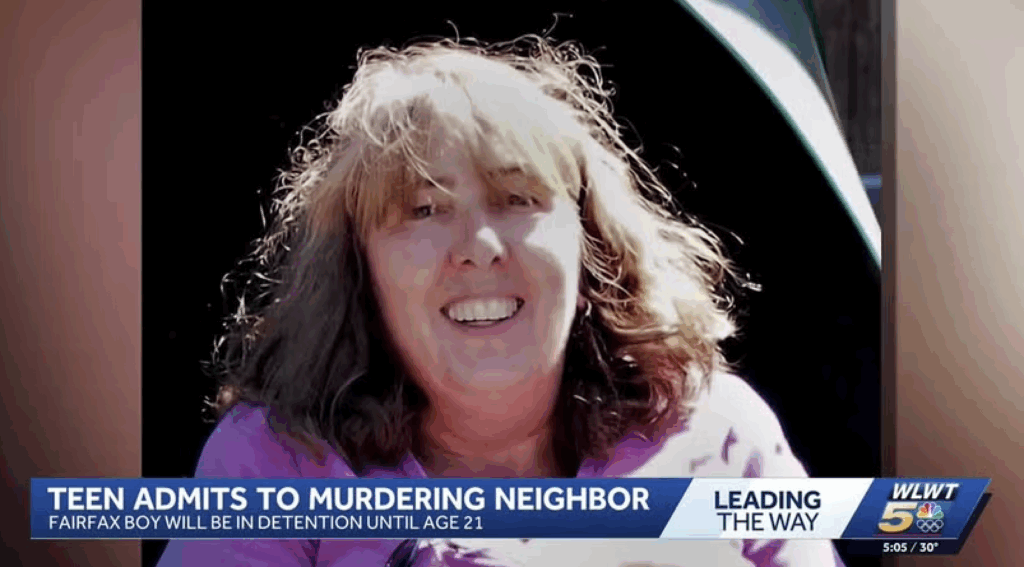
A horrifying story emerged from Ohio this week, as a teenage boy confessed to strangling his 64-year-old neighbor to death.
The unidentified minor, who is now 14, but was 13 at the time of the crime, struck a deal with prosecutors that will require him to spend the rest of his childhood in Ohio Department of Youth Services facilities.
The assailant pled guilty to aggravated murder, aggravated burglary, and strangulation on Monday, and he has been remanded to state custody until his 21st birthday.
Sheila “Denise” Tenpenny was allegedly killed by a 13-year-old neighbor seeking the “perfect victim.” (YouTube)
The victim — identified as Sheila “Denise” Tenpenny — was found dead inside her home on Sunday, February 2, 2025.
According to a press release from the Ohio Attorney General’s Office, Tenpenny’s body was discovered by her brother, who called 911 after finding her lifeless in her bed.
“I think my sister’s been murdered. She got her face covered with a pillow … She did not respond when I yelled at her,” he told a 911 operator.
Investigators believe that the minor broke into Tenpenny’s home sometime between 2 am and 5 am and struck her with a blunt object.
According to prosecutor Linda Scott, the defendant “researched how to strangle someone, how to do it, how to find a victim … For months, the defendant did this sort of research.”
With the crime completed, the assailant allegedly “notified all his social media people,” posting a message that read, “This one was a fighter.”
Investigators explained that the perpetrator fortunately did not do a good job of covering his tracks.
“He left his DNA; he tried to clean up the crime scene with items that wouldn’t have been successful,” Ohio Bureau of Criminal Investigation Agent David Ward told reporters.
“It was good luck for us that he did make those mistakes, but in the future, is he going to learn from those mistakes?”
Ward added that in his 25 years in law enforcement, “this is the first time I’ve ever had a person of this age commit this type of crime. And to add to that the premeditation of the offense is just chilling to me.”
The defendant was arrested ten days after Tenpenny’s murder.
Prosecutors say that after he was swabbed for DNA, the teen posted another social media message, this one reading, “I think I just got caught.”
Rebecca Gayheart has opened up about something intensely personal and very painful.
Seven months after Eric Dane told the world that he had been diagnosed with amyotrophic lateral sclerosis (ALS), his estranged wife — with whom he shares daughters Billie, 15, and Georgia, 13 — reflected on their family dynamic amid this extremely challenging chapter.
“I am trying to show them that we show up for people no matter what,” Rebecca explained on the November 17 edition of the Broad Ideas with Rachel Bilson and Olivia Allen podcast.
“He is our family. He is your father. We show up, and we try to do it with some dignity and some grace and just get through it. We will get through it the best we can.”
(Getty Images for Chrysalis Butterfly Ball)
In 2018, Gayheart filed for divorce from the Grey’s Anatomy alum — but in March 2025, she dismissed the divorce filing.
Less than a month after she filed this dismissal, Dane revealed that he was diagnosed with the aforementioned disease.
“I am grateful to have my loving family by my side as we navigate this next chapter,” he told People Magazine at the time.
“It’s super complicated for me,” Gayheart continued on this podcast. “We’ve been separated for eight years. The kids live with me 100 percent of the time. There’s been a lot of other stuff. I’m trying to stay optimistic, though, about it all.”
It’s complicated, but also important as a parent, Gayheart reasons.
“I don’t know if I’m doing it well or if I’m doing it in the wrong way or the right way,” she said. “I’m just showing up. I’m showing up and I’m trying to be there for them. I guess time will tell.”
ALS is an incurable neurological disease that attacks the nerve cells in the brain and spinal cord. As you might imagine, such a diagnosis is next to impossible for kids as young as Billie and Georgia to grapple with and/or comprehend.
“They are good girls who are just going through a lot,” the actress added. “They’re having such complex feelings about it all because it’s public. It confuses them.”
Eric Dane attends the premiere of HBO’s Euphoria during the ATX Television Festival at the Paramount Theatre on May 6, 2019 in Austin, Texas. (Photo by Gary Miller/Getty Images for FIJI Water)
Dane is best known for roles on Grey’s Anatomy, The Last Ship and Euphoria.
“I don’t think this is the end of my story. I don’t feel like this is the end of me,” he said in June during a Good Morning America interview.
“I feel fortunate that I am able to continue working and am looking forward to returning to set of Euphoria next week,” Dane said in his original statement. “I kindly ask that you give my family and I privacy during this time.”
Eric Dane attends the Los Angeles premiere of the new HBO series “Euphoria” at the Cinerama Dome Theatre in Hollywood on June 4, 2019. (Photo by Chris Delmas / AFP)
Gayheart previously said she and Dane are “best friends” and admitted on this podcast that the ongoing journey is understandably hard for her as well.
“I am definitely experiencing growth as a person, as a human being,” the 53-year-old said.
“It’s all very humbling. I think one piece of this that I hope I’m passing on to my kids is the idea that you can show up for someone and be there for them, but you also have to show up for yourself. This is life. Life, sadly, is just moments, good and bad strung together.
“You never know what you’re going to get and we should treat today as a really special day. This isn’t a dress rehearsal. This is it. Whatever we’re doing today, this is our life.”
But Trump’s war against free speech isn’t over. He’s taking aim at the NBC Late Night host, and
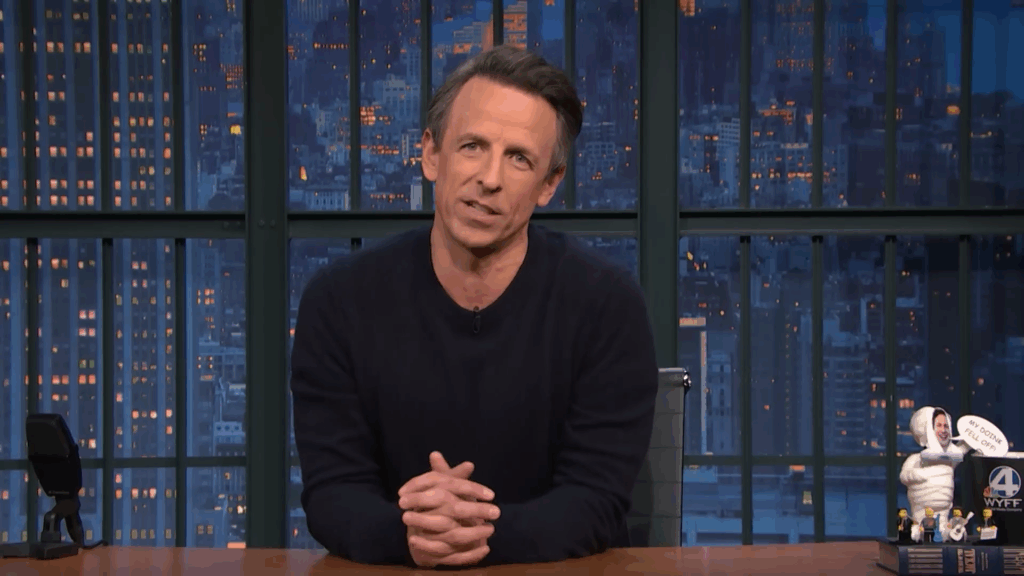
During the Thursday, November 13 episode of ‘The Late Show With Seth Meyers,’ the eponymous host highlighted the recent and recently revealed wrongdoings of Donald Trump. (Image Credit: NBC)
Donald Trump wants Seth Meyers fired ‘immediately’
When ABC briefly put Jimmy Kimmel’s show on hiatus following the White House’s clear threats through FCC chairman Brendan Carr, it was difficult to determine what exactly was the excuse.
Something related to Charlie Kirk or his death, ostensibly, but even conservative viewers had difficulty pinpointing the offending line. It was, many pointed out, merely a pretext to silence a critic.
In the case of NBC’s Late Night, the situation is different.
Donald Trump is calling for Seth Meyers’ firing.
This time, he isn’t pretending to single out a single joke or comment. It’s more like … he hates everything.
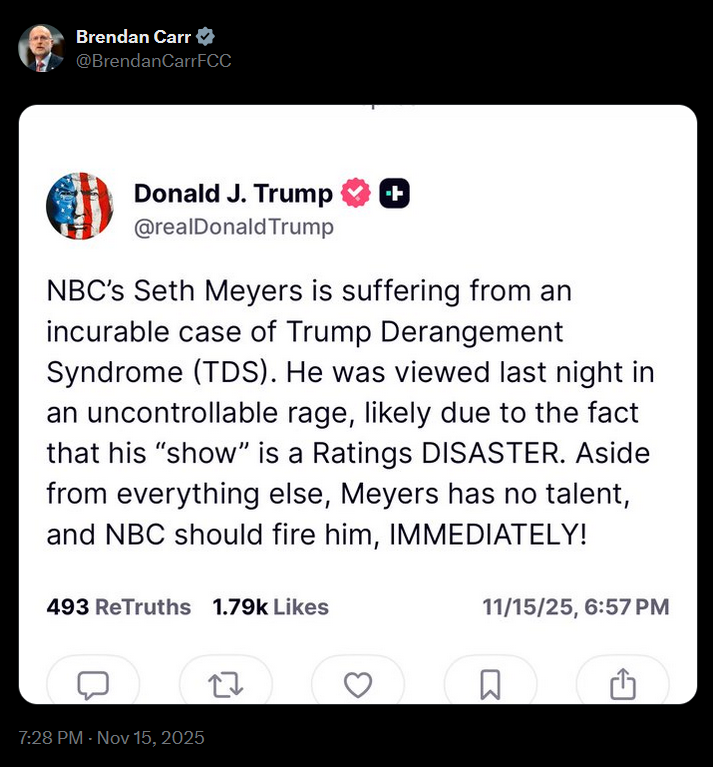
In a dangerous and anti-American move, FCC Chairman Brendan Carr tweeted out a screenshot of Donald Trump’s screed against Seth Meyers in November 2025. (Image Credit: Twitter)
On his curiously named very own social media network, Trump posted a rant about viewing Meyers “in an uncontrollable rage” following widespread coverage of the former reality star’s Jeffrey Epstein ties.
“NBC’s Seth Meyers is suffering from an incurable case of Trump Derangement Syndrome (TDS),” he proclaimed.
Trump Derangement Syndrome is the fringe right’s cringe attempt to medicalize outrage over Trump’s words, actions, and crimes.
“He was viewed last night in an uncontrollable rage,” Trump alleged.
He wrote that this was “likely due to the fact that his ‘show’ is a Ratings DISASTER.”
Like countless late night hosts, Seth Meyers would love to stop discussing our current political horrors. Unfortunately, we continue to live in interesting times. (Image Credit: NBC)
Brendan Carr seems eager to do Trump’s will
“Aside from everything else,” Donald Trump continued in his anti-Seth Meyers tirade, the comedian “has no talent.”
He then suggested: “And NBC should fire him, IMMEDIATELY!”
As is always the case with Trump, his choices regarding punctuation and grammar are puzzling. However, the recently publicized Epstein emails demonstrate that his broader social circle seems to share some of his idiosyncrasies.
Obviously, someone occupying the White House calling for the firing of a television host for criticizing them is appalling and anti-American. But this is more than mere bluster.
FCC Chairman Brendan Carr boosted the post in a tweet, doubling down upon the menacing text with the implied threat that he would take steps to apply governmental pressure to serve his master’s will.
It is not the role of the FCC to regulate speech. And, officially, Carr cannot do that.
However, he can violate the United States constitution by approving or denying certain mergers based upon whether corporations roll over and obey Trump’s edicts.
We all saw as Skydance and Paramount merged. The resulting massive media company is now under Trump sycophant David Ellison — this after Paramount paid an apparent bribe to Trump’s presidential library and also fired Colbert (the company claims that this was for financial reasons).
Following the ideological fall of CBS News, CNN could be next. NBCUniversal’s parent company, Comcast, is one of the expected bidders for Warner Bros. Discovery.
The FCC can approve or deny mergers. Under Carr, these approvals may be subject to the capricious whims of America’s self-appointed king.
In addition to his name cropping up so much in Epstein’s emails, Donald Trump also announced publicly that America lacks skilled workers. As Seth Meyers pointed out, that’s not a great look. (Image Credit: NBC)
Parts of the GOP are in revolt, but will it last? Will it matter?
Will Donald Trump be able to fire Seth Meyers? That depends upon whether NBCUniversal is run by cowards. So … that’s up in the air.
The good news is that Trump’s power is actively and sharply waning at the moment. His ability to bully congress into refusing to check his power stems largely from his power over the GOP base.
That control has weakened after months of his actively sabotaging the economy for no reason. Sending ICE to terrorize American communities hasn’t done him many favors, either.
Of course, Trump may lack the cognitive capacity to realize how much power he’s losing. And, if he does, we all know that a cornered beast is at its most dangerous.
His desire to persecute his enemies — a fast-growing list that appears to include most of America — will continue to outlast his ability to grasp complex topics or follow conversations. He will continue to take aim at critics, and toadies like Carr will continue to pull the trigger.
Going into the 2025 NFL season, prognosticators expected the Kansas City Chiefs to dominate the AFC and return to the Super Bowl for the fourth straight time.
But now, following Sunday’s upset loss to the Denver Broncos, fans are concerned that Patrick Mahomes’ 5-5 squad might not even make the playoffs.
The Chiefs’ surprising struggles come amid another unexpected twist in this season’s narrative:
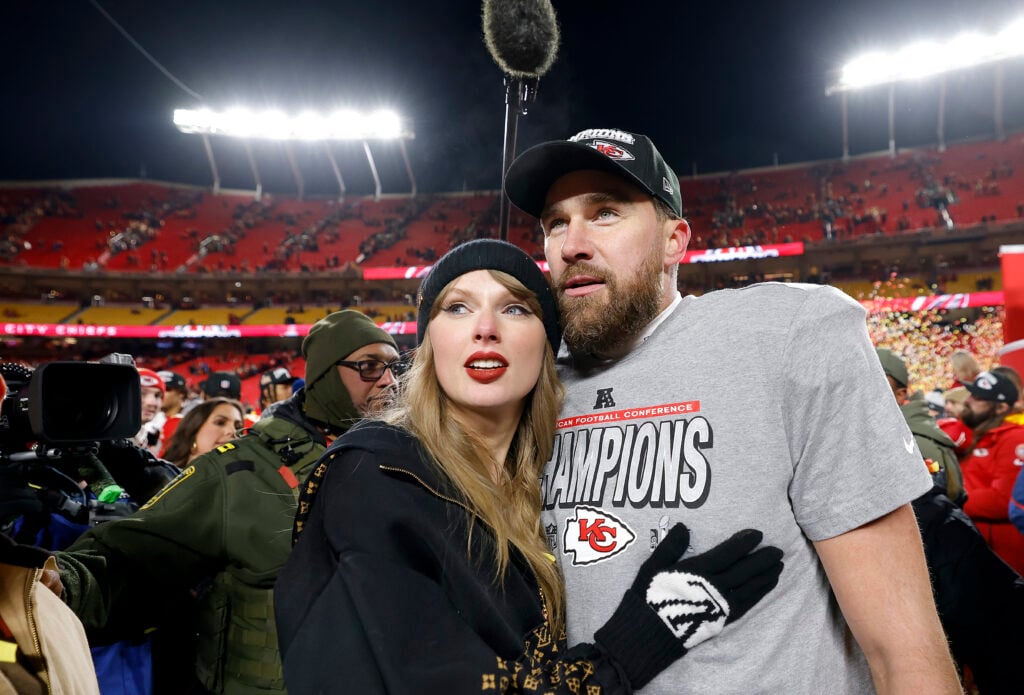
Taylor Swift celebrates with Travis Kelce #87 of the Kansas City Chiefs after defeating the Buffalo Bills 32-29 in the AFC Championship Game at GEHA Field at Arrowhead Stadium on January 26, 2025 in Kansas City, Missouri. (Photo by David Eulitt/Getty Images)
Taylor has not attended a single Chiefs away game all season, a decision that’s made all the more surprising by the fact that this will likely be Travis’ last season in the NFL.
(The future hall of famer — who became the Chiefs’ all-time touchdown leader on Sunday — is 36, which is approximately 110 in tight end years.)
There are numerous theories as to why Taylor has opted not to follow the Chiefs on the road this year:
Taylor Swift looks on prior to a game between the Kansas City Chiefs and the Denver Broncos at GEHA Field at Arrowhead Stadium on November 10, 2024 in Kansas City, Missouri. (Photo by Jamie Squire/Getty Images)
Some believe the pop icon has become more concerned about security risks, while others insist that she’s busy managing her massive business empire.
And in all likelihood, the decision has nothing to do with the Chiefs’ current struggles.
But perhaps it was inevitable that social media users would try and find a connection between the KC’s nightmare season and the absence of the NFL’s most famous fan.
“Can the Chiefs finally stop flopping? As a Taylor Swift fan, I am not used to failure,” wrote one X user following the team’s latest loss.
Some Chiefs fans complained about Taylor being at games too much but maybe her presence was the driving force and the wind beneath their wings. She is the magic and fairy dust and secret recipe and yall fumbled,” another theorized.
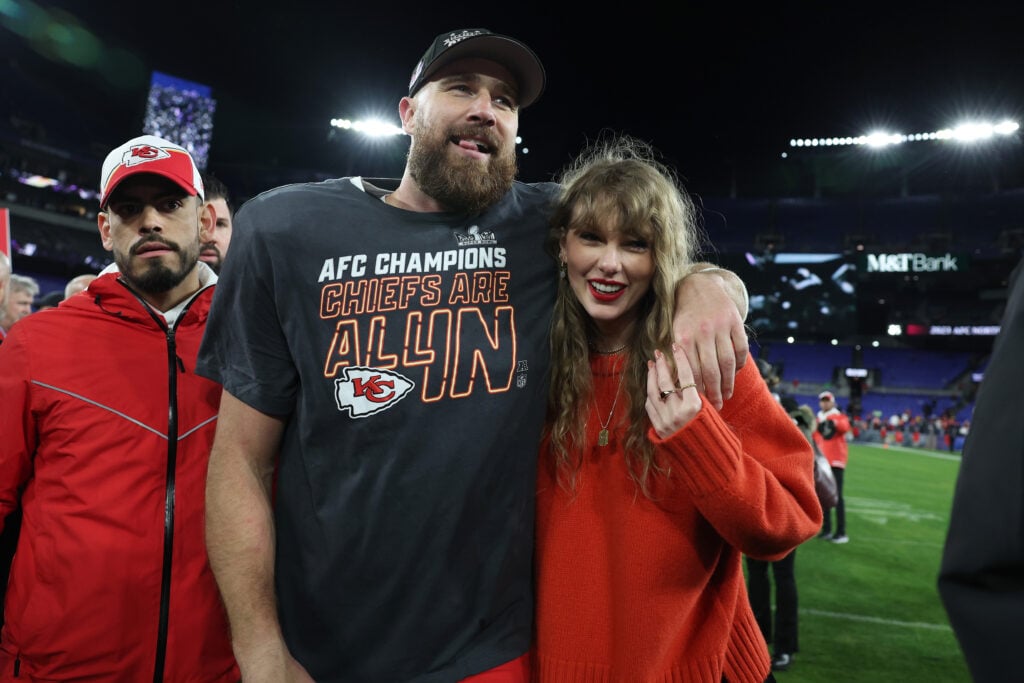
Travis Kelce #87 of the Kansas City Chiefs celebrates with Taylor Swift after a 17-10 victory against the Baltimore Ravens in the AFC Championship Game at M&T Bank Stadium on January 28, 2024 in Baltimore, Maryland. (Photo by Patrick Smith/Getty Images)
“It’s not Reid or Veach’s fault that their players are more focused on drag racing or plugging Taylor Swift’s (terrible) new album on their podcasts or opening restaurants than they are on winning these days,” a third chimed in, referring to Chiefs head coach Andy Reid and the team’s GM, Brett Veach.
Others even went so far as to allege that Taylor stepped away because she knew she’d been a distraction to Travis in the offseason, and she assumed she would be blamed if the team had a tough year.
Obviously, that’s insane — but sadly, such lunacy is par for the course on social media these days.
Needless to say, most of the theories about Taylor’s changing relationship to the Chiefs are sheer foolishness — and there are certainly more to come.
The Chiefs’ next game is on the road against the Dallas Cowboys.
Because it’s an away game, Taylor probably won’t be in attendance. And because it’ll take place on Thanksgiving, you might have to listen to your drunk uncle’s theories about why she decided to stay home.