Britain is at the lowest risk of a winter power blackout than at any point in the last six years, the national electricity grid operator has said.The Latest News from the UK and Around the World | Sky News









Britain is at the lowest risk of a winter power blackout than at any point in the last six years, the national electricity grid operator has said.The Latest News from the UK and Around the World | Sky News

Customers of five water firms are facing higher than expected rises to their inflation-busting bills after the companies disputed limits imposed by the industry regulator.The Latest News from the UK and Around the World | Sky News

English football’s first regulator has admitted owners accused of human rights abuses cannot be blocked from clubs because his remit is only safeguarding “financial stability”.The Latest News from the UK and Around the World | Sky News

The sun went down and the volume went up.The Latest News from the UK and Around the World | Sky News
By: James Brooks, Alaska Beacon

The FBI searched the cellphone records of Republican Alaska Sen. Dan Sullivan and seven other U.S. senators and a member of the U.S. House as part of its investigation into the Jan. 6, 2021 insurrection at the U.S. Capitol, a newly released document shows.
The call logs cover several days during and around the insurrection, when rioters stormed the Capitol in an attempt to support then-incumbent President Donald Trump, who falsely claimed to have won reelection in 2020.
The logs do not show that the FBI obtained phone call recordings, only that an investigating agent was interested in who the senators were talking to, when they talked, how long they talked, and where the callers were. The document, released this week by the U.S. Senate Judiciary Committee, does not say why those senators were identified in particular and it does not say whether any investigative leads resulted from the records.
According to a news release from the committee, the FBI sought and obtained data about the senators’ phone use in the days before, on and after the Jan. 6 insurrection, from Jan. 4 through Jan. 7, 2021.
The U.S. Department of Justice indicted Trump in 2023 for allegedly conspiring to overturn the results of the 2020 presidential election, but the special prosecutor in charge of the investigation abandoned that case after Trump was re-elected in 2024. Department policy says that sitting presidents cannot face criminal prosecution, and after the 2021 insurrection, the U.S. Supreme Court issued a decision limiting a president’s liability for conduct while in office.
Asked whether Sullivan had any contact with people who participated in or organized the riot at the U.S. Capitol, Devyn Shea, a spokesperson for Sullivan, said, “absolutely not.”
In a written statement, Sullivan called the FBI investigation “an absolute outrage.”
“We’ve just learned the Biden FBI was engaged in what appears to be an unprecedented fishing expedition against at least nine sitting Republican members of Congress — none of whom were under any type of investigation — surveilling our personal cell phone calls with family members, staff and colleagues. This is a new low in the political weaponization of the Justice Department,” Sullivan’s statement said.
The other seven senators were Cynthia Lummis (R-Wyo.), Lindsey Graham (R-S.C.), Josh Hawley (R-Mo.), Tommy Tuberville (R-Ala.), Ron Johnson (R-Wis.), Marsha Blackburn (R-Tenn.), and Bill Hagerty (R-Tenn.). Rep. Mike Kelly (R-Pa.) was also on the FBI list.
Some senators, including Hawley and Tuberville, voted to object to the certification of the electoral results of the 2020 election.
Sullivan voted to support the certification of the election, and in a statement the day after the Jan. 6 violence at the Capitol, he called the event “sad” and “dispiriting.”
All have been supporters of Trump and his policies; in office, Sullivan has been a reliable vote for the president and his agenda.

NOTN- Juneau voters appear poised to approve two cost-cutting tax measures while rejecting the third that would have shifted more of the city’s tax burden onto tourists, according to preliminary results from Tuesday’s municipal election.
Early results show Proposition 2 , which would exempt food and residential utilities from city sales tax, passing by a wide margin, with roughly 70% of voters in favor.
Proposition 1, which would reduce the city’s mill rate cap from 12 to 9 mills, is also leading narrowly with 3,104 yes votes to 2,920 no’s. Proposition 3, a proposed seasonal sales tax that would have raised summer rates while lowering winter ones, is trailing with 2,534 no votes to 2,514 yes.
Both Propositions 1 and 2 were placed on the ballot through signature drives by the Affordable Juneau Coalition.
City officials have warned that the two propositions could reduce annual revenue by as much as $10 million to $12 million, potentially forcing budget cuts or limits on the city’s ability to respond to emergencies.
The seasonal sales tax proposal, which the Assembly placed on the ballot, was intended to offset those losses by collecting more from visitors during the summer tourism season.
In the Assembly races, Greg Smith secured the District 1 seat with 4,092 votes, while Ella Adkison ran unopposed for the areawide seat.
The tightest contest came in District 2, where Nathaniel “Nano” Brooks led incumbent Wade Bryson by just three votes, 2,743 to 2,740.
Steve Whitney leads in the race for the Board of Education with 3,197 votes, followed by Melissa Cullum with 2,428, Jeremy “JJJ” Johnson with 2,366, and Jenny Thomas with 2,302. Board President Deedie Sorensen, received 1,317 votes.
A total of 6,073 ballots were tallied as of late Tuesday night about 21.7% of the 28,017 mailed to registered voters.
The City and Borough of Juneau said additional ballots cast at vote centers, drop boxes, or mailed by Election Day are still being processed.
Updated unofficial results are expected Friday, Oct. 10. The election is scheduled to be certified Oct. 21.
Bipartisan agreement is rare in these politically polarized days.
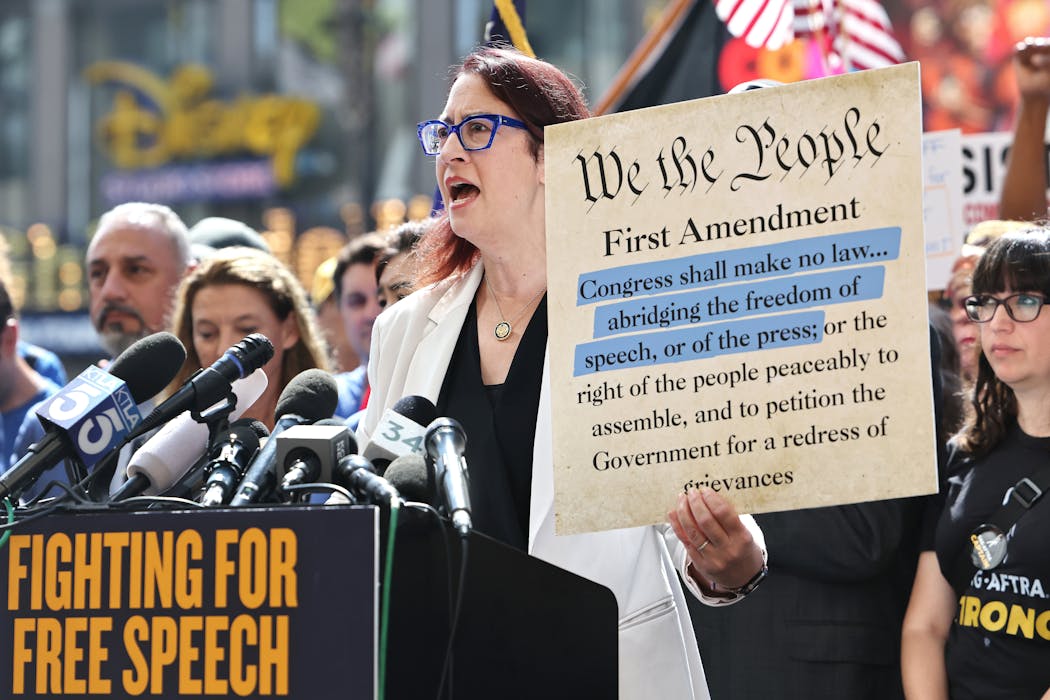
But that’s just what happened in response to ABC’s suspension of “Jimmy Kimmel Live!” The suspension followed the Federal Communications Commission chairman’s threat to punish the network for Kimmel’s comments about Charlie Kirk’s alleged killer.
It lit up the media. Democrats and civil libertarians denounced the FCC chairman Brendan Carr for violating the First Amendment’s guarantee of freedom of speech. Voices on the right, including Senator Ted Cruz, joined them.
Within a week, Kimmel’s show was back on the air.
While bipartisan agreement may be rare, it’s not surprising that it came in defense of the First Amendment – and a popular TV show. A recent poll found that a whopping 90% of respondents called the First Amendment “vital,” while 64% believed it’s so close to perfection that they wouldn’t change a word.
In just 45 words, it bars Congress from establishing or preventing the free exercise of religion, interfering with the peoples’ right to assemble and petition, or abridging freedom of speech or the press.
I’m a historian and scholar of modern U.S. law and politics. Here’s the story of why this amendment – now considered fundamental to American freedom and identity – wasn’t part of the original Constitution and how it was included later on.
Added three years after the Constitution was ratified, it resulted from political compromise and a change of heart by framer James Madison.

Building a strong national government was the focus of Madison and the other delegates who met in Philadelphia in May 1787 to draft the Constitution.
They believed the government created by the Articles of Confederation after the colonists declared independence was dysfunctional, and the nation was disintegrating.
The government could not pay its debts, defend the frontier or protect commerce from interference by states and foreign governments.
Although Madison and the other framers aimed to create a stronger national government, they cared about protecting liberty. Many had helped create state constitutions that included pioneering bills of rights.
Madison himself played a critical role in securing passage in 1776 of the Virginia Declaration of Rights, a monument to civil liberties.
By the time the Constitutional Convention met, however, Madison had soured on such measures. During the 1780s, he had watched with alarm as state legislatures trampled on rights explicitly guaranteed by their constitutions. Bills of rights, he concluded, weren’t sufficient to protect rights.
So Madison and his colleagues put their faith in reinventing government.
The Constitution they wrote created a government powerful enough to promote the national interests while maintaining a check on state legislatures. It also established a system of checks and balances that ensured federal power wasn’t abused.
In the convention’s waning days, delegates briefly discussed adding a bill of rights but unanimously decided against it. They had sweated through almost four months of a sweltering Philadelphia summer and were ready to go home. When Virginia’s John Rutledge noted “the extreme anxiety of many members of the Convention to bring the business to an end,” he was stating the obvious. With the Constitution in final form, few had the appetite to haggle over the provisions of a bill of rights.
That decision nearly proved fatal when the Constitution went to the states for ratification.
The new Constitution’s supporters, known as Federalists, faced fierce opposition from Anti-Federalists who charged that a powerful national government, unrestrained by a bill of rights, would inevitably lead to tyranny.
Ratification conventions in three of the most critical states – Massachusetts, New York and Virginia – were narrowly divided; ratification hung in the balance. Federalists resisted demands to make ratification contingent on amendments suggested by state conventions. But they agreed to add a bill of rights – after the Constitution was ratified and took effect.
That concession did the trick.

The three critical states ratified without condition, and by midsummer 1788, the Constitution had been approved.
However, when the First Congress met in March 1789, the Federalist majority didn’t prioritize a bill of rights. They had won and were ready to move on.
Madison, now a Federalist leader in the House of Representatives, insisted that his party keep its word. He warned that failure to do so would undermine trust in the new government and give Anti-Federalists ammunition to demand a new convention to do what Congress had left undone.
But Madison wasn’t just arguing for his party keeping its word. He had also changed his mind.
The ratification debates and Madison’s correspondence with Thomas Jefferson led him to think differently about a bill of rights. He now thought it harmless and possibly helpful. Its provisions, Madison conceded, might become “fundamental maxims of a free government” and part of “the national sentiment.” Broad popular support for a bill of rights might provide a check on government officials and how they wielded power.
Madison pushed his colleagues relentlessly. Wary of provisions that would weaken the national government, he developed a slate of amendments focused on individual rights. Ultimately, Congress approved 12 amendments – ensuring rights from freedom of speech to protection from cruel and unusual punishment – and sent them to the states for ratification.
By the end of 1791, 10 of them – including the First Amendment ≠ had been ratified.
As Madison anticipated, the First Amendment wasn’t a cure for a government bent on suppressing dissent. From the Sedition Act in the 1790s to McCarthyism in the 1950s and the Trump administration’s assault on the First Amendment, government has used its awesome powers to pursue and punish critics.
On occasion, courts have intervened to protect First Amendment rights, a weapon Madison didn’t anticipate. But not always.
Perhaps the ultimate protection for First Amendment rights is “national sentiment,” as Madison suggested. Norm-breaking presidents can disregard the law, and judges may cave. But public sentiment is a powerful force, as Jimmy Kimmel can attest.

Donald Nieman receives funding from the National Endowment for the Humanities and the American Council of Learned Societies. He is affiliated with Braver Angels.
Politics + Society – The Conversation
President Donald Trump set the tone for his second term by issuing 26 executive orders, four proclamations and 12 memorandums on his first day back in office. The barrage of unilateral presidential actions has not yet let up.
These have included Trump’s efforts to remove thousands of government workers and fire several prominent officials, such as members of the Corporation for Public Broadcasting and the chair of the Commission on Civil Rights. He has also attempted to shut down entire agencies, such as the Department of Education and the U.S. Agency for International Development.
For some scholars, these actions appear rooted in the psychology of an unrestrained politician with an overdeveloped ego.
But it’s more than that.
As a political science scholar who studies presidential power, I believe Trump’s recent actions mark the culmination of the unitary executive theory, which is perhaps the most contentious and consequential constitutional theory of the past several decades.
In 2017, Trump complained that the scope of his power as president was limited: “You know, the saddest thing is that because I’m the president of the United States, I am not supposed to be involved with the Justice Department. I am not supposed to be involved with the FBI, I’m not supposed to be doing the kind of things that I would love to be doing. And I’m very frustrated by it.”
The unitary executive theory suggests that such limits wrongly curtail the powers of the chief executive.
Formed by conservative legal theorists in the 1980s to help President Ronald Reagan roll back liberal policies, the unitary executive theory promises to radically expand presidential power.
There is no widely agreed upon definition of the theory. And even its proponents disagree about what it says and what it might justify. But in its most basic version, the unitary executive theory claims that whatever the federal government does that is executive in nature – from implementing and enforcing laws to managing most of what the federal government does – the president alone should personally control it.
This means the president should have total control over the entire executive branch, with its dozens of major governmental institutions and millions of employees. Put simply, the theory says the president should be able to issue orders to subordinates and to fire them at will.

The president could boss around the FBI or order the U.S. attorney general to investigate his political opponents, as Trump has done. The president could issue signing statements – a written pronouncement – that reinterpret or ignore parts of the laws, like George W. Bush did in 2006 to circumvent a ban on torture. The president could control independent agencies such as the Securities and Exchange Commission and the Consumer Product Safety Commission. The president might be able to force the Federal Reserve to change interest rates, as Trump has suggested. And the president might possess inherent power to wage war as he sees fit without a formal authorization from Congress, as officials argued during Bush’s presidency.
A theory is one thing. But if it gains the official endorsement of the Supreme Court, it can become governing orthodoxy. It appears to many observers and scholars that Trump’s actions have intentionally invited court cases by which he hopes the judiciary will embrace the theory and thus permit him to do even more. And the current Supreme Court appears ready to grant that wish.
Until recently, the judiciary tended to indirectly address the claims that now appear more formally as the unitary executive theory.
During the country’s first two centuries, courts touched on aspects of the theory in cases such as Kendall v. U.S. in 1838, which limited presidential control of the postmaster general, and Myers v. U.S. in 1926, which held that the president could remove a postmaster in Oregon.
In 1935, in Humphrey’s Executor v. U.S., the high court unanimously held that Congress could limit the president’s ability to fire a commissioner of the Federal Trade Commission. And in Morrison v. Olson the court in 1988 upheld the ability of Congress to limit the president’s ability to fire an independent counsel.
Some of those decisions aligned with some unitary executive claims, but others directly repudiated them.
In a series of cases over the past 15 years, the Supreme Court has moved in an unambiguously unitarian, pro-presidential direction. In these cases, the court has struck down statutory limits on the president’s ability to remove federal officials, enabling much greater presidential control.
These decisions clearly suggest that long-standing, anti-unitarian landmark decisions such as Humphrey’s are on increasingly thin ice. In fact, in Justice Clarence Thomas’ 2019 concurring opinion in Seila Law LLC v. CFPB, where the court ruled the Consumer Financial Protection Bureau’s leadership structure was unconstitutional, he articulated his desire to “repudiate” the “erroneous precedent” of Humphrey’s.
Several cases from the court’s emergency docket, or shadow docket, in recent months indicate that other justices share that desire. Such cases do not require full arguments but can indicate where the court is headed.
In Trump v. Wilcox, Trump v. Boyle and Trump v. Slaughter, all from 2025, the court upheld Trump’s firing of officials from the National Labor Relations Board, the Merit Systems Protection Board, the Consumer Product Safety Commission and the Federal Trade Commission.
Previously, these officials had appeared to be protected from political interference.

Remarks by conservative justices in those cases indicated that the court will soon reassess anti-unitary precedents.
In Trump v. Boyle, Justice Brett Kavanaugh wrote, “whether this Court will narrow or overrule a precedent … there is at least a fair prospect (not certainty, but at least a reasonable prospect) that we will do so.” And in her dissent in Trump v. Slaughter, Justice Elena Kagan said the conservative majority was “raring” to overturn Humphrey’s and finally officially embrace the unitary executive.
In short, the writing is on the wall, and Humphrey’s may soon go the way of Roe v. Wade and other landmark decisions that had guided American life for decades.
As for what judicial endorsement of the unitary executive theory could mean in practice, Trump seems to hope it will mean total control and hence the ability to eradicate the so-called “deep state.” Other conservatives hope it will diminish the government’s regulatory role.
Kagan recently warned it could mean the end of administrative governance – the ways that the federal government provides services, oversees businesses and enforces the law – as we know it:
“Humphrey’s undergirds a significant feature of American governance: bipartisan administrative bodies carrying out expertise-based functions with a measure of independence from presidential control. Congress created them … out of one basic vision. It thought that in certain spheres of government, a group of knowledgeable people from both parties – none of whom a President could remove without cause – would make decisions likely to advance the long-term public good.”
If the Supreme Court officially makes the chief executive a unitary executive, the advancement of the public good may depend on little more than the whims of the president, a state of affairs normally more characteristic of dictatorship than democracy.

Graham G. Dodds does not work for, consult, own shares in or receive funding from any company or organization that would benefit from this article, and has disclosed no relevant affiliations beyond their academic appointment.
Politics + Society – The Conversation

Reading Time: 4 minutes
Ghislaine Maxwell, Jen Shah, and Elizabeth Holmes could end up being besties.
We previously wrote about how Jen Shah and Elizabeth Holmes are at the same federal prison.
It turns out that there was room for one more.
Maxwell’s cushy transfer after speaking to Trump’s attorney this summer has her sharing prison walls with white collar criminals. Including those two.
In July of this year, the Bureau of Prisons transferred convicted sex trafficker Ghislaine Maxwell from a much more restrictive facility to FPC Bryan in Texas.
If that name sounded familiar to you when you heard the news, it should.
We here at THG have already written about Camp Bryan.
Disgraced Theranos founder and confessed scammer Jen Shah are both serving their respective prison sentences at the same federal facility.
Both women’s white collar crimes had real, dire consequences for their victims. Neither of them were luring underage girls into a pedophile’s bed like Maxwell was, however.

In 2022, The Real Housewives of Salt Lake City star Jen Shah pleaded guilty to wire fraud.
This was over a scam in which she targeted the elderly with a scheme that purported to include business-building tools.
Shah expects to leave prison as early as August 2026.
Meanwhile, Holmes’ conviction for fraud and conspiracy came from a much more forward-facing scam. It seems that her legal consequences stemmed from misleading investors rather than the people who believed that they were part of genuine medical trials.
Both of these crimes are heinous. But, as we said, not of the same magnitude as sexual predation upon underage girls.

We know that Elizabeth Holmes’ prison experience is “hell,” according to her.
At the same time, we know that Jen Shah is teaching ab workouts to other inmates. She’s also apparently tutoring some of them.
Obviously, this facility is a prison. But it is, by all accounts, nicer and more relaxed by far than Ghislaine Maxwell’s previous prison.
Her cooperation with Todd Blanche, the former personal attorney of Donald Trump and the current Deputy Attorney General of the actual United States, has clearly paid dividends.
While Maxwell’s only hope is a Trump pardon if she wants to fully leave prison, her current situation is the next best thing.

As for Camp Bryan, Business Insider spoke with consultant Justin Paperny about conditions in the prison.
FPC Bryan might physically resemble a community college or a small office park, he shared. It is a minimum security facility full of white collar criminals — and Maxwell.
In Paperny’s mind, the key difference at her new facility may be that “cooperation isn’t frowned upon” by her fellow inmates.
Not everyone there is rich, let alone famous. But there is little stigma against cooperation with authorities, in contrast to “harder” prison facilities.
It is, of course, possible that Maxwell’s heinous crimes against children will set her apart from other inmates. But Bryan is not really the sort of place where one usually has to look out for a shiv. Instead, best to beware of Jen Shah’s Housewives play.

As soon as people connected the dots that Ghislaine Maxwell is now a the same facility as Jen Shah and Elizabeth Holmes, some began to wonder if they’ll become friends.
It is possible. Many people form social connections that they had never imagined while free. (Prison often makes people worse; these new associates are one of the ways that this happens)
However … scamming people, be they the rich or the elderly, is a far cry from targeting teen girls and serving them up to an evil man.
Some people have lines that they will not cross. Others will excuse any friendship, giving history’s worst monsters the undeserved benefit of the doubt.
We will say that it’s unlikely that Maxwell is going to emerge from prison a Real Housewife. But if Jen Shah ever returns to Bravo, we have to imagine that she’ll have some interesting stories to share.
Ghislaine Maxwell, Jen Shah, Elizabeth Holmes Now at Same Prison: Will They Be Friends? was originally published on The Hollywood Gossip.
The Hollywood Gossip

Reading Time: 2 minutes
While other pop stars might be enduring one PR crisis after another, Addison Rae is having one hell of a week.
In addition to celebrating her 25th birthday, Rae is receiving rave reviews for her work in the new Netflix limited series, Monster: Ed Gein.
And Addison decided to top off her latest succession of wins by flashing her Instagram followers.
Okay, she managed to abide by Instagram’s “no nipple” policy, but she still surprised fans with an unusually risque post (below).
And based on the nearly 400,000 likes in less than 24 hours, it seems that they very much appreciated her efforts.
But while many of the comments are about what you would expect, quite a few of them took the surprising approach of congratulating Addison on having a better week than Taylor Swift.
“How does it feel to have made a better album than Taylor Swift?” one commenter asked.
“How does it feel to have a better album that Flop Taylor?” another inquired.
“The actual life of a showgirl,” a third chimed in. You get the idea.
Obviously, art is subjective, and there’s no way to state concretely that one piece of music is superior to another.

But reviews for Addison’s album have been decidedly strong, while Taylor’s have been rather … well, mixed would be the polite way to put it.
And while Taylor is being accused of bullying her fellow pop stars and loading her album with problematic lyrics, Addison has enjoyed a refreshingly scandal-free rise to superstardom.
Addison’s career began in the summer of 2019, when she joined TikTok and started posting dance routines from her bedroom in Lafayette, Louisiana.
From there, she managed to make the leap that millions of content creators dream of, and she’s now a bona fide pop star.
We’re sure she’s not one to compete with other artists, but being compared to the biggest entertainer on the planet at 25 must feel pretty good, right?
Anyway, Addison certainly has a lot to celebrate this week. And we’re sure there’s a lot more where that came from.
Addison Rae Flashes Instagram as Fans Congratulate Her on Having Better Week Than Taylor … was originally published on The Hollywood Gossip.
The Hollywood Gossip