NOTN- Juneau Mayor Beth Weldon says the city is preparing to welcome Nathaniel “Nano” Brooks to the Assembly following this month’s municipal election.
Brooks won the District 2 Assembly seat by a narrow margin and will officially take office once election results are certified later this month.
“October 27 is our reorganization meeting.” Weldon said, “But he’s officially part of the assembly when the election is certified. He’ll get his big notebook and start plowing through that and learn the fun things about the assembly that are hard to deal with.”
Weldon said she and other city officials met with Brooks Wednesday morning to begin his orientation and help him prepare for his new role.
She added that the biggest challenge for new members often comes from adapting to the city’s decision-making process.
“The biggest problem that people have coming on to any of our boards or commissions or assembly is all of our decisions are made in the public.” Said Weldon, “That’s different for lots of people, because it’s hard to talk about everything in front of the public when you first come on, and it’s what we do, we involve the public in all our decision making.”
Weldon said she’s looking forward to working with Brooks, who she described as excited about his new position.
Volumes of the Alaska Administrative Code are seen on Wednesday, Oct. 15, 2025, at the Legislative Reference Library in the Alaska State Capitol at Juneau. (Photo by James Brooks/Alaska Beacon)
In the next few years, Alaskans could see sweeping changes to everyday life under an ambitious and far-reaching program launched by Gov. Mike Dunleavy.
Administrative Order 360, issued in August, calls on state agencies to reduce the number of state regulations by 15% before 2027 and 25% cumulatively before 2028.
Both deadlines would come after Dunleavy, who is term-limited, leaves office in December 2026.
If laws are the bones of a state, regulations are the ligaments and connective tissue that keep it moving. Alaska’s administrative code, a shelflong 10-volume set of thick books, dictates everything from how to conduct an election to the proper labeling of eggs and the correct way to install an underground fuel tank.
Forty-five different professions are regulated by the state: Pharmacists follow the rules in that code, as do nail technicians, concert promoters, barbers, midwives, and people who euthanize animals.
Elections officials operate under a system of regulations, as do local electric companies, water providers, and the people providing Internet service. Utilities, which have local monopolies on critical services, are tightly regulated, with even their profit margins controlled by the state.
Regulations are intended to protect the public and ensure safety, but some businesses see them as a problem, particularly if the cost of following them is high, or if they go beyond what the business owner thinks is warranted.
“There are often numerous, unnecessary requirements that simply impose an unnecessary burden on businesses, the public, and the agencies themselves,” says a regulatory reduction guide distributed by the Dunleavy administration to state agencies as part of the administrative project.
Development permitting regulations are a top priority
The governor’s order specifies that the departments of Natural Resources, Environmental Conservation and Fish and Game focus “on permitting process reform,” eliminating regulations that lay out steps to take before a development project like a new mine, road or neighborhood can be built.
Attorney General-designee Stephen Cox began leading the Alaska Department of Law not long after Dunleavy issued AO 360, and his agency is taking a lead role in its implementation.
“One of the things that the governor is trying to do is make Alaska all the more attractive for investment,” he said.
Sometimes, Cox said, regulations go farther than what was intended by law. Rather than serving as connective tissue, they can act “almost like a spider web” as additional forms and requirements are added over time, with none taken away.
“You might start out with a single strand, but then there becomes this whole web that you can walk right into. You can feel it everywhere. … it’s just sort of expanding and expanding, and it hardly ever shrinks, until the rain comes, and that’s what AO 360 will be akin to,” he said.
Department of Law officials believe the state has a large number of outdated regulations that could be easily removed.
In other cases, regulations have adopted parts of federal law by reference, but agencies haven’t checked to see whether those federal laws have been repealed or changed in the meantime.
A cursory review shows some areas of the code haven’t kept up with technological development. “Telegraph” appears five times in the code, “fax” 16 times, “telex” four times.
For many departments, the guide suggests that reducing training requirements or eliminating parts of mandatory forms could earn credit toward the governor’s goal, even if the main regulation stays in place.
“Consider, for instance, a requirement that an applicant for a professional license complete 1,000 hours of training before he or she can be certified. Some training is necessary, so the requirement should not be eliminated completely, but 1,000 hours may be excessive. Requiring 500 hours of training, for instance, may be sufficient,” the guide states.
Fairbanks writer Dermot Cole, a frequent critic of the Dunleavy administration, noted online that doctors are required by regulation to take 25 credit-hours of continuing-education classes each year. Under the guide, the state is encouraging Alaska’s state medical board to reduce that requirement, he argues.
The guide states that when eliminating requirements, “agencies should be mindful of the important role of regulations in promoting public health, safety, and welfare, and developing our natural resources, and should not eliminate any requirements that are critical to protecting the public and the environment.”
Deadlines approach for early action
Already, state agencies have flooded Alaska’s public notice system with requests for Alaskans submit suggestions for regulations to eliminate. The first deadlines to do so are this week.
According to a draft schedule, agencies have until Jan. 5 to draft “a proposed plan setting forth regulations identified for reform based upon stakeholder meetings.”
Final plans should be posted for review no later than Feb. 1.
Further squeezing agencies is a requirement that they submit guidance documents — materials that tell Alaskans how to follow regulations — to the Department of Law for review. By Feb. 1, the department will make a determination whether those documents should themselves become regulations.
If they do, that would mean the agencies would have to make further cuts in order to fit their guidance documents within the number of regulations they’re allowed.
The state’s baseline number of regulations — a figure that will dictate how many regulations must be cut under the governor’s plan — was supposed to be published by Oct. 13, according to the draft schedule. It has not yet been finalized.
Seven agencies have completed or substantially completed their baseline count information, according to a spokesperson for the Department of Law. The remaining agencies have asked for an extension.
The Alaska Public Interest Research Group, a consumer watchdog, has been following the governor’s project with some alarm. It’s particularly concerned with upcoming changes to utility regulations.
“We support thoughtful, periodic review of regulations to make sure they’re effective and up to date. But this process isn’t that. By setting an arbitrary target for cuts and moving at breakneck speed, the state is creating a chaotic process that favors well-organized industry interests, leaves the public at a disadvantage, and places unnecessary strain on state agencies already stretched thin,” said AKPIRG regulatory analyst Brian Kassof.
“Regulations exist to protect the public interest and provide stability and certainty for communities and businesses. This rush to eliminate 15% of regulations across our state agencies does not leave adequate time for meaningful public engagement and risks creating unintended consequences that will be much harder to fix later.”
Alaska’s program follows others in Idaho and Virginia
Dunleavy’s program is modeled after a similar one that began in Virginia in 2022, Cox said. That one was itself modeled after a different but similar effort in Idaho that started in 2019.
Both of those programs had the support of prominent national conservative groups, including the Federalist Society and the American Legislative Exchange Council, which has offered example programs to states for them to use.
Think-tanks like the Heritage Foundation have called Virginia’s program a “role model for other states,” and the Hoover Institution praised both Virginia’s system and a newly launched one in Texas.
In July, after three years of work, Virginia Gov. Glenn Youngkin held a ceremony to celebrate the fact that his state had beaten its 25% regulation-reduction goal.
That event showed the similarities and differences between that state’s program and the one in the works for Alaska, which has fewer state agencies and regulations.
Youngkin, for example, praised the elimination of tens of thousands of regulations related to home construction, something he claimed had reduced the cost of new homes in the state.
Here in Alaska, the state doesn’t regulate home construction. In Alaska’s administrative code, the word “house” appears only 316 times, and is more likely to apply to housing assistance or an ice fishing house than a residential structure.
Virginia’s program significantly reduced the rules governing how stormwater runoff is regulated. Andrew Wheeler, former EPA director for President Donald Trump, launched Virgnia’s program for Youngkin and said that before he started work, Virginia’s stormwater regulations formed a stack 23 inches high. Afterward, the stack was five inches high.
In Alaska’s administrative code, the word “stormwater” appears just seven times.
The federal government has taken steps toward regulatory reform under multiple Republican and Democratic administrations, but during the first Trump administration, the president tried regulatory budgeting and ordered that two federal regulations be repealed for every new one. That was new.
“They adopted something called regulatory budgeting, and so they would look for ways to reduce the number,” Cox said.
Something similar will be in place in Alaska. If an agency wants to enact a new regulation, it needs to find another to remove, while also pursuing additional removals to meet the 25% goal.
Cox said AO 360 was issued with the federal context and other states’ context in mind.
“It’s with that goal of really unleashing the Alaska economy and inviting new investment into Alaska, that is motivating the governor in terms of why this is appropriate,” he said.
Bad Bunny recently decided to avoid performing on the U.S. mainland, citing fears that some of his fans could be targeted and deported by ICE.Michael Loccisano/Getty Images for Coachella
Soon after the NFL’s announcement that Puerto Rican rapper Bad Bunny would headline the Super Bowl halftime show, conservative media outlets and Trump administration officials went on the attack.
Homeland Security head Kristi Noem promised that U.S. Immigration and Customs Enforcement “would be all over the Super Bowl.” President Donald Trump called the selection “absolutely ridiculous.” Right-wing commentator Benny Johnson bemoaned the fact that the rapper has “no songs in English.” Bad Bunny, conservative pundit Tomi Lahren complained, is “Not an American artist.”
And yet, as experts on issues of national identity and U.S. immigration policies, we think Lahren’s and Johnson’s insults get at the heart of why the rapper has created such a firestorm on the right. The spectacle of a Spanish-speaking rapper performing during the most-watched sporting event on American TV is a direct rebuke of the Trump administration’s efforts to paper over the country’s diversity.
It is home to 3.2 million U.S. citizens by birth. If it were a state, it would be the 30th largest by population, according to the 2020 U.S. Census.
But Puerto Rico is not a state; it is a colony from a bygone era of U.S. overseas imperial expansion. Puerto Ricans do not have voting representatives in Congress, and they do not get to help elect the president of the United States. They are also divided over the island’s future. Large pluralities seek either U.S. statehood or an enhanced form of the current commonwealth status, while a smaller minority vie for independence.
Revelers in New York’s Spanish Harlem wave Puerto Rican flags during the neighborhood’s annual 116th street festival. Mario Tama/Getty Images
But one thing is clear to all Puerto Ricans: They’re from a nonsovereign land, with a clearly defined Latin American culture – one of the oldest in the Americas. Puerto Rico may belong to the U.S. – and many Puerto Ricans embrace that special relationship – but the island itself does not sound or feel like the U.S.
Puerto Ricans exist in what we describe as the “alien-citizen paradox”: They are U.S. citizens, but only those residing in the mainland enjoy all the rights of citizenship.
A recent congressional report stated that U.S. citizenship for Puerto Ricans “is not equal, permanent, irrevocable citizenship protected by the 14th Amendment … and Congress retains the right to determine the disposition of the territory.” Any U.S. citizen that moves to Puerto Rico no longer possesses the full rights of U.S. citizens of the mainland.
The xenophobic fervor against Bad Bunny has led political leaders like House Speaker Mike Johnson to call for a more suitable figure for the Super Bowl, such as country music artist Lee Greenwood. Referring to Bad Bunny, Johnson said “it sounds like he’s not someone who appeals to a broader audience.”
That global appeal has impressed the NFL, which hopes to host as many as eight international games next season. Additionally, Latinos represent the league’s fastest-growing fan base, and Mexico is its largest international market, with a reported 39.5 million fans.
The Bad Bunny Super Bowl saga may actually become an important political moment. Conservatives, in their efforts to highlight Bad Bunny’s “otherness” – despite the United States being the second-largest Spanish-speaking country in the world – may have unwittingly educated America on the U.S. citizenship of Puerto Ricans.
In the meantime, Puerto Ricans and the rest of the U.S. Latino community continue to wonder when they’ll be accepted as social equals.
The authors do not work for, consult, own shares in or receive funding from any company or organization that would benefit from this article, and have disclosed no relevant affiliations beyond their academic appointment.
Yet, the U.S. is different in a meaningful way. Here, abortion has historically been framed as a personal right to privacy. In many other countries I’ve studied, abortion is viewed more as a collective right that is inextricably tied to broader social and economic issues.
Initially, for some of those autocratic leaders, limiting access to abortion and contraception was a strategy to gain the approval of the nation’s religious leaders. The Catholic Church held great power in Italy and Spain, as did the Orthodox Church in Romania. At the time, these faiths opposed artificial birth control and still believe life begins at conception.
Restrictions on reproductive rights also aimed to increasebirth rates following two world wars that had stamped out some of the population, particularly in the Soviet Union and Italy. Many political leaders saw procreation as a national duty. They designated women – white, heterosexual women, that is – specific roles, primarily as mothers, to produce babies as well as future soldiers and workers for their regimes.
In the past two decades, countries in Europe and the Americas have been following this recognizable pattern. Nicaragua and Poland have both banned abortion. Hungary, Turkey and Russia have all clamped down on access to it.
Restricting reproductive freedoms has helped Hungary’s Viktor Orbán, Russia’s Vladimir Putin and Turkey’s Recep Tayyip Erdoğan stoke lasting political divisions within society that help them consolidate their own power.
These politicians have also taken power away from a significant portion of the population by reinstating earlier, fascist-era restrictions on bodily autonomy. As feminist scholars have pointed out, strong reproductive rights are central to functioning democracies.
Restrictions on reproductive freedoms often necessitate other kinds of restrictions to enforce and maintain them. These might include free speech limits that prohibit providers from discussing people’s reproductive options. Criminalizing political dissent enables the arrest of people who protest restrictions on reproductive freedoms. Travel bans threaten prison time for individuals who help young people get abortion care out of state.
When these civil liberties weaken, it becomes harder to defend other rights. Without the right to speak, dissent or move freely, people cannot engage in conversations, organize or voice collective grievances.
Putting the US in a global context
In 2022, the U.S. joined the likes of Poland and Hungary when the Supreme Court overturned Roe v. Wade, ending 50 years of federal abortion protections.
President Donald Trump was not in power when this happened. Yet the Supreme Court’s conservative majority was shaped during his first term.
Since then, both the second Trump administration and many states have enacted their own regulations or bans on abortion. This has created a divided country where in some states abortion is as restricted as it is under some of the world’s most autocratic regimes.
Yet, there’s a key difference.
In the U.S., abortion is viewed by the law and the public as a matter of individual rights. The debate often boils down to whether a person should be allowed to terminate their pregnancy.
In many other contexts, reproductive rights are understood as a collective good that benefits all society – or, conversely, harms all society when revoked.
This perspective can be a powerful driver of change. It’s how, for example, women’s and feminist groups in places such as Argentina, Colombia and Mexico have successfully pressured their governments to decriminalize abortion in recent years.
The Latin American feminist activists have also documented how restricting abortion intensifies authoritarianism and worsens both individual and collective rights.
In a region where many citizens remember life under military dictatorship, highlighting the relationship between abortion and authoritarianism may be particularly galvanizing.
This was basically what the mainstream pro-choice movement advocated for at the time. White feminists saw abortion rights as a personal liberty. This framing has real limitations.
As Black and brown reproductive justice advocates have long pointed out, Roe never served women of color or poor people particularly well because of underlying unequal access to health care. Their work has, for decades, illustrated the strong connection between racial, economic and reproductive justice, yet abortion is still largely regarded as solely an individual issue.
When debates about reproductive freedoms are framed as fights over individual rights, it can engender a legal quagmire. Other entities with rights emerge – the fetus, for example, or a potential grandparent – and are pitted against the pregnant person.
Recently, for instance, a pregnant woman declared brain dead in Georgia was kept alive for several months until her fetus became viable, apparently to comply with the state’s strict anti-abortion law. As her mother told the press, her family had no say in the matter.
Narrowly focusing on abortion as an individual right can also obscure why banning it has societal impacts.
Research worldwide shows that restricting reproductive freedoms does not lead to fewer abortions. Abortion bans only make abortion dangerous as people turn to unregulated “back alley” procedures. Maternal and infant mortality rates rise, especially in marginalized communities.
Other kinds of suffering increase, too. Women and their families tend to become poorer when contraception and abortion are hard to get.
Abortion bans also lead to discriminatory practices in health care beyond reproductive health services, such as oncology, neurology and cardiology. Physicians who fear criminalization are forced to withhold or alter gold-standard treatments for pregnant patients, for example, or they may prescribe less effective drugs out of concern about legal consequences should patients later become pregnant.
As a result, abortion bans decrease the quality and effectiveness of medical care for many patients, not just those who are pregnant.
Defending reproductive freedoms for healthy democracies
These findings demonstrate why reproductive rights are really a collective good. When viewed this way, it illuminates why they are an essential element of democracy.
Already, the rollback of reproductive freedoms in the U.S. has been followed by efforts to limit other key areas of freedoms, including LGBTQ rights, freedom of speech and the right to travel.
Access to safe abortion for pregnant people, gender-affirming care for trans youth, and international travel for noncitizens are intertwined rights – not isolated issues.
When the government starts stripping away any of these rights, I believe it signals serious trouble for democracy.
This story is published in collaboration with Rewire News Group, a nonprofit newsroom dedicated to covering reproductive and sexual health.
Seda Saluk does not work for, consult, own shares in or receive funding from any company or organization that would benefit from this article, and has disclosed no relevant affiliations beyond their academic appointment.
The cost of providing parking – borne by developers and passed on to residents – helps push prices up. Parking minimums may be mandated by city ordinances or demanded by lenders. Some renters prefer apartments that come with dedicated parking.
Structured parking can cost as much as US$50,000 per parking space, according to Denver’s Community Planning and Development office. Off-street surface parking, though cheaper to construct, requires dedicating valuable urban land to parking lots.
We found that cutting minimum-parking requirements would likely boost housing construction in Denver by about 12.5%, translating into roughly 460 more homes per year.
This is a surprisingly high-impact result for a single, relatively simple policy change. We published our findings as a white paper with the Rocky Mountain Land Use Institute in July 2025.
Before the policy change, market-rate apartments in Denver were required by law to provide as many as one parking space per unit. In a 200-unit building, parking could add millions of dollars to the developer’s costs.
Parking requirements are often determined by a formula. Based in part on an outdated view that modern cities should be car-oriented, cities around the country, including Denver, passed zoning codes in the 1950s and 1960s that created legal requirements for the number of parking spaces that new housing projects must include.
Land is expensive in high-demand cities like Denver. Dedicating part of a building’s footprint to parking imposes both a direct cost – because developers must pay to build the parking – and an indirect cost, because it leaves less space for housing. These development costs are passed along to renters and owners, decreasing affordability.
Reducing parking requirements lets developers build only the parking spaces that residents want or need.
Eliminating parking minimums
We built a simulator that estimates the total number of apartments expected to be built in multifamily, market-rate rental developments in Denver in one year. It then allows for a comparison of possible outcomes based on changing policy assumptions.
Our predictions factor in:
Building size and allowable unit counts for parcels.
The type of development and corresponding number of units that are likely to be financially feasible.
The probability that parcels might actually be developed in the future based on a statistical analysis of historical Denver development data.
Following guidelines developed by the Lincoln Institute of Land Policy, we modeled 75 scenarios. They included five potential parking policies tested across five economic environments and three sets of assumptions for developer-driven parking inclusion.
Changes would bring hundreds of housing units
Our prediction that eliminating parking mandates in Denver could result in approximately 460 additional multifamily units per year is based on three assumptions:
Somewhat unfavorable economic conditions, including high interest rates and relatively low margins for developers.
Elimination of all regulatory parking mandates.
Voluntary construction of 0.5 spaces per unit near light rail and 1.0 spaces per unit away from light rail.
We find that eliminating parking minimums creates more options for developers and renters. Developers will still build parking where needed or demanded by city residents.
Eliminating mandatory parking requirements offers several additional benefits.
The city will save labor costs associated with enforcing parking requirements, reducing housing costs.
Removing parking minimums can increase the flexibility to use small undeveloped or underdeveloped parcels for “missing middle” forms of housing, such as duplexes or triplexes. These forms of housing provide “gentle density,” meaning they do not significantly alter neighborhoods but still make them more affordable for lower- and middle-income people and increase the city’s overall housing supply. It can also allow for the adaptive reuse of historic buildings that may have been built before the city required on-site parking.
Susan D Daggett has received a teaching stipend from the University of Denver’s Executive Certificate in Affordable Housing Program, which is partially funded by a donation from the Colorado Housing Finance Authority and the Simpson Family. She serves on the Board of Smart Growth America and Transportation Solutions. She is married to Senator Michael Bennet, a Democrat from Colorado.
Stefan Chavez-Norgaard previously worked as an in-residence scholar at the Lincoln Institute of Land Policy, an organization mentioned in the article.
Throughout modern American history, reporters who cover the Pentagon have played an invaluable role shining a light on military actions when the government has not been forthright with the public.
But free press advocates warn that recent changes in a Pentagon policy threaten journalists’ ability to cover the Department of Defense. That’s because it could curb their rights to report information not authorized by the government for release.
As a First Amendment expert, I believe the Pentagon policy change represents an unprecedented development in the Trump administration’s offensive against the press and a historic departure from previous administrations’ policies.
Attacks on journalism, said once-imprisoned journalist Peter Greste, “are a national security issue, and we have to protect press freedom.” Greste spoke in early October 2025 at the Global Free Speech Summit in Nashville, Tennessee, adding that “anything that undermines press freedom undermines national security.”
Greste was jailed for more than a year in Egypt while working for Al Jazeera in 2013. In Nashville, he drew a direct connection between the public’s access to information under a free press and the stability and freedom that democracies enjoy.
Even President Donald Trump seemed critical of the policy initially, telling a reporter in September 2025 he didn’t think the Pentagon should be in charge of deciding what reporters can cover.
An attempt to control critical coverage
Under the initial Pentagon policy change, journalists covering the Defense Department were required to sign a contract saying that department information must be “approved for public release by an appropriate authorizing official before it is released, even if it is unclassified.”
Defense Secretary Pete Hegseth told Fox News on Oct. 5, “The Pentagon press corps can squeal all they want, we’re taking these things seriously. They can report, they just need to make sure they’re following rules.”
The Pentagon revised its initial policy change on Oct. 6 and set an Oct. 14 deadline for journalists to comply. The revised policy says prior approval would not be required to report on the Defense Department, but it suggests that soliciting information from Pentagon sources “would not be considered protected activity under the 1st Amendment.” But journalists who don’t sign and follow the revised policy could be deemed “security risks” and lose their credentials to access the Pentagon.
As the Oct. 14 deadline approached, dozens of media outlets said they would not sign the revised policy. Fox, Newsmax and the Daily Caller – all conservative news organizations – have also rejected the policy. The following day, journalists from dozens of news outlets turned in their press passes rather than agree to the new policy.
The Pentagon Press Association, which represents journalists covering the Defense Department, says the revised policy is “asking us to affirm in writing our ‘understanding’ of policies that appear designed to stifle a free press and potentially expose us to prosecution for simply doing our jobs.”
Conservative commentators have also criticized the policy. Law professor Jonathan Turleytold Fox News: “What they’re basically saying is if you publish anything that’s not in the press release, is not the official statement of the Pentagon, you could be held responsible under this policy. That is going to create a stranglehold on the free press, and the cost is too great.”
This isn’t the first time Hegseth has sought to limit media coverage of the Pentagon. In May 2025 he restricted journalists’ access to large portions of the Pentagon where they’d previously been allowed to go unescorted.
Freedom from government control
It is not unusual for the government to view the press as an adversary. But such direct attempts to control media outlets have been rare in the U.S.
The federal government has rarely been successful in its efforts to censor the media. In the 1930s, the Supreme Court set a high bar for the government to overcome if it wanted to stop the presses.
As Chief Justice Charles Hughes wrote in 1930 in Near v. Minnesota: “The fact that, for approximately one hundred and fifty years, there has been almost an entire absence of attempts to impose previous restraints upon publications relating to the malfeasance of public officers is significant of the deep-seated conviction that such restraints would violate constitutional right.”
U.S. Defense Secretary Pete Hegseth speaks during a news conference at the Pentagon on June 22, 2025, in Arlington, Va. Photo by Andrew Harnik/Getty Images
In the years since, the high court has reiterated its belief that an adversarial press is essential to democracy. At the height of the Vietnam War, the court ruled the government could not prevent The New York Times from publishing leaked documents detailing U.S involvement in the conflict, despite the sensitive nature of the documents.
President Richard Nixon’s own nominee, Chief Justice Warren Burger, recognized the danger of allowing the government to restrict freedom of the press. “The thread running through all these cases is that prior restraints on speech and publication are the most serious and the least tolerable infringement on First Amendment rights. … The damage can be particularly great when the prior restraint falls upon the communication of news and commentary on current events,” Burger wrote.
Burger acknowledged the role the press plays as a watchdog against the government’s abuse of power in 1976 in Nebraska Press Association v. Stuart. “The press … guards against the miscarriage of justice by subjecting the (legal system) to extensive public scrutiny and criticism.”
Whether the Supreme Court’s commitment to these long-standing precedents remains steadfast is anyone’s guess.
Law scholars RonNell Andersen Jones and Sonja West have documented a marked decline in references by the high court to press freedom over the past two decades. They have also noted a dramatic change in the justices’ tone when discussing the press:
“(A)ny assumption that the Court is poised to be the branch to defend the press against disparagement is misplaced … When members of the press turn to the Court in their legal battles, they will no longer find an institution that consistently values their role in our democracy,” Andersen Jones and West write.
Yet even Burger was aware that muzzling the press posed serious consequences for a democratic society: “(I)t is nonetheless clear that the barriers to prior restraint remain high unless we are to abandon what the Court has said for nearly a quarter of our national existence and implied throughout all of it. The history of even wartime suspension of categorical guarantees, such as habeas corpus or the right to trial by civilian courts cautions against suspending explicit guarantees,” Burger wrote in his opinion in Nebraska Press Association v. Stuart in 1976.
The new Pentagon policy, however, does just that by threatening reporters who write critical stories with the loss of their press credentials.
Amy Kristin Sanders has served as an expert witness for Fox News. She previously served on the Board of Directors for the Student Press Law Center and was a member of the Society of Professional Journalists.
Pennsylvania Senator John Fetterman is receiving both praise and criticism for comments he made earlier this week.
Speaking at a town hall event hosted by News Nation, the controversial politician shared his feelings regarding Trump supporters.
And while Republicans have applauded his comments, many of Fetterman’s own supporters wish he sounded a bit more like a member of the opposition party.
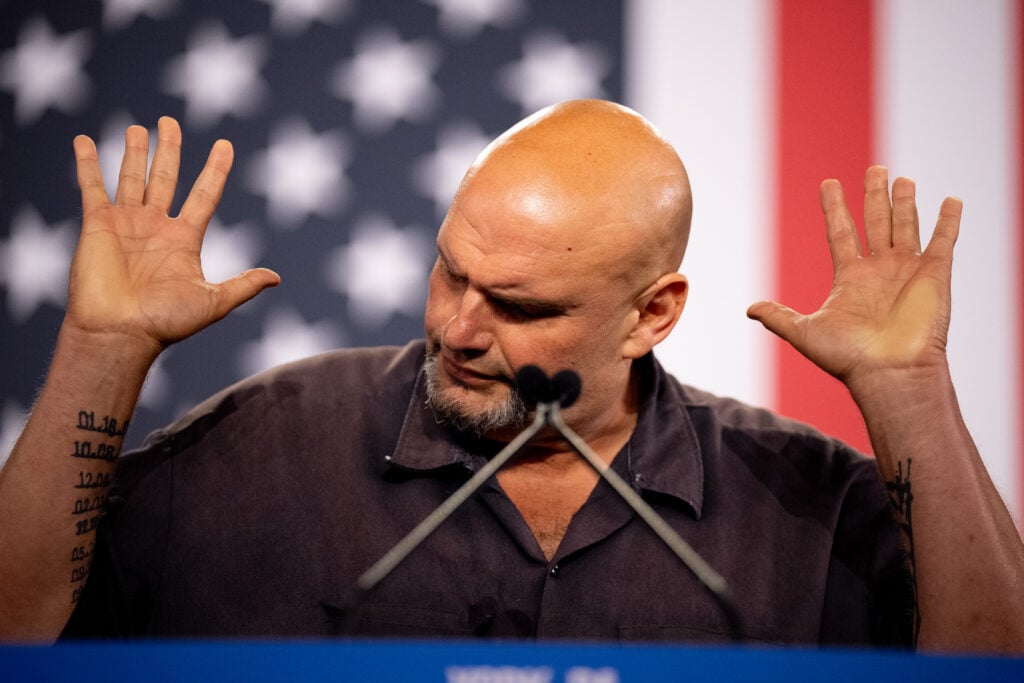
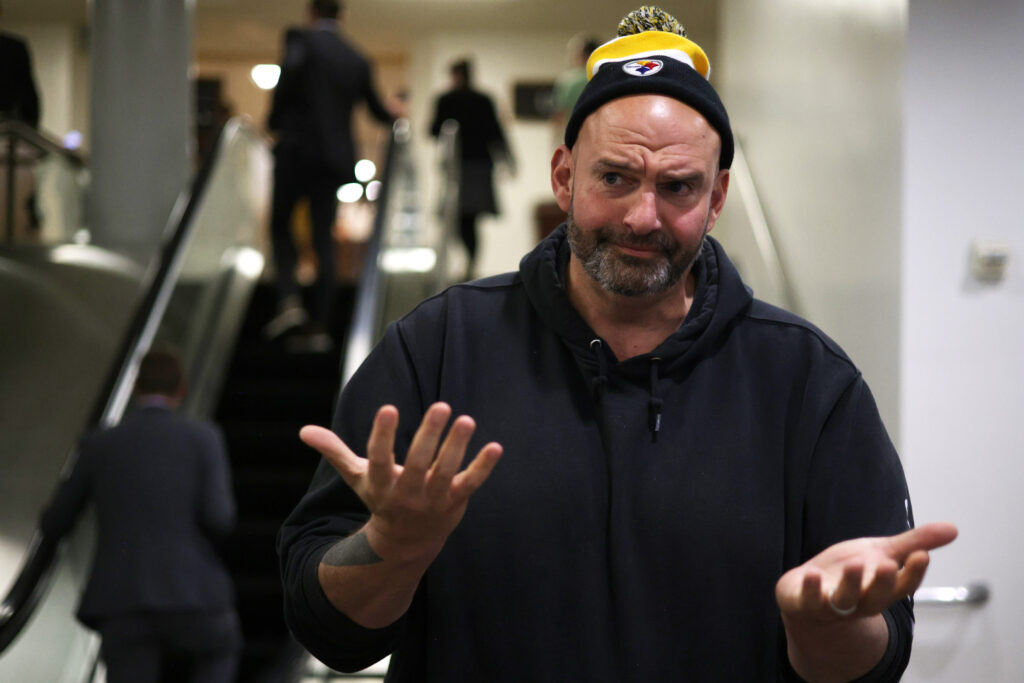
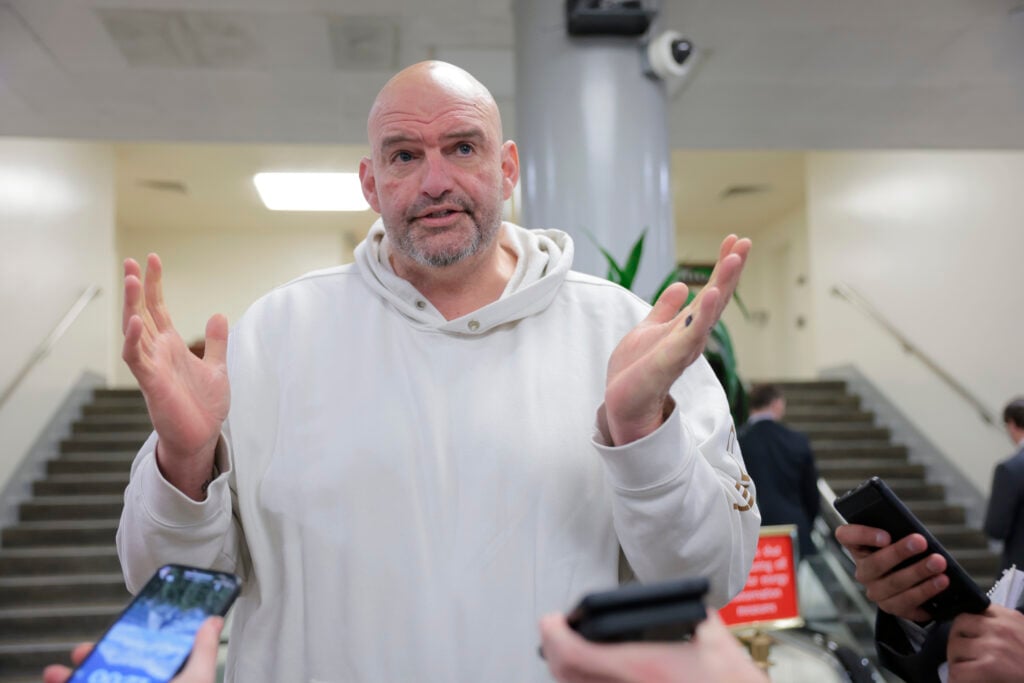
Sen. John Fetterman (D-PA) gestures while speaking at a rally for Democratic vice presidential nominee Minnesota Gov. Tim Walz at York Exposition Center UPMC Arena on October 2, 2024 in York, Pennsylvania. (Photo by Andrew Harnik/Getty Images)
Fetterman criticizes fellow Dems for comparing MAGA movement to Nazi party
Asked about rhetoric used to describe the far right amid ICE raids and National Guard deployments in US cities, Fetterman argued that it’s the critics of those developments who are guilty of going to extremes.
“I’m the only Democrat in my family. I grew up in a conservative part of Pennsylvania,” Fetterman told the crowd, clad in his signature hoodie.
“I would never compare anybody, anybody to Hitler, and those things,” he continued, adding:
“I know and I love people who voted for President Trump. They are not fascists, they’re not Nazis, they’re not trying to destroy the Constitution.”
U.S. Sen. John Fetterman (D-PA) speaks to members of the press at the U.S. Capitol on November 15, 2023 in Washington, DC. (Photo by Alex Wong/Getty Images)
“I refuse to call people Nazis or fascists. I would never compare anybody — anybody to Hitler.”
Fetterman says Charlie Kirk criticism went too far
From there, Fetterman lashed out at public figures and social media users who criticized Charlie Kirk’s views in the wake of his assassination.
“Like Charlie Kirk, all I could say is let people grieve — give people the space. I’m not going to use that terrible thing and that assassination to make my argument and try to put out my views,” Fetterman said.
“It’s like, my God, he’s a father that had his neck blown out by a bullet. And now people have forgotten: President Trump was in my state — was shot in the head,” he continued.
U.S. Sen. John Fetterman (D-PA) speaks to reporters in the Senate Subway during a series of confirmation votes for U.S. President Donald Trump’s cabinet nominees at the U.S. Capitol Building on February 12, 2025 in Washington, DC. (Photo by Anna Moneymaker/Getty Images)
“Could you imagine where our nation would be if he were hit in the same way as Kirk? We really got to turn the temperature down.”
Other Democrats who implored Americans to turn the temperature down amid the current wave of political violence were subsequently criticized by prominent Republicans for their alleged hypocrisy.
But Fetterman’s appeal to the GOP seems to be earning him support from the Right — even as it raises doubts on the Left.
“If there is a worse Democrat than Fetterman I’d like to know who it is,” wrote one X user.
“Fetterman is more focused on helping Trump than helping his constituents,” another added.
Fetterman has yet to respond to the criticism against him, which is not terribly surprising. After all, he doesn’t seem very concerned about the opinions of the Democrats who voted for him these days.
“Can I take off this helmet?” the panicking Gia asks.
Frantically, she explains: “Like, I can’t breathe.”
At this point, Gia received some help from DS Foxy (Sergeant Jason Fox), but not perhaps in the form that she had hoped.
“You can breathe,” he assures her. “You’re breathing now. You’re talking to me.”
He then doubles down: “Go on and get through there. Let’s go! No more excuses, let’s get in there!”
A promotional photo for Gia Giudice on Season 4 of Fox’s ‘Special Forces: World’s Toughest Test.’ (Photo Credit: Pete Dadds/FOX)
The sneak peek does not show us the outcome
Obviously, that is only a sneak peek clip of Gia Giudice tackling a terrifying Special Forces challenge.
Viewers will have to watch the entire episode to know the outcome.
Gia is not only famous for appearing on The Real Housewives of New Jersey, but also for Next Gen NYC.
However, she and RHONJ OG Teresa Giudice entered the absurd Fox competition series as daughter and mother.
Teresa left the show early. Which, honestly, seems pretty wise, no matter the excuse. Look at what Gia’s going through. No thanks.
Special Forces: World’s Toughest Test is currently airing its fourth season.
The premise of the show is that a select group of “celebrities” (that is, public figures of varying levels of fame and notoriety) must endure vaguely militaristic challenges — of their minds and bodies.
It is a miserable experience for many contestants. This is by design.
For some, it is also a miserable experience for viewers. Critics argue that the series is an indictment of our culture, indicating backsliding by decades.
But hey, look at it this way: it’s not as bad as The Masked Singer. Let that be a comfort to us all.
On ‘Special Forces,’ Gia Giudice was clearly feeling broken down. (Image Credit: FOX)
Is this the end of Gia on ‘Special Forces’ Season 4?
Teasers are often deeply misleading. This applies to real television and to reality shows in equal measure.
A promo or a sneak peek might show one person on the edge of a breakdown, only for them to pull through shortly after the end of the clip.
Or this could be heralding the beginning of the end for Gia Giudice’s time on the show.
Truth be told, getting to leave this abject misery sounds optimal.
But perhaps we’ll see Gia overcome her very reasonable and understandable anxieties and pull through. If that’s really what she wants to do, well, more power to her.
A third season of the Bravo series McBee Dynasty: Real American Cowboys is set to begin filming this week — but family patriarch Steve McBee will not be roaming the ranch with his sons.
McBee was sentenced to 24 months in prison today after pleading guilty to crop insurance fraud in November of 2024.
He will also be forced to pay more than $4 million in restitution.
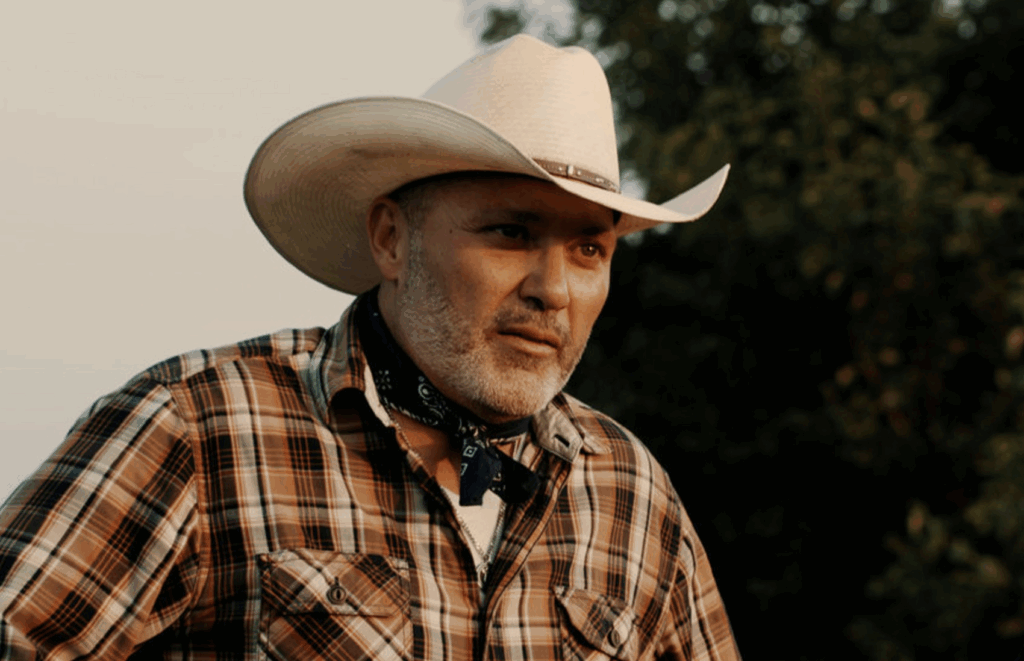
Steve McBee of Bravo’s ‘McBee Dynasty’ has been sentenced to two years in prison. (Bravo/YouTube)
According to a Justice Department press release published by People magazine, McBee and his business partners confessed to defrauding an insurance company called Rain and Hail, which is reinsured by the Federal Crop Insurance Corporation.
McBee allegedly sent “fraudulent documents to Rain and Hail that underreported his total 2018 corn crop by approximately 674,812 bushels and underreported his total 2018 soybean crop by approximately 155,833 bushels.”
The falsified documents reportedly enabled McBee to receive $2,605,943 in federal crop insurance benefits.
He also received $552,980 in federal crop insurance premium subsidies, making a total of $3,158,923 in unauthorized benefits.
Steve McBee of Bravo’s ‘McBee Dynasty’ has been sentenced to two years in prison. (Bravo/YouTube)
Lawyers for the reality star requested that he be let off with supervised release — but given the size of his theft, McBee is lucky that he only received two years.
McBee was the central focus of the first season of McBee Dynasty.
But he appeared only twice in the second season, as the patriarch’s mounting legal woes forced producers to shift their focus to his sons.
“On the heels of a wedding and the arrival of two new babies, the McBee clan is growing — and so are the challenges of balancing love, legacy, and life on the ranch,” reads the show’s official logline.
Earlier this week, Steve’s son Steve Jr. admitted to feeling “scared, nervous, anything, and everything” ahead of today’s hearing.
“We love him so much, and love our family unit,” Steven Jr. continued, according to Bravo. “So, to picture him not being here with us for any amount of time, it’s scary.”
The McBees have not yet spoken publicly about today’s sentencing news.
We will have further updates on this developing story as new information becomes available.
Now, the situation has become even more problematic, as a new excerpt includes allegations that Britney combined alcohol and prescription medications while she was pregnant.
Britney Spears poses with sons Jayden James Federline (L) and Sean Preston Federline (R) during a game against the San Diego Padres at Dodger Stadium on April 17, 2013 in Los Angeles, California. (Photo by Jon SooHoo/LA Dodgers via Getty Images)
In the excerpt, published Thursday afternoon by People, Federline writes that a “silent alarm” was tipped in his mind when he learned that his then-wife was drinking and popping pills while expecting.
“That mix was… dangerous. F—-d up, honestly,” he writes.
“You’re not supposed to drink when you’re on meds like that. A couple of glasses of wine for her would hit like a whole bottle because of the medication.”
Federline goes on to explain that he made excuses for Britney, as he reasoned that drinking and pills were her methods for coping with the pressures of fame.
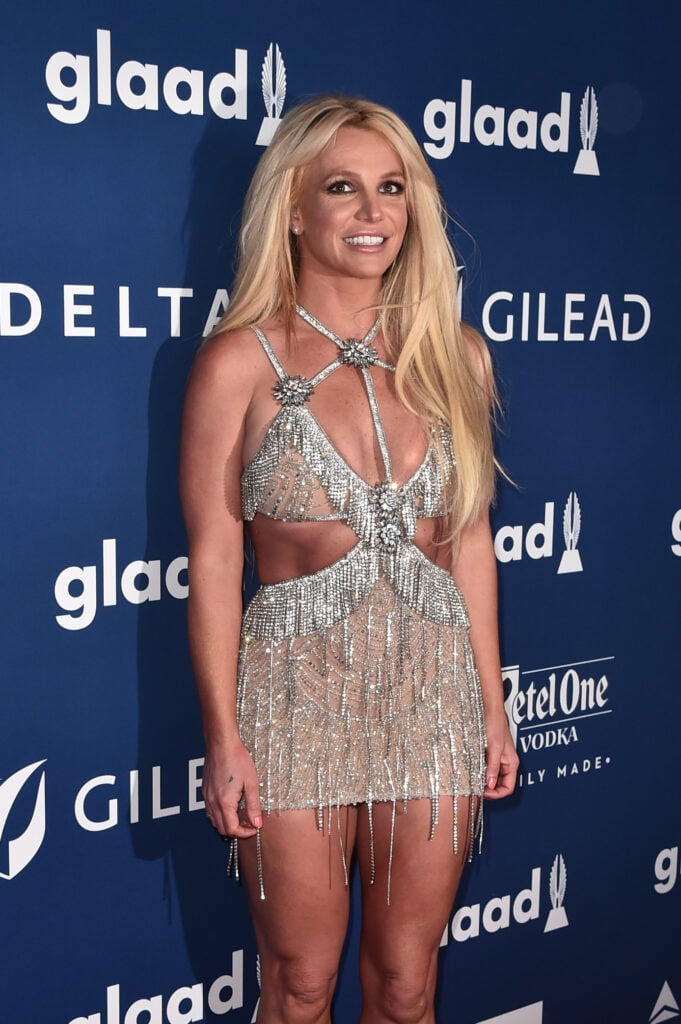
Honoree Britney Spears attends the 29th Annual GLAAD Media Awards at The Beverly Hilton Hotel on April 12, 2018 in Beverly Hills, California. (Photo by Alberto E. Rodriguez/Getty Images)
The situation came to a head at a release party for Federline’s 2006 album “Playing With Fire,” which he did not expect Britney to attend.
“I was happy [Britney’s father, Jamie Spears] had decided to come support me,” Federline recalls in an excerpt from his memoir obtained by Us Weekly.
“He threw a look my way, shook his head and motioned to my dressing room door. His expression sat in that flat blank space between disapproval and apprehension, as if to say: ‘She’s here, and it’s not good.’”
Federline says that he opened the door to the dressing room, where he found “Britney and [a] young starlet friend snorting a fat line of coke off the table.”
Britney Spears attends the 2016 MTV Video Music Awards at Madison Square Garden on August 28, 2016 in New York City. (Photo by Jamie McCarthy/Getty Images)
“Both were wearing these outrageous wigs. Britney’s was electric blue. It was surreal. They didn’t even try to hide it,” he alleged.
Federline did not name Brit’s companion for the evening, but identified her as an “actress who was about to blow up from a role that would transform her life.”
“I had seen it before, her drinking and breastfeeding, and it was really upsetting because of the danger to the kids,” he writes, adding:
“She could have pumped milk for Jayden so her mom had that ready.”
Britney released a statement denying the first round of Federline’s allegations, but she has not responded to claims that she drank and did drugs while pregnant and breastfeeding.
We will have further updates on this developing story as new information becomes available.