Categories
Featured Juneau News Juneau Local Ketchikan Local News Feeds Sitka Local

Alaska cities and boroughs consider higher sales taxes to help pay for public services

By: James Brooks, Alaska Beacon

“I voted” stickers are seen on display in the headquarters offices of the Alaska Division of Elections in Juneau on Tuesday, Nov. 12, 2024. (Photo by James Brooks/Alaska Beacon)

Election day is around the corner for most of Alaska’s local governments, and many communities are considering whether to raise local sales taxes to pay for the escalating cost of public services, including basic infrastructure like road repairs and landfills.

Alaska’s largest city, Anchorage, holds its elections in the spring, as do Valdez and Cordova, but most of the state’s 150-plus municipal governments will have their elections in the next week.

In the state capital, Juneau, where voting has been underway by mail since late September, voters are considering three ballot measures with major implications for the City and Borough of Juneau budget.

Measure No. 1 would tighten the cap on local property taxes below current rates, effectively cutting city revenue by about $1 million and eliminating the city’s ability to raise rates. 

The second measure would exempt food and residential utilities from local sales taxes. That would eliminate between $10 million and $12 million per year from the city budget.

To compensate, there’s also Measure No. 3, which would raise the city’s sales tax from 5% to 7.5% in the summer and lower it to 3% in the winter. If that measure passes, it would roughly balance the lost money if Measure No. 2 passes.

If ballot measure No. 3 doesn’t pass, Juneau city officials expect to significantly cut local services in order to balance the budget.

Juneau is one of several communities deciding whether to pass sales tax hikes this month.

In Skagway, voters are considering a seasonal sales tax increase from 5% to 7% in the summer, with some of the proceeds earmarked for water, wastewater and garbage services in order to lower local rates.

In neighboring Haines, voters are deciding whether to raise the local sales tax from 5.5% to 7% in the summer within the Haines townsite, with a smaller increase in the rest of the borough. The sales tax would fall to 4.5% in the townsite during the winter, 3% in the rest of the borough, and groceries would be exempted.

In Ketchikan, borough residents are being asked whether they want to extend part of the local sales tax through 2032. The borough has a 2.5% sales tax, but half of a percent is dedicated to construction and renovation projects at local schools. That’s what voters will consider renewing.

Slightly north, in Petersburg, voters will decide whether to reduce a senior citizen sales tax exemption so it applies only to low-income residents. 

Ketchikan city voters consider seven ballot measures

While voters in the Ketchikan borough contemplate a sales tax measure, voters within the city of Ketchikan itself will also have seven other ballot propositions to consider.

First is a $15 million bond to pay for sewer mains and upgrades to the city’s water treatment facility. Those upgrades are being mandated by the state and federal governments. 

Voters in the First City also will decide six different amendments to the city charter. Proposition No. 2 would eliminate a 30-day waiting period for city ordinances to take effect. No. 3 would allow the city manager to live outside city limits, but only on the road system of Revillagigedo Island, where the city is located.

Proposition No. 4 would remove the requirement that voters approve the sale of any city property worth more than $30,000. Instead, the city council would have the authority to approve those sales.

The fifth proposition would allow the city to award large contracts to someone other than the lowest bidder, and the sixth would allow the city to approve sales or contracts with city employees and elected officials as long as there are at least three cost quotes and the chosen contract is “the most advantageous to the city.”

The last proposition, the seventh, would allow the city’s annual fiscal audit to take more than four months.

In addition to those ballot measures, three candidates are running for two seats on the Ketchikan City Council. There’s also a two-way race for borough mayor, two contested borough assembly races and two contested school board races.

Voters in Sitka will consider two ballot measuresThe first would allow the city to use proceeds from the local tobacco tax and the sale of the local hospital for parks and recreation. 

The second, if adopted, would require all ballot measures to include a comprehensive economic impact study report before reaching the signature-gathering phase. 

Six people are running for two seats on the Borough Assembly in Sitka, and there are three candidates for two seats on the local school board.

In Petersburg, two candidates are running for mayor and five candidates are running for two seats on the borough assembly. There is one candidate and two open seats for the school board. 

In Skagway, the one candidate for mayor is running uncontested, after the previous mayor resigned earlier this year. There are four candidates for two assembly seats, and one candidate for two open school board seats. In Haines, there are four candidates for two assembly seats, and two candidates for two school board seats. 

North Slope voters contemplate big borrowing plan

In the North Slope Borough, two of four assembly races are contested, and only one of four school board races is contested. Borough voters also will consider eight different bond proposals. That’s more ballot propositions than any other municipal election taking place this month in Alaska. 

The borough is proposing to borrow a combined $204 million for public facilities, including light, power, water, sewage, public safety, education and flood control.

At Utqiagvik, the borough’s largest town and the northernmost town in the United States, voters will choose between two candidates for mayor. There’s also two city council races, only one of which is contested.

Voters also are being asked to choose whether or not to extend Utqiagvik’s 20% wholesale tobacco tax to cover “alternative nicotine products and equipment,” such as vape and e-cigarette products. 

Within the Northwest Arctic Borough, there are four borough assembly seats on this year’s ballot. Only one race is contested, and one seat — covering Ambler, Kobuk and Shungnak — has no candidates at all.

Similarly, among three races for school board, none are contested and one of the three seats has no candidates.

In the Kotzebue city election, two seats on the city council are on the ballot, and each race has two candidates. Another seat was vacated by the resignation of Ruth Moto in September, and someone will be appointed to fill that seat after the election, with the replacement being up for election in October 2026. 

The Nome Nugget noted “meager interest to run for public office” in Nome this year, with two city council seats and two school board seats unopposed, but voters there will also be asked whether to raise the city’s sales tax from 5% to 6%. 

This week, the Nugget reported that if the tax increase doesn’t pass, city officials will cut services.

In the Matanuska-Susitna Borough, Houston considers sales tax hike

The Matanuska-Susitna Borough holds its elections in November (as does Metlakatla in Southeast), but the cities within the Mat-Su borough vote in October.

Wasilla has no ballot measures; its city election includes three city council races, only one of which is contested.

In Palmer, five people are competing to become the city mayor, the most competitive single municipal race this fall. Three people are competing for two three-year seats on the city council. There also is a one-year seat on the council, and two people are vying for it.

Palmer voters are also being asked if they want to change the city charter so the city manager is no longer required to live within the city. The change would allow the manager to live within five miles of city limits.

Within Houston, six people are running for three spots on the city council. Houston also has four ballot measures. One asks whether voters support a city-owned airport. A second asks voters to approve a 2% sales tax increase (from 2% to 4%) in order to pay for road repairs. The third and fourth measures ask voters to approve the “Matanuska Thunder Festival” and “Founder’s Day” as city holidays. 

Many ballot measures in the Kenai Peninsula Borough

Within the Kenai Peninsula Borough, voters will decide five different ballot propositions. The first would require elections officials to hand-count ballots and ban electronic tabulators. The Matanuska-Susitna Borough has already taken a similar move.

Proposition No. 2 would create a special taxing district in Ninilchik to fund a new local swimming pool there. No. 3, if approved, would increase the property tax exemption in the borough so the first $75,000 of a homeowner’s residence would be exempted from local property taxes. The current exemption applies to the first $50,000.

The fourth proposition would raise the borough’s sales tax cap every five years. Currently, sales taxes only apply to the first $500 of a purchase.

Proposition No. 5 would shift borough elections to November, aligning them with state and federal elections, much as the Mat-Su borough has done.

Five seats on the Kenai borough assembly are up for election, and three of the races are contested. Three school board seats are on the ballot as well, with two races contested.

Among city elections on the Kenai Peninsula, only Soldotna has a ballot measure. That proposition asks voters to approve or reject the annexation of 2.63 square miles of nearby land into the city limits. 

In the Interior, none of Fairbanks’ three local governments have ballot measures this year, but this year’s ballot will decide three seats on the borough assembly and two on the borough school board. There’s a two-person race to become Mayor of Fairbanks, and two seats on the city council are up for election. 

Southeast of Fairbanks, in North Pole, four seats on the city council are up for election. There are only four candidates, but the order of the candidates will determine who gets a three-year term, a two-year term or a one-year term.

Kodiak will pick a new mayor

In Kodiak, voters will pick between two candidates for borough mayor, five candidates for two seats on the borough assembly, and they will vote on a variety of service area boards.

Within city limits on Kodiak, four people are running to replace longtime Mayor Pat Branson, and four candidates are running for two seats on the city council.

In southwest Alaska, Bethel has four open city council seats but only three registered candidates and one write-in candidate

In Unalaska, Mayor Vince Tutiakoff Sr. is running unopposed for re-election, and three people are running for one of the two city council seats on the ballot. The other incumbent for city council is unopposed. On the local school board, three people are running for one of two school board seats; the other seat is held by the incumbent school board president, who is unopposed in his re-election bid.

Within the Aleutians East Borough, which includes Sand Point, King Cove and Cold Bay, two of three borough assembly seats have unopposed races, and the third has two candidates. All three school board seats on the ballot have candidates running unopposed.

Further north in Dillingham, two city council seats have two candidates apiece, and three people are running unopposed for three school board seats.

Within the Bristol Bay Borough, based in Naknek, three people are running for two seats on the borough assembly, and there are five candidates for the two school board seats on the ballot.

In the Lake and Peninsula Borough, two borough assembly members and two school board members are running unopposed. Those elections, like those in Juneau, are conducted by mail, and ballots must be postmarked by Oct. 7 and received by the borough clerk before Nov. 7.

Categories
Featured Juneau News Juneau Local Ketchikan Local News Feeds Sitka Local

Former Anchorage Mayor Dave Bronson announces run for Alaska governor

By: James Brooks, Alaska Beacon

Anchorage Mayor Dave Bronson speaks in May 2022 at the Alaska Sustainable Energy Conference. (Photo by Yereth Rosen/Alaska Beacon)

Former Anchorage Mayor Dave Bronson said Thursday in Fairbanks that he intends to run for governor in 2026, becoming the 13th candidate and 12th Republican in next year’s race.

Incumbent Gov. Mike Dunleavy is term-limited and unable to run again, which has caused an unusually large number of early entries into the governor’s race.

Only one Democratic candidate, former Anchorage state Sen. Tom Begich, has entered the race. Other Democrats say they are awaiting the possible run by former Democratic U.S. Rep. Mary Peltola, who had the highest favorability rating among top candidates, according to one poll this summer.

Republicans face no such obstacle. In addition to Bronson, the Republican field of candidates includes former state Sen. Click Bishop of Fairbanks; Lt. Gov. Nancy Dahlstrom of Eagle River; Anchorage businesswoman Bernadette Wilson; podiatrist Matt Heilala of Anchorage; Matanuska-Susitna Borough Mayor Edna DeVries; former teacher James William Parkin IV of Angoon; current state Sen. Shelley Hughes of Palmer; Bruce Walden of Palmer; former Alaska Revenue Commissioner Adam Crum; and former Alaska Attorney General Treg Taylor.

All of those candidates have filed letters of intent or statements of candidacy with the Alaska Public Offices Commission, which allows them to fundraise and spend money on a campaign.

They have not yet registered with the Alaska Division of Elections, which officially places a candidate on the August primary ballot. 

Republican Henry Kroll of Soldotna, who has not registered with the Public Offices Commission, is the lone candidate to have registered with the Division of Elections.

The deadline to file with the Alaska Division of Elections is June 1, 2026.

In Alaska, the top four vote-getters for a state office, regardless of political party, advance from the August general election to the November general election.

Wilson has vowed to withdraw from the election if she finishes in the top four but isn’t the top Republican. She has encouraged other Republicans to take similar vows in an attempt to consolidate support for the top Republican front-runner in the general election.

Bronson, who delivered brief remarks in Fairbanks before participating in a panel discussion with six other Republican candidates, said he supports increased spending on infrastructure and the Permanent Fund dividend, saying he would like to see a constitutional amendment that would mandate a dividend paid according to a formula that was used from 1982 through 2016. 

That would require spending an additional $2 billion per year for dividend payments above what lawmakers and Dunleavy approved this year. As a whole, the state’s operating budget is currently $5.9 billion. Bronson did not explain how he intends to pay for the increase.

An experienced pilot, Bronson was elected mayor of Anchorage in 2021, months after the incumbent Democratic mayor resigned during a sex scandal and amid a conservative backlash against COVID-19 mitigation efforts imposed by the Anchorage assembly. 

He served a single term and was endorsed for re-election by Dunleavy and U.S. Sen. Dan Sullivan but lost in 2024 to current Mayor Suzanne LaFrance.

Bronson’s time in office was marked by major conflicts with city employees, public health officials and the assembly. In 2023, the city manager Bronson appointed and fired, sued him and the city, alleging illegal and unethical acts. The assembly settled that case in 2024 for $250,000 after Bronson left office.

In January, Dunleavy appointed Bronson to manage Ted Stevens Anchorage International Airport. After less than eight months, he announced his resignation from that job in August.

Categories
Politics

Shutdowns are as American as apple pie − in the UK and elsewhere, they just aren’t baked into the process

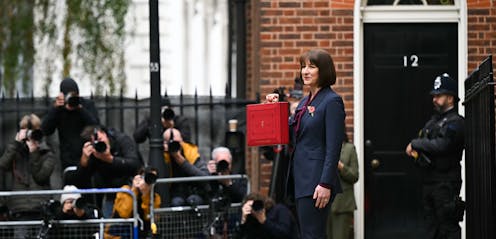
The obligatory showing of the red briefcase containing budget details is as exciting as it gets in the U.K. Justin Tallis – WPA Pool/Getty Images

When it comes to shutdowns, the U.S. is very much an exception rather than the rule.

On Oct. 1, 2025, hundreds of thousands of federal employees were furloughed as the business of government ground to a halt. With negotiations in Congress seemingly deadlocked over a funding deal, many political watchers are predicting a lengthy period of government closure.

According to the nonpartisan nonprofit Committee for a Responsible Federal Budget, the latest shutdown represents the 20th such funding gap since 1976.

But it doesn’t have to be like this – and in most countries, it isn’t. Other Western democracies experience polarization and political turmoil, too, yet do not experience this problem. Take for example the U.K., traditionally one of Washington’s closest allies and home to the “mother of parliaments.”

In the British system, government shutdowns just don’t happen – in fact, there has never been one and likely never will be.

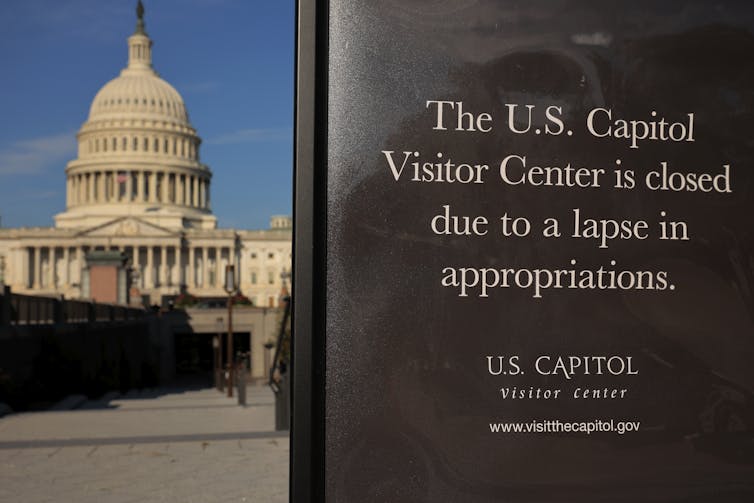
A sign reads 'The US Capitol Visitors Center is closed due to a lapse in appropriations.'
The U.S. Capitol Visitors Center is closed to visitors during the federal government shutdown on Oct. 01, 2025.
Chip Somodevilla/Getty Images

So why do they occur in Washington but not London? Essentially, it comes down to four factors: the relative power of the legislature; how easy it is to pass a budget; the political stakes at play; and distinctive appropriation rules.

1. Legislative power

There are significant differences in how the legislatures of the U.K. and U.S. shape the budgetary process.

In the U.K., only the executive branch – the party or coalition in power – has the authority to propose spending plans. Parliament, which consists of members from all political parties, maintains an oversight and approval role, but it has very limited power over the budgetary timeline or to amend spending plans. This is a stark contrast with the U.S., where Congress – which may be split or controlled by a party different to the executive – plays a far more consequential role.

The U.S. president starts the budget process by laying out the administration’s funding priorities. Yet, the Constitution grants Congress the power of the purse – that is, the power to tax and spend.

Moreover, past legislation has bolstered congressional control. The 1974 Congressional Budget Act helped curtail presidential involvement in the budgeting process, giving Congress more authority over the timeline. That gave Congress more power but also offered it more opportunities to bicker and derail the budgetary process.

2. Thresholds to pass a budget

Congress and the U.K. Parliament also differ when it comes to their voting rules. Passing the U.S. budget is inherently more complicated, as it requires the support of both the Senate and the House of Representatives.

In Parliament, however, the two houses – the elected House of Commons and unelected House of Lords – are not equally involved. The two Parliament Acts of 1911 and 1949 limited the power of the House of Lords, preventing it from amending or blocking laws relating to budgeting.

Additionally, approving the budget in Westminster requires only an absolute majority of votes in the House of Commons. That tends to be quite a straightforward hurdle to overcome in the U.K. The party in power will typically also command a majority of votes in the chamber or be able to muster one up with the support of smaller parties. It is not, however, so easy in Congress. While a simple majority suffices in the House of Representatives, the Senate still has a 60-vote requirement to close debates before proceeding with a majority vote to pass a bill.

3. Political stakes

U.S. and U.K. politicians do not face the same high stakes over budget approval. Members of Congress may eventually pay a political price for how they vote on the budget, but there is no immediate threat to their jobs. That is not so in the U.K.

Indeed, the party or coalition in power in the U.K. must maintain the “confidence” of the House of Commons to stay in office. In other words, they need to command the support of the majority for key votes. U.K. governments can actually fall – be forced to resign or call for new elections – if they lose formal votes of confidence. Since confidence is also implied in other major votes, such as over the annual budget proposals, this raises the stakes for members of Parliament. They have tended to think twice before voting against a budget, for fear of triggering a dissolution of Parliament and new elections.

4. Distinctive appropriation rules

Finally, rules about appropriation also set the U.S. apart. For many decades, federal agencies could still operate despite funding bills not being passed. That, however, changed with a ruling by then-Attorney General Benjamin Civiletti in 1980. He determined that it would be illegal for governments to spend money without congressional approval.

That decision has had the effect of making shutdowns more severe. But it is not a problem that the U.K. experiences because of its distinct rules on appropriation. So-called “votes on account” allow the U.K. government “to obtain an advance on the money they need for the next financial year.”

This is an updated version of an article that was first published by The Conversation U.S. on Sept. 28, 2023.

The Conversation

Garret Martin receives funding from the European Union for the Transatlantic Policy Center, which he co-directs.

​Politics + Society – The Conversation

Categories
Politics

Where George Washington would disagree with Pete Hegseth about fitness for command and what makes a warrior

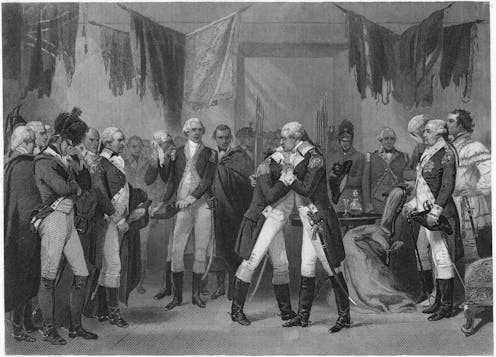
On Dec. 4, 1783, after six years fighting against the British as head of the Continental Army, George Washington said farewell to his officers and returned to civilian life. Engraving by T. Phillibrown from a painting by Alonzo Chappell

As he paced across a stage at a military base in Quantico, Virginia, on Sept. 30, 2025, Secretary of Defense Pete Hegseth told the hundreds of U.S. generals and admirals he had summoned from around the world that he aimed to reshape the military’s culture.

Ten new directives, he said, would strip away what he called “woke garbage” and restore what he termed a “warrior ethos.”

The phrase “warrior ethos” – a mix of combativeness, toughness and dominance – has become central to Hegseth’s political identity. In his 2024 book “The War on Warriors,” he insisted that the inclusion of women in combat roles had drained that ethos, leaving the U.S. military less lethal.

In his address, Hegseth outlined what he sees as the qualities and virtues the American soldier – and especially senior officers – should embody.

On physical fitness and appearance, he was blunt: “It’s completely unacceptable to see fat generals and admirals in the halls of the Pentagon and leading commands around the country and the world.”

He then turned from body shape to grooming: “No more beardos,” Hegseth declared. “The era of rampant and ridiculous shaving profiles is done.”

As a historian of George Washington, I can say that the commander in chief of the Continental Army, the nation’s first military leader, would have agreed with some of Secretary Hegseth’s directives – but only some.

Washington’s overall vision of a military leader could not be further from Hegseth’s vision of the tough warrior.

A man in front of a US flag, looking like he is shouting and holding out his fists.
U.S. Secretary of Defense Pete Hegseth speaks to senior military leaders at Marine Corps Base Quantico on Sept. 30, 2025.
Andrew Harnik/Getty Images

280 pounds – and trusted

For starters, Washington would have found the concern with “fat generals” irrelevant. Some of the most capable officers in the Continental Army were famously overweight.

His trusted chief of artillery, Gen. Henry Knox, weighed around 280 pounds. The French officer Marquis de Chastellux described Knox as “a man of thirty-five, very fat, but very active, and of a gay and amiable character.”

Others were not far behind. Chastellux also described Gen. William Heath as having “a noble and open countenance.” His bald head and “corpulence,” he added, gave him “a striking resemblance to Lord Granby,” the celebrated British hero of the Seven Years’ War. Granby was admired for his courage, generosity and devotion to his men.

Washington never saw girth as disqualifying. He repeatedly entrusted Knox with the most demanding assignments: designing fortifications, commanding artillery and orchestrating the legendary “noble train of artillery” that brought cannon from Fort Ticonderoga to Boston.

When he became president, after the Revolution, Washington appointed Knox the first secretary of war – a sign of enduring confidence in his judgment and integrity.

Beards: Outward appearance reflects inner discipline

As for beards, Washington would have shared Hegseth’s concern – though for very different reasons.

He disliked facial hair on himself and on others, including his soldiers. To Washington, a beard made a man look unkempt and slovenly, masking the higher emotions that civility required.

Beards were not signs of virility but of disorder. In his words, they made a man “unsoldierlike.” Every soldier, he insisted, must appear in public “as decent as his circumstances will permit.” Each was required to have “his beard shaved – hair combed – face washed – and cloaths put on in the best manner in his power.”

For Washington, this was no trivial matter. Outward appearance reflected inner discipline. He believed that a well-ordered body produced a well-ordered mind.

To him, neatness was the visible expression of self-command, the foundation of every other virtue a soldier and leader should possess.

That is why he equated beards and other forms of unkemptness with “indecency.” His lifelong battle was against indecency in all its forms. “Indecency,” he once wrote, was “utterly inconsistent with that delicacy of character, which an officer ought under every circumstance to preserve.”

More statesman than warrior

By “delicacy,” Washington meant modesty, tact and self-awareness – the poise that set genuine leaders apart from individuals governed by passions.

For him, a soldier’s first victory was always over himself.

“A man attentive to his duty,” he wrote, “feels something within him that tells him the first measure is dictated by that prudence which ought to govern all men who commits a trust to another.”

In other words, Washington became a soldier not because he was hotheaded or drawn to the thrill of combat, but because he saw soldiering as the highest exercise of discipline, patience and composure. His “warrior ethos” was moral before it was martial.

Washington’s ideal military leader was more statesman than warrior. He believed that military power must be exercised under moral constraint, within the bounds of public accountability, and always with an eye to preserving liberty rather than winning personal glory.

In his mind, the army was not a caste apart but an instrument of the republic – an arena in which self-command and civic virtue were tested. Later generations would call him the model of the “republican general”: a commander whose authority rested not on bluster or bravado but on composure, prudence and restraint.

That vision was the opposite of the one Pete Hegseth performed at Quantico.

A man on a white horse and in a uniform saluting a long line of soldiers in front of him.
Washington formally taking command of the Continental Army on July 3, 1775, in Cambridge, Mass.
Currier and Ives image, photo by Heritage Art/Heritage Images via Getty Images

Discipline and steadiness, not fury and bravado

The “warrior ethos” Hegseth celebrates – loud, performative – was precisely what Washington believed a soldier must overcome.

In March 1778, after Marquis de Lafayette abandoned an impossible winter expedition to Canada, Washington praised caution over juvenile bravado.

“Every one will applaud your prudence in renouncing a project in which you would vainly have attempted physical impossibilities,” he wrote from the snows of Valley Forge.

For Washington, valor was never the same as recklessness. Success, he believed, depended on foresight, not fury, and certainly not bravado.

The first commander in chief cared little for waistlines or whiskers, in the end; what concerned him was discipline of the mind. What counted was not the cut of a man’s figure but the steadiness of his judgment.

Washington’s own “warrior ethos” was grounded in decency, temperance and the capacity to act with courage without surrendering to rage. That ideal built an army – and in time, a republic.

The Conversation

Maurizio Valsania does not work for, consult, own shares in or receive funding from any company or organization that would benefit from this article, and has disclosed no relevant affiliations beyond their academic appointment.

​Politics + Society – The Conversation

Categories
Politics

Moral panics intensify social divisions and can lead to political violence

The day before Charlie Kirk was assassinated, I was teaching a college class on science, religion and magic. Our class was comparing the Salem witch trials of the 1690s with the McCarthy hearings of the early 1950s, when U.S. democratic processes were eclipsed by the Red Scare of purported communist infiltration.

The aim of the class was to better understand the concept of moral panics, which are societal epidemics of disproportionate fear of real or perceived threats. Such outsized fear can often lead to violence or repression against certain socially marginalized groups. Moral panics are recurring themes in my research on the anthropology of fear and discrimination.

Our next class meeting would apply the moral panic concept to a recent example of political violence. Tragically, there were many of these examples to choose from.

Minnesota State Representative Melissa Hortman and her husband were assassinated on June 14, 2025, which happened to be the eighth anniversary of the congressional baseball shootings in which U.S. House Majority Whip Steve Scalise and three other Republicans were wounded. These shootings were among at least 15 high-profile instances of political violence since Rep. Gabby Gifford was severely wounded in a 2011 shooting that killed five and wounded another 13 people.

Seven of these violent incidents occurred within the past 12 months. Kirk’s killing became the eighth.

In most of these cases, we may never fully know the perpetrator’s motives. But the larger pattern of political violence tracks with the increasing polarization of American society. While researching this polarization, I have found recurring themes of segregation and both the dehumanization and disproportionate fear of people with opposing views among liberals and conservatives alike.

Segregation and self-censorship

The first ingredient of a moral panic is the segregation of a society into at least two groups with limited contact between them and an unwillingness to learn from one another.

In 17th century Salem, Massachusetts, the social divisions were long-standing. They were largely based on land disputes between family factions and economic tensions between agriculturally-based village communities and commercially-based town communities.

Within these larger groups, a growing number of widowed women had become socially marginalized for becoming economically independent after their husbands died in colonial wars between New England and New France. And rumors of continuing violence led residents in towns and villages to avoid Native Americans and new settlers in surrounding frontier areas. Salem was divided in many ways.

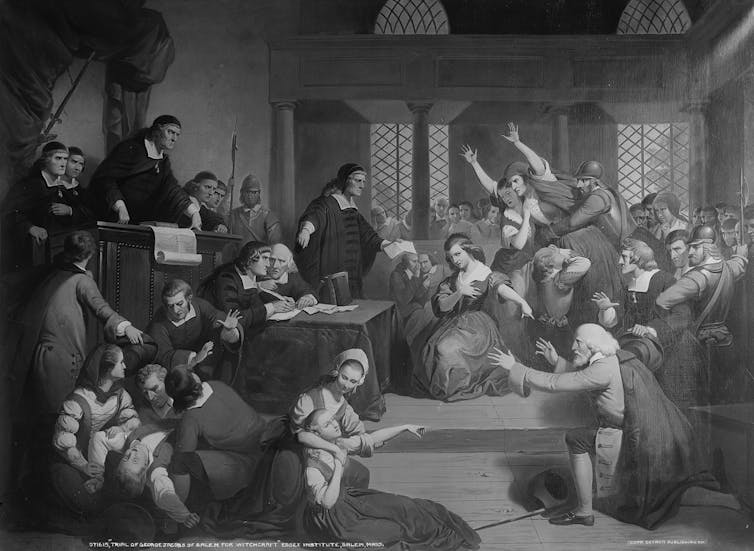
A black-and-white copy of a painting depicts a trial in Salem, Massachusetts, in 1692.
The painting ‘Trial of George Jacobs of Salem for Witchcraft’ by Tompkins Harrison Matteson. Jacobs was one of the few men accused of witchcraft.
Tompkins Harrison Matteson/Library of Congress via AP

Fast forward to the end of World War II. That’s when returning American veterans used their benefits to settle into suburban neighborhoods that would soon be separated by race and class through zoning policies and discriminatory lending practices. This set the stage for what has come to be called The Big Sort, the self-segregation of people into neighborhoods where residents shared the same political and religious ideologies.

It was during the early stages of these sorting processes that the Red Scare and McCarthy hearings emerged.

The Big Sort turned digital in the early 2000s with the rise of online information and social media platforms with algorithms that conform to the particular desires and biases of their user communities.

Consequently, it is now easier than ever for conservatives and liberals to live in separate worlds of their own choosing. Under these conditions, Democrats and Republicans tend to exaggerate the characteristics of the other party based on common stereotypes.

Dehumanization and discrimination

Dehumanization is perhaps the most crucial ingredient of a social panic. This involves labeling people according to categories that deprive them of positive human qualities. This labeling process is often conducted by “moral entrepreneurs” – people invested by their societies with the authority to make such claims in an official, unquestionable and seemingly objective way.

In 1690s Massachusetts, the moral entrepreneurs were religious authorities who labeled people as satanic witches and killed many of them. In 1950s Washington, the moral entrepreneurs were members of Congress and expert witnesses who labeled people Soviet collaborators and ruined many of their lives.

In the 21st century, the moral entrepreneurs include media personalities and social influencers as well as the nonhuman bots and algorithms whose authority is derived by constructing the illusion of broad consensus.

Under these conditions, many U.S. liberals and conservatives regard their counterparts as savage, immature, corrupt or malicious. Not surprisingly, surveys reveal that animosity between conservatives and liberals has been at its highest over the past five years than any other time since the measurements first began in 1978.

Adding to the animosity, dehumanization can also justify discrimination against a rival group. This is shown in social psychology experiments in which conservatives and liberals discriminate against one another to a greater degree than by race when deciding on scholarships and job opportunities. Such discrimination lends credence to further animosity.

Exaggerating fear

There is a fine line between animosity and disproportional fear. The latter can lead to extreme policies and violent actions during a moral panic.

Such fear often takes the form of perceived threats. Rachel Kleinfeld, a scholar who studies polarization and political violence, says that one of the best ways to rally a political base is to make them think they are under attack by the other side. She says that “is why ‘They are out to take your x’ is such a time-honored fundraising and get-out-the-vote message.”

In the past few years, the “x” that could be taken has escalated to core freedoms and personal safety, threats which could easily trigger widespread fear on both sides of the political divide.

But the question remains whether exaggerated fears are sufficient to trigger political violence. Are assassins like Kirk’s killer simply pathological outliers among agitated but otherwise self-restrained populations? Or are they sensitive indicators of a looming social catastrophe?

A black-and-white photo shows two men dressed in suits sitting in front of a desk.
The House Committee on Un-American Activities investigates movie producer Jack Warner, right, in Washington on Oct. 20, 1947.
AP Photo

Countering the panic

We do not have the answers to that question yet. But in the interim, there are efforts in higher education to reduce animosity and encourage constructive interactions and discussion between people with different perspectives.

A nonpartisan coalition of faculty, students and staff – known as the Heterodox Academy – is promoting viewpoint diversity and constructive debates on over 1,800 campuses. The college where I teach has participated in the Congress to Campus program, promoting bipartisan dialogue by having former legislators from different parties engage in constructive debates with one another about timely political issues. These debates serve as models for constructive dialogue.

It was in the spirit of constructive dialogue that my class debated whether the Kirk assassination could be explained as the product of a moral panic. Many agreed that it could, and most agreed it was probably an assault on free speech despite having strong objections to Kirk’s views. The debate was passionate, but everyone was respectful and listened to one another. No witches were to be found in the class that day.

The Conversation

Ron Barrett does not work for, consult, own shares in or receive funding from any company or organization that would benefit from this article, and has disclosed no relevant affiliations beyond their academic appointment.

​Politics + Society – The Conversation

Categories
Politics

Supreme Court to decide if Colorado’s law banning conversion therapy violates free speech

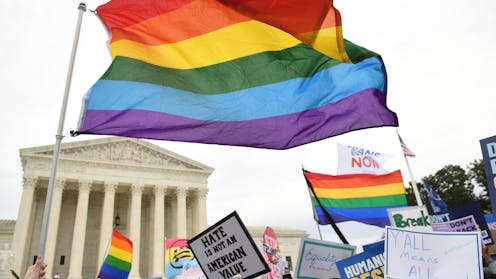
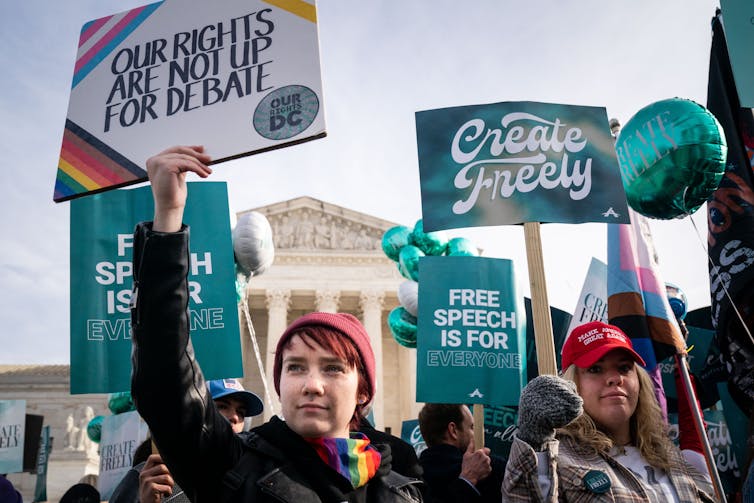
The US Supreme Court will hear oral arguments for yet another case involving the LGBTQ+ community. Saul Loeb/AFP via Getty Images

The constitutionality of a Colorado law that bans so-called “conversion therapy” is scheduled to go before the Supreme Court on Oct. 7, 2025. The question at the center of the case, Chiles v. Salazar, is whether a therapist who uses talk therapy to try to convince minors to change their sexual orientation or gender identity is protected by a First Amendment right to free speech.

Twenty-three other states and the District of Columbia also ban conversion therapy.

People stand behind a table cheering as a white man in a blue suit jacket signs bills into law.
Colorado Gov. Jared Polis is applauded as he signs a law banning the use of conversion therapy on minors.
Aaron Ontiveroz/The Denver Post via Getty Images

I am a legal scholar who has explored aspects of the rights of the LGBTQ+ community, and this case is an important test of the status of the community’s rights and protections at the Supreme Court.

Why it matters

The case has similarities to the court’s 2025 decision in United States v. Skrmetti that upheld state laws banning gender-affirming care for transgender minors, such as the use of puberty-blocking hormones. LGBTQ+ persons viewed those bans as hurting the community, whereas bans like Colorado’s on conversion therapy are viewed as protecting the community.

Technically, the legal issue in Skrmetti was different: The court addressed whether the ban violated the equal protection clause of the 14th Amendment, which prohibits states from discriminating against particular protected classes, such as race or gender, absent a particularly strong state interest. In the Skrmetti decision, the court held there was no discrimination on the basis of sex, which meant the law received no heightened scrutiny.

Instead, the court assessed whether there was a “rational basis” for the law and held that Tennessee had “plausible reasons” for the ban: protecting minors from harms such as sterility and treatments whose long-term effects are unclear. The court upheld the law banning gender-affirming care even though major U.S. medical professional associations oppose such bans and support such care.

The facts of Chiles

In Chiles, the issue is freedom of speech, not equal protection. But this time the Colordo ban on conversion therapy aligns with leading medical associations.

Kaley Chiles is a licensed professional counselor who uses talk therapy in her counseling practice. Chiles identifies as Christian and often works with Christian clients. Chiles “does not try to help minors change their attractions, behavior, or identity, when her minor clients tell her they are not seeking such change.” She would like to use talk therapy with clients “who have same-sex attractions or gender identity confusion and who also prioritize their faith above their feelings” and who “are seeking to live a life consistent with their faith,” according to court filings.

Chiles sued Colorado to invalidate the statute as unconstitutional for violating her freedom of speech and religion under the First Amendment of the U.S. Constitution. Both the federal district court in Colorado and the U.S. Court of Appeals for the 10th Circuit denied her request for a preliminary injunction, rejecting both arguments.

The Supreme Court agreed only to hear her free speech claim, leaving the 10th Circuit’s rejection of her religious liberty claim in place.

Is ‘talk therapy’ speech or conduct?

The Supreme Court first will need to address whether talk therapy is protected speech under the First Amendment. This decision likely will determine the case’s outcome.

Chiles contends that talk therapy is protected speech and that Colorado is impermissibly regulating the content of her potential speech. The law permits her to help minor clients embrace their sexual orientation or gender identity through talk therapy but not to change it. If this therapy is speech, it would be regulating the content of her speech because the law determines what can and cannot be said. Affirming talk therapy is allowed, but conversion therapy is prohibited.

Colorado, however, insists that the statute regulates medical conduct, which is not protected by the First Amendment, even if there is an incidental burden on speech.

A state undisputably can regulate medical activity, such as the prescription of a medicine. If the therapy involved the use of medicines, there would be no dispute because no speech would be involved. The Colorado conversion therapy ban is part of a broader statute, the Mental Health Practice Act, which prohibits acts that could harm patients. Thus, talk therapy, according to Colorado, is treatment – like providing medicine – that the state is free to regulate.

Conversion therapy is also deemed ineffective and harmful to children by leading medical associations, such as the American Psychiatric Association and the American Medical Association. The 10th Circuit noted that the Colorado ban regulates treatment, not expression, because Chiles is free to share her views on conversion therapy, even with minors. She simply cannot engage in actual therapy under the law.

People with protest and support signs stand outside of the U.S. Supreme Court building.
Members of both sides of the debate stand in front of the U.S. Supreme Court on Dec. 5, 2022. The high court heard oral arguments in a case involving the owner of a website design company in Colorado who refused to create websites for same-sex weddings despite a state antidiscrimination law.
Kent Nishimura/Getty Images

The Supreme Court will need to decide whether talk therapy is speech or conduct. The court often takes a broad view of what constitutes speech, particularly in the area of LGBTQ+ rights. In 303 Creative LLC v. Elenis, another case out of Colorado, the court held that creating a wedding webpage was deemed protected speech. This 2023 decision permitted the webpage designer to deny services to same-sex couples requesting webpages for their weddings, in violation of Colorado’s law prohibiting sexual orientation discrimination.

If the court concludes that conversion therapy is conduct, then the Colorado law is subject to the same standard used in Skrmetti – rational basis – and likely will survive. In light of 303 Creative, however, the court may deem it speech.

If talk therapy is speech, can Colorado ban it?

Simply because an act constitutes speech protected by the First Amendment does not mean the state cannot regulate it. For example, the state can rightly regulate defamatory statements or obscene material.

Courts, however, apply an exacting standard of review, known as strict scrutiny, and rarely does a law survive such analysis. Colorado must show that its ban on conversion therapy is narrowly tailored to achieve a compelling state interest. Colorado contends that ensuring minors receive safe and effective mental health care is a compelling interest, and the law is narrowly tailored because “(i)t prohibits only specific harmful treatment while leaving therapists free to engage in any other appropriate therapy.”

Chiles’ strongest argument is that the law is not narrowly tailored for a number of reasons. Chiles contends the law is too broad because it bans more speech than necessary to protect against any harms to LGBTQ+ minors, including any therapy to change behavior, expression, identity or feeling.

For example, she argues she could not counsel a gay client toward celibacy. It is also not properly tailored, Chiles argues, because it exposes minors to the harms of conversion therapy by its omissions: It applies only to licensed mental health professionals and not others, such as life coaches, and it applies only to minors. If conversion therapy is as harmful as Colorado alleges, these gaps show the lack of proper tailoring, says Chiles.

The court has frequently struck down laws that regulate the content of speech. If the court concludes that talk therapy is protected speech, it is likely the court will find the Colorado ban on conversion therapy unconstitutional.

Such a decision would contrast sharply with Skrmetti. If the court strikes down the Colorado law, then a law meant to protect LGBTQ+ minors will be invalidated while one deemed harmful to trans minors will stand.

The court again will have gone against the predominant view of medical experts in a way detrimental to the LGBTQ+ community, potentially adding to criticism of the Supreme Court as being too political.

Read more of our stories about Colorado.

The Conversation

Timothy R. Holbrook does not work for, consult, own shares in or receive funding from any company or organization that would benefit from this article, and has disclosed no relevant affiliations beyond their academic appointment.

​Politics + Society – The Conversation

Categories
Politics

Supreme Court opens with cases on voting rights, tariffs, gender identity and campaign finance to test the limits of a constitutional revolution

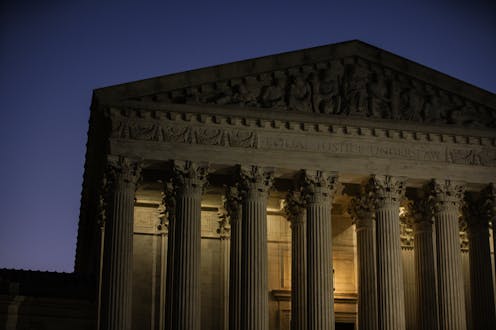
The U.S. Supreme Court building at dawn in Washington, D.C. Samuel Corum/Bloomberg via Getty Images

The most influential cases before the U.S. Supreme Court this term, which begins on Oct. 6, 2025, reflect the cultural and partisan clashes of American politics.

The major cases in October and November address the role of race in elections, conversion therapy and the Trump tariffs. Later cases include campaign finance and transgender sports.

This year’s controversies focus on three dominant themes. One is the continuing constitutional revolution in how the justices read our basic law. The court has shifted from a living reading of the Constitution, which says the Constitution should adapt to the American people’s evolving values and the needs of contemporary society, to an original reading, which aims to enforce the constitutional principles understood by the Americans who ratified them.

Another clear theme is the deep cultural division among Americans. The core disputes at the court this year reflect controversial factual questions about gender and race: How pervasive and influential is racism in the current day? Are gender transitions a recognized fact, which means that they must be accepted in sports competitions, or can a state assert that trans athletes are not women?

A final theme is the struggle for partisan advantage embedded in several cases.

A portion of the U.S. Constitution, torn into blue and red pieces.
The justices’ constitutional interpretations could have major partisan significance.
Douglas Rissing, iStock/Getty Images Plus

Constitutional revolution

Until just a few years ago, the majority of justices would have agreed that the proper way to read the Constitution was as an evolving document, an approach usually described as living constitutionalism.

The new majority reads the Constitution as an expression of enduring principles, which maintain their historical meaning unless the American people collectively decide to amend the document, an approach known as originalism.

Since 2022, this revolutionary shift has led to dramatic changes in the law on abortion, religion, guns, affirmative action and the power of federal agencies to regulate in areas such as the environment, public health or student debt.

This year, the constitutional revolution – “a historic constitutional course correction.” as legal scholars Gary Jeffrey Jacobsohn and Yaniv Roznai put it – turns to transgender politics.

Little v. Hecox and West Virginia v. B.P.J. ask whether a state can ban transgender athletes from participating in girls or women’s sports. The plaintiffs are middle school and university students who were banned by state laws from participating as a female competitor. They are asking the court to rule that transgender identity is a protected category similar to race and gender under the equal protection clause of the 14th Amendment.

Originalists argue that the meaning of the 14th Amendment is clear and fixed. It establishes the equal status of racial minorities as holders of rights. But originalists do not believe the equal protection clause was meant to apply to sexual identities unless that is explicitly approved through a constitutional amendment by the American public.

Originalists also emphasize the role of federalism as a core constitutional principle. Federalism allocates a great deal of authority to state legislatures to make decisions when a question of rights is uncertain.

For these reasons the court majority is likely to see the regulation of who gets to participate in women’s sports as a state-by-state decision.

Cultural divisions, disputed perceptions

The status of transgender identity also reflects the disputed perceptions of reality that have come to dominate American politics. In essence, the Iowa and West Virginia sports cases ask the court to rule whether a transgender girl – a person assigned male at birth who has transitioned to align with their identity as a girl or woman, as the AP Stylebook phrases it – is a girl or a boy.

The court is likely to leave such questions about what is factually true for state legislatures to determine.

The same need for the court to determine who can decide what is or is not a legitimate fact also applies to this year’s controversy over conversion therapy. Colorado bans the practice – condemned by many professional medical associations – in which counselors attempt to alter sexual orientation or gender identity.

Chiles v. Salazar challenges the Colorado law as a violation of the First Amendment’s protections of free speech and religious liberty.

An original reading of the First Amendment provides strong support for open expression on controversial topics, even by medical professionals. But on the factual question of whether homosexuality or gender identity in young people is indisputably innate or immutable, the court may defer to state legislatures to decide whether licensed professionals must assert only a specific set of accepted facts.

Partisan advantage

Many observers perceive a partisan as well as principled divide on the current court. Decisions in several cases this year potentially give a distinct advantage in future elections to Democrats or Republicans.

The most clear case may be about the regulation of campaign finance. National Republican Senatorial Committee v. FEC – a lawsuit begun in 2022 by then-U.S. Sen. JD Vance – asks the court to overturn a restriction that bars political parties from coordinating unlimited spending on campaign advertising with the official campaign.

Many Democrats believe Republicans will be the larger beneficiaries in the coming years if the court rules that the current limits violate the First Amendment.

Then there’s the challenge to the constitutionality of the Trump tariffs.

Learning Resources v. Trump will determine whether the recent tariffs are authorized by Congress under the International Emergency Powers Act of 1977. The answer hinges on the application of what’s known as the “major questions doctrine,” which limits presidential authority over issues of great economic or policy importance in the absence of direct endorsement from Congress.

The major questions doctrine is an originalist concept, but in the court’s view it may not apply to actions in the foreign policy realm – including tariffs – where the president has greater discretion.

A container ship loaded with hundres of containers, coming into a port.
Will the court strike down Trump’s tariffs on imported goods such as those on this ship in Oakland, Calif.?
Justin Sullivan/Getty Images

Race and elections

The case that represents all three trends at the court is Louisiana v. Callais on the creation of majority-Black congressional districts.

The Voting Rights Act of 1965 outlaws racial discrimination in voting. This landmark legislation from the civil rights era helped raise the rate of Black voter registration and turnout in Southern states from less than half the white rate to exceeding it over the past 60 years.

The question in front of the court is whether the law requires a state to make sure that some congressional districts have a majority of Black voters.

The argument opposing the intentional creation of racial districts is that the equal protection clause of the 14th Amendment demands the same treatment of all citizens regardless of race, banning any distinction even when designed to benefit minorities.

Underlying the differences of opinion are competing perceptions of the prevalence and influence of racism in the current day. This dispute was clear in the court’s 2013 Shelby County decision, which struck down the part of the Voting Rights Act that limited Southern states from passing new elections laws without “pre-clearance” from the Department of Justice. That requirement aimed to ensure that new laws would not discriminate against Black voters, whether intentionally or unintentionally.

In striking down that requirement, Chief Justice John Roberts ruled that “no one can fairly say” that the South “shows anything approaching the ‘pervasive,’ ‘flagrant,’ ‘widespread,’ and ‘rampant’ discrimination that faced Congress in 1965.”

Justice Ruth Bader Ginsburg famously responded that removing the Voting Rights Act’s protections was “like throwing away your umbrella in a rainstorm because you are not getting wet.”

The ultimate number of majority-Black districts in Louisiana is not only a question of constitutional principles applied to prevailing facts. It is also about partisan advantage. Partisans on both sides are well aware that a majority-Black district is also a Democratic district.

So whether the state ends up with two or just one – or potentially even none – of its six congressional districts shaped by race could shift the future partisan balance in a closely divided Congress.

With partisan advantage, clashing perceptions of reality and revolutionary readings of the Constitution all in play, the rulings of the Supreme Court this year will reach far into American politics and culture.

The Conversation

Morgan Marietta does not work for, consult, own shares in or receive funding from any company or organization that would benefit from this article, and has disclosed no relevant affiliations beyond their academic appointment.

​Politics + Society – The Conversation

Categories
Entertainment

Danielle Fishel Brutally Rebuffs Whitney Leavitt After ‘DWTS’ Gaffe

Reading Time: 2 minutes

Did Danielle Fishel just put Whitney Leavitt in her place?

It sure looks like it.

The Dancing With The Stars Season 34 cast expressed shock and sorrow over Tuesday’s dramatic elimination.

As you can see in the clip below, Leavitt seemed to want to celebrate. Fishel wasn’t having it.

Danielle Fishel on Dancing With The Stars.
Danielle Fishel performs on TikTok Night for ‘Dancing With The Stars.’ (Image Credit: ABC)

(Almost) everyone was sad to see Lauren Jauregui go

On Tuesday, September 30, Dancing With The Stars Season 34 saw the elimination of Lauren Jauregui of Fifth Harmony and of her dance partner, Brandon Armstrong.

It was a shocker! Not only to fans, but to fellow contestants.

The others took tot he stage to console the freshly eliminated duo.

Then, it appears that a new layer of drama emerged on the dance stage.

Whitney Leavitt of The Secret Lives of Mormon Wives seemed to want Danielle Fishel to celebrate with her.

At least, those viewing video online observed Leavitt looking happy — and seeming to want Fishel to mirror her apparent joy.

Whitney Leavitt smiling on Dancing With The Stars.
Giving a totally normal smile, Whitney Leavitt performs on the TikTok Night episode of Dancing With The Stars. (Image Credit: ABC)

Danielle Fishel seemed to turn down Whitney Leavitt

However, Danielle Fishel did not take Whitney Leavitt’s invitation to gleefully celebrate the stunning elimination.

In fact, it appears that the Boy Meets World alum actually shooed the Hulu star away.

As you can imagine, Leavitt’s mood appeared the shower.

Her face falls, even looking chastened. See for yourself:

Obviously, no one knows with certainty what exchange took place between these two.

However, some believe that Fishel simply wished to celebrate this elimination in private, being more experienced in the public eye than Leavitt.

Others note that perhaps Fishel felt genuinely heartbroken over Jauregui’s elimination — and thus did not share Leavitt’s enthusiasm, even privately.

Lauren Jauregui and Brandon Armstrong on Dancing With The Stars.
On what would be their final night on Dancing With The Stars, duo Lauren Jauregui and Brandon Armstrong wowed the audience with a Cha Cha. (Image Credit: ABC)

Don’t gloat over fan favorites leaving (it’s a bad look)

It is important to note that Lauren Jauregui and Brandon Armstrong were a fan-favorite couple — yes, even this early in the season.

The audience found their elimination heartbreaking.

So did many of the other contestants.

No matter how someone might truly feel about the elimination (it is, after all, a competition), openly celebrating would not be a good look.

Danielle Fishel Brutally Rebuffs Whitney Leavitt After ‘DWTS’ Gaffe was originally published on The Hollywood Gossip.

​The Hollywood Gossip

Categories
Entertainment

Amy Duggar: My Uncle Stole All My Reality TV Money!

Reading Time: 3 minutes

Amy Duggar has revealed how much money she made from appearing various times back in the day on 19 Kids and Counting.

And it won’t take anyone very long do to the math.

On the latest episode of The Viall Files, the niece of Jim Bob and Michelle Duggar said plainly that she made “nada” from her time on television.

She knows who to blame for that zero in her bank account column, too.

(Zondervan Books)

“My uncle, he told all of us that 19 Kids and Counting was a ministry — and that we were on the show to shine a light in the darkness, to be a part of this ministry and that God has called us to this,” Amy told listeners of Jim Bob, emphasizing there was no compensation for the kids involved.

The author of a new memoir titled Holy Disruptor: Shattering the Shiny Facade by Getting Louder with the Truth, Amy said she “signed a contract blindly,” estimating that the series made her family over $6 million during its run.

Giving reluctant credit to Jim Bob, Amy added:

“He’s very smart, he really is. He’s a businessman and he knows how to do it.”

That’s one way to put it. Another way to put it would be that Jim Bob is selfish and dishonest and continues to spend money his children earned.

Amy Duggar and Dillon King arrive at WE tv's Real Love: Relationship Reality TV's Past, Present & Future event at The Paley Center for Media on December 11, 2018 in Beverly Hills, California.
Amy Duggar and Dillon King arrive at WE tv’s Real Love: Relationship Reality TV’s Past, Present & Future event at The Paley Center for Media on December 11, 2018 in Beverly Hills, California. (Photo by Amanda Edwards/Getty Images)

In general, Amy is not the first Duggar to accuse Jim Bob of withholding pay.

The patriarch’s daughter Jill Duggar Dillard — who starred in 19 Kids and Counting, as well as its spinoff Counting On — has made the same allegations.

“I never received any payout — no check, no cash, no nothing,” Jill said in the 2023 docuseries Shiny, Happy People: Duggar Family Secrets. “For seven and a half years of my adult life, I was never paid.”

She and husband Derick walked away from Counting On in 2017, four years before the show was canceled.

“That’s when we got an attorney involved and finally recovered some of the money,” Jill said in a 2020 YouTube vlog. “It was a process.”

(Image Credit: Amazon Prime)

In her aforementioned book, Amy admits that she was once close to cousin Josh Duggar... who is currently serving time in federal prison after having been convicted on child pornography charges.

The book doesn’t come out until October 14, but Amy has been making the media rounds of late in promotion for it.

“I think the entire book will drop jaws. No one knows the things that I was struggling with,” she recently told People Magazine, for example.

She added in this same interview:

“I hope this book brings closure as to why things kind of went the way they went for me. I hope it does connect the dots for those that did watch the show. And, I hope also that it feels like a hug for those that have experienced abuse in their lives.”

Amy Duggar: My Uncle Stole All My Reality TV Money! was originally published on The Hollywood Gossip.

​The Hollywood Gossip

Categories
Entertainment

Bad Bunny Super Bowl LX Halftime Show Threatened by ICE

Reading Time: 4 minutes

Bad Bunny’s Halftime Show may be ruined by ICE terrorizing the crowd.

That’s not speculation — it’s a threat directly from the Trump administration.

After last month’s Bad Bunny Super Bowl announcement, the singer expressed his excitement.

Armed federal agents seem poised to raid the Super Bowl itself. Truly, no American institution is safe.

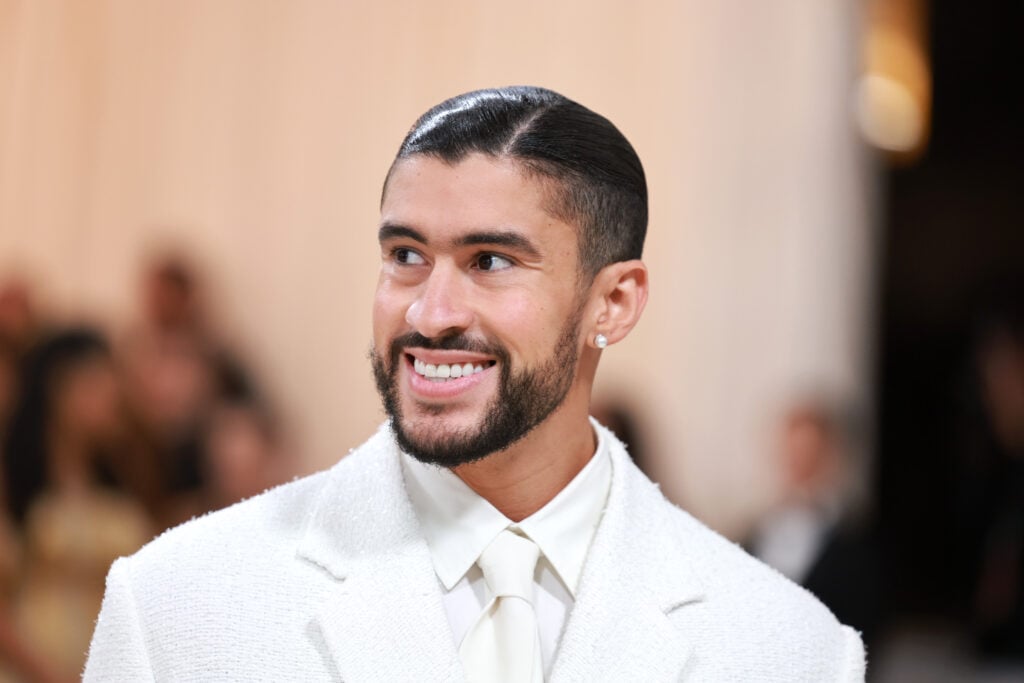
Bad Bunny at the 2023 Met Gala.
Bad Bunny attends The 2023 Met Gala Celebrating “Karl Lagerfeld: A Line Of Beauty” at The Metropolitan Museum of Art on May 01, 2023. (Photo Credit: Theo Wargo/Getty Images for Karl Lagerfeld)

Bad Bunny will headline the 2026 Super Bowl Halftime Show!

In late September, the NFL announced their decision to have Bad Bunny — Benito Antonio Martínez Ocasio — perform at the Super Bowl’s main event: the Halftime Show.

“I’m going to embrace the moment,” the singer himself announced at the time. He even teased the performance itself.

“I’m going to show what we have, our music, our culture,” he gushed.

He is an American — specifically, Puerto Rican — and very proud of his heritage.

Bad Bunny, whom fans call Benito as a term of endearment, added: “I’m just going to the stage to enjoy and have fun.”

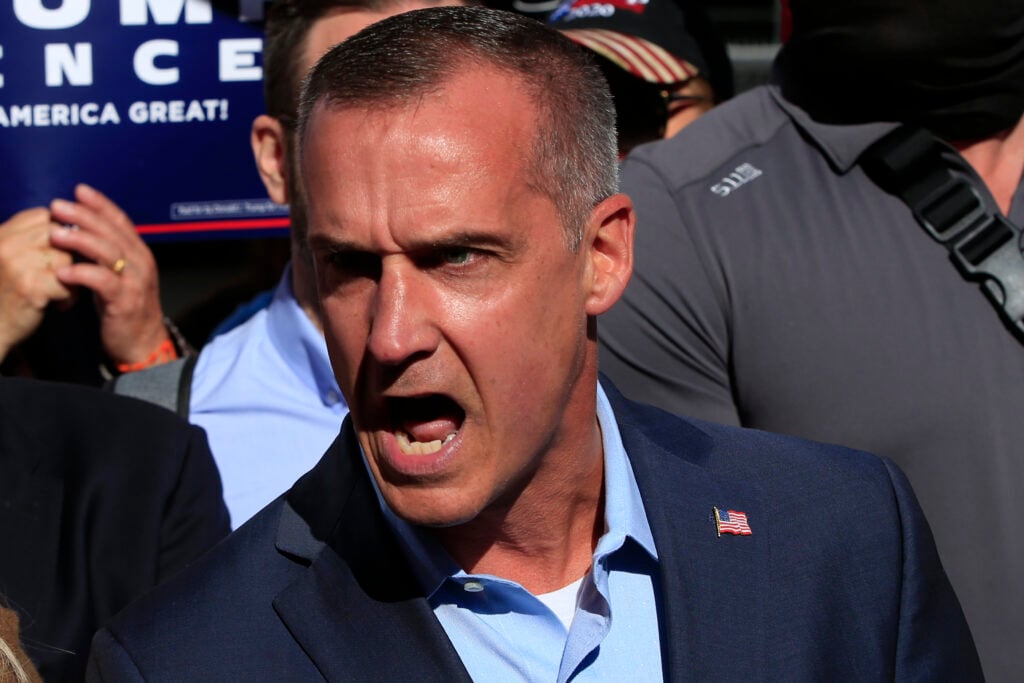
Corey Lewandowski yells in 2020.
Trump campaign adviser Corey Lewandowski speaks outside the Pennsylvania Convention Center on November 5, 2020. (Photo Credit: KENA BETANCUR/AFP via Getty Images)

We probably don’t have to tell you that Bad Bunny is one of the most popular male singers on the planet.

However, despite his latest studio album (Debí Tirar Más Fotos came out this year), he opted to not go out tour.

He cited a desire to protect his fans from Donald Trump’s ICE thugs as our national decline continues.

Specifically, Bad Bunny predicted that “f–king ICE” would target fans at his shows. And he was probably right.

As it turns out, that same looming threat also applies to the Super Bowl.

Bad Bunny performs in 2025.
Bad Bunny performs live during “No Me Quiero Ir De Aquí; Una Más” Residencia at Coliseo de Puerto Rico José Miguel Agrelot on September 20, 2025. (Photo Credit: Gladys Vega/Getty Images)

Here is what Corey Lwandowski is threatening for the Super Bowl

On-again, off-again Trump advisor Corey Lewandowski is chief advisor to noted dog-murderer Kristi Noem.

And he’s threatening the Super Bowl crowd.

On Wednesday, October 1, Lewandowski appeared on The Benny Show, telling host Benny Johnson that no American place is safe from Trump’s forces.

“I don’t care if it’s a concert for Johnny Smith or Bad Bunny or anybody else,” he menaced during the podcast. “We’re going to do enforcement everywhere.”

Paradoxically, Lewandowski added: “We are going to make Americans safe. That is a directive from the president. If you’re in this country illegally, do yourself a favor: Go home.”

Obviously, in real life, we all know that plenty of legal residents — including American citizens — are targets of ICE.

And Lewandowski is vowing on behalf of DHS that no place in America is safe.

“There is nowhere that you can provide safe haven to people in this country illegally,” he continued. “Not the Super Bowl and nowhere else.”

Lewandowski threatened: “We will find you, we will apprehend you. We will put you in a detention facility, and we will deport you.”

He added: “So know that that is a very real situation under this administration, which is completely contrary to what how it used to be.”

Corey Lewandowski in 2019.
Donald Trump’s former campaign manager, Corey Lewandowski, looks on before testifying before the House Judiciary Committee as part of a congressional investigation of the Trump presidency on September 17, 2019. (Photo Credit: OLIVIER DOULIERY/AFP via Getty Images)

He also made an odd statement about the singer himself

Around 70 thousand people regularly attend the Super Bowl each year.

Additionally, tens of thousands of employees make the big game happen in the first place.

Lewandowski is effectively threatening to terrorize all of them — especially those with brown skin.

Beyond siccing ICE on America’s biggest show, he’s espousing big opinions about Bad Bunny himself.

“It’s so shameful that they’ve decided to pick somebody who just seems to hate America so much to represent them at the halftime game,” Lewandowski whined without explanation.

Bad Bunny in August 2025.
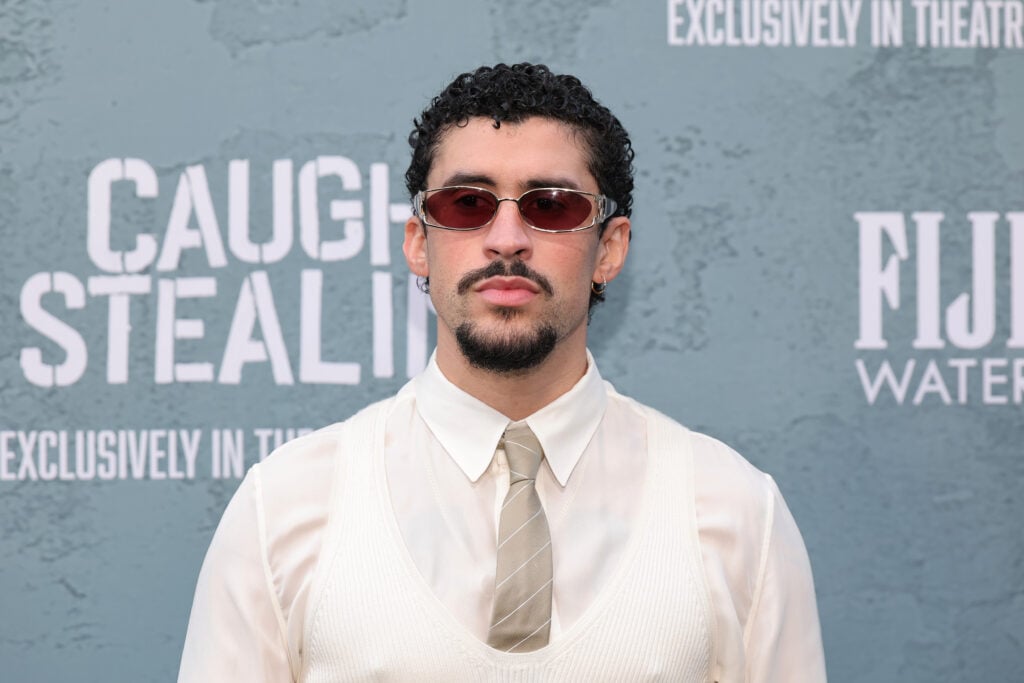
Bad Bunny attends Columbia Pictures’ “Caught Stealing” premiere at Regal Union Square on August 26, 2025. (Photo Credit: Dia Dipasupil/Getty Images)

The plans for ICE at Super Bowl LX before, during, and after the Bad Bunny Halftime Show are, unfortunately, no idle threat.

The notorious agency told TMZ in a statement: “There is no safe haven for violent criminal illegal aliens in the United States.”

Obviously, that is not ICE’s actual target. They know that, and so do we.

This is a clear warning for anyone considering attending the Super Bowl to consider carefully whether they or their loved ones may be in danger.

It will be years before ICE agents can be put on trial en masse. Perhaps Corey Lewandowski will be right there beside them.

If so, his podcast threats about Bad Bunny could be evidence. Only time will tell.

Bad Bunny Super Bowl LX Halftime Show Threatened by ICE was originally published on The Hollywood Gossip.

​The Hollywood Gossip