NOTN- The Juneau Assembly voted to purchase two floors of the Michael J. Burns Building to serve as a new City Hall, citing the need to consolidate operations and cut costs.
“The reason we’re trying to move is the buildings that we have historically leased are either no longer available or have major problems.” Said Mayor Beth Weldon, “We’re just trying to consolidate. We’re trying to cut our rent money, and this makes fiscal sense.”
The city will spend $9.3 million on the property, with an additional $2.7 million reserved for future capital projects. Weldon said the move is more cost-effective than building a new city hall, which was estimated at $48 million.
Assembly member Christine Woll, head of the Finance Committee said the city’s current office spaces are aging and expensive to maintain. “The Burns building has emerged as the most financially responsible option, and makes the most sense to bring all our city employees into a single building that’s not leaking like our other locations right now.”
The plan also includes a $600,000 condominium lease, but Weldon said overall costs will still save the city money compared to current rental expenses.
“I do think it’s important to recognize that we should be seeing thousands of people likely lose coverage from this,” said Jared Kosin, president and CEO of the Alaska Hospital and Healthcare Association.
Speaking to a room at Juneau’s convention center, they said if federal subsidies end, the cost of health insurance would rise so much that many Alaskans will go uninsured, discouraging them from getting checkups that could prevent serious illnesses. Hospitals would see a larger number of emergencies from uninsured people, straining them. It might even lead to an exodus from the state, as people seek alternative options and cheaper places to live.
“I worry about that,” said Kim Champney, executive director of the Alaska Association on Developmental Disabilities. “Because I think people will decide to leave Alaska because we have the most expensive health care in the country.”
Anton Rieselbach, with the Juneau Economic Development Council provided an analysis of cost estimates for Juneau. In Alaska’s capital city alone, 1,389 people receive health care via insurance plans bought through the federal marketplace. Right now, those Juneauites pay an average of $124 per month. If those subsidies expire, that will rise to $1,008 per month, an increase of more than 700%.
The council, a nonpartisan organization devoted to economic growth in the capital city, is worried about what will happen if the subsidies expire.
“We want people to be working and spending money, generating economic activity,” Rieselbach said, “but this just places another huge burden on people’s ability to spend their money in other arenas besides health insurance.”
A problem years in the making
The upcoming problem stems from federal subsidies enacted by Congress in 2021 and extended through the end of 2025. Those subsidies, known as “enhanced premium tax credits,” were applied on top of subsidies included in the original Affordable Care Act, which established the federal insurance marketplace.
Now, almost anyone who buys an individual health care plan through the marketplace gets some kind of subsidy.
Generally, that includes people whose employers don’t provide health insurance, self-employed people, and people who retired early and aren’t yet eligible for Medicare, which insures people with disabilities and people 65 or older.
Subsidies helped expand the number of people on federal marketplace plans from 11.4 million in 2020 to 24.3 million this year, allowing millions of Americans to get regular health care.
They also came at a high cost to the federal treasury: Extending them for another 10 years would cost $335 billion.
But if subsidies end, Alaska would be exceptionally hard-hit. The state has the highest health-care costs in the nation, which means unsubsidized insurance rates are high.
Of the 28,736 Alaskans who have health insurance policies through the federal marketplace, 25,170 receive the enhanced subsidies, according to figures published by the Centers for Medicare and Medicaid Services.
If the enhanced subsidies expire, the poorest Alaskans will still see their plans subsidized. Middle-class Alaskans would be hard hit.
According to estimates published in March by the Alaska Division of Insurance, a single 50-year-old who earns $58,650 per year would see their monthly health insurance cost rise from $282 per month to $407 per month for a “silver” plan. If they have a “bronze” plan, their costs wouldn’t change.
But Alaskans who earn more than 400% of the federal poverty line — $78,000 per year for an individual — would see their costs skyrocket.
In 2023, 2024 and 2025, the average cost of a health insurance marketplace plan in Alaska rose by more than 16% each year. In 2023 alone, the cost went up by an average of 18.4%.
That same 50-year-old would go from paying $534 per month for a silver plan to $1,415 per month. Under a bronze plan, their cost would go from $9 per month to $890 per month.
Lori Wing-Heier, the director of the Division of Insurance at the time of those estimates, called the increase “pretty horrific” for affected Alaskans.
“It’s an insane amount,” said Rep. Genevieve Mina, D-Anchorage, talking about the increase.
This spring, Mina sponsored and the Alaska Legislature passed House Joint Resolution 9, a bipartisan letter asking Congress to extend the subsidies.
Across the state this year, the average monthly premium for Alaskans of all ages and all plans was $971.43, but the average subsidy was $866.28, the Division of Insurance said in March.
Kosin, of the hospital and healthcare association, said his group thinks it’s “really important” to extend the enhanced subsidies.
Insurance is based on the concept of sharing risks and costs. The more people in an insurance pool, the better it works. Subsidies encourage healthy people to be a part of the health insurance pool, he said. If people drop off, the cost of caring for any individual person is spread among fewer members, and rates go up.
An extension relies on congressional action
For the moment, Alaskans only have estimates of what will happen if the subsidies expire. Open enrollment on the federal insurance marketplace starts Nov. 1. There’s a “window shopping” period at the end of October that will give a sneak preview.
People must sign up by Dec. 15 to get insurance coverage that starts with the new year. Miss that deadline, and Jan. 15 is the deadline to get coverage that starts Feb. 1.
Kosin said he’s heard the argument that Alaskans could afford health care before the enhanced subsidies came into effect, and so there won’t be many people who drop their coverage.
That fails to take into account the way health insurance costs have gone up since 2020, he said.
In 2023, 2024 and 2025, the average cost of a health insurance marketplace plan in Alaska rose by more than 16% each year. In 2023 alone, the cost went up by an average of 18.4%.
“If there truly is a doubling or tripling of premiums, especially at once, I think I would have to guess it would be a higher percentage than a fifth of the population that would consider themselves priced out of the market,” he said.
U.S. Sen. Lisa Murkowski knows plenty of those people.
“If you are a 60-year-old couple (earning about) $82,000 in Alaska, you would be looking at a premium increase … without enhancements, of $44,556. My husband and I are over 60. Now, granted, we’re not on the exchange, but I have a lot of friends are in that category, and I don’t know very many of them that could swallow an additional $44,000 a year to pay for their insurance if they’re on the exchange,” she said in a Sept. 17 phone call.
Murkowski is among the members of the U.S. Senate who have been trying for months, without success so far, to find enough votes to extend the subsidies.
Impending government shutdown
The issue has now gotten entangled with the impending government shutdown. Senate Democrats have demanded — among other things — a permanent extension of the health care subsidies, without changes, in exchange for their votes on keeping the federal government open.
Sen. Dan Sullivan also supports an extension of the subsidies, but “there’s no way I would ever vote for that,” he said of the Democratic plan.
“I do think there’s bipartisan support to get this done. We’ve just got to power through these different issues,” he said by phone.
He identified three hurdles for the subsidies.
“It’s how long you extend them; are there pay-fors (budget cuts to compensate for the cost of the extension) … but the most important and complicated — and we just did a deep dive on this, and I do think there’s bipartisan support on this, is reforms,” Sullivan said.
“We are looking at ways to reform the system to make it work for the people who need it and are using it honestly, but have a disincentive against those who have been abusing it,” he said.
“We’re getting there. It’s complicated. I think the reform piece is going to be the most complicated, but I’m hopeful, and I’m putting a lot of effort into it,” Sullivan said.
Murkowski is more interested in a straight extension without changes. She introduced a standalone two-year measure and voted against both Republican and Democratic proposals to keep the government open, saying one of her conditions was an extension of the subsidy.
Speaking by phone this month, Mina noted that an extension has the support of groups as far afield as the Anchorage Chamber of Commerce.
“I think if you’re directly on the insurance marketplace, you should be concerned. But also, if you care about economic diversification and startups, you should also be concerned,” she said.
If the marketplace doesn’t work, she noted, it would increase the costs of health care for everyone in the state because hospitals are required to treat people regardless of their ability to pay. If people can’t pay, that means their costs get shifted to people who can, increasing the health insurance rates of everyone, not just those on the marketplace.
“What I fear is that we’re regressing to the state that we were in (a decade ago) when we had all of these news articles about people paying like, $800, $1,000 a month for their health insurance, and we were able to stabilize that and find solutions to help people,” Mina said. “We’re just going backwards in that regard.”
Trump’s recent fury showed how much he expects top officials in federal law enforcement to carry out his retribution.
He was enraged when Erik S. Siebert, the U.S. attorney for the Eastern District of Virginia, decided there was insufficient evidence to charge two people Trump regards as enemies: former FBI director James Comey and New York Attorney General Letitia James.
“I want him out,” Trump angrily told reporters on Sept. 19, 2025. Siebert resigned, although Trump claimed he had fired him.
Trump’s most recent demands for retribution came soon after top adviser Stephen Miller’s vow to prosecute leftists in the “vast domestic terror movement” – that the administration blames, without evidence, for Charlie Kirk’s assassination – using “every resource we have.”
As the director of the FBI, Patel will likely be in charge of the investigations of perceived enemies generated by the Department of Justice and the White House. He already has sacrificed the bureau’s independence, making it essentially an arm of the White House.
This isn’t the first time an FBI director has been driven by a desire to suppress the rights of people perceived to be political enemies. Hoover, director until his death in 1972, operated a secret FBI within the FBI that he used to destroy people and organizations whose political opinions he opposed.
FBI Director Kash Patel reacts to Donald Trump’s address to a joint session of Congress at the U.S. Capitol on March 4, 2025. AP Photo/Ben Curtis
A burglary’s revelations
Hoover’s secret FBI was revealed, beginning in 1971, when a group of people called the Citizens Commission to Investigate the FBI broke into an FBI office and removed files.
This group suspected Hoover’s FBI was illegally suppressing dissent. Given Hoover’s enormous power, they thought it was unlikely any government agency would investigate the FBI. They decided documentary evidence was needed to convince the public that suppression of dissent – what they considered a crime against democracy – was taking place.
A historical marker commemorates the site of the burglary that exposed COINTELPRO. Betty Medsger
The files they stole and made public confirmed the FBI was suppressing dissent. But they revealed much more: Hoover’s secret FBI and the startling crimes he had committed. These secret operations had become so extensive that they eventually diminished the bureau’s capacity to carry out its core mission: law enforcement.
Hoover, one of the most admired and powerful officials in the country, had secretly conducted a wide array of operations directed against people whose political opinions he opposed.
The files revealed that agents were instructed to “enhance paranoia” and make activists think there was an FBI agent “behind every mailbox.” Questioning Vietnam war policy could cause anyone, even a U.S. senator, Democrat J. William Fulbright of Arkansas, to be placed under FBI surveillance.
It was the revelation of Hoover’s worst operations, COINTELPRO – what Hoover called The Counter Intelligence Program – that made Americans demand investigation and reform of the FBI. Until the mid-1970s, there had never been oversight of the FBI and little coverage of the FBI by journalists, except for laudatory stories.
A video chronicle about the 1971 break-in at an FBI office in Media, Pa., that uncovered vast FBI abuses.
‘Almost beyond belief’
The COINTELPRO operations ranged from crude to cruel to murderous.
Antiwar activists were given oranges injected with powerful laxatives. Agents hired prostitutes known to have venereal disease to infect campus antiwar leaders.
Many of the COINTELPRO operations were almost beyond belief:
· The project conducted against the entire University of California system lasted more than 30 years. Hundreds of agents and informants were assigned in 1960 to spy on each of Berkeley’s 5,365 faculty members by reading their mail, observing them and searching for derogatory information – “illicit love affairs, homosexuality, sexual perversion, excessive drinking, other instances of conduct reflecting mental instability.”
· An informant trained to give perjured testimony led to the murder conviction of Black Panther Geronimo Pratt, a decorated Vietnam War veteran. He served 27 years in prison for a murder he did not commit. He was exonerated in 1997 when a judge found that the FBI concealed evidence that would have proved Pratt’s innocence.
· The bureau spied for years on Martin Luther King Jr. After it was announced King would receive the 1964 Nobel Peace Prize, Hoover approved a particularly sinister plan that was designed to cause King to commit suicide.
A letter sent anonymously by the FBI to Martin Luther King Jr. in 1964 urging him to commit suicide. Wikipedia
· What one historian called Hoover’s “savage hatred” of Black people led to the FBI’s worst operation, a collaboration with the Chicago police that resulted in the killing of Chicago Black Panther Fred Hampton, shot dead by police as he slept. An FBI informant had been hired to ingratiate himself with Hampton. He came to know Hampton and the apartment very well. He drew a map of the apartment for the police on which he located “Fred’s bed.” After the killing, Hoover thanked the informant for his role in this successful operation. Enclosed in his letter was a cash bonus.
· Actress Jean Seberg was the victim of a 1970 COINTELPRO operation. In a memo, Hoover wrote that she had donated to the Panthers and “should be neutralized.” Seberg was pregnant, and the plot, approved personally by Hoover – as many COINTELPRO plots were – called for the FBI to tell a gossip columnist that a Black Panther was the father. Agents gave the false rumor to a Los Angeles Times gossip columnist. Without using Seberg’s name, the columnist’s story made it unmistakable that she was writing about Seberg. Three days later, Seberg gave birth prematurely to a stillborn white baby girl. Every year on the anniversary of her dead baby’s birth, Seberg attempted suicide. She succeeded in August 1979.
There was wide public interest in these revelations about COINTELPRO, many of which emerged in 1975 during hearings conducted by the Church Committee, the Senate committee chaired by Sen. Frank Church, an Idaho Democrat.
At this first-ever congressional investigation of the FBI and other intelligence agencies, former FBI officials testified under oath about bureau policies under Hoover.
“Never once did I hear anybody, including myself, raise the questions: ‘Is this course of action which we have agreed upon lawful? Is it legal? Is it ethical or moral?’ We never gave any thought to that line of questioning because we were just pragmatic. The one thing we were concerned about: will this course of action work, will it get us what we want.”
As for Patel, fired FBI Officials stated in their recent lawsuit over those dismissals that Patel had told one of them it was “likely illegal” to fire agents because of the cases they had worked on, but that he was powerless to resist Trump’s demands.
The recent statements from both Trump and top aide Miller suggest the FBI’s independence, and broader constitutional requirements that the administration remain faithful to the law, are meaningless to them. They suggest that, like Hoover, they would criminalize dissent.
What will happen at the FBI after the internal purge ends? Will retribution fever wane? Will Patel refocus on the bureau’s chief mission, law enforcement? And will the questions asked in Congress in 1975, as the bureau was being forced to reject Hoover’s worst practices, be asked now: Is what we are doing ethical? Is it legal?
Betty Medsger does not work for, consult, own shares in or receive funding from any company or organization that would benefit from this article, and has disclosed no relevant affiliations beyond their academic appointment.
Militarizing law enforcement risks using excessive force against civilians by troops trained for warfare. And it undermines a constitutional principle, enshrined in the Bill of Rights, that limits the coercive power of the state against its citizens.
With continued militarization of law enforcement, the United States is entering largely uncharted waters.
But in other countries, including Chile and Argentina, this is familiar territory. There, established democracies broke down in the 1970s into military dictatorships.
However, civilian elites could not resolve their own governance failures. They exacerbated civil unrest and economic instability and successfully encouraged the military to intervene.
Trump administration tactics
Three Trump administration tactics mirror those of officials in Chile and Argentina who politicized their militaries.
The first is priming the public to focus on exaggerated threats to society. Trump administration officials have sought to “liberate” Los Angeles. They have touted arrests of the “… Worst of the Worst Criminal Illegal Aliens” in Los Angeles.
Priming the public this way establishes a danger so great that ordinary – civilian – resources are an insufficient response. Military resources become the solution.
Emblematic of this tactic is Trump’s executive order deploying the National Guard to Washington, D.C. He falsely declared a “crime emergency” in the capital so great as to “undermine critical functions of Government and thus the well-being of the entire Nation.”
Portraits of people disappeared during the Gen. Augusto Pinochet dictatorship in Santiago, Chile, on July 7, 2023. AP Photo/Esteban Felix
Latin American conditions in the 1970s were far more dire. Yet there, too, rather than find political solutions, elected leaders sounded alarms and looked to the military.
That led the opposition-dominated lower house of Congress to pass a resolution calling on the military to “put an end to” the government of President Salvador Allende, whom they lacked sufficient votes to constitutionally impeach.
Although Congress and Allende had months to work for compromise solutions to the nation’s problems, both remained intransigent. With the resolution, Congress handed the military a blank check to intervene. The military took over just three weeks later.
Using the military as backup
A second tactic is to place military forces in prominent missions as backup for nonmilitary personnel. The expectation is that they will reinforce each other seamlessly.
The Trump administration’s deployment of Marines in Los Angeles required that they protect federal immigration agents without engaging in law enforcement. In practice, however, lines may not be so clear.
Military troops may be tasked into law enforcement support operations where they directly confront civilians. This happened in Los Angeles, where Marines detained a civilian who had entered an unauthorized zone. Such detention is by law the job of local law enforcement.
At least 19 states have authorized National Guard deployments to collaborate with ICE in targeting illegal immigration. All this raises the question of what ICE methods military troops may absorb through the collaboration.
Argentina reflects a worst-case scenario of how the military can absorb practices from nonmilitary agents that erode its professionalism.
In the two years before the 1976 coup, the army was prepared to counter two guerrilla groups – Montoneros and ERP – that orchestrated bombings and attacked police and military installations. Yet senior officers were deeply divided over any collaboration with the Argentine Anticommunist Alliance, a paramilitary group created by the civilian government that eliminated the government’s rivals.
The growing crisis galvanized an interventionist sector in the military, enabling the 1976 coup. Once in power, it adopted the AAA’s horrific methods, including enforced disappearance and clandestine murder. In short, the military eliminated the group and adopted its death squad methods.
Argentina’s dictator Gen. Jorge Rafael Videla is sworn in as president in Buenos Aires, Argentina, on March 24, 1976. AP Photo/Eduardo Di Baia, File
Demanding political litmus tests
The third tactic may be the most debilitating within the military itself. It involves publicly shaming and firing military personnel for allegedly being woke.
Yet while seeking to eliminate diversity, the tactic is likely to encourage a culture of institutional policing and concealment. This erodes military norms of merit-based promotion and professional trust.
In both Chile and Argentina, it was professedly apolitical officers who led the coups of the 1970s. Chile’s Gen. Augusto Pinochet and Argentina’s Gens. Jorge Rafael Videla and Roberto Viola had established reputations as officers opposed to intervention.
Yet while their appearance of being apolitical facilitated promotion to the highest ranks, it was no guarantee of moderation.
On the eve of the coup in Chile, the CIA reported uncertainty that Pinochet would “actively support” other leaders of the coup in the military.
Yet two months later, Pinochet had not only taken charge but was plotting to eliminate rival officers by arrest and even assassination. He also created a specialized intelligence agency to carry out political repression.
Yet after coups brought them to power, they endorsed repression and presided over the shuttering of all representative institutions. Systematic repression through extrajudicial executions and thousands of enforced “disappearances” followed.
The dangers of a partisan military
To be sure, none of these tactics destine the United States to democratic breakdown or military takeover. But Americans ignore the partisan use of the armed forces at their peril.
To this day, their armed forces remain tainted by the weight of their misrule and repression some 50 years ago. This is not a path that other democracies can afford to take.
Kristina Mani does not work for, consult, own shares in or receive funding from any company or organization that would benefit from this article, and has disclosed no relevant affiliations beyond their academic appointment.
Congress faces a deadline of Oct. 1 to adopt a spending measure to keep the federal government open. Various reporters will be interviewing serious people saying serious things in the basement corridors of the U.S. Capitol. There will also be political posturing, misrepresentation and either braggadocio or evasion. Politics editor Naomi Schalit interviewed congressional expert Charlie Hunt, a political scientist at Boise State University, about the now-perennial drama over spending in Congress and what’s very different about this year’s conflict.
In the past, how did Congress pass budgets so that government could keep operating?
Typically, you would get an actual passage of a full budget for a year. But in the last 20 or 30 years or so, since we’ve become a more polarized country with a polarized Congress, we have a lot of what are called continuing resolutions, or CRs.They’re stopgap measures – not the full budget – and don’t tend to make a lot of changes on a lot of the spending priorities that Congress has.
The president has the power to veto any piece of legislation, and that includes the federal budget. Essentially, what majorities in Congress need when they are going into a budget fight is either the president’s implicit sign-off on whatever they pass, or they need enough votes to override the president’s veto.
Congress and the presidency right now are both held by Republicans, they’re in pretty deep alignment, so that’s not as much of a concern this time. It’s really just what Trump wants that needs to be a part of this legislation, and if there’s something in it that he really doesn’t like, then Congress needs to go back to the drawing board and the Republicans need to find out a way to get that into the bill.
What is driving each party in these negotiations?
Two different things are at work here. One is that Congress, as I mentioned, is really polarized. The two parties are farther apart from each other than they used to be. So the average Democrat and the average Republican aren’t going to agree as much on policy priorities and funding priorities than they did, say, in the 1980s or 1970s or before that.
The other thing is that Congress in recent decades has been more closely divided than they have been in the recent past, say, the last century. In both chambers, House and Senate, it’s very rare for one party or the other to have some massive majority. You need a majority of 60 in the Senate to have a chance at passing most legislation, for example, and this big a majority hasn’t happened since 2009. That’s something President Obama enjoyed with the Democrats for just a short period of time.
Since then, there have been very closely divided chambers in Congress, and that means that you need, at least in the Senate, some bipartisanship in order to pass that 60-vote threshold to break a filibuster. That’s what’s really gumming up the works right now. Democrats don’t feel like they’re being included in negotiations, and so they’re not likely to agree to a Republican-only budget in the Senate.
Speaker of the House Mike Johnson, a Republican from Louisiana, has been key to rallying House Republicans behind a stopgap funding bill to avert a shutdown. Kent Nishimura/Getty Images
What is different about the 2025 budget fight than previous ones?
A lot of the dynamics are still the same. You still have partisan fighting. And you still have some divides within the two parties that I think are worth mentioning. One example: There was a Senate vote just the other day on one of these budget resolutions, and a couple of Republicans voted with the Democrats. So for some of these more deficit-hawk Republicans, that concern is still playing a role.
What’s new this time around is this element of rescissions. This is a tool that’s been available since the 1970s in which presidents ask Congress to rescind spending that they had allocated. This is what happened earlier this year with the rescissions on public broadcasting – NPR and PBS – that got a lot of attention, as well as on USAID. Trump said he wanted to cut funding for public broadcasting – the GOP in the Senate and House voted to let him. They didn’t need 60 votes in the Senate for a rescission, either. Just a majority for this move.
So in this case, Democrats are looking at this and thinking, “Why should we negotiate, if you’re just going to rescind that later on without our consent?” That’s a major element that’s changed. While it’s a power that has been in place for a while, Trump and the Republicans have been really willing to wield that.
Do you see this rescission power being exercised with every budget or continuing resolution that Congress passes?
This is a pretty serious breach of what we call Congress’ “power of the purse.” That spending power is set out in Article 1 of the Constitution. It is a key power, maybe their most important power and point of leverage they have in going back and forth with the president and making sure the executive branch doesn’t accrue too much power.
But if this rescission authority is going to be used in this way going forward, where basically any spending priority that the president doesn’t want or doesn’t want to fund is going to be subject to rescission, then Congress doesn’t really have the power of the purse, right? They have a president who is going to veto anything that doesn’t live up to their expectations, or they can just sign it and then ask for these rescissions later.
The key thing here is that President Trump currently has in Congress a set of Republicans in both the House and the Senate who are willing to do virtually anything he wants and are subject to a lot of the political pressures in their districts that put him in office in the first place. So if they don’t go along with rescissions, they’re going to face the wrath of their Republican voters in their district.
That’s one thing that’s really changed in the last 30 years that I think gives the president a lot more authority in these matters, and makes rescission such a powerful tool that did not exist before.
Charlie Hunt does not work for, consult, own shares in or receive funding from any company or organization that would benefit from this article, and has disclosed no relevant affiliations beyond their academic appointment.
Tori Spelling and Charlie Sheen once went on a date.
She also faced the question of whether or not to hide him from federal law-enforcement during a manhunt.
Yes, as Charlie opens up about his past, those who knew him during his most turbulent years are walking down memory lane, too.
For Tori, knowing him was a bit of a mixed bag. The date was great. She wasn’t up for harboring a fugitive, however.
Tori Spelling attends the 2024 iHeartRadio Music Awards at Dolby Theatre on April 01, 2024. (Photo Credit: Frazer Harrison/Getty Images)
Long ago, Tori Spelling and Charlie Sheen went on a date
On the Monday, September 22 episode of her misSPELLING podcast, Tori Spelling opened up about a double date that she once shared with Charlie Sheen.
Tori was roommates with a friend, Kevin, at the time.
Though he would later become her dentist, he was not sober in the mid-1990s when this outing took place. (And neither was Charlie)
This is a key detail, because their Los Angeles condo was just a few floors above Sheen’s.
(No word yet on how many other nepo babies dwelled into the building)
Charlie Sheen attends a conversation for his new book “The Book Of Sheen” with David Duchovny at 92NY on September 08, 2025. (Photo Credit: Dominik Bindl/Getty Images)
As Tori explained on her podcast, Kevin and Sheen “partied together.”
This is how her roommate learned that Charlie had some interest in her.
“Kevin said, ‘Charlie wants to ask you on a date,’” Tori recalled. She admitted to feeling “nervous” and “didn’t want to go alone.”
The group date, it turned out, included Kevin’s parents.
Awkward for most adults, but she and Charlie both knew them.
Tori Spelling attends “The Carters” special screening at AMC The Grove 14 on April 09, 2025. (Photo Credit: Jon Kopaloff/Getty Images for Paramount+)
All things considered, it sounds like a very tame date
“We were just getting to know each other,” Tori Spelling said of Charlie Sheen.
She admitted that Kevin was “trying to set us up.”
She gushed: “And what I learned that night is how unimaginably intelligent [Sheen] is. Off the charts.”
Tori continued: “And his humor was just so — talk about charming, smart, funny, witty. Like, this guy was it.”
Later, Tori described: “I get a call: ‘Come downstairs. Charlie’s having this party. You have to come here, please.’”
Shen she arrived, Charlie allegedly offered her a crack pipe.
Not the traditional way of greeting a guest as a good host.
“I was like, ‘No, thanks,’” Tori recalled. “And he was like, ‘What would you like? We have every drug.’”
Charlie Sheen attends a charity softball game to benefit “California Strong” at Pepperdine University on January 13, 2019. (Photo Credit: Rich Polk/Getty Images for California Strong)
She wasn’t quite up to hiding him away in her laundry room
That same year, US Marshals were seeking to arrest Charlie Sheen following his alleged attack on then-girlfriend Brittany Ashland.
Tori Spelling did not know any details except that authorities were looking for him.
“They were actively searching for him. Like, helicopters,” she recalled.
She shared: “All I know is I was standing in my laundry room, and Kevin comes in and says, ‘T, I need to ask you a favor.’ And I was like, ‘Yeah, of course, anything.’ And he’s like, ‘Can we hide Charlie?’”
Tori Spelling attends KIIS FM’s iHeartRadio Jingle Ball 2024 Presented By Capital One at Intuit Dome on December 06, 2024. (Photo Credit: Alberto E. Rodriguez/Getty Images)
“’Are you f99king kidding me?’” Tori remembered saying.
“‘No! I’m not doing that. … I’m sorry. I think he’s a really great guy.’”
Notably, Charlie — who was arrested by authorities and received probation — described the same incident in his memoir, not seeming to blame Tori for bowing out.
Hiding someone from authorities can be an act of courage or it can be a despicable move. It’s very circumstantial.
Based on social media reactions, most were moved by the raw grief shared by Charlie’s widow, Erika Kirk, in her eulogy, but many took issue with the opportunistic grandstanding of political figures like Stephen Miller.
One prominent conservative figure took the criticism much further in a social media rant in which he criticized both the participants and the event itself.
Erika Kirk speaks during the memorial service for her husband, political activist Charlie Kirk at State Farm Stadium on September 21, 2025 in Glendale, Arizona. (Photo by Win McNamee/Getty Images)
Milo Yiannopoulos calls out Nick Fuentes for Charlie Kirk criticism
Nick Fuentes is a far-right podcaster and social media personality who frequently criticized Kirk for being too moderate in his views.
Not long after the memorial, fellow far-right activist Milo Yiannopoulos called Fuentes out for comments he’d made about the event on the messaging app Telegram.
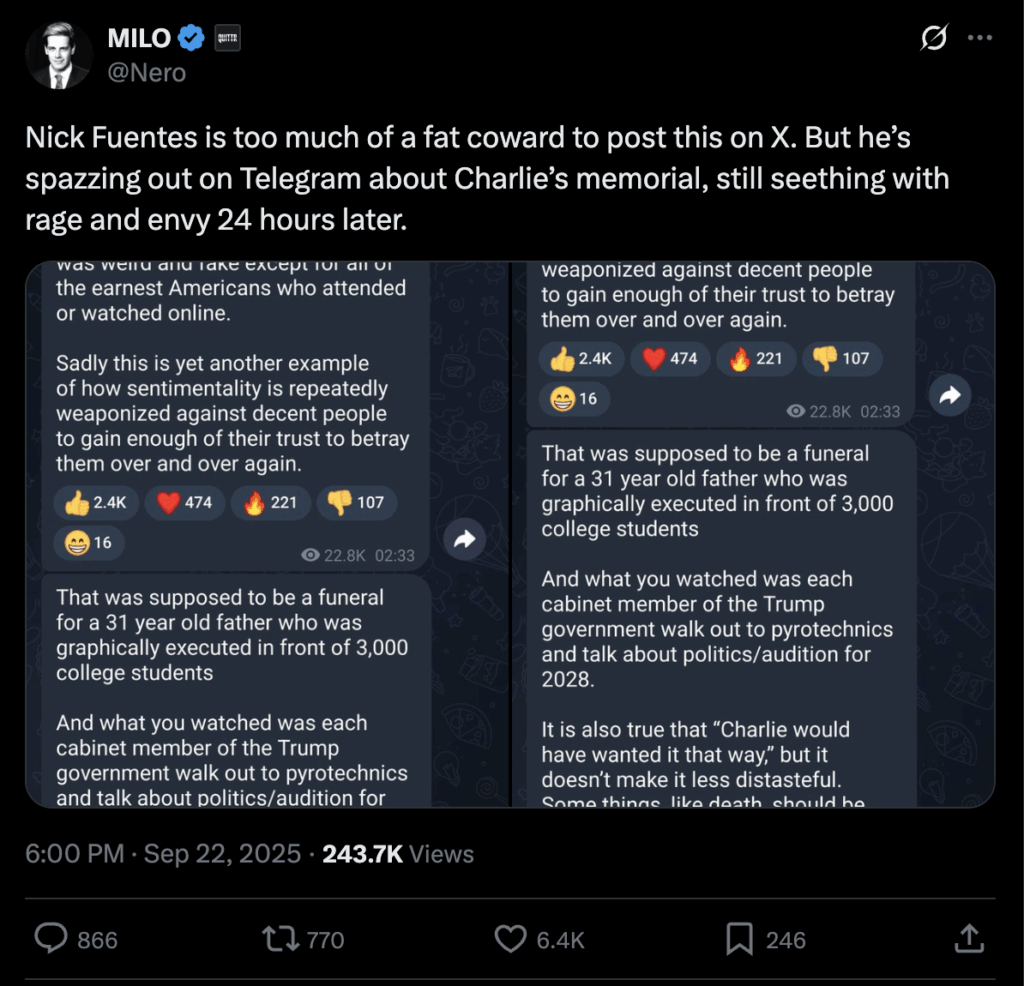
“Nick Fuentes is too much of a fat coward to post this on X. But he’s spazzing out on Telegram about Charlie’s memorial, still seething with rage and envy 24 hours later,” Yiannopoulos tweeted, alongside a series of screenshots.
“Everything about that ‘memorial’ was weird and fake except for all of the earnest Americans who attended or watched online,” Fuentes’ rant began.
(X screentshot)
Sadly this is yet another example of how sentimentality is repeatedly weaponized against decent people to gain enough of their trust to betray them over and over again.
“This memorial is a giant, shameless political spectacle to promote the GOP,” he continued, adding:
“That was supposed to be a funeral for a 31 year old father who was graphically executed in front of 3,000 college students.
“And what you watched was each cabinet member of the Trump government walk out to pyrotechnics and talk about politics/audition for 2028.”
Fuentes concluded with a bizarrely personal shot at Kirk himself:
Conservative student and supporter of US President Donald Trump, Nick Fuentes, answers question during an interview with Agence France-Presse in Boston, Massachusetts, on May 9, 2016. (WILLIAM EDWARDS/AFP via Getty Images)
“It is also true that ‘Charlie would have wanted it that way,’ but it doesn’t make it less distasteful. Some things, like death, should be sacred,” Fuentes wrote.
“This entire spectacle seemed like a calculated play, basically a cynical excuse to put on an RNC.”
But even among those who agreed with his broader message, many found the parting shot at Kirk himself distasteful.
A rift within the online Right
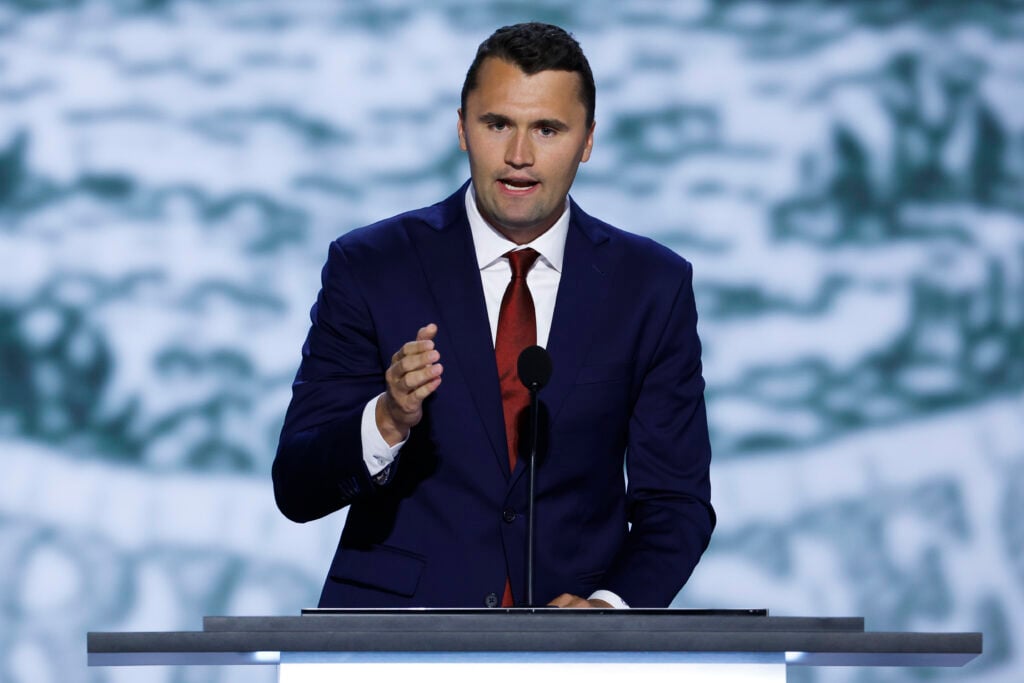
CEO of Turning Point USA Charlie Kirk speaks on stage on the first day of the Republican National Convention at the Fiserv Forum on July 15, 2024 in Milwaukee, Wisconsin. (Photo by Chip Somodevilla/Getty Images)
As Kirk and Fuentes were both supporters of Donald Trump, the feud between them might seem perplexing to casual observers.
The two factions achieved an uneasy truce ahead of the 2024 election, largely due to Kirk’s willingness to shift to the right to appease Fuentes.
But clearly, even that wasn’t enough to create a lasting peace.
It’s yet another reminder that the current US political climate is divided into too many factions to count. And while a lot of people are profiting from all that division, virtually no one seems interested in unity.
Everyone knows Jenelle Evans well enough to side with Jace.
The former Teen Mom villain was one of the franchise’s worst parents. She continues to prove that she doesn’t need an awful husband to carry on that tradition.
On social media, Jace is exposing alleged, expletive-laden texts from his own mother.
This is not how any parent should speak to their child. But it is, sadly, no surprise to those familiar with Jenelle.
Jenelle Evans has a very poor relationship with son Jace. (Instagram)
Weeks ago, Jace Evans exposed Jenelle as … exactly who you think she is
This poor boy deserves so much better than … any of this.
Jenelle Evans’ son, Jace Evans, is 16 years old.
In a span of months, he has lived in three different states: Nevada, Florida, and now, back home in North Carolina.
Taking to Instagram, Jace Evans shared alleged texts from his notorious mother, Jenelle. (Image Credit: Instagram)
Back in August, Jace returned to live with Barb, the grandmother who has been his “parent” for much of his life.
Barb has her own flaws and her own problems.
But most Teen Mom viewers agree that Jenelle was a worse situation for Jace — even before her horrible ex-husband David Eason entered the picture.
Unfortunately, as the texts that Jace exposed this summer reveal, Jenelle doesn’t seem to hesitate to lash out at her son, screeching “F–K YOU” in these alleged messages. This is important context.
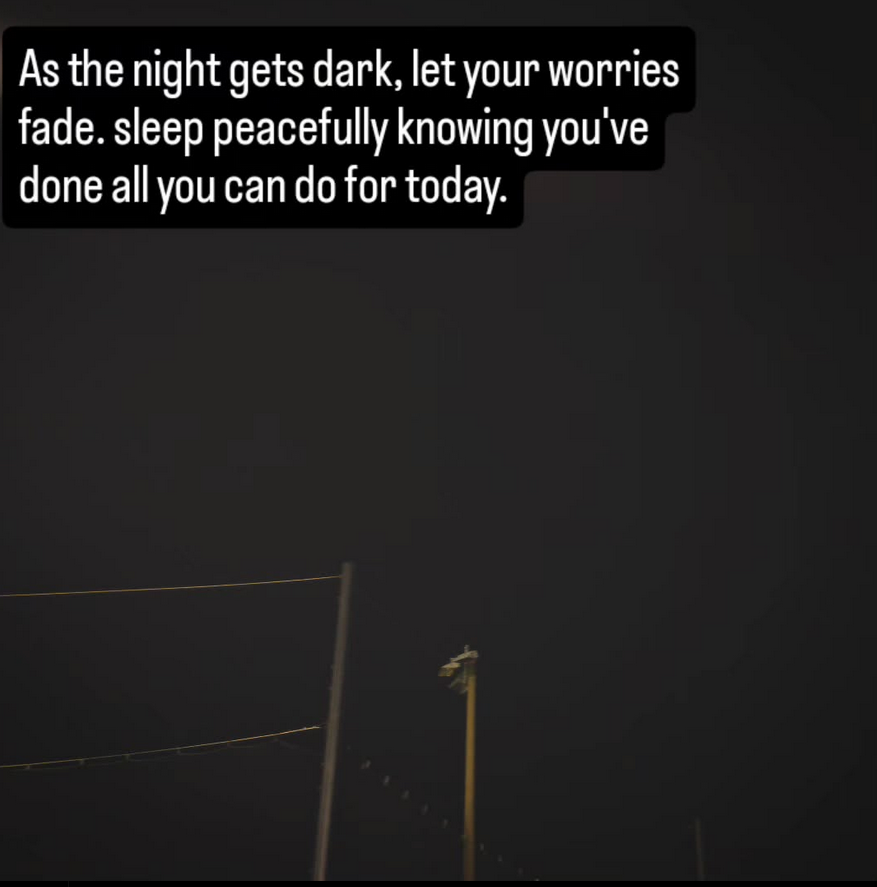
In September, Jace Evans took to his Instagram page to share this message. (Image Credit: Instagram)
Here is what he’s saying now
“As the night gets dark, let your worries fade,” Jace Evans posted to his Instagram page over the weekend, weeks after leaking those messages from Jenelle.
“Sleep peacefully,” the text post counsels, “knowing you’ve done al you can for the day.”
That is sound advice for almost anyone.
But, to Teen Mom fans, it reads as commentary from a worn out teenager who does not get the kindness and love that he should be receiving from his mother.
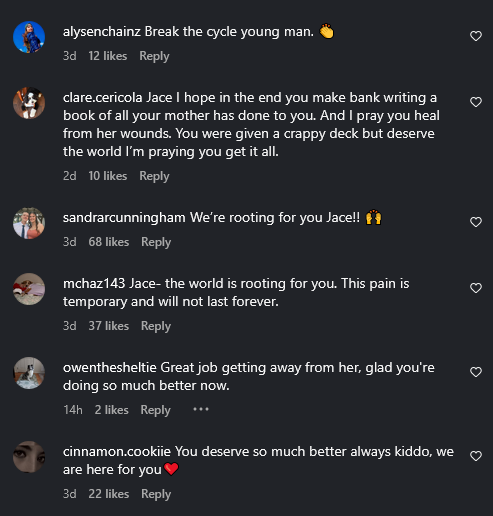
Comment after comment is showering Jace Evans with support because of how his awful mother (and others) have treated him. (Image Credit: Instagram)
As you can see from this small sample of the replies, Jace received comment after comment praising him.
These are not messages from his classmates or peers.
Instead, these are people who appear to be familiar with Jenelle from her many years as a public figure.
These are people who know that Jace needs support and uplifting, because he is a young man who has endured worse than anyone should.
Jenelle Evans and her oldest son on Teen Mom. (MTV)
We wish Jace the very best
Obviously, not everyone is on the same page. Even the likes of Jenelle Evans has her defenders. We live in a mixed-up world. Some people have skewed values.
Truth be told, Jace’s message might not even be about Jenelle.
She is just what we know about him. He has his own life, his own friends, his own struggles.
Yes, Jenelle is a big part of those struggles. On some level, even if they never speak again, she likely always will be.
But, given the way that she speaks to him, Jace has to be better off talking to a therapist than with the woman whose mistakes have defined his life.
We hope you aren’t operating any heavy machinery or taking a bite of anything you may choke on.
Why?
Because Christine Brown just made quite the shocking and/or jaw-dropping statement.
Christine and Kody Brown are no longer married. That’s probably a good thing. (TLC)
The long-time Sister Wives cast member, who walked away from Kody Brown in November 2021 and who has spent nearly every waking hour since trashing her ex, has confessed to People Magazine that Kody isn’t totally Satanic all the time.
“I do believe that Kody is a good person, and I think that things are going to be better,” she told this outlet of Kody’s broken relationship with his children. “I hope things are going to be better.”
“Things take time,” she also told People of Kody fixing these bonds. “There’s a lot of things that we say about each other that we hear, and it’s just the nature of it. So we’ve got some things to work through, I’m sure.”
Christine Brown and Kody Brown barely talk these days. (TLC)
Kody and Christine were spiritually married for 28 years; they share kids Aspyn, Mykelti, Paedon, Gwendlyn, Ysabel and Truely.
The mother of six admitted on a December 2022 episode of the Reality Life with Kate Casey podcast that she partly chose to leave Kody due the way he treated his sons and daughters.
“It was like a vicious cycle all the time. Because for years, I’d say you know, your dad loves you. He loves you, he wanted to spend time with you,” she said back then.
“I would tell my kids that all the time — that he’s going to come over, we’re going to have a great time, blah, blah, blah. And after a while, they just stopped believing me.”
Christine Brown finds something funny on Sister Wives. (TLC)
In her new memoir, Christine gets real, raw and very personal when it comes to her history with Kody.
When it comes to his children, meanwhile, Kody knows he has a lot of work to do.
“My children will always be my children and the door will always be open to them,” he said on a previous episode of Sister Wives.
“They’ve got to come through that door. I’m going to be holding a hand out for that, but I’m going to be holding this hand that’s next to me, and I won’t let go of that hand.”
Kody Brown just doesn’t seem like a very nice guy. (TLC)
Sister Wife: A Memoir of Faith, Family, and Finding Freedom is now available, wherever books are sold.
Here is the official synopsis:
Christine Brown Woolley had always dreamed of having a picture-perfect family—beautiful children, an adoring husband, and of course, a sisterhood of wives to share him with. Raised in Utah by practicing polygamists, Christine knew her life was less than normal, but that didn’t stop her from loving the full house of her childhood any less.
Becoming Kody Brown’s third wife in 1994, Christine finally found the big, happy family she had hoped for. When TLC’s hit show Sister Wives premiered in 2010, Christine knew it was her chance to shine a light on the brighter side of polygamy—the helping hands, the lively discussions, and their unmatched devotion to each other. But the cameras also revealed a much darker truth.
Now, in this candid tell-all, Christine shares for the first time the journey that led her away from polygamy and the bold path she is carving to live apart from all she has ever known. Moving, genuine, and insightful, this is a uniquely powerful tour de force of Christine’s journey toward and beyond her time in the spotlight as a sister wife.
Nexstar Media Group will continue to preempt “Jimmy Kimmel Live!” on its ABC affiliates, the company said Tuesday, effectively pulling the late-night show from dozens of local stations as the comedian prepares to make his return to the airwaves.
The company noted it would “monitor” the show as it returns to ABC, but said its stations would “focus on continuing to produce local news and other programming relevant to their respective markets.” The move makes Nexstar the second broadcasting company to preempt the show, following suit after the Sinclair Broadcasting Group announced Monday it would not air the talk program on its nearly 40 ABC affiliates.
“We made a decision last week to preempt ‘Jimmy Kimmel Live!’ following what ABC referred to as Mr. Kimmel’s ‘ill-timed and insensitive’ comments at a critical time in our national discourse,” the company wrote in a statement Tuesday. “We stand by that decision pending assurance that all parties are committed to fostering an environment of respectful, constructive dialogue in the markets we serve.”
Nexstar, the country’s largest local broadcasting group, owns roughly 30 ABC affiliates across cities like Nashville, Tenn., New Orleans and Salt Lake City. Sinclair also owns dozens of affiliates, including the ABC station serving Washington and its suburbs.
ABC parent Disney announced Monday it would resume airing “Jimmy Kimmel Live!” after deciding to suspend the show last week to “avoid further inflaming a tense situation at an emotional moment for our country.”
The show’s suspension sparked a flood of criticism from lawmakers and party leaders across the aisle, citing concerns about censorship — particularly after Federal Communications Commission Chair Brendan Carr threatened to look into affiliates because of the comedian’s comments.
Nexstar is currently seeking a merger with Tegna, which requires FCC approval.
“We have spent the last days having thoughtful conversations with Jimmy, and after those conversations, we reached the decision to return the show on Tuesday,” Disney’s statement on Monday read.