Categories
Featured Juneau News Juneau Local Ketchikan Local News Feeds Sitka Local

Invasive Green Crab spotted in Ketchikan for the first time

News of the North- The invasive European green crab has been confirmed on beaches along the Ketchikan road system for the first time. The species was first detected in Alaska in July 2022 by the Metlakatla Indian Community on Annette Island, who have since spearheaded local and regional responses.

The green crab is considered one of the most invasive species in the marine environment. It has few predators, aggressively hunts and eats its prey, destroys seagrass, and outcompetes local species for food and habitat. It has been documented that green crab devour juvenile king crab as well as juvenile salmon. They also destroy eelgrass habitat that larval fish use to hide from predators, and outcompete Dungeness crabs for food and habitat. Green crab could potentially damage Alaska’s multi-billion dollar fisheries industries, especially for salmon, crab, and mariculture operations.

Southeast Alaska Tribal Ocean Research, Alaska Fish & Game, and Alaska Sea Grant provide public resources about European green crabs in Southeast Alaska including detection, identification, and impact information, The best way to identify green crab is to count the spines. There are 5 spines behind the eye on each side of the shell.

Green crabs live on rocky shores, cobble beaches, sandflats and tidal marshes. They can often be found near eelgrass beds or other shoreline vegetation. Green crabs tolerate a wide range of water salinity and temperature. They can also survive upstream of river mouths in some estuarine environments. 

Report your sightings via the ADF&G Invasive Species Reporter or by calling the Invasive Species Hotline: (877) INVASIV ((877) 468-2748). If you locate invasive green crab on Annette Islands Reserve, you can call (907) 886-FISH to make a report.

Categories
Featured Juneau News Juneau Local Ketchikan Local News Feeds Sitka Local

Alaska Gov. Dunleavy forces early vote on education veto override with special session in August

Governor Mike Dunleavy speaks during a press conference on Thursday, April 17 in Juneau. (Photo by Greg Knight/NOTN)

By: Corinne Smith and James Brooks, Alaska Beacon

Alaska Gov. Mike Dunleavy is calling state legislators back to Juneau for a surprise special session.

On Wednesday, the governor issued a proclamation stating that the session, which begins Aug. 2, will cover education reform and his executive order creating a new Department of Agriculture.

The proclamation also forces an early vote on whether to override or sustain several of the governor’s vetoes, including an unprecedented cut to the base student allocation, core of the state’s per-pupil funding formula for public schools.

Under the Alaska Constitution, legislators must vote on an override in the first five days of the next session, in this case a special session.

That’s significant, because 45 votes are needed to override a budget veto, and while there were 46 votes in favor of a prior veto override this spring, at least one legislator who voted in favor of that override is expected to be unavailable in August.

In a prepared statement, Dunleavy outlined his stated reasons for calling a special session.

​​“Enacting a few necessary reforms to our public education system can elevate those children struggling in Alaska’s school system,” Dunleavy said. “As elected officials we must do all we can to put the next generation on the path to a successful and prosperous future, and that starts with a solid public education.” 

The governor’s office declined to answer an emailed question asking whether the special session’s goals included an early vote. Some legislators said that seemed apparent.

House Minority Leader Mia Costello, R-Anchorage, said members of the House’s Republican minority were preparing to meet with the governor Wednesday afternoon.

Asked whether she thinks the governor called the session to force a veto override early, she said, “undoubtedly, the governor is aware that those issues would be taken up in the first five days in the Legislature. So, I do believe that is a part of the plan.”

She said she doesn’t know whether calling the vote early will decrease the chances of an override. Though some lawmakers may be absent, “people are home, talking to their constituents … how that translates into their votes is a hard thing to tell.”

Sen. Bill Wielechowski, D-Anchorage and chair of the Senate Rules Committee, did not mince words: “Oh yeah, this is all about the veto override,” he said. “Because he knows there’s people that are not in the state. You know, that’s actually the day that the National Conference of State Legislatures starts to meet also. So I know there’s some people who are scheduled to go to that. So, yeah, this is all about trying to game the system so we don’t have enough votes to override his veto.”

Legislators uniformly said that the governor’s special session proclamation came as a surprise. Rep. Andy Josephson, D-Anchorage, was hiking in Denali when reached by phone. Speaker of the House Bryce Edgmon, I-Dillingham, was at his town’s boat harbor.

“It’s a stunning announcement,” Edgmon said. “It’s extraordinary to get the Legislature back to Juneau, and it takes a tremendous amount of organization, cooperation, dialogue, you know, conversations, particularly when you’re throwing a topic like education policy in the mix, which normally could take up an entire two years of a legislative session.”

Senate President Gary Stevens, R-Kodiak, said the Legislature will reconvene but the votes for an override are uncertain. “I suspect that’ll be the first thing we deal with, if not the only thing we deal with, and we’ll see how the votes go.”

Under the Alaska Constitution, governors have the power to call special sessions, with the subjects limited to those chosen by the governor and the reconsideration of vetoed bills. While the Legislature is required to convene, it’s not required to actually discuss the chosen subjects. 

Stevens said there’s no guarantee that the Legislature will take up Dunleavy’s agenda items. “It should be no secret to anyone that we’re going to, when we do meet —  it’s my intention — on Aug. 2 to bring up first the issue of the override. And then we could, after we’ve done that, pass or fail, then we probably … can easily adjourn and deal with these issues the governor brought up at a later date.”

Sen. Forrest Dunbar, D-Anchorage, is currently deployed in Poland as part of U.S. National Guard service, and Stevens says it’s unlikely he would be able to make the special session. “He’s doing a service to the country, and it’d be very hard for him to get back. I don’t know if the military would even allow him to leave at this point, he’s in a training session, and so we’ll certainly look into that. But I would say it’s probably unlikely that he can be back.” 

Dunbar did not respond to requests for comment by Wednesday afternoon.

“But he’s not the only one,” Stevens added. “There are others that are traveling, which makes it even more difficult to get to 45 votes.”

That threshold matters because overriding a governor’s budget veto requires 45 of 60 legislators, meeting in joint session.

This spring, 46 lawmakers voted to override the governor’s veto of a bill increasing the base student allocation in state policy. But authorizing spending the money was a separate vote, as part of passing the budget. If Dunbar is absent, all 45 remaining supporters of the veto override would have to stand firm in order to restore public school funding cut by the governor.

“I don’t know where people are going to be, but it’s really going to come down to probably one vote on a number of these overrides. So, not having that one vote, it’s going to be tough,” Wielechowski said.

In addition to the budget vetoes, the governor had vetoed three policy bills, including Senate Bill 183, increasing the powers of the legislative auditor. 

Legislators said that bill, which passed with bipartisan support, was needed because the executive branch has stopped providing reports needed to verify the work of oil tax auditors on state taxes owed. Dunleavy said legislators’ criticism of the administration’s handling of the issue insinuated that it was acting unethically or illegally and undermined public trust in government. He demanded in a letter to lawmakers last week that they stop.

Afterward, at a meeting of the Legislative Budget and Audit Committee, lawmakers voted to authorize subpoenas against members of the administration over the issue.

Calling a special session makes an override of the SB 183 veto more difficult, Wielechowski said.

“If you’re an oil company, today’s a great day. They’re probably popping champagne bottles in Houston, Texas, today, and also all across the oil basins, because they know that it’s going to be harder to audit their taxes and probably likely to cost the state hundreds of millions of dollars,” he said.

Josephson said there will likely be several veto override votes taken up by the Legislature. “There will be attempts on multiple overrides. Multiple, multiple overrides,” he said, and hopes it includes an override vote to restore a policy bill addressing funding for teacher housing and Mount Edgecumbe High School in Sitka, and budget increases for infant learning programs. “So that’s going to be sort of interesting as well, because those veto override attempts must occur.”

After addressing the overrides, lawmakers could adjourn the special session without taking up either of the topics on the formal agenda.

Rep. Kevin McCabe, R-Big Lake, said he hopes that doesn’t happen and lawmakers consider creating a Department of Agriculture separate from the Department of Natural Resources.

Agriculture is currently overseen by a division within DNR, and McCabe said that recent wildfires in the Denali Borough show the need for DNR to be free to concentrate its attention on more important things without taking time away from agriculture.

Dunleavy addressed the issue in his statement announcing the session: “Splitting the Division of Agriculture away from DNR into a department will elevate food security and support our hard-working farmers while growing the agricultural sector.”

In May, lawmakers voted 32-28 to deny an executive order by Dunleavy to create a new Department of Agriculture, citing the proposal’s costs as well as creation through an executive order rather than as legislation, with public input.

Sen. Löki Tobin, D-Anchorage, chair of the Senate Education Committee, said by phone Wednesday that the Legislature passed legislation related to many of the governor’s policy priorities for education in May, including taking steps toward easing access for new charter school applications and expanding funding for career and technical education, as well as creating a task force to examine open enrollment and other measures. 

She said she was unclear what further education reforms the governor wants: “I haven’t heard from the governor nor any of his staff, about anything else that he would like to see happen within our public education system.”

In a video Dunleavy released when he vetoed the school policy bill, he said it “fell short” on the policies he sought, including on charter schools, reading improvement incentives and open enrollment.

Other legislators were skeptical that the special session would accomplish its stated goals.

“I don’t think it’s going to work, is it?” said Rep. Jamie Allard, R-Eagle River, on talk radio Wednesday morning. 

Senate Minority Leader Mike Shower, R-Wasilla, said he hadn’t spoken to the governor or any of his staff about the special session but said that sustaining the vetoes could be a primary objective.

“Honestly, I don’t know exactly what the intent is, or what the hope is for accomplishing (something), whether it’s PR or some kind of vote with people missing, or anything like that,” he said.

“Personally,” Shower said, “I’m not the biggest fan of special sessions, only because in my eight-plus years here, I’ve never seen them actually accomplish anything.”

Categories
Featured Juneau News Juneau Local Ketchikan Local News Feeds Sitka Local

Cruise Passenger Missing after Hike in Juneau

Search and rescue crews in Juneau are looking for a missing cruise ship passenger who didn’t return from a hike Monday.

Police say 62-year-old Marites Buenafe, a Kentucky resident and passenger aboard the Norwegian Bliss, disembarked around 7:30 a.m. on July 1 and told family she planned to take the tram up the mountain and hike alone.

She never returned to the ship, which departed at 1:30 p.m.

Buenafe is described as 5’1″, about 110 pounds, with short black hair and brown eyes.

The Alaska State Troopers and Juneau Mountain Rescue launched a search operation, which remains ongoing.

Anyone with information is urged to contact authorities.

Categories
Featured Juneau News Juneau Local Ketchikan Local News Feeds Sitka Local

Affordable Juneau Coalition succeeds in getting two initiatives on October’s Ballot

News of the North- Two tax-related propositions will appear on Juneau’s municipal ballot this fall. One seeks to cap the city’s property tax rate at nine mills, plus any extra needed to pay off voter-approved debt.

“The cap on the mill rate will make Juneau more affordable,” local attorney Joe Geldhof said. “Instead of just raising property taxes and getting more revenue, they’ll have to start making some considered choices on what it is Juneau really needs.”

Another proposal would include a sales tax exemption on groceries for personal consumption and sales of heating fuel, including wood, wood pellets and fuel oil for non-commercial use.

“For years now, the politicians down there have been talking about eliminating taxes primarily on groceries, and they never get around to doing it,” Geldhof said. “Pretty much everybody says, gee, why should a low-income or middle-income family pay sales tax on an essential like food or on their heating fuel? And a bunch of us finally decided they can’t figure it out, so we’re going to.”

Both initiatives aim to lower the cost of living.

A third petition to reinstate in-person voting didn’t gather enough signatures.

“By-mail voting is convenient in one sense, especially for the bureaucrats,” Geldhof added. “It also turns out to be fantastically more expensive than the old way where you’d go to your polling station. It also turns out to be way slower.”

City officials warn these changes could cut millions from the city’s budget, potentially leading to reduced services, Property taxes make up roughly 40% of the city’s general fund revenue.

Voting in this year’s municipal election ends on Tuesday, Oct. 7.

Categories
Featured Juneau News Juneau Local Ketchikan Local News Feeds Sitka Local

ICE transfers detainees from Alaska prison, but questions remain around due process and conditions

The entrance to the Anchorage Correctional Complex is seen on Aug. 29, 2022. (Photo by Yereth Rosen/Alaska Beacon)

By: Corinne Smith, Alaska Beacon

The Alaska Department of Corrections announced that 35 men that were arrested and detained by the U.S. Immigration and Customs Enforcement from out of state and held at the Anchorage Correctional Complex were transferred out of state on Monday.

ICE transferred 42 men to Alaska from out of state on June 8, as part of an ongoing agreement between the Department of Corrections and the U.S. Department of Justice, amid a nationwide deportation crackdown. The move sparked daily protests, a fact-finding hearing by the Alaska House Judiciary Committee, and concerns from attorneys and the American Civil Liberties Union of Alaska around the punitive conditions of detention, violations of due process and criminal confinement.  

A spokesperson for the Department of Corrections said department Commissioner Jen Winkelman was not available for an interview on Tuesday to discuss the transfer, concerns around conditions of detention, and ongoing plans to house ICE detainees in Alaska.

“The ICE detainees who were transferred due to severe overcrowding in the Washington facility are no longer in the custody of the Alaska Department of Corrections,” said DOC spokesperson Betsy Holley in an email, in which she included the italics and underlining. She added that all questions on the details of the transfer should be directed to DHS/ICE. 

Cindy Woods, a senior immigration law and policy fellow with the ACLU of Alaska, said the transfer was not unexpected, since DOC had said they agreed to hold detainees for 30 days. She also said she and several other attorneys were not notified of the transfers. 

“Yesterday evening, I flagged the attorneys that I know represent folks who had been transferred, to let them know that they were being transferred again, and but none of them had been told by ICE prior to that,” she said. 

Woods said all the detainees were going through civil immigration proceedings, and faced no criminal charges. 

“These individuals were all in civil detention, so they were not being detained as part of an ongoing criminal proceeding. They were all in administrative immigration proceedings,” she said, and a number of the men have applied for or received asylum protections.

“And then there were also a handful of folks who were waiting for their immigration proceedings to commence,” she said. “And so (they) were waiting for the opportunity to speak with a judge about either a potential asylum claim or some other request for immigration relief.”

The ICE transfer of detainees to Alaska DOC custody raised serious concerns around standards of detention from legislators and advocates. Attorneys testified before the June 20 hearing of the Alaska House Judiciary Committee that despite no criminal charges, their clients reported that they were subject to lengthy lockdowns, overuse of handcuffs and overcrowding — sleeping three to a cell. In addition, they were denied or had limited access to calls with family and attorneys, regularly strip-searched after visits with attorneys, and subjected to use of force by DOC staff members, who pepper-sprayed a unit to stop a “verbal demonstration” on June 12, the attorneys said.

The ACLU of Alaska sent a letter on Saturday to Alaska state officials and ICE demanding detainees be removed from Anchorage Correctional Complex custody, and a stop to any additional transfers “unless and until constitutionally adequate conditions of confinement and attorney access can be guaranteed.”

The letter provided further detail on the pepper-spray incident: “This ‘verbal demonstration’ consisted of detainees requesting access to their belongings, including an individual who was trying to access his property to get the phone number for his consulate. Following the incident, many individuals experienced respiratory distress, including coughing, burning sensations in their mouth, nose, and eyes, and nosebleeds, and did not receive medical attention. They were also unable to change their clothes for an extended period of time.”

Holley said in the Department of Corrections’ emailed response to an interview request that the state did not make the call to transfer the detainees.

“The decision to transfer these detainees out of Alaska rested solely with the federal government. The decision was not influenced by the recent House Judiciary Committee hearing or the letter issued by the ACLU this past weekend,” Holley said. 

“It is important to note the Alaska DOC routinely houses both civil detainees and federal prisoners. While we do not currently know whether ICE will request additional placements in the future, the Alaska DOC remains fully prepared to support DHS/ICE in coordinated efforts that prioritize public safety and the efficient use of government resources.”

The ACLU filed a class action lawsuit against the Department of Corrections in May challenging what they say is “inadequate, dangerous and inhumane” health care provided for incarcerated Alaskans. 

Woods said the DOC protocols and detention conditions are unnecessary, and violated the men’s right to due process. “The conditions that they were all held in were punitive, whether or not that was the intention of the government, and such punitive nature are clearly outside the scope of the law, and especially when it comes to the standards and the requirements for civil detainees, who are not being held under criminal charges,” she said.

ICE did not respond to requests for comment about why the detainees were transferred to and from Alaska. Woods said she was able to search in the ICE inmate locator and confirm the men were transferred back to the ICE detention facility in Tacoma, Washington, with reportedly better conditions.

Woods said detainees reported the experience in DOC custody as humiliating.

“They were being held in really substandard conditions, being subjected to pepper spray and strip searches, and handcuffs, and all of those things. And so it was really hard for a lot of people to deal with that shift,” she said, referring to being transferred from Washington state to Alaska custody. “And especially because they were also largely cut off from those outside relationships that sustained them, particularly those who, you know, regularly spoke with their children and their parents and their loved ones who were not located in the United States — having that kind of completely shut off really impacted the individuals who experienced that.”

On Friday, seven U.S. congressional representatives from Washington and Oregon sent a letter to the U.S. Department of Homeland Security questioning why detainees were transferred to Alaska,  as well as the cost and criteria for who is transferred. The letter also raised concerns that “ICE is wasting taxpayer dollars, flying dozens of people between detention centers thousands of miles apart, in efforts that do nothing to help protect Americans.”

Categories
Politics

Invasive carp threaten the Great Lakes − and reveal a surprising twist in national politics

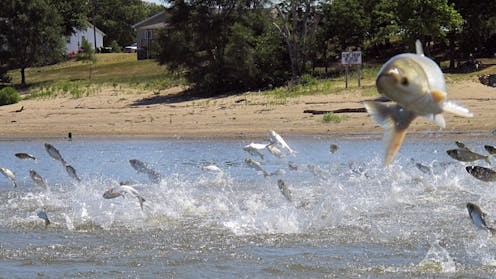
Invasive Asian carp are spreading up the Mississippi River system and already clog the Illinois River. AP Photo/John Flesher

In his second term, President Donald Trump has not taken many actions that draw near-universal praise from across the political spectrum. But there is at least one of these political anomalies, and it illustrates the broad appeal of environmental protection and conservation projects – particularly when it concerns an ecosystem of vital importance to millions of Americans.

In May 2025, Trump issued a presidential memorandum supporting the construction of a physical barrier that is key to keeping invasive carp out of the Great Lakes. These fish have made their way up the Mississippi River system and could have dire ecological consequences if they enter the Great Lakes.

It was not a given that Trump would back this project, which had long been supported by environmental and conservation organizations. But two very different strategies from two Democratic governors – both potential presidential candidates in 2028 – reflected the importance of the Great Lakes to America.

As a water policy and politics scholar focused on the Great Lakes, I see this development not only as an environmental and conservation milestone, but also a potential pathway for more political unity in the U.S.

A feared invasion

Perhaps nothing alarms Great Lakes ecologists more than the potential for invasive carp from Asia to establish a breeding population in the Great Lakes. These fish were intentionally introduced in the U.S. Southeast by private fish farm and wastewater treatment operators as a means to control algae in aquaculture and sewage treatment ponds. Sometime in the 1990s, the fish escaped from those ponds and moved rapidly up the Mississippi River system, including into the Illinois River, which connects to the Great Lakes.

Sometimes said to “breed like mosquitoes and eat like hogs,” these fish can consume up to 40% of their body weight each day, outcompeting many native species and literally sucking up other species and food sources.

Studies of Lake Erie, for example, predict that if the carp enter and thrive, they could make up approximately one-third of the fish biomass of the entire lake within 20 years, replacing popular sportfishing species such as walleye and other ecologically and economically important species.

Invasive carp are generally not eaten in the U.S. and are not desirable for sportfishing. In fact, silver carp have a propensity to jump up to 10 feet out of the water when startled by a boat motor. That can make parts of the Illinois River, which is packed with the invasive fish, almost impossible to fish or even maneuver a boat.

Look out! Silver carp fly out of the water, obstructing boats and hitting people trying to enjoy a river in Indiana.

The Brandon Road Lock and Dam solution

Originally, the Great Lakes and the Mississippi River were not connected to each other. But in 1900, the city of Chicago connected them to avoid sending its sewage into Lake Michigan, from which the city draws its drinking water.

The most complete way to block the carp from invading the Great Lakes would be to undo that connection – but that would recreate sewage and flooding issues for Chicago, or require other expensive infrastructure upgrades. The more practical, short-term alternative is to modify the historic Brandon Road Lock and Dam in Joliet, Illinois, by adding several obstacles that together would block the carp from swimming farther upriver toward the Great Lakes.

The barrier, estimated to cost US$1.15 billion, was authorized by Congress in 2020 and 2022 after many years of intense planning and negotiations. For the first phase of construction, the project received $226 million in federal money from the Bipartisan Infrastructure Law to complement $114 million in state funding – $64 million from Michigan and $50 million from Illinois.

On the first day of Trump’s second term, however, he paused a wide swath of federal funding, including funding from the Bipartisan Infrastructure Law. And that’s when two different political strategies emerged.

A brief documentary explains the construction of a connection between the Great Lakes and the Mississippi River basin.

Pritzker vs. Whitmer vs. Trump

Illinois, a state that has voted for the Democratic candidate in every presidential election since 1992, has the most financially at stake in the Brandon Road project because the project requires the state to acquire land and operate the barrier. When Trump issued his order, Illinois Gov. JB Pritzker, a Democrat, postponed the purchase of a key piece of land, blaming the “Trump Administration’s lack of clarity and commitment” to the project. Pritzker essentially dared Trump to be the reason for the collapse of the Great Lakes ecosystem and fisheries.

Another Democrat, Gov. Gretchen Whitmer of Michigan, a swing state with the most at stake economically and ecologically if these carp species enter the Great Lakes, took a very different approach. She went to the White House to talk with Trump about invasive carp and other issues. She defended her nonconfrontational approach to critics, though she also hid her face from cameras when Trump surprised her with an Oval Office press conference. When Trump visited Michigan, she stood beside him as they praised each other.

When Trump released the federal funding in early May, Pritzker kept up his adversarial language, saying he was “glad that the Trump administration heard our calls … and decided to finally meet their obligation.” Whitmer stayed more conciliatory, calling the funding decision a “huge win that will protect our Great Lakes and secure our economy.” She said she was “grateful to the president for his commitment.”

A woman shakes hands with a man in a blue suit wearing a red ballcap.
Michigan Gov. Gretchen Whitmer greets President Donald Trump as he arrives in her state in late April 2025.
AP Photo/Alex Brandon

Why unity on carp?

Whether coordinated or not, the net result of Pritzker’s and Whitmer’s actions drew praise from both sides of the aisle but was little noticed nationally.

Trump’s support for the project was a rare moment of political unity and an extremely unusual example of leading Democrats being on the same page as Trump. I attribute this surprising outcome to two key factors.

First, the Great Lakes region holds disproportionate power in presidential elections. Michigan, Wisconsin and Pennsylvania have backed the eventual winner in every presidential race for the past 20 years. This swing state power has been used by advocates and state political leaders to drive funding for Great Lakes protection for many years.

Second, Great Lakes are the uniting force in the region. According to polling from the International Joint Commission, the binational body charged with overseeing waterways that cross the U.S.-Canada border, there is “nearly unanimous support (96%) for the importance of government investment in Great Lakes protections” from residents of the region.

There aren’t any other issues with such high voter resonance, so politicians want to be sure Great Lakes voters are happy. For example, Vice President JD Vance has been particularly vocal about the Great Lakes. And Great Lakes restoration funding was one of the few things in the presidential budget that Democrats and Republicans agreed on.

Both Pritzker and Whitmer likely had state-based and national motivations in mind and big aspirations at stake.

Their combined effort has put the project back on track: As of May 12, 2025, Pritzker authorized Illinois to sign the land-purchase agreement he had paused back in February.

And perhaps the governors have identified a new area for unity in a divided United States: Conservation and environmental issues have broad public support, particularly when they involve iconic natural resources, shared values and popular outdoor pursuits such as fishing and boating. Even when political strategies diverge, the results can bring bipartisan satisfaction.

The Conversation

Mike Shriberg was previously the Great Lakes Regional Executive Director of the National Wildlife Federation, which entailed being a co-chair (and, for part of the time, Director) of the Healing Our Waters – Great Lakes Coalition.

​Politics + Society – The Conversation

Categories
Politics

Bill Moyers’ journalism strengthened democracy by connecting Americans to ideas and each other, in a long and extraordinary career

“Bill Moyers? He’s spectacular!” George Clooney said – and no wonder.

I mentioned this legendary television journalist to the actor and filmmaker after Clooney emerged from the Broadway theater where he just had been portraying another news icon: Edward R. Murrow. Or as the Museum of Broadcast Communications put it in a tribute to Moyers, he was “one of the few broadcast journalists who might be said to approach the stature of Edward R. Murrow. If Murrow founded broadcast journalism, Moyers significantly extended its traditions.”

Moyers, who died at 91 on June 26, 2025, was among the most acclaimed broadcast journalists of the 20th century. He’s known for TV news shows that exposed the role of big money in politics and episodes that drew attention to unsung defenders of democracy, such as community organizer Ernesto Cortés Jr..

Earlier in his life, Moyers served in significant roles in the Kennedy and Johnson administrations, but his fame comes from his journalism.

Making a connection

Despite his prominence, Moyers was the same down-to-earth guy in person as he seemed to be on the screen. In 1986, he was commanding a television audience of millions, and I was a historian at home with a preschooler, teaching the occasional college course in a dismal job market. Seeing that Moyers would be speaking at the conference on President Lyndon B. Johnson where I would be giving a paper, I wrote to him.

To my utter amazement, he replied and then showed up to hear my paper, on Johnson’s experiences as a young principal of the “Mexican” school in Cotulla, Texas, where he championed his students but also forged links to segregationists. Cotulla was “seminal” to LBJ’s development, Moyers said. In 1993, he recommended me for a grant that helped me finish a book: “LBJ and Mexican Americans: The Paradox of Power.

A few years later, he asked me to head up a project researching the documents related to his time in Johnson’s administration. His memoir of the Johnson years never materialized. Instead, I edited the bestselling ”Moyers on America: A Journalist and His Times.“

Part of what always impressed me about Moyers was his belief that what matters is not how close you are to power, but how close you are to reality.

‘Amazing Grace’

Moyers didn’t just dwell on politics and policy as a journalist. He also delved into the meaning of creativity and the life of the mind. Many of his most moving interviews spotlighted scientists, novelists and other exceptional people.

He was also arguably among the best reporters on the religion beat. Even if it wasn’t always the main focus of his work or what comes to mind for those familiar with his legacy, still, he was a lifelong spiritual seeker.

This is hardly surprising: Moyers had degrees in both divinity and journalism. As a young man, he briefly served as a Baptist minister.

He once told me that his favorite of the many programs that he produced was the PBS documentary ”Amazing Grace.“ It featured inspiring renditions of this popular Christian hymn as performed by country legend Johnny Cash, folk icon Judy Collins, opera diva Jessye Norman and other musical geniuses. As they share with Moyers their personal connections to this song of redemption, he draws viewers into the stirring saga of its creator, John Newton: a slave trader who became an abolitionist through “amazing grace.”

Bill Moyers interviews Judy Collins about singing ‘Amazing Grace,’ following the production of his PBS special about the hymn.

Life’s ultimate questions

This appreciation of the ineffable clearly informed Moyers’ blockbuster TV series exploring life’s ultimate questions, “Joseph Campbell and the Power of Myth.”

His interviews with Campbell, a comparative mythologist, evoked moments that made time stand still, and this reminded me of Thomas Merton, the American monk and poet, writing, “Everything is emptiness and everything is compassion” on beholding the immense Polonnaruwa Buddhas of Sri Lanka.

To my surprise, Moyers knew about this Trappist monk, telling me, “I always wished that I could have interviewed Merton,” who died in 1968.

It turned out that Moyers had been introduced to Merton by Sargent Shriver, founding director of the Peace Corps, where Moyers was a founding organizer and the deputy director.

Mentored by LBJ

Moyers characterized his Peace Corps years as the most rewarding of his life. When Johnson, his mentor, became president, he asked Moyers to join the White House staff. Moyers turned down the offer, so Johnson made it a presidential command.

The wunderkind – Moyers was 29 years old in 1963, when Johnson was sworn in after President John F. Kennedy’s assassination – coordinated the White House task forces that created the largest number of legislative proposals in American history. Among the programs and landmark reforms established and passed during the Johnson administration were Medicare and Medicaid, a landmark immigration law, the Freedom of Information Act, the Public Broadcasting Act and two historic civil rights laws.

Johnson’s war on poverty, in addition, introduced several path-breaking programs, such as Head Start.

Moyers served as one of Johnson’s speechwriters and was a top official in Johnson’s 1964 presidential campaign. The following year, the Johnson administration began escalating U.S. involvement in the Vietnam War and Johnson named a new press secretary: Bill Moyers. Again, the young man tried to decline, but the president prevailed.

As Moyers had feared, he could not serve two masters – journalists and his boss – especially as the administration’s Vietnam War policies became increasingly unpopular.

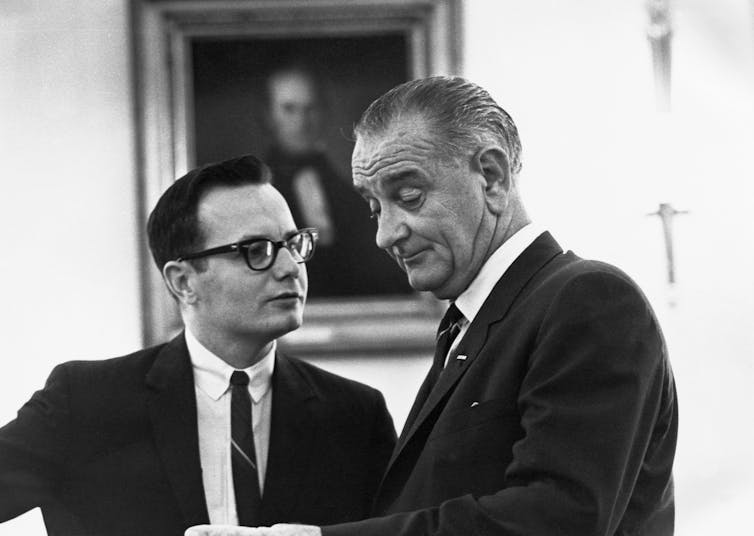
LBJ speaks with a young man with dark-rimmed glasses who is wearing a 1960s-style suit and skinny tie.
President Lyndon B. Johnson confers with Bill Moyers, his press secretary, in 1965.
Corbis Historical via Getty Images

Appreciating the world around you

Moyers left the Johnson administration in 1967, turning to journalism. He became the publisher of Newsday, a Long Island, New York, newspaper, before becoming a producer and commentator at CBS News. His commentaries reached tens of millions of viewers, but the network refused to provide a regular time slot for his documentaries. He had previously worked at PBS. In 1987, he decamped there for good.

Moyers’ programs won many journalism awards, including over 30 Emmys, along with the Lifetime Emmy for news and documentary productions.

He helped millions of Americans appreciate the world around them. As he reflected in 2023, in one of the last interviews he gave, to PBS journalist Judy Woodruff at the Library of Congress: “Everything is linked, and if you can find that nerve that connects us to other things and other places and other ideas – and television should be doing it all the time – we’d be a better democracy.”

Judy Woodruff interviews Bill Moyers about his life’s work in government and the media, including his contributions to the launch of PBS, at the Library of Congress.

Today, with disinformation metastasizing, professional journalists losing their jobs by the thousands and some newspaper owners muzzling their editorial staff, thoughtful explanations can lose out. That means Americans can lose out.

“It takes time, commitment” to dig below the surface and discover the deeper meaning of people’s lives, Moyers noted. He sought to understand, for example, why so many folks in his own hometown of Marshall, Texas, have become much more suspicious – resentful, even – of outsiders than when he gave these folks voice in his poignant, prize-winning 1984 program Marshall, Texas; Marshall, Texas.

In this era of growing threats to democracy, what can a young person do who aspires to follow in Bill Moyers’ footsteps – whether in journalism or public life?

Woodruff asked Moyers that question, to which he responded: “You can’t quit. You can’t get out of the boat! Find a place that gives you a sense of being, gives you a sense of mission, gives you a sense of participation.”

Today, with the future of journalism – and of democracy itself – at stake, I think it would help everyone to take to heart the insights of this late, great American journalist.

The Conversation

Julie Leininger Pycior edited the book “Moyers on America: A Journalist and His Times.” She also was hired by Moyers to direct the 18-month “LBJ Years” research project.

In addtion, she served as an unpaid, informal historical adviser for some of his public television programs.

​Politics + Society – The Conversation

Categories
Politics

Mexican flags flown during immigration protests bother white people a lot more than other Americans

Protesters wave the Mexican flag in Los Angeles on June 9, 2025. Luke Johnson/Los Angeles Times via Getty Images

Agents with U.S. Immigration and Customs Enforcement conducted a series of raids throughout Los Angeles and Southern California in early June 2025, sparking protests in downtown Los Angeles and other cities, including New York, Chicago and Austin, Texas.

Some demonstrators expressed growing frustration with ICE by showcasing the Mexican flag, which has become the defining symbol of the protests in Los Angeles.

The use of the flag has also become the subject of intense debate in the media.

Some outlets have depicted the flag as symbolizing ethnic pride, solidarity with immigrants and opposition to the Trump administration.

Others have called it the “perfect propaganda” tool for Republicans and conservatives, some of whom have referred to the Mexican flag as the “confederate banner of the L.A. riots.” They point to its use as evidence of anarchy and a city taken over by immigrants.

But what do Americans think about protesters waving the Mexican flag, and why?

Much of our knowledge surrounding this question is based on the 2006 immigrant rights protests across the United States, which occurred in a much less politically polarized era. Additionally, a vast majority of protesters then brought U.S. flags compared with other national flags, including the Mexican flag.

Research published in 2010 found that even though the public was more likely to be bothered by protesters waving the Mexican flag than the U.S. flag, that difference was largely absent once you divided the public into subgroups, including white people, Latinos and immigrants.

To reexamine public attitudes toward protesters waving the Mexican flag, we conducted an online survey experiment among 10,145 U.S. adults in 2016.

As political scientists who specialize in Latino politics and immigration-related issues, we tested how exposure to the Mexican flag versus the American flag shaped opinion about protests during Trump’s first presidential campaign in 2016.

We found that even though much of the public continued to be less bothered by the American flag than the Mexican flag, there were also important and perhaps surprising differences in protest attitudes between white Americans and other racial and ethnic groups.

A man holds a Mexican flag in front of several police officers on motorcycles.
A demonstrator holds a Mexican flag in front of law enforcement during a protest on June 13, 2025, in Los Angeles.
AP Photo/Wally Skalij

More or less bothered

In the study, we randomly divided respondents into two groups: a treatment group and a control group. Respondents in the treatment group were shown an image of protesters waving a Mexican flag. Respondents in the control group were shown an image of protesters waving the U.S. flag. After viewing the image, respondents were then asked about the extent to which they supported or were bothered by the protests.

Overall, 41% of the respondents said they were bothered by protesters waving the Mexican flag, and 28% said protesters waving the U.S. flag bothered them.

Our results show important differences in opinion between racial and ethnic groups.

White respondents were more likely than any other racial and ethnic group to say they were bothered by protesters waving Mexican flags. Sixty-nine percent of white respondents said they were bothered, 31 percentage points more than the average of nonwhite respondents.

However, 51% of white respondents were also bothered by the image of protesters waving U.S. flags. By contrast, just 20% of Latinos, 33% of Black Americans and 34% of Asian Americans said they were bothered by protesters waving U.S. flags.

Put differently, large majorities of nonwhite respondents were supportive of showing U.S. flags at protests despite their more positive views toward Mexican flags.

What explains racial differences?

When taking a deeper look at what causes Americans to feel bothered about protesters waving Mexican flags, some clear patterns emerge.

On average, older Americans were more likely to be bothered relative to younger Americans. This was particularly true for Americans over 40 years of age compared with millennials, born between 1981 and 1996, and Gen Z respondents, born between 1997 and 2012.

However, there are some nuances when examining age groups and whether they had attended a protest, march or rally in the previous year.

Our findings suggest that older Americans who had not engaged in protests were most likely to be bothered when they saw images of protesters waving Mexican flags. Millennials and Gen Z respondents who participated in a protest were least likely to be bothered.

Given that this issue intersects nationality, race, ethnicity, gender and citizenship status, it’s logical that these factors explained why Americans supported or opposed the use of Mexican flags at immigration protests.

A woman carrying a Mexico-U.S. flag walks in front of soldiers.
A woman carrying a flag with details of the United States and Mexican flags walks past members of the United States Marine Corps on June 14, 2025, in Los Angeles.
Cristopher Rogel Blanquet/Getty Images

For example, racial minorities who have a stronger sense of ethnic or racial identity were more likely to be supportive of protesters waving Mexican and U.S. flags. In other words, group identity is a strong predictor of support for protests in general, regardless of what flag is being flown.

However, minorities who lack a sense of ethnic pride and identity were most likely to be upset when they saw others expressing their First Amendment right to peaceably assemble.

The reality is that recent immigration protests across the country are the first time many of the Latino youth who are citizens have participated in these types of protests. Anyone under age 22 would not have memory of, or been alive during, the last large pro-immigrant protests in 2006.

The Mexican flag represents more than nationalistic pride. It represents their parents’ heritage, hard work and their binational experience as Americans engaged in politics.

The Conversation

The authors do not work for, consult, own shares in or receive funding from any company or organization that would benefit from this article, and have disclosed no relevant affiliations beyond their academic appointment.

​Politics + Society – The Conversation

Categories
Entertainment

Porsha Williams Opens Up About Death of Beloved Cousin Londie Favors

Reading Time: 3 minutes

Porsha Williams is in mourning.

The popular Real Housewives of Atlanta star recently lost her beloved cousin Yolanda “Londie” Favors.

And now, she’s opening up about Favors’ final hours and the close nature of their relationship.

Porsha Williams attends the Atlanta premiere of BET+ "The Deadly Getaway" on May 08, 2024 in Atlanta, Georgia.
Porsha Williams attends the Atlanta premiere of BET+ “The Deadly Getaway” on May 08, 2024 in Atlanta, Georgia. (Photo by Paras Griffin/Getty Images for BET+)

Porsha Williams shares painful account of Londie Favors’ final moments

On this week’s episode of RHOA, Porsha revealed that she’s struggling mightily in the wake of Londie’s passing.

“Dealing with he loss of my cousin Londie… I’m going through a lot emotionally while being there for my family. She meant so much to all of us. So it’s pretty difficult,” she said.

“I’m just numb. We’re like sisters. We grew up… we were babies together.”

Porsha also revealed that Londie was on the phone with her sister Lauren at the time of her death.

Porsha Williams attends the "Mission Impossible – The Final Reckoning" Atlanta Special Screening with Angela Bassett at Regal Atlantic Station on May 21, 2025, in Atlanta, Georgia.
Porsha Williams attends the “Mission Impossible – The Final Reckoning” Atlanta Special Screening with Angela Bassett at Regal Atlantic Station on May 21, 2025, in Atlanta, Georgia. (Photo by Paras Griffin/Getty Images for Paramount Pictures)

“So you know they were on the phone,” Williams told Phaedra Parks.

“She actually transitioned while you were on the phone?” Parks asked Lauren.

“Yeah,” Lauren confirmed.

In a confessional segment, Williams revealed, “I was at work and I got some news that Londie was in distress and within an hour or two we had lost Londie. She was just the most giving person you could ever think of.”

Favors was a cousin, a best friend, and a co-star

Porsha Williams attends the Atlanta premiere of BET+ "The Deadly Getaway" on May 08, 2024 in Atlanta, Georgia.
Porsha Williams attends the Atlanta premiere of BET+ “The Deadly Getaway” on May 08, 2024 in Atlanta, Georgia. (Photo by Paras Griffin/Getty Images for BET+)

Before her passing in August of 2024, Londie was a major part of Porsha’s life both on and off camera.

In addition to her appearances on RHOA, she was a regular on the short-lived spinoff series, Porsha’s Family Matters, which ran for one season in 2022.

“It just was so sudden — so difficult,” Williams said in a confessional.

“Londie was just the most giving person you could ever think of. [She was] a loyal person, the most creative with her company. She did so much for my grandfather’s foundation. The most honest person you can ever think of. It’s just a huge loss.”

TV personality Porsha Williams attends the 68th Annual Primetime Emmy Awards at Microsoft Theater on September 18, 2016 in Los Angeles, California.
TV personality Porsha Williams attends the 68th Annual Primetime Emmy Awards at Microsoft Theater on September 18, 2016 in Los Angeles, California. (Photo by Alberto E. Rodriguez/Getty Images)

During Sunday’s episode of RHOA, Porsha revealed that she and her immediate family will be planning and paying for Londie’s funeral.

“God has given us strength because He knows that her mom and sister wouldn’t be able to do all this right now,” she said.

Porsha is in the midst of a messy divorce, and it’s obviously been a very difficult year for her.

But at the time Sunday’s episode was filmed, there was clearly little on her mind aside from mourning her beloved cousin.

Our thoughts go out to Londie’s loved ones during this enormously difficult time.

Porsha Williams Opens Up About Death of Beloved Cousin Londie Favors was originally published on The Hollywood Gossip.

​The Hollywood Gossip

Categories
Entertainment

Did A$AP Rocky Just Reveal the Sex of Rihanna’s Baby?

Reading Time: 3 minutes

Rihanna is pregnant with Baby #3.

As she and A$AP Rocky revealed at this year’s Met Gala, the couple are set to welcome their third child following ample speculation and hype.

After the baby bump debut, the couple haven’t exactly been forthcoming with details.

Until now, that is. Did A$AP Rocky just leak huge news?

Rihanna and A$AP Rocky at the Smurfs premiere on June 28, 2025.
Rihanna and A$AP Rocky attend the “Smurfs” Global Premiere at Mont des Arts on June 28, 2025. (Photo Credit: Arnold Jerocki/Getty Images for Paramount Pictures)

Is Rihanna having a baby girl?

On Saturday, June 28, A$AP Rocky was attending the Smurfs world premiere in Brussels.

He was not alone. In fact, the 36-year-old rapper was there to support Rihanna on the red carpet.

There, he let slip a detail that neither he nor the gorgeous expectant mother had previously released.

Rihanna at the Met Gala debuting her baby bump on May 5, 2025.
Rihanna attends the 2025 Met Gala Celebrating “Superfine: Tailoring Black Style” at Metropolitan Museum of Art on May 05, 2025. (Photo Credit: Jamie McCarthy/Getty Images)

Kevin Frazier was there repping Entertainment Tonight, and he took a chance by asking Rocky a big question.

“Is that the girl you’ve been waiting for?” Frazier asked.

Rocky could not help but beam, answering: “It is, man, it is.”

Rihanna at the Smurfs premiere on June 28, 2025.
Rihanna attends the “Smurfs” Global Premiere at Mont des Arts on June 28, 2025. (Photo Credit: Arnold Jerocki/Getty Images for Paramount Pictures)

Did A$AP Rocky say too much, or was he joking the whole time?

As if A$AP Rocky had abruptly realized that he had spilled the proverbial beans, he seemingly attempted to cover up his mistake.

He held up a Smurfette toy.

Rihanna, of course, voices the iconic and hotly debated character in the film.

“Right here, right here,” Rocky joked. He then laughed off the topic.

Rihanna and A$AP Rocky at Cannes in May of 2019.
Rihanna and ASAP Rocky attend the red carpet of the movie Highest 2 Lowest during the 78th Cannes Film Festival Cannes France 2025/05/19. (Photo Credit: LAURENT HOU/Hans Lucas/AFP via Getty Images)

Obviously, it is unclear whether Rocky let the news slip or just pulled a prank on Frazier — and on the rest of us.

Only time will tell.

He and Rihanna already share two sons.

Though gender is a social construct that matters most to the individual, sometimes parents hope for both a son and a daughter.

Rihanna alongside Smurfette, showing off her baby bump in June 2025.
Rihanna attends the “Smurfs” Global Premiere at Mont des Arts on June 28, 2025. (Photo Credit: Antoine Flament/Getty Images for Paramount Pictures)

‘Smurfs’ is coming out on July 18

Though the world premiere of Smurfs took place over the final weekend of June in Brussels, the actual premiere is on July 18.

Taking on the role of Smurfette marks Rihanna’s return to the big screen.

This is her first film in over half a decade.

Why? Well, in addition to a global pandemic, she also became a mom twice over since her last film. And baby #3 is on the way.

Did A$AP Rocky Just Reveal the Sex of Rihanna’s Baby? was originally published on The Hollywood Gossip.

​The Hollywood Gossip