







Categories
Featured Juneau News Juneau Local Ketchikan Local News Feeds Sitka Local

US housing secretary visits Alaska to gather insights into urban and rural challenges

By: Yereth Rosen, Alaska Beacon
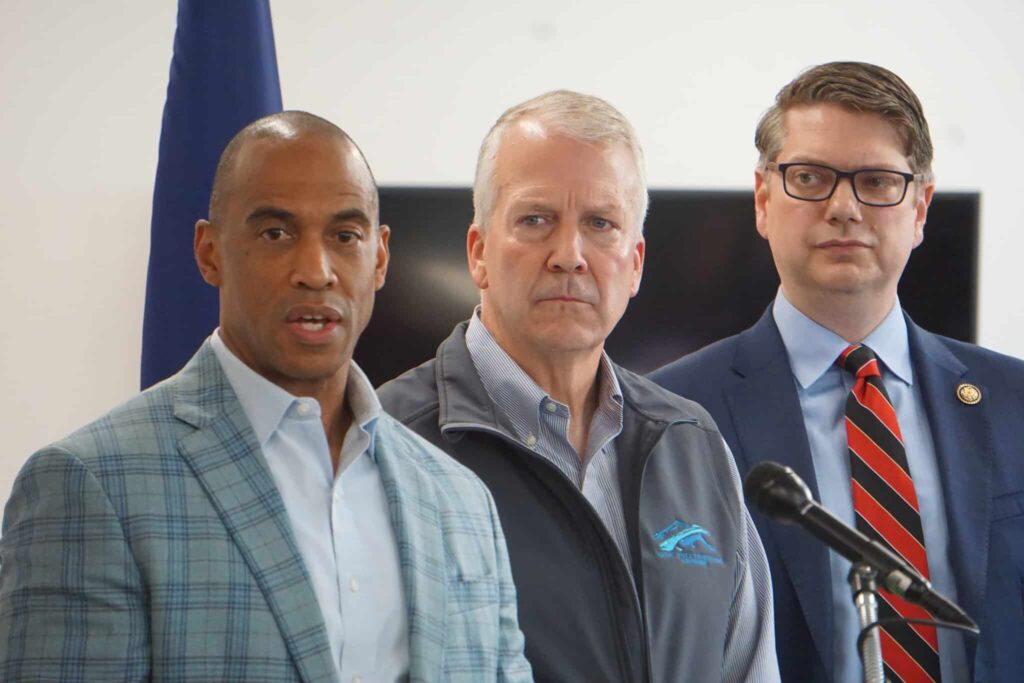
Scott Turner, secretary of the U.S. Department of Housing and Urban Development, speaks at a news conference on Tuesday in Anchorage. With him is U.S. Sen. Dan Sullivan, R-Alaska, and U.S. Rep. Nick Begich, R-Alaska. Turner is one of several Trump administration cabinet members who have traveled to Alaska this summer. (Photo by Yereth Rosen/Alaska Beacon)

The secretary of the U.S. Department of Housing and Urban Development, visiting Alaska this week, said he hopes to learn about challenges facing both the state’s urban centers and remote rural communities.

“I came here to be a great listener, to understand the needs of the people of Alaska, to understand the challenges of the people of Alaska and particularly when it comes to homelessness and affordable housing,” Scott Turner, the Trump administration’s HUD secretary, said at a news conference Tuesday in Anchorage.

Turner is among several Trump administration cabinet members touring Alaska this summer.

He spent part of Tuesday meeting with Anchorage municipal officials who discussed the challenges of homelessness in the state’s largest city.

It is a national issue, Turner said.

That 770,000 people identified as homeless in the nation “is unacceptable to me, it’s unacceptable to my colleagues and I know it’s unacceptable to you,” he said.

In Alaska, he said, almost 2,700 people are homeless, with about 1,700 of them in Anchorage. “That’s something that we want to attack and eradicate,” he said.

Those numbers show that past efforts by HUD to address homelessness have not been effective, said Turner. To make his point, he referred to his background as a professional football player.  

“One of the things that holds you accountable in the NFL is called game film,” he said. “You can say what you want to on Sunday during the game. You can say, ‘Well, I did the right thing,’ but on Monday, the film will tell the story, and the film does not lie.”

On Wednesday, Turner was touring Bethel, in Western Alaska, to learn about rural Alaska housing problems.

Crowding is a dire concern in rural communities, according to the Alaska Housing Finance Corp., a state agency. Conditions are most severe in the Yukon-Kuskokwim Delta region, where Bethel is located, according to AHFC. Crowded conditions are linked to poor health, including transmission of respiratory diseases like COVID-19.

Turner said HUD wants to add 7 million more units of affordable housing to the national supply and is focused on reducing regulations that reduce housing access in rural areas as well as in urban areas.

Sen. Dan Sullivan, R-Alaska, accompanied Turner and asserted at the news conference that overregulation by HUD is one of the major impediments to housing availability and quality in rural parts of the state.

“You can send all the money you want to rural Alaska, but it’s so smothered in red tape that it costs a million bucks to build a duplex. One duplex. A lot of that, I think, is self-inflicted,” Sullivan said.

Other analysis identified different problems for rural Alaska housing.

The high cost of energy in rural communities, which are unconnected to larger power grids, is one problem that for years has been cited as a key factor making rural Alaska housing unaffordable.

However, the budget reconciliation bill passed by Congress at the end of June, along with various actions by the Trump administration, has created new barriers to renewable energy development in rural Alaska and elsewhere.

Climate change has also exacerbated rural Alaska’s housing crisis, according to reports by government agencies.

A 2019 statewide assessment by the Denali Commission found that 144 rural communities are threatened by increased erosion, flooding, permafrost thaw or some combination of those factors.

More frequent flooding in the Yukon-Kuskokwim region, for example, is attributed to climate change and has affected housing quality and safety.

But the Trump administration is seeking to halt in-state policies intended to mitigate and adapt to climate change, including those in Alaska.

The administration also abolished the Federal Emergency Management Agency’s Building Resistant Infrastructure and Communities program. The program provided grants to help communities prevent damage from natural disasters, many of which are linked to climate change.


Categories
Featured Juneau News Juneau Local Ketchikan Local News Feeds Sitka Local

Virtual planning meeting to cover housing, long-term development

Photo of  phase 1B of the Pederson Hills Subdivision II subdivision, courtesy of the City and Borough of Juneau

NOTN- The City and Borough of Juneau Planning Commission will meet virtually on Tuesday, Aug. 12 at 7 p.m. to review a proposed housing subdivision and continue discussion of a long-term development plan for the Downtown Douglas and West Juneau neighborhoods.

Commissioners will conduct a final plat review for Phase 1B of he Pederson Hill Subdivision, a project by the Tlingit Haida Regional Housing Authority. The proposed phase includes 30 residential lots, two public use lots, and designated rights-of-way, including a pedestrian path called Wild Rose Walk.

The commission will also continue deliberating a proposed text amendment that would formally adopt the Downtown Douglas / West Juneau Area Plan into the city’s Comprehensive Plan. If approved, the amendment would update land use policies and guide future development in those neighborhoods.

The meeting will be held virtually via Zoom. Residents can join online or by phone.

Those wishing to testify virtually must state their name and place of residence before speaking and remain available for questions from commissioners.

Written public comments are encouraged and must be submitted by 12 p.m. on Aug. 8.

Categories
Featured Juneau News Juneau Local Ketchikan Local News Feeds Sitka Local

Know your local leaders; Ella Adkison

Assembly member Ella Adkison is seeking re-election to the Juneau Assembly’s area-wide seat, hoping to continue her work on housing affordability, economic resilience, and education funding after finishing out the term of a previous member.

“This will be my first full term if I’m elected,” Adkison said in an interview. “I’ve really enjoyed the work, and I hope Juneau isn’t sick of me yet.”

Adkison, 25, first joined the assembly two years ago. A lifelong Juneau resident, she said her decision to run stemmed from seeing her peers and local businesses struggle during the pandemic.

A major focus of Adkison’s platform is housing. She supports efforts to increase density across Juneau, she discussed the city’s land constraints and high cost of living. “it’s just so important, in my opinion, to have density, because that’s one of the things that Juneau lacks right now.”

Adkison pointed to the city’s ongoing Title 49 rewrite, a comprehensive update to land use codes, as a long-term tool to ease development barriers and encourage growth.

“I want to make sure the Assembly keeps pushing for solutions that make it easier to build housing here,” she said.

She says projects like Telephone Hill are complicated but could potentially add 100-150 housing units, addressing housing needs for Juneauites across generations.

“Housing is one of those issues where it actually affects every demographic in Juneau, right? I mean for young people, I first think of all my friends and people I grew up with who have to leave Juneau because they can’t afford it.” She said, “but also with our seniors, if they’re in bigger houses and there are no smaller, friendly units for them to move into, then they have to stay in the larger houses that may not be comfortable for them, and then a young family maybe can’t have that big house because it’s not available.”

Education funding is also high on her list of priorities. Adkison emphasized the importance of maintaining support for local schools, especially while there is uncertainty over state-level contributions.

“Juneau is committed to supporting our schools, we’re doing our part, and the state has to do theirs.”

Adkison also noted the importance of collaboration within the assembly, “assembly members, they all want to work together to make a thing happen, even when people come to the assembly or send us an email and say we don’t like what you’re doing, it’s never just criticism. It’s always, we really appreciate your work, how can we help you get there? And I think that’s been the best part of the assembly is knowing that, even with all our disagreements, I know that everyone wants to get to the same end goal, which is a strong, healthy capital city.”

Adkison is gearing up this campaign season, she intends to go door-to-door, participate in candidate forums, and have direct conversations with voters, she says that’s her favorite part of the process.

“I really like knocking on doors, talking to people one on one, because when you’re on the assembly, you have a very high-level view of things, and just having the opportunity to go door to door and talk to individual Juneauites and have them tell you what matters to them is a really good public opinion reset in my brain.”

Election Day is October 7, with ballots expected to arrive by mail beforehand. Adkison encouraged voters to watch for candidate forums, attend events, and reach out directly with questions or concerns.

“I want to emphasize what a privilege it’s been to be on the assembly and represent such an amazing community.” she said, “Juneau is my home and has been, and it’s place I am so happy to work for.”