Categories
Uncategorized

When immigration detention becomes a system of concentration: Lessons from research on 150 historical cases

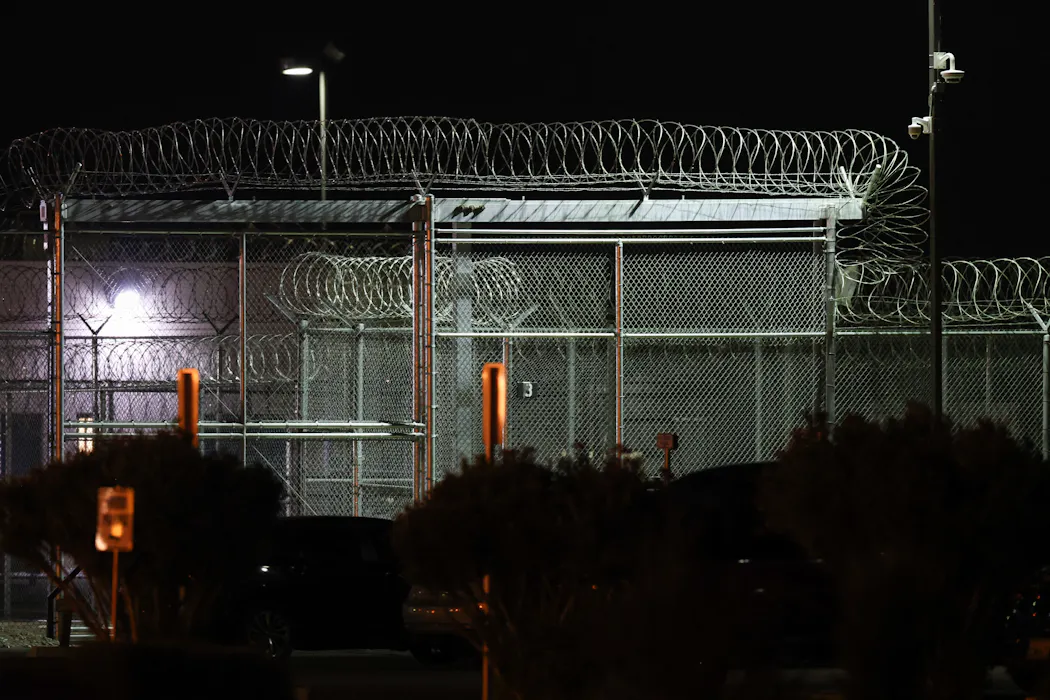
Barbed wire surrounds the GEO Group ICE detention facility in Adelanto, Calif. on July 10, 2025. Patrick T. Fallon/AFP via Getty Images

The phrase “concentration camp” is freighted with dark historical meaning. Most people hear it and instinctively think of concentration camps used by the Nazis to exterminate Jews and other minority populations during the Holocaust.

But the use and name of concentration camps originated far earlier. In the late 1800s, Spanish military officials used concentration camps – reconcentrados – during their 1896–97 Cuban campaign to isolate civilians from rebels, resulting in widespread death and disease.

We are scholars whose research into international relations and conflict includes studying historical and modern uses of these systems of camps as a form of repression.

In recent peer-reviewed research, we identified four characteristics that define what qualifies as a concentration camp system: targeting groups of civilians for imprisonment; enclosed spaces where the state controls who enters and exits; departure from standard detention practices; and abuse and neglect. We then created a dataset detailing 150 systems of camps used globally since 1896 that fit this criteria. This includes the U.S. internment of more than 125,000 Japanese immigrants and Japanese American citizens during World War II, the Argentine military junta’s use of camps in their mid-1970s campaign to reorganize society, and Vladimir Putin’s use of so-called filtration camps in Russia’s war against Ukraine.

Our use of the term “concentration camp” is not meant to sensationalize or diminish its historical meaning, particularly as it relates to the Holocaust.

Rather, identifying such systems early is how the concept of “never again” – the promise to prevent mass atrocities, such as genocide, and combat extremism – can be translated into meaningful policy action from the public and policymakers.

Based on our criteria, we believe the network of detention facilities maintained by U.S. Immigration and Customs Enforcement fits into this broader definition of a system of concentration camps.

The evolution of concentration camps

After the use of concentration camps by the Spanish in Cuba, British officials adopted the practice in southern Africa during their counterinsurgency campaign against the Boer population – descendants of Dutch, French and German Protestant settlers – at the turn of the 20th century. The British detained 110,000 Boers and 37,000 indigenous Blacks in their network of 120 camps. At least 27,000 Boers and 14,000 Blacks died as a result of rampant disease and insufficient food supplies.

By the time major German military operations in Eastern Europe began in 1939, states around the world had erected more than 30 systems of concentration camps, according to our research.

Yet the term soon took on an even darker meaning. Concentration camps were employed most infamously as part of the Nazi regime’s brutal genocide in the 1930s and ’40s. In its 12 years in power, the Nazi government opened more than 1,000 concentration camps in which it detained millions of individuals. In addition to facilitating the Nazi Holocaust and other group-targeted violence against minoritized and non-German populations, Nazi security forces used the camps to repress political opposition and provide labor to the German civilian and military economies.

Though few camp systems have reached the severity or scale of those used during the Holocaust, modern camps often pursue similar goals of ethnic cleansing and forced displacement, practices such as torture and an absence of due process.

In our study, we found 93 examples of systems of concentration camps used since the conclusion of World War II. This includes more than 1,200 camps erected by Chinese authorities in Xinjiang province as part of an expansive policy of discrimination against the Uyghur population there. The Chinese government has detained more than 1 million Muslim Uyghurs since at least 2017, stripping them of their traditions, cultures and languages.

Our 4 criteria further explained

Our research confirms that the word “concentration” is critical to describing these camps. Two key criteria of the camps are the concentration of large numbers of targeted civilians into spaces, which are then secured by small numbers of captors who control who enters and exits the camps.

A third criteria we examined identifies concentration camps as “irregular” insofar as they operate outside of legal frameworks that regulate prisons, refugee camps and immigration detention centers. Concentration camps are run by separate authorities that deny detainees due process, such as formal criminal charges, legal representation or a fair trial.

The last criteria we used as we evaluated camps was the presence of squalor and routine violence. Specifically, we looked for evidence that detainees regularly experienced at least two forms of abuse, including but not limited to torture, beatings, mass killing, sexual violence, psychological abuse, lack of food, lack of water, lack of shelter, lack of healthcare, overcrowding and spread of disease.

ICE detention centers

As of April 2026, there are more than 240 active ICE detention facilities across the U.S.

Migrants held in these camps are not free to leave, though some are given a choice: self-deport − agreeing to leave the country immediately − or remain in custody. Since the beginning of Trump’s second term, migrants have filed more than 34,000 habeas corpus petitions challenging their confinement without trial, exercising a constitutional right.

Based on the criteria we developed, ICE detention camps fit in the spectrum of a system of concentration camps.

Parents and children dressed in olive green outfits walk along a brightly lit hallway.
Families and their children walk along the halls of the T. Don Hutto Residential Center in Taylor, Texas, an ICE detention facility for families.
Robert Daemmrich Photography Inc/Corbis via Getty Images

Starting with the first criteria, groups of civilians are being targeted by ICE, often based on their perceived ethnicity.

Though ICE’s stated mission is to detain those without documented legal status, many arrests have been based on physical appearance and location rather than evidence of unlawful presence in the United States.

More than 272,000 people arrested by ICE in the first six months of Trump’s second term were booked into ICE detention facilities. While deportations are increasing at a rapid rate, at least 60,000 people remain in detention facilities as of April 2026 – neither released nor deported. These numbers easily exceed counts of individuals held in immigrant detention centers in earlier years.

Hundreds of U.S. citizens have been detained, without justification and against their will, by ICE. The number of individuals arrested in homes and communities, often without an arrest warrant signed by a judge, reached more than 400 people per day in October 2025.

In terms of the second part of our definition, these people are being concentrated in spaces where the Trump administration controls who, when and under what conditions people may enter or exit these facilities. Access has been restricted for lawyers, family members of migrants, journalists and members of Congress.

As for the third criteria, the ICE detention centers also operate separately from the U.S. Federal Bureau of Prisons. ICE detention is managed by the Office of Enforcement and Removal Operations under the Department of Homeland Security, in collaboration with private prison companies.

As of April 2026, more than 70% of migrants had no criminal conviction, while many of the remainder were held for minor offenses, such as traffic violations. Failure to provide trials for migrants, particularly those who do not pose these risks, is a departure from established norms.

Our framework’s final criterion is purposeful abuse or neglect. This includes the practice of inflicting direct physical harm or the failure to provide basic necessities – food, water, shelter, healthcare.

A white bus with blacked-out windows drives towards a large building.
A shuttle bus transports detainees outside the private prison company GEO Group’s ICE detention facility in Adelanto, Calif., on July 11, 2025.
Patrick T. Fallon/AFP via Getty Images

Numerous reports have highlighted cutoffs in payments to third-party medical providers who gave care to detainees and a 36% decline in mandated detention facility inspections by ICE’s internal Office of Detention Oversight. These actions have resulted in unsanitary conditions and medical neglect in these facilities. Twenty-three deaths were reported between October 2025 and March 2026, putting the current fiscal year on pace to be the deadliest in over 20 years.

As scholars, we argue that ICE detention centers meet the criteria for concentration camps. We do so not to be provocative but to provide precise language, rather than euphemisms, so people can heed the warnings of atrocities committed in the past.

As journalist Andrea Pitzer argues in her writing about concentration camps, the longer camps exist, the more they shift from a transient emergency measure to a permanent pillar of state function.

Malia Hirasa and Sydney Horton, undergraduate students at the University of Arizona, contributed to this story.

The Conversation

Alex Braithwaite received funding from the US National Science Foundation (NSF) through grant award 2213615.

Rachel D. Van Nostrand does not work for, consult, own shares in or receive funding from any company or organization that would benefit from this article, and has disclosed no relevant affiliations beyond their academic appointment.

​Politics + Society – The Conversation
Categories
Uncategorized

Gerrymandering is unpopular with Florida voters – my recent survey shows why DeSantis pushed it through anyway

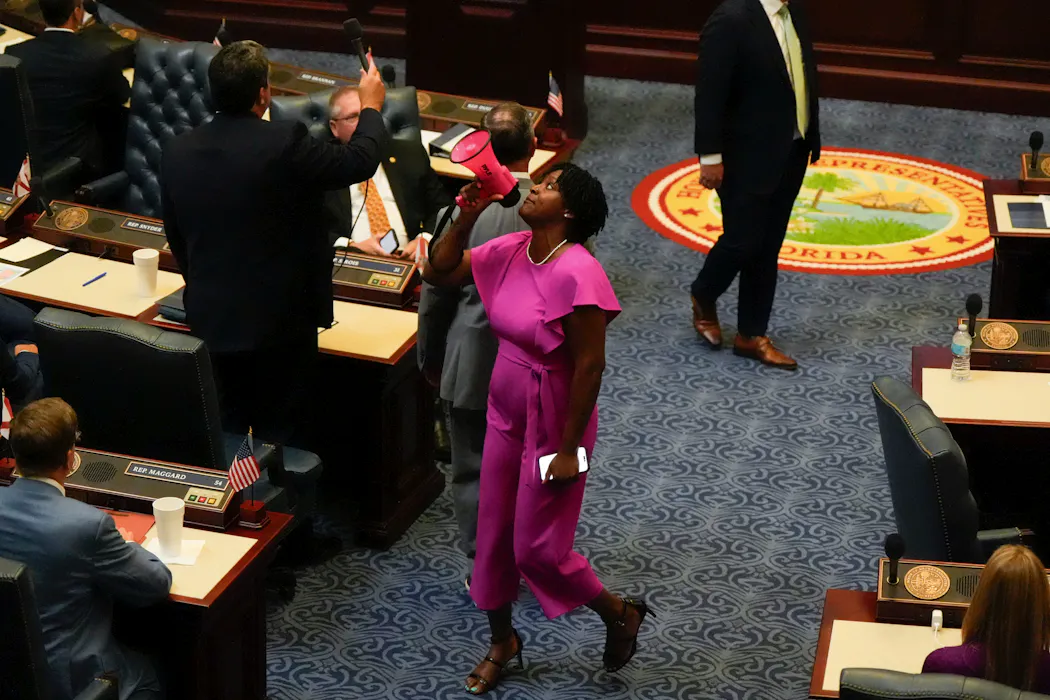
State Rep. Angie Nixon, D-Fla., speaks against mid-decade redistricting during a special session of the Florida Legislature on April 29, 2026. AP Photo/Mike Stewart

The Sunshine State has joined Texas, California and a handful of other states in the battle of mid-decade redistricting.

On April 29, 2026, in a near party-line vote, the Florida Legislature adopted new congressional maps drawn by a staffer of Gov. Ron DeSantis. The GOP-led effort could lead to four more of Florida’s 28 seats in the U.S. House of Representatives turning Republican. Florida redrew its maps with the same underlying population data just four years ago.

Mid-decade redistricting in Florida was all but inevitable once Donald Trump made partisan map-drawing a national priority. Florida’s Republican legislators had little incentive – or political cover – to resist.

I’m a political scientist, and my research focuses on voting and elections. I’ve served as an expert in redistricting cases in Florida, and I’ve been tracking Florida voters’ opinions on DeSantis’ 2026 redistricting efforts.

What Florida voters think about gerrymandering overall

University of Florida Ph.D. student Rolland Grady and I conducted a representative survey of more than 2,300 Florida registered voters drawn randomly from the publicly available Florida voter file.

Participants had one week, from April 6-13, 2026, to fill out our web-based survey linked to an email invitation. We did not offer any incentives to respondents providing us with their opinions.

The results show broad, principled opposition to partisan gerrymandering in Florida. Roughly two-thirds of Florida voters we contacted said they oppose redrawing district lines to advantage a political party.

What they think about their own party gerrymandering

But beyond gauging how Florida voters feel about gerrymandering in theory, we wanted to see how they responded to actual scenarios of mid-decade redistricting, and whether it mattered to them which party was leading the redistricting.

So we designed an experimental survey: Before respondents were asked how they felt about mid-decade redistricting, each participant was randomly shown one of five different statements.

The control version of this statement read, “The redrawing of congressional district boundaries typically occurs every 10 years, immediately following the U.S. Census.”

The other versions gave that control statement, and then added information about a particular state – California, Texas or Florida – that was redrawing its maps, and which party was endorsing that gerrymandering.

Finally, there was a version of the statement that included the control statement, told voters that Republican Ron DeSantis was endorsing the redistricting in Florida, and then added a third line of text: “As you might know, in 2010 citizens in Florida passed the Fair Districts Amendment with bipartisan support of more than 60% of the vote.”

According to our survey results, Florida Democrats are intensely opposed to gerrymandering for partisan purposes when it is framed as benefiting Republicans. This strong opposition may increase the focus of big donors on Florida, helping to drive fundraising for Democratic candidates. It may also mobilize some Democrats to come out to the polls in November. But when it comes to persuasion, most Democrats who plan to vote in the midterm elections are already highly engaged and unlikely to support GOP candidates anyway.

Florida Republicans also oppose mid-decade redistricting in the abstract. Not surprisingly, support for drawing lines to help the GOP increases when framed as something DeSantis is pursuing, but only by 15 percentage points.

This suggests some latent, principled discomfort among GOP voters. On the other hand, strong messaging from Republican leaders, particularly Trump, in the run-up to the election may override concerns about fairness. Partisanship and leader-motivated behavior will drive many Republican voters to rationalize the GOP’s effort to increase their congressional margins by four seats.

Where independent voters fall

Finally, our poll finds that Florida independent voters have strong and consistently principled opposition to partisan gerrymandering; their support rarely exceeds 15% under any condition. But in Florida, independent voters, who are often registered with no party affiliation, are less politically organized or active than registered Republicans and Democrats. And it’s likely that these voters redrawn into a new congressional district will be even less knowledgeable about who represents them when it’s time to pick candidates.

It is possible that Democrats will be able to use GOP gerrymandering in November to get independent voters to the polls and oppose Republican candidates. But opposition to gaming the system is just one of many factors that will shape how independents vote. Other issues, such as concerns over the rising cost of living, immigration, foreign policy and presidential approval, usually play a much greater role in determining candidate choice in midterm elections.

The Florida GOP’s mid-decade redistricting gambit reveals a troubling truth about American democracy: Voters oppose partisan gerrymandering in principle but tolerate it in practice when their side benefits.

So even though a majority of Florida voters disapprove of the GOP’s effort to tilt the state’s map even further toward electing Republicans, I’m not expecting widespread punishment of Republican incumbents due to these redistricting efforts.

DeSantis is betting that Trump’s influence will paper over GOP voters’ discomfort, that Democrats will stay demoralized, and that independents will stay home in November.

How GOP gerrymandering could backfire

But just because the GOP’s gerrymandering won’t sway voters away from their party doesn’t mean it won’t end up hurting them at the polls.

DeSantis’ map crams Democrats into just four of 28 districts – a high-stakes gamble that requires lightning to strike twice. To succeed for the GOP, the map requires both 2024’s Democratic and independent voter apathy and 2022’s swing to the right by independents.

But midterms tend to bring lower turnout, and today’s economic squeeze plus Trump’s dismal approval ratings make another 2022-style GOP surge highly unlikely.

The worst case for the GOP would be a 2018-style blue wave. It would destroy DeSantis’ gerrymander and could potentially flip three South Florida GOP seats and two in Central Florida to Democrats. Aggressive redistricting may meet unintended consequences come November.

See you in court

Florida Democrats and other groups will likely sue under the state constitution’s Fair Districts amendments, which were adopted in 2010 by Florida voters of all political stripes. These amendments to the Florida Constitution expressly prohibit redrawing districts with the intent to favor or disfavor a political party or an incumbent.

But DeSantis and his lawyers are setting the stage to defend the mid-decade partisan gerrymander. They fully expect that the Florida Supreme Court will strike down the Fair Districts amendments’ ban on partisan redistricting. The odds are stacked against the citizens of Florida who support fair districts.

In my view, the real losers here are the Florida voters, particularly those who approved the state’s Fair Districts amendments in 2010, which were a bipartisan triumph.

The Conversation

Daniel A. Smith is an Advisory Board Member of Common Cause Florida and President of ElectionSmith.

​Politics + Society – The Conversation

Categories
Uncategorized

What Trump’s post as a Jesus-like figure tells us about political messianism

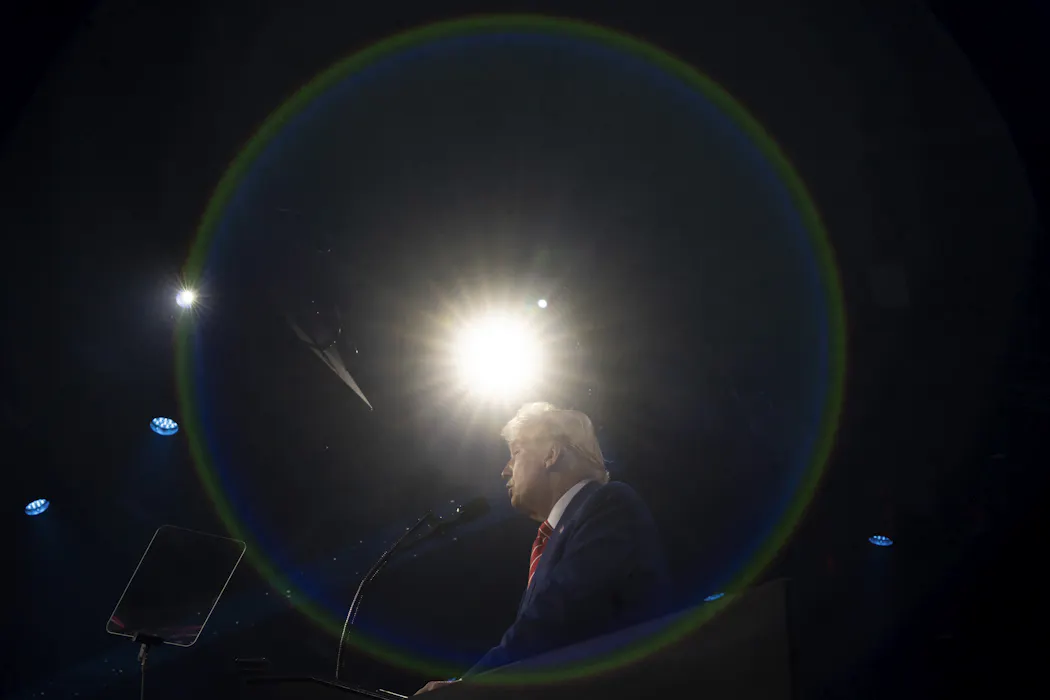
President-elect Donald Trump speaks during Turning Point USA’s AmericaFest at the Phoenix Convention Center on Dec. 22, 2024, in Arizona. Rebecca Noble/Getty Images

President Donald Trump sparked immediate outcry on April 12, 2026, when he posted an image of himself as a Jesus-like figure. The post, which Trump later said was supposed to depict him as a doctor, came shortly after the president criticized Pope Leo XIV as “weak” and “terrible.”

Three days later, Trump posted an image depicting Jesus with his left hand on the president’s shoulder. Referring to that post, Trump observed, “Radical Left Lunatics might not like this, but I think it is quite nice!!!”

These posts help illustrate the political messianism that Trump has brought to the Oval Office.

Political messianism is a style of leadership that places great faith in a single leader who is endowed with godlike attributes. It does not welcome dissent, and it portrays politics as a struggle between good and evil.

Eric Voegelin, a 20th-century political thinker, warned that political messianism often fuels authoritarian rule. It divides society, with a messianic leader’s supporters seeing him as a savior who will deliver their country into a golden age, while opponents foresee a coming apocalypse.

Democratic politics thrive when leaders and followers act with modesty and humility, when no one sees themselves as infallible or indispensable. As someone who teaches and writes about U.S. democracy, I don’t think it can thrive, or even survive, when its leaders see themselves as godlike and when the citizenry is divided into true believers and heretics.

Trump’s messianic vision

The image depicting Trump as a Jesus-like figure is the latest evidence of the president’s messiah complex.

At the Republican National Convention in 2016, he boasted that “I alone can fix it,” referring to a system that was responsible for what he would later call “American carnage.”

In a 2019 speech, Trump referred to himself as “the chosen one.”

In 2023, he described what he had done in his first term this way: “I think you would have a nuclear war if I weren’t elected.” As president, “I was very busy. I consider this the most important job in the world, saving millions of lives.”

And in a Jan. 8, 2026, interview with The New York Times, Trump said, “I don’t need international law,” since his actions as commander in chief were guided only by “my own morality. My own mind.”

The president is not alone in believing in his messiah status, or in comparing himself to Christ. On April 2, 2026, at a White House Easter celebration, Paula White-Cain, one of his spiritual advisers, used Jesus’ death and resurrection to explain what had happened to Trump.

“Jesus taught so many lessons through his death, burial, and resurrection,” she said. “He showed us great leadership, great transformation requires great sacrifice. And Mr. President … you were betrayed and arrested and falsely accused. It’s a familiar pattern that our lord and savior showed us.”

Mugshot of a man dressed in suit and tie.
In this handout provided by the Fulton County Sheriff’s Office, former U.S. President Donald Trump poses for his booking photo at the Fulton County Jail on Aug. 24, 2023, in Atlanta, Ga.
Fulton County Sheriff’s Office via Getty Images

Democracy and humility

In a democracy, it’s dangerous for leaders to see themselves as better than or morally superior to the people they serve. President Joe Biden captured that insight when, after he was elected, he recalled a family mantra instilled in him by his mother: “‘Joey, no one is better than you. Everyone is your equal, and everyone is equal to you.’”

The political philosophy scholar Michael Sandel, whose book “The Tyranny of Merit” seeks to explain what happens to democracy when people, not just leaders, think that they are better than others, argues that such a view breeds “meritocratic hubris.” Such hubris has “a corrosive effect … on the social bonds that constitute our common life,” he writes.

“Humility is a civic virtue essential to this moment,” he adds. “It’s a necessary antidote to the meritocratic hubris that has driven us apart. It points … toward a less rancorous, more generous public life.”

Michael Walzer, another political theorist, explained the dangers of messianic politics this way: It “poses dangers to social order and national survival.” When it takes hold, he writes, “compromise is preempted by command; moral absolutism leaves no room – or all too little – for maneuver in times of crisis and emergency.”

Presidential fallibility

Even the greatest American presidents have not seen themselves as American saviors. They embraced at least some of the humility Sandel describes.

George Washington described the kind of person who would succeed him in office as just “a citizen,” not a savior or a person of extraordinary gifts. Their task, he thought, would not be grand. They would be chosen “to administer the executive government of the United States.”

Washington acknowledged that his judgment was “fallible” and that he’d made numerous errors during his time in office. “Whatever they may be,” he said, “I fervently beseech the Almighty to avert or mitigate the evils to which they may tend.”

He resisted the idea advanced by John Adams, who wanted the first U.S. chief executive to be called “His Elective Majesty,” “His Mightiness” and even “His Highness, the President of the United States of America and the Protector of their Liberties.” Washington turned down the pompous titles and accepted instead the simple title adopted by the House: “The President of the United States.”

Not a trace of a messiah complex in someone who could understandably have seen himself that way.

A photo of a man pointing next to an image of a Jesus-like figure placing his right hand on the forehead of another man.
This photo illustration created on April 13, 2026, shows a picture of President Donald Trump on a screen and an AI-generated picture he posted on his Truth Social platform depicting himself as Jesus Christ after criticizing Pope Leo XIV.
Mandel Ngan/AFP via Getty Images

Or take Abraham Lincoln.

In his Gettysburg Address, considered one of the greatest speeches in American history, Lincoln did not toot his own horn or exaggerate the significance of his own words. Just the opposite.

As Rabbi Menachem Genack observes, Lincoln asserted during the dedication of the cemetery for fallen soldiers at Gettysburg that “’the world will little note, nor long remember, what we say here.’ (T)hat phrase was not an expression of false modesty nor just a poor prediction of how that tribute would be recorded. It was a symbol of deep-seated humility.”

And in an 1860 letter to an admirer who wanted to inscribe a book to him during his first presidential campaign, Lincoln responded that “begging only that the inscription may be in modest terms, not representing me as a man of great learning, or a very extraordinary one in any respect.”

Almost 100 years later, President Harry Truman referred to himself as nothing more than an “old man who by accident became president of the United States.”

‘If men were angels’

Writing in 1788, Alexander Hamilton reminded Americans of a key maxim of life in a constitutional democracy. Government, he said, is “the greatest of all reflections on human nature. If men were angels, no government would be necessary.”

“If angels were to govern men, neither external nor internal controls on government would be necessary,” Hamilton said. “In framing a government which is to be administered by men over men, the great difficulty lies in this: you must first enable the government to control the governed; and in the next place oblige it to control itself.”

Democracy is a mode of government built on the idea that none of us is infallible, including those who assume positions of leadership. Elections give the people the chance to change course and correct mistakes.

Presidential scholar Stephen Hess captured the essence of democratic leadership in a 2009 interview with Reuters. He said: “It’s more important to admit mistakes than to make them.”

In the end, as Walzer observes, there can be no messiahs in a democracy. The leader cannot “cast aside” the people. In a democracy, they must be “chastised, defended, argued with, educated” by those who lead.

Those “activities,” Walzer insists, “undercut and defeat” any pretense that it is only the leader who knows the way.

The Conversation

Austin Sarat does not work for, consult, own shares in or receive funding from any company or organization that would benefit from this article, and has disclosed no relevant affiliations beyond their academic appointment.

​Politics + Society – The Conversation

Categories
Uncategorized

Supreme Court ruling: The latest in history of diminishing minority voting rights

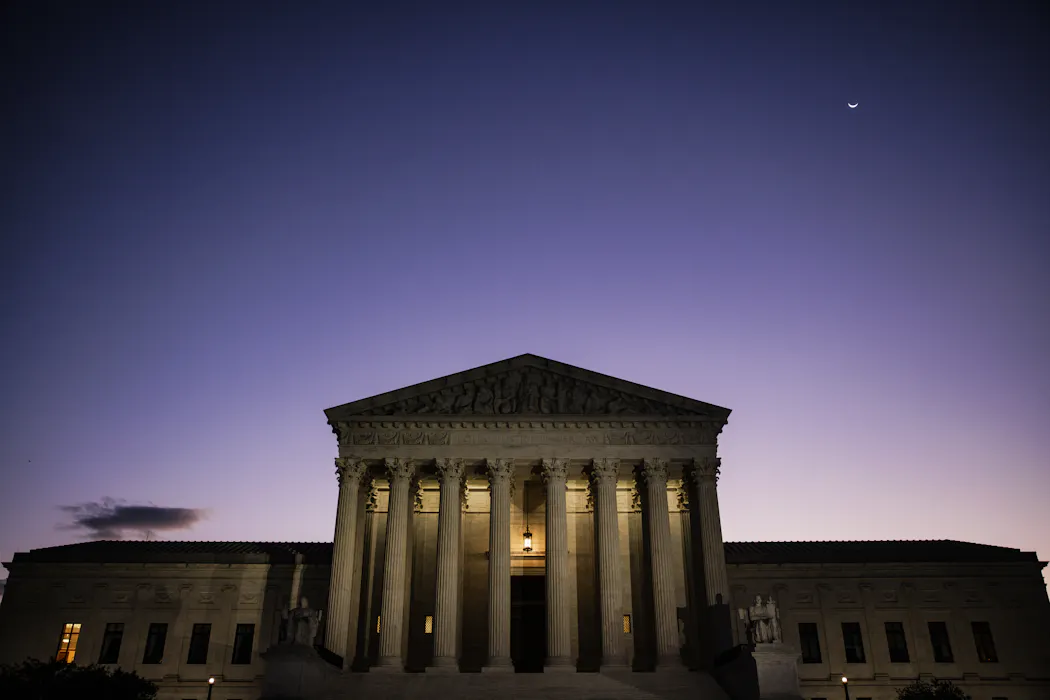
The Supreme Court issued a significant ruling that could limit minority voting rights in states across the country. Bloomberg Creative via Getty Images

Divided along ideological lines, the U.S. Supreme Court on April 29, 2026, issued a ruling that severely weakens a provision of the landmark Voting Rights Act of 1965. That provision, known as Section 2, prohibited any discriminatory voting practice or election rule that results in less opportunity for minority groups to exercise their political clout.

In her dissent on the ruling, Justice Elena Kagan wrote that it is the “latest chapter in the majority’s now-completed demolition of the Voting Rights Act.”

The decision in the case known as Louisiana v. Callais struck down a Louisiana voting district drawn to consolidate Black voters into a district where they would be the majority. The court’s conservative majority deemed the drawing of the district an unconstitutional gerrymander.

That, wrote Kagan, will “systematically dilute minority citizens’ voting power.”

I’m a historian of racial formation and electoral and cultural politics in the U.S. I see this decision by the nation’s highest court as the latest in a long line of successful attempts, by both state and federal authorities, to limit the political power of Black Americans and, most recently, to reverse the gains they won in two periods of civil rights advancement.

Etching away at voting rights

Back in 2013, the Supreme Court tossed out a key provision of the Voting Rights Act regarding federal oversight of elections.

In the Louisiana v. Callais case, the court seemed ready to abolish Section 2 of the Voting Rights Act.

While the conservative majority in Louisiana v. Callais did not explicitly strike down Section 2, the ruling appears likely to nonetheless open the floodgates for widespread vote dilution by allowing primarily Southern state legislatures to redraw political districts, weakening the voting power of racial minorities.

A group portrait depicts the first Black senator and a half-dozen Black representatives.
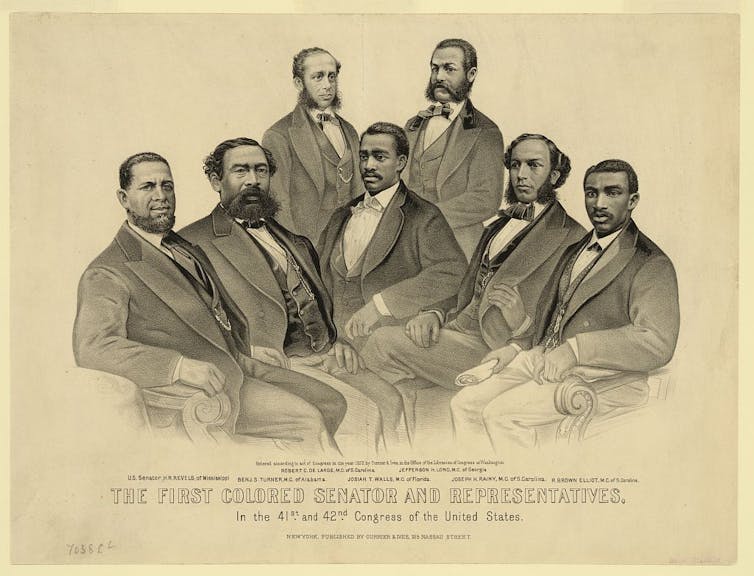
The first Black senator and representatives were elected in the 1870s, as shown in this historic print.
Library of Congress

The case was brought by a group of Louisiana citizens who declared that the federal mandate under Section 2 to draw a second majority-Black district violated the equal protection clause of the 14th Amendment and thus served as an unconstitutional act of racial gerrymandering.

Initially designed to enshrine federal civil rights protections for freed people facing a battery of discriminatory “Black Codes” in the postbellum South, the 14th Amendment’s equal protection clause has been the foundation of the nation’s modern rights-based legal order, ensuring that all U.S. citizens are treated fairly and preventing the government from engaging in explicit discrimination.

The cornerstone of the nation’s “second founding,” the Reconstruction-era amendments to the Constitution, including the 14th Amendment, created the first cohort of Black elected officials.

As I highlight in my new book “Requiem for Reconstruction,” the struggle over the nation’s second founding not only highlights how generational political progress can be reversed but also provides a lens into the specific historical origins of racial gerrymandering in the United States.

Without understanding this history – and the forces that unraveled Reconstruction’s initial promise of greater racial justice – we cannot fully comprehend the roots of those forces that are reshaping our contemporary political landscape in a way that I believe subverts the true intentions of the Constitution.

The long history of gerrymandering

Political gerrymandering, or shaping political boundaries to benefit a particular party, has been considered constitutional since the nation’s 18th-century founding, but racial gerrymandering is a practice with roots in the post-Civil War era.

Expanding beyond the practice of redrawing district lines after each decennial census, late 19th-century Democratic state legislatures built on the earlier cartographic practice to create a litany of so-called Black districts across the postbellum South.

The nation’s first wave of racial gerrymandering emerged as a response to the political gains Southern Black voters made during the administration of President Ulysses S. Grant in the 1870s. Georgia, Alabama, Florida, Mississippi, North Carolina and Louisiana all elected Black congressmen during that decade. During the 42nd Congress, which met from 1871 to 1873, South Carolina sent Black men to the House from three of its four districts.

Initially, the white Democrats who ruled the South responded to the rise of Black political power by crafting racist narratives that insinuated that the emergence of Black voters and Black officeholders was a corruption of the proper political order. These attacks often provided a larger cultural pretext for the campaigns of extralegal political violence that terrorized Black voters in the South, assassinated political leaders, and marred the integrity of several of the region’s major elections.

Election changes

Following these pogroms during the 1870s, southern legislatures began seeking legal remedies to make permanent the counterrevolution of “Redemption,” which sought to undo Reconstruction’s advancement of political equality. A generation before the Jim Crow legal order of segregation and discrimination was established, southern political leaders began to disfranchise Black voters through racial gerrymandering.

These newly created Black districts gained notoriety for their cartographic absurdity. In Mississippi, a shoestring-shaped district was created to snake and swerve alongside the state’s famous river. North Carolina created the “Black Second” to concentrate its African American voters to a single district. Alabama’s “Black Fourth” did similar work, leaving African American voters only one possible district in which they could affect the outcome in the state’s central Black Belt.

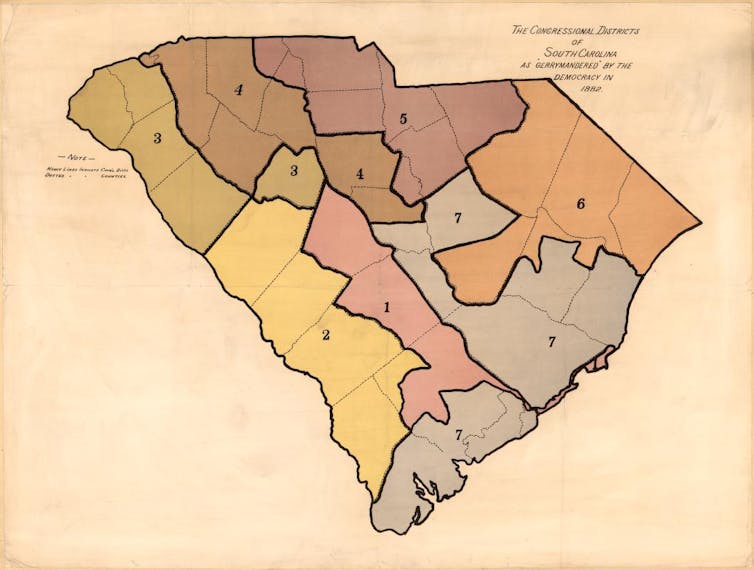
South Carolina’s “Black Seventh” was perhaps the most notorious of these acts of Reconstruction-era gerrymandering. The district “sliced through county lines and ducked around Charleston back alleys” – anticipating the current trend of sophisticated, computer-targeted political redistricting.

Possessing 30,000 more voters than the next largest congressional district in the state, South Carolina’s Seventh District radically transformed the state’s political landscape by making it impossible for its Black-majority to exercise any influence on national politics, except for the single racially gerrymandered district.

A map showing South Carolina's congressional districts in the 1880s.
South Carolina’s House map was gerrymandered in 1882 to minimize Black representation, heavily concentrating Black voters in the 7th District.
Library of Congress, Geography and Map Division

Although federal courts during the late 19th century remained painfully silent on the constitutionality of these antidemocratic measures, contemporary observers saw these redistricting efforts as more than a simple act of seeking partisan advantage.

“It was the high-water mark of political ingenuity coupled with rascality, and the merits of its appellation,” observed one Black congressman who represented South Carolina’s 7th District.

Racial gerrymandering in recent times

The political gains of the Civil Rights Movement of the 1950s and 1960s, sometimes called the “Second Reconstruction,” were made tangible by the 1965 Voting Rights Act. The law revived the postbellum 15th Amendment, which prevented states from creating voting restrictions based on race. That amendment had been made a dead letter by Jim Crow state legislatures and an acquiescent Supreme Court.

In contrast to the post-Civil War struggle, the Second Reconstruction had the firm support of the federal courts. The Supreme Court affirmed the principal of “one person, one vote” in its 1962 Baker v. Carr and 1964 Reynolds v. Sims decisions – upending the Solid South’s landscape of political districts that had long been marked by sparsely populated Democratic districts controlled by rural elites.

The Voting Rights Act gave the federal government oversight over any changes in voting policy that might affect historically marginalized groups. Since passage of the 1965 law and its subsequent revisions, racial gerrymandering has largely served the purpose of creating districts that preserve and amplify the political representation of historically marginalized groups.

This generational work is being undone by the current Supreme Court with its ruling in Louisiana v. Callais.

This is an updated version of an article originally published on Feb 3, 2026.

The Conversation

Robert D. Bland does not work for, consult, own shares in or receive funding from any company or organization that would benefit from this article, and has disclosed no relevant affiliations beyond their academic appointment.

​Politics + Society – The Conversation

Categories
Uncategorized

Supreme Court bolsters donors’ free speech rights in unanimous crisis pregnancy center ruling

State governments have had trouble regulating what crisis pregnancy centers should tell their clients and donors. AP Photo/Mark Zaleski

The U.S. Supreme Court has cleared the way for a chain of crisis pregnancy centers based in New Jersey to challenge a subpoena from New Jersey’s attorney general.

First Choice Women’s Resource Centers operates at several locations throughout New Jersey. There are more than 2,500 of these Christian-led nonprofits in the United States. Most try to discourage pregnant women from obtaining abortions. Some offer free medical services, such as over-the-counter pregnancy tests and sonograms. Many give their clients clothing, diapers and other items that the parents of babies require.

First Choice caught the attention of Matthew Platkin in 2023 while he served as the state’s attorney general. He suspected that it violated New Jersey’s Consumer Fraud Act by misleading its donors about its mission and operations. According to court filings, Platkin wanted to determine if First Choice had misled its donors and patients into believing that the centers provide “comprehensive reproductive health care services, including abortion care and contraception, when they in fact have an objective of deterring individuals from seeking such services.”

As part of New Jersey’s investigation, Platkin issued a subpoena demanding that First Choice produce donation records, including the personal information of the donors, over a 10-year period so that his office could “contact a representative sample” of them to determine if they had “been misled” by First Choice about what the group does – that is, whether or not it provided abortions.

First Choice asserted that the subpoena violated its First Amendment rights, and that it had a right to sue New Jersey’s attorney general in federal court to quash the subpoena.

The Supreme Court sided with First Choice in its unanimous ruling on First Choice Women’s Resource Centers, Inc. v. Davenport. The case now bears the name of New Jersey’s current attorney general, Jennifer Davenport.

In my view as a privacy and constitutional law scholar, the court ruled correctly by concluding that issuing a subpoena for personal information regarding a crisis pregnancy center’s donors may deter those donors from supporting the organization.

Quashing New Jersey’s subpoena

After First Choice sued to block the subpoena, Platkin argued that federal courts lacked jurisdiction to decide the case. That’s because First Choice’s alleged injury – deterring donors from supporting the organization – had not yet materialized because New Jersey had not yet tried to enforce the subpoena in court.

In other words, Platkin argued that the case was premature.

But First Choice argued that merely issuing a subpoena can deter donors from making a gift. To further its argument, First Choice presented what it said was an “anonymous declaration from several donors describing the present chill on their First Amendment-protected association.” In its view, the injury was real and concrete enough for the federal courts to decide the case.

The justices have now cleared the way for First Choice to continue with its lawsuit against New Jersey authorities in federal court.

Court ruled on a related case in 2018

The First Choice case might sound similar to a case the court decided in 2018.

In National Institute of Family and Life Advocates v. Becerra, the Supreme Court considered a different First Amendment claim asserted by a California-based organization that counsels crisis pregnancy centers.

In 2015, California enacted the Reproductive Freedom, Accountability, Comprehensive Care, and Transparency Act, better known as the Reproductive FACT Act. That law required clinics to inform their patients of California’s free or low-cost access to family-planning services, prenatal care and abortion. Several anti-abortion groups objected to California’s mandate, claiming the Reproductive FACT Act unconstitutionally compelled crisis pregnancy centers to disclose a message they do not support.

The Supreme Court agreed. Justice Clarence Thomas, writing for the court, concluded that the Reproductive FACT Act required clinics to “provide a government-drafted script about the availability of state-sponsored activities” that the clinics opposed.

In the court’s view, this violated the clinics’ First Amendment rights because it compelled them to speak a message containing an implicit viewpoint – support for abortion – that the clinics fundamentally opposed.

Both cases sit at the intersection of abortion politics and the First Amendment, but they raise distinct questions. The prior one, which addressed California’s attempt to regulate crisis pregnancy centers, asked whether the government can force those centers to make mandated statements. This new one, First Choice, asks whether the government can force the centers to disclose their donors’ identities.

A woman who supports abortion rights protests outside the Supreme Court building.
An abortion rights supporter protests outside the Supreme Court building in 2018, when the court heard a different crisis pregnancy center case.
AP Photo/Carolyn Kaster

Precedent set in an old NAACP case

The court has found previously that donations are a form of protected speech, including in its Citizens United v. Federal Elections Commission ruling. In that 2010 decision, the majority recognized that “All speakers, including individuals … use money amassed from the economic marketplace to fund their speech.”

As Justice Neil Gorsuch wrote in the Free Choice ruling, each right protected by the First Amendment “necessarily carries with it a corresponding right to associate with others.” Without such a right, he added, “no two men could safely share the same soapbox.”

This crisis pregnancy center ruling also reaffirms what the court decided about seven decades earlier in NAACP v. Alabama. The NAACP, founded in 1909, is one of the nation’s biggest civil rights groups.

In this 1958 ruling, the court concluded that any government actions that “may have the effect of curtailing the freedom to associate” warrant the highest form of protection under the First Amendment.

That ruling protected the privacy of NAACP members in Alabama. While there were no donors involved in that case, I believe that the rights of donors in the First Choice case are analogous to the rights of the NAACP’s members in the 1958 case – in that both have the right to the protection of their privacy.

In the 1950s, Alabama Attorney General John Patterson wanted to shut down the local NAACP chapter, based on his belief that the civil rights organization was “causing irreparable injury to the property and civil rights of the residents and citizens of the State of Alabama” by operating within the state as an unincorporated association.

As a part of his effort to oust the NAACP from Alabama, Patterson sought the membership lists of the local chapter, which, if disclosed, would have unquestionably caused “intimidation, vilification, economic reprisals, and physical harm.”

Similarly, in the 2026 First Choice case, Gorsuch, who wrote the 9-0 decision, “demands for private donor information inevitably carry with them a deterrent effect on the exercise of First Amendment rights.”

That is similar to Alabama’s demand for the NAACP’s membership list in 1958.

“It is hardly a novel perception that compelled disclosure of affiliation with groups engaged in advocacy may constitute as effective a restraint on freedom of association,” Supreme Court Justice John Marshall Harlan II declared in the ruling, which essentially shut down Alabama’s effort to ban the NAACP.

“This Court has recognized the vital relationship between freedom to associate and privacy in one’s associations,” Harlan added.

How to read this ruling

Many conservatives today will surely see the court’s decision as a win for the anti-abortion movement and its associated organizations. And many progressives will perceive it as another ruling from a supermajority conservative court that favors the rights of Americans who oppose access to abortion over those who support abortion rights.

The court, for example, overturned the nationwide right to abortion in 2022 in its Dobbs v. Jackson’s Women’s Health Organization ruling.

I think both interpretations are wrong because this case is more about free speech than abortion.

The fundamental principle the court asserted in NAACP v. Alabama remains intact – there is a vital relationship between the right to privacy and the freedom to associate.

Since its ratification in 1791, the First Amendment has protected much more than the rights that are expressly mentioned in its text. It protects the right to speak freely, just as it protects the right not to speak and the right to speak anonymously.

The First Amendment protects the right to associate with groups and organizations, just as it protects the right to associate with those groups and organizations anonymously.

It protects the right to think freely, to hold certain beliefs and to reject others. And as the Supreme Court reaffirmed in the First Choice case, the First Amendment protects individuals’ rights to associate with organizations that align with their beliefs by donating to them.

The Conversation

Wayne Unger does not work for, consult, own shares in or receive funding from any company or organization that would benefit from this article, and has disclosed no relevant affiliations beyond their academic appointment.

​Politics + Society – The Conversation
Categories
Uncategorized

How much should politics influence science, and vice versa? National Science Board’s ousting resurrects an existential debate

The governing structure of the National Science Foundation partially insulated science from political control. Evgeny Gromov/iStock via Getty Images Plus

“On behalf of President Donald J. Trump,” read 22 emails sent from the White House Presidential Personnel Office on Friday afternoon, April 24, 2026, “I am writing to inform you that your position as a member of the National Science Board is terminated, effective immediately.”

The email was signed “Thank you for your service.”

The distinguished scientists and engineers who made up the National Science Board did not know the firings were coming. Several had been reappointed by Trump himself during his first term. The board was scheduled to meet the following week to finalize a report on the state of American science.

When asked why the entire board was removed, a White House spokesperson cited the Supreme Court’s 2021 decision in United States v. Arthrex, Inc., stating that the case raised constitutional questions about the National Science Board, its independence and its role in the agency it oversees, the National Science Foundation. Specifically, whether non-Senate confirmed appointees can exercise the authorities that Congress gave the board when it authorized the NSF in 1950.

We have been studying and doing science policy. One of us (Wagner) has worked closely with the National Science Board several times and regularly uses their database on scientific and engineering progress. The other of us (Olds) led the National Science Foundation’s Directorate for Biological Sciences from 2014 to 2018 and has previously called for reform of the board.

We argue that the dismissal is not just a political act dressed in constitutional language; it is the resurfacing of an argument almost as old as the National Science Foundation itself — one that nearly killed the agency in its cradle.

Truman’s 1947 veto

In 1945, the science advisor of President Franklin D. Roosevelt, Vannevar Bush, proposed that a new federal science agency be governed by a part-time board of eminent volunteer scientists. This agency came to be called the National Science Foundation, and the board – not the president – was designated to choose its director for a six-year term.

Bush’s intent was to insulate basic research from political pressure. But with Roosevelt’s death in April of that year, it would be up to the following president, Harry Truman, and Congress to make the final decision.

Harley Kilgore, a senator from West Virginia, objected to the board’s formation and its independent role. He argued that vesting public authority in scientists not directly accountable to the president was constitutionally suspect and democratically unsound. The board should not choose the director. President Truman’s 1947 veto signaled agreement.

Black-and-white photo of Vannevar Bush, Harry Truman and James Conant smiling in suits, Truman presenting Conant a medal
Vannevar Bush, left, played a key role in the creation of the National Science Foundation, which President Harry Truman, center, ultimately ratified after an initial veto.
Abbie Rowe/National Park Service via Wikimedia Commons

A series of lively hearings on the creation of the National Science Foundation served to forge the post-war science system. Out of these debates came the 1950 compromise that finally established NSF and the National Science Board, giving each side something.

The director would be appointed by the president and confirmed by the Senate. Above the director sat the National Science Board – also presidentially appointed and Senate-confirmed, but serving staggered six-year terms designed to outlast any single administration. The board would set NSF policy, approve major grants and report independently to the president and Congress on the state of American science. The director would handle operations.

The structure was deliberately uneasy. It was meant to allow scientific judgment and political accountability to coexist without one absorbing the other.

What the board has done

For 75 years, the National Science Board has carried out three functions. It has overseen the agency’s largest research investments – telescopes, polar research stations, supercomputing facilities. It has produced periodic reports on the state of American science, first issued in 1972. And it has served as an independent voice to advise the president and Congress on long-term scientific priorities.

The board’s remit has expanded over time. The 1968 Daddario Amendments broadened the NSF’s mandate. The America COMPETES Acts of 2007 and 2010 added duties around workforce and research infrastructure. The CHIPS and Science Act of 2022 brought research security and coordinating emerging technologies into the board’s portfolio.

Through all of this, the dual governance structure held. The board functioned as a bridging device – a mechanism by which scientific judgment could inform federal decisions without scientists becoming political officers, and political priorities could shape research agendas without dictating findings.

Reviving the original argument

The Trump administration’s removal of all sitting members of the National Science Board echoes a debate from the agency’s founding: Should officers with federal authority over spending operate beyond the president’s discretion? An independent board with power over a federal agency is a constitutional outlier, regardless of its competence or track record. The contrary view, which has governed the National Science Board for 75 years, is that expert bodies can be shielded from political pressures.

White flag with NSF logo flapping over a backdrop of two glass facades
Oversight of the National Science Foundation has been contentious.
AP Photo/Mark Schiefelbein

The Supreme Court has moved partway toward the president’s position in recent years. Seila Law v. CFPB (2020) struck down protections against the removal of the head of an independent agency. Loper Bright Enterprises v. Raimondo (2024) ended a court’s ability to defer to an agency’s interpretation of ambiguous laws.

U.S. v. Arthrex, Inc (2021) – the case the Trump administration cited in its justification for dismissing the National Science Board – held that certain officers who were not confirmed by the Senate had been improperly exercising authority reserved for executive branch officials.

Members of the National Science Board are presidentially appointed and were historically confirmed by the Senate, though this requirement was eliminated by the Presidential Appointment Efficiency and Streamlining Act of 2011.

These legal questions will likely be tested in court.

Separation of science and state

The National Science Board’s ousting sits atop a deeper conflict between science and the state.

The 1950 compromise that founded the National Science Foundation rested on a teetering wager: that scientific inquiry, partially insulated from political control, would over time produce goods useful enough to the American public to justify being unencumbered by political steering.

For 75 years, this wager paid off. American science led the world. The measures the compromise built – peer review, the National Science Board, reports on scientific progress – allowed political and scientific judgment to inform each other without collapsing into one another.

The National Science Board’s firing comes at the heels of billions of dollars of science funding cuts.

The current moment tears the Band-Aid off this old conflict and the complex system underneath. If political accountability requires that no expert body be insulated from presidential control, the 1950 settlement that founded the NSF cannot survive in its present form. Then the question becomes what could replace the NSF – and whether the benefits the state has come to expect from American science can be produced under different arrangements.

The historical record on political intervention in scientific operations is consistent. Soviet biology under Trofim Lysenko. German physics under the Nazis. Chinese science during the Cultural Revolution. In each case, the institution of science survived in name but stopped producing what science is supposed to produce: verifiable, trusted knowledge. While the names on the doors stayed the same, the work changed to serve politics.

The firing of the National Science Board has brought back the old question that Truman thought he had answered in 1950: how much politics should intervene in science. Now, that question is shaking the very foundations of U.S. science.

The Conversation

The authors do not work for, consult, own shares in or receive funding from any company or organization that would benefit from this article, and have disclosed no relevant affiliations beyond their academic appointment.

​Politics + Society – The Conversation
Categories
Uncategorized

Supreme Court considers whether police can use Big Tech data to capture info from all cellphone users in a place and time

Police got cellphone data for many people who happened to be in this area near the time of a bank robbery. AP Photo/Steve Helber

Google tracks the vast majority of cellphones in the United States, collecting your location, usage and device data through installed software and apps. The tracking occurs by various autonomous processes you cannot see or stop, even when you turn off location history, and Google and other companies keep that data for years. Outside of your control and wherever you go, your cellphone continuously creates a durable and revealing digital trail, and law enforcement agencies can get warrants to obtain it.

But some of those warrants aren’t looking for data about a specific person. Instead, police are compelling tech companies to reveal every cellphone in a particular area during certain time periods. Called geofence warrants, their use is at the heart of a case before the U.S. Supreme Court that will determine what the Fourth Amendment’s protections against unreasonable search and seizure mean in the digital age.

The Supreme Court case Chatrie v. United States involves the hunt for a suspect in an armed bank robbery in busy Midlothian, Virginia, in May 2019, and how police settled on a man named Okello Chatrie as the perpetrator.

Detective Joshua Hylton was granted a geofence warrant that compelled Google to search its database and identify every cellphone in a 17½-acre area around the bank, including private residences and a church, for a period of two hours. Working closely with Google, police ultimately narrowed in on Chatrie. When the trial court denied Chatrie’s motion to suppress the geofence-derived evidence, Chatrie appealed.

The Supreme Court will decide if, when and how law enforcement can use geofences. It matters because all cellphone-carrying people can end up in tomorrow’s geofence, like all those who were unknowingly grabbed in the Chatrie search. And nearly all users are unaware of these fences. No one specifically consents to be included in them, but people have no choice. What happened in the Chatrie case is a feat otherwise impossible but for advances in location tracking technology and advanced AI systems.

As a privacy, electronic surveillance and tech law attorney, author and legal educator, I have spent years researching, writing, educating and advising about these kinds of privacy and legal issues, and my books on electronic surveillance and evidence are routinely cited and relied upon by courts grappling with these issues.

a woman walks in between a brick and cement buidling and a parking lot
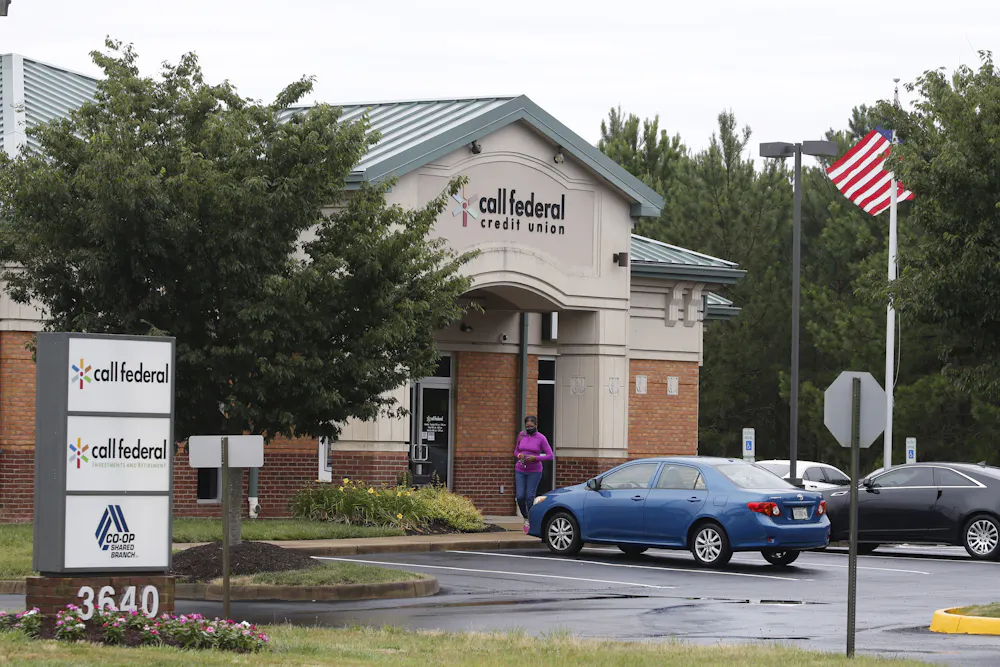
A customer walks out of a credit union in Virginia where a robbery in 2019 set in motion events that led to a Supreme Court case.
AP Photo/Steve Helber

How geofences work

Geofences are part of modern life. By carrying your smartphone and other devices, you generate location and other device activity data. That data is collected, stored, analyzed, and bought and sold by multiple companies. The location history data being collected about you is what makes geofences possible, and it is comprehensive and precise.

Location history relies on a variety of sources of data that can include cell tower location, cellphone data such as connections to Wi-Fi networks and Bluetooth sources, and cellular data sent via cell tower. This means the communications you received and sent and the apps you used can be swept up in a geofence.

Advanced AI technologies analyze that data to discern increasing amounts of personal and behavioral data – insights about people, groups and activities – that can be used for a variety of purposes, including targeted advertising. Your rich location history and device data get snatched up regularly in such fences by private companies; your present and past self travels through them constantly.

A geofence can be in real time, for instance to identify and track who is at a protest, or any period in the past decade or so. It can be dynamically generated, like a circle around a specific location, or it could be a predefined set of boundaries, such as a specific address or area defined by streets or other geographical boundaries. One geofence warrant that Google received covered 2.5 square miles of San Francisco for a period of 2½ days.

There has been a significant increase in law enforcement’s use of geofence warrants over the past decade. Google revealed in court that it received a 1,500% percent increase in geofence requests from 2017 to 2018, a 500% percent increase from 2018 to 2019, and by 2020, it had 11,500 geofence warrants in a year. Between 2021 and 2023, geofence warrants made up over 25% of all warrants that Google received from law enforcement agencies in the United States.

a hand holds a smartphone displaying a map with a map in the background
If you carry a smartphone around with you, Google and other tech companies keep track of where you are and everywhere you’ve been.
Dilara Irem Sancar/Anadolu via Getty Images

Search warrants and the Fourth Amendment

The Fourth Amendment is the foundation on which all U.S. electronic privacy laws rest. When government agents want to search or seize a person, place or thing – absent consent or emergency – the Fourth Amendment requires agents to obtain a court-approved warrant based on probable cause. Agents do this by providing a judge with enough evidence to establish probable cause that the person, place or thing to be searched or seized is associated with a crime.

The resulting warrant must describe with “particularity” the specific person, place or thing to be searched or seized. If these requirements are not met, the search is unreasonable and therefore unlawful, and evidence obtained in that search cannot be used in court, barring a good-faith exception.

The Fourth Amendment’s “particularity” requirement strictly forbids general warrants, historically used by British troops against Colonists to engage in overly broad or all-encompassing searches.

Reverse warrants

The only “particularity” that police can specify in applying for a geofence warrant is that a crime occurred at a particular time and place. Hence, geofence warrants are often called reverse warrants because they literally reverse the traditional process of conducting an investigation to identify a suspect and then obtain a warrant to gather information on that suspect. Geofence warrants gather all devices in a time and place, and then, aided by technology, police sift through for potential suspects.

The execution of a geofence warrant is very different from that of a typical warrant. Litigation records reveal a collaborative effort between law enforcement and Google that follows a three-step process. First, law enforcement officials specify in the warrant a time and place to be searched. The data they’re seeking is not merely a list of cellphone devices in the area; it is usually more detailed. For instance, it could include data about whether a device accessed a particular email account or app or sent a text at the time it was in the area of the geofence.

Second, the company provides the officials with an anonymized list of users or devices matching the warrant’s criteria. At this point, things start to become more fluid, and the officials may seek additional information about specific users outside of the initial search parameters.

Third, law enforcement officials then analyze the information and request that the company “unmask” certain users. In complying, Google may tell police the account holder’s name, their address, their email address, and even whether they were communicating or using certain apps during the relevant time. The officials then decide whether any of the users may be connected to the crime.

This close work between the private entity – usually Google – and law enforcement throughout the geofence warrant process raises significant privacy and civil liberties concerns. It also does not appear that there is any court review or judicial oversight during this give-and-take between law enforcement officers and Google in the geofence warrant process.

A split among appeals courts

In the Chatrie case, the trial court took issue with the geofence warrant police used, finding that it lacked particularized probable cause. But the trial court also determined that the officers in question had relied on the defective warrant in good faith, and thus it ruled the geofence evidence could be used against the defendant.

On appeal to the 4th U.S. Circuit Court of Appeals, a divided panel affirmed the trial court’s decision, and it concluded, over vigorous dissent, that obtaining the geofence data was not a search. The full 4th Circuit affirmed the trial court’s decision.

But the 4th Circuit’s 2024 Chatrie decision stands at odds with the 5th Circuit’s 2024 decision in United States v. Smith. In the Smith case, the 5th Circuit ruled that “geofence warrants are modern-day general warrants and are unconstitutional under the Fourth Amendment.” This split among the federal appeals courts should be resolved by the Supreme Court in its Chatrie decision.

Chatrie and the Supreme Court

For decades, the court has grappled with law enforcement’s use of technologies to track the location of people or things, issuing decisions about cell site location information and GPS. It has ruled that the U.S. Constitution requires law enforcement agents to obtain a warrant to track a person using their cellphone location history data or GPS, barring exigent circumstances.

The government is arguing in the Chatrie case that users voluntarily consented to the collection of location history, so they have no reasonable expectation of privacy in the data, and thus there is no violation of the Fourth Amendment.

Some of the amicus briefs filed in support of the defendant assert that electronic location data is protected by the Fourth Amendment’s warrant requirement, and that the geofence warrant fails to satisfy the Fourth Amendment’s particularity requirement. Some also argue that approving this warrant would open the door to a variety of reverse search warrants. And some contend that there is no meaningful consent or voluntariness around the data collection that underpins geofence technology.

Questions from the Supreme Court justices during oral arguments on April 27, 2026, indicate that at least some of them consider geofence warrants to be general warrants and thus unconstitutional. But for now, we wait.

The Conversation

Anne Toomey McKenna serves on the Advisory Board to the Institute for Electrical and Electronics Engineers (IEEE)-USA’s Artificial Intelligence Policy Committee (AIPC) and Chairs multiple AIPC subcommittees. The AIPC work involves subject matter and education-related interaction with U.S. Senate and House congressional staffers and the Congressional AI Caucus. McKenna has received funding from the National Security Agency for the development of legal educational materials about cyberlaw (a course which the government still makes available online for the public) and funding from The National Police Foundation together with the U.S. Department of Justice-COPS division for legal analysis regarding the use of drones in domestic policing.

​Politics + Society – The Conversation
Categories
Uncategorized

Supreme Court’s Voting Rights Act ruling makes it harder to protect minority voting power and alters the landscape of future elections

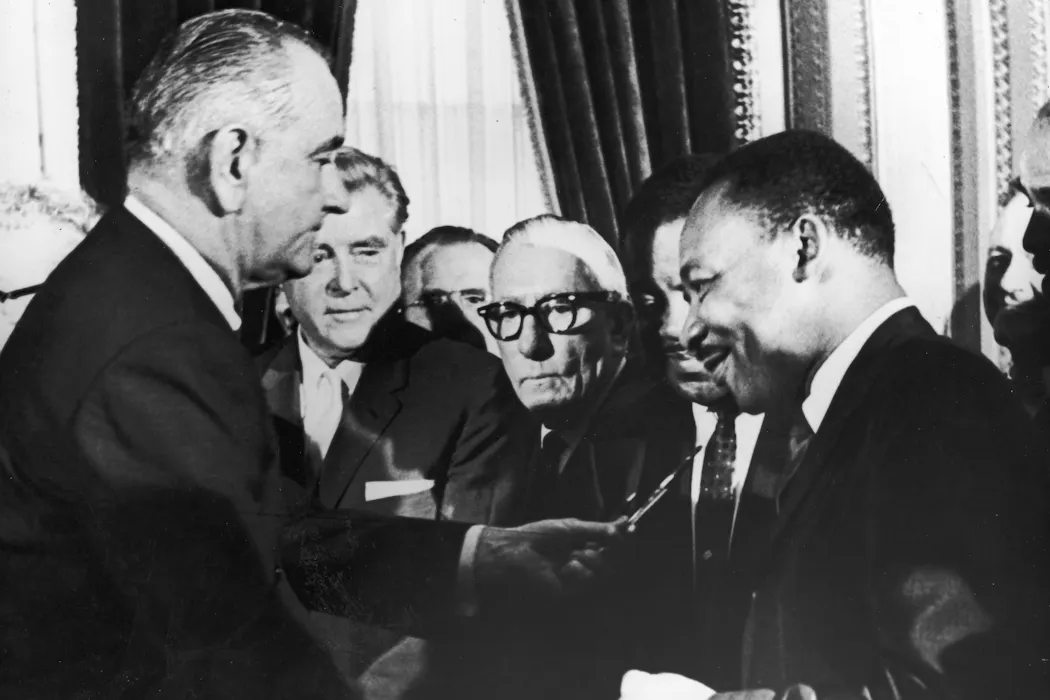
President Lyndon Johnson hands a pen to civil rights leader Rev. Martin Luther King Jr. during the signing of the Voting Rights Act in Washington, D.C., on Aug. 6, 1965. Hulton Archive, Washington Bureau/Getty Images

In a major ruling that would permit weakening the voting power of minorities in the United States, the Supreme Court on April 29, 2026, struck down a Black-majority district in Louisiana’s congressional map as “an unconstitutional gerrymander” and altered the court’s interpretation of the Voting Rights Act.

In a 6-3 decision, the court’s conservative majority argued that Louisiana had violated the law by drawing a second Black-majority district. Justice Samuel Alito wrote that the court was upholding a key part of the Voting Rights Act known as Section 2, which prohibits “voting practices or procedures that discriminate on the basis of race, color, or membership in one of the language minority groups identified” in the act.

But the conservative justices also devised a new interpretation for its application based on historical developments. By doing that, the court majority made it more difficult for plaintiffs to challenge redistricting plans under the act.

In a dissent, Justice Elena Kagan called the decision the “latest chapter in the majority’s now-completed demolition of the Voting Rights Act.”

Kagan, joined by the other two liberal justices, argued that the decision will make it effectively impossible to use race in redistricting – as has been done historically under the Voting Rights Act – and more difficult to prove discrimination under the act. She wrote, “The court’s decision will set back the foundational right Congress granted of racial equality in electoral opportunity.”

I’m a scholar of national political institutions, election law and democratic representation. The timing of the case carries major implications for the 2026 midterm elections. The decision, by weakening the Voting Rights Act, could make it easier for states to draw partisan gerrymanders of their congressional districts that reduce the power of minorities.

Long legal battle

The central question in the case was to what extent race can, or must, be used when congressional districts are redrawn.

Plaintiffs challenged whether the longstanding interpretation of Section 2 of the Voting Rights Act, which requires protection of minority voting power in redistricting, violates the equal protection clause of the U.S. Constitution, which guarantees that individuals should be treated the same by the law.

In short, the plaintiffs argued that the state of Louisiana’s use of race to make a second Black-majority district was forbidden by the U.S. Constitution. From my perspective as a scholar of U.S. federal courts and electoral systems, this case represent the collision of decades of Supreme Court decisions on race, redistricting and the Voting Rights Act.

To understand the stakes of the current case, it’s important to know what the Voting Rights Act does. Initially passed in 1965, the act helped end decades of racially discriminatory voting laws by providing federal enforcement of voting rights.

Section 2 of the Voting Rights Act forbids discrimination by states in relation to voting rights and has been used for decades to challenge redistricting plans.

Callais had its roots in the redistricting of Louisiana’s congressional districts following the 2020 Census. States are required to redraw districts each decade based on new population data. Louisiana lawmakers redrew the state’s six congressional districts without major changes in 2022.

Police smashing marchers on a street with billy clubs.
State troopers in Selma, Ala., swing billy clubs on March 7, 1965, to break up a march by advocates for Black Americans’ voting rights.
AP Photo, File

Soon after the state redistricted, a group of Black voters challenged the map in federal court as a violation of the Voting Rights Act. The plaintiffs argued that the new map was discriminatory because the voting power of Black citizens in the state was being illegally diluted. The state’s population was 31% Black, but only one of the six districts featured a majority-Black population.

Federal courts in 2022 sided with the plaintiffs’ claim that the plan did violate the Voting Rights Act and ordered the state legislature to redraw the congressional plan with a second Black-majority district.

The judges relied on an interpretation of Section 2 of the Voting Rights Act from a 1986 Supreme Court decision in the case known as Thornburg v. Gingles. Under this interpretation, Section 2’s nondiscrimination requirement means that congressional districts must be drawn in a way that allows large, politically cohesive and compact racial minorities to be able to elect representatives of their choice.

In 2023, the Supreme Court upheld a lower court’s interpretation of Section 2 of the Voting Rights Act in a similar racial gerrymandering case in Alabama.

Louisiana lawmakers redraw districts

Following the court order, the Louisiana state legislature passed Senate Bill 8 in January 2024, redrawing the congressional map and creating two districts where Black voters composed a substantial portion of the electorate in compliance with the Gingles ruling. This map was used in the 2024 congressional election and both Black-majority districts elected Democrats, while the other four districts elected Republicans.

These new congressional districts from Senate Bill 8 were challenged by a group of white voters in 2024 in a set of cases that became Louisiana v. Callais.

The plaintiffs argued that the Louisiana legislature’s drawing of districts based on race in Senate Bill 8 was in violation of the 14th Amendment’s equal protection clause, which requires equal treatment of individuals by the government, and the 15th Amendment, which forbids denying the right to vote based on race.

Essentially, the plaintiffs claimed that the courts’ interpretation of Section 2 of the Voting Rights Act was unconstitutional and that the use of race to create a majority-minority district is itself discriminatory. Similar arguments about the 14th Amendment’s equal protection clause were also the basis of the Supreme Court’s recent decisions striking down race-based affirmative action in college admissions.

In 2024, a three-judge district court sided with the white plaintiffs in Louisiana v. Callais, with a 2-1 decision. The Black plaintiffs from the original case and the state of Louisiana appealed the case to the Supreme Court. The court originally heard the case at the end of the 2024-2025 term before ordering the case reargued for 2025-2026.

A large, white building with a tall tower in the middle.
The Louisiana state Capitol in Baton Rouge.
AP Photo/Stephen Smith

Major implications

The court’s opinion reinterprets key precedent on the Voting Rights Act and the application of Section 2 to redistricting. It carries major consequences for the federal courts, gerrymandering and the voting rights of individuals.

For 39 years, Section 2 of the Voting Rights Act has required redistricting institutions to consider racial and ethnic minority representation when devising congressional districts. Majority-minority districting is required when a state has large, compact and cohesive minority communities. Historically, some states have redistricted minority communities in ways that dilute their voting power, such as “cracking” a community into multiple districts where they compose a small percentage of the electorate.

Section 2 also provided voters and residents with a legal tool that has been used to challenge districts as discriminatory. Many voters and groups have used Section 2 successfully to challenge redistricting plans.

Section 2 has been the main legal tool for challenging racial discrimination in redistricting for the past decade. In 2013, the Supreme Court effectively ended the other major component of the Voting Rights Act, the preclearance provision, which required certain states to have changes to their elections laws approved by the federal government, including redistricting.

In this case the court did not fully overrule the previous interpretation of Section 2, but it has altered its application. The effect is that it limits the legality of using race in redistricting and the most common way to challenge discriminatory redistricting.

Additionally, because of the strong relationship between many minority communities and the Democratic party, the court’s decision has major implications for partisan control of the House of Representatives.

By changing the interpretation of Section 2, Republicans could use the ruling to redraw congressional districts across the country to benefit their party. Politico reported that Democrats could lose as many as 19 House seats if the Supreme Court sided with the lower court.

This case builds directly on a recent case also authored by Alito. In 2024, the court overruled a lower court’s finding of racial vote dilution in South Carolina.

This is an updated version of a story that originally published on Oct. 13, 2025.

The Conversation

Sam D. Hayes does not work for, consult, own shares in or receive funding from any company or organization that would benefit from this article, and has disclosed no relevant affiliations beyond their academic appointment.

​Politics + Society – The Conversation

Categories
Uncategorized

Can the nearly $1 trillion-a-year US military really be depleting key weapons in Iran?

The guided-missile destroyer USS Frank E. Petersen Jr. fires a Tomahawk missile during Operation Epic Fury on Feb. 28, 2026. U.S. Navy via AP

The fragile U.S.-Iran ceasefire announced on April 7, 2026, after 40 days of war came at an opportune time for the United States. Several reports indicate it is running out of weapons amid the conflict.

As a scholar focused on U.S. military deployments, these reports are concerning and somewhat surprising.

After all, the United States spends more money on its military – nearly US$1 trillion annually – than the next nine highest-spending countries combined.

How can the U.S. military be depleting its weapons against a largely isolated country that spends less than 1% of what the United States does?

I believe that gauging U.S. weapons stockpiles provides insight into how the U.S. military may be constrained in the future, and what countries such as Russia and China may learn from the Iran conflict.

The US has a missile problem

Operation Epic Fury, as the U.S. calls the military operation in Iran, has employed a large amount of military assets in a short time. Military analysts suggest the U.S. is running low on Tomahawk missiles, surface-to-surface missiles and air-defense interceptor missiles.

After a month of war, the U.S. had used over 850 Tomahawk missiles, the sea- or ground-launched cruise missile that has a 1,500-mile range.

That represents years of stockpile accumulation. The U.S., for instance, budgeted for 57 Tomahawk missiles in 2025 and procured 22 of them. The U.S. has built roughly 9,000 since the 1980s and may have deployed over 30% of its current stockpile since the start of the Iran war.

The U.S. military has used two types of surface-to-surface missiles at rates that are not sustainable if the Iran conflict were to continue at its previous intensity. These missiles have a range of 200 to 250 miles (320 to 400 km) and are used for precision strikes against military targets, such as air defenses or enemy troops.

Tanks and military equipment appear in front of a military plane.
Trucks carry parts of U.S. missile launchers and other equipment needed for the THAAD missile defense system at Osan Air Base, South Korea, in 2017.
NurPhoto/Contributor/Getty Images

The air-defense interceptor missiles used for the Patriot system, a ground-based air defense system, and terminal high-altitude area defense system, or THAAD, are used to protect bases, infrastructure and troops.

The U.S. has eight THAAD systems and has sent munitions from a Korean THAAD system to the Middle East for the Iran conflict.

THAAD systems operate by shooting a missile without an explosive payload. Instead, THAAD interceptors rely on kinetic energy, which is derived from its motion, to destroy incoming missiles. The U.S. has used between 50% to 80% of its THAAD stockpile in its war with Iran, according to the Center for Strategic and International Studies.

The rapid consumption of these resources has forced the U.S. to divert missiles from other regions while seeking new funding and contractors to build missiles. But producing and deploying missiles can take 18 to 24 months because certain components need to be manufactured before being assembled into a final product.

The U.S. has alternatives to these systems, such as the shorter-range, low-cost unmanned combat attack system that uses drones. They are known as LUCAS drones and are based on Iran’s Shahed drone design.

These lower-cost alternatives, however, are less effective and increase the danger to ships, service members and civilians.

Broader concerns

The Iran conflict is not the first time the U.S. has been reported to be depleting its weapons stockpiles. In part, that’s due to its role as the world’s largest supplier of arms, accounting for 43% of global arms exports.

The U.S. has supplied Ukraine with substantial military hardware – missile defense systems, missiles, tanks – for its war with Russia. That has led to delays in weapons shipments, including stinger missiles and Paladin howitzers, to Taiwan, where the U.S. has sent arms since the 1950s to deter China from invading it.

After pausing aid, the Trump administration resumed sending weapons to Ukraine in July 2025. And European support for Ukraine comes through the purchase of U.S. military equipment.

Israel’s war in Gaza and Lebanon has put additional pressure on the U.S. weapons stockpile. The U.S. provides $3.8 billion annually in military aid to Israel, in addition to $16.3 billion since the Oct. 7, 2023, Hamas attacks in Israel.

Whether the U.S. is depleting its weapons because it’s consuming its own stockpile or because of its global commitments, or both, it has ripple effects across the globe. A conflict in the Middle East and new demands on the supply chain for increased production mean there will be shortfalls in Europe and Asia, where U.S.-aligned countries rely upon arms exports for their security.

The US and other powers

The U.S., nonetheless, has evolved its approach to preparing for global threats since the end of the Cold War.

In the 1990s, Washington’s strategy was to be prepared to fight wars in two regions simultaneously. The U.S. has scaled back this 1990s strategy to focus on conflict against a single adversary in a single theater.

The Iran war has nonetheless exposed the limits of U.S. military dominance. And rivals such as China and Russia are learning lessons from the Iran conflict at the United States’ expense.

The Conversation

Michael A. Allen received grant research funding from the Department of Defense’s Minerva Initiative, the US Army Research Laboratory, and the US Army Research Office from 2017 to 2021.

​Politics + Society – The Conversation

Categories
Uncategorized

Stockings once worn by Philly’s wealthiest man show the value of women’s mending in early America

At the time of his death in 1831, Stephen Girard – a Philadelphia merchant, banker and philanthropist – was the wealthiest man in the United States. In his will, he left the city of Philadelphia an extraordinary gift of roughly US$6 million, which is almost $227 million today.

Girard also left instructions to use a portion of this gift to found a boarding school for poor, orphaned white boys. Today, this institution for grades 1-12 is known as Girard College, and it now admits students from underserved communities regardless of race or gender. Girard College inherited Girard’s material possessions, including furniture, personal papers and clothing – including this pair of heavily repaired silk stockings.

Their survival might make you wonder: Why was the wealthiest man in America walking around in mended clothing?

As a textile historian who writes about the labor of mending in early America, I studied the stitches used to repair Girard’s stockings along with his expansive archival records.

Together, this historical evidence helped me unravel new details about the value of textiles in early America, but also the women – including those who worked in Girard’s household — who made the country’s expansive economic growth possible.

Lessons from a rich man’s socks

Textiles were used every day by virtually every single early American, and were at the time usually the most valuable items one could own.

Prior to widespread mechanization, textiles were expensive due to the cost of materials and skilled labor needed to produce fabric, and they were often sourced abroad. In the late 18th and early 19th centuries, the U.S. had a growing domestic textile industry, but many Americans still imported fabrics from other countries like Great Britain, France and India. Bills from Girard’s household show that he regularly purchased many articles of his clothing, including silk stockings, from France.

The high value of textiles at this time meant that even the wealthiest households rarely discarded damaged clothes. Instead, they repaired them, using sewing needles and thread. While some men did mend, the overwhelming majority of textile repair was completed by women.

The menders: Sally, Polly and Hannah

In Girard’s household, at least three women would have mended his silk stockings and other clothes.

While Girard did marry, his wife, Mary, was institutionalized for mental illness at the Pennsylvania Hospital in 1790, and they had no children. In Mary’s absence, Girard had several mistresses who served as his housekeepers: Sally Bickham, a Quaker woman described by Girard in a letter as a “tayloress” or seamstress, and Polly Kenton, who was a laundress. As part of their labor, they managed Girard’s household affairs and shopping to keep his life running smoothly.

In addition, a Black woman named Hannah Brown from Saint-Domingue, a former French colony in what is now Haiti, was enslaved in Girard’s household for more than 40 years. This was the case even though Pennsylvania’s Gradual Abolition Act in 1780 should have ensured her freedom within six months of her arrival in the U.S. Pennsylvania unevenly enforced gradual abolition, and enslavers like Girard were able to skirt its implementation. Girard’s will granted Brown her freedom.

All three women labored in Girard’s household to mend his stockings, run his household’s daily activities and maintain his home. Three different mending techniques on Girard’s stockings – such as Swiss darning or duplicate knit stitch, woven darning and reinforced heels – are also material expressions of their work alongside paper records like household bills, letters and receipts.

Many early American women both free and enslaved completed unpaid labor in homes, but their labor was a central force in the national economic growth of the early 19th century. Across the country, men like Girard encouraged and profited from widespread industrialization and expanded commercial opportunities, but women’s unpaid domestic labor made their participation and profits possible.

While Philadelphians today may not find their names on prominent street signs or city buildings, Sally, Polly and Hannah’s combined efforts — hidden inside Girard’s shoes and behind his looming historical legacy in Philadelphia – were integral to Girard’s economic success.

Read more of our stories about Philadelphia and Pennsylvania, and sign up for our Philadelphia newsletter on Substack.

The Conversation

Emily J. Whitted currently receives funding from The Library Company of Philadelphia.

​Politics + Society – The Conversation