Categories
Uncategorized

How Pennsylvania’s new paid leave bill leaves the sandwich generation behind

Approximately 63 million Americans are family caregivers. Jub Rubjob/Moment Collection via Getty Images

The number of family caregivers has grown from 53 million Americans in 2020 to 63 million as of 2025. This number is expected to increase as the baby boomer generation ages and faces the limitations of our current health and social services systems.

A family caregiver is an unpaid individual who provides assistance to a family member who needs support due to illness, disability or aging.

The population of metro Pittsburgh is one of the oldest in the country, according to U.S. Census Bureau data. This means an increasing proportion of the local population will require care from family caregivers as they age. In Allegheny County, the number of residents age 65 and older is projected to grow by 50,000 by 2050.

Despite their critical role in supporting the aging population, however, family caregivers are not often provided with medical training or help with navigating the health and social services systems. This puts them at significant risk of experiencing physical and mental strain that can lead to burnout and leaving the workforce before retirement age. Caregivers and those they support can also develop health complications based on these factors.

This is particularly true for women, who provide a disproportionate amount of care in the U.S.

I study ways to improve the quality of life for aging adults and their care partners. My work centers on how family caregiving can improve mental health for families. I also examine the toll that caregiving takes on families navigating serious illness and decline.

Sandwich generation caregivers

The “sandwich generation” refers to adults – typically in their 40s and 50s – who are simultaneously caring for their aging parents while raising their own children. They are “sandwiched” between two generations of dependents and often face significant financial and emotional pressures as a result.

A woman wearing glasses stands at a podium.
Pennsylvania is currently debating paid leave legislation through the Family Care Act, proposed by Democratic Rep. Jennifer O’Mara.
Rep. Jennifer O’Mara/Instagram

These caregivers often find themselves caught between work and unpredictable caregiving demands. Without formal protections like paid leave, they may feel forced to reduce hours, turn down promotions or leave the workforce altogether. These decisions can add to the financial strain they’re already under.

Where the law falls short

Several national and state programs exist to support older adults.

The federal Older Americans Act funds services like meal delivery, transportation and caregiver support, and Medicaid Home and Community-Based Services helps older adults receive care at home rather than in a facility. But systemic barriers – from eligibility gaps to access issues – limit their reach.

Federal initiatives like the RAISE Family Caregivers Act offer some hope for family caregivers. It outlines specific actions the government can take to help caregivers, including making it easier for them to balance caregiving with their jobs.

In addition, several states have implemented paid family leave policies. California, for example, offers up to eight weeks of paid family caregiving leave – replacing up to 90% of wages for lower earners. Washington and Massachusetts both provide up to 12 weeks, with wage replacement rates of 90% and 80%, respectively, and include job protection so caregivers don’t have to choose between their loved one and their livelihood.

Pennsylvania may be next. Legislators are currently debating the Family Care Act, paid leave legislation proposed by state Rep. Jennifer O’Mara. The bill, approved by the Pennsylvania House in March 2026, would allow employees to take up to 12 paid weeks off after the birth of a child or to care for a family member during a serious illness. Spotlight PA reports that the House-approved bill proposes employers cover the cost, with grants available for small businesses.

The state Senate’s version of the Family Care Act, pending in the Labor & Industry Committee as of May 2026, would fund benefits through employee payroll deductions of up to 1% of their income. This addresses a critical gap in existing federal law, which guarantees only unpaid leave.

Even if passed and signed into law, the proposal may fall short for sandwich generation caregivers, who face simultaneous, overlapping demands on both ends of the age spectrum. Many of these caregivers have already reduced hours or left the workforce entirely. A benefit tied to employment may never reach the people who need it most.

Pittsburgh’s generational tug-of-war

Pittsburgh-based sandwich generation caregivers face competing demands: securing reliable, affordable childcare – a growing problem in Allegheny County driven by staffing shortages and limited spots – while simultaneously managing eldercare responsibilities. Without a state or federal paid leave mandate, many Pittsburgh workers, like those in lower-wage or part-time roles, have no guaranteed access to the time off they might need to meet either obligation.

Paid leave policies vary by employer, and without a universal federal mandate, coverage is uneven – often weakest for lower-wage workers, part-time employees and people at small businesses.

Research has shown that sandwich generation caregivers already use most of their paid time off for caregiving tasks. This means they have limited time to take care of their own health. The proposed Family Care Act caps paid leave at 12 weeks per year. While this is an improvement from having no mandatory paid leave, it’s designed to supplement – not replace – standard sick days. The Family Care Act would cover intermittent leave for singular events, like childbirth or surgery. But sandwich generation caregiving is chronic, overlapping and resource-intensive in ways the bill isn’t designed to address.

A historic-looking building behind a sign that says
The Pennsylvania paid leave bill would give workers paid leave for up to 12 weeks.
arlutz73/iStock collection via Getty Images Plus

In addition, the act proposes a partial wage replacement – 90% of wages for a weekly benefit cap ranging from $573 to $995 per week, depending on the individual’s earnings.

Caregivers who step back from work to care for a child or an aging parent are disproportionately lower- and middle-income workers. A 90% wage replacement rate at a lower-wage tier means those workers don’t have to choose between a paycheck and showing up for their family.

Yet this coverage is still likely insufficient for caregivers who often face significant financial strain related to caregiving, such as out-of-pocket expenses for care.

While the Family Care Act – whether it is funded through employee and employer payroll contributions – is a step forward, it still falls short for sandwich generation caregivers. What this population needs is the ability to take flexible time off as needs arise, not just in one block. However, intermittent leave presents administrative challenges for employers, like scheduling disruptions and paperwork burdens that could make it harder to put into practice.

The Conversation

Kate Perepezko does not work for, consult, own shares in or receive funding from any company or organization that would benefit from this article, and has disclosed no relevant affiliations beyond their academic appointment.

​Politics + Society – The Conversation

Categories
Uncategorized

Ted Turner didn’t just revolutionize television − he changed the way we see our world

Ted Turner attends the CNN launch event in Atlanta, Ga., on June 1, 1980. Rick Diamond/Getty Images

Ted Turner, who died on April 6, 2026, was bright, shrewd and, most of all, lucky. The cable TV visionary proved to be in the right place, at the right time, to change television and video news forever.

Most of his big gambles, on things such as the MGM studio and library, which led to the creation of the Turner Classic Movies channel, paid off handsomely.

But Turner will be remembered mostly for the creation and development of the Cable News Network – CNN – which launched in 1980 and made our knowledge of distant events instantaneous and our world more comprehensible. In this sense, Turner’s legacy extends beyond television. He changed our conception not only of journalism but also of our world.

Turner’s obituaries note his record-setting philanthropy, his impressive conservation efforts and his campaign to make the world safer by securing post-Soviet Union era nuclear weaponry. Over the course of his 87 years, Turner proved an outstanding yachtsman, an active and involved sports team owner and a quotable maverick in the business world.

Yet as a scholar of broadcast history – and a former CNN employee – I think Turner’s ultimate legacy is a bit more atmospheric than measurable.

He changed the media ecology in profound and lasting ways. CNN’s arrival disrupted an established media environment, in which broadcast journalism routines and audience viewing habits had become standardized by the ABC, CBS and NBC TV networks.

The ramshackle early CNN, with its farcical “world headquarters” housed in a former Atlanta-area country club, was derided as the “Chicken Noodle Network” by veteran network journalists. But by the mid-1980s it had established profitability, and by 1991, with the collapse of the Soviet Union and the Gulf War, it assumed a singular position in America’s – and the world’s – information environment.

CNN had matured to respectability, and Turner was recognized as a visionary by Time magazine, which named him 1991’s Man of the Year. His idea had blossomed into a new arena for global information sharing, and his cable network fully competed with the established broadcast channels on big stories throughout the 1990s.

Right place, right time, right team

Turner’s cable TV news revolution required significant collaboration. The fulfillment of his vision needed luck, inherited money, innovative new technologies, supportive partners and even federal regulatory intervention.

For example, had Newton Minow’s Federal Communications Commission not pushed Congress to pass the All-Channel Receiver Act of 1962, American TV manufacturers would likely never have placed the UHF dial on their sets. That UHF dial made additional local TV competition possible by allowing more stations to broadcast.

In 1970, Turner purchased UHF Channel 17 in Atlanta, which he named WTGC for “Turner Communications Group,” and UHF Channel 36 in Charlotte, North Carolina, which he named WRET for “Robert Edward Turner,” and began building his broadcasting empire.

By the mid-1970s, the cost of satellite distribution to cable system operators had decreased to such an extent that Turner realized – and seized – an opportunity to nationally distribute his local station. He worked with satellite and cable system operators, building early relationships that would prove beneficial to everyone in the cable industry as it developed over the 1980s and ’90s.

In 1979 and 1980, he used these relationships to build the first 24-hour TV network, but it was his internal hires that made the original channel function. To launch CNN, Turner hired veterans of the TV news business, including Robert Wussler, who had previously been president of CBS Sports and the CBS Television Network. And he hired Reese Schonfeld, who had previously founded the Independent Television News Association, a national syndicator of pooled local TV programming.

A man stands in a newsroom, arms folded.
Ted Turner in the newsroom of his Cable News Network in Atlanta in 1985.
AP Photo

It was Turner’s vision, investments and established partnerships that made CNN possible. But the creation of the network proved a team effort requiring managerial competence and veteran television production experience.

CNN’s success was never assured. The channel continually lost money in its initial years. But the idea of 24-hour TV news being delivered to paying subscribers, through their cable system operators, proved so valuable that as early as 1981, two CBS executives secretly jetted to Atlanta to meet with Turner and Wussler about purchasing the network.

“I’ll sell you CNN,” he told them. But the deal floundered when the CBS executives would not accept anything less than 51% ownership – and control – of the channel. “You want control? You don’t buy control of Ted Turner’s companies,” he explained. “Forty-nine percent or less.”

Only four years later, Turner would turn the tables and attempt to take over CBS.

Turner came very close to living long enough to see CBS and CNN under a single ownership. CBS’ parent company, Paramount Skydance, is closing in on the purchase of Warner Bros. Discovery, the corporation that owns CNN.

Yet today, these two once hugely profitable news operations have been subsumed within massive multinational corporations, with their legacy brand equity providing as much value to their ownership as their journalism. Turner had long bemoaned the managerial fate of his cable news channel, which he sold to Warner Bros. in 1996.

Success invites criticism, establishes a legacy

Turner is one of the few figures in American media history who left a clearly identifiable legacy. There was a media world that existed before CNN and the one that came after. CNN’s success gave rise to competitors such as MSNBC, Fox News and others.

These channels simultaneously differentiated themselves from CNN while constantly measuring themselves against their older rival. But Turner’s original vision was distinct from the panel programs and punditry that’s now replaced original reporting from around the world.

Four men dressed in suits stand in a newsroom.
President Bill Clinton tours CNN’s new studios in Atlanta with Ted Turner on May 3, 1994.
AP Photo/Dennis Cook

Turner wanted to own and operate a global news organization where the news would always be the star, and where, like the classic wire services, professional reporting would be instant and accurate. And he wanted to make a fortune while doing it.

When he finally succeeded, critics began to complain about what journalist and academic Tom Rosenstiel called “The Myth of CNN” in a cover story in The New Republic in 1994. Scholars bemoaned CNN for its privileging good visuals over context and depth. They argued that its foreign coverage failed to maintain sufficient independence from the U.S. government.

Dictators and terrorists around the world learned to exploit CNN to get their messages across to the American public. In this sense, CNN’s neutrality, once a source of respect and credibility, could also undermine it by making the channel easily exploitable.

Billions of people around the world now take for granted the profusion of news access to anywhere on earth, at any time of day or night. That world was unimaginable before Turner’s work to make CNN conceivable and then real.

His legacy is not simply a series of cable channels but an entirely new way of thinking about information retrieval and access. Think about that the next time you scroll past video clips from London, Tokyo, Beirut or Mexico City, or check out breaking news videos from Ukraine or Tehran. And thank Ted for making such a world possible.

The Conversation

Michael J. Socolow does not work for, consult, own shares in or receive funding from any company or organization that would benefit from this article, and has disclosed no relevant affiliations beyond their academic appointment.

​Politics + Society – The Conversation

Categories
Uncategorized

Online hate groups sustain their messages by repeating powerful stories or routinely adding new allegations

Studying the types of messages hate groups spew online helps researchers understand the groups’ persistence. Westend61/Westend61 via Getty Images

Hate communities often flourish online for years, raising the question of how they persist. My research team has found that powerful stories keep members of a hate group galvanized, either by repeating the story over and over or by constantly adding fresh accusations and interpretations to it.

I’m a computational social scientist who studies social and political networks. My colleagues and I uncovered these trends by examining 10 years of posts, reactions and participation patterns in Facebook groups that shared antisemitic and Islamophobic content. Our findings have been accepted at the 2026 International Conference on Web and Social Media.

First, we measured who was posting and how that related to engagement on a site. Groups in which a small number of people produced most of the content tended to attract more reactions and responses. Then we looked at subjects the group members discussed – religion, immigration, geopolitics – and the kinds of stories members told about those topics, such as describing an entire group of people as criminals or warning that certain types of people are secretly taking over a country’s way of life.

When we put these pieces together, we discovered some clear patterns. Messages posted by a few very active people were strongly associated with higher site engagement in the form of likes and shares in the near term. And repetition – espousing the same ideas again and again – was an effective tactic. We also found that when many users kept adding fresh accusations, conspiracy theories and explanations, a group tended to persist. Very uniform content that used the same framing led to less engagement over time.

Different communities seemed to be drawn to different messaging patterns. In Islamophobic groups, the most prolific posters tended to repeat a narrow, consistent set of messages. Often these were religiously framed posts that portrayed Muslims as morally condemned. In antisemitic groups, the most engaged members were more likely to impart a mix of narratives, from tales of victimization to conspiracy theories about public figures.

A woman wearing a headscarf and face mask holds a sign
A woman protests after a Kashmiri shawl seller was assaulted in India on Jan. 31, 2026.
NurPhoto via Getty Images

Why it matters

Our findings suggest that hate communities can sustain themselves in various ways, so efforts to moderate them should consider these variations. If a few voices drive the conversation, removing them could quiet the noise. If new stories constantly appear from many contributors, harmful ideas may survive even if a few key online accounts are taken down. Hate networks can persist even after social media platforms ban specific groups or accounts.

It is also important to understand how stories can make prejudice feel justified and emotionally compelling. Extremist stories may claim that a group is under attack, that outsiders are dangerous or subhuman, or that violence is the only way to stay safe. Groups seen as outsiders – such as immigrants – are common targets, and they may be described as an “invasion” that threatens the nation.

What other research is being done

Researchers are finding that extremist ideas are now spreading through looser networks where many voices contribute and messaging can vary widely. That could affect whether engagement in the future still depends on consistent repetition or novelty. Some investigators are also scrutinizing how harmful language, conspiracy theories and propaganda evolve over time.

What’s next

Another important direction is tracking how hate narratives are spread by public figures and influencers, how the narratives move between online platforms, and how they surface in offline groups and efforts to organize supporters, all of which can normalize harmful ideas. My group is starting to study how this amplification works: who shares which narratives and why, which kinds of people become bridges across different online platforms, and how those roles shape which messages spread.

The Research Brief is a short take on interesting academic work.

The Conversation

Yu-Ru Lin’s research has received federal funding, including National Science Foundation and the Department of Defense (DARPA, AFOSR, Minerva, and ONR). Any opinions, findings, and conclusions or recommendations expressed in this material do not necessarily reflect the views of the funding sources.

​Politics + Society – The Conversation

Categories
Uncategorized

Trump’s new ‘Coalie’ mascot and myth of ‘clean, beautiful coal’ have a long history in advertising

Interior Secretary Doug Burgum posted this cartoon of himself with ‘Coalie,’ a lump of coal. Interior Secretary Doug Burgam/X

If you follow the Trump administration’s social media posts, you might spot its new mascot: a cartoon lump of coal with big eyes and babylike features. “Coalie” sparked a backlash almost as soon as Interior Secretary Doug Burgum debuted it for the Office of Surface Mining and Reclamation Enforcement in early 2026.

Coalie’s design draws on a type of Japanese anime called Kawaii, a word meaning “cute” or “adorable.” It’s the latest in the White House’s efforts to pass off coal as harmless, despite the well-established environmental and human health harms of mining and burning the fossil fuel.

As a scholar of American literature and culture, I write about media portrayals of coal, beginning in the 19th century with its rise to become the leading fuel in the United States. Coal use grew until the early 2000s, when other sources became cheaper and its health and environmental damage became unacceptable to more of the public.

While “Coalie” might be new, the logic behind it is not. For centuries, coal’s promoters have worked hard to show coal as harmless – as well as “clean” and “beautiful,” to use President Donald Trump’s words.

‘An agreeable heat’

Humans living with the effects of burning coal have disliked it for as long as they have burned it.

In 1578, Queen Elizabeth complained that she was “greatly grieved and annoyed with [its] taste and smoke” in the air. In 1661, John Evelyne’s treatise Fumifugium outlined negative health effects of breathing coal smoke.

The front page of a pamphlet published in 1661 with the title and test, including 'the inconveniencie of the aer and smoak of London.'
In his 1661 treatise Fumifugium, John Evelyne described health risks from breathing coal smoke.
University of California San Diego Libraries/Wikimedia

English settlers were drawn to North America in part because of the continent’s abundant supply of timber, a substitute for coal that deforestation had made prohibitively expensive in England.

But by the 19th century, the price of timber had risen in America as well. When, in the 1820s, news spread of Pennsylvania’s rich veins of anthracite coal, urban consumers were eager for a cheaper source of fuel.

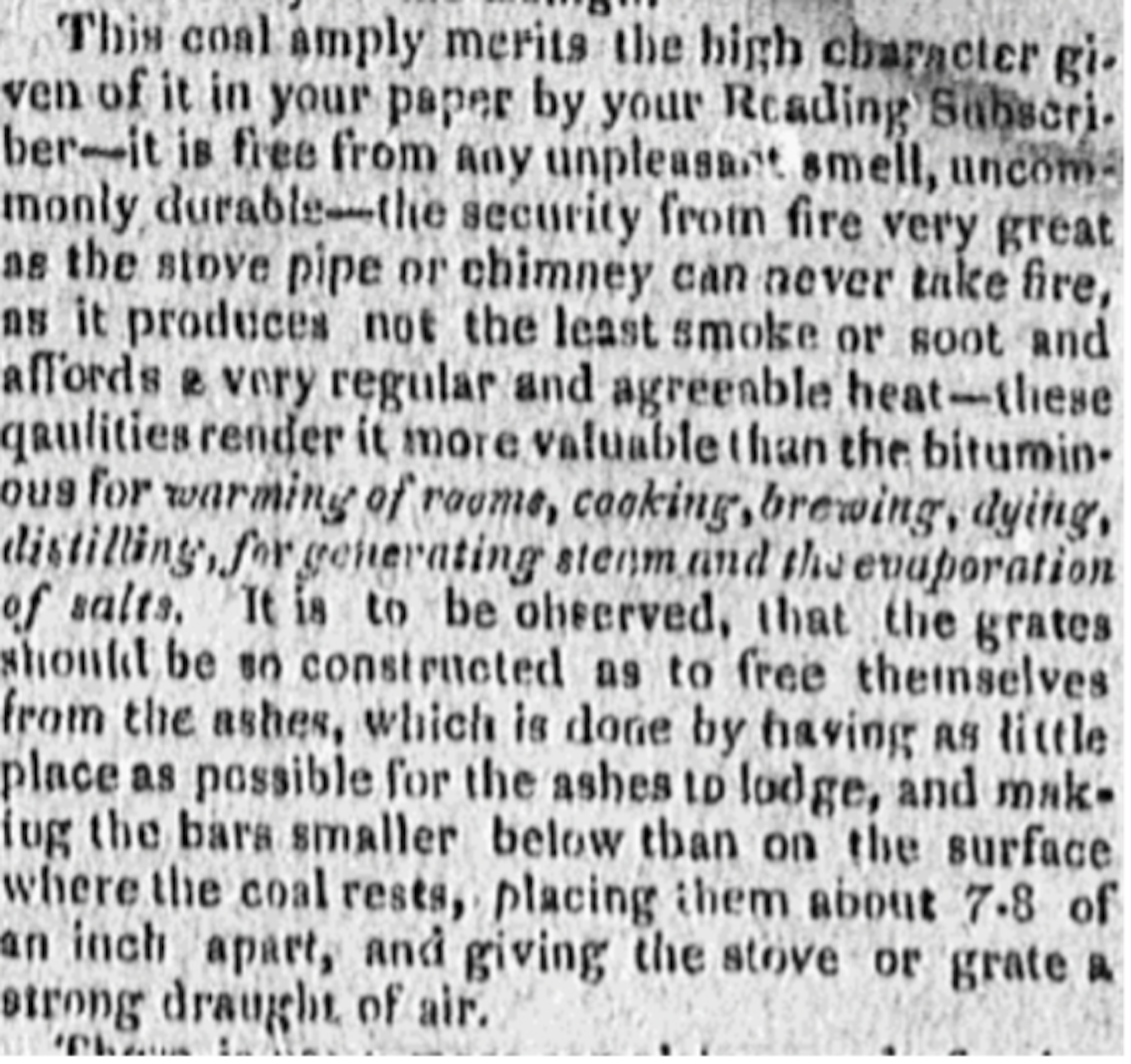
In addition to its lower price, anthracite coal grew desirable because of its high carbon, low-sulfur content, which produced less visible smoke when it was burned. An enthusiastic 1815 letter to the editor of the American Daily Advertiser captured increasingly common attitudes toward anthracite as “affor[ding] a very regular and agreeable heat.”

‘A healthful home’

The spread of anthracite also shored up tolerance for smokier but cheaper bituminous coal.

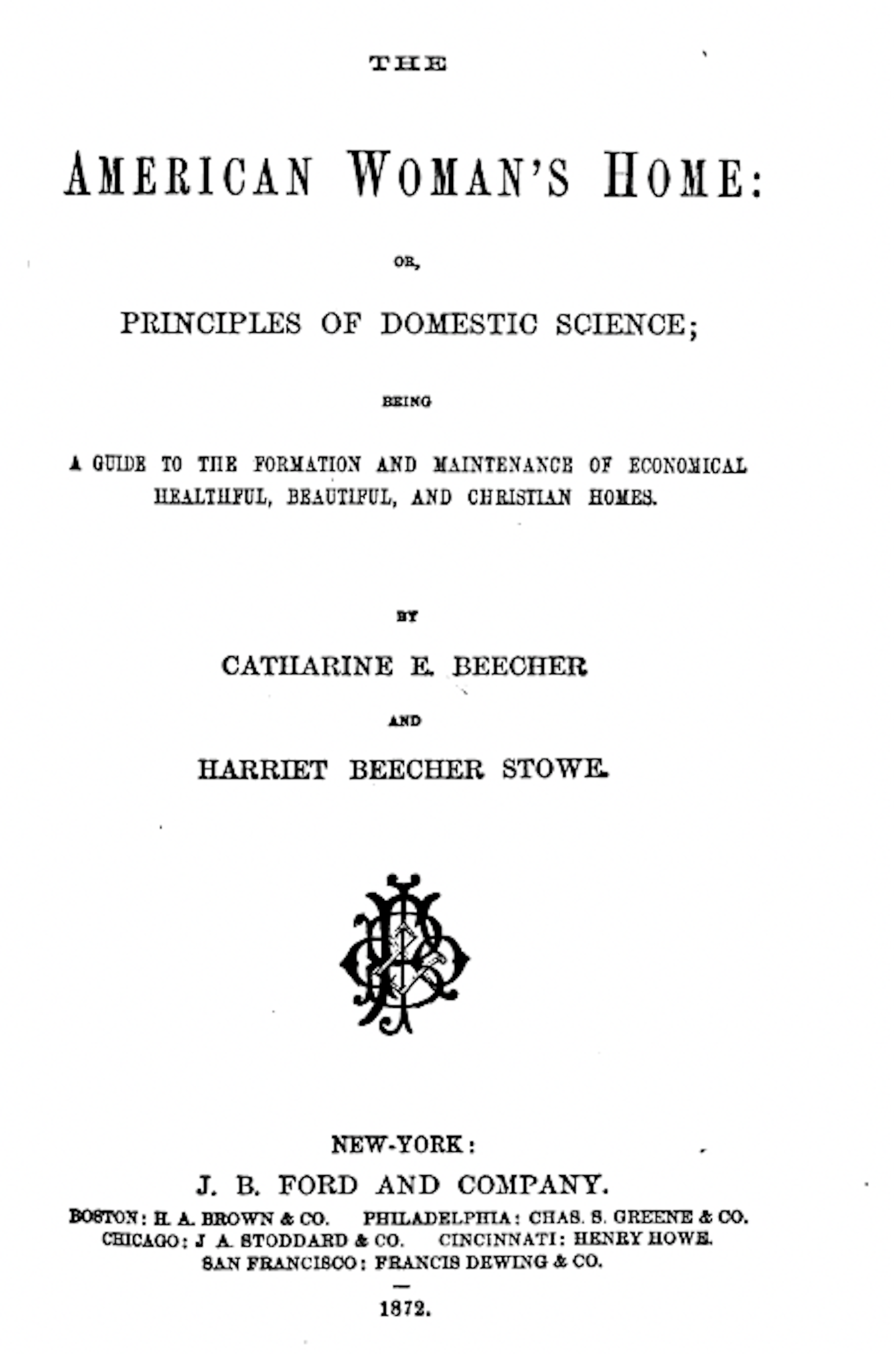
To help people, housekeeping manuals aimed at the fossil fuel’s mostly female users tried to invent workarounds for its smoke. In 1869, Harriet Beecher Stowe, best known as the author of “Uncle Tom’s Cabin,” and her sister Catharine Beecher wrote one of many 19th-century articles to acknowledge the “evils” of coal smoke, while outlining “modes of making a healthful home,” in the housekeeping manual American Woman’s Home.

Consumers provided temporary solutions for maintaining indoor air quality while burning coal by sending in suggestions that were published in housekeeping manuals, magazines and newspapers.

An add reading 'Why not?'
An 1892 advertisement in the Rocky Mountain News promoted a brand of coal stoves as ‘the best, handsomest and most economical.’
Nineteenth Century Newspapers

At the same time, as the century progressed, coal and coal-stove companies began to suggest that burning coal was healthy, that it could improve indoor air as well as domestic aesthetics. One 1892 newspaper advertisement claimed that stoves were “necessary to heat, cheer, and beautify the home and preserve its health.”

To keep the children clean and bright …

In the 20th century, marketers churned out more colorful claims about the benefits of coal: One magazine advertisement showed a mother and child pointing at the crackling stove aflame with the company’s coal, saying it “cannot be excelled in purity, cleanliness, and free-burning qualities.”

An ad with a woman and child with a coal stove.
An ad for a coal stove described its ‘purity’ and ‘cleanliness.’
Madison Historical, CC BY-NC-SA

Similarly, the Lackawanna Railroad Company came up with the classy, often rhyming, character of Phoebe Snow. In one ad, she points to the importance of comfort, suggesting that not only could anthracite fuel faster travel, but it could also make your travel – and your life – more comfortable.

A postcard ad for Lackawanna Railroad featuring Phoebe Snow, wearing white, talks about its use of anthracite coal.
A Phoebe Snow postcard ad from 1912 talked about avoiding ‘smoke and cinders’ with trains run on anthracite coal.
Railroad Museum of Pennsylvania/Wikimedia Commons

Coal marketing often used children to suggest safety and reach parents. Another iteration of the Phoebe Snow series promised that anthracite-powered railway travel could keep children “clean and bright.”

Two women sit in a train car talking with well-behaved, very clean children.
One of the Phoebe Snow ads, in 1910, advertised Lackawanna Railway’s coal-powered trains using children and whiteness to suggest purity.
Photo Courtesy of Poster House/Poster House Permanent Collection

A 1930s advertisement went so far as to position a piece of anthracite coal next to a child in a bathtub, a visual proximity implying that coal was as good as soap.

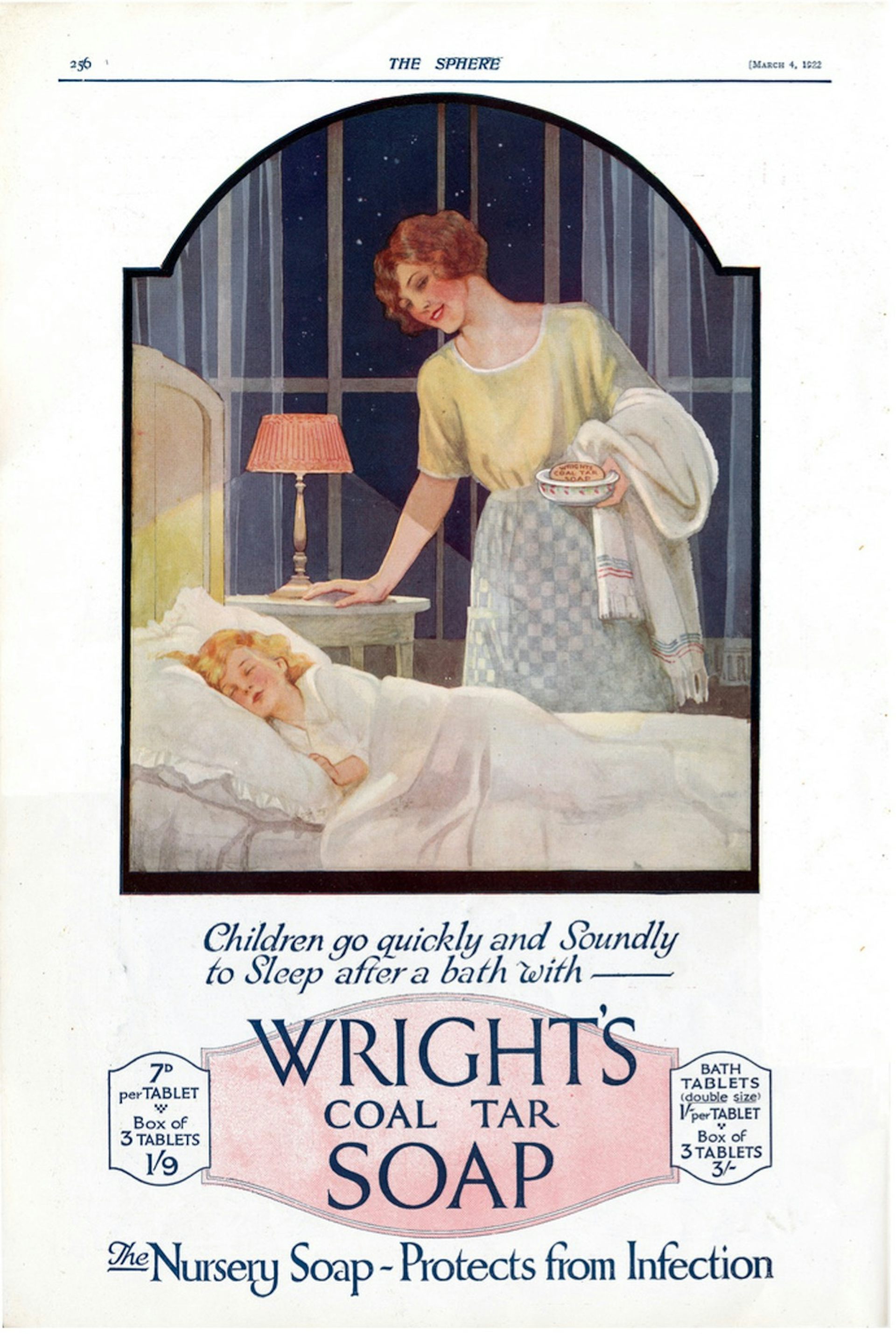
In fact, soap made of “coal tar” – a liquid byproduct of producing coke, a fuel made from bituminous coal used in industrial blast furnaces – did (and does) exist. The British company Wright’s, also popular in the U.S., generated a slew of advertisements praising its soap as having antiseptic properties for children.

A smiling woman stands over a sleeping child in an ad for coal tar soap.
Wright’s Coal Tar Soap used a sleeping child dressed in white and sleeping on white sheets to advertise its ‘nursery soap,’ which it claimed protected children from infection, in 1922.
Wikimedia Commons

Each of these advertisements tried to capitalize on a mother’s desire for healthy children. And they pushed back against the image of the tyrannical “King Coal” that had come about amid strikes by miners protesting dangerous, degraded working and living conditions as well as the rise of black lung disease.

‘Clean coal’

By the mid-20th century, petroleum took coal’s place as America’s main energy source. The U.S. environmental movement continued to grow, and people got interested in natural gas as an alternative to coal.

In response, coal companies doubled down on the fantasy of “clean” coal.

Two hands hold a lump of coal and a scrub brush and appear to be scrubbing the lump of coal. It says 'Can coal be cleaned before it's burned? Yes. Inside and out!'
An American Electric Power ad in The Wall Street Journal in 1976 talked about cleaning coal.
Wall Street Journal archive

A 1979 advertisement for American Electric Power, for example, flew in the face of Clean Air Act mandates that coal corporations employ “scrubbing” technology to remove sulfur dioxide from smoke – the ad depicted someone cleaning coal by hand.

The myth continues

Today, coal generates only 16.2% of America’s electricity, down from generating more than half of the U.S. power supply in the 1990s. But the country isn’t done with it. Even though coal production today is far below its peak, as companies try to shut down old uneconomic plants, Trump has promised to “reinvigorate” the coal industry.

In addition to ordering some coal plants to continue operating, the Trump administration has pulled out old coal promotion tactics from the past, including repeatedly referring to coal as “clean and beautiful.” One image inserts Coalie next to a coal-mining family that otherwise looks like an ad that could have appeared a century ago.

A drawing of a family with a cartoon coal lump looking like a toy.
A 2026 promotion for the Office of Surface Mining Reclamation and Enforcement includes a cartoon family with ‘Coalie’ added to the picture, looking like a child’s toy.
OSMRE

And, like its predecessors, this picture tries to present an innocent image of a product that harms human health and the environment.

A 2018 study found that black lung disease was on the rise in Appalachia, where about 40% of America’s coal is mined today. Living near a fossil-fuel power plant exposes residents to pollutants that contribute to premature deaths, asthma and lung cancer, including tiny particulate matter known at PM 2.5, sulfur dioxide and mercury. Even when it’s just sitting in piles waiting to be used at a power plant, coal can harm human health as the wind blows across it and carries coal dust into the air and people’s lungs.

The myth of coal as healthy and family friendly has been around for centuries – but coal has never been clean, or cute.

The Conversation

Annie Persons does not work for, consult, own shares in or receive funding from any company or organization that would benefit from this article, and has disclosed no relevant affiliations beyond their academic appointment.

​Politics + Society – The Conversation

Categories
Uncategorized

The American Revolution’s triumphant story of democracy and freedom overlooks loyalists who paid a steep price for allegiance to Britain

The announcement of the Declaration of Independence on July 4, 1776, in Philadelphia. Hulton Archive via Getty Images

On the eve of the American Revolution, Matthias Aspden made a decision that would change the trajectory of his life. A wealthy merchant from Philadelphia, Aspden carefully prepared to leave his home in March 1776 as rumors of revolution circulated. He drafted a will and appointed trusted friends to manage his property while he traveled to England.

As a loyalist, someone who wanted to remain loyal to the crown and the British empire, Aspden believed the war would be brief. Historians estimate that at the beginning of the war as many as one-third of all American colonists identified as loyalists. Aspden believed his departure would be temporary. Order, he assumed, would soon be restored, and he would permanently return within a few years.

But that wasn’t the case.

The American Revolution is often told as a triumphant story of democracy and freedom. But this narrative leaves out a significant group: the loyalist men and women who remained faithful to Britain and, as a result, lost their homes, property and sometimes their sense of belonging.

As a historian of the American Revolution who studies Philadelphia loyalists, I believe Aspden’s story offers a glimpse into an overlooked experience of the war.

A wealthy Philly merchant exiled in England

Born and raised in Philadelphia, Aspden was not a marginal figure. He was a Quaker merchant with extensive property holdings, including a home on Water Street, in what is now the Old City neighborhood, and land in Chester County outside Philadelphia.

When he left in 1776, he abandoned nearly everything he owned, believing he would return. As others celebrated independence that summer, Aspden quietly slipped away to London.

Black text on white page
A letter written by Matthias Aspden from London in 1779.
Yale University

In England, reality set in. Exile was not just physical; it was deeply social and emotional. In Philadelphia, Aspden had been established. In London, he was one of tens of thousands of displaced loyalists trying to rebuild a life. He gravitated toward communities of fellow exiles. These networks offered some stability, but they could not replace what he had left behind.

Aspden’s letters to friends and family from this period reveal a man caught between hope and anxiety. He followed news from Philadelphia obsessively, requesting newspapers and updates from friends and business contacts. At one point, he described himself as “an idle man until I can return to America.” His words suggest both longing and uncertainty, as if his life were on pause.

By 1780, that uncertainty turned into fear.

A ‘traitor’ trying to come back home

Aspden began hearing about laws in Pennsylvania aimed at confiscating loyalist property. These laws required individuals accused of treason to appear in court and defend themselves. Aspden, still in England, could not do so. As a result, he was tried in absentia, declared a traitor and subjected to the state’s harshest penalties.

The consequences were devastating. In 1782, Aspden learned that all of his property had been confiscated and would be sold to aid the patriots in the American Revolution. An official commissioner of confiscation seized his Philadelphia home and wharf, which were worth thousands of pounds, along with his land in Chester County. Aspden, facing financial ruin, decided to return to Philadelphia to defend his name and his property.

In 1785, after nearly a decade abroad and with the war over, he crossed the Atlantic, hoping the new United States would restore his property under the terms of the peace treaty with Britain. Instead, he was met with rejection.

Pennsylvania officials informed him that individuals in his position were not protected. He had no legal claim to his property and, more shockingly, no rights as a citizen. While the peace treaty prevented further confiscation of loyalist property, his property was not restored.

The message was clear: Philadelphia was no longer his home.

Rows of two-story, red-brick homes on cobblestone street
Matthias Aspden longed to return to his life in Philadelphia.
Brian Logan/iStock via Getty Images Plus

One last trip to Philadelphia

Aspden left again, traveling through New Jersey and New York before securing passage back to England. Reflecting on his departure, he wrote of the pain of being forced from his “native country.” His brief return confirmed what he had feared. He had no home.

In the years that followed, Aspden sought compensation wherever he could. The American government offered nothing, so he turned to Britain. The Loyalist Claims Commission, established to reimburse those who had lost property during the war, eventually awarded him just over 1,100 pounds, a fraction of his estimated losses.

Aspden made one final visit to America in the early 1790s. By then, he had received a legal pardon and could travel without fear of arrest. But he still could not recover his property or successfully pursue compensation in American courts. Once again, he left – this time for good.

Black and white illustration of line of children in colonial dress waving to soldiers
About a third of American colonists were loyal to the British Crown during the American Revolution.
H A Ogden/Frederick A Stokes Company via Getty Images

Heirs recover his fortune

Aspden died in England in 1824, having spent nearly 50 years in exile from the city he always considered home.

Decades after his death, his heirs pursued a legal claim in the United States against Pennsylvania, arguing that his estate had been unjustly seized. After years of litigation, the court ruled in their favor in 1848, awarding them over a half-million dollars – approximately US$20 million today. It was a remarkable reversal, but Aspden never saw justice.

His life raises difficult questions about loyalty, identity and belonging. Aspden did not see himself as disloyal to Philadelphia. To him, loyalty to the British Crown and loyalty to home were not opposites.

His story reminds us that the Revolution was not just a fight for independence. It was also a civil conflict that divided communities and reshaped lives. For every celebrated patriot, there were loyalists like Aspden and others who lost so much during the American Revolution.

Read more of our stories about Philadelphia, or sign up for our Philadelphia newsletter on Substack.

The Conversation

Kimberly Nath does not work for, consult, own shares in or receive funding from any company or organization that would benefit from this article, and has disclosed no relevant affiliations beyond their academic appointment.

​Politics + Society – The Conversation

Categories
Uncategorized

US violent crime is at its lowest in more than a century – but the funding that helped reduce it is disappearing

Homicides across 35 major American cities fell 21% in 2025. South_agency/Getty Images

The United States is experiencing one of the steepest declines in violent crime in modern history, including a murder rate at its lowest point in more than a century.

Homicides across 35 major American cities fell 21% in 2025, amounting to 922 fewer people killed. Robberies dropped 23%. Gun assaults declined 22%. Carjackings plummeted 43%.

Yet the Trump administration has yanked hundreds of millions of dollars from the programs that helped make those numbers possible.

As a scholar focused on how policy decisions and structural conditions shape crime in marginalized communities, I see a pattern forming that could put these historic gains at serious risk.

‘Wasteful grants’

In April 2025, the Department of Justice terminated 365 previously awarded grants. About US$500 million in promised funds evaporated, affecting more than 550 organizations across 48 states.

The cuts stretched across the public safety landscape: community violence intervention, victim services, law enforcement training, juvenile justice, offender reentry and criminal justice research.

Then-Attorney General Pam Bondi described the cancellations as eliminating “wasteful grants.” The White House argued that the grant programs had been “funding DEI and cultural Marxism” rather than helping to keep Americans safe.

The DOJ’s fiscal year 2026 budget proposal reduces the pool of funds for public safety and justice programs by an additional $850 million – about a 15% decrease from the prior year.

A prison cell is seen with it door partly open.
A law supporting ex-inmates with temporary housing and healthcare lost $40 million in funding.
Edwin Remsberg/Getty Images

Bipartisan programs

On the ground, the effects of the cancellations were immediate.

Initiatives implementing a federal law to support ex-inmates with temporary housing, job training and healthcare lost $40 million in funding, according to the Brennan Center for Justice at New York Unversity.

Many of the terminated programs had deep bipartisan roots.

Project Safe Neighborhoods, a crime-reduction initiative launched in 2001 under President George W. Bush, lost its training funds, the Council on Criminal Justice found. Also axed was an anti-terrorism program that had trained more than 430,000 state and local law enforcement officers and other partners since 1996.

More modest programs were targeted as well.

In rural Oregon, a DOJ grant had allowed the Union County district attorney to hire an investigator who, after a few years of probing a 43-year-old cold case involving the killing of a 21-year-old woman, finally developed some leads. When the money was cut, the investigation stopped.

Funding cliffs

The funding cuts couldn’t have come at a worse time. States and local jurisdictions were already facing looming cuts, as billions of dollars provided by President Joe Biden’s COVID recovery plan run out on Dec. 31, 2026.

Many local governments had used that money to build violence prevention programs from the ground up: employing community-based mediators, launching youth employment initiatives and expanding behavioral health teams.

And now? A double funding cliff with the sudden cancellation of DOJ grants, paired with the expiration of COVID recovery money.

In Chicago, this cliff has already forced a 43% cut to the city’s domestic violence prevention budget for 2026 – even as its share of domestic-related homicides rose 13% over the previous year.

Larger and more targeted

Criminology research helps explain the particular risks of abrupt disinvestment. Emory sociology professor Robert Agnew’s General Strain Theory identifies a direct relationship between increased strain – economic pressure, blocked opportunities, the withdrawal of institutional support – and higher risks of criminal behavior.

Flashing red and blue lights are seen on a police car at night.
Researchers warn that cuts to violence prevention programs are likely to lead to increases in gun crime.
Jeremy Hogan/Getty Images

Historical precedent reinforces the concern. In 2013, federal across-the-board spending cuts eliminated services for more than 955,000 crime victims in a single year. The capacity of the FBI and related agencies was slashed by the equivalent of more than 1,000 agents.

Between 2014 and 2016, the violent crime rate climbed 7%.

The 2025 cuts are substantially larger and more targeted, and have devastated some groups.

Equal Justice USA, a national organization working to end the death penalty and reduce violence through community-based interventions, shut down in August 2025 after losing more than $3 million in DOJ grants.

Local programs like Baltimore’s LifeBridge Health’s Center for Hope lost $1.2 million to provide therapy for gun violence survivors.

“What shocked me the most … was what feels like the utter cruelty of it,” said Adam Rosenberg, who runs the center, referring to the cancellation of the funds.

As of April 2026, the DOJ has not paid out $200 million in approved grants to assist victims of domestic violence, sexual assault and human trafficking.

This comes after the department last year allowed more than 100 grants for human trafficking survivors to expire, affecting more than 5,000 victims, despite Congress allocating $88 million for these services.

Researchers at the University of Pennsylvania warn that cuts to violence prevention programs are likely to lead to increases in gun crime.

What happens next

The initiatives now losing funding are the ones that helped drive crime down in many American cities.

Community members trained in conflict mediation help extinguish tensions before they turn lethal. Youth programs provide alternatives to street economies. Forensic labs process the evidence that solves cases. Reentry programs keep people from cycling back through the system. With each serving a distinct function, together they form the infrastructure of public safety.

As funding for crime prevention from two main sources runs out, whether progress continues depends on what happens next.

The Conversation

Andrea Hagan does not work for, consult, own shares in or receive funding from any company or organization that would benefit from this article, and has disclosed no relevant affiliations beyond their academic appointment.

​Politics + Society – The Conversation

Categories
Uncategorized

In rural Appalachia, abortion pill offers reproductive choice and privacy − but police may see a crime

A 35-year-old Kentucky woman was arrested in late 2025, accused of taking abortion pills that she ordered online.

The gestational age and status of the pregnancy is unknown. But Kentucky, like the majority of Southern states that contain Appalachian counties, has a complete abortion ban.

Mifepristone is a medication approved by the Food and Drug Administration for self-administered abortion care through 10 weeks’ gestation, and research suggests it is safe and effective up to 16 weeks. Mifepristone can still be ordered into states with abortion bans after the Supreme Court weighed in on the matter on May 4, 2026.

Abortion is illegal in Kentucky, however, and the police viewed the woman’s actions as criminal. A grand jury supported bringing charges, including fetal homicide, “abuse of a corpse” and tampering with physical evidence. Her distressed mugshot was plastered all over regional news sites.

As a social work researcher who studies access to reproductive healthcare in underserved Appalachian communities, I have worked with clients in similar circumstances. I have observed that many decisions to end pregnancies are motivated by intense barriers to accessing healthcare – not by criminal intent.

It can be extremely difficult for women in this region to get healthcare, and these access burdens affect quality of life in the region. For example, research suggests that Appalachian women are more likely to die at younger ages when compared to women living in other regions of the United States.

Here are six factors I consider when a case like this appears in the news.

1. Abortion bans do not stop abortion

Data clearly shows that outlawing abortion care does not stop abortions from happening.

According to data from the Society of Family Planning’s #WeCount project, U.S. abortion rates have actually increased since the Supreme Court overturned Roe v. Wade in 2022, ending federal abortion protections.

What state abortion bans do is change how people try to get care.

2. Abortion bans isolate patients from doctors

For people living in most of rural Appalachia, brick-and-mortar abortion facilities are currently only available in another state, often a great distance away.

The only way many people can get care, then, is to order pills and self-manage their own abortion.

When someone orders abortion pills without medical consultation, however, there is more room for error in assessing relevant medical information, such as how far along their pregnancy is. When abortion care is legal and accessible, like other forms of healthcare, such estimates are made in consultation with a health provider.

Multiple clinics, community groups and pharmacies will send abortion pills to Kentucky for self-managing abortions up to about 13 weeks into pregnancy, according to the abortion access resource Plan C. These places may offer medical support, peer support or no additional support at all.

A photo of abortion medication.
Mifepristone use is FDA-approved through 10 weeks’ gestation.
Carl Lokko/iStock via Getty Images

Patients who do involve a telehealth provider report satisfaction with that experience.

Yet patients in abortion-ban states may avoid using sites that are connected to support services because they fear being discovered and prosecuted. Abortion bans may therefore compel patients to make critical reproductive health decisions without consulting an expert.

This may have occurred in the Kentucky case, according to what the law enforcement officers reported to the Lexington Herald-Leader newspaper.

3. Ending Roe worsened healthcare deserts

Another factor to consider is how abortion bans contribute to existing healthcare deserts in rural Appalachian communities.

Even before the repeal of Roe, people living in Appalachian communities were not getting adequate healthcare. Communities in central and southern Appalachia face significant health disparities: These regions have higher illness and death rates and increased risk of cancer and diabetes compared to non-Appalachian areas of the United States.

In part, that has to do with inadequate healthcare infrastructure endemic in rural parts of the country. Geographic isolation, limited financial incentives and lack of infrastructure decrease the number of available health providers, meaning that only about 9% of U.S. physicians practice in rural areas.

Appalachia has lost regional obstetric services in recent years and seen numerous hospital closures, further discouraging providers from working there. One study found that of 53 rural hospitals that closed between 2005 and 2016, 66% of them were in Southern states, 21% in Appalachia.

This has reduced access to specialty care, including reproductive healthcare.

Abortion bans have compounded all these problems. They make it difficult, if not impossible, for providers to practice within established standards of care when treating conditions such as miscarriage, which can discourage ER physicians and OB-GYNs from remaining in red states.

The shortage of medical professionals makes it increasingly challenging to obtain reproductive healthcare in the region – except by mail.

4. Poverty influences reproductive decisions

Money is another important factor in people’s reproductive choices.

Research indicates that financial distress is a main reason that people seek abortions. Those who are denied abortion access are more likely to be in poverty four years after they give birth than those who were able to access it.

Appalachia’s history of resource extraction has left it impoverished. In Central Appalachia – in Kentucky – up to 21% of residents live in poverty.

The median household income in adjusted 2023 dollars in Wolfe County, Kentucky, where the woman was arrested, is just over US$29,000, compared to about $79,000 in the rest of the country. It costs approximately $232,000 to raise a child in Kentucky from birth to age 18, the mortgage broker LendingTree calculated in April 2026.

Facing the daunting cost of another mouth to feed, families confronting an unintended pregnancy may see abortion as a financial necessity. Appalachian residents in these circumstances are figuring out how to get the abortion care they need against steep odds.

A person holds another person's hand in a health clinic.
Research shows that financial hardship is a main reason that people seek abortions.
thianchai sitthikongsak/Getty Images

5. In rural Appalachia, abortion can carry stigma

In rural Appalachian communities where most residents know each other, abortion and reproductive health stigma – some of which, research suggests, is rooted in religiosity – can present a significant barrier to care.

My own research has found that stigma may dissuade Appalachians from seeking healthcare and discussing sexual health topics with providers due to fear of judgment. Many Appalachians have reported to me their negative reproductive health visits with regional medical providers, including attempts to coerce patients into using or not using contraception.

Because abortion is stigmatized in Appalachian communities, healthcare workers may be inclined to inform police on their patients.

One news report indicates that in cases where abortions were reported to police, 39% of reports were made by health professionals and another 6% by social workers. In 412 cases of pregnancy criminalization analyzed by the advocacy group Pregnancy Justice, 264 involved information that had been disclosed in a medical setting.

That is what happened in the Kentucky case: People working in a clinic allegedly told the police that the woman had disclosed her abortion.

Abortion medication shipped directly to one’s home, by contrast, offers privacy.

The prosecutor eventually dismissed the homicide charge, because Kentucky law exempts pregnant people from being prosecuted for getting abortion care. But other charges were added, including concealing the birth of an infant. The woman may still be facing legal consequences.

6. Sex education is important – and lacking

One final factor I consider relevant in understanding this case is sex education – or rather, the lack of it in most Appalachian states.

Kentucky requires some sexual health education in public schools, but each county can dictate much of the content. Sex education in the state is not required to be comprehensive, and it must promote abstinence.

As NPR reported in 2023, there are parts of rural Appalachia without comprehensive sex education, where contraception is unaffordable and abortion is also banned. Those trying to provide better sex education have faced harassment and threats of violence.

When people do not receive the sexual health education needed to know their bodies and how they function, they are more vulnerable to negative health outcomes such as unintended pregnancy. And they may not know their bodies well enough to know how long they’ve been pregnant when they make reproductive health choices.

Bad policies, impossible situations

All of the factors listed above could potentially affect people in any community. But rural Appalachian communities are disproportionately affected by a confluence of these factors.

In my analysis, the Kentucky case elucidates how poor health infrastructure and bad health policies – such as abortion bans – place one barrier after another in front of people who are just trying to do the best they can to cope with an unintended pregnancy.

This story was produced in collaboration with Rewire News Group, an independent newsroom dedicated to covering reproductive health in the United States. Read their version here.

The Conversation

Gretchen E. Ely has previously received funding for her research from the Society of Family Planning.

​Politics + Society – The Conversation

Categories
Uncategorized

Is it wrong to pay incarcerated people in jail? This Pennsylvania county says no

Unlike prison, jail confinement is primarily about custody and court processing, not punishment for convicted criminals. The Washington Post/The Washington Post Collection via Getty

Allegheny County, Pennsylvania, is experimenting with a policy that has drawn national attention and local skepticism: providing cash compensation to people confined in the Allegheny County Jail in the city of Pittsburgh. The funds include monthly disbursements to all those incarcerated and additional pay tied to work assignments and participation in educational programming.

At first glance, the policy may sound counterintuitive. Why pay people who are in jail, especially when many law‑abiding residents are struggling to afford housing, food and transportation? That reaction is understandable. But it often reflects a misunderstanding about who is held in the Allegheny County Jail, the amount of the disbursements and what the county is trying to accomplish.

An outdoor shot of a building with bars on the windows.
Allegheny County Jail is experimenting with a new policy that compensates incarcerated people.
AP Photo/Gene J. Puskar

Over the course of two decades, I have partnered with Allegheny County on policy relevant to justice research and served on the advisory board of the Allegheny County Jail Collaborative, a nationally recognized initiative launched in 2000 to better coordinate jail, health and community-based services. Long before many places began using data to rethink criminal justice, Allegheny County was already analyzing data from multiple sources to develop and test new approaches. With that history in mind, this policy may come as less of a surprise – though it still deserves scrutiny.

Most people in jail haven’t been convicted

Understanding the county’s rationale for compensating people in jail begins with understanding the jail population itself. Jail confinement is primarily about custody and court processing, not punishment after being convicted of wrongdoing.

According to county data, only about 8% of people housed in the jail have been convicted and sentenced to jail time. These individuals are serving a maximum incarceration term of less than two years for misdemeanor or lower-level felony convictions. Roughly half of those incarcerated at the Allegheny County Jail, or 46%, are awaiting trial and have not been convicted of a crime. Another 36% are detained based on an alleged probation violation. The remaining 10% are either on a legal hold placed by an outside agency – such as federal authorities or a correctional facility in another state – are awaiting transfer to a different facility or are ordered to be incarcerated for allegedly violating family court orders.

While jails provide food, clothing and basic hygiene items, those provisions often fall short of what people actually need. Commissary purchases make up the gap, yet many people in jail have little to no money. When even basic necessities, such as ramen noodles, toothpaste and tampons, become scarce, bartering can take place. Commissary items become currency. Debt, theft, intimidation and power imbalances emerge, leading to conflicts that can cause serious or fatal injury. Staff must manage these threats, sometimes at risk to their personal safety.

Incarcerated person mopping a jail floor.
The compensation is for labor, education and vocational training.
Boston Globe/Boston Globe Collection via Getty Images

The county’s compensation policy addresses this reality in concrete ways. Since 2022, the Allegheny County Jail Oversight Board has approved monthly payments of about US$100 to every person housed in the jail through the Incarcerated Individuals Welfare Fund. The fund is financed by proceeds from jail commissary, phone and tablet contracts. These funds can be used for commissary items, phone access, fees, or to accrue savings for post-release needs.

$5 a day – and the research behind it

In addition, in March 2026 the county began compensating people confined in jail approximately $5 per day for voluntary work assignments, as well as for participation in some types of vocational and educational programming. Some of this compensated work is labor that keeps the jail running – including cooking, cleaning and maintenance – and benefits the institution directly. Some of it includes education and vocational training. Paying for it signals some level of fairness and respect. It is also pragmatic: When people perceive systems as legitimate, they are more likely to follow rules and less likely to engage in misconduct.

Offering compensation for education may also boost enrollment, much like how earned credits toward early release encourage participation in federal programs through the First Step Act. This may better prepare them for reentry into society while also reducing idle time, which is linked to misconduct.

Man in orange jumpsuit sits inside a cell behind bars.
The financial incentives may not meaningfully change behavior for everyone.
fpphotobank/iStock via Getty Images Plus

Another reason for compensation comes at the point of release. People often leave jail with no cash and limited access to transportation. Providing even limited financial resources can help people make better choices during a well-documented critical transition period that can make or break successful reentry intro society.

Still experimenting

None of this means the policy will work as intended. Increased access to resources could shift, rather than eliminate, forms of conflict among those incarcerated. And the financial incentives may not meaningfully change behavior for everyone.

This makes rigorous, transparent evaluation essential. Research should measure both intended and unintended effects of this policy, including on institutional safety, program participation, reentry outcomes and overall cost effectiveness.

Paying people in jail is not about rewarding crime. In Allegheny County, it is a pragmatic experiment grounded in local data, institutional realities and a clear-eyed commitment to public safety. Whether it ultimately improves safety inside the jail or stability after release remains to be seen. But asking the question and measuring the answer is exactly what evidence-based justice policy should look like.

The Conversation

Nancy La Vigne does not work for, consult, own shares in or receive funding from any company or organization that would benefit from this article, and has disclosed no relevant affiliations beyond their academic appointment.

​Politics + Society – The Conversation

Categories
Uncategorized

A democracy or a republic? History shows that some Americans are asking the wrong question

A Harper’s Weekly image of the first reading of the Declaration of Independence outside Independence Hall in Philadelphia on July 8, 1776. MPI/Getty Images

As the nation observes its 250th birthday, historians can help settle one present-day dispute: Is the United States a democracy or a republic?

For years, advocates have argued the point.

Yet the question itself is misleading. It assumes that the categories constructed by political theorists neatly describe actual practice.

As a historian of early America, I know this nation has always been unwieldy, its institutions hammered out from conflicting ideals and the pragmatic lessons of lived experience. Just as Britain today is both a monarchy and a democracy, so the U.S. has always been a hybrid.

Ideals of both republicanism and democracy have shaped the nation. To understand how requires a history lesson.

No purity

A yellowed page from a 1787 newspaper, covered in small print.
James Madison’s essay, known as Federalist X, was published under the pseudonym ‘Publius’ in the New York Daily Advertiser on Nov. 22, 1787.
Library of Congress

Let’s start with a famous definition. Here is the often-quoted “Father of the Constitution,” James Madison, urging Americans to ratify the new frame of government proposed by the Constitutional Convention in 1787.

In Federalist essay No. 10, Madison distinguished two sorts of governments for his readers.

One was a “pure democracy,” which he described as “a society consisting of a small number of citizens, who assemble and administer the government in person.” A New England town meeting might qualify for this definition, where voters assembled to choose town officers and approve local bylaws.

The other type of government was a “republic,” defined as “a government in which the scheme of representation takes place”
– meaning where the people’s chosen representatives made governing decisions for them.

That seems cut and dried. Surely no one thought the entire population of 13 states could work like a town meeting.

But Madison here was saying only that the possibility of a “pure” democracy was impractical. He was by no means banishing all democratic ideas and institutions.

As the French theorist Montesquieu had noted, republics were of varying sorts. Some republics were aristocratic, controlled by a relative few who were set above the rest. Other republics were democratic, engaging many more in the ongoing affairs of government.

What was at stake in the U.S. in 1787 wasn’t a “pure” democracy nor a “pure” republic. The issue was how aristocratic – and how democratic – the American scheme of representation would be.

Who would be represented – the many or the few?

‘Actual’ representation

America had never been the home of an aristocracy in the British sense. Besides, the Revolution had discredited the very idea of hereditary power. There would be no House of Lords, filled with titled men born into political power and a special set of legal privileges denied to ordinary people. The people alone would be sovereign, and all authority to govern derived, directly or indirectly, from them.

Even so, the problem of aristocracy remained. After all, it had been the lower house of Parliament – the House of Commons, not of Lords – that had sparked the imperial debate when it tried to tax and legislate for the Colonists.

Not nobility, members of the Commons still formed a remote and ambitious elite. None was elected by American voters or even necessarily informed about the Colonists’ lives. Apologists for Parliament claimed that the Commons “virtually” represented the Colonies anyway.

But the Colonists watched the Commons ignore American grievances while favoring private interests – East India Company shareholders, for example – that served wealthy British gentlemen such as themselves.

Many concluded that the members of the House of Commons did not “actually” represent either the poor of Britain or the growing population of the continental Colonies.

In contrast, “patriot” Americans pointed to the legislative assemblies established in each colony soon after its founding.

Needing to attract British settlers, and following the British model, each colony established an elected house of the legislature to provide a check to governors and upper houses that were appointed by the king or a wealthy Colonial proprietor.

Law and custom required that delegates to these assemblies live among their constituents. Although they were men of some fortune and standing in their districts, assemblymen might plausibly “actually represent” their lesser neighbors.

In the lead-up to the Revolution, patriots used new measures to ensure their representatives’ fidelity: They called for vigilant popular oversight of government decision, publicized those decisions in the press, wrote constituent instructions for legislators and winnowed out noncompliant officeholders at election time.

Individual and collective liberties

With independence, Americans created a patchwork of new, representative state governments. South Carolina empowered its wealthy planter elite by setting a high property-holding requirement for voters and a higher one for officeholders. Pennsylvania and Vermont adopted unprecedentedly democratic systems that allowed a large proportion of the white male population to participate in government.

By 1787, some Americans thought there was too much popular democracy – too much power given to nonelite members of society, especially within state governments.

The Constitution adopted restraints on democracy – a Senate appointed by state legislatures, an electoral college that put the choice of president at a remove from the people, a supremacy clause that allowed national laws to supersede, or contravene, state laws.

At the same time, a commitment to democracy was also evident in the U.S. frame of government.

A man with rosy skin and curled white hair looks off to the distance against a dark curtain.
Founder James Madison, frustrated when pushed to define the U.S. government, said the ordinary ‘political vocabulary’ fell short.
Painting by Gilbert Stuart, National Gallery

The Constitution set no property requirements for federal officeholders. It left suffrage requirements up to individual states, some of which already extended the vote to all male taxpayers.

Equally important, the ratification process produced a consensus that a bill of rights was necessary to protect ordinary people’s rights and liberties from government overreach.

These first 10 amendments would defend individual rights but also collective rights of the people, such as their right to assemble, to petition the government or even to change it.

The Bill of Rights also protected a free press. It ensured that ordinary free men would still serve in armed militias when their state needed protection. And they would still sit on grand and petit juries to enforce the law or prevent its overreach.

These were the sorts of institutions that the lawyer John Adams called “democratical.”

More and better democracy

Within a few decades, the common phrase for the American system became “democracy.”

Madison had been inconsistent in how he used the term. In the 1790s and 1800s he called himself a “Democratic Republican,” in opposition to the allegedly aristocratic party, the Federalists.
Decades later, Madison was frustrated when pushed to define the U.S. government more precisely. Ordinary “political vocabulary” fell short, he wrote. The American system was “so unexampled in its origin, so complex in its structure, and so peculiar in some of its features” that it was best understood as something new.

How aristocratic? How democratic? The question of 1787 has returned repeatedly to face Americans.

Elites with aristocratic aspirations have repeatedly tried to build permanent governing hierarchies. American history is partly the story of these contests – Free-Soilers against a slaveholding elite, reformers against wealthy “barons” of the Gilded Age, critics of inequality against billionaires who shape government policies today. In such cases, Americans have often turned to more and better democracy, their necessary resource for pressing their political leaders to actually represent the people.

Following Madison’s advice, Americans today can refuse to be misled into describing the U.S. in a single, inadequate term.

They might prize both of these historic commitments: to a republic that insists on the people’s right to be represented rather than ruled, and to a democracy that ensures that ordinary people might collectively make it so.

The Conversation

Barbara Clark Smith does not work for, consult, own shares in or receive funding from any company or organization that would benefit from this article, and has disclosed no relevant affiliations beyond their academic appointment.

​Politics + Society – The Conversation

Categories
Uncategorized

Why the 60-day War Powers Resolution deadline doesn’t actually constrain presidents

A TV displays U.S. President Donald Trump’s prime-time address on the war in Iran inside a Cheesecake Factory on April 1, 2026, in Washington, D.C. Anna Moneymaker/Getty Images

May 1, 2026, marks the 60th day of Operation Epic Fury in Iran – a symbolically significant date designating when a president who has mounted unilateral military operations must receive Congressional approval or wind it down.

However, the complex history of the War Powers Resolution clock demonstrates it is a toothless milestone.

The Trump administration signaled on April 30, 2026, that it would ignore that deadline, set by the War Powers Resolution. Secretary of Defense Pete Hegseth testified before the Senate Armed Services Committee that “we are in a cease-fire right now, which my understanding is that the 60-day clock pauses or stops in a cease-fire. That’s our understanding, so you know.”

Sen. Tim Kaine of Virginia, a Democrat, responded that the 60-day threshold poses a “legal question” and “constitutional concerns.”

This is not the first time presidents and members of Congress have sparred on the meaning of the War Powers Resolution. What happens next will play out through regular politics, because the conflict is not a matter of simple legal interpretation.

War: Collective judgment

In the U.S. Constitution, Congress and the president share war powers.

In the shadow of political struggles in the final years of the Vietnam War, Congress passed the War Powers Resolution in 1973 to “insure that the collective judgment of both the Congress and the President will apply to the introduction of United States Armed Forces into hostilities.”

A crucial section of the resolution reasserts legislators’ role, and makes clear that the constitutional power of the president to make war is subject to, or exercised with, the following conditions: a Congressional declaration of war; specific statutory authorization; or a national emergency created by attack upon the United States, its territories or possessions or its armed forces.

For new military campaigns that do not meet these criteria, the resolution included a 60-day clock that begins when a president reports the action to congressional leadership within 48 hours of the action beginning.

The clock can be expanded to up to 90 days upon presidential determination and certification of “unavoidable military necessity respecting the safety of United States Armed Forces” related to removal of troops.

After 60 to 90 days, the resolution originally said this type of unilateral military action would be terminated automatically unless both chambers of Congress approved some form of legislative authorization.

Congress could also choose to terminate an unauthorized military operation any time before the 60 days with a concurrent resolution, which doesn’t require a president’s signature – essentially, a “legislative veto.”

And to make sure the president couldn’t stretch the definition of congressional approval, the resolution said neither existing treaties nor new budget appropriations could substitute for legislative authorization of a military action.

Since 1973, actions by all three branches across a variety of political and policy landscapes have undermined its intents and procedures.

Veto vetoed

In 1983, the Supreme Court declared various kinds of legislative vetoes unconstitutional, which led Congress to reinterpret its War Powers Resolution procedures and powers and effectively amend its processes to expedite any joint resolution or bill that “requires the removal of U.S. armed forces from hostilities outside the United States.”

Now, if members want to stop a presidential military campaign already in progress, they must act affirmatively and pass a disapproval resolution, which a president could veto like any other bill. Congress has sent only one such disapproval – to President Donald Trump in his first term – which he vetoed. Congress did not have the two-thirds required in the Constitution to override.

Both chambers of Congress now have to vote twice, once to disapprove a military action and then again to overcome a likely veto, to stop something it never approved in the first place.

House Majority Leader Mike Johnson explains on March 4, 2026, why his party rejects a Democratic-led measure to assert Congress’ war powers and stop the Iran military action.

The 60-day mark for the current Iran operation has therefore loomed as more of a politically charged symbol of this longstanding imbalance on war powers than a real deadline for action by either branch.

Parallels to Kosovo and Libya

The House and Senate have tried to pass legislation to stop military operations against Iran six times since operations began. All attempts have failed, including the most recent vote on April 30. Democrats are considering filing suit against President Trump if operations go beyond 60 days without authorization.

Yet federal courts have long expressed disinterest in getting involved in constitutional questions related to the War Powers Resolution, especially if members of Congress are the plaintiffs.

Although most presidents from Richard Nixon onward have claimed that the War Powers Resolution is an unconstitutional check on their institutional powers, they usually filed the required reports on new military actions 48 hours after they began.

While the current Iran conflict is different in many ways, presidential unilateralism, inconclusive chamber actions and even member lawsuits all echo controversies over U.S. military action in Kosovo in 1999 and Libya in 2011.

Where Trump administration may lean on Clinton

Operation Epic Fury against Iran began Feb. 28, 2026, and President Trump sent the required report to Congress on March 2, 2026.

After detailing the rationale for military action, Trump added “Although the United States desires a quick and enduring peace, it is not possible at this time to know the full scope and duration of military operations that may be necessary.”

He concluded the memo with his interpretation of constitutional power to act unilaterally.

“I directed this military action consistent with my
responsibility to protect Americans and United States interests both at home and abroad and in furtherance of United States national security and foreign policy interests,” the president wrote. He acted, he said, “pursuant to my constitutional authority as Commander in Chief and Chief Executive to conduct United States foreign relations.” He said he made the report “consistent with the War Powers Resolution. I appreciate the support of the Congress in these actions.”

Similarly, on March 26, 1999, President Bill Clinton sent a War Powers Resolution letter explaining his decision two days earlier to take part in a NATO-led operation against the Federal Republic of Yugoslavia, known as FRY.

Clinton wrote to Congress using mostly the same words and phrases Trump did in his 2026 letter. Clinton also said that he took the action “in response to the FRY government’s continued campaign of violence and repression against the ethnic Albanian population of Kosovo.”

A gray-haired man in a dark jacket and blue tie, sitting at a desk in a very formal looking room.
President Bill Clinton after his television address to the nation on the NATO bombing of Serbian forces in Kosovo, March 24, 1999.
Pool/Getty Images

Clinton explained his authority in virtually the same language as Trump and, like Trump, said it was hard to predict how long the operations would continue.

The House and Senate repeatedly failed to either approve or disapprove of Clinton’s actions through a series of votes across March and April 1999. But lawmakers did send him supplemental appropriations for the operations in May.

NATO suspended the operation after 78 days. Almost a year later, a federal appellate court upheld a district court’s decision rejecting a lawsuit led by Rep. Tom Campbell, a California Republican, alleging Clinton violated the War Powers Resolution. Rather than deciding on the merits, the decision rejected the lawmakers’ claims of injury as not reviewable by the court.

Obama did it, too

In a very different context, a similar rhythm played out during President Barack Obama’s presidency.

During the “Arab Spring” revolts of 2010-2011, the U.N. Security Council passed two resolutions condemning violence against Libyan civilians by security forces under the direction of Colonel Moammar Gadhafi.

On March 21, 2011, two days after NATO operations began against Gadhafi’s forces, which included American air support, Obama sent his War Powers Resolution letter to the Republican House and Democratic Senate. Obama had not received prior legislative authority from Congress.

Obama’s letter included language almost identical to Clinton’s earlier letter and Trump’s later one.

As with Kosovo, the House and Senate did not ultimately agree to either approve or disapprove of the president’s actions in support of the UN and NATO over the operation’s 222 days. In addition, Democratic Rep. Dennis Kucinich of Ohio led a group of mostly Republican House members in a failed War Powers Resolution lawsuit to stop the president.

Unilateral action endures

The Office of Legal Counsel in the Department of Justice has published legal opinions that explain and defend presidential war powers, including with Kosovo and Libya. In December 2025, that office published a memo defending the imminent January 2026 capture of Nicolás Maduro. On April 21, 2026, the State Department published a defense of ongoing U.S. actions in Iran.

Within the current dynamics of the War Powers Resolution, until Congress musters bipartisan supermajorities to connect its own institutional ambition with constitutional power, presidents from either party will decide alone if, and when, the country goes to war. Instead of Congress, presidents may heed public opinion and economic indicators, especially in election years.

The Conversation

Jasmine Farrier is affiliated with the American Political Science Association.

​Politics + Society – The Conversation