Cubans are trying to carry on with daily life amid ongoing blackouts and economic uncertainty, as shown in this photo of Havana from March 2026.Adalberto Roque/AFP via Getty Images
Cuba has run out of oil, the country’s energy minister announced on May 14, 2026.
U.S. Secretary of State Marco Rubio announced on May 13 that the U.S. continues to be ready to offer humanitarian assistance of up to US$100 million – but only if Cuba reforms its communist government. The State Department did not provide many specifics, but according to Archbishop Thomas Wenski of Miami, who is involved in the discussions on behalf of the Catholic Church in its role as distribution partner of U.S. aid, a regime change would be necessary.
But at current prices, this aid would buy only about 20 days’ worth of oil for the island nation, covering a mere 5% of Cuba’s annual oil import.
For most of Cuba’s history, its energy capabilities lacked a stable infrastructure. This was primarily due to its dependence on foreign countries for the supply of oil necessary to produce electricity.
According to the official history of the state-run energy company, Union Eléctrica, until 1956 only about 56% of the country’s population had access to electricity. By 1992, that number had grown to 95%, largely due to fuel supplies and technological aid sourced from the former Soviet Union.
In 1998, Hugo Chavez was elected president of Venezuela. Within a year, he had negotiated a deal with Cuban President Fidel Castro that made Venezuela the main provider of Cuban oil. This was a lifeline for Cuba.
Venezuela was the largest exporter of petroleum and oil to Cuba through 2021. And though there is no data past 2021, we know that Venezuela continued to be a major oil supplier to Cuba until Jan. 3, 2026, when U.S. forces captured Venezuelan President Nicolás Maduro in Caracas.
Finding a long-term solution
The current U.S. embargo on Cuba now puts the nation in a situation similar to the one it faced when the USSR fell. Memories of 1989 linger in the minds of many Cubans. The cause may be different, but the blackouts Cuba is now experiencing are not new.
As oil limitations persist, Cuba is increasingly looking to alternative sources of energy, and it has found one solution in solar power. Historical experience with energy insecurity and the recent blackouts have helped spur the transition.
Still, the nation relies heavily on oil for most of its energy production. According to data from the International Energy Agency, oil accounts for 83% of Cuba’s energy production, while solar accounts for just 0.84%.
And a transition to solar energy does not necessarily equate to energy independence. Indeed, part of Cuba’s transition to solar energy has already been expedited by assistance from foreign nations, including China and Brazil. China’s contributions through its Belt and Road Initiative, as well as Brazil’s assistance, indicate that Cuba’s reliance on foreign powers for energy will likely continue.
But at this point, one thing is clear: There is no short-term, immediate solution to satisfying the oil energy requirements of Cuba’s electrical grid. There is a clear need for a long-term solution to a long-term problem.
Whatever Cuba chooses to do about its energy crisis, it will also remain dependent on foreign nations. The questions are, which nations and how dependent?
The authors do not work for, consult, own shares in or receive funding from any company or organization that would benefit from this article, and have disclosed no relevant affiliations beyond their academic appointment.
I’m a historian of race and nationalism and author of “Blood, Oil and the Axis,” a book about World War II and nationalism in Iraq and Syria. I’ve studied how fascist regimes fight. At its core, fascism is ultranationalism fused with a cult of masculine strength, racial hierarchy, paranoia about socialism and contempt for democracy. It also has a theory of war: Victory belongs to the ruthless and the ideologically pure. Rules are for the weak.
Nazi Germany, fascist Italy and Imperial Japan all built their military strategies on some version of this ideology in the run-up to the Second World War. And in each case, the strategy failed, undone by its own contradictions.
What distinguishes fascist powers from democracies is their contempt for rules based on their sense of superiority. In 1933, Adolf Hitler’s propaganda minister Joseph Goebbels announced that the Nazis would claim the absolute right to override democratic constraints. “This contemptible parliamentarianism … is gone,” he said.
Italian dictator Benito Mussolini said it more bluntly in 1936: “We do not argue with those who disagree with us, we destroy them.”
But rules of engagement function as a control system that ties tactical decisions to strategy, law and the risk of escalation. Discarding them tends to produce the atrocities and strategic blowback that lose wars.
Democratic procedure does similar work: Political scientists who studied 197 conflicts from 1816 to 1987 found that democracies won about 76% of their conflicts and non-democracies 46%, in large part because accountable leaders and public access to information force a government to notice when a plan isn’t working.
A fascist regime that treats democratic constraints as obstacles is likely to decide inconvenient information is an obstacle too. Because of this, in fascist governments, loyalists rank higher than experts. Fascist systems don’t remove people for being wrong; they remove them for insufficient loyalty. The man who tells the leader what he wants to hear rises. The man whose report contradicts the leader’s views endangers himself.
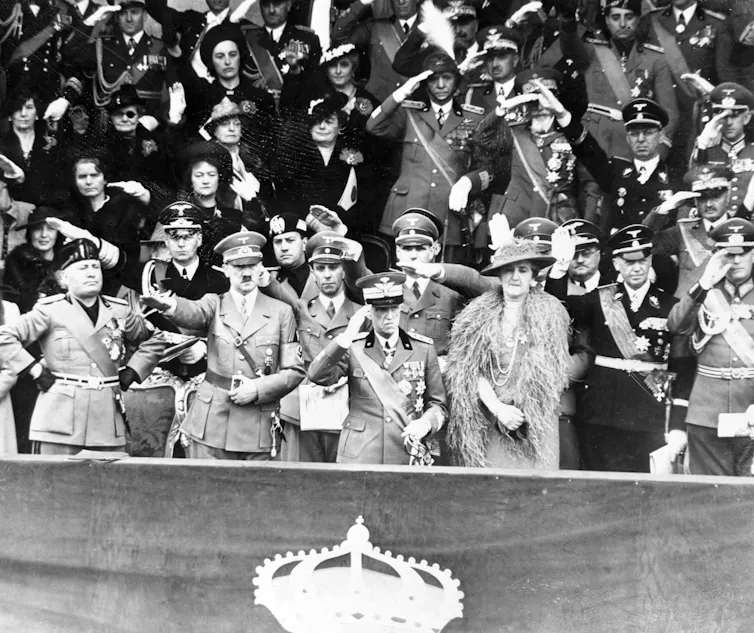
Benito Mussolini, Adolf Hitler, King Victor Emmanuel III and Queen Elena watch a parade held in Hitler’s honor in 1938. Behind them, from left: Joachim von Ribbentrop, Galeazzo Ciano, Joseph Goebbels and Rudolf Hess. Bettmann/Getty Images
Before becoming Hitler’s foreign minister, he was a wine salesman whose years in Canada became his qualification for understanding America. He attached himself to Hitler and was rewarded with a top seat in his government, where Ribbentrop’s signature contribution was overruling the diplomats who warned that Americans would fight if pushed too far by the Axis.
The Nazi view prevailed: Americans were too racially mixed, too soft, too consumed by money to be dangerous. When Germany declared war on the U.S. four days after Pearl Harbor, it did so partly on that disdain for what Hitler called a “mongrel nation.” Ribbentrop was among the most consequentially wrong foreign ministers in modern history – he’d also misjudged Britain’s willingness to join the war over the invasion of Poland – still, he kept his job.
Attempting to match Hitler’s conquests and assert dominance over the Mediterranean, Mussolini invaded Greece in October 1940 with shorthanded divisions, in mountain terrain and at the start of winter, because he believed Italian spirit would overwhelm Greek resistance in two weeks. His generals had doubts, but many did not express them. The Greeks counterattacked, but Mussolini blamed his generals’ “insufficient will,” the only kind of failure his theory allowed. Germany had to intervene.
What the leader said happened
Connected to the fascist superiority complex is a contempt for feedback, creating a closed information system that can’t register failure, tolerate disagreement or revise a plan. Strategy requires accurate reporting, even when the news is bad, and the willingness to be wrong. Fascist regimes punish the first and refuse the second.
German high command was still reporting a controlled advance in November 1942 when its 6th Army, some 330,000 soldiers, was being encircled at Stalingrad. Hitler had declared the city practically taken; the press never reported the Soviet counteroffensive that surrounded it. When the remnants finally surrendered on Feb. 2, 1943, it was a turning point in the war – Germany’s first catastrophic defeat on the Eastern Front, from which the Wehrmacht never recovered.
Mussolini bragged about his mighty army of 8 million soldiers while 3.5 million – the real number – were being routed on three fronts in as many years.
In that environment, officers had every incentive to lie up the chain of command when reality on the ground did not match what leaders wanted to hear. For example, after the Battle of Midway, a catastrophic defeat for Japan in June 1942, naval headquarters filed reports that bore little resemblance to what happened. Later that year, the Imperial Navy told Tokyo they had sunk twelve American ships near today’s Taiwan when they had merely damaged two.
Two years of retreat later, the kamikaze program – which sent some 3,900 pilots to their deaths in suicidal crashes against Allied ships – was the logical conclusion: Let pilots prove their loyalty by dying.
John Broich does not work for, consult, own shares in or receive funding from any company or organization that would benefit from this article, and has disclosed no relevant affiliations beyond their academic appointment.
The fund, the result of a settlement of legal claims by Donald Trump and his family against the IRS, aims to compensate those who “suffered weaponization and lawfare” at the hands of the federal government. It has already been called a “slush fund” by the New York Times editorial board, which noted – as many have – that it’s likely to pay much of its US$1.8 billion funding to Trump allies who rioted at the U.S. Capitol on Jan. 6, 2021.
What is the Judgment Fund, and why was it created?
The Judgment Fund is a permanent, indefinite appropriation that Congress established to pay most judgments and settlements against the federal government. Prior to 1956, whenever a judgment or settlement was agreed upon or finalized, Congress would have to appropriate money to pay it. That meant the administration and Congress would have to go through kind of a karaoke: “Here’s a new settlement, here’s why it should be approved.” “OK, we approve it.” And it took up a lot of time and didn’t produce much good effect.
So the old General Accounting Office recommended that Congress set up a system that would pay some claims automatically, and in 1956, Congress established the Judgment Fund. It allows payment of settlements and judgments if those payments were final and not authorized or provided for by some other legally available appropriation.
Congress essentially handed over responsibility for paying for settlements and judgments, which was taking up a lot of time, to the executive branch?
Yes, the Department of Justice would do the paperwork and say this is final, or this is an appropriate settlement, send that to Treasury, Treasury then certifies that it was properly documented, and then orders the payment.
From the constitutional perspective, it appears that Congress was getting rid of an annoying thing that it had to do, but wasn’t it also giving away its power of the purse?
Yes, but only in a limited way to begin with. When the Judgment Fund was first established, any settlement or judgment that could go through the process had to be less than US$100,000. That worked so well that Congress increased the amount a couple of times, and then ultimately in 1977 said there’s no cap. It’s a permanent indefinite appropriation, and once it was established, nobody ever has to go back to Congress to ask that it be updated or refilled. It works automatically.
The administration’s Todd Blanche, acting head of DOJ, and Vice President JD Vance are grilled on May 19, 2026, over the $1.8 billion fund.
You’ve written and given testimony about concerns you have with the Judgment Fund, over quite a few years and spanning several administrations. What are those concerns?
The concern is that under our system, Congress should be responsible for – and is responsible for – appropriating money.
The Obama administration also went much further in litigation involving claims of civil rights violations by the Department of Agriculture.
The Obama administration’s use of the Judgment Fund in class action suits for discrimination in Department of Agriculture civil loan programs struck me as really bad policy. After class action suits by Hispanic and female farmers had largely failed, the Obama administration announced that it had created a new program, the Hispanic or women farmers and ranchers claims process. This new program was funded with $1.3 billion from the Judgment Fund and open to people who had not been involved in the litigation. It was unilaterally created without congressional input or an appropriation. It wasn’t illegal, but it was using the Judgment Fund in a way that Congress had certainly never anticipated.
When that happened, my antenna went up, because for many years I was at the Department of Justice defending cases involving the Judgment Fund in cases alleging wrongful acts or omissions by federal employees. I defended suits brought against the government for auto accidents, medical malpractice, flood cases, wild animals, a wide range of things. Seeing the potential for abuse, I started suggesting that Congress amend the Judgment Fund to cap any settlement at $500 million. Above that cap, you’d have to go to Congress.
That hasn’t happened.
Donald Trump-aligned rioters take over the steps of the Capitol on Jan. 6, 2021, as Congress works to certify the Electoral College votes. Bill Clark/CQ-Roll Call, Inc via Getty Images
What did you think when you first heard about the establishment of this $1.776 billion pot, using the Judgment Fund, to compensate the so-called victims of lawfare?
I was surprised. I always expected someone would do this kind of a thing again, but I had not foreseen this one coming. And then I thought I was right: We should have amended the Judgment Fund.
The Obama administration had manipulated the fund to create the Women and Hispanic Farmers and Ranchers Claims Process without congressional input or approval. Having seen that blueprint, the Trump administration has similarly manipulated the fund to create the Anti-Weaponization Fund without congressional input or approval.
In each case, the administration believes that the people that are being compensated are worthy and should get compensation, even though they would have a lot more difficulty getting it without the creation of such a thing.
Now that it’s been used twice, unless Congress steps in, I have no doubt this scheme will be used again by another administration. It’s bad government; it’s not how our system was set up. Congress has the power of the purse. Congress, rather than the executive, has the authority to create and fund programs. The executive branch should not have it own source of funds. The Judgment Fund should not be used as an executive branch piggy bank.
Has it occurred to you to say I told you so?
Yes. I called my daughter – she appreciates certain gallows humor – and I told her that just what I’d predicted had happened. She said, “Well, aren’t you happy about that?” and I said, “Well, I’m not happy that it happened, but I’m happy that I saw it and have been out preaching about it – with remarkable lack of success.”
Paul Figley does not work for, consult, own shares in or receive funding from any company or organization that would benefit from this article, and has disclosed no relevant affiliations beyond their academic appointment.
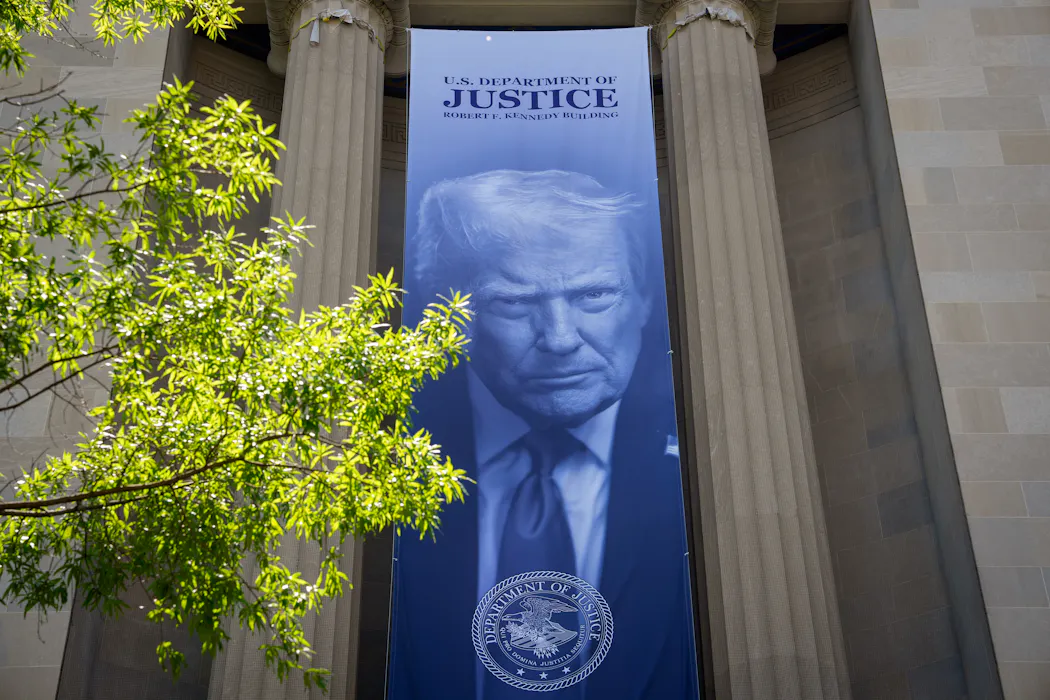
A banner featuring President Trump on the outside of the DOJ building in Washington, D.C.Andrew Harnik/Getty Images
Thomas Hobbes took a very dim view of rebels and insurrectionists. He believed that insurrectionists relinquish their status as citizens the moment they seek to overthrow the government and should never be rewarded for doing so.
Hobbes, one of the finest political theorists of his time, said this in his great political treatise, “Leviathan,” published in 1651 during a civil war in England and Scotland.
Hobbes would likely also take a dim view of a major development announced by the Trump administration on May 20, 2026.
The U.S. Department of Justice has established a US$1.776 billion “Anti-Weaponization Fund,” to be used, the AP reports, to “allow people who believe they were targeted for prosecution for political purposes, including by the Biden administration Justice Department, to apply for payouts.”
The fund, Acting Attorney General Todd Blanche said, offers “a lawful process for victims of lawfare and weaponization to be heard and seek redress.”
The establishment of the fund is part of a settlement agreement, in response to which President Donald Trump dropped his $10 billion lawsuit against the Internal Revenue Service for damages stemming from the leak of his tax returns. Those leaks, the lawsuit alleged, “caused Plaintiffs reputational and financial harm, public embarrassment, unfairly tarnished their business reputations, portrayed them in a false light, and negatively affected President Trump.”
A DOJ press release indicates the fund will provide “formal apologies and monetary relief” to those who file claims and will cease processing claims “no later than” Dec. 1, 2028. It will be run by a five-person board appointed by the attorney general, and the president will also have the power to remove board members.
Whether or not Jan. 6 participants benefit, some believe that this situation creates an unavoidable appearance of self-dealing and favoritism. As a student of American law and political morality, I think there are important moral and constitutional issues implicated by the president’s suit against the IRS and the creation of the Anti-Weaponization Fund.
Some of them are straightforward; others are less so.
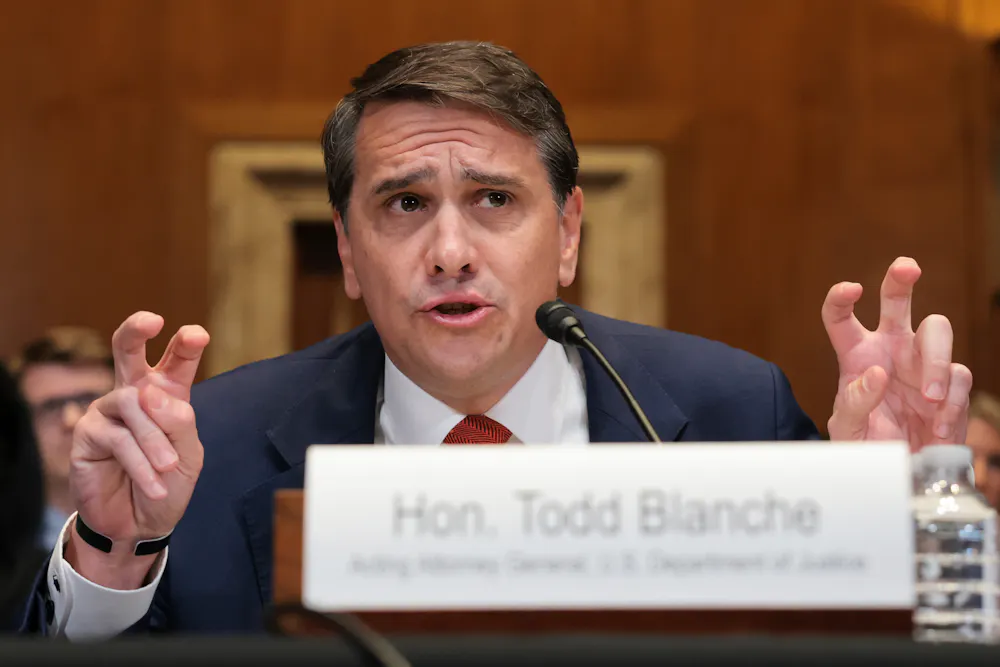
Acting U.S. Attorney General Todd Blanche testified about the compensation fund during a Senate Committee on May 19, 2026, in Washington, D.C. Anna Moneymaker/Getty Images
A judge in their own cause
An obvious question is: Should taxpayer funds be given to Trump allies, in a settlement reached by the Trump-controlled DOJ as compensation for a Trump family lawsuit?
As far back as ancient Greece, philosophers like Aristotle have worried about what happens when people are called on to make judgments in cases where they are involved. Aristotle thought that the natural instinct for self-preservation meant that they would always favor themselves.
From that concern emerged what was then, and remains, an uncontroversial, bedrock moral principle.
In the Roman world, the Latin phrase “Nemo iudex in causa sua” meant “no one should be a judge in their own cause.” It recognized that anyone having a personal interest should not get to decide matters in which they are involved.
In the Englsh-speaking world, Hobbes himself reiterated that phrase as he explained some of the advantages of living in an organized society, which could supply impartial judges to resolve disputes. And in 1787, James Madison wrote, “No man is allowed to be a judge in his own cause, because his interest would certainly bias his judgment, and, not improbably, corrupt his integrity.”
Commentators reacting to the Justice Department’s decision to establish an Anti-Weaponization Fund to settle the president’s claims against the IRS have drawn on these longstanding principles to criticize it, including how the DOJ, which is part of the executive branch controlled by Trump, negotiated with him to reach this settlement.
The conservative lawyer and activist Ed Whelan said, “There is a glaring conflict of interest with Trump being on both sides of the claim.” Whelan added, “It is outrageous that he and those answering to him would be deciding how the government responds to these extravagant claims.”
“It’s not limited to Republicans. It’s not limited to Democrats,” Blanche added. “It’s not limited to January 6th defendants. It’s limited only by the term weaponization.” Blanche promised that payments from the fund will be publicly disclosed.
Negotiating with himself
In April, Kathleen Williams, the Florida federal judge who was presiding over Trump’s lawsuit, reframed the moral issue of self-dealing as a legal one. She questioned whether the case could go on, noting “President Trump’s own remarks about this matter acknowledge the unique dynamic of this litigation.”
The remarks she referenced occurred when the president talked about the lawsuit and the prospect of negotiating with himself. “And they do say that, you know, it’s never been a case like this. Donald Trump sues the United States of America. Donald Trump becomes president, and now Donald Trump has to settle the suit.”
Williams, the judge, wrote that “it is unclear to this Court whether the Parties are sufficiently adverse to each other so as to satisfy Article III’s case or controversy requirement.” That requirement means that a court can only rule when there is a real dispute before it.
That rule is designed to prevent so-called collusive lawsuits, in which “the parties are not actually in disagreement but are cooperating” to achieve a result. Judge Williams was scheduled to hear arguments on that question on May 20, 2026. But the settlement announcement was made two days before, and, in light of it, she dismissed the case.
Back to Hobbes
Beyond the case and controversy question, the Justice Department’s actions may implicate constitutional issues.
Another is whether the fund violates the Constitution’s Emoluments Clause, which prohibits the president from receiving any “Emolument from the United States” other than his salary.
While the new fund may not make direct payments to Trump, he may benefit from payments to family members, business associates and others who will claim to have been victimized by the Biden administration, including people prosecuted and convicted of crimes committed on Jan. 6.
Referring to the president, Raskin argues hypothetically, “So, to the extent that he wants to give a million dollars to each of 1,600 pardoned rioters and insurrectionists, we think that that’s an unconstitutional use of money.”
That section of the 14th Amendment was designed to ensure that Confederate rebels would not receive compensation for the value of their emancipated slaves. However, in Perry v. United States, a 1935 case, the Supreme Court stated that Section 4’s “language indicates a broader connotation” beyond its Civil War context.
It seems clear that courts will soon be asked to decide whether Raskin and other legal critics are right in their assertions of a host of legal problems with the Anti-Weaponization Fund. How they will do so remains to be seen.
But, in a democracy, deciding whether the creation of the fund violates the moral maxim that no one can be a judge in his or her own cause ultimately will be up to the people.
Austin Sarat does not work for, consult, own shares in or receive funding from any company or organization that would benefit from this article, and has disclosed no relevant affiliations beyond their academic appointment.
The Election Security Group turns intelligence about foreign election threats into warnings and offensive operations.Charly Triballeau/AFP via Getty Images
With the 2026 midterms less than six months away, the Election Security Group would normally be busy helping prepare the nation’s election infrastructure. The federal task force typically briefs Congress on upcoming threats and engages with state and local leaders to game out scenarios ranging from ransomware to critical infrastructure attacks on Election Day.
These losses – and the disbanding of other federal offices that counter foreign influence operations – make it harder for local officials to learn of threats to election infrastructure, like AI-enabled targeting of voting tabulation systems or deepfakes of candidates. Little is known about whether the proactive cyber deterrence that has defined U.S. elections for much of the past decade remains in place in any other form.
I’m a scholar of global efforts to secure democracy, and I co-edited a book called “Securing Democracies” about cyberattacks and disinformation worldwide. I can attest to the importance of guarding against foreign efforts to undermine trust in U.S. elections and believe that, without groups like the EI-ISAC and the Election Security Group in place, the 2026 midterms could mark a milestone: For the first time in perhaps a decade, the next election may be less secure than the last.
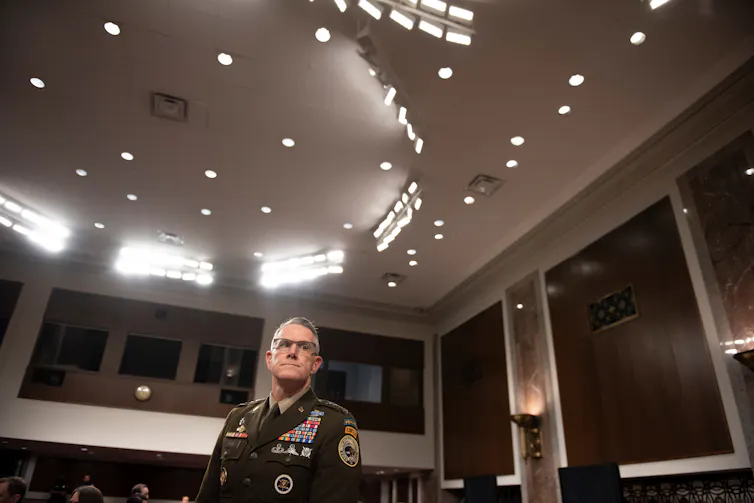
Gen. Joshua Rudd, who’s in charge of the two agencies that jointly run the Election Security Group, told the Senate Armed Services Committee on April 28, 2026, that he didn’t know if the group had been set up yet for the midterm elections. AP Photo/Cliff Owen
A decade of election defense
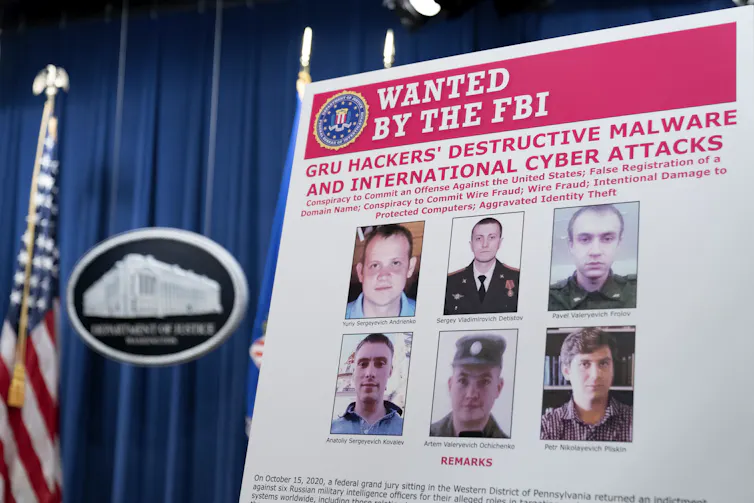
The Russian-backed Internet Research Agency began targeting the U.S. political system to sow divisions in 2014. Thanks to Internet Research Agency troll farms – organized groups paid to flood social media platforms with fake or divisive content – disinformation proliferated through the 2016 election. At the same time, Russia’s GRU – its military intelligence agency – homed in on the Democratic National Committee and probed all 50 state election systems. It breached Hillary Clinton’s campaign and compromised election systems in Illinois.
Though there is no evidence that votes were altered as a result, Russian influence exposed the country’s election vulnerabilities and set the stage for extensive investigations and hearings questioning how the U.S. government should respond. It left lasting damage in its wake, like lower trust in electoral processes and widened political divides.
In the final weeks of the Obama administration, the Department of Homeland Security designated election infrastructure as critical, akin to water and electricity. The first Trump administration built on that designation and created the Cybersecurity and Infrastructure Security Agency, a component of the Department of Homeland Security, in 2018. That same year, the National Security Agency and U.S. Cyber Command – the military nerve center for cybersecurity – partnered to launch what was initially called the Russia Small Group, a task force to guard U.S. election infrastructure against Russian interference.
Since at least the Obama administration, the U.S. had been largely focused on defensive measures to protect elections, like multifactor authentication and encryption, which make it harder to compromise systems in the first place. The Trump administration wanted to be more proactive, to put adversaries on notice and deter future attacks. This approach is known as defending forward, or persistent engagement.
The test for this new, more activist policy came during the 2018 midterms, as the Internet Research Agency again tried to widen divisions in U.S. society through hundreds of thousands of manufactured tweets and posts that made divisive views appear more widely shared than they were on both sides of hot-button issues. This time, however, the Russia Small Group took the Internet Research Agency offline during and immediately after the election. Although the details are classified, public reporting indicates that Cyber Command temporarily disrupted the Internet Research Agency’s internet access and sent direct messages to operatives warning them against such activities and instructing them to not interfere in U.S. elections.
By the 2020 presidential election, the Russia Small Group had been renamed the Election Security Group, and its scope expanded beyond Russia to include China, Iran, North Korea and nonstate actors. It worked to “disrupt, deter and degrade foreign adversaries’ ability to interfere with and influence how U.S. citizens vote and how those votes are counted.”
The Election Security Group does this through detailed information-sharing across agencies and with local officials and the private sector. If, for instance, a foreign influence campaign falsely claims that polling places have closed early in a swing state, the Election Security Group can alert election officials, platforms and distributed cybersecurity teams before the claim goes viral. In true “defend forward” spirit, it can also help cut off foreign trolls and state-backed hackers from what’s needed to run an influence operation, like internet access, servers and accounts.
Typically, it is active during election years, serving as a vital coordination hub and turning intelligence about foreign election threats into warnings, defensive measures and offensive operations.
The Election Security Group’s absence comes at a time when both threats and technological vulnerabilities are multiplying.
These challenges – combined with losing the EI-ISAC and, possibly, the Election Security Group – could leave the U.S. less prepared this November. Local and state election officials have fewer places to turn for the latest intelligence, and Congress is less informed about pressing threats – all while global U.S. standing is slipping and foreign adversaries could feel emboldened.
The Election Security Group, which was created by the first Trump administration – alongside both the Elections Infrastructure Information Sharing and Analysis Center and the Cybersecurity and Infrastructure Security Agency – has been an important weapon in the U.S. arsenal to defend vulnerable election systems. What fills these gaps remains unclear. One outlet has reported that plans to revive the Election Security Group are beginning to move through senior intelligence and defense channels, weeks after Rudd’s testimony. Even if the group is activated immediately, it will have less than six months to do what it has historically done across a full election year. With early voting beginning in some states even sooner, the clock is ticking.
The views expressed in this article are the author’s own.
The National Park Service removed an exhibit on slavery at the President’s House site in Philadelphia on Jan. 22, 2026.AP Photo/Matt Rourke
On the evening of May 21, 1796, Ona Judge made the daring decision to free herself.
Considering the prominence of her owner, the laws of the time and the dangerous trek to New Hampshire, a place where she could discreetly live freely, the act carried remarkable risk. Nevertheless, she slipped out of the President’s House undetected while the first family dined.
The house, then located at the intersection of 6th and Market streets in Philadelphia, served as the first executive mansion. It stood mere feet from Independence Hall, where the nation adopted its lofty language regarding freedom.
The slavery exhibition at Independence Hall opened in December 2010. It was the first slavery memorial on federal land in U.S. history. Michael Yanow/NurPhoto via Getty Images
Years later, Judge described her narrow escape to Rev. Benjamin Chase in an interview for the abolitionist newspaper The Liberator. Judge told Chase, “I had friends among the colored people of Philadelphia, had my things carried there beforehand, and left Washington’s house while they were eating dinner.”
Prior to her escape, Judge served as a chambermaid in the President’s House. She spent years tending to Martha Washington’s every need: bathing and dressing her, grooming her hair, laundering her clothes, organizing her personal belongings, and even periodically caring for her children and grandchildren.
Being a chambermaid also included grueling daily tasks such as maintaining fires, emptying chamber pots and scrubbing floors.
Even though she engaged in this arduous labor as property of the Washingtons, living in Philadelphia provided Judge a glimpse of what freedom could eventually look like for her. Historians estimate that 5% to 9% of the city’s population at the time were free Black people. Prior to her escape, Judge befriended several of them.
In the spring of 1796, the Washingtons prepared to return to Virginia to resume private life. President Washington issued his farewell address in the fall of 1796, but he told family and close confidants of his plans earlier in the year.
During that time, Martha Washington made arrangements for their pending return to Mount Vernon. Her plans included bequeathing Ona Judge to her granddaughter, Elizabeth Parke Custis, as a wedding gift. Upon learning this, Judge made plans of her own.
In her interview with Chase she explained, “Whilst they were packing up to go to Virginia, I was packing to go, I didn’t know where; for I knew that if I went back to Virginia, I should never get my liberty.”
As a civil rights lawyer and professor in the Africology and African American Studies department at Temple University in Philadelphia, I study the intersection of race, racism and the law in the United States. I am pleased that the city of Philadelphia has decided to honor May 21 as “Ona Judge Day” starting this year, as I believe Judge’s story is vital to the telling of America’s history, despite attempts by the Trump administration to erase that legacy.
Before January 2026, those who wished to learn about Judge could literally stand on the same walkway in Philadelphia where Judge once stood when she chose to flee. Several footprints, shaped like a woman’s shoes and embedded into the pathway outside of where the President’s House once stood, memorialize the beginning of Judge’s journey. These footprints composed part of an exhibit examining the paradox between slavery, freedom and the nation’s founding.
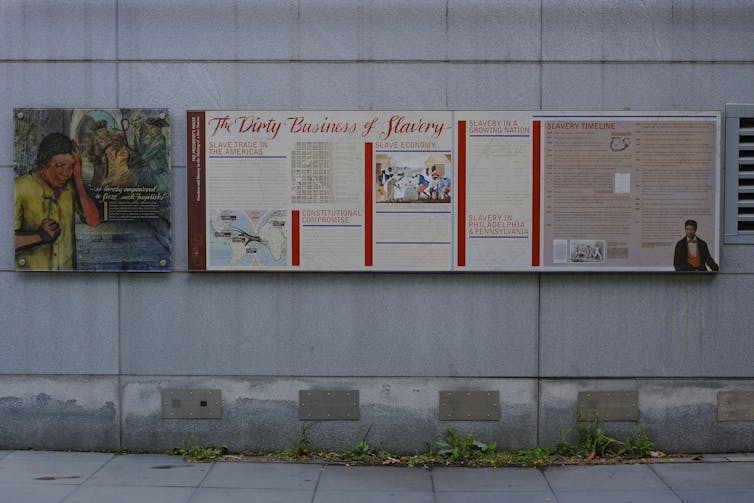
The exhibit, “Freedom and Slavery in the Making of a New Nation,” also included 34 explanatory panels bolted onto brick walls along that sidewalk. They provided biographical details about the nine people the Washingtons owned while living in the presidential mansion. The exhibit presented the sobering reality that our nation’s first president enslaved people while he held the nation’s highest office.
These and other panels discussing the founders’ owning of slaves were removed in late January 2026, after an executive order issued by President Donald Trump in March 2025 called to eliminate materials deemed disparaging to the Founding Fathers or the legacy of the United States. Matthew Hatcher/Getty Images
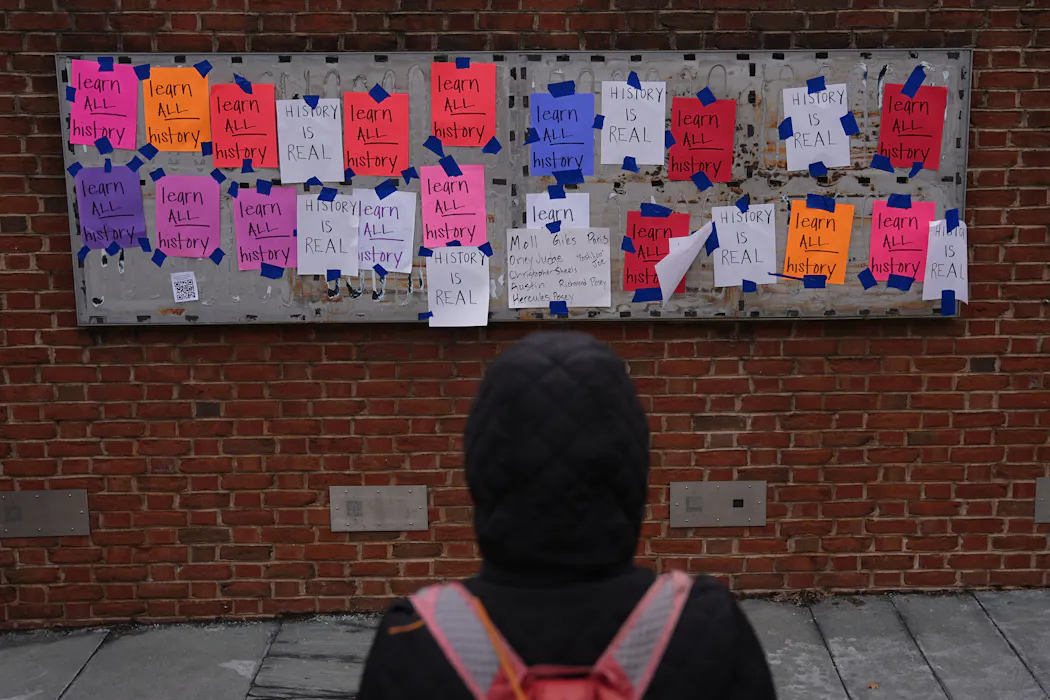
This changed in late January when the National Park Service dismantled the slavery exhibit at Philadelphia Independence National Historic Park. The removal sparked intense, immediate outrage from people across the country dismayed by the attempt to suppress unfavorable aspects of American history.
Philadelphia Mayor Cherelle Parker responded swiftly. “Let me affirm, for the residents of the city of Philadelphia, that there is a cooperative agreement between the city and the federal government that dates back to 2006,” she said in a public statement. “That agreement requires parties to meet and confer if there are to be any changes made to an exhibit.”
The city of Philadelphia later sued Interior Secretary Doug Burgum and National Park Service acting Director Jessica Bowron. Pennsylvania subsequently filed an amicus brief in support of the city’s lawsuit.
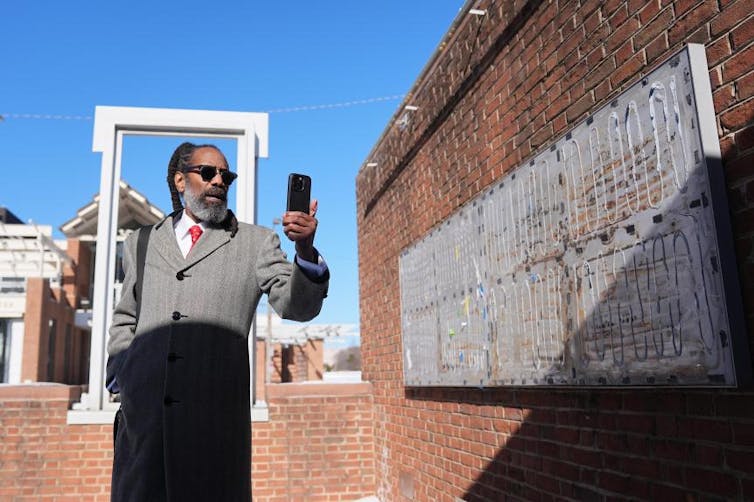
Civil rights activist and Philadelphia-based attorney Michael Coard had an opportunity to visit and examine the exhibits in storage prior to a ruling from Rufe that ultimately ordered their restoration. Coard led the fight to create and preserve the exhibit and later led the fight to restore it.
Philadelphia-based attorney Michael Coard, who helped lead the effort to create the exhibition, visited the site after its removal. AP Photo/Matt Rourke
Limiting discussion of race
In ruling to “reinstall all panels, displays, and video exhibits that were previously in place,” Rufe referenced George Orwell’s “1984.” She chided the federal government’s efforts to “dissemble and disassemble historical truths.” Critics had raised similar concerns and argued that the National Park Service’s dismantling of the exhibit was an attempt to “whitewash history” and erase stories like Ona Judge’s.
Avenging the Ancestors Coalition, a Philadelphia-based organization dedicated to preserving Black history, has scheduled a celebration on May 21, 2026, at Independence Hall to honor Ona Judge Day and Judge’s courageous escape more than two centuries ago.
Organizers feel greater urgency to share this history around slavery in the U.S. because of actions by the federal government that seek to suppress it. For example, the Trump administration has restored and reinstalled two Confederate monuments of Albert Pike in Washington and Arlington National Cemetery, while it removed the slavery exhibit in Philadelphia.
Similarly, during the first Trump administration, the federal government engaged in various efforts to counterbalance the 1619 Project, a project spearheaded by Pulitzer-winning journalist Nikole Hannah-Jones that discussed the 400th anniversary of slavery’s beginnings in America. The 1619 Project spawned yearslong backlash. This included the 1776 Commission, created during the first Trump administration, which tried to discredit the conclusions of the 1619 project.
This pattern has intensified as the United States prepares to celebrate the 250th anniversary of the framers signing the Declaration of Independence. As the nation celebrates its history, it must decide how much of it to explore.
_This is an updated version of an article originally published on Feb. 11, 2026.
At a time when hard-fought primary elections in Georgia, Kentucky and Indiana and Ohio are making national news, perennial battleground Pennsylvania seems to be nodding through one of the sleepiest primary seasons in a long time.
I’m an associate professor of political science at the University of Pittsburgh. My research focuses on how political institutions like political parties and state and local governments affect political representation.
In statewide races, only the Republican lieutenant governor slot is contested, a race between GOP-endorsed attorney Jason Richey and newcomer John Ventre. In the state Senate, less than a third of incumbents drew a challenger. Only 21 of the 203 state Assembly seats see an incumbent facing an in-party challenge. So why does Pennsylvania, usually a hotbed of political strife, appear to be sitting this midterm primary season out?
Uncontested primaries are normal
According to political scientists Shigeo Hirano and James M. Snyder Jr., uncontested primaries, and uncontested elections in general, are normal – and can even be a good thing. They argue it’s because high quality candidates do not tend to draw a challenge. This means that an uncontested primary signifies the district has no potential candidates who both want the job and think they can win against the incumbent.
The biggest reason challengers stay home is because of a well-dug-in incumbent, and Pennsylvania had plenty of those this cycle. Unlike in Indiana, no wave of anti-establishment energy is giving long-shot challengers a fighting chance.
Interestingly, the moderate Trump foe and incumbent Brian Fitzpatrick, a Republican state representative from Bucks County, managed to avoid a primary challenge this year. Fitzpatrick was one of only two Republicans to vote against the H.R. 1 Act – also known as President Donald J. Trump’s “One Big Beautiful Bill.”
The only other dissenting vote came from Kentucky’s Thomas Massie — and the President responded by personally recruiting a primary challenger to run against him.
Why Pennsylvania’s Fitzpatrick got a pass
So how did Fitzpatrick manage to avoid Trump’s notice? It helps to compare his political fortunes with Massie’s.
Massie’s district is solidly red. He typically wins at least 60% of his general election vote. In 2024, no Democrat even ran against him.
Fitzpatrick, on the other hand, hails from a decidedly “purple” district where the vote could go in either party’s direction. He rarely wins more than 55% of the vote, and is perennially on the list of the most at-risk Republican incumbents.
In other words, in a midterm election in which Republicans face strong competition and fear losing the House of Representatives, Republicans need Fitzpatrick more than they need Massie. Without Fitzpatrick, his district is much more likely to fall in the Democratic column. Without Massie, Republicans can still expect to keep the seat red.
Pennsylvania parties hold the key
Pennsylvania incumbents have mostly been able to avoid finding themselves part of a larger conflict.
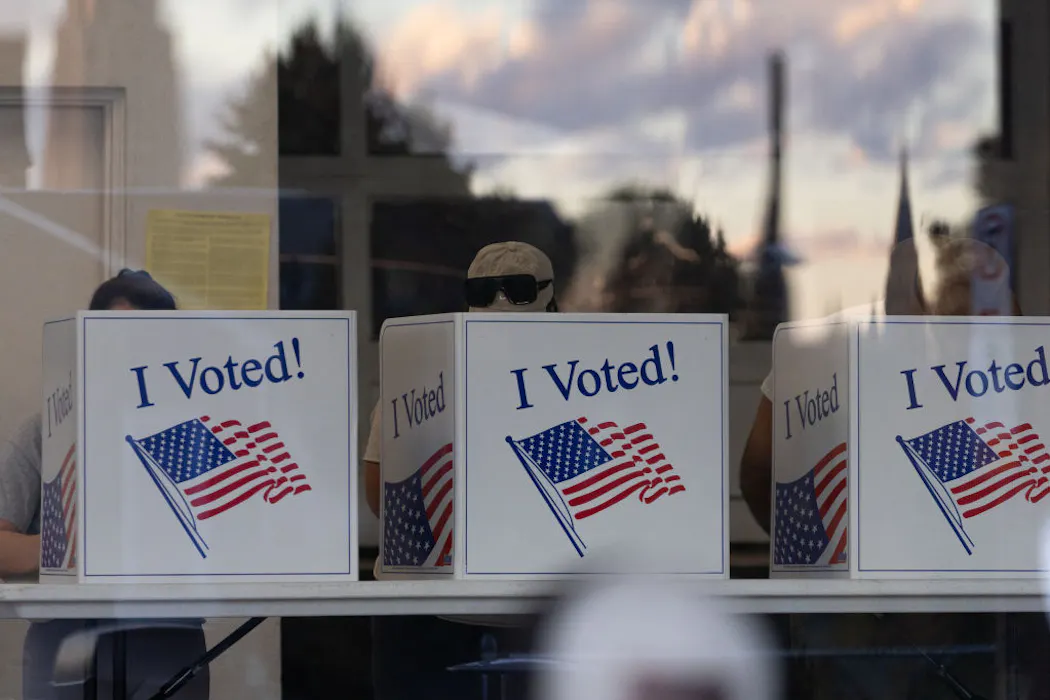
Pennsylvania remains one of only 13 American states that holds closed primary elections. That means voters must already be registered as party members to vote in that party’s primary. In an open, or even semi-open, primary state like Michigan and Iowa, potential challengers can try to win a primary election by relying on new voters choosing to align with the party only for that election day, or even for that specific election.
A closed party system gives party regulars, and the party organization itself, enormous sway over who gets nominated. Potential candidates in closed-party states are much better off working within the party organization and waiting for an incumbent to step down before throwing their hats in the ring.
Pennsylvania is a closed-party state and a swing state. In an election cycle in which political parties from West Virginia’s Republicans to California’s Democrats seem to be turning on their own members, Democrats and Republicans in the Commonwealth of Pennsylvania have managed to keep their parties more unified.
The desire for party fealty is strong, but not as strong as the need to win in the general election. Pennsylvania parties are powerful, and they are staying cautious until November. An uncontested primary, in other words, isn’t a sign of apathy. In Pennsylvania, it’s strategy.
Kristin Kanthak does not work for, consult, own shares in or receive funding from any company or organization that would benefit from this article, and has disclosed no relevant affiliations beyond their academic appointment.
One of NOAA’s WP-3D Orion hurricane hunters, dubbed Miss Piggy, flies over Tropical Storm Idalia on Aug. 28, 2023.Nick Underwood/NOAA
The 2026 Atlantic hurricane season starts June 1, and while a developing El Niño might result in a tamer season than in the past few years, all it takes is one big storm hitting a populated area to make it a bad hurricane season.
Every year, Americans rely on accurate forecasts when hurricanes might be developing to know when to stock up on supplies, prepare for power outages or evacuate.
Those forecasts have improved dramatically in recent decades, but the improvements can’t be taken for granted. Over the past year, federal funding cuts and job losses in the very programs that are helping make Americans safer from extreme weather threaten to stall progress and stretch forecasting resources to the breaking point.
Hurricane track forecasts have become more accurate over the past three decades. For example, recent forecasts showing where a storm is expected to be in 96 hours have been, on average, about as accurate as a 24-hour track forecast was in the early 1990s. That gives people more time to evacuate. The lines show how many miles off the National Hurricane Center’s official storm tracks were. National Hurricane Center
I am an atmospheric scientist whose research focuses on hurricanes, including how and why they intensify or weaken. I also work with scientists at the National Atmospheric and Oceanic Administration, NOAA, to analyze observations collected by reconnaissance aircraft and evaluate computer model forecasts of hurricanes.
Here’s what forecasters rely on during hurricane season and why investing in science, forecasting technologies and the people who run them matters.
Flying through hurricanes
To have the best chance of an accurate hurricane forecast, computer models and meteorologists need to know about the location, intensity and structure of a hurricane, along with the environment that surrounds it. Satellites are crucial for tracking storms from above, but many details can be collected only inside the storm, where satellites can’t see.
That’s why NOAA relies on “hurricane hunters” – a group of skilled pilots and scientists who fly through storms all season long to collect storm data, which is quickly transmitted to forecasters and computer models.
Flight Director Quinn Kalen at his work station during a flight into Hurricane Lee on Sept. 8, 2023. Lt Cmdr Utama/NOAA Corps A radar display shows NOAA’s Miss Piggy hurricane hunter aircraft in the center of Tropical Storm Idalia on Aug. 28, 2023. Nick Underwood/NOAA
When storms are developing, the U.S. Air Force Reserve and NOAA conduct several hurricane hunter flights per day to provide the most up-to-date storm information. During these missions, the crews often fly directly into the storm, through screaming winds and heavy rain, to release instrument packages called dropsondes.
The dropsonde is a feat of science and engineering, able to accurately measure the temperature, humidity, wind and pressure in hostile conditions. This data is radioed back to the aircraft. From there, it is processed and transmitted to NOAA, where forecasters analyze it and computer models use it to initialize forecasts.
A NOAA scientist explains how hurricane forecasters use dropsondes.
A big reason hurricane forecasts have gotten better has been federal investments in computer models that can simulate these storms.
In 2008 the U.S. government funded the NOAA Hurricane Forecast Improvement Project, leading to substantial advancements in computer modeling and forecast accuracy. Computer models got better at incorporating the observations gathered by aircraft, showing air movements and rain bands in greater detail.
A HAFS radar forecast shows Hurricane Melissa as it approaches Jamaica in October 2025. The HAFS model performed well in forecasting the intensification and extreme strength of the Category 5 storm in the days leading up to its landfall in Jamaica. NOAA/AOML/HRD
When storms rapidly intensify, as several have done in recent years, they can pose an acute risk to coastal communities. More accurate forecasts give people and communities better information to decide how to prepare and when they need to evacuate. Improvements since 2007 have resulted in an estimated US$2 billion in savings per hurricane landfall and many lives saved.
There are some exciting developments ahead in hurricane observations and modeling.
NOAA in 2024 ordered two new aircraft, expected to be delivered by 2030, to begin replacing its aging hurricane hunter fleet so fights and their data collection can continue.
Private companies working with NOAA have deployed and tested autonomous drones – both in the air and sail drones on the ocean surface – that can collect data in areas where quality observations are hard to get.
Additionally, artificial intelligence weather models have emerged, such as Google DeepMind, which made a big splash as the most accurate forecast model of the 2025 hurricane season.
Some lingering dark clouds
Despite these promising developments, a different storm is eroding the bedrock upon which the national weather forecast enterprise sits.
Cuts in funding and staffing have stressed NOAA’s ability to collect critical observations. Last year, retired NOAA scientists volunteered to staff hurricane hunter reconnaissance flights so the missions could still be flown.
Knowing when to evacuate is crucial. Hurricane Helene made a mess in Horseshoe Beach, Fla., on Sept. 28, 2024. The storm was blamed for at least 250 deaths across six states. Chandan Khanna/AFP via Getty Images
I worry about the funding and staff cuts stressing systems that keep scientific progress marching forward and warn Americans about hazardous weather. Losing staff and support raises the risk of critical failures, such as delayed severe weather warnings and broken equipment causing new blind spots when storms threaten. In the long run, failing to invest risks stagnation or even reversing the hard-fought progress the U.S. has made in advancing weather prediction.
With coastal populations and development expanding over the past few decades, and storms becoming stronger, the vulnerability of the U.S. to costly, damaging hurricanes has increased dramatically. It is more important than ever that public investment in hurricane science and forecasting continue.
Brian Tang receives funding from the National Science Foundation, the National Aeronautics and Space Administration, and the Center for Western Weather and Water Extremes. He has research collaborations with the National Oceanic and Atmospheric Administration’s Hurricane Research Division. He is a member of the American Meteorological Society.
The first half of 2026 has been a chaotic time for U.S. foreign policy: new tariffs, threats to annex Greenland, the capture of Venezuelan President Nicolás Maduro and the struggle for control of the Strait of Hormuz.
As a researcher focused on the values and rhetoric of American presidents, I study how presidents and their administrations communicate to the public about foreign policy. My primary aim is to understand the values systems and policy priorities that make up a president’s public persona.
I have found the second Trump administration exceptionally difficult to track and assess. Keeping up with Truth Social posts, press conferences and off-the-cuff Oval Office remarks from the president can feel like drinking from a fire hose.
Gone for now are the days when a U.S. president stepped to the lectern and delivered a speech direct from the teleprompter or released a carefully crafted statement that was understood to be official U.S. policy.
In its place is an unpredictable barrage of communication – ranging from traditionally worded executive orders in the mold of previous administrations to an expletive-laden Truth Social post on Easter morning in the midst of Operation Epic Fury, the Pentagon name for the war in Iran.
In either case – whether it’s Trump’s defenders or detractors – it is increasingly difficult to ascertain whether the language of the president signals actual policy positions from the White House.
If the words of the American president no longer function as reliable indicators of U.S. foreign policy, where can the public, U.S. allies and America’s adversaries look to better understand the administration’s geopolitical priorities?
One answer may be found by examining the words of key Cabinet members.
Vance redefines ‘Western’ values
At the 2025 Munich Security Conference, U.S. Vice President JD Vance shocked gathered leaders when he spoke about ‘the retreat of Europe from some of its most fundamental values.’
Trump’s second term has introduced a political paradox: because he is president, his words carry enormous weight. And yet, because of his hyperbolic and often erratic communication style, each statement also carries significant political uncertainty.
The rhetoric of Cabinet members increasingly serves as a bridge between Trump’s erratic communication style and actual policy.
Public statements delivered in 2025 by Vice President JD Vance, Secretary of State Marco Rubio and Defense Secretary Pete Hegseth offered, I believe, critical insight into the administration’s foreign policy vision and helped lay the groundwork for major policy actions in 2026.
In February 2025, Vance stood at a lectern at the Munich Security Conference to address a gathering of prominent European political and military leaders. Many analysts expected an aggressive speech from Vance criticizing Europe’s spending on defense in the context of shared American-European security concerns, such as NATO and the war in Ukraine.
Instead, Vance argued that Europe’s political elites had failed to defend “Western” values. Speaking over audible gasps from attendees, Vance declared: “What I worry about is the threat from within, the retreat of Europe from some of its most fundamental values, values shared with the United States of America.”
Using freedom of speech as a shared value, Vance argued that many left-leaning European governments – not authoritarian-led Russia or Hungary – posed the real threat to this cornerstone of Western society.
As the first major foreign policy speech delivered abroad by the second Trump administration, Vance’s remarks signaled a major shift in America’s approach to the trans-Atlantic alliance.
The speech suggested that, in the eyes of the administration, the “values-and-interests” framework that shaped the U.S.-European relationship post-World War II had weakened. In that phrase, “values” are understood as a country’s moral and cultural preferences and its “interests” as the factors that advance its security and prosperity.
Instead, Vance argued that liberal values alone would no longer guarantee cooperation, and the administration made clear it would not avoid public fights over ideological differences with European allies.
The speech also appeared to send a clear signal to right-leaning political leaders in Europe, including then-Hungarian Prime Minister Viktor Orbán, that their brand of “Western” values had become increasingly attractive to Washington.
It is not difficult to connect Vance’s Munich speech to the administration’s subsequent embrace of right-leaning political leaders and its pullback from postwar liberal foreign policy priorities, such as a commitment to international aid.
Rubio: Trade over humanitarian aid
One of the most tumultuous domestic periods of Trump 2.0 came during the DOGE process of massive budget cutting, which eliminated programs across the government.
One DOGE flash point was the fate of the U.S. Agency for International Development, or USAID, which since 1961 had been the American government’s primary organization delivering humanitarian aid globally.
That same day, Rubio published an article on the State Department’s Substack account titled Make Foreign Aid Great Again, arguing for a new approach that prioritized “trade over aid, opportunity over dependency, and investment over assistance.”
Like Vance in Munich, Rubio adopted an overtly aggressive tone in criticizing both USAID and America’s broader humanitarian aid model. Rubio argued that the “charity-based model failed.” Rubio’s rhetoric built on and complemented themes from Vance’s speech.
First, it reinforced the administration’s broader free-ride-is-over argument that prioritized quid pro quo relationships over established liberal values-based commitments. While Vance applied this logic to European allies in the context of “Western” values and military support, Rubio applied it to humanitarian aid projects and America’s relationships across the Global South.
Second, Rubio’s remarks made clear that a quid pro quo foreign policy rooted in what he deemed to be U.S. national interests would increasingly shape State Department decision-making – regardless of the humanitarian consequences from cuts to international aid programs or multilateral institutions such as the United Nations.
Hegseth rewrites US rules of war
In September 2025, Secretary of Defense Pete Hegseth stood in the Oval Office alongside Trump to discuss his department’s renaming to the “Department of War.” Hegseth asserted that the War Department would focus on “maximum lethality, not tepid legality; violent effect, not politically correct.”
Viewed alongside the administration’s actions in late 2025 and into 2026 – from attacks on nonmilitary vessels around Venezuela to the extraction of Maduro, to the scale of destructive force deployed against Iran – the “maximum lethality” statement may prove to be one of the most consequential rhetorical moments from a Trump Cabinet official.
Pete Hegseth declares that the newly named Department of War will focus on ‘maximum lethality, not tepid legality; violent effect, not politically correct.’
As Operation Epic Fury continues, Hegseth has defiantly reaffirmed the administration’s “maximum lethality” posture. At one point he declared that “we negotiate with bombs,” and at another briefing he called for “no quarter, no mercy for our enemies” – a practice that violates international law.
These remarks and others underscore the administration’s rejection of international law and diplomacy in favor of military force as the preferred tool of American foreign policy.
Beyond the noise
In 2025, Vance, Rubio and Hegseth articulated new visions of America’s role in the world. In their own ways, they deployed rhetoric that sought to reshape U.S. foreign policy by redefining Western values, embracing quid pro quo relationships and prioritizing military force as guiding principles of the Trump administration’s agenda.
Despite the daily frenetic social posts and statements from Trump, members of his Cabinet will surely continue to project their own moral and political visions of America throughout 2026 and beyond.
Kevin Maloney is affiliated with the Carnegie Council for Ethics in International Affairs.
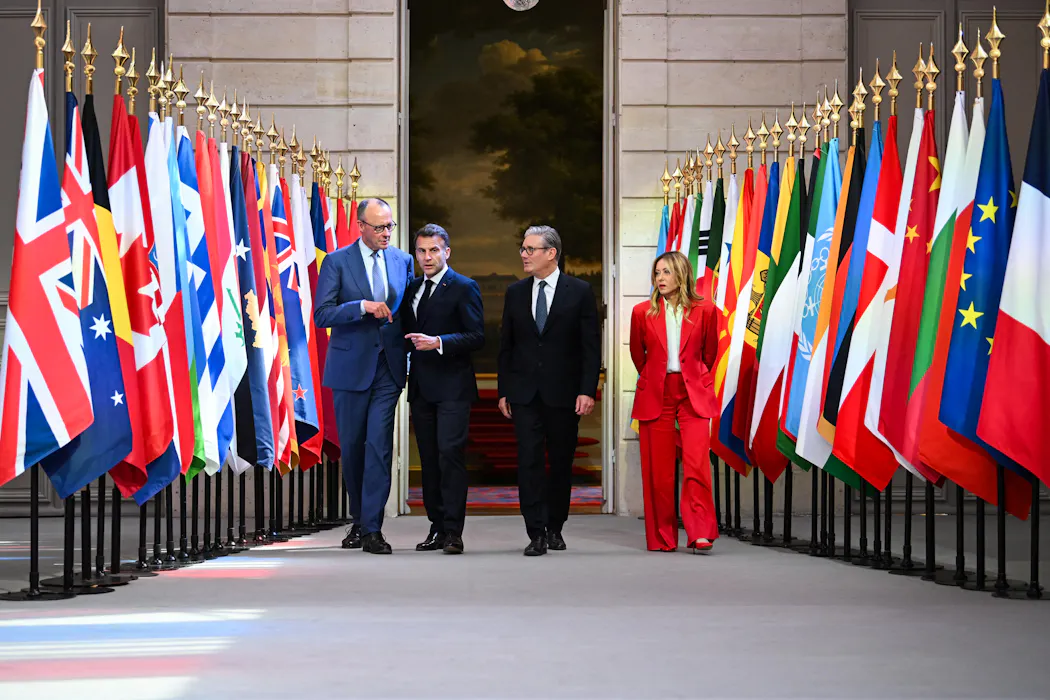
German Chancellor Friedrich Merz, French President Emmanuel Macron, British Prime Minister Keir Starmer and Italian Prime Minister Giorgia Meloni arrive for a press conference at the Elysee Palace in Paris on April 17, 2026.Jeanne Accorsini/Pool/AFP via Getty Images
“We are a sovereign country that does not wish to take part in illegal wars,” Sánchez said. U.S. President Donald Trump responded by threatening a full trade embargo against Spain.
Weeks later, Italian Prime Minister Giorgia Meloni – Trump’s closest European ally and the only EU head of government invited to his second inauguration – broke publicly with Washington.
“When we don’t agree, we must say it,” she said. “And this time, we do not agree.” Rome then refused to let U.S. bombers refuel at a base in southern Italy.
These are not minor diplomatic frictions. As a scholar of alliance politics and nuclear security, I see something much larger than a tactical disagreement. The Iran war’s most consequential casualty may not be in Tehran. It may be American credibility as an ally, and with it, the trans-Atlantic alliance itself.
The Iraq comparison misleads
The initial U.S. and Israeli strikes on Iran were launched with virtually no advance consultation with European allies. The Trump administration treated NATO partners not as participants in strategic decision-making but as logistical infrastructure to be commandeered or punished for refusing assistance.
The reflex in Washington has been to read this as a rerun of 2003, when France and Germany opposed the Iraq War. In January 2003, Defense Secretary Donald Rumsfeld dismissed France and Germany as “old Europe” while courting the postcommunist “new Europe,” including Poland, the Czech Republic and Hungary.
On the surface, the parallel is tempting: a unilateral American war in the Middle East, European refusal to participate, trans-Atlantic recriminations.
Protesters against the Iran war carry placards in Rome on March 28, 2026, depicting U.S. President Donald Trump, Italy’s Prime Minister Giorgia Meloni and Israeli Prime Minister Benjamin Netanyahu. Tiziana Fabi/AFP via Getty Images
But the comparison conceals more than it reveals. In 2003, the United States wanted Europe in its coalition. The George W. Bush administration sought United Nations authorization, courted allies and treated European refusal as a problem to be managed.
The deeper difference is structural. In 2003, the trans-Atlantic alliance still rested on shared commitments to collective defense, open trade and an international, rules-based order.
Today, the Trump administration does not share the commitments that traditionally bound the United States to its European partners, whether on NATO, the Russia-Ukraine war, or the rules governing trade and migration.
The shared values that papered over the Iraq disagreement in 2003, and that allowed President Nicolas Sarkozy to reintegrate France into NATO’s command by 2009, are no longer there to do the work of repair.
The Iran war inverts the conditions of that lesson. In 1956, Europeans learned that they could not act independently of Washington. In 2026, they are learning that they cannot rely on Washington’s consent being available, and that the U.S. will act without them, against their stated interests and at their economic expense.
Secretary of State John Foster Dulles, left, and President Dwight Eisenhower discuss the nationalization of the Suez Canal by the Egyptian government in August 1956 at the White House. Abbie Rowe/PhotoQuest via Getty Images
The pattern is the same: Dependence on the U.S. is unsustainable, and autonomous capacity is no longer optional. What has changed is that Europe is now willing to use the financial, economic and military tools it has long possessed in ways it would not have considered before.
The strategic postures were debated for decades. The Iran war is making them operational.
This is not yet European strategic independence. Europe remains militarily reliant on U.S. air defense, satellite capacity and intelligence.
The closure of the Strait of Hormuz, for example, has forced an uncomfortable energy reckoning with American liquefied natural gas, Russian pipelines, Middle Eastern hydrocarbons and Chinese-dominated renewable supply chains. None of the available paths to energy security run through trusted partners.
France and Germany still disagree on nearly every detail of how integration should proceed. But the political condition for autonomy, a shared European belief that Washington can no longer be trusted to share strategic decision-making, has crystallized in a way that no previous crisis produced.
The post-1945 trans-Atlantic bargain traded U.S. security guarantees for European deference on global strategy. Iraq 2003 strained that bargain. Trump’s first term cracked it, and the Iran war has broken it.
What replaces it will not be a renewed partnership. It will be a parallel relationship between two powers with sometimes overlapping interests and, increasingly, separate strategic horizons.
In 1956, Europe learned how dependent it was on Washington. In 2026, it is learning that dependence is no longer sustainable.
Eleni Lomtatidze, a student in the International Relations Program at the University of Pennsylvania and at SciencesPo Paris, contributed to this story.
Farah N. Jan does not work for, consult, own shares in or receive funding from any company or organization that would benefit from this article, and has disclosed no relevant affiliations beyond their academic appointment.