Categories
Uncategorized

Afghan migrants stranded in Pakistan after the US suspends refugee resettlement

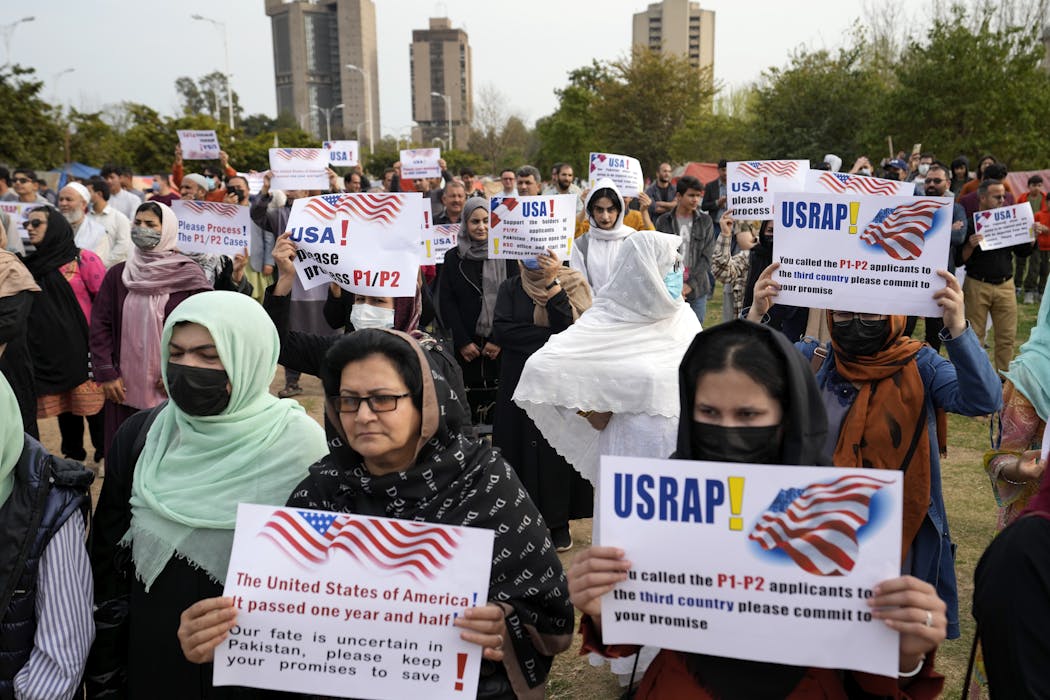
Afghan refugees hold placards during a protest in Islamabad, Pakistan, on Feb. 26, 2023. AP Photo/Rahmat Gul

In January 2025, Seema received an email from the International Organization for Migration saying that her flight from Pakistan to the United States, which she and her family were booked on after months of extensive interviewing and background checks by U.S. Citizenship and Immigration Services, had been canceled.

“We had sold our TV and refrigerator,” her husband, Samir, told me during an interview for my dissertation project on Afghan migration to America after the 2021 U.S. military withdrawal from Afghanistan. “We had told our landlord that we were vacating our apartment. Then it was all canceled.”

The U.S. withdrawal in August 2021 triggered a rapid political collapse that left millions of Afghan civilians in limbo. As the Taliban swept across the country and reclaimed power, Afghans who had worked alongside U.S. forces and international NGOs faced immediate danger.

Women, minorities and human rights advocates feared the loss of basic freedoms and possible Taliban reprisals. With evacuation pathways unclear and protections unevenly applied, panic spread as families tried to escape before they were cut off entirely.

Seema, Samir – pseudonyms to protect their identity – and their children are among tens of thousands of Afghan refugee families who immediately fled to neighboring Pakistan in late 2021 on the U.S. government’s recommendation for Afghans to process their immigration cases in third countries. However, many Afghans soon encountered Pakistan’s mass deportation campaign, underway since 2023, as they awaited U.S. resettlement.

Following the fall of Kabul in 2021, President Joe Biden directed the federal government to launch Operation Allies Welcome and other immigration pathways in an effort to resettle Afghans who had worked for U.S. forces and were at risk of being targeted by the Taliban. Beginning in early 2025, however, the U.S. refugee system retreated from the commitments U.S. leaders once made to protect Afghan civilians.

The costs of suspension

Until recently, some Afghans waiting in Pakistan hoped they would eventually be resettled in the United States through the few humanitarian pathways still open to them. However, that hope has dimmed.

The suspension of U.S. refugee resettlement during the first days of Donald Trump’s second presidency, along with additional immigration restrictions issued after the November 2025 shooting of National Guard personnel in Washington, D.C., have frozen the processing of all Afghan cases – including those already approved.

The Trump administration has justified these measures as necessary to protect U.S. safety and national interests.

For families like Seema’s, U.S. policy decisions have left them insecure and abandoned. As a scholar focused on international migration, I believe Seema’s story highlights a common thread among many Afghans stranded in Pakistan: Many of those who supported the U.S. are questioning the worth of the U.S.’s decades-long mission for promoting security, democracy and human rights in Afghanistan.

Exposed to the Taliban’s retaliation, regional deportation regimes and a collapsing refugee protection system, Afghans are holding the U.S. and other international governments responsible for abandoning them.

Caught between abandonment and deportation

Trained as a gynecologist, Seema worked at a private clinic in Afghanistan. And alongside her husband Samir, she served as managing director of an organization that led U.S.-funded projects for women and children.

“We took two projects from the U.S. Embassy,” she told me. “We established a resource center, bought computers, gave girls internet access and trained them in digital literacy.”

Several men dressed in military gear stand guard.
Many Afghans stranded in Pakistan fear being targeted by the Taliban, pictured here in December 2024, if they are forced to return to Afghanistan.
AP Photo/Saifullah Zahir

That work, funded and promoted by the U.S. government, made Seema and Samir targets. Even before 2021, they received threats from the Taliban. After the Taliban takeover in 2021, the threats escalated.

Fearing for their lives, they fled their home and attempted but failed to enter the Kabul airport multiple times during the chaotic U.S. evacuation in 2021. They ultimately escaped to Pakistan.

In Pakistan, a former colleague at the U.S. embassy recommended Seema for a Priority 2 visa – an immigration pathway created specifically for Afghans who supported U.S.-funded programs.

But when she and Samir tried to follow up with the U.S. Embassy in Pakistan in 2022, they received no response. A few months later they learned that changes to the U.S. Refugee Admissions Program in early 2022 likely caused their referral to be lost.

As U.S. processing stalled, Pakistan’s stance toward Afghan refugees hardened. Since late 2023, the Pakistani government has accelerated deportations under its “Illegal Foreigners’ Repatriation Plan” that targets both undocumented Afghans and those who once held legal refugee status. More than 1 million Afghans have already been deported.

Human rights groups warn that these removals violate the principle of nonrefoulement, which prohibits returning people to countries where they face serious harm. Under Taliban rule, women’s rights, employment opportunities and personal safety in Afghanistan have been systematically diminished.

Yet while Pakistan deports, the U.S. and other countries where Afghan refugees had once been able to resettle, including Germany, continue to close their doors.

A promise made, then suspended

In 2024, the U.S government accepted Seema’s refugee resettlement case, which she submitted in late 2022 with the assistance of SHARP, a local organization in Pakistan that works to protect Afghan refugees amid the country’s intensifying immigration crackdown. After several rounds of interviews, background checks, biometrics and medical exams, she and her family were told they would soon leave for the U.S.

Then the cancellation email arrived.

Seema and her family fear for their safety and their children’s future. Their children can no longer go to a school in Pakistan, as many Pakistani schools refuse to enroll Afghan students.

Several women in a room hold placards.
Afghan refugees hold placards during a gathering in Islamabad, Pakistan, on July 21, 2023. Hundreds of Afghan refugees facing extreme delays in the approval of U.S. visas were protesting in Pakistan’s capital.
AP Photo/Rahmat Gul

Police raids across major cities have also forced Afghan families to stay indoors, afraid to work or move freely. With no stable income, Seema and Samir struggle to meet basic needs.

“When I came to Pakistan, I was 40 years old,” Samir said. “Now I’m 44. Four years of my life have gone waiting for the U.S. case.” His voice hardened with anger. “We worked with the U.S. for 20 years. We fought terrorism. We supported democracy. What was the benefit?”

For decades, the U.S. government relied on the critical leadership of Afghan civilians like Seema and Samir to promote peace, security and women’s empowerment.

These partnerships were not symbolic. They were deeply embedded in everyday Afghan life.

With a smile on her face, Seema said that before 2021 “it never crossed my mind to leave Afghanistan because we were helping people in our country.”

Seema now fears being forced to return to Afghanistan, where her work and identity place her at grave risk of being targeted by the Taliban. Her request is modest. “At least let those whose cases were approved, whose flights were booked, resettle in the U.S.,” she said.

Her plea echoes across Pakistan, where thousands of Afghan families remain stranded.

Their lives now hinge on policy choices that will determine whether the United States honors the obligations it made during two decades of intervention that reshaped Afghan lives and livelihoods.

The Conversation

Mehr Mumtaz receives funding from the Russell Sage Foundation Dissertation Grant, and the Mershon Center for International Security’s Graduate Research Grant.

​Politics + Society – The Conversation

Categories
Uncategorized

ICE not only looks and acts like a paramilitary force – it is one, and that makes it harder to curb

As the operations of Immigration and Customs Enforcement have intensified over the past year, politicians and journalists alike have begun referring to ICE as a “paramilitary force.”

Rep. John Mannion, a New York Democrat, called ICE “a personal paramilitary unit of the president.” Journalist Radley Balko, who wrote a book about how American police forces have been militarized, has argued that President Donald Trump was using the force “the way an authoritarian uses a paramilitary force, to carry out his own personal grudges, to inflict pain and violence, and discomfort on people that he sees as his political enemies.” And New York Times columnist Jamelle Bouie characterized ICE as a “virtual secret police” and “paramilitary enforcer of despotic rule.”

All this raises a couple of questions: What are paramilitaries? And is ICE one?

Defining paramilitaries

As a government professor who studies policing and state security forces, I believe it’s clear that ICE meets many but not all of the most salient definitions. It’s worth exploring what those are and how the administration’s use of ICE compares with the ways paramilitaries have been deployed in other countries.

The term paramilitary is commonly used in two ways. The first refers to highly militarized police forces, which are an official part of a nation’s security forces. They typically have access to military-grade weaponry and equipment, are highly centralized with a hierarchical command structure, and deploy in large formed units to carry out domestic policing.

These “paramilitary police,” such as the French Gendarmerie, India’s Central Reserve Police Force or Russia’s Internal Troops, are modeled on regular military forces.

The second definition denotes less formal and often more partisan armed groups that operate outside of the state’s regular security sector. Sometimes these groups, as with the United Self-Defense Forces of Colombia, emerge out of community self-defense efforts; in other cases, they are established by the government or receive government support, even though they lack official status. Political scientists also call these groups “pro-government militias” in order to convey both their political orientation in support of the government and less formal status as an irregular force.

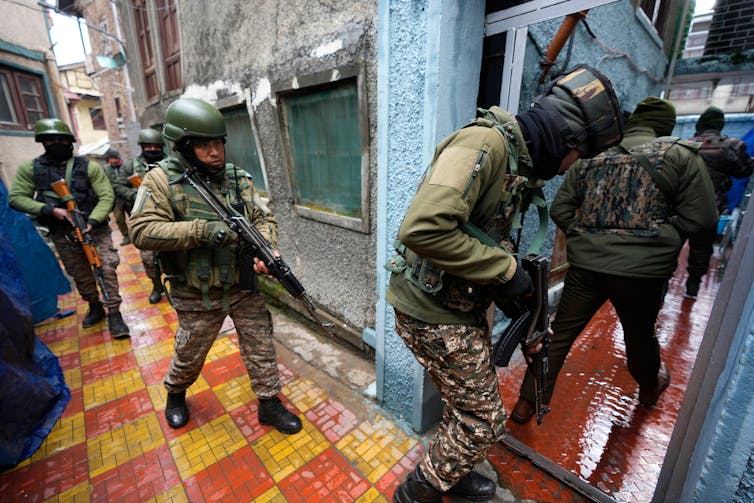
Heavily armed and masked security personnel enter a home.
Indian paramilitary personnel conduct a house-to-house search in Kashmir.
AP Photo/Mukhtar Khan

They typically receive less training than regular state forces, if any. How well equipped they are can vary a great deal. Leaders may turn to these informal or unofficial paramilitaries because they are less expensive than regular forces, or because they can help them evade accountability for violent repression.

Many informal paramilitaries are engaged in regime maintenance, meaning they preserve the power of current rulers through repression of political opponents and the broader public. They may share partisan affiliations or ethnic ties with prominent political leaders or the incumbent political party and work in tandem to carry out political goals.

In Haiti, President François “Papa Doc” Duvalier’s Tonton Macouts provided a prime example of this second type of paramilitary. After Duvalier survived a coup attempt in 1970, he established the Tonton Macouts as a paramilitary counterweight to the regular military. Initially a ragtag, undisciplined but highly loyal force, it became the central instrument through which the Duvalier regime carried out political repression, surveilling, harassing, detaining, torturing and killing ordinary Haitians.

Is ICE a paramilitary?

The recent references to ICE in the U.S. as a “paramilitary force” are using the term in both senses, viewing the agency as both a militarized police force and tool for repression.

There is no question that ICE fits the definition of a paramilitary police force. It is a police force under the control of the federal government, through the Department of Homeland Security, and it is heavily militarized, having adopted the weaponry, organization, operational patterns and cultural markers of the regular military. Some other federal forces, such as Customs and Border Patrol, or CBP, also fit this definition.

The data I have collected on state security forces show that approximately 30% of countries have paramilitary police forces at the federal or national level, while more than 80% have smaller militarized units akin to SWAT teams within otherwise civilian police.

The United States is nearly alone among established democracies in creating a new paramilitary police force in recent decades. Indeed, the creation of ICE in the U.S. following the terrorist attacks of Sept. 11, 2001, is one of just four instances I’ve found since 1960 where a democratic country created a new paramilitary police force, the others being Honduras, Brazil and Nigeria.

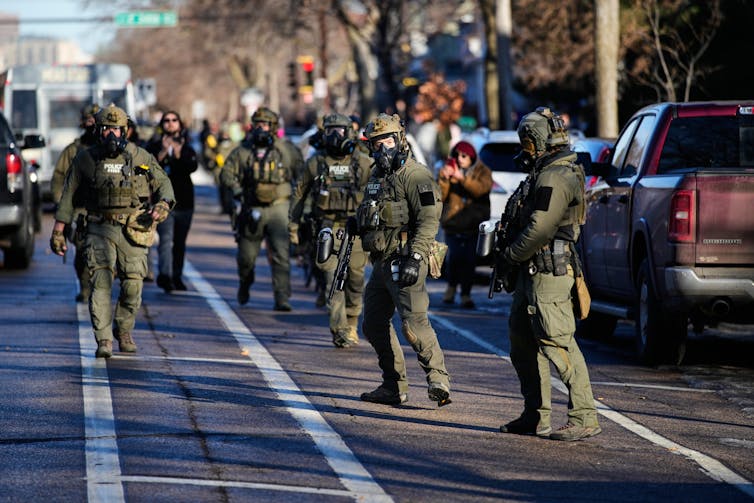
A group of uniformed ICE personnel walk along cars in a bike lane.
ICE agents on patrol near the scene of the fatal shooting of Renee Good in Minneapolis.
AP Photo/John Locher

ICE and CBP also have some, though not all, of the characteristics of a paramilitary in the second sense of the term, referring to forces as repressive political agents. These forces are not informal; they are official agents of the state. However, their officers are less professional, receive less oversight and are operating in more overtly political ways than is typical of both regular military forces and local police in the United States.

The lack of professionalism predates the current administration. In 2014, for instance, CBP’s head of internal affairs described the lowering of standards for post-9/11 expansion as leading to the recruitment of thousands of officers “potentially unfit to carry a badge and gun.”

This problem has only been exacerbated by the rapid expansion undertaken by the Trump administration. ICE has added approximately 12,000 new recruits – more than doubling its size in less than a year – while substantially cutting the length of the training they receive.

ICE and CBP are not subject to the same constitutional restrictions that apply to other law enforcement agencies, such as the Fourth Amendment’s prohibition on unreasonable search and seizure; both have gained exemptions from oversight intended to hold officers accountable for excessive force. CBP regulations, for instance, allow it to search and seize people’s property without a warrant or the “probable cause” requirement imposed on other forces within 100 miles, or about 161 kilometers, of the border.

In terms of partisan affiliations, Trump has cultivated immigration security forces as political allies, an effort that appears to have been successful. In 2016, the union that represents ICE officers endorsed Trump’s campaign with support from more than 95% of its voting members. Today, ICE recruitment efforts increasingly rely on far-right messaging to appeal to political supporters.

Both ICE and CBP have been deployed against political opponents in nonimmigration contexts, including Black Lives Matter protests in Washington, D.C., and Portland, Oregon, in 2020. They have also gathered data, according to political scientist Elizabeth F. Cohen, to “surveil citizens’ political beliefs and activities – including protest actions they have taken on issues as far afield as gun control – in addition to immigrants’ rights.”

In these ways, ICE and CBP do bear some resemblance to the informal paramilitaries used in many countries to carry out political repression along partisan and ethnic lines, even though they are official agents of the state.

Why this matters

An extensive body of research shows that more militarized forms of policing are associated with higher rates of police violence and rights violations, without reducing crime or improving officer safety.

Studies have also found that more militarized police forces are harder to reform than less-militarized law enforcement agencies. The use of such forces can also create tensions with both the regular military and civilian police, as currently appears to be happening with ICE in Minneapolis.

The ways in which federal immigration forces in the United States resemble informal paramilitaries in other countries – operating with less effective oversight, less competent recruits and increasingly entrenched partisan identity – make all these issues more intractable. Which is why, I believe, many commentators have surfaced the term paramilitary and are using it as a warning.

The Conversation

Erica De Bruin does not work for, consult, own shares in or receive funding from any company or organization that would benefit from this article, and has disclosed no relevant affiliations beyond their academic appointment.

​Politics + Society – The Conversation
Categories
Uncategorized

The end of ‘Pax Americana’ and start of a ‘post-American’ era doesn’t necessarily mean the world will be less safe

President Donald Trump’s America First policies have reshaped the nation’s stance regarding global security and trade. AP Photo/Evan Vucci

America’s role in the world is changing. If this wasn’t obvious before, it should be now, following President Donald Trump’s efforts to take over Greenland and his visibly strained relations with traditional allies in Europe and elsewhere.

But how much will the world change if America’s stance is different?

Some scholars of international relations argue that because Washington has been central to global governance for so long, Trump’s “America First” turn – suggesting isolationism on some issues and unilateral action on others – spells the end of the international order as we’ve known it.

The most pessimistic analysts caution that the era of “Pax Americana,” or the long period of relative world calm since World War II due to U.S. leadership, is coming to a close. They forecast a turbulent transition to a more chaotic world.

This view may well prove correct in the long run. But it is too early to say with confidence. As a scholar who studies U.S. foreign policy, I see some grounds for optimism. The world can become a more just, stable and secure place despite the diminishment of American leadership.

For the remaining three years of Trump’s presidency, all bets are off. Trump is famously difficult to predict. That world leaders genuinely believed in recent weeks that the United States could invade Greenland – and still might – should give pause to anyone who thinks they can foretell the remainder of Trump’s second term.

The unprecedented raid on Venezuela and Trump’s oscillation between threatening Iran and calling for negotiations with Tehran provide additional examples of Trump’s volatile foreign policy maneuvers.

But the long-term trends are clear: The United States is losing its enthusiasm (and capacity) for global leadership. The rest of the world can assume that, after Trump, there will continue to be a decline in America’s participation in world affairs. His recent actions suggest America’s security guarantees to others will become more dubious, its markets will become less accessible to foreigners, and its support for international institutions will weaken.

Does this mean a cascade of disorder for smaller nations? Perhaps – but not necessarily.

Are US allies more vulnerable?

Certainly U.S. foreign policy and its wars and other actions abroad have sparked criticism over the past few decades. Still, the prospect of U.S. retrenchment understandably causes anxiety for those who have long sheltered under America’s security umbrella.

Once U.S. forces, spread throughout the globe, have decamped to the continental United States, the argument goes, there won’t be much stopping large countries such as Russia and China from steamrolling their vulnerable neighbors in Europe and East Asia.

This is an overly pessimistic assessment, in my view. It must be remembered that America’s alliance commitments and vast military deployments date from the early Cold War of the 1950s, an era that bears few similarities with the present day. Back then, U.S. forces were needed to deter the Soviet Union and China from attacking their neighbors, who were almost uniformly weak and impoverished following the Second World War.

Today, the European members of NATO and America’s allies in Asia are among the world’s wealthiest countries. These governments are easily rich enough to afford the sort of national militaries needed to deter potential aggressors and uphold stability in their respective regions. Indeed, they can likely do a better job of securing themselves than the United States presently manages on their behalf.

Preserving free trade

Will the world become poorer and perhaps more dangerous if global economic integration falls by the wayside?

This is a reasonable concern given the standard view that free trade leads to economic growth and, in turn, that economic growth can help foster world peace.

But again, it is wrong to assume that the worst will happen. Instead of accepting that globalization is irreversibly in retreat, there is every chance that governments will relearn the benefits of economic integration and defend an open world economy, even absent U.S. leadership. After all, Trump’s trade wars have visibly harmed U.S. firms and consumers, as well as caused friction with America’s allies. Future leaders in Washington and around the world will presumably learn from such fallout.

Finally, there is no reason to conclude that global governance must collapse in the absence of strong U.S. leadership. As Canadian Prime Minister Mark Carney proposed at the recent Davos conference in Switzerland, so-called middle powers, such as Australia, Brazil and Canada itself, have the capacity to rescue the world’s most vital international organizations for the benefit of future generations, and to create new institutions as necessary.

A video screen shows Canadian Prime Minister Mark Carney as he addresses the audience at Davos.
Canadian Prime Minister Mark Carney gave a speech at Davos that suggested possible outlines for a post-American world.
AP Photo/Markus Schreiber

Nations such as Canada, Japan, Australia and the members of the European Union obviously lack the overwhelming military power and economic clout of the United States. But they could choose instead to implement a more collective approach to global leadership.

No safe bets

There are obviously no guarantees that the post-Pax Americana era will be an unbridled success. There will be war and suffering in the future, just as there has been war and suffering under U.S. leadership. The idea of Pax Americana has always rung hollow to some people, including citizens of countries that have been attacked by the United States itself.

The question is whether the international system will become any more violent and unstable in the absence of U.S. leadership and military dominance than it has been during America’s long period of global dominance. It well might, but the international community shouldn’t resign itself to fatalism.

The United States has lost influence. The silver lining is that more countries – including America’s friends and allies – might rediscover their own capacity to shape world affairs.

The post-American era is therefore up for grabs.

The Conversation

Peter Harris is a Non-Resident Fellow with Defense Priorities.

​Politics + Society – The Conversation

Categories
Uncategorized

There are long-lasting, negative effects for children like Liam Ramos who are detained, or watch their parents be deported

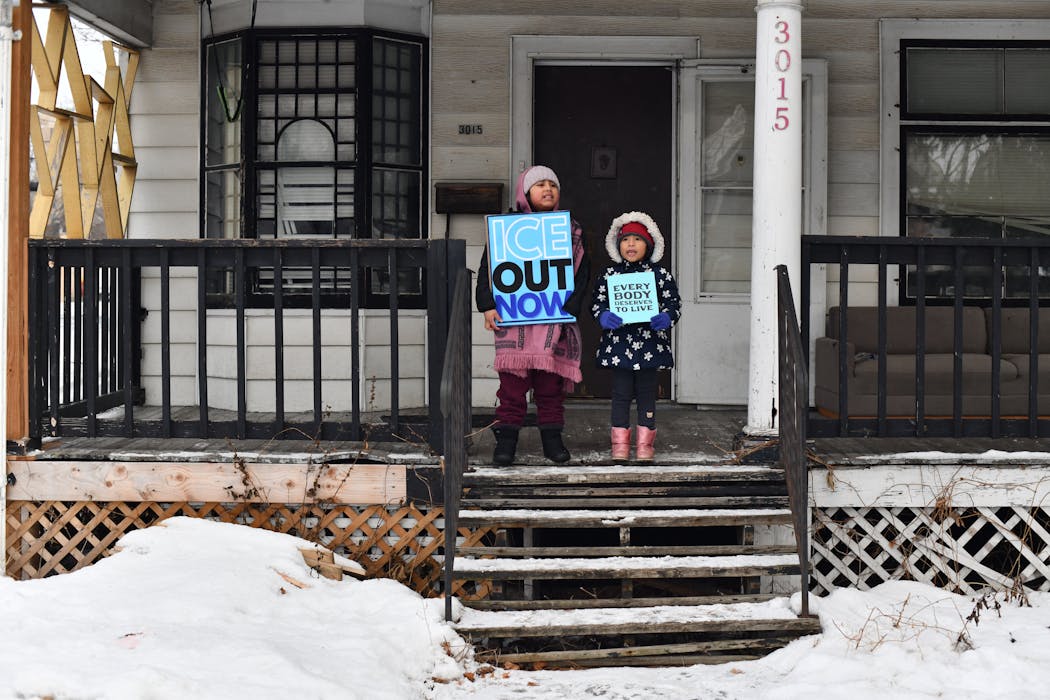
Children hold signs on the porch of a house as protesters march in Minneapolis against Immigration and Customs Enforcement on Jan. 10, 2026. Octavio JONES/AFP via Getty Images

When Immigration and Customs Enforcement agents detained Liam Conejo Ramos, a 5-year-old boy who is an asylum seeker, in Minneapolis on Jan. 20, 2026, the photos quickly became a flash point in the Trump administration’s aggressive immigration enforcement activity.

In one image, a man wearing a black uniform holds onto a gray and red Spider-Man backpack that the worried-looking young boy, wearing a blue bunny hat with floppy ears, has on his back.

Meanwhile, ICE and Customs and Border Patrol operations near schools have become increasingly common over the past year, spreading from Texas to Maine. While some parents in Minnesota have set up patrols around schools, there are families choosing to keep their kids home for days or weeks.

We are scholars of migration and children and childhood adversity.

Our research shows that exposure to severe immigration enforcement experiences during childhood carries long-term, significant consequences: These children are twice as likely to suffer from anxiety in young adulthood.

People dressed in winter clothing stand close together and hold signs that say 'Bring Liam home'
People protest on Jan. 23, 2026, in Minneapolis and show signs referencing Liam Conejo Ramos, a 5-year-old child apprehended by immigration enforcement officers.
Roberto Schmidt/AFP via Getty Images

Why this matters

There is well-documented research showing how immigration enforcement has immediate negative effects on children and adults

Children whose immigrant parents are arrested, detained or deported often experience emotional and behavioral problems, including separation anxiety, school absenteeism, hyperactivity and other behavioral issues.

Yet, until recently, it has not been well understood how experiencing or being subjected to immigration enforcement actions affects children once they grow up to become adults.

That said, over three decades of research shows the clear links between traumatic childhood events and mental health problems in adulthood. Studies show, for example, that adults who experienced temporary separation from their parents as children are more likely to say they’ve experienced depression symptoms years later.

We decided to investigate whether a child being exposed to immigration enforcement actions – meaning the arrest of a parent, or detention of a close family member, for example – is associated with mental health problems among young adults who grew up in immigrant families.

How immigration enforcement unravels families

Our study first combined interviews and open-ended survey questions to define what it means to experience severe immigration enforcement during childhood.

We then examined the link between severe immigration enforcement actions and anxiety among 71 young adults – all U.S. citizens age 18 to 34 – who were raised in immigrant households in New York.

As children, all of these young adults witnessed or experienced the arrest, detention or deportation of an immigrant family member or a member of their communities. Three-quarters of the participants identified as Hispanic.

We analyzed our interviews to develop several criteria to determine what constitutes severe exposure to enforcement during childhood, considering factors like whether they witnessed a detention or arrest more than once, and how old they were when these experiences took place.

We found that approximately 26% of the survey participants – all of whom in this group were Hispanic, except one – had severe exposure to immigration enforcement actions during childhood. Not all of them had a parent who has been deported.

Some of these young people had relatives who had drawn-out cases in immigration court, or felt constant fear that their parents might be deported.

When we linked our interviews with survey data, our results were striking.

We found that young adults who experienced severe immigration enforcement actions as children were twice as likely to have anxiety, compared with young adults who did not have this experience when they were growing up.

Exposure to severe immigration enforcement actions as a child was not independently associated with depression as a young adult. But all the survey participants who said they were experiencing depression also reported anxiety symptoms – further evidence of a connection between severe immigration enforcement actions and anxiety among young people.

A young girl wearing a pink shirt holds an adult's hand and looks directly at the camera. She stands on a street near a parked gray SUV.
A father and child watch as U.S. Customs and Border Patrol Commander Gregory Bovino and fellow agents conduct operations in Kenner, La., on Dec. 6, 2025.
Adam Gray/AFP via Getty Images

Lasting impact of today’s policies

Many legal experts and political observers say that the Trump administration’s immigration enforcement tactics in Minneapolis and in other cities are designed to intimidate and instill fear among civilians.

Children are not immune to these tactics, either as witnesses or as targets.

Federal immigration officers deployed tear gas, for example, on students at Roosevelt High School in Minneapolis on Jan. 8. Experiences like this constitute a major adverse childhood event, exposing children and adolescents to significant trauma.

We believe that we can learn from decades of adverse childhood experiences research, which clearly shows the link between childhood adversity and physical and mental health outcomes in adulthood.

The enforcement tactics ICE is using in Minnesota and other places in the U.S. today are likely, our research suggests, going to harm the next generation of U.S. citizens and residents.

As trauma researchers have long known, our bodies keep score over a lifetime. The question facing policymakers is not whether these enforcement tactics will cause lasting harm – our research suggests they would – but what human costs we, as a nation, are willing to bear.

The Conversation

Joanna Dreby receives funding from Russell Sage Foundation

Eunju Lee receives funding from Russel Sage Foundation (PI Dreby).

​Politics + Society – The Conversation

Categories
Uncategorized

How government killings and kidnappings in Argentina drove mothers to resist and revolt − and eventually win

A series of shootings by federal immigration agents, including two deaths in Minneapolis, have galvanized intense local and national protests against the Trump administration’s immigration enforcement operations. Federal immigration agents killed Renee Nicole Good, 37 – a mother of three – and Alex Pretti, a 37-year-old nurse, weeks apart in January 2026.

Since Donald Trump assumed the presidency on Jan. 20, 2025, Immigration and Customs Enforcement agents have detained thousands of people across the country, including U.S. citizens and legal residents. At least 11 people have been shot, including a Venezuelan migrant in Minneapolis on Jan. 14, 2026. Children and babies have been tear-gassed.

I am a political scientist who studies authoritarian regimes. I also lived through Argentina’s brutal military junta of the 1970s and 1980s. When I consider today’s ICE violence, I think of the state terrorism that tore Argentina apart – and how mothers became a potent force in resisting authoritarianism and ultimately restoring democracy.

Masked agents and the ‘Trump effect’

U.S. federal immigration enforcement actions began raising human rights concerns starting in April 2025, when masked federal agents in plain clothes began detaining international students.

Historically in the U.S., police and other official state security forces have used face coverings almost exclusively during undercover operations to protect agent safety and the integrity of ongoing investigations, according to federal law enforcement sources.

The global human rights group Amnesty International has begun using the phrase “the Trump effect” to describe masking and other administration actions that it believes violate global human rights standards.

Meanwhile, violence by ICE agents also runs counter to international law – as does police violence more broadly.

Several United Nations principles require that police action be guided at all times by legality, necessity, proportionality and nondiscrimination. Any use of force that does not comply with these principles violates international law.

Amnesty International’s policing guidance is based on these standards. It explains that police must attempt to use nonviolent means first, such as verbal commands, negotiation and warnings.

When force is necessary, officers must use “the least harmful means likely to be effective.” In such cases, proportionality requires that “the harm caused by the use of force may never outweigh the damage it seeks to prevent.”

Good’s and Pretti’s killings occurred in broad daylight. Video analysis suggests that Good was attempting to turn her vehicle away from the scene when an ICE agent shot her three times. Pretti had a holstered weapon, but witnesses and videos show he had been disarmed before a federal agent fatally shot him.

As nonimmigrant local community members, neither victim would be the apparent target of immigration enforcement operations in Minneapolis.

Argentina’s dictatorship

In both its use of masks and its brazen disregard for proportionality, ICE evokes in me unsettling memories of all-powerful, authoritarian governments that exercise control over life and death.

In March 1976, the Argentine armed forces overthrew a weak and chaotic government – that of María Estela Martínez de Perón, widow of Juan Domingo Perón – claiming the need to restore order in a country engulfed in political violence. So began one of the darkest periods in contemporary Argentine history.

Between 1976 and 1983, approximately 30,000 people were forcibly “disappeared,” meaning secretly kidnapped, never to be seen again. The vast majority were young men and women involved in labor unions, political organizations or student movements with left-wing ideologies, including Catholic priests and nuns who embraced liberation theology, a movement within the church that interprets the gospel of Jesus Christ through the experiences of poor people and the oppressed.

In April 1977, roughly a year after young Argentines first began vanishing, 14 women gathered in the Plaza de Mayo, a central square in Buenos Aires that faces the presidential palace. They were searching for their sons and daughters, who had been detained by the police or the military.

Some of these arrests had taken place at night, in the homes where these young victims lived with their families. In those cases, the women – who came to be known as the Madres de la Plaza de Mayo, or Mothers of the Plaza de Mayo – knew their children had been taken by security forces. In other cases, their children had simply failed to return home. Nothing was known of their whereabouts. They had disappeared.

Even those who had been detained at home had disappeared, too, as their location remained unknown.

Later, the nation would learn that many of the regime’s victims were tortured, then flown in airplanes over the nearby River Plate and dropped into the water on so-called “death flights.” All this information was compiled in a 1984 report written during the first democratic government after military rule and published under the name “Nunca Mas”: Never again.

The Mothers didn’t know that yet. They wanted their children back – alive.

Demonize, deny, discredit

The dictatorship had imposed a state of siege prohibiting all forms of assembly. To technically evade this restriction, the Mothers walked in circles around the plaza, avoiding the concentration of people in any single location, demanding truth and justice.

The regime reacted by systematically attempting to discredit the grieving women. To weaken their moral authority, state-controlled media labeled them as emotionally unstable “mad women.” The were called Las Locas de Plaza de Mayo instead of the Madres de Plaza de Mayo.

Regime media also suggested the Mothers were political subversives with links to guerrilla groups and members of foreign organizations out to damage Argentina’s international reputation.

Officials accused the women of exaggerating or inventing kidnappings and sometimes mocked their ever-growing weekly marches. By attacking their credibility and dignity, the dictatorship sought to undermine public sympathy and maintain a climate of fear.

At first, this narrative worked. Early in the dictatorship, many Argentines viewed the Mothers with ambivalence, skepticism or even fear. Others, while privately sympathetic, avoided expressing support due to fear of repression and social consequences.

The government’s attacks were not only rhetorical. In 1977, three of the founding Mothers – Esther de Balestrino, Azucena Villaflor and Mary Ponce de Bianco – disappeared when a group of military personnel stormed the Church of the Holy Cross in Buenos Aires. Twelve other people were abducted. None have ever been found.

The Mothers received substantial support from abroad. International human rights organizations, foreign journalists and religious institutions all played a crucial role in legitimizing their claims and broadcasting their struggle to the world.

France, in particular, helped publicize the Mothers’ cause in Europe, which put diplomatic pressure on the Argentine regime. This international solidarity contributed significantly to breaking the dictatorship’s silence and exposing its crimes.

Over time, as evidence of systematic forced disappearances became undeniable, public perception of the Mothers gradually shifted in Argentina, too. The Mothers came to be seen as a brave force for moral resistance.

A democracy built in part by mothers

In 1982, the military dictatorship invaded the South Atlantic islands known in Argentina as the Malvinas, or Falklands. The land has been British since 1833, but Argentina’s generals claimed sovereignty. Argentina was quickly defeated, and the military government fell.

After democratic elections were held in October 1983, the Mothers continued their efforts to uncover the histories of their children and to find and bury their remains. Many also started working to locate their grandchildren who had been born in captivity and illegally adopted after their parents were disappeared.

Their dedication to recovering their loved ones exposed the full extent of the regime’s atrocities.

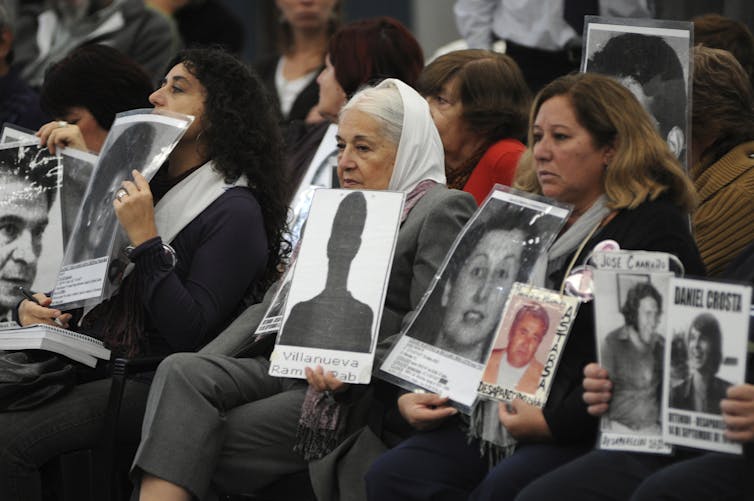
Seated women, some wearing the white banadana, hold black and white photos of missing loved ones.
Argentines hold images of disappeared people in Buenos Aires during the trial of Argentina’s last dictator in 2010.
Rolando Andrade Stracuzzi Source/AP

In 1983, President Raúl Alfonsín, who reestablished Argentine democracy, established the National Genetic Data Bank to identify kinship between the parents and children of the disappeared. Thousands of analyses were conducted on children suspected of being born in captivity and illegally adopted by military families.

More than 120 grandchildren have since been identified.

The Mothers and children of the disappeared have also played a fundamental role in convicting dozens of military officials for crimes against humanity. As direct witnesses to the long-term consequences of forced disappearance, they have repeatedly testified against military officials.

The Mothers’ activism, which continues today, has helped sustain public pressure in Argentina for accountability and to transform private trauma into collective political action.

The killings in Minneapolis inspired me to recount this story for a simple reason: The government can protect, condemn or kill. Argentine history shows that it matters how society reacts to state terrorism.

This story was produced in collaboration with Rewire News Group, a nonprofit news organization that covers reproductive health.

The Conversation

Laura Tedesco is an Amnesty International donor.

​Politics + Society – The Conversation
Categories
Uncategorized

Greenland’s Inuit have spent decades fighting for self-determination

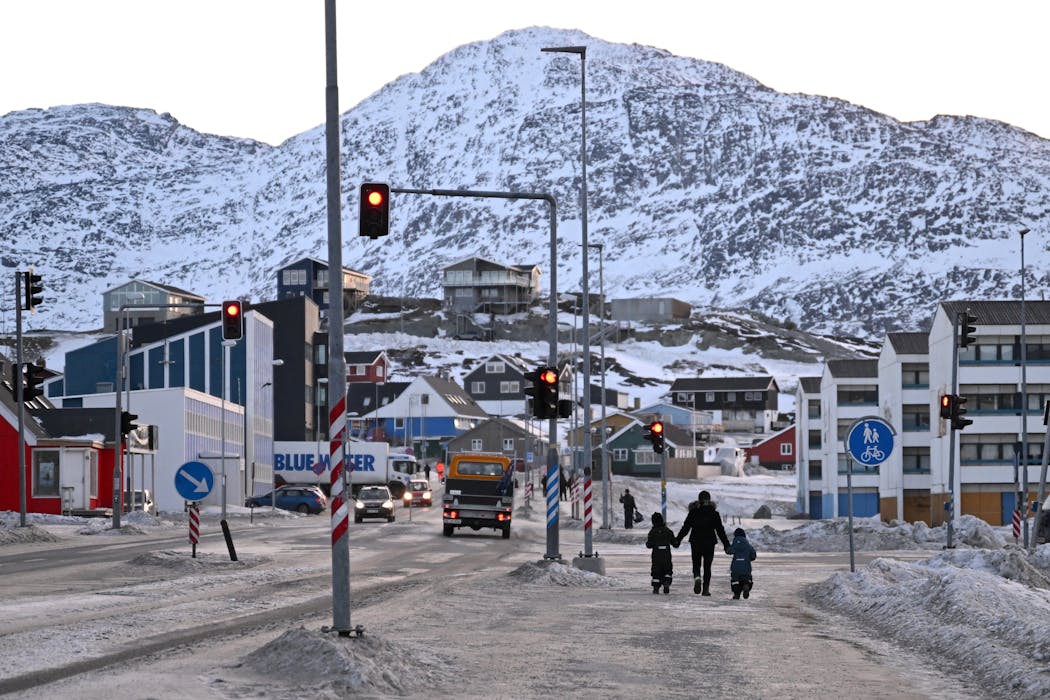
People walk along a street in Nuuk, the capital of Greenland. Ina Fassbender/AFP via Getty Images

Amid the discussion between U.S. President Donald Trump and Danish and European leaders about who should own Greenland, the Inuit who live there and call it home aren’t getting much attention.

The Kalaallit (Inuit of West Greenland), the Tunumi (Inuit of East Greenland) and the Inughuit (Inuit of North Greenland) together represent nearly 90% of the population of Greenland, which totals about 57,000 people across 830,000 square miles (2.1 million square kilometers).

We are Arctic anthropologists who work in a museum focused on the Arctic and its people. One of the areas we study is a land whose inhabitants call it Kalaallit Nunaat, or land of the Kalaallit. Known in English as Greenland, it is an Indigenous nation whose relatively few people have been working for decades to reclaim their right to self-determination.

Arrivals from the west

For nearly 5,000 years, northwestern Greenland – including the area that is now the U.S. Space Force’s Pituffik Space Base, formerly known as Thule Air Force Base – was the island’s main entry point. A succession of Indigenous groups moved eastward from the Bering Strait region and settled in Siberia, Alaska, Canada and Greenland.

Approximately 1,000 years ago, the ancestors of the Inuit living in Greenland today arrived in that area with sophisticated technologies that allowed them to thrive in a dynamic Arctic environment where minor mishaps can have serious consequences. They hunted animals using specialized technologies and tools, including kayaks, dog-drawn sleds, complex harpoons, and snow goggles made from wood or bone with slits cut into them. They dressed in highly engineered garments made from animal fur that kept them warm and dry in all conditions.

Their tools and clothing were imbued with symbolic meanings that reflected their worldview, in which humans and animals are interdependent. Inughuit families who live in the region today continue to hunt and fish, while navigating a warming climate.

Local people fish from a small boat by an iceberg with an ice cave, near Ilulissat, in 2008.
Bryan Alexander, courtesy of the Peary-MacMillan Arctic Museum, Bowdoin College, CC BY-NC-ND

Arrivals from the east

At Qassiarsuk in south Greenland, around the time Inuit arrived in the north, Erik the Red established the first Norse farm, Brattahlíð, in 986, and sent word back to Iceland to encourage others to join him, as described in an online exhibit at the Greenland National Museum. Numerous Norse families followed and established pastoral farms in the region.

As Inuit expanded southward, they encountered the Norse farmers. Inuit and Norse traded, but relations were sometimes tense: Inuit oral histories and Norse sagas describe some violent interactions. The two groups maintained distinctly different approaches to living on the land that rims Greenland’s massive ice sheet. The Norse were very place-based, while the Inuit moved seasonally, hunting around islands, bays and fjords.

As the Little Ice Age set in early in the 14th century, and temperatures dropped in the Northern Hemisphere, the Norse were not equipped to adjust to the changing conditions. Their colonies faltered and by 1500 had disappeared. By contrast, the mobile Inuit took a more flexible approach and hunted both land and marine mammals according to their availability. They continued living in the region without much change to their lifestyle.

A center of activity

In Nuuk, the modern capital of Greenland, an imposing and controversial statue of missionary Hans Egede commemorates his arrival in 1721 to establish a Lutheran mission in a place he called Godthåb.

In 1776, as trade became more important, the Danish government established the Royal Greenland Trading Department, a trading monopoly that administered the communities on the west coast of Greenland as a closed colony for the next 150 years.

By the 19th century some Kalaallit families who lived in Nuuk/Godthåb had formed an educated, urban class of ministers, educators, artists and writers, although Danish colonists continued to rule.

Meanwhile, Kalaallit families in small coastal communities continued to engage in traditional economic and social activities, based on respect of animals and sharing of resources.

On the more remote east coast and in the far north, colonization took root more slowly, leaving explorers such as American Robert Peary and traders such as Danish-Greenlandic Knud Rasmussen a free hand to employ and trade with local people.

The U.S. formally recognized Denmark’s claim to the island in 1916 when the Americans purchased the Danish West Indies, which are now the U.S. Virgin Islands. And in 1921, Denmark declared sovereignty over the whole of Greenland, a claim upheld in 1933 by the Permanent Court of International Justice. But Greenlanders were not consulted about these decisions.

People gather outdoors carrying red and white flags.
People protest President Donald Trump’s desire to own Greenland outside the U.S. consulate in Nuuk, Greenland, in January 2026.
AP Photo/Evgeniy Maloletka

The world arrives

A 1944 ad urging U.S. customers to buy shortwave radios touts contact with the people of Greenland as one benefit.
Courtesy of the Peary-MacMillan Arctic Museum, Bowdoin College, CC BY-NC-ND

World War II brought the outside world to Greenland’s door. With Denmark under Nazi control, the U.S. took responsibility for protecting the strategically important island of Greenland and built military bases on both the east and west coasts. The U.S. made efforts to keep military personnel and Kalaallit apart but were not entirely successful, and some visiting and trading went on. Radios and broadcast news also spread, and Kalaallit began to gain a sense of the world beyond their borders.

The Cold War brought more changes, including the forced relocation of 27 Inughuit families living near the newly constructed U.S. Air Force base at Thule to Qaanaaq, where they lived in tents until small wooden homes were built.

In 1953, Denmark revised parts of its constitution, including changing the status of Greenland from a colony to one of the nation’s counties, thereby making all Kalaallit residents of Greenland also full-fledged citizens of Denmark. For the first time, Kalaallit had elected representatives in the Danish parliament.

Denmark also increased assimilation efforts, promoting the Danish language and culture at the expense of Kalaallisut, the Greenlandic language. Among other projects, the Danish authorities sent Greenlandic children to residential schools in Denmark.

In Nuuk in the 1970s, a new generation of young Kalaallit politicians emerged, eager to protect and promote the use of Kalaallisut and gain greater control over Greenland’s affairs. The rock band Sumé, singing protest songs in Kalaallisut, contributed to the political awakening.

Sumé, a rock band singing in Kalaallisut, the Greenlandic language, helped galvanize a political movement for self-determination in the 1970s.

In a 1979 Greenland-wide referendum, a substantial majority of Kalaallit voters opted for what was called “home rule” within the Danish Kingdom. That meant a parliament of elected Kalaallit representatives handled internal affairs, such as education and social welfare, while Denmark retained control of foreign affairs and mineral rights.

However, the push for full independence from Denmark continued: In 2009, home rule was replaced by a policy of self-government, which outlines a clear path to independence from Denmark, based on negotiations following a potential future referendum vote by Greenlanders. Self-government also allows Greenland to assert and benefit from control over its mineral resources, but not to manage foreign affairs.

Today, Nuuk is a busy, vibrant, modern city. Life is quieter in smaller settlements, where hunting and fishing are still a way of life. While contemporary Greenland encompasses this range of lifestyles, Kalaallit are unified in their desire for self-determination. Greenland’s leaders have delivered this message clearly to the public and to the White House directly.

The Conversation

Susan A. Kaplan has received funding from NSF, NEH, IMLS, SSHRC and private foundations to pursue anthropological and archaeological research in Nunatsiavut, NL, Canada; and offer Arctic-focused outreach programs, museum exhibits and conferences.

Genevieve LeMoine receives funding from the National Science Foundation, Office of Polar Programs, the National Geographic Society, and the Social Sciences and Humanities Research Council of Canada. She has conducted fieldwork in Avannaata Kommunia, Kalaallit Nunaat in collaboration with Nunatta Katersugaasivia Allagaateqarfialu/Greenland National Musuem and Archives and the University of California, Davis.

​Politics + Society – The Conversation

Categories
Featured Juneau News Juneau Local Juneau Local News Feeds Uncategorized

City leaders discuss changes to Eaglecrest board at meeting Monday night

Committee of the Whole, Monday Jan. 26

NOTN- The major topic discussed at the Committee of the Whole meeting last night was proposed changes to governance at Eaglecrest Ski Area, which has struggled for years with operational instability and deferred maintenance.

Juneau Mayor Beth Weldon said she introduced an ordinance that would shift the Eaglecrest board from an empowered governing body to an advisory role under a newly established City and Borough of Juneau Eaglecrest Recreation Area Department. The change would give the city more direct oversight over operations and capital investments.

“My ultimate goal is to try to save Eaglecrest. If anybody knows my history, both my kids grew up in Eaglecrest. In fact, my youngest son continued ski racing in college.” She said, “Eaglecrest is a great place to learn how to ski, but they have struggled with operational instability and management challenges for many years. So this tells me there’s a structural problem.”

She emphasized that the proposal is not a reflection on the current board, but rather an effort to ensure the ski area’s long-term survival.

“Currently, the board that we have is a very strong board, but despite having more year-round staff than ever before, Eaglecrest has still struggled with basic ski operations, amplified by long-term neglect of equipment and deferred maintenance.” Said Weldon, “And I think in order for Eaglecrest to survive, it needs a little shake-up, and the only shake-up we can really do is to have more city oversight.”

Without additional city control, Weldon warned, major repairs may not be financially feasible.

A joint meeting is scheduled for early March between the city’s Committee of the Whole and the Eaglecrest board to address these proposals and gather further input.

“We’re going to have a joint meeting where we’ll sit and talk to the Eagle Crest board, and then I think a couple weeks later, it’ll be back in front of the Committee of the Whole and we can decide what we change.” Said Deputy Mayor Greg Smith, “I’ve heard a lot about it. It shows how much people care about Eaglecrest.”

Categories
Uncategorized

Repeated government lying, warned Hannah Arendt, makes it impossible for citizens to think and to judge

Despite evidence to the contrary, Homeland Security Secretary Kristi Noem said at a Jan. 24, 2026, news conference that Alex Pretti ‘came with a weapon … and attacked’ officers, who took action to ‘defend their lives.’ AP Photo/Julia Demaree Nikhinson

In Minneapolis, two recent fatal encounters with federal immigration agents have produced not only grief and anger, but an unusually clear fight over what is real.

In the aftermath of Alex Pretti’s killing on Jan. 24, 2026, federal officials claimed the Border Patrol officers who fired weapons at least 10 times acted in self-defense.

But independent media analyses showed the victim holding a phone, not a gun, throughout the confrontation. Conflicting reports about the earlier death of Renée Good have similarly intensified calls for independent review and transparency. Minnesota state and local officials have described clashes with federal agencies over access to evidence and investigative authority.

That pattern matters because in fast-moving crises, early official statements often become the scaffolding on which public judgment is built. Sometimes those statements turn out to be accurate. But sometimes they do not.

When the public repeatedly experiences the same sequence – confident claims, partial disclosures, shifting explanations, delayed evidence, lies – the damage can outlast any single incident.

It teaches people that “the facts” are simply one more instrument of power, distributed strategically. And once that lesson sinks in, even truthful statements arrive under suspicion.

And when government stories keep changing, democracy pays the price.

CNN’s Jake Tapper goes through key excerpts from a judge’s ruling which found that Border Patrol official Greg Bovino lied “multiple times” about events surrounding his deployment of tear gas in a Chicago neighborhood.

Lying in politics

This is not a novel problem. During the U.S. Civil War, for example, President Abraham Lincoln handled hostile press coverage with a blunt mix of repression and restraint. His administration shut down hundreds of newspapers, arrested editors and censored telegraph lines, even as Lincoln himself often absorbed vicious, personal ridicule.

The Iran-Contra scandal in the 1980s brought similar disingenuous attempts by the Reagan administration to manage public perception, as did misleading presidential claims about weapons of mass destruction in the 2003 leadup to the Iraq War.

During the Vietnam era, the gap between what officials said in public and what they knew in private was especially stark.

Both the Johnson and Nixon administrations repeatedly insisted the war was turning a corner and that victory was near. However, internal assessments described a grinding stalemate.

Those contradictions came to light in 1971 when The New York Times and The Washington Post published the Pentagon Papers, a classified Defense Department history of U.S. decision-making in Vietnam. The Nixon administration fiercely opposed the document’s public release.

Several months later, political philosopher Hannah Arendt published an essay in the New York Review of Books called “Lying in Politics”. It was also reprinted in a collection of essays titled “Crises of the Republic.”

Arendt, a Jewish refugee who fled Germany in 1933 to escape Nazi persecution and the very real risk of deportation to a concentration camp, argued that when governments try to control reality rather than report it, the public stops believing and becomes cynical. People “lose their bearings in the world,” she wrote.

‘Nobody believes anything any longer’

Arendt first articulated this argument in 1951 with the publication of “The Origins of Totalitarianism,” in which she examined Nazism and Stalinism. She further refined it in her reporting for The New Yorker on the 1961 trial of Adolf Eichmann, a major coordinator of the Holocaust.

Arendt did not wonder why officials lie. Instead, she worried about what happens to a public when political life trains citizens to stop insisting on a shared, factual world.

Arendt saw the Pentagon Papers as more than a Vietnam story. They were evidence of a broader shift toward what she called “image-making” – a style of governance in which managing the audience becomes at least as important as following the law. When politics becomes performance, the factual record is not a constraint. It is a prop that can be manipulated.

The greatest danger of organized, official lying, Arendt warned, is not that people will believe something that is false. It is that repeated, strategic distortions make it impossible for citizens to orient themselves in reality.

“The result of a consistent and total substitution of lies for factual truth is not that the lie will now be accepted as truth and truth be defamed as a lie,” she wrote, “but that the sense by which we take our bearings in the real world … [gets] destroyed.”

She sharpened the point further in a line that feels especially poignant in today’s fragmented, rapid and adversarial information environment:

“If everybody always lies to you, the consequence is not that you believe the lies, but rather that nobody believes anything any longer,” she wrote. “A lying government has constantly to rewrite its own history … depending on how the political wind blows. And a people that no longer can believe anything cannot make up its mind. It is deprived not only of its capacity to act but also of its capacity to think and to judge.”

When officials lie time and again, the point isn’t that a single lie becomes accepted truth, but that the story keeps shifting until people don’t know what to trust. And when this happens, citizens cannot deliberate, approve or dissent coherently, because a shared world no longer exists.

A gray-haired woman with a cigarette, looking thoughtful.
Political theorist Hannah Arendt in 1963.
Bettman/Getty Images

Maintaining legitimacy

Arendt helps clarify what Minneapolis is showing us, and why the current federal government posture matters beyond one city.

Immigration raids are high-conflict operations by design. They happen quickly, often without public visibility, and they ask targeted communities to accept a heavy federal presence as legitimate. When killings occur in that context, truth and transparency are essential. They protect the government’s legitimacy with the public.

Reporting on the Pretti case shows why. Even as federal government leaders issued definitive claims about the victim’s allegedly threatening behavior – they said Pretti approached agents while brandishing a gun – video evidence contradicted that official account.

The point isn’t that every disputed detail in a fast-moving, complicated event causes public harm. It’s that when officials make claims that appear plainly inconsistent with readily available evidence – as in the initial accounts of what happened with Pretti – that mismatch is itself damaging to public trust.

Distorted declarations paired with delayed disclosure, selective evidence or interagency resistance to outside investigations nudge the public toward a conclusion that official accounts are a strategy for controlling the story, and not a description of reality.

Truth is a public good

Politics is not a seminar in absolute clarity, and competing claims are always part of the process. Democracies can survive spin, public relations and even occasional falsehoods.

But Arendt’s observations show that it is the normalization of blatant dishonesty and systematic withholding that threatens democracy. Those practices corrode the factual ground on which democratic consent is built.

The U.S. Constitution assumes a people capable of what Arendt called judgment – citizens who can weigh evidence, assign responsibility and act through law and politics.

If people are taught that “truth” is always contingent and always tactical, the harm goes beyond misinformation. A confused, distrustful public is easier to manage and harder to mobilize into meaningful democratic participation. It becomes less able to act, because action requires a shared world in which decisions can be understood, debated and contested.

The Minneapolis shootings are not only an argument about use of force. They are a test of whether public institutions will treat facts and truth as a public good – something owed to the community precisely when tensions are highest. If democratic life depends on a social contract among the governed and those governing, that contract cannot be sustained on shifting sand. It requires enough shared reality to support disagreement.

When officials reshape the facts, the damage isn’t only to the record. The damage is to the basic belief that a democratic public can know what its government has done.

The Conversation

Stephanie A. (Sam) Martin does not work for, consult, own shares in or receive funding from any company or organization that would benefit from this article, and has disclosed no relevant affiliations beyond their academic appointment.

​Politics + Society – The Conversation

Categories
Uncategorized

Minnesota raises unprecedented constitutional issues in its lawsuit against Trump administration anti-immigrant deployment

Federal immigration officers are seen outside the Bishop Whipple Federal Building in Minneapolis on Jan. 12, 2026. AP Photo/Jen Golbeck

A federal judge heard arguments on Jan. 26, 2026, as the state of Minnesota sought a temporary restraining order to stop the Trump administration’s immigration enforcement operation in the state. The administration has sent some 3,000 immigration agents to Minnesota, and attorneys for the state have argued, in part, that it amounts to an unconstitutional occupation, on 10th Amendment grounds. Alfonso Serrano, a politics editor at The Conversation U.S., spoke with Andrea Katz, a law scholar at Washington University in St. Louis, about the Minnesota lawsuit and its possible legal implications.

What’s the legal issue at stake in this court case?

In Minnesota v. Noem, attorneys for the state are arguing that the federal government is acting illegally by intruding on a sphere of state power (the police power). They’re claiming violations of the 10th Amendment, which is this idea that under the U.S. Constitution, states are reserved powers that existed before the Constitution was drafted, powers that are not delegated to the federal government.

They’re also making this rather new claim under what’s called the equal sovereignty principle, which is that states all have to be treated equally by the federal government. There’s also a First Amendment claim, and an Administrative Procedure Act claim, which is that the government is acting illegally in an arbitrary and capricious way. I think the 10th Amendment arguments are ones that I would say are kind of unprecedented, rather untested waters.

On that note, when does a federal law enforcement response cross the line and violate the 10th Amendment? Is there precedent for this?

The question you just posed is one that the district judge, Kate M. Menendez, seems to be nervous about having to hear. This is essentially asking a federal judge to sift into different buckets that which is federal power and that which is state power. And I can say there’s not a lot of case law on this issue.

The most filled-out doctrine under the 10th Amendment is the anti-commandeering doctrine. It holds that the federal government cannot use the state government as a sort of puppet. The federal government can’t use state officers forcibly against the state’s will to enforce the law. Now that is not, strictly speaking, what’s going on here, because Minnesota is complaining about the presence of federal agents enforcing the laws in ways that it thinks are illegal.

A woman is detained by federal agents.
A woman is detained by federal agents in Minneapolis on Jan. 13, 2026.
AP Photo/Adam Gray

And so it seems to me that the 10th Amendment has been most developed in this area that Minnesota is not touching on, and so for that reason, I think their invocation of it is pretty unusual. They’re essentially claiming that the 10th Amendment protects their police powers and that the federal government is intruding on that. I think that’s a novel argument in court, and my suspicion is that it is not likely to be a winning argument in court.

The Trump administration has dismissed the state’s legal theory, saying the president is acting within his authority, correct?

Yeah, I think that’s correct. Again, I want to make clear that Minnesota has made many arguments against the Trump administration, and I’m just focusing on the merits of this 10th Amendment argument.

There was a sort of undeveloped strand of cases in the mid-20th century where the Supreme Court tried to develop this idea of core state powers. And so it said the federal government couldn’t act in a way that violated a state’s core powers, like where to put your state capital, or control over natural resources, or defining salaries for state government employees. The court said these are core state powers.

But then in a famous case called Garcia v. San Antonio Metropolitan Transit Authority, in 1985, the court overruled itself and said – and this is still where we are – federal courts cannot be in the business of defining what constitutes a core state power. It’s too open-ended, undefined. It’s a political inquiry. It’s not something that’s appropriate for a judge.

And so I think on this 10th Amendment argument, Minnesota is essentially asking the courts to revive this core state powers doctrine, which I think the court is unlikely to do.

What repercussions could the judge’s ruling have?

Minnesota has already filed, in a case called Tincher v. Noem, a more conventional set of claims, which is that ICE agents broke the law, are violating rights, acting in excess of their authority. They have already gotten preliminary relief on this first set of claims, although Judge Menendez’s order is now on hold, pending appeal before the 8th Circuit court.

Fireworks are set off on a street.
Fireworks are set off by protesters outside the Bishop Henry Whipple Federal Building in Minneapolis on Jan. 12, 2026.
AP Photo/Jen Golbeck

That is different from this 10th Amendment claim. In the 10th Amendment argument, one of the arguments that Minnesota has made is the equal sovereignty principle. The equal sovereignty principle was articulated in the 2013 case, Shelby County v. Holder. This is the famous case where the Supreme Court struck down an important part of the Voting Rights Act that prevented Southern states from restricting the vote, apparently on the basis of race. In Shelby County, the court said that the Voting Rights Act, which subjected certain states with a pattern of racial discrimination on the vote to a preclearance process where the federal government had to approve their laws before they passed them, treated different states differently.

Of course, in that case, the federal government said those are states that have a history of discrimination, so the federal government was justified in treating them differently.

But Chief Justice John Roberts, who wrote the Shelby County opinion, said the 10th Amendment means that the government can’t treat different states differently.

Now it’s not a well-regarded doctrine, so it’s kind of shocking that Minnesota is invoking it here. For one reason, the equal sovereignty principle has not been well developed since Shelby County. The second reason it would be a big deal – quite shocking to me, if the judge enforced it – is that Shelby County was talking about legislation that treated different states differently.

If we pass a rule where the executive branch can’t treat different states differently, you’re essentially denying the existence of discretion in enforcement, which is very quintessentially an executive power, right?

It could, for example, lead to states saying that federal agents can’t come in to help people in a natural disaster. So again, I think this argument, like the rest of the 10th Amendment arguments, suffers from being undeveloped in the case law and potentially carrying a risk of kneecapping the federal government’s ability to enforce the law, which sometimes does, for totally good-faith reasons, require treating different states differently.

Any final thoughts?

The first Trump administration was highly disorganized and didn’t take concerted action for a while. The second Trump administration was the precise opposite of that. They acted quickly and in a very organized fashion, pushing power as far as it can go in a number of agencies.

And I think the question this gets back to is how the federal courts have reacted to this barrage of executive orders, of new applications of old laws, of new forms of government power exercised in a way that threatens federalism.

The federal courts usually grant deference to the president when the government issues statements in the context of litigation. Court doctrine is to defer to those statements as being entitled. It’s a presumption of regularity, of accuracy. And I think we’re already seeing in the district courts some suspicion by the judges of the government’s version of things.

To me, this is sort of a brave new world, whether we’re going to see courts relax their deference toward the executive branch. And I mean, we are in kind of a brave new world. We have videos all over the internet showing the facts of the Alex Pretti shooting. But I just want to note that, from a separation of powers point of view, it’s very interesting to see federal judges seeming to distrust official accounts of events from the executive branch. I think this is an area in which the doctrine seems to be moving, and we’re watching it in real time.

The Conversation

Andrea Katz does not work for, consult, own shares in or receive funding from any company or organization that would benefit from this article, and has disclosed no relevant affiliations beyond their academic appointment.

​Politics + Society – The Conversation

Categories
Uncategorized

Political polarization in Pittsburgh communities is rooted in economic neglect − not extremism

Pittsburgh is a city where your politics often depend on how your community and neighborhood are doing. Rebecca Droke/AFP Collection via Getty Images

When it comes to political polarization in the United States, the Pittsburgh region offers a useful window into what communities can do about it.

Pittsburgh is a “comeback city.” The once-prosperous steel industry may have declined, but universities, hospitals and technology are driving reinvention and a new emphasis on manufacturing.

It’s also a city where people’s economic situation and political orientation often depend on where they live and how their community and neighborhood are doing. Different neighborhoods experience different levels of safety, school quality, housing stability and responsiveness from public services. In the region’s hardest-hit communities, this shows up not only in frustration with local institutions, but in shifting voting patterns and growing openness to populist messages of renewal.

Protestors block intersection in the East Liberty neighborhood of Pittsburgh.
Pittsburgh’s political polarization is often less about ideology and more about whether people think local institutions still work for them.
Gene J. Puskar/AP

Our research at the University of Pittsburgh’s Center for Governance and Markets examines Rust Belt revitalization and how economic decline reshapes civic life and political conflict in communities such as Pittsburgh and its surrounding mill towns.

It also shows how local government performance shapes trust and political conflict in distressed communities across the Pittsburgh region.

We’ve found that the region’s polarization is often less about culture war debates and political ideology and more about whether people think local institutions still work for them. It also grows out of economic despair, eroding trust and the feeling that the rules of the game no longer produce a future worth believing in.

This polarization plays out most visibly in practical disputes about safety, housing, schools and basic public services. Residents split between calls for tougher law enforcement and demands for alternative approaches to criminal justice; between building more housing and regulating affordability; between consolidating schools and maintaining neighborhood anchors; and between higher spending on basic services such as construction costs and frustration over government’s ability to deliver.

National politics do matter here, but local conflicts are where politics become tangible and where trust rises or falls based on performance. Those decisions happen locally through city departments, school boards, neighborhood meetings and county agencies.

Not just ‘blue city, red suburbs’

At its core, Pittsburgh is really about the differences in the neighborhoods and communities. This shapes how communities perceive fairness and whether they trust that the government is capable of solving problems.

In some neighborhoods, civic institutions are strong and residents feel empowered in public life. In others, decades of disinvestment have weakened the foundations of everyday governance.

Man holding
A sign reads ‘No Place For Hate’ at a vigil held for the Tree of Life synagogue victims.
SOPA Images/Contributor/Getty Images

Squirrel Hill is one of Pittsburgh’s most civically vibrant neighborhoods. It is affluent and educated, and it has a number of synagogues, bookstores, immigrant service organizations and active civic groups. When political conflict emerged in the aftermath of the Tree of Life synagogue mass shooting, residents had networks to absorb disagreement rather than let it spiral into hostility.

Now shift to the South Side, where gentrification shapes politics differently. The South Side Flats evolved from a blue-collar neighborhood into a place with many renters and younger residents. People are civic-minded, though local debates often revolve around nightlife, public safety, rising costs and development.

Carrick remains politically mixed, reflecting tensions in a working- and middle-class community navigating demographic change and uncertainty about the future. Local concerns include schools, traffic, infrastructure and neighborhood stability, but national polarization shapes how issues are interpreted. Potholes become a service complaint and a symbol of being left behind. Housing projects become flash points for who belongs.

Homewood is a historically Black neighborhood shaped by decades of disinvestment. Deep challenges include poverty, blight and long-standing concerns about safety. Yet it also shows civic resilience through churches, nonprofits, health centers and grassroots leaders who have kept public life intact even when government capacity falls short. Even in heavily democratic neighborhoods like Homewood, citizens feel a sense of being overlooked.

Different neighborhoods experience “Pittsburgh” through different governing realities. The suburbs and mill towns are part of the story, too.

Braddock sign lit up across from steel building
Braddock has suffered economically after the collapse of the steel economy.
Jeff Swensen/Getty Images

In Braddock, where U.S. Sen. John Fetterman once served as mayor, the collapse of the steel economy severely damaged the tax base and weakened local capacity to provide reliable services. When municipal governments are forced to govern with fewer resources, politics become a battle over shortages of basic services, such as trash collection. Civic participation declines, and frustration is unabating.

In Aliquippa, the closure of major steel employers contributed to long-term economic contraction and political realignment. Communities once firmly Democratic have become more open to conservative populism, including among working-class and minority voters attracted to messages of economic renewal. This shift often involves less dramatic ideological conversation than a search for a political language that takes economic loss seriously.

Young girls celebrate Kamala Harris visiting their Aliquippa, PA neighborhood
Young supporters of U.S. Vice President Kamala Harris celebrate as her motorcade departs from Aliquippa High School during her 2024 presidential campaign .
Anna Moneymaker/Getty Images

And in McKeesport, a former manufacturing hub, economic distress combines with infrastructure decay and opioid addiction. Yet McKeesport also shows that polarization does not erase cooperation. Community organizations build partnerships around practical concerns, such as youth programming, small-business support and downtown development.

The Pittsburgh region is not “blue city, red suburbs.” Deindustrialization did more than eliminate jobs: It reduced mobility, strained families, shrank tax bases, weakened local civic institutions and made daily life feel less stable.

A lesson from Pittsburgh’s new mayor

Corey O’Connor, Pittsburgh’s new mayor, has emphasized economic revitalization, but also has argued what many officials forget or ignore: Residents judge government first by whether it delivers basic competence.

For many Pittsburghers, a government that cannot clear streets after a storm, fill potholes or maintain a functional snow removal fleet does not feel capable of managing large-scale economic revitalization or building civic trust. Snow removal and filling potholes aren’t trivial issues, but a test of whether public authority is reliable and fair.

When basic services cannot be provided in real time, mistrust becomes almost inevitable.

Rebuilding legitimacy from the bottom up

Escaping polarization requires a long-term strategy to rebuild opportunity, restore institutional credibility and strengthen civic infrastructure.

For Pittsburgh and its region, this depends on fostering frameworks for civic participation by expanding job training programs and delivering public services effectively, including through municipalities helping each other out to provide them.

Research shows that competence in the everyday work of government is a significant way to rebuild trust in public institutions. Starting with the basics in local government demonstrates that cooperation is possible and institutions can solve problems.

The lesson of Pittsburgh is that economic stability is civic stability. When it collapses, politics become less about disagreement than respect and recognition. Polarization is a consequence of people not feeling seen, heard or treated fairly by the institutions that govern them. Communities cannot wait for Washington to solve problems that are experienced – and addressed – locally.

The Conversation
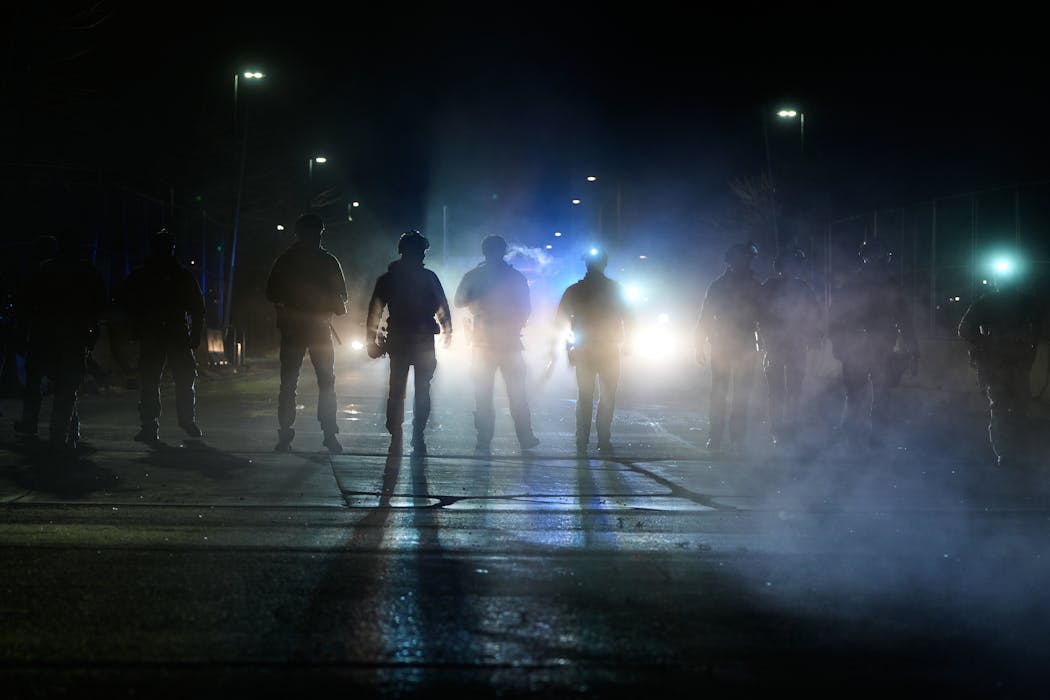
Ilia Murtazashvili does not work for, consult, own shares in or receive funding from any company or organization that would benefit from this article, and has disclosed no relevant affiliations beyond their academic appointment.

​Politics + Society – The Conversation