Categories
Uncategorized

Detroit is spending millions on gunshot detection tech – is it an effective tool in the fight against violent crime?

Detroit Police Chief Todd Bettison says ShotSpotter helps officers do their job, but residents question the cost and transparency of the technology. City of Detroit

_Detroit Police Chief Todd Bettison says alerts from ShotSpotter, a gun detection technology, help officers respond quickly to shootings.

“Without it, I wouldn’t have the closure rate [of resolved crimes] that I have and a lot of families wouldn’t have the justice they deserve,” he said in March 2026, according to BridgeDetroit, a nonprofit news service.

_During a Detroit City Council committee meeting on May 18, 2026, police officials said ShotSpotter led to hundreds of search warrants and confiscated guns in 2025. _

It’s not clear how many arrests resulted last year. Bettison has been quoted saying that ShotSpotter during the May 18 City Council meeting and
256 during a March 23 budget briefing. We reached out to the Detroit Police Department to clarify the number, but it didn’t respond by our deadline.

The department has requested a nine-month extension for ShotSpotter, which would cost the city an additional $US2.06 million, while it considers other vendors to provide gun detection technology, the Detroit News reported.

The system uses a network of acoustic sensors to detect, locate and alert police to shots fired. ShotSpotter is in use in more than 180 American cities, according to the company. The technology has been criticized for its high price tag, ineffectiveness in improving public safety and lack of transparency.

Detroit City Council first approved ShotSpotter in 2020, and the system became fully active in 2021. In 2022, City Council members narrowly approved, by a 5-4 vote, expanding the program to more neighborhoods. The technology now covers approximately 39 square miles (about 101 square kilometers), about a third of the city, and is deployed in the neighborhoods police say are most likely to experience gun violence. The contract that expires on June 30, 2026, cost $7 million over a four-year period.

Divya Ramjee and Tian An Wong are part of a team of researchers who studied the effectiveness of gunshot detection technology in Detroit during its first two years. The study is currently under peer review. They answered the following questions for The Conversation Detroit._

How did ShotSpotter affect calls to 911 to report gunshots?

Wong: Our research first looked at calls to 911 reporting gunshots before and after the first deployment of ShotSpotter in Detroit, covering February 2018 to November 2022. This data is available on Detroit’s Open Data Portal. In the areas of Detroit where ShotSpotter was implemented in 2021, calls to 911 to report gunshots initially dropped by 47%. This effect disappeared about after a year, however, and these calls returned to previous levels.

Our study does not cover the 2023 expansion of ShotSpotter in Detroit, though the data is currently available for those interested.

Although ShotSpotter alert time and location data is publicly available, the outcome of the police response to those alerts, is not and the DPD has never released data on the effectiveness of the technology during these first two years of use. To analyze outcomes, we made a Freedom of Information Act, or FOIA, request to the Detroit Police Department.

Did the technology affect officer response times or the rates of arrests for violent crime in Detroit?

Wong: By analyzing the FOIA data, we found that of the 5,853 ShotSpotter alerts from that first deployment, just two alerts, or 0.03%, resulted in at least one arrest. Additionally, 798 alerts, or 13.63%, resulted in at least one firearm recovered.

Those numbers are obviously low. However, we don’t believe that arrest rates should be used as a measure of ShotSpotter’s success. We need to understand the nature of those arrests and if they helped bring down gun-related incidents in the community.

We did not find any difference in officer response times. Some have argued that the alerts generate responses to events that would otherwise not have been reported due to lack of trust in law enforcement, but it is difficult to verify this claim.

These maps illustrate gunfire data and response times for 2019, two years before ShotSpotter was brought online. The Detroit Police Department likely relied on this data to decide where to use the technology first. Visualization used with permission of Michigan Advance, CC-BY-ND

I’d argue the request to renew ShotSpotter is not based on a rigorous review of the technology’s impact. In addition to ShotSpotter, Detroit also introduced a community violence intervention program in 2023 with a similar name – Shot Stoppers. That program determines grant renewals to participating community organizations based on a drop in homicides and nonfatal shootings in their geographic area.

But the reality is that homicides in Detroit hit a 60-year low in 2025, and nonfatal shootings are also significantly down. This tracks with nationwide crime trends. Our research tries to get at the role ShotSpotter played in this reduction, if any.

What do you make of Bettison’s statement that ShotSpotter alerts led to dozens or hundreds of arrests in 2025?

Wong: The arrest data that we obtained from the Detroit Police Department covers February 2018 to November 2022. Bettison is referring to a later time period – after the expansion of the coverage area – so his numbers don’t necessarily contradict ours. The only way to know for sure is to FOIA data for this most recent time period and fact-check what the chief is saying. This process is currently underway.

In the meantime, two arrests, as we found in the actual data we obtained from the police department, compared with 78 – or even 256, as Bettison as said – seems like a big jump, and more context is needed.

Is there any evidence that ShotSpotter saved lives of gunshot victims?

Ramjee: Evidence is inconclusive at best. Some research supports that the technology can potentially increase the likelihood of police transport of gunshot victims to hospitals and reduce EMS response times for victims, which could potentially improve survival outcomes. However, research hasn’t proved a corresponding reduction in mortality rates in areas where ShotSpotter has been deployed across the U.S.

Woman sits behind a computer.
Gabriela Santiago-Romero, center, represents the 6th district on Detroit City Council. The council member voted against ShotSpotter’s contract renewal in 2022 and continues to question the city’s investment in the technology.
City of Detroit, Public Domain via Wikimedia Commons

How is ShotSpotter received in other U.S. cities?

Ramjee: There are continued issues with the accuracy of sensors, including false positives and missed gunshot detections, that complicate its practical effectiveness.

A piece of gun detection technology secured on a light pole
A ShotSpotter device attached to a light pole. Some cities in the U.S. have ended or declined to extend their ShotSpotter contracts.
Jessica Rinaldi/The Boston Globe via Getty Images

The lack of evidence that ShotSpotter improves public safety, given its high cost, has prompted a number of communities to reassess its value. Chicago; San Antonio; Houston; Baton Rouge, Louisiana; Charlotte, North Carolina; and Portland, Oregon have either terminated existing agreements or indicated that they do not intend to renew them upon expiration.

In New York, the city comptroller indicated that available evidence from a June 2024 audit did not support continued investment in ShotSpotter. Nevertheless, the New York City Police Department opted to renew its contract for an additional three-year term, at a cost of approximately $21.8 million.

What happens to the data ShotSpotter collects? Specifically, does the city of Detroit own it, can researchers access it, and how does that compare to 911 data?

Ramjee: ShotSpotter data ise not broadly shared with the public. The company, which rebranded as SoundThinking, Inc. in 2023, considers the raw audio from sensors, the underlying algorithms and other system-generated data to be proprietary. SoundThinking states that the company only shares alerts, gunshot locations, timestamps and short, isolated audio clips with police agencies. Prosecutors, defense attorneys and courts may also access this incident data as part of criminal cases, depending on legal rules.

Cities and municipalities themselves do not necessarily obtain full ownership of ShotSpotter data even when data is shared with them. In most cases, contractual agreements dictate the access and use of incident data by the respective jurisdictions, and there are generally constraints on how they can store, analyze or publicly release the data.

For 911 call data in Detroit, access to the data depends on the level of detail required. The city’s Open Data Portal provides a large dataset of law enforcement-serviced 911 calls that includes time of incident, call type, response metrics and ShotSpotter-initiated 911 alerts, but it redacts information that exposes a person’s identity.

Obtaining the actual dispatch logs or the arrest outcomes from ShotSpotter alerts typically requires submitting a FOIA request. That process can be tedious, may involve delays due to issues with resources, outdated technology or flawed data reporting practices, and may ultimately result in partial data or data with redactions.

The Conversation

Tian An Wong received funding from the American Council of Learned Societies (ACLS).

Divya Ramjee is affiliated with the Center for Strategic and International Studies.

​Politics + Society – The Conversation

Categories
Uncategorized

Can kids go to prison? A legal expert explains how young people can be tried and sentenced as adults

In some states, children of middle school age or even younger can face a judge and jury in an adult courtroom. O2O Creative/E+ via Getty Images

Curious Kids is a series for children of all ages. If you have a question you’d like an expert to answer, send it to CuriousKidsUS@theconversation.com.


Can kids go to prison? – Artie, age 10, New York City


The United States has a special justice system for people under age 18. But youth can be tried in adult courts and go to adult jails and prisons for certain crimes.

The youth justice system was created because young people are different from adults. The part of the brain that helps control emotions and actions doesn’t finish developing until your mid-20s. Research shows that most people who commit crimes in their youth grow out of this behavior as they mature.

For this reason, juvenile courts and detention centers are designed to protect young people and help them return to normal life. That’s supposed to be balanced with holding young people accountable in ways that reflect their age and degree of maturity.

The Supreme Court has recognized that children are not little adults. It ruled in 2005 that sentencing a person under 18 to death violated the Constitution’s ban on cruel and unusual punishments.

In 2010 the court reached the same conclusion about sentencing someone under 18 to life in prison without the possibility of parole for crimes other than murder. And in 2012 it ruled that states could not mandate life without parole for people under 18 even if they committed murder.

Concerns about “superpredators” in the 1990s spurred a wave of measures that steered young offenders who committed certain crimes into the adult justice system. Now some states are reconsidering those policies.

Juvenile court is not ‘kiddy court’

Many young people who end up in court are accused of delinquency – actions that break the criminal law, such as stealing a car or breaking into someone’s house. If they are found guilty, the consequences can be serious.

They may be put on probation and supervised in their community. But they can also be placed in residential programs or committed to locked juvenile facilities until age 18, or 21 in some states.

Young people can also be charged with what are called status offenses – actions that are illegal for people under age 18, such as skipping school, running away from home or being unable to follow the rules at home. Status offenders can be sent to foster care or group homes, where they are not locked up. They are not supposed to be placed with delinquents in juvenile facilities.

Pie chart showing different types of custody in which some 32,000 young people in the U.S. were held in custody as of 2025.
As of the end of 2025, nearly 32,000 youth were confined in the United States. About 8% (2,437) were in adult jails and prisons; the rest were in youth detention centers, residential treatment centers, group homes or locked facilities.
Prison Policy Initiative, CC BY-ND

Children in court

The U.S. is more willing than many other countries to try young children in the criminal system. This is true even though the Supreme Court ruled in 1960 that no person should be prosecuted in any court system unless they have a factual and rational understanding of the charges they face and can effectively communicate with their lawyer.

Many youth under age 14 lack these abilities and are not legally competent to stand trial. This was an important reason Massachusetts, where I served as a juvenile court judge, raised the minimum age of juvenile court jurisdiction for all offenses to 12 in 2018.

However, 24 other states and four U.S. territories have no minimum age for trying children in juvenile court. Among the 26 states that do have a minimum, that age is 10. Fourteen states and four territories allow children of any age to be detained or locked up.

The American Bar Association recommends that 14 should be the minimum age of prosecution. That’s the most common standard in other countries.

Trying young people as adults

In every state, cases that involve serious offenses, such as armed robbery or rape, can be moved to the adult criminal system. Generally, youth can be transferred to adult courts at age 14 for certain offenses. Some states allow transfer of people as young as age 10.

This can happen for different reasons. Some states allow prosecutors to ask juvenile court judges to waive jurisdiction after a hearing on the case. Other states let prosecutors directly file cases in the criminal system. Still others have laws that automatically send youth to the criminal legal system solely based on the offense charged.

The Supreme Court ruled in 1966 that transfer to adult court should not occur without a statement of findings or reasons by a judge. When judges considered these requests, the court held, they should take into account the nature of the offense, the impact on the victim, and the offender’s age, maturity, prior history and prospects for treatment.

But in states that automatically steer cases to adult court, or let prosecutors choose to file charges there, hearings don’t occur.

Where you live matters

Today, 28 states and Washington, D.C., have provisions for automatically sending youth to the adult criminal system. Data shows that this policy mainly affects people of color.

Between 2009 and 2024, for example, 80% of Maryland youth charged as adults were Black. In 2017, 84% of Alabama youth charged as adults were Black. And in Nebraska in 2024, 36% of youth transferred to the adult system were Black and 20% were Latino.

Florida prosecutes children as adults for serious crimes and sends juvenile offenders to adult prisons at higher rates than any other state. From 2009 through 2019, more than 16,000 children – some as young as 10 years old – were prosecuted as adults in Florida.

Transferring young people to adult prisons interrupts their education and social development. It also exposes them to high rates of violence by adult inmates.

What’s more, it doesn’t make the public safer. Studies show that youth who are transferred to the adult justice system are 34% more likely to commit new crimes after release than offenders who stay in the juvenile system.

Many of my fellow lawyers believe that trying young people as adults isn’t being smart on crime. In our view, the best way to keep the public safe and rehabilitate young offenders is to treat them in ways that reflect their age. That means channeling fewer young offenders into adult courts and not allowing youth who are transferred to be locked up with adults.


Hello, curious kids! Do you have a question you’d like an expert to answer? Ask an adult to send your question to CuriousKidsUS@theconversation.com. Please tell us your name, age and the city where you live.

And since curiosity has no age limit – adults, let us know what you’re wondering, too. We won’t be able to answer every question, but we will do our best.

The Conversation

Jay Blitzman was a juvenile court judge in Massachusetts for 24 years, culminating as first justice of the Massachusetts Juvenile Court, Middlesex Division. Previously, he was a founder and the first director of the Roxbury Youth Advocacy Project and co-founded Citizens for Juvenile Justice, where he currently serves on the advisory committee. He is a member of several American Bar Association committees addressing youth justice issues.

​Politics + Society – The Conversation

Categories
Uncategorized

US indictment of Raúl Castro comes amid a long history of American aggression against Cuba

Acting U.S. Attorney General Todd Blanche announces the indictment of former Cuban President Raúl Castro, in Miami, Fla., on May 20, 2026. Chandan Khanna/AFP via Getty Images

The Trump administration on May 20, 2026, indicted former Cuban President Raúl Castro for murder, based on the downing of two planes near the Cuban coastline in 1996 that killed four people.

As a historian of Latin America and U.S. foreign policy, I believe the indictment may be the prelude to direct U.S. military action against Cuba.

Before Castro, the last U.S. indictment of a Latin American leader occurred in January 2026, when a U.S. attorney appointed by President Donald Trump charged Venezuela’s Nicolás Maduro with narco-terrorism. Those charges were promptly followed by U.S. military strikes on Venezuela and the abduction of Maduro.

Since January, the U.S. has ended the flow of Venezuelan oil to Cuba and has used economic and military pressure to prevent other nations from trading with the island. And Trump recently threatened a “friendly takeover” of Cuba.

I believe that what’s missing from most recent analysis of this situation is the history of U.S. aggression against Cuba. This is essential context for understanding the Trump administration’s recent escalations.

‘Striking at Cuba constantly’

In 1823, U.S. Secretary of State John Quincy Adams identified Cuba as “an object of transcendent importance to the political and commercial interests of our Union.” The 1959 Cuban Revolution that overthrew U.S.-backed dictator Fulgencio Batista and replaced him with Fidel Castro, brother of Raúl, directly challenged those interests by asserting political autonomy and expropriating private property.

State Department officials observed that “the majority of Cubans support Castro” because of the government’s redistributive measures and its “real honesty, courtesy, and idealism.” One official warned “that if the Cuban revolution is successful other countries in Latin America and perhaps elsewhere will use it as a model and we should decide whether or not we wish to have the Cuban revolution succeed.”

They decided quickly. By December 1959, President Dwight Eisenhower’s CIA director had approved plans to overthrow the Castro government. U.S. policy thereafter included direct sponsorship and safe haven for Cuban paramilitary groups.

Several men in a black and white photo inspect the wreckage of a plane.
An American plane is shot down on Playa Girón during the Bay of Pigs invasion in April 1961.
Keystone-France/Gamma-Keystone via Getty Images

The CIA-led Bay of Pigs invasion in April 1961 is only the most famous episode. The U.S. trained 1,400 Cuban exiles to invade Cuba, hoping to ignite a nationwide rebellion. Instead, Cubans rallied behind the government.

Though U.S. analysts often criticize the invasion because it failed, it was also a major crime under international law. Several hundred Cubans were killed.

Fear of a repeat invasion also led Soviet premier Nikita Khrushchev to send nuclear missiles to Cuba, precipitating the Cuban missile crisis of October 1962 that nearly led to nuclear war.

Longtime CIA official Richard Helms later testified that in the early 1960s, “We had task forces that were striking at Cuba constantly. We were attempting to blow up power plants, we were attempting to ruin sugar mills, we were attempting to do all kinds of things during this period. This was a matter of American Government policy.”

In 1976, Luis Posada Carriles and Orlando Bosch, two Cuban exiles, planned the bombing of a Cuban civilian airliner near Barbados that killed all 73 people aboard.

“The C.I.A. taught us everything,” Posada Carriles said later. “They taught us explosives, how to kill, bomb, trained us in acts of sabotage.”

Both men were given refuge in the United States for the rest of their lives.

The Bay of Pigs invasion and the airline bombing violate the core principles of international law, including prohibitions on the unprovoked “threat or use of force” and collective punishment. The U.S. government itself defines “international terrorism” as “violent acts” intended “to influence the policy of a government by intimidation or coercion” or to “intimidate or coerce a civilian population.”

By that definition, its Cuba policy qualifies.

By ‘every possible means’

Another U.S. method of striking at Cuba was through economic sanctions, first imposed on the country in 1960. That year, a State Department official wrote that “every possible means should be undertaken promptly to weaken the economic life of Cuba” so as “to bring about hunger, desperation and overthrow of government.” The logic of collective punishment was clear: make Cubans suffer enough that they rebel against Castro.

Three billboards of three men appear on a weathered wall outdoors.
Images of Cuban President Miguel Díaz-Canel, Raúl Castro and Fidel Castro adorn the state building in Havana, Cuba, on May 20, 2026.
AP Photo/Ramon Espinosa

This policy is now more aggressive than ever. The tightening of U.S. sanctions since Trump’s first term has reduced Cuba’s income from tourism, remittances and overseas medical missions. Now, by choking off the supply of fuel, the U.S. has critically weakened the healthcare and sanitation systems that depend on electricity.

Medical professionals and United Nations observers have described scenes of ventilators and incubators left without power, pharmacies empty and healthcare workers forced into “horrible decisions” about who lives and dies. A recent medical study reported a 148% increase in infant mortality between 2018 and 2025, meaning that about 1,800 infants died who otherwise would have lived.

‘I was trained as a terrorist by the United States’

The focus of the recent U.S. indictment against Raúl Castro was the incident on Feb. 24, 1996, when the Cuban military, which was headed by Castro, shot down those two planes.

The planes were operated by Brothers to the Rescue, an anti-Castro group of Cuban exiles who said they were aiding Cuban emigres trying to reach Florida. The group’s head, and one of the surviving pilots that day, was José Basulto, a veteran CIA asset and participant in the Bay of Pigs invasion.

In 1962, Basulto fired a cannon and machine gun “16 times” at a Cuban hotel, he later recounted. “I was trained as a terrorist by the United States,” Basulto once told an interviewer.

Basulto’s plane had entered Cuban airspace on Feb. 24, as a U.S. customs service specialist later testified. Correspondence from the day shows that Basulto did so knowingly. The previous July, he had told a TV audience, “We want confrontation.”

While the Cuban military could have deescalated the situation more carefully that day, Cuba had been trying for months to stop the violations of its airspace.

I believe indicting Cuban officials over the incident is disingenuous, given the provocations by Brothers to the Rescue and U.S. actions against Cuba, which are in direct violation of international and U.S. laws that prohibit threats, nondefensive violence and collective punishment.

The Conversation

Kevin A. Young does not work for, consult, own shares in or receive funding from any company or organization that would benefit from this article, and has disclosed no relevant affiliations beyond their academic appointment.

​Politics + Society – The Conversation

Categories
Uncategorized

James Comey’s Instagram seashell post sits in a murky legal zone between protected political speech and criminal threat

Did James Comey, former FBI director, ‘knowingly and willfully’ threaten, kidnap or ‘inflict bodily injury upon the President of the United States’? Samuel Corum/Anadolu Agency/Getty Images

In the case of United States v. James Brien Comey Jr., the U.S. president’s security is pitted against the bedrock right to free speech enjoyed by Americans.

Two federal charges have been lodged against former FBI Director James Comey and are based on his Instagram post that depicted seashells spelling out “86 47.”

Comey’s post was interpreted by the U.S. Department of Justice as a threat to harm President Donald Trump. The indictment, obtained by the DOJ, alleges Comey violated two federal laws: 18 U.S.C. § 871, which makes it a crime to “knowingly and willfully” threaten, kidnap or “inflict bodily injury upon the President of the United States,” and 18 U.S.C. § 875, which criminalizes “communication containing any threat to kidnap any person or any threat to injure the person of another.”

Comey’s argument against the charges is likely to be twofold: (1) He lacked the requisite intent that the prosecutor needs to prove his case, and (2) even if he had the intent required by the statute, his speech is protected by the First Amendment. U.S. District Judge Louise Flanagan set Oct. 21 as the Comey case trial date.

I’m a scholar of constitutional and criminal law as well as the First Amendment. The charges against Comey exist in a legal gray area that includes the First Amendment and a series of court decisions over five decades that have gone back and forth over what dangers constitute speech that can be punished.

Three men standing in front of a curtain, flags and some official seals while one speaks at a lectern.
Ellis Boyle, U.S. attorney for the Eastern District of North Carolina, is flanked by acting Attorney General Todd Blanche, left, and FBI Director Kash Patel at a press conference on April 28, 2026, concerning charges against James Comey.
Tasos Katopodis/Getty Images

Parsing the charges

In criminal law, there are generally two parts to most crimes – the criminal act and the criminal intent. The criminal act is referred to as the “actus reus.” The criminal intent is known as the “mens rea.”

Some crimes also require a particular result. For instance, murder requires a death of a person. A defendant can neither be charged with nor convicted of murder unless and until the victim dies. If the victim doesn’t die, then at most the defendant can be convicted of only attempted murder.

The criminal charges alleged in Comey’s case don’t require a result, however. The president need not be kidnapped or injured for someone to be charged with violating either of them.

But the prosecutor must still prove the criminal intent and the criminal act for both charges to stick in Comey’s case. In my view, the Justice Department will have a difficult time proving the mens rea against him.

Comey has consistently maintained that he didn’t know “86 47” implied violence against the president.

Meaning and purpose

Comey has stated he came across the shells that spelled out “86 47” while walking on a beach in North Carolina, took a picture and posted it on Instagram.

The term “86” is commonly used to mean “to throw out” or “to get rid of” in American slang. According to Merriam-Webster, the term “comes from 1930s soda-counter slang meaning that an item was sold out.”

Comey later removed the image from Instagram and posted a statement that read, “I posted earlier a picture of some shells I saw today on a beach walk, which I assumed were a political message. I didn’t realize some folks associate those numbers with violence. It never occurred to me but I oppose violence of any kind so I took the post down.”

Even though Comey has insisted that he thought it was a silly picture of shells arranged in a clever way to express a political viewpoint, the Trump administration argues that Comey not only knew the meaning of “86 47” but that he purposefully threatened the president.

What’s plausible?

The first crime charged in the indictment, 18 U.S.C. §871, requires the defendant to have “knowingly and willfully” threatened to kidnap or inflict bodily injury upon the president. This is the statute’s mens rea; the defendant must have known that he was threatening the president of the United States.

Comey’s statements suggest that he didn’t know the threatening nature of his Instagram post. Thus, he cannot be convicted of “knowingly” threatening the president if he didn’t know its meaning.

To convict Comey, the prosecutor must prove that he did, in fact, know the meaning of “86 47” when he posted it.

Comey’s career as a federal prosecutor and his tenure as the FBI director may work against him here. In my view, it’s more than plausible that Comey encountered the threatening version of the term “86” in his career. It’s also more than plausible that the term appears in documents, records and court filings that Comey has drafted and signed over his career, all of which could be used against him at trial.

But even if the Justice Department can prove Comey did, in fact, know the threatening nature of “86 47,” its case against him is not a slam dunk.

And that’s because of the First Amendment.

Testing what’s protected speech

A balding man stands in front of a soldier who is wearing a helmet.
A draft protester was convicted after declaring in 1966, ‘If they ever make me carry a rifle, the first man I want to get in my sights is L.B.J.’ His conviction was overturned by the Supreme Court.
Yoichi Okamoto/PhotoQuest/Getty Images

As a constitutional law scholar, I’d expect Comey to argue that his Instagram post was protected speech.

Even though the laws charged in Comey’s case are generally valid and constitutional, criminal defendants can always argue that otherwise valid and constitutional laws are unconstitutional as applied to them and their particular case. Comey is likely to argue this in his defense, but it won’t be as straightforward as one might think.

The First Amendment is not absolute – not all speech and expression is protected by the Constitution.

In Chaplinsky v. New Hampshire from 1942, Justice Frank Murphy wrote that it’s “well understood that the right to free speech is not absolute at all times and under all circumstances.”

In 1969, the U.S. Supreme Court held in Watts v. United States that while “true threats” are not protected by the First Amendment, political hyperbole remains protected speech. The Supreme Court defines true threats as statements where the speaker means to communicate a serious expression of intent to commit an act of unlawful violence against a particular individual or group of individuals, but the speaker need not actually intend to carry out the threat.

Watts v. United States involved a threat against the sitting president of the United States, Lyndon B. Johnson. In that case, Robert Watts expressed his strong opposition to the military draft at a public rally, saying, “If they ever make me carry a rifle, the first man I want to get in my sights is L.B.J.” He was subsequently charged and convicted under the same statute, 18 U.S.C. § 871, used in Comey’s case.

The Supreme Court reversed the conviction, ultimately agreeing with Watts, who had maintained that his statement was “a kind of very crude offensive method of stating a political opposition to the President.”

As the court explained, quoting an earlier decision on press freedom, “For we must interpret the language Congress chose ‘against the background of a profound national commitment to the principle that debate on public issues should be uninhibited, robust, and wideopen, and that it may well include vehement, caustic, and sometimes unpleasantly sharp attacks on government and public officials.’”

Since Watts, countless defendants have faced similar charges for threatening the president. Many have been convicted.

In the 1970s, Eugene Hart was convicted of threatening the president after his brother reported Hart’s plan to assassinate President Richard Nixon. An appellate court affirmed his conviction, concluding that Hart’s verbal threat coupled with his detailed assassination plan couldn’t have been “uttered in jest or in the nature of a hyperbole.”

In the 1980s, David Hoffman was convicted of threatening President Ronald Reagan when he mailed a letter to the White House stating, “Ronnie, Listen Chump! Resign or You’ll Get Your Brains Blown Out.” And in 1999, Donald Adams was convicted of threatening the president when he approached the White House gates telling Secret Service officers, “I want to kill the president.”

But in those cases and others, the defendants took concrete steps that demonstrated their sincerity and conscious awareness of the threatening nature of their speech. In my estimation, both are absent in Comey’s case.

The Conversation

Wayne Unger does not work for, consult, own shares in or receive funding from any company or organization that would benefit from this article, and has disclosed no relevant affiliations beyond their academic appointment.

​Politics + Society – The Conversation

Categories
Uncategorized

For Black women in abusive relationships, gun-control loopholes can engender deadly disparities

Femicide claims more than 1,800 lives in the United States every year. SimpleImages/Getty Images

In April 2026, Dr. Cerina Wanzer Fairfax was shot and killed by her husband while their divorce was pending.

She had done what she was supposed to do. She had initiated the legal process to leave Justin Fairfax, the former lieutenant governor of Virginia. It didn’t save her.

What happened to Wanzer Fairfax has a name: femicide.

Femicide is the intentional killing of women on the basis of gender. Women are most often killed by their partner, former partners or another person who believes they have a claim on their life. It happens in living rooms and driveways and parking lots. It happens during marriage, divorces, separations and in the weeks after a woman finally walks out the door.

As a scholar focused on the intersection of firearm violence and intimate partner homicide, I examine the policy and structural conditions that determine who is at risk and where prevention efforts are falling short.

Intimate partner homicide doesn’t affect all women equally. Black women have the nation’s highest rates of homicide by an intimate partner, according to data from the Centers for Disease Control and Prevention.

Intimate partner violence by the numbers

A 2024 study in The Lancet tracking homicide deaths from 1999 to 2020 found that Black women ages 25 to 44 are killed at nearly four times the rate of their white peers.

Spring 2026 saw three such cases make national headlines.

Just prior to Wanzer Fairfax’s death, Vice Mayor Nancy Metayer Bowen of Coral Springs, Florida, was shot to death – allegedy by her husband. Also in April, in Louisiana, Shaneiqua Pugh was shot by her husband, as was Christina Snow, the mother of three of the killer’s children. Pugh and Snow are both expected to survive. Eight children, however, were killed.

Three cases. Three states. One month. All, sadly, preventable.

Intimate partner homicide claims more than 1,800 lives in the United States every year. Nearly half of victims are killed by a current or former intimate male partner – not a stranger. These aren’t random acts of violence.

Separation is one of the most dangerous times in an abusive relationship. This is why we cannot see the death of Wanzer Fairfax and others like hers as one-off tragedies. They represent a decades-long pattern of intimate partner femicide in Black relationships – a pattern driven by firearm access coupled with inadequate policy enforcement.

Guns are what make intimate partner violence so deadly. About half of the roughly 1,800 annual intimate-partner femicide cases involved a gun. And in every region of the country, firearm homicide disproportionately kills Black women.

‘The partner loophole’

If the gun is what escalates the risk, it is also where policy has its best chance to intervene.

State law can explicitly restrict perpetrators of domestic violence from purchasing or possessing firearms through two types of civil protection orders: final domestic violence restraining orders and temporary restraining orders. Research demonstrates that states with strong gun restrictions along these lines have meaningfully lower rates of intimate partner homicide.

Generally speaking, though, these laws are not working as designed.

In most states, for example, only certain kinds of relationships qualify for protective orders to be issued against an abusive partner. The most common qualifying relationship is romantic partner or former partner. This characterization poses a problem called “the partner loophole.”

Federal gun-possession restrictions had a similar limitation for decades. If the relationship was a dating partnership, the prohibition against abusive partners obtaining a firearm did not apply. This came to be known as the “boyfriend loophole.”

In 2022, the bipartisan Safer Communities Act extended the gun prohibition to abusive dating partners. While the law now covers more kinds of relationships, it does not yet offer equal protection to Black women in those kinds of relationships.

Research using the National Violent Death Reporting System found that state-level enforcement of the policy was associated with reductions in intimate partner homicide among unmarried white victims, but not among victims of color.

Firearm-relinquishment laws are another weak spot I’ve identified in protecting Black women from intimate partner violence.

When a court issues a domestic violence protective order, federal law prohibits the restrained person from possessing a gun. But this prohibition does not automatically remove guns already in the person’s possession: A gun-relinquishment law must be invoked to compel them to surrender their weapons.

Some states, including California and Washington, have strong relinquishment provisions. They require judges to mandate surrender, set compliance deadlines and authorize law enforcement to recover unrelinquished weapons. These laws are associated with reductions in intimate partner homicide.

But other states give judges discretion. A 2025 review of civil protection order cases in South Carolina found that courts issued a firearm-protection order in only 32% of eligible cases in 2019. In North Carolina, a 2024 study examining state enforcement laws found that despite 93% of cases meeting the conditions for gun relinquishment, the policy was enforced in only 37% of cases.

As a result, researchers have found, firearms are discussed in fewer than 1 in 4 protective-order hearings nationwide, and courts order abusers to surrender their guns in 66% of applicable cases.

The result of unequal state policy enforcement is a prohibition that exists on paper and a gun that stays in the home.

The racial equity gap

The evidence is clear: When gun prohibition and relinquishment laws are fully enforced in abusive relationships, they can save lives.

Yet most states have gaps that limit how effective these policies are in practice. And that failure falls hardest on Black women.

Research shows that state firearm restriction laws with relinquishment provisions were associated with a 16% reduction in firearm intimate partner homicide for white victims. For Black victims, the reduction was not statistically significant.

This is especially concerning given that Black women experience the highest incidence of injury and death from intimate partner violence in the country.

The problem isn’t the laws themselves. It’s that the mechanisms of the law depend on a delivery system – courts, law enforcement, protective orders – that doesn’t work well for Black women.

After reporting domestic abuse, Black women are more likely to be incarcerated for defending themselves against their abuser, and they lose custody of their children more often once CPS becomes involved. A study examining preferences of intimate-partner violence survivors found that Black women report fear and distrust of police as a barrier to engaging with the legal system.

Because of these experiences, Black women understandably engage the criminal justice system less frequently. And laws protect only the people who can use them.

The media usually get Black femicide wrong

Another problem surrounding intimate partner homicide inflicts its harms after death.

When a woman is killed by her partner, media coverage often follows a familiar script: a name, a location, a grieving community. What it almost never includes is the word that I believe most accurately describes what happened: femicide.

Feminists in many countries, particularly in Latin America, have fought to enact femicide laws in response to pervasive violence against women. But the U.S. has no such laws and lags behind here.

Research has documented consistently that news coverage of intimate partner homicide depicts it as episodic rather than systemic, treating each killing as an isolated event rather than part of a preventable pattern.

When the victim is a Black woman, the issues compound.

Coverage of Black women’s deaths is less frequent, less sustained and less likely to generate the kind of public outrage that drives policy change. The focus in these stories, when they do run, tends to fall on the relationship or the victim’s personal history rather than on the systems that failed her.

This matters because media framing helps to determine what the public believes is fixable.

When journalists cover intimate partner homicide as a private tragedy, it becomes politically inert. When they contextualize it as the result of an unenforced gun law or a legal loophole, it becomes a policy failure – and policy failures have a policy remedy.

I believe the U.S. needs comprehensive standards for firearm restrictions in domestic violence cases, more robust enforcement and targeted efforts ensuring these protections reach all communities equitably.

For Black women, delay or failure may be the difference between life and death.

This story was produced in collaboration with Rewire News Group, an independent, nonprofit newsroom dedicated to covering reproductive health.

The Conversation

Sativa Banks does not work for, consult, own shares in or receive funding from any company or organization that would benefit from this article, and has disclosed no relevant affiliations beyond their academic appointment.

​Politics + Society – The Conversation

Categories
Uncategorized

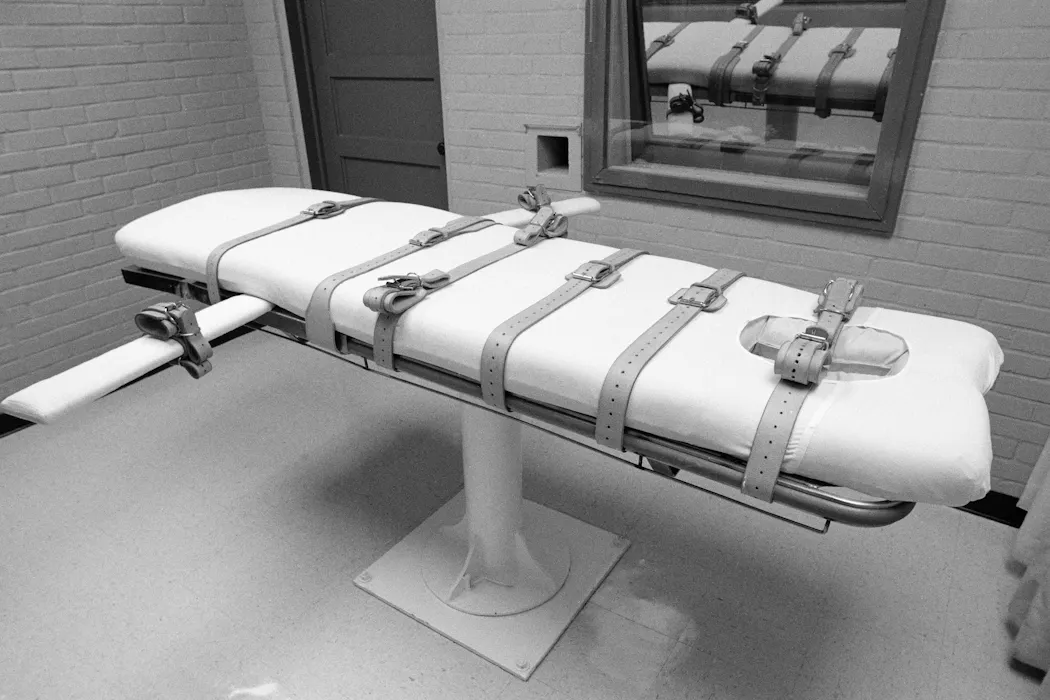
Tony Carruthers recently survived a lethal injection attempt – the latest man to endure a failed execution

In the past 80 years, at least nine men have survived execution attempts. Bernd Obermann/Getty Images

Tennessee set out to execute Tony Carruthers on May 21, 2026, but he lived to tell about it.

Carruthers, who was sentenced to death for a 1994 triple murder, survived his date with death when the execution team members could find only one suitable vein in which to secure an IV, but not, as USA Today reports, the “backup line, which is required under the state’s lethal injection protocol.”

After the failed attempt, Tennessee Gov. Bill Lee gave Carruthers a one-year reprieve, a decision the governor did not explain.

What happened to Carruthers is a reminder that things frequently go wrong in executions, even if in almost all cases the problem is resolved and the execution is completed.

Indeed, in the past 80 years, only eight other men have had experiences like Carruthers’ and survived execution attempts.

Four of those execution “survivors” were killed by a second execution attempt, while others escaped that fate. Three others died on death row; one of them after the state agreed not to try to execute him a second time, and one of them is still alive and awaiting his fate.

Having studied capital punishment for decades, I know the Eighth Amendment’s prohibition of “cruel and unusual punishment” has shaped constitutional discussions around failed executions. But so far, courts have not stood in the way when state governments have wanted to try to execute the same man again.

Not just a lethal injection problem

Carruthers survived a lethal injection attempt, but execution failures have not been confined to that method. A look at the history of hanging reveals several instances in which it failed.

In 1833, for example, a hanging in Pennsylvania failed to kill Charles Getter, who had been sentenced to death for murdering his wife.

“The rope was placed around Getter’s neck. The hangman drew it up fast,” true crime author Amanda Howard notes. “Getter struggled and kicked, choking, before the rope broke, throwing him to the ground.” However, Getter did not die.

The executioner sent someone to look for a stronger rope. This time, the rope did not break and Getter met “the fate of a murderer.”

In 1894, Will Purvis’ hanging also failed when the noose loosened. Instead of dying from a broken neck, Purvis survived, suffering only rope burns on his neck.

Unlike Getter, Purvis returned to prison contending that he was innocent. His lawyers unsuccessfully tried to get the courts to prevent a second execution attempt. Purvis remained behind bars until 1898, when Mississippi’s governor pardoned him. Purvis is the only execution survivor ever to receive such grace.

In the late 19th century, the electric chair replaced hanging as the country’s primary execution method, but it did not prevent failed executions. At least once in the 20th century, the electric chair also failed to kill.

In the spring of 1946, the state of Louisiana tried to use it in the execution of Willie Francis, a 16-year-old Black youth who had been convicted of murdering a local sheriff. At the time, the electric chair was said to be the most humane execution method.

But what Francis experienced hardly seemed humane. When the electric current reached him, “He started going into convulsions.” The executioner “flipped the switch again,” but Francis was not killed.

Later, like Purvis, Francis turned to the courts to try to stave off another execution attempt. The decision in his case would set the precedent for how judges would deal with other execution survivors.

A young Black man sits in a prison cell and smiles.
Willie Francis, 17, who was convicted of murdering a sheriff, sits in a prison cell in May 1946.
AP Photo/Bill Allen

An accident?

In January 1947, months after Francis survived the electrocution, the U.S. Supreme Court gave Louisiana permission to try again. The justices split, with five giving Louisiana the green light and four dissenting.

Justice Stanley Reed’s majority opinion emphasized that what had happened to Francis was accidental and that, without malicious intent, there was no violation of the Eighth Amendment. As he put it, “The fact that an unforeseeable accident prevented the prompt consummation of the sentence cannot, it seems to us, add an element of cruelty to its subsequent execution.”

In his view, “The cruelty against which the constitution protects a convicted man is cruelty ‘inherent’ in the method of punishment, not the ‘necessary suffering’ involved in any method employed to extinguish life humanely.”

Justice Harold Burton spoke for the dissenting judges. As he put it: “The intent of the executioner cannot lessen the torture or excuse the result.” A second execution would offend the “fundamental instincts of civilized man.”

Francis was put to death almost a year to the day after his first execution failed.

It would be several decades until another person survived an execution. But the pace of failed executions has only picked up since the start of the 21st century.

21st century execution survivors

From 2009 until May 2026, six people survived failed lethal injection attempts. Romell Broom became the first 21st-century execution survivor when in 2009 the state of Ohio gave up after trying for two hours to find a usable vein in which to secure an IV line.

In his case, the Ohio Supreme Court, relying on the Francis precedent, decided that “The insertion of IV lines is merely a preparatory step to the execution.” In its view, Broom’s punishment had not really begun. Therefore, a second execution would not violate the prohibition on double jeopardy or on the imposition of cruel punishment.

Mugshot of a white man.
The state of Alabama executed Kenneth Smith in 2024 after he survived a previous lethal injection attempt.
Alabama Department of Corrections via AP

But before Ohio could again attempt to execute Broom, he died on death row in December 2020 after contracting COVID-19. Another 21st-century execution survivor, Alva Campbell, also died on death row.

In 2018, Doyle Hamm reached an agreement with the state of Alabama stating that he would not be subject to a second execution after executioners couldn’t access a vein during an attempted lethal injection. Hamm died from cancer in 2021.

However, Alabama succeeded in executing two other execution survivors, Alan Miller and Kenneth Smith, both in 2024. In both cases, they had survived failed lethal injections.

And Thomas Creech is, like Carruthers, still alive after lethal injection failure, this time in Idaho. It’s not clear if and when Idaho will try again to put him to death. If it does, the state will use the firing squad, which will become its primary execution method on July 1, 2026.

Carruthers’ fate

As Carruthers awaits his fate in Tennessee, defense lawyers in the state have asked Gov. Lee to halt all executions pending a thorough review of its protocol.

A mug shot of a Black man.
This undated photo released by the Tennessee Department of Correction shows Tony Carruthers.
Tennessee Department of Correction via AP

And as the Death Penalty Information Center reports, “attorneys from the Federal Public Defender’s Office filed a new federal lawsuit … to prevent Tennessee from attempting to execute Mr. Carruthers a second time.”

That suit builds on litigation filed in March 2025 alleging that the administration of lethal injection in Tennessee inflicts cruel and unusual punishment.

Only time will tell if the judges who hear those cases will be persuaded by what Justice Burton wrote in the Francis case: “Although the failure of the first attempt, in the present case was unintended, the reapplication of the electric current will be intentional … The present case demonstrates that, today, two separate applications are sufficiently ‘cruel and unusual’ to be prohibited.”

When the state, Burton explained, seeks to execute someone, it has a duty “to make sure that there (is) no failure.”

The Conversation

Austin Sarat does not work for, consult, own shares in or receive funding from any company or organization that would benefit from this article, and has disclosed no relevant affiliations beyond their academic appointment.

​Politics + Society – The Conversation
Categories
Uncategorized

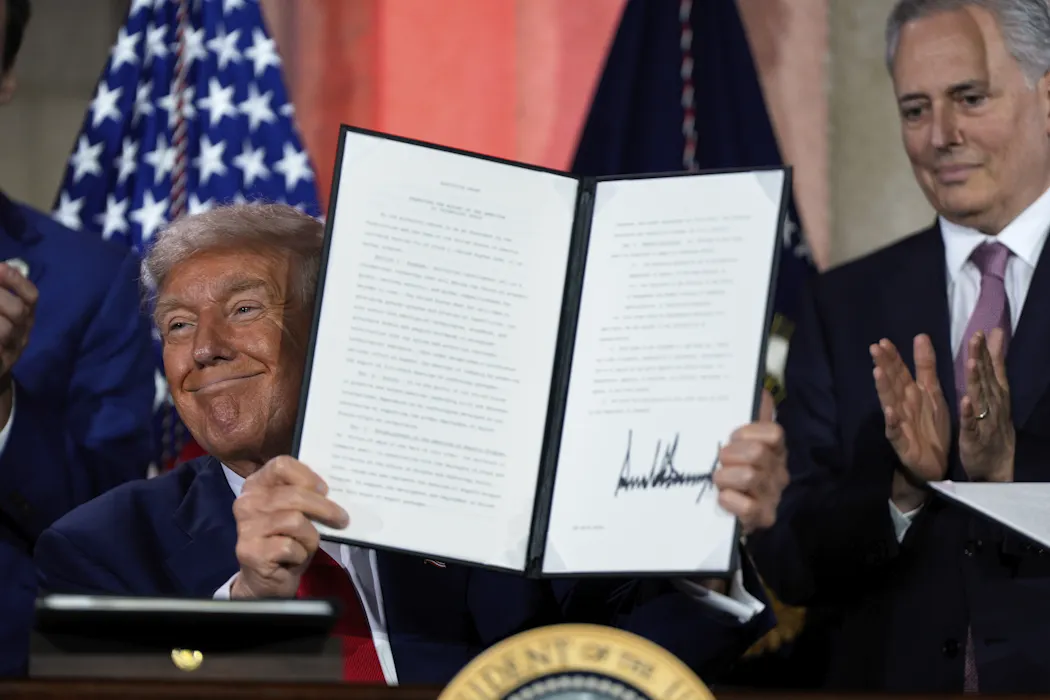
From oversight to coercion: How authoritarian governments are twisting AI safety to get tech companies to fall in line

President Trump’s 2025 executive order about ‘woke AI’ put the tech industry on notice about aligning with the administration’s views. AP Photo/Julia Demaree Nikhinson

When researchers founded Anthropic in 2021, they said the race to build powerful AI was moving too recklessly. They inserted detailed safety measures into their products and marketed their commitment to safety as the corporate quality that distinguished them from competitors – notably OpenAI, the rival company they had left. In March 2026 that reputation was tested when the Trump administration declared that Anthropic was a supply chain risk.

The company had refused to remove built-in safeguards that prohibited domestic surveillance and autonomous weapons from products it had supplied to the Pentagon. President Donald Trump ordered the federal government to stop using Anthropic and its large language model, Claude, labeling the company a national security risk. Within hours, OpenAI made a deal to be the Pentagon’s supplier instead.

Despite Anthropic’s apparent stand, during its clash with Trump the company quietly scrapped the binding principles in its main safety policy. Several weeks earlier, Anthropic’s head of safeguards research had resigned, warning that “the world is in peril.” And a week after the Pentagon officially banned Claude, the U.S. military was still using the technology to select and target sites to bomb in Iran.

As a philosopher studying the rule of law and democracy, I’ve found that authoritarian governance of technology often does not involve direct censorship. Instead it delegitimizes the intended protections, poisoning any external regulation and even voluntary self-regulation that deviates from the regime’s goals or values.

The Trump administration, which follows the authoritarian playbook, has argued that AI safety standards and user restrictions are ideological impositions rather than sound engineering decisions. The “Preventing Woke AI” executive order of July 23, 2025, didn’t change what companies are allowed to do with their products. By by attaching the “woke” label to basic ethics protections, the administration made those protections politically costly to maintain.

The Brennan Center, a legal policy and advocacy organization, has documented how AI ethics is being redefined through contract negotiations. In these cases, the government weaponizes terms such as “biased” to disqualify companies that maintain civil rights protections from competing for federal contracts.

The prisoner’s dilemma

A single U.S. Defense Department AI contract can be worth billions of dollars. It can also provide access to data no private company could otherwise have and unlock further government work. Companies that maintain the ethics guardrails risk ceding ground to competitors that don’t.

When OpenAI moved in to take the Pentagon work, CEO Sam Altman told his board of directors the move looked “opportunistic and sloppy.” But he said the company took it anyway, because admitting that an action looks bad is different from being willing to fall behind.

Donald Trump talking to AI leaders at the White House.
President Donald Trump and OpenAI CEO Sam Altman speak during a Jan. 21, 2025, news conference during which Trump announced an investment in AI infrastructure.
Andrew Harnik/Getty Images

This situation reflects the classic prisoner’s dilemma. If Anthropic maintains safety provisions and OpenAI strips them away, OpenAI gets the contracts and the future advantage. If both companies maintain the provisions, digital protections might survive. But because neither company can be certain the other will hold the line – and because being left behind is not a good option – the rational choice is to discard safety measures.

These circumstances differ from a standard market race to the bottom in one key respect: The trap of having to strip away guardrails isn’t an accident of competition; it’s being maintained by the government through incentives.

Palantir didn’t wait to be caught in this trap. The data analytics company was founded by Peter Thiel and run by Alex Karp, who spent years denouncing “woke” Silicon Valley. Palantir built its business model around government surveillance and military data infrastructure. While Palantir has said it is committed to privacy and civil liberties, critics contend that the company is dismantling those protections. The company’s stock has surged under the Trump administration, its contracts have expanded, and it now has a front-row seat where AI policy is being written. Palantir solved the prisoner’s dilemma by defecting first.

It’s important to note that the dissolution of safety teams across the industry, such as OpenAI’s Superalignment team and Microsoft’s ethics unit, isn’t the result of anyone deciding to abandon safety. What I see in analyzing the different companies’ actions is a pattern: an accumulation of collective, incremental compromises that quietly reorient the definition of safety away from the public and toward the state. The resulting harm and risks fall on everyone whose lives are shaped by AI systems.

Redefining safety to serve the government

Across government contracts and policy documents, I have also observed that the original definition of AI-related safety has shifted from protecting the public toward making systems controllable for the state. The “anti-woke” framing accelerates this shift: Once ethics requirements are characterized as ideological rather than technical, removing them can be framed not as a safety reduction but as a correction.

This shift does not require bad faith from the companies. Safety teams are still doing rigorous work. The companies are not lying when they describe their safety commitments. Those commitments are now simply oriented toward the government rather than the public.

The case for stronger AI regulation assumes that a government constrains commercial entities on behalf of the public. But blacklisting a company for maintaining civil rights protections, and then banning the military deployment of its AI hours later, shows that the federal government in this instance enables the harm that regulation is meant to prevent.

Expanding regulatory authority over AI companies does not necessarily protect citizens. Safety regulations – intended to constrain corporate power – in authoritarian regimes become tools to coerce compliance.

The Conversation

Michael Gregory does not work for, consult, own shares in or receive funding from any company or organization that would benefit from this article, and has disclosed no relevant affiliations beyond their academic appointment.

​Politics + Society – The Conversation

Categories
Uncategorized

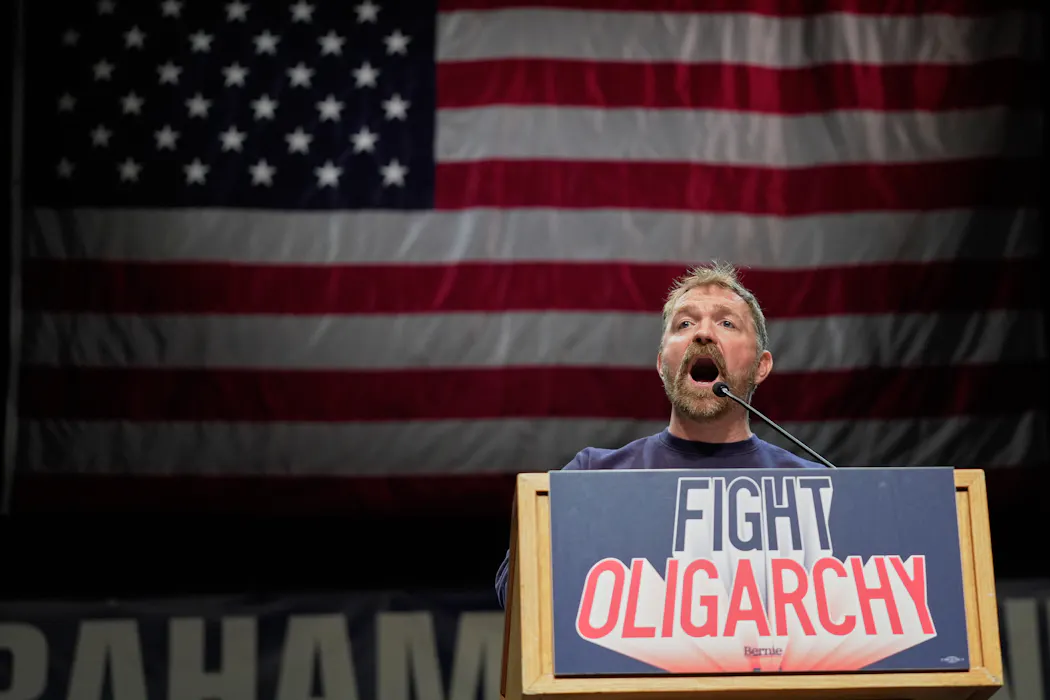
Democrats don’t get why they’ve lost most working class voters

Graham Platner, Democratic candidate for U.S. Senate, speaks at an event hosted by U.S. Sen. Bernie Sanders in Orono, Maine, on May 24, 2026. AP Photo/Robert F. Bukaty

Since 2016, when Donald Trump shattered the Democrats’ blue wall by winning working-class voters across the Midwest, a cottage industry has sprung up on the left dedicated to answering a single question: How can Democrats win back the working class?

The answers come in different forms. Sometimes it is veteran Vermont Sen. Bernie Sanders – barnstorming red districts, railing against oligarchy and corporate greed.

Or it’s Connecticut Sen. Chris Murphy, who after the 2024 election declared, “Democrats must reclaim our identity as the party of the working class.”

Or the answer comes from a new generation of candidates – tattooed veterans, mechanics, bartenders – whose biography is supposed to do the political work that policy has not.

Graham Platner, the Maine Senate candidate who has become the left’s latest blue-collar savior, put the theory in its most unguarded form.

“We are in a form of class war,” he says. “And if the Democratic Party is going to have a future with working people, it needs to pick the side of working people.”

How does he define the working class? “Essentially everybody who isn’t making all their money on an immense amount of wealth.”

The theory is all the same: Somewhere out there is a latent working-class majority, held together by shared economic grievances, waiting to be politically reassembled to vote for Democrats. The New Deal did it – Democrats can do it again.

I’m a political scientist who has written extensively about rural and working-class communities. I believe it is an open question whether these reformist Democrats are really interested in understanding working-class voters on their own terms. Because working-class voters, as they tell us themselves, are not simply waiting to be activated by the right program, the right messenger, the right phrase. “Fight the oligarchy” probably isn’t going to do it.

Working-class voters have a worldview. For 50 years, it has been growing less compatible with the Democratic Party’s – not because working-class voters changed, but because Democrats did.

Working-class identity

Since the early 1950s, the American National Election Studies has asked respondents whether they think of themselves as members of the working class. This article uses my analysis of that data.

While a larger proportion of the electorate has obtained a college degree and household incomes have risen, the share of Americans who consider themselves working class has remained remarkably stable: roughly 35% of voters for the past 70 years, 38% in 2024.

Working-class identity is something more durable and culturally grounded than a description of who isn’t a billionaire. It is a specific way of looking at the world.

There are conventional ways to define the working class, but they often miss how people understand their own place in society. In the 2024 American National Election Studies, for example, 21% of those who identify as working class have a college degree, only 5% belong to a private-sector union, and 37% own stocks. Conversely, most Americans without a college degree do not identify as working class.

Working-class voters have never been a predominantly Democratic group – not even at the height of the New Deal coalition. Based on the American National Election Studies self-report measure, the working-class share of the Democratic coalition peaked around 56% in 1960 and has fallen more or less continuously since, sitting at just about 30% today.

Meanwhile, the share of working-class voters who identify as Democrats has been declining for half a century: A majority did so in 1958, but not since.

Working-class voters have not become Republicans. Only in 2020 and 2024 – the first time in the survey’s history – did more working-class voters identify as Republican than Democrat, and even then by narrow margins.

The data shows a working class that is politically homeless: estranged from the Democrats, not captured by the Republicans, stuck in the middle with diminishing attachment to either party.

Economic abandonment

So what drove them out?

A segment of the progressive left has a ready answer: Democrats abandoned working-class voters economically – on trade, wages and industrial policy. Working-class voters responded rationally. Fix the economics and the coalition comes back.

Trade is where the argument is strongest. In 1988, roughly 74% of both Democrats and working-class voters groups favored limits on imports to protect American jobs.

By 2024, only 26% of Democrats favored limits, while a majority – 54% – of working-class voters continued to do so.

Unlike most Democrats, many working-class communities do not see globalization in their interest. Running alongside the trade gap is a widening divide over values that no tariffs can fix.

What fairness requires

In 1984, Democrats and working-class voters broadly agreed that treating people more equally would mean fewer social problems. A divergence opened after 2008 and accelerated after 2016, with Democrats now 28 points more likely than working-class voters to think we should worry more about equality.

In 1986, half of mainstream Democrats and a slightly smaller percentage of working-class voters agreed with the idea that Black Americans don’t succeed because they don’t try hard enough. By 2024, Democratic agreement had collapsed to 13%. Working-class voters declined too, but to 32%.

The gap that opened between them is not primarily a story about rising working-class racial resentment. It is a story about the Democratic Party’s rapid post-2008 shift toward a worldview that places far greater explanatory weight on structural barriers and far less on individual effort and personal responsibility.

Working-class voters, who historically have understood their own lives through a framework of hard work and earned reward, did not shift so dramatically.

Alignment becomes division

On cultural questions, the pattern persists: Working-class voters did not move right in reactionary revolt. Democrats moved left.

In 1986, similar levels of Democrats and working-class voters agreed with the statement “This country would have many fewer problems if there were more emphasis on traditional family ties.” By 2024 a 25-point gap emerged.

On whether religion is an important part of their life: a near-zero gap through the early 1990s, but 17 points by 2024. On abortion, a 3-point gap in 1980 became 30 points in 2024. Regarding whether immigration levels should be increased, the two groups were virtually identical in 2000 – around 8% support – but by 2020 Democrats were at 48%, working-class voters at 24%.

But even where working-class voters nominally agree with a Democratic policy goal, they don’t trust the institution being asked to deliver it – a distrust decades in the making.

How the ‘system’ plays

In 1958, working-class voters and Democrats were within 5 points of each other on whether government wastes a lot of tax money. By 2024 that gap reached 27 points – not because working-class voters lurched toward anti-government extremism, but because mainstream Democrats became dramatically more trusting of government as an instrument of social change.

Working-class voters are 17 points more likely than Democrats to say people like them have no say in what government does. In 2024, 88% of working-class voters and 75% of Democrats said government is run by a few big interests. Both groups agree the system is captured.

Yet the Democratic policy response, invariably, is to expand the system.

On support for expanding government – from healthcare to jobs to environmental programs – Democrats and working-class voters have diverged dramatically since the 1980s. By 2024, there were approval gaps of between 20 and 30 points on providing government health insurance, environmental spending and a guaranteed jobs program.

On every major plank of the progressive economic agenda, Democrats are now substantially to the left of the workers they claim to champion.

Not all class war

Working-class voters have been telling pollsters for 60 years that the political system doesn’t hear them. Democrats, over the same period, have grown more comfortable with the institutions working-class voters have increasingly less faith in.

This distrust is the accumulated residue of specific experiences: deindustrialization that happened on government’s watch, trade deals that economists endorsed and workers paid for, a 2008 financial crisis response that saved the banks and foreclosed on their homes, an opioid epidemic that regulators missed entirely.

To be fair, this is precisely what the new crop of reform candidates say they want to fix. The argument that the right candidate can move the needle is not crazy. Candidate quality matters. Personal trust can substitute for institutional trust, at least at the margins.

But economic grievance politics is a very small slice of what working-class voters are telling us. The data documents a comprehensive, decades-long divergence in how working-class voters and mainstream Democrats understand fairness, government, personal responsibility and social change.

Reducing that to class war jams working-class voters into a prefabricated progressive agenda rather than taking seriously what they are actually saying.

The Conversation

Nicholas Jacobs does not work for, consult, own shares in or receive funding from any company or organization that would benefit from this article, and has disclosed no relevant affiliations beyond their academic appointment.

​Politics + Society – The Conversation

Categories
Uncategorized

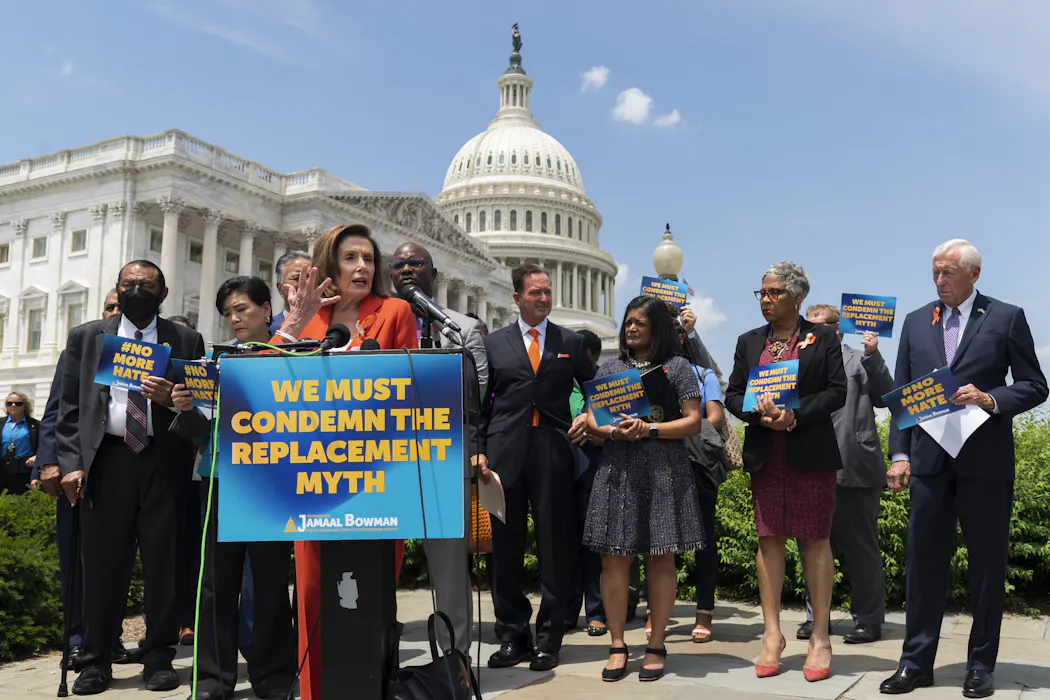
How Fox News viewership increases belief in the anti-immigrant great replacement theory

House Speaker Nancy Pelosi speaks on Capitol Hill on June 8, 2022, about a resolution condemning the great replacement theory. AP Photo/Manuel Balce Ceneta

During a Washington Nationals baseball game on May 17, 2026, three people unfurled a large banner from the upper deck of Nationals Park displaying a link to a white nationalist website.

The website, warning of the replacement of whites by people of color, called for the deportation of 100 million people from the United States.

The disturbing incident reflects the broader ascendance of the “great replacement theory,” the xenophobic conspiracy theory asserting that shadowy elites are embracing permissive immigration policies to replace native-born white Americans with immigrants of color.

Prominent Republicans, including President Donald Trump, Speaker of the House Mike Johnson and conservative podcaster Tucker Carlson, have echoed ideas associated with the great replacement theory. And conservative media outlets, such as Fox News, have disseminated them to millions of viewers.

But are the xenophobic ideas recently expressed at Nationals Park limited to a small number of extremists, or are they also endorsed by the broader public? If the latter, how do political and media elites contribute to their spread?

To answer these questions, our team has conducted several nationally representative surveys that ask Americans about their support for key tenets of the great replacement theory.

New immigrants as a threat

We consistently found that a substantial minority of Americans agree with the sentiment that new immigrants threaten the political, cultural and economic power of white Americans. In our latest poll of 1,000 Americans fielded in March 2026, 36% agreed with the statement: “Native-born Americans are losing their economic, political, and cultural influence in this country because of the growing population of immigrants.”

A notable number of Americans – 26% – also believed political elites are trying to “replace” the existing white population, agreeing with the statement: “There are people who secretly work to make sure immigrants will eventually replace real Americans.”

Support for these beliefs is concentrated most heavily among white Americans, Republicans, conservatives and self-identifying members of Donald Trump’s Make America Great Again movement. Indeed, more than 3 in 4 members of the MAGA movement and close to 6 in 10 Republicans agreed with the statement: “Immigrants invade and colonize the United States.”

But what explains this spread of the great replacement theory?

In our newly published, peer-reviewed study, we used nationally representative panel survey data that tracked over 500 white Americans over time to attempt to answer this question.

We found that white Americans who identified as Republican, who are conservatives and who have negative views of people from other racial backgrounds are all more likely to express support for key tenets of the great replacement theory. Moreover, we uncovered clear evidence that white Americans who watch Fox News are also more likely to agree with the conspiracy theory.

Given the popularity of Fox News, we believe this latter point deserved further investigation. As detailed in our paper, while 39% of all white Americans agree that immigrants invade and colonize the U.S., 61% of white Americans who watch Fox News agree with this view. Even when taking into account partisan identification, ideology, racial attitudes and demographic characteristics, Fox News viewership remains significantly associated with more support for the great replacement theory.

Additionally, because we tracked white Americans over time, we could observe changes in their support for the conspiracy theory in response to variations in their viewership of Fox News. Simply put, the more Fox News programming that a white American watches, the more likely they are to adopt the conspiracy theory.

A Black man wearing sunglasses speaks outdoors in front of a lecturn.
House Majority Whip Jim Clyburn delivers remarks on the mass shooting at the Tops Grocery Store in Buffalo, N.Y., and the rise in replacement theory rhetoric, on May 19, 2022, in Washington, D.C.
Anna Moneymaker/Getty Images

Links to political violence

Our research builds on decades of work showing that public opinion is strongly influenced by media consumption. Recent scholarship, in particular, highlights the influence of Fox News on public opinion. It shows how exposure to Fox News leads Americans to express more conservative attitudes about the COVID-19 pandemic, immigration policies and criminal justice issues.

Given the attention that Fox News hosts, elected officials and pundits dedicate to the great replacement theory, our results suggest that this coverage has indeed influenced the views of white Americans. The great replacement theory is no longer purely on the fringes of society.

In our view, this is troubling, not only because the conspiracy theory treats immigration as an existential issue — where the stakes are framed as the very preservation of one’s self and country — but also because the theory is also linked to numerous instances of political violence directed at people of color and religious minorities.

As America approaches its 250th birthday, the nation will no doubt continue to grapple with the topic of immigration, race and what it means to be an American.

While there’s plenty of room for disagreement over immigration policy, conspiracy theories make it much harder to find common ground or craft political compromises. What we’ve found is that when prominent media embrace conspiracy theorizing, increased public endorsement of conspiracies will follow.

The Conversation

Jesse Rhodes receives funding from the National Science Foundation, the Spencer Foundation, and Demos.

Tatishe Nteta receives funding from the Russell Sage Foundation.

Adam Eichen does not work for, consult, own shares in or receive funding from any company or organization that would benefit from this article, and has disclosed no relevant affiliations beyond their academic appointment.

​Politics + Society – The Conversation

Categories
Uncategorized

How out-of-work fishermen saved the American Revolution

Ships like these played a vital role in the American Revolution. wynnter/iStock via Getty Images Plus

George Washington knew his forces could not win the American Revolutionary War without some measure of sea power. “It follows then as certain as that night succeeds the day,” he later wrote in a letter, “that without a decisive naval force we can do nothing definitive, and with it everything honorable and glorious.”

The problem was that the American commander did not have a navy.

As a professor of early American history, I have taught courses on the American Revolution for more than 20 years and have written two books on its maritime dimensions. Washington’s solution wouldn’t come from a French shipyard or a congressional committee. It would come from a group of angry, out-of-work New England fishermen.

Supplying the army from the sea

In 1775, American ground forces managed to lay siege to the British army in Boston, but Washington needed provisions and military stores to sustain pressure on this key commercial hub. Looking out across the Atlantic Ocean, he noticed supply ships arriving in droves from Great Britain – unescorted – to supply the British army in Boston with guns and ammunition.

Unbeknownst to them, the British had already handed the American commander the ships and mariners he needed to capture those resources.

The Sons of Liberty, a network of political activists, had angered the British government by resisting taxes and commercial regulations – from the 1765 Stamp Act, which taxed printed documents, to the 1773 Tea Act, which controlled what tea leaves made their way into North American cupboards.

To punish rebels for their treason, Parliament passed the Restraining Act of 1775, banning New Englanders from fishing on the Atlantic Ocean. Overnight, thousands of skilled mariners – men who spent their lives wrestling 100-pound cod out of the freezing, storm-tossed North Atlantic – were out of a job. They weren’t just unemployed; they were furious. These fishermen left their work tools and ships behind, picked up weapons and joined the siege of Boston alongside American farmers.

Ashley Bowen, who lived and worked in Marblehead, Massachusetts, the principal fishing port in America at the time, recorded in his journal on May 22, 1775, “the fishermen are enlisting quite quick.”

A letter from a French diplomat to the foreign minister in Paris confirmed the news a couple of weeks later: “4,800 sailors seeing they were going to be deprived of their fishing rights, deserted their ships and joined their compatriots under arms.”

A black-and-white image shows John Paul Jones standing in the midst of a battle on a ship
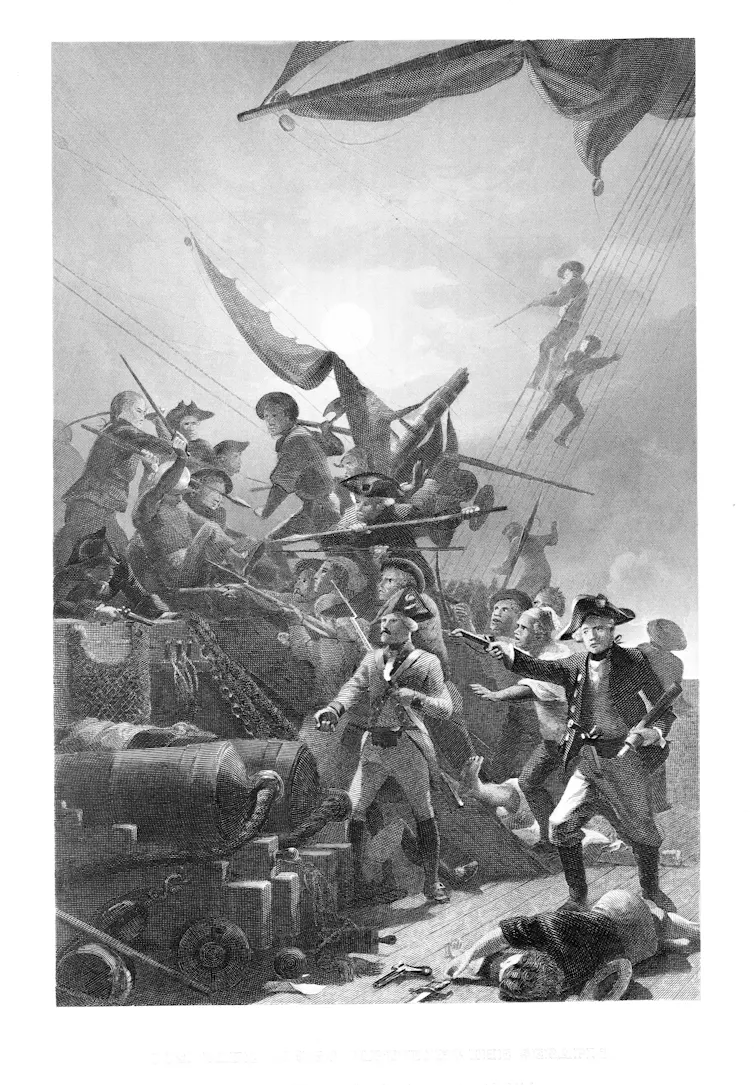
John Paul Jones, known as the Father of the American Navy, commanded sailors during the American Revolutionary War.
Christine Kohler/iStock via Getty Images Plus

Creating the first navy

Washington, commissioned by Congress as commander in chief of all American armed forces in June 1775, saw an opportunity. He didn’t wait for Congress to build new frigates. Instead, he reached out to John Glover, a fish merchant from Marblehead and a commissioned officer under his command.

Washington’s plan was simple: Take the sturdy, salt-stained schooners used for fishing and turn them into armed, seagoing predators.

The first of these was Glover’s own fishing vessel and trade ship, Hannah. She wasn’t a formidable man-of-war but a 78-ton workhorse that spent summers at the Grand Banks and winters hauling rum and sugar from the Caribbean. Washington armed the trade ship with a few cannons, manned her with fishermen and sent her out to hijack British supply ships to help his army win the siege of Boston.

Just two days after the Hannah was underway, her crew captured the Unity, a sloop loaded with naval stores and lumber, supplies sorely needed by British forces in Boston.

Between August and October 1775, Washington outfitted a fleet of schooners at Congress’ expense to intercept British supply ships off the coast of New England. These vessels and crews, whose wages were paid by the American government, constituted what many historians consider America’s first navy. Washington reminded each captain that they sailed “at the Continental Expense.” These orders from Washington and the payments made by Congress made these ships official American warships, operating under the authority of what would become the federal government.

These recruits didn’t need nautical training; they were seasoned seafarers who had battled rough waters and gale force winds. On Oct. 13, 1775, George Washington wrote to his brother, John Augustine Washington, that the fishermen were “soldiers … who have been bred to the sea.”

In 1776, Washington informed the governor of Connecticut, who had asked to draft seamen from Washington’s regiments for his own naval expedition, that he could not spare any. “I must depend chiefly upon them for a successful opposition to the Enemy,” Washington explained.

A black-and-white image shows two ships at battle
An American navy ship defeats a British navy ship, 1779.
Christine Kohler/iStock via Getty Images Plus

Keeping the Revolution alive

This fleet of converted fishing boats punched above its weight: In the early years of the war they captured 55 British vessels. One such prize, the Nancy, was transporting 2,000 muskets, 30 tons of musket balls and a massive 15-inch brass mortar – supplies the American army desperately needed for the war effort.

Because the British navy was spread too thin, with too few warships available to police the Atlantic coastline, the armed fishing vessels were able to disrupt supply lines and keep the Revolution alive through its infancy. By the time the British realized the threat, the damage was done.

On Feb. 26, 1776, just a few months after Washington launched his fleet, British Admiral Molyneux Shuldham wrote in a report to his superiors that his forces in Boston were low on everything from naval supplies to weapons. What little they could find had to be purchased “at the most extravagant prices.”

The British government had not assigned military convoys to trans-Atlantic shipments at the start of the conflict in 1775. Now, Shuldham recommended arming the supply ships themselves, since valuable stores were being intercepted by rebels in small vessels, “however attentive our Officers to their Duty.”

He concluded the report with an ominous note, explaining that he simply did not have the resources to do everything that was being asked of him – support the army, blockade rebel ports and protect British ships bound for Boston: “I must beg leave to observe to you the very few Ships I am provided with to enable Me to Co-operate with the Army, Cruize off the Ports of the Rebels to prevent their receiving Supplies, or protect those destined to this place from falling into their hands.”

The Conversation

Christopher Magra does not work for, consult, own shares in or receive funding from any company or organization that would benefit from this article, and has disclosed no relevant affiliations beyond their academic appointment.

​Politics + Society – The Conversation