Categories
Uncategorized

Paving paradise: Dismantling the US Roadless Rule threatens to disrupt wildlife, water and peace in the last quiet places in America

A sign on a dirt hiking trail in the Tongass National Forest in southeast Alaska points to naturalist John Muir’s cabin. Wanderluster/iStock/Getty Images

Pause for a moment and listen. What do you hear? Chances are, somewhere in the background, is the ever-present hum of a road.

More than 4.2 million miles of public roads crisscross the lower 48 states – enough to reach the Moon and back almost nine times. This vast network of roads spiderwebs its way across the contiguous U.S., leaving only about 5% as an inventoried roadless area or wilderness.

Now, some of those last remaining lands free of roads are under threat from the Trump administration’s proposed rollback of the 2001 Roadless Rule. That includes southeast Alaska’s Tongass National Forest, where eagles, bears, salmon and many other species thrive in old-growth coastal forest along the Inside Passage.

A black bear in a tree
An American black bear hangs out in a tree near Anan Creek in the Tongass National Forest.
Gerald Corsi/iStock/Getty Images Plus

In announcing its plan, the administration said rescinding the rule would remove prohibitions on road construction and logging on nearly 59 million acres of national forest, arguing that the rule slowed economic development.

In Congress, another effort is underway to try to change the law through an amendment to the Wildfire Prevention Act. That change, if approved, would both remove the Roadless Rule and prevent the U.S. Forest Service from reinstituting it in the future, despite overwhelming public support for the rule.

As ecologists who have spent decades studying wilderness and the animals and ecological functions that depend on undisturbed habitats, we believe it’s important to understand that preserving roadless areas has value for environmental health, clean water, wildlife survival and people’s own well-being.

What is the Roadless Rule?

The National Forest Roadless Area Conservation Policy, better known as the Roadless Rule, was issued in January 2001 by President Bill Clinton. It has had overwhelming public support and received more public comments than any other rule in history.

The rule prohibits road construction, maintenance and commercial timber harvest in inventoried roadless areas within the National Forest System. It applies to over 58 million acres across the country, excluding Idaho and Colorado, which have their own state-specific roadless rules. While most of these roadless areas are in the western states and Alaska, 38 total states as well as Puerto Rico host roadless areas.
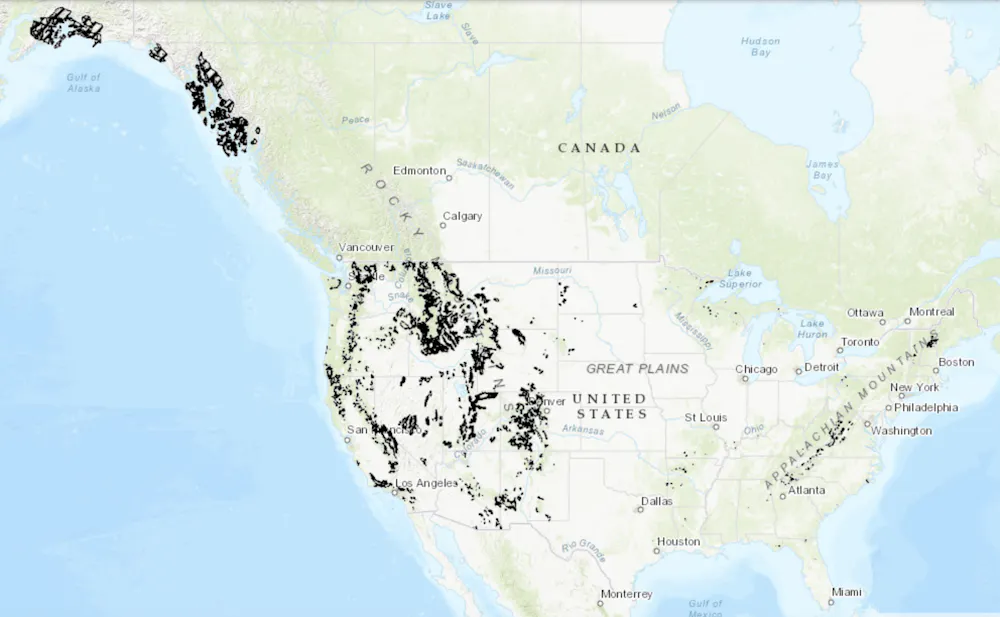
A US map shows lots of roadless areas in Alaska, Idaho and Montana, as well as in other western states.
The nation’s inventoried roadless areas are primarily in the western U.S. and include large parts of southeast Alaska, where 14,779,000 acres of roadless areas are within National Forest System land.
US Forest Service Enterprise Map Services Program

The primary goal of the Roadless Rule is to maintain forest health and productivity for future generations. It also helps avoid exacerbating the U.S. Forest Service’s road maintenance backlog by not making new roads.

The Roadless Rule prohibits new road construction, with very limited exceptions, as well as commercial logging in designated roadless areas. It does not restrict other uses that are compatible with the management plan, such as hiking and mountain biking, or resource uses such as grazing livestock and working existing mining claims.

Beyond providing vital habitat for species and enabling healthy forests, the rule protects drinking water for the millions of Americans whose water flows from national forests. It also preserves high-quality recreation opportunities – hiking, camping, hunting and fishing – that Americans cherish.

The problem with roads in national forests

While roads can provide benefits, such as access to forests, they can also do ecological harm.

Roads enable invasive weeds to spread by being carried on vehicle tires and deposited in exposed soils, erode sediments into streams and fragment habitat that wildlife rely on. Vehicles directly kill and injure animals through collisions. They occasionally start fires, too. A recent study found that fires are more likely to start in areas with roads than in areas without.

A large logging truck on a narrow road through woods.
Logging and mining use large, loud vehicles that can disrupt wildlife and fragment habitat.
AP Photo/Don Ryan

Studies show that road noise displaces wildlife, increases stress and can affect wildlife behavior patterns at distances of over a mile from the road.

And roads don’t just cause problems for species on land. Most roads cross streams and rivers, which requires building a way for those waters to keep flowing under the road (structures called culverts). While culverts can be designed to allow fish to pass through and maintain ecological connections, they are rarely built to do so. This leads to declines in the health of fish populations and can leave some species locally extinct.

The benefits of roadless areas

Inventoried roadless areas are among the most ecologically intact and wildest places left in the United States, yet – unlike Wilderness Areas and National Parks – there are no signs acknowledging their boundaries when you enter one.

Most are part of larger ecosystems, directly adjacent or ecologically connected to better known national parks and wilderness areas. Removing Roadless Rule protections would erode ecological buffers to these more famous protected lands.

For some species, roadless areas protect critical core habitat. For instance, over half the suitable habitat for relictual slender salamander, a critically imperiled species native to the Sierra Mountains of California, occurs in a roadless area. Nearly 40% of Mount Pinos, lodgepole chipmunk, an imperiled subspecies of the lodgepole chipmunk, also live in roadless areas in California.

Research shows that every formal roadless area provides habitat for at least two wildlife species of conservation concern – those facing risks to their long-term survival – with the median roadless area supporting 10 of these imperiled species. Some Arizona roadless areas contain habitat for up to 62 of these species.

A landscape view across the East Fork of the Salmon River with colorful valleys and snow-capped mountains in the distance.
The Sawtooth National Recreation Area in Idaho is bordered by roadless areas within the Sawtooth National Forest.
Eric Zamora/VW PICS/Universal Images Group via Getty Images

Roadless areas also protect watersheds that supply drinking water to 47 million Americans.

Without this protection, these watersheds would still provide water, but their long-term health and hydrological sustainability could be compromised if roads block stream flow and increase sediments flowing into waterways. The result can be higher costs for water purification.

The Forest Service’s own watershed health assessment, known as the Watershed Condition Framework, uses road density as a key indicator of conditions that can disrupt water quantity and quality.

What is at risk in rescinding the Roadless Rule?

The Trump administration’s proposed rollback, expected to be formalized in 2026, would open these last wild places to development, fragmenting habitats that can never be restored.

The American public spoke loudly in 2001 when they supported the Roadless Rule. Two decades later, the public comments submitted on the recission notice overwhelming opposed rolling back the rules, a Center for Western Priorities review found, reaffirming that U.S. roadless forests remain as vital and valued as ever.

Protecting these areas is about promoting healthy ecosystems on public lands so they can provide hiking, hunting and fishing opportunities for generations to come to enjoy the tranquility of being in nature.

The Conversation

Mariah Meek has received research funding from federal agencies, such as the US Fish and Wildlife Service and the National Science Foundation. She also serves as the Director of Research for The Wilderness Society and is an affiliate associate professor at Montana State University.

Travis Belote does not work for, consult, own shares in or receive funding from any company or organization that would benefit from this article, and has disclosed no relevant affiliations beyond their academic appointment.

​Politics + Society – The Conversation

Categories
Uncategorized

Who was the first transgender person?

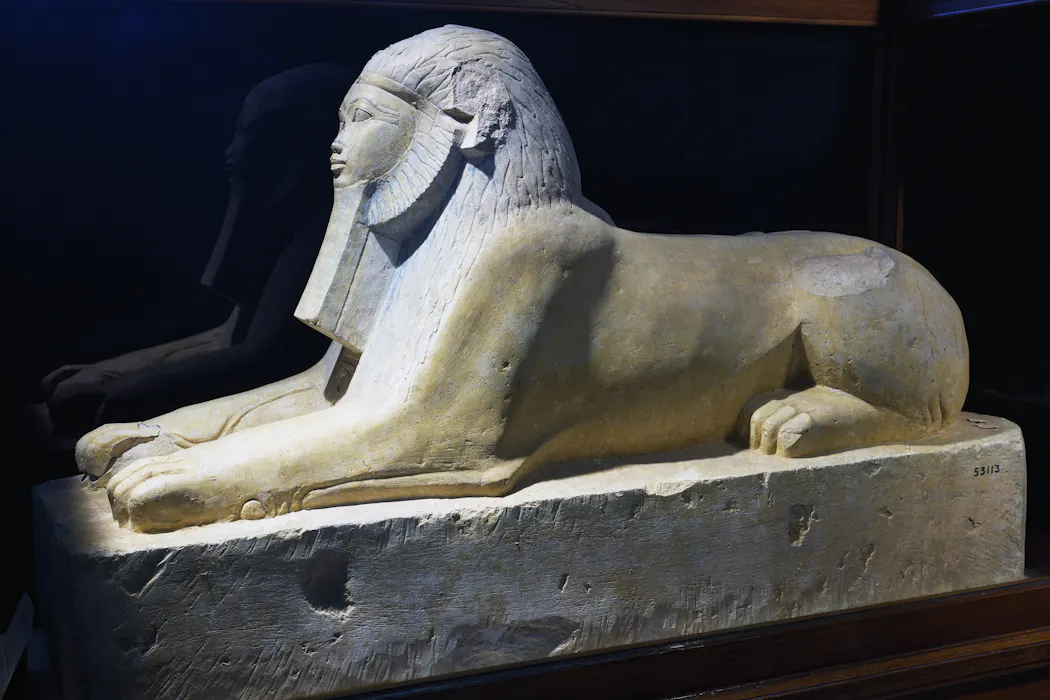
Hatshepsut (c. 1505–1458 B.C.E.) was Egypt’s second female ruler. She often is depicted as a sphinx or wearing a beard, a traditional sign of pharaonic authority. G. Dagli Orti/De Agostini Editorial via Getty Images

Curious Kids is a series for children of all ages. If you have a question you’d like an expert to answer, send it to CuriousKidsUS@theconversation.com.


Who was the first transgender person? – Dexter, age 11, Las Vegas, Nevada


Imagine you have a time machine, and you can travel back to any civilization in history. Maybe you’d go back to ancient Athens, or to a monastery in the Middle Ages. Or you could mingle with Hittite warriors before battle in Bronze Age Anatolia, in what is now Turkey.

In all of these times and places, you’d see differences between people that you would understand as men and women, generally speaking. You’d see a variety of clothing, hairstyles, body shapes and other indicators of gender in these different cultures.

But if you asked anyone you met in these time periods what is essential to being a man or a woman, or whether a man could become a woman and vice versa, or whether there was any kind of human besides men and women, you’d get different answers depending on whom you asked.

And not only would a medieval monk in the 13th century respond differently from a Hittite warrior from 2,500 years earlier, but even within a single city, people with different jobs, social roles or ways of thinking might answer differently.

The interesting thing is that wherever there is evidence of gender boundaries in ancient societies, there is evidence of people crossing those boundaries. In fact, as long as there have been humans, there have been people whom we would call transgender today.

We are both teachers of classics, the study of the cultures of ancient Greece and Rome. Nick specializes in ancient Greek mathematics and science, and Ky specializes in the history of gender and gender categories in Greece and Rome. So we will focus mainly on ancient Greece and the regions near it as we consider trans people from past civilizations.

Defining the terms

Just because people’s ability to cross, blur or redefine the boundaries of gender has been around since ancient times doesn’t mean ancient people would understand the term “transgender” as people do today. In today’s language, this word refers to someone who was labeled as either a boy or a girl when they were born, but later decided that they were not what they were labeled as.

Along with that definition comes a whole set of ideas about what it means to be a boy or a girl in the first place. The shape of your body, the hormones inside it, which chromosomes you have and how all of that affects how you behave and how other people treat you – these have all become part of people’s notion of “gender” now.

But before hormones were discovered in 1849 and DNA was discovered in 1869, people thought about gender – and therefore being transgender – pretty differently.

statue of a person with both breasts and a male genitalia
This Hermaphrodite statue from Pergamum, Turkey, was sculpted in the 3rd century B.C.E.
DEA/Archivio J. Lange/De Agostini via Getty Images

Gender in antiquity

Aristotle, a Greek philosopher who wrote in the fourth century B.C.E., distinguished men and women in part by how much heat and moisture they supposedly have in their bodies.

Meanwhile, Isaeus, a Greek lawyer from around that same time, described men and women according to their different privileges under the law.

But there were always groups of people who didn’t easily fit into these categories. Ancient authors used many different words for these people, such as hermaphrodite, eunuch, androgyne, tribad, malthakos and others. Many of these terms were meant as insults and were – and remain today – tremendously rude, but others reflect the bewilderment of trying to categorize people who don’t fit into standard categories easily.

In the fifth century B.C.E., two Greek authors – Herodotus, known as the father of history, and Hippocrates, the father of medicine – wrote about people they call Anarieis from Scythia, a vast ancient territory to the north and west of the Black Sea that today would be part of Ukraine and Russia. Their descriptions of the Anarieis’ gender are similar to the way many people describe trans women today. Their accounts are supported by what we know about Scythia and Anarieis from anthropologists and archaeologists today.

Going back to the Stone Age

And you can find evidence of trans people even further back in history. In March 2026, archaeologists published a study of 125 burials from a Stone Age civilization in modern-day Hungary. Their study shows that even 7,000 years ago, people could cross gender boundaries.

The archaeologists used DNA evidence and the shapes of skeletons to make their best guess as to what gender most of these Stone Age people would have been assigned if they had been born in the modern era. They labeled 64 females and 52 males.

Overall, an examination of the skeletons showed a clear difference between how the skeletons labeled as females and those labeled males lived, worked and were buried. But a few of the skeletons had lived, worked and been buried in a way opposite to the gender that the archaeologists had assigned them. One skeleton that archaeologists had marked female, for example, was buried with stone tools that otherwise went with the skeletons labeled as male, and it showed stress injuries more similar to the “male” skeletons than to the other “female” ones.

So have these archaeologists found a 7,000-year-old trans man? Well, that depends. It’s impossible to say for certain how that Stone Age person understood gender or their own place in society. It’s hard to look back in 2026 and say whether they felt or were treated the same as the men whom they seem to have worked alongside.

But looking at what anthropologists do know of this society, there were normal lifestyles for each gender, and this person didn’t follow the normal route. That’s something that most trans people can recognize and relate to. So even though it’s impossible to know how this person would self-describe, our modern idea of transgender is big enough to include them.

All this is to say that no one will ever know who the first trans person was, because there was never just one. There were people we would now call trans in ancient Egypt, Imperial China and among the Mayans. Trans people were then, as they always have been, part of the human community.


Hello, curious kids! Do you have a question you’d like an expert to answer? Ask an adult to send your question to CuriousKidsUS@theconversation.com. Please tell us your name, age and the city where you live.

And since curiosity has no age limit – adults, let us know what you’re wondering, too. We won’t be able to answer every question, but we will do our best.

The Conversation

The authors do not work for, consult, own shares in or receive funding from any company or organization that would benefit from this article, and have disclosed no relevant affiliations beyond their academic appointment.

​Politics + Society – The Conversation

Categories
Uncategorized

The Constitution promises an interpreter for fair trials – US courts often can’t deliver

A court interpreter checks the day’s schedule of assignments. AP Photo/Brennan Linsley

In northern Oregon, just before dawn in October 2025, Immigration and Customs Enforcement officers arrested and shackled two farmworkers on their way to work. The man and woman were Guatemalan citizens who spoke no English and very little Spanish. They spoke Mam, an Indigenous Mayan language.

Despite the man trying to tell an ICE officer as much, he was not provided with an interpreter, according to his sworn declaration. Suspected of being in the country illegally, they were detained in an immigration processing center and signed papers they did not understand. They were released later with ankle monitors and placed under an intensive supervision program requiring frequent check-ins at an ICE office in Portland.

Their experience points to a problem that reaches far beyond Oregon.

The civil liberties guaranteed by the U.S. Constitution broadly apply to everyone in the U.S., regardless of immigration status. Courts have held that the right to an interpreter is protected by the Sixth Amendment, which guarantees the right to a fair trial – including understanding court proceedings and communicating with counsel. It’s also protected by the Fifth and 14th amendments, which state that no person can be deprived of “life, liberty, or property, without due process.”

But in a multilingual society, these rights collide with how little most Americans, including law enforcement and court professionals, are taught about language itself. Speakers of minority languages, or languages that are not commonly used in schools, courts or government, are often disadvantaged by this lack of linguistic awareness. This can even affect nonstandard English speakers or people who speak a variety of English that differs from the mainstream varieties privileged in courts and schools.

Imagine an English speaker detained abroad and forced to navigate a criminal trial in a language they do not understand. Most people would recognize that as fundamentally unfair, but speakers of minority languages often face this reality in U.S. courtrooms.

These failures are poised to multiply. Early in his second term, President Donald Trump issued an executive order designating English as the official U.S. language and rescinding a 2000 executive order that directed federal agencies to provide language access – despite the fact that around 25 million people in the U.S. have limited English proficiency.

At the same time, the Trump administration has sharply expanded an immigration crackdown that targets Latino communities. In immigration enforcement, heavily reduced training may be leaving ICE officers with limited understanding of constitutional protections, sweeping growing numbers of Indigenous-language speakers into a legal system unequipped to communicate with them.

As a linguist, translator and courtroom interpreter for the Ch’ol language – a Mayan language spoken by roughly a quarter of a million people – I see firsthand the ways in which the court system is unprepared.

Minority and Indigenous languages

More than 30 Mayan languages are spoken today by roughly 7 million people; they’re not dialects of Spanish but members of a separate linguistic family and have their own vocabulary, grammar and sound systems, as distinct from one another as the languages spoken across Europe. A speaker of Ch’ol would not be able to understand Mam, as is the case for thousands of other minority or Indigenous languages worldwide.

Since 2015 I have worked in southern Mexico with speakers of Ch’ol, and since 2023 I have been an expert witness and court interpreter. I have twice worked with defendants suspected of having learning disabilities, when, in reality, they had just been provided interpretation in the wrong language.

Consequences in the courtroom

A lack of awareness about language diversity and linguistic needs can have serious consequences in the courtroom. In the 1980s, a speaker of a Mixtec language was wrongfully convicted of murder after a trial conducted through a Spanish interpreter, a language he barely spoke. Four decades later this problem persists: In Texas in 2022, a man who spoke the Northern Tepehuan language was convicted of possession of marijuana with intent to distribute and sentenced to 24 months in prison despite not understanding his court proceedings.

Data on linguistic diversity is more available in Los Angeles and New York City, two cities with large Indigenous populations. But in other areas of the country, court systems are unprepared for diverse linguistic needs. Even the 2020 census, which researchers and Indigenous-rights advocates say undercounts these communities, recorded more than 1.3 million people identifying as Latin American Indian. Still, in court files and immigration records, Indigenous-language speakers are typically logged as Hispanic or Spanish-speaking, erasing the distinction that determines whether someone gets an interpreter they can understand.

Although neither ICE nor Customs and Border Protection tracks Indigenous immigrants or the languages they speak, reporting at the border suggests as many as 1 in 5 people in immigration detention are Indigenous.

By one estimate, speakers of Indigenous languages represent between 10% and 44% of new arrivals at the U.S.-Mexico border, but without the right language services, misunderstanding and bias can push asylum-seekers to abandon valid claims and return to dangerous situations or otherwise jeopardize their chances of gaining entry.

Indigenous language–speakers are denied asylum in the U.S. more often than speakers of more commonly spoken languages. In one instance, when a woman was asked to describe a domestic abuse injury to a judge, one interpreter used the word “heel”; another, later, used “ankle.” In Mam, “heel” and “ankle” are the same word, but the inconsistency led the judge to think the asylum-seeker was changing her story. The judge ordered her removed.

A broader impact

The failure to respect language and dialect diversity threatens the fairness of the legal system for immigrants and citizens alike, as linguistic discrimination can extend to varieties of English as well.

Court reporters are required to transcribe at a minimum of 95% accuracy, but that measure does not evaluate their ability to transcribe nonstandard English. In one study, researchers tested more than two dozen Philadelphia court reporters and found that when it came to African American English, their transcriptions were less than 60% accurate, sentence by sentence. AAE is a group of varieties of English spoken by many Black communities in the U.S. with their own rule-governed syntax, lexicon and phonology that make them distinct from mainstream American English. Inaccurate transcription, the study explained, can lead to errors that “change the official record of who performed what actions under which circumstances, with potentially dramatic legal repercussions.”

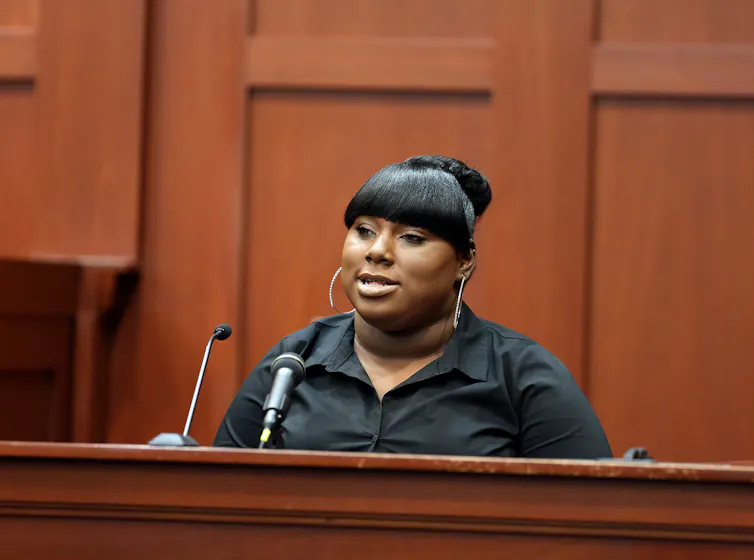
In 2012, George Zimmerman killed unarmed Black teenager Trayvon Martin and was charged with second-degree murder. Rachel Jeantel was on the phone with Martin before his death and, so, was a key witness for the prosecution. She testified for nearly six hours – including about the start of the encounter and who confronted whom, a question central to Zimmerman’s self-defense claim – but jurors found her testimony not credible and ended up disregarding it. One said it was hard to understand. Zimmerman would eventually be acquitted.

A young woman testifying on a witness stand, sitting near a microphone
Rachel Jeantel, a key witness in George Zimmerman’s trial, testifies in Florida in 2013.
AP Photo/Orlando Sentinel, Jacob Langston

It is difficult to show how many people are affected by linguistic discrimination. Unlike people whose proficiency in English is low, AAE speakers are not counted as a distinct linguistic group, so the scale of the harm is undocumented. Nevertheless, one study showed that witnesses with foreign-accented English are viewed as less credible, and studies in both the U.K. and the U.S. found that speakers of nonstandard varieties of English are perceived to be guiltier.

In cases involving stigmatized varieties of speech, expert witnesses could help jurors understand linguistic diversity and separate how someone speaks from whether they are credible. Expert witnesses could also help jurors understand what linguistic discrimination is and explain that biases against someone’s language are often masked biases against their race, gender or socioeconomic background.

‘The last bastion of overt social discrimination’

The case against the two Mam-speaking farmworkers in Oregon was challenged in court, and in January 2026 a federal judge found the agents’ actions to be “reckless and erroneous.” The judge ordered ICE to remove their ankle monitors and end the supervision program imposed on them. Neither was convicted of a crime.

Despite the ruling in the farmworkers’ favor, though, their case reflects a broader problem: Although the right to an interpreter is constitutionally protected, that right means little when courts and officers are unaware of linguistic needs. Education for law enforcement and court officials on linguistic diversity, early language identification and increased funding for interpretation services are all essential before the courts can deliver on the rights the Constitution guarantees.

As sociolinguist James Milroy argued in a 1998 essay about linguistic discrimination in education, unless societies become more educated about linguistic diversity, “the last bastion of overt social discrimination will continue to be a person’s use of language.”

The Conversation

Carol Rose Little does not work for, consult, own shares in or receive funding from any company or organization that would benefit from this article, and has disclosed no relevant affiliations beyond their academic appointment.

​Politics + Society – The Conversation
Categories
Uncategorized

Conspiracy theories that emerged from a civil rights shooting 60 years ago resonate today

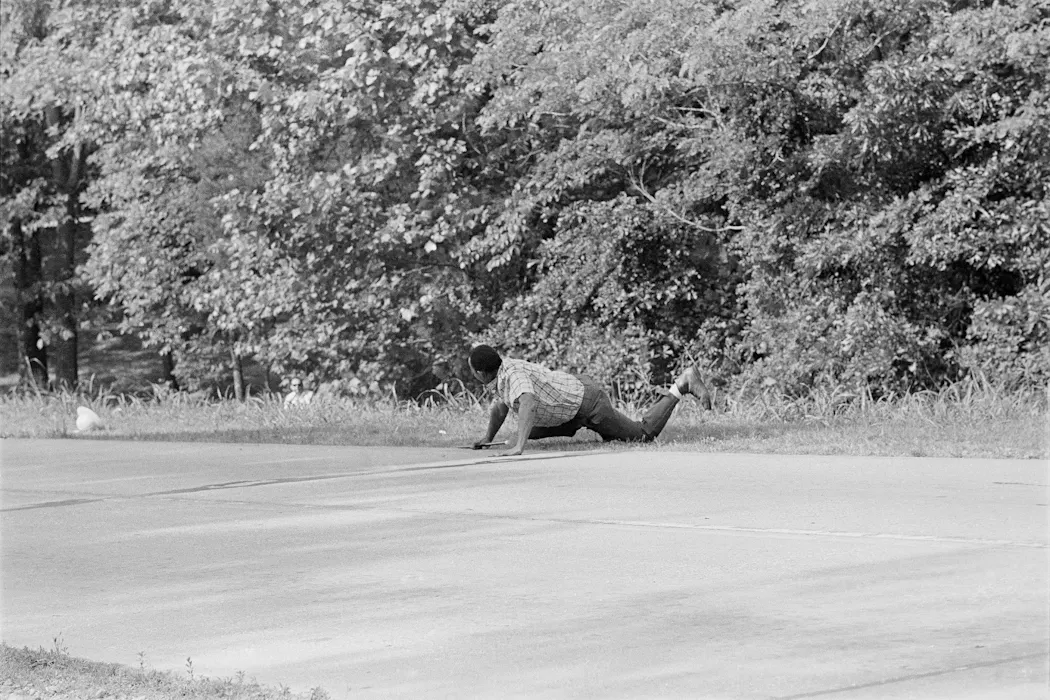
James Meredith looks at Aubrey Norvell, partially hidden behind foliage, after Norvell shot him in Hernando, Miss., on June 6, 1966. AP Photo/Jack Thornell

On June 6, 1966, on a stretch of Highway 51 just south of Hernando, Mississippi, a portly, middle-aged white man named Aubrey Norvell stepped out of a gully, lifted his shotgun and fired three shots at James Meredith, a Black civil rights activist and Air Force veteran.

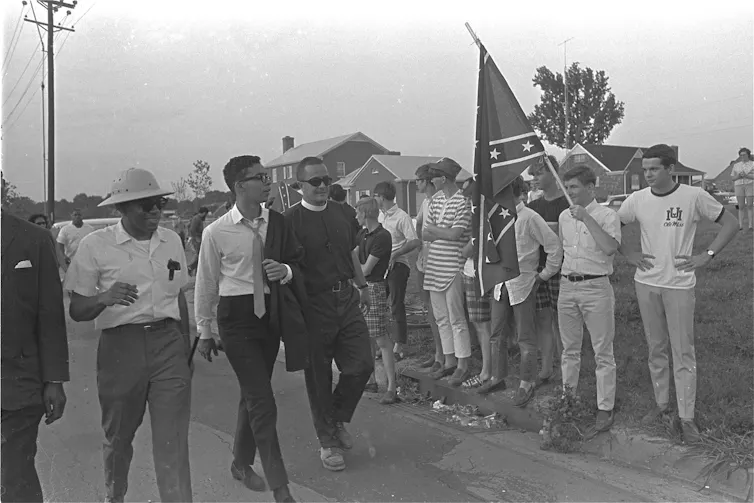
Famous for integrating the University of Mississippi four years earlier, Meredith was on the second day of a walk from Memphis, Tennessee, to Jackson, Mississippi, with the aims of registering voters and defying white intimidation.

Bloodied by bird shot, Meredith again returned to the national spotlight. The shooting transformed his walk into a civil rights spectacle.

Activists descended upon Mississippi for a three-week mass march. It featured titans of the movement, including Martin Luther King Jr., while inspiring Mississippians to march down country roads, volunteer their homes and food, and register at their local courthouses. During these protests, the civil rights activist Stokely Carmichael introduced “Black Power,” a slogan of self-determination that marked the next stage in the Black freedom struggle.

It is a rich, intricate and evocative story – one that I tried to chronicle in my book, “Down to the Crossroads: Civil Rights, Black Power, and the Meredith March Against Fear.”

Sixty years later, however, a mystery lingers. Clouded in the haze of a political extravaganza, Norvell never revealed his motivations for shooting Meredith.

His silence allowed for the flourishing of conspiracy theories – most notably, from those most resistant to racial equality. In a political and rhetorical strategy that echoes into the present day, many white conservative Southerners painted themselves as Norvell’s real victims.

‘A quiet, Christian man’

At first, it was civil rights activists who suspected a conspiracy. Meredith’s companions testified that law enforcement had reacted slowly to Norvell’s threat. They assumed that Norvell was a virulent white supremacist, in cahoots with a racist police force.

But as reporters investigated Norvell, they found no evidence of a hate-spewing Klansman. He lived in a middle-class Memphis suburb. He had no criminal record. Neighbors described him as a “quiet, Christian man” who never mentioned civil rights, one way or another.

Upon posting bond, Norvell disappeared from the public eye until his trial that November.

A white man points his finger at a Black man inside a car.
A University of Mississippi student points a finger at James Meredith as he is taken to class, in Oxford, Miss., on Oct. 4, 1962.
AP Photo

The significance of bird shot

By presenting a blank slate, Norvell allowed white Southern conservatives to launch a counternarrative. The previous decade of Black activism, from the Montgomery bus boycott through the Selma-to-Montgomery march, had taught them that open violence ignited public outrage and prompted civil rights legislation. So they distanced themselves from Norvell.

Mississippi Gov. Paul Johnson noted that Meredith was attacked “by birdshot by an out-of-state resident.” It foreshadowed the language employed by a host of Southern politicians and newspaper editorialists.

Again and again, in speeches and articles and letters, they mentioned that Norvell used bird shot. If he was aiming to kill, why pepper Meredith with pellets? They claimed a conspiracy against the white South.

“The whole affair smells badly of a plot instigated by the Communist-controlled rights groups and capitalized on by the press, the government, and all the other liberal screamers,” wrote one woman to Sen. James Eastland, as I discovered during my research. Like many others, she imagined that civil rights organizations paid Norvell to wound Meredith, which would stoke a media hubbub and invite the federal government to persecute white Southerners.

Searching for a conspiracy

The Mississippi State Sovereignty Commission opened in 1956 to protect white supremacy. In an incredible twist to this tale, a commission investigator authorized a US$5,000 bribe to Norvell’s attorney if Norvell would admit that liberals paid him to shoot Meredith.

A Black man walks by white men, one of them holding a Confederate flag.
James Meredith, left, passes white spectators after he began a 225-mile walk from Memphis, Tenn., to Jackson, Miss., on June 6, 1966.
AP Photo

According to commission files, an FBI agent from Mississippi, high-ranking officials of the Memphis Police Department and a Mississippi district attorney all agreed that Norvell’s shooting was “a hired job for the advancement of various civil rights groups.”

Segregationists kept grasping at this far-fetched scenario, exaggerating and manipulating it to serve the purpose of discrediting the Meredith March Against Fear. A Mississippi sheriff named Jack Cauthen went even further, suggesting Meredith hadn’t even been shot in the first place. He claimed to have put his arm around Meredith, who had rejoined the march for its final days.

“His back was just smooth as silk. There hadn’t been no pellets or shots in James’s back,” asserted Cauthen, as I found while conducting research for my book. “I don’t think he was shot, no sir.”

Echoes from the past

Norvell pleaded guilty and spent 18 months in Parchman Prison in Sunflower County, Mississippi. Despite being approached by many journalists and historians – including me – he never revealed his motive. He died in 2016.

In the 1960s, white southerners perceived that their way of life was under assault by big institutions, including the federal government and the media. They blamed the Civil Rights Movement on nefarious “outside agitators” determined to smash their status. Their political motivations led them down bizarre and fantastical paths, with some even fashioning themselves as the true victims of Norvell’s attack.

Racist conspiracy theories still plague American politics, from baseless accusations that Barack Obama was born in Kenya to false assertions that global elites are engineering a “great replacement” of white Americans.

Even if these notions emerge from a modern sense of dislocation and anxiety, I think they have roots in the same crass bigotry that defined the conspiratorial segregationists of the civil rights era.

The Conversation

Aram Goudsouzian does not work for, consult, own shares in or receive funding from any company or organization that would benefit from this article, and has disclosed no relevant affiliations beyond their academic appointment.

​Politics + Society – The Conversation

Categories
Uncategorized

Trump’s ‘narco-terrorism’ war in Latin America evokes Reagan – then as now, it’s more about fighting leftists than drug runners

Peruvian army personnel during operations against alleged drug trafficking. Cris Bouroncle/AFP via Getty Images, CC BY

More than any other U.S. president in decades, Donald Trump has aggressively pursued military interventions in Latin America.

On Jan. 3, 2026, U.S. special forces captured Venezuelan President Nicolás Maduro on charges of narco-terrorism. In the months before the operation, U.S. Southern Command began targeting small, fast-moving boats in the Caribbean and eastern Pacific. The death toll from the continuing war on these alleged narco-terrorists has risen to over 200 people.

At the heart of these events is the Trump administration’s stated goal of combating drug trafficking organizations. The White House and State Department have designated a plethora of guerrilla groups, drug cartels, gangs and criminal enterprises as “foreign terrorist organizations.”

Washington has also expanded security ties with Ecuador and El Salvador, which are led by right-wing Trump allies. At the same time, the administration has pressured left-wing governments in Colombia, Guatemala, Brazil and Mexico to join the U.S. war on drugs or else risk Trump’s wrath.

When it comes to opening legal avenues for the application of armed force, the narco-terrorism label is useful. Indeed, it is how the Trump administration justified Operation Absolute Resolve to capture and indict Maduro. Yet Trump’s decision to pardon a right-wing ally – former Honduran President Juan Orlando Hernández – who was convicted and sentenced to 45 years in prison for drug trafficking and related weapons offenses, appeared to some observers to be “at odds with Trump’s war on drugs.”

The history of that war on drugs, however, especially during the presidency of Ronald Reagan, shows that the narco-terrorism label has always been politicized. My research on Reagan and the drug war suggests that the nebulousness of the concept aided U.S. policymakers in achieving fundamentally anti-communist and anti-leftist political objectives.

Shining Path and the roots of narco-terrorism

Peruvian President Fernando Belaúnde Terry first coined the term narco-terrorism in 1982 to describe the infiltration of Sendero Luminoso – or Shining Path – guerrillas into the drug trade.

An ultraradical offshoot of the Peruvian Communist Party, Shining Path was one of the most vicious insurgencies in Latin America. A truth and reconciliation commission later attributed at least half of the 70,000 conflict-related deaths and disappearances to the Maoist guerrillas in their campaign to overthrow the “bourgeois” democratic government. After the Peruvian army chased the guerrillas out of their home base in Ayacucho in the southern Andes, they moved north to the upper Huallaga Valley, the source of over half the world’s cocaine supply at the time.

The Peruvian police, together with the U.S. Drug Enforcement Administration, created special counternarcotics units focused on crop eradication in the upper Huallaga. This strategy sought to reduce the supply of cocaine by eliminating its source, the coca plant. Peasant growers’ resistance to these operations fueled the Shining Path insurgency by providing recruits and creating an opening for the guerrillas to interpose themselves between the farmers and the police.

A gathering of world leaders in suits stand around a man at a desk.
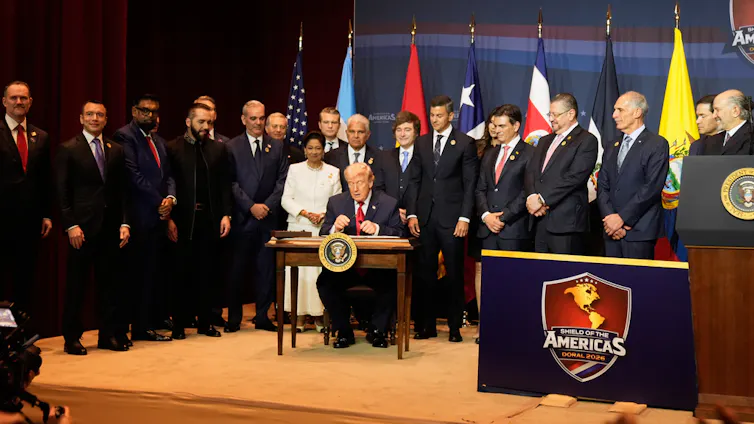
President Donald Trump signs a proclamation committing the U.S. to countering cartel criminal activity on March 7, 2026, in Doral, Fla.
AP Photo / Mark Schiefelbein

With the Cold War drawing to a close, a militarized drug war expanded under the administration of George H.W. Bush. As the federal counternarcotics budget nearly doubled, U.S. officials pressured the Peruvians to militarize their counternarcotics efforts, too. But it wasn’t until the Peruvian armed forces pursued a tacit truce with the traffickers that they were able to locate and capture Shining Path leader Abimael Guzmán in September 1992 and dismantle the insurgency.

The Peruvian counterinsurgency succeeded due to a strategy that deliberately cut ties between the guerrillas and the drug traffickers. Essentially, the armed forces of Peru took control of the drug trade from the leftist guerrillas. U.S. anti-narcotics officials, together with their Peruvian police colleagues, were less than thrilled with this strategy – as were the tens of thousands of people who were caught in the crossfire. But for myriad U.S. defense officials more interested in defeating Shining Path than stemming the tide of drugs, the narco-terrorism label had facilitated a clear success – and drafted a valuable blueprint.

Colombia and the ‘narco-guerrilla connection’

The incident that indelibly linked the drug cartels and the communist guerrillas in the U.S. concept of narco-terrorism was the November 1985 M-19 siege of the Colombian Palace of Justice, the country’s supreme court. The M-19, or 19th of April movement, so named for a disputed election, had as a main objective to establish socialism in Colombia. The guerrillas took the high court hostage and intended to subject the then-president to a trial. The resulting clash with the military left nearly 100 people dead, including soldiers, guerrillas and 11 of the justices.

Allegations surfaced that Pablo Escobar, head of the notorious Medellín cartel, had paid M-19 for the raid. The guerrillas had apparently stolen hundreds of documents, including U.S. extradition requests for Escobar. Though this motive is still disputed – and even the U.S. ambassador in Bogotá emphasized that the “narco-guerrilla connection” had not been proven – the shocking event hardened U.S. public opinion against the new threat of narco-terrorism.

In April 1986 the Reagan administration issued National Security Decision Directive 221, officially linking counternarcotics and counterinsurgency in U.S. foreign policy. The declaration of drugs as a national security threat widened the scope of U.S. involvement in the Colombian counterinsurgency against entrenched communist guerrilla groups such as the Revolutionary Armed Forces of Colombia and the National Liberation Army.

That cooperation continues to the present day, though it is currently jeopardized by hostility between Trump and Colombian President Gustavo Petro, himself a former member of M-19.

A man stands at a lectern alongside two others.
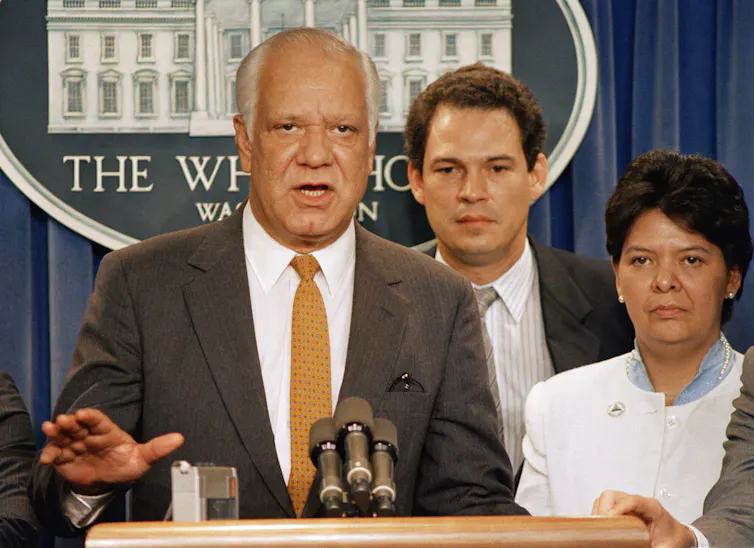
Contra leaders Adolfo Calero, left, with Pedro Joaquin Chamorro and Mario Azucena Ferrey, talk with reporters in 1987 in the White House briefing room after a meeting with President Ronald Reagan.
AP Photo / Scott Stewart

The selective application of trafficking claims

The narco-terrorism label was selectively applied not only to left-wing guerrillas but to the two communist governments in Latin America. The Reagan administration seized upon allegations of Nicaraguan and Cuban drug trafficking to influence U.S. public opinion at a time when the American people worried about becoming bogged down in another Vietnam-style quagmire.

Vietnam had shattered the foreign policy consensus around the containment of Soviet communism, but the 1980s crack cocaine epidemic created a powerful new rationale for U.S. intervention. After Congress, citing human rights concerns, restricted aid to the anti-communist Contra forces fighting Nicaragua’s left-wing Sandinista government, Reagan publicly accused the Sandinistas of drug trafficking.

The only evidence produced to support the charge was likely obtained as the result of a joint DEA-CIA sting operation involving Barry Seal, an American drug smuggler turned DEA informant later played by Tom Cruise in the Hollywood cinematic version of the sordid tale, “American Made.” Questions arose as to whether the Nicaraguan trafficker identified by the sting was even linked to anyone in the Sandinista government.

At the same time, the Reagan administration ignored allegations that the Contras themselves were smuggling cocaine into the U.S. Indeed, a Senate investigation spearheaded by U.S. Sen. John Kerry revealed that administration officials had repeatedly ignored or obstructed evidence of Contra drug trafficking. The CIA’s inspector general found that the agency had received but neglected to verify similar allegations.

These activities were tolerated because they raised money for a cause that Reagan and his supporters viewed as righteous. The Contras were seen as “freedom fighters” struggling to liberate Nicaragua from communism.

Coming full circle

Then, as now, Washington policymakers pursued a regional approach designed to strengthen security cooperation and bolster the military capabilities of allied nations.

In March 2026 the Trump administration created the Americas Counter Cartel Coalition, or Shield of the Americas, a security alliance to stop illegal immigration, Russian and Chinese interference, and “narco-terrorist gangs and cartels.” In his remarks at the March 7 opening summit, Trump insisted that “the only way to defeat these enemies is by unleashing the power (of) our militaries.”

Then, as now, this collaboration appears to be aimed at the leftist and communist governments in the Western Hemisphere.

In many cases, the drug framing is an explicit rationale for action. That was most recently on display with the U.S. designation of the two largest criminal gangs in Brazil as foreign terrorist organizations, leading Brazilian officials of the leftist Lula government to warn that any pretext for intervention would be “unacceptable.”

In other cases the administration’s argument is broader. The ratcheting up of military maneuvers, rhetoric and sanctions against Cuba – including declaring the island nation an “unusual and extraordinary threat” to U.S. security – has led many to speculate that Cuba is the next target of regime change.

While the narco-terrorism label may be applied selectively depending on the case, the result remains the fulfillment of anti-communist political objectives dating back to the Cold War.

The opinions expressed are the author’s alone and do not reflect the views of the U.S. Naval War College, the Department of the Navy, or any other part of the federal government.

The Conversation

Michelle D. Paranzino does not work for, consult, own shares in or receive funding from any company or organization that would benefit from this article, and has disclosed no relevant affiliations beyond their academic appointment.

​Politics + Society – The Conversation
Categories
Uncategorized

How Pennsylvania towns are protecting themselves from the noise, heat and utility costs of massive data centers

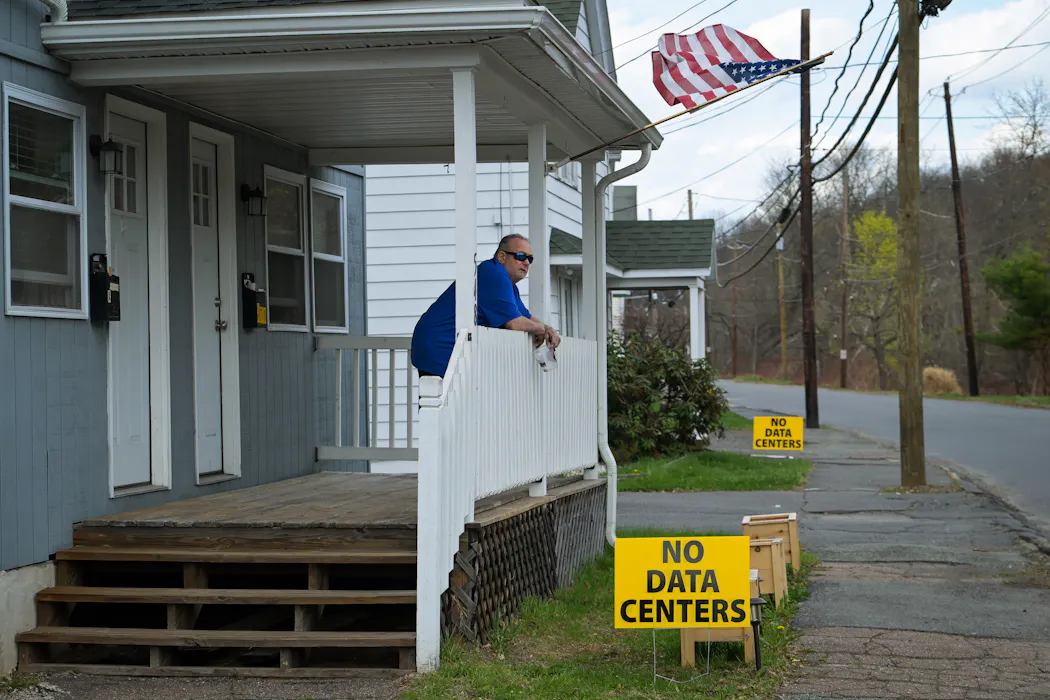
Residents of Archbald, Penn., are experiencing a contentious boom in proposed AI data center projects.
Heather Ainsworth for The Washington Post via Getty Images

Pennsylvania has become a hot spot for data center proposals and public backlash about where to build them.

I’m a law professor and executive director of Penn State’s Center for Energy Law and Policy. I’m also a native of Archbald, a borough of 7,500 residents in the Lackawanna Valley in northeastern Pennsylvania. My hometown has drawn national attention because of proposals for multiple data centers that would cover 14% of its area.

Because of my professional and personal interest in data centers, I have been researching local responses to data center proposals across Pennsylvania. I’ve learned there are a host of considerations that local officials and citizens are taking into account when they evaluate data center proposals.

Pros and cons of big data centers

At its most basic, a data center is a building that houses and runs large computer systems.

Because data centers tend to be large developments, hosting one can provide a community more tax revenue. This revenue comes from increased property tax assessments as well as newly created jobs.

However, these job are mostly limited to the construction phase. One estimate suggests a moderately large data center would create about 15-30 long-term jobs.

On the other hand, data centers raise concerns about environmental and social impacts. They consume large amounts of energy and water, leading to fears of higher water and electric utility bills for other consumers.

Emissions from diesel generators can contribute to local air pollution and worsen asthma and other health conditions.

Data centers have also been shown to create heat island effects, raising the local air temperature by an average of 3.6 degrees Fahrenheit (2 degrees Celsius).

They can also be loud due to the noise from cooling systems and diesel generators. And some residents object to what they consider eyesores in rural or suburban communities.

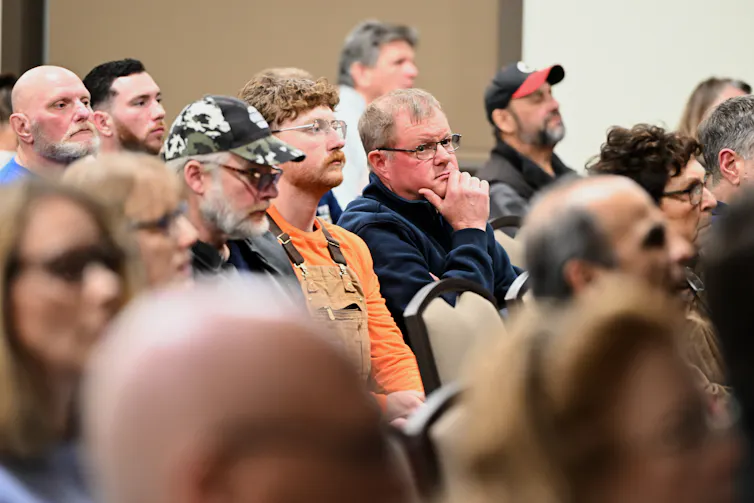
Rows of people seated in chairs listen
Residents of East Vincent Township in Pennsylvania listen during a supervisors meeting in December 2025 where an agenda item involved a data center proposal for the former Pennhurst state hospital grounds.
AP Photo/Marc Levy

Communities can plan ahead

Because of the significant impact that a data center can have on its surroundings, communities benefit from planning ahead before any proposal has even been made in their area.

One of the most powerful tools a Pennsylvania municipality has is its authority over zoning under Pennsylvania’s Municipalities Planning Code.

Under this law, a municipality generally cannot completely exclude from its zoning ordinance a legal use of a property unless it is inherently objectionable. An example of an inherently objectionable use might be a heliport in a heavily residential municipality.

But it can regulate where within the municipality buildings or other structures can be constructed and how they can operate.

Many Pennsylvania municipalities, including East Vincent Township and Jessup Borough, have amended their zoning ordinances to account for data centers.

Zoning ordinances are a powerful tool

The Pennsylvania municipalities of Fairview Township and Butler Township/Arendtsville Borough have restricted data centers to industrial zones. Mayfield Borough has restricted them to commercial zones.

Municipalities can also determine what level of municipal approval is required for a data center development. In Pennsylvania, uses can be allowed “by right,” “special exception” or “conditional use.”

“By right” means that no approval is required as long as ordinance provisions are followed.

By “special exception” requires approval from a municipal zoning hearing board.

By “conditional use” requires approval from the municipality’s governing body. This might be a board of supervisors or borough council.

Most Pennsylvania municipalities that have addressed this issue have designated data centers as a conditional use. Some, such as Butler Township/Arendtsville Borough, have allowed them as a special exception. When a municipal body evaluates an application for a conditional use or special exception, it must determine whether the proposed data center complies with the zoning ordinance and that it would not otherwise injure the public interest.

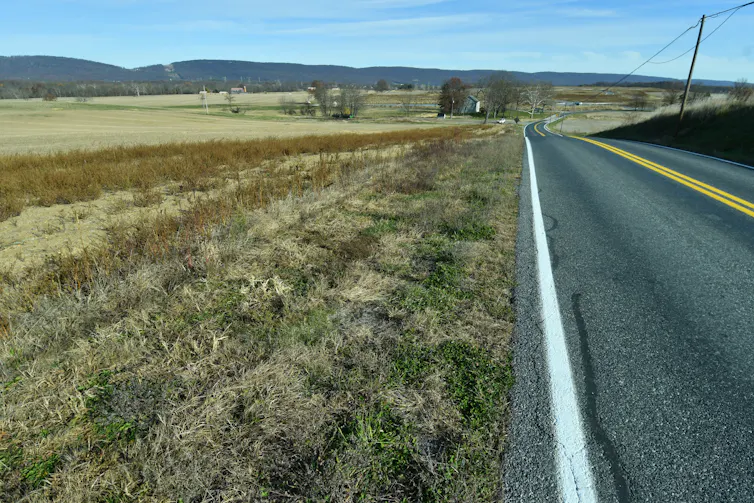
Rural grassy area alongside a highway
A stretch of land between the Conodoguinet Creek and Country Club Road near Carlisle, Pa., is set to become the site of a hyperscale data center.
AP Photo/Marc Levy

Setback distances and impact studies

Another significant tool that municipalities have used is setback distances. A setback distance defines how far a data center structure must be from an adjacent property.

In Pennsylvania, ordinances have established setbacks for data centers from 50 feet (15 meters) to 400 feet (122 meters). Many ordinances establish longer setbacks from residential properties, hospitals or schools than from industrial sites.

Many ordinances also require plans or studies to be submitted as part of a zoning application. Noise or sound studies are common ones. These studies are intended to establish background noise levels for the area of the proposed data center and to identify ways to mitigate noise impacts.

Municipalities may also require developers to submit an environmental impact assessment, transportation impact study or emergency response plan, such as for a fire on-site.

How to protect your community

Learning about the specifics of a particular data center proposal can help a community to understand the potential impacts – both positive and negative – and prepare a response.

Local residents and officials should be poised to ask probing questions about:

  • power and water demand, and the source of those resources

  • infrastructure needs

  • utility rate impacts

  • cooling system design and noise and resource consumption impacts

  • site design and landscape impact

  • job creation and tax revenue projections

  • noise mitigation strategies

  • traffic effects

  • air and water pollution emissions

Penn State Extension published a guide to common questions about data centers that may facilitate discussions with community officials and data center developers.

It may be possible in some circumstances for municipalities to negotiate community benefits agreements with data center developers. These agreements can ensure that the host community obtains certain specified benefits, such as local workforce guarantees or infrastructure development, as a result of the data center project.

The drive to build data centers and related infrastructure is moving quickly. By updating ordinances in advance, and diligently collecting information about any data center proposals that are made, local officials and citizens can protect the best interests of their communities.

Read more of our stories about Philadelphia and Pennsylvania, or sign up for our Philadelphia newsletter on Substack.

The Conversation

Michael Helbing’s work for the Penn State Center for Energy Law and Policy has received funding from the Sloan Foundation, Arnold Ventures, the Center for Rural Pennsylvania, the U.S. Department of Energy, the Commonwealth of Pennsylvania, and the National Science Foundation. He is a member of Citizens for a Healthy Jessup and has volunteered for the Democratic Party. He owns shares in PPL Corporation.

​Politics + Society – The Conversation

Categories
Uncategorized

Pepper pot stew was survival food for the poor and a path to freedom for Black women in early Philadelphia

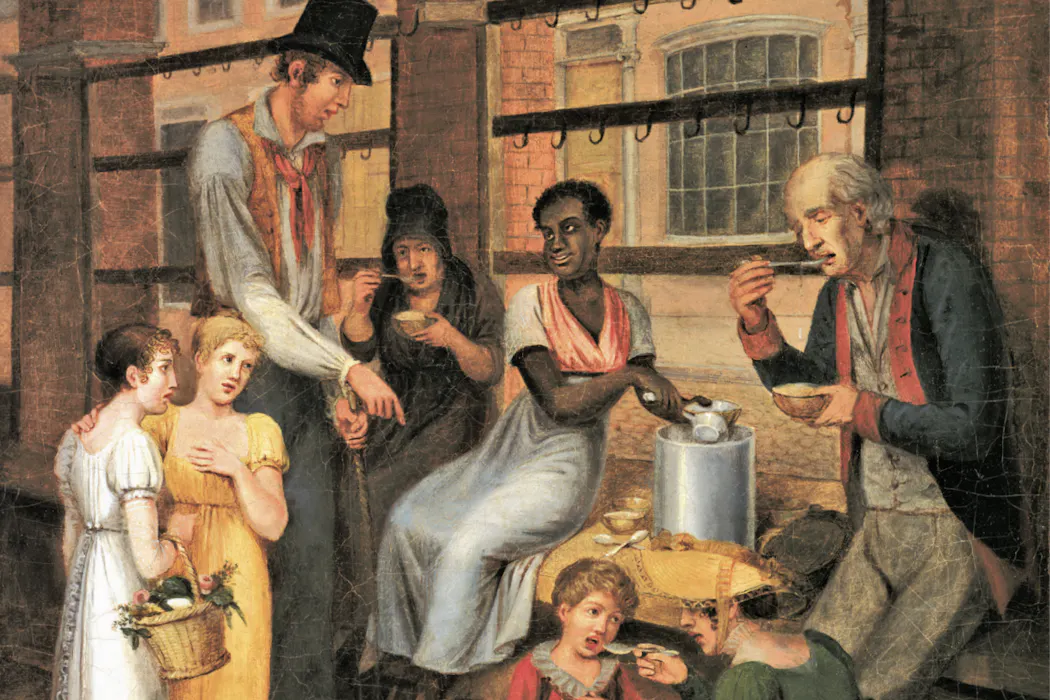
“Pepper-Pot: A Scene in the Philadelphia Market,” by painter John Lewis Krimmel, 1811. Philadelphia Art Museum: 125th Anniversary Acquisition. Gift of Mr. and Mrs. Edward B. Leisenring, Jr., 2001-196-1

Americans typically commemorate the nation’s birthday with hot dogs and hamburgers.

Instead, I think we should mark the 250th anniversary of the United States with a hearty bowl of pepper pot stew.

Yellowed page of book with black-and-white illustration of group of people gathered around a large pot
A children’s book published in 1810 describes street life and sounds in Philadelphia. It includes a wood cut illustration of a group of customers around a pepper pot soup.
‘Pepper Pot,’ The Cries of Philadelphia, Johnson and Warner, 1810, Collection of the Historical Society of Pennsylvania

In the 18th and 19th centuries, pepper pot stew was a popular street food. A dish of Afro-Caribbean origin, it was typically made with tripe and other cheap cuts of meat mixed with vegetables, hot peppers and other spices.

Enslaved Africans likely brought the dish to Philadelphia from the Caribbean in the 18th century, when the two regions were tightly connected through trade.

As a historian of women and labor in the early republic, I have learned how important impoverished and ordinary individuals were to the country’s founding. Cooking and preparing food, spinning and weaving cloth, washing and mending clothes, and caring for the sick were just some of the kinds of labor that supported the fledgling nation. Much of this work was carried out by marginalized women who are often overlooked in national commemorations.

One such woman I’ve researched represents both the possibilities and sharp limitations of freedom in that era. She was a pepper pot seller in Philadelphia known to us only as Dina.

Hiding in plain sight

Pennsylvania, like many northern states, responded to the Declaration of Independence’s rhetorical commitment to liberty by enacting a gradual emancipation law.

On the day the law went into effect in 1780, however, its provisions freed no one.

Children born to enslaved mothers before March 1, 1780, would remain enslaved for the rest of their lives. Children born after that date remained in bondage until they were 28 years old. So-called “slaves for life,” the status Dina held, would have had no hope of gaining legal freedom.

In the face of this grim reality, some, like Dina, seized freedom for themselves.

She slipped away from her enslaver, Rev. James Anderson, in Middletown, Chester County, sometime in 1785 or 1786 and made her way to nearby Philadelphia.

Almost all of the information we have about Dina comes from a notice Anderson placed in a local newspaper offering a reward for her return. Each detail is stained with his opinions about the woman he held as property. Anderson described Dina as “lusty,” a word that can be interpreted in a number of ways.

White people generally held insidious ideas about Black women’s sexuality in this period. In the 18th century, lusty also meant insolent, which might have conveyed Anderson’s frustrations with Dina’s unwillingness to accept his authority over her. The word also could refer to health and vigor, so it’s possible Anderson was describing Dina’s physique and general affect.

Nonetheless, the advertisement exemplifies the paradox of liberty and enslavement at the nation’s founding.

A yellowed page from an old newspaper
Enslaver James Anderson offered $4 to anyone who would return Dina, whom he wrote ‘passes for a free woman, and is often seen in the market selling Pepperpot.’
Freeman’s Journal, No. CCCXII, April 11, 1787/Library Company of Philadelphia

It is impossible to know how familiar Dina was with Philadelphia, or if she had friends or family there when she arrived. She might have simply decided that her best chance of avoiding recapture was in an urban area where she could blend in with the free Black community that was growing rapidly due to migration from neighboring states and people manumitted by their enslavers. Dina might have imagined she could tuck herself into the hustle and bustle of this incredibly dense city more easily than in a thinly populated rural area.

After Dina got to Philadelphia, she made an interesting decision. Instead of finding more discrete employment, such as working as a domestic, she supported herself by selling pepper pot stew in one of the city’s markets. According to Anderson, she had been seen “numerous times” over the past 18 months.

One of many Black women selling the dish, Dina could essentially hide in plain sight from Anderson and anyone who hoped to collect the US$4 reward he offered.

A yellowed page of recipes with 'Soups' written at top of page
A recipe for pepper pot stew from 1798.
‘The New Art of Cookery,’ by Richard Briggs, 1798.

It is unclear how long she was able to evade Anderson, but the fact that she maintained her freedom for at least a year and a half is remarkable. Philadelphia’s vagrancy docket is full of examples of freedom seekers who were apprehended almost immediately.

Dina’s ultimate fate is unknown. After Anderson’s three newspaper notices, she disappears from the archive. She may have been captured and returned to Anderson. Or it’s possible that working as a pepper pot seller allowed her to gain her freedom permanently.

Opportunity in Philly’s informal economy

Spiraling war debt and inflation during the 1780s fell heavily on the neediest Americans. In Philadelphia, impoverished people often subsisted on bread. Affordable, hearty street food like pepper pot stew would have offered important nutrients and perhaps pleasure from a good meal. By providing cheap, nourishing food for working Philadelphians, pepper pot sellers could be seen as participating in a kind of informal mutual aid.

However, city officials characterized some market activities during this period as “riotous and disorderly” and imposed stricter regulations around when and where pepper pot sellers could operate. Boisterous gatherings of Black and white working-class people might have seemed potentially threatening or disruptive to city leaders.

Dina’s role as an informal trader echoed across the 19th century. Many Black women took up the pepper pot trade, and some earned decent incomes. These women, in turn, contributed to a range of charitable, religious and abolitionist organizations that formed the backbone of a vibrant Black Philadelphia. They also helped support their families, even in an economic order that devalued Black women’s labor.

As the United States celebrates its semiquincentennial this year, many Americans will be reminded of the stories of popular Revolution-era figures such as Paul Revere or George Washington.

But I’ll be thinking of Dina and the countless other Black women who sold pepper pot stew on the streets of Philadelphia, the nation’s first capital. To me, they symbolize the fragile hope, terrible failures and tireless quest for true freedom that defined the founding era.

Read more of our stories about Philadelphia and Pennsylvania, or sign up for our Philadelphia newsletter on Substack.

The Conversation

Carolyn Zola has received funding from the Library Company of Philadelphia and the American Association of University Women.

​Politics + Society – The Conversation
Categories
Uncategorized

How money exchanges between House members shape the balance of power in Congress

Researchers tracked the campaign cash that senior House lawmakers steer to fellow members of their own party. Kevin Carter/Getty Images

When Americans think about campaign finance, they usually picture wealthy donors, political action committees and super PACs pouring money into elections.

But some of the most revealing money moves happen inside Congress itself.

Members of the U.S. House of Representatives routinely give campaign money to fellow members of their own party. These transfers make up only a small share of total campaign spending, but they can reveal something important: how parties reward influence, support vulnerable candidates and organize power from within.

In our recent study, my research colleague and I analyzed campaign contributions exchanged among House members from 2009 to 2022, using data from the Federal Election Commission. We looked at who gave money to whom across seven election cycles and asked a simple question: Are these decisions mostly ad hoc, or do they follow clear political patterns?

We found that they are far from random. Internal campaign giving reflects the structure of party politics in the House. Senior members and party leaders are more likely to be givers than receivers, and members facing pressure from outside spending are more likely to attract support from their party colleagues. We also found that Democrats and Republicans organize these campaign contributions differently.

A hidden side of campaign finance

Campaign contributions between House members are legal, common and publicly reportable. In practice, these transfers can help members build alliances, strengthen their party standing and direct resources to competitive races.

That makes these contributions politically meaningful even if they do not dominate the overall money race. More than a financial act, a contribution from one representative to another serves as a signal about who matters and who is vulnerable.

To study this, we treated member-to-member contributions as a network. Each House member was a node, and each contribution created a link from one member to another. This allowed us to track broad patterns over time rather than focusing only on high-profile lawmakers.

Leaders give more than they receive

One of our clearest findings is that party insiders – meaning senior lawmakers and members in formal leadership roles – play a major role in steering campaign cash.

In our study, leadership included the speaker, party leaders, whips, caucus or conference chairs, and committee chairs or ranking members. Across the seven election cycles that we analyzed, about 79% of Democratic leaders and 71% of Republican leaders gave to at least one fellow House member, compared with 65% and 58% of nonleaders.

Leaders also tended to give to far more colleagues. In the 2021-22 election cycle, for example, Democrat Hakeem Jeffries gave to 76 fellow members in our network, Nancy Pelosi to 61, and Republican Steve Scalise to 192. Republican Jason Smith gave to 100 fellow members.

Public reporting shows the scale that these efforts can reach. During the 2021-22 cycle, Kevin McCarthy’s Majority Committee PAC reportedly contributed about US$4 million to select House Republicans in difficult reelection races.

Seniority mattered too, especially among Democrats. Longer-serving Democratic members were more likely to give and less likely to receive. This suggests that experienced members often help channel money toward colleagues with greater electoral need.

The two parties do not look the same

Our study also found a striking difference between the two major parties.

Democratic contribution networks were relatively stable over time. Their giving patterns remained more centralized, with money flowing repeatedly through a smaller set of members. That suggests a more consistent and hierarchical internal system for directing support.

Republican networks changed more over the same period. Early in our study, their money flows were also more centralized. But over time, contributions became less focused on a small core of recipients and were more likely to occur within smaller connected groups. That suggests support was being coordinated less through a single hub and more through clusters of politically connected members.

While Democrats do seem to rely more on a stable central structure, and Republicans appear to have moved toward a more dispersed system, it should not be taken to mean that one party is orderly and the other is chaotic. Both approaches offer their own advantages.

In today’s political language, a uniparty means the idea that Democrats and Republicans are basically one indistinguishable establishment. Our findings point the other way: At least in internal campaign finance, the parties are behaving in distinct ways.

A photo of a large federal building with red dollar bills superimposed behind it.
House members targeted by more super PAC activity were more likely to receive contributions from fellow party members.
Greggory DiSalvo/Getty Images

What outside spending may be signaling

We also examined the role of super PACs, which can spend unlimited sums independently to support or oppose candidates.

We found a consistent pattern across both parties: Members targeted by more super PAC activity were more likely to receive contributions from fellow party members and less likely to contribute to others themselves.

A concrete example shows why this matters. In the 2020 cycle, our data shows that outside spending reached about $8.4 million in Abigail Spanberger’s Virginia race for the House and about $7.36 million in Rep. David Valadao’s California race. When that much outside money floods a contest, it sends a public signal that the race is competitive and strategically important. Other lawmakers can see that signal and redirect their own money toward the colleague under pressure.

Why this matters

At a time when the role of money in politics remains deeply contested, such patterns remind Americans that campaign finance is not just a story about donors and interest groups. It is also about how politicians finance one another from the inside.

Those internal flows help show how parties build influence, protect vulnerable members and respond to election pressures. They also offer a window into broader differences between Democrats and Republicans.

More interestingly, it tells a story about party insiders making strategic choices about where money should go — and, in doing so, helping shape the balance of power in Congress.

The Conversation

Mayank Kejriwal does not work for, consult, own shares in or receive funding from any company or organization that would benefit from this article, and has disclosed no relevant affiliations beyond their academic appointment.

​Politics + Society – The Conversation

Categories
Uncategorized

Why the director of national intelligence needs more than political loyalty to do the job

President Donald Trump’s choice for acting director of national intelligence, Bill Pulte, has proved controversial. Pulte’s lack of background in national security matters has sparked resistance from Democrats on Capitol Hill, which is not surprising. But some Republicans, too, have expressed dismay at the president’s choice, a Trump loyalist who currently runs the Federal Housing Finance Agency.

“I see no evidence of any qualifications for that job,” said U.S. Sen. John Cornyn, a Republican from Texas.

The current director of national intelligence, Tulsi Gabbard, is leaving the job at the end of June 2026.

Here’s why it matters who holds the job of director of national intelligence.

Principal national security adviser

To speak of telling truth to power seems terribly old-fashioned these days, but as a veteran of White House intelligence operations, I know that is the essence of the job.

The director of national intelligence is the president’s principal adviser on intelligence, though the CIA director has remained somewhat co-equal in that role. In past administrations, the director of national intelligence has been responsible for both the President’s Daily Brief, where the most crucial and sophisticated intelligence is presented, and for the work of the National Intelligence Council.

Most of the President’s Daily Brief items are still done by the CIA, but the director of national intelligence or a deputy briefed the president, daily in most administrations but one or two times a week in the first Trump administration. Now, it is not clear the briefings take place.

The issues in those briefings lean toward the immediate and tactical: What is the situation on the ground in the wars in Iran and Ukraine? If the United States does X, how will the Iranian regime or Russian President Vladimir Putin respond?

But intelligence strives to push presidents and their colleagues to think more strategically: What are the implications of hypersonic missiles? What is the trajectory of the relationship between Russia and China? What are China’s geostrategic objectives, and what is the role of the Belt and Road Initiative in that vision? What if, far from toppling it, U.S. and Israeli attacks push the Iranian regime to become more hard line, or even produce some “rally ’round the flag” effect among previous opponents of the regime.

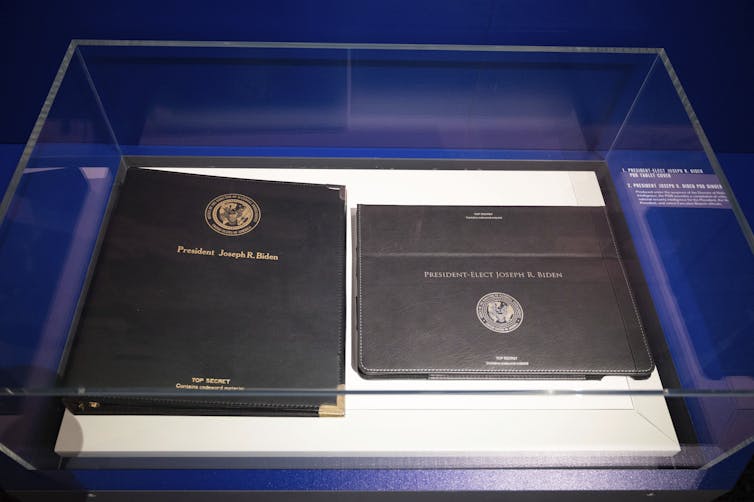
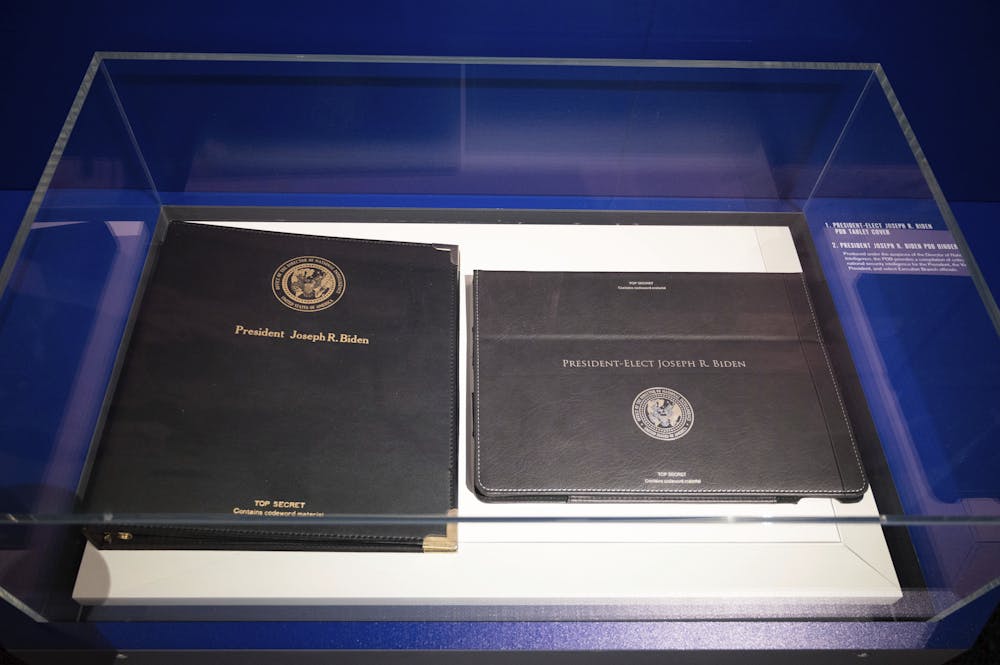
Two brown notebook covers that have 'President Joseph R. Biden' and 'TOP SECRET' printed on the front.
A display showing the covers of the President’s Daily Brief at the Central Intelligence Agency’s museum in the headquarters building in Langley, Va., on Sept. 24, 2022.
AP Photo/Kevin Wolf

9/11 led to intelligence changes

I was chair of the National Intelligence Council from 2014 to 2017, providing day-to-day intelligence support to the National Security Council and its committees, as well as trying to find time to do more strategic intelligence, looking at trends and connections across issues, producing what are called National Intelligence Estimates.

The director of national intelligence, known as the DNI, sits atop the 17 agencies that make up what is called the U.S. intelligence community. The director neither runs those agencies nor has full control of their budgets.

Rather, the director of national intelligence coordinates them, which sometimes seems like the proverbial herding of cats. They assemble a combined budget for intelligence, but many of the big agencies, such as the National Security Agency, which makes and breaks codes and intercepts signals of interest, belong to the Pentagon.

The creation of the director of national intelligence position was a direct result of the 9/11 terrorist attacks.

The report of the 9/11 Commission was vividly damning about the failures of communication between agencies in the run-up to 9/11. In meetings in New York that summer, CIA and FBI officers were literally unsure what they could tell each other: The former wondered whether the FBI people were really cleared to hear this, while the latter feared that talking might blow a case they were working on. That lack of coordination played a role in letting the plotters slip through intelligence, often in plain sight.

The result of the commission’s work was the Intelligence Reform and Terrorism Prevention Act of 2004, which created the director of national intelligence position.

Before that, the director of central intelligence wore two hats, as the director of the Central Intelligence Agency and loose coordinator of the broader intelligence community. Hardly surprisingly, directors of central intelligence spent most of their time running the CIA, for that was the source of their troops – and their troubles when they arose.

A score of blue-ribbon panels over 50 years had recommended breaking the director of central intelligence’s conflict of interest – coordinating agencies and their budgets while running one of them – and creating a director of national intelligence position.

James Clapper, the director of national intelligence for whom I worked as chair of the National Intelligence Council, constantly emphasized “integration.” Across agencies, integration mostly means talking to each other and sharing information. This works against the natural tendency to scoop your colleagues.

Across disciplines, integration means better aligning what information intelligence agencies collect with what analysts need.

How integration works

If presidents want to know what the CIA thinks about a particular issue, they can simply ask. Usually, though, the question is what does the intelligence community think, and then the question goes to the National Intelligence Council, the director of national intelligence’s interagency group for intelligence analysis.

The National Intelligence Council is organized like the State Department, with officers for regions and functions. Once a question has been presented, the relevant national intelligence officer will convene his or her colleagues from the other agencies. They will argue about the answer to the question, a process sweetly called “coordination,” then agree on the answer. If need be, the process can be done in a few hours.

Major strategic analyses – national intelligence estimates – like one done in 2022 on the implications of the COVID-19 pandemic out to 2026, may take months. In all cases, though, the analysis carefully records where there are differences of view in the intelligence community.

In my last year chairing the National Intelligence Council, of the 700 or so analyses we did, about 400 were responses to questions – called “taskings” in governmentese – from the national security adviser or one of the deputies.

National intelligence officers are national experts from inside or outside federal government, and their deputies – the heart and soul of the NIC – are all assigned from intelligence agencies. The largest number come from the CIA, but I worked with a cyber analyst from the Secret Service and a wonderful analyst from the New York Police Department.

A bald man with a goatee talks into a microphone and gestures with his hands.
James Clapper, nominated by President Barack Obama for director of national intelligence, testifies at his Senate Select Intelligence Commitee confirmation hearing on July 20, 2010.
Melina Mara/The Washington Post via Getty Images

Resolutely nonpolitical stance

What was striking then and has struck me both times I’ve had the privilege of running a U.S. intelligence agency is the dedication of the officers.

They work for the nation, not for a political party or ideology. As chair of the NIC, I had no idea of the politics of my people, save for the several closest to me. For them, telling truth to power is not a slogan. It is what they do. They are always worried about “politicizing” – producing an assessment to suit a policymaker’s preference or, worse, being pressured to do so.

The president’s daily briefers, for instance, give up a year of their lives to come to work at 4 a.m., learn their briefs and then fan out across Washington to brief senior officials. They like being “on the team” of the person they brief, but they become uncomfortable if the conversation turns political.

The director of national intelligence sets the tone for that resolutely nonpolitical stance and polices it through principles articulated in the agency’s analytic integrity and standards. As chair of the NIC, for instance, I’d receive regular assessments of both the quality of our analyses and whether we risked becoming “politicized.”

For their part, do politicians and agency leaders like it when their pet projects are assessed by intelligence as unwise or infeasible? Of course not. I’ve been on that side of the intelligence-policy divide as well. But the United States is much the better for it.

This story, originally published on Dec. 4, 2024, has been updated to reflect that Bill Pulte has been chosen by President Trump to be the acting director of national intelligence.

The Conversation

Gregory F. Treverton does not work for, consult, own shares in or receive funding from any company or organization that would benefit from this article, and has disclosed no relevant affiliations beyond their academic appointment.

​Politics + Society – The Conversation

Categories
Uncategorized

As America approaches its 250th anniversary, The Federalist remains an indispensable guide to understanding the constitutional system and the nation’s enduring independence

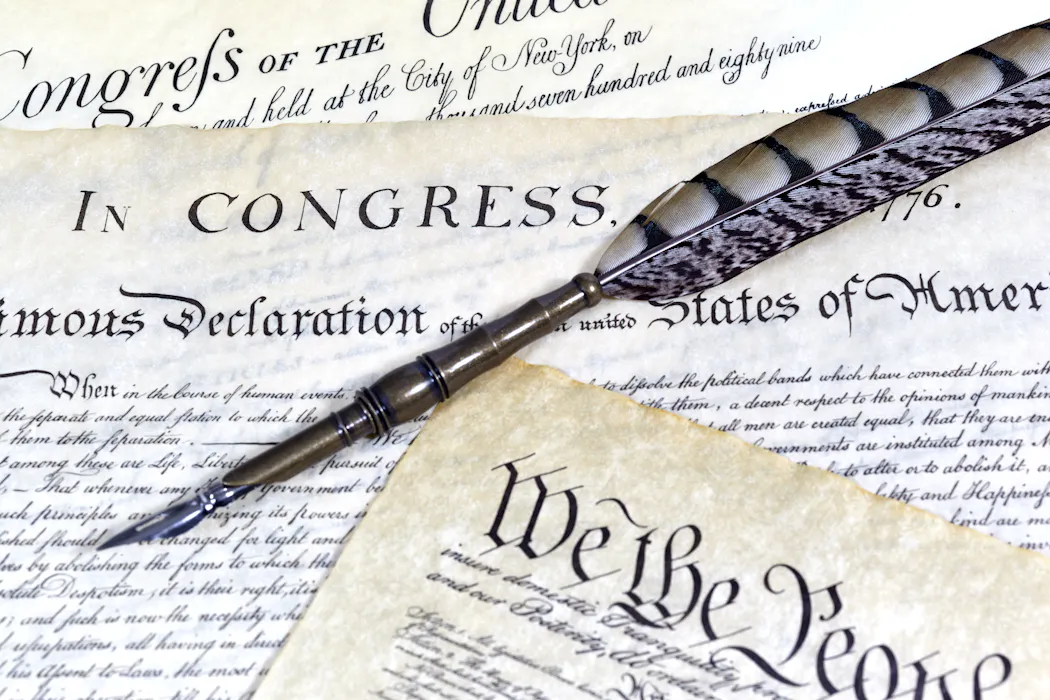
Without the series of essays known as The Federalist, the U.S. Constitution might never have been ratified. wingedwolf, iStock/Getty Images Plus

More people are talking about the Declaration of Independence now than they likely have for decades, largely because of the festivities, exhibits, historical commemorations and other public events associated with the upcoming 250th anniversary of American independence.

But even as they discuss the historical meaning, purpose and ideas of the declaration, they should remember that independence was only the first step in becoming a nation.

Despite laying out the purposes of the new nation, the declaration did not say what kind of government the new United States should have. That discussion was left for later debates, leading first to the Articles of Confederation and then, ultimately, to the Constitution.

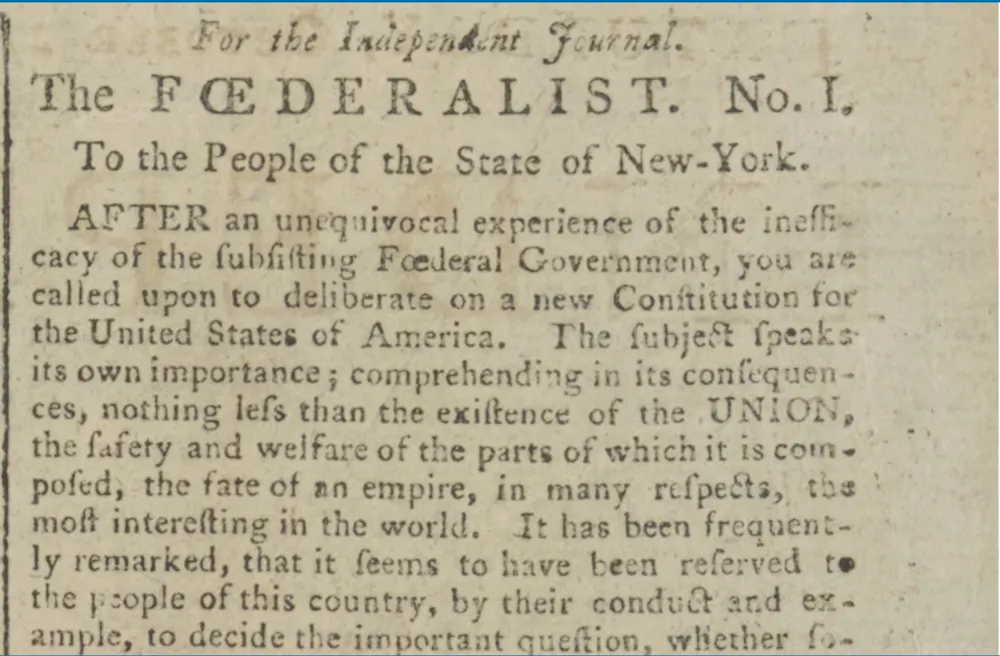
Yet, fully understanding the Constitution requires referring to the another crucial founding-era document: The Federalist, known to many as The Federalist Papers. Without it, the Constitution may not have been ratified, and it has helped guide American government and law for the past 2½ centuries.

A political cartoon from 1788 showing columns, each labeled after a state, being placed upright by a hand extending from a cloud, labeled 'United they stand - divided fall.'
An early Federalist political cartoon from the Massachusetts Centinel, Jan. 16, 1788, in which the standing pillars are states that have ratified the Constitution.
Library of Congress

Drive for ratification

Under the Articles of Confederation, adopted by the Continental Congress in late 1777, the national government was exceptionally weak, unable to levy taxes or tariffs or enforce treaty obligations. Moreover, the states often abused their authority, both over their own citizens and with regard to each other. For example, states would often impose tariffs on each other’s goods, even if those goods were moving only from Virginia to Maryland and vice versa, thereby inhibiting the development of a national market and hamstringing internal trade.

The Constitution sought to correct these problems by creating a much stronger national government able to protect itself from national security threats, both foreign and domestic, and secure liberty at the same time.

Those supporting ratification adopted the name Federalists on the idea that they supported strengthening the national government, which was often described as a federal union. Their opponents, who sought to defeat the Constitution’s ratification, were then dubbed the Anti-Federalists, much to the latter’s consternation.

While there were a variety of Federalist authors writing to support the Constitution during the ratification debates in 1787-88, the essays of The Federalist were specifically co-authored by Alexander Hamilton, James Madison and John Jay under the collective pseudonym “Publius.”

The practical political purpose of the essays was to convince New York to ratify the Constitution. Nine states had to ratify to put the Constitution into effect, yet it was recognized that without key states such as New York, Virginia, Massachusetts and Pennsylvania, the Constitution – and more broadly the union – could not survive.

Thus, even though 10 states ratified before New York, enabling the Constitution to go into effect, New York’s ratification remained essential.

Each of The Federalist’s 85 essays – 51 by Hamilton, 29 by Madison and five by Jay – were addressed “To the People of the State of New York.” Nearly all were published in New York newspapers as op-eds, with some republished in other states. They were meant to be read and thought about by an interested and educated public, as the authors understood the importance of public opinion not simply to the ratification process but to any democratic system.

Ratifying the Constitution was the immediate goal of The Federalist. But in making their arguments, the authors went further, addressing fundamental questions of politics by laying out the political theory that underlies that Constitution.

In short, The Federalist sits at the intersection where theory meets practice.

Advancing political science

In “Federalist 1,” Hamilton breaks down major issues to be considered in deciding whether to adopt the Constitution: the utility of the union; the defects of the Articles of Confederation; the need for energetic government; how the Constitution is analogous to the New York constitution; how the Constitution will preserve liberty and prosperity; and how the Constitution creates a republican government. Such a republican government is defined by Madison in “Federalist 39” as a government with powers derived from the people and administered by representatives for a period of time.

Reflecting the political debate, however, the authors had to be flexible with their writing plans as they responded to the arguments made by their Anti-Federalist opponents.

Yet, even in that dynamic environment, there are two consistent themes that contribute to The Federalist’s timelessness.

The first theme revolves around what Hamilton in “Federalist 9” calls “the science of politics.” Hamilton and Madison frequently address the ideas of past political philosophers and the traditional assumptions of what republics were supposed to look like.

This is most evident in “Federalist 10” where Madison overturns the long-held belief, articulated most clearly by the French philosopher Montesquieu and embraced by the Anti-Federalists, that republics needed to be small to preserve liberty.

Madison shows that, on the contrary, it was a large republic that could best deal with the problem of factions and preserve liberty by preventing any faction from gaining a majority, thereby providing “a republican remedy for the diseases most incident to republican government.”

Similarly, in “Federalist 70,” Hamilton explains that a single strong executive is not inherently monarchical and antithetical to republican government, but rather is essential to a republic’s proper operation. “Energy in the Executive is a leading character in the definition of good government,” he wrote.

The Federalist advanced political science itself, changing the conception of what a republic was and could be.

An almost 250-year-old portion from a newspaper column, entitled 'The FEDERALIST. No I.'
A section from Federalist No. 1, published in New York on Oct. 27, 1787, by the Independent Journal, also known as The General Advertiser.
Library of Congress

Accounting for self-interest

A second theme is the recognition of how human motivations interact with institutions.

Past philosophers, such as Aristotle, emphasized the necessity of virtue in both the people and their rulers, and Montesquieu argued that virtue was the defining principle of republics.

But Hamilton and Madison, focusing more on historical experience than theory, emphasized the need for institutions to account for the self-interested behavior of officeholders.

This emphasis is evident at the very beginning when Hamilton asserts in “Federalist 1” that a clean debate on the merits of any public proposal “is a thing more ardently to be wished than seriously to be expected,” and that some people will be driven by personal interests.

In “Federalist 51,” Madison provides the clearest articulation of this view with his famous statement, “Ambition must be made to counteract ambition. The interest of the man must be connected with the constitutional rights of the place.”

In their view, it is not enough to rely on the virtue of officeholders. But we can arrange our institutions in such a way that our low, base, self-interested human nature may be channeled to ultimately serve a higher public good.

This is not, however, to say that The Federalist is a cynical work.

Enlightened statesmen not always at the helm

In “Federalist 55” Madison points out that “there are other qualities in human nature which justify a certain portion of esteem and confidence.”

That optimistic statement is followed by his observation, “Republican government presupposes the existence of these qualities in a higher degree than any other form.”

Republics rely on the people having some measure of public virtue to work. The key insight Madison brings out is that such higher qualities alone cannot be relied upon.

The institutions created by the Constitution are set up to be functional, but they are also built to account for the kind of human beings who will inhabit them. As Madison succinctly put it in “Federalist 10”: “Enlightened statesmen will not always be at the helm.”

Thomas Jefferson called The Federalist “the best commentary on the principles of government which ever was written.” It remains the most systematic and important exploration of our constitutional system.

As Americans celebrate the 250th anniversary of American independence, it is worth reflecting on the institutions that have facilitated the endurance of that independence. You can find no better guide to that reflection than The Federalist.

The Conversation

Jordan Cash does not work for, consult, own shares in or receive funding from any company or organization that would benefit from this article, and has disclosed no relevant affiliations beyond their academic appointment.

​Politics + Society – The Conversation