Categories
Uncategorized

Trump doesn’t own the government – even though he acts as if Congress is not his equal in constitutional power and authority

President Donald Trump boards Air Force One at Geneva Airport on June 17, 2026. Martial Trezzini/Keystone/Pool via AP

In a recent exchange with reporters about the newly brokered Iran agreement, President Donald Trump was asked whether he planned to submit the deal to Congress.

“I never thought about sending – never even thought about it, but I will,” Trump said. “I will send it to Congress. I like the idea.”

The most revealing phrase in the president’s statement was not “I will send it.” It was “I never thought about it.”

In a constitutional system built around separated powers, the consent of Congress should be more than an idea the president remembers after a reporter asks. Especially when it comes to questions of war, peace and foreign policy, Congress is where the public’s representatives play a crucial role in national decision-making.

Exactly what role Congress has in this particular agreement is not yet clear. The Constitution gives the Senate formal responsibility for approving or rejecting treaties. But presidents also enter many international agreements without submitting them for a Senate vote. As a result, lawyers and lawmakers often disagree about when congressional approval is legally required and when a president can act on his own.

But the legal question is not the only issue. Trump’s comment was revealing because it suggested that Congress had not been part of his thinking from the beginning.

That fits a larger pattern in Trump’s rhetoric. In his public remarks, he rarely describes Congress as a coequal branch of government. It appears as an obstacle, an audience, a pressure point, a rubber stamp or an afterthought.

As a scholar of media and presidential rhetoric, and an endowed professor for the Frank Church Institute, a center established to honor the former senator who once chaired a committee that aimed to ensure Congress’ role overseeing executive branch activities, I pay close attention to how presidents talk about power. The language they use often reveals not only what they intend to do, but how they understand America’s constitutional system itself.

In 2016, Trump accepted the GOP nomination for president, saying of the country’s problems, ‘I alone can fix it.’

Bypassing Congress

The U.S. Constitution does not imagine the president as the owner of the government with absolute, top-down, decision-making privileges. Instead, it places the president within a system of separated powers. Authority is divided among institutions, and no single office stands above the others.

The modern expansion of presidential power did not begin with Trump. Presidents of both parties have claimed broad unilateral authority. This is especially true when it comes to foreign affairs, war powers, immigration, emergencies, tariffs and administrative actions.

Nor did Trump invent the practice of presidents bypassing Congress by appealing directly to the public. Political communication scholars call this tactic “the rhetorical presidency.”

The basic idea is straightforward. As mass media became central to politics, presidents increasingly used public communication to build support for their agendas and pressure Congress from the outside.

To illustrate the contrast between the era of presidential pressure directly on Congress versus going to the public for that support, Abraham Lincoln actively lobbied legislators to pass the 13th Amendment, which made slavery illegal.

Franklin Delano Roosevelt engendered support for his New Deal programs through press conferences and fireside chats broadcast nationally on radio.

That development changed the presidency. Presidents became not only administrators of government but constant public performers of leadership.

Trump represents a further turn in this theory. He does not merely go over or around Congress to make a public case for his actions. He often speaks as though Congress has no independent claim on national authority, and that the legislature’s main role is to offer him unconditional support. To wit, after Congress voted to limit Trump’s authority to use force in Iran, he called supporters of the measure, including some Republicans, “unpatriotic.”

Who decides? Who represents?

Like Trump, other presidents have also personalized power. In 2006, President George W. Bush drew criticism when he defended keeping Donald Rumsfeld as defense secretary by saying, “I’m the decider, and I decide what is best.” The line became famous because it seemed to compress executive authority into one person’s will.

But Trump’s attitude seems more expansive than was Bush’s. He speaks as though being president means being the person who knows more than anyone else, who can act more decisively than anyone else, and who deserves to be questioned less than anyone else. He told Axios that there are “no limits” to his ability to exert power that he has yet found.

When Trump speaks this way, presidential power sounds like personal superiority. His words obscure the fundamental constitutional principle that no government official is beyond scrutiny, correction or institutional constraint.

A large chamber filled with people seated in curved rows, being addressed by a an in the front of the room.
President Franklin D. Roosevelt addresses a joint session of Congress on Dec. 8, 1941, asking for a declaration of war against the Japanese empire. Within a half-hour after he spoke, the war was declared by both houses.
Bettman/Getty Images

Power to the people

Congress is not simply a rival power center to the presidency. It is the branch through which citizens are most directly represented in national government. Members of Congress are elected from states and districts. Their roles include hearing from constituents, taking account of local concerns, debating policy, authorizing spending, overseeing the executive branch and making laws.

When a president treats Congress as optional, he is also treating representation as unnecessary. And when representation is unnecessary, accountability can also fall by the wayside.

Congress is where public authority becomes governmental authority. In a representative democracy, the people are sovereign. Public power, meaning the authority government exercises on behalf of the people, does not originate with the president. It originates with citizens and is carried into government through elections, deliberation, law and consent.

Questions about Iran have exposed this tension. When Congress has tried to limit or review Trump’s authority to use lethal force against Iran, the debate has not only been about military strategy. It has also been about whether congressional authorization and oversight still count as legitimate parts of decision-making about military force – and sending American troops into situations in which they could die.

How democracy works

Congress is not infallible, and the Constitution does not suggest that its judgment should automatically prevail over presidential will. Moreover, not every international agreement requires the same kind of congressional involvement.

It is also possible that the public supports the new Iran deal, and so the president has its implicit consent.

But even if these things are true, the point is more fundamental. In saying, “I never thought about it,” the president returned to a claim about power that has defined his political rhetoric since 2016, when he declared that only he could repair what was broken in America: “I alone can fix it.” It’s a philosophy that says the president acts first, and other institutions are invited to catch up later.

The danger is not simply that he is sidelining the role of Congress. It is that this understanding of power makes the constitutional system resemble a hierarchy rather than a republic. And when the institutions through which citizens exercise their authority can be treated as optional, it is ultimately the people who are pushed to the margins of self-government.

That undermines the democratic order. The president does not stand above the people. He serves within a constitutional system designed to keep public authority from becoming personal power.

The Conversation

Stephanie A. (Sam) Martin does not work for, consult, own shares in or receive funding from any company or organization that would benefit from this article, and has disclosed no relevant affiliations beyond their academic appointment.

​Politics + Society – The Conversation

Categories
Uncategorized

In deep-red Idaho, even Republicans break with Trump on farm labor

Farmworkers harvest corn in a field. Much of U.S. agriculture, including Idaho’s dairy industry, relies on immigrant labor. Hill Street Studios/DigitalVision via Getty Images

Under the second Trump administration, the United States has seen mass deportations and a sharp escalation in immigration enforcement. The Department of Homeland Security says the crackdown pushed nearly 3 million people out of the country in Trump’s first year back in office.

For the first time since the 1960s, the number of immigrants living in the U.S. is declining; because most farmworkers are foreign born, those losses are already beginning to strain American farms.

We are social scientists who study immigrant communities in Idaho and the challenges farmworkers face. We also run an annual survey exploring public opinion on a range of policy issues, including immigration and economic conditions. Amid the government’s heated rhetoric, our data shows public opinion on immigration in one of the country’s reddest agricultural states is diverging from national politics and may even be at odds with federal policy.

Immigrant labor in agriculture

According to the Center for Migration Studies, 86% of farmworkers in the U.S. are foreign born, and 45% are undocumented. In 2025 the Trump administration suggested it would not target farms. Still, farmworkers across the country are scared to go to work.

Between March and July 2025, the agricultural workforce declined by 7%, with farms reporting labor shortages in states that voted for Trump, including Pennsylvania, and states that didn’t, including California. Meanwhile, immigration crackdowns are threatening this country’s food security.

National polling on the administration’s immigration policies tends to follow party lines, drawing Democrats’ disapproval and Republicans’ support, but recent polling suggests some softening among the latter. Pew Research Center reported that half of all respondents disapprove of the administration’s approach to immigration, and more than half say Trump is “doing too much” when it comes to deportation. Among Republicans the share is smaller – 20% – but rising.

Research suggests people think about immigration differently at the local level. To explore how public opinion on immigration varies in farm-dependent states, we looked at one of the most agriculture-reliant and Republican states in the country just as its farms face policy-driven labor shortfalls.

A worker balances a crate of husk-on corn on his shoulder amid tall cornstalks.
A worker carries a crate of freshly picked corn through the field. Immigrant workers make up a large share of the U.S. agricultural workforce.
Hill Street Studios/DigitalVision via Getty Images

A closer look

Agribusiness is important for Idaho’s economy, accounting for 20% of its annual GDP, according to the Idaho State Department of Agriculture. Dairy is a cornerstone: The state is the fourth-largest milk producer in the U.S., according to the Idaho Dairymen’s Association. Ninety percent of Idaho dairy workers are foreign born.

Idaho is also a deeply red state: About 60% of voters are registered Republicans, and 67% voted for Trump in 2024. These numbers make Idaho a clear test of how national rhetoric and intensifying immigration enforcement track with public sentiment in places that have the most to lose.

Our 11th annual Idaho Public Policy Survey polled 1,000 adults in the fall of 2025. Because immigrants have lower crime rates than native-born Americans, we designed a question around long-term residents without a criminal record – specifically, dairy workers and their families who have lived in Idaho more than 10 years.

The results showed broad support for a pathway to legal working status for them: 85% of respondents were in favor, with 56% strongly supportive and 29% somewhat. Just 9% opposed. We expected immigration positions to tie directly to political affiliation, but results cut across party lines, with 79% of Republicans, 88% of independents and 95% of Democrats in favor.

We also asked participants whether increased presence from U.S. Immigration and Customs Enforcement, or ICE, would help or harm Idaho’s agricultural economy. More than half – 53% – said it would harm the economy, 19% said it would help, 18% said there would be no impact, and 10% were unsure.

The pattern was sharpest where it would matter most: Residents of agriculture-dependent regions were more likely to say ICE presence would hurt the economy. Republicans were more likely than others to say it would help; even so, only 35% of Republicans responded that way, compared with 11% of independents and less than 3% of Democrats.

In agriculture-dependent Idaho, many residents say they recognize the role immigrants play in sustaining local rural economies, and research shows that recognition can shift attitudes about immigration, potentially increasing support for more inclusive policies.

According to our research, public opinion in Idaho is more nuanced than the right-left divide suggests. We believe findings here are likely to hold in other places similarly dependent on agriculture, as farmers from Wisconsin to Delaware speak up about their reliance on immigrant labor.

The Conversation

The authors do not work for, consult, own shares in or receive funding from any company or organization that would benefit from this article, and have disclosed no relevant affiliations beyond their academic appointment.

​Politics + Society – The Conversation
Categories
Uncategorized

Americans keep voting for scandal-prone candidates because they just don’t want the other party to win

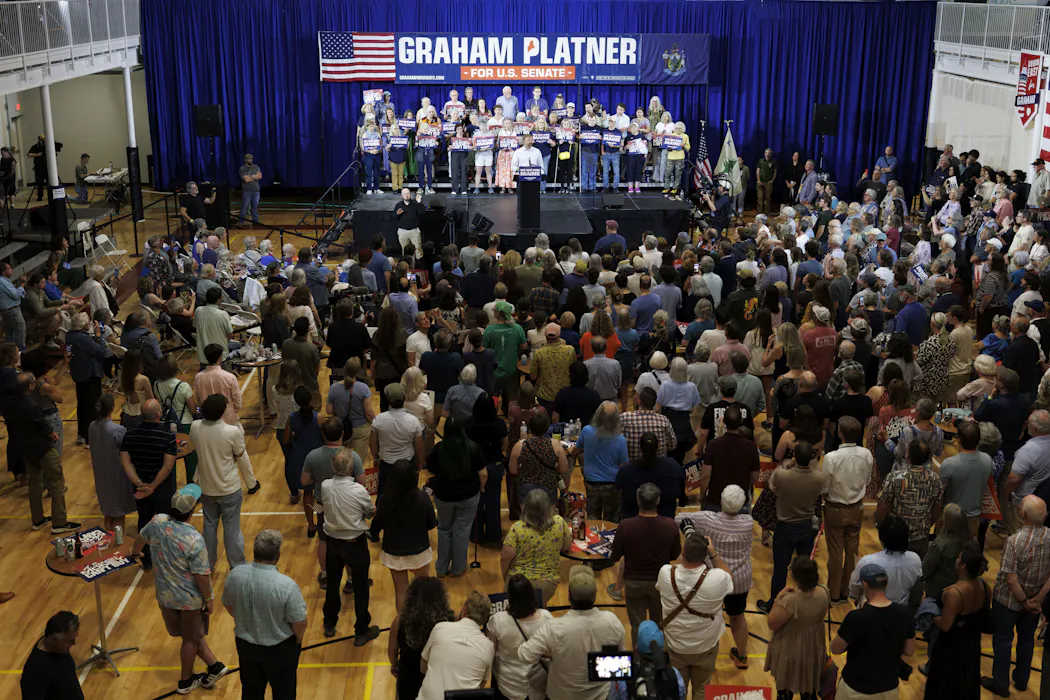
U.S. Senate nominee Graham Platner speaks to supporters on June 9, 2026, in Blue Hill, Maine. CJ Gunther/Getty Images

Every election cycle sees its share of controversial, scandal-plagued candidates running for office. But the 2026 midterm elections will feature two such candidates – one from each party – in two of the highest-profile U.S. Senate races.

In Texas, the state’s attorney general, Ken Paxton, recently secured the Republican Party’s nomination over incumbent Sen. John Cornyn.

Cornyn and others have insisted that Paxton’s substantial legal and personal baggage – including corruption and bribery accusations that got him impeached by the GOP-led state House of Representatives – might lose Republicans a seat they’ve held for decades.

Democrats in Maine, meanwhile, have nominated Graham Platner, a political novice whose grassroots campaign and brash communication style propelled him to a decisive victory over the state’s Democratic governor, Janet Mills, who remained on the ballot but suspended her campaign in April.

This, despite Platner facing a series of personal scandals ranging from alleged sexual misconduct to a tattoo that turned out to be an emblem of Hitler’s paramilitary Schutzstaffel, or SS. Platner has claimed he was unaware of the symbol’s origins and has since covered it up.

Both Paxton and Platner won resounding victories in their primaries over more establishment candidates who were comparatively free of scandal.

As a scholar who studies Congress and elections, and the co-host of a podcast about political scandals, I believe political science offers answers about how Paxton and Platner pulled off victories in their states’ primaries – and why they might win in November.

Historic distance and distaste between the parties

Both Paxton’s and Platner’s flaws were well known prior to primary voting.

Early polling indicates that most of Texas’ Republican voters are likely to back Paxton in November. Polling also shows that Platner will continue to consolidate his party’s support in Maine.

Both parties’ leadership in Congress and beyond have also rallied behind their respective candidates. And both parties have used the opposing candidate’s scandals against them in the campaign, despite propping up flawed candidates themselves.

These actions can coexist thanks to two forces that political science has much to say about, precepts that have been steadily increasing in relevance over the past few decades: party polarization – or the distance between the two parties – and negative partisanship, voters’ tendency to vote based on negative feelings toward the other party.

Several women hold signs and look toward a stage.
Supporters in Plano, Texas, celebrate Texas Attorney General Ken Paxton’s win on May 26, 2026.
AP Photo/Tony Gutierrez

Democrats and Republicans are far away from each other on policy preferences, issue positions and culture. They are also distant in terms of where they live, whom they support, how they feel and even whom they love.

Political science tells us that this polarized distance has increased feelings of personal animus between members of the two parties. Political psychology says the more different Americans are from each other, the easier it is for them to not just disagree with the other side but to dislike the other side to the point of viewing them as a threat.

These are trends Americans frequently see reflected in public opinion studies, many of which use the “feeling thermometer” to ask respondents to rate their personal feelings toward a person or party on a scale of zero degrees, or coldest/most unfavorable, to 100 degrees, or warmest/most favorable.

In the late 1970s, the average voter in each party was more or less neutral toward the opposing party, with scores hovering just below 50 degrees. By 2024, the average voter sentiment toward the other party had plummeted to 19 degrees.

In 1978, only 9% of Democrats and 7% of Republicans had a very negative opinion of the opposing party. By 2024, vast majorities in both parties – 64% apiece – reported such negative opinions.

Political science also tells us that these negative feelings about the other party are not simply prevalent. They are the driving force behind many voters’ election choices.

In other words, Americans are increasingly making voting decisions based not on who should win elections but rather on who shouldn’t. The opposing party is not just the less preferred option – it’s a threat that must be stopped at all costs.

When feelings about the other side are this negatively polarized, then winning – even with a less-than-ideal candidate as your standard-bearer – becomes more crucial than ever.

In fact, researchers have found that scandals involving candidates in a voter’s own party trigger a “defensive partisanship” that increases their hostility toward the other side. That is, scandals in a voter’s own party can make them more – not less – loyal to their team.

A rear view of a multiracial group of people standing in a long line in order to vote in the election.
Voters constantly report feeling the need to vote for the ‘lesser of two evils.’
SDI Productions/Getty Images

The higher the stakes, the lower the standards

Polarization and negative partisanship are not the only factors at work. The tight competition for control over major political institutions such as Congress and the presidency have raised the stakes of elections higher than ever. And, in the process, it has lowered standards for whom Americans are willing to support.

In her 2016 book, “Insecure Majorities,” political scientist Frances Lee found that partisan control over the federal government is more in question now that it has been in over a century. Lee says that closely fought elections that determine control of government help explain changing governing strategies in Congress.

But Lee’s findings also help explain our choices in elections and how – even in closely fought, high-profile races such as the 2026 Senate contests in Texas and Maine – voters end up nominating such blemished candidates.

In theory, closely fought competition should drive a “race to the top” in terms of candidate selection. Because control over institutions rests constantly on a knife’s edge, Americans might expect both sides to put forward their best, brightest and most electorally compelling candidates to try to win.

But thanks to polarization and negative partisanship, it isn’t always so. Instead, hard-fought elections among a closely divided electorate mean that individual votes matter more; that power hangs by a thread; and as a result, that one’s personal and political enemies are inches away from controlling the government.

Thus, closely divided elections only raise the stakes of one’s vote, along with the cost of defecting from your party’s candidate, however flawed they might be.

The lesser of 2 evils?

Voters constantly report feeling the need to “hold their noses” and vote for the “lesser of two evils.” The alternative – the other party taking power – is too grave to permit a truly principled stand. As a result, the race to the bottom continues, because the other side will always be worse.

These trends can help explain why, for example, Republicans circled the wagons around Donald Trump in 2016 despite his many scandals and serious misgivings within the party. They also illustrate why Democrats rallied around Joe Biden well into 2024, even as serious questions were raised about his physical age and mental fitness for office.

Whether Paxton’s or Platner’s partisan voters end up coalescing around them despite their scandals remains to be seen. Regardless, the reappearance of such imperfect candidates each cycle tells a bitter story about what voters will put up with to win.

The Conversation

Charlie Hunt does not work for, consult, own shares in or receive funding from any company or organization that would benefit from this article, and has disclosed no relevant affiliations beyond their academic appointment.

​Politics + Society – The Conversation

Categories
Uncategorized

How local communities are challenging Big Tech data centers’ noise, pollution and rising electricity bills

Citizens attend a City Council hearing in Pocatello, Idaho, to discuss the prospect of a new $2.6 billion data center in their community. Natalie Behring/Getty Images

As the race to build data centers across the United States accelerates, local governments worry that the tech industry mantra of “move fast and break things” means their communities are at risk of being broken.

I’m a Harvard researcher studying the relationship between data centers and energy. I’ve closely monitored how local governments respond to proposals or even just concerns about the potential for data centers in their communities. What I’ve found is a complex story of community needs, political tensions and corporate power – all interacting with local, state and national democratic processes.

Promises and potential

Technology companies stay competitive by being ready to provide data and communications services even before customer demand rises. Data centers already power online communications, shopping and banking systems. Now, expanding demand for artificial intelligence has led to over 1,000 pending data center proposals across the country.

Federal actions also drive development. The Trump administration has identified data center build-out as a strategic priority. The administration has promoted data center capacity as a measure of American strength and signaled that federal regulations on data centers may be eased.

At the community level, technology companies claim that data centers bring jobs, economic revitalization, digital connectivity and economic growth to local communities.

Not great neighbors

So far, however, data centers’ benefits are overshadowed by more visible harms.

Nearby residents experience higher air pollution and excess noise. Data processing also uses a lot of water to cool the buildings and their equipment.

People sit behind a long desk looking at a diagram of a data center cooling system.
Local leaders, like these in Evanston, Wyo., are faced with questions, and potential opportunities, when data centers are proposed in their communities.
Natalie Behring/Getty Images

Simultaneously, electricity prices continue to outpace inflation, burdening families across the country. These trends reflect, in part, the costly infrastructure investments needed to power data centers.

The local movement

My research has found that local governments across the U.S. are trying to avoid or reduce these harms.

Some counties and cities that don’t have specific zoning rules and regulations for data center development are using short-term moratoriums. These pauses in data center permitting and construction give communities time to consider how to define new laws and regulations about the facilities’ location, electricity use, water conservation and noise buffering.

Speaking about his town’s decision to impose a one-year data center moratorium, Rick Bella, the town council president in Merrillville, Indiana, about 40 miles southeast of Chicago, stressed a desire to “evaluate real-world impacts and learn from a project developing right next door before determining what may or may not be appropriate for Merrillville.”

Other places want to block data centers altogether. In April 2026, for example, the Ypsilanti Community Utilities Authority near Detroit, Michigan, passed a yearlong halt to the “delivery, commitment, reservation, extension, or approval of water and sewer services” for data centers. The move blocks data centers, including one under development by the University of Michigan and Los Alamos National Laboratory, from getting the water they need to operate.

Separately, towns across Ohio, Wisconsin, Maryland, Nevada and California have put questions related to data centers on their local ballots. Through these referendums, voters can weigh in on construction bans, tax incentives and zoning ordinances.

An aerial view of a large construction site.
Many residents opposed the construction of this $16 billion data center in Saline, Mich., developed by Related Digital for Oracle and Open AI.
Jim West/UCG/Universal Images Group via Getty Images

Power struggles

While public attitudes around data centers have remained largely nonpartisan, local and state officials don’t always see eye to eye.

Officials in Hood County, Texas, for example, rejected a proposal for a six-month moratorium after a state senator urged the Texas attorney general to intervene and prevent the measure.

In 2025, West Virginia passed a bill that reduces local governments’ zoning and regulatory powers in relation to data centers and microgrids. A similar bill in New Hampshire’s legislature was defeated in May 2026.

Tech companies are also flexing their legal and financial muscles. For example, data center developers sued Saline Township, Michigan, and Chatham County, North Carolina, seeking to overturn their local zoning decisions, to be able to proceed with data center construction.

Changing tides

Local pushback comes at a pivotal moment for artificial intelligence technology itself.

As seen in objections to the internet’s expanding AI “slop,” backlash over AI-generated Super Bowl ads, worries about an AI-related financial bubble and complaints about Google’s pivot to AI-directed search, Americans are reckoning with AI’s role in society.

Further, many people are questioning the role of technology broadly. Increasing numbers of teens and adults are addicted to their smartphones, emotionally and psychologically dependent on their availability. Parents and teachers are questioning the usefulness of various types of digital technologies in classrooms. Even the pope has warned that technology must serve humanity – and not the other way around.

Americans are responding to this moment through the power of their voices and votes.

People sit at a table decorated with signs saying 'community hearing on data centers,' 'inform the public' and 'repeal tax breaks.'
Data center opponents speak at a rally at the Minnesota State Capitol.
Michael Siluk/UCG/Universal Images Group via Getty Images

Technology companies may view moratoriums and new regulations as delays in project development. But the town hall discussions, community coalitions, public petitions and even farmers’ unions reflect American democracy at work.

In Sunbury, Ohio, local officials considered a moratorium only after witnessing the scope of public protest over a proposed data center.

In April 2026, voters in Festus, Missouri, removed several City Council members after they supported a new data center despite resident pushback.

The question of whether a community wants or should have a data center does not have a universal answer. I believe it’s a question that deserves deliberate processes, transparency and consideration.

To me, these local-level actions reflect a desire to slow down. There is little question that data centers and AI will be part of our collective future. Today, communities are asking for a fair say in what their futures will be.

The Conversation

Rachel Mural does not work for, consult, own shares in or receive funding from any company or organization that would benefit from this article, and has disclosed no relevant affiliations beyond their academic appointment.

​Politics + Society – The Conversation

Categories
Uncategorized

Colorado criminal cases are dismissed at a higher rate when prosecutors face heavier workloads

Nearly 1 in 5 felony cases filed in Denver and resolved in 2025 was dismissed with no strings attached.

For misdemeanor cases, the rate was 1 in 4.

A criminal case might be dismissed for a variety of reasons. Sometimes, evidence falls apart. Law enforcement, prosecutor or lab errors can similarly derail a case. Or perhaps prosecutors decide that pursuing it no longer serves the interests of justice. These situations are a normal, inevitable and sometimes even desirable aspect of the legal system.

But other times, cases get dismissed because the system lacks the bandwidth to hold onto them. Heavy caseloads in prosecutors’ offices can lead to more of these dismissals, according to my recent research.

I am a professor who studies prosecutorial policy and decision making. I am also a co-manager of Prosecutorial Performance Indicators, a research and technical assistance project that collaborates with prosecutors’ offices across the country to promote transparency, equity and data-informed policy. Between 2021 and 2024, my research team partnered with elected district attorneys throughout Colorado to produce data dashboards that show statistics on criminal cases and outcomes.

My colleague Don Stemen and I then used data from that project to investigate how prosecutors responded to weekly fluctuations in their criminal caseloads. Weekly caseloads can vary by as much as 15% above or below the average across weeks in a Colorado judicial district, with a mean change of 6%. Our research shows that in weeks when active caseloads are higher, fewer cases get resolved via a plea deal. Instead, dismissal rates rise to compensate.

In other words, as cases pile up, more of them end up getting dropped.

Case outcomes in Colorado

In the American legal system, which relies on plea deals, guilty pleas account for an estimated 95% of criminal convictions across the country. Trials, though constitutionally guaranteed, are rare.

However, a notable share of cases do not result in a conviction at all.

An NBC News report explains how plea deals work and how often they are used in the U.S.

Once a prosecutor has decided to file charges, cases can follow several pathways other than guilty plea or trial. Defendants may be screened for diversion programming, which redirects eligible individuals away from conviction and toward rehabilitative services, such as substance use or domestic violence offender treatment. They may also receive a deferred judgment, in which they initially plead guilty but avoid formal conviction if they can successfully complete conditions such as community service hours, counseling and remaining arrest-free for a set period of time. Other defendants see their cases dismissed outright by either a judge or prosecutor.

Across the half-million cases in our Colorado sample, about 45% were resolved in one of these alternative ways that avoided a criminal conviction.

Our sample includes all felony and misdemeanor cases resolved in 19 of Colorado’s 23 judicial districts between 2021 and 2024. Data was extracted from Action, the case management system used by prosecutors’ offices across the state, and shared by the Colorado District Attorneys’ Council.

Information from individual, public-facing data dashboards in the state show a similar reliance on alternatives to conviction. In the 20th Judicial District, which is Boulder, for example, 34% of felony cases resulted in a dismissal, diversion or deferred judgment in 2025. That was true for 50% of misdemeanors as well.

For misdemeanors in particular, this represents a 10% decline in the conviction rate in Boulder in just five years. It suggests that hundreds of defendants in less serious cases who would previously have been convicted now receive a different outcome each year.

Outright dismissals make up the bulk of misdemeanor nonconvictions in many jurisdictions. In the 18th Judicial District, which includes most of Aurora and Centennial, 56% of misdemeanor cases did not result in a conviction in 2025. Of those nonconvictions, 77% were dismissals.

Colorado’s dismissal rates do not appear to be outliers. Most prosecutors’ offices do not make their data available to researchers or the public, but more than 50% of all cases are routinely dismissed in some urban areas that do, such as Milwaukee and Philadelphia.

The pressure to dismiss

Prosecutors’ offices in Colorado are battling staff recruitment and retention shortages, with attorney vacancy rates above 50% in some offices.

Consequently, prosecutor caseloads have more than doubled in jurisdictions such as Golden, Colorado’s 1st Judicial District, where each prosecutor opened an average of four more felony cases or 122 more misdemeanor cases than they closed in 2025.

The rise of digital evidence, everything from body-worn camera footage to social media activity, has further increased the time and technology investment required to prosecute. Monthslong turnaround times for forensic testing create additional trouble, forcing prosecutors to proactively prioritize some cases for lab analysis over others.

Body camera footage and other forms of digital evidence are causing a backlog in the state’s criminal justice system, according to a CBS Colorado report.

Prosecutors’ offices across the U.S. are similarly struggling to hire and keep lawyers as they continue to grapple with technological challenges and case backlogs triggered by court closures during the COVID-19 pandemic.

In Anchorage, hundreds of cases were dismissed because there were not enough prosecutors available to move them toward trial in 2024. In 2019, the passage of Kalief’s Law, which established stricter evidence disclosure requirements for prosecutors, sent misdemeanor dismissals caused by failure to meet trial deadlines skyrocketing from 9% to 48% within five years in New York City.

Making prosecution more efficient

Case dismissals triggered by a lack of resources could be construed as the recalibration of a historically punitive legal system. Dismissing more cases, especially low-level cases involving defendants with little to no criminal history, may benefit society more than maintaining high conviction rates. After all, it is expensive to be tough on crime, and the evidence that mass conviction and incarceration improves public safety is thin at best.

Even so, these dismissals are symptomatic of a system in crisis. There are too many cases and too few resources to handle them.

If prosecutors’ offices are able to implement more rigorous early case screening, they are likely to eliminate weak cases faster and with less resource expenditure. This may be particularly effective if prosecutors also use their discretion to decline more undeserving cases up front, treating the use of taxpayer dollars on prosecution as something that requires deliberate justification rather than something that happens by default.

Research suggests that greater selectivity at early stages of prosecution reduces caseloads more efficiently than dismissals later on. Selectivity also spares defendants and victims from the prolonged uncertainty of a lingering case. Though moves in this direction would require an up-front investment by prosecutors’ offices, the long-term benefits may be well worth the effort.

Read more of our stories about Colorado.

The Conversation

Rebecca Dunlea receives funding from the Microsoft Justice Reform Initiative and the John D. and Catherine T. MacArthur Foundation.

​Politics + Society – The Conversation

Categories
Uncategorized

How political leaders use combat spectacles to symbolize national power and purpose

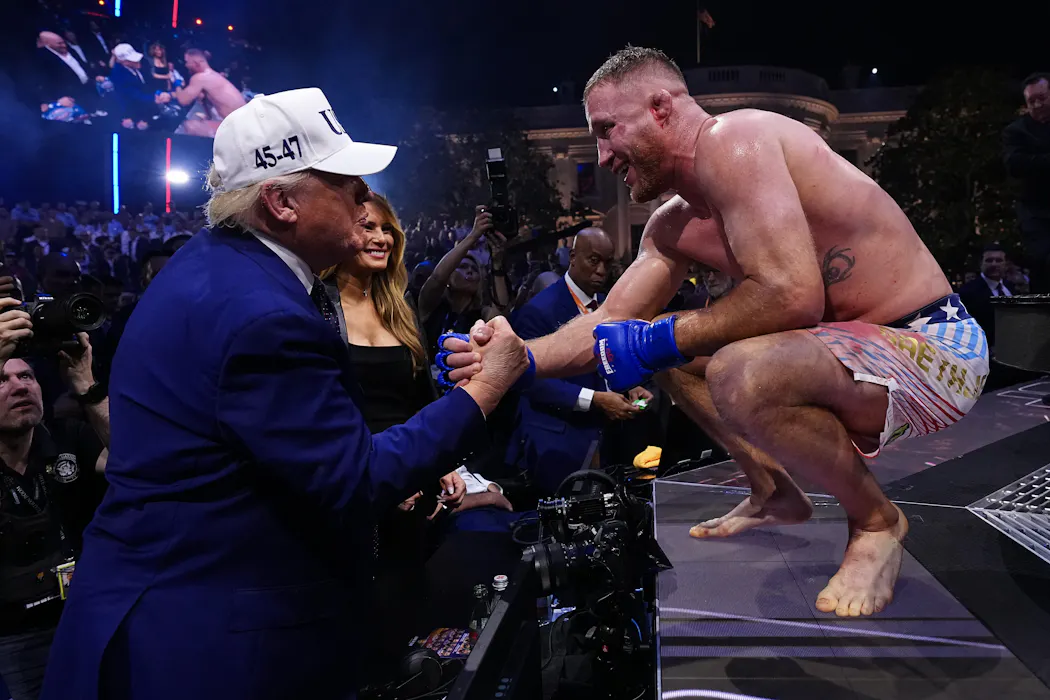
Justin Gaethje shakes hands with President Donald Trump after winning the UFC lightweight title fight at the White House on June 14, 2026. Chris Unger Zuffa LLC/Getty Images

Throughout history, rulers and political movements have used public spectacles of combat to evoke courage, sacrifice, collective strength and national purpose. From Roman gladiator contests to modern mixed martial arts, combat spectacles have served not merely as entertainment but as public rituals through which people experience belonging to something larger than themselves.

When President Donald Trump proposed staging a UFC championship event on the White House grounds as part of America’s 250th anniversary celebration, many observers treated it as another example of his affinity for spectacle and mixed martial arts, or MMA, a combat sport combining striking and grappling techniques from multiple martial arts disciplines. Yet the symbolism runs deeper than a president’s taste for theatricality and combat sports.

I’ve spent decades studying why people are willing to fight, sacrifice and even die for causes, and I see such spectacles illuminating an important psychological process known as identity fusion.

People belong to groups: families, nations, religions, professions, political movements, sports teams. Usually, these identities remain distinct from the personal self.

Identity fusion occurs when that boundary disappears. People do not just support a group – they experience it as an inseparable part of who they are. The group’s successes and failures become personal; threats to the group are experienced as threats to oneself.

The important question isn’t just what happens inside the cage – it’s what such spectacles can do for the audience. Public displays of courage, endurance and sacrifice can strengthen emotional bonds among spectators and deepen identification with the groups, causes or leaders they associate with those displays.

Research with soldiers and other front-line fighters in Iraq and Afghanistan, supporters of Ukraine, Palestinians in Gaza, Taiwanese concerned about a Chinese invasion, and participants in extremist movements shows that identity fusion predicts willingness to endure hardship, accept risk and make sacrifices for a collective cause.

This process does not necessarily produce violence. It can motivate volunteerism, mutual aid, military service and resistance to oppression.

It helps explain how public rituals that celebrate courage, sacrifice and collective strength can deepen commitment to groups, causes and leaders under conditions that appear irrational from a purely material perspective.

Two fists, colliding.
Combat sport fighters publicly test themselves against pain, exhaustion, fear and possible defeat.
koyu/iStock Getty Images Plus

Why shared struggle matters

One of the strongest pathways to identity fusion is shared hardship. People who endure danger, suffering or intense challenges together often emerge with unusually strong bonds.

Combat sports play into this dynamic. Fighters publicly test themselves against pain, exhaustion, fear and possible defeat. Spectators witness not simply athletic competition but symbolic demonstrations of courage and endurance. The attraction lies partly in how character is being revealed under pressure.

For ancient Romans, gladiators embodied “virtus” – courage, discipline, endurance and willingness to confront death. Their appeal stemmed not merely from violence but from values they represented.

Modern mixed martial arts is often celebrated in similar terms: a proving ground for toughness, resilience and self-mastery.

In both cases, physical contests become moral dramas about sacrifice and human limits.

MMA has become politically important

The significance of combat sports extends beyond professional competition.

Across Europe and North America, mixed martial arts has become a focal point for segments of the contemporary far right. Organizations known as Active Clubs, now found in countries including the United States, Germany, Sweden, France and Britain, combine physical training with ethnonationalist activism, including recruitment, ideological indoctrination, public demonstrations and transnational networking among ethnic – particularly white – nationalist groups.

Gyms provide venues for recruitment and networking, but their deeper significance is psychological. Training and enduring hardship together and testing oneself before peers generates forms of trust and solidarity difficult to reproduce online. Political commitment becomes literal and embodied.

This helps explain why mixed martial arts has acquired unusual importance within transnational, ethnonationalist networks. Activists from different countries may possess distinct national identities, yet they recognize one another through a shared culture of physical discipline, masculine camaraderie and readiness for struggle. Combat sports provide a symbolic language that transcends borders, reinforcing a broader civilizational identity.

In this respect, mixed martial arts performs a role similar to military training camps, revolutionary youth movements and fraternal organizations in earlier eras. It creates bonds simultaneously local and international.

From Nero to the White House

The Roman emperor Nero was unusual not because he sponsored gladiatorial games – many emperors did – but because, as historian Thomas Wiedemann observed, he openly identified with the arena’s culture. Rather than maintaining aristocratic distance, Nero linked his public image to the virtues and popularity of spectacle.

Something similar occurs whenever political leaders align themselves with combat sports. The significance lies less in the sport itself than in what the spectacle symbolizes. A combat event staged as part of a national celebration transforms athletic competition into a ritual of collective identity and public values.

The White House UFC event was especially revealing because it linked a combat spectacle to the commemoration of the American republic’s 250th anniversary and to Trump’s own 80th birthday. Symbolically, it joined nationhood, leadership and martial virtue in a single public performance.

The symbolism also intersects with recent calls by administration officials, including the newly dubbed “secretary of war” Pete Hegseth, to restore a “warrior ethos” to U.S. military and civic life. The warrior becomes not merely a soldier but an ideal citizen: disciplined, courageous, physically formidable and prepared for sacrifice.

A man in Roman dress sitting in a crowd, gesturing thumbs down.
‘Thumbs down’: Roman Emperor Nero in the arena dooming a gladiator who has to reenter the fight.
Illustration: Bettman/Getty Images

Why spectators experience awe

Mass rallies, military parades, religious pilgrimages, revolutionary festivals and combat spectacles can all produce moments in which individuals feel absorbed into something larger than themselves.

Such experiences do not automatically lead to political extremism. Most do not. But they help explain why people become deeply attached to groups and causes that provide meaning, belonging and a sense of shared destiny.

Spectacular public rituals – especially those involving violence and pain – often evoke what British political philosopher and politician Edmund Burke called “the sublime”: intense experiences of danger, terror and grandeur that transform fear into exaltation before overwhelming power.

The attraction of combat spectacles lies not merely in violence or entertainment. Their enduring power comes from transforming individual contests into collective stories of courage, sacrifice, identity and purpose. They reveal a fundamental human desire not only for security and comfort, but also for struggle, significance and belonging – as George Orwell observed in 1940 when reviewing the allure of Hitler’s autobiography, “Mein Kampf.”

In an age when established political institutions and movements command diminishing loyalty, combat spectacles provide more than excitement. They create communities of feeling and, under the right conditions, powerful engines of political commitment.

The Conversation

Scott Atran previously received funding for related research from the U.S. Department of Defense, the National Science Foundation, the Carnegie Corporation.

​Politics + Society – The Conversation

Categories
Uncategorized

Prediction markets are opening many new opportunities for unregulated insider trading and unethical bets – in the name of making a game out of politics

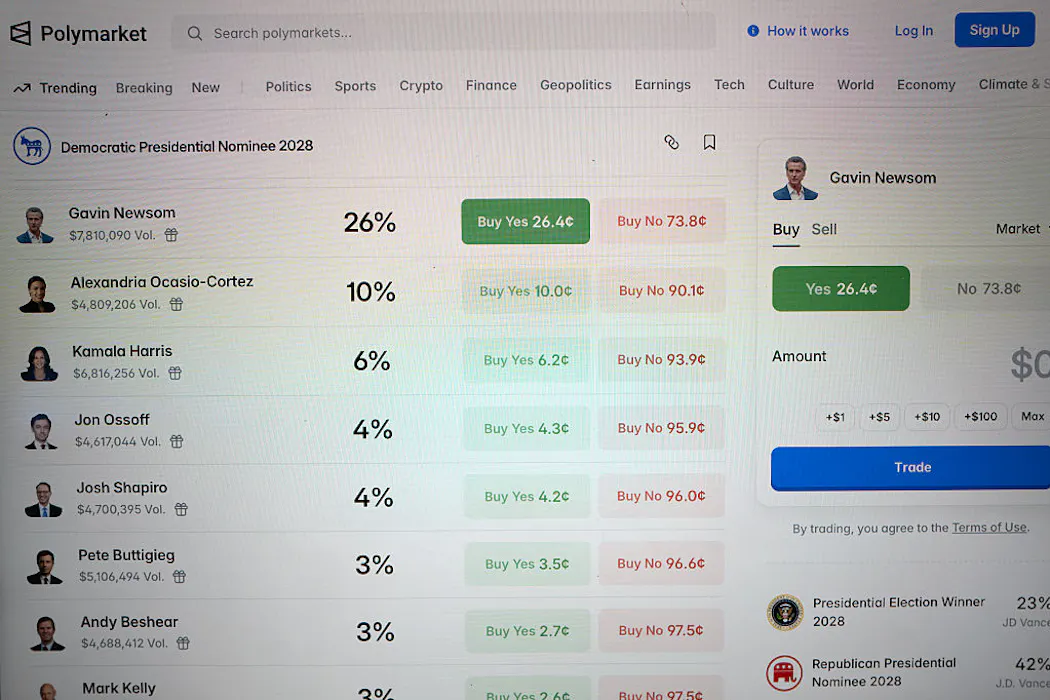
People wager on potential Democratic presidential candidates on the predictions market site Polymarket on Feb. 25, 2026. Scott Olson/Getty Images

Arrests for betting on the U.S. military operation that removed Venezuelan leader Nicolás Maduro. Death threats from gamblers to a journalist reporting on an Iranian missile attack on Israel. Fears of government officials manipulating world events – including the Iran war – to make a quick buck.

These are some of many concerns that experts have raised about how prediction markets – online marketplaces that allow people to bet on world events – might be affecting national security in the U.S. and abroad.

But prediction markets may not be only influencing international affairs. They could also affect the 2026 midterm elections.

We are social scientists who study gambling, public policy and national security. Here are four things you need to know about how prediction markets may be changing American politics:

A telephone screen with a question on it: 'Will Iran effectively close the Strait of Hormuz for 7+ days?'
The Kalshi market wager ‘Will Iran effectively close the Strait of Hormuz for 7+ days?’ appears on a smartphone screen on March 9, 2026.
Nikolas Kokovlis/NurPhoto via Getty Images

Prediction markets turn politics into a game

Prediction markets offer people the opportunity to bet on political events by purchasing “shares” – like stock in a company – of different potential outcomes. If an outcome takes place, the market pays out for each share purchased by those who guessed correctly. More betting activity in favor of an outcome raises its price and lowers its payout, and vice versa.

Prediction markets are different from casinos and online sportsbooks because there is no “house” – like a casino – that determines the size of the payout for correctly guessing who will win or lose a sporting event. In a prediction market, players “bet” against one another, not the house. The markets make money by charging transaction fees on each trade.

Betting on prediction markets allows users to turn many aspects of U.S. politics into a game. For example, betting on election outcomes is very popular on prediction markets. Kalshi – a popular prediction market platform – has a portion of its site specifically designated for election-related markets. That includes the chance to bet on the eventual winner of the 2028 presidential election, the margin of victory in the 2026 South Dakota primary elections and which of two Dan Sullivans could become Alaska’s next senator.

Kalshi also offers opportunities to bet on nonelection outcomes, like whether or not the Supreme Court will ban transgender girls and women from competing on “female sports teams,” or whether the government will confirm before September 2026 that aliens exist.

The gamification of politics through prediction market betting is not new. Predictit, a self-described “political prediction market,” has been operating in the U.S. for over a decade.

What has changed in recent years, however, is that prediction markets are no longer an obscure pastime enjoyed by political junkies. Prediction markets have become quite popular, and media organizations are even integrating betting market data in their political analysis. For example, Kalshi is CNN’s “official prediction markets partner.” In a segment called “The Odds,” CNN commentators often use Kalshi data to make predictions about candidates’ electoral performance.

Insider trading could affect US elections

Insider trading on prediction markets occurs when people with nonpublic information – like internal polling, military intelligence, etc. – place wagers on events. While some prediction markets are trying to crack down on the practice, insider trading could already be affecting the upcoming U.S. midterm elections.

In spring 2026, for example, NPR documented several cases where campaign staffers working on statewide campaigns admitted to using inside information about candidates’ performance in the polls to “buy low” on their candidate’s electoral prospects prior to the release of favorable polling data. Additionally, although prediction markets usually prohibit betting on one’s own campaign, both Democrats and Republicans running for political office have come under fire for betting on their own campaigns.

Betting on one’s own campaign could create a scenario where a candidate’s electoral performance seems more robust than it actually is to prediction market users or watchers, including media organizations who report on prediction market data.

This may in turn generate more favorable media coverage, which could affect public sentiment toward the candidate. Unlike polling, which is not typically prone to the same kind of meddling by campaigns, betting on one’s own campaign could ultimately change voters’ minds regarding the viability of a candidate.

A screenshot of a headline from The Wall Street Journal that says 'Kalshi Fines Former Gubernatorial Candidate, MrBeast Employee on Prediction Wagers.'
A screenshot from a Wall Street Journal article on two Kalshi attempts to punish insider trading, including by a politician betting on his own campaign.
The Wall Street Journal

Policymakers are paying attention

Given concerns about insider trading and its potential consequences, we asked Americans whether U.S. government officials should be forbidden from trading on prediction markets. In a nationally representative online survey of 1,000 U.S. adults conducted via the survey platform Verasight in March 2026, we found that nearly 70% supported banning government officials from trading on prediction markets, while 20% supported a more limited trading ban when government officials have “inside” information.

Lawmakers in Washington are beginning to respond to public opinion. The Senate recently banned senators and their staff from trading on prediction markets, although how this policy will be implemented remains uncertain. However, members of the House, employees of the executive branch, military officials and other government employees can still bet on prediction markets.

Some lawmakers have proposed limiting trading when government officials have insider information about an event, such as internal polling or fundraising data that members of the public do not have access to.

Others in Congress have made an effort to ban all trading on “death markets,” which include war, assassinations and related topics. Known as the “DEATH BETS Act” – its title is an acronym that stands for “Discouraging Exploitative Assassination, Tragedy, and Harm Betting in Event Trading Systems Act – the legislation has been introduced but is pending committee review.

State governments are also taking action to regulate prediction markets.

Massachusetts, for example, is suing Kalshi for allowing “backdoor betting” on sports.

Backdoor betting refers to wagering through less regulated channels like prediction markets, rather than highly regulated state casinos and sportsbooks. Backdoor betting has been estimated to cost states over US$1 billion in tax revenue since prediction markets first began allowing sports wagering in early 2025.

Minnesota became the first state to ban prediction markets altogether, while Illinois has sent cease and desist letters to prediction market operators that it claims are operating without adhering to state gambling laws.

Trump wants control over prediction markets

In a recent Truth Social post, President Donald Trump blasted the idea that states should be able to regulate prediction markets. Referencing their recent regulatory actions, Trump referred to Minnesota Governor Tim Walz and Illinois Governor JB Pritzker as “SCUM” in the post.

Trump also expressed enthusiasm for prediction markets in the post, saying that the U.S. is “at the top” of a “new form of Financial Market.” The president and his family have deep financial ties to the industry. For example, Donald Trump Jr. serves as a prediction market adviser to Kalshi and Polymarket and is an investor in Polymarket.

Following Trump’s post, the administration began reviewing a proposal to give the Commodity Futures Trading Commission the exclusive authority to regulate prediction markets.

While the CFTC has repeatedly asserted regulatory authority over prediction markets, some – like former CFTC Chairman Gary Gensler – believe that states, not the CFTC, should be in charge.

The Conversation

Matt Motta receives funding from the Massachusetts Gaming Commission.

Robert Ralston does not work for, consult, own shares in or receive funding from any company or organization that would benefit from this article, and has disclosed no relevant affiliations beyond their academic appointment.

​Politics + Society – The Conversation

Categories
Uncategorized

The world agreed to protect 30% of the ocean by 2030 – but marine protection can’t be judged by area alone

Rose Atoll Marine National Monument is a large marine protected area in American Samoa. Wendy Cover/NOAA

The ocean is home to some of the richest biodiversity on Earth. From coral reefs and mangrove forests to the deep sea, marine ecosystems sustain countless species, support coastal communities, regulate the climate and underpin global food security.

But these systems face growing pressure from overfishing, habitat loss, pollution and climate change.

In response, nations have adopted an ambitious global goal to conserve at least 30% of the world’s ocean by 2030 – known as 30×30. This target has expanded marine protection worldwide, particularly through marine protected areas.

But what happens after protection is announced?

Decades of experience have shown that effective marine protection requires consistent rules, regulations and oversight, along with financing and meaningful collaboration with local governments, industries and communities. Without it, these areas risk becoming paper parks: lines on a map without real-world impact, where marine life may continue to face overfishing and other threats.

A sea turtle swimming underwater
A sea turtle swims in Bunaken National Park, one of Indonesia’s first protected marine areas.
Claus Giering/Unsplash, CC BY

Two new reports we led, one from Oregon State University and the other from the Smithsonian Tropical Research Institute, offer an important reality check on where marine conservation stands today and what must be done to achieve the goal of protecting 30% of the ocean.

Together they argue that the primary barrier to realizing the 30×30 ocean conservation goal is no longer ambition to protect the ocean, but effective action that can make it real.

A decade of commitments

The 30×30 goal is often promoted at global ocean meetings, including the 11th Our Ocean Conference, being held in Kenya on June 16-18, 2026.

According to the Oregon State analysis, the conservation commitments announced at past Our Ocean Conferences have helped establish more than 3.88 million square miles (10 million square kilometers) of marine protected areas, or about 2.8% of the global ocean.

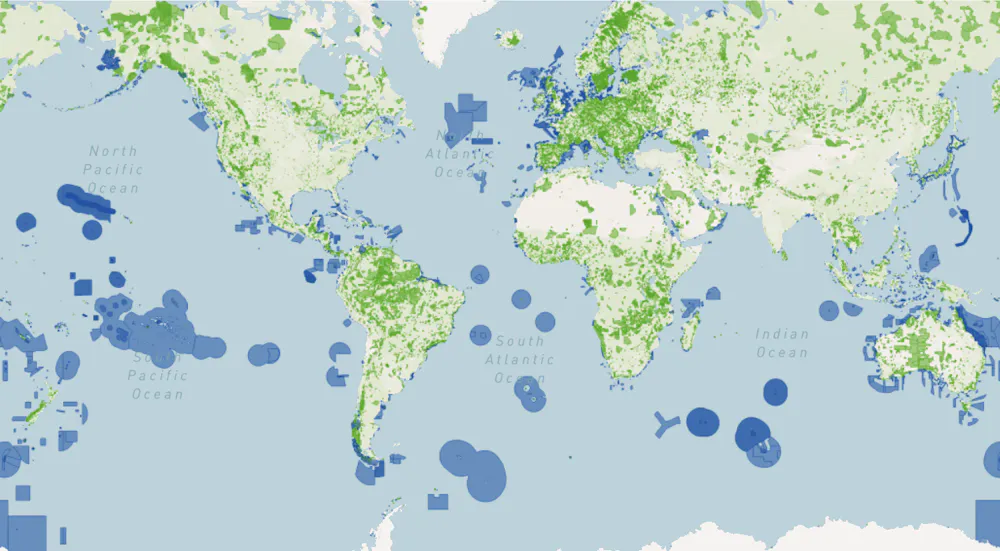
In all, marine protected areas now cover nearly 10% of the global ocean. But only about 3.5% of that is fully or highly protected.

The reach of protected areas shows that voluntary pledges can translate into tangible conservation gains when progress is consistently tracked and publicly reported. However, the findings also point to a key challenge: the growing difference between the extent of protection and its effectiveness.

In other words, ocean protection cannot be judged by area alone.

The implementation gap

The Smithsonian report takes a closer look at what is needed to turn such commitments into effective conservation.

Since the Kunming-Montreal Global Biodiversity Framework was approved in 2022, with almost every country agreeing to protect at least 30% of Earth’s land and waters, marine protection has expanded considerably. However, global numbers show that at least half of existing marine protected areas remain unimplemented or inoperable, with rules and regulations not in place or even allowing destructive activities like bottom trawling.

Achieving the 30×30 goal still requires protecting an additional 20% of the ocean over the next four years. The challenge is twofold: expanding coverage, while also ensuring that the areas are actually benefiting marine life and people.

A map showing lots of marine protected areas scattered largely around islands
The World Database on Protected Areas maps both land and marine protected areas around the world. Marine protected areas are in blue.
World Database on Protected Areas

Effective, long-lasting conservation depends on management plans, trained personnel, monitoring systems, enforcement capacity, sustainable financing and community participation. Without these elements, legal designation alone does not lead to biodiversity protection, thriving ecosystems and benefits to people.

Yet, across regions, the Smithsonian report found a troubling pattern: Countries’ ambition to create protected areas is outpacing their capacity to help those areas succeed.

We found two key constraints: lack of coordination around capacity development – the strengthening of skills and tools needed to effectively achieve a goal – and applying a one-size-fits-all approach to distinctly different regional contexts.

Divers with a measuring tape on a reef
Divers from the Mayotte Marine Natural Park between Madagascar and mainland Africa check the health of a protected coral reef.
Alexis Rosenfeld/Getty Images

Many countries and communities are committed to marine protection, but they often need better continuous governance and policy, stakeholder engagement and inclusion, data and technology, socio-ecological integration, and communication for effective implementation of marine protected areas over time.

Similarly, securing funding for marine conservation remains a persistent challenge. When we spoke with groups and communities involved in marine conservation, they often cited complex application processes and funding structures that often do not match their local realities or priorities. This creates a mismatch between how conservation is funded and how it is implemented.

There are efforts to close this gap. The Bali-based Coral Triangle Center’s Coral Triangle Initiative on Coral Reefs, Fisheries and Food Security Capacity Building Roadmap works to conserve ocean areas in a region that harbors the richest marine biodiversity on the planet. Through regional training hubs, leadership programs, internships and digital platforms, it has trained over 8,200 government officials, community leaders and private-sector representatives in science-based marine conservation practices.

The Sustainable Finance Coalition, a group of nonprofits and international organizations, is using its expertise in another way: finding creative ways to secure money for projects in Africa and the South West Indian Ocean to protect key habitats on land and sea. To date, the coalition has tapped into more than US$43 million to protect nature and support the effective management of 170,500 acres (69,000 hectares).

Beyond lines on a map

The two reports found that political momentum for ocean protection is strong. Governments, Indigenous peoples, local communities, scientists and conservation organizations have rallied around the 30×30 target, creating a global movement of support.

The challenge now is delivering on this momentum.

Achieving the conservation goals behind the 30×30 plan will depend less on announcing new protected areas and more on investing in the capacity, finance, enforcement and long-term institutional support needed to help these protected areas function as planned.

As 2030 approaches, the central question is becoming sharper. It is no longer simply how much of the ocean can be protected — but whether that protection can be made real, durable and effective.

The Conversation

Kirsten Grorud-Colvert has disclosed no relevant affiliations beyond their appointment with Oregon State University. Kirsten Grorud-Colvert receives funding related to this work from Oceans 5, Bloomberg Ocean Fund, Oceankind, Pew Bertarelli Ocean Legacy, and The Pew Charitable Trusts.

Ana Spalding has disclosed no relevant affiliations beyond their appointment with the Smithsonian Tropical Research Institute. In terms of the report cited in the article, this work was made possible through the support of the Bloomberg Ocean Fund within the Ocean Impact Partnership, a sponsored project of Rockefeller Philanthropy Advisors.

​Politics + Society – The Conversation

Categories
Uncategorized

Trump’s US-Iran ceasefire deal is a costly return to prewar conditions – and resolving nuclear questions will run into the ‘indivisibility problem’

People ride motorcycles past a large billboard in central Tehran on June 8, 2026. Atta Kenare/AFP via Getty Images

Shehbaz Sharif, the prime minister of Pakistan, which served as the key negotiator between the U.S. and Iran, announced on June 14, 2026, that the two sides had agreed on a deal to end the war. It will be officially signed on June 19 in Switzerland.

President Donald Trump announced it on Truth Social as a triumph, claiming that the Strait of Hormuz is open for everyone, the U.S. blockade has been lifted, and the oil is flowing again. What Trump did not mention was Iran’s nuclear program and what happens to its enriched uranium stockpile, one of the main reasons cited for starting the war.

The nuclear issue – along with core issues such as ballistic missiles and Iran’s proxies – has been deferred for 60 days.

This raises two important questions: What was the war actually for? And what did the U.S. achieve?

As an international and nuclear security expert, I believe the answer is nothing – and in the process the U.S. lost credibility as a negotiating partner.

Why the nuclear question is the hardest

The “rationalist theory of war,” as developed by political scientist James Fearon in 1995, identifies three problems that drive states to war when they would prefer to reach a deal: incomplete information about each other’s resolve; the inability to credibly promise a deal or commitment; and what international relations scholars call the indivisibility problem – when the thing in dispute cannot be split or shared, because it leaves no middle ground to settle on.

The war clarified the first reason. Each side saw what the other would actually do – how much force the U.S. was willing to use and what Iran could absorb while still staying in the fight.

What the war could not solve was the nuclear commitment problem. And this goes far back between the U.S. and Iran.

Iran adhered to the 2015 Joint Comprehensive Plan of Action, the landmark nuclear deal that restricted Tehran’s nuclear program. The International Atomic Energy Agency verified that Tehran kept uranium enrichment to 3.67% and its stockpile under 300 kilograms – a concentration used to fuel a power reactor but far too low for a weapons program.

But the U.S. walked away in 2018, and Trump later called it “the worst deal ever” over its sunset clauses and on its silence on Iran’s ballistic missiles.

A woman waves a flag in a city square.
A woman waves an Iranian flag in Islamic Revolution Square in Tehran, Iran, on June 14, 2026.
AP Photo/Vahid Salemi

Iran returned to negotiations in 2025, and the U.S. and Israel bombed Iran while those talks were still taking place. Similarly, in February 2026 the negotiations were ongoing and a deal was within reach when Israel and the U.S. struck Iran – killing Supreme Leader Ali Khamenei and lead negotiator Ali Larijani.

The U.S. has demonstrated a record of reneging on its deals and breaking the negotiating process. Which is why Iran now insists on guarantees and demands sanctions relief before signing a deal, and not just good faith.

A state that previously kept its commitments and was still bombed has little reason to accept promises of relief in the future. For this reason, I believe the 60-day deferral is a window for Tehran to watch whether the U.S. and Israel will hold the ceasefire on all fronts, including Lebanon.

The third problem of indivisibility – when the thing or issue in dispute can’t be split or shared – is why the nuclear question is the hardest.

Most disputes can be split. Sanctions, for example, can be lifted by degrees. Even a nuclear program can be split, which the world saw in the Joint Comprehensive Plan of Action deal, with centrifuges counted, enrichment capped and a stockpile metered.

What cannot be split is the U.S. demand for zero uranium enrichment and Tehran calling uranium enrichment a sovereign right.

A deal, a war and a ceasefire

The 2015 nuclear deal also limited Iran’s centrifuges – the machines that do the enriching – and placed Iran’s nuclear program under the most intrusive inspections, all in exchange for sanctions relief.

The nuclear question was not part of the 2015 deal – it was the actual deal.

During the June 2025 negotiations with Iran, and again in February 2026, the U.S. position was about the nuclear program, but in the opposite direction from the Joint Comprehensive Plan of Action. It was not about limits but the total elimination of Iran’s nuclear program.

In both rounds of talks in 2025 and 2026, Washington’s envoy, Steve Witkoff, demanded zero enrichment and the dismantling of Natanz, Fordow and Isfahan – Iran’s three most important nuclear sites. Iran called enrichment a sovereign right and refused.

Both rounds of negotiations ended in bombings.

A man points at a screen with a map of the Strait of Hormuz.
A man points toward the positions of ships in the Strait of Hormuz on a screen at the Maritime Information and Cooperation and Awareness Center in Brest, France, on April 27, 2026.
Fred Tanneau/AFP via Getty Images

The current deal to be signed on June 19 does not put a cap on Iran’s enrichment, nor does it discuss the elimination of its nuclear program. It ends the fighting, reopens the Strait of Hormuz and consigns enrichment, the stockpile, missiles and Iran’s regional proxies to 60-day negotiations.

In a recent New York Times interview, Trump said he was in no rush to remove the near-bomb-grade fuel still buried under the bombed sites. He claimed Iran would suspend enrichment for 15 or 20 years and enrich only for nonmilitary purposes.

In the Joint Comprehensive Plan of Action deal under President Barack Obama, the nuclear question was addressed where 97% of Iran’s stockpile was shipped out of the country and the cap was a verified fact.

Because it doesn’t address any of these issues, the Trump deal is a ceasefire agreement, not a nuclear agreement.

A costly return to the status quo

Going back to the bargaining theory, we know the war settled the information problem – it revealed what each side would endure.

The commitment problem remains. Neither side can yet make a promise the other believes, least of all an Iran whose negotiators were killed.

And I believe the indivisibility problem is now worse. The question of zero enrichment versus a sovereign right cannot be split. The current 60-day deferral is not a resolution. It is the same unsolved problem with a clock attached.

The one thing that could change is American restraint. If Washington holds Israel from striking Iran and Lebanon, it can slowly rebuild its credibility that was destroyed by the two wars. And that is a real challenge for the Trump administration.

Even as the deal was being finalized, Israel struck Beirut, the kind of action that can derail any talks.

In my view, the 60-day window should be read not as the path to a settlement but as the interval or pause before the next one fails.

I argued in April that this conflict would not end in a clean settlement but in a series of contested pauses. The deal to be signed on June 19 is the first of them.

Iran emerges with its enrichment knowledge intact, its stockpile buried and fresh reason to believe that only a nuclear weapon would have deterred the U.S.-Israel attack.

But Iran also knows that it stood its ground and was able to strike U.S. bases and allies in the region. It has discovered leverage it did not previously know it held. The Strait of Hormuz has proved a better deterrent than the nuclear bomb.

The strait is open, the oil is flowing, and the question the war was fought over sits exactly where it began. Thousands of lives were lost to arrive back to square one. Nobody has won, though both sides will say they did.

The Conversation

Farah N. Jan does not work for, consult, own shares in or receive funding from any company or organization that would benefit from this article, and has disclosed no relevant affiliations beyond their academic appointment.

​Politics + Society – The Conversation

Categories
Uncategorized

This successful Arctic fishing treaty has kept Russia, China, the US and others working together for 5 years – it could be a model for future diplomacy

An Arctic cod (_Boreogadus saida_) swims under the ice. Erling Svensen/Artsdatabanken, CC BY

Lately, much of the news about the Arctic has been bleak. The far north is warming three to four times faster than the rest of the planet. Arctic climate change – manifesting in sea ice loss, permafrost thaw and coastal erosion, among other phenomena – is already causing serious problems for Arctic residents, ecosystems and the rest of the planet.

At the diplomatic level, Russia’s invasion of Ukraine in 2022 has had spillover effects in the Arctic, raising tensions and causing a breakdown in cooperation among the Arctic countries. The Trump administration’s interest in Greenland, along with its combative approach to NATO, has roiled relations among Arctic allies. The Arctic Council, established in 1996 to promote cooperation among the Arctic states, significantly scaled back its operations after the Russian invasion.

But there is a bright spot. Five years ago, the United States, Russia and China joined six other nations and the European Union to bring into force a new treaty – the Central Arctic Ocean Fisheries Agreement – to keep commercial fishing out of the region, at least for now.

A map looking at the North pole and Arctic sea ice extent.
A map of the Central Arctic Ocean highlights fishable depths where the sea ice has receded.
© Pew Charitable Trusts

The agreement’s moratorium on fishing remains in place today, and the parties to the treaty, including Russia, continue to work together to advance scientific understanding of the Arctic Ocean under the treaty, despite other tensions in the region.

While serving in the U.S. State Department, I chaired the negotiations that produced this treaty. It’s useful to look at why this unusual pact came together, why it still works, and whether it could serve as a model for future diplomacy in the Arctic.

The need for precaution

At the heart of this treaty, and part of what can make it a good role model, is a tenet of modern international law known as the precautionary principle, or precautionary approach. In fact, it may be the best example of it that I’ve ever seen in international law.

In the context of managing international fisheries, this tenet calls upon governments to “be more cautious when information is uncertain, unreliable, or inadequate.” Unlike many treaties, including past fishing treaty failures, the countries agreed to take action in advance, before commercial fishing could become a problem.

Commercial fishing has never taken place in the Central Arctic Ocean. That’s because the area was completely covered by ice as far back as records exist, until recently. Today, as temperatures quickly rise in the Arctic and sea ice declines, a significant portion of the Central Arctic Ocean – the ocean’s international waters – is open water for part of each year.

David Balton and others discuss what makes the Central Arctic Ocean Fisheries Agreement unique and successful.

Nobody can say what effect commercial fishing might have on the ecosystem in this region, given the dearth of scientific knowledge about the Arctic Ocean.

In the face of such uncertainty, this treaty – applying the precautionary approach – delays the start of commercial fishing until governments have adequate information to manage fishing sustainably. The treaty also sets up a research program to study and monitor the Central Arctic Ocean.

US leadership fostered international cooperation

The origins of the agreement trace back to a bipartisan effort in the United States that may be difficult to imagine now. In 2008 Congress passed a joint resolution, signed by President George W. Bush, calling for a Central Arctic Ocean fisheries treaty.

Under President Barack Obama the United States convened two sets of international negotiations. The first round aligned the views of the United States and the four other countries that have coastlines on the Central Arctic Ocean: Canada, the Kingdom of Denmark, Norway and Russia. Next, the negotiations expanded to include Iceland and others with large, distant-water fishing fleets: China, Japan, South Korea and the European Union.

The treaty is also one of the best examples of a binding international agreement that requires incorporating Indigenous knowledge and the involvement of Arctic Indigenous peoples in its implementation. I believe the negotiations would not have succeeded without the involvement of Indigenous and other nongovernmental experts and groups, including scientists, industry leaders and environmental organizations.

The resulting treaty entered into force in 2021. The United States signed and ratified the agreement during President Donald Trump’s first term.

Each country has something to gain from cooperation. For the United States, the agreement extends the successful model of fisheries management off Alaska to the high seas and helps limit foreign vessel activity in the region. For countries that don’t border the Arctic Ocean, such as China, Japan and South Korea, the treaty gives them international recognition as Arctic players. At the same time, the treaty doesn’t preclude future commercial fishing in the Central Arctic Ocean, but instead allows time to ensure any fishing there can be sustainable.

A rare venue with Russia

The 10 parties to the treaty have met each year since 2022 to implement the agreement. They have advanced scientific research in this little-known part of our planet and are developing rules for very limited “exploratory fisheries” to study the migration of fish into the Central Arctic Ocean.

The fact that these meetings are taking place at all is an anomaly. In contrast to the Arctic Council, the conferences of the parties to this treaty have involved Russian experts each time, including during a meeting taking place June 16-17, 2026, in Brussels.

Despite the geopolitical turmoil in the world, those working to implement the treaty have put aside their differences to pursue their common interests concerning the Central Arctic Ocean.

Looking ahead

That willingness to set aside differences in pursuit of common interests can have many benefits.

Even during the Cold War, the United States and the Soviet Union worked together on a wide range of issues, including a joint effort to spearhead the Antarctic Treaty, which has kept Antarctica demilitarized and facilitated scientific advancements at the Earth’s other pole.

After the Cold War ended, the Arctic also became a region of exceptional East-West collaboration. Nations cooperated to protect the Arctic environment, to promote economic development, to bolster search-and-rescue capacity and to improve scientific understanding.

The current breakdown in cooperation with Russia is, on one level, entirely understandable, given the desire to maintain pressure on Russia to end the war in Ukraine. However, the Arctic Ocean is facing new challenges, with commercial shipping increasing as the ice melts and the rising potential for seabed mining, each of which poses unknown risks to its environment.

I believe the Central Arctic Ocean Fisheries Agreement could serve as an inspiration, maybe even as a road map, for the path back to a cooperative, well-managed Arctic region, if countries follow its example.

The Conversation

David Balton receives funding from the Harvard Kennedy School’s Belfer Center and from the Ocean Conservancy.

​Politics + Society – The Conversation