Categories
Uncategorized

The Trump administration’s global campaign against ‘radical left terrorism’ is built on a national security memo without congressional approval

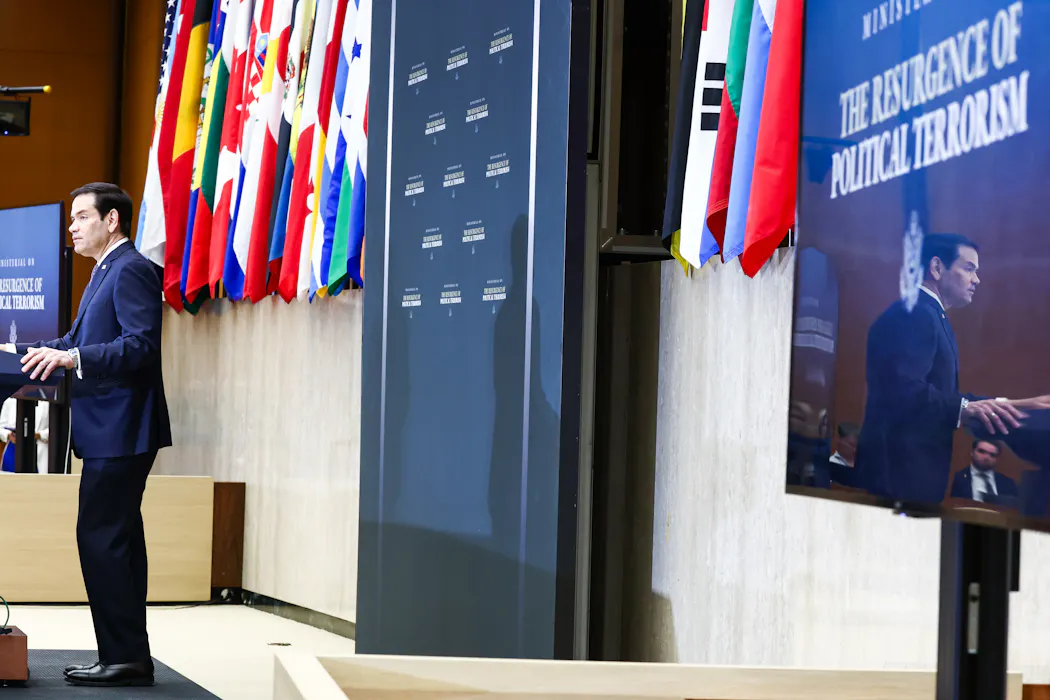
U.S. Secretary of State Marco Rubio delivers opening remarks during the Ministerial on the Resurgence of Political Terrorism at the State Department on July 16, 2026, in Washington. Finn Gomez/Getty Images

A little-noticed presidential national security directive is now the legal engine behind a wave of terrorism prosecutions against left-wing protesters.

That domestic campaign now has an international dimension, one that American officials had been planning for months, culminating on July 16, 2026, when Secretary of State Marco Rubio’s Ministerial on the Resurgence of Political Terrorism drew representatives from more than 65 countries to Washington. The gathering was informally called the “Antifa summit.”

Rubio described antifa-aligned networks as sharing infrastructure across borders and accused Iran and Cuba of helping bankroll the movement, without offering evidence. The White House declared the summit the start of an “unprecedented global offensive” against what it calls “radical left terrorism.”

This offensive is built on the same domestic legal architecture that has now sent American activists to prison for decades.

That architecture is National Security Presidential Memorandum/NSPM-7, issued on Sept. 25, 2025, which for the first time appeared to authorize preemptive law enforcement measures against Americans based not on whether they are planning to commit violence but for their political or ideological beliefs.

Nearly a year later, that blueprint has moved from paper into practice.

The Justice Department has built task forces staffed by counterterrorism prosecutors. The FBI has set up its own NSPM-7 mission center to oversee investigations into left-wing movements, including a joint effort with the IRS to investigate nonprofit groups.

The Justice Department has used this machinery to convict activists and send some of them to prison for decades.

NSPM-7 was not passed by Congress. It’s a lesser-known tool of executive power: a presidential memorandum.

As an international relations scholar who has studied U.S. foreign policy decision-making and national security legislation, I recognize that presidents can take several types of executive actions without legislative involvement: executive orders, memoranda and proclamations.

This structure allows the president to direct law enforcement and national security agencies, with little opportunity for congressional oversight.

A man in a dark suit and blue tie sits at a desk.
The presidential memorandum signed by Donald Trump identifies ‘anti-Christian,’ ‘anti-capitalism’ or ‘anti-American’ views as potential indicators that a group or person will commit domestic terrorism.
Andrew Harnik/Getty Images

Presidential national security powers

Executive memorandums direct agencies to prepare reports, implement policies or align programs with the administration’s priorities. Unlike executive orders, they aren’t required to be published. When they relate to national security, like NSPM-7, they’re called national security directives – many of which stay classified and may not be declassified for years or decades.

The stated purpose of NSPM-7 is to counter domestic terrorism and organized political violence, focusing mainly on perceived threats from the political left. The memorandum identifies “anti-Christian,” “anti-capitalism” or “anti-American” views as potential indicators that a group or person will commit domestic terrorism.

The memorandum claims that political violence originates with “anti-fascist” groups that hold the following views: “support for the overthrow of the United States Government; extremism on migration, race, and gender; and hostility towards those who hold traditional American views on family, religion, and morality.”

The strategy includes preemptive measures to disrupt groups before they engage in violent political acts, empowering multiagency task forces to investigate potential federal crimes related to radicalization and the groups’ funders. Former Attorney General Pam Bondi’s December 2025 implementation memo went further, ordering a five-year review of agency files on antifa. A task force staffed with counterterrorism and organized-crime prosecutors is carrying out these investigations.

‘Domestic terrorist organizations’

The memorandum directs the Department of Justice to focus FBI resources from approximately 200 Joint Terrorism Task Forces on investigating “acts of recruiting or radicalizing persons” for the purpose of “political violence, terrorism, or conspiracy against rights; and the violent deprivation of any citizen’s rights.”

NSPM-7 also allows the attorney general to propose groups for designation as “domestic terrorist organizations.” That includes groups that engage in “organized doxxing campaigns, swatting, rioting, looting, trespass, assault, destruction of property, threats of violence, and civil disorder.”

Existing laws allow the secretary of state to designate groups as “foreign terrorist organizations” that are then subject to financial sanctions.

But these laws do not permit the president to label domestic groups this way.

That gap hasn’t stopped prosecutions. In Texas, eight defendants tied to a “North Texas Antifa Cell” were sentenced in June 2026 for a 2025 armed confrontation at the Prairieland immigration detention center. One man received 100 years, and others who never fired a weapon still drew decades in prison under terrorism sentencing guidelines.

In Minnesota, 15 members and associates of a group called Direct Action Minnesota were indicted in June 2026 on conspiracy and assault charges. A 94-page indictment cited behavior such as wearing an “I’m Antifa!” sweatshirt, possessing a bullhorn or including a devil emoji in a Signal message.

A protest with a person in an orange outfit carrying a sign saying 'It's my First Amendment right to be HERE.'
Would protesters like these at a Washington ‘No Kings’ demonstration be seen as potential domestic terrorists by the Trump administration?
Jose Luis Magana/AP

Defining terrorism

NSPM-7 marks a major conceptual shift in U.S. counterterrorism policy, departing from approaches that primarily targeted foreign threats.

Earlier directives, dating to Ronald Reagan’s presidency, treated terrorism as a global menace countered through military power and diplomacy. In the 1990s, the Clinton administration reframed it as a domestic challenge after the 1993 World Trade Center bombing and 1995 Oklahoma City bombing.

After 9/11, the Bush administration fused counterterrorism with national defense through the global war on terrorism. The Obama administration later tried to narrow those powers, asking whether targeted individuals “pose a continuing, imminent threat to U.S. persons” — a standard focused on tactics and capture feasibility, not ideology.

The first Trump administration used a “travel ban” against several “terror-prone” countries, while President Joe Biden redirected focus toward weapons of mass destruction.

Notably, the “domestic terrorist” label itself has rarely produced actual charges. The State Department designated four antifa-aligned groups as foreign terrorist organizations. But antifa is a decentralized movement, not a formal group with a roster.

This designation lacks any real legal weight because U.S. law has no formal domestic terrorist organization category. Creating one risks infringing on First Amendment protected speech. Domestic terrorism itself is not a chargeable offense.

Prosecutors have instead leaned on older statutes such as material support for terrorism and conspiracy laws, tools originally built for cases like the ones above, not protest movements.

First Amendment rights at risk

There is no single official definition of terrorism in U.S. law; definitions vary by purpose – criminal law, intelligence collection, civil liability.

Definitions in all those areas typically focus on identifying violent or dangerous acts done with the intent to intimidate or coerce civilians or influence government policy.

But more than redefining terrorism, NSPM-7 reorients the machinery of national security toward the policing of belief.

The First Amendment generally prevents the government from punishing people for unpopular opinions. It also protects the ability for people to associate to advance public and private ideas in pursuit of political, economic, religious or cultural goals.

The directive’s emphasis on ideological orientations – “anti-Christianity,” “anti-capitalism” and “anti-American” views – as indicators of domestic terrorism potentially jeopardizes First Amendment rights.

Thirty-one members of Congress sent a letter to Trump in October 2025 expressing “serious concerns” about NSPM-7, warning that it poses “serious constitutional, statutory and civil liberties risks, especially if used to target political dissent, protest or ideological speech.”

As the ACLU warns, any definition of terrorism that includes ideological components risks criminalizing people or groups based on belief rather than based on violence or other criminal conduct.

Congress has declined to create a domestic complement to the foreign terrorist designation in large part because of the potential for impinging on First Amendment–protected association and speech.

But I fear that chilling speech may be the point.

Silencing dissent

NSPM-7 does not criminalize previously legal conduct.

Rather, it states that the Trump administration will focus investigations around the identity and ideology of supposed perpetrators. Prioritizing investigations into this broad swath of ideologies serves to instill fear, silencing anti-fascist and other messages in opposition to the Trump administration.

Law professor Steve Vladeck frames this chill as “obeying in advance,” in which organizations self-censor rather than risk investigation, prosecution or defending against the “domestic terrorist” label. Federal judges in the Prairieland case have shown little sympathy for that distinction: One judge described the protest itself as “an assault on democracy,” even for defendants who never touched a weapon.

Although left-wing violence has risen in the past decade, empirical evidence shows it remains far below historical levels of right-wing or jihadist violence.

Most domestic terrorists in the U.S. are politically on the right, accounting for the vast majority of domestic terrorism fatalities.

Yet NSPM-7 focuses disproportionately on left-wing ideologies. NSPM-7 departs from prior U.S. counterterrorism frameworks by prioritizing the suppression of ideologically motivated dissent, even where, as in Minnesota, judges have already dismissed roughly half of similar federal cases for lack of evidence.

This is an updated version of a story originally published December 3, 2025.

The Conversation

Melinda Haas does not work for, consult, own shares in or receive funding from any company or organization that would benefit from this article, and has disclosed no relevant affiliations beyond their academic appointment.

​Politics + Society – The Conversation

Categories
Uncategorized

Why Trump’s move to gut the Endangered Species Act likely won’t hold up in court

Piping plovers lay their eggs on the ground. They became an endangered species as development encroached on their habitat and made it harder for their chicks to survive. Under the Same Moon/Flickr, CC BY

The Trump administration has decided that destroying the habitat of endangered species is not harmful.

Think about that.

Habitat loss is the No. 1 reason species become endangered. Red-cockaded woodpeckers need mature long-leaf pine forests to reproduce. Endangered western monarch butterflies depend on pesticide-free milkweed for food. Pacific salmon must have clean, cool rivers for spawning. If coastal water becomes too polluted, manatees will starve.

Yet, on July 14, 2026, the U.S. Department of Interior formally rescinded the so-called harm rule under the Endangered Species Act, removing language that has protected species from losing millions of acres of habitat.

Young salmon in a stream.
Endangered fish have fueled many disputes over rights to the water that the fish need as habitat for survival.
Peter E. Steenstra/USFWS, CC BY

As a law professor who has followed these issues for over five decades and litigated early cases under the Endangered Species Act, I believe this effort to gut the nation’s premier wildlife conservation law is unjustified and unlawful.

I see several reasons the rule change is not likely to survive the legal challenges that have already begun.

Origins of the Endangered Species Act

Enacted in 1973 at the behest of President Richard Nixon and passed overwhelmingly by both houses of Congress, the Endangered Species Act’s stated purpose is to “provide a means whereby the ecosystems upon which endangered species and threatened species depend may be conserved.”

The U.S. Supreme Court in 1978 described the act’s role more plainly: to “halt and reverse the trend of species extinctions whatever the cost.”

The act requires federal agencies to designate habitat for species as critical if it is deemed “essential to the conservation and recovery” of that species. Once habitat is designated, federal agencies are required to “insure” that their actions are not likely to result in the “destruction or adverse modification” of such habitat. All of this is spelled out in the text of the law itself.

The ‘take’ prohibition

The Endangered Species Act prohibits the unauthorized “take” of protected species. It broadly defines “take” to include deliberate actions such as hunting and trapping, but also those that “harm or harass” individual members of the protected species.

The prohibition applies to everyone: individuals, corporations, states and municipalities, tribes and others. The act is by far the most important federal law protecting habitat on nonfederal land.

“Take” is a term of art in wildlife law with deep roots in Anglo-American jurisprudence. It has always included requirements to conserve habitat. The earliest wildlife laws in England also required landowners to retain adequate forage and cover for wildlife, in addition to regulating hunting and fishing.

Two large white birds in a wetland area with a large nest.
A female whooping crane repositions the eggs in her nest near Baraboo, Wis. The tall, migrating birds are coming back from near extinction in the U.S., but with only a few habitats they return to each year, they remain vulnerable.
Rondiel/Wikimedia Commons, CC BY-SA

In 1975, shortly after Congress passed the Endangered Species Act, the U.S. Department of Interior created the rule defining harm to include “acts or omissions that actually injures or kills wildlife,” including habitat degradation that “significantly disrupts essential behavioral patterns, which include, but are not limited to, breeding, feeding or sheltering.”

The rule was revised somewhat in 1981 to clarify that harm “may include significant habitat modification or degradation where it actually kills or injures wildlife by significantly impairing essential behavioral patterns, including breeding, feeding or sheltering.”

The 1982 Endangered Species Act amendments

In 1981, the 9th Circuit Court of Appeals held that habitat destruction qualifies as an unlawful take under the Endangered Species Act, ruling in a case brought on behalf of an endangered bird called the palila.

Congress reacted to that ruling by amending the act to create the incidental take program. I testified in favor of this provision during the hearings.

The incidental take program provides a way to reduce conflicts between protected species and commercial development by authorizing only those takes that meet strict rules to minimize and mitigate the impact on the species in question. Over the years, hundreds of incidental take permits have been issued covering over 47 million acres of habitat.

If Congress didn’t believe habitat destruction and degradation constitute “harm” under the statute, why would it require permits and plans to offset habitat loss?

This will factor into the litigation to come challenging the move to rescind the harm rule.

The Sweet Home decision

The controversy over the harm rule reached the Supreme Court in 1995 in a case brought by the timber industry in Oregon. In Sweet Home Communities for a Greater Oregon v. Babbitt, the court upheld the harm rule by a vote of 6-3.

Justice John Paul Stevens wrote the court’s majority opinion. He cited multiple reasons for upholding the rule as a “reasonable interpretation” of congressional intent under the then-prevailing Chevron Doctrine:

  • First, Stevens wrote that the ordinary meaning of “harm” naturally encompasses habitat modification that results in actual injury or death to members of an endangered or threatened species.

  • Second, under relevant Supreme Court precedent, every word in a statute must be given effect. Thus the word “harm” must encompass indirect as well as direct injuries or it would have no meaning that does not duplicate the other words in the definition of “take.”

  • Third, the fact that Congress amended the act to authorize incidental take permits with habitat conservation plans strongly suggests that Congress intended for the law to prohibit both direct and indirect causes of death or injury.

Justice Antonin Scalia dissented in that case, arguing that the word “harm” applies only to an action “directed immediately and intentionally against a particular animal.” Or as he put it, “A strikes B.”

Justice Sandra Day O’Connor disagreed, arguing in a sharp exchange with Scalia: “… to make it impossible for an animal to reproduce is to impair its most essential physical functions and to render that animal, and its genetic material, biologically obsolete. This, in my view, is actual injury.”

The Loper Bright ruling’s impact

Fast-forward to 2024, when the Supreme Court, in deciding Loper Bright Enterprises v. Raimondo, formally abandoned the Chevron Doctrine. In doing so, it ruled that the courts must decide what the “best reading” of statutory text is without deferring to agency interpretations.

The Trump administration argues that the Loper Bright ruling means that the court’s decision in Sweet Home is no longer good law because Stevens’ majority opinion relied on the Chevron doctrine.

Instead, the Trump administration argues that Scalia’s dissent is actually the best reading of “harm” and is now the law of the land.

A turtle swims underwater
Threats to the endangered hawksbill sea turtle include loss of nesting habitat and coral reefs, rising sea levels and rising temperatures, as well as threats from fishing gear.
U.S. Fish and Wildlife Service

However, in the majority opinion in Loper Bright, Chief Justice John Roberts cautioned: “We do not call into question prior cases that relied on the Chevron framework.” In short, it is not enough to say a precedent relied on Chevron and suggest it is no longer valid.

The Trump administration will have to overcome the presumption that the Sweet Home ruling remains the law unless the current Supreme Court overturns it.

Where we go from here

Environmental groups and tribes have already filed multiple lawsuits challenging the repeal of the harm rule.

In addition to defending the validity of the Sweet Home decision as the best reading of the law, the cases allege a number of procedural flaws in how the Department of Interior changed the rule.

Those include alleged violations of the National Environmental Policy Act by failing to prepare an environmental impact statement; violations of the Endangered Species Act by failing to engage in consultation regarding the impacts of the rescinding of the harm rule; and failure to comply with the Administrative Procedure Act to justify and explain the basis for wholesale repeal of the harm rule without proposing an alternative.

While the administration is likely counting on getting the case to the Supreme Court before its time in office runs out, I expect the strategy of the challengers will be to delay the litigation by filing lawsuits in multiple courts and asking the courts for preliminary injunctions to block the rule change pending the cases’ outcome. That would allow a future administration to reinstate the rule.

The stakes are huge for the nation’s most imperiled species. Over two-thirds of listed species depend on nonfederal land for their survival and recovery. The harm rule is the single most important reason they are still alive and have a chance of recovery.

The Conversation

Patrick Parenteau does not work for, consult, own shares in or receive funding from any company or organization that would benefit from this article, and has disclosed no relevant affiliations beyond their academic appointment.

​Politics + Society – The Conversation

Categories
Uncategorized

After 1776, the founders designed a government that accounts for ‘a degree of depravity in mankind’

Once America had become a country, a new government needed to be designed. Nazlisart/iStock Getty Images

The parades, reenactments and fireworks are over. And in the aftermath of Americans’ celebration of the 250th anniversary of the Declaration of Independence, it is important to recognize that the declaration was only the first step in making a unified country.

Many of the founders argued that the country needed a remodeled government. They asked whether it was possible to design a government for the new country that ensured liberty in the face of the inherent flaws of human nature.

Revolution’s aftermath

In the aftermath of the American Revolutionary War, the national government remained a loose confederation of state governments. While effective in winning the war, the new government faced social and political fissures in the postwar period.

The war left the new republic with extensive debts shared unevenly between the states. Common farmers, including many Revolutionary War veterans, rebelled in opposition to postwar taxation policies. Rather than a cohesive national unit, Americans faced a loose, tense and combative set of state and local interests.

The Second Continental Congress in 1777 produced the first constitution of the United States, the Articles of Confederation. However, differing interests between state governments, including the management of western territory and public finance, slowed ratification. Only in 1781, as the Revolutionary War was entering its final stage, did all of the states finally agree to ratify the articles.

Both the terms of ratification and the text of the Articles of Confederation reflected a suspicion between the state governments, each of which wanted to protect their own local interests rather than cede authority to the national government.

A large, formal hall with many men in Colonial dress talking, some from a stage.
A 1935 painting depicting – and titled – ‘The Adoption of the U.S. Constitution in Congress at Independence Hall, Philadelphia, Sept. 17, 1787.’
John H. Froehlich, painter; photo by Universal History Archive/Universal Images Group via Getty Images

Lumbering system

The limited powers that the articles granted to the national government reflected the lack of consensus between states. The government designed in the articles lacked any strong executive authority and did not have a national judiciary.

Additionally, the national legislature, which the articles referred to as a “league of friendship,” functioned less like a representative organ of the people at large than a council of state governments.

The articles created a single-chamber Congress in which each state cast one vote. Major legislation required a supermajority, and amendments required unanimity.

To many, such a slow-moving, restrictive system was preferable, particularly with the memory of the abuses of the British government still in recent memory.

However, the 1780s saw a series of contentious events – a barely thwarted uprising of frustrated soldiers called the Newburgh Conspiracy, interstate trade disputes, an economic depression and a rural tax rebellion that prompted many American leaders to reconceptualize the role and structure of American government around a more unified, national and interventionist model.

Competing visions

The nationalists were members of the Constitutional Convention that met in Philadelphia in the Summer of 1787 to draft the successor to the articles, the United States Constitution. This group included Alexander Hamilton, James Madison and John Jay. These three men sought to convey that the proper role of government is to protect people from themselves.

The nationalists believed in a more centralized national union that balanced competing interests in the new republic. They sought to eliminate friction between the states by eliminating interstate trade barriers, consolidating state debts and creating a stronger central administrative body under a strong executive.

Furthermore, they sought to create a balance of power by creating a three-part federal government consisting of a two-chamber legislature, an executive branch and a national judiciary. Each would have expanded powers.

In contrast to the articles, the proposed Constitution included uniform national commercial regulation, monetary controls such as the exclusive right of the national government to issue legal tender, augmented executive powers to determine foreign policy and an overarching federal court structure. It also included an explicit national power to suppress uprisings.

The representatives to the convention, which also included prominent figures such as George Washington and Benjamin Franklin, considered the federal government’s ability to deal with uprisings and fiscal policy to be particularly important. It was also topical: A tax imposed on cash-poor farmers to pay down the public war debt had just prompted a rebellion in western Massachusetts led by Revolutionary veteran Daniel Shays.

Many rebels believed the burden of repaying the public debt fell disproportionately on common people while benefiting elites. Nationalist political theorists such as Hamilton, Madison and Jay saw such revolts against national authority as the product of demagogues instigating unrestrained urges into social movements they referred to as “factions.”

Initially, the terms of the new Constitution received substantial opposition from prominent political writers later known as the Anti-Federalists. These often anonymous authors began publishing criticisms of the yet unratified Constitution as an unwarranted accumulation of federal power that would endanger the hard-won liberties secured by the Revolutionary War.

This is where the document that has become known as the Federalist Papers comes in.

A gray-haired man dressed in a Colonial manner, with a ruffled white shirt and gray waistcoat and jacket.
Alexander Hamilton, who along with James Madison and John Jay wrote the collection of essays called the Federalist Papers.
Stock Montage/Getty Images

‘If men were angels …’

Hamilton, Madison and Jay responded to these criticisms as a group. Adopting the pen name Publius, they published 85 essays in New York newspapers supporting ratification. In defense of the Constitution’s proposal to increase the powers of the proposed national government, these authors turned to some of the most basic philosophical questions about humanity.

Each argued that the inherent flaws of human nature necessitated a strong government to check political abuse, self-interest and even violence that they saw as inherent in the fabric of human society. They rallied around the position reflected in Madison’s famous statement in the essay known as Federalist 51 that “if men were angels, no government would be necessary.”

The Federalist Papers include proposals for institutional solutions that sought to redirect the destructive drives of individuals toward positive social ends. To the authors, a new constitutional government that controlled both the impulses of the masses and the abuses of their leaders would serve as the means through which the new United States government could accomplish this task.

Each saw human nature as susceptible to corruption by base impulses and self-interest.

In Federalist 10, Madison argued that faction is “sown in the nature of man.”

Similarly, in Federalist 6, Hamilton rejected the commonly held idea that republics were automatically peaceful. Instead, he argued, political leaders and states were driven by ambitions and jealousies, which he saw as a characteristic shortcoming of the government under the Articles of Confederation as well as a law of nature governing relations between nations.

Hamilton wrote that if the states remained disunited, then “the subdivisions into which they might be thrown would have frequent and violent contests with each other.” To argue otherwise, he wrote, would be “to forget that men are ambitious, vindictive, and rapacious.”

Consequently, as Hamilton asserted in Federalist 15, governments must have effective coercive authority to enforce laws because they cannot rely solely on the goodwill and civic virtue of their citizens: “If there be no penalty annexed to disobedience, the resolutions or commands which pretend to be laws will, in fact, amount to nothing more than advice or recommendation.”

Ultimately, the defense of the Constitution provided by the Federalist Papers sought to frame the new government in terms of a skeptical view of humanity that recognized what Madison called “a degree of depravity in mankind.”

They also asserted that constitutional design and balanced government could control these dangerous impulses. As Madison added, “There are other qualities in human nature which justify a certain portion of esteem and confidence.”

The Conversation

Donovan Fifield receives funding from the European Research Council.

​Politics + Society – The Conversation

Categories
Uncategorized

When can a power company take your land for a data center?

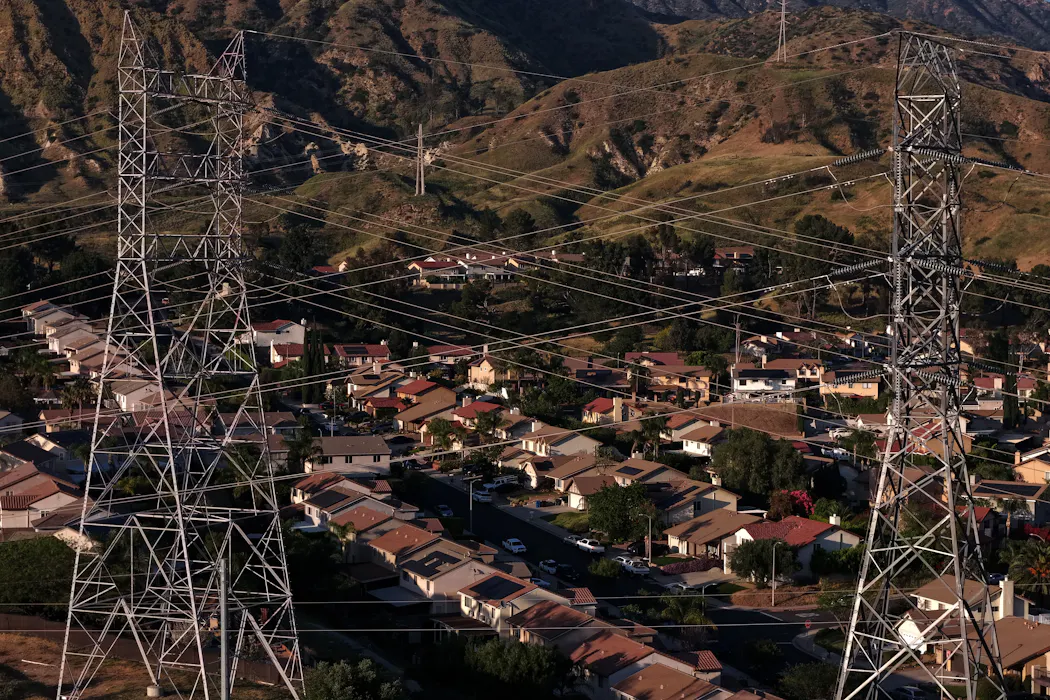
Meeting data center power demands will mean building more transmission lines and acquiring more land to put them on. These lines are in California. Justin Sullivan/Getty Images

The artificial intelligence boom in the United States is being matched by a data center building boom. There are more than 3,000 data centers in the U.S. and another 1,500 in development, according to a Pew Research Center analysis.

While President Donald Trump has promoted AI advancement, calling it crucial to economic and national security, polling shows that 7 in 10 Americans oppose the construction of AI data centers in their communities, citing higher utility bills, pollution, noise and the loss of green space. These centers, which hold computer servers that process words, images and lines of code for large language models such as ChatGPT, also use high amounts of water and electricity.

There is growing opposition to the infrastructure surrounding them, too, particularly the transmission lines needed to power them, which often must cross land belonging to private citizens.

Where private citizens refuse to sell their land, companies are turning to eminent domain, the government’s inherent power to seize private property without a landowner’s consent. But does a line built to serve a private data center qualify?

I’m a legal scholar who studies eminent domain issues, and I interpret today’s disputes over seizure of property for the benefit of AI infrastructure as the latest incarnation of a long-standing debate about the limits of taking private property for public use.

Why is expansion needed?

Data centers have massive power needs that can stress electrical grids and threaten their reliability. In 2024 they accounted for more than 4% of the nation’s total electricity use. Demand will grow as more are built. To meet this demand, power companies must build more transmission lines – and acquire land to put them on.

Across the U.S. – in states such as Georgia and Pennsylvania – power companies have looked to eminent domain to facilitate these goals.

What is eminent domain?

Power companies can approach landowners to purchase easements for transmission lines; if landowners refuse, the government might force a sale.

The government may take private land without consent if the seizure is for “public use” and if the landowner is given “just compensation,” according to the takings clause of the Fifth Amendment of the U.S. Constitution.

While the federal government has the power to initiate eminent domain actions – also called condemnations – most are done by state and local governments.

Governments can also delegate this power to private entities or “common carriers,” such as power and water companies, though every state has its own rules for whether and how these utilities can exercise eminent domain. In Texas, for example, the state Supreme Court has held that a project must “serve the public” and “cannot be built only for the builder’s exclusive use” in order to qualify as a common carrier.

What is the ‘public use’ standard?

While property may be taken only for “public use,” the U.S. Supreme Court has interpreted that requirement permissively. In its 2005 Kelo v. City of New London decision, the court held that economic development qualified, allowing New London, Connecticut, to seize homes for private development around a Pfizer facility. That redevelopment, however, never happened, and Pfizer eventually left New London.

In response to that decision – and the public backlash that followed – 45 states enacted eminent domain reform laws.

In addition to reform laws, some state supreme courts interpret the eminent domain provisions of their own state constitutions more restrictively. The supreme courts of Michigan, Ohio and Oklahoma have all prohibited seizing private property to give it to another private party purely for economic development.

This means private landowners may have more success challenging condemnation actions under their state constitutions than in federal court. Still, courts typically permit exercise of eminent domain by utilities such as power companies.

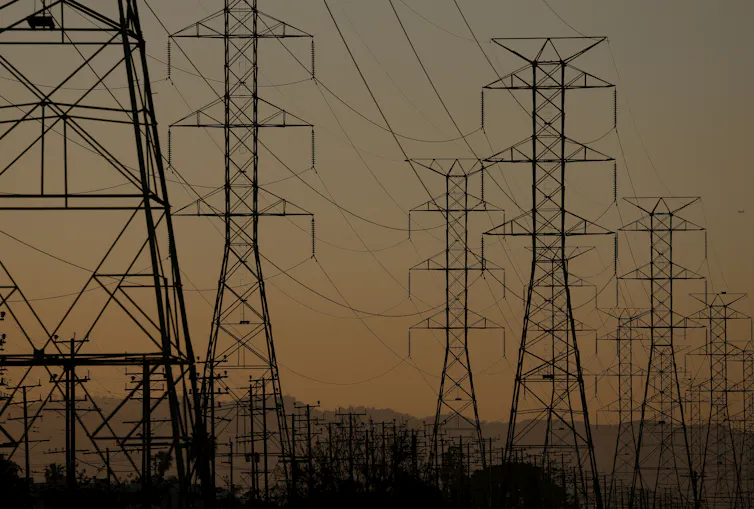
Rows of transmission towers and power lines silhouetted against a hazy sky
Data centers used more than 4% of U.S. electricity in 2024, and demand is rising.
Justin Sullivan/Getty Images

What does this mean for data center expansion?

Suits challenging the seizure of property for transmission lines on the grounds of public use have mixed results.

For example, the supreme courts of South Dakota and Vermont have each affirmed seizures by power companies, determining that providing at least some energy and improved power grid reliability to in-state customers were valid public uses.

But this argument changes if transmission lines, some of which cross state lines, don’t benefit anyone in the state.

In 1984, for example, the Mississippi Supreme Court rejected a power company’s condemnation action because the transmission line in question would have run from Mississippi into Louisiana without benefiting any Mississippi customers.

These decisions suggest that as data centers increase energy demand and stress current infrastructure, seizing land to improve power grid reliability will likely qualify as public use, especially if the intention is to secure reliability for in-state customers.

Still, arguments around whether additional transmission lines actually serve in-state customers may give landowners grounds for a challenge.

The Conversation

Aaron Walayat does not work for, consult, own shares in or receive funding from any company or organization that would benefit from this article, and has disclosed no relevant affiliations beyond their academic appointment.

​Politics + Society – The Conversation
Categories
Uncategorized

How Lindsey Graham’s keen ability to read the moment propelled him to political relevance for 3 decades

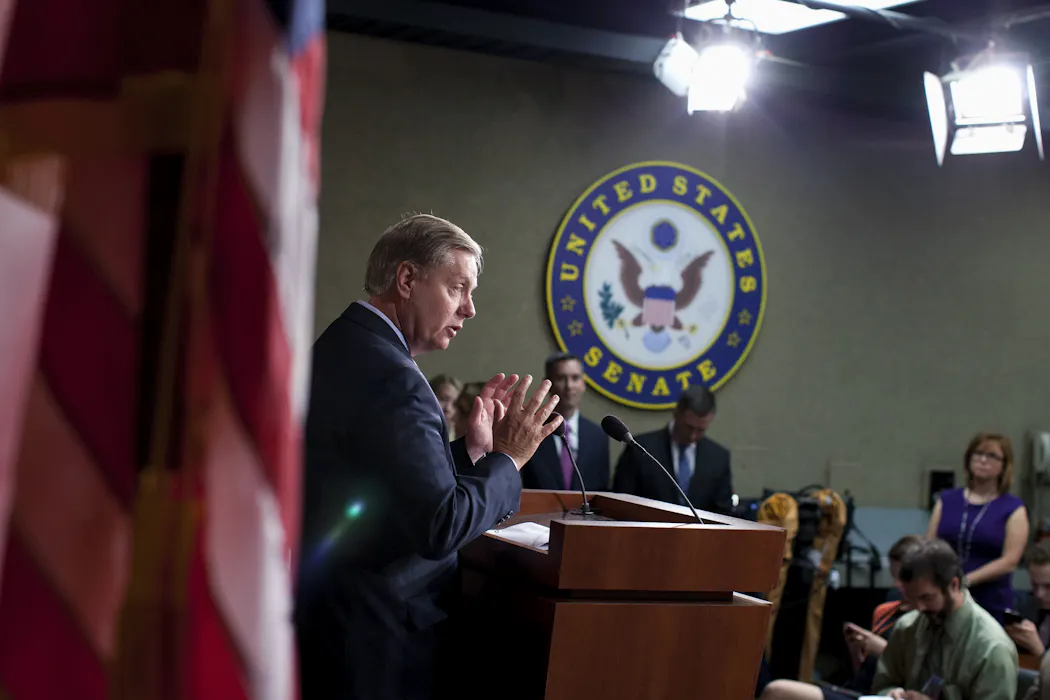
Sen. Lindsey Graham holds a news conference on Capitol Hill in Washington, D.C., on Oct. 8, 2013. AP Photo/ Evan Vucci

Since South Carolina Sen. Lindsey Graham’s death on June 11, 2026, much of the commentary has focused on his evolution from Donald Trump critic to Trump ally.

But focusing on that transformation misses the broader pattern that defined his political career. For more than three decades, Graham repeatedly positioned himself where Republican politics in the South were headed rather than where they had been.

As scholars of elections and Southern politics, we believe that instinct helps explain not only his embrace of Trump but also nearly every major political decision he made.

That includes everything from running as a Republican in South Carolina when Republicans were still an ascendant minority in the state to joining the “Republican Revolution,” when Republicans took control of both houses of Congress in the 1994 midterms, to adapting to the tea party era, when insurgent Republicans rode a wave to an abrupt electoral shift, and ultimately becoming one of Trump’s closest allies.

Reading the political tea leaves

One of Graham’s early bets was that South Carolina’s political future belonged to the Republican Party. Although Republicans remained a minority in the early 1990s, demographic change, evangelical mobilization and suburban realignment were steadily improving their prospects.

In 1992, Graham challenged South Carolina Rep. Lowell Ross, a Democrat, for the 2nd District seat in the state’s legislature. Graham won 60% of the vote and became one of the first Republicans to represent upstate South Carolina since Reconstruction. Republicans gained control of the South Carolina House during the next cycle in 1994 and took control of the South Carolina Senate in 2000.

While many ambitious South Carolina politicians remained in the Democratic Party through the early 1990s, Graham understood that the state’s political future belonged to Republicans.

The ‘Republican Revolution’

Just as he had anticipated the changing political landscape in South Carolina, Graham’s entry into national politics displayed a keen ability to read the political moment.

He ran for an open seat in the U.S. House of Representatives after Democrat Butler Derrick, a 20-year incumbent, announced his retirement. Graham recognized that South Carolina’s 3rd District had become part of a broader Southern realignment that was increasingly favoring Republican congressional candidates.

In addition to these trends, there was a growing backlash against healthcare reform and other policies championed by Democratic President Bill Clinton. Graham joined a group of Republican candidates who united behind the “Contract with America,” a series of promises – tax cuts, welfare reform, a balanced budget – from the Republican leadership to the American people. The resulting GOP surge concluded with a takeover in the House for the first time in 40 years.

Two men in suits and ties stand on a stage with an American flag.
Republican Sens. John McCain and Lindsey Graham wait to speak during a news conference on Capitol Hill in Washington, D.C., on Jan. 21, 2016.
AP Photo/Susan Walsh

Graham and his newly elected colleagues helped propel Newt Gingrich to the House speakership. Graham entered Congress just as the Republican Party was transforming itself from a congressional minority into a governing majority.

Adapting to a changing GOP

Graham again showed his knack for political timing when he decided to run for the open seat vacated by longtime Sen. Strom Thurmond in 2002.

Though midterm contests had historically been difficult for candidates from the president’s party, President George W. Bush was riding record approval ratings following the Sept. 11 terrorist attacks.

Graham had amassed a political war chest during his time in Washington and did not face a primary challenger in 2002. His general election opponent was Alex Sanders, the former chief judge of the South Carolina Court of Appeals and president of the College of Charleston. Graham won handily, by a 54% to 44% margin.

Graham’s Senate career also displayed his political acumen and ability to respond to changes within the Republican electorate.

During the pre-Trump era, Graham frequently reached across the aisle, most famously as one of the “Three Amigos” – a term for the hawkish national security views of Sens. Graham, Joe Lieberman, a Democrat, and Republican John McCain that riffed off a popular movie by the same name starring Steve Martin, Martin Short and Chevy Chase.

He also worked on other high-profile bipartisan legislation, including a climate change measure in 2009 with Democratic Sens. John Kerry and Lieberman. And he supported some judicial nominees from Democratic presidents.

These bipartisan efforts reflected a Republican Party that still rewarded cross-party cooperation on national security, judicial appointments and some major policy issues. This was also an era when McCain-style conservatism – marked by a softer rhetorical style and less ideological fervor – still held considerable influence among Republicans.

A man in a red shirt looks at another man in a suit and tie.
Sen. Lindsey Graham speaks with President Donald Trump on the South Lawn of the White House on June 22, 2017.
AP Photo/Alex Brandon

South Carolina’s increasing conservatism

Even before Trump arrived, Graham already had shown an ability to read the political moment by adapting after the tea party movement focusing on lower taxes and a smaller government reshaped Republican incentives.

During this era, Graham’s rhetoric became increasingly conservative. He emphasized immigration enforcement and became more combative with Democrats.

Graham’s role in the 2013 bipartisan “Gang of Eight” immigration reform efforts is a good example. He initially advocated a pathway to citizenship as part of comprehensive reform. But after the effort collapsed and immigration became a defining issue in Republican politics, he increasingly emphasized border security and criticized Democratic approaches to immigration.

Graham recognized that compromise had become a political liability among Republican primary voters. Political scientist Sean Theriault labeled Graham one of the “Gingrich Senators,” a group that fundamentally altered norms in the Senate, driving it toward more obstructionist and conservative policies.

The culmination of a pattern

Graham’s decision to ally himself with Trump, therefore, represented less of a sudden reversal than the culmination of a pattern that had defined his career. By 2016, Republican primary voters had largely embraced Trump, and Graham recognized that reality more quickly than many Republicans.

When asked about his increasing conservatism, Graham acknowledged the change in political math that had altered South Carolina politics and reordered his incentives.

“Most of us have one thing to worry about, and that’s the primary. Most of us are not in swing states,” Graham said.

Whether viewed as principled adaptation or political opportunism, Graham repeatedly aligned himself toward the direction South Carolina, Southern and Republican politics were moving. That instinct – not simply his alliance with Trump – helps explain how he remained politically relevant for more than three decades while many contemporaries faded from the scene.

As the Gingrich Senators age out of office and are replaced by newer senators who have experienced political life only in the Trump era, Graham may come to be seen as one of the last Republicans whose career spanned two distinct political worlds.

The Conversation

The authors do not work for, consult, own shares in or receive funding from any company or organization that would benefit from this article, and have disclosed no relevant affiliations beyond their academic appointment.

​Politics + Society – The Conversation

Categories
Uncategorized

As lawmakers politicize the 250th anniversary, Americans are looking for unity over division

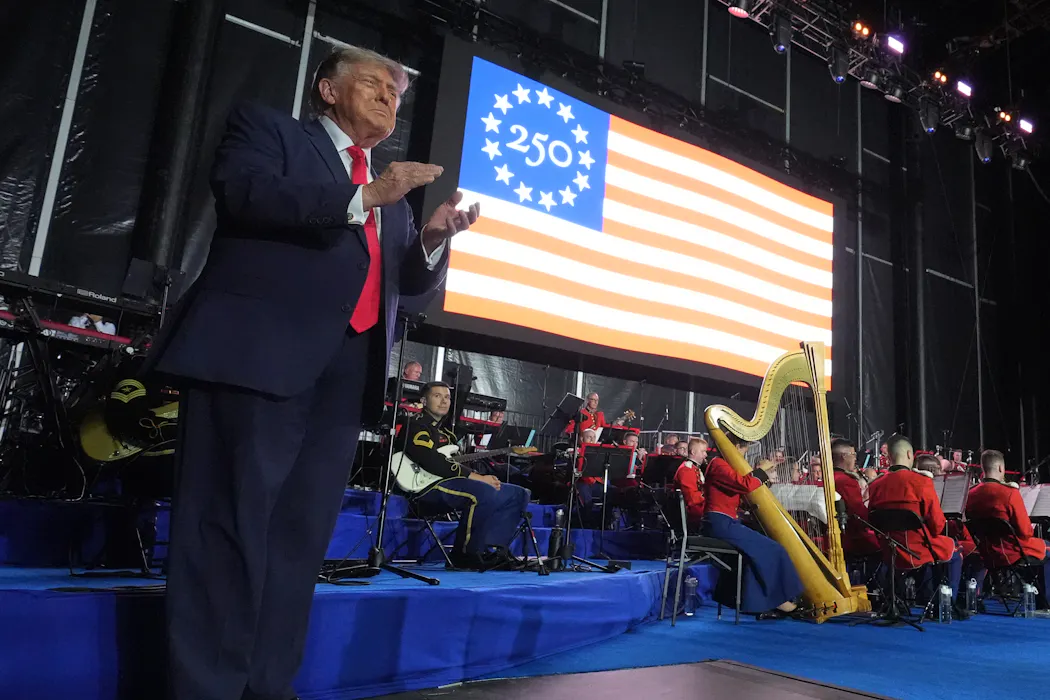
President Donald Trump arrives at the Great American State Fair Celebration on June 24, 2026, in Washington. Alex Brandon-Pool/Getty Images

The Trump administration has planned a series of commemorative events as part of its Freedom 250 initiative to celebrate America’s 250th birthday. These commemorations, according to Chief of Protocol Monica Crowley, were intended to “bring the country back together” through a renewed sense of patriotism, national unity and civic pride.

The Great American State Fair – a 16-day event on the National Mall designed to showcase all 56 U.S. states and territories – was at the center of the plans. But the effort to commemorate the nation’s semiquincentennial has been mired in political controversy.

Several musical artists withdrew from the fair in May, arguing that what was presented as a nonpartisan celebration had become politicized. Eight states – including Pennsylvania and North Carolina, both won by President Donald Trump in 2024 – declined official participation.

Fair attendance was reportedly lackluster, and the event experienced several technical issues that included frequent power outages and a display of the Confederate flag. Additionally, House Democrats have accused Trump and Freedom 250 of turning the festivities into a “hotbed of corruption and self-enrichment.”

To cap off the 250th anniversary on July Fourth, Trump announced ahead of the celebration that he would hold a political rally at the White House that he billed as “the most spectacular TRUMP RALLY of them all.” During the speech, he nodded to his intention to pass the SAVE Act – or the Safeguard American Voter Eligibility Act – to combat alleged electoral fraud, and his military interventions in Iran and Venezuela.

Lost in the controversy surrounding the celebration of the nation’s 250th anniversary are the views of everyday Americans. What do they think about the historic milestone?

Our latest UMass poll suggests that while there is division over the meaning of the 250th anniversary, there is nevertheless strong evidence that Americans are less divided than the politics surrounding the anniversary would suggest.

‘A proud national milestone’

In March 2026, we asked a nationally representative sample of 1,000 Americans about their views of the 250th anniversary. We asked them whether the ideals of the Declaration of Independence – that people possess unalienable rights, that governments exist to protect these rights, and the assertion that “all men are created equal” – still resonate today. We also asked whether Americans still share things in common.

When we asked respondents to select one statement that best captures what the 250th anniversary means to them, we found limited excitement for the celebrations. Only 37% selected “a proud national milestone,” while 24% said the celebration was “not something I think much about.” Eighteen percent categorized it as “mostly symbolic and ceremonial.”

Unsurprisingly, we found partisan differences on this question. Sixty-two percent of Republicans believe the anniversary is a “proud national milestone,” compared with only 20% of Democrats. The 250th anniversary, according to 29% of Democrats, is “not something I think much about.” Only 11% of Republicans express that same viewpoint.

Finally, 25% of Democrats thought the milestone was a “chance to reflect on our unfinished work,” with 4% of Republicans holding a similar opinion.

A crowd stands on a grass field in front of a stage.
Attendees watch a rally to kick off the Great American State Fair on the National Mall on June 24, 2026, in Washington.
Tasos Katopodis/Getty Images

Legacy of the declaration

Despite the division over America 250, our survey found a number of areas of strong agreement across partisan lines concerning the legacy of the Declaration of Independence and the future of the nation.

When asked how much the U.S. has succeeded in achieving its founding ideals, 57% responded “a moderate amount” or “a great deal.” Only 33% said “not at all” or “not very much.”

Republicans were more likely to declare success, with 80% responding “a moderate amount” or “a great deal,” yet a majority of Democrats, 52%, also agreed.

Close to 6 in 10 Americans, or 59%, indicated that the founding ideals of the declaration still guide the country. This view was shared by majorities of Democrats, 51%, and Republicans, 75%.

Almost 3 in 4 Americans, 74%, endorsed the statement that “Americans have far more in common than things that divide us.” This sentiment cuts across Democrats, 79%, and Republicans, 76%.

Lastly, 63% agreed that “The U.S. is one nation with a shared history and common future, and should never be divided,” including strong majorities from both parties.

In the midst of serious challenges at home and abroad – including the Iran war, a weak economy and the conflict over immigration – we found that Americans strongly believe there is more that unites Americans than divides them.

Despite the actions of Trump, there remains a desire to celebrate how the values at the heart of the founding continue to shape a more inclusive and egalitarian nation.

The Conversation

The authors do not work for, consult, own shares in or receive funding from any company or organization that would benefit from this article, and have disclosed no relevant affiliations beyond their academic appointment.

​Politics + Society – The Conversation

Categories
Uncategorized

Cuba’s future remains in limbo while Trump’s unpredictable foreign policy offers no clear path forward

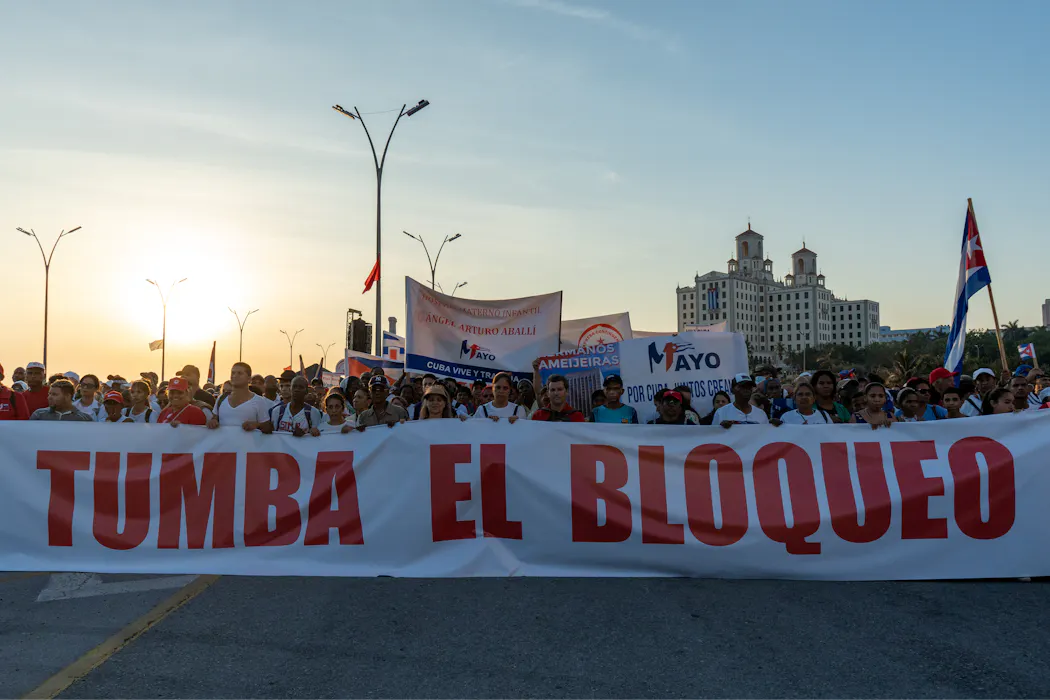
An International Workers’ Day demonstration on May 1, 2026, in Havana includes a protest of the ongoing U.S. blockade of oil to Cuba. Anadolu/Anadolu via Getty Images

As I consider the dire economic and political turning point my home country of Cuba is facing today, the words of Cuban singer Willy Chirino’s “Nuestro día ya viene llegando (Our day is coming)” come to mind like they did in the 1990s:

“Hoy que mi pueblo vive ilusionado, yo me siento inspirado y un Son estoy cantando anunciándole a todos mis hermanos, que nuestro día viene llegando.” This translates to, “Now that my people live filled with hope, I feel inspired and a Son I am singing, telling all my brothers, that our day is coming.”

Many Cubans in the diaspora of nearly 3 million in the U.S., including some of my own friends and family members, believe the days of the Cuban failed political system on the island are almost over.

As a Cuban American and a senior lecturer in global and intercultural studies, I am curious and concerned about what the country’s next chapter will be.

Memories of Havana

Growing up in Havana’s Chinatown neighborhood, I witnessed firsthand Cuba’s economic transformation in the early 1990s, during the euphemistically named “Special Period in a Time of Peace” following the collapse of the USSR.

At the time, I was completing my compulsory military service. I saw how the supplies provided by the Eastern Bloc to the Cuban military started to dwindle. Little by little, basic supplies, such as boots and uniforms, were no longer being replaced when they got worn out.

Back home during my weekends off, I started to see changes in my neighborhood. Privatization and commercialization were taking over my old street. The building across from our apartment was being remodeled into a three-story Chinese restaurant called El Pacífico. The many Cuban and Chinese families who had lived there were relocated to apartments on the outskirts of Havana.

Chinatown was open for business. This was the first of many neighborhoods in Havana that started to be commodified for tourism in the 1990s. Nevertheless, Cuba’s government maintained its socialist messaging to the Cuban people: Collective ownership and equality can be provided and guaranteed only by the socialist state.

But at the same time, it was making agreements with international capitalist enterprises, such as the hotel chain then called Sol Meliá, or other projects, including Fidel Castro’s international promotion of Cohiba cigars. And these contradictions were becoming harder to hide from the people in changing neighborhoods like Chinatown.

gate at the entrance to Chinatown in Havana
The Friendship Gate at the entrance of Havana’s Chinatown was built in 1999 to make the neighborhood more appealing to tourists.
David Silverman/Getty Images News

A nuanced authoritarianism

In the early years after the revolution that brought Fidel Castro’s government to power in 1959, the government held popular tribunals in which those perceived as standing in the way of socialist ideals were put on trial. Most of the accused were found guilty without due process and either endured long prison sentences or faced execution squads.

This dogmatic approach to revolutionary citizenship led to the horrible treatment of any perceived as nonconformist, such as LGBTQ people, hippies or punks. These dissidents were sent to labor camps designed to transform “questionable” people into Che Guevara’s ideological concept of the “hombre nuevo” – the new revolutionary man.

But in the past 20 years, Cuba’s more progressive social policies have helped to redeem the authoritarian excesses of the revolution’s early years. This has helped to guarantee the government’s survival.

One of the few Latin American countries to legalize gay marriage, Cuba has also gained a global reputation in its many advances toward gender equity. In fact, Mariela Castro, Raúl Castro’s daughter, is now the leading voice of the LGBTQ+ movement in Cuba.

Those most affected by the U.S. sanctions and Cuban government antipathy are “los cubanos de a pie,” that is, “Cubans on foot.” This is a large majority of the population that has very little income, no connection to the government and no access to the new private-public partnership business model in Cuba known as “mipymes” and no remittances from relatives living abroad. Today, they are crying out for a change – any change.

What has – and hasn’t – happened in Venezuela

The tactics used by President Donald Trump’s administration on Jan. 3, 2026, to capture Venezuelan president Nicolás Maduro set the road map for what many in the diaspora expected would follow in Cuba.

Many Latinos, including Cubans and Cuban Americans living in the United States, were in favor of this action, especially the old generation of Miami Cuban and Venezuelan exiles who have long supported the Republican Party.

On the island, many Cubans are willing to accept a U.S. invasion if it means things will change. They feel that if Cubans are not going to have access to any of their country’s resources, it might as well be in the hands of the United States.

What very few have discussed publicly, however, both in the Cuban community and outside of it, is what has – or has not – happened in Venezuela since the U.S. took Maduro. Few are asking: Has the political system really changed? Is Venezuela better off now than under Maduro?

Trump has yet to publicly state his aims for the future of Venezuela, outside of taking over its oil industry. The U.S. appointed acting President Delcy Rodriguez on Jan. 5, 2026, but it’s not clear what this bodes for Latin American sovereignty.

A U.S. military capture of Cuban President Miguel Díaz-Canel and even the aged Raúl Castro, who has been indicted by the U.S. judicial system, might have symbolic power but, in my opinion, is not likely to repopulate Havana’s Palacio de Gobierno with fresh political perspectives.

In Cuba, the trappings of the old regime remain deeply rooted in the country’s political infrastructure, and the threat of U.S. military intervention is nothing new for the Cuban government that has outlasted many U.S. administrations.

The Cuban government also knows it can create chaos in the Caribbean by unleashing another migratory crisis. This leverage, of course, comes at the expense of “los cubanos de a pie.”

What’s next for Cuba

The Cuban economy, heavily reliant on tourism, faces unprecedented pressures.

With the specter of U.S. intervention looming, many foreign companies operating on the island have decided to leave. The abrupt departure of companies such as mining company Sherritt International and the SOL by Meliá hotel chain has undermined mining, tourism and energy in Cuba.

And in June 2026, Trump further hardened sanctions with an executive order that punishes companies doing business with Cuban companies. This additional economic pressure seems to be creating some momentum and fragmentation to force the Cuban government into a dialogue that favors the U.S. agenda.

Add to this the fact that oil imports from Venezuela and other countries, including Mexico and Russia, have dissipated, causing a major energy crisis, and it’s clear that change is urgently needed – but in which direction?

Uncertainty and hope remain

As days pass, the uncertainty remains, and the voice of the Cuban people is obscured behind the political clamor between the Cuban and U.S. governments.

Like Willy Chirino, I long for a day when I can come back to Cuba with my now-teenage children to show them where I was born and introduce them to their relatives still living on the island, with the hope of building a real future together.

In the meantime, as I sip a cortado in a Midwestern college town, another 1990s popular song comes to mind. It comes from Los Van Van, a Cuban band formed during the exciting early revolutionary years, beloved by Cubans inside and outside the island: “Orula, para todos los Cubanos, Ashé yo te pediré,” which translates to, “Orumila, Yoruba deity, blessings for all the Cubans is what I am asking for.”

The Conversation

Juan Carlos Albarran does not work for, consult, own shares in or receive funding from any company or organization that would benefit from this article, and has disclosed no relevant affiliations beyond their academic appointment.

​Politics + Society – The Conversation

Categories
Uncategorized

For nearly 250 years, the US has had eyes on Latin America – but interventions then looked rather different

A statue of Francisco de Miranda stands in Cuba. Riccardo Lombardo/REDA/Universal Images Group via Getty Images

Since the beginning of the second Trump administration, the United States has ramped up military, economic and political interventions in Latin America.

Nowhere were those three factors more clear than the U.S. abduction of Venezuelan President Nicolás Maduro in January 2026. Since then, the Trump administration has used a mix of carrots and sticks to cajole what remains of Maduro’s government to support U.S. aims, including opening up the country’s oil industry to foreign development and targeted killings of accused criminals in the country. At the same time, the U.S. has found local Venezuelan allies in opposition leaders such as María Corina Machado, winner of the 2025 Nobel Peace Prize and a longtime Maduro critic.

As a historian of early U.S. political economy, diplomacy and war, I believe the ongoing U.S. intervention in Venezuela echoes a far earlier intervention in the early 19th century.

It was then, in 1805, that the South American revolutionary Francisco de Miranda visited the U.S. on a charm offensive to meet with leading statesmen, including President Thomas Jefferson. In a similar vein as Machado today, his goal in meeting with U.S. officials was to rally support for his proposed expedition to overthrow an unpopular government at home.

The fight against the Spanish Empire

From almost the beginning, America’s founders wanted to protect and expand the country beyond the 13 original states. In addition to running up against vast tracts of land populated by Native Americans, that meant almost immediate rivalries with the foreign empires – Britain, France and Spain – that had laid claim to large parts of the modern-day U.S.

It was in this age of revolution and expansion in Europe and the Americas that Miranda cut a ubiquitous figure.

He was a veteran of the American Revolution, fighting in a U.S.-allied Spanish army against the British in Florida. He would go on to fight among republican forces during the French Revolution, being imprisoned by the more radical Jacobins.

Yet it was the independence of South America from the Spanish Empire – particularly in his native Venezuela – that could be considered his life’s work.

Miranda had spent over two decades courting allies in the U.S. in support of South American republicanism – and specifically the overthrow of the Spanish colonial government in Caracas and elsewhere. Such was Miranda’s successful cultivation of powerful Americans that Alexander Hamilton, the nation’s first Treasury secretary, was one of his most influential advocates.

In 1784, Hamilton sent Miranda a long list of notables who would be interested in South American intervention. Then, in 1798, once Hamilton was appointed inspector general, he implied that the recently expanded U.S. Army could be a vehicle for seizing Spanish territory. Although that didn’t come to fruition at the time, the point was clear: Miranda believed American statesmen were receptive to his ideas.

An old painting of three men.
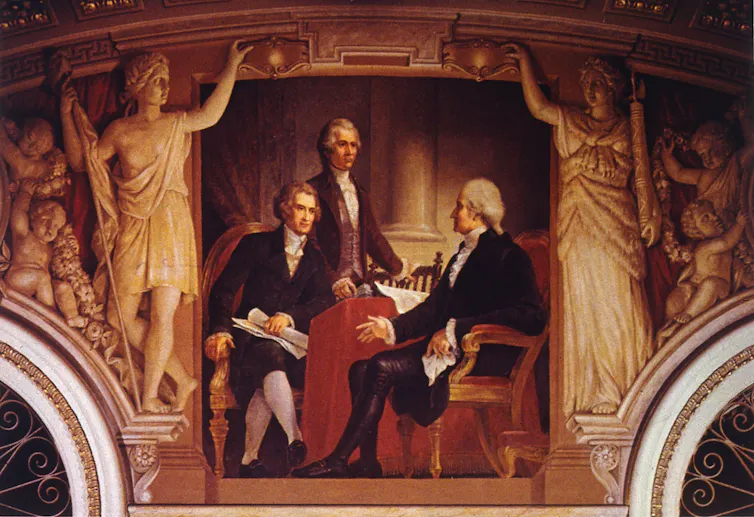
Thomas Jefferson and Alexander Hamilton appear alongside George Washington in an old painting.
MPI/Getty Images

In the early 19th century, anticolonial agitation rocked the Spanish territory that would soon become Venezuela. Increasing Spanish costs for defense, such as building forts and training militia, led to higher taxes and strained local economies. That came after several tax rebellions broke out in the last decades of the 18th century. In general, there was widespread societal discontent over restrictive Spanish trade monopolies, as well as exclusive government posts for Spanish-born judges and officials.

The birth of a revolutionary plot

Soon after their own revolution from colonial rule, many Americans had a general sympathy for South American colonial subjects – if a limited understanding of their political situation.

Additionally, U.S. investors wanted access to the South American silver trade, as well as an end to Spanish royal monopolies on Venezuela’s coffee, cacao and indigo, just like U.S. investors today eye oil and real estate.

Amid this context, Miranda arrived in New York City in the fall of 1805 with plans to find allies for a scheme to foment a war for independence.

He met with William Smith, an old friend and the son-in-law of former President John Adams. Smith, serving as surveyor of the port of New York, connected him with a wealthy merchant named Samuel Ogden, who often sailed armed vessels to Haiti. The two men suggested that Miranda travel to Washington to secure official U.S. government support before proceeding with his plans to overturn the government in what became Venezuela.

When Miranda arrived at the White House, he sat in on a Cabinet meeting and was invited to dine with Jefferson. They chatted about revolution, and Jefferson spoke favorably of Spanish American independence, predicting that it would soon come to pass.

Jefferson would later write to Don Valentín de Foronda, Spanish minister to the U.S., that his administration “had no suspicion that (Miranda) expected to engage men here.” But it would be very surprising if Jefferson had not caught whiff of the expedition – either from Miranda himself or through gossip.

Indeed, the capital’s elites were abuzz with Miranda’s visit and plans. Washington merchant and investor William Mayne Duncanson, for example, called on Jefferson to offer his services in the venture, assuming that Jefferson was amenable to Miranda’s plans.

Whatever Jefferson’s knowledge, he also cared about America’s diplomatic reputation – and, more broadly, the law of nations. So he worked for several years to convince Spain that the U.S. government was not involved in organizing the expedition.

Failure abroad and domestic blowback

Miranda returned to New York from Washington in early January 1806 without official support. He assumed, however, that he had the tacit approval of the Jefferson administration. So he, Smith and Ogden fitted out a merchant vessel called the Leander with military stores and 200 men, who had varying degrees of understanding about what they had signed on to.

They left New York City on Feb. 2, 1806, and the press began speculating about where the ship was going and who was on board.

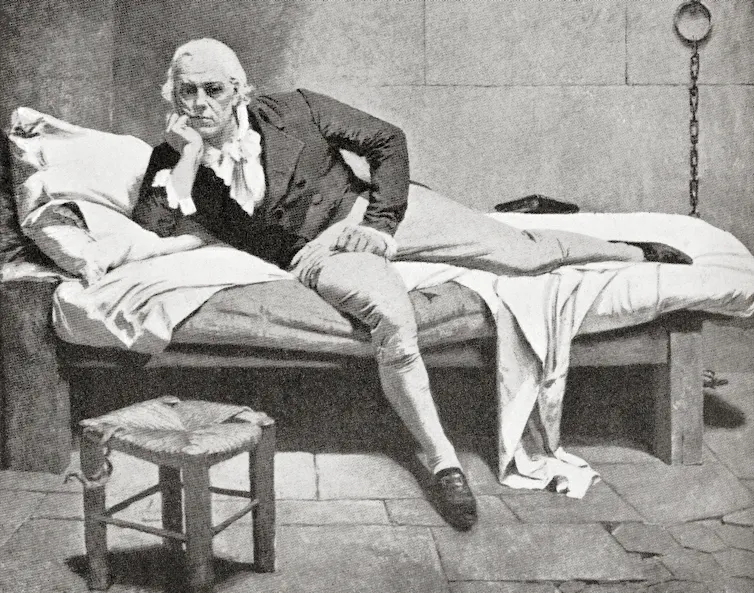
An old black and white drawing of a man on a bed.
An artist’s rendering of Miranda in his prison cell in Sevilla, Spain.
Universal History Archive/Universal Images Group via Getty Images

On Feb. 22, a list of incriminating questions addressed to Secretary of State James Madison appeared in the Philadelphia Gazette. This editorial, assumed by other newspaper editors to be submitted by the Spanish ambassador, accused Madison and Jefferson of condoning Miranda’s actions.

Partly to avoid culpability at home and abroad, Jefferson pressed charges against Ogden and Smith. They were arrested on Feb. 20 and tried in a federal court that summer. A sympathetic jury declared them not guilty.

Meanwhile, members of Miranda’s expedition were captured by Spanish soldiers off the coast of what would soon become Venezuela and tried for their attempted insurrection. The majority were imprisoned; 10 men were hanged.

Miranda escaped to Aruba and later played a major role in the Venezuelan war of independence from Spain that begin in 1810. There, he briefly led the country before being sidelined by his protegé, the great liberator Simón Bolívar, who believed Miranda traitorously reached armistice terms with the Spanish Empire in 1812 and gave him up to Spanish authorities. Miranda died in a prison in Spain in 1816.

In the U.S., the fate of the American prisoners fueled public outrage and an acrimonious political debate about expedition. As Jefferson’s opponents criticized him for sanctioning intervention and neglecting to free the prisoners, his supporters lashed out at the opposing Federalist Party for allegedly orchestrating a rebellion in Spain’s colonies in the first place.

Miranda’s expedition was one of the earliest instances of debates of the U.S. considering intervention in Latin America. At this point in its young history, the U.S. government officially refused to countenance a military expedition.

But it would launch a long history of foreign elites like Miranda believing that American intervention could be a necessary tool for creating a new political reality at home. The goal, as ever, was freedom from unpopular rule.

The Conversation

Lindsay Schakenbach Regele does not work for, consult, own shares in or receive funding from any company or organization that would benefit from this article, and has disclosed no relevant affiliations beyond their academic appointment.

​Politics + Society – The Conversation
Categories
Uncategorized

When a congressman beat a senator unconscious, America confronted the limits of free speech

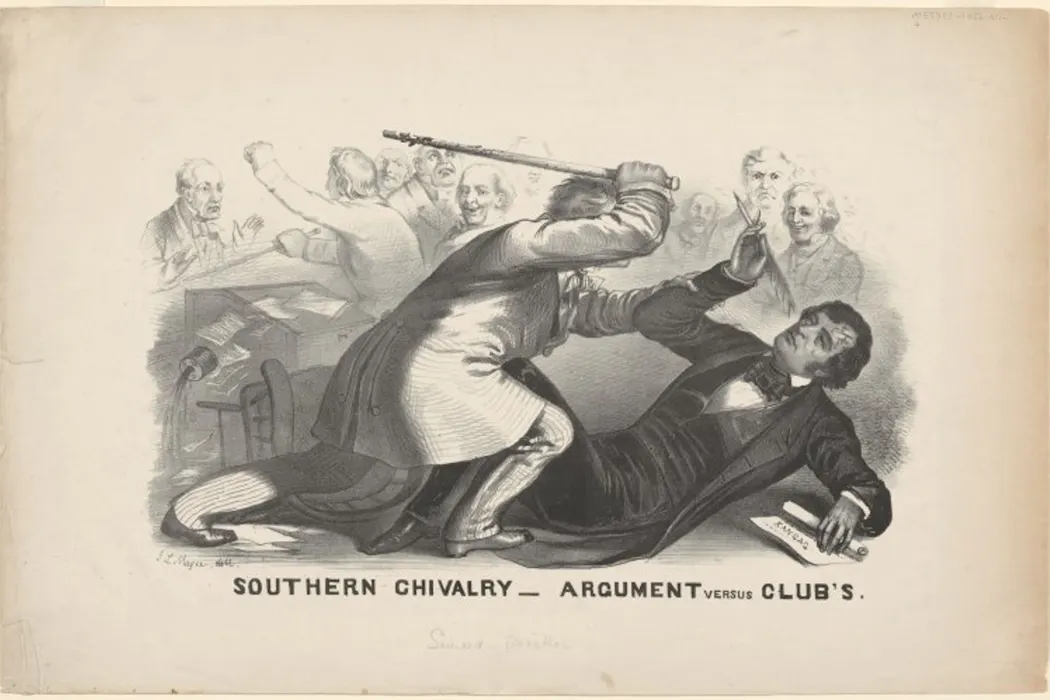
In John Magee’s print, Preston Brooks wields a cane against Charles Sumner, who is clutching a pen and a rolled-up speech. John L. Magee, The New York Public Library

On May 22, 1856, Preston Brooks strode into the United States Senate chamber and beat Sen. Charles Sumner unconscious with a cane. Brooks, a South Carolina congressman, was retaliating for a speech Sumner had given condemning slavery and personally insulting a relative of Brooks.

Though lasting only a minute, the beating had far-reaching consequences. It pushed Americans one step closer to civil war.

And, as I discovered while researching my book “The Man Behind the Cane: Preston Brooks, Political Violence, and the Road to the Civil War,” it sparked a nationwide debate over free speech, political violence and the relationship between the two.

A white-haired man shown in side and front views in an antique photo.
Alexander Stephens, future Confederate vice president, justified the caning by saying, ‘I have no objection to the liberty of Speech, when the liberty of the cudgel is left free to combat it.’
Heritage Images, Hulton Archive/Getty Images

Speak without reprisal

Northerners denounced the caning as an attack on Sumner’s right to free expression. Even if they thought Sumner’s abolitionism too radical – as most white Northerners did in 1856 – they believed a U.S. senator had the right to say what he wanted without violent reprisal.

Visual images of the caning reflected the Northern take on free speech. In John Magee’s political caricature, “Southern Chivalry – Argument Versus Club’s,” Brooks wields a sturdy stick against a defenseless Sumner, who is clutching a pen in one hand and a rolled-up speech in the other. Winslow Homer’s print “Arguments of the Chivalry” depicts Sumner writing at his desk as Brooks prepares to strike.

Homer’s headline captured the message of both depictions: “The Symbol of the North is the Pen; the Symbol of the South is the Bludgeon,” which is a quote from a speech by antislavery activist Henry Ward Beecher.

Defenders of Brooks insisted any abolitionist speech was too incendiary to deserve protected status. Brooks’ hometown newspaper in Edgefield, South Carolina, berated Sumner for “licentiously prostituting the principle of freedom of speech,” reflecting the widespread conviction among white Southerners that free speech had limits.

Collapsing the distinction between words and violence

The argument between supporters of Brooks and Sumner was not isolated to the caning incident. Societies throughout history have punished language deemed blasphemous, seditious, inciting or slanderous. In most times and places, authorities have hewed more to slaveholders’ conception of free speech as a limited privilege than to abolitionists’ assertion of an absolute right. In the United States, the idea of free speech as virtually inviolable became mainstream only in the 20th century.

To pro-slavery Americans, abolitionist words warranted violent responses because such words were themselves tantamount to violence.

Alexander Stephens, future Confederate vice president, justified the caning by saying, “I have no objection to the liberty of Speech, when the liberty of the cudgel is left free to combat it.”

Another Southern politician wrote to Brooks, “Address your arguments to the Skin, to the physical sensibilities.” And one of the many replacement canes given to Brooks bore the revealing inscription “Use Knock-Down Arguments.”

Slaveholders were collapsing the distinction between words and physical violence. Language could constitute violence, and an act of violence could be a counterargument.

This logic has resurfaced in our own time, but instead of slaveholders using it to maintain white supremacy, today it is more often deployed to designate certain types of expression, such as burning crosses or displaying Nazi symbols, as hate speech against marginalized communities. It has also appeared in the increasing moves by the Trump administration to label dissent as terrorism.

A man with thick, dark hair, wearing a black coat over a white shirt, looking steadily at the camera in an antique photo.
Antislavery crusader Frederick Douglass concluded that ‘slavery cannot tolerate free speech.’
Associated Press

Suppressing antislavery language

While most Northerners in the 1850s continued to value freedom of speech over violence, the caning convinced some that they must respond in kind.

One Minnesota newspaper editor hoped that “every Northern member will fully arm himself, and if necessary plant a cannon by the side of his desk to be used as the most effectual argument in favor of Free Speech.”

It was increasingly difficult to keep rhetorical and physical violence separate as the slavery conflict heated up.

This was a new phase in the history of free speech. While abolitionists and increasing numbers of Northerners fought for an expansive idea of free expression, publishing pamphlets and newspapers and submitting petitions to Congress, slaveholders tried to suppress antislavery language.

Terrified that abolitionist words might lead to rebellions by the enslaved, slaveholders feared for their survival. As prominent abolitionist Frederick Douglass recognized, “Slavery cannot tolerate free speech.”

Political reformer Lydia Maria Child described a growing threat: “A slaveholding community necessarily lives in the midst of gunpowder and, in this age, sparks of free thought are flying in every direction.”

Responding to those sparks of abolitionist free thought with violent repression, including acts such as the Sumner caning, slaveholders’ violence fueled the rise of the new Republican Party. The Republicans articulated their opposition to slavery with their slogan of “free soil, free speech, free labor, free men.”

Brooks and his kind ultimately brought about their own demise by provoking Northern outrage – outrage that ultimately led to war once the slaveholding South seceded.

Who gets to say what to whom? Are there any words that can justify violence? These questions polarized the country after the caning. In new forms, they continue to confound American politics 170 years on.

The Conversation

Paul Quigley received funding from The Carnegie Trust for the Universities of Scotland.

​Politics + Society – The Conversation
Categories
Uncategorized

How redefining one word strips the Endangered Species Act’s ability to protect vital habitat

Northern spotted owls living in old growth forests in the Pacific Northwest were listed as threatened species because of habitat loss. Kyle Sullivan/Bureau of Land Management, CC BY

It wouldn’t make much sense to prohibit people from shooting a threatened woodpecker while allowing its forest to be cut down, or to bar killing endangered salmon while allowing a dam to dry out their habitat.

But that’s what the Trump administration is doing by changing how one word in the Endangered Species Act is interpreted: harm.

For 50 years, the U.S. government has interpreted the Endangered Species Act as protecting threatened and endangered species from actions that either directly kill them or eliminate their habitat. A new federal rule change, announced July 10, 2026, keeps the first part – protecting against the direct killing of the species – but removes habitat destruction.

That matters, because most species on the brink of extinction are on the Endangered Species list because there is almost no place left for them to live. Their habitats have been paved over, burned or transformed. Habitat protection is essential for their survival.

A newly hatched turtle scoots through sand
Green sea turtles, like this hatchling in Florida, are endangered due in part to habitat destruction and fishing nets.
Keenan Adams/USFWS

As an ecologist and a law professor, we have spent our entire careers working to understand the law and science of helping imperiled species thrive. We recognize that the rule change could green-light the destruction of protected species’ habitats, making it nearly impossible to protect those endangered species.

The legal gambit

The Endangered Species Act, passed in 1973, bans the “take” of “any endangered species of fish or wildlife,” which includes harming protected species.

Since 1975, regulations have defined “harm” to include habitat destruction that kills or injures wildlife. Developers and logging interests challenged that definition in 1995 in a Supreme Court case, Babbitt v. Sweet Home Chapter of Communities for a Great Oregon. However, the court ruled that the definition was reasonable and allowed federal agencies to continue using it.

In short, the law says “take” includes harm, and under the regulatory definition at the time, harm included indirect harm through habitat destruction.

The Trump administration has now changed the definition of “harm” in a way that leaves out habitat modification.

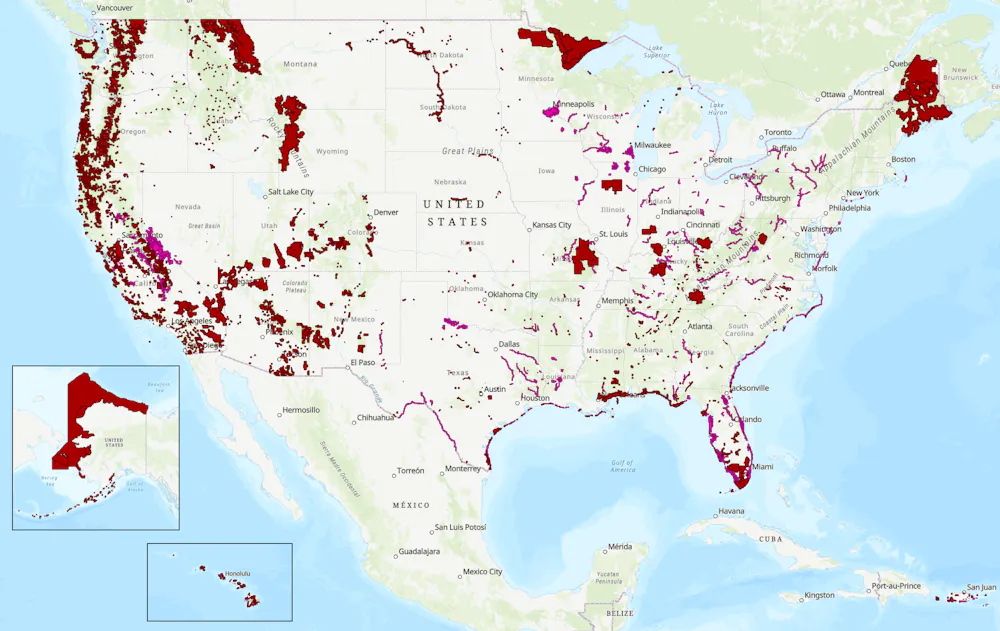
Map showing large areas marked as critical habitat along the Pacific US coast and in Maine. Also along the Alaska coast.
Critical habitat throughout the U.S., including many coastlines and mountain areas. Note: Alaska is not to scale.
U.S. Fish and Wildlife Service

This narrowed definition unravels the most significant protections granted by the Endangered Species Act.

Why habitat protection matters

Habitat protection is the single most important factor in the recovery of endangered species in the United States – far more consequential than curbing direct killing alone.

A 2019 study examining the reasons species were listed as endangered between 1975 and 2017 found that only 17% were primarily threatened by direct killing, such as hunting or poaching. That 17% includes iconic species such as the red wolf, American crocodile, Florida panther and grizzly bear.

In contrast, a staggering 81% were listed because of habitat loss and degradation. The Chinook salmon, island fox, southwestern willow flycatcher, desert tortoise and likely extinct ivory-billed woodpecker are just a few examples. Globally, a 2022 study found that habitat loss threatened more species than all other causes combined.

As natural landscapes are converted to agriculture or taken over by urban sprawl, logging operations and oil and gas exploration, ecosystems become fragmented and the space that species need to survive and reproduce disappears.

A small fox with a fluffy tail under cactuses.
The Catalina Island fox is endemic to Catalina Island. Habitat loss, diseases introduced by domestic dogs, and predators have diminished the population of these small foxes to threatened status.
Catalina Island Conservancy/Wikimedia Commons, CC BY-SA

Currently, more than 107 million acres of land in the U.S. are designated as critical habitat for Endangered Species Act-listed species. Industries and developers have called for changes to the rules for years, arguing it has been weaponized to stop development. However, research shows species worldwide are facing an unprecedented threat from human activities that destroy natural habitat.

Under the new change, development could be accelerated in endangered species’ habitats.

Gutting the Endangered Species Act

The definition change is a quiet way to gut the Endangered Species Act.

It is also fundamentally incompatible with the purpose Congress wrote into the act: “to provide a means whereby the ecosystems upon which endangered species and threatened species depend may be conserved [and] to provide a program for the conservation of such endangered species and threatened species.” It contradicts the Supreme Court precedent, and it would destroy the act’s habitat protections.

A bird with a yellow cheeks and a black cap and wings sits on a juniper branch.
The golden-cheeked warbler breeds only in Texas, primarily in Texas Hill Country. It has been losing habitat as development expands in the region.
Steve Maslowski/USFWS, CC BY

Secretary of the Interior Doug Burgum has argued that the recent “de-extinction” of dire wolves by changing 14 genes in the gray wolf genome means that America need not worry about species protection because technology “can help forge a future where populations are never at risk.”

But altering an existing species to look like an extinct one is both wildly expensive and a paltry substitute for protecting existing species.

The administration has also didn’t conduct the usual analysis of the environmental impact that changing the definition could have. That means the American people won’t even know the significance of this change to threatened and endangered species until it’s too late, though wildlife groups are already planning to sue over the change.

The ESA is saving species

Surveys have found the Endangered Species Act is popular with the public, including Republicans. The Center for Biological Diversity estimates that the Endangered Species Act has saved 99% of protected species from extinction since it was created, not just from bullets but also from bulldozers. This regulatory rollback seeks to undermine the law’s greatest strength: protecting the habitats species need to survive.

Congress knew the importance of habitat when it passed the law, and it wrote a definition of “take” that allows the agencies to protect it.

This is an update to an article originally published May 13, 2025.

The Conversation
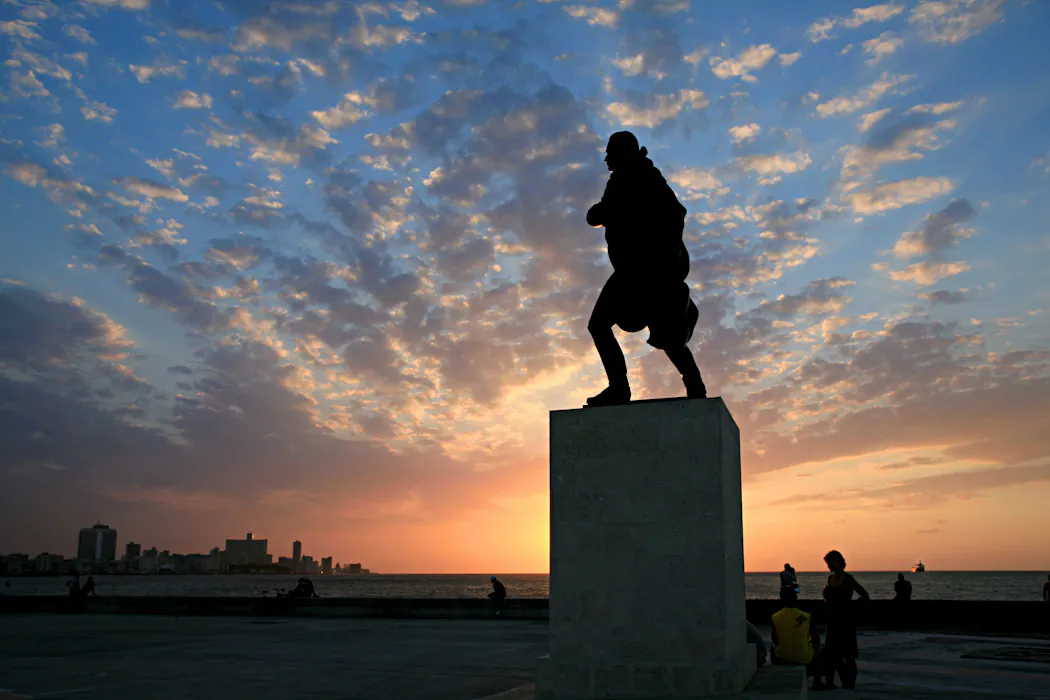
Mariah Meek has received funding from the National Science Foundation, the US Fish and Wildlife Service, and several state agencies. In addition to being a professor, she is also the Director of Research for The Wilderness Society.

Karrigan Börk receives grant funding from the U.S. Bureau of Reclamation and several California state agencies. He is on the Advisory Board of Water Audit California, an organization that works to protect California’s public trust resources.

​Politics + Society – The Conversation