Categories
Uncategorized

Public opinion on abortion has shifted 4 years after Dobbs decision overturned Roe v. Wade

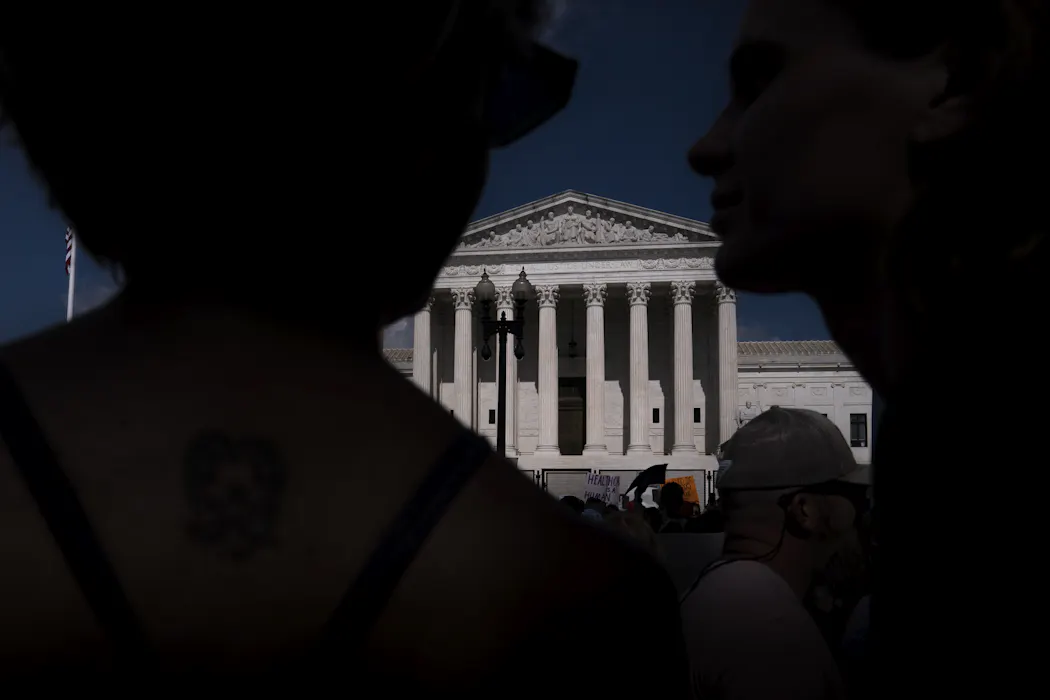
People gather in front of the Supreme Court building following the Dobbs v. Jackson Women’s Health Organization ruling on June 24, 2022, in Washington, D.C. Nathan Howard/Getty Images

It’s been four years since the Supreme Court’s decision in Dobbs v. Jackson Women’s Health Organization overturned Roe v. Wade, ending the federal constitutional right to abortion.

In the immediate aftermath of the decision, national attention centered on implementation of state bans and a rapidly shifting legal landscape.

But four years later, one of the most impactful developments has been less visible: a significant, sustained and politically consequential shift in public opinion. In the wake of Dobbs, the debate over abortion rights did not simply return to the states. It fundamentally altered how many Americans think about the issue and how they vote.

In our recently published book, “Not Going Back: Public Opinion on Abortion in Post-Dobbs America,” we examined how and why these changes have occurred, and what they mean for U.S. politics. We believe the shift could have real consequences for the November 2026 midterms.

Post-Roe stability

Drawing on several nationally representative surveys conducted before and after Dobbs, we examined how Americans’ abortion attitudes, political priorities and voting behavior have changed in response to the most significant shift in abortion policy in half a century.

For nearly 50 years after Roe, public opinion on abortion was remarkably stable. In 1975, Gallup found support for legal abortion in certain circumstances at 54% and support for a ban in all circumstances at 22%. In 2021 – the year before the Dobbs decision – these figures were virtually the same: 48% and 19%, respectively.

Despite heated political rhetoric, most Americans held nuanced views. They were neither fully anti-abortion nor fully pro-abortion. Instead, they supported legal abortion in some circumstances and not in others.

That underlying stability shaped both policy and politics for decades. Republicans were able to rally a committed core of supporters around opposition to Roe, while the underlying constitutional right to access abortion remained unchanged.

As states moved quickly after the Dobbs decision to enact abortion bans and strict gestational limits, public opinion moved in the opposite direction.

Today, more Americans identify as pro-choice than they did before Dobbs. And, as we document in our book, more Americans are now taking absolutist positions. They support legal access to abortion in all or most cases and oppose government regulation altogether.

How Dobbs shattered the equilibrium

One of the most striking changes in the post-Dobbs era concerns who cares most about abortion. For decades, abortion was a higher priority for Republicans and those identifying as pro-life.

That dynamic has now flipped. In both 2022 and 2024, Democrats and pro-choice Americans were more likely than Republicans to say abortion was a top political issue shaping their vote. In our book, we document how in both 2022 and 2024, pro-choice Democrats were especially motivated to vote and remained highly loyal to Democratic candidates.

At the same time, the considerable minority of Republicans who support legal abortion found themselves politically cross-pressured, meaning they experienced conflicting political influences.

Drawing on multiple nationally representative data sets, our book reveals that roughly one-third of Republicans hold views on abortion that do not align with the official pro-life position embraced by their party. They either identify as pro-choice or support legal abortion in at least some cases.

It was one thing to identify as a pro-choice Republican when Roe guaranteed a constitutional right to abortion. After Dobbs, however, Republican electoral victories could directly result in abortion bans and other restrictions. That makes partisan choices far more consequential.

We found that cross-pressured Republicans had lower turnout rates and were more willing to cross party lines, reflecting the growing tension between their abortion views and their party’s position. Given the size of this group, that presents a serious challenge for GOP candidates.

Several people gather in front of a federal building with columns.
A group of abortion-rights supporters gather in front of the Supreme Court on June 28, 2022, in Washington, D.C.
Nathan Howard/Getty Images

Reshaping US politics

At the same time, efforts to find a middle ground on abortion have proven difficult. Republican legislators in North Carolina and Virginia, for example, have sought to position policies such as 12- or 15-week bans as a reasonable compromise.

That might have worked in 1990. But public opinion has shifted in ways that make this strategy increasingly untenable. Our research shows that most Americans, including Republicans, do not see these “moderate” policies as meaningfully different from more restrictive bans.

One reason may be that, in the wake of Dobbs, abortion restrictions have become concrete rather than abstract. Extensive media coverage of women denied care during miscarriages, severe pregnancy complications and other medical emergencies has highlighted the consequences of gestational limits. This leads many Americans to judge these policies by their practical effects rather than the specific week at which abortion is prohibited.

In addition, our original survey data reveals that many Americans have only a limited understanding of how pregnancy is dated. That makes distinctions between six-, 12- and 15-week bans less meaningful than policymakers often assume.

Another major change is the emergence of a gender gap in abortion attitudes. For decades, men and women held remarkably similar views on abortion. That is no longer the case.

Since Dobbs, women have become significantly more supportive of abortion rights than men. For example, 56% of women say abortion should be legal in all or most circumstances, compared to 41% of men.

This new gender gap reflects both women’s experiences with pregnancy and abortion and the changed policy environment following Dobbs. After the ruling, the consequences of abortion restrictions became far more immediate and tangible.

Rather than accepting these new restrictions, many women reacted against them. As abortion policy moved sharply to the right in many states, women’s attitudes moved in the opposite direction. This has resulted in substantially greater support for abortion rights.

Our survey research further finds that a better understanding of human reproduction, including how pregnancies are dated, is associated with greater support for legal access to abortion.

Taken together, these changes have reshaped American politics in ways that advantage Democrats. Abortion rights played a key role in the 2022 midterms, contributing to stronger-than-expected Democratic performance nationwide.

And it continues to shape voter motivation and turnout patterns heading into future elections.

‘Not going back’

That said, abortion is not the only issue that matters in modern U.S. politics. In the 2026 midterm elections, the economy and partisanship – especially in an era dominated by President Donald Trump – will remain central to electoral outcomes.

Abortion alone is unlikely to determine any single race. But it has altered the political landscape in ways that will matter this November and beyond.

The phrase that gives our book its title – “Not Going Back” – captures this moment. The changes we document are not temporary reactions to a single Supreme Court decision.

The stability that defined abortion politics for half a century is gone. The new normal is a political landscape in which abortion rights have become both more widely supported and more politically consequential. They are motivating Democratic voters while creating new tensions within the Republican coalition.

Perhaps most importantly, Dobbs transformed abortion from a constitutional question into an electoral one. As abortion laws became substantially more restrictive, public opinion moved toward greater support for abortion access. The 2026 elections will offer another test of how the U.S. responds when public policy and public preferences move in opposite directions.

This story was produced in collaboration with Rewire News Group, an independent nonprofit media outlet that covers reproductive health.

The Conversation

The authors do not work for, consult, own shares in or receive funding from any company or organization that would benefit from this article, and have disclosed no relevant affiliations beyond their academic appointment.

​Politics + Society – The Conversation

Categories
Uncategorized

The antifa terrorism threat the Trump administration describes does not exist

Secretary of State Marco Rubio speaks during the political terrorism conference on July 16, 2026, in Washington. Brendan Smialowski / AFP via Getty Images

The State Department on July 16, 2026, hosted what officials billed as a ministerial on the resurgence of left-wing political terrorism.

Secretary of State Marco Rubio invited representatives from more than 60 countries to Washington to hear an argument that many of them appear not to believe: that a transnational far-left terrorist movement called antifa threatens the democratic world. At the event, allies were asked to mobilize against that enemy despite nations like the Netherlands and Germany politely noting to their host that they cannot find evidence of any such group.

Some intelligence analysts have declined to brief on antifa at interagency meetings because they do not regard it as a serious counterterrorism threat.

As a terrorism scholar who spent a decade running the State Department office that designates terrorist organizations, I understand their confusion. The threat the administration describes does not exist in the form the administration describes it.

Antifa is not a group

As I and others have written before, antifa is not a group. It is a movement and an ideology, a loose commitment to opposing fascism. In its most organized form, it amounts to scattered local collectives like Rose City Antifa in Portland, Oregon.

There is no membership roll, no command hierarchy and no funding structure. There is no leader of antifa – the Trump administration has not named one – and there is no record of deadly attacks attributed to a U.S.-based organization called antifa.

Groups like the Islamic State group and al-Qaida have killed tens of thousands of people and have a documented chain of command. Antifa does not. You cannot decapitate a movement with no head, and you cannot sanction an organization that does not exist.

As such, the Trump administration created one.

A man with a bandana covering his face faces off against a man with a black hat.
An unidentified man faces off with Rose City Antifa members on June 29, 2019, in Portland, Ore.
Moriah Ratner/Getty Images

Trump administration targets antifa

The construction project began on Sept. 22, 2025, when President Donald Trump signed an executive order purporting to designate antifa as a domestic terrorist organization. The order describes antifa as “a militarist, anarchist enterprise that explicitly calls for the overthrow of the United States Government.” It directs every relevant agency to investigate and dismantle its operations.

Two problems are immediately apparent. First, no legal authority exists to designate domestic organizations as terrorist groups. It’s a gap that Congress has deliberately preserved for First Amendment reasons.

Second, the order designates as an organization something the FBI’s past leadership has described as an ideology. Trump’s executive order asserts an antifa enterprise into existence and then declares war on it.

Three days after the executive order, the White House implemented the order through National Security Presidential Memorandum 7, which converts the fiction into machinery. The memorandum directs the Treasury Department to identify and disrupt financial networks that fund what it deems domestic terrorism. The memorandum instructs banks to file suspicious activity reports with the Financial Crimes Enforcement Network, the U.S. government’s financial intelligence unit.

That means the government’s financial surveillance apparatus, built to trace al-Qaida’s money in the wake of the 9/11 terrorist attacks, is being pointed at Americans that the administration considers left-wing.

The memorandum likewise directs the FBI’s Joint Terrorism Task Forces to coordinate a comprehensive national strategy to investigate, prosecute and disrupt entities and individuals. That harnesses a network of roughly 200 task forces comprising over 4,000 personnel from federal, state and local agencies.

The wording of National Security Presidential Memorandum 7 gives away the administration’s true intent. It identifies the markers of this supposed terrorist movement as anti-Americanism, anti-capitalism and anti-Christianity. It criticizes the movement for its hostility toward those who hold traditional American views on family, religion and morality.

Those are not indicators of terrorism. They are political positions.

State Department targets groups overseas

The foreign component of the campaign arrived in November 2025. That’s when the State Department designated four European groups – one each from Germany and Italy and two from Greece – as Specially Designated Global Terrorists and Foreign Terrorist Organizations pursuant to the Immigration and Nationality Act.

The State Department-designated groups are real. And some of their members have committed genuine crimes, including assaults and small-scale bombings.

But as I have noted, the designations are very peculiar. These groups have committed vandalism and harmed people, but not one of the four has carried out an attack that led to any fatalities.

German leaders have said the threat from one of the designated groups, Antifa Ost, or Antifa East, had recently decreased significantly.

As the former head of the State Department’s office that recommended to the secretary of state which groups to designate, I’ve been involved in the designations of hundreds of individuals and organizations. The bar was never this low. That’s because the Foreign Terrorist Organization list loses its meaning, and its deterrent power, when it includes groups whose body count is zero while genuinely lethal movements go unlisted.

Protesters hold a black banner while walking on a city street.
A banner reading ‘Free All Antifas’ is displayed at a May Day protest in Berlin on May 1, 2026.
Tonny Linke/NurPhoto via Getty Images

The foreign nexus

That brings us back to the State Department’s ministerial. The sequence of events leading up to it matter:

Invent the organization by executive order; build the enforcement machinery by presidential memorandum; manufacture the foreign nexus through the State Department’s Foreign Terrorist Organization designations; and then convene the world to ratify the story. Each step launders the previous one.

Behind it all, Trump administration officials have discussed using the foreign terrorism labels to justify going after Americans with links to the movement. That is the point of the exercise, and U.S allies like the Netherlands have explained how antifa could not be designated as a terrorist group under their laws.

Counterterrorism tools are among the most powerful instruments the U.S. government possesses. I don’t believe that using them against an ideology, one defined by opposition to fascism, makes America safer. I believe it tells every ally the U.S. asks for help that the world’s leading counterterrorism power can no longer tell the difference between a threat and an opponent.

Implications of the ministerial meeting

This is not just an issue of semantics and rhetoric – each action by the Trump administration against a strawman enemy creates risks. And the push to internationalize the antifa threat could have dire consequences at home.

First, if the State Department leaves the July 16 meeting with pliable allies willing to brand antifa a terrorist organization, it will embolden the administration to point to a supposed global conspiracy of the far left.

That path leads to a State Department foreign terrorist designation. Such a designation means Americans could have their bank accounts frozen and quite possibly find themselves rounded up for providing material support to a movement rather than an organization. This would be more dangerous than Trump’s earlier executive order.

Second, it could chill freedom of speech and assembly. Once other governments treat antifa as a terrorist entity, the U.S. government gains cover to shut down protests under the guise of exposing global left-wing plotting.

Third, it could justify the revival of projects like the FBI’s Counterintelligence Program, resurrecting the surveillance, infiltration and disruption of lawful political activity that the bureau was supposed to have abandoned after the abuses of the 1970s.

Fourth, as one European counterterrorism scholar recently warned, the summit lays bare a widening split between American and European counterterrorism priorities and the Trump administration’s willingness to bend counterterrorism policy to partisan ends.

That divergence is the real hazard, far more than any phantom left-wing terrorism group, because European counterterrorism leans so heavily on U.S. intelligence. As such, transatlantic counterterrorism cooperation could be in for turbulent times.

Whatever the outcome of the ministerial meeting, there is no version that will make Americans safer.

I believe one result is certain: Genuine threats – from groups with leaders, actual funding and malicious intent – will get less attention from the U.S. and any ally co-opted to take action against antifa.

The Conversation

Jason M. Blazakis is running as a Democrat for county commissioner in Hunterdon County, New Jersey.

​Politics + Society – The Conversation

Categories
Uncategorized

Philadelphia’s criminal justice fines and fees fall hardest on poorest neighborhoods

The Fairhill neighborhood of North Philadelphia has a high concentration of criminal justice fines. Andrew Lichtenstein/Corbis via Getty Images

When people think about criminal justice punishment, they might picture a prison cell or a crew picking up roadside trash to fulfill community service hours.

But for millions of Americans, another penalty quietly follows them for years after they have served their time: debt.

Known as legal financial obligations, or criminal justice debt, these penalties encompass a range of economic sanctions. They can include court costs, fines, fees and restitution payments imposed during criminal proceedings.

Legal financial obligations have become a routine feature of punishment across the United States. They are justified as a way to hold people accountable, reduce incarceration and help fund the criminal justice system itself.

We are a team of researchers and criminal justice policy evaluators who want to better understand when these fines and fees are assessed and the impact they have on individuals and communities.

Our analysis of more than a decade of court data from Philadelphia suggests that these financial penalties are not evenly distributed across the city.

Instead, they are heavily concentrated in Black and Latino neighborhoods – places already facing the highest crime and victimization rates, significant economic hardship and the repercussions of entrenched, historical discrimination.

Lasting consequences of legal debt

Previous research has shown that court debt can have lasting consequences. People burdened by legal debt are more likely to experience ongoing involvement with the justice system, including probation violations and reincarceration.

Financial obligations can also make it harder to find and keep employment and afford transportation, food and housing.

Much of this research has focused on individual outcomes. Our study asked a different question: Where do these people live, and how are the debts distributed across the city?

If legal debt is concentrated geographically, its effects may extend beyond individuals and their immediate family or support network. It can contribute to broader patterns of neighborhood-level disadvantage.

Mapping debt across Philadelphia

We analyzed addresses linked to nearly 200,000 felony court cases involving defendants sentenced in Philadelphia between 2010 and 2020.

Pennsylvania law mandates various court costs and fees, and it permits judges to impose a range of additional economic sanctions. This means a criminal sentence generally leads to at least some legal financial obligations, though the amount and requirements can vary meaningfully.

Using geographic information systems and spatial analysis techniques, our team mapped where Philadelphians who were assessed these financial penalties lived. We compared those locations with measures of income, crime and victimization.

The results revealed clear geographic patterns.

Neighborhoods in North Philadelphia and parts of West Philadelphia emerged as major hot spots for criminal justice debt. Kensington, Fairhill, Hunting Park and Nicetown showed particularly high concentrations.

These are also neighborhoods, particularly Kensington, widely recognized for their persistent poverty and economic distress.

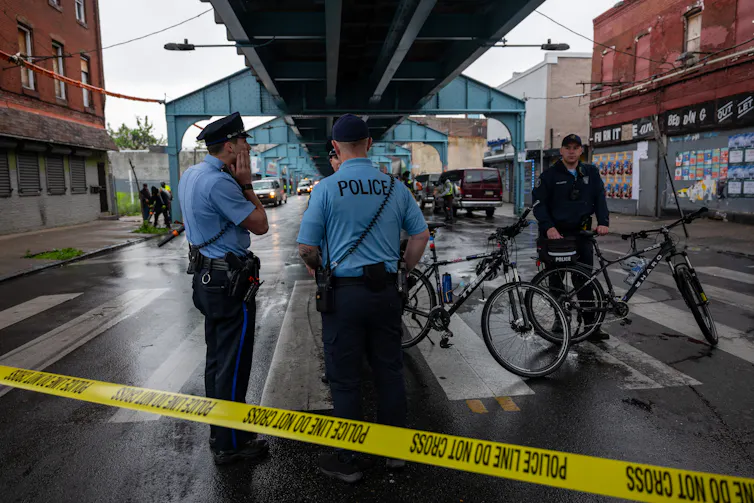
Uniformed police officers gather under underpass behind yellow police tape
Kensington is an area with high crime, poverty, drug activity and police presence.
Spencer Platt via Getty Images

A burden concentrated in disadvantaged communities

Our study found that ZIP codes with the highest rates of legal financial obligations shared several key characteristics. They had lower median household incomes, higher rates of shootings and arrests, and larger proportions of Black and Latino residents compared to the city’s average.

By contrast, neighborhoods with the lowest rates of legal financial obligations tended to have substantially higher incomes, lower crime rates and larger white populations. Most of these areas are in Center City.

When we examined the data on an even smaller geographic scale – census block groups – the relationship became even clearer. Even when accounting for population size, those areas with the highest concentrations of legal financial obligations were also more likely to have lower incomes and higher rates of violent crime and shootings. Statistical analyses confirmed that these patterns were unlikely to be random.

A block group-level choropleth map of the rate of legal financial obligations per 100,000 residents by quintile.
This map shows the rate of legal financial obligations per 100,000 residents by block group in Philadelphia. The highest concentrations are in North Philadelphia and Southwest Philadelphia.
Journal of Crime and Justice, CC BY-SA

More than a personal punishment

A growing body of research shows that criminal justice policies often concentrate their effects in specific communities. For example, researchers have identified “million-dollar blocks,” where governments spend enormous sums incarcerating residents from a single city block. Others have shown that aggressive policing practices disproportionately affect disadvantaged neighborhoods.

Our data suggests that legal financial obligations may work in much the same way. Court debt accumulates in neighborhoods that already struggle with poverty, violence and limited economic opportunities.

Even in treatment-oriented diversion programs in Philadelphia, our internal data shows that average total debt can range from US$500 to $800 and increase substantially if restitution is ordered. While any single penalty may not seem like that much, their accumulation across the justice process can be substantial.

As residents pay fines and fees, money is extracted from the communities that can least afford the loss. People who owe these criminal justice debts may rely on borrowing money from friends and family members. Some use their mortgages or property as collateral to pay the debt. This can put them at risk for foreclosure if payments are missed.

If court debt is concentrated in disadvantaged neighborhoods, policies that focus solely on individuals’ repayment may overlook broader impacts on the community’s housing stability, transportation and health.

Some advocates have proposed eliminating many fines and fees altogether, or redirecting the revenue toward communities most affected by criminal justice involvement.

We believe policymakers should consider reforms, such as finely tuned ability-to-pay assessments, reduced reliance on monetary sanctions and greater transparency in how fines and fees are imposed and collected.

While our study shows where legal financial obligations were imposed, it does not show how much money was assessed or how much remains unpaid. It also cannot determine whether legal financial obligations directly cause neighborhood disadvantage. It only shows that they are concentrated in places where disadvantage is already severe.

Regardless, the research highlights an often overlooked dimension of criminal justice policy. Court debt – and punishment generally – is typically viewed as an individual responsibility. Yet when thousands of cases are mapped across a city, a different picture emerges: one in which economic sanctions become a neighborhood-level burden.

Read more of our stories about Philadelphia and Pennsylvania, or sign up for our Philadelphia newsletter on Substack.

The Conversation

Jordan Hyatt receives funding from Arnold Ventures and the City of Philadelphia.

Clare Strange receives funding from the National Institute of Justice. She is affiliated with the Pennsylvania Commission on Crime and Delinquency.

Nathan Link receives funding from Arnold Ventures.

Brian Lawton receives funding from Arnold Ventures.

​Politics + Society – The Conversation

Categories
Uncategorized

5 lessons from 20 years of climate surveys: Political party matters, but it doesn’t explain everything

Voters of all ages come to climate policies with different views, and those views are not always tied to party affiliation. Scott Olson/Getty Images

Why would a young Republican back solar power but reject a carbon tax? Why would two Democrats agree that climate change is real but split over a policy that would charge households more if they exceeded a monthly limit on energy use?

Those patterns may go against the partisan rhetoric of our times, but they reflect the reality that Americans do not sort neatly into simple camps on climate change.

We study complex systems. In a new paper, we analyzed 20 years of Gallup environmental surveys, digging into individual responses from 2000 to 2020 that aren’t released to the public. We wanted to look beyond the usual headline that Democrats and Republicans disagree when it comes to climate change.

Rather than treating age, education, income and ethnicity as separate influences, we studied how they combine inside each party to shape climate beliefs and support for specific policies.

A large group of people of all ages holds U.S. flags while cheering
Belonging to the same party doesn’t necessarily mean holding the same views on climate policies, as 20 years of Gallup polls show.
Al Drago/Getty Images

This deeper, more nuanced view changes the story by identifying people as more than just their political affiliations. To be clear, political party is still the strongest divide, but it does not tell us enough on its own. The same policy can mean very different things to different people, even within the same party.

We found several enduring themes.

1. Climate polarization deepened after 2017

A broad partisan split already existed, but it sharpened after Donald Trump first won election to the presidency in 2016. In Gallup polling from 2017, concern about global warming jumped among Democrats and independents, while Republicans stayed far less worried.

In those first months, Trump moved quickly against Obama-era climate policies: His administration removed Environmental Protection Agency climate-related webpages, proposed deep EPA budget cuts and then moved to dismantle policies meant to reduce power plant emissions, while signaling that it would withdraw the U.S. from the 2015 Paris climate agreement, the international foundation of many climate actions. So the issue was suddenly much more visible and conflict-driven.

Our analysis shows that the greatest shifts in concern were among Democrats and independents, particularly those who worry about global warming, whether it is human-caused or natural, and whether it will threaten their way of life.

That matters because it suggests opinion on climate change and policy can be reshaped by political context.

2. Among Republicans, age is a major force

The biggest internal divide among Republicans was age.

Younger Republicans have often been much more open to renewable energy and much less supportive of fossil fuel expansion than older Republicans. In our data, Republicans ages 18 to 34 were more likely than older Republicans to oppose coal development and drilling in the Arctic National Wildlife Refuge. They also showed strong support for solar energy and alternative fuels.

Among some older Republican subgroups, support for oil exploration and nuclear power was much stronger.

Bars show a striking difference among Republican views on policies based on age.
Results from two decades of Gallup surveys.
Yidan Sun, The Conversation, CC BY-ND

This is more than a descriptive age gap. The survey responses suggest that within today’s Republican coalition, climate and energy preferences are being sorted through different priorities. Younger Republicans appear more open to future-oriented energy development, such as spending more government money on developing solar and wind power. Older Republicans are more attached to established energy systems and the economic language surrounding them.

3. Climate policy support depends on what the policy asks people to do

One of the clearest lessons from our analysis is that support for climate action depends heavily on the design of the policy itself.

Younger Republicans often supported renewable energy, but Republican-leaning respondents ages 18 to 54 still tended to oppose carbon taxes, which would raise the price of continuing to rely on fossil fuels. Support for solar panels or alternative fuels did not automatically translate into support for every climate policy.

That distinction helps explain why public opinion on an issue such as climate can look inconsistent when it is viewed as a monolith. People are reacting not only to climate change itself but also to what a policy signals about government, markets, fairness and personal cost.

This finding fits with earlier research on solution aversion: When threatened by a solution, a person’s belief in the problem itself may be challenged.

We found something similar across the political spectrum with proposals to legally limit household energy use. Those were unpopular not just with Republicans but also with many Democrats and other respondents who described themselves as concerned about climate change. Even people who accept that there is a problem may resist solutions that feel coercive or too close to everyday private life, meaning policies that interfere directly with daily household choices or bills.

4. Education does not erase the partisan gap

A common but mistaken assumption is that more education naturally leads to more agreement on climate change. Our results point to a messier reality.

Among Democrats, higher education was linked to stronger support for climate policies such as carbon taxes, emissions standards for business and industry, and renewable energy investment. College-educated Democrats were especially supportive of regulatory and tax-based climate policies, such as imposing mandatory controls on carbon dioxide emissions and passing a carbon tax to encourage people and industries to reduce their carbon dioxide emissions.

Among Republicans, education did much less to reduce skepticism about climate policies. Better-educated Republicans did not simply converge toward Democrats. In some cases, they remained skeptical of climate regulation even while showing support for technologies such as nuclear power.

Charts show the different role education plays in political views on climate policies by party based on 20 years of Gallup surveys
Results from two decades of Gallup surveys.
Yidan Sun, The Conversation, CC BY-ND

We believe that this is one of the most important analytical lessons in the study. Education is not just adding information into a neutral space. It is interacting with party identity. The same increase in education can deepen support for climate policy in one partisan context while leaving skepticism largely intact in another.

5. The biggest group is the ‘mixed middle’

The largest group in our analysis was not those most concerned about climate change or the skeptics. It was the mixed middle: people with complicated, sometimes inconsistent views.

That group matters because it suggests American opinions on climate change are polarized but not fixed. The surveys showed that this middle group was the largest of the three Gallup clusters: 10,617 mixed-middle respondents, compared with 6,682 who were highly concerned about climate change and 3,102 skeptics. Many people are neither fully convinced nor fully dismissive of the need for policies to counter the drivers of climate change. Their views depend on the issue, the framing of policy proposals – for example, whether it is presented as a tax or an incentive, a regulation or a technology investment – and the trade-offs involved.

If there is a practical takeaway from 20 years of climate surveys, it is this: Political party remains the strongest clue to how Americans think about climate change, but to understand where opinion might move next – and which policies might actually gain support – requires looking deeper than the party label.

The Conversation

Mayank Kejriwal receives funding from DARPA.

Yidan Sun receives funding from DARPA.

​Politics + Society – The Conversation
Categories
Uncategorized

Declassified intelligence is not the same as proof

Screens in the James S. Brady Press Briefing Room show President Donald Trump delivering a primetime address on July 16, 2026, during which the White House unveiled a collection of declassified documents. Alex Wong/Getty Images

President Donald Trump used a nationally televised address on July 16, 2026, to unveil a collection of declassified documents. He said these documents, which the White House posted online during the address, show serious vulnerabilities in American election systems, extensive Chinese acquisition of U.S. voter data, and an intelligence community effort to suppress reporting on those threats.

A common misconception is that declassification works like a curtain being pulled back: A “Top Secret” marking comes off, and the public sees the truth. In reality, a released record may be raw reporting, a fragment of a communication, a source’s claim or a draft assessment. Each carries a different relationship to reliability and analytic judgment.

I’m an international affairs professor with nearly 30 years of experience in the U.S. intelligence community, including executive roles in the Central Intelligence Agency, National Counterterrorism Center and National Security Agency. I would advise anyone reviewing this release – or any declassified intelligence – to keep one distinction in mind before drawing conclusions: Declassification changes who may see information, but it does not determine whether the information is true, important, current, corroborated or representative of the broader intelligence record.

The archive is not the assessment

The 17th-century French statesman Cardinal Richelieu is commonly credited as saying, “If you give me six lines written by the hand of the most honest of men, I will find something in them which will hang him.” It’s an apt warning here – not because intelligence collection is indifferent to truth, but because of what it deliberately preserves.

Intelligence agencies collect widely and retain material across a full spectrum of reliability, including reporting that was later contradicted, downgraded or explicitly discounted, because judging what matters is supposed to happen through analysis over time, not by declining to collect something in the first place.

In my experience, that means the government’s holdings almost certainly contain a report that appears to support nearly any serious allegation someone could make about a public official, a foreign government or a disputed national event – sitting alongside the later reporting and analytic judgment that determined how much weight, if any, it deserved.

Mistaking a document’s existence for proof of its content – without the context of what came after it – is, in my assessment, the most common way declassified material can get misread.

‘Intelligence report’ is misleading

The phrase “intelligence report” adds to the confusion. It is often used as though it describes one kind of document. It does not. A report might be an unevaluated database entry, a clandestine source account, an intercepted communication or a finished assessment such as the President’s Daily Brief. These documents sit at different points in the intelligence cycle: planning, collection, processing, analysis, dissemination and evaluation. Evaluation, though it’s listed as a step in the cycle, is continuous.

A human-source report includes both what a source said and how the intelligence officer handling that source assessed the source’s access, reliability and possible motives. Those judgments help analysts weigh the reporting. They do not make it definitive. A well-placed source can misunderstand what he heard. A generally reliable source can still be wrong.

Signals intelligence can create a different kind of false confidence. Intercepted communications can appear definitive, but a single intercept shows only that something was said. It does not establish that the speaker knew the truth, that the communication was complete or that later reporting supported it.

Finished intelligence exists to weigh those questions. Analysts compare reporting streams, test assumptions, identify gaps, assign confidence levels and state what remains uncertain. Finished products can still be wrong.

This is why intelligence work runs on a cycle, with evaluation happening at every stage, not only at the end. That discipline is what keeps flawed or incomplete information from being mistaken for settled fact.

The round seal of the Central Intelligence Agency is in front of a dark blue curtain and beside a US flag
Material held by agencies such as the CIA spans a wide range of reliability, from raw reporting to finished assessments.
Carolyn Kaster/AP Photo

What a declassification review exists to catch

That distinction matters in any declassification, but it becomes especially important when the process is rushed.

Removing a classification marking is only one part of the process. Review also asks what release might expose beyond the text: a human source, collection method, foreign liaison relationship, ongoing operation or analytic context needed to keep the public from being misled.

One document can also involve several agencies. A report about a foreign leader might draw on information from a CIA source, quote communications collected by the National Security Agency and discuss a diplomatic relationship managed by the State Department. Large-scale declassification is therefore normally interagency work, not simply the decision of one office.

The Biden administration’s decision to declassify intelligence on Russian preparations leading up to the February 2022 invasion of Ukraine moved unusually fast by intelligence standards. I was involved in that process while serving at the CIA. But the speed served a specific purpose: warning allies and shaping Russian calculations before an invasion occurred. The review process was compressed, not abandoned.

What to look for once something is released

Readers should ask practical questions when declassified material appears: Is this document raw reporting, an intercept, a source account, a draft or a finished assessment? Was it released with the caveats, later reporting and interagency review needed to judge its weight? If it is being used to challenge an intelligence assessment, does the release show how analysts evaluated that material, what other reporting they weighed and why they accepted or discounted it?

None of these questions requires assuming bad faith. They are the same questions intelligence professionals ask before turning information into judgment. A raw report in a classified system is evidence that something was reported. It is not, by itself, proof that the report was true.

The Conversation

Brian O’Neill does not work for, consult, own shares in or receive funding from any company or organization that would benefit from this article, and has disclosed no relevant affiliations beyond their academic appointment.

​Politics + Society – The Conversation

Categories
Uncategorized

What Allegheny County’s new court-ordered mental health treatment program can and can’t do

More than 5,000 Allegheny County residents are evaluated for involuntary psychiatric hospitalization each year. adamkaz/iStock collection via Getty Images Plus

Pittsburgh-area courts have a new tool for people in mental health crisis: the power to order treatment instead of incarceration or hospitalization.

Between 2015 and 2022, more than 5,000 people a year were evaluated for involuntary hospitalization in Allegheny County, and roughly 3,700 were committed. Fewer than half got follow-up outpatient care afterward, and 20% died within five years of that first evaluation. These deaths often trace to more than psychiatric illness – untreated medical conditions, substance use, unstable housing, poverty and limited care access all raise mortality risk too.

Assisted outpatient treatment is a shift from the county’s existing process for mental health crises, known as a 302 commitment.

A 302 is Pennsylvania’s process for involuntary emergency psychiatric evaluation and short-term hospitalization. Someone with firsthand knowledge – a family member, clinician or other person – can petition, describing behavior showing the person is a danger to themselves or others due to mental illness.

In Allegheny County, a mental health delegate typically authorizes the petition, though police or physicians can act directly in some cases. Once authorized, a physician examines the person and decides whether to admit them. If admitted, they can be held up to 120 hours. Extending treatment beyond that requires a separate court hearing. The process doesn’t require any follow-up care after release.

Not everyone qualifies for assisted outpatient treatment. To meet Pennsylvania’s criteria, a person generally must have a serious mental illness that significantly impairs daily functioning. Or they must have a history of repeated hospitalizations, incarceration or behavioral health crises and difficulty staying engaged in voluntary treatment.

I study poverty, mental health and access to social services among vulnerable populations, with a focus on racial justice and health equity, and I know that asking whether someone meets that bar is only the first question. What happens next depends on whether the services their plan calls for actually exist and are accessible. That’s not always the case.

How assisted outpatient treatment is supposed to work

Pennsylvania has allowed counties to adopt assisted outpatient treatment since 2018, but nearly all of the state’s 67 counties have opted out every year, citing cost and staffing concerns. Aside from Allegheny, only five counties – Bucks, Dauphin, Carbon, Monroe and Pike – have operational assisted outpatient treatment programs.

Allegheny County describes assisted outpatient treatment as a “step down” from inpatient care, a “step up” before a 302 becomes necessary, or a “step over” from the criminal justice system into civil treatment. It carries no criminal penalties – a judge can hold a review hearing, change the plan or order a new evaluation, but the person can’t be jailed for noncompliance alone. If someone becomes an immediate danger, the county can still use the 302 process.

Assisted outpatient treatment is intended to help people remain safely in their community while a court keeps the case open. An assisted outpatient treatment petition can be filed by a family member, provider or other concerned party. If a petition is granted, the order lasts up to 90 days.

A service coordinator tracks whether appointments, medication management, peer support and housing referrals are actually happening during this period. At the end of 90 days, the order can end or be extended if the person still meets the criteria. The need for treatment isn’t always just psychiatric. Other common needs include financial support, medical care, stable housing, financial support and transportation.

A person may leave the hospital with a referral, miss an appointment, stop medication or deteriorate again. Assisted outpatient treatment is meant to keep a team attached after the crisis passes: A coordinator reports to a judge, and missed appointments can trigger more hearings. Nonadherence alone can’t lead to jail, but a separate emergency commitment can still be filed if the person becomes a danger to themselves or others.

A sign reads 'outpatient clinic' above a doorway.
Assisted outpatient treatment is intended to help people avoid involuntary hospitalization.
Jeff Greenberg/Universal Images Group via Getty Images

On paper, Allegheny County has hundreds of mental health providers ready to see Medicaid patients. In practice, most of them aren’t reachable at all. Public funding – state, federal and county – covers most mandated psychiatric care, and most people leaving involuntary hospitalization rely on Medicare or Medicaid. Yet many still struggle to find care.

In a University of Pittsburgh simulated-patient study, 279 outpatient mental health providers in Allegheny County listed as accepting adult Medicaid. Out of that number, only 34 had available appointments, and more than 50% of patient calls went unreturned.

In other words, roughly 1 in 8 listed providers could actually see a new patient.

Even among Medicaid clients who eventually secured care, patients spent an average of 28 days searching for an appointment and another 19 days waiting to be seen.

Fewer hospitalizations, but why?

Allegheny County’s assisted outpatient treatment program is too new to evaluate on its own, but Pennsylvania isn’t the first state to try this approach to helping people with mental illness. California and New York have run similar programs for years. Their results, which depend heavily on whether people get timely community services, offer the best preview of what to expect.

A group of people sit around a table in a medical facility.
Participants in assisted outpatient treatment in Allegheny County are monitored by the court and care teams to ensure they’re attending the required therapies and following medical plans.
MediaNews Group/Reading Eagle via Getty Images

Most people referred under Laura’s Law in California never had to appear in court. Over 80% instead accepted voluntary services in 2023. Even those who went through the court process improved: Homelessness, hospitalizations, police contact, violent behavior and substance use all declined, while employment rose.

Still, a 2020 state audit found that many Californians cycled through repeated involuntary hospitalizations without ever being connected to ongoing care.

On the other side of the country, Kendra’s Law in New York showed similar gains: lower hospitalization and treatment costs in its first two years, as crisis use fell and outpatient care rose. But a 2024 state audit found the program was often slow to check on people and get them into treatment, with some court orders lapsing before renewal.

Several studies suggest people’s daily functioning often improves once assisted outpatient treatment begins. They have fewer hospitalizations, less crisis-service use, fewer interactions with law enforcement and stronger connections to care providers and community supports.

A 2025 peer-reviewed evaluation followed 392 clients in federally funded assisted outpatient treatment programs across several states. The evaluation found that participants were more likely to attend appointments and take medications. They reported improved symptoms, life satisfaction and stronger relationships with their care teams. They also had fewer hospitalizations and arrests, and they reported less illicit drug use, homelessness, suicidal thoughts and violent behavior.

What to watch

Assessing the success of assisted outpatient treatment in Pennsylvania requires asking not just whether it “works,” but which part is doing the work. A typical plan is a bundle of legal pressure, service coordination, provider accountability and community supports, and these vary widely by location.

Before assisted outpatient treatment launched, Allegheny County gathered feedback from 58 people with lived experience of the behavioral health or justice systems. Participants saw potential value in assisted outpatient treatment as a way to help people stay in or return to the community instead of cycling through jail or inpatient care – but also raised concerns about service speed and deepening contact with police.

A large, old stone building in the middle of a city.
Because assisted outpatient treatment is a civil process, individuals are not held in contempt of court or punished for not following the plan.
Gene Puskar/AP

Allegheny County’s public dashboards offer a way to monitor what’s changing as assisted outpatient treatment rolls out. Suicides were 14% lower from January through June 2026 compared to the same months in 2025. At the same time, however, 302 petitions rose 5.3% year over year and upheld petitions rose 2%.

None of this shows the direct impact of assisted outpatient treatment. The program launched in January, and there’s likely an adjustment period as professionals, families and community members learn how to use it. For now, these are early indicators worth continuing to track.

Assisted outpatient treatment may help some people avoid incarceration, hospitalization or other restrictive measures, but only if Allegheny County addresses the severe shortages of community mental health services and supports.

The Conversation

Erica Maloney does not work for, consult, own shares in or receive funding from any company or organization that would benefit from this article, and has disclosed no relevant affiliations beyond their academic appointment.

​Politics + Society – The Conversation

Categories
Uncategorized

Most Americans support conservation – here’s how the Great Lakes Restoration Initiative got politicians from both parties on board too

A person walks the trail along Lake Michigan at Chicago’s North Avenue Beach. AP Photo/Charles Rex Arbogast

In a time of political polarization, it’s easy to forget that the vast majority of Americans of all backgrounds and beliefs – 80% or more, depending on the poll – value environmental conservation. However, this support is not easily or often translated into successful, popular initiatives.

One success story is the Great Lakes Restoration Initiative. Since 2010, it has provided over US$5 billion to improve the quality of the region’s environment, with an overarching goal of cleaning up the water in the Great Lakes watershed. And it has survived multiple attempts to reduce its funding or eliminate it altogether.

As a water policy and politics expert and a former leader in the Great Lakes advocacy community who has worked on and analyzed the initiative, I worked with environmental historian and Great Lakes expert Marc Gaden along with a team of graduate students to comprehensively assess the initiative and determine useful lessons learned for other projects in conservation and beyond.

A bit of background

The Great Lakes contain approximately 20% of the world’s available surface freshwater, providing drinking water to over 40 million people in the U.S. and Canada and billions of dollars annually in economic activity and ecological productivity.

Throughout most of the 20th century, the ecosystem in and around the lakes was degraded and contaminated due to raw sewage, industrial waste, invasive species, loss of natural habitats and runoff pollution from development, among other issues.

Many problems remained even after the major environmental and Great Lakes laws of the late 20th century took effect. The Great Lakes Restoration Initiative has funded more than 8,000 specific projects, focusing on cleaning up especially toxic locations, controlling invasive species, restoring natural habitat and educating the next generation of leaders.

Government reports, public opinion polls, economic analysis and many other accounts suggest that the initiative has not only been successfully implemented and popular but has led to positive results for water quality, habitat restoration and wildlife while boosting the local and regional economy.

A close-up of a person's hand holding several small black-and-white shells.
Invasive species, like these zebra mussels taken from Lake Michigan, are just one problem plaguing the Great Lakes region’s ecology.
AP Photo/John L. Russell

Deep connection

But these results didn’t happen by accident, and they weren’t inevitable. Our research team identified converging forces, some unique to the Great Lakes but many broadly applicable, that led to this success.

Underlying each force is the iconic status of the waters themselves. People in the region feel a deep attachment to the lakes and the quality of life they enable, with more than 50% of residents engaging in walking/hiking, swimming, boating or simply being with family and friends along the lakes. As U.S. Rep. Bill Huizenga, Republican co-chair of the Great Lakes Congressonal Task Force, said in mid-July 2026: “The Great Lakes aren’t a Republican issue or a Democratic issue. They’re an economic engine, a source of drinking water for millions of people, and part of our way of life here in Michigan. Protecting them is something we can all rally around.”

A 2024 poll of a random sample of more than 2,500 Americans and Canadians found 96% of the region’s residents think it’s important for governments to invest in protecting the Great Lakes – a level of near-unanimity unheard of for other issues.

A prominent launch

Shared identity and popular support are not enough to launch a major government effort without a spark and a plan.

In 2004, President George W. Bush – in part driven by the swing state electoral power of the Great Lakes region – signed an executive order declaring the Great Lakes to have “national significance” and launching the Great Lakes Regional Collaboration Strategy. Developed over the course of a year through work groups involving more than 1,500 people combined with public input sessions, the strategy laid out common goals for restoration and prioritized a list of needs, such as funding to clean up toxic hot spots and sewage overflows, which was critical to securing congressional support for funding.

A person stands on a flat area and holds a fishing rod out over a body of water with a city skyline in the background.
Fishing, even in cold temperatures, is popular in the Great Lakes region.
AP Photo/Nam Y. Huh

Diverse allies

A plan for restoration – even for an iconic resource – will not garner billions of dollars in federal funding without significant bipartisan support from all levels of government and strong community support.

Those speaking up for the new program were “not simply one group or one voice. It was governors, mayors, the NGO community and tribes,” David Naftzger, executive director of the Great Lakes St. Lawrence Governors & Premiers, which works with all the chief state and provincial executives across the region, told our research team.

Business leaders have been particularly crucial backers. They relay to lawmakers the economic value of restoration projects, providing political cover for a program that increases government spending.

The broad range of support continues today and has helped the initiative weather various efforts to reduce or eliminate its funding.

Most famously, in 2019, President Donald Trump proposed cutting the initiative’s funding by 90%. Three weeks later, while traveling with Trump to a political rally in Michigan, three Michigan congressional Republicans explained how critical the Great Lakes Restoration Initiative is to the region’s identity and economy, and how popular it is. At the rally, Trump reversed course and announced he would support keeping funding levels at US$300 million per year, promising to “make the Great Lakes great again.”

At a Washington, D.C., event celebrating the Great Lakes in 2023, I saw JD Vance, then a Republican U.S. senator from Ohio, and U.S. Sen. Debbie Stabenow, a Michigan Democrat, proclaim that while they may not agree on much, they are united in their support for the Great Lakes Restoration Initiative.

A large round building emerges from the surface of a body of water covered in green algae.
Algae blooms, like this one in Lake Erie in 2014, have been common problems in the Great Lakes.
AP Photo/Haraz N. Ghanbari

Clear communication

Our analysis found that initiative supporters have been organized and disciplined about how they talk about the program and the overall goals. State officials, local leaders, tribal nations, nonprofit groups and businesses all deliver a “coordinated, consistent kind of beating of the drum,” Erika Jensen, executive director of the Great Lakes Commission, told our research team.

This includes not only the many positive stories of success but also the economic benefits. A University of Michigan study that showed the Great Lakes Restoration Initiative boosts the region’s economic output by more than $3 for every dollar of federal spending is used often to make this case.

These coordinated messages allow political leaders to tie the initiative into their priorities and build support across diverse audiences. One key reason for this kind of powerful communication is that the initiative funds work in every congressional district in the Great Lakes watershed, so every member of Congress in the region can say they brought home federal money to make significant improvements in their own districts.

‘Secret sauce’

The Great Lakes Restoration Initiative pays for community-based work on local lands and waterways – it does not regulate industries or tread into particularly controversial territory.

Everywhere has places that need help, cleanup and care. These ecosystems are relatively easy to build support for, and when connected with other projects across a wide region, these smaller efforts can make a significant difference in environmental quality and quality of life while building political and community support for even bigger undertakings.

I believe that many of the core lessons and converging forces that make up the Great Lakes Restoration Initiative’s “secret sauce” can be applied not only to the future of the Great Lakes but to conservation initiatives across the U.S. and the world. And they may even be able to help restore bipartisanship to at least some parts of U.S. politics.

The Conversation

Mike Shriberg previously worked at the National Wildlife Federation, which received external funding from foundations and private donors to work on the Great Lakes Restoration Initiative. The research highlighted in this article is supported by grants from the Wege Foundation and the Joyce Foundation.

​Politics + Society – The Conversation

Categories
Uncategorized

Featuring Trump on US coins and bills would put America in rare company

Treasury Secretary Scott Bessent holds up an image of the proposed $250 bill in May 2026. Jacquelyn Martin/AP Photo

A slang term for cash money is “dead presidents.” But now the very much alive President Donald Trump could appear on U.S. coins and banknotes, too.

Ever since Trump returned to power in 2025, his administration has put the president’s face and name on all sorts of things, from federal buildings to national park passes. Putting him on the almighty dollar would be the crowning achievement of these efforts. After all, the value of physical U.S. currency in circulation today stands at over US$2.46 trillion, an all-time high.

If a sitting president’s portraits start appearing on U.S. currency, what would this change say about American political culture?

Treasury Secretary Scott Bessent has said he doesn’t “think that there’s anything untoward” about the idea, while Democratic Sen. Jeff Merkley has said, “President Trump’s self-celebrating maneuvers are authoritarian actions worthy of dictators like North Korea’s Kim Jong Un.”

As a professor of international relations who has studied the global evolution of currency iconography for over 20 years, I take a worldwide perspective on this debate. The data that I have amassed shows that such a choice by the U.S. would be out of step with nearly every other currency in the world.

All about the Benjamins – or the Donalds?

The Trump administration has been incredibly active on the currency front.

In January 2026, Trump’s handpicked commissioners of the U.S. Commission of Fine Arts, a federal agency that advises on design and aesthetics, recommended designs for a circulating $1 coin featuring Trump’s head. The commission later also recommended a different portrayal of Trump for a 24-karat gold commemorative coin that it suggested making “as large as possible.” These coins were supposed to be ready for July 4, but production delays at the U.S. Mint have pushed the release date back.

The administration is also preparing Trump-branded banknotes. In March 2026, the U.S. Department of the Treasury announced a historic first: From now on, the president’s signature will be on newly printed paper dollars.

In April, the Treasury Department abruptly reassigned the director of its Bureau of Engraving and Printing, Patricia Solimene, after she had refused to advance a $250 bill with Trump’s face on it, according to The Washington Post.

“The buck stopped here,” Solimene wrote in a goodbye email to colleagues. But after her reassignment, the buck started again. In May, Bessent publicly displayed a $250 bill design featuring Trump – even while acknowledging that the new bills cannot be printed until Congress changes the 160-year-old law against depicting living persons on U.S. paper currency.

The Donald J. Trump $250 Bill Act, a measure to amend the law, is awaiting further congressional action in the House Committee on Financial Services. Treasury claims it already has the legal authority to mint its Trump coins.

Examining the world’s coins

Putting the sitting president’s face on coins would be a dramatic departure from U.S. tradition. The only previous such instance in the country’s history was a 1926 commemorative half-dollar showing then-President Calvin Coolidge alongside George Washington.

But what about other countries in the contemporary world? How normal is it for their sitting leaders to appear on their coins?

Using the most recent edition of Coin & Mint News’ Directory of Circulating Coins – a standard reference for coin professionals working at national mints and central banks – I counted the images of sitting state leaders on the circulating coins of the world as of 2024. (Note: This data has not yet gone through rigorous peer review.)

Analyzing nearly 1,000 coins from 165 independent countries, I counted only 22 countries – about 13% of the total – whose circulating coins feature their sitting head of state. This number includes coins depicting heads of state who were in office when the coin was originally issued, whether or not they were still there in 2024.

Almost all the sitting heads of state who appear on the circulating coins that I analyzed are hereditary monarchs.

If a country is a hereditary monarchy – whether its political system is democratic, like the United Kingdom, or authoritarian, like Brunei – there is a high chance that its reigning king or queen is on its circulating coins. This is the case for about 62% of the monarchies in my database, or 21 out of 34.

On the other hand, if a country is not a hereditary monarchy, its sitting head of state is almost certainly not on its circulating coins. This is the case for 99% of the nonmonarchy countries in my database, or 130 out of 131.

The lone exception is Samoa, a parliamentary democracy whose circulating coins all feature the country’s head of state as of 2011, the coins’ original year of issuance. However, even Samoa is hardly an exception, as its political culture has many of the trappings of a monarchy: Its head of state is called “His Highness,” and he is traditionally chosen from among the country’s four paramount chieftains.

A view of bank notes – £5, £10, £20 and £50 – issued by the Bank of England, against a white backdrop
Bank notes issued by the Bank of England feature King Charles III.
Gareth Fuller/PA Images via Getty Images

Examining the world’s banknotes

A similar story emerges from my data on banknotes.

Using Bank Note Museum – a free online catalog crowdsourced from a network of banknote collectors – and supplementing that data with information from Greysheet publications’ paywalled catalog The Banknote Book, I created a database of all the circulating banknotes in the world that were newly designed and issued between 2019 and 2024.

According to my data, 84 independent countries issued 340 new regular circulating banknotes during the chosen time frame. Yet only 13 of those countries – about 15% – issued new banknotes depicting their sitting head of state. All but one of the 13 countries that did so are hereditary monarchies.

The lone exception to the rule is Botswana, a democratic republic that has traditionally featured the sitting president’s portrait on its 10 pula banknote denomination. However, Duma Boko, Botswana’s president since late 2024, is still waiting for his 10 pula note.

US currency: Fit for a king?

Today, almost every country that isn’t a hereditary monarchy is declining to issue currency that features its sitting head of state. Since the U.S. isn’t a hereditary monarchy, putting Trump’s face on U.S. currency while he is still in office would be highly abnormal.

The nationwide “No Kings” protest movement has mobilized millions of Americans to march the streets in opposition to what they perceive as Trump’s monarchical ambitions. The global patterns of currency iconography suggest that they might have a point.

University of Southern California undergraduate student Anyi Tan contributed to this research.

The Conversation

Jacques Hymans does not work for, consult, own shares in or receive funding from any company or organization that would benefit from this article, and has disclosed no relevant affiliations beyond their academic appointment.

​Politics + Society – The Conversation

Categories
Uncategorized

How America’s newspapers lost their voice

What happened to newspaper editorials? RapidEye, iStock/Getty Images

Hazel Brannon Smith was almost certainly the most unpopular woman in Mississippi when she wrote an editorial in 1963 lambasting the racist White Citizens Councils in the Lexington Advertiser, a newspaper she owned.

“The hierarchy of rulers in this totalitarian-like organization permit no deviation from its official line – and those who believe in and stand for the traditional American concepts of human liberty, dignity, and decency, do so at their own peril,” she wrote in an editorial that was both poetic and dangerous.

A dark-haired woman wearing a strand of pearls and a dark top, speaking into a microphone.
Hazel Brannon Smith, who won a Pulitzer Prize in 1964 for her courageous editorials crusading against white supremacists in the South.
Bettman/Getty Images

The councils constituted a network of white supremacy groups throughout the South, often with deep ties to prominent local citizens. They had already been targeting Smith with economic pressure, not for being a full-throated integrationist – she wasn’t – but for editorials in which she insisted on adherence to the rule of law, demanded fairness for all and encouraged peaceful race relations.

Smith paid a steep price for her courage.

Death threats, arson in her
pressroom, boycotts and even the firing of her husband
as a hospital administrator did not temper her fight for liberty and justice. She became the first woman to win a Pulitzer Prize for editorial writing, in 1964.

Smith’s story is inspiring, yet by no means an isolated instance. But the long history of newspaper editorials may now be about to end, a casualty of both changing news values and economic pressure.

From calls for reform to partisan attacks

Since the birth of this nation, newspapers large and small have published their own opinion pieces challenging the powerful, calling for reform and demanding accountability. The editorials weren’t always constructive. There were plenty of editorials criticizing Smith, and others were partisan attacks. But many reflected care for the community and calls for a better future.

Editorials – in their ideal form – are essentially letters from the newspaper itself to its readers explaining a problem, outlining the facts and then concluding what would be in the best interests of the community. You can agree or disagree, but the end result is that you gave it some thought, which is what the editorial writer intended anyway. Typically, the opinion is written by one journalist in consultation with the publisher, editor and knowledgeable colleagues, and relies in good part on the newspaper’s own reporting.

In 1841, publisher Horace Greeley pioneered the stand-alone editorial page in the New York Tribune. The innovation, which separated the newspaper’s views from news articles, was widely adopted by other publishers.

Over the past 185 years, newspaper editorials have played a role in virtually every important social and justice movement in American history. William Lloyd Garrison’s call for the abolition of slavery in the Boston-based Liberator and the battle for women’s suffrage spearheaded by Susan B. Anthony and Elizabeth Cady Stanton in The Revolution in New York City presaged and helped inspire similar calls for justice in the pages of local papers across America.

A photo of the top of a newspaper called 'The Revolution' includes the paper's motto: 'Principle, Not Policy: Justice, Not Favors.'
The masthead of The Revolution, the newspaper run by Susan B. Anthony and Elizabeth Cady Stanton, in which they advocated for women’s rights.
encyclopediavirginia.org

And when President Franklin Roosevelt ordered the internment of American citizens of Japanese descent in 1942, just one newspaper – The Bainbridge Review, on Bainbridge Island, Washington – called it out as the unconstitutional act it was. The paper saw the rounding up of citizens in its own community and would not stand silent.

Losing the newspaper’s soul

During my career as editor-in-chief of USA Today and daily newspapers in Wisconsin, Florida and New York, I’ve reviewed thousands of editorials. I can tell you that on the local level, newspaper editorials tend to be about more mundane and yet essential topics like supporting local schools, monitoring the use of taxpayer dollars and calling out ineffective government processes.

In his book “Outrage, Passion & Common Sense” on historic editorials, journalist Michael Gartner began by quoting legendary journalist William Allen White on their importance:

“The editorial is the soul of the newspaper. Maybe the heart and the soul. And on a good newspaper that knows and understands and loves its hometown, or its home country, the editorial is the heart of the town, or nation as well.”

Unfortunately, in a trend that began four years ago, editorials are quickly disappearing. Nominations for the Pulitzer Prize for editorials peaked in 1995 with 101 entries, but declined to just 25 this year, according to Pulitzer Prizes administrator Marjorie Miller. This led to combining editorials with other opinion pieces into a single category moving forward.

Major news companies have backed away

Some news companies have concluded that local editorials aren’t in their interests. Editorials and endorsements have largely been jettisoned, along with the men and women who used their institutional knowledge to look out for their communities.

Gannett, now USA Today Co. Inc. and the largest newspaper company in the U.S., and Lee Enterprises, the third largest, led the scaling back of local editorials beginning in 2022.

“In their place, the (Lee) company distributed to its papers standardized editorial pages consisting of commentary from national columnists and its editorial board, wrote Paul Farhi for Nieman Reports when the change was made. “The change might have been a boon for those seeking yet another opinion about presidential politics, Congress, and international affairs, but it did little for commentary about events occurring down the street from Lee’s 77 daily newspapers.”

Gannett was candid about its reasons, saying that editorials were “frequently cited” by readers as a reason for canceling their subscriptions. Speaking truth to power was affecting the bottom line.

A group of Gannett editors were also quoted as saying, “Readers don’t want us to tell them what to think,” according to The Washington Post.

In my experience, that’s a straw man. Good editorials don’t dictate. They’re actually a balancing of ideas, looking out for a community with the perspective of a longtime and loyal resident who has seen it all. In fact, USA Today pioneered dual editorials, one offering its view, the other a differing perspective.

The front page of The New York Times, featuring an editorial.
An unusual front page editorial in the Dec. 5, 2015, edition of The New York Times, the first time the paper placed an editorial on the front page since 1920.
Paul Richards AFP/Getty Images

The public wants accountability

Granted, local editorials will yield fewer online clicks than major news or sports stories. But recent research indicates that readers remain hungry for the public accountability of government officials.

“As they have for the past four decades, most Americans say criticism from news organizations keeps political leaders from doing things they shouldn’t,” a Pew Research study found in 2024.

Despite the steady decline in daily newspaper editorials, I believe there remain ways for news organizations to restore the spirit of editorials in an economical and high-impact model. Some suggestions for today’s newsrooms:

1. Publish editorials on an as-needed basis. They don’t have to appear daily, but if published only when something absolutely needs to be addressed, the community will take notice. Give them the authoritative local take that no one else can.

2. Create a community editorial board composed of civic-minded residents with distinct and diverse viewpoints and open minds. Identify the most important issues facing your community and ask the board members to explore them, looking for consensus, but acknowledging legitimate points from all sides. Publish an editorial at least once a month and promote it heavily.

3. Collaborate with any other news outlets in your town to reinstate endorsement interviews. In a decades-long tradition, newspapers routinely invited incumbents and those running against them to discuss why they would best serve the community. Ask the tough questions and leave it to each outlet how to use the end product. That could lead to differing endorsements by different outlets or simply a comprehensive Q&A that the entire community sees. Public officials would be hard-pressed to skip the interview if their opponents’ views are getting broad local exposure.

Any one of these approaches would help reinstate the accountability of public officials at a fraction of the costs once incurred by legacy news media.

In 1791, the first generation of Americans demanded that freedom of the press be part of the Constitution, counting on journalists to serve as a check on corruption and the abuse of power. Some debts are never fully paid.

The Conversation

I have no ties to research institutions, foundations or news sources cited in this article. There are two companies cited as leading the phase-out of editorials. I edited USA Today and other Gannett properties, as noted in the column.

​Politics + Society – The Conversation

Categories
Uncategorized

Republicans control Congress, so why is Trump’s SAVE America Act stuck?

Republican Rep. Ralph Norman joins members of the conservative House Freedom Caucus at the Capitol in June 2026 to criticize the Senate for not acting on the Save America Act. The act is stuck in limbo between the U.S. House and Senate. J. Scott Applewhite/AP Photo

President Donald Trump’s obsession with unfounded claims of election fraud has defined his second term in office. But in recent months his fixation has moved from executive nominee litmus tests and executive orders reinforcing proof of citizenship to vote into legislation – dragging Congress into the fray.

The Safeguard American Voter Eligibility Act, or the SAVE America Act, featured heavily in Trump’s primetime speech on July 16, 2026.

It’s become the focus of the administration in recent months, eclipsing prior legislative efforts by proposing stringent and widespread voting changes. The proposed law, which would federalize elections, require additional documentation in order to vote and curtail mail-in registration and ballots in all states, faces major logistical, legal and political hurdles.

The act, which is stuck in limbo between the U.S. House and Senate, has dominated and derailed the summer’s legislative calendar. In the House, Republican members delayed votes on major legislation in an effort to pressure the Senate to take the bill up for a vote, and it has become a sticking point in other unrelated legislation.

The controversial act has also soured the relationship between Trump and members of his party, leading him to refuse to sign a bipartisan housing bill passed by Congress. Although the bill became law without his signature, Trump’s preoccupation with the SAVE America Act ultimately denied congressional Republicans an opportunity to tout a bipartisan, popular policy win.

Yet, despite mounting political pressure, Congress hasn’t budged.

This tension between Trump’s priorities and congressional inaction is noteworthy because Republicans control both chambers. But as a political scientist who studies the evolving power of congressional leadership, I find inaction on the SAVE America Act to be more than a reflection of Trump’s waning popularity among Republican lawmakers. Rather, congressional hesitation on what would be the largest election reform in decades reflects an awareness of constituent needs and lawmakers’ own reelection risks.

What’s the latest?

House Republicans have been quick to blame the Senate – and the 60-vote filibuster threshold the legislation must overcome to receive a vote on the Senate floor – for the inaction.

House Speaker Mike Johnson has brought the legislation to the floor for at least three votes in an effort to pressure the Senate to take up the legislation. In July 2026, Johnson took a more creative approach, relenting to conservative lawmakers by including portions of the SAVE America Act in a House-passed bill to fund the State Department.

These actions are largely theatrical. Senate Majority Leader John Thune has said since February 2026 that there aren’t enough votes to move the SAVE America Act through the Senate, telling Fox News in June that “the votes currently aren’t there.” Although Senate Republicans could vote to remove the filibuster, which Trump has also requested, they have not.

Even in the House, the slim margins of Republican control have made it challenging for Johnson to keep the party together on the controversial issue. And Johnson’s gambit to attach the SAVE America Act to important legislation risks not only derailing bipartisan policy but another government shutdown, too.

If Republicans were serious about electoral reform, including moderate reforms that the majority of Americans do support, their approach would be like that used for other major legislation: bipartisan. Instead, partisan passage of a controversial bill, with a known Senate blockade, presents half-hearted strategy that avoids true responsibility.

Republican House Majority Leader Steve Scalise speaks to reporters about the SAVE America Act in February 2026.
Tom Brenner/AP Photo

Legal and logistical hurdles

The SAVE America Act would be confusing, time-consuming and expensive, and it would not provide funding to help states implement changes.

Changing election processes warrants precision and time, too. As Republican Sen. Thom Tillis noted, “Do you honestly believe that we can have this thing up in 50 states? There’s no funding. There’s no specific implementation instructions.”

Beyond logistics, the legality of federalizing election processes is murky.

Congress does have the power to mandate election requirements. But under Article 1, Section 4, of the Constitution, while Congress can outline parameters, states are responsible for election administration.

For example, the National Voter Registration Act of 1993 reinforced citizenship as a requirement, but states maintained responsibility for creating their own form and enrollment process. The SAVE America Act attempts to circumvent this by requiring federal possession of voter rolls.

Uncertainty for American citizens

Beyond legal challenges, the SAVE America Act introduces very real implications for American voters – and the members of Congress who represent them.

While the act’s stated goal is to ensure only citizens vote, citizenship requirements for voting are already federal law. In practice, many scholars believe the bill would make it more difficult for eligible voters to engage in the democratic process.

For rural Americans, most of whom are represented by Republican members of Congress, the act would sharply restrict mail-in registration and mail-in voting. More than 5 million Americans would need to drive an hour or more to register to vote, with some voters facing drives as long as eight hours.

For women who changed their name after marriage, a trait more likely to be associated with Republican women, voting would require marriage certificates in addition to birth certificates.

First-time voters, young voters on college campuses and voters who have recently moved could also face the hurdle of finding and presenting this documentation in person.

Members of Congress, particularly those who represent rural areas, are likely aware of this reality. Disenfranchising or, at best, confusing their voters risks their own electoral success, too.

Safety and security of upcoming elections

One of Trump’s first acts following the Supreme Court’s ruling in Trump v. Slaughter in June 2026, which allowed the president to remove executive branch officials without cause, was to fire the remaining members of the bipartisan, Senate-confirmed Election Assistance Commission.

The agency is the point of contact for states regarding election administration processes, offering resources, guidance and expertise on voting logistics. If the SAVE America Act were to pass, this office would be integral to ensuring changes are unbiased and fair across all 50 states.

Coupled with warnings that Trump may invoke emergency powers over election administration, aggressive actions by the Department of Justice to control voter rolls, partisan redistricting, and now a vacated election commission, the SAVE America Act risks further disrupting elections. All while these elections have already been secure and overwhelmingly free of fraud.

As Tillis noted to reporters, “They’re being disingenuous to suggest to the American people they could possibly be operational by this election. And so then it begins to make me wonder … if we’re just beginning to undermine the underlying integrity of any of our elections. And I think that’s dangerous, and I think it’s wrong.”

Trump’s grip on Republicans

Does Congress’ hesitation to pass the SAVE America Act reflect a weakened Trump grip on the Republican party? Possibly. The president is more unpopular than he has been at any point during his second term. Ignoring Trump on the SAVE America Act may be a risk worth taking to some members.

But for most Republican members of Congress, appeasing Trump remains key to primary and electoral success. The president’s record on primary endorsements – even for Senate incumbents – remains strong, as he continues to define the party. Among constituents, some provisions of the SAVE America Act are popular among MAGA-aligned voters, making it an important electoral issue for members representing deep-red districts.

By publicly supporting the act, but relying on the Senate to serve as a doorstop to House-passed legislation, Congress falls into a familiar pattern that allows conservative members to appeal to the president while using procedure to block legislation that would make major changes to voting, mere months from Election Day.

Congress’ hesitance to pass the SAVE America Act is more than a test of its relationship with Trump. It’s an example of Congress doing what it was intended to do: represent its constituents.

The Conversation

SoRelle Wyckoff Gaynor does not work for, consult, own shares in or receive funding from any company or organization that would benefit from this article, and has disclosed no relevant affiliations beyond their academic appointment.
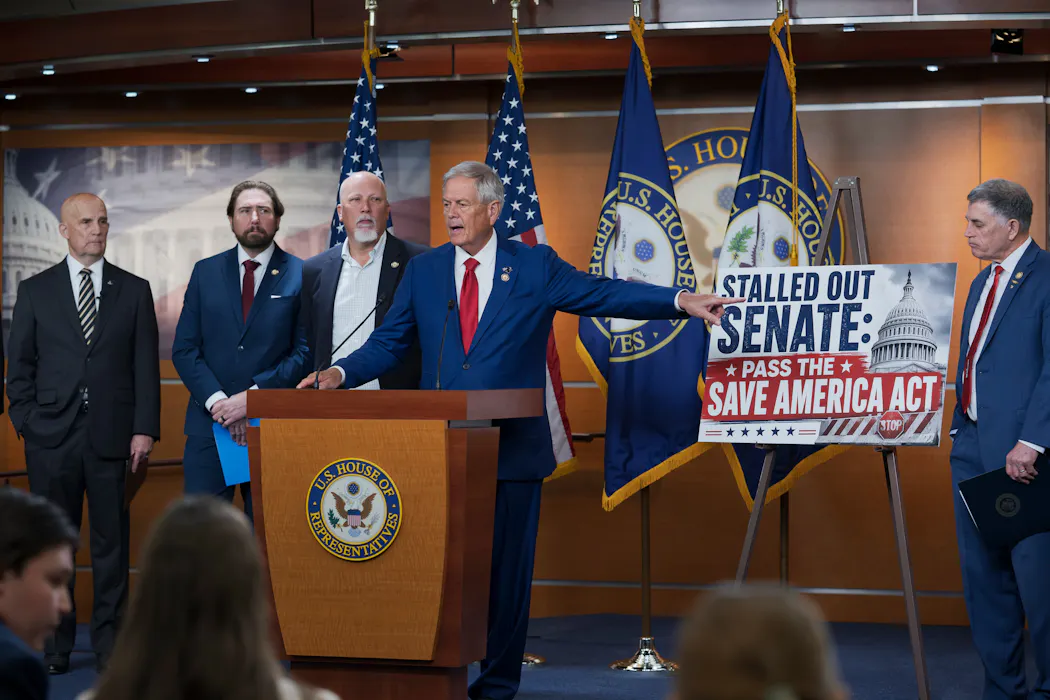
​Politics + Society – The Conversation