Categories
Uncategorized

Nearly half of Detroit seniors spend at least 30% of their income on housing costs − even as real estate values fall

The high costs of maintaining a home can put Detroit seniors at risk. Nick Hagen/The Washington Post via Getty Images

For Detroit homeowners over 65 who overwhelmingly live on fixed incomes, unexpected costs – increases in grocery prices, rising health care premiums or an emergency repair – heighten their risk of financial instability and can even lead to them falling into poverty.

I am a policy researcher at Poverty Solutions at the University of Michigan. Our initiative uses action-based research, an approach that seeks to understand real-world problems and inform policy changes that could make life work better for people with low incomes. The center recently examined data from the 2023 American Community Survey to explore how low-income seniors in Detroit are affected by declining housing values and high housing costs compared to seniors across Michigan.

Federal, state and local programs to help seniors with these costs are already strained. As the population of older adults in metro Detroit continues to grow, demand for support services, such as caregiving and healthy meal programs, will likely increase.

Housing cost burdens are more acute for Detroit seniors

The poverty rate of senior-headed households in Detroit is nearly twice as high as the rate statewide.

Detroit seniors, both owners and renters, are more likely to be housing cost-burdened than Michigan seniors overall, with 45% paying more than 30% of their income on housing costs compared to 31% of seniors statewide. This is partially driven by lower median incomes in the city compared to the state.

Even when we focus on the seniors who would be considered the most financially stable, those who own their homes free and clear, the proportion burdened by housing costs is twice as high as the state: 32% versus 16%.

Detroit seniors pay more for property taxes and utilities

Lower incomes aren’t the only thing driving the higher housing cost burden. Detroit seniors pay more for all homeownership costs, including utilities – not only as a proportion of home values and income, but also in terms of real costs.

Detroiters face higher rates for auto insurance, and they pay more for utilities, compared to others in the state, adding to a situation where many residents, especially seniors on fixed incomes, struggle to make ends meet.

While the cost of living in urban areas is often higher compared to suburban and rural places, my analysis found that comparative costs for insurance, water, electricity and gas are lower in cities such as Milwaukee and Pittsburgh, which points to systemic issues that might be unique to Detroit.

Insurance and property taxes are also higher for seniors in Detroit compared to seniors across the state, especially relative to median home values. Detroit seniors pay the same or slightly more for these essentials despite living in homes that are worth less, based on the analysis.

The median house value for senior property owners in Detroit is $65,000, compared to $170,000 for seniors in Michigan.

High property taxes and insurance rates drive costs

Detroit lost over half a million residents between 1980 and 2020, causing an oversupply of single-family housing stock and a steady drop in home prices.

As residents left and businesses followed, the property tax base eroded. To generate the same revenue as cities with a richer tax base, Detroit levies property taxes at relatively high rates. Detroiters face a property tax rate close to 3%, significantly higher than the national average of 1.38%.

The housing market in Detroit has seen such large declines in property values that a disconnect has emerged. The replacement cost of a home, which is the actual expense required to reconstruct the dwelling, is often substantially higher than its current market value. This makes the cost of homeowner’s insurance disproportionately expensive relative to the market value of a home in Detroit.

A property’s condition and the condition of neighboring properties also raises the cost of homeowner’s insurance because insurance premiums are primarily influenced by the risk associated with insuring a property. Poor property and neighborhood conditions limit the availability of homeowner’s insurance, driving those who want homeowner’s insurance to purchase costly policies from insurers of last resort, or companies that provide coverage to people who cannot obtain it through other means due to high insurance risks.

The high cost drives many Detroit residents to forgo homeowner’s insurance. According to my analysis, almost 35% of Detroit seniors do not insure their homes, putting their main financial asset at risk.

Big utility bills

Utility bills in Detroit are higher compared to those statewide for two reasons: higher use and higher rates. The housing stock in Detroit is significantly older, with 88% of Detroit seniors living in houses built before 1960, compared to 34% of seniors in the rest of the state. These older homes use more energy because they often lack modern insulation and have single-paned windows, outdated appliances, older plumbing fixtures and poor seals around windows and doors.

Detroiters and others in Michigan served by DTE Energy, a utility provider, pay gas and electricity rates that are higher than others in the state. Detroiters also pay more for utilities due to a 5% “utility users tax” added to their gas and electricity bills. This surcharge isn’t new. It stems from legislation originally passed in the 1970s, and the funds collected flow to the Public Lighting Authority, which is responsible for improving and maintaining street lights in the city, and to the Detroit Police Department.

In the wake of Detroit’s bankruptcy filing in 2013, the Detroit Water and Sewerage Department carried out widespread shut-offs. From 2014 to 2020, the shut-offs affected as many as 141,000 Detroit residents, mostly those with low incomes. The crisis garnered national and international attention.

The initial crisis has passed, yet the cost of water continues to increase across the entire state, with those in the metro Detroit area served by the Great Lakes Water Authority seeing substantially higher rate increases than the state overall to cover deferred maintenance and infrastructure costs.

Costs are compounded by social isolation

Costs stemming from isolation and disability exacerbate the financial strain Detroit seniors already face.

Several factors contribute to older adults living alone, including increased life expectancy for women as well as children and family members moving farther away from each other. Older adults living alone are also more likely to be poorer than older adults who are a part of a larger household.

This issue is more pronounced in Detroit, where 54.7% of seniors live alone compared to the 43.2% statewide average. Living alone increases the risk of social isolation, which is linked to poorer health outcomes. Detroit seniors also have higher rates of disability than other seniors in the state of Michigan, which can lead to higher health care costs, decreased mobility and increased social isolation.

Less funding could create more hardship

Historically the demand for support outstrips the available resources, with only a small proportion of eligible households receiving energy assistance. And now, programs that help vulnerable seniors with the costs of utilities are at risk of funding cuts.

Detroit Water and Sewerage Department’s Lifeline Plan, launched in 2022, ran out of state and federal money in October 2025.

Meanwhile, the entire staff that administers the federal Low Income Home Energy Assistance Program, known as LIHEAP, was cut in April 2025. While the program is funded in the continuing resolution passed on Nov. 12, 2025, it is zeroed out in the president’s fiscal year 2026 proposed budget.

Even before funding uncertainties emerged, Detroit seniors who own their homes faced institutional barriers accessing property tax relief, putting many at risk of tax foreclosure. Additionally, Detroiters struggle to keep up with home repair costs, heightened by the needs of older homes and because the home repair assistance system is fragmented and difficult to access.

Without these programs, Detroit seniors will be left without an essential lifeline.

The Conversation

Amanda Nothaft does not work for, consult, own shares in or receive funding from any company or organization that would benefit from this article, and has disclosed no relevant affiliations beyond their academic appointment.

​Politics + Society – The Conversation

Categories
Uncategorized

Wars without clear purpose erode presidential legacies, and Trump risks political consequences with further military action in Venezuela

The body of U.S. Army Spc. Israel Candelaria Mejias is carried in a transfer case at Dover Air Force Base in Delaware after he was killed on April 5, 2009, near Baghdad. AFP Photo/Paul J. Richards via Getty Images

Despite public support in the U.S. for deposing Venezuelan leader Nicolás Maduro, President Donald Trump is unlikely to find that level of support for fighting an actual war in that country.

Even as Trump tries to work through Delcy Rodríguez, Maduro’s vice president and now the acting leader of the country, to manage Venezuela, there are echoes of President George W. Bush in Iraq with Trump saying that the United States will “run” Venezuela and “nurse it back to health” with Venezuelan oil wealth. None of that – which requires a lot of control by Washington and a major presence on the ground – can or will happen without a significant commitment of U.S. military forces, however, which Trump hasn’t ruled out.

“We’re not afraid of boots on the ground,” Trump said.

Yet U.S. citizens have been and remain deeply skeptical of military action in Venezuela. From Lyndon Johnson to George W. Bush, history shows that leaders often pay a high political price – and costs to their legacy, too – when wars they start or expand become unpopular.

As an expert on U.S. foreign policy and regime change wars, my research shows that every major U.S. war since 1900 – especially those that involved regime change – was buoyed at its outset by a big story with a grand purpose or objective. This helped galvanize national support to bear the costs of these wars.

During the Cold War, a story about the dangers of Soviet power to American democracy and the need to combat the spread of communism brought strong public support, at least initially, for wars in Korea and Vietnam, along with smaller operations in the Caribbean and Latin America.

In the 2000s and 2010s, the dominant narrative about preventing another Sept. 11 and quelling global terrorism generated strong initial public support for wars in Iraq – 70% in 2003 – and Afghanistan, 88% in 2001.

A big problem Trump now faces is that no similar story exists for Venezuela.

President Donald Trump said on Jan. 3, 2026, that the US is “not afraid of boots on the ground” in Venezuela.

What national interest?

The administration’s justifications for war cover a hodgepodge of reasons, such as stopping drugs that flow almost exclusively to Europe, not the U.S.; seizing oil fields that benefit U.S. corporations but not the wider public; and somehow curtailing China’s efforts to build roads and bridges in Latin America.

All these are unrelated to any story-driven sense of collective mission or purpose. Unlike Korea or Afghanistan at the start, Americans don’t know what war in Venezuela will bring them and whether it is worth the costs.

This lack of a holistic story or broad rationale shows up in the polls. In November, only 15% of Americans saw Venezuela as a national emergency. A plurality, 45%, opposed an overthrow of Maduro. After Maduro was removed in early January 2026, Americans’ opposition to force in Venezuela grew to 52%. No rally around the flag here.

Americans also worry about where things are heading in Venezuela, with 72% saying Trump has not clearly explained plans going forward. Few want the mantle of regime change, either. Nine in 10 say Venezuelans, not the United States, should choose their next government. And more than 60% oppose additional force against Venezuela or other Latin American countries.

Only 43% of Republicans want the United States to dominate the Western Hemisphere, indicating Trump’s foreign policy vision isn’t even popular in his own party.

Overall, these numbers stand in sharp contrast to past U.S. wars bolstered by big stories, where there was generally a deep, bipartisan consensus behind using force.

For the moment, 89% of Republicans support removing Maduro. But 87% of Democrats and 58% of independents are opposed.

Reflecting the national skepticism – and in a rebuke of Trump – the U.S. Senate advanced a measure to final vote requiring Trump to get congressional approval before taking further military action in Venezuela. Five Senate Republicans joined all Democratic senators in voting for the measure.

All told, the U.S. political system is flashing red when it comes to war in Venezuela.

Hubris can turn deadly

Research shows that U.S. regime change wars almost never go as planned. Yet, the hubris of U.S. leaders sometimes causes them to ignore this fact, which can result in deadly trouble. In Iraq, influential Vice President Dick Cheney told one interviewer, “We’ll be greeted as liberators.” We weren’t, and U.S. forces got bogged down in a bloody insurgency war.

Experts say the same trouble could come in Venezuela.

US soldiers sitting at a table with a tv behind them showing an image of Barack Obama.
U.S. Army soldiers watch a TV airing election coverage of Democratic presidential candidate Barack Obama at a base located along the Afghanistan-Pakistan border on Nov. 4, 2008.
David Furst/AFP via Getty Images

What might stop the United States from rolling into a deeper war that’s not in line with how the public views U.S. interests? My research shows that the answer lies with U.S. leaders taking steps to back away from owning what comes next in Venezuela.

This turns a lot on presidential rhetoric. When leaders make robust commitments to action, it often boxes them in politically later on to follow through, even if they don’t want to do so. Their words create what political scientists call “audience costs,” which are domestic political setbacks, or punishment, that leaders will face if they fail to follow through on what they promised to do.

Audience costs can even form in a case like Venezuela, because despite limited public support for force, the media along with proponents of war inside and outside government often pick up on a president’s words and produce a churning conversation. That conversation is visible now in the news cycle, with leading Republicans and other prominent voices calling for more robust action. It’s the “you broke it, you fix it” discussion.

This churn raises questions about the president’s credibility that sometimes makes leaders feel boxed in to act, even when public support is questionable.

As a presidential candidate in 2008, Barack Obama promised to devote greater attention and resources to the war in Afghanistan. When he got in office, Obama’s words came back to bite him. Political pressure generated by his campaign pledge made it almost impossible for Obama to avoid surging troops into Afghanistan at a much higher level than what he intended.

While presidents should always strive to keep the public informed of the direction policy is headed, research shows that leaders can avoid the trap of audience costs by remaining relatively vague and noncommittal, which the public now prefers, about future military actions.

On Venezuela, Trump has done some of this vague language work already by sidestepping specifics about when and if force will be used again, and by also downplaying talk of U.S.-led democracy promotion. If he stops talking about “running” Venezuela and adopts the more measured language used by advisers such as Secretary of State Marco Rubio, who says the goal is to “move (Venezuela) in a certain direction” but not run the country, Trump could take another step away from being boxed in to do more militarily.

Events on the ground in Venezuela might also factor into future U.S. policy. Obama would not have faced the political pressure for the surge that he did when coming to office if the Afghan war had been going in a more positive direction.

Venezuela is close to economic collapse, according to some experts, due to Caracas’ inability to reap the profits of selling oil abroad. If that happens, political chaos could follow and leave Trump, like Obama in Afghanistan, feeling lots of pressure to act militarily, especially if Trump is still saying he “runs” Venezuela.

Again, Americans don’t want that, which means taking steps, such as loosening the current oil embargo, to alleviate economic pain in Venezuela might make sense for Trump. Otherwise, if American troops are sent in by Trump and deaths mount, even a president deemed virtually untouchable by scandal and failure could find himself finally paying a political price for his decisions.

The Conversation

Charles Walldorf is affiliated with Defense Priorities.

​Politics + Society – The Conversation

Categories
Uncategorized

Trump lawsuits seek to muzzle media, posing serious threat to free press

President Donald Trump, who has been involved in thousands of lawsuits, has made news outlets a particular target for litigation this year. AP Photo/Evan Vucci

In December 2025, President Donald Trump filed a US$10 billion lawsuit against the BBC in a federal court in Florida. It was only the latest in a long series of high-dollar legal challenges Trump has brought against prominent media organizations, including ABC, CBS, The New York Times and The Wall Street Journal, among others.

Trump has won some sizable settlements in cases legal scholars had dismissed as largely lacking in merit. But as media scholars, we believe prevailing in court is not necessarily his primary goal. Instead, Trump appears to use lawsuits as a strategic weapon designed to silence his enemies and critics – who sometimes seem to be one and the same in his eyes.

Trump has always been litigious. Over the course of his life, he has been involved in more than 4,000 lawsuits. Many of these involved Trump suing for defamation over perceived threats to his reputation. Relatively few, however, have been successful, if success is defined as prevailing in courts of law.

But using litigation as a tool for intimidation can produce other results that can count as victory. We are concerned that the president may be using the courts as a tool not to correct the record but to muzzle potential watchdogs and deprive the public of the facts they need to hold him accountable.

Winning major settlements

Trump claims the BBC attempted to interfere with the 2024 election by misrepresenting statements he’d made. As with Trump’s other defamation suits, the odds appear long against the president winning his case against the British broadcaster in court.

Just after Trump’s election in 2024, ABC, whose parent company is Disney, promised to make a $15 million contribution to the Trump presidential library to settle a defamation suit many experts said had dubious merit.

CBS and its parent company Paramount Global settled an arguably weaker defamation suit involving editing of a “60 Minutes” interview with Kamala Harris that Trump said was done “to make her look better.” Paramount contributed $16 million to Trump’s presidential library and his legal fees in order, the company said, to avoid the “uncertainty and distraction” of litigation. That same month, the Federal Communications Commission approved the $8 billion acquisition of Paramount by Skydance Media.

Those two defamation suits were filed while Trump was still a presidential candidate. Weeks after winning reelection, Trump sued The Des Moines Register for publishing a preelection poll that suggested he might lose the swing state of Iowa. Instead, he carried the state by 13 percentage points.

Kamala Harris greeting supporters during the 2024 campaign.
Paramount Global agreed to pay $16 million to settle a lawsuit Trump had filed complaining that a CBS News interview with Kamala Harris had been misleadingly edited.
AP Photo/Jacquelyn Martin

Trump could have just gloated over his victory, as President Harry Truman did when he famously posed holding the Chicago Tribune’s “Dewey Beats Truman” headline the day after his reelection. Instead, Trump went to court, accusing The Des Moines Register and its pollster, J. Ann Selzer, of violating Iowa’s consumer protection laws by fraudulently deceiving consumers and campaign donors.

Even if Trump loses this suit, he has inflicted expensive litigation costs on a news organization.

The considerable costs of defense

From the 1960s until the late 1990s, leading media outlets, rich from advertising dollars, could afford to hire lawyers to defend against governmental overreach and protect their role in the U.S.’s democratic order. Those fights led to Supreme Court decisions shielding media outlets from most libel complaints and government censorship prior to publication.

But the rise of the internet and then social media led to the collapse of the economic model supporting traditional news production. As audiences and advertisers have fled traditional media outlets, including newspapers and broadcasters, the money to hire lawyers to defend against expensive defamation suits or fight for access to government information is much harder to find.

If even media giants such as ABC and CBS are settling rather than fighting, what local news editor is going to assign a story that might trigger a presidential lawsuit? That’s why Trump’s suit against The Des Moines Register is such an ominous development.

Giving up without a fight

What’s disheartening about the media giants’ capitulation is that they are at risk of squandering the protections afforded by the Constitution and the courts.

In medieval England, criticizing the king or peers of the realm was a crime. But early in U.S. history, attempts to enforce seditious libel laws by the British government and later by President John Adams and the Federalist-controlled Congress generated public outcry and rebuke. This was based in part on the understanding that in a democracy the people must be free to criticize those who govern them, a principle enshrined in the First Amendment.

The Supreme Court ratified this understanding of press freedom in its 1964 decision New York Times v. Sullivan. In a resounding victory for free expression, the justices held that government officials cannot prevail in defamation cases unless there is clear and convincing proof that their critics knowingly or recklessly disregarded the truth. Careless errors are not enough.

President Trump pumps his fist in front of supporters.
Trump addressed supporters on Jan. 6, 2021, prior to their march to Capitol Hill. The question of whether he incited them to riot is at the heart of his lawsuit against the BBC.
AP Photo/Jacquelyn Martin

Under these protections, even Trump’s case against the BBC – where the network has admitted an ethical lapse – is not a certain winner, especially since the contested content didn’t air in Florida, where the lawsuit was filed.

Although Trump claims the BBC’s misleading edits implied that he directly incited protesters to storm the Capitol on Jan. 6, 2021, the network can argue in court that the inaccuracy is only technical, given that Trump truly did give a firebrand speech that was widely criticized as at least indirectly leading to the violence that followed . If the edited version of Trump’s speech is not appreciably more harmful to Trump’s reputation than his actual speech, Trump’s defamation claim would likely fail.

Trump is the first U.S. president to use the weight of his office to extract private settlements from news outlets tasked with holding him accountable. Ostensibly, these suits are to recover monetary damages for harm to his reputation, but they are part of a broader attack on what Trump perceives as hostile media coverage.

New limits from states

Some of Trump’s targets are fighting back.

One is the Pulitzer Prize Board, the defendant in yet another Trump defamation suit – in this case, over the awards the board gave for reporting on Russian interference in the 2016 presidential election.

In December 2025, the Pulitzer Prize Board asked the judge in the case to force the president to hand over tax and medical records to prove that he had suffered the financial and emotional harm he is claiming.

Another key development: Most states have enacted anti-SLAPP laws. SLAPP stands for “strategic lawsuits against public participation,” referring to cases filed to intimidate and discourage public criticism. Thirty-eight states, plus the District of Columbia, now have anti-SLAPP laws in place. It’s probably not a coincidence that Trump filed the latest iteration of his suit against The Des Moines Register on June 30, which happened to be one day before Iowa’s anti-SLAPP law took effect.

These state laws allow targets of SLAPPs to get early resolutions of meritless suits and can force people found to have filed such suits to pick up their targets’ legal bills.

Without such tools protecting First Amendment rights – and media organizations taking steps themselves to defend such rights – dissent might be characterized as a “deceptive trade practice,” and speech is no longer truly free.

The Conversation

Lyrissa Barnett Lidsky is affiliated with the Florida First Amendment Foundation.

Kathy Kiely does not work for, consult, own shares in or receive funding from any company or organization that would benefit from this article, and has disclosed no relevant affiliations beyond their academic appointment.

​Politics + Society – The Conversation

Categories
Uncategorized

Damn the torpedoes! Trump ditches a crucial climate treaty as he moves to dismantle America’s climate protections

Severe storms triggered flooding across the central and eastern U.S. in April 2025, including in Kentucky’s capital, Frankfort. Leandro Lozada/AFP via Getty Images

On Jan. 7, 2026, President Donald Trump declared that he would officially pull the United States out of the world’s most important global treaty for combating climate change. He said it was because the treaty ran “contrary to the interests of the United States.”

His order didn’t say which U.S. interests he had in mind.

Americans had just seen a year of widespread flooding from extreme weather across the U.S. Deadly wildfires had burned thousands of homes in the nation’s second-largest metro area, and 2025 had been the second- or third-hottest year globally on record. Insurers are no longer willing to insure homes in many areas of the country because of the rising risks, and they are raising prices in many others.

For decades, evidence has shown that increasing levels of greenhouse gases in the atmosphere, largely from burning fossil fuels, are raising global temperatures and influencing sea level rise, storms and wildfires.

The climate treaty – the United Nations Framework Convention on Climate Change – was created to bring the world together to find ways to lower those risks.

Trump’s order to now pull the U.S. out of that treaty adds to a growing list of moves by the admnistration to dismantle U.S. efforts to combat climate change, despite the risks. Many of those moves, and there have been dozens, have flown under the public radar.

Why this climate treaty matters

A year into the second Trump administration, you might wonder: What’s the big deal with the U.S. leaving the United Nations Framework Convention on Climate Change now?

After all, the Trump administration has been ignoring the UNFCCC since taking office in January. The administration moved to stop collecting and reporting corporate greenhouse gas emissions data required under the treaty. It canceled U.S. scientists’ involvement in international research. One of Trump’s first acts of his second term was to start the process of pulling the U.S. out of the Paris climate agreement. Trump made similar moves in his first term, but the U.S. returned to the Paris agreement after he left office.

This action is different. It vacates an actual treaty that was ratified by the U.S. Senate in October 1992 and signed by President George H.W. Bush.

People stand near a bridge and searchers look through debris that has washed up.
Volunteers and law enforcement officers searched for weeks for victims who had been swept away when an extreme downpour triggered flash flooding in Texas Hill Country on July 4, 2025. More than 130 people died, including children attending a youth camp.
Ronaldo Schemidt/AFP via Getty Images

America’s ratification that year broke a logjam of inaction by nations that had signed the agreement but were wary about actually ratifying it as a legal document. Once the U.S. ratified it, other countries followed, and the treaty entered into force on March 21, 1994.

The U.S. was a global leader on climate change for years. Not anymore.

Chipping away at climate policy

With the flurry of headlines about the U.S. intervention in Venezuela, renewed threats to seize Greenland, persistent high prices, immigration arrests, ICE and Border Patrol shootings, the Epstein files and the fight over ending health care subsidies, important news from other critical areas that affect public welfare has been overlooked for months.

Two climate-related decisions did dominate a few news cycles in 2025. The Environmental Protection Agency announced its intention to rescind its 2009 Endangerment Finding, a legal determination that certain greenhouse gas emissions endanger the public health and welfare that became the foundation of federal climate laws. There are indications that the move to rescind the finding could be finalized soon – the EPA sent its final draft rule to the White House for review in early January 2026. And the Department of Energy released a misinformed climate assessment authored by five handpicked climate skeptics.

Both moves drew condemnation from scientists, but that news was quickly overwhelmed by concern about a government shutdown and continuing science funding cuts and layoffs.

A man holds a fire hose to try to safe a property as a row of homes behind him burn
Thousands of people lost their homes as wildfires burned through dry canyons in the Los Angeles area and into neighborhoods in January 2025.
AP Photo/Ethan Swope

This chipping away at climate policy continued to accelerate at the end of 2025 with six more significant actions that went largely unnoticed.

Three could harm efforts to slow climate change:

Three other moves by the administration shot arrows at the heart of climate science:

Fossil fuels at any cost

In early January 2025, the United States had reestablished itself as a world leader in climate science and was still working domestically and internationally to combat climate risks.

A year later, the U.S. government has abdicated both roles and is taking actions that will increase the likelihood of catastrophic climate-driven disasters and magnify their consequences by dismantling certain forecasting and warning systems and tearing apart programs that helped Americans recover from disasters, including targeting the Federal Emergency Management Agency.

To my mind, as a scholar of both environmental studies and economics, the administration’s moves enunciated clearly its strategy to discredit concerns about climate change, at the same time it promotes greater production of fossil fuels. It’s “damn the torpedoes, full speed ahead!” with little consideration for what’s at risk.

Trump’s repudiation of the UNFCCC could give countries around the world cover to pull back their own efforts to fight a global problem if they decide it is not in their myopic “best interest.” So far, the other countries have stayed in both that treaty and the Paris climate agreement. However, many countries’ promises to protect the planet for future generations were weaker in 2025 than hoped.

The U.S. pullout may also leave the Trump administration at a disadvantage: The U.S. will no longer have a formal voice in the global forum where climate policies are debated, one where China has been gaining influence since Trump returned to the presidency.

The Conversation

Gary W. Yohe does not work for, consult, own shares in or receive funding from any company or organization that would benefit from this article, and has disclosed no relevant affiliations beyond their academic appointment.

​Politics + Society – The Conversation

Categories
Uncategorized

George Washington’s foreign policy was built on respect for other nations and patient consideration of future burdens

George Washington believed restraint was the truest measure of American national interest. Elizabeth Fernandez/Getty Images

Foreign policy is usually discussed as a matter of national interests – oil flows, borders, treaties, fleets. But there is a problem: “national interest” is an inherently ambiguous phrase. Although it is often presented as an expression of sheer force, its effectiveness ultimately rests on something softer – the manner in which a government performs moral authority and projects credibility to the world.

The style of that performance is part of the substance, not just its packaging. On Jan. 4, 2026, on ABC’s This Week, that style shifted abruptly for the U.S.

Anchor George Stephanopoulos pressed Secretary of State Marco Rubio to explain President Donald Trump’s declaration that “the United States is going to run Venezuela.” Under what authority, Stephanopoulos asked, could such a claim possibly stand?

Rubio dodged the question. He just said that the United States would enact “a quarantine on their oil.” Venezuela’s economy would remain frozen, unable “to move forward until the conditions that are in the national interest of the United States and the interests of the Venezuelan people are met.”

Rubio’s point presumed authority rather than pausing to justify it. It was a diplomacy of dominance – coercion dressed up as concern. The unspoken assumption was pure wishful thinking: that “national interest” would immediately prevail, flowing smoothly in all directions.

As a historian of the early republic and the author of a biography of George Washington, I’ve been reminded these days of how Washington – amid harsh storms unlike anything the country faces today – forged a vision that treated restraint, not self-justifying unilateralism, as the truest measure of American national interest.

ABC’s George Stephanopoulos interviewed Secretary of State Marco Rubio on Jan. 4, 2026.

Acknowledging burdens and consequences

In the 1790s, the United States faced a world ruled by corsairs and kings. The Atlantic was not yet an American lake. Spain blocked its western river, the Mississippi. Britain still held forts on U.S. soil. Revolutionary France tried to recruit American passions for European wars. And in North Africa, petty “Regencies,” as Europe politely called them, seized American ships at will.

The young nation was humiliated before it was strong. George Washington understood that humiliation intimately. Independence had freed America from Britain, but not from the world.

“Would to Heaven we had a navy,” he confessed to the Marquis de Lafayette in 1786, longing for ships “to reform those enemies to mankind, or crush them into nonexistence.” But such a fierce wish never became Washington’s foreign policy. Visibility invited peril; peril required composure.

In 1785, two American merchant vessels – the Maria of Boston and the Dauphin of Philadelphia – were captured by Algerian cruisers. Twenty-one sailors were chained, stripped and sold into slavery. Their families begged the government to pay ransom. Negotiators proposed paying tribute, a kind of protection-in-advance payment system. The price kept rising.

President Washington refused to be rushed by either pity or anger. Paying the extravagant sum, he warned his cabinet in 1789, “might establish a precedent which would always operate and be very burthensome if yielded to.”

Precedent mattered to Washington. A republic must measure not only what it can afford, but what it will be forced to feel tomorrow because of what it pays today.

The Trump administration’s approach to Venezuela demonstrates the opposite instinct. It represents a readiness to take unprecedented steps without pausing to acknowledge their burden and consequences.

Washington feared that habit of nearsightedness in foreign affairs precisely because he believed it corrupted empires – and could corrupt republics as well.

Neutrality as ‘emotional discipline’

The storms soon multiplied.

By 1793, Europe was already “pregnant with great events,” Washington wrote to Lafayette. The French Revolution, welcomed at first as a triumph of “The Rights of Man,” slid into terror and general war.

Citizen Genet, the French envoy to the United States, landed in Charleston, South Carolina, and proceeded to enlist American citizens’ help in France’s war with Britain by commissioning privateers in U.S. ports to prey on British ships. Genet did not request permission to do this from Washington.

Gratitude to France – indispensable ally during the Revolution, provider of fleets, soldiers and hard-to-forget loans – clashed with alarm at her new demands. A single misstep could have dragged the United States into another catastrophic conflict.

And yet, Washington responded to Genet not with rashness and bravado but with restraint made public law.

The 1793 Proclamation of Neutrality insisted that the “duty and interest of the United States” required “a conduct friendly and impartial toward the belligerent powers.” Neutrality was an emotional discipline – the only source of authority.

Friendliness: strategy, not concession

President Washington knew that the road to successful pursuit of national interests was paved with international credibility.

Washington wanted America “to be little heard of in the great world of Politics,” preferring instead “to exchange Commodities & live in peace & amity with all the inhabitants of the earth.”

The first president pitched the republic’s voice toward ordinary people rather than rival powers. He spoke of “inhabitants,” not foreign enemies. He treated restraint – not self-justifying unilateralism – as the truest measure of national interest.

An engraving of the head of an 18th century man in profile.
At his presidency’s end, George Washington wrote to fellow statesman Gouverneur Morris, ‘My policy has been, and will continue… to be upon friendly terms with, but independent of, all the nations of the earth.’
Library of Congress

Even when insulted or thwarted – by Spanish intrigues on the Florida frontier, by British seizures in the Caribbean, by pamphleteers accusing him of being a monarch in disguise – Washington’s tone remained measured.

On March 4, 1797, he would leave the presidency. His final creed was simple and devout: “My policy has been, and will continue … to be upon friendly terms with, but independent of, all the nations of the earth.”

For Washington, friendliness was a strategy, not a concession. The republic would treat other nations with civility precisely in order to remain independent of their appetites and quarrels.

Foreign policy as civic mirror

The statements from the Trump administration about Venezuela revive habits Washington once deplored: sovereignty managed through fear, pressure enforced by economic asphyxiation, domination smoothed over with promises of kindness. In this performance, U.S. interests function as a blank check, and restraint appears obsolete.

Yet foreign policy has never been only a ledger of advantage. It is also a civic mirror: the emotional register of a government that tells citizens what kind of nation is acting in their name, and whether it tries to balance national interest with responsibilities to others.

Washington believed America’s legitimacy abroad depended on patience and respect for the autonomy of others. The current approach to Caracas announces a different imagination: a power that boasts of quarantines, sets conditions – and calls the result partnership.

A republic must still defend its interests. But I believe it should also defend the temperament that made those interests compatible with independence in the first place. Washington’s America learned to stand among stronger powers without demanding to run them.

The question asked on “This Week,” then, is only the beginning.

The deeper question remains whether the United States will continue to perform power with the discipline of a constitutional republic – or surrender that discipline to the easy allure of what seems to only serve national interest, but fails to build credibility or relationships that endure.

The Conversation

Maurizio Valsania does not work for, consult, own shares in or receive funding from any company or organization that would benefit from this article, and has disclosed no relevant affiliations beyond their academic appointment.

​Politics + Society – The Conversation

Categories
Uncategorized

Why the Pittsburgh Post-Gazette’s closure exposes a growing threat to democracy

The Pittsburgh Post-Gazette announced it will shut down on May 3. AP Photo/Gene J. Puskar

The Pittsburgh Post-Gazette announced on Jan. 7, 2026, that it will cease all operations effective May 3. The daily newspaper, founded in 1786, has been the city’s paper of record for nearly a century and is one of the oldest newspapers in the country.

Block Communications, the company that owns the Post-Gazette, says the paper has lost “hundreds of millions of dollars” during the past two decades. The shuttering of the Post-Gazette comes after a three-year strike by newspaper employees who were asking management for better wages and working conditions. The strike ended in November 2025 after an appellate court ruled in favor of the union workers. The Post-Gazette was found to have violated federal labor law by cutting health care benefits and failing to bargain in good faith. Then, on Jan. 7, the U.S. Supreme Court ruled against the paper, stating that the Post-Gazette was required to adjust its health insurance coverage for union members. Hours later, Block Communications announced that the paper would shut down.

Victor Pickard, an expert on the U.S. media and its role in democracy, was born and raised just outside Pittsburgh. He talked to Cassandra Stone, The Conversation U.S. Pittsburgh editor, about what the closing means for local journalism and democracy.

Newspapers have been in decline for decades. How significant is this closure?

The Pittsburgh Post-Gazette has long been a vital part of the local community throughout western Pennsylvania. This would be the first major metropolitan newspaper closing since the Tampa Tribune shut its doors in 2016, and it’s a devastating blow to residents in that entire area of the state. Block Communications also closed down the Pittsburgh City Paper, which is an alt-weekly newspaper in Pittsburgh, in January 2026. The loss of the Post-Gazette will likely create a major gap in local news coverage.

Two women hug in foreground while people stand around desks in background
Pittsburgh Post-Gazette employees celebrate in 2019 after it was announced that the paper’s staff coverage of the shooting at the Tree of Life Synagogue was awarded the Pulitzer Prize for Breaking News Reporting.
AP Photo/Gene J. Puskar

How much did the labor strike from 2022-2025 affect the newspaper’s profitability?

I wouldn’t pin the Pittsburgh Post-Gazette’s loss of profitability on the strike – which was legitimate and did have a profound impact – as much as on the structural forces affecting nearly all local newspapers at this time.

Throughout the country, local journalism increasingly is no longer a profitable enterprise. The core business model of being reliant on advertising revenue has irreparably collapsed, and subscriptions rarely generate enough financial support.

Since the early 2000s, the U.S. has lost about 40% of its local newspapers and about 75% of the jobs in newspaper journalism, according to a 2025 report from the Medill School of Journalism at Northwestern University. A study published last year by Rebuild Local News and Muck Rack shows that in 2002, there were roughly 40 journalists per 100,000 people in the United States. Today, it’s down to about eight journalists.

This evisceration of local journalism leads to ever-expanding news deserts across the country, where tens of millions of Americans are living in areas with little or no local news media whatsoever.

How might this affect local civic engagement and democracy in Pittsburgh?

Democracy requires a free and functional press system. When a local newspaper closes, fewer people vote and get involved in local politics, and corruption and polarization increase.

Without local news outlets, people often turn to national news or even “pink slime” news sites. These sites masquerade as official local media institutions but in fact are often propagandistic outlets that amplify misinformation and disinformation.

With the retreat of newspapers, people are receiving less high-quality news and information. This means that people living in these areas are less knowledgeable about politics. They often don’t know who’s running for office in their communities, or what their political platforms are, and there’s just less civic engagement in general.

Backs of three trucks printed with 'The Tampa Tribune'
The Tampa Tribune closed abruptly on May 3, 2016, after covering the city for 123 years.
AP Photo/Chris O’Meara

Most Americans have 24/7 access to unlimited news and information through their social media feeds, including local news influencers. Does this counteract the loss of local reporting?

I think an important distinction needs to be made between carefully reported and fact-checked articles and what seems like a glut of information at our fingertips at all times. Beyond the surface-level appearance of countless news sites, social media reports offer relatively few new facts that have been borne out of rigorous reporting.

You could say that Americans are living in a new golden age of political discourse, where we constantly see a churn of social media-based forms of expression. But that’s not necessarily journalism.

When we’re talking about the collapse of newspapers and fewer newspaper journalists working their beats, it would be an entirely different story if that journalism were being replaced by other institutions, by influencers, by podcasters. But many of those outlets are amplifying opinion-based commentary and punditry.

That’s not the same thing as reporting that adheres to journalistic norms and introduces new information into the world. Losing this kind of knowledge production hurts communities everywhere – from small towns and rural areas to major cities like Pittsburgh.

The Conversation

Victor Pickard does not work for, consult, own shares in or receive funding from any company or organization that would benefit from this article, and has disclosed no relevant affiliations beyond their academic appointment.

​Politics + Society – The Conversation
Categories
Uncategorized

Americans have had their mail-in ballots counted after Election Day for generations − a Supreme Court ruling could end the practice

An active service member used this election war ballot cover to mail in a vote in the 1944 presidential election. National Postal Museum, Smithsonian Institution

What is an election and when is it completed?

That’s the legal question at the heart of Watson v. Republican National Committee, the mail-in ballot case the U.S. Supreme Court took up in November 2025. The court will most likely hand down a ruling before the midterm elections in 2026.

Mississippi law, similar to that of 15 other states, allows for mail-in ballots postmarked by Election Day to be received by election officials up to five days later, then counted.

But the Republican National Committee is arguing in the Watson case, which was brought against the state of Mississippi in January 2024, that this procedure is not legal. An election, the argument goes, includes the receipt of ballots; therefore, all ballots must be in hand at the close of Election Day – the congressionally established “Tuesday after the first Monday” in November.

President Donald Trump’s March 2025 executive order 14248 similarly calls for ballots to be received no later than Election Day if they are to be counted, saying that doing otherwise “is like allowing persons who arrive 3 days after Election Day, perhaps after a winner has been declared, to vote in person at a former voting precinct, which would be absurd.”

The Supreme Court’s decision on mail-in ballots could have major consequences for the 47.6 million Americans who voted by mail in 2024, as well as more than 900,000 overseas military and civilian voters covered under the Uniformed and Overseas Citizens Absentee Voting Act. More than 28 million of the 47.6 million domestic mail-in votes and nearly 800,000 of the 900,000 votes cast and counted under the uniformed and overseas citizens act were from states that allow for return of mail-in ballots after Election Day.

As a political scientist and scholar of migration, I have conducted research for over 20 years on military service members and civilian U.S. citizens living overseas.

Currently, 16 states plus the District of Columbia allow domestic absentee ballots that are postmarked by Election Day to be counted if they arrive after Election Day; 29 states extend that right to military and civilian voters living overseas, recognizing that international mail often delays ballot return.

According to the U.S Constitution, states administer elections. Under the equal protection clause, however, the federal government can pass legislation to prevent inequalities in access to voting. This includes facilitating the right to vote of military service members and civilian U.S. citizens living overseas.

The Supreme Court will decide whether federal law overrides state election administration in determining whether ballots that are postmarked by Election Day but arrive later can be counted.

A 250-year history

The history of absentee, or mail-in, ballots in U.S. elections stretches back 2½ centuries.

Soldiers first voted by mail during the American Revolution, when men from the town of Hollis, New Hampshire, wrote their town leaders asking to have votes counted in local elections.

Pennsylvania passed the first law allowing soldiers to vote absentee in the War of 1812, a right expanded in the Civil War when 19 Union and seven Confederate states allowed soldiers to vote absentee.

Yellowed postmarked envelope with state election and tally-sheet labels and a clerk-of-the-court address
Civil war soldiers who were away from their home state during the 1864 Ohio state election voted on tally sheets that were mailed in envelopes like this one.
National Postal Museum, Smithsonian Institution

Absentee voting for soldiers from all states was codified in federal law in 1942. A 1944 amendment specified that ballots that were postmarked by Election Day and arrived within two weeks after Election Day could be counted.

Some civilians residing overseas, including civilian government employees and spouses and dependents of military and civilian employees, gained absentee ballot voting rights with the 1955 Federal Voting Assistance Act. All overseas U.S. citizens were enfranchised with the 1975 Overseas Citizens Voting Act. The 1986 Uniformed and Overseas Citizens Absentee Voting Act consolidated military and civilian voting rules. Later laws addressed electronic communications.

Over 1,000 military service members requested an absentee ballot in Mississippi’s 2024 election, along with nearly 1,000 civilian overseas voters. Nationally, more than 900,000 people voted in 2024 under the uniformed and overseas citizens act.

Many of these U.S. citizens would be affected by a ballot receipt deadline on Election Day. Their votes, coming from around the world, are often not able to be counted because of late arrival.

Yellowed ballot titled Official Federal War Ballot with instructions and write-in boxes
The Official Federal War Ballot, issued in 1944, allowed U.S. armed forces members stationed outside the country to vote.
National Postal Museum, Smithsonian Institution

Under the magnifying glass in Florida

Overseas absentee military and civilian ballots came to widespread notice in Florida in the 2000 presidential election. That election – and ultimately the presidency — centered on state election law being waived by canvassing boards under pressure from the Republican Party to count military and civilian absentee ballots received after Election Day.

The Supreme Court decided in December 2000 to stop further counting of mail-in ballots received after Election Day because of tight certification deadlines, with the Electoral College meeting just six days later.

Congress was concerned about the unequal treatment of ballots at home and abroad in the 2000 election. To move toward addressing these concerns, Congress passed the Help America Vote Act in 2002, which includes measures to facilitate overseas voting.

Ensuring that everyone gets a vote

Increasing mail-in voting has been a question of making sure everyone who qualifies to vote can do so. Oregon was the first state, in 1998, to offer mail-in voting. Surveys have shown that more Democrats than Republicans voted by mail in 2020. Sending ballots to all voters reduces that gap.

By 2020, 33 states offered “no excuse” domestic absentee voting, with others expanding or facilitating mail-in voting during the COVID-19 pandemic that year.

The Federal Voting Assistance Program is charged with making it easier for overseas voters to vote. It continues to find obstacles, including problems in returning ballots on time. Meanwhile, Florida election supervisors in November 2025 requested that Florida officials reinstate a checkbox that was dropped from Florida absentee ballots in 2021. The checkbox allowed the voter to request an absentee ballot for the next election.

Mail-in ballot security

Following concerns about the security of mail-in ballots in the 2000 election in Florida, the 2002 Help America Vote Act required that all states have a minimum security requirement.

The multiple levels of scrutiny include signature comparison, ballot tracking and penalties for malfeasance from the moment of registration to ballot request, to ballot receipt. With these layers of security there were only an estimated four fraudulent votes cast for every 10 million mail-in ballots in the 2016, 2018, 2020 and 2022 U.S. general elections.

Mail-in voting elsewhere

The United States is one of 32 countries worldwide that allow mail-in voting for at least some of its citizens. These include the United Kingdom since 1945 and Germany since 1957.

In Germany’s federal elections in 2025, 37% of all voters, or 18.5 million citizens, cast a ballot by mail. German citizens who are eligible to vote automatically receive ballots. In the United Kingdom’s 2024 election, just under 5%, or nearly 1.3 million citizens, applied for mail-in ballots.

The bottom line

The Supreme Court case could reshape the voting landscape in the United States, potentially affecting 47 million people, including some 5 million military and civilian voters living abroad. Watson v. Republican National Committee could also affect laws in 29 states. The outcome of the case has the potential to make voting more difficult for millions of civilian and military voters at home and abroad.

The Conversation

Amanda Klekowski von Koppenfels does not work for, consult, own shares in or receive funding from any company or organization that would benefit from this article, and has disclosed no relevant affiliations beyond their academic appointment.

​Politics + Society – The Conversation

Categories
Uncategorized

ICE killing of driver in Minneapolis involved tactics many police departments warn against − but not ICE itself

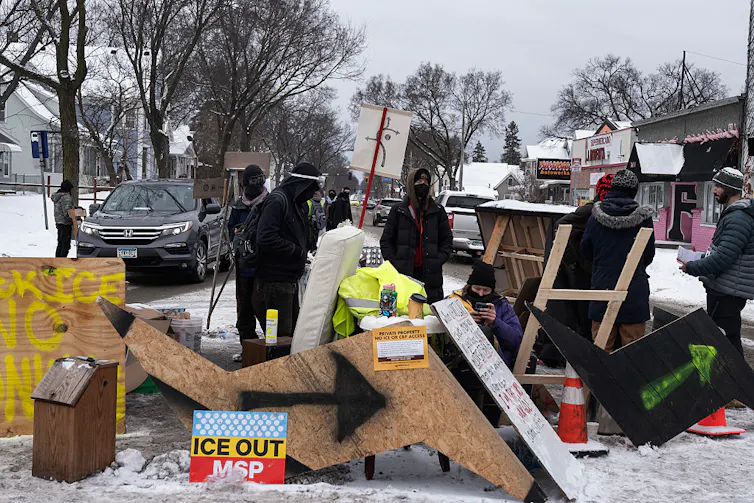
A protester stands near a makeshift memorial honoring Renee Nicole Good, the victim of a fatal shooting in Minneapolis involving federal law enforcement agents. AP Photo/Tom Baker

Minneapolis is once again the focus of debates about violence involving law enforcement after an Immigration and Customs Enforcement officer shot and killed Renee Nicole Good, a 37-year-old mother, in her car.

The incident quickly prompted dueling narratives. Trump administration officials defended the shooting as justified, while local officials condemned it.

The shooting will also likely prompt renewed scrutiny of training and policy of officers and the question of them shooting at moving vehicles. There has been a recent trend in law enforcement toward policies that prohibit such shootings. It is a policy shift that has shown promise in saving lives.

Decades ago, the New York City Police Department prohibited its officers from shooting at moving vehicles. That led to a drop in police killings without putting officers in greater danger.

Debates over deadly force are often contentious, but as I note in my research on police ethics and policy, for the most part there is consensus on one point: Policing should reflect a commitment to valuing human life and prioritizing its protection. Many use-of-force policies adopted by police departments endorse that principle.

Yet, as in Minneapolis, controversial law enforcement killings continue to occur. Not all agencies have implemented prohibitions on shooting at vehicles. Even in agencies that have, some policies are weak or ambiguous.

In addition, explicit prohibitions on shooting at vehicles are largely absent from the law, which means that officers responsible for fatal shootings of drivers that appear to violate departmental policies still often escape criminal penalties.

In the case of ICE, which is part of the Department of Homeland Security, its policy on shooting at moving vehicles – unlike that of many police agencies – lacks a clear instruction for officers to get out of the way of moving vehicles where feasible. It’s an omission at odds with generally recognized best practices in policing.

ICE’s policy on shooting at moving vehicles

ICE’s current use-of-force policy prohibits its officers from “discharging firearms at the operator of a moving vehicle” unless it is necessary to stop a grave threat. The policy is explicit that deadly force should not be used “solely to prevent the escape of a fleeing suspect.”

That point is relevant for evaluating the fatal shooting in Minneapolis. Videos show one officer trying to open the door of the vehicle that Good was driving, while another officer appears to be in front of the vehicle as she tried to pull away.

Kristi Noem, the Homeland Security secretary, stands behind a podium at a news conference.
Homeland Security Secretary Kristi Noem said that an ICE officer ‘feared for his life’ before shooting a woman in Minneapolis.
AP/Yuki Iwamura

Shooting to prevent the driver simply from getting away would have been in violation of agency policy and obviously inconsistent with prioritizing the protection of life.

ICE’s policy lacks clear instruction, however, for its officers to get out of the way of moving vehicles where feasible. In contrast, the Department of Justice’s use-of-force policy makes it explicit that officers should not shoot at a vehicle if they can protect themselves by “moving out of the path of the vehicle.”

Notably, President Joe Biden issued an executive order in 2022 requiring federal law enforcement agencies – like ICE – to adopt use-of-force policies “that are equivalent to, or exceed, the requirements” of the Department of Justice’s policy.

Despite that order, the provision to step out of the way of moving cars never made it into the use-of-force policy that applies to ICE.

The rationale for not shooting at moving vehicles

Prioritizing the protection of life doesn’t rule out deadly force. Sometimes such force is necessary to protect lives from a grave threat, such as an active shooter. But it does rule out using deadly force when less harmful tactics can stop a threat. In such cases, deadly force is unnecessary – a key consideration in law and ethics that can render force unjustified.

That’s the concern involved with police shooting at moving vehicles. It often is not necessary because officers have a less harmful option to avoid a moving vehicle’s threat: stepping out of the way.

This guidance has the safety of both suspects and police in mind. Obviously, police not shooting lowers the risk of harm to the suspect. But it also lowers the risk to the officer in the vast majority of cases because of the laws of physics. If you shoot the driver of a car barreling toward you, that rarely brings a car to an immediate stop, and the vehicle often continues on its path.

Many police departments have incorporated these insights into their policies. A recent analysis of police department policies in the 100 largest U.S. cities found that close to three-quarters of them have prohibitions against shooting at moving vehicles.

The gap between policy and best practices for protecting life

The shooting in Minneapolis serves as a stark reminder of the stubborn gap that often persists between law and policy on the one hand and best law enforcement practices for protecting life on the other. When steps are taken to close that gap, however, they can have a meaningful impact.

Blendon Township, Ohio, police officer Connor Grubb greets a family member after being found not guilty at a Columbus courthouse.
Connor Grubb, a police officer in Blendon Township, Ohio, was acquitted in November of charges stemming from a killing that involved a pregnant woman fleeing in a car.
Doral Chenoweth/AP

Some of the most compelling examples involve local, state and federal measures that reinforce one another. Consider the “fleeing felon rule,” which used to allow police to shoot a fleeing felony suspect to prevent their escape even when the suspect posed no danger to others.

That rule was at odds with the doctrine of prioritizing the protection of life, leading some departments to revise their use-of-force policies and some states to ban the rule. In 1985, the U.S. Supreme Court ruled that it was unconstitutional for police to shoot a fleeing suspect who was not a danger.

Banning that questionable tactic notably led to a reduction in killings by police.

This history suggests that clear bans in law and policy on questionable tactics have the potential to save lives, while also strengthening the means for holding officers accountable.

The Conversation

Ben Jones does not work for, consult, own shares in or receive funding from any company or organization that would benefit from this article, and has disclosed no relevant affiliations beyond their academic appointment.

​Politics + Society – The Conversation
Categories
Uncategorized

Racial profiling by ICE agents mirrors the targeting of Japanese Americans during World War II

A Japanese American family is taken to a relocation center in San Francisco in May 1942. Circa Images/GHI/Universal History Archive/Universal Images Group via Getty Images

The Department of Homeland Security in September 2025 said that 2 million undocumented immigrants had been forced out of the United States since the start of Donald Trump’s second presidency.

Through its use of the Alien Enemies Act, a wartime law from 1798, the Trump administration has bypassed immigration courts and the right to due process to more easily detain and deport immigrants.

The Trump administration has, in part, reached these numbers by arresting immigrants in courthouses and at their workplaces. It has also conducted raids in schools, hospitals and places of worship.

And the Supreme Court in September, in its Noem v. Vasquez Perdomo decision, lifted a federal court order that barred agents with Immigration and Customs Enforcement from racially profiling suspected undocumented immigrants. For now, ICE agents can use race, ethnicity, language and occupation as grounds for stopping and questioning people.

This form of targeting has disproportionately affected Latino communities, which represent 9 in 10 ICE arrests, according to a UCLA study published in October.

Targeting immigrants is a centuries-old American practice. In particular, Asian Americans have drawn parallels between the attacks on Latinos today and the forced relocation and incarceration of Japanese Americans during World War II.

Notably, the passage of the War Brides Act, passed just three months after the end of WWII, in December 1945, broke with the nation’s centuries-long practice of exclusionary immigration policy. The act allowed American servicemen to bring their non-American spouses and children to the United States. The measure seemed to inaugurate a new era of inclusive immigration policy.

As a feminist studies scholar and author, I know the War Brides Act forever altered the nation’s racial demographics, increasing both Asian migration to the U.S. and the birth of biracial children.

On the 80th anniversary of the War Brides Act, I’ve also noticed an alarming contradiction: Although America may be more multiracial than ever before, the U.S. immigration system remains as exclusive as it has ever been.

Exclusionary immigration policy

The racial profiling of Latino people by ICE agents today is not unlike what took place during World War II in the U.S.

Following Japan’s attack on Pearl Harbor in 1941, President Franklin D. Roosevelt issued an executive order authorizing the forced removal of anyone deemed to be a national security threat. Anyone, that is, who was Japanese. From 1942 to 1945, the U.S. government incarcerated approximately 120,000 Japanese Americans in internment camps.

To determine who was a national security threat, the government used overt racial profiling. Similar to today, when the U.S. government often misidentifies Latino Americans as noncitizens, a majority of the Japanese people incarcerated in WWII were U.S. citizens.

Amid the Trump administration’s treatment of immigrants, it’s worth recalling the exclusionary origins of U.S. immigration policy.

The first restrictive immigration law in the U.S., the Page Act of 1875, barred Chinese women from entering the country. The assumption the law was based on was that all Chinese women were immoral and worked in the sex trade.

A soldier holds a rifle on a city street.
Immigration and Customs Enforcement agents conduct operations in a predominantly Mexican American community in Chicago on Nov. 8, 2025.
Jacek Boczarski/Anadolu via Getty Images

The Page Act laid the groundwork for the Chinese Exclusion Act of 1882, which banned all Chinese immigration into the U.S. for 10 years. This was the first federal law to ban an entire ethnic group, launching an era of legalized and targeted exclusion.

With the passage of the Immigration Act of 1924, the U.S. created its first border control service, which enforced new immigration restrictions. It also implemented a quota system, which banned or limited the number of immigrants from specific regions, including Asia and Southern and Eastern Europe.

The act stemmed from nativism – the policy that protects the interests of native-born residents against those of immigrants – and a desire to preserve American homogeneity.

The 1945 War Brides Act largely diverged from these previous measures, helping to dismantle the Asian exclusion made commonplace in the 19th and early 20th centuries. From 1945 until 1948, when the War Brides Act expired, more than 300,000 people entered the country as nonquota immigrants, people from countries not subject to federal immigration restrictions.

Exclusionary tendencies

Decades later, in 1965, the U.S. formally abolished the quota system. America opened its doors to those who President Lyndon B. Johnson deemed most able to contribute to the nation’s growth, particularly skilled professionals.

The Immigration and Nationality Act of 1965 eliminated racial exclusion. As a result, the U.S. population diversified. Immigrants deepened the multiracialism initiated by the War Brides Act.

This trend increased later in the 1960s when the Supreme Court, in Loving v. Virginia, overturned anti-miscegenation laws, which criminalized marriage between people of different races. The justices ruled that laws banning interracial marriage violated the 14th Amendment.

Multiracialism further increased after the Vietnam War. Subsequent legislation such as the 1987 Amerasian Homecoming Act facilitated the entry of biracial children born in Vietnam and fathered by a U.S. citizen.

Japanese-Americans arrive at a train station.
People of Japanese ancestry arrive at the Santa Anita Assembly Center in California before being moved inland to relocation centers, April 5, 1942.
© CORBIS/Corbis via Getty Images

By the 1960s, however, exclusion was taking on a different shape.

After 1965, immigration policy initiated a preference system that prioritized skilled workers and relatives of U.S. citizens. Quotas related to race and national origin were abolished. Nonetheless, preferences for families and professionals excluded people from Latin America.

For the first time, immigration from the Western Hemisphere was limited. This directly affected migrant workers in the farming and agricultural industries, many of whom were Latino.

Recalling the War Brides Act allows Americans to better comprehend the fiction that undergirds the U.S. immigration system: that immigration policy’s preference for certain immigrants is enough to justify the discriminatory policies which deem some families more valuable than others.

The Conversation

Anna Storti has received funding from the Institute for Citizens and Scholars, the Andrew W. Mellon Foundation, and the McNair Scholars Program.

​Politics + Society – The Conversation

Categories
Uncategorized

Congress takes up health care again − and impatient voters shouldn’t hold their breath for a cure

Congress has long been unable to come to an agreement on how to help constituents pay for health care. iStock/Getty Images Plus

As the bell struck midnight on Jan. 1, 2026, time ran out on Obamacare subsidies for over 24 million Americans. These subsidies, propped up through various legislative packages over the years, lowered the health insurance costs for Americans on the Obamacare exchange.

Following the expiration of these subsidies, health insurance premiums are skyrocketing for around 90% of Americans who use health insurance from the exchange. For many Americans, the new year means a choice between paying exorbitant costs or taking the risk of no health insurance at all.

But unlike other policy challenges that Congress may face in 2026, the expiration of health insurance subsidies was not unexpected.

The extension of health care subsidies was the pivotal disagreement that ultimately led to the longest government shutdown in U.S. history in the fall of 2025. Democratic members, in support of extending the subsidies, faced off against the majority party in Congress: Republicans who wanted a short-term legislative fix that did not fund subsidies.

Republicans ultimately won the shutdown battle. And while Democrats attempted a last-gasp vote in December to reform and extend health care subsidies, the health care debate was yet again punted into the next year.

Congress has reconvened, and Democratic members – joined by four Republican members – used the best possible procedural tool at the minority party’s disposal, the discharge petition, to force congressional leaders to allow votes on an extension of Obamacare subsidies during its first week back in session. But overcoming congressional leadership is an immense challenge: Even if the House is successful, Senate Republican leadership has made clear that there is no future for the legislation in that chamber.

The challenge of passing meaningful solutions to rising health care costs is not unique to this year or to this Congress. It has been a decades-long argument among lawmakers that shows no sign of being resolved.

Why is it so hard for Congress to lower the cost of health care for the people who sent them to Washington?

Like many policy problems, partisanship is partly to blame. But the sprawling complexities of the American health care system pose a particular challenge to members of Congress. As my own research finds, the outsized power and resources of congressional leaders means that for Congress’ most intricate issues, rank-and-file members do not have the time, resources or, frankly, the interest to dedicate to meaningful problem-solving.

The failure of two health care proposals in December 2025, one from Democrats and one from Republicans, meant certain Obamacare enrollees face huge premium increases.

Government ‘dips its toe’

Americans face some of the highest health care costs in the world. Lawmakers on both sides of the aisle have long campaigned on addressing exorbitant costs and equitable access.

Progressive politicians proposed the idea of national health insurance as early as the 1900s, but efforts were limited to women and children, and any policy successes were moderate and temporary.

Following the Great Depression and the advent of Social Security in the 1940s, Congress had warmed to the idea of the federal government providing social services. But attempts at widespread health care coverage failed to gain traction.

During the 1950s, as Americans began to expect more services from their tax dollars, formal coalitions formed in support of, and in opposition to, government-supported health care. Workers and unions, bolstered by Congress and the Supreme Court, used the power of collective bargaining to push for employee benefits such as health insurance. Doctors and medical providers, enjoying their current – and profitable – position, coordinated campaigns against national health insurance proposals.

The tension held until 1956, when the government dipped its toe into federally funded health care, enacting the first “Medicare” government-funded program for dependents of the armed forces.

In the private sector, employee demands and employer tax incentives led to a convoluted web of employer-based insurance programs. But for many Americans, particularly the retired and elderly and those with low-paying jobs, there remained few, if any, insurance options available.

Enter: Medicare and Medicaid

In the 1960s, under Democratic President Lyndon Johnson’s vision for a “Great Society,” and with a bipartisan vote in Congress, the federal government took the greatest step forward in providing federal health assistance for Americans: Medicare and Medicaid. The programs helped with the cost of health care via federal health insurance for those who were elderly and low-income, and they ushered in a new era of federal health policy.

This was a watershed moment for policymakers. With health care coverage now under the umbrella of the federal government, domestic policymaking responsibility expanded to match. For lawmakers, this meant not only new debates but also new federal agencies, new congressional committees, new lobbying firms and new interest group coalitions.

An older woman pats the cheek of a much taller middle-aged man.
An elderly woman shows her gratitude to President Lyndon B. Johnson for his signing of the Medicare health care bill in April 1965.
Corbis via Getty Images

In the decades that followed, Congress’ responsibility for health care policy continued to expand: Coverage amounts and eligibility requirements were tweaked, programs were expanded to include prescription drugs and vaccines, health savings accounts were introduced, and more.

Yet still, the web of private and federal health insurance programs left millions of Americans uninsured. It wasn’t until 2010, under President Barack Obama, that the Democratic-controlled House and Senate passed the Patient Protection and Affordable Care Act, known as “Obamacare,” to close that gap. But as evident from the 2025 government shutdown, this solution was far from perfect – and quite expensive.

Why, despite centuries of attention, does health care coverage remain one of – if not the most – perplexing and challenging domestic issues that Congress faces?

Consensus becomes more difficult

Part of this is a uniquely American problem: Like many services, the American health care system is based on economic incentives, and the foundational ideal of American liberalism means the government is inclined to let capitalism thrive.

As a former congressional staffer and now a scholar of Congress, I know that nowhere is the tension of societal support and personal freedom more apparent than the debate over health care access.

But the issue is also immensely complex, and today’s Congress does not have the resources to meet the challenge, particularly in the face of a sprawling executive branch.

Over time, as policies were adopted by the federal government, the scope of potential solutions expanded. To put it another way, as more cooks enter the policymaking kitchen, consensus became more difficult. The history of American health care is populated by private industries, powerful interest groups, federal officials and concerned citizens.

And the web of federal funding and private insurance companies across 50 states has resulted in a policy landscape that is easier to tweak, rather than whole-scale reform.

This is further stymied by the limited resources and expertise of the modern Congress. My research has shown that rank-and-file members are increasingly reliant on party leaders to take the lead on policymaking and problem-solving. Negotiating across coalitions and parties is unpleasant, and communicating policy changes on such a complex issue is difficult.

The result? Tepid policy tweaks made for partisan messaging.

And as ideological divisions on government support and personal autonomy become crystallized by the two parties in Congress, partisan policy solutions diverge even further. Collaboration becomes harder every year.

The continuing resolution passed late in 2025 funded the government only until Jan. 30, 2026, which means Congress is facing a Groundhog Day rather than a clean slate for the new year. With millions of Americans facing exploding health care costs, the question becomes who will Congress follow: party leadership or concerned constituents?

The Conversation

SoRelle Wyckoff Gaynor does not work for, consult, own shares in or receive funding from any company or organization that would benefit from this article, and has disclosed no relevant affiliations beyond their academic appointment.

​Politics + Society – The Conversation