One of Europe’s most shocking royal scandals has reached a dramatic conclusion.
Marius Borg Hoiby, the son of Norway’s Crown Princess Mette-Marit and stepson of Crown Prince Haakon, has been sentenced to four years in prison after being convicted on multiple criminal charges, including two counts of rape.
The verdict was handed down Monday by the Oslo District Court following a lengthy and closely watched trial that has dominated headlines in Norway for months.
Mitch Evans (L) and Marius Borg Hoiby compete on the Formula E Simulator at the BRITS official aftershow party, in partnership with Tempus Magazine, at the Intercontinental London – The O2 on February 21, 2018 in London, England (Photo by Ian Gavan/Getty Images for Tempus Magazine)
Hoiby, 29, faced dozens of charges stemming from allegations involving multiple women.
The court ultimately found him guilty on 34 counts, including rape, domestic violence, assault, drug-related offenses, and other crimes. He was acquitted on several charges, including two additional rape allegations.
While Hoiby is closely connected to Norway’s royal family, he does not hold a royal title and is not in the line of succession to the throne. Still, his relationship to the future king and queen has ensured intense public scrutiny throughout the case.
According to CBS News, prosecutors argued that several of the women involved were unable to consent because they were unconscious or otherwise incapacitated.
One of the rape convictions involved an incident that took place in the basement of the royal family’s official residence.
The court also found Hoiby guilty of abusing former girlfriend Nora Haukland, one of the few accusers who has been publicly identified. In addition to his prison sentence, he was ordered to pay compensation to multiple victims and was issued a restraining order related to one of the women involved in the case.
Prosecutors had sought a much longer sentence of more than seven years behind bars. Hoiby’s defense team, meanwhile, argued for a substantially lighter punishment.
The disgraced royal relative has consistently denied the rape allegations and is expected to appeal the verdict.
The case has cast a long shadow over Norway’s royal family, which, unlike the British royal family, has traditionally enjoyed strong public support and a largely scandal-free reputation. In recent months, the trial has generated intense debate throughout the country about privilege, accountability, and whether royal connections influenced the investigation.
Adding to the family’s difficulties, Crown Princess Mette-Marit is reportedly awaiting a lung transplant as she continues to battle serious health issues.
The Norwegian Royal Court has declined to comment on the verdict.
With an appeal expected and public interest showing no signs of fading, this story will likely continue making headlines for months to come.
We will have further updates on this developing story as new information becomes available.
The news has only just become public. For many celebrity breakups, that means a renewed wave of feelings.
Over the weekend, Ariana broke down in tears on stage, thanking the audience for their support.
Many believe that there was more to this than the breakup, however.
Ariana Grande attends the AFI Awards Luncheon at the Four Seasons Hotel Los Angeles at Beverly Hills on January 09, 2026, (Photo Credit: Emma McIntyre/WireImage)
‘This is so overwhelming’
On Saturday, June 13, Ariana Grande performed to a massive arena in Los Angeles for her second Eternal Sunshine Tour concert.
On the stage, she broke down in tears.
“This is so overwhelming in the most beautiful way ever,” she said, as captured in this TikTok video.
“Thank you so much for being so loving,” Ariana expressed.
“Holy moly,” she said, as if quoting Billy Batson. “I said holy moly, but I meant it, you know.”
@arianagrande breaks down crying on stage from her overwhelming support from her fans her second night in Los Angeles. She hasn’t been on tour in 7 years. 😭 She’s such an amazing human being. We love you!! #eternalsunshine#arianagrande#losangeles
Gushing to the crowd, Ariana expressed that she has “never in my life experienced a crowd like this.”
She assured fans that their enduring support “means so much to me.”
“You can’t do this to me, you know what I mean, because you know what’s going to happen,” Ariana playfully told the crowd.
“You know I’m a Cancer. This is going to happen,” she continued.
Ariana was referring to astrology, a belief that constellations and planets have a supernatural impact on one’s life, personality, and fortunes. A “Cancer” (referring to crabs) was born between June 22 and July 23. Ariana, famously, has a June 26 birthday.
‘I just have so much gratitude’
As the crowd applauded, Ariana continued to address the thousands of attendees offering her emotional support.
She thanked her audience for being “such a loving, safe presence” in her life.
Ariana noted that this has been true “throughout all these chapters and all of these years.” True!
“It’s been seven years since I’ve been on stage in front of you all,” she specified, “and you’ve stood by my side and supported me.”
Ariana gushed: “I just have so much gratitude.”
“And wow. Holy s–t. Holy f–k. Thank you,” Ariana continued, pivoting away from her “holy moly” from earlier.
This could have been nothing more than an emotional thank-you for
It could also have been a reaction to their enduring support after her breakup with Slater.
The 22-year-old ‘Duck Dynasty’ star has been dealing with a stalker, and it’s had a massive effect on her life. Continue reading…Country Music News – Taste of Country
The 22-year-old ‘Duck Dynasty’ star has been dealing with a stalker, and it’s had a massive effect on her life. Continue reading…The Boot – Country Music News, Music Videos and Songs
British singer-songwriter Sekou has announced In A World We Don’t Belong Pt. 2, a new mixtape due June 26. The project follows In A World We Don’t Belong Pt. 1, which was released in November 2025, and arrives as Sekou continues a year that has included headline dates, festival appearances, and new material.
The upcoming mixtape will include the previously released single “Dangerous Lover” alongside four new releases. Its tracklist also includes the forthcoming “Does She Know,” which received its live debut during Sekou’s recent UK and European headline tour. Speaking about the project, Sekou said he wanted to tell his story and express how he feels as a 21-year-old artist. He described the title as connected to feeling like an outcast while also finding value in that experience.
Click to load video
Sekou also said the new songs came from an honest place. “When I write songs, I’m still learning about myself, and that’s what makes it exciting,” he said. The announcement follows news of Sekou’s headline show at KOKO in London on December 14. He also appeared at Capital’s Summertime Ball at Wembley Stadium, where he performed and drew praise from SZA and Kehlani.
Sekou begins his first US headline tour on June 15 at Vinyl in Atlanta. The North American run includes Elsewhere, The Hall in Brooklyn on June 21, El Cid in Los Angeles on June 24, The Troubadour in Los Angeles on June 26, and Barboza in Seattle on June 29. He will then play Montreux Jazz Festival on July 3, Summer Sonic Festival in Osaka and Tokyo in August, All Points East in London on August 21, Rock en Seine in Paris on August 26, Lalalib in Dijon on September 4, and KOKO in London on December 14. Earlier in 2026, Sekou opened for Sam Smith at the To Be Free residency in San Francisco and made his BBC Radio 1 Live Lounge debut with “Catching Bodies” and a cover of Justin Bieber’s “Yukon.”
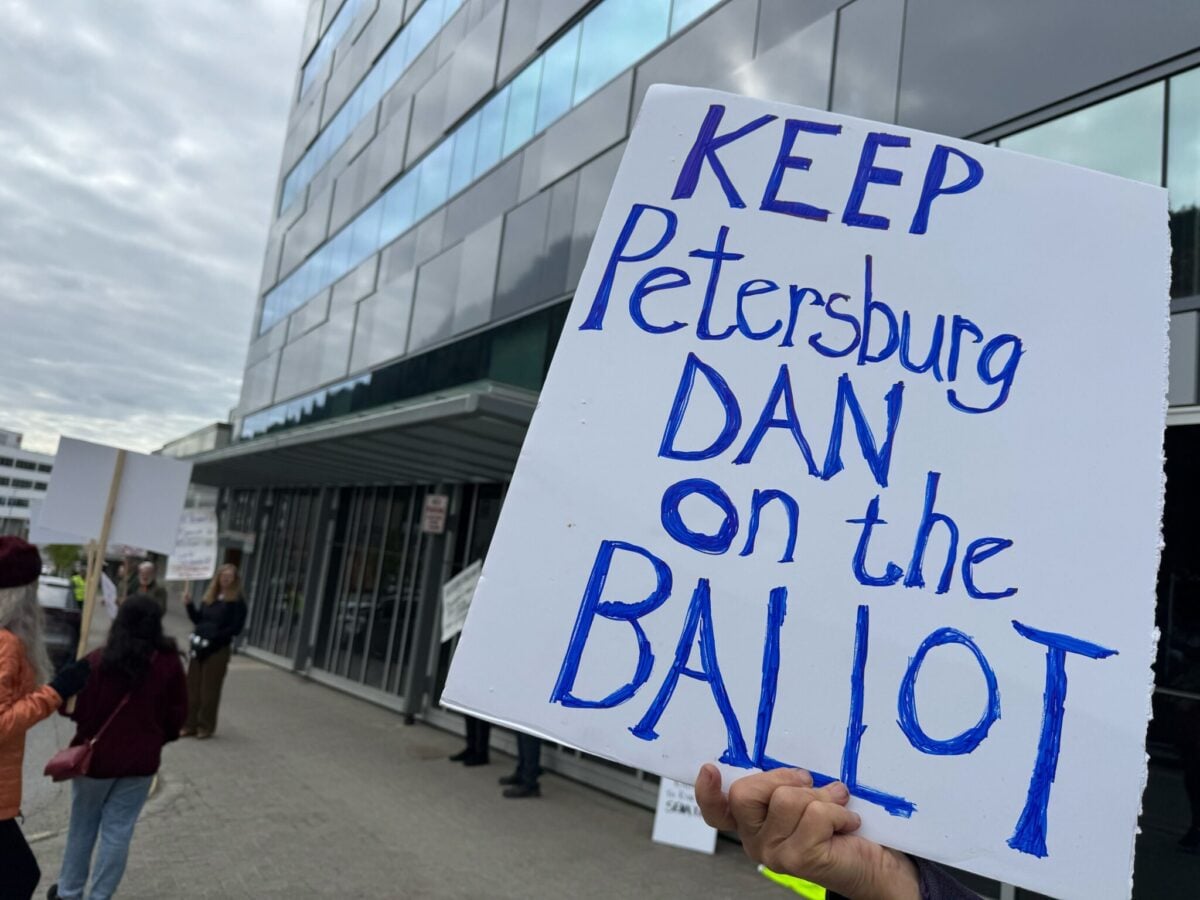
A demonstrator holds a protest sign in support of Dan J. Sullivan of Petersburg after the Alaska Division of Elections issued a preliminary decision to remove the candidate from the ballot on June 12, 2026. (Photo by James Brooks/Alaska Beacon)
The Alaska Division of Elections announced that the state intends to disqualify a Petersburg candidate from Alaska’s U.S. Senate race. Dan J. Sullivan has the same first and last name as the incumbent senator. The decision comes after complaints from the incumbent and Republican Party groups and eligibility concerns.
The decision is preliminary, and the division gave no timeline for a final decision.
Dan Sullivan of Petersburg announced his campaign for the U.S. Senate on May 29 to challenge incumbent U.S. Sen. Dan Sullivan. (Photo courtesy of Dan Sullivan)
Dan J. Sullivan, a retired teacher from Petersburg, announced his candidacy last month, along with 15 candidates challenging the Republican incumbent U.S. Sen. Dan S. Sullivan for the seat.
The incumbent Sen. Sullivan and Republican groups criticized him as a “sham candidate” and said his candidacy is illegitimate and aimed at confusing voters to the benefit of the Democratic candidate, Mary Peltola.
Sullivan from Petersburg has defended his candidacy as authentic, and said he has complied with filing rules and has the right to run for the seat. He declined to comment on the preliminary decision on Friday.
Carol Beecher, division director, issued a preliminary decision on Wednesday, writing to the Petersburg Sullivan that the division had determined “that a preponderance of evidence does not support your eligibility for the office of U.S. Senate.”
Beecher did not provide the evidence or give a specific reason. She said the candidate had until 5 p.m. Friday to respond, and the state would issue a final decision with or without his response. Her office did not respond to a request for comment about the reasoning behind the preliminary decision to disqualify Sullivan on Thursday.
Beecher cited two complaints brought against Sullivan, one by the Alaska Republican Party which accused the Petersburg Sullivan of misrepresenting himself as a Republican. The group said at the time of filing for the seat he was registered to vote as “undeclared.”
The Petersburg Sullivan said he was affiliated with the Alaska Independence Party until it disbanded last year, then filed for the seat as a Republican.
The state’s filing form gives an option for candidates to change registered parties in a note under party affiliation.
Dan J. Sullivan declared his candidacy for the U.S. Senate on May 29, 2026 as a Republican. The form notes an option for candidates to change registered parties. (Screenshot of declaration of candidacy)
The preliminary announcement to disqualify Sullivan came just hours after the candidate responded to questions by a deadline issued by the Lt. Gov. Nancy Dahlstrom’s office, which launched an investigation into the candidate on Monday.
Dahlstrom, a Republican, asked the candidate about his affiliation with the Republican Party, names he has used to register to vote, design decisions on his campaign website and logo and whether he has coordinated with the Democratic Party. The lieutenant governor said false statements could carry the penalty of perjury. She questioned whether Sullivan was running with “the deliberate intent to confuse voters.”
Sullivan denied the allegations, saying he was running under his lawful name as a Republican, and denied any affiliation with outside groups.
On Thursday evening, he issued a statement criticizing Dahlstrom’s actions and the message they send to voters.
“I am a qualified candidate who followed the rules and filed to run for office under my legal name. Yet, unsupported accusations have been given credibility while political operatives continue their effort to keep me off the ballot. Alaskans have every reason to ask whether this process is being driven by politics rather than by a fair application of the law,” he wrote.
A spokesperson for the Peltola campaign denied any connection to the candidate on Friday. “Our campaign has no involvement with either Sullivan campaign,” said Harry Child by email. The Alaska Democratic Party also denied involvement with the candidate.
The National Republican Senatorial Committee, which works to elect Republicans, filed a complaint with the Federal Election Commission that accused the candidate of violating federal law, and said he was working with political strategist, Amber Lee, to misrepresent his campaign. Sullivan said he was working with Lee, but denied the claims.
Sen. Sullivan’s campaign did not respond to a request for comment on the state’s preliminary decision to remove Sullivan from the ballot on Friday.
Demonstrators in Juneau took to the street Friday morning, protesting outside the Alaska Division of Elections office in support of Sullivan.
Demonstrators protest in front of the Alaska Division of Elections office in Juneau following a preliminary decision to cancel the candidacy of Dan J. Sullivan of Petersburg for U.S. Senate on June 12, 2026. (Photo by James Brooks/Alaska Beacon)
Anjuli Grantham with the grassroots advocacy group Juneau for Democracy said she doesn’t know Sullivan personally, but was out protesting in support. She said he meets qualifications for candidates under Alaska law, including being over 30 years old, a U.S. citizen and a resident of the state.
“And so what this actually is, it’s a sign of authoritarian slippage on the part of the state of Alaska,” she said. “In dictatorships, they control elections by deciding who will be on the ballot. And so we’re out here because it’s our constitutional right to run for office.”
Grantham also pointed to the division’s decision to share confidential voter information with the U.S. Department of Justice, a choice that some fear will be used to scrub Alaska voters from the rolls. Civil rights groups have filed a lawsuit against the Division of Elections saying it was a violation of voters’ privacy rights.
“That was very likely in violation of our state constitutional rights to privacy,” she said. “And so what we’re seeing now is another what seems to be anti-constitutional action on the part of the Division of Elections, so we’re here as democracy defenders and as people who are standing up to authoritarianism,” Grantham said.
Protesters gather in front of the Alaska Division of Elections office in Juneau after a preliminary decision to cancel the candidacy of Dan J. Sullivan of Petersburg for U.S. Senate on June 12, 2026. (Photo by James Brooks/Alaska Beacon)
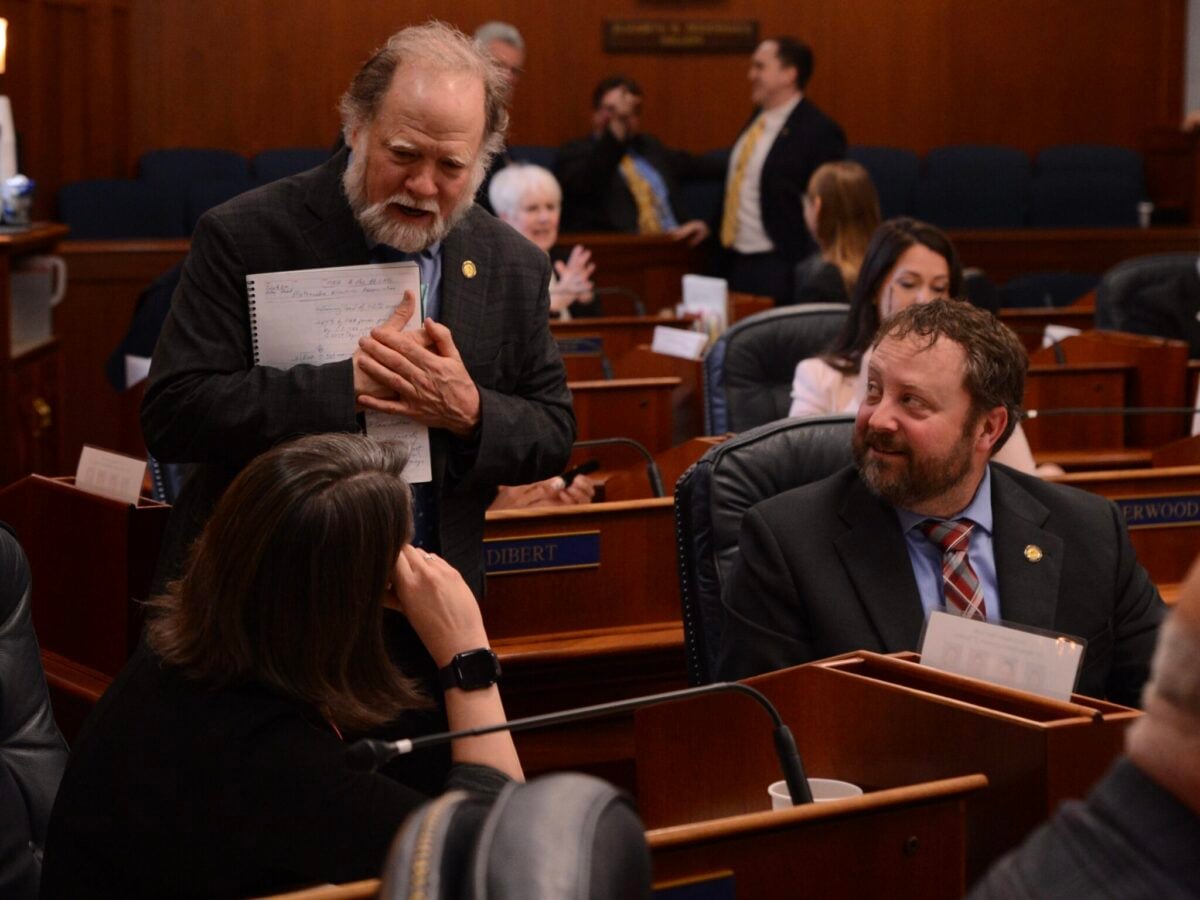
Rep. Ted Eischeid, D-Anchorage, talks with Rep. Carolyn Hall, D-Anchorage, as Rep. Bill Elam, R-Kenai, looks on Friday June 12, 2026, at the Alaska State Capitol in Juneau. (James Brooks photo/Alaska Beacon)
By: James Brooks, Alaska Beacon
Rep. Ted Eischeid, D-Anchorage, talks with Rep. Carolyn Hall, D-Anchorage, as Rep. Bill Elam, R-Kenai, looks on Friday June 12, 2026, at the Alaska State Capitol in Juneau. (James Brooks photo/Alaska Beacon)
The Alaska House of Representatives has voted to advance a multibillion-dollar tax break for the proposed trans-Alaska natural gas pipeline project.
The House’s 34-5 action sends the tax break to the state Senate, which is expected to take up the issue next week. Legislators are in a 30-day special session devoted to the issue, and the session ends June 19.
House Bill 381, containing the tax break, doesn’t guarantee pipeline construction, but project skeptics and advocates alike say that without the change, the pipeline is uneconomic.
“I’m very proud of us getting this bill to where we are today and giving this project a fighting chance,” said Rep. Calvin Schrage, I-Anchorage, “so that Alaskans and hopefully the world can benefit from the gas reserves that we have here in the state.”
If enacted, the bill would replace the state’s 2% petroleum property tax with a tax on gas shipped through the pipeline.
Proceeds from the petroleum property tax are split between boroughs and the state. If the pipeline is built, those governments would collectively forego about $800 million per year, said Rep. Andy Josephson, D-Anchorage.
The state would still collect royalties, corporate income taxes, production taxes and other fees, said Rep. Chuck Kopp, R-Anchorage. Those are expected to net the state between $600 million and $700 million in new revenue per year.
HB 381 also contains a rate cap to mandate that pipeline developers provide natural gas to Southcentral Alaska residents at a price that’s lower than the predicted price of imported gas.
Currently, Southcentral Alaska relies on natural gas from fields beneath Cook Inlet. Available supplies are running low.
“I think everyone’s been asking: What is the benefit to Alaska?” said Rep. Sarah Vance, R-Homer. “The benefit, if you could summarize it into one thing, and that’s reliable energy.”
Other parts of the bill mandate an impact fund to compensate local governments for the effects of construction, and send money to a rural power fund to pay for energy projects away from the pipeline.
“Every region of Alaska will get a share of this project one way or the other, and there’s real protections for Alaska ratepayers,” Kopp said.
Gov. Mike Dunleavy and Glenfarne, the multinational firm developing the pipeline, issued written statements after the vote, praising lawmakers’ action.
“This project has the potential to transform Alaska’s economy for decades,” the governor said in part. “I look forward to working with the Senate to get this important legislation across the finish line.”
As currently planned, the Alaska LNG project would be built in two phases. The first phase would include a pipeline from the North Slope to Cook Inlet, with limited processing plants needed to deliver gas to Southcentral Alaska for domestic use.
Glenfarne expects to begin operating the first phase by 2029.
The second phase would involve building a large facility on the North Slope and another on the Kenai Peninsula, allowing the pipeline to ship larger volumes of gas for export overseas.
Glenfarne expects the second phase of construction to be done in 2033 and that both phases will cost between $44.5 billion and $54.5 billion altogether.
Exports would subsidize the cost of gas for in-state use, with Glenfarne projections suggesting that if the pipeline reaches full capacity, the cost of gas in Southcentral could be half of what it is today.
That’s still hypothetical. Estimates from the Alaska Department of Revenue suggest the pipeline project’s economics are marginal. Even if the tax break is adopted, the cost of exported gas may not be competitive on global markets with gas from other sources around the world.
“We cannot control global economics, and the passage of this bill does not guarantee a pipeline will be built. I think that’s important to recognize,” said Rep. Zack Fields, D-Anchorage. “This bill absolutely increases the likelihood that the project can progress.”
Under the terms of HB 381, pipeline developers would pay no gas tax for the first five years of the project, or until gas volume reaches a certain, export-level threshold.
After that point, the new tax would kick in.
Because boroughs are forgoing so much revenue, HB 381 requires the pipeline developer to pay $80 million into an impact fund that would be distributed to boroughs — including Anchorage — along the route.
That money might be used to pay for extra street repairs, additional police or other services needed to address the needs of thousands of extra workers who would be building the pipeline.
Rep. Dan Saddler, R-Eagle River, said he’s heard from Alaskans who think HB 381 is a giveaway and that the state could pull in hundreds of millions more if it simply left the property tax alone.
“I shake my head and tsk just a little bit,” he said, “because a high tax on no pipeline gets you no money; a lower tax on a real pipeline gets you money.”
Rep. Robyn Frier, D-Utqiagvik, speaks Friday, June 12, 2026, on the floor of the Alaska House of Representatives. (James Brooks photo/Alaska Beacon)
Rep. Robin Frier, D-Utqiagvik, opposed the final version of HB 381. She represents the North Slope Borough, which relies heavily on the petroleum property tax for local needs. The borough would forego hundreds of millions of dollars in prospective revenue under a switch to a gas tax.
Before Friday’s final vote, she offered a pair of amendments that would have reduced the impact on the North Slope. Both were defeated by wide margins.
Rep. Donna Mears, D-Anchorage, was excused absent from Friday’s vote because of travel problems that kept her from reaching Juneau.
By text message, she said that had she been present, she would have voted against the bill.
“This legislation will push costs down onto communities and lock us into tax breaks we won’t be able to re-evaluate for decades,” she said.
Rep. Sara Hannan, D-Juneau, also voted against the bill, saying her constituents raised climate change concerns. Burning natural gas releases greenhouse gases, which contributes to climate change.
Rep. Jeremy Bynum, R-Ketchikan, offered a different perspective, saying that he believes cheap natural gas will displace diesel fuel, thus leading to an overall reduction in greenhouse gas emissions because gas is cleaner burning than fuel oil.
Fairbanks Democratic Rep. Ashley Carrick borrowed a term from public health and said that natural gas is an issue of “harm reduction.” In her district, many people heat their homes with fuel oil at $6 per gallon. When oil isn’t available — or is unaffordable — people burn wood.
“Fairbanks has some of the worst air quality in the nation, in the world, because of those fuel sources. Natural gas is harm reduction. I believe in that, and while I do share the frustration and concern from many, I believe this is a step in the right direction towards more sustainable energy, available energy and affordable energy for our communities,” she said.
Saddler, who is retiring from the Legislature this year, said he hopes lawmakers “can bring an end to that old joke that a natural gas pipeline is Alaska’s future and it always will be. I hope you never hear that joke again.”