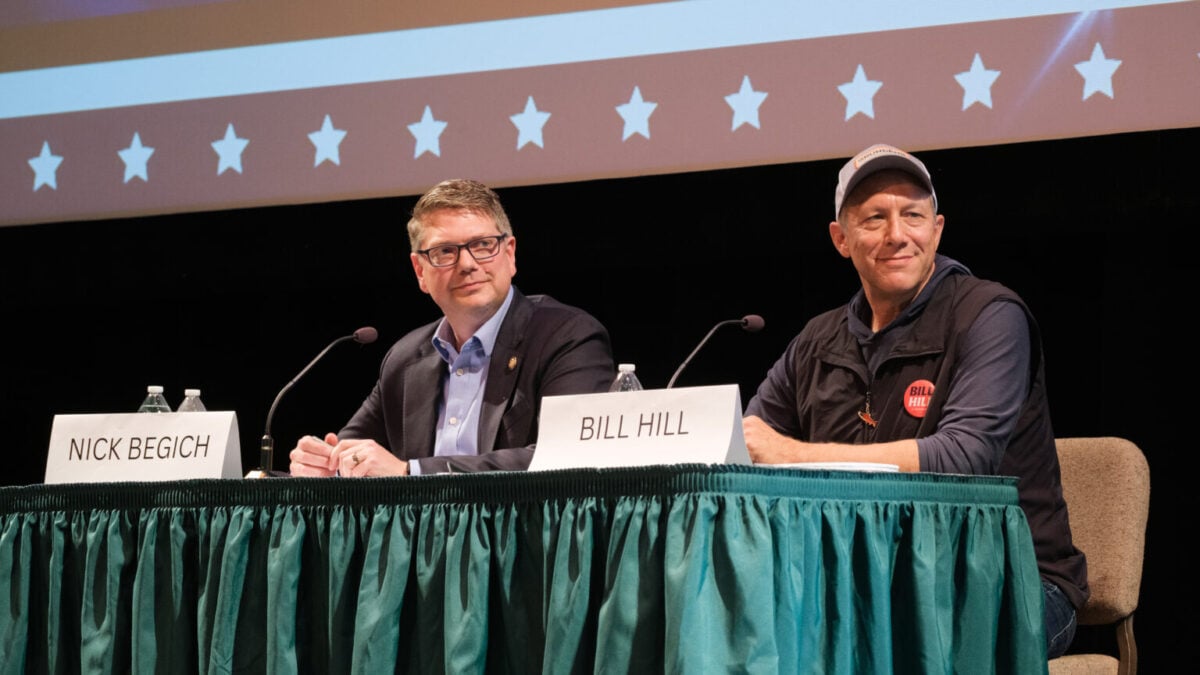
People buying Juneau Symphony tickets don’t pay the city’s 5% sales tax because the organization is a nonprofit. But Executive Director Charlotte Truitt says customers won’t be the only ones paying the price if the Juneau Assembly eliminates that tax exemption.
“We estimate that implementing this ordinance, it would require approximately $2,000 to modify our bookkeeping processes,” she told the Assembly during its meeting Monday night. “And then after that we estimate our bookkeeping cost would continue to increase by approximately $500 every month.”
The symphony would collect about $12,500 in sales tax revenue for the city during the coming year, based on current sales, compared to the organization’s total compliance cost of about $8,000, Truitt said.
“We’re fortunate that we have a bookkeeper who works about 10 hours a month,” she said. “But many of the 263 nonprofits in Juneau don’t have that luxury. They rely on volunteer treasurers or bookkeepers who donate their time because they believe in a mission. They do not have retail point-of-sale systems. This ordinance asks those volunteers to take on an entirely new level of responsibility and liability. Implementing new accounting systems, modifying ticketing and bookkeeping procedures, filing returns, and maintaining compliance all require staff time and professional expertise.”
The proposal by the Assembly to repeal the tax exemption for nonprofits — unless they are government or social service organizations — was put on hold until a Sept. 2 Finance Committee meeting after similar concerns were expressed by several other nonprofit officials and supporters.
Many said the proposed change was a surprise, although it has been among a series of tax modifications Assembly members have been considering during the past couple of months while trying to address a deficit in the city’s budget.
An analysis by the city finance director in May found the nonprofit exemption could bring in more than $3 million more a year — one of the most lucrative options — but changes suggested since then could reduce that amount if more organizations remain exempt.
Bob Urata, a doctor who’s served on numerous nonprofit boards in Juneau, suggested if the Assembly repeals the sales tax exemption there should be “a threshold of maybe a million dollars in annual earned revenues before the collection requirements apply.”
“The issue isn’t whether large nonprofits should contribute,” he said. “The issue is whether the administrative burden is proportional to an organizational size and capacity.”
Other people testifying during the meeting questioned how the city would track and audit nonprofits if they had to collect sales taxes, and what organizations would be categorized as “social service” and thus still exempt from the requirement.
Current city code states the local tax exemption does not apply to pull-tab games by tribes or other nonprofits, and sales by certain city-owned entities such as Eaglecrest Ski Area and Juneau International Airport.
The proposed change was on Monday’s meeting agenda as a possible item for final approval by the Assembly, but Deputy Mayor Greg Smith proposed returning the ordinance to the Finance Committee for further review this fall. The delay was approved unanimously.
“I’ve heard from people, some of whom work extremely close with many nonprofits, just having found out about this like a week ago,” he said. “So it is impactful. Every conversation I have I learn more. I would like to bring it back to our committee worksession to see what people want to do.”
Elections workers double-check the results of Alaska’s Aug. 16, 2022, primary election during a meeting of the state review board on Tuesday, Aug. 30, 2022, at the Alaska Division of Elections in Juneau. (Photo by James Brooks/Alaska Beacon)
Early, in-person voting begins Monday for Alaska’s Aug. 18 state primary election, and thousands of voters have already cast absentee ballots by mail.
Regardless of when — or how — Alaskans vote, ballots will be counted starting on election day, according to a preliminary schedule provided by the Alaska Division of Elections.
Polls close at 8 p.m. Alaska Daylight Time, and the division expects to have the first preliminary results “between 8:45 p.m. and 9 p.m.”
“There are additional results updates that follow but how many or at what time they will be published will vary,” the division said in an information packet given to reporters.
The final unofficial tally will take place Aug. 28, 10 days after election day, and the division expects to certify official results by Aug. 31.
Any recounts must be requested by Sept. 5, and any lawsuit challenging a result must be filed by Sept. 10.
Under Alaska’s election system, voters pick one candidate for each race in the primary election. The top four vote-getters, regardless of political party, advance to the general election in November. If there are four or fewer candidates in a race, all advance to the general election.
In practice since 2022, lower-finishing Republican candidates have preferred to withdraw after the primary rather than compete against another Republican.
The Valley Republican Women, a notable group from the Matanuska-Susitna Borough, are running ads this year to promote the strategy. Those ads urge Republicans to “consolidate the vote” and “don’t split the field.”
In races with many competitors, a withdrawn candidate will be replaced by another until there are four options on the ballot or no more replacements are available. Any replacements may themselves withdraw.
The deadline to withdraw after the primary is Aug. 31.
Normally, ballots cast in person are counted on election day itself. Since 2020, votes cast in person have leaned Republican.
It’s common for some rural Alaska precincts to not report results on election night itself.
Two years ago, for example, only 387 of 403 precincts had reported results by 1 a.m. Wednesday, the day after election day. Four years ago, four precincts needed more than four days to report results from election day.
Historically, some rural precincts have had staffing problems that prevented them from opening on election day. In 2024’s primary, two precincts failed to open, and one opened only in the afternoon. In 2022, two precincts failed to open. In both 2024 and 2022, voters in the affected places were able to cast absentee ballots instead.
Absentee ballots are counted starting on election day, but that counting process extends until Aug. 28. Under Alaska law, absentee ballots — if they are postmarked on or before Aug. 18 — can reach the Division of Elections up to 10 days after election day and still be counted.
Counting an absentee ballot requires the division to first verify the identity information on the outside of the ballot envelope. That verification process starts Aug. 11, the division said, though the ballot inside the envelope won’t be counted until at least election day.
The verification process continues after election day, with ballots added to the tally in batches. The division expects to update results on Aug. 25 and again on Aug. 28, with additional updates possible between those two dates.
Bristol Bay is seen in 2004 from the community of Naknek. (Photo provided by the Alaska Division of Community and Regional Affairs)
Five days after graduating from high school in 1980, my identical twin brother, Malcolm, and I boarded a plane for Alaska. We were young, restless and convinced we were heading north to make our fortune.
We had no idea Alaska would shape the rest of our lives.
Our first couple summers were spent working long shifts in a cannery, surrounded by machinery, fish slime and the constant smell of salmon. We worked close to 100 hours a week and learned quickly that Bristol Bay did not care how tired, cold or inexperienced we were. Everyone was expected to carry his or her share of the load.
We watched the fisherman, seeing that’s who we wanted to be, and moved from the cannery to the decks of fishing boats. We became deckhands, then captains and boat owners. After years of fishing under other permit holders, we purchased our own limited-entry permit and earned a place in one of the most competitive wild-salmon fisheries in the world.
That journey became the foundation of my book, The Commercial Fishermen.
The book is my personal story, but it is also a record of 45 seasons of change in Bristol Bay. During those years, I watched boats, technology, regulations and markets evolve. Fiberglass boats replaced many of the older wooden vessels. Refrigerated seawater systems improved fish quality. Satellite communication, GPS navigation and more accurate forecasting changed how fishermen operated.
But some things never changed.
The weather could still turn without warning. A calm morning could become a dangerous afternoon of six-foot chop stacked across shallow water. Engines still failed. Nets tangled. Crew members got hurt. A missed tide, a bad delivery price or a transfer to the wrong district could determine whether a fisherman made money or went home owing it.
Commercial fishing is often portrayed as an adventure, and it certainly can be. But it is also a complicated business built around uncertainty. Before catching a single fish, fishermen invest in boats, permits, nets, fuel, insurance, repairs, food, transportation and crew. Then they depend on a wild resource, regulated openings and a market price they do not control.
Bristol Bay has always felt like the Super Bowl of wild salmon. Tens of millions of sockeyes return each summer, and thousands of boats compete during short openings sometimes measured in hours. Success requires preparation, instinct and the ability to make decisions under pressure.
It also requires respect for the fish, the ocean, the regulators, the processors and the communities that make the fishery possible.
Bristol Bay is not simply an economic engine. It is a living culture shared by fishermen, cannery workers, tender crews, mechanics, pilots, local families and Alaska Native communities whose relationship with salmon extends far beyond any commercial season. The health of the fishery depends on protecting the rivers and habitat that produce these extraordinary runs.
That responsibility belongs to everyone who benefits from Bristol Bay.
Over the decades, we witnessed strikes, low prices, record runs, enforcement disputes and seasons when optimism disappeared almost as quickly as the fish. Permit values rose to nearly unimaginable levels and later dropped dramatically. Some fishermen built successful operations. Others lost boats, marriages, money or years of their lives chasing one greater season. It’s the high of gold fever and always trying to catch more.
Yet fishermen return because Bristol Bay becomes part of them. They return for the first announcement over the radio, the sight of salmon hitting the net and the electricity that moves through the fleet when the fish arrive. They return for the friendships formed during long days and sleepless nights. They return because, for a few weeks every summer, every decision matters.
I wrote The Commercial Fishermen because these stories deserve to be preserved. Much of Alaska’s history lives not only in official records, but also in wheelhouses, net lofts, bunkhouses and conversations between fishermen waiting for the next opener.
My brother and I arrived in Alaska as teenagers looking for opportunity. We left with something more valuable: a lifetime of experiences, friendships and respect for a place that demanded everything we had to give.
My boat has been sold, but the tide keeps moving. New generations of fishermen are now writing their own Bristol Bay stories. My hope is that they will inherit not only a productive fishery, but also an understanding of the sacrifice, responsibility and community required to keep it alive.
The Haines Borough Administration Building, March 3, 2025. (Will Steinfeld/Chilkat Valley News)
The borough is preparing to go public in a search for offers on Port Chilkoot Dock management, pending another assembly vote next month.
Even just a few months ago the concept of outside management at the borough’s cruise ship facility wasn’t on the radar. The borough has long owned the facility, maintained it, and in recent years has collected a head tax there from docking cruise ships.
In late April, an international port management company, Global Ports Holding, approached the borough with an unsolicited offer. In that offer, the company proposed taking over much of the operations and costs at the dock, as well as its main revenue streams. As part of the deal, the company said they would significantly increase the number of cruise passengers landing in town.
Following news of the Global Ports offer, two other companies, Huna Totem Corporation and Survey Point Holdings, said they would be interested in competing with Global Ports for the right to manage the facility.
Borough staff have been in contact with Global Ports for weeks now, after the assembly two months ago asked the company to put forward an official offer with more concrete details for the body to consider.
In some ways, it seems that process has stalled: borough manager Alekka Fullerton said Tuesday the company asked the borough to sign a non-disclosure agreement regarding the proposal, hoping to keep confidential what they said was proprietary business information that would be in a detailed offer. The municipal government, however, is subject to broad public-records laws which allow the government to keep information confidential under only a narrow set of exceptions to the law.
A solution proposed by the borough’s attorney, Fullerton said, was to put out a general call for proposals, open to any company interested in managing the facility. Fullerton had said she was considering the idea, referred to as an RFP, or request for proposals, as early as mid-June.
The assembly Tuesday was generally supportive of the idea and directed borough staff to draft documents for an RFP. That draft will be considered for assembly approval at its next meeting.
Under current plans, the RFP would be somewhat open ended, and wouldn’t bind the borough to choosing the lowest bidder. As Fullerton described it at the meeting, the borough would select an option from the range of bidders. Rather than accept the submitted offer outright, the borough would then begin negotiations with that company.
“It’s a qualitative relationship we’re talking about entering,” she said. “Certainly there’s an income component in terms of how much the lease would be, but that’s just one of several components should we choose to go forward.”
There are still outstanding questions about how to judge the quality of a deal in the first place. For instance, Global Ports has been offering an increase in passenger count, but it’s not clear whether that is seen as a positive or a negative by the community, or even the assembly itself.
“I couldn’t put out a credible RFP today because two parties would want to bid on the same deliverable, and we don’t have a deliverable right now,” said assembly member Eben Sargent.
“If we let these guys in… they’ll overrun us and do what they want,” assembly member Craig Loomis said. “The community should tell them what we want rather than them telling us what they want to do.”
Global Ports may be frustrated with how the borough is planning to open negotiations with other companies.
In a letter sent to the assembly prior to the meeting, the company said it would be amenable to participating in an RFP process, but asked for a sort of special treatment.
“While we appreciate that the borough wishes to test the market, we respectfully submit that it would be inequitable if the investment made by (Global Ports) in creating this opportunity were simply used to establish a competitive process without any recognition of our contribution,” the letter said.
The company proposed it be given best and final offer status, allowing it to match any “best” offer submitted by a different company.
The assembly did seem receptive to the company’s concerns about proprietary information, and it believes an RFP process would keep information confidential until a set date when all the proposals would be unsealed.
The assembly did not, however, vote into place or substantively discuss any measures to give Global Ports best and final offer status.
In a brief comment on the issue, assembly member Kevin Forster said “it feels like offering a best and final offer to one entity will open us up to all sorts of legal challenges.”
Chilkoot Moratorium
The borough will not grant any new commercial tour permits next season in the Chilkoot Lake area, including the bridge over the Chilkoot River. The assembly voted nearly unanimously Tuesday to put into place a one-year moratorium on new permits, a measure that had been recommended by the Chilkoot Corridor Working Group. The working group, comprising representatives from user groups and government agencies, has been tasked with addressing crowding and wildlife interaction concerns at the popular tourism destination.
Assembly member Cheryl Stickler said she supported the measure specifically because of a new state regulation banning tour operators from driving large buses into the Chilkoot Lake State Recreation Site. Critics of the regulation say it has resulted in more total vehicles and more congestion.
“Taking a year to see how this falls out, to get our feet under us and figure out how to proceed, is a wise decision,” Stickler said.
Assembly member Mark Smith was the only vote against the moratorium.
Dock contingency number stays put
Assembly member Eben Sargent Tuesday proposed increasing the amount of funds set aside as contingency for Lutak Dock construction.
The contingency number determines how much is set aside to be used in the event of cost overruns — funds not dedicated toward planned costs and construction. The borough has $26 million in total funding for the project, some of which has already been spent.
There’s been discussion for months over how large that contingency fund should be. In initial talks with the borough in November 2025, Moffatt & Nichol’s Shaun McFarlane, a borough advisor on the project, said he expected the contingency fund to be in the ballpark of 15-25% of total budget. In a memo from the same time, borough harbormaster Henry Pollan recommended a 20% contingency.
By May, Moffatt & Nichol had revised their advised contingency number to 10%. Borough staff in turn, based off the Moffatt & Nichol number, recommended a 12% contingency because it resulted in a “round number” of $22 million in available funds, Fullerton wrote at the time. Fullerton brought that figure to the assembly on May 12, asking for assembly approval, but the assembly did not vote on the issue at the meeting.
Sargent’s argument Tuesday was that circumstances had changed since that decision, requiring a reevaluation of the decision itself.
Specifically, he said, the recommendations were “made by Moffatt & Nichol with erroneous information.”
“At the time, (Moffatt & Nichol) communicated clearly they believed permitting was completely in place, which proved to be false. It was news to them this summer that they did have to communicate these amounts like pile driving to MARAD,” Sargent said.
Delays in the timeline from unforeseen permitting, Sargent argued, could result in increased costs, specifically because construction work won’t be able to go forward until permitting is completed.
Sargent, however, faced strong pushback from some assembly members and the borough manager who said a larger contingency — Sargent proposed 20% — would “hamstring” the project. “I’m worried that we need every cent for this project,” Fullerton said.
Smith said Sargent’s proposal was aligned with “dark forces in the community that don’t want to see the dock done at all.”
Assembly member Gabe Thomas took a slightly different tack, saying the proper time to limit construction costs was in awarding a bid to a contractor down the line, not increasing contingency funds.
Assembly member Kevin Forster spoke in favor of the larger contingency, calling it a way to ensure taxpayers wouldn’t be on the hook for municipal bonds to fund cost overruns.
The final vote on increasing contingency funds to 20% was tied, with Loomis and Forster siding with Sargent.
That put it to mayor Tom Morphet to break the tie. Morphet responded to the deadlock with a “hm” and a long pause.
The rather momentous decision being entirely in Morphet’s hands wasn’t something he could’ve prepared for, as Sargent’s motion hadn’t been on the agenda prior to the meeting. It was proposed as direction to the manager during the manager’s report. Morphet, when pressed by Sargent as he thought about the decision, said he “wasn’t expecting to vote on this.”
After some time deliberating, the mayor voted no, keeping the contingency at the current 12% figure.
Sales tax on alcohol advances
Voters may decide on a new tax this October: a 2% sales tax on alcohol. The assembly narrowly introduced the measure Tuesday, with the condition it go to the voters for approval.
Putting the tax into place is a somewhat complicated process. With the measure now introduced for consideration, the assembly will hold at least two public hearings on the new tax. Following the public hearings, the assembly will take another vote, on whether the measure goes on the ballot for the municipal election in October.
If that passes, voters will then decide at the polls whether to approve the new tax.
If approved in October, revenue from the tax would go into the areawide general fund, the borough’s broadest funding source, paying for services like the school.
Assembly members Thomas, Smith, and Stickler voted against introduction — the first step in kicking off the entire approval process. The tied vote once more gave mayor Tom Morphet final say. This time, Morphet voted in favor of the motion, saying the tax “deserves a public airing.”
(Courtesy/Alixanne Goodman)
(left) Takshanuk Ridge runners Luke Davis, Tim Parr and Finn McMahan pose with their prizes for first, second and third places respectively, in the parking lot of Haines Brewing on Sunday, July 26, in Haines, Alaska.
Reed Scott-Schwalbach, whose mother Stephanie Scott was a longtime Haines resident, special education teacher, dahlia flower farmer and mayor, was in town for Kaya Ramirez’s wedding. (Ramirez is Beth MacCready and Gregg Bigsby’s niece). Scott-Schwalbach attended the Southeast Alaska State Fair and did some hiking. Husband Chris Celauro did his part to support the Haines Brewing Company. The two also visited friends from Scott-Schwalbach’s childhood and summers working in classic Alaska jobs like deckhanding and being a rafting guide. As part of her 50th birthday celebration this week she’ll be backpacking with Laurie Dadourian and Mardell Gunn.
On July 8, eight friends reunited after 10 years to raft 120 miles of the Tatshenshini River. Locals Marley Horner and Erik Stevens were joined by former residents Ben Feldman, Andrew Cardella, Tyler Ehrlich,Bryce Ehrlich, Grey Tampa and Brian Buckley for the 11-day trip. The “Long on Sausage Boys” had incredible luck with weather, campsites, and the vibes overall. A combination of former guides and college friends, the trip itself was 10 years in the making, as Bryce had applied for the permit in 2015. Horner reports that they all felt incredibly lucky that the Chilkat Guides diaspora continues to stay connected, and they thank the memory of Nels Niemi for continuing to inspire them to make trips happen. It also wouldn’t be a trip into the absolute wilderness without running into another former Haines resident (and former Chilkat Guide) Eliza Lende, on another private trip that had put in a day ahead, finally crossing paths at the last camp at Alsek Lake.
Nancy Coleman has been to every Southeast Alaska State Fair since she was born, with the exception of a few childhood years in Ketchikan. She said her participation changes every year, this year she is working at “Grandma’s Closet,” a booth is where children might pick up the perfect tiara or tutu for their fair flair. When Coleman was about 9 yearsold she rode in a wagon at the Strawberry Festival, which pre-dates the fair, touting her as “future strawberry festival queen.” The strawberry festival was a celebration of Haines homesteader and grower of prize-winning strawberries, Charles H. Anway. Coleman has been to a lot of fairs, and has yet to officially be named queen. Her 60+ years of attending the fair might be outdone by former Haines mayor Jan Hill. Hill proudly boasts that she’s been going to the fair since before it was the fair, too. Every. Single. Year. And since Hill reportedly has a couple more years of experience being alive that Coleman, this puts her in the running for “Person Who Has Attended the Most Local Fairs.”
The horseshoe pitchers showed up at the fair in force this year. Thursday’s top three pitchers were Michael Carter, Tom Ward III, and Jeff Kellner. Friday’s top three were Eddie Mcquaid, Brady Lamb, and Charlie Lamb and Saturday’s top three were Micheal Carter, Chris Dixon, and Ezra Miller.
After 40 years, Chip Lende has officially retired from Lutak Lumber. Lende has been running the place since March of 1986. There have been rumors and steps toward retirement for months, but you know it’s official when the occasion is marked with complimentary beer at Haines Brewing. At the behest of wife Heather Lende, friends and neighbors gathered at the brewery last Wednesday to celebrate his hard work and contributions to the community. Chip Lende said he cannot single out a best day, after four decades in business. Every day had its challenges, pits and peaks, he said, adding that he enjoyed serving the people of the Chilkat Valley.
Locals Sally Andersen and Michael Wald have been planning Arctic wilderness trips since the 1990s. Darsie Culbeck recently returned from one of them, a rafting expedition down the Firth River. He said the clear green water and exciting rapids were highlights. Culbeck witnessed four massive grizzly bears dining on a pile of caribou that met an untimely demise by drowning in the river. He also spotted hiking notes left by Haines legend Nels Niemi at the Nunaluk Spit emergency shelter guest book.
Dana Perreard invited a group of eight volunteers to visit Haines from Christ United Church in New Castle, Penn. Amanda Mitcheltree is one of them. She and the group volunteered at the fair and followed it up with an open invite to help anyone in town with just about any chore. This is their first trip to Alaska and have been doing miscellaneous projects to help anyone in the community. Their group totals 29 workers spread out through Skagway, Hoonah, Kake and Haines.
This year’s fair logging show during the fair was full of surprises. There was an unprecedented seven-way tie in the first round of the men’s axe throwing, which required an elimination round, leaving Garret Schooley as the winner. This year women also had faster times than men in the small saw event, according to emcees Mads McNeil and Jess Beattie. The thing that was not surprising was Cosmo Fudge winning the log-rolling competition for the eighth year in a row. Women’s Small Saw winner was Erika Johnson. Jack and Jill Handbucking champs were Jack and Hannah Mason. The Women’s Ax Throw winner was Lilly Kamp.
Also of note, this year’s total for ears of corn sold by the Uglys was 1,392. They also sold more than 400 pounds of smoked pulled pork.
The Takshanuk Ridge Run celebrated its 8th year running. Get it?
This trail race covers approximately 11 miles with just under 5,000 feet of elevation change. The race was started when Jordan Baumgartner and Adam McMahan, trail running enthusiasts, decided to grow the Haines trail running community and get kids involved. The funds raised go to the Haines Glacier Bears cross-country running program. This year’s men’s first place winner was Tim Parr in 2:13:21. Second place was Luke Davis in 2:13:59 and third place was 15 year old Finn McMahan in 2:30:56. The woman’s first place winner was Tracy Wirak-Cassidy in 3:12:24 . Second place was a tie at 3:17:55 for Lark Olson and Ayva Reed. Third place was Genevieve Bell at 3:48:35.
The Haines Brewery offered its parking lot to the racers as the finish line again this year. Each racer also enjoyed a frosty beer or root beer donated by the brewery. Shuttles were donated by Discover Deishú. Interesting Takshanuk Trail Run facts this year: 15-year-olds, Finn McMahan and Yoa George were the youngest runners. They have been doing this trail run since they were 11-years-old. The first place winner gets a pineapple, second place is two mangoes and third place, a watermelon. This year’s winner, Tim Parr set the new course record this year.
Last week’s 2026 Southeast Alaska State Fair, seen in photos
Chad Bieberich competes in the logging show Saturday afternoon. July 25, 2026. (Will Steinfeld/Chilkat Valley News)
Lily Jo Ramsey during the fair’s wearable arts show. Friday, July 24, 2026. (Will Steinfeld/Chilkat Valley News)
Jack Smith watches the logging show Saturday afternoon. July 25, 2026. (Will Steinfeld/Chilkat Valley News)
Lumi Foss listens to the Rain Dogs Friday afternoon at the fair. July 24, 2026. (Will Steinfeld/Chilkat Valley News)
Emma Landwerlen dances along to the Rain Dogs Friday afternoon at the fairgrounds. July 24, 2026. (Will Steinfeld/Chilkat Valley News)
Chad Bieberich after competing in the logging show Saturday afternoon. July 25, 2026. (Will Steinfeld/Chilkat Valley News)
Fiddler Carter Bancroft plays at an impromptu jam at Dawson City Saturday afternoon. July 25, 2026. (Will Steinfeld/Chilkat Valley News)
Haines’ Pete Redshaw practices before his set Saturday morning. July 25, 2026. (Will Steinfeld/Chilkat Valley News)
Brendan Williamson dances along to the Rain Dogs Friday afternoon at the fairgrounds. July 24, 2026. (Will Steinfeld/Chilkat Valley News)
Mike Durand competes in the logging show Saturday afternoon. July 25, 2026. (Will Steinfeld/Chilkat Valley News)
Koa Doddridge dances during an impromptu jam session at Dalton City Saturday afternoon. July 25, 2026. (Will Steinfeld/Chilkat Valley News)
A young fair-goer looks at baby chickens in McPherson Barn Saturday afternoon. July 25, 2026. (Will Steinfeld/Chilkat Valley News).
Spectators watch an impromptu jam session at Dalton City Saturday afternoon. July 25, 2026. (Will Steinfeld/Chilkat Valley News)
Good N’ Greasy’s Coop Briody plays Friday evening at the Klondike Stage. July 24, 2026. (Will Steinfeld/Chilkat Valley News)
William and Koa stake out a road in the Fairgrounds Saturday afternoon. July 25, 2026. (Will Steinfeld/Chilkat Valley News)
Avery Ellfeldt and Charlotte Martin Friday evening outside Martin’s booth. Martin, a local artist, did Henna at the fairgrounds. July 24, 2026. (Will Steinfeld/Chilkat Valley News)
Spectators watch the logging show Saturday afternoon. July 25, 2026. (Will Steinfeld/Chilkat Valley News)
Good N’ Greasy plays Friday evening at the Klondike Stage. July 24, 2026. (Will Steinfeld/Chilkat Valley News)
Kevin Shove helps fill up water guns Saturday afternoon. July 25, 2026. (Will Steinfeld/Chilkat Valley News)
Darrel Jerue holds some of his handiwork from the logging show Saturday afternoon. July 25, 2026. (Will Steinfeld/Chilkat Valley News)
Chad Bieberich competes in the logging show Saturday afternoon. July 25, 2026. (Will Steinfeld/Chilkat Valley News)
Two competitors in the most lovable dog competition Saturday morning. July 25, 2026. (Will Steinfeld/Chilkat Valley News)
Ryan Charles plays his set at the main stage Saturday evening. July 25, 2026. (Will Steinfeld/Chilkat Valley News)
Brendan Williamson dances along to the Rain Dogs Friday afternoon at the fairgrounds. July 24, 2026. (Will Steinfeld/Chilkat Valley News)
Colorado native Elijah Lake at the Klondike Friday evening. July 24, 2026. (Will Steinfeld/Chilkat Valley News)
Two fair-goers dance to Sitka-based Pedal Boys at the Klondike Friday evening. July 24, 2026. (Will Steinfeld/Chilkat Valley News)
A crowd dances along as Good N’ Greasy plays Friday evening at the Klondike Stage. July 24, 2026. (Will Steinfeld/Chilkat Valley News)
Lea Harris at the fair’s wearable arts show. Friday, July 24, 2026. (Will Steinfeld/Chilkat Valley News)
Contestants await the fair’s wearable arts show, including Joe Parnell and his “Famous Haines Free Pile” outfit. Friday, July 24, 2026. (Will Steinfeld/Chilkat Valley News)
Taylor and Mijah pet Bunty the pig. Bunty was part of a return of animals to McPherson Barn Friday, July 24, 2026. (Will Steinfeld/Chilkat Valley News)
Trygve Bakke stands outside the fairgrounds Saturday evening. July 25, 2026. (Will Steinfeld/Chilkat Valley News)
Palmer Head Start teacher Moriah Morris sits with children. (Photo courtesy of Mark Lackey)
In Alaska, the gap between the need for childcare and the availability of services is growing, according to providers and national data. Some sources estimate it’s costing the state millions each year.
An estimated 55% of Alaska children lack reasonable access to child care, according to data compiled by the national non-profit advocacy group First Five Years Fund. Alaska childcare providers say state and federal funding to support programs is insufficient — and that rising costs mean they are able to offer less and less.
In Alaska, 60% of children have all available parents in the workforce. The cost of center-based childcare is an estimated $12,425 and over $11,000 for home-based childcare each year.
Federal and state programs provide funding for childcare and early education, but there is only enough funding to serve a fraction of eligible families in Alaska — and cost and availability of providers range widely across rural and urban regions of the state.
In the Matanuska-Susitna Borough region, Head Start programs that serve children from infancy to age five have had to decrease the number of children served by 38% in the last five years due to insufficient funding, said Mark Lackey, executive director of CSS Early Learning, which operates four sites in Palmer, Wasilla and Fairview.
“Because funding was not sufficient to cover inflation, from federal and state, and so our only option has been to ask the feds permission to serve fewer children while keeping our same amount of dollars,” he said.
“We are in the fastest-growing area of Alaska,” he added. “And we have been for many, many years. We have had waiting lists that entire time.”
Lackey estimates 40% to 50% of children in his Head Start programs are in foster care or unhoused. Those children are bumped to the top of the waitlist, followed by children with disabilities and from low income families. He said it’s well-known that the need for childcare in the region far outweighs the combined 230 slots they have available.
Statewide, an estimated 21% of eligible Alaska children from infancy to age three are served by Early Head Start, and 52% of eligible children from ages three to five are served by Head Start statewide in 2025, according to data from the national Office of Head Start.
Alaska’s 17 Head Start programs are funded through various state and federal funding sources. Lackey said Head Start received a 1% cost of living increase in federal funding this year. Federal funds for Head Start totalled $68.6 million this year, plus $13 million in state grants provided through the Alaska Department of Education and Early Development.
Lackey said federal and state funding have remained flat while costs have increased, including prices for food, utilities, fuel, employee salaries and health insurance.
“The cost of health insurance is just staggering,” he said. “So we’ve had to slowly give our employees less quality health insurance, you know, higher deductibles. Just like every business in Alaska, we have to make those same sacrifices, which makes recruiting and retaining our workforce even harder.”
This fiscal year, Gov. Mike Dunleavy vetoed $6.4 million for childcare provider recruitment and retention grants that was approved by the Legislature. He approved a total of $20.4 million for child care assistance. He also vetoed $3.7 million in additional funding for Head Start programs, retaining $16.75 million this year.
In his veto summary, the governor cited the need to preserve funds to support long-term fiscal stability. A spokesperson for Dunleavy’s office said on Wednesday that a bill the governor introduced, but that failed to advance in the Senate would have boosted the unemployment insurance trust fund, which supports grants for training and workforce development.
“The bill could have easily funded childcare services using surplus UI trust funds but for some reason the Legislature passed on this opportunity,” said Jeff Turner, communications director for Dunleavy, by email.
“That funding was crucial,” Lackey said of the vetoed money. “We can’t charge parents any more because they have all of these same inflationary pressures, and childcare already is expensive just to make the bottom lines work out.”
On the Kenai Peninsula, Laurie Mead has been working in early childcare for over 40 years and operates a licensed home-based child care business, Kyrie N’ Friends, serving 12 children.
“Right now, it’s just gotten harder and harder to find anyone that wants to work in the field of early childhood. It can be very rewarding, but at the same time, it’s high stress, low pay,” she said.
Mead said on average children are in her care for 10 hours a day, and while she wants to keep employees long term to maintain consistency for the children and families she has to compete with other employers who can offer higher wages and better benefits.
“It’s just a hard, hard thing to navigate. And you know, unfortunately, I would love to do it just because I love the kids, but I also need to make a wage as well,” she said.
Mead said she has a long waitlist, particularly for infants and toddlers, and some families have signed on to her waitlist as soon as they get pregnant. She said the cost of her daycare — $1,100 for an infant per month — is above what families receive in childcare assistance.
Mead said she wants to see more state investment because childcare is essential for families.
“It’s huge for them because they couldn’t put food on their table if they had one income. They just can’t do it,” she said. “It’s unfortunate, with inflation and things the way they are in America, not just Alaska. It takes two working parents now.”
Lost wages, tax revenue
The economic burden of the childcare gap is felt by households in lost wages, lost revenue for businesses and lost tax revenue.
According to a 2025 analysis from the non-profit advocacy group Child Care Trust, the earnings loss for households in Alaska over ten years is an estimated $1.1 billion.
For Joanne Glaves, a 29-year old single mother based in Wasilla, state childcare assistance and enrolling her two-year-old at Meadow Lakes Head Start operated by CSS Early Learning was crucial for her to be able to work and support her family. But she is one of a diminishing number of parents who have access to care.
“My mom had been caring for him while I was going to work, and she got sick suddenly and had to go to the hospital. And so, I lost childcare, and I ended up losing my job. And I had no idea that Head Start even existed until I started doing my own research, and I found them, and reached out,” she said.
Glaves said with state assistance, she pays $71 per month, and works full time as a peer support specialist for homeless youth at MY House in Wasilla.
“It meant the world to me, and you can’t really put a number on it when you’re under such high stress,” she said. “And just knowing he was in a safe place and really getting, I think, the best care there is at Head Start because they have developmental check-ins and things like that, and they also connect you to community resources. So they really changed my life.”
Glaves said she was inspired to get involved with Head Start and now volunteers on several parent advisory boards and this year traveled to Juneau and to Washington D.C. to advocate for more support for Head Start programs.
“It’s the foundation of our society and our communities,” she said. “If we don’t take care of the children, then what does that future look like?”
A lot of women hit a wall in their 40s when it comes to making friends, and it has nothing to do with effort or … Read moreThe post Grown women are relearning how to say hi to strangers, and…
Menopausal hormone therapy no longer has the highest-level warning label about the risk of breast cancer, opening a gray area on who would benefit most from treatment.