Longtime Chilkat Valley resident Marilyn Wilson died June 26. She would have been 88 this month.
Wilson was born Aug. 3, 1938, in Juneau to Norwegian mother Nancy Burke and Lingít father Ben Wright of Angoon. Marilyn was Teikweidí, brought in by the late Esther Shea of Ketchikan, and her Tlingit name was Gush gu ge’. She spent much of her youth in Skagway, as well as in Angoon with her father’s mother, who raised…
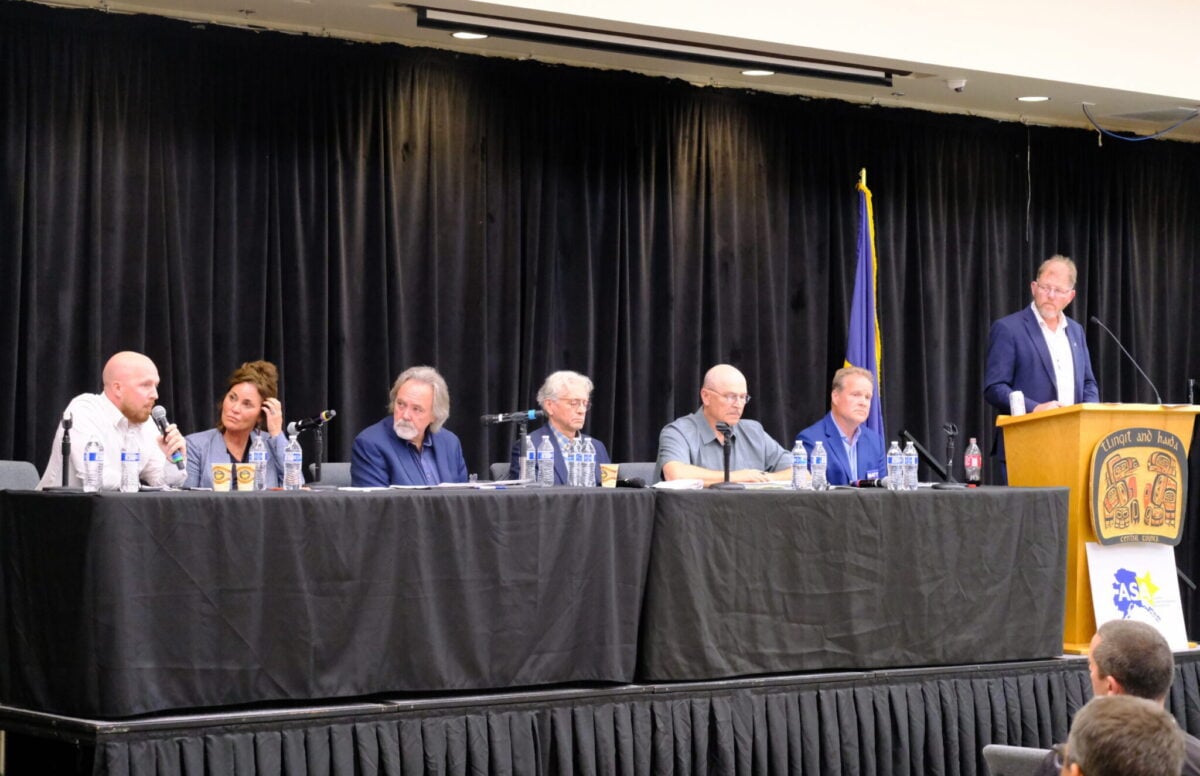
Six candidates for Alaska governor from across the political spectrum appeared side-by-side in a room full of superintendents and school officials in Juneau and promised that boosting education funding would be a priority of their administration, if elected.
Six candidates participated in the debate, out of 17 running for governor this year. Randy Hoffbeck, a candidate for Lieutenant Governor who stood in for his running mate, Bill Walker. They discussed their plans for education in a two-hour event hosted by the Alaska Superintendents’ Association on July 30.
The gubernatorial candidates included Republican Click Bishop, Democrat Tom Begich, Republican Matt Heilala, Republican Lesil Maguire, Democrat Jonathan Kreiss-Tomkins, and Independent Hoffbeck.
The panel was moderated by Randy Trani, superintendent of the Matanuska-Susitna Borough School District, with questions organized by the board of the Alaska Superintendents Association. A group of roughly 50 superintendents and school administrators from across Alaska attended as part of the association’s summer conference event in Juneau.
All six candidates agreed Alaska education has been underfunded by the Dunleavy administration, with several candidates characterizing public education as “in crisis.”
A record 12 schools were closed this year, amid millions in budget shortfalls, and others have cut teachers, programs and extracurricular activities. Districts reported funding has not kept pace with skyrocketing operating costs, amid declining enrollment as families leave the state or move to homeschool programs.
Trani said afterward he found all the candidates “super impressive,” particularly their ideas for funding education.
“They understand that there’s a fiscal reality problem in the state and it has to be addressed,” he said. “They all have different ideas of how they’re going to do it, but at least they’re leading with it as a top priority.”
Superintendents and school officials from across Alaska gathered for a summer conference in Juneau listen to a gubernatorial candidate debate on education on July 30, 2026. (Photo by Corinne Smith/Alaska Beacon)
Luke Meinert is superintendent of the Fairbanks North Star Borough School District, which has closed seven schools in the past five years due to budget shortfalls and declining enrollment. He said he was impressed with the candidates, their willingness to invest in education and their experience working on education issues in Alaska.
“They’ve been in the game,” Meinert said. “I think maybe every one of them went to public schools here in Alaska, and so they had experienced public schools at a time where we were investing a lot in our school districts. And it was great to hear that they want to get back to those times because that can improve our retention and recruitment efforts for teachers, and then obviously student outcomes on the other end of that.”
Hoffbeck, who is running for Lieutenant Governor on Bill Walker’s ticket, did not go to Alaska public schools, but Walker did.
The candidates shared their plans for funding for Alaska districts, tackling billions of dollars in deferred maintenance, boosting recruitment and retention of teachers and staff, and providing them healthcare and retirement, as well as views on local control of school boards, fiscal plans for the state and other issues.
Funding for education
Despite Alaska school districts reporting severe budget shortfalls and cutting teachers and programs, Gov. Mike Dunleavy has opposed sustained increases to per student funding, arguing against more funding without changes to policy. He has particularly sought changes related to charter schools and homeschool programs.
Democrat Tom Begich discusses his education policy platform, with Independent Randy Hoffbeck (left) and Republican Click Bishop (right) at an education debate on July 30, 2026. (Photo by Corinne Smith/Alaska Beacon)
But all six candidates agreed that schools have not been adequately funded under the Dunleavy administration, and that stable and reliable funding for districts is essential. They all said boosting investment in education is a priority of their campaigns.
Begich, Hoffbeck, Kreiss-Tomkins and McGuire said they support “forward funding” education and providing budgets to districts earlier in the year to provide more stability to districts. The state budget is currently finalized in June.
Begich said he would advocate for an immediate boost to per student funding, known as the base student allocation — the core of the state’s funding formula — to account for rising inflation. He proposed increasing the figure by roughly 15% to $7,680 per child and tie increases with inflation each year. He said he would also support fully funding pre-K to be available in all school districts.
Bishop said he would focus particularly on investing in career and technical education, referring to his experience growing up in a family of operating engineers and working in construction. “I’m going to push that till the day I die,” he said. “Nothing wrong with four-year degrees or higher. Career and tech ed needs to be improved upon in this state, and I’m the person that can do it working with you.”
McGuire and Kreiss-Tomkins said they support reviewing and revising the state’s complex funding formula to ensure districts are adequately funded. Both McGuire and Kreiss-Tomkins as well as Heilala said education has become a politically divisive issue which has obstructed progress. Kreiss-Tomkins called education policy a “Pandora’s box” avoided by lawmakers not wanting to take political risks.
Democrat Jonathan Kreiss-Tomkins, a candidate for governor, speaks at a debate on education on July 30, 2026. (Photo by Corinne Smith/Alaska Beacon)
Kreiss-Tomkins and Hoffbeck said they support a constitutional amendment to create a special fund for education separate from the state’s budget. “A constitutional amendment’s only way to dedicate funds in Alaska that can effectively politically de-risk education funding going forward, and also largely account for inflation,” Kreiss-Tomkins said.
Hoffbeck agreed there is a lack of trust between districts and the state under Dunleavy, which he said must be repaired. He said he believes adequate funding varies by school district across the state, and he and Walker both support a review of state funding for education by an independent third party to study and assess how much funding is needed by each school.
“Just throwing more money at it doesn’t fix the problem. We need to be surgical on how we add that money,” he said. “Yes, absolutely, we are underfunded. We need more funding, but we need to fund very surgically as we go forward.”
Teacher recruitment and retention
The candidates agreed investing in hiring and retaining teachers is a major priority, but diverged on the question of whether the state should revive a defined benefit retirement plan for educators.
Bishop and Heilala said they would focus education investments on boosting teacher pay. Heilala said funding should be more focused and efficient, and directed to teachers. “I believe teachers need pay raises. I think they probably need 15 to 30% pay raises, and of course, that’ll happen with a booming economy,” he said.
Independent Randy Hoffbeck, candidate for lieutenant governor running with Bill Waker, speaks at a debate on education on July 30, 2026. (Photo by Corinne Smith/Alaska Beacon)
Hoffbeck said teacher recruitment and retention should focus on training and hiring local teachers, particularly for rural Alaska. “The local teachers would stay in the rural communities,” he said, referring to his time working in the North Slope Borough. “And so I think we need to have a robust local recruitment process, including certification programs that make it possible for somebody in the village that may not have a four-year degree.”
Bishop, Begich and Kreiss-Tomkins support reviving the defined benefit retirement system for teachers, and said they believe offering that again would boost recruitment.
The state defined benefit retirement system for public employees was ended in 2006, after the system accrued a multi-billion dollar shortfall. Lawmakers passed legislation to revive the program this year, but Dunleavy vetoed it.
Begich said he would also want the state to provide medical benefits in a new defined benefit retirement plan, as well as grants for teacher housing.
Heilala disagreed, and said the defined benefit system is the “biggest mistake.” He said a 401(k) retirement plan has greater certainty to create income.
Republican Lesil McGuire speaks at a gubernatorial candidate debate on education on July 30, 2026. (Photo by Corinne Smith/Alaska Beacon)
Hoffbeck said he has concerns about a defined benefit retirement system as some districts would not be able to afford it.
McGuire said she does not support a defined benefit retirement plan, but supports a retirement system that the state can afford. She said she supports a student loan forgiveness program for teaching in Alaska, and low interest loans for housing to boost recruitment and retention.
“I think housing is a huge issue. Let’s make Alaska the place you want to come teach,” she said.
School maintenance backlog
The candidates all agreed that addressing the state’s multi-billion dollar backlog in deferred maintenance in K-12 schools and the University of Alaska system would be a major priority of their administrations, and presented various ideas on how to fund it.
Republican Click Bishop speaks at a gubernatorial candidate debate on education on July 30, 2026. (Photo by Corinne Smith/Alaska Beacon)
Bishop said part of his plan for funding education would be to levy an “education head tax,” a flat-rate tax per Alaskan regardless of income to pay for school maintenance. He said he’d introduced similar legislation when he was a member of the Alaska State Senate.
“It’s ludicrous that we have this much of a deferred maintenance schedule,” he said.
Begich said he supports the state paying to help boroughs and districts with school bond reimbursement, which is debt incurred by voter-approved bonds to fund school maintenance. He also supports the state backing a general obligation bond to generate hundreds of millions to address the existing maintenance backlog list.
McGuire, Hoffbeck and Kreiss-Tomkins agreed issuing bonds was a good idea. Hoffbeck and Kreiss-Tomkins also said prioritizing hiring local contractors for construction and maintenance is important.
Kriess-Tomkins noted maintaining schools is an obligation under Alaska’s Constitution. He also cautioned that there will be changes to schools with declining numbers of students as a result of outward migration from the state and families having fewer children. He said he’d want to invest in a system to keep up with school repairs in order to avoid large costly repairs like roof replacements decades in the making.
Republican Matt Heilala speaks at a gubernatorial candidate debate on education on July 30, 2026. (Photo by Corinne Smith/Alaska Beacon)
Heilala said the deferred maintenance backlog is a challenge, but sees opportunities for consolidating schools with “goodwill.” He said he believes “connectivity” will change infrastructure needs and said he sees artificial intelligence as a “supersonic tsunami” hitting American society now, and creating opportunities for education. “Education is going to be disrupted and changed. I believe in a good way,” he said. “There’s a lot of great opportunity, but we need to approach it with optimism.”
McGuire said a variety of solutions are needed to address school maintenance and repairs. “We’re so far behind at this point. We’re actually bordering up against litigation,” she said.
She cited legislative hearings and public outcry around the state-run boarding school, Mt. Edgecumbe High School this year when a quarter of students disenrolled sparking public focus on deteriorating school facilities.
“It was a stomach-turning event,” McGuire said. “So I think there are a variety of solutions. We need to be brave and bold, pull it out, assess what we need to do, and then look at solutions and address it immediately.”
Alaska lost a higher percentage of its federal workforce last year than almost all U.S. states to sweeping Trump administration cuts, according to a newly published analysis by the Alaska Department of Labor and Workforce Development.
By the end of 2025, Alaska’s federal workforce was 10.5% smaller than it had been at the end of the prior year, according to the analysis, published in Alaska Economic Trends, the monthly magazine of the department’s research section. In the fourth quarter of 2025, after many workers accepted buyouts or early retirement, the state’s federal workforce had dropped by 1,607 from the total in the fourth quarter of 2024, to 13,767 from 15,374 the year prior, according to the analysis.
The job losses came through mass firings and cuts made by the so-called Department of Government Efficiency, or DOGE, the government-reducing campaign led by trillionaire Elon Musk that started shortly after Donald Trump took office for his second term. To a large extent, job losses were concentrated at the end of the year.
Calculated by the annual average, Alaska lost about 4.5% of its federal jobs in 2025. Only Maryland, which lost 6.5% of its federal jobs, and New Mexico, which lost 5.8% of its federal jobs, lost more.
Federal job losses reduced Alaska’s total earnings by $36.5 million on average in 2025, according to the Department of Labor and Workforce Development analysis, and they brought federal employment in Alaska to the lowest level since at least 1990.
Much of the cutting in Alaska came in the U.S. Department of Defense’s civilian workforce. Calculated by annual average, 340 defense related jobs were lost to the DOGE cuts, but the fourth-quarter loss was calculated at 755 jobs.
The large amount of job losses in the Department of Defense category was a bit surprising, said Karinne Wiebold, the state labor economist who wrote the Trends article. “I assumed early on that the DoD might be one of the less affected departments and that our strong military presence might insulate us,” she said by email.
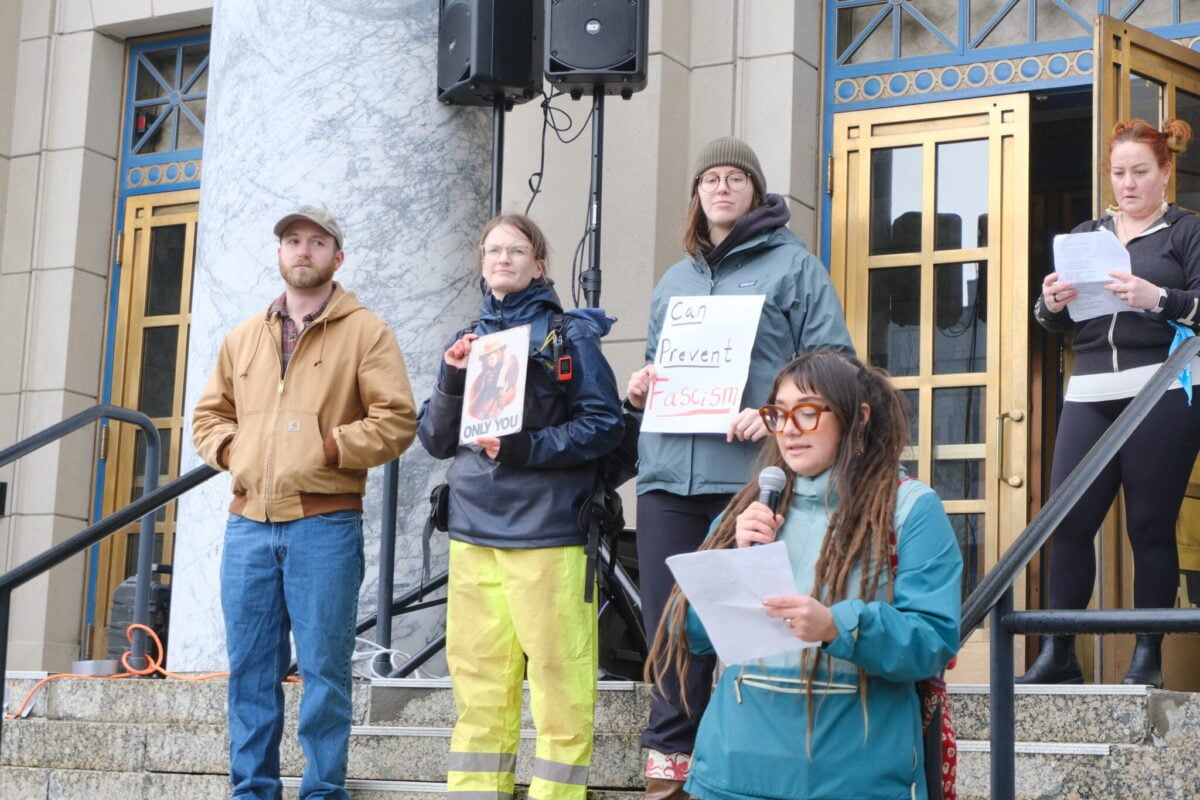
Federal agencies that sustained high numbers of job losses included the U.S. Forest Service, which had 180 fewer employees at the end of 2025 than in late 2024, the Bureau of Land Management, which had lost 133 jobs at the end of the year, and the National Oceanic and Atmospheric Administration, which had lost 101 of its workers by the end of 2025.
The fallout from the job losses continues, and the public does not yet have a complete picture, Wiebold said. “I do think the public is aware of the federal job losses and that they have been deep and a bit unpredictable,” she said. “I don’t know if the public generally understands what the ramifications of the cuts will be — federal employees perform a wide variety of oftentimes highly specialized work.”
Certain parts of the state were harder hit than others. The Southeast Fairbanks Census Area, which has been reliant on military-related employment, and parts of Southeast Alaska, where employment related to the Tongass National Forest is important, are among those regions with steeper job losses by percentage, according to the analysis.
Alaska’s ranking among states hit by DOGE-related job cuts could change, Wiebold said. Data from this year has yet to be fully analyzed, she said. “Even in the first parts of 2026, there are reports of the rankings shifting somewhat,” she said.
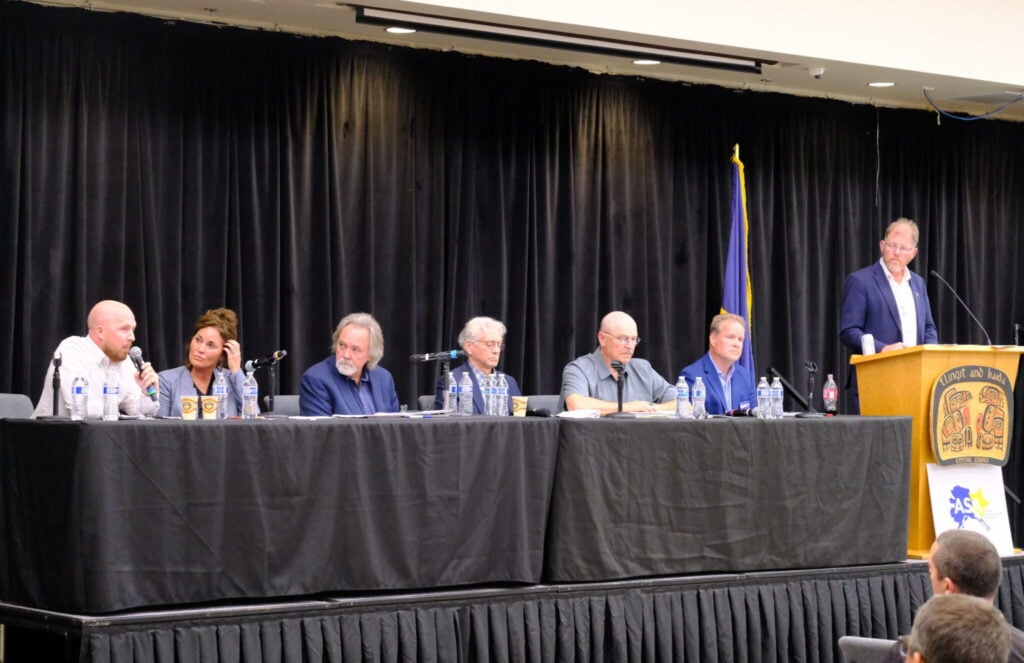
Six candidates for Alaska governor and lieutenant governor participated in a debate on education hosted by the Alaska Superintendents Association in Juneau on July 30, 2026. (Photo by Corinne Smith)
Six candidates for Alaska governor from across the political spectrum appeared side-by-side in a room full of superintendents and school officials in Juneau and promised that boosting education funding would be a priority of their administration, if elected.
Six candidates participated in the debate, out of 17 running for governor this year. Randy Hoffbeck, a candidate for Lieutenant Governor who stood in for his running mate, Bill Walker. They discussed their plans for education in a two-hour event hosted by the Alaska Superintendents’ Association on July 30. 2026 Voter Guide.
The candidates, the ballot measures, and the tools you need to cast your vote.
The gubernatorial candidates included Republican Click Bishop, Democrat Tom Begich, Republican Matt Heilala, Republican Lesil Maguire, Democrat Jonathan Kreiss-Tomkins, and Independent Hoffbeck.
The panel was moderated by Randy Trani, superintendent of the Matanuska-Susitna Borough School District, with questions organized by the board of the Alaska Superintendents Association. A group of roughly 50 superintendents and school administrators from across Alaska attended as part of the association’s summer conference event in Juneau.
All six candidates agreed Alaska education has been underfunded by the Dunleavy administration, with several candidates characterizing public education as “in crisis.”
A record 12 schools were closed this year, amid millions in budget shortfalls, and others have cut teachers, programs and extracurricular activities. Districts reported funding has not kept pace with skyrocketing operating costs, amid declining enrollment as families leave the state or move to homeschool programs.
Trani said afterward he found all the candidates “super impressive,” particularly their ideas for funding education.
“They understand that there’s a fiscal reality problem in the state and it has to be addressed,” he said. “They all have different ideas of how they’re going to do it, but at least they’re leading with it as a top priority.”
Superintendents and school officials from across Alaska gathered for a summer conference in Juneau listen to a gubernatorial candidate debate on education on July 30, 2026. (Photo by Corinne Smith/Alaska Beacon)
Luke Meinert is superintendent of the Fairbanks North Star Borough School District, which has closed seven schools in the past five years due to budget shortfalls and declining enrollment. He said he was impressed with the candidates, their willingness to invest in education and their experience working on education issues in Alaska.
“They’ve been in the game,” Meinert said. “I think maybe every one of them went to public schools here in Alaska, and so they had experienced public schools at a time where we were investing a lot in our school districts. And it was great to hear that they want to get back to those times because that can improve our retention and recruitment efforts for teachers, and then obviously student outcomes on the other end of that.”
Hoffbeck, who is running for Lieutenant Governor on Bill Walker’s ticket, did not go to Alaska public schools, but Walker did.
The candidates shared their plans for funding for Alaska districts, tackling billions of dollars in deferred maintenance, boosting recruitment and retention of teachers and staff, and providing them healthcare and retirement, as well as views on local control of school boards, fiscal plans for the state and other issues.
Funding for education
Despite Alaska school districts reporting severe budget shortfalls and cutting teachers and programs, Gov. Mike Dunleavy has opposed sustained increases to per student funding, arguing against more funding without changes to policy. He has particularly sought changes related to charter schools and homeschool programs.
Democrat Tom Begich discusses his education policy platform, with Independent Randy Hoffbeck (left) and Republican Click Bishop (right) at an education debate on July 30, 2026. (Photo by Corinne Smith/Alaska Beacon)
But all six candidates agreed that schools have not been adequately funded under the Dunleavy administration, and that stable and reliable funding for districts is essential. They all said boosting investment in education is a priority of their campaigns.
Begich, Hoffbeck, Kreiss-Tomkins and McGuire said they support “forward funding” education and providing budgets to districts earlier in the year to provide more stability to districts. The state budget is currently finalized in June.
Begich said he would advocate for an immediate boost to per student funding, known as the base student allocation — the core of the state’s funding formula — to account for rising inflation. He proposed increasing the figure by roughly 15% to $7,680 per child and tie increases with inflation each year. He said he would also support fully funding pre-K to be available in all school districts.
Bishop said he would focus particularly on investing in career and technical education, referring to his experience growing up in a family of operating engineers and working in construction. “I’m going to push that till the day I die,” he said. “Nothing wrong with four-year degrees or higher. Career and tech ed needs to be improved upon in this state, and I’m the person that can do it working with you.”
McGuire and Kreiss-Tomkins said they support reviewing and revising the state’s complex funding formula to ensure districts are adequately funded. Both McGuire and Kreiss-Tomkins as well as Heilala said education has become a politically divisive issue which has obstructed progress. Kreiss-Tomkins called education policy a “Pandora’s box” avoided by lawmakers not wanting to take political risks.
Democrat Jonathan Kreiss-Tomkins, a candidate for governor, speaks at a debate on education on July 30, 2026. (Photo by Corinne Smith/Alaska Beacon)
Kreiss-Tomkins and Hoffbeck said they support a constitutional amendment to create a special fund for education separate from the state’s budget. “A constitutional amendment’s only way to dedicate funds in Alaska that can effectively politically de-risk education funding going forward, and also largely account for inflation,” Kreiss-Tomkins said.
Hoffbeck agreed there is a lack of trust between districts and the state under Dunleavy, which he said must be repaired. He said he believes adequate funding varies by school district across the state, and he and Walker both support a review of state funding for education by an independent third party to study and assess how much funding is needed by each school.
“Just throwing more money at it doesn’t fix the problem. We need to be surgical on how we add that money,” he said. “Yes, absolutely, we are underfunded. We need more funding, but we need to fund very surgically as we go forward.”
Teacher recruitment and retention
The candidates agreed investing in hiring and retaining teachers is a major priority, but diverged on the question of whether the state should revive a defined benefit retirement plan for educators.
Bishop and Heilala said they would focus education investments on boosting teacher pay. Heilala said funding should be more focused and efficient, and directed to teachers. “I believe teachers need pay raises. I think they probably need 15 to 30% pay raises, and of course, that’ll happen with a booming economy,” he said.
Independent Randy Hoffbeck, candidate for lieutenant governor running with Bill Waker, speaks at a debate on education on July 30, 2026. (Photo by Corinne Smith/Alaska Beacon)
Hoffbeck said teacher recruitment and retention should focus on training and hiring local teachers, particularly for rural Alaska. “The local teachers would stay in the rural communities,” he said, referring to his time working in the North Slope Borough. “And so I think we need to have a robust local recruitment process, including certification programs that make it possible for somebody in the village that may not have a four-year degree.”
Bishop, Begich and Kreiss-Tomkins support reviving the defined benefit retirement system for teachers, and said they believe offering that again would boost recruitment.
The state defined benefit retirement system for public employees was ended in 2006, after the system accrued a multi-billion dollar shortfall. Lawmakers passed legislation to revive the program this year, but Dunleavy vetoed it.
Begich said he would also want the state to provide medical benefits in a new defined benefit retirement plan, as well as grants for teacher housing.
Heilala disagreed, and said the defined benefit system is the “biggest mistake.” He said a 401(k) retirement plan has greater certainty to create income.
Republican Lesil McGuire speaks at a gubernatorial candidate debate on education on July 30, 2026. (Photo by Corinne Smith/Alaska Beacon)
Hoffbeck said he has concerns about a defined benefit retirement system as some districts would not be able to afford it.
McGuire said she does not support a defined benefit retirement plan, but supports a retirement system that the state can afford. She said she supports a student loan forgiveness program for teaching in Alaska, and low interest loans for housing to boost recruitment and retention.
“I think housing is a huge issue. Let’s make Alaska the place you want to come teach,” she said.
School maintenance backlog
The candidates all agreed that addressing the state’s multi-billion dollar backlog in deferred maintenance in K-12 schools and the University of Alaska system would be a major priority of their administrations, and presented various ideas on how to fund it.
Republican Click Bishop speaks at a gubernatorial candidate debate on education on July 30, 2026. (Photo by Corinne Smith/Alaska Beacon)
Bishop said part of his plan for funding education would be to levy an “education head tax,” a flat-rate tax per Alaskan regardless of income to pay for school maintenance. He said he’d introduced similar legislation when he was a member of the Alaska State Senate.
“It’s ludicrous that we have this much of a deferred maintenance schedule,” he said.
Begich said he supports the state paying to help boroughs and districts with school bond reimbursement, which is debt incurred by voter-approved bonds to fund school maintenance. He also supports the state backing a general obligation bond to generate hundreds of millions to address the existing maintenance backlog list.
McGuire, Hoffbeck and Kreiss-Tomkins agreed issuing bonds was a good idea. Hoffbeck and Kreiss-Tomkins also said prioritizing hiring local contractors for construction and maintenance is important.
Kriess-Tomkins noted maintaining schools is an obligation under Alaska’s Constitution. He also cautioned that there will be changes to schools with declining numbers of students as a result of outward migration from the state and families having fewer children. He said he’d want to invest in a system to keep up with school repairs in order to avoid large costly repairs like roof replacements decades in the making.
Republican Matt Heilala speaks at a gubernatorial candidate debate on education on July 30, 2026. (Photo by Corinne Smith/Alaska Beacon)
Heilala said the deferred maintenance backlog is a challenge, but sees opportunities for consolidating schools with “goodwill.” He said he believes “connectivity” will change infrastructure needs and said he sees artificial intelligence as a “supersonic tsunami” hitting American society now, and creating opportunities for education. “Education is going to be disrupted and changed. I believe in a good way,” he said. “There’s a lot of great opportunity, but we need to approach it with optimism.”
McGuire said a variety of solutions are needed to address school maintenance and repairs. “We’re so far behind at this point. We’re actually bordering up against litigation,” she said.
She cited legislative hearings and public outcry around the state-run boarding school, Mt. Edgecumbe High School this year when a quarter of students disenrolled sparking public focus on deteriorating school facilities.
“It was a stomach-turning event,” McGuire said. “So I think there are a variety of solutions. We need to be brave and bold, pull it out, assess what we need to do, and then look at solutions and address it immediately.”
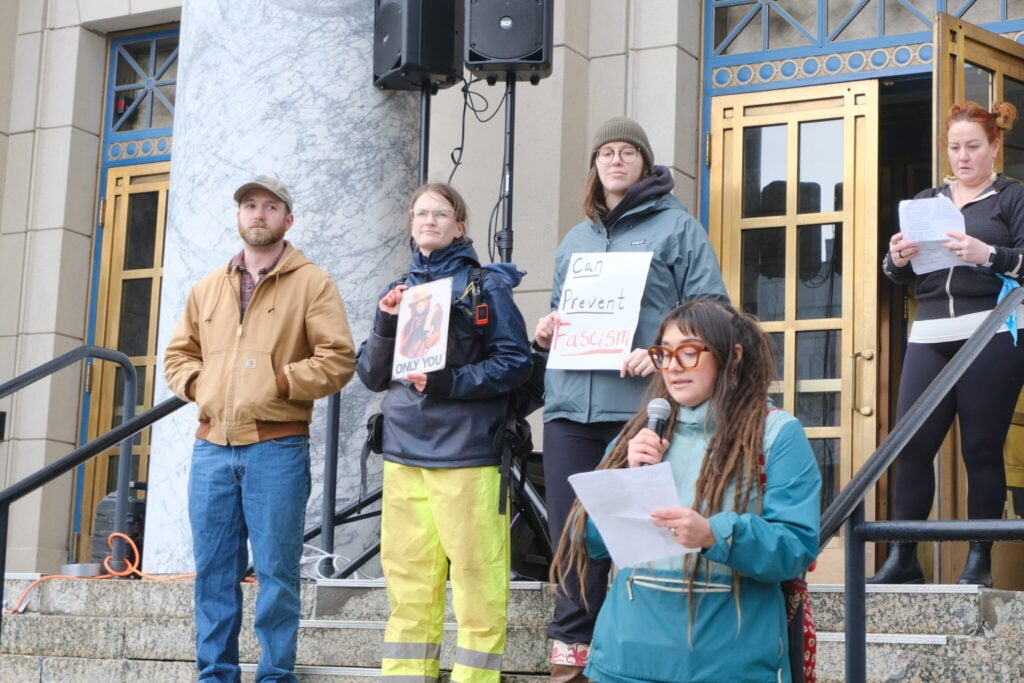
Fired federal workers formerly with the U.S. Forest Service based at the Mendenhall Glacier in Juneau speak at the Alaska State Capito; on March 21, 2025, about their experiences. The Forest Service was among the federal agencies in Alaska most heavily affected by job cuts. (Photo by Corinne Smith/Alaska Beacon)
Alaska lost a higher percentage of its federal workforce last year than almost all U.S. states to sweeping Trump administration cuts, according to a newly published analysis by the Alaska Department of Labor and Workforce Development.
By the end of 2025, Alaska’s federal workforce was 10.5% smaller than it had been at the end of the prior year, according to the analysis, published in Alaska Economic Trends, the monthly magazine of the department’s research section. In the fourth quarter of 2025, after many workers accepted buyouts or early retirement, the state’s federal workforce had dropped by 1,607 from the total in the fourth quarter of 2024, to 13,767 from 15,374 the year prior, according to the analysis.
The job losses came through mass firings and cuts made by the so-called Department of Government Efficiency, or DOGE, the government-reducing campaign led by trillionaire Elon Musk that started shortly after Donald Trump took office for his second term. To a large extent, job losses were concentrated at the end of the year.
Calculated by the annual average, Alaska lost about 4.5% of its federal jobs in 2025. Only Maryland, which lost 6.5% of its federal jobs, and New Mexico, which lost 5.8% of its federal jobs, lost more.
Federal job losses reduced Alaska’s total earnings by $36.5 million on average in 2025, according to the Department of Labor and Workforce Development analysis, and they brought federal employment in Alaska to the lowest level since at least 1990.
Much of the cutting in Alaska came in the U.S. Department of Defense’s civilian workforce. Calculated by annual average, 340 defense related jobs were lost to the DOGE cuts, but the fourth-quarter loss was calculated at 755 jobs.
The large amount of job losses in the Department of Defense category was a bit surprising, said Karinne Wiebold, the state labor economist who wrote the Trends article. “I assumed early on that the DoD might be one of the less affected departments and that our strong military presence might insulate us,” she said by email.
Federal agencies that sustained high numbers of job losses included the U.S. Forest Service, which had 180 fewer employees at the end of 2025 than in late 2024, the Bureau of Land Management, which had lost 133 jobs at the end of the year, and the National Oceanic and Atmospheric Administration, which had lost 101 of its workers by the end of 2025.
The fallout from the job losses continues, and the public does not yet have a complete picture, Wiebold said. “I do think the public is aware of the federal job losses and that they have been deep and a bit unpredictable,” she said. “I don’t know if the public generally understands what the ramifications of the cuts will be — federal employees perform a wide variety of oftentimes highly specialized work.”
Certain parts of the state were harder hit than others. The Southeast Fairbanks Census Area, which has been reliant on military-related employment, and parts of Southeast Alaska, where employment related to the Tongass National Forest is important, are among those regions with steeper job losses by percentage, according to the analysis.
Alaska’s ranking among states hit by DOGE-related job cuts could change, Wiebold said. Data from this year has yet to be fully analyzed, she said. “Even in the first parts of 2026, there are reports of the rankings shifting somewhat,” she said.
Six candidates for Alaska governor and lieutenant governor participated in a debate on education hosted by the Alaska Superintendents Association in Juneau on July 30, 2026. (Photo by Corinne Smith)
Six candidates for Alaska governor from across the political spectrum appeared side-by-side in a room full of superintendents and school officials in Juneau and promised that boosting education funding would be a priority of their administration, if elected.
Six candidates participated in the debate, out of 17 running for governor this year. Randy Hoffbeck, a candidate for Lieutenant Governor who stood in for his running mate, Bill Walker. They discussed their plans for education in a two-hour event hosted by the Alaska Superintendents’ Association on July 30.
The gubernatorial candidates included Republican Click Bishop, Democrat Tom Begich, Republican Matt Heilala, Republican Lesil Maguire, Democrat Jonathan Kreiss-Tomkins, and Independent Hoffbeck.
The panel was moderated by Randy Trani, superintendent of the Matanuska-Susitna Borough School District, with questions organized by the board of the Alaska Superintendents Association. A group of roughly 50 superintendents and school administrators from across Alaska attended as part of the association’s summer conference event in Juneau.
All six candidates agreed Alaska education has been underfunded by the Dunleavy administration, with several candidates characterizing public education as “in crisis.”
A record 12 schools were closed this year, amid millions in budget shortfalls, and others have cut teachers, programs and extracurricular activities. Districts reported funding has not kept pace with skyrocketing operating costs, amid declining enrollment as families leave the state or move to homeschool programs.
Trani said afterward he found all the candidates “super impressive,” particularly their ideas for funding education.
“They understand that there’s a fiscal reality problem in the state and it has to be addressed,” he said. “They all have different ideas of how they’re going to do it, but at least they’re leading with it as a top priority.”
Superintendents and school officials from across Alaska gathered for a summer conference in Juneau listen to a gubernatorial candidate debate on education on July 30, 2026. (Photo by Corinne Smith/Alaska Beacon)
Luke Meinert is superintendent of the Fairbanks North Star Borough School District, which has closed seven schools in the past five years due to budget shortfalls and declining enrollment. He said he was impressed with the candidates, their willingness to invest in education and their experience working on education issues in Alaska.
“They’ve been in the game,” Meinert said. “I think maybe every one of them went to public schools here in Alaska, and so they had experienced public schools at a time where we were investing a lot in our school districts. And it was great to hear that they want to get back to those times because that can improve our retention and recruitment efforts for teachers, and then obviously student outcomes on the other end of that.”
Hoffbeck, who is running for Lieutenant Governor on Bill Walker’s ticket, did not go to Alaska public schools, but Walker did.
The candidates shared their plans for funding for Alaska districts, tackling billions of dollars in deferred maintenance, boosting recruitment and retention of teachers and staff, and providing them healthcare and retirement, as well as views on local control of school boards, fiscal plans for the state and other issues.
Funding for education
Despite Alaska school districts reporting severe budget shortfalls and cutting teachers and programs, Gov. Mike Dunleavy has opposed sustained increases to per student funding, arguing against more funding without changes to policy. He has particularly sought changes related to charter schools and homeschool programs.
Democrat Tom Begich discusses his education policy platform, with Independent Randy Hoffbeck (left) and Republican Click Bishop (right) at an education debate on July 30, 2026. (Photo by Corinne Smith/Alaska Beacon)
But all six candidates agreed that schools have not been adequately funded under the Dunleavy administration, and that stable and reliable funding for districts is essential. They all said boosting investment in education is a priority of their campaigns.
Begich, Hoffbeck, Kreiss-Tomkins and McGuire said they support “forward funding” education and providing budgets to districts earlier in the year to provide more stability to districts. The state budget is currently finalized in June.
Begich said he would advocate for an immediate boost to per student funding, known as the base student allocation — the core of the state’s funding formula — to account for rising inflation. He proposed increasing the figure by roughly 15% to $7,680 per child and tie increases with inflation each year. He said he would also support fully funding pre-K to be available in all school districts.
Bishop said he would focus particularly on investing in career and technical education, referring to his experience growing up in a family of operating engineers and working in construction. “I’m going to push that till the day I die,” he said. “Nothing wrong with four-year degrees or higher. Career and tech ed needs to be improved upon in this state, and I’m the person that can do it working with you.”
McGuire and Kreiss-Tomkins said they support reviewing and revising the state’s complex funding formula to ensure districts are adequately funded. Both McGuire and Kreiss-Tomkins as well as Heilala said education has become a politically divisive issue which has obstructed progress. Kreiss-Tomkins called education policy a “Pandora’s box” avoided by lawmakers not wanting to take political risks.
Democrat Jonathan Kreiss-Tomkins, a candidate for governor, speaks at a debate on education on July 30, 2026. (Photo by Corinne Smith/Alaska Beacon)
Kreiss-Tomkins and Hoffbeck said they support a constitutional amendment to create a special fund for education separate from the state’s budget. “A constitutional amendment’s only way to dedicate funds in Alaska that can effectively politically de-risk education funding going forward, and also largely account for inflation,” Kreiss-Tomkins said.
Hoffbeck agreed there is a lack of trust between districts and the state under Dunleavy, which he said must be repaired. He said he believes adequate funding varies by school district across the state, and he and Walker both support a review of state funding for education by an independent third party to study and assess how much funding is needed by each school.
“Just throwing more money at it doesn’t fix the problem. We need to be surgical on how we add that money,” he said. “Yes, absolutely, we are underfunded. We need more funding, but we need to fund very surgically as we go forward.”
Teacher recruitment and retention
The candidates agreed investing in hiring and retaining teachers is a major priority, but diverged on the question of whether the state should revive a defined benefit retirement plan for educators.
Bishop and Heilala said they would focus education investments on boosting teacher pay. Heilala said funding should be more focused and efficient, and directed to teachers. “I believe teachers need pay raises. I think they probably need 15 to 30% pay raises, and of course, that’ll happen with a booming economy,” he said.
Independent Randy Hoffbeck, candidate for lieutenant governor running with Bill Waker, speaks at a debate on education on July 30, 2026. (Photo by Corinne Smith/Alaska Beacon)
Hoffbeck said teacher recruitment and retention should focus on training and hiring local teachers, particularly for rural Alaska. “The local teachers would stay in the rural communities,” he said, referring to his time working in the North Slope Borough. “And so I think we need to have a robust local recruitment process, including certification programs that make it possible for somebody in the village that may not have a four-year degree.”
Bishop, Begich and Kreiss-Tomkins support reviving the defined benefit retirement system for teachers, and said they believe offering that again would boost recruitment.
The state defined benefit retirement system for public employees was ended in 2006, after the system accrued a multi-billion dollar shortfall. Lawmakers passed legislation to revive the program this year, but Dunleavy vetoed it.
Begich said he would also want the state to provide medical benefits in a new defined benefit retirement plan, as well as grants for teacher housing.
Heilala disagreed, and said the defined benefit system is the “biggest mistake.” He said a 401(k) retirement plan has greater certainty to create income.
Republican Lesil McGuire speaks at a gubernatorial candidate debate on education on July 30, 2026. (Photo by Corinne Smith/Alaska Beacon)
Hoffbeck said he has concerns about a defined benefit retirement system as some districts would not be able to afford it.
McGuire said she does not support a defined benefit retirement plan, but supports a retirement system that the state can afford. She said she supports a student loan forgiveness program for teaching in Alaska, and low interest loans for housing to boost recruitment and retention.
“I think housing is a huge issue. Let’s make Alaska the place you want to come teach,” she said.
School maintenance backlog
The candidates all agreed that addressing the state’s multi-billion dollar backlog in deferred maintenance in K-12 schools and the University of Alaska system would be a major priority of their administrations, and presented various ideas on how to fund it.
Republican Click Bishop speaks at a gubernatorial candidate debate on education on July 30, 2026. (Photo by Corinne Smith/Alaska Beacon)
Bishop said part of his plan for funding education would be to levy an “education head tax,” a flat-rate tax per Alaskan regardless of income to pay for school maintenance. He said he’d introduced similar legislation when he was a member of the Alaska State Senate.
“It’s ludicrous that we have this much of a deferred maintenance schedule,” he said.
Begich said he supports the state paying to help boroughs and districts with school bond reimbursement, which is debt incurred by voter-approved bonds to fund school maintenance. He also supports the state backing a general obligation bond to generate hundreds of millions to address the existing maintenance backlog list.
McGuire, Hoffbeck and Kreiss-Tomkins agreed issuing bonds was a good idea. Hoffbeck and Kreiss-Tomkins also said prioritizing hiring local contractors for construction and maintenance is important.
Kriess-Tomkins noted maintaining schools is an obligation under Alaska’s Constitution. He also cautioned that there will be changes to schools with declining numbers of students as a result of outward migration from the state and families having fewer children. He said he’d want to invest in a system to keep up with school repairs in order to avoid large costly repairs like roof replacements decades in the making.
Republican Matt Heilala speaks at a gubernatorial candidate debate on education on July 30, 2026. (Photo by Corinne Smith/Alaska Beacon)
Heilala said the deferred maintenance backlog is a challenge, but sees opportunities for consolidating schools with “goodwill.” He said he believes “connectivity” will change infrastructure needs and said he sees artificial intelligence as a “supersonic tsunami” hitting American society now, and creating opportunities for education. “Education is going to be disrupted and changed. I believe in a good way,” he said. “There’s a lot of great opportunity, but we need to approach it with optimism.”
McGuire said a variety of solutions are needed to address school maintenance and repairs. “We’re so far behind at this point. We’re actually bordering up against litigation,” she said.
She cited legislative hearings and public outcry around the state-run boarding school, Mt. Edgecumbe High School this year when a quarter of students disenrolled sparking public focus on deteriorating school facilities.
“It was a stomach-turning event,” McGuire said. “So I think there are a variety of solutions. We need to be brave and bold, pull it out, assess what we need to do, and then look at solutions and address it immediately.”
(The Center Square) – Nearly two dozen state attorneys general banded together as early as April 2024 to plot litigation against President Donald Trump before he was reelected by 2.3 million more votes than his Democratic opponent, according to a…