








Categories
Alaska News

A Q&A with Tom Begich who visited Haines during the Fair

Tom Begich talks with potential voters in the Haines Brewery, Wednesday, Oct. 29, 2025. (Will Steinfeld/Chilkat Valley News)

Former Alaska State Sen. Tom Begich stopped in Haines this week as he campaigns back and forth across the state. The 65-year old Democrat currently leads the race to be the state’s next governor, according to a range of polls. While in Haines, he competed in the singer-songwriter contest at the Southeast Alaska State Fair. He also spoke to CVN reporter Will Steinfeld about a range of issues, including education, state-funded infrastructure, tribal sovereignty and resource development. 

You’ve been traveling all over the state. What’s the scope of the concerns you’ve been hearing from people? Is it a lot of local issues, or are there consistent big picture issues you’re hearing about?

It’s a little bit of both. But mostly it’s been two main issues. They talk about education and whether or not it will ever be fully funded again, and there’s a real feeling that we’ve allowed our education system to really fall apart. You know, we’re 48, 49th in the nation now, depending on which categorical area you’re looking at,

Then, when we talk about affordability, energy costs are outrageous. Where they have been able to shift to renewables, it’s lowered costs significantly, but there has been a real pullback at the federal level for that renewable funding, and I think the state has to pick up the slack there.

On education, do you hear from people that it’s a money issue, that communities just need more funds to work with?

You hear that, but it’s a quality issue too… . How do you make a more stable education system? I’ve proposed some ways that we can do that. Most school districts aren’t able to recruit new teachers because they don’t know their budgets until, in this case, we don’t even know them today, and we’re already in the new fiscal year for these school districts. I’ve proposed taking the education budget as a separate component out of the operating budget, and placing it so that we address it in the first 60 days (of the legislative session). That’s a process issue, not a money issue. 

But the second piece to that is a money issue. I wouldn’t have vetoed the pension plan that the bipartisan majorities passed in the Senate and the House. We’re the only state in the union that doesn’t give what we call a defined benefit of pension plan to teachers. So when our teachers reach their peak teaching ability after four or five years, they’ve been educators in Alaska, they can compete for jobs in 49 other states that will give them a pension plan. So we lose them, and we know that because we’ve actually studied that. 

To fully fund education, you’re probably looking at somewhere around an additional $185 million to $215 million a year. I have a plan for how you get there and how you can pay for that. And I don’t think any other candidate for governor does have a fiscal plan that is as detailed as mine is. 

If your fiscal plan can’t deliver that new revenue in year one or two, or at all, do you see education as a priority enough to take from other pools of funding?

Well I think you can have a fiscal plan that gets there in year one, and I’ll talk about that in a second. But it is a priority, and we will find the funding for it because it must happen. A failed school system does not provide opportunity for young people. And if you’re looking to have kids here, you don’t want to raise them in a place that doesn’t provide an education. I simply won’t stand for it, and I don’t think most Alaskans will either anymore. So how do we get there? 

This governor twice vetoed the internet fee, which would, like 36 other states, simply put the international internet companies into our corporate tax code. 

Number two, we must fix what’s called the S-Corp exception. This has allowed over 100 million in tax revenue we used to get from BP, British Petroleum, to fall off our books immediately, and it fell off our books because an S-Corp, Hilcorp, bought their assets. That was never the intent of the S-Corp law. It was to support small businesses. Just fixing that is worth between $100 million and $150 million annually, according to our own state Senate Resources Committee.

Finally getting rid of the tax credits on Prudhoe, Kuparak, and Alpine, the three legacy fields on Prudhoe. You don’t provide tax credits to a field that’s been producing for 20, 30, or 40 years. You provide it for new development. That will produce between $200 and $250 million annually into our state budget. 

The first two have or nearly have consensus already. If we get the third one, you’re talking about $400 million a year we’re not collecting today. That is more than enough to pay for that education and also do some of the other issues that have come up around retrofitting for energy efficiency or ensuring that we’re looking at our healthcare and housing issues in a manner that will actually reach Alaskans. 

People seem to be afraid to talk about the tax credit issue. They’ll talk about the S-Corp and they’ll talk about the internet fee, but they’re all afraid to talk about getting our fair share from the oil industry. Just remember, those are our resources, and our Constitution demands that we create maximum value from the production of our resources. We should do that because ultimately, in the end, those resources aren’t going to be there forever.

I have a slightly different question for you, a more local question. Week to week, I hear a lot of people bring up the old lumber mills pretty frequently: this idea of a search for what kind of industry is next that will bring some kind of local employment base. Do you think in these kinds of Southeast towns, the state has some role to play in looking for a next option? Do you think there is a next option?

There’s always a next option. You know, I look back in the 80s, we had pulp mills in Sitka and Ketchikan that were really the mainstays of both communities. In Sitka,  what they did was they began a multi-year plan to figure out how they could expand tourism, how they could expand the university, how they could expand their arts community, and they also developed and supported small businesses. Sitka ended up thriving, being a diversified community that had all these different sectors that were then represented. 

That requires comprehensive community planning. The state could lead that effort with the community, but only if the community wants that effort. The administration at the state level is really not very interested in that. I am. I cut my teeth on community organizing, community development, whether it was strategic planning in the Northwest Arctic Borough or working with school districts like the Upan School District in Western Alaska. That’s the same kind of skill set I want to bring to bear as governor.

I think this community ought to be a thriving community and it doesn’t have to be built on whether or not you’re cutting timber everywhere. In fact, we have a law in the books. It’s a carbon credit bill. Sealaska took 117,000 acres, sold carbon credits, and are making $100 million a year. I was up in Klukwan talking to folks there, one of the things we talked about was, instead of building a bridge to that state land and cutting timber on that land, maybe building a road to mines that might not be built, what if we instead carbon credited that state land, producing millions of dollars a year that we could use to help Haines plan for its future, and for the village to do the same thing. Now you’re protecting commercial fishing grounds, you’re protecting subsistence hunting and fishing habitat, and you’re making income in doing so. And that income could be used to reimagine what this community could be like

Recently the CEO of Vizsla Copper, the Palmer Project owner, said his company was working with the state to fund work on a new industrial port facility in Haines. We don’t know exactly what it looks like yet…

Whoa whoa. So he’s telling you about this, but the community doesn’t know anything about it?

The community didn’t know about it, as far as I know, until he said this. 

Let me just say this again. I don’t know whether y’all support that dock or not, but not on my watch. Nothing moves forward in a community without the community identifying what it wants to do. The state does not have a role in bypassing community interests, ever. That has been the role of this administration, to pick a project and to impose that project, whether a community wants it or not. I’d rather have that debate and that discussion in the community and decide what you guys want to do. Now, if you want to work with them and do a dock, that’s your decision. I’m going to be intervening to say, do you have a meaningful place at the table, or are they just shining you on?

How does the public process change to facilitate that?

If I were governor and somebody came to me and said, hey, I got a great idea for Haines, my first question would be, how does the community feel about it? In this case, it sounds like the answer would be, well, I haven’t talked to them yet. I would say, “well, you come back to me after you’ve talked to the community, and then let me go talk to the city manager and the mayor and ask what they’re thinking.”

Are there specific ways you could codify that so that at an agency level, even if people aren’t coming to your desk, that would still be the case?

Yeah, you could even do it by executive order. I was up in Fairbanks, and a bunch of community members from Esther Dome came up to talk to me because there’s a mining operation happening up there, and they didn’t want it. I said, what was the public process? Well, there wasn’t one. They didn’t even know how it had occurred. That can’t happen. The Ambler Road. People talk about that all the time. You know there are 88 resolutions of villages opposing the Ambler Road. You probably didn’t know that, because the governor has used AIDEA as a tool to push that road through without even talking to communities that are going to be directly impacted by it. And that, to me, is the wrong approach. Government should never have the approach of imposing on a community a development it doesn’t want. 

How do you think the state’s dialogue with the borough of Haines, for example, or the general population of Haines, should differ from consultation with local tribes? Should it be different?

I think there shouldn’t be a difference in the long run. We have, by statute, said we recognize local tribes. I want to take that a step further and ensure that we’re doing full recognition of our tribes because our tribes have sovereignty. We never conquered them here. There’s no treaty. There’s an understanding that they have some sovereign power, and so that relationship should be fraternal, not paternal. What I mean by that is, the government works with its municipalities to try to find solutions. Government does have the power to impose some decisions, eminent domain, and things like that. I want to be sure that our discussions with tribes are on a fraternal relationship basis: not, “nice, thank you for your opinion. We’re going to do this anyway.”

I guess beyond general principles, do you think that in terms of the process, there’s a difference between dealing with a municipality and dealing with a sovereign government?

There is, and part of that difference is that a sovereign government has a lot more authority than a municipality has. How we negotiate that and how we make that look will be something we work out with sovereign governments on a regular basis. 

(The Chilkat Valley News) has been following the federal Department of the Interior policy going back and forth on the status of allotment land, like in Eklutna. I wish I was more educated on the topic, but it seems like the Department of Law and the state have been relatively consistent across recent administrations on how the state views state sovereignty over allotment land and tribal land. Do you feel like there’s a change of direction to be had?

I don’t share that view. It will be a near reversal of direction. I look at this very, very differently. I think this administration has created an antagonistic relationship with a fifth of our population, and I think that it reflects prior administrations as well. I said there’s an exception in the Walker-Mallott administration that was much friendlier, but not since the Knowles administration have we had a strong working relationship outside of Walker’s administration with tribes. In fact, prior to that, we didn’t even fully understand tribes until the Clinton administration recognized our tribes up here. Prior to that, it was all about the corporations, and there were (Indian Reorganization Act) entities that were demanding recognition. 

Everyone should be treated in a manner that is respectful to their existence. You’re not threatening subsistence rights all the time because you believe that a particular sport fishing organization is more important than people who’ve lived here for 10,000 years. I don’t buy that, and what I want to do is find those collaborative places we can work that will preserve subsistence preference, while at the same time ensuring we have a commercial fishing industry here, and the two are compatible. 

How deep are you into the marine highway? Like, are you thinking at the level of we should have more day boats, should invest in mainliners, that kind of planning? Are you more thinking about the broader process of ‘let’s change how the board is composed and how we fund the system?’

I want professionals who understand the board, not a bunch of DOT bureaucrats determining how that board, how that marine highway system is run. I want us to stop looking at it as, boy, we don’t make enough money off the people on the ferry system to justify it. You don’t make enough money on the Glenn Highway either. In fact, you make no money on the Glenn Highway. Why do our students pay $60,000 (for transportation) in sports leagues in Southeast because they don’t know if they’re going to have regular ferry service, so they have to have a backup plan with Seaplanes? You know, this is stuff that the community deserves to get fair treatment on. If you have a board that’s coming from these communities, you will be able to deal with these issues on a regular basis. More importantly, if you have that $200 million to deal with those deferred maintenance pieces — you have a lot more than that deferred maintenance, but that’s a starting point — It jumpstarts your ability to be successful. If you have bonding authority, that means you can be looking at a 10- or 20-year plan and doing replacement and envisioning what that system looks like. 

Do you feel like legislators from other parts of the state would go for extensive bonding for the marine highway system? Like, do you have any indication that that’s possible?

I do. The revenue bond isn’t just for (the Marine Highway). The revenue bond would be a $850 million general obligation bond. $200 million would be for the marine highway system. $250 million would be for the deferred maintenance. Over $2 million for the University of Alaska. You’d have $200 million reserved for the major maintenance list and the maintenance and the school construction lists, and then you have $200 million for roads and bridges that are falling apart across the state. That’s $850 million. It’s not even a billion dollars. It’s a general obligation bond, which gives us a time period to pay it back over time, and that time period allows us to jumpstart every one of those areas. That fiscal plan I laid out earlier, coupled with using carbon credits appropriately and some of the other ideas that are out there, could produce enough income for the state of Alaska to allow us to finally have a capital budget that we can count on every year. These are all part of the planning process that I’m looking at. I want to see a state that is not just reflecting on the past, but looking to the future. And I think we can get there. I’m sure we can get there.

The post A Q&A with Tom Begich who visited Haines during the Fair appeared first on Chilkat Valley News.

Categories
Alaska News

Alaska Airlines almost doubles its number of Boeing 737 freighters

Alaska Airlines will add four more converted Boeing 737-800 freighters to its fleet, raising to nine the number of all-cargo aircraft the company operates.

The additional freighters will be dedicated to serving Alaska and Hawai’i, not any specific route, Tim Thompson, the company’s director of public relations, said in an email July 22.

Alaska operates a weekly cargo flight into Petersburg on Wednesdays, using a Boeing 737-700, which is slightly smaller than the 800 series but capable of carrying about 40,000 pounds in cargo containers lined up where the seats would be on a passenger aircraft.

The weekly flight is scheduled to leave Seattle every Thursday afternoon, arriving in Wrangell that evening after stops to drop off and pick up freight in Ketchikan, Sitka and Juneau.

Petersburg also is scheduled for a weekly cargo flight, on Wednesdays.

The newest additions to the airline’s freighter fleet – scheduled for delivery next year, on long-term leases – could be used anywhere on Alaska’s route system when heavier loads demand an additional flight, Thompson said.

“Adding new freighters provides greater cargo capacity and allows us to add supplemental service as needed to communities,” he said.

The airline also moves cargo in the belly of its daily passenger flights in and out of Petersburg, but space is limited, particularly for larger items or when passenger loads are heavy.

Alaska Air Group owns and operates Alaska Airlines and Hawaiian Airlines, which it took over in 2024, maintaining a fleet of more than 300 passenger jets, with capacity ranging from 124 passengers to 300 seats on the Boeing 787-9 Dreamliners it flies on its new international routes.

The two airlines fly a total of 15 freighters, of which 10 are operated by Hawaiian Airlines.

Alaska Air Group’s regional carrier, Horizon Airlines, operates 92 of its 76-passenger planes.

The post Alaska Airlines almost doubles its number of Boeing 737 freighters appeared first on Chilkat Valley News.
Categories
Music

Russell Dickerson Makes KIDZ BOP History With ‘Happen To Me’ Music Video Cameo

Russell Dickerson just made KIDZ BOP history as the first country artist to ever make an appearance in a music video with the #1 children’s music group.

The singer/songwriter’s Platinum-certified hit, “Happen To Me,” has become a worldwide fan favorite with its upbeat, feel-good energy, and now the song has found a new audience with a KIDZ BOP cover and music video featuring a special cameo from Dickerson himself.

Russell Dickerson X Kidz Bop; Photo Provided

Out now, the video opens with Dickerson in the SiriusXM’s The Highway studio, where he joins host Macie Banks in discussing the success of “Happen To Me.” She reveals the very exciting news that the has found its way to KIDZ BOP, prompting Dickerson to ask, “Have I made it? Does that mean I made it?”

He then gets to thinking and admits that he has always wondered what it would be like to be a KIDZ BOP kid. Dickerson suddenly gets his wish as he is transformed into a real KIDZ BOP kid.

The familiar melody begins to play as the kid version of Dickerson joins the rest of the KIDZ BOP group for an adventure through Nashville. Filmed in partnership with Visit Music City, the video finds them visiting several iconic locations including Broadway, the Country Music Hall of Fame and the Grand Ole Opry.

Dressed up in their denim ensembles the talented young performers dance their way through Nashville while singing their version of the upbeat track. Their adventure eventually leads them backstage at the Grand Ole Opry before they step into the iconic circle on the legendary stage.

The fun-filled journey comes to an end with Dickerson transforming back into himself just in time to join the KIDZ BOP Kids for an energetic dance party. The country star even shows off a few of the signature moves from the viral dance that gained momentum amid the song’s rapid rise.

The  KIDZ BOP’s version of “Happen To Me” is now available to stream on all major streaming platforms. Plus, Russel Dickerson recorded a special message on KIDZ BOP Radio on SiriusXM Channel 135, where it’s all KIDZ BOP, all the time.

The post Russell Dickerson Makes KIDZ BOP History With ‘Happen To Me’ Music Video Cameo appeared first on Country Now.

​Country Now

Categories
Alaska News

Petersburg crew revives Sitka deckhand with CPR after overboard near-drowning

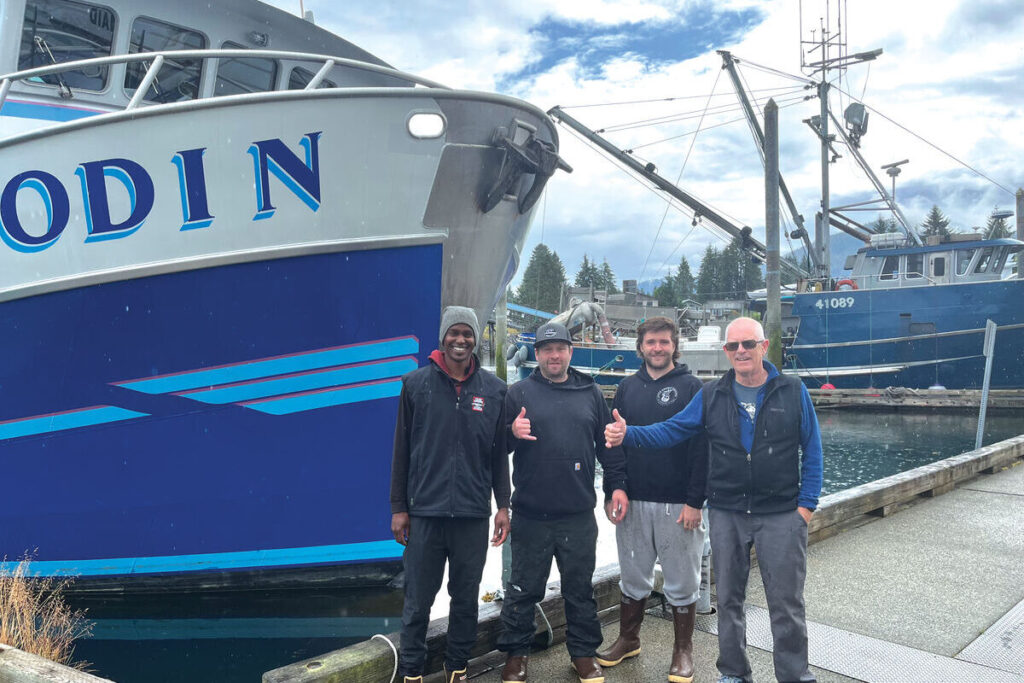
On Wednesday, July 29, Trevor McKay, Mike Doyle, Brent Birchell and Mark Severson sent their encouragement to their fellow F/V Odin crewman Tausani Ieremia at home in Sitka, recovering from the accident. (Courtesy/Karen Severson)

Tausani Ieremia, of Sitka, was setting the net aboard the Petersburg seiner Odin on the morning of Sunday, July 26, when the boat’s own purse line snared his ankle and dragged him over the stern and into the water near Saint Joseph Island, west of Prince of Wales. In the minutes that followed, the 22-year-old fisherman was pulled under by the net, lost consciousness and stopped breathing. The Odin’s crew pulled him back, revived him with CPR. He was helicoptered by the Coast Guard to Sitka then life-flighted to Anchorage. He is now home recovering in Sitka.

The accident happened around 11:30 a.m., skiffman Trevor McKay said. Fishing has been slow so far this season, and it was slow again that morning as the Odin began its set. Ieremia had just fixed a lead line and walked to the stern to throw it clear when he stepped into a bight of the purse line. It caught him by the ankle and pulled him over the stern – a moment captured on the boat’s deck camera. Skipper Mark Severson was setting the net slowly, around two knots, and is glad he was, figuring that the low speed probably spared Ieremia much worse injury going over the stern.

McKay, running the power skiff, had been watching the net go out. “I usually look at the net go out for the first 10 to 15 fathoms before I give it any gas,” he said. The net was clear, so he turned and began to speed up toward the kelp line. “It wasn’t long before I felt a big jerk,” he said – usually the sign of a ring snarl. He looked back and saw “a body and a tangle of web flying over the rail.”

McKay released the pin as Severson immediately came over the radio – “Go get him!” – spun the skiff around and ran full throttle toward Ieremia. He watched him go down and surface once, then turned to ready his plunger pole. When he looked again, “all I could see was his hand, and it was sinking.” He reached the net, threw the skiff in reverse and landed just above a set of sunken corks. Ieremia was nowhere in sight, pulled into the dark water by the weight of the fishing gear. Corks sit low like that only when something is tangled in the purse line or rings, McKay said. He swirled his pole through the water, hoping Ieremia might grab it. Nothing. Minutes passed.

“I started to feel the reality that he isn’t going to come back up,” McKay said. Then there were bubbles, and a hand rose toward him through the sunlit water alongside the corks – “like an angel was guiding him up to me.”

Ieremia had managed to slip from his boots, freeing him from the net, said Severson.

McKay caught Ieremia’s hand and lifted him about halfway out of the water. “His eyes were as big as I’ve seen, lips blue and skin pale,” he said. Ieremia was too heavy to pull in, and everything on his raingear McKay grabbed with his free hand was tearing or breaking; he held tightly onto Ieremia’s hand. “I remember yelling, ‘Help! I need help,’” he said. He felt the grip in Ieremia’s hand fade to nothing; Ieremia’s head fell back as he lost consciousness. The Odin was right on top of them by then, McKay said, and the crew got Ieremia up onto the deck and immediately started CPR.

On the Odin’s deck, crew members Mike Doyle and Brent Birchell began chest compressions and rescue breaths – McKay soon joined them. Water came up from his lungs from the chest compressions, Severson said. After around ten minutes of continuous CPR, Ieremia began breathing on his own. He grew more responsive over the next 20 minutes and was on his feet roughly a half-hour after that.

“I was told to never stop CPR trying to save a life,” McKay said. “We weren’t going to stop.”

The F/V Reality, a nearby seiner with a crewmember trained as an EMT, reached the Odin soon after Ieremia had been revived and assisted with his care, the family told the Pilot.

A Coast Guard Jayhawk helicopter crew arrived and lowered a rescue swimmer to the deck, and Ieremia got into the rescue basket under his own power, Severson said. The Coast Guard flew him to Mt. Edgecumbe Medical Center in Sitka; a Coast Guard public affairs officer said he was in stable condition when he was delivered. Guardian Flight then flew Tausani and his father, Joe, to Providence hospital in Anchorage for ICU monitoring. He thankfully had no broken ribs and no brain damage, Severson said, but was very bruised from the chest compressions; the family said the water remaining in his lungs was cleared in Anchorage. He is now home.

Severson, who has fished for about 50 years, said he sets his net slowly by habit – so that if something goes wrong, the boat does less damage. In five decades, he said, he had never seen a crewman taken over the stern like that, “but always worried about it.” Just two days before the accident, he remembers warning the crew: “Don’t get close to the net and never turn your back on it.”

Severson said he hopes the near-miss pushes the whole seine fleet to tighten up around the net and to stay current on first aid. “Everybody needs to go do their CPR class every year,” he said. It had been years since his own last class, he acknowledged, and techniques change – but what his crew did worked. He shared the deck-camera footage which captured the entire incident with the Coast Guard and his insurer, who praised the Odin’s crew for their nonstop effort.

“It was the most horrifying, worst set of my life, and it turned out to be the best one,” Severson said. He knew Ieremia would be all right, he said, when the young fisherman got to his feet on deck. “He’s a great kid,” he said.

In their statement, the Ieremia family thanked McKay, Doyle, Birchell and Severson, the crew of the F/V Reality, the neighboring boats, the Coast Guard and the Guardian Flight crew that carried their son to Anchorage. They singled out “the incredible skill and herculean effort taken by Trevor to retrieve him and never let go,” Severson’s handling of the boat around the net “under intense pressure,” and Doyle and Birchell, “who performed CPR and didn’t stop.”

“Tausani is now home, surrounded by family and friends, as he recovers from the injuries and trauma of this near-tragic fishing accident,” the family wrote. “We all know how amazing it is that we have this incredible outcome of Tausani’s survival. It feels like a miracle.”

The post Petersburg crew revives Sitka deckhand with CPR after overboard near-drowning appeared first on Chilkat Valley News.

Categories
Alaska News

Sitka, cruise lines, negotiate taxes after Skagway’s lawsuit

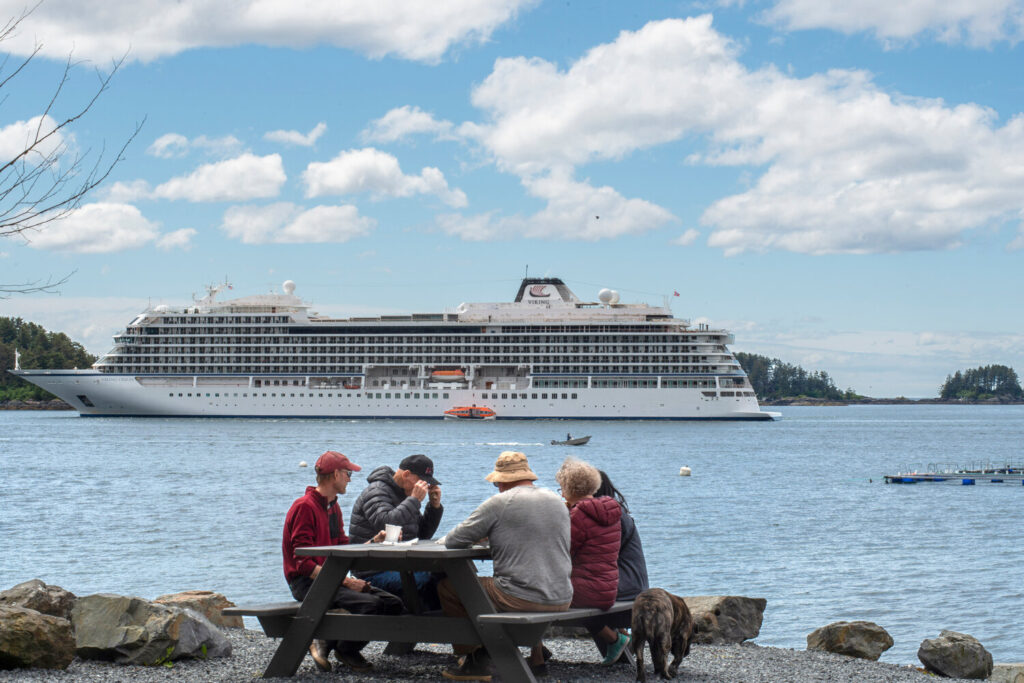
Visitors sit at a picnic table near the Sitka Sound Science Center Wednesday June 8, 2022. (Photo by James Poulson/Sitka Sentinel)

The City and Borough of Sitka and the cruise line trade association have reached agreement on some questions of collecting sales tax on on-board sales of goods and services that occur in Sitka, including Sitka Sound.

But a number of questions remain unanswered, pending the conclusion of a lawsuit filed by the industry against the City of Skagway.

The suit questions whether Skagway has the right to collect taxes on sales that take place outside the city’s boundaries for services that occur within the city boundaries.

A two-page letter in the July 28 Assembly packet from Administrator John Leach summarized what Sitka and and the Cruise Lines International Association have agreed on.

Leach spoke to the Daily Sitka Sentinel last week and today about the negotiation process, and working with the cruise lines to clarify what sales tax must be remitted under city code.

“Throughout this we made it clear we didn’t pass any new laws or apply anything newly created; it’s just application of existing code,” he said.

Leach said the city has heard concerns from the public that the city is not receiving the full sales tax due from cruise lines for tours and excursions in Sitka.

“They’re sold to the ship wholesale,” he said. “The cruise ship puts a commission on that and we’re not getting that full value. We’re getting the value on the price it was sold to the cruise lines at. The reason we don’t get the full value is because of our code.”

The city does not tax commissions on sales.

Still up in the air is the question of collecting sales tax on services (including tours) that occur in Sitka, when the purchase is made elsewhere.

“Let’s say you’re a person sitting in Idaho, you buy a cruise to Sitka, and a shore excursion as part of the package; the nexus of that service takes place here,” Leach said. “Our argument is that you have to pay sales tax because the service is provided here. They’re pushing back on that, and they’re not wrong. That’s what the lawsuit is about in Skagway.”

Sitka is not part of the lawsuit, and Leach in his letter says that the city is waiting to hear what happens with CLIA v. Skagway. “We reserve our right to reopen the topic, pending the Skagway decision,” the administrator said.

Also in the letter, Leach confirmed with the cruise industry that cruise ships must collect sales tax for on- board sales that take place within Sitka. The two parties agreed that the boundary is Sitka Sound, as defined by the Department Fish and Game.

“I don’t understand how it was overlooked for so long,” Leach said.

Leach said he became aware that cruise ships were not collecting sales taxes for goods and services within the boundary when he was contacted by one of the cruise lines, asking for a sales tax account in order to collect and remit.

He also learned through his work on the Port Communities of Alaska association that other communities in Southeast are collecting sales taxes for onboard transactions in the ships’ food and gift shops. As Sitka starts collecting this tax it will mean additional revenue, though he doesn’t expect it to be a lot: some cruise lines close their stores while the ship is in port.

In the letter, Leach thanked Cruise Lines International Association Alaska for the group’s “cooperation and collaborative approach” on this issue.

The post Sitka, cruise lines, negotiate taxes after Skagway’s lawsuit appeared first on Chilkat Valley News.

Categories
Entertainment

Stassi Schroeder’s Marital Problems Shock Viewers of New Reality Show

Reading Time: 2 minutes

Stassi Schroeder is no stranger to showcasing a toxic relationship on reality TV.

The woman dated Jax Taylor, for Pete’s sake.

But these days, Stassi is older, wiser, and more mature — and her marriage to Beau Clark seems to be much healthier than her earlier romances.

Which is why fans are shocked to see the couple’s dark side showcased on House of Stassi.

Beau Clark and Stassi Schroeder Clark celebrate the release of her new book "YOU CAN'T HAVE IT ALL: The Basic B*tch Guide To Taking The Pressure Off" at Barnes & Noble The Grove on September 18, 2024 in Los Angeles, California.
Beau Clark and Stassi Schroeder Clark celebrate the release of her new book “YOU CAN’T HAVE IT ALL: The Basic B*tch Guide To Taking The Pressure Off” at Barnes & Noble The Grove on September 18, 2024 in Los Angeles, California. (Photo by Rodin Eckenroth/Getty Images)

The new Hulu show follows the former Vanderpump Rules star as she balances a booming career with raising two young children alongside Clark. But behind the polished social media posts, the couple reveals they’re facing some very real relationship struggles.

The entire eight-episode first season dropped on Thursday, and viewers expressed surprise at scenes in which Clark became emotional while discussing how much their relationship has changed since he stepped away from his career as a casting director to become the family’s primary caregiver.

“I’ve felt angry and resentful,” he admitted, explaining that he often feels more like a roommate than a husband.

Clark said he has struggled with losing his sense of identity after leaving the workforce, adding that staying home with the couple’s children has taken a toll on his mental health.

At one point, Beau even compared himself to “a 1950s housewife,” saying he feels unfulfilled despite loving his family.

The candid confession caught Stassi by surprise.

She acknowledged that she hadn’t realized just how unhappy her husband had become and admitted she wished he had shared his feelings sooner.

While Stassi said she’s grateful for everything Beau has done for their family, she also explained that her expanding career has created opportunities she doesn’t want to walk away from.

The former Bravo personality has been busier than ever with House of Stassi, her podcast, and other business ventures.

She told Clark that she has no desire to stop working, even suggesting she would financially support him if he wanted to stay home permanently.

But for Beau, the issue isn’t money.

Instead, he said he misses having a career of his own and wants to return to casting because it gives him a sense of purpose. He emphasized that his frustration stems from feeling disconnected from himself, not from resentment toward Schroeder’s success.

By the end of their emotional conversation, Schroeder promised to make more of an effort to reconnect with her husband and prioritize their relationship alongside their careers and parenting responsibilities.

The couple, who married in 2020 and share daughter Hartford and son Messer, appear committed to working through their challenges rather than hiding them from viewers.

If nothing else, House of Stassi is proving that even reality TV’s happiest-looking couples aren’t immune to the everyday pressures of marriage.

Stassi Schroeder’s Marital Problems Shock Viewers of New Reality Show was originally published on The Hollywood Gossip.

​The Hollywood Gossip

Categories
Music

Riley Green Reveals ‘That’s Just Me’ Track List, Drops New Song ‘Imagine That’

Riley Green is continuing to build anticipation for his upcoming studio album, That’s Just Me, arriving September 18.

This week, the country star gave fans a preview of all 19 tracks, sharing short snippets of each song on social media while offering even longer previews exclusively to members of his Back 40 fan club.

Along with the previews, Green also unveiled the album’s full track list, revealing several collaborations. The project will feature the recently released duet “Go Again” with Hannah McFarland, as well as “Well Well Whiskey” with Jake Worthington, “Pave All Them Red Dirt Roads” featuring Brooks & Dunn, and “Lookout Mountain” with Randy Owen of country supergroup Alabama.

Riley Green; That's Just Me
Riley Green; That’s Just Me

The album also showcases a number of co-writes from some of Green’s longtime collaborators, including Randy Montana, Erik Dylan, Jonathan Singleton, and others. Green also penned or co-penned several of the album’s tracks himself.

Riley Green That’s Just Me Track List: 

1.  My Way (Riley Green)

2.  That’s Just Me (Riley Green)

3.  Don’t Come Any Closer (Riley Green, Randy Montana, Erik Dylan)

4.  Go Again (featuring Hannah McFarland) (Riley Green)

5.  Imagine That (Riley Green, Jonathan Singleton, Ray Fulcher)

6.  Got That From You (Riley Green, Rhett Akins, Erik Dylan, Nick Walsh)

7.  Bartender In Destin (Sam Banks, Nick Walsh)

8.  Beach Happy (Randy Montana, Jeremy Stover, Corey Crowder)

9.  Think As You Drunk  (Riley Green, Jessi Alexander, Erik Dylan, Wyatt McCubbin, Scott Emerick, Toby Keith)

10. Well Well Whiskey (featuring Jake Worthington) (Riley Green)

11. P.O.S. (Riley Green, Randy Montana, Erik Dylan, Drake White)

12.Runs In The Family (Riley Green, Jessi Alexander, Jameson Rodgers)

13. Pave All Them Red Dirt Roads (featuring Brooks & Dunn) (Riley Green, Dallas Davidson)

14. Lookout Mountain (featuring Randy Owen of Alabama)  (Riley Green, Erik Dylan, Randy Montana, Drake White)

15. Seven Second Ride (Jimi Bell, Tucker Bethard, Jonathan Singleton)

16. Radio Road (Riley Green, Erik Dylan)

17.Ol’ Stray Dog (Erik Dylan, Jon Randall)

18.More Of A Man Than Me (Riley Green)

19.Ten Pairs of Boots (Joe Fox, Seth Ennis, Chase McGill, Josh Miller)

Riley Green - Imagine That
Riley Green – Imagine That

With the full track list now out and the album’s release just around the corner, Green also surprised fans by dropping a brand-new song, “Imagine That.” The track, which appears as No. 5 on That’s Just Me, was co-written by Green alongside Jonathan Singleton and Ray Fulcher.

The emotional song tells the story of two former lovers who never truly move on from each other. Blending heartfelt lyrics with vivid storytelling, “Imagine That” delivers the kind of stripped-back country sound Riley Green has become known for.

As fans count down to the release of That’s Just Me, they’ll also have plenty of chances to see Green perform the new music live. The country star recently added 10 more dates to his headlining Cowboy As It Gets Tour, and with a packed schedule of festival appearances and headlining fair shows still ahead, he has no plans of slowing down.

The post Riley Green Reveals ‘That’s Just Me’ Track List, Drops New Song ‘Imagine That’ appeared first on Country Now.

​Country Now

Categories
Alaska News

Flooding from glacial outburst damages Fish Creek site near Hyder

A popular bear and salmon observation site near Hyder remains closed after being damaged on July 16 by floodwaters stemming from a glacial outburst.

U.S. Forest Service staff plan to continue assessing the damage to the Fish Creek Wildlife Observation Site next week, according to USFS information. Meanwhile, the State of Alaska has issued an emergency authorization to state immediate repairs of a levee that was breached in the flooding.

“Work is expected to begin today (Friday) and will focus on filling the breached area with rock,” according to a Forest Service reply to a Daily News inquiry.

Located about three miles north of  the small Alaska community of Hyder, which itself is located on the mainland at the head of Portland Canal about 75 miles northeast of Ketchikan, the Fish Creek site draws visitors from around the world to watch from an approximately 600-foot-long elevated observation walkway as brown and black bears eat pink and chum salmon returning to Fish Creek to spawn.

The site is protected from the adjacent Salmon River primarily by the Fish Creek levee. The Salmon River flows from the large Salmon Glacier that sits at a higher elevation just across the U.S.-Canada border. A lake above the Salmon Glacier — Summit Lake — experiences a sudden “jökulhlaup” glacial outburst that sends lake water coursing below the Salmon Glacier and into the Salmon River.

It was this type of glacial outburst that resulted in the river cresting to a level that caused the Fish Creek levee along the river to fail, producing “damaging impacts to the Fish Creek Bear Viewing area,” according to a National Weather Service report.

The Forest Service quickly announced that the “rushing waters broke off at least 100 (feet) of the viewing platform,” and that the site was closed until further notice.

In an email response to the Daily News on Friday, Tongass National Forest Public Affairs and Partnerships Staff Officer Paul Robbins Jr. wrote that Ketchikan/MIsty Fjords District Ranger Cathy Tighe, “joined by engineers and fisheries staff, visited the site earlier this week to begin damage assessment.

“While water levels have returned to normal, the glacial silt added by the new waters made it difficult to fully assess areas downstream,” wrote Robbins. “Staff did note the remaining sections of the raised platform sustained significant damage to support footings. Another trip will be made by Forest Service staff next week to obtain additional information (including downstream drone footage) and continue assessment. The Forest Service plans to open a portion of the Fish Creek Wildlife Observation Site once the dike repair is complete and additional safety measures are in place.”

Alaska Department of Transportation public information staff did not return Daily News email and phone inquiries by presstime on Friday.

The National Weather Service report from July 16 noted that “another potential impact area for this event is the road from Hyder to Premier, Canada, at around mile point 9 along the Salmon River.”

The magnitude of the damage to the observation site, levees and roads was described by a July 20 letter from Hyder Board of Development Director Nick Korpela to the governor’s office, legislative offices, Forest Service and DOT.

“During the peak of the flood, a significant portion of the flow was redirected into the forest near the Fish Creek Bear Viewing Platform. With Marx Creek inundated and backed up, the only remaining outlets were over the roadway itself and over the Fish Creek levee beneath the Bear Viewing Platform,” states the letter. “This overtopping severely eroded the backside of the roadway in multiple locations near the Fish Creek observation platform parking area and completely unraveled the Fish Creek levee in the Blue Lagoon area. A new river channel has formed that is now carrying approximately 1/4 of the total Salmon River flow. The Salmon River Highway was never designed for this volume of water and sustained heavy erosion in one primary location along with lesser damage elsewhere. ”

Overall, the “resulting damage to the Fish Creek site, surrounding salmon habitat, and the Salmon River Highway is severe, ongoing, and will only worsen with every subsequent high-water event,” states the letter, which requests immediate action to rebuild the Fish Creek levee and and the longer-term extension of another levee in the area.

The letter states that the “State of Alaska owns the levees that protect an area under the stewardship of the U.S. Forest Service.”

The road itself extends across the U.S-Canada border into British Columbia and past the Salmon Glacier into a long-standing mining district. The area has Cambria Gold’s Premier Gold mining complex, the Scottie Resources Corp.’s Scottie Gold Mine Project area, Goldstorm Metals’ exploration property, and the Long Lake Hydro Project, all of which are accessible by road, only via the road from Hyder.

The post Flooding from glacial outburst damages Fish Creek site near Hyder appeared first on Chilkat Valley News.

Categories
Alaska News

No seine midweek opening due to low pink slamon numbers

For the second week in a row, the commercial purse seine fishing fleet will not have a mid-week harvest opening in the southern Southeast Alaska Districts 1-4 because of low numbers of pink salmon in the region.

“We’re just not seeing what we need to see for pink salmon abundance, in a nutshell,” Troy Thynes, the Alaska Department of Fish and Game’s Region 1 management coordinator, told the Ketchikan Daily News late Tuesday afternoon after the department released its midweek salmon purse seine fishery announcement.

As in the previous midweek announcement, the inside waters areas of Section 1-F and District 2, along with the outside waters Section 3-A, 3-B and District 4 off the southwest coast of Prince of Wales Island are closed.  Also as in the pervious week, there will be some limited mid-week harvest opportunities for the seine fleet farther north, according to Tuesday’s announcement.  A portion of the Amalga Harbor Terminal Harvest areas in Section 11-A will be open from 9 a.m. to 6 p.m. on Thursday, and portions of Section 13-B near Sitka will be open from 5 a.m. to 8 p.m. Thursday.

Pink salmon have long been a mainstay species for the seine fleet, which also focuses on chum salmon.

The department’s preseason forecast for the 2026 pink salmon harvest in Southeast Alaska was 19 million fish. That’s considered to be on the lower end of “average pink salmon harvest range” of 19 million to 33 million, according to Fish and Game.

Regular seine harvest opportunities began in late June, with the first openings in southern Southeast Alaska beginning with a July 2 midweek opening in portions of Section 1-F south of Ketchikan and District 2 off the southeast coast of Prince of Wales Island.

Portions of southern Southeast areas were opened along with some farther north sections for specific hours each Sunday and Thursday until Thursday, July 23, when only two areas farther north were opened.

Fish and Game included District 4 and portions of Section 1-F, District 2 and Sections 3-A and 3-B in this past Sunday’s seine openings, but noted on Friday that “pink salmon harvests to date have been very poor and well be below average for this time of year. Due to the low harvest and observations of low pink salmon abundance and escapement a midweek opening did not occur this week.”

According to the department’s “Blue Sheet” preliminary in-season catch estimates online as of Tuesday evening, commercial fishermen had landed an approximate total of only 269,000 pink salmon in Southeast Alaska.

Meanwhile, chum salmon catches in Southeast Alaska, which include the substantial seine, gillnet, troll and cost-recovery fisheries for hatchery produced chum salmon in terminal harvest areas, have been stronger, totaling about 2.9 million fish to date, according to the “Blue Sheet” preliminary numbers.

In addition to looking at harvest numbers, Fish and Game’s commercial fisheries managers spend a lot time doing aerial surveys of the region to see where fish are located along the shorelines and in spawning rivers and streams.

“We’ve seen a weak harvest (of pinks) so far this year,” Thynes said. “You know, our managers and (Ketchikan area commercial fisheries management biologist Bo Meredith) in particular, … he’s been out flying, looking at escapement, you know, looking for fish moving along the bays and systems, and he just hasn’t been seeing what he needs to see for pink salmon abundance and escapement.”

The survey work will continue ahead of the department’s next seine opening announcement, which is scheduled to be published on Friday ahead of potential seine openings on Sunday.

“Our managers around the region will continue to look for, look at pink salmon abundance, look at pink salmon escapement, and look for opportunities,” Thynes said. “… They’re working very hard, very diligently, trying to line things up for … future seine openings.”

Pink salmon runs usually peak in mid-August. One indicator of run timing is the ratio of male and female fish. Typically, the start of the run has more male fish, with the ratio shifting to a greater proportion of female fish as the run continues to its conclusion.

Thynes said that the current year’s run of pink salmon thus far is showing a higher-than-normal percentage of males, “which would indicate, you know, later run timing.

So, you know, we do have that going for it,” he said, “But, you know, time will tell.”

The post No seine midweek opening due to low pink slamon numbers appeared first on Chilkat Valley News.

Categories
Music

The Trailer for Season 2 of Leanne Morgan’s Show ‘Leanne’ is Here

Leanne is getting her groove back! Continue reading…​Country Music News – Taste of Country