Categories
Alaska News

SEARHC opens new $300 million Mt. Edgecumbe hospital

SEARHC workers look over the new SEARHC Medical Center on Japonski Island during a ribbon-cutting ceremony Thursday, April 23, 2026. Hundreds of people turned out to see the new 234,528-square-foot hospital, double the size of the existing building. The ceremony included speeches by SEARHC executives and Indian Health Service Deputy Director Benjamin Smith as well as Tlingit songs and dances. (James Poulson / Daily Sitka Sentinel)

SEARHC cut the ceremonial ribbon on its new $300 million Mt. Edgecumbe Medical Center in Sitka on April 23.

The event for the five-story, 234,528-square-foot facility featured a traditional blessing, a welcome and addresses by leaders of SEARHC and the Sitka community.

Charles Clement, SEARHC president and CEO of 14 years, said in his remarks, “This has been a real challenging project to pull together, beginning to end.”

“It has come to represent much more than a building for me,” said Clement, of Metlakatla. “It represents our commitment to our patients, our commitment to our communities, our commitment to our employees.”

SEARHC designed and constructed the medical services building. In 2020 SEARHC was selected by the U.S. Indian Health Service for the Indian Health Service Joint Venture Construction Program, which provides long-term funding for staffing and operation of the new hospital.

The hospital is about twice the size of the building it replaces but will have the same number of patient beds. That’s due to funding and license requirements, Clement told the Sitka Sentinel.

“To qualify as a critical-access hospital, it has to be 25 beds or less,” he said.

Services at the new building will start May 4, with departments making the transfer in May and June.

The new hospital comes 10 years after the city of Sitka entered talks with SEARHC about consolidating the services provided by SEARHC and city-owned Sitka Community Hospital. After long negotiations and voter approval in a city election, the Sitka Community Hospital’s buildings, grounds and business were sold to SEARHC in 2019, and SEARHC pledged to continue, and expand, the health and medical services available to the public.

Health care has become the largest sector of the Sitka economy, with total earnings at $67.3 million (782 jobs) in 2024, according to a Rain Coast Data presentation last year.

Growth in health care continues in Sitka. At the ribbon-cutting, the deputy director of the Indian Health Service, Benjamin Smith, announced that IHS will work with SEARHC in a joint venture to develop a new long-term care facility on the Sitka campus.

Clement told the Sentinel the project would “replace the long-term care facility over (at the Sitka Community Hospital building) with a newer, larger facility here on SEARHC campus.” Initial plans are for the facility to have 35 beds in the long-term care unit, up from the 19 beds SEARHC currently offers in a building at the former Sitka Community Hospital site.

In the interview, Clement also addressed SEARHC plans in other Southeast communities.

The tribal nonprofit plans to build “a small critical-access hospital” in Haines, he said, “based on the model that we developed in Wrangell.”

SEARHC opened its $30 million Wrangell hospital in 2021. It’s about one-fifth the size of the new Mt. Edgecumbe facility.

“We’re building a new medical office building (in Wrangell) to consolidate onto a single campus,” Clement said. “We have multiple facilities all over town, and we have enough land there to bring it all into a medical campus.”

The health care provider also plans to build eight rental units in Wrangell to house its traveler staff.

In Klawock, “we’re doing a lot of site work down there to get ready to do another clinic replacement, with a goal eventually developing, if we can make it work, long-term care and a critical-access hospital there,” Clement said.

Sitka will remain a hub for medical services in Southeast, and continues to be the only SEARHC location offering labor and delivery services, Chief Operating Officer Martin Benning told the Daily Sitka Sentinel.

“Everything that’s over at the current hospital is moving in here by the end of June,” Benning said.

As for the future of the old SEARHC hospital building and the Sitka Community Hospital building, Benning said, “We haven’t nailed anything down definitively, we’ve just been focused, ‘Let’s get this done,’ and then we’ll figure out, ‘What do we do?’”

Back at the old SEARHC hospital building on April 23, long-time employees and patients gathered around cafeteria lunch tables to reflect on the history of the building that began as a naval hospital in World War II.

The post SEARHC opens new $300 million Mt. Edgecumbe hospital appeared first on Chilkat Valley News.

Categories
Politics

A rare Mamdani-Menin alliance

Mayor Zohran Mamdani and Council Speaker Julie Menin held a joint press conference on Tuesday urging for tax credit reforms.

DAYS THE BUDGET IS LATE: 28

WITH FRIENDS LIKE THESE: Mayor Zohran Mamdani and Council Speaker Julie Menin have been at loggerheads over how to close New York City’s multibillion-dollar budget gap.

Mamdani has maintained the deep deficit can only be plugged if the state raises taxes on millionaires and large corporations. Menin has countered that the gap can be addressed by trimming municipal bloat — a proposal Mamdani panned as “unrealistic” just weeks ago.

Today brought a major deescalation: The two leaders joined forces to call on Gov. Kathy Hochul and state lawmakers to scale back a tax credit largely benefitting millionaires. Doing so would generate $1 billion in new revenue for the city, a windfall that could go a long way in helping the city balance its books, Menin and Mamdani said at a joint press conference.

“We are standing together today, we will stand together again,” Mamdani said, appearing alongside Menin in the City Hall Rotunda. “If we were to reduce this tax credit by just a quarter, as the speaker said, we would be talking about raising nearly $1 billion in additional revenue that would be critical in our city’s ability to balance this budget.”

Hochul, who’s still grappling with a state budget that’s now nearly a month late, immediately threw cold water on the new push from Mamdani and Menin, putting a dent in their unusual alliance.

“It’s not happening. We’re not changing the PTET,” Hochul told reporters in Albany later in the day, using an acronym for the Pass-Through Entity Tax credit eyed for reform by Mamdani and Menin.

In slamming the door on the proposal, Hochul is leaving Menin and Mamdani without a clear path forward on how to fill the city’s budget hole. The governor’s opposition to the tax credit push also creates an unusual new front in the negotiations on this year’s overdue state budget, with Mamdani and Menin on one side and Hochul on the other.

The fraught dynamic comes at a politically delicate time for the Buffalo-born governor, who is gearing up for a reelection bid and will need deep blue New York City if she wants to cruise to a second full term. Being at odds with Mamdani, who draws support from a fervent left-leaning base, would complicate Hochul’s political standing with many Democratic voters.

Mamdani and Menin made the joint plea for the tax credit changes in tandem while announcing they had agreed to push back the release of the mayor’s executive budget proposal until May 12, a deal first reported by POLITICO on Monday night.

The executive spending plan, which forms the basis for the final stretch of negotiations before the mayor and the Council must finalize a city budget by July 1, is technically due this Friday.

But as the state budget is now nearly a month late with its own budget, Mamdani and Menin are agreeing to delay the executive plan’s release in hopes that Albany will have its fiscal outlay in order by May 12. Without knowing how much revenue will flow to the city from the state, Mamdani and Menin both said there will be holes in the city’s spending plan that would be hard to reconcile.

Read the full story from Chris and Nick in POLITICO

FROM CITY HALL

Advocates warn closing the 30th Street intake shelter without careful coordination could pose serious health risks for homeless New Yorkers.

SHELTER MOVES: A man died by suicide after he was abruptly moved out of a shelter as part of Mayor Mamdani’s plan to close the long-decaying Bellevue intake center on East 30th Street in Manhattan.

Mamdani announced the closure plan on March 5, kicking off a weeks-long rush to clear out two East Village shelters and convert them into intake centers for homeless men and adult families requesting beds. Mamdani said the move was a proactive measure based on expert guidance, noting the Bellevue intake center’s state of “severe disrepair.”

Advocates who work with homeless New Yorkers warned that the relocations posed serious health risks if not done in a careful and coordinated way.

Then Steven Rosa — who was moved from an East Village shelter with on-site behavioral health services to a hotel-turned-shelter in Brownsville, Brooklyn — seemingly fell through the cracks.

Rosa’s family told POLITICO his depression worsened after the move, and he started spending much of his time alone in his hotel room. He was found dead in early April.

“We are saddened by this tragic loss, and our hearts are with this individual’s family and loved ones during this difficult time,” a spokesperson for Comptroller Mark Levine’s office said in response to POLITICO’s reporting. “The deployment of care and support for vulnerable New Yorkers is extremely delicate and our office had raised concerns with the City about the effect changes may have on New Yorkers. We are seeking to better understand the circumstances surrounding this tragedy.”

A Department of Social Services spokesperson called Rosa’s death a “heartbreaking tragedy” but said the agency cannot comment specifically on his case due to client confidentiality.

“We continue to build on our efforts to assess potential risk factors — which might not be evident based on self-reported information and case history available to the agency — while strengthening connections to healthcare for all clients,” DSS spokesperson Neha Sharma said in a statement.

The new intake sites were supposed to open on May 1, but the timeline is in flux due to pending litigation. Maya Kaufman

HIGH STAKES: There was a woman in candy stripes on a stilt. There was Assemblymember Stacey Pheffer Amato wearing her lucky shoes. There was Nas doing shoutouts to Resorts World during a rendition of his 1996 hit, “If I Ruled the World.”

All of this at 9:30 this morning for a ribbon cutting at New York City’s first full-fledged casino.

Resorts World is the first of three newly licensed casinos to have live table games as it begins a massive expansion of its existing gambling facility at the Aqueduct racetrack in Queens.

Boosters hail the economic opportunity from the coming overhaul, which would add a new resort and make the casino among the largest in the world. The company has also promised $2 billion in community benefits that local leaders have high hopes for.

“I have to allude to the fact that we lost a 15-year-old, Jaden Pierre, in this community,” Borough President Donovan Richards said during his remarks at the ribbon cutting. “So these benefits are largely not just about benefits for this site, it’s about the lives that this site will save.”

Resorts World was a surprise winner of a casino license following a years-long process. Proposals from Bally’s in the Bronx and billionaire Mets owner Steve Cohen also were awarded licenses in December.

Amato, who chaired a community advisory board that tested local support for the casino, began wearing a pair of shoes studded with baubles and fake diamonds during the process. She wore the same pair to the opening of the casino, which she already visits regularly.

Other speakers, like Richards and City Council Member Ty Hankerson, made a point of saying they don’t gamble, but that they want the casino to do well.

Former Council Speaker Adrienne Adams — who is running for lieutenant governor on Hochul’s ticket — said Resorts World first approached her about building a gaming facility at Aqueduct 15 years ago, when she was working for the NAACP. She said it took a while for the civil rights group to trust Resorts World but she now views the company as an “amazing” partner who has been held accountable to its community and its promises.

The head of Genting — Resorts World’s Malaysian parent company — came to do the ribbon cutting.

“Our planned expansion will bring a world-class integrated resort to this site, and when it is complete, New York will have something no other city in America can match,” Genting chair KT Kim said.

From closer to home, Nasir Jones, the New York rapper known as Nas, wore a tuxedo to help roll the ceremonial first dice.

Resorts World’s parent company has a history of late or overbudget projects, which even the body that recommended it received a license warned about, but it has some advantages: It’s open now, years before the two others will be. It also has pledged an enormous share of its revenue to the state.

It also outlasted other bidders, most notably a trio of developers who wanted to put casinos in Manhattan, including Caesars’ plan to have a gaming emporium in Times Square. Ironically, one of the older slot machine rooms at Resorts World is called Time Square Casino – and it’s the only one in New York for the foreseeable future. – Ry Rivard

From the Capitol

Gov. Kathy Hochul has pressed to weaken deadlines in current climate law to make state goals easier to achieve.

CLIMATE TANGO CONTINUES: The debate over changes to weaken New York’s 2019 climate law appears to be moving toward an end. Gov. Kathy Hochul’s latest proposal is for emissions reduction regulations by 2028 with an interim flexible target in 2040 and keeping the firm 2050 mandate.

“It is certainly better than it was,” said Senate Majority Leader Andrea Stewart-Cousins on Tuesday. “We’re trying to work on an entire package. … It is a huge push to make sure that we do not lose ground that we should not cede while we are waiting for the promulgation” of the regulations.

Stewart-Cousins said that rebates to help New Yorkers with high energy bills and proposals to accelerate solar investments were on the table as part of the discussions.

Hochul’s proposal includes the controversial accounting change long sought by the governor that would essentially require less aggressive action to reduce fossil fuel use, particularly natural gas, according to four people familiar with the agreement.

Some Democratic lawmakers remain dissatisfied with the proposal, and environmental groups like Food and Water Watch and New York Communities for Change are calling for them to vote no on any budget that includes changes to the climate law.

“I don’t really understand why we have to compromise so much when the entire environmental advocacy community is saying that’s a bad idea,” said Democratic Assemblymember Linda Rosenthal. “We passed the climate law. We don’t want to roll it back so dramatically.”

Hochul on Tuesday declined to commit to providing estimates of how much her proposal would cost businesses and households. She’s raised concerns about the cost of abruptly implementing a cap-and-trade program to meet the near term 2030 deadline in the climate law.

Her push to update the law would moot that target and the lawsuit over regulations to achieve it brought by environmental advocates. Hochul originally championed “cap and invest” in 2023 but has soured on the program.

“I don’t know if there will be cap and invest,” the governor said. “If there’s cap and invest, is it capped cap and invest? Is it set at a certain number? All that is unknown right now. All I know is that to give some breathing room for New York families and business I have to have a longer runway.”

The governor’s proposal currently under discussion would specify cap and invest would be part of the regulations due in 2028, according to the people familiar with the discussions. Marie J. French

HOOD IN THE HOOD: Madison County Sheriff Todd Hood pledged to be an active lieutenant governor if elected on Republican Bruce Blakeman’s ticket this fall.

“I’m definitely not a sit-in-the-office kind of guy,” Hood said.

There’s been a split in visions for the office in recent decades — with some candidates characterizing the role as a cheerleader for the governor, and others saying it should be an independent office. Hood falls in the former category, saying his job would be to help Blakeman succeed at lower taxes and heating costs.

The Republican was at the Capitol as part of the NY Sheriffs’ Association lobby day, where he railed against Hochul’s plan to ban 287(g) cooperation agreements with ICE, saying that “cutting off communication between agencies makes everyone less safe and reverses post-9/11 progress.”

Like his ticket-mate, the sheriff took a tough-on-crime approach.

“There are tons of false allegations against police,” he said when asked about a Hochul-backed plan to let New Yorkers sue ICE agents who infringe on their rights. “That’s what I’ve seen the most of in my career, are lies.”

Hood also downplayed the uproar over the recent killings of Renee Good — saying she was using her vehicle as “a deadly instrument” — and Alex Pretti by federal agents in Minneapolis.

“Yeah, you’re fighting with a police officer with a loaded firearm on you and that weapon is discovered – that’s bad things,” he said of Pretti. — Bill Mahoney

RFK JR. BEWARE: The state Assembly is pushing back against federal policy changes to vaccine recommendations with a package of six bills that would strengthen the state’s laws surrounding immunization.

Lawmaker says the package of bills is aimed at countering efforts by Health and Human Services Secretary Robert F. Kennedy Jr. to roll back immunization recommendations issued by the federal government.

The package includes legislation that would allow the state Department of Health to recommend vaccine schedules for New Yorkers using longstanding medical standards and taking into consideration recommendations from the American Academy of Family Physicians, a private professional association not beholden to recommendations made at the federal level. The state previously relied on the Advisory Committee on Immunization Practices, a federal panel responsible for making vaccine recommendations that Kennedy attempted to overhaul in an effort to install his allies before a judge blocked the appointees.

“Vaccines are foundational to public health and have long been a trusted and effective bulwark against harmful and deadly diseases, especially for our most vulnerable populations,” Speaker Carl Heastie said in a statement. “New York will stand on the side of proven science as attacks on lifesaving immunizations continue from the federal administration place our residents at risk. This legislation puts the health and well-being of New Yorkers first and ensures that these vital resources remain accessible for our communities.”

The package also includes legislation that would require college students to be immunized for Hepatitis B, a bill that would set immunization mandates for children attending summer camps and a bill that would require health insurance coverage for vaccines without cost-sharing.

An additional measure was passed that would create liability protections for health care providers administering vaccines that follow state and local guidance, a protection that could become key if providers’ actions are alleged to contradict federal guidance. — Katelyn Cordero

CAR WARS: Hochul wants to address how car insurance companies set rates for premiums — potentially a key provision that would help resolve a major sticking point in the ongoing state budget talks.

“Yes, we are looking closely at how insurance companies set their rates and what criteria they use,” Hochul told reporters Tuesday. “So there’s two sides of the equation. One is I want to make sure that some of the drivers of why we have such high insurance premiums in the state are addressed, but also the insurance companies, we’re taking a close look at their practices as well. “

POLITICO reported Monday that Hochul and state lawmakers have discussed addressing so-called flex increases that car insurance companies use to raise premiums.

Read more from POLITICO Pro’s Nick Reisman here. 

IN OTHER NEWS

NEVER THE SAME: Timothy Brown, the man police beat in a Brooklyn liquor store, which went viral on social media, is suing New York City for $100 million in damages, saying he will never recover from the incident. (Gothamist)

NEW PROTOCOLS: The New York Police Department has stalled or rejected policy changes recommended by the Department of Investigations regarding its controversial gang-database, which critics argue is used to target Black and Hispanic youth. (THE CITY)

GETTING PERSONAL: Citadel CEO Ken Griffin will meet with Hochul to discuss New York City’s direction following a quarrel with Mamdani after the mayor announced a proposed new tax on pricey second-homes in front of the billionaire’s Manhattan penthouse. (Bloomberg)

Missed this morning’s New York Playbook? We forgive you. Read it here.

​Politics

Categories
Alaska News

Alaska’s energy cliff isn’t coming. It’s already here

Alaska utilities have warned of sharp price hikes when they start importing liquefied natural gas in the coming years to replace dwindling supplies of locally produced gas that’s traditionally been used for home heating and generating electricity.

The first LNG tankers aren’t expected to arrive for a few years.

But increases in the prices paid by consumers are starting to land now.

This month, Hilcorp, urban Alaska’s leading local gas producer, is hiking by 14% the price it charges the electric utility in the Matanuska-Susitna region north of Anchorage — to $9.00 per thousand cubic feet, from $7.89.

More increases scheduled over the next two years will bring the price to $11.75 by 2028 — a 49% jump from the rate in early 2026, before the effective date of a revised contract approved by the Mat-Su utility’s board in recent months.

The utility members’ electric bills will rise by more like 5% each year, since gas prices are only one part of the utility’s operating costs. But by 2028, that still will translate into a monthly hike  of more than $20 for typical consumers, according to utility correspondence with regulators.

Utility officials said the amended contract with Hilcorp gets them an extra year of guaranteed gas, when the alternative is a shortfall in supply that could force the utility to generate power with even more expensive diesel fuel.

But the officials also acknowledged that prices for consumers are likely only headed in one direction: up.

“We’re really seeing this as a gradual approach to the unfortunate increase in what Alaskans may see in fuel costs,” Kim Henkel, chief fiscal officer at Matanuska Electric Association, known as MEA, said in an interview earlier this year.

Officials with Hilcorp, urban Alaska’s dominant local gas supplier, said in a prepared statement that its amended contract with MEA reflects a “collaborative approach.”

The deal represents a “deliberate investment approach with our utility partners to bring forward existing production and provide a bridge while longer-term solutions are pursued,” the statement quoted Luke Saugier, Hilcorp’s top Alaska executive, as saying.

MEA isn’t the only utility whose ratepayers are facing imminent price hikes as a result of urban Alaska’s dwindling gas supplies.

In Fairbanks, the local electric utility has no natural gas plants of its own. Historically, as much as 30% of its power has been generated by other utilities’ gas plants farther south and shipped north along a transmission line.

Power lines run toward Mt. Susitna outside Anchorage. (Nathaniel Herz/Northern Journal)

Now, with no excess gas, those lower-priced power sources have dried up, and Fairbanks’ utility has been forced to boost its dependence on its own expensive diesel generation.

Residential prices there have risen nearly 50% since a low in 2020, to roughly double the national average.

Meanwhile, customers of urban Alaska’s main heating utility, Enstar, could also pay $12 a month more if the company moves forward with a proposed acquisition of a new storage reservoir. Enstar says it could fill the reservoir with both locally produced gas in the short-term, as well as imported LNG when cargoes start arriving.

With its own supplies tightening, Enstar says, the $240 million storage project would also add to its capacity to pipe gas out to home and commercial heating customers — as flows become increasingly difficult to sustain with less fuel produced by local companies at any one time.

Additional price increases are almost certain in the coming years when Enstar, and Anchorage and the Mat-Su’s electric utilities, begin replacing their locally supplied fuel with imported liquefied natural gas — expected to cost at least 50% more than what Enstar currently pays Hilcorp for local gas.

“I hate to be the one crying wolf,” John Sims, Enstar’s president, said in an interview. But such steep increases in the cost of energy, he added, are “the start of an economy that just doesn’t work any more.”

One problem, Sims said, is that local gas producers like Hilcorp have seen the prices that the utilities expect to pay for imported LNG, which have been revealed publicly in utility consultants’ reports. “Now I’ve got no leverage,” said Sims, whose company is investor-owned. “They know what the alternative cost is going to be.”

For now, it will be hard for the urban utilities to stem further price increases because of their deep dependence on fossil fuels — and decades of foregone decisions that could have been made to diversify and boost efficiencies, according to Phil Wight, an energy historian and utility expert at University of Alaska Fairbanks.

Urban Alaska’s four major electric utilities could have done more to cooperate on power plant construction and ongoing generation, so that only the most efficient plants were used, Wight said.

They also, added Wight, could have started construction on large-scale renewable projects when substantial federal tax credits were available. But no major projects are set to be built in the state before the credits phase out — and urban Alaska still runs on some 80% fossil power.

“We have these systemic structures that make it hard for us to really get out of this paradigm,” Wight said, adding: “We’re going to be in this pit for a while.”

Nathaniel Herz welcomes tips at natherz@gmail.com or (907) 793-0312. This article was originally published in Northern Journal, a newsletter from Herz. Subscribe at this link.

The post Alaska’s energy cliff isn’t coming. It’s already here appeared first on Chilkat Valley News.

Categories
Alaska News

Higher temperatures spur Alaska’s invasive pike to eat more, a bad sign for salmon

An invasive northern pike is shown to have its stomach stuffed with tiny juvenile salmon. (Photo provided by the Alaska Department of Fish and Game)

An invasive northern pike is shown to have its stomach stuffed with tiny juvenile salmon. Invasive northern pike are well-established on the Deshka River, where they are eating their way through the supply of salmon and other fish. As tempertures have risen, pike are eating more, a new study found. (Photo provided by the Alaska Department of Fish and Game)

Invasive northern pike have wreaked havoc in Southcentral Alaska rivers and lakes. Introduced illegally in the 1950s, they have been devouring juvenile salmon and other native species.

Now a University of Alaska Fairbanks study warns that matters could get even worse.

As temperatures rise in waterways, invasive pike eat more, said the study, published in the journal Biological Invasions. And as temperatures continue to rise, that trend will continue, the study said. Based on expected temperature trends, invasive northern pike will eat 6% to 12% more by the end of the century, the study said.

“We expect there will be significant warming in the future, and the amount of fish that pike consume is going to increase with it,” Benjamin Rich, who led the study while earning a master’s degree at UAF’s College of Fisheries and Ocean Sciences, said in a statement released by the university.

The UAF study found that over the past decade, northern pike of all age classes ate more as waters warmed. The increase was most dramatic in year-old pike, which upped their intake by about 63% over the period.

The study site was the Deshka River, a Matanuska-Susitna Borough waterway that is an important feeder to Cook Inlet and commercial fisheries there. The 44-mile river, a tributary of the Susitna River, is also a cherished destination for Southcentral Alaska sport anglers.

It is famous for its abundance of salmon — or it has been. Salmon in the Deshka is a lot less abundant now than in the past.

The decline is a decades-long problem that affects king salmon in particular. State and federal biologists have cited numerous reasons for  the decline.

The presence of invasive pike is one of them; pike have eaten a lot of juvenile king salmon, also known as Chinook, and coho salmon, also known as silver salmon.

Southcentral Alaska. (Photo by Benjamin Rich/U.S. Fish and Wildlife Service)
A pair of juvenile Chinook salmon emerge from the stomach of a northern pike caught on the Deshka River in Southcentral Alaska. (Photo by Benjamin Rich/U.S. Fish and Wildlife Service)

Heat stress is also among the myriad causes of declines. The Deshka is particularly vulnerable to heat. It is in a flat area and not glacier-fed, and it is known to be one of the warmest river systems in the Matanuska-Susitna Borough.

It is the subject of ongoing temperature monitoring and studies by the U.S. Fish and Wildlife Service, the conservation group Cook Inletkeeper and others.

In 2019, a record-hot year in Alaska, waters in the Deshka were particularly warm — exceeding 81 degrees Fahrenheit that July, according to readings by Cook Inletkeeper.

Warmer temperatures, along with speeding pike metabolism and spurring more food consumption, appear to be sharpening the northern pikes’ predation skills, said Erik Schoen, a UAF fisheries biologist and a study co-author.

Fish, which are cold-blooded animals, have varying physiological responses to heat, Schoen said. Compared to salmon, which get sluggish in warm temperatures, northern pike thrive and become speedier swimmers, he said.

“If it keeps getting warmer, they get much better at catching salmon,” he said. “They’re amazing ambush predators.”

Deshka pike are actually eating less salmon than they did in past years, analysis of stomach content shows. But that is not because they are turning away from salmon; rather, it is evidence of salmon declines in the river.

The abundance of adult king salmon in the Deshka dropped by 42% over the past decade. At about the same time, the biomass of juvenile salmon eaten by northern pike decreased by 30% to 74%, depending on age class.

Do not expect the pike to go away if they deplete all the salmon, warned Schoen, who grew up in Anchorage and spent a lot of time fishing in the Deshka.

Rather, they will turn to other fish, as they appear to have done in the Deshka, such as whitefish and rainbow trout. If they can’t eat fish, they eat flies, he said. Northern pike are even known to eat birds, such as eagle chicks and ducklings, small mammals like voles and shrews — and, on occasion, each other.

“Once they wipe out the salmon, the pike don’t die off because they run out of food,” Schoen said.

Two Chinook salmon, also known as king salmon, migrate up the Deshka River. (Photo by Katrina Liebich/U.S. Fish and Wildlife Service)
Two Chinook salmon, also known as king salmon, migrate up the Deshka River in this undated photo. The Matanuska-Susitna Borough river is a popular spot for sport anglers, but its salmon runs, especially its runs of Chinook salmon, have dwindled. (Photo by Katrina Liebich/U.S. Fish and Wildlife Service)

Northern pike are native to the Interior and northern parts of Alaska, but they are not part of the natural ecosystem south of the Alaska Range. The first introduction was about seven decades ago, prior to statehood, and traced to the Bulchitna Lake, which is part of the Susitna River drainage. Through the following years, flooding and reproduction spread the fish to new places. And they have proved persistent, showing up not just around the Matanuska-Susitna Borough but also in Anchorage and, to biologists’ dismay, on the Kenai Peninsula.

As entrenched as the pike infestation is in the Matanuska-Susitna Borough, the salmon picture there is not beyond hope, Schoen said.

Pike prefer areas with slow-moving waters and lots of plants. That means areas with swift-flowing waters and gravelly banks are much less likely to be invaded by pike, and there are several such pike-resistant spots in the borough.

Even though it can’t get rid of all the pike, the Alaska Department of Fish and Game has had some success suppressing the invaders in certain important Matanuska-Susitna spots, Schoen said.

One is Alexander Creek, a 40-mile waterway that was one of the most important Northern Cook Inlet freshwater sites for king and silver salmon.

A multiyear program launched by the department resulted in removal of more than 25,000 Northern pike from Alexander Creek by 2021, according to a department report. Salmon numbers have improved. But pike remain a persistent problem, and suppression should continue, the report concluded.

Through its activities as part of the Alaska Invasive Species Partnership, a multiagency organization, the department is pursuing a long-term plan to control northern pike.

SUPPORT: YOU MAKE OUR WORK POSSIBLE

Categories
Music

Zac Brown Shares Secrets Behind His Band’s Sound [EXCLUSIVE]

Zac Brown’s band takes creativity to a whole new level, using everything from phone notifications to goat hooves for their distinct sound. Continue reading…​The Boot – Country Music News, Music Videos and Songs

Categories
Music

Zac Brown Shares Secrets Behind His Band’s Sound [EXCLUSIVE]

Zac Brown’s band takes creativity to a whole new level, using everything from phone notifications to goat hooves for their distinct sound. Continue reading…​Country Music News – Taste of Country

Categories
Entertainment

Fast Food Chains That Serve The Highest-Quality Ice Cream

Quality ingredients are part of what makes these fast food frozen treats so good. You’ll find wholesome add-ins, hand-spun shakes, and fresh frozen custard.

​Mashed – Fast Food, Celebrity Chefs, Grocery, Reviews

Categories
Entertainment

Cleetis Mack Cause of Death: Digital Underground Rapper, Early Tupac Collaborator Passes …

Reading Time: 2 minutes

We have tragic news to report from the world of music.

Cleetis Mack — the pioneering hip hop artist best known for his work with Digital Underground — has passed away.

News of Mack’s death comes courtesy of a statement issued by representatives of his former group:

Producer Cleetis Mack arrives at the Smooth Pre-BET party at Club A.D. on June 23, 2003 in Los Angeles, California.
Producer Cleetis Mack arrives at the Smooth Pre-BET party at Club A.D. on June 23, 2003 in Los Angeles, California. (Photo by Amanda Edwards/Getty Images)

The reps tell TMZ that the loss of Mack “leaves a void in our Digital Underground family and in our hearts that can never truly be filled.”

The statement notes that Mack was “more than a part of the movement — he was part of the soul behind it, bringing warmth, loyalty, and quiet strength to everyone around him.

“He will always be remembered by his humility, love, and spirited energy, qualities that lifted those around him and made a lasting impression on all who knew him.”

Digital Underground was founded in 1987 by original members Shock G (Gregory Jacobs), Chopmaster J (Jimi Dright), and Kenny-K (Kenneth Waters).

Mack joined the group in 1993, first performing on the single “Wussup Wit the Luv,” which also featured a young Tupac Shakur.

Though Digital Underground was best known for their 1990 hit “The Humpty Dance,” Mack had not yet joined the group at that juncture.

But it’s a testament to his immense talent that he was recruited for membership after DU had achieved international fame.

Within minutes of the news of his passing, Mack’s name became a trending topic across social media platforms, as friends and fans paid tribute.

Mack’s cause of death and his age at the time of his passing are both unclear at this time.

We will have further updates on this developing story as new information becomes available.

Our thoughts go out to Cleetis Mack’s loved ones during this incredibly difficult time.

Cleetis Mack Cause of Death: Digital Underground Rapper, Early Tupac Collaborator Passes … was originally published on The Hollywood Gossip.

​The Hollywood Gossip

Categories
Entertainment

What Are The Tiny Hairs On Raspberries (And Are They Safe To Eat)?

Ever give a raspberry a closer look and wonder why they’re so hairy? These little fruits are actually covered in two kinds of hair. Here’s what they do!

​Mashed – Fast Food, Celebrity Chefs, Grocery, Reviews

Categories
Music

Backstage Access Presents Turns Napa Valley Into an Intimate Country Music Escape

Some may say country music is best enjoyed from big stages with packed festival crowds, but those who’ve experienced Backstage Access Presents could argue that there’s something special about hearing it in the heart of Napa Valley, surrounded by stunning vineyards, good wine, and an intimate crowd.

Held April 14–16, the inaugural three-day destination event brought this setting to life, thanks to the vision of seasoned music industry executive and experiential strategist, Bobbii Jacobs, who has spent more than three decades building connections across every corner of the music industry.

With this latest venture, a hand-selected guest list of artists, media, brands, and industry leaders came together to enjoy live music, shared meals, and relaxed moments with views beyond compare. This space naturally resulted in meaningful conversations and sparked creative connections throughout a carefully curated string of experiences.

Photo Courtesy of Backstage Access Presents / Alexander Rubin

The week kicked off at Sleeping Giant in Napa with a Music Industry Luncheon featuring acoustic performances from Bradley Gaskin, Allie Colleen, Cyndi Thomson, and more, setting the tone for what was to come. As guests enjoyed their family-style meal, each of the acts took turns showcasing new music and sharing meaningful stories behind their work.

Speaking to Country Now before sitting down with his guitar in hand, Bradley Gaskin shared his appreciation for being included in the event, noting how meaningful opportunities like this are for him as an artist working hard each day to achieve his dreams.

“Me being a singer-songwriter from small town Alabama, anytime somebody reaches out…The whole goal as a kid growing up being a songwriter and an artist is to go out and play and perform for people. And so being invited and being part of such a cool thing is right up my alley,” he explained.

Photo Courtesy of Backstage Access Presents / Ryan Waneka

From there, guests headed over to Round Pond Estate Winery for a Golden Hour Reception, to enjoy a new scenery along with estate wines, regional bites from Hook & Cleaver Ranch and performances from Alex Lambert, Thelma & James, Liam St. John, and The 502s. Just as the sun set over the open fields surrounded by vineyards stretching as far as the eye could see, each artist took the stage one by one in the rustic barn venue, delivering stripped-down performances that paired perfectly with the golden-hour backdrop.

As guests enjoyed the music, they also made the rounds to explore the delicious eats, take advantage of the photo ops and shop a curated selection of brand partners.

Thelma & james, Photo Courtesy of Backstage Access Presents / Ryan Waneka

Husband and wife duo, Thelma & James, revealed they are no strangers to the beautiful Napa Valley area and were eager to return, this time as part of the Backstage Access Presents lineup. Sitting in front of the crowd, they delivered a more intimate rendition of songs in their catalog including their latest, “Alternate Ending.”

“We had some of our favorite people writing with us that day and it kind of just fell out of the sky for us. It was like one of those magic writes,” the duo’s Jake Etheridge shared of the track.

His wife and duo partner, MacKenzie Porter, added, “We didn’t have the title or the idea or anything. We just were working on something else and then it kind of shifted into that song and we turned it in and our team really loves it. And I think people have been enjoying it.”

Jake Hoot; Photo Courtesy of Backstage Access Presents / Ryan Waneka

Later on, music echoed through the space of the private industry dinner at Louis Martini. The underground cellar, lined with towering barrels, featured a long communal table stretching the length of the room, with an intimate stage set at the very front.

One of the night’s performers, Jake Hoot proudly showcased stories ranging from love songs to a letter to the state of Colorado and more. He took in everything the space had to offer noting, “Stepping down in that cellar and doing our soundcheck, it just felt like those halls were made for music.”

Ty Myers, Photo Courtesy of Backstage Access Presents / Ryan Waneka

When day two came around, artists including Kruse Brothers, Julia Cole, Emily Ann Roberts, Matt Stell, and Ty Myers took part in the “Pickin’ & Playin’” luncheon at Regusci Winery.

Roberts, who was a first-time visitor to Napa Valley, said the simplicity of singing with just her and her guitar was a nice change of pace compared to her usual full-band shows because it reminded her of the early days of performing.

“I started playing shows just with me and my guitar, sitting on a stool for tips, anywhere where they would let me come and play. And so anytime I get to get back to the basics, I think it’s really special. And in this environment, you don’t really need all that much to have a special moment. Just a simple guitar and a vocal will do the trick.”

Emily Ann Roberts, Photo Courtesy of Backstage Access Presents / Ryan Waneka

Each delivering their sets in between hitting the golf course, Ty Myers and Matt Stell reflected on the experience, highlighting the mix of great food, wine, and connection.

“Had some great meals, some great wine, great fellowships, people that I’ve met because I’ve been out here before a time or two and get to see people that I consider friends and then make some new ones. And then we got to play some music the last couple nights,” Stell shared.

Myers added, “Destination spots to play music and are never going to let you down.”

Matt Stell, Photo Courtesy of Backstage Access Presents / Ryan Waneka

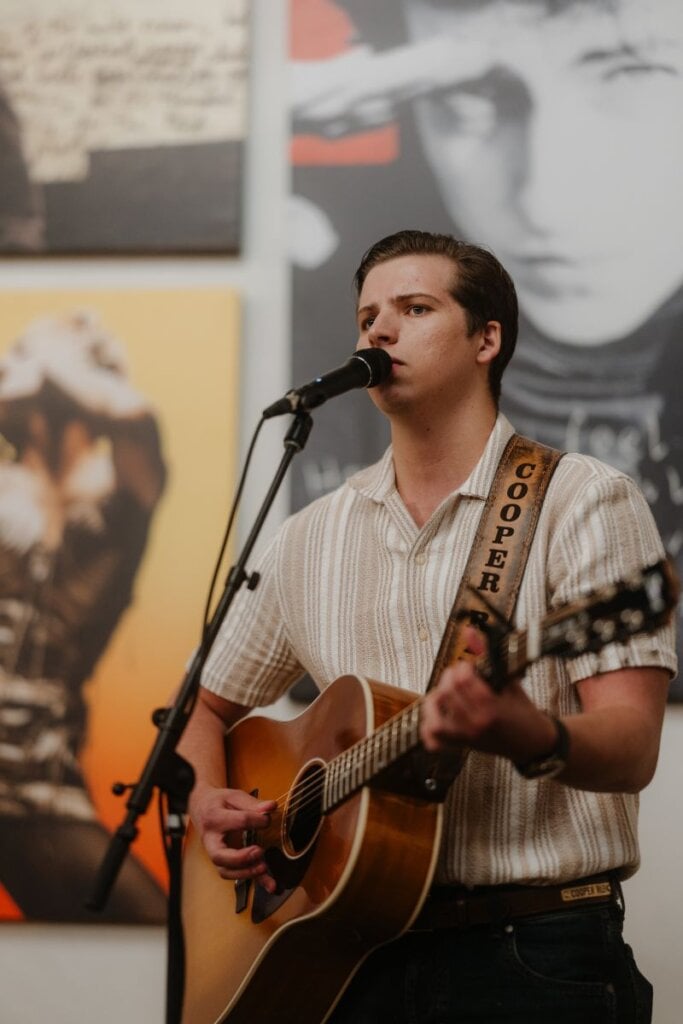
The day continued with a wine tasting experience at Mark Herold Winery. As guests sipped on wine and enjoyed light bites, Cooper Riley, Sacha, Brett Kissel, and FILMORE all took the mic. Riley put it perfectly when he said, “There’s no better place than wine country. I mean it’s just beautiful. Beautiful scenery and great wine, great food. Really it doesn’t get much better than that.”

Cooper Riley; Photo Courtesy of Backstage Access Presents / Ryan Waneka

The live music continued into the night with Mainstage at the Mansion Gardens showcasing a mix of rising acts like Kalsey Kulyk, Madden Metcalf and Jacob Hackworth as well as hitmaker Parker McCollum.

Metcalf was eager to introduce Backstage Access Presents attendees to “all the songs that really described me as a person” from his debut EP, Saltwater Southern. Meanwhile, Hackworth did not hold back in expressing his excitement over stepping into a new setting with a fresh set of hears on songs like his radio debut, “What Took You So Long.”

“It’s a bunch of new faces, new people, and I’m excited for them to get to hear my music. I love concerts from the perspective of a listener to being able to perform them, and I think it’s always amazing. So I’m excited.,” Hackworth shared.

Parker McCollum gave the listeners a chance to really get to know him as he cracked jokes, interacted with individual audience members and even showcased a few brand-new unreleased songs, alongside his fan-favorites such as “Big Ole Fancy House.”

Jacob Hackworth, Photo Courtesy of Backstage Access Presents / Ryan Waneka
Parker McCollum; Photo Courtesy of Backstage Access Presents / Will Bucquoy

The final morning took place at Pahlmeyer with a vineyard brunch featuring acoustic performances that spanned beyond country music and tapped into true artistry from Tom Siletto, Kasey Tyndall, Maggie Rose, Shinedown, and Grace Potter. Prior to these performances, Hannah Dasher brought her fun-loving energy to the stage where she did a live cooking demonstration for her delicious blueberry biscuit recipe pulled straight from her Stand By Your Pan cook book.

“Since I balance the fender and the frying pan, I’m getting to do both,” she said previewing the event, before adding that she was “tickled” to be a part of the week.

Hannah Dasher, Photo Courtesy of Backstage Access Presents / Ryan Waneka

A select group stuck around for the final event, Wine, Women & Song at Whetstone Wine Cellars, closing out the first-ever Backstage Access Presents experience in Napa Valley. The intimate afternoon was filled with even more wine and a real sense of women supporting women, as the artists shared personal stories through song.

Photo Courtesy of Backstage Access Presents / Ryan Waneka

By the time the last glass was poured, it was clear Backstage Access Presents had delivered on its promise to show that country music feels just as powerful, if not more, in a quieter setting surrounded by true music lovers with a shared openness to learn, connect, and grow.

The post Backstage Access Presents Turns Napa Valley Into an Intimate Country Music Escape appeared first on Country Now.

​Country Now