We spoke with two experts on life in the Old West to get an idea of what meats cowboys really ate while on the range. And it wasn’t always steak.

Mashed – Fast Food, Celebrity Chefs, Grocery, Reviews










We spoke with two experts on life in the Old West to get an idea of what meats cowboys really ate while on the range. And it wasn’t always steak.
Mashed – Fast Food, Celebrity Chefs, Grocery, Reviews

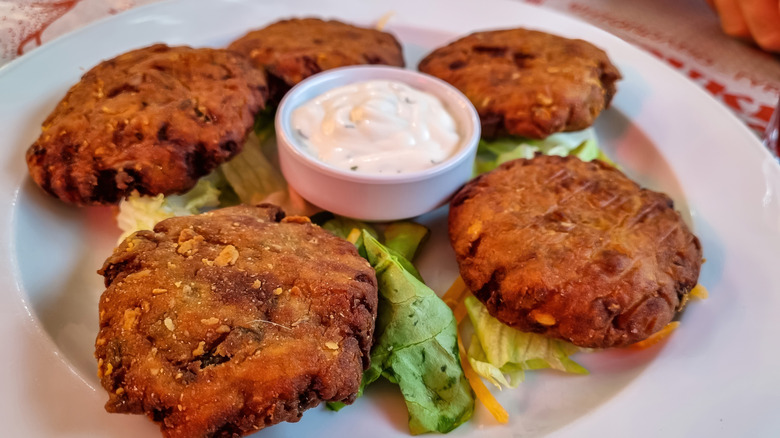
To give your burgers a creamier texture and an unforgettable flavor, all you need is this one ingredient. Here’s how to make this Greek-style burger at home.
Food Republic – Restaurants, Reviews, Recipes, Cooking Tips
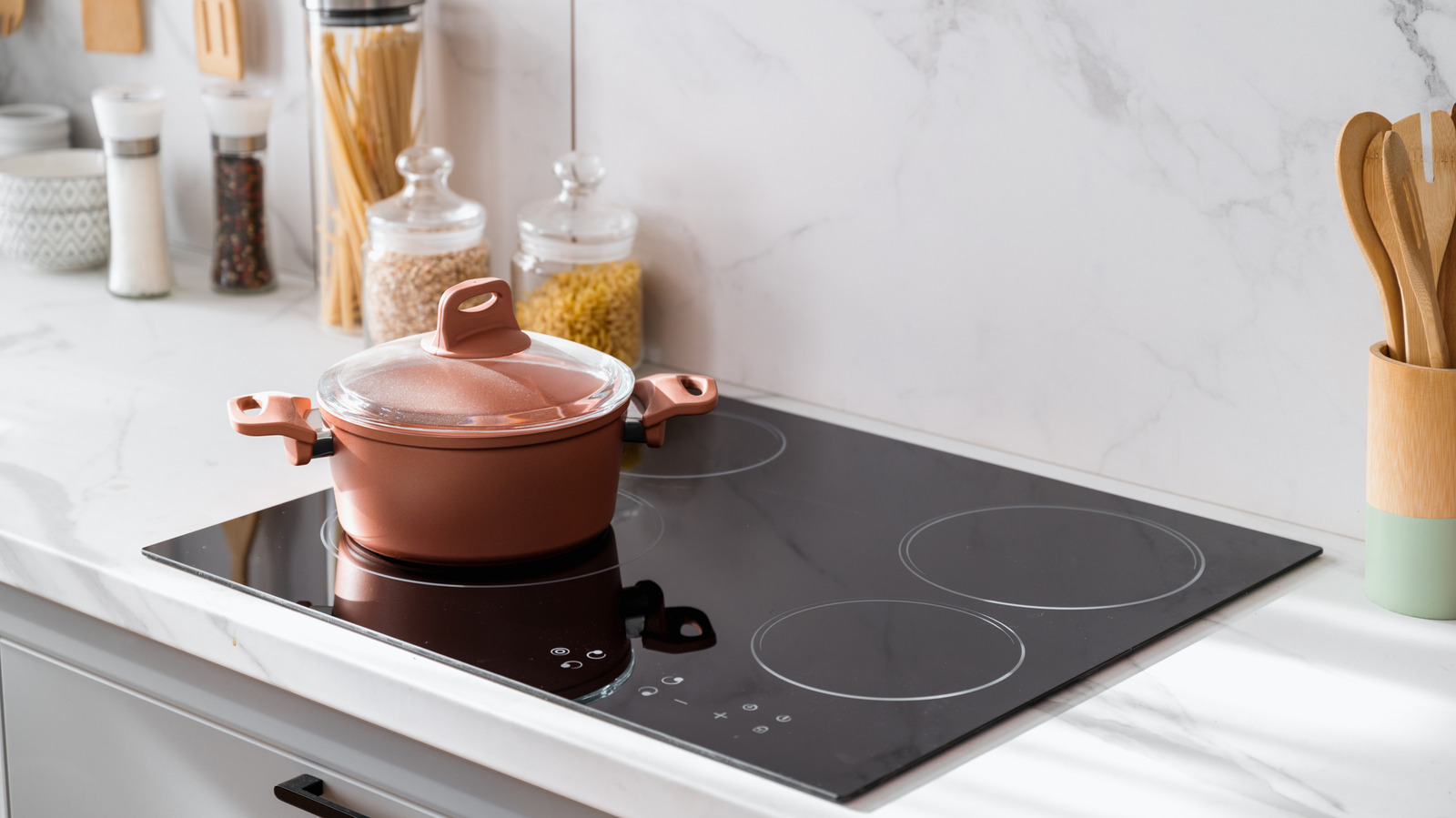
Before making the switch to – and the investment in – an induction stove, consider how much these potential drawbacks might bother you.
Mashed – Fast Food, Celebrity Chefs, Grocery, Reviews
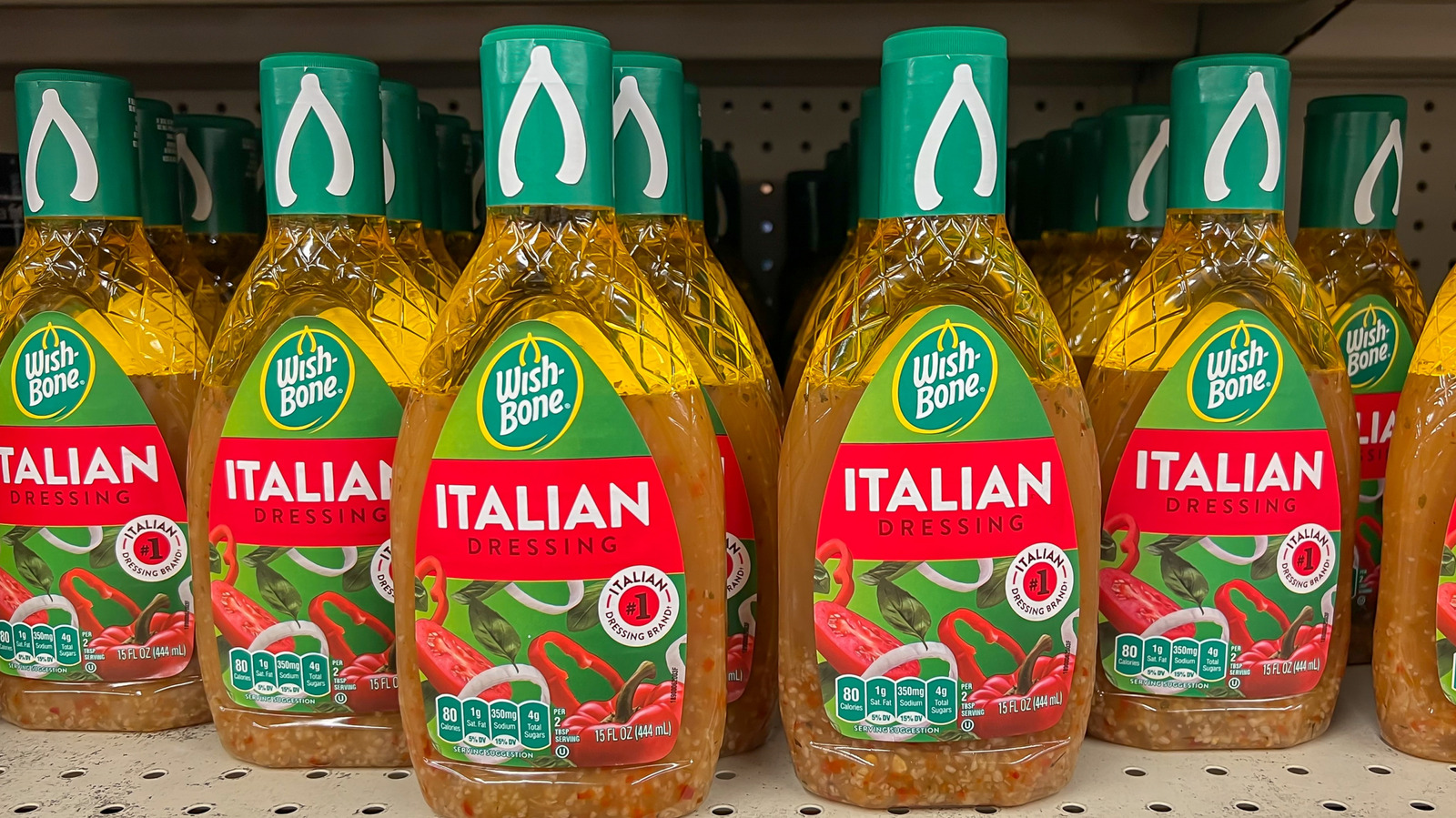
If you have a bottle of store-bought Italian dressing that’s just sitting in your fridge or pantry, these are some non-salad smart ways you can use it up.
Food Republic – Restaurants, Reviews, Recipes, Cooking Tips

 Breaking: We couldn’t wait any longer. The Golden Life is coming early! Tune in at 8 p.m. to reunite with Sonja Morgan, Luann de Lesseps, Ramona Singer, Dorinda Medley and Kelly Bensimon. Can’t…
E! Online (US) – Top Stories

Reading Time: 2 minutes
It’s been just over a week since RJ Mitte was found dead inside his Texas home.
Now, we have new information about the Breaking Bad star’s suicide, including reports of tension with his fiancee, Kennedy Suarez.
According a report from TMZ, the couple’s relationship became increasingly strained after Suarez moved from their home in Brownsville, Texas, to the Atlanta area in December 2025.
The move was reportedly for work, even though her position was initially expected to be remote.
Sources told the outlet that Suarez never returned to Texas full-time, while Mitte was unwilling to relocate to Georgia. Their disagreement reportedly contributed to mounting tension between the couple.
Mitte, who played Walter “Flynn” White Jr. on Breaking Bad, died at age 34 on October 12. A county official confirmed that the actor died by suicide.
Sources told TMZ that Mitte had been struggling with his relationship with Suarez since at least August.
They believe the situation contributed significantly to his emotional decline in the months leading up to his death.
The outlet also reported that Suarez sometimes stopped wearing her engagement ring, allegedly explaining that she was afraid of being robbed.
The couple had been friends for approximately a decade before their relationship turned romantic in 2020. Mitte proposed on October 10, 2025, about a year before his death.
It remains unclear whether the couple officially ended their engagement before Mitte died.
Their relationship reportedly faced additional complications involving the actor’s close-knit family. According to sources who previously spoke with TMZ, Suarez allegedly wanted Mitte to choose between her and his mother, Dyna Mitte, and sister, Lacianne.
Mitte reportedly refused to cut ties with his family, contributing to the friction between the couple.
Dyna has since acknowledged that her son was dealing with personal struggles, although she has emphasized that the details of his relationship were private.
In comments reported by People, Dyna said she did not know all the conversations that took place between her son and Suarez. She also confirmed that the two had seen each other only three or four times after Suarez moved to Georgia.
Suarez was absent from Mitte’s October 16 celebration of life in Brownsville. However, Dyna clarified that she had not personally told Suarez not to attend, explaining that no funeral plans had been made when Suarez reached out to one of Mitte’s friends on the day his body was discovered.
The circumstances surrounding Mitte’s final months have prompted renewed attention to the actor’s personal life, but the full extent of what he was experiencing remains known only to those closest to him.
His death has left family, friends, and fans mourning a beloved actor and activist taken far too soon.
We will have further updates on this developing story as new information becomes available.
RJ Mitte’s Fiancee Had Moved to Different State, Stopped Wearing Engagement Ring … was originally published on The Hollywood Gossip.
The Hollywood Gossip

 Carrot Top is getting back into his routine.
A month after the comedian (real name Scott Thompson) was hospitalized following a suicide attempt, he returned to the stage at Luxor Hotel and Casino…
E! Online (US) – Top Stories
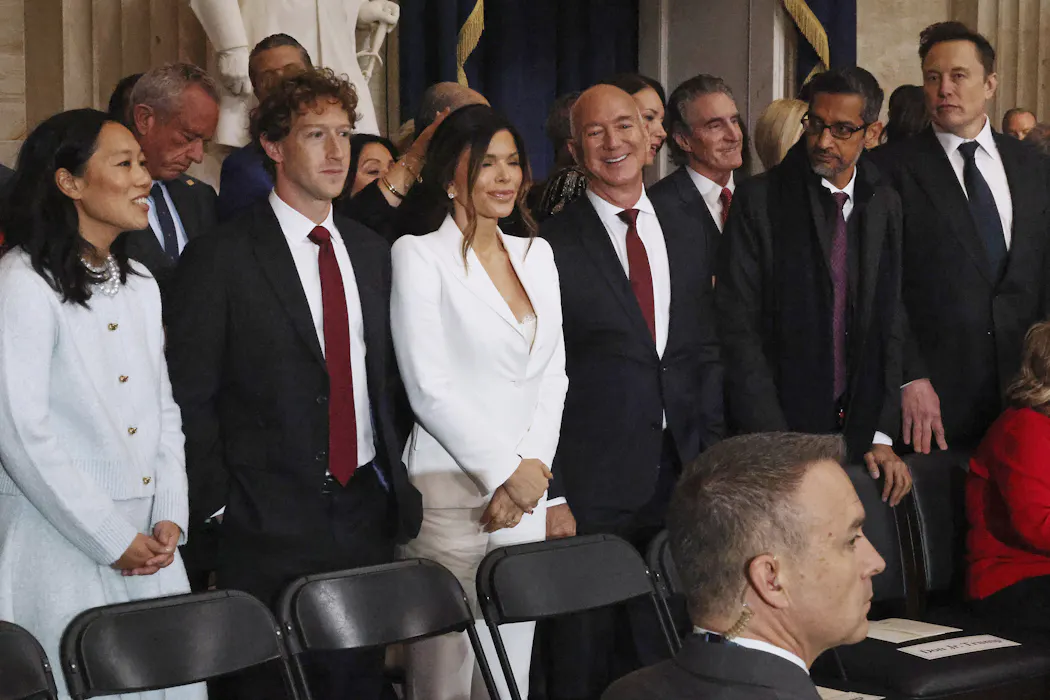
The buzzword of the 2026 U.S. midterm elections may be affordability, but growing anger over inequality is behind the sentiment.
A Pew Research survey released in October 2026 found that roughly 6 in 10 Americans – including 4 in 10 Republicans – believe there’s too much inequality in the U.S. And a growing share from both major political parties state that the economy needs to be fundamentally rebuilt to address this.
This sentiment has, however, been difficult to convert into political results. Public support for California’s proposed wealth tax on billionaires has been waning ahead of the midterms, for example, and in 2025, Republicans passed President Donald Trump’s sweeping legislation that included tax cuts for the wealthy while cutting safety net programs.
I’m an economist who has been studying inequality for about two decades. My research confirms the trend of rising inequality since 1980, driven by the wealthiest pulling away not just from the middle class, but also from the “merely wealthy.” Overall, recent research underscores how policy choices – including taxation and public spending – enabled this 40-year rise in inequality.
Some policies enacted more recently appear to be accelerating this trend. An analysis by the Institute on Taxation and Economic Policy, a nonpartisan research organization, concluded that policy changes since the start of 2025 have imposed higher costs on everyone except the top 1%.
Recent federal data shows that wealth inequality continues to grow. The top 1% saw their share of wealth increase from 31.7% to 32.5% just between the first and second quarters of 2026, a jump of over $8.5 trillion. That caps a steady climb from 30.9% in the last quarter of 2024 – and from 27.4% in 1999.
These recent gains come at the expense of the middle class – the 40% between the bottom half and the top 10% – who hold only 28.8% of all wealth despite being a group that’s 40 times larger than the top 1%. And the middle’s share is shrinking, down from 32.9% in 1999 and 30.2% at the end of 2024, according to the data.
But the ultra-wealthy, those in the top 0.1%, are pulling away even from the rest of the rich, the data shows. This tiny elite owns 15% of all wealth – almost half of all the wealth of the top 1%. Both the top 0.1% and the next 0.9% saw their share of wealth increase, but the top 0.1% captured two-thirds of the gains between the first and second quarters of 2026.
Even within the highest echelons of wealth concentration, these two groups are on different trajectories.
Crucially, the wealth of the top 0.1% is disproportionately boosted by corporate profits, which are up sharply overall. The top 0.1% reap the most from this growth because their portfolios’ value has soared on the promise of future increased profitability that’s driving up stock prices – especially thanks to the tech and artificial intelligence boom.
Since President Ronald Reagan’s tax cuts in the 1980s, the U.S. tax code has become less and less progressive, often through policy changes supported by both Republicans and Democrats.
The common argument for tax cuts is that they stimulate growth, but a growing body of research – including international studies – doesn’t back that up. A 2025 Brookings report notes that U.S. tax policy has gone through massive changes throughout history without any discernible effect on growth.
Nonetheless, congressional Republicans used their narrow majorities in 2025 to pass Trump’s sweeping policy and tax bill, which included provisions making most of his 2017 tax cuts permanent. Those included the historically low top-income tax rate and the lowest corporate tax rate since 1940.
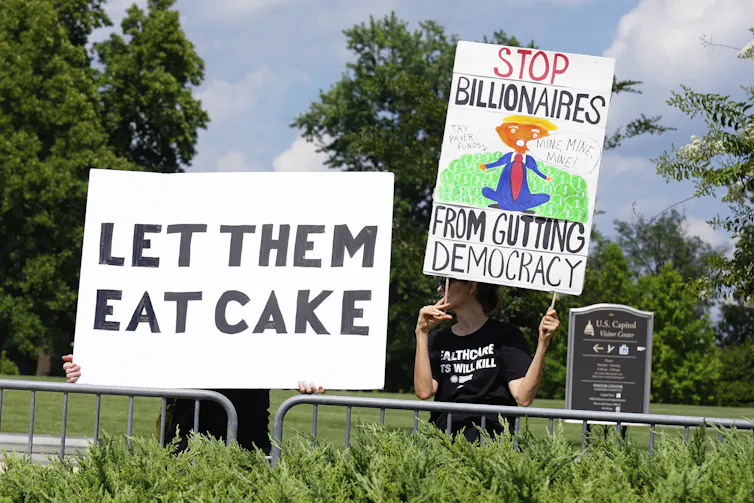
It’s also important to understand that the top 0.1% have a different tax exposure from the rest of the top 1% because the composition of their wealth is different. They own as much in stocks and mutual funds as the next 0.9%, a group that is nine times larger, and those holdings are where most of their recent gains came from.
Furthermore, roughly three-quarters of the top 0.1%’s wealth portfolio consists of corporate and business ownership, allowing them to benefit from the Trump tax cuts in multiple ways – including lower tax rates and more opportunities to defer or avoid tax liability. Their massive holdings of stock mean that they can borrow against it for cash, usually tax-free, rather than having to sell shares.
By contrast, below that elite, real estate is a much more important component of wealth, while corporate equity is a smaller and smaller share. For the middle class, nearly two-thirds of wealth is held in their homes and retirement savings, while corporate and business ownership accounts for only 15%.
Much of the inequality debate focuses on the role that taxation has played. But other recent policy changes have shifted different kinds of costs on to low- and middle-income earners, while leaving the wealthy relatively unscathed.
One example is a provision in Trump’s 2025 legislation that allowed federal healthcare subsidies through the Affordable Car Act to lapse. Insurers and analysts expect the number of people signing up for coverage through ACA plans to drop by about 5 million due to higher premiums and face much higher out-of-pocket costs.
The spike in energy costs, including gasoline, diesel and heating oil, is another case in point. They disproportionately affect low- and middle-income consumers but barely dent the budgets of the wealthy – while boosting the profits of companies engaged to the extraction, processing and transportation of oil. This divergence has been especially pronounced since the start of the conflict with Iran in February 2026, which has pushed up the global price of oil.
Then there are tariffs, which are fundamentally a consumption tax on imports. Economists at the New York Federal Reserve have found that these levies have inflicted a heavy hit on many common consumer goods. They estimated that prices for these items, which make up a much larger share of household budgets among the nonwealthy, would have fallen on average by 1% over the year without the tariffs. Instead, they have risen by 2.9%.
This acceleration in the redistribution of wealth from the middle class to the very top, in short, has an array of drivers. But they’re not inexorable forces of history. As economist Thomas Piketty put it in “A Brief History of Equality,” published in 2022: “Inequality is first of all a social, historical, and political construction.”

Markus Schneider does not work for, consult, own shares in or receive funding from any company or organization that would benefit from this article, and has disclosed no relevant affiliations beyond their academic appointment.
Politics + Society – The Conversation

With the U.S. midterms approaching, about 1 in 5 voters has asked AI chatbots about elections and politics, a recent survey found.
But many voters may not know that governments around the world increasingly shape what chatbots can say. And because many tech companies apply the same policies worldwide, the answers American voters get may be shaped by governments at home and abroad.
I’m a researcher at a nonpartisan think tank at Vanderbilt University, where I study free speech policy. In two reports published in 2025 and 2026, my colleagues and I worked with global legal experts to examine how governments in 12 countries and regions regulate artificial intelligence. Our research shows that they often use existing rules, such as national security or anti-state propaganda laws, rather than new AI laws to control what AI models can say.
AI can cause real harm, from launching cyberattacks to generating sexualized images of children.
It’s important that governments tackle these harms. But, in our assessment, some governments use legitimate concerns like these as a pretext to control political discussion, particularly chatbot responses about those in power.
In 2024, an Indian journalist asked Google’s Gemini chatbot whether the policies of India’s prime minister, Narendra Modi, were fascist. Gemini responded that some experts say yes. The government reacted by requiring official permission before “unreliable” AI models could be released. Although authorities later dropped this requirement, the case shows how terms like “under-testing” or “unreliable” can be used for political purposes.
India is not alone. China requires AI models to uphold “socialist core values.”
And in Turkey, a court blocked posts by Grok, the chatbot built into the social platform X, that allegedly insulted President Recep Tayyip Erdoğan, founding father Mustafa Kemal Atatürk and religious values. Research by Turkish law scholar Yaman Akdeniz identifies the Turkish rulings as among the earliest documented cases of state censorship of chatbots.
Vietnam shows what such content controls can mean for dissidents, including those in exile. A Vietnamese court sentenced two activists, who live in Germany, to 17 years each in prison in December 2025 for spreading anti-state material. Prosecutors accused them of using AI to fake voices and images of Vietnamese leaders, illustrating how prosecutions can target political criticism.

Some of these government measures only affect people residing in their countries. Other statutes cross borders.
The European Union’s AI Act, adopted in 2024, requires any company offering AI tools in Europe, wherever it is based, to mark AI-generated content. Anthropic, for one, applies the marks globally because it has no reliable way to apply them by region. This is an example of the Brussels Effect, in which rules adopted in the EU end up applying elsewhere.
European rules also affect what chatbots say about politics.
In August 2026, the EU placed ChatGPT under the strictest tier of its Digital Services Act, Europe’s online safety rulebook. OpenAI, creator of ChatGPT, now must assess and reduce the “systemic risks” of its service, including risks to elections, such as the spread of disinformation.
And the Dutch Data Protection Authority tested four chatbots before the 2025 national election and found that the political middle ground “virtually disappears” in their voting advice. It urged providers to “prevent their systems from being used for voting advice.”
These rules can be used to pressure platforms.
In 2024, Thierry Breton, then the EU’s top digital rules enforcer, reminded Elon Musk of his legal obligations before Musk’s live interview with then-presidential candidate Donald Trump on X, warning against the spread of “harmful content.”
Threats to Americans’ access to information do not come only from abroad.
In 2025, President Trump issued an executive order on “Preventing Woke AI in the Federal Government.” It requires the AI models the government buys to be “truth-seeking,” ideologically neutral and not favoring ideas such as “diversity, equity and inclusion.”
“Truth-seeking” may sound like an objective, neutral term, but it can mean very different things to different people. Take media reporting: The president recently banned three news outlets from the White House for reporting “FICTION and LIES” and dismissed media polls as “fake.”
More recently, the Federal Trade Commission has suggested that AI companies that steer answers toward undisclosed ideological or biased objectives might break consumer protection law.
A 2025 Pew Research Center survey found that 8 in 10 Americans believe Republican and Democratic voters cannot agree on basic facts. In other words, as our report notes, government mandates to seek truth are often driven by ideological belief systems, particularly on political issues.
Meanwhile, dozens of states have passed laws restricting AI-generated political deepfakes. California and Hawaii, for example, are two states that have banned sharing deceptive AI content about candidates in the months around an election. U.S. courts have blocked both of those laws, citing the First Amendment.
What does this mean for voters? When you ask your chatbot about the elections, treat the answer as a starting point. Keep in mind that governments, both foreign and domestic, may try to influence the answer. AI responses should not replace your critical thinking at the ballot box.

Jordi Calvet-Bademunt is affiliated with The Future of Free Speech, a nonpartisan, nonprofit think tank located at Vanderbilt University. The organization is supported by foundations and individual donors, and it retains full independence and final authority over its work, including research, methodology, analysis, conclusions, and presentation.
Politics + Society – The Conversation
With the midterms fast approaching, communicating just the right message has been top of mind on all sides of the political aisle.
Whether that message drives home a lack of affordability as gas, food and home prices surge or stokes fears about the rise of communism in the American heartland, Democrats and Republicans are spending a lot of time thinking about what to say.
But as a linguist who studies the impact of accents on the way people are perceived, I believe how politicians and voters say what they say might be just as important as the words they use in understanding the social consequences and linguistic changes resulting from the political divides that are growing between us.
If there is one regional American accent that has long endured on the lips of its speakers – as well as in the minds of listeners beyond the region – it’s the Southern accent. From North Carolina through Texas and pretty much all states in between, the so-called Southern drawl has long been emblematic of a distinct culture found in the South.
Yet, in the urban South, recent linguistic research finds that the drawl’s most salient features are starting to fade on the lips of young speakers. Fewer “pins” are merged with “pens,” and pronunciations such as “far” for “fire” or “say-ud” for “said” are becoming rarer.
While linguists have been busy trying to understand this trend, political scientists have been measuring how different accents perform on the campaign trail. The verdict? Southern accented candidates are generally heard as more conservative than those without a Southern accent, particularly to Democratic listeners.
Putting these findings from linguists and political scientists together, alongside a spate of studies examining correlations between voting patterns and vowels, hints, I believe, that the increasing conservative-liberal divide in American politics just might be the key to understanding what’s driving the decline of the drawl in the urban South.
The traditional Southern accent has no shortage of stereotypes: From positive, friendly, country and down-home vibes to negative, backward, uneducated and lazy tropes, the accents of William Faulkner, Bill Clinton and the hillbilly Clampetts have weathered it all.
The reality, of course, is that the Southern accent is not some incorrect version of a national standard but instead a historically separate and unique dialect – or, more accurately, set of dialects.
As explored in my recent book, this dialect formed from linguistic variation that came in with colonial-era settlers from different places and stations. The incipient differences increased after the Civil War intensified hostilities and cultural differences between the North and South.
The association with “countryness” often triggered by a Southern accent grew out of this region’s agricultural past and its related cultural folkways. But what “country” has come to mean relies largely on stereotypes about what a country lifestyle involves. They include things like hunting, gun ownership and less socially progressive views – often arising from media portrayals of and beliefs about the South.
As the South has become more and more industrialized over the past half-century, these social meanings associated with the accent’s use now highlight a disconnect between its new urban vibe and its older, traditional rural one.
As rural vs. urban ideological and political divides in the U.S. have intensified, so has using symbolic means to signal this opposition.
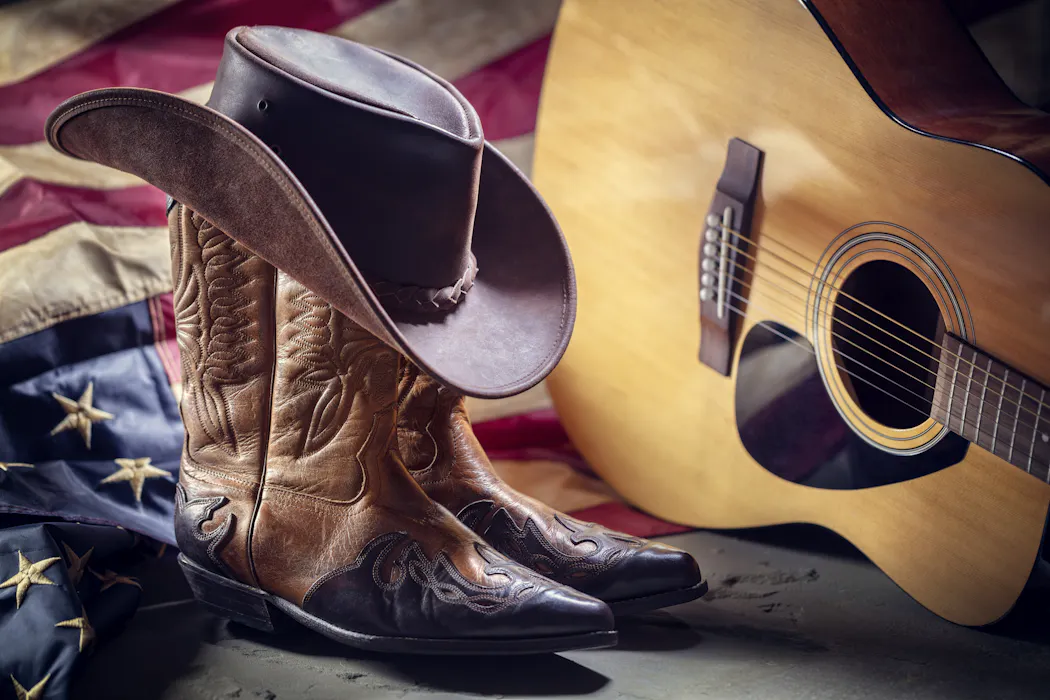
Pickup trucks emblazoned with American flags and country music have become politicized. The white Southern accent, by virtue of its association with more rural traditional values, has also become emblematic of a conservative political identity not all modern Southerners share.
Recent linguistic research has compared voters in the South who had strong Southern accents to those with weaker ones, mainly measured through their use of a set of unique Southern vowel pronunciations, such as saying “bay-ud” for “bed” or “rawed” for “ride.”
It turns out that those holding more right-leaning positions and voting Republican in previous presidential elections used significantly more Southern vowels than those with more left-leaning positions who voted for Democrats. Three separate studies in Georgia, North Carolina and Tennessee discovered the same relationship between degree of Southern accent and political conservatism or liberalism.
The takeaway from these studies is that conservatism itself is embodied in a strong Southern accent.
The pronunciation of one’s vowels has become a barometer of how one’s beliefs and values fit within the old vs. new South.
Conservative ideologies and politics have become enmeshed with “country” speech and lifestyles. Young urban Southerners who don’t identify with these traits might be moving not so much away from Southern identity itself but rather specifically from this rural conservative identity it is often associated with.
Of course, other factors are also playing a role in the decline of the Southern accent in cities, such as heavy migration by non-Southerners to the region and greater interaction with people from other dialect areas via social media.
Outside the South, interestingly, recent research has found a greater embrace of Southern accent features, emerging in particular among those in rural areas where traditional lifestyles and, often, more conservative views are embraced. For instance, in a small, rural town in Ohio, speakers who identified themselves as more drawn to country lifestyles showed use of vowel features – such as saying “baa” for “bye” – more associated with the South.
So, in this circuitous and indirect way, vowels have become the latest players in partisan politics: Democratic Southerners wanting to distance themselves from the ideological and political climate associated with the rural South are moving away from its unique vowels. More “traditional” or conservative-leaning speakers continue to embrace them.
The real casualty in this particular battleground might be the obscuring of a larger culture, practice and community that the Southern accent has long represented for those who are automatically – and often erroneously – assigned a politicized identity just by the sound of their voice.

Valerie M. Fridland has received funding from The National Endowment for the Humanities and the National Science Foundation.
Politics + Society – The Conversation