They visited the Kings Head earlier this month, reportedly to wind down after a day of filming for season three of the hit Netflix show.
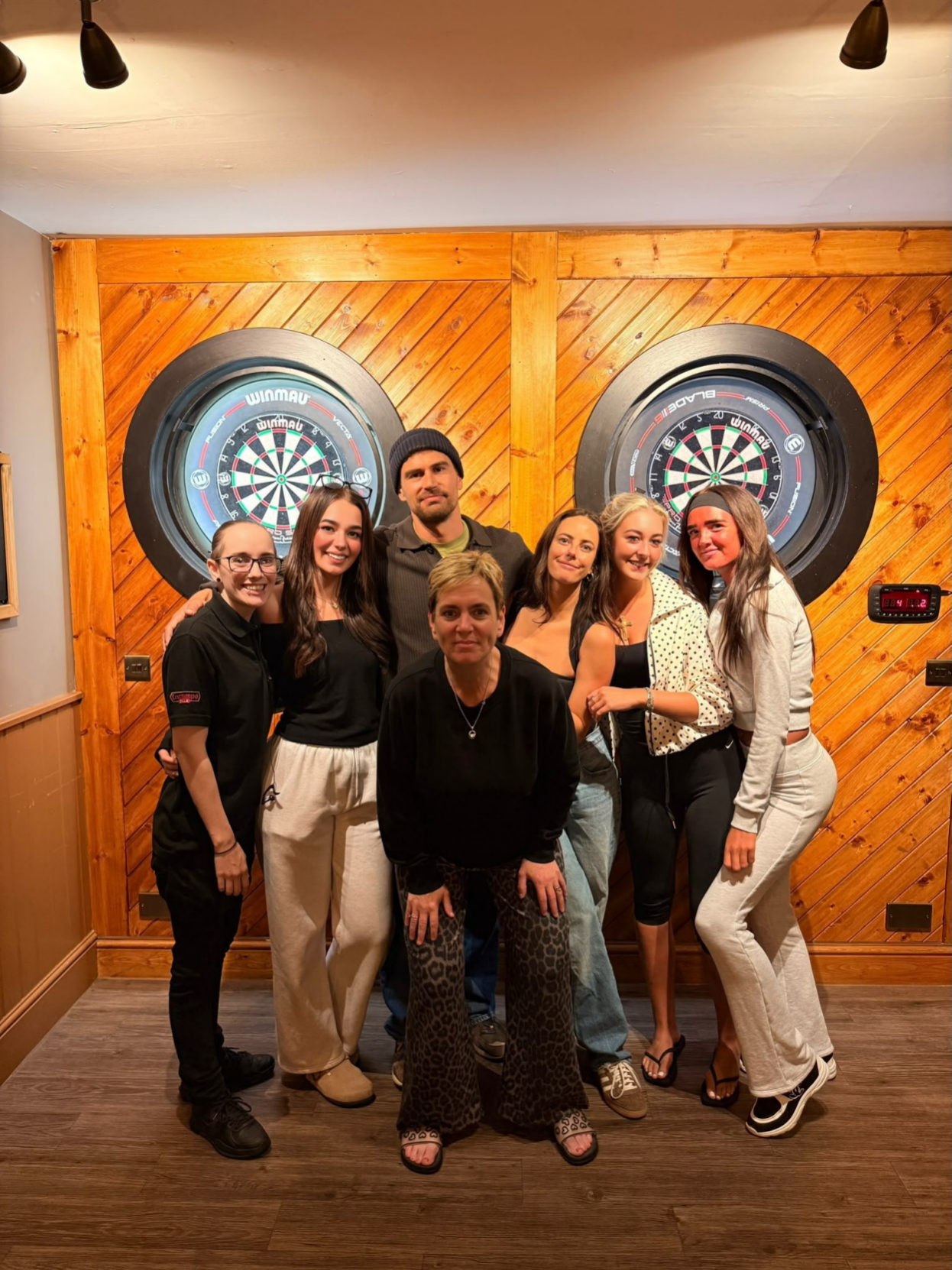









They visited the Kings Head earlier this month, reportedly to wind down after a day of filming for season three of the hit Netflix show.
Actors Theo James and Kaya Scodelario at the Kings Head pub in the UK. (Kim Novell via SWNS)

 Call her mommy.
Alex Cooper confirmed on Oct. 20 that she gave birth to her first child with husband Matt Kaplan.
Though the Call Her Daddy host kept much of the details private—including her…
E! Online (US) – Top Stories
This fall, parents skip the ticketed corn maze and the pumpkin patch with the photo op line and go back to apple picking, backyard bonfires … Read moreThe post Slow fall is in, and millennial parents are making it happen…

OpenStation is a free WordPress plugin that turns wp-admin into a desktop. Every admin screen opens in its own window that you can move, resize and keep open next to the others. You can try it in your browser right now, with nothing to install.
Can’t see the video? Watch it on YouTube.
Most of us spend the day jumping between screens in wp-admin. You open a post, go back to the list, check the media library, then go back again. With OpenStation, those screens stay open side by side, so you don’t lose your place.
Go to the OpenStation page on WordPress.org and click Live Preview. It runs a full WordPress site with OpenStation in your browser tab, so you can’t break anything.
OpenStation is opt-in for each user, so the rest of your team keeps the normal admin. Click the same icon to go back to the classic view. If you deactivate the plugin, wp-admin goes back to exactly how it was. It doesn’t change WordPress core.
Have a question? Ask in the support forum. Found a bug or have an idea? Open an issue on GitHub.

Post Content

Boats line the harbor at Whittier on Oct. 1, 2026. A new National Park Service designation honors Whittier for its role as a supply and support center for the World War II effort in Alaska. Whittier continues to serve as a najor transportation hub for Alaska, though now in the civilian sphere. It has marine, rail and road connections. (Photo by Yereth Rosen/Alaska Beacon)
The Prince William Sound town of Whittier is sometimes called the “strangest town in Alaska” because nearly all of its roughly 250 residents dwell in a single high-rise building. Now it has another claim to fame: It is designated by the National Park Service as one of the nation’s American World War II Heritage Cities.

The designation, announced last week, is part of the Park Service’s American World War II Heritage City Program, created in 2019 as part of the John D. Dingell Jr. Conservation, Management, and Recreation Act. Under the program, one city in each state or territory can receive the designation.
Whittier was one of 10 cities given the honor last week. Among the others were Charlotte Amalie, U.S. Virgin Islands; Pendleton, Oregon, and Honolulu, Hawaii.
“These designations highlight the enduring legacy of service, sacrifice, innovation, and industrial achievement that helped establish the United States as the “Arsenal of Democracy” and continue to shape our national story,” Jessica Bowron, the National Park Service’s acting director, said in a statement. “The 2026 designations reinforce the role communities played across the country, from manufacturing critical military equipment to hosting strategic training facilities, and their ongoing work to preserve and interpret this history for future generations.”

Whittier’s World War II designation stems from its service as a supply and support center for the war effort in Alaska. To put Whittier into use, the Army blasted a tunnel through Maynard Mountain and laid a rail spur connecting the site with the Alaska Railroad. The rail link to the port town was completed in 1943.
Aside from its handy location as a transportation hub — a function the city continues to serve — Whittier had another attribute that attracted the military. Shrouded by tall mountains and near-constant cloud cover, it was well-hidden from enemy eyes.
Whittier’s military service continued for a while after the war. The sprawling Buckner Building, completed by the U.S. Army Corps of Engineers in 1953, was considered a city unto itself, with accommodations for 1,000 soldiers and amenities like a theater, bowling alley and hospital. The Corps also completed the 14-story Hodge Building in 1957. It was converted to civilian use and later named for the late U.S. Rep. Nick Begich, D-Alaska, who died in a 1972 plane crash.

The Begich Towers building remains in use as the home of most residents, but the Buckner Building was shut down after only a few years. Local and state officials are trying to figure out what to do with the Buckner building, which has historic status but is also in extreme disrepair and riddled with asbestos and other dangers.
Whittier’s history extends far earlier than its military era.
The same location that made it strategic to the Army also made it important to Indigenous travelers prior to European contact.
A short hike over Portage Pass connected the Prince William Sound homeland of the Alutiiq people and the Cook Inlet region homeland of the Dena’ina people. Portage Pass’ role as a trade link continued after European contact, with explorers and miners also making the quick trek. In the past, travelers crossed a portion of Portage Glacier, but the glacier has since receded dramatically.

Now part of the Chugach National Forest, Portage Pass remains a popular hiking destination. The modern recreation trail runs about 2 miles from the Whittier trailhead to Portage Lake, still linking the Alutiiq and Dena’ina homelands.
Whittier’s new designation adds to others in Alaska that honor the state’s role in World War II.
Best-known is the National Park Service’s Aleutian Islands World War II Heritage Area. Based in Unalaska, it commemorates the war history in the Aleutians, which includes the 1942 Battle of Attu, the Dutch Harbor bombing and the trauma endured by the Indigenous Unangan people.


Reading Time: 3 minutes
In The Shadow of Eight is out, it is a bestseller, and it portrays Kate Gosselin in an appropriately damning way.
Those reading Collin Gosselin’s memoir are moved by his maturity, his suffering, and by the descriptions of cruelty by his infamous mother.
There are loud calls to put Kate behind bars — a small slice of justice after everything that Collin recalled in his book.
But many may feel surprised by his reply.
While speaking to Page Six, Collin weighed in on the growing number of people calling for Kate’s imprisonment.
Does he agree?
“I think if we could go around all day and try to put people in jail,” his answer began, “we’d be more hung up on them and not ourselves.”
Collin continued: “And I think everything that I’m doing today in my life — working, going to school, taking on challenges like ‘Special Forces,’ and writing my story — your effort is sometimes better.”
He rephrased: “It’s better to put it in the right places and invest that [effort] in yourself.”
“Like I said, while we could run around and try to put everybody away,” Collin suggested.
But, he argued, “I think our time is better spent working on ourselves and growing.”
Collin affirmed: “That’s what today really is about for me.”
It sounds like his argument is that the best revenge — or justice, in this case — is success. Or, at least, wellness. That may often be true.
Others might counter that there are many forms of justice. Restorative justice can coexist with a system that excises the truly evil people from society.
In his memoir, Collin also delved into the heavy topic of processing his very reasonable anger towards Kate.
“I could stay angry,” he acknowledged. “In my opinion, I have every right to be angry for the rest of my life.”
Collin explained: “But I’ve learned that anger keeps me tied to the past, and I absolutely do not want to live there anymore.” Very understandable.
“The other option is I could just…let it go,” he continued. “Not because what happened didn’t matter. But because I don’t want to carry it anymore.”
Collin reasoned: “I don’t want to wake up every day in fight-or-flight mode or feeling pissed off.”
It is clear that Collin has also undergone a tremendous amount of emotional processing as he continues the longer-than-it-should-be road to recovery from his childhood.
He’s right that spending his time and energy on hating Kate as she deserves might not be fulfilling and won’t allow him to move forward and heal.
When it comes to not joining the push to imprison her, there may be a pragmatic aspect to all of this.
Simply put, the legal system seldom takes any real action to protect children from their parents, let alone to punish the parents. There exceptions, such as murders and CSA, but these are extreme cases.
Kate was on video hitting Collin when he was a little kid. Police did not take action then. Why would they take action now?
Until we live under a legal system that actually cares about children more than it does about “parents’ rights,” Collin is probably doing the smart thing by not investing his hopes in a justice that will likely never come. Living well is the best way forward.
Does Collin Gosselin Want Kate in Prison for Abusing Him? was originally published on The Hollywood Gossip.
The Hollywood Gossip

Barbara Palvin turned heads strutting down the catwalk at six weeks postpartum. However, we would argue this shouldn’t be considered the universal standard.

Health Digest – Health News, Wellness, Expert Insights

 Christina Applegate is left with more questions than answers about her health.
More than five years after the Married… with Children alum spoke out about her battle with multiple sclerosis, she…
E! Online (US) – Top Stories