 The Disney Channel family is in mourning.
Carla Jeffery, star of the original Zombies movie trilogy who also appeared in Good Luck Charlie and Shake It Up, died at age 33, her management team led…
E! Online (US) – Top Stories









The Disney Channel family is in mourning.
Carla Jeffery, star of the original Zombies movie trilogy who also appeared in Good Luck Charlie and Shake It Up, died at age 33, her management team led…
E! Online (US) – Top Stories

A participant in the second annual Cancer Screening Day at the Alaska State Fair on Aug. 27, 2026 gets a blood draw for a prostate cancer screening. (Photo courtesy of the Aurora Integrated Oncology Foundation)
Every August, Alaskans gather in Palmer for the State Fair. They come for the exhibits, the food, and the chance to see neighbors from across the state. On Thursday, Aug. 27, a good number of them also came for something less festive and more useful: cancer screening.
That day was the second annual Cancer Screening Day at the Alaska State Fair, organized by Aurora Integrated Oncology Foundation and a group of clinical and community partners.
In six hours, 443 people received screenings or related preventive services. Staff and partners recorded 1,922 community engagements — conversations with fairgoers about prevention, risk, and how to get care. The weather cooperated. The lines moved. People left with information they did not have when they arrived.
The numbers are straightforward. Partners provided 181 skin cancer screenings, 146 PSA blood draws for prostate cancer, 52 mammograms, 22 oral cancer screenings, and two HPV vaccinations. In addition, 40 people began the process for at-home colorectal screening. Those are not program slogans. They are individual Alaskans who chose to do something about their health in a place they were already going.
Cancer is the leading cause of death in Alaska. It accounts for about one in five deaths in the state. Breast, prostate, lung, and colorectal cancers make up roughly half of new diagnoses. For several of those cancers, screening finds disease earlier, when treatment is more effective and less burdensome. That is not a slogan. It is how medical evidence works.
Alaska makes this harder than it should be. Distance, weather, work schedules, insurance status, and a thin health workforce all get in the way of routine preventive care. A substantial share of women who should be current on mammograms are not. Colorectal screening still lags recommended levels. Late-stage diagnosis remains too common, and late-stage care is harder on patients, families, employers, and the health system. Anyone who has worked on infrastructure or economic development will recognize the pattern. Deferred maintenance is expensive. The same is true of deferred screening.
That is why the Foundation exists. Aurora Integrated Oncology Foundation is a nonprofit that operates radiation oncology centers in Anchorage, the Mat-Su Valley, the Kenai Peninsula, and Juneau. Our purpose is to improve the quality of, and access to, cancer prevention, treatment, and supportive care for Alaskans — regardless of insurance status. Treatment is essential. So is finding disease before it requires the most intensive treatment. Screening Day is one way we put prevention in front of people instead of waiting for them to navigate an appointment they may never make.
We did not do this alone. The Alaska State Fair gave us a setting where thousands of Alaskans already gather, and the Fair staff were steady hosts. Clinical partners brought the equipment, the clinicians, and the follow-up capacity. Our team handled the unglamorous work that makes a public event function: scheduling, supplies, patient flow, and problem-solving when something did not go as planned. Events of this kind succeed or fail on logistics. I am proud of the efforts of our staff and community partners. It was a resounding success.
Those partners include: Alaska Breast & Cervical Health Check, Alaska Health Fair, Alaska Men’s Run, American Cancer Society, American Lung Association, Anchorage Neighborhood Health, ANTHC, Breast Cancer Detection Center, Let Every Women Know, Connect Mat-Su, Mat-Su Public Health, Providence Imaging Center, Abbott Cancer Diagnostics, Mat-Su Dermatology, Palmer Fire & Rescue all alongside Aurora Integrated Oncology Foundation.
I have spent most of my working life on questions of investment and return in this state — in energy, infrastructure, workforce, and civic institutions. Health belongs on that same ledger. A screened population is a more productive population. Early treatment keeps people at work and at home. It reduces the travel and lodging burden that so often accompanies a late diagnosis in Alaska. It is also simply the responsible thing to do.
Screening Day will not, by itself, change statewide cancer statistics. One afternoon at the Fair is not a substitute for a primary-care relationship or a regular mammogram schedule. It is a demonstration that if you remove friction — cost, travel, time, and uncertainty — Alaskans will take the test. The task now is to keep removing that friction the other 364 days of the year.
If you were among the people who stopped between Raven Hall and the farm exhibits last Thursday, thank you. If you were not, the invitation still stands. Talk with your clinician about the screenings appropriate for your age and risk. Do not wait for a fairgrounds booth to appear. And if you are in a position to support screening access in your community — as an employer, a clinic, a borough, or a neighbor — do that. Early detection is not complicated. It is work. Alaska is capable of the work.

We would like to wish a big thank you to the Chilkat Valley Community Foundation for the generous grant that funded the Haines Arts Council 2026 Winter Workshop Series. With their support we were able to host a series of twelve workshops and a culminating Music, Art & Dance Camp for children and adults. The programs ran from January through April last year, serving over 500 community members and engaging over 30 local teaching artists, offering…
We at the Four Winds Resource Center want to send our heartfelt gratitude to the Chilkat Valley Community Foundation for supporting our mission year after year with their generous grants.
This past year, CVCF gave us the ability to “Power Up” our organization by funding the purchase of requested tools for our Tool Library, yoga equipment, building materials for a permanent compost structure and needed chairs for community events.
In addition, we won a popularity…
Southeast Alaska Independent Living (SAIL) wishes to extend our gratitude to our community and the Chilkat Valley Community Foundation (CVCF) for continued phenomenal support of the Haines SAIL program. Thanks in part to a CVCF grant, SAIL is well on our way to serving even more seniors and people with disabilities in Haines and Klukwan this year! We are proud to empower local seniors and adults and youth with disabilities to live independent lives right…

If you buy the first pack of hamburger meat you see and don’t give it another thought, you may want to reconsider. This is how to get high-quality ground beef.

Mashed – Fast Food, Celebrity Chefs, Grocery, Reviews

Tartar sauce’s core ingredients are simple, which makes it a good condiment to jazz up with flavorful additions, such as this bold accompaniment.

Mashed – Fast Food, Celebrity Chefs, Grocery, Reviews
By: Corinne Smith, Alaska Beacon
The Alaska Department of Revenue announced on Monday that Alaska’s K-12 public schools will receive an additional $115 million in state funding this year, prompted by a boost in oil revenues driven by the U.S. war on Iran.
Legislators earmarked the additional oil revenue for schools as part of the state budget approved by Gov. Mike Dunleavy in June.
The additional funding is a relief to school districts statewide. Many districts have faced severe budget shortfalls in recent years due to funding not keeping pace with rising costs. This year, a record 12 elementary and middle schools closed across the state.
Following the announcement, Luke Meinert, superintendent of the Fairbanks North Star Borough School District — the state’s third-largest district by student count — welcomed the news, and said the district is appreciative of the Legislature for making it a priority.
“(We’re) very excited that the projected numbers came through and that we will see a sizable increase in funding for our school district through the one-time funds that are being allocated,” he said in an interview Tuesday.
Officials with the Department of Revenue announced the state had collected sufficient revenue funds to meet the special appropriation of nearly $600 million.
Lawmakers designated funding for four priorities areas, in sequential order: nearly $128 million to the Permanent Fund to allocate one-time energy relief payments of $200 per eligible Alaskan along with dividend checks; $115 million to K-12 schools through the Alaska Department of Education and Early Development; $15 million to the bulk fuel loan program; and $341 million to the state’s budget reserve account.
According to the announcement, the Monday revenue estimates are expected to be revised and finalized this fall. The revenue amounts are expected to “change slightly,” impacting the exact amount that will land in the budget reserve fund, the state’s savings account, officials said.
The $115 million will be distributed to school districts according to the state’s education funding formula, which is based on student enrollment counts in October.
For Fairbanks, that’s estimated to be roughly $10.2 million this year. Meinert said the district designed its budget this year anticipating about half of that amount, and the additional funding will go toward teachers and staff, as the district is currently in union contract negotiations are ongoing, and other areas. “So that will help us in our negotiation discussions for this school year,” he said.
“Student activities have been an area that’s been cut pretty hard over the past several years,” he continued. “So potentially adding some funding there to ensure that families aren’t having to pick up a bigger burden of paying for student activities. And then, additionally, I think there may be some smaller investments for teacher mentoring, teacher coaching, and possibly some funding in our nutrition services department.”
School board members with Fairbanks and Anchorage called on the state in June to release estimates earlier, ahead of the school year — “the earliest practical information available,” they wrote in an op-ed for the Anchorage Daily News. They asked the state to announce whether “funding is likely, unlikely or still uncertain,” to help districts plan, particularly for hiring teachers.
But the Department of Revenue did not change its scheduled announcement.
Lisa Parady, executive director of the Alaska Council of School Administrators, said they were “elated” and “grateful” at the announcement. But she said it underscores Alaska schools’ needs for prior notice and consistent state funding.
“We do have to get to the place where we have predictable, reliable funds in advance of needing to extend contracts. That’s the biggest issue,” she said Tuesday.
“Because we’re in the greatest education shortage in the history of Alaska and in the nation, it allows for the recruitment and retention of quality educators and that ability to lock in those contracts sooner,” she said.
Among the state’s largest districts, the Anchorage School District is expected to get $32 million. The Matanuska Susitna Borough School District is expecting $16.1 million, the Kenai Peninsula School District is expecting $7.6 million. Both districts closed schools this year.
Parady said it’s difficult to say if the additional funding earlier in the year would have prevented school closures.
Districts cited surging costs of operations, as well as declining enrollment as more families opting for homeschool programs or leaving the state.
“Each school district is in their own unique place in terms of overall education funding in their budgets,” Parady said. “Having a long term fiscal plan that allows for timely, reliable, and predictable revenue for schools … is the only way that school boards and our school district leaders can have the tools they need to make the best decisions as they’re managing their budgets. And school closures are obviously a piece of that, and so I can’t say for sure that it could have changed an outcome, but it’s certainly possible.”
Anchorage Democrat Sen. Löki Tobin, who chairs the Senate Education Committee expressed her reaction Tuesday as “mixed.” “We know that our schools are in desperate need of resources,” she said.
“We have nonpartisan financial memos from our Division of Legislative Finance that says to adequately address the years that inflation has eroded the purchasing power of our base in funding, we need to appropriate significant financial resources per student to our schools, and while $115 million is a significant amount of dollars, it’s clearly not enough. And one-time funds do not create stability nor predictability.”
Tobin also acknowledged the moral dilemma of the upswing of Alaska oil revenues and state funding driven by the U.S. war on Iran.
“It is gut-wrenching to know the reason that Alaska has been able to receive these resources,” Tobin said. “It is not without contemplation or thought that I have been thinking about the children that were bombed in these recent years in a place that is very far away from us, but is no less important and nor no less critical for the health and well-being of all of our kids, and how those choices are driving the record increases in the price of a per barrel of oil.”
With the boost in state revenues, Tobin also credited the efforts of lawmakers across political divides in designating funding for schools. “Folks who work to get this funding into our budget not only crossed the aisle but also were bicameral in nature, and that is absolutely critical,” she said.
Lawmakers allocated roughly $144 million in one-time additional funding for K-12 schools, plus $148 million for school repairs and construction this year to address an extensive maintenance backlog. They approved $29 million to offset districts’ rising energy costs beginning in 2028 and subject to future lawmakers approving the funding.

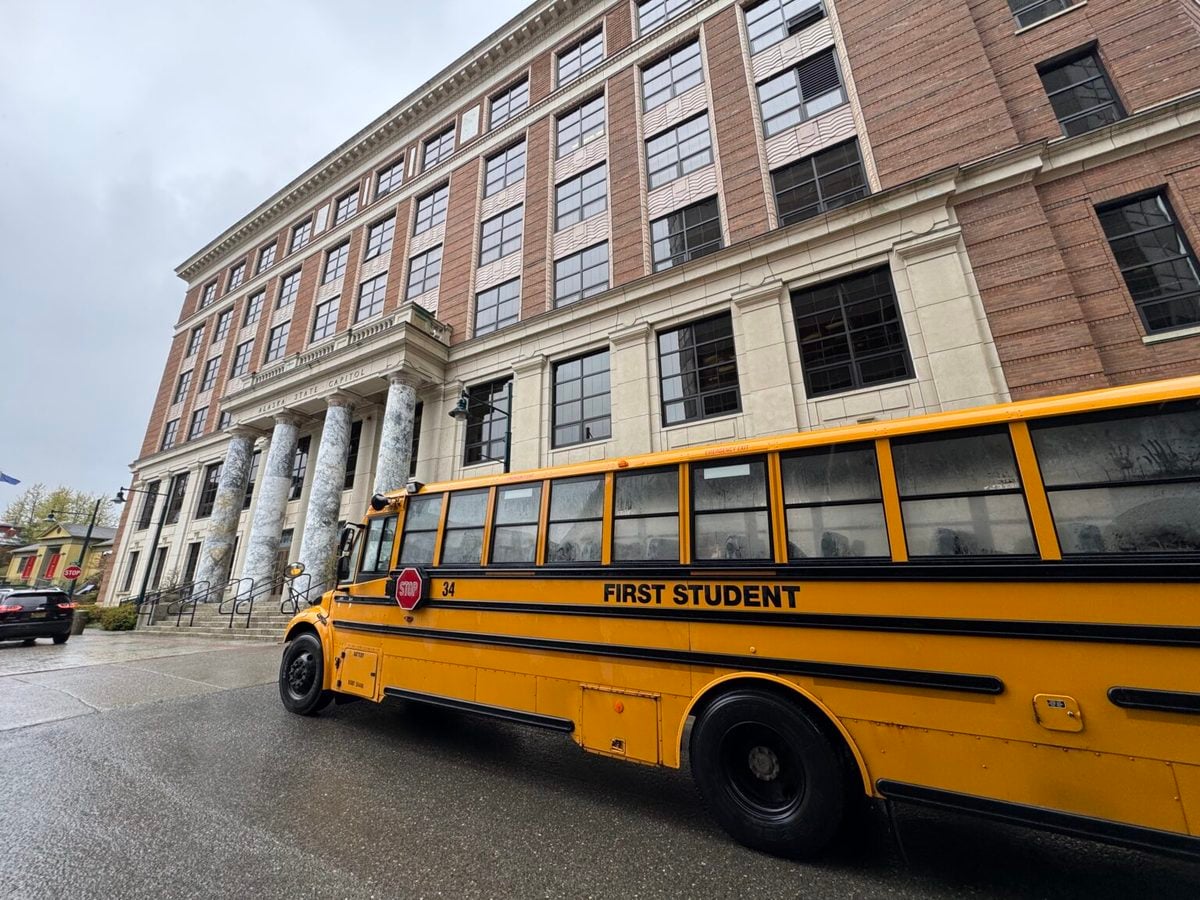
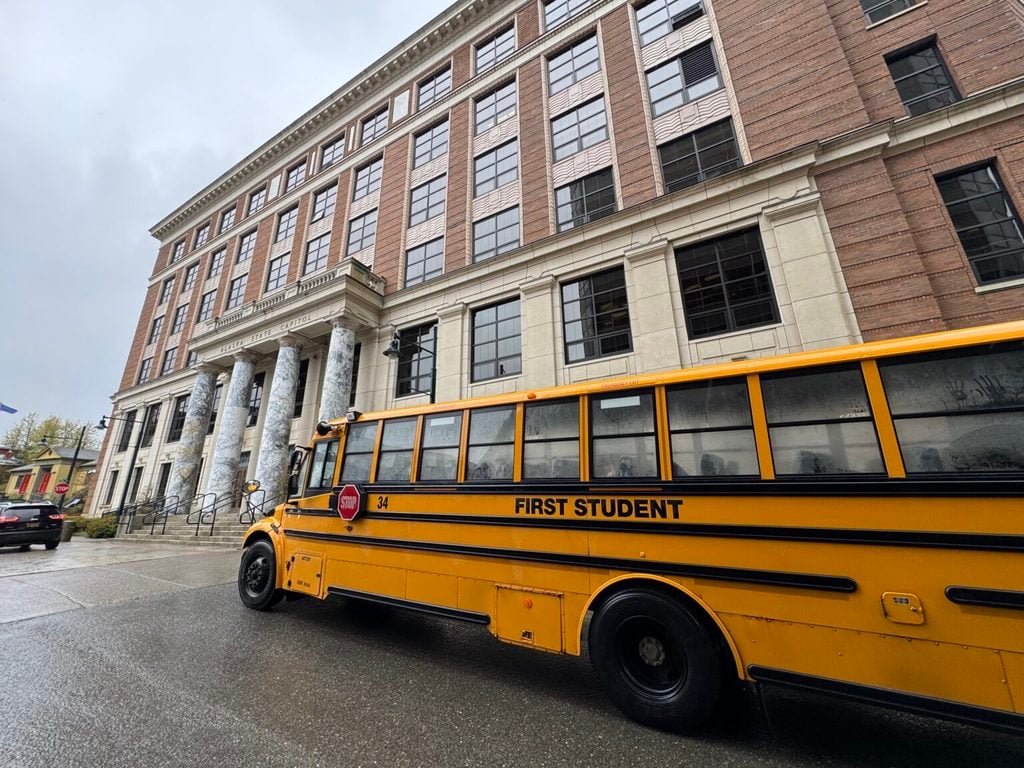
A school bus passes in front of the Alaska State Capitol on Wednesday, May 20, 2026. (James Brooks photo/Alaska Beacon)
The Alaska Department of Revenue announced on Monday that Alaska’s K-12 public schools will receive an additional $115 million in state funding this year, prompted by a boost in oil revenues driven by the U.S. war on Iran.
Legislators earmarked the additional oil revenue for schools as part of the state budget approved by Gov. Mike Dunleavy in June.
The additional funding is a relief to school districts statewide. Many districts have faced severe budget shortfalls in recent years due to funding not keeping pace with rising costs. This year, a record 12 elementary and middle schools closed across the state.
Following the announcement, Luke Meinert, superintendent of the Fairbanks North Star Borough School District — the state’s third-largest district by student count — welcomed the news, and said the district is appreciative of the Legislature for making it a priority.
“(We’re) very excited that the projected numbers came through and that we will see a sizable increase in funding for our school district through the one-time funds that are being allocated,” he said in an interview Tuesday.
Officials with the Department of Revenue announced the state had collected sufficient revenue funds to meet the special appropriation of nearly $600 million.
Lawmakers designated funding for four priorities areas, in sequential order: nearly $128 million to the Permanent Fund to allocate one-time energy relief payments of $200 per eligible Alaskan along with dividend checks; $115 million to K-12 schools through the Alaska Department of Education and Early Development; $15 million to the bulk fuel loan program; and $341 million to the state’s budget reserve account.
According to the announcement, the Monday revenue estimates are expected to be revised and finalized this fall. The revenue amounts are expected to “change slightly,” impacting the exact amount that will land in the budget reserve fund, the state’s savings account, officials said.
The $115 million will be distributed to school districts according to the state’s education funding formula, which is based on student enrollment counts in October.
For Fairbanks, that’s estimated to be roughly $10.2 million this year. Meinert said the district designed its budget this year anticipating about half of that amount, and the additional funding will go toward teachers and staff, as the district is currently in union contract negotiations are ongoing, and other areas. “So that will help us in our negotiation discussions for this school year,” he said.
“Student activities have been an area that’s been cut pretty hard over the past several years,” he continued. “So potentially adding some funding there to ensure that families aren’t having to pick up a bigger burden of paying for student activities. And then, additionally, I think there may be some smaller investments for teacher mentoring, teacher coaching, and possibly some funding in our nutrition services department.”
School board members with Fairbanks and Anchorage called on the state in June to release estimates earlier, ahead of the school year — “the earliest practical information available,” they wrote in an op-ed for the Anchorage Daily News. They asked the state to announce whether “funding is likely, unlikely or still uncertain,” to help districts plan, particularly for hiring teachers.
But the Department of Revenue did not change its scheduled announcement.
Lisa Parady, executive director of the Alaska Council of School Administrators, said they were “elated” and “grateful” at the announcement. But she said it underscores Alaska schools’ needs for prior notice and consistent state funding.
“We do have to get to the place where we have predictable, reliable funds in advance of needing to extend contracts. That’s the biggest issue,” she said Tuesday.
“Because we’re in the greatest education shortage in the history of Alaska and in the nation, it allows for the recruitment and retention of quality educators and that ability to lock in those contracts sooner,” she said.
Among the state’s largest districts, the Anchorage School District is expected to get $32 million. The Matanuska Susitna Borough School District is expecting $16.1 million, the Kenai Peninsula School District is expecting $7.6 million. Both districts closed schools this year.
Parady said it’s difficult to say if the additional funding earlier in the year would have prevented school closures.
Districts cited surging costs of operations, as well as declining enrollment as more families opting for homeschool programs or leaving the state.
“Each school district is in their own unique place in terms of overall education funding in their budgets,” Parady said. “Having a long term fiscal plan that allows for timely, reliable, and predictable revenue for schools … is the only way that school boards and our school district leaders can have the tools they need to make the best decisions as they’re managing their budgets. And school closures are obviously a piece of that, and so I can’t say for sure that it could have changed an outcome, but it’s certainly possible.”
Anchorage Democrat Sen. Löki Tobin, who chairs the Senate Education Committee expressed her reaction Tuesday as “mixed.” “We know that our schools are in desperate need of resources,” she said.
“We have nonpartisan financial memos from our Division of Legislative Finance that says to adequately address the years that inflation has eroded the purchasing power of our base in funding, we need to appropriate significant financial resources per student to our schools, and while $115 million is a significant amount of dollars, it’s clearly not enough. And one-time funds do not create stability nor predictability.”
Tobin also acknowledged the moral dilemma of the upswing of Alaska oil revenues and state funding driven by the U.S. war on Iran.
“It is gut-wrenching to know the reason that Alaska has been able to receive these resources,” Tobin said. “It is not without contemplation or thought that I have been thinking about the children that were bombed in these recent years in a place that is very far away from us, but is no less important and nor no less critical for the health and well-being of all of our kids, and how those choices are driving the record increases in the price of a per barrel of oil.”
With the boost in state revenues, Tobin also credited the efforts of lawmakers across political divides in designating funding for schools. “Folks who work to get this funding into our budget not only crossed the aisle but also were bicameral in nature, and that is absolutely critical,” she said.
Lawmakers allocated roughly $144 million in one-time additional funding for K-12 schools, plus $148 million for school repairs and construction this year to address an extensive maintenance backlog. They approved $29 million to offset districts’ rising energy costs beginning in 2028 and subject to future lawmakers approving the funding.

Miley Cyrus has dropped her famous last name, and her dad, country star Billy Ray Cyrus, is weighing in on the change.
In a new Instagram post, the “Some Gave All” singer shared his thoughts on Miley dropping “Cyrus” from her professional name, comparing the move to iconic artists like Elvis and Cher, who are known simply by one name.
Alongside a throwback family photo, Billy Ray reflected on his own name and the way he has always referred to his children.
“Family means more than ever now. I always called my little girl Miley. Just … Miley. Just like I always called my little boy Braison. Bet you didn’t know … I was just CYRUS before ‘Achy Breaky Heart’ came out in 92. All of my swag and T shirts only read. CYRUS SOME GAVE ALL with a picture of a POW MIA flag on it that and the words .. ‘You are not forgotten.’”
He went on to reveal that he recently spoke with his superstar daughter about her decision to go by her first name professionally.
“I told Miley yesterday I felt good about her going with her first name. I mentioned Dolly and Cher. Thinkin about it more and more … Elvis .. Prince …and so on. It’s a natural progression for an iconic superstar legend. And the legend continues!”
Billy Ray also shared his excitement for Miley’s upcoming album, adding that he is “looking forward” to hearing the project.
He closed out his post with a joke about his own stage name, writing, “Now … if only Mercury / Polygram would have just not insisted on the” Billy Ray” part and just let me be CYRUS…… I could have done something!!! Ha ha !!! 🤣 All good.”
Billy Ray’s comments come after Miley, 33, underwent a professional rebranding, dropping “Cyrus” from her name ahead of the announcement of her new album.

The singer announced her 10th studio album, BASS PERSUADES, which is set for release September 18.
Along with the album announcement, Miley also revealed plans for two Hollywood Bowl shows in October.
The post Billy Ray Cyrus Reacts to Daughter Miley Dropping ‘Cyrus’ From Her Name: ‘Natural Progression for an Iconic Superstar Legend’ appeared first on Country Now.
Country Now