LOS ANGELES — British-born California gubernatorial candidate Steve Hilton — who said he was cheering for the United States while it was still in the mix — today said he wanted Americans to help England prevail.
“Maybe a small consolation would be for them to just let England win the World cup here on American soil 250 years later,” Hilton, a Republican, told an annual conference of the National Association of Latino Elected Officials. The remark was received with a mix of boos, groans and some laughter.
Pomegranates are notoriously messy to eat and juice. Here are the most effective ways to get a glass of pomegranate juice, plus how many aerils you’ll need.
A ballot and instructions for the 2024 Alaska primary election are seen on Monday, Aug. 5, 2024. (Photo by James Brooks/Alaska Beacon)
Alaska’s midterm election season is underway. Residents who lost the right to vote with a felony conviction may have their right restored once they are unconditionally discharged from the Alaska Department of Corrections’ supervision.
Restoration of voting rights after a felony conviction varies by state. Alaska is one of more than a dozen states that requires residents to complete their prison sentence and be unconditionally discharged from custody before their right to vote is restored.
That means Alaskans can vote again once they are no longer under DOC supervision, which includes halfway houses, sentenced electronic monitoring, probation or parole.
The Department of Corrections is required to issue a letter as proof of unconditional discharge, which residents must provide to the Alaska Division of Elections to re-register to vote if they otherwise meet eligibility requirements.
The deadline to register to vote is July 19 for Alaska’s primary elections, September 6 for local elections and October 4 for the midterm elections in November.
Alaskans lose the right to vote after a state or federal felony conviction involving crimes of moral turpitude, a list which includes murder, assault, drug-related felonies and others. That means they are ineligible to vote in all local, state and federal elections while in prison and under DOC supervision.
If convicted of a misdemeanor or a felony not involving a crime of moral turpitude, Alaskans are eligible to register and vote in elections.
The roughly 40% of Alaska’s incarcerated population who is pre-trial — even under felony charges — are also eligible to vote. That includes incarcerated Alaskans who are awaiting trial, plea agreements or sentencing.
This year, the deadline for eligible voters to apply for absentee by-mail voting is August 8 for the primary, and by October 24 for the general election.
An official with the Department of Corrections said probation officers at all correctional facilities will assist any inmate that requests help with voting, including registration, updating address information and applying for or casting an absentee ballot.
“Each facility has posted in all common areas an instructional notice from the Division of Elections and each facility has paper copies of the absentee ballot application,” said Betsy Holley, a public information officer for the department, by email on Wednesday.
Under Alaska statute, most inmate mail is scanned and copied before it is provided to inmates. Ballots are considered “privileged mail” and subject to monitoring under specific criteria, Holley said. Inmates fill out their ballots and cast their vote like any other eligible voter.
“Mailroom staff may not read or search outgoing privileged mail. Mailroom staff will verify, in the prisoner’s presence, that the intended recipient of the mail is the same person as the privileged addressee,” Holley said.
Holley said the numbers of Alaskans unconditionally discharged from DOC custody and eligible to vote each year was not immediately available.
The ACLU of Alaska has updated voter guidance and resources for formerly and currently incarcerated Alaskans. The organization, along with state nonprofit Partners for Progress, is hosting voter restoration information sessions this election season.
“Incarceration does not automatically disqualify Alaskans from voting,” said Meghan Barker, ACLU of Alaska communications director, by email on Tuesday. “It’s critical that people who have interacted with the criminal legal system know their rights and know how to either request an absentee ballot while incarcerated or, if eligible, take the steps to restore their voting rights after they’ve been incarcerated.”
Barker said that as of May there are nearly 1,750 Alaskans that are incarcerated and awaiting trial or sentencing that may be eligible to vote. She noted that Alaska Native people make up a disproportionate number of those incarcerated statewide. While Alaska Native people are less than 20% of the state’s population, they made up 40% of the prison population last year.
“As we continue to look at ways to combat the disenfranchisement of Alaska Native people, we must also consider the demographics of Alaska’s prisons and the people who are eligible to vote, even if they are incarcerated far from their home communities or districts where they would vote,” she said.
Tory Leader Kemi Badenoch was in a jovial mood during the usually combative PMQs by calling for all MPs to unite behind England against Argentina this evening.
Badenoch said that while Keir Starmer may be “disappointed that he won’t be emulating his hero Harold Wilson in winning multiple elections … we all hope that he may be about to emulate him in another way, by being the prime minister when England win the World Cup.” England’s only previous success came in 1966.
The Tory leader said that was something “every single one of us in this house should get behind, especially the SNP.” But the diminished rump of Scottish independence-supporting MPs, possibly still bruised from going out in the World Cup group stage, shook their heads.
Indeed, opposition to England’s success crossed party lines.
Scottish Labour MP Brian Leishman told POLITICO he’ll be watching “from behind the couch and the cracks in our fingers,” adding it will be “unbearable” if England makes the final.
Elle King is opening up about her recent autism diagnosis and she’s very excited about what’s to come. Continue reading…Country Music News – Taste of Country
Elle King is opening up about her recent autism diagnosis and she’s very excited about what’s to come. Continue reading…The Boot – Country Music News, Music Videos and Songs
And now, she’s revealing that she resorted to desperate measures to support her struggling husband early in their relationship.
Jelly Roll and Bunnie Xo attend the 68th GRAMMY Awards at Crypto.com Arena on February 01, 2026 in Los Angeles, California. (Photo by Brianna Bryson/WireImage)
Yes, before Jelly Roll became one of country music’s biggest success stories, he and Bunnie were simply trying to survive.
The podcast host is now opening up about the difficult years before her estranged husband’s career took off, revealing she worked as an escort to help keep them financially afloat while the aspiring musician chased his dreams.
“I was turning tricks to pay our bills,” Bunnie said on the latest episode of “Dumb Blonde.”
“I literally went on tour with him and was seeing clients just to fund our life at the time.”
Despite speculation that she entered the relationship with significant savings, Bunnie insisted that wasn’t the case.
“I had sugar daddies at the time that were paying for all of this,” she explained, adding that the couple “literally had nothing” when they got together in 2015.
“We were two kids who literally had nothing… We were still in the streets. We were making money as it came,” she said.
Long before Jelly Roll was selling out arenas and topping the charts, Bunnie said his concerts drew only a handful of fans.
She recalled attending some of his earliest performances, where crowds numbered around 20 people.
“And it was crazy because within the first three years of us being together, the crowd started doubling,” she remembered.
The singer — whose real name is Jason Bradley DeFord — would eventually become one of country music’s biggest crossover stars. But according to Bunnie, those early years were defined by financial uncertainty and doing whatever they could to get by.
The revelations come just months after Jelly Roll, 41, filed for divorce from Bunnie in May, citing irreconcilable differences.
The couple married in Las Vegas in 2016, but Bunnie said the relationship began to unravel over the past year and a half as she pursued IVF treatments in hopes of starting a family.
She described the experience as “one of the loneliest, darkest journeys,” revealing she suffered multiple miscarriages and lost several embryos.
“It completely wrecked me,” she said. “It wrecked me emotionally, spiritually, physically… I became a shell of the person I was because I’m doing [IVF].”
According to Bunnie, the emotional strain created distance between the couple.
During the IVF process, she said she and Jelly Roll “stopped communicating.”
She also made a heartbreaking admission about how she viewed their relationship.
“I think that it’s safe for me to say that I always loved my husband a little bit more than he loved me,” Bunnie said.
“I was like always protecting him and always making sure he was okay and like always chasing him, and I literally was the glue that held us together.”
Her candid comments offer a deeply personal look at both the sacrifices she says she made during Jelly Roll’s rise to fame and the struggles that ultimately preceded the end of their nearly decade-long marriage.
LONDON — Soccer fans in Atlanta may be exchanging chants about the Falklands — but there’s another British Overseas Territory making news today.
The 118-year-old border between Gibraltar and Spain will disappear on Wednesday. You can thank Brexit.
Today is the culmination of a decade of uncertainty for the British Mediterranean territory, which back in 2016 voted by 95.9 percent to stay in the EU — but was pulled out against its will.
Life immediately became harder for the thousands of people who cross the Gibraltar-Spain border every day, including 15,000 Spaniards who go to work in the territory.
Passport checks became more onerous and transporting goods became more complicated. As a result Brussels, London, Gibraltar and Madrid have spent the last 10 years negotiating an agreement to remove physical border controls from the frontier with Spain.
It’s an ironic move given it was triggered by Britain’s decision to leave the EU. While Gibraltar will remain fully British and sovereign, the border will become, for the most part, just a line on a map.
The agreement’s details will be familiar to anyone who has ever taken a Eurostar train under the English Channel. As at London St Pancras station, passengers arriving at Gibraltar’s airport will go through both Gibraltarian passport controls and EU passport controls in succession. Once through, they’ll be free to roam both Gibraltar and the Schengen area, provided they get the approval of both authorities.
As a result, Gibraltar and Spain will do away with border controls at the land border. Gibraltar will also align with various EU single market and customs rules to ease the flow of goods, which have sometimes become harder to source since Brexit.
Gibraltar is adamant it isn’t joining the EU passport-free Schengen area. Legally, it is right.
For many passengers, though, it will feel pretty similar, with no passport checks to walk into Spain. The difference will be that Gibraltar will still set its own visa policy.
The U.K’s Europe Minister Stephen Doughty is formally signing the agreement Tuesday in Brussels with the EU Trade Commissioner Maroš Šefčovič.
The deal was a bipartisan effort on the British side, with former Foreign Secretary David Cameron working to get it over the line during his time in office. In spring 2024 the deal looked close to being done — only for Rishi Sunak to call an election. The resulting change in government delayed it by another year.
Some critics, notably Tory Euroskeptics, have said the agreement harms Gibraltar’s sovereignty, but the Rock’s government is very keen on the plan.
“Brexit was sold to the British people in a false prospectus,” Gibraltar’s Chief Minister Fabian Picardo told the Telegraph newspaper in the run-up to the dismantling of the border. “The United Kingdom needs to seriously reconsider its relationship with the European Union, whether that is to return to membership or a much closer relationship.”
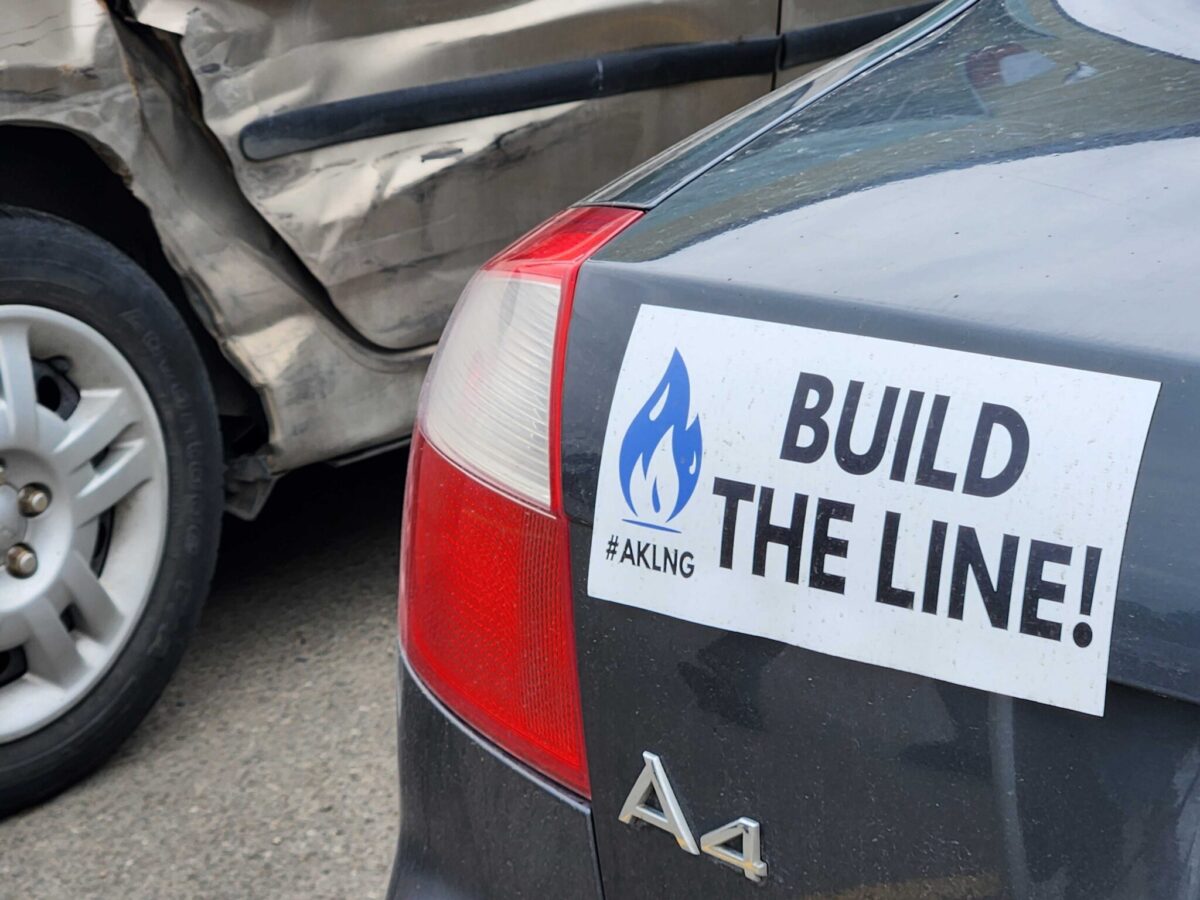
A bumper sticker on a car parked in Midtown Anchorage on June 29, 2026, expresses support for the Glenfarne-Alaska Gasline Development Corp. plan for natural gas pipeline tax concessions. (Photo by Yereth Rosen/Alaska Beacon)
A few months from now, if developers of the proposed trans-Alaska natural gas pipeline move forward with the project, they will ask Alaskans for something between a few hundred million and a billion and a half dollars.
The request is optional, but if the state doesn’t chip in, Alaska’s 25% ownership of the pipeline will dwindle to a smaller fraction, and any profits will similarly shrink.
Two other requests for cash could come as soon as next year, to first fund a gas treatment plant on the North Slope and then a natural gas export facility on the Kenai Peninsula.
As state lawmakers debate a multibillion-dollar tax break for the pipeline project this week, a confidential memo and legislative testimony show the break won’t be the last financial request from Alaskans.
Keeping the state’s 25% ownership of the Alaska LNG project will cost at least $4 billion, according to estimates from the Alaska Department of Revenue.
If the state spends that money, and if the project is built and sells gas as planned, the department estimates the state will earn more than $21 billion through 2062, almost five times its initial investment.
But there’s a risk: if the pipeline project costs more than expected, the state of Alaska will be asked to pay more.
“We have reserved the option for the state of Alaska to elect to invest or not,” Frank Richards, president of the Alaska Gasline Development Corp., told the Senate Finance Committee on June 4. “The project will proceed forward without the state investment, but we wanted to give the state that opportunity should it elect to, eyes wide open.”
A potential investment for the state
Last year, the Gasline Development Corporation, a state-owned company charged with building the gas pipeline project, sold the lead role in the project to Glenfarne, a private multinational developer.
According to a confidential memo analyzing the deal, Glenfarne agreed to pay $10 million and fund the project’s development until the “Final Investment Decision,” the point at which investors start to put down money and contracts go out for construction.
Glenfarne has 75% ownership of 8 Star Alaska, the parent company of the pipeline project. The state — through AGDC — has 25% ownership. AGDC’s ownership share stays the same regardless of how many new investors come into the project.
But ownership of 8 Star Alaska may not mean much.
The Alaska LNG project includes three separate “subprojects” — a gas treatment plant on the North Slope, the pipeline itself and an export terminal on the Kenai Peninsula.
Each of those subprojects is its own subsidiary company, and not all of the subproject profits will go back to 8 Star Alaska.
“The real value is down in the three subsidiaries of 8 Star,” said Sen. Cathy Giessel, R-Anchorage, in a July 2 podcast interview.
Right now, each subsidiary is subject to the same 75-25 ownership split as 8 Star, but that changes at FID, when other investors put in their money.
At that point, said Matt Kissinger, AGDC’s commercial director, there will be enough money to build each subproject, but the state will have the opportunity to push out other investors and preserve its 25% ownership.
“All the investors will be in; they’ll all be committed, and then we’ll have 180 days for the state to decide to back them out of some of their commitment,” he said.
According to a draft analysis of last year’s Glenfarne-AGDC deal, AGDC has “the right to invest in up to 25%, but not less than 5%, of each sub-project at FID.”
The 5% minimum — if AGDC takes any share at all — was negotiated with Glenfarne, Kissinger said, because if the state is going to push out another investor, it needs to do so for a meaningful amount.GET THE MORNING HEADLINES.SUBSCRIBE
Part or all of the 25% buy-in could be taken by AGDC. The state could buy in directly, or another state-owned corporation like the Alaska Industrial Development and Export Authority, Alaska Railroad or the Alaska Permanent Fund Corp. could do so.
If the state and public corporations don’t reach the 25% maximum, then Alaska residents, Alaska Native corporations and other in-state companies would have a chance to take some or all of the remainder.
On June 25, the AGDC board voted unanimously to approve the creation of a subsidiary that will allow individual Alaskans to invest in the project through AGDC.
“No more funds are required by the State of Alaska to invest for this project to proceed forward, it’s just that we have the option to, and if Alaskans want the opportunity to invest, that’s the structure that we’re going to set up for them,” Richards told the board.
AGDC and Glenfarne expect the pipeline subproject to reach FID this year. The gas treatment plant and the export facility FIDs are expected no sooner than 2027.
Department of Revenue estimates a $4.4 billion cost
Keeping the state’s share of the project at 25% is likely to be expensive. Glenfarne estimated last month that building the pipeline alone will cost as much as $16.9 billion.
In an example scenario AGDC presented to legislators last month, the company suggested developers could take out loans for 70% of that cost.
The Alaska Department of Revenue is independently using that percentage for its baseline predictions, too.
The developers could cover the remaining 30% by selling part of the pipeline subsidiary.
If the state wants to keep 25% ownership of the whole project, that would mean buying 25% of that 30%.
Using some assumptions, “that would result in $4.4 billion in nominal terms that would be required to invest in the project,” said Dan Stickel, the Department of Revenue’s chief economist, on May 21.
That’s on top of the tens of billions of dollars in production taxes, property taxes, royalties and fees that the state would receive regardless of whether or not it takes an additional ownership share.
What happens if Alaska doesn’t buy in?
“That (25% ownership) will definitely be diluted. That’s the mechanism that was designed,” Kissinger told state lawmakers.
AGDC’s scenario, presented to legislators on June 4, suggested 8 Star Alaska would keep 35% of the pipeline subsidiary. AGDC would have a quarter of that 35%, or 8.75% of any profits after debts are paid.
If 8 Star Alaska keeps less than that 35%, then the state’s quarter would shrink correspondingly.
While investing in the project increases the potential profits, there’s also a risk, said Sen. Bert Stedman, R-Sitka, on June 16. If the project costs more than expected, the state and other investors would have to pay more money to keep their share of the project.
“If the state wishes to take that risk, and if the state wishes to be a paying member of the project … you would be paying 25% of any of the investment dollars coming in to maintain that,” Kissinger said on June 3.
Where would Alaska get the money?
Current state law allows AGDC to borrow money without legislative approval.
“Right now, under the current statutes, AGDC has extremely broad bonding authority. We can raise revenue bonds — provided there is no recourse back to the state — without any further approvals,” Kissinger said on June 26.
What’s a revenue bond?
The Alaska Constitution severely limits the kinds of government borrowing that the state is responsible for and must repay through taxes. Corporations like AGDC can instead issue revenue bonds, which are repaid by the corporation’s profits. There’s no obligation for the state to bail out a corporation that can’t pay its bond holders.
The current version of the gasline tax break being considered by state lawmakers would limit AGDC’s borrowing power.
Legislators would have to meet within 90 days — possibly in special session — to approve any bonds.
The Alaska Department of Revenue would be required to analyze the investment and make a recommendation to legislators.
Another funding possibility is that the state could offer things instead of money in order to pay for its share of the project.
“What we’re hoping to do is to utilize state materials, state assets, to be able to provide to the project in lieu of cash,” Richards told the House Finance Committee on May 27. “The gravel that will be used for access road and pipe bedding and pipe backfill and pipe storage yards and camp facilities represents about 20 million cubic yards of material, so that has a value of roughly $60 million and if we are able to then utilize that value and gain equity, then that would be a non-cash option that we would like to exercise for the state.”
In an interview on Tuesday, Richards said the state could also offer the land that the pipeline will use. Instead of paying something like $9 million per year in rent to the Department of Natural Resources, the state could simply deed the land to the pipeline operator and receive a share of the pipeline subsidiary in return.
Lawmakers could also appropriate money directly from the state treasury to AGDC in order to fund the project.
Rep. Andy Josephson, D-Anchorage, said on May 21 that in order to come up with the money for the 25% investment, the state’s independent financial adviser recommended overdrawing the earnings reserve of the Alaska Permanent Fund.
“I know that’s sacrilege to talk about, and it’ll be left for the next Legislature … but $4 billion is something this state could probably borrow or find, I guess,” he said.
“This is such a significant decision for what I call the re-electeds,” said Josephson, who is retiring and not running for re-election. “If they don’t do it, they could be chastised for decades and remembered for not doing it, but if the project has significant cost overruns, they could be chastised for that.”
“I would agree, it’s a very significant decision,” Stickel said.
Speaking June 19 on the floor of the state Senate, Sen. Jesse Kiehl, D-Juneau, said he is terrified of what might happen if the state invests and there is a cost overrun that requires more money to complete the project.
“Does it go bankrupt, and we just leave it? Nobody in this room is that naive. There’s one deep pocket around this project. There’s one entity that’s had a 50 year dream of building the pipe. There’s one place you can go for billions and billions of dollars,” he said.
Left unsaid was the name of the Alaska Permanent Fund.