Categories
Hip Hop

How Ariana Grande Shed Her Pop Persona To Become A ‘Dangerous Woman’

Ariana Grande Dangerous Woman album cover

Every Ariana Grande album cover features a photo of the singer, each one capturing the intention behind the release. On Dangerous Woman, she projects youthful playfulness with her signature ponytail, though her black-latex bunny mask hints at something more provocative beneath the bubble-gum surface. It was clear that Grande’s third studio album would showcase the singer’s more sensual side while exploiting her knack for interpreting any style or sound with transformative results.

Released on May 20, 2016, Dangerous Woman picked up from where My Everything had left off, delivering more floor-filling dance hits and moving further away from her ballad-heavy beginnings.

Over the hopping backing track of “You Don’t Know Me,” Grande sings, “The girl you see in photographs is only a part of the one I am.” Through its title alone, Dangerous Woman vowed to showcase a new maturity in Grande’s artistry. Sonically, the album furthered that mission, enhancing the retro R&B elements of her first two albums, Yours Truly and My Everything, while exploring more electro-pop soundscapes that would shape her future career.

Entering dangerous new territory

The Dangerous Woman era started with the promotional single “Focus,” which was in October 2015. While “Focus” featured the same upbeat, horn-driven energy of Grande’s 2014 smash hit “Problem,” it also teed up the album’s first official single, as Grande coquettishly instructed listeners to “focus on me.”

YouTube Video
Click to load video

Emerging five months later, the album’s title track found Grande venturing into moodier territory than the frothy pop of “Focus.” Sparked by an electric guitar, the singer climatically calls out, “Somethin’ ’bout you makes me feel like a dangerous woman!” throughout the track. We knew Grande could deliver arena-sized singalongs, and this slow jam channeled all the great power ballads of the 80s with a hook that promised, “All girls wanna be like that/Bad girls underneath, like that.”

Listen to Dangerous Woman now.

On the other side of the spectrum, “Be Alright” offered a stark contrast to the slow tempo and sensuality of “Dangerous Woman.” Dipping into a deep house sound, Grande’s celebratory single was adopted as an anthem for the LGBTQ community.

Embracing collaborators

A month later, she’d embark on the new course that trap-R&B had laid out in mainstream music, dropping the hypnotic “Let Me Love You,” featuring Lil Wayne. This paved the way for the dance-pop perfection of “Into You,” which signaled that Grande was ready to storm the summer of 2016.

YouTube Video
Click to load video

With a belting declaration of love that revolved around thudding EDM basslines, “Into You” is Grande and hitmaker Max Martin at their best. It contained all the hallmarks of a classic earworm, with Grande’s breathy falsetto floating over the thick beats. Grande finished off the album’s advance singles run with the retro-pop, uptown funk of “Greedy,” a song given away with digital pre-orders and which featured a choir of her exuberant vocals over a slick bassline.

Dangerous Woman opens with the swinging doo-wop ballad “Moonlight,” closely aligning with the sound Grande experimented with on Yours Truly. On the deep cut “Leave Me Lonely,” she brought Macy Gray back into the public eye, the latter expertly delivering some Nina Simone theatrics that fit in with the dramatic nature of the song.

A mature transition

Keeping in line with the album’s premise, Grande debuts her “adult” anthem, “Side To Side,” with help from hip-hop’s raunchiest queen, Nicki Minaj. Like many former child stars turned pop divas before her, Grande was consciously leaning into her “grown-up” phase, while at the same time side-stepping all the usual clichés that came with the territory.

One of the best pop and hip-hop collaborations of the decade, “Side To Side” capitalized on the dancehall trend of the time, with reggae riddims and plenty of sexual innuendo packaged in the campy imagery of the SoulCycle fitness craze. Just as Olivia Newton-John made her “body talk” in the iconic “Let’s Get Physical” music video, Grande and Minaj’s cardio-driven duet rode its way to the top of the charts, hitting No.4 on the Billboard Hot 100.

YouTube Video
Click to load video

Grande followed “Side To Side” with another collaborative effort on the Future-assisted “Everyday.” As trap-influenced pop started to gain more traction in the mainstream, “Everyday” helped fuel its dominance, paving the way for the trap leanings on her subsequent albums Sweetener and thank u, next.

Evolving the pop formula

Much of Dangerous Woman sees Grande playing with tempos, genres, and time shifts. “I Don’t Care” finds her embracing orchestral R&B to forget a lost love, “Sometimes” ventures into more acoustic pop (a rarity for Grande), and “Bad Decision,” “Touch It,” “Knew Better/Forever Boy” and “Thinking Bout You” all rely on Grande’s powerful pipes and EDM synth-pop production.

With her third album, Ariana Grande found success in evolving the pop formula she’d already established while venturing into uncharted, edgier territory. The gamble paid off, with Dangerous Woman debuting at No.2 on the Billboard 200 charts and notching her first No.1 album in the UK. It was clear that the ascending pop queen was just getting started.

Dangerous Woman can be bought here.

​Discover more about the world’s greatest R&B artists | uDiscover Music

Categories
Politics

Trump’s MAGA brand dominates Georgia primary night

The MAGA takeover of the Georgia GOP is nearly complete.

The old-guard of the Republican Party in Georgia has fallen after withstanding MAGA’s furor since 2020, replaced by a new breed of candidates — up and down the ballot — closely aligned with President Donald Trump.

On Tuesday, the Trump allies marched on: Trump-backed Lt. Gov. Burt Jones clinched a spot in the gubernatorial runoff on Tuesday alongside billionaire Rick Jackson, who told supporters he’d govern like the president “with a southern tone.” In the GOP Senate primary, Rep. Mike Collins, a staunch MAGA ally, advanced to a runoff. And House candidates Jim Kingston, Houston Gaines and Clay Fuller won their races by wide margins, boosted by the president’s endorsement.

Meanwhile, longtime Trump antagonists — especially those who denied the 2020 election was “stolen” — lost their primary battles: Secretary of State Brad Raffensperger, Attorney General Chris Carr and Gabriel Sterling, a former top Raffensperger aide.

The results offered the clearest sign yet that Georgia Republican voters increasingly want their political future tied to Trump-style politics and messaging — a shift in one of the nation’s premier battlegrounds that could shape elections in 2026 and beyond.

“It’s key to success in a Republican primary in Georgia today to either have the president’s endorsement or be able to make the case to voters that you’re certainly a Trump-aligned candidate,” said Georgia Republican Party chair Josh McKoon, a loyal Trump ally.

Candidates like Raffensperger may now be “relics of the past,” said Chip Lake, a longtime Republican strategist who helped Jones’ campaign. “That doesn’t mean they’re bad human beings, it just means that their style of politics is not consistent today with where the base of the party is.”

But hugging Trump that tightly in the primary has proved lethal for some Republicans in the general election, and Democrats in Georgia hope 2026 will echo the GOP’s 2022 election losses.

The Republican Party in Georgia, like in other states, has been drifting more and more toward a full-throated populist approach during the Trump era. But the old guard led by outgoing Gov. Brian Kemp (R) as well as Raffensperger and Carr managed to hold on through the 2022 midterm primaries against a number of Trump-backed challengers, delaying the hard MAGA takeover that occurred in many other states earlier on. The sharp shift this cycle comes as the GOP pushes for more resources and attention in the key swing state.

Now, some GOP strategists increasingly view aligning with Trump not just as an ideological litmus test, but as a practical necessity — especially as Trump’s political operation sits on  roughly $300 million in campaign funds. 

“It is good for the state of Georgia to choose these MAGA-aligned candidates in that the president has a huge war chest, and that war chest can be utilized for candidates that he likes,” said one Georgia-based Republican strategist granted anonymity to speak candidly about the state’s dynamics.

Across the state’s marquee Senate and governor’s primaries, the winning GOP candidates all embraced Trump’s brand. The expensive and rancorous primary for the governor’s mansion quickly evolved into a contest over who best carried the MAGA mantle — Jones, who has the president’s explicit support, or Jackson, who tried to convince voters that he, too, was closely aligned with Trump.

Trump has stayed out of the Senate primary so far, but the candidates still raced to align with his movement. Collins, a hardline immigration hawk and loyal Trump ally on Capitol Hill who appeared at a rally with Trump earlier this year, said that he is “unapologetically Pro-God, Pro-Trump, Pro-2nd Amendment, Pro-Strong Military” after advancing to the runoff.

Even former football coach Derek Dooley — Kemp’s handpicked candidate who will face off against Collins in the June runoff — leaned into his status as an outsider (à la Trump) and adopted a “Georgia First” pitch.

“We haven’t made any attempts to alienate Trump whatsoever. Derek supports the agenda. He’s made it clear through the debate and multiple interviews that he supports the president,” said a senior Dooley adviser, who was granted anonymity to speak openly about the race, prior to Election Day.

It’s a notable gamble for a party that was punished during the 2022 midterms for nominating hardline MAGA candidates across the country — including former football star Herschel Walker for Georgia Senate — who later lost in key races. This midterms cycle appears to be trending much harder toward Democrats, given Trump’s low approval ratings, voters’ concerns with the economy and the unpopular war in Iran.

Democrats are more than eager to tie Republicans to the president. Devon Cruz, a spokesperson for the Georgia Democratic Party, said in a statement that the Senate runoff will leave Collins and Dooley “terminally inseparable” from Trump.

Still, Tuesday’s results underscored how Trump’s dominance is increasingly shaping which Republicans can win statewide primaries in key races. And it’s not just in Georgia.

Rep. Thomas Massie (R-Ky.), who has long been a thorn in the president’s side, lost his seat to a Trump-endorsed challenger in a bitter retributive campaign. Louisiana Sen. Bill Cassidy was ousted by the president’s favored candidate. Trump vanquished a majority of the Indiana Republicans who bucked him on redistricting. And he finally backed Texas Attorney General Ken Paxton for the Senate race after deeming Sen. John Cornyn to be an insufficient ally.

“The party has completely changed in 50 states,” Lake, the Republican strategist, said. “It looks nothing like it did a decade ago, and it looks absolutely nothing like it did 15 years ago.”

“We’re a party that’s a lot different, that’s got a sharper focus, that’s willing to fight more, ” he added.

Raffensperger, who had become the biggest icon of standing up to the president, acknowledged to reporters following his loss that conspiracies about the 2020 election – despite no evidence to support any claims of fraud – helped tank his chances with Republican voters.

But he stopped short of blaming Trump’s grip on the party on his failure to advance in the runoff: “I just think terms are up, and so it’s a changing of the guard and turning over a new leaf,” he told reporters after his election loss. “We’ll have new people with new plans, new hopes, new visions, and we’re going to see where it goes.”

​Politics

Categories
Alaska News

Dunleavy calls special session Thursday on Alaska gasline tax break

Maynard Holt, chief executive of the Houston-based consulting company Veriten LLC., moderates a presentation on May 19, 2026, by Gov. Mike Dunleavy and U.S. Interior Secretary Doug Burgum at the Alaska Sustainable Energy Conference. (Photo by Yereth Rosen/Alaska Beacon)

Maynard Holt, chief executive of the Houston-based consulting company Veriten LLC., moderates a presentation on May 19, 2026, by Gov. Mike Dunleavy and U.S. Interior Secretary Doug Burgum at the Alaska Sustainable Energy Conference. At a news conference following the presentation, Dunleavy announced that he was calling the legislature into a special session to consider his proposal to grant tax concessions to Glenfarne, the company proposing to build a massive natural gas pipeline. (Photo by Yereth Rosen/Alaska Beacon)

Alaska Gov. Mike Dunleavy said Tuesday he is ordering state lawmakers into a special session to force a new decision on his top priority: property tax breaks for the company proposing to build a massive pipeline system to ship natural gas from the North Slope to tidewater.

Dunleavy outlined his plan during a news conference at the Alaska Sustainable Energy Conference in Anchorage. 

The special session, to start 10 a.m. Thursday morning, “will go on as long as they need to come up with a decision,” he said at the news conference.

The Legislature’s ongoing regular session ends at 11:59 p.m. Wednesday night, and legislators will enter special session the following morning.

The governor has characterized property tax-relief for the project as his top priority, and at the news conference he accused lawmakers of risking Alaska’s future by rejecting his plan.

The bill would replace state and local petroleum property taxes with an “alternative volumetric tax” on natural gas that would eventually flow through the pipeline.  That gives Glenfarne Group, the company developing the pipeline in conjunction with the state, a tax break that its leaders have said is necessary to attract investors.

Negotiations to pass the governor’s preferred legislation fell apart on Monday, and Dunleavy blamed lawmakers for that outcome.

“This is a decision on the part of a handful of folks in Juneau who wish, for whatever reason I don’t understand, (to) play with the future of Alaska,” he said at the news conference.

Legislative critics of Dunleavy’s approach said Glenfarne had provided too little information on its cost estimates, thus making it impossible for them to determine whether the proposed tax break was appropriate. Some argued that the process had been too rushed. Dunleavy introduced his proposal in March, with the regular session half over.

But the governor had harsh words for those lawmakers. He said they were focused on the wrong things after an extremely cold winter that strained energy supplies in the populated Railbelt corridor.

“Last night there was time to shove a spay and neuter bill into an invasive species bill in (House) Finance,” he said at Tuesday’s news conference. “So Rome is burning and we’re shoving a spay and neuter bill into an invasive species bill.”

Glenfarne's display at the entrance to the Alaska Sustainable Energy Conference is seen on May 19, 2026. Glenfarne is a major sponsor of the conference. (Photo by Yereth Rosen/Alaska Beacon)
Glenfarne’s display at the entrance to the Alaska Sustainable Energy Conference is seen on May 19, 2026. Glenfarne, the company proposing to build a massive natural pipeline to deliver North Slope natural gas to tidewater in Southcentral Alaska, is a major sponsor of the conference. Gov. Mike Dunleavy wants the legislature to approve a property tax break to help Glenfarne finance the project. (Photo by Yereth Rosen/Alaska Beacon)

Dunleavy was referring to a popular bill to establish a statewide spay and neuter fund, House Bill 258, which was combined during Monday’s House Finance Committee meeting with another bill related to animals, Senate Bill 174, that would establish a state invasive species council. It has since been removed from the bill.

U.S. Interior Secretary Doug Burgum, a featured speaker at the conference, also nudged lawmakers to accept Dunleavy’s plan.

As a former governor of North Dakota, Burgum said he considered it “inappropriate” for him to insert himself into Alaska legislative business. However, he said lawmakers should focus on getting the gas pipeline built before worrying about how the revenues from it would be allocated.

“The key thing for when we’re competing (for) capital that can go anywhere around the world, the key thing for Alaska is: Get the project,” he said at the news conference. Alaskans should not worry about the revenue distributions until after a project is built and providing its promised myriad economic benefits, he said.

Burgum’s comments at the news conference echoed comments he made about the gas pipeline during his address at the conference.

“That project has to happen. And I would just invite Alaska to not get in your own way if you’re worrying about, ‘How do we divide up the pie,’ and the pie hasn’t even been baked yet,” he said. He called the gasline “a generational, transformational project that’s going to affect the state, the communities, the prosperity, the universities. I mean, the benefits of this thing are unbelievable.”

But lawmakers say those benefits have not been made clear to them, and neither have the cost tradeoffs.

Senate President Cathy Giessel, R-Anchorage, did not mince words in a newsletter she issued Tuesday morning that said the governor has demanded that lawmakers “pass his version of a gas pipeline bill that no one is allowed to know much about.”

“His version of a gas pipeline defies our Constitution – ignoring resource development for benefit of Alaskans (benefit for a private company), surrenders our taxing authority (removes local taxation authority, forbids financial transparency, logical financial assessment),” Giessel’s newsletter said.

Dunleavy’s decision to veto a pension-overhaul bill that had been two years in the making after lawmakers rejected this gas pipeline bill was a “transactional” decision that is “the worst possible way to make public policy,” she said.

SUPPORT: YOU MAKE OUR WORK POSSIBLE

Categories
Alaska News Featured Juneau News juneau Juneau Local Juneau Local Ketchikan Local News Feeds Sitka Local

Alaska legislators fail to override governor’s veto of public pension bill

By: James Brooks, Alaska Beacon

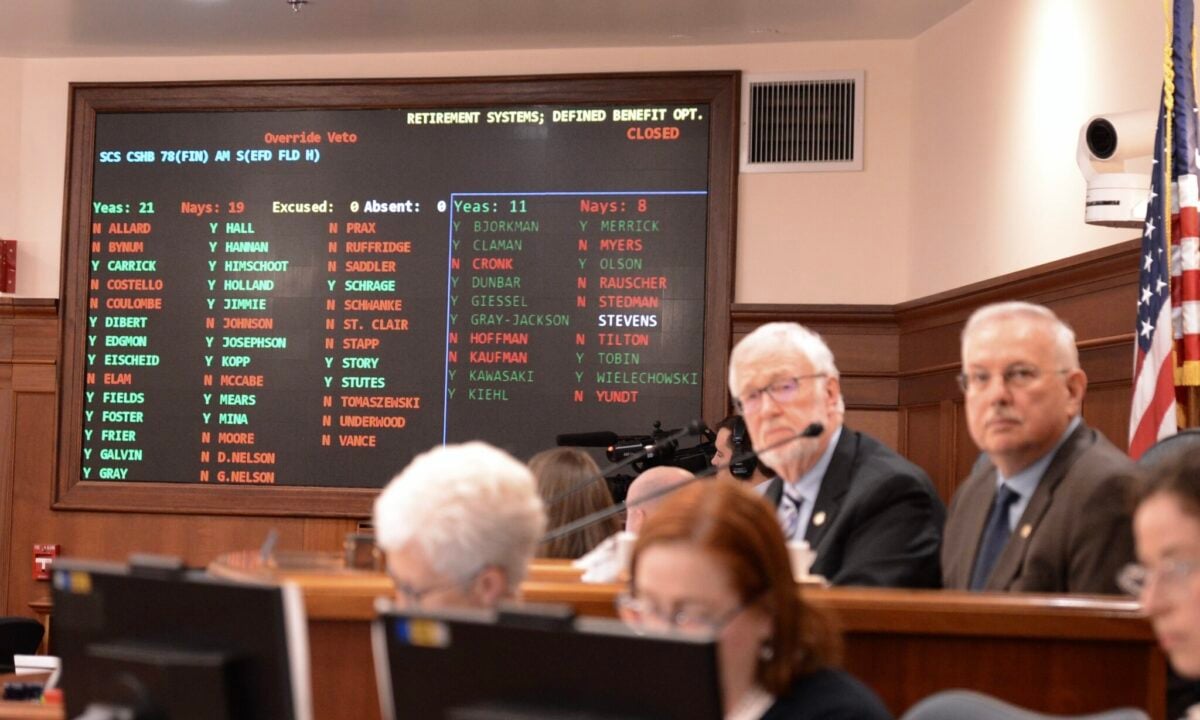
 Senate President Gary Stevens, R-Kodiak (left) and Speaker of the House Bryce Edgmon, I-Dillingham, watch the voting board in the Alaska Legislature as lawmakers vote on a veto override Tuesday, May 19, 2026, for the pension bill, House Bill 78. (Claire Stremple photo/Alaska Beacon)

Alaska’s public employees and public school teachers will not have access to pensions this year.

In a 33-27 vote Tuesday, the Alaska Legislature failed to override Gov. Mike Dunleavy’s veto of a bill that would have created a new pension system for teachers, municipal employees and state employees in Alaska. Forty votes were needed for an override.

The failure was expected. Lawmakers had passed the pension bill, House Bill 78, by a combined vote total of 33-27 last month, and there was no sign that any legislator had changed his or her position since that vote. 

Alaska has been without a pension for new public employees since 2006, when lawmakers closed the existing pension plan to new applicants and mandated a 401(k)-style retirement system.

Though Dunleavy himself receives a public pension, he is opposed to opening a new system for current employees. In a veto message to lawmakers on Monday night, he expressed concerns about potential long-term costs and risks to the state.

“Pension obligations extend for decades, and the full cost of this bill may not be apparent until years after its enactment,” his veto message stated in part.

Despite the governor’s concerns, he was willing to allow the bill to become law as part of a grand compromise: If legislators approved a gas pipeline tax relief bill he supports, he would not veto the bill.

That arrangement fell apart on Monday afternoon after the House failed to advance the governor’s preferred proposal. The governor issued his veto about 10:39 p.m. that night.

Under the Alaska Legislature’s current interpretation of the state constitution, lawmakers are required to meet in joint session within five days to consider a veto override.

Under previous interpretations, legislators frequently skipped holding joint sessions if they either didn’t want to discuss an override or knew they lacked the votes to do so.

On Tuesday afternoon, though legislators knew an override was not in the cards, advocates and opponents spoke for a combined two hours before the final vote.

Rep. Chuck Kopp, R-Anchorage, speaks during a joint session of the Alaska Legislature as lawmakers vote on a veto override Tuesday, May 19, 2026, for the pension bill, House Bill 78. (Claire Stremple photo/Alaska Beacon)

Rep. Chuck Kopp, R-Anchorage and the pension bill’s most vocal proponent, said the bill is intended to reduce the amount of staff turnover in the state. While the bill was expected to cost $73 million per year to implement, Kopp expected it would save over $240 million in training costs for new employees and overtime needed to cover positions left vacant by staff who had resigned.

“House Bill 78 is not a retirement bill. … It is a workforce bill, and it’s a resource development bill. We cannot build a gasline through this state unless we can retain our engineers. We cannot permit a mine when the permitting office turns over in 18 months. We can’t drill on the North Slope when the Haul Road isn’t being maintained,” he said.

Sen. Bert Stedman, R-Sitka, gave a 25-minute speech rejecting Kopp’s argument, saying in part that the lack of a pension system is not causing the vacancy problem. If the state’s Supplemental Benefit System — not used by some municipalities — is included with the state’s 401(k)-like public employee retirement system, Alaska has generous retirement benefits, he said.

Stedman suggested that higher salaries may be part of the answer to the state’s vacancy issues. Alaska used to be No. 1 in the country for teacher salaries. It’s now ranked below Washington state, he said.

Rep. Jeremy Bynum, R-Ketchikan, said that in his experience as an employer, higher salaries helped but weren’t a complete solution.

“That still didn’t solve the problem of retention, because people still cannot live in our communities affordably, so we’ve got a lot of challenges ahead of us,” he said.

Stedman also warned that the bill is based upon actuarial estimates that may or may not be accurate. The state’s prior pension plan was left only partially funded because of an actuarial error that led to a years-long lawsuit and left a multibillion-dollar shortfall.

Sens. Bill Wielechowski, D-Anchorage, and Jesse Kiehl, D-Juneau, each suggested that the proof of the need for the bill is in the state’s lived experience. Alaska has experienced 13 consecutive years of negative migration, and state and municipal governments continue to struggle to fill positions.

“This will make a tremendous difference if we override this veto and put back the option of a modest defined benefit pension for Alaska’s public servants,” Kiehl said.

The legislature’s regular session ends Wednesday night. 

Any new pension bill would have to restart from scratch in January, when the 35th Alaska Legislature convenes for its first year.

Categories
Politics

Mike Collins and Derek Dooley head to runoff in Georgia Senate GOP race

Rep. Mike Collins and former football coach Derek Dooley advanced to a runoff in Georgia’s Republican Senate primary, dragging out a bitter contest to take on Democratic Sen. Jon Ossoff in November.

The result plunges Republicans into another monthlong intraparty fight. Meanwhile, Ossoff, who already has a massive name ID and $31 million and counting in his warchest, can continue building and conserving his resources in the marquee race.

It also sets up a proxy battle between President Donald Trump, who holds Collins as a close ally, and Georgia’s GOP Gov. Brian Kemp, who backed Dooley for the nomination. Dooley, who was polling in third place ahead of Election Day, had a late burst of momentum after casting himself as a political outsider and leaning on his ties to Kemp.

The outcome now intensifies pressure on Trump, who didn’t support a candidate in the primary, to intervene. The president’s endorsement in a runoff — where the electorate tends to be highly engaged voters — could prove decisive.

The primary was marked by infighting and state Republicans’ escalating concerns that the national GOP was shifting its attention to other battleground states instead of Georgia.

A runoff looked all but inevitable in the contest’s final weeks with polls showing none of the candidates near the 50 percent support they’d need for an outright win. Dooley and Collins will face off again June 16, though Tuesday’s result suggests the latter holds an advantage.

Early public polling of hypothetical general election match-ups shows Ossoff with a lead over both Republicans.

The general election is expected to be one of the most expensive in the country. The GOP-aligned Senate Leadership Fund has already pledged an initial $44 million in spending for the fall, while the Democratic-aligned Senate Majority PAC recently committed $20 million.

​Politics

Categories
Entertainment

A Lawsuit Was Sparked By This (Alleged) Unsettling Chick-Fil-A Bun Find

Chick-fil-A always seems to be in the news for some reason, and this disturbing allegation may have you thinking twice before stopping to get lunch there.

​Mashed – Fast Food, Celebrity Chefs, Grocery, Reviews

Categories
Politics

Progressive firebrand Chris Rabb wins Democratic primary for the nation’s bluest House seat

Chris Rabb, a progressive state representative and self-styled “rabble-rouser,” clinched the Democratic nomination Tuesday for the nation’s bluest House district.

Rabb is all but guaranteed to succeed retiring Rep. Dwight Evans in Pennsylvania’s 3rd District. It’s a major win for the party’s left flank and a significant blow to the city’s storied political machine, which split between two other candidates in the race.

The progressive five-term state lawmaker toppled state Sen. Sharif Street, a former state Democratic Party chair and scion of a prominent North Philadelphia political family who had the backing of much of the city’s establishment. He also defeated Evans’ preferred successor, Ala Stanford, a pediatric surgeon who was running her first political campaign.

The race became a microcosm of the ideological and stylistic fights roiling the party nationally and a proxy battle between its progressive and center-left wings.

In a field where each candidate claimed progressive bona fides, Rabb tacked furthest to the left. He racked up endorsements from members of the “Squad,” won the backing of the local chapters of the Working Families Party and Democratic Socialists of America and held rallies with Rep. Alexandria Ocasio-Cortez (D-N.Y.) and polarizing left-wing political streamer Hasan Piker.

He pushed his rivals to join him in calling Israel’s war in Gaza a “genocide” and attempted to tie his competitors to the American Israel Public Affairs Committee, which has become a lightning rod in Democratic primaries. AIPAC said it was not involved in the race.

His victory is as much an exclamation point for progressives as it is a remarkable rebuke of Philadelphia’s Democratic machine.

In an interview ahead of Election Day, Rabb said his win would signal “that the era of establishment politics is coming to an end.” Nationally, he said it would show that “folks who are framed as radical or far left by mainstream media and establishment politics … are very much in the moral center.”

​Politics

Categories
Politics

Keisha Lance Bottoms wins Democratic nomination for governor in Georgia

Keisha Lance Bottoms is the Democratic nominee for Georgia governor, as the party seeks to flip the state’s top seat for the first time in nearly three decades.

Bottoms, who defeated a crowded field to win the race outright Tuesday, can pivot to the general election — even as Republicans are headed toward a costly runoff of their own.

Georgia hasn’t elected a Democrat to the governorship since 1998 but has trended hard toward purple-state status in recent years, with Democrats carrying the state in the 2020 presidential election and winning Senate races there that year and in 2022. But the governor’s mansion has remained elusive — and some Democrats have already questioned Bottoms’ ability to win in a general election, noting that her rocky tenure as Atlanta’s mayor from 2018 to 2022 makes her vulnerable to general election attacks.

Bottoms’ outright win lets her get a head start at closing her fundraising gap in the race: Both Lt. Gov. Burt Jones and health care executive Rick Jackson — the two leading candidates on the Republican side — have amassed war chests that exceed hers by millions of dollars, but much of that money has come from personal loans to their campaigns.

With the primary now behind her, she is likely to ramp up efforts to tap national donors and support from Democratic leaders who had largely stayed on the sidelines.

Bottoms, who served as a senior adviser during the Biden administration and earned the former president’s endorsement, boasted higher name recognition than her primary opponents. She easily defeated former state Sen. Jason Esteves, former DeKalb County executive Michael Thurmond and former Lt. Gov. Geoff Duncan to clinch the nomination Tuesday.

Public polling before the primary showed Bottoms as the clear front-runner, but the state’s rules — which require candidates to win more than 50 percent of the vote — increased the likelihood of a runoff.

Still, even before the primary concluded, she was already the subject of attack ads from Republicans, including Jackson, foreshadowing the onslaught likely to come.

​Politics

Categories
Alaska News

Alaska legislators fail to override governor’s veto of public pension bill

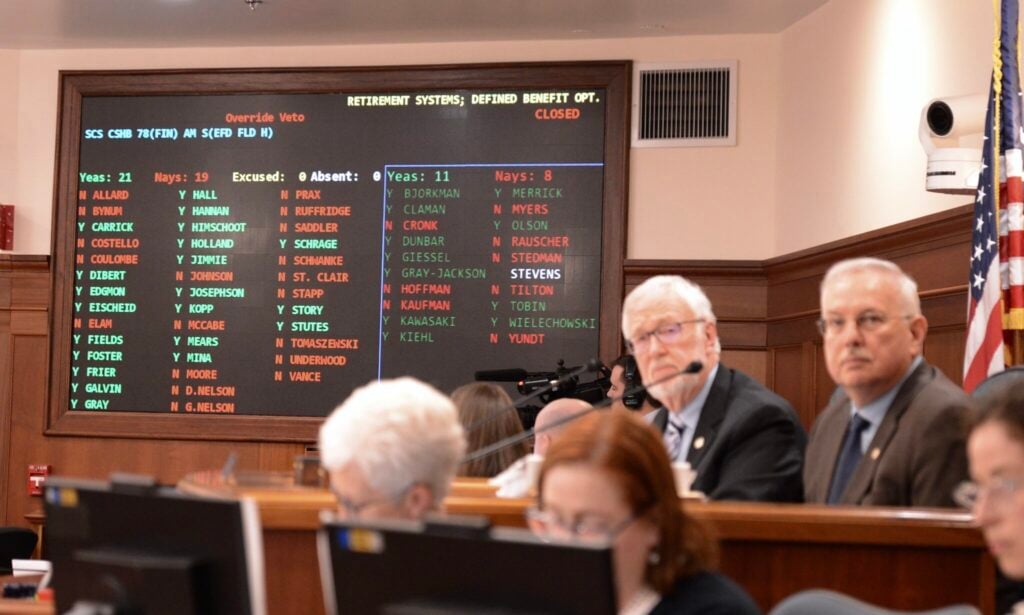
Senate President Gary Stevens, R-Kodiak (left) and Speaker of the House Bryce Edgmon, I-Dillingham, watch the voting board in the Alaska Legislature as lawmakers vote on a veto override Tuesday, May 19, 2026, for the pension bill, House Bill 78. (Claire Stremple photo/Alaska Beacon)

Alaska’s public employees and public school teachers will not have access to pensions this year.

In a 33-27 vote Tuesday, the Alaska Legislature failed to override Gov. Mike Dunleavy’s veto of a bill that would have created a new pension system for teachers, municipal employees and state employees in Alaska. Forty votes were needed for an override.

The failure was expected. Lawmakers had passed the pension bill, House Bill 78, by a combined vote total of 33-27 last month, and there was no sign that any legislator had changed his or her position since that vote. 

Alaska has been without a pension for new public employees since 2006, when lawmakers closed the existing pension plan to new applicants and mandated a 401(k)-style retirement system.

Though Dunleavy himself receives a public pension, he is opposed to opening a new system for current employees. In a veto message to lawmakers on Monday night, he expressed concerns about potential long-term costs and risks to the state.

“Pension obligations extend for decades, and the full cost of this bill may not be apparent until years after its enactment,” his veto message stated in part.

Despite the governor’s concerns, he was willing to allow the bill to become law as part of a grand compromise: If legislators approved a gas pipeline tax relief bill he supports, he would not veto the bill.

That arrangement fell apart on Monday afternoon after the House failed to advance the governor’s preferred proposal. The governor issued his veto about 10:39 p.m. that night.

Under the Alaska Legislature’s current interpretation of the state constitution, lawmakers are required to meet in joint session within five days to consider a veto override.

Under previous interpretations, legislators frequently skipped holding joint sessions if they either didn’t want to discuss an override or knew they lacked the votes to do so.

On Tuesday afternoon, though legislators knew an override was not in the cards, advocates and opponents spoke for a combined two hours before the final vote.

Rep. Chuck Kopp, R-Anchorage, speaks during a joint session of the Alaska Legislature as lawmakers vote on a veto override Tuesday, May 19, 2026, for the pension bill, House Bill 78. (Claire Stremple photo/Alaska Beacon)

Rep. Chuck Kopp, R-Anchorage and the pension bill’s most vocal proponent, said the bill is intended to reduce the amount of staff turnover in the state. While the bill was expected to cost $73 million per year to implement, Kopp expected it would save over $240 million in training costs for new employees and overtime needed to cover positions left vacant by staff who had resigned.

“House Bill 78 is not a retirement bill. … It is a workforce bill, and it’s a resource development bill. We cannot build a gasline through this state unless we can retain our engineers. We cannot permit a mine when the permitting office turns over in 18 months. We can’t drill on the North Slope when the Haul Road isn’t being maintained,” he said.

Sen. Bert Stedman, R-Sitka, gave a 25-minute speech rejecting Kopp’s argument, saying in part that the lack of a pension system is not causing the vacancy problem. If the state’s Supplemental Benefit System — not used by some municipalities — is included with the state’s 401(k)-like public employee retirement system, Alaska has generous retirement benefits, he said.

Stedman suggested that higher salaries may be part of the answer to the state’s vacancy issues. Alaska used to be No. 1 in the country for teacher salaries. It’s now ranked below Washington state, he said.

Rep. Jeremy Bynum, R-Ketchikan, said that in his experience as an employer, higher salaries helped but weren’t a complete solution.

“That still didn’t solve the problem of retention, because people still cannot live in our communities affordably, so we’ve got a lot of challenges ahead of us,” he said.

Stedman also warned that the bill is based upon actuarial estimates that may or may not be accurate. The state’s prior pension plan was left only partially funded because of an actuarial error that led to a years-long lawsuit and left a multibillion-dollar shortfall.

Sens. Bill Wielechowski, D-Anchorage, and Jesse Kiehl, D-Juneau, each suggested that the proof of the need for the bill is in the state’s lived experience. Alaska has experienced 13 consecutive years of negative migration, and state and municipal governments continue to struggle to fill positions.

“This will make a tremendous difference if we override this veto and put back the option of a modest defined benefit pension for Alaska’s public servants,” Kiehl said.

The legislature’s regular session ends Wednesday night. 

Any new pension bill would have to restart from scratch in January, when the 35th Alaska Legislature convenes for its first year.

SUBSCRIBE: GET THE MORNING HEADLINES DELIVERED TO YOUR INBOX.

Categories
Politics

Shapiro-backed Brooks wins competitive Pennsylvania primary

Pennsylvania Gov. Josh Shapiro just passed his first major test of the midterms.

Bob Brooks, a Shapiro-endorsed firefighter union leader, will take on GOP Rep. Ryan Mackenzie in a key November battleground after clinching the Democratic nomination for Pennsylvania’s 7th District over a crowded field.

It’s a significant win for Shapiro, who helped recruit Brooks into the race as part of his aggressive push to help Democrats retake the House by flipping four competitive seats in Pennsylvania. A romp across the map could serve as a launchpad for the governor’s potential 2028 presidential campaign.

It’s also a boon to the Democratic Congressional Campaign Committee, which recently added Brooks to its “Red to Blue” program and boosted him with a pre-primary ad buy.

Brooks, a first-time candidate, leaned heavily on the highly popular governor’s imprimatur to boost him over a four-way field that included former Northampton County Executive Lamont McClure, former federal prosecutor Ryan Crosswell, and engineer Carol Obando-Derstine, who served as an adviser to former Sen. Bob Casey (D-Pa.).

Shapiro went all-in, endorsing Brooks and hosting a fundraiser for him in December, cutting an ad for him in the spring and stumping with him shortly before Election Day.

The governor’s support brought scrutiny on both men. News outlets unearthed Brooks’ problematic old social media posts and a messy family property dispute. Brooks suggested that Shapiro tried to retaliate against a political foe in 2024 by encouraging his union to back her GOP opponent. (Brooks later said he misspoke.)

And a mysterious outside group with apparent ties to the GOP, Lead Left PAC, spent more than $1 million boosting McClure and attempting to sink Brooks and Crosswell in the final days of the race. Voters appeared to look past it all.

Brooks had more than just Shapiro in his corner. The blue-collar everyman who worked as a bartender and moonlights as a snowplow driver is being held up by an array of Democrats as a model for how the party can win back working-class voters.

He boasts one of the broadest endorsement lists of any House challenger on the map, a roster that spans from Sen. Bernie Sanders (I-Vt.) to former Transportation Secretary Pete Buttigieg, and from the Congressional Progressive Caucus to the Blue Dogs. He’s also brought together a cross-section of top Democratic operatives, including the progressive Fight Agency and The Bench, a new group that works to elect nontraditional Democrats.

​Politics