Fans have recently noticed him performing with a knee brace, and this explains why.
“We just got back from skiing in Aspen, where I tore my MCL like an idiot. It didn’t require surgery. A meniscus would, and an ACL would, but my doctor said the MCL does not require surgery. So that’s good news,” he said.
Justin Moore; Photo by Andrew Wendowski
Moore, his wife, and their four kids are avid skiers, and he actually considers himself pretty skilled on the slopes, but this time, things didn’t go as planned.
“We’ve been taking the kids skiing for spring break for ten years. I was skiing the best I have in years. I was skiing with good skiers. I kept up with them for 4-5 runs. We went through this trick part. Then my knee went in one direction, and the rest of my leg went in the other. I knew from playing sports that it wasn’t good.”
He’s currently wearing a brace while healing, but the injury isn’t slowing down future family plans on the slopes.
Justin Moore; Photo by Andrew Wendowski
“We’re still going. We’ve been going to Steamboat. That’s our favorite. It’s kid friendly,” he explained. “So I was looking forward to it because my confidence was really high. I’ve been told
as you get older, things will stop working. Your reaction time is slower.”
Moore’s latest single at country radio is “Time’s Ticking” and that is certainly something he can relate to as he revealed that his oldest daughter recently started driving.
“I just bought my daughter a car. It is the most bizarre feeling ever,” he admitted. “You’re giving this piece of machinery to this baby, in your eyes. But you have to let them be independent.”
While he is still getting used to the idea of Ella driving, he is enjoying the perks of having an extra driver in the house.
“We’ve been soccer moms for their lives. Now we just send Ella,” he said. “We go ‘Ella, go get your brother.’ She loves it because she wants to drive all the time. Now, I don’t want to drive ever.”
The upcoming trek will visit arenas and major cities across the U.S., including stops in Nashville, Alpharetta, Cleveland, Saratoga Springs, Salt Lake City, Hartford, and more.
For a full list of Justin Moore’s upcoming tour dates, visit his official website.
Former Republican Rep. Mark Sanford is set to make a run for his former congressional seat, according to paperwork filed with South Carolina’s elections commission.
Sanford is a fixture in South Carolina politics, known nationally for his high-profile extramarital affair while serving as governor, his sharp criticism of President Donald Trump while serving in Congress and his quixotic 2020 presidential run against Trump.
He submitted paperwork recently to run in the already-crowded Republican primary in the first congressional district stretching from the Charleston area down the coast to Hilton Head Island, vacated by Rep. Nancy Mace (R-S.C.) as she mounts a bid for governor. The election commission’s website shows Sanford as an “active” candidate.
The former Palmetto State politician — who slammed Trump for his brash personality and conduct during his first term — is seeking to reenter Republican politics even as Trump maintains his ironclad grip on the party.
Sanford did not respond to a call and text message from POLITICO, but he told the Post & Courier on Monday that “people have been telling me it’s time to get off the bleachers” and promised to focus his campaign on his longtime top issue: the national debt.
The former governor and member of Congress has a long record in state and national politics — and a history of making remarkable political comebacks. First elected to Congress in 1994, Sanford served in the seat he is once again seeking for nearly a decade before mounting a successful bid for governor in 2002. He also received early buzz as a potential 2012 presidential candidate.
But his political fortunes came to a crashing halt in 2009 when he disappeared from the state under the auspices of hiking on the Appalachian Trail — only later admitting he had taken part in an extramarital affair with a woman in Argentina. Sanford declined to resign from his post, but ceded his chairmanship of the Republican Governors Association and quietly left office at the end of his second term.
He reentered politics just a few years later, announcing a bid for the first congressional district, winning a crowded primary and holding the seat until he lost to a Trump-backed primary challenger in 2018, only for a Democrat to go on to flip the seat in the 2018 midterms.
Sanford later launched a longshot presidential primary bid against Trump. He dropped out in November of 2019.
The South Carolina Republican is set to face off against several candidates in this June’s primary, including a popular state representative, a local Charleston county councilmember, and a retired lieutenant colonel who commanded the final flight of U.S. forces out of Afghanistan in 2021.
With its sumptuous interiors and curated menus, this chain offers a mouthwatering filet mignon that customers say justifies the premium steakhouse pricing.
Graham, a legend of the Austin music scene, died on Friday (March 27) at the age of 67. Continue reading…The Boot – Country Music News, Music Videos and Songs
We have tragic news to report from the world of television today.
Multiple outlets have now confirmed that beloved actor and comedian Alex Duong has passed away.
He was just 42 years old.
Comedian Alex Duong performs during the Laugh Factory hosts Virtual Telethon To Support Families Of Atlanta Shooting Victims at The Laugh Factory on March 27, 2021 in West Hollywood, California. (Photo by Frazer Harrison/Getty Images)
News of Duong’s passing comes courtesy of a statement from his longtime friend Hilarie Steele
“He was comfortable and thankfully out of pain,” Steele wrote on a GoFundMe page for Duong’s family.
“He was alert enough to say goodbye to his little girl, whom he has treasured every moment since the day she was born,” she continued, adding:
“We are devastated, but so grateful for the support, prayers and generosity you have all shown during this unimaginable time.”
Duong was diagnosed with alveolar rhabdomyosarcoma, a rare cancer affecting soft tissue, last year.
Steele provided updates about his condition as Duong’s condition deteriorated rapidly in recent days:
“He has gone into septic shock, a severe and life-threatening infection that has overwhelmed his body,” she wrote.
“He is in the hospital, and the situation is critical. Everything has changed so quickly.”
A popular standup comic in Los Angeles, Duong racked up numerous TV credits over the years, including roles on Blue Bloods, Dexter, Everybody Hates Chris, 90210, The Young and the Restless, and Pretty Little Liars.
Last summer, comics Ronny Chieng and Atusko Okatsuka hosted the “The Alex Duong Has Cancer In His Eye Comedy Benefit Show” at the Largo in Los Angeles.
Comic and actor Alex Duong has passed away after a battle with cancer. (GoFundMe)
Steele says Alex’s family has been “overwhelmed with gratitude” over the outpouring of support from fans.
“Please keep Alex and his family in your prayers,” she wrote.
“Your support is carrying them through the hardest time of their lives.”
The GoFundMe page has already raised more than $120,000 toward its original goal of $95,000.
Duong is survived by his wife, Cristina, and their 5-year-old daughter, Everest.
Our thoughts go out to his loved ones during this incredibly difficult time.
Kendra is now hiding from the public eye. But … what’s she doing around kids?
Following her arrest, Kendra Caldwell Duggar posed for a mugshot. (Photo Credit: Washington County Detention Center)
‘They brought me to a good place to stay’
It only took 90 minutes before Kendra Caldwell’s mother-in-law showed up to bail her out of Washington County jail.
Kendra and Joseph are both facing four counts of endangering the welfare of a minor in the second degree and four counts of false imprisonment in the second degree.
Though Joseph appears to have been extradited to Bay County, Florida to face charges for molesting a 9-year-old girl in 2020, Kendra is still in Arkansas.
Prior to this, he was being held in solitary confinement while awaiting extradition.
Phone calls in jails and prisons are recorded. And a recording of a call between Joseph and Kendra following her release was illuminating.
In this still from the Washington County Sheriff’s Office, a handcuffed Kendra Caldwell Duggar sits and speaks to a law enforcement officer. (Image Credit: Washington County Sheriff’s Office)
Peopleobtained an audio recording of Joseph and Kendra’s phone call from 8:11 PM on Friday, March 20.
“Did you hear that I’m out here with, um, did you hear where I’m at and everything?” she asked Joseph.
Her disgraced husband advised her against stating her location.
“They brought me to a good place to stay that’s very private,” Kendra shared.
We do not know that location. But we do know that, clearly, she is not alone.
‘Trying to keep my spirits up’
As the call recording continues, you can hear what sounds like children playing in the background.
(We’ll get into that momentarily.)
“So you’re doing okay,” Kendra asked during the call.
Joseph told her that he was “trying to keep my spirits up.”
He added that “reading the bible has really been helpful and calming to think about all the situation – situations.”
Joseph Duggar and Kendra Caldwell appear on TLC, before a sequence of disgraceful events. (Image Credit: TLC)
Audibly, Joseph appeared to get choked up before he shared that reading his religion’s holy book had been “uplifting.”
Kendra offered to get Joseph more reading material.
However, Joseph stopped responding. It seems likely that he was crying.
The call was still ongoing. In fact, Joseph was the one paying for it.
After two minutes of silence, Kendra hung up the phone.
Kendra Caldwell and Joseph Duggar stare into each other’s eyes in this photo. (Image Credit: TLC)
It seems most likely that the children playing in the background on the call were perhaps niblings — if she’s staying with one of Joseph’s siblings.
That doesn’t necessarily mean that she’s on the infamous Duggar compound or at someone’s house.
(Some have wondered if she’s staying with Anna Duggar, since Jim Bob purchased her house not too long ago, but that is pure speculation.)
With this family, and he wider cult, Kendra could be staying at a rental house or at a family friend’s house where the general public might never find her.
However well she hides, she’s due in court on April 29.
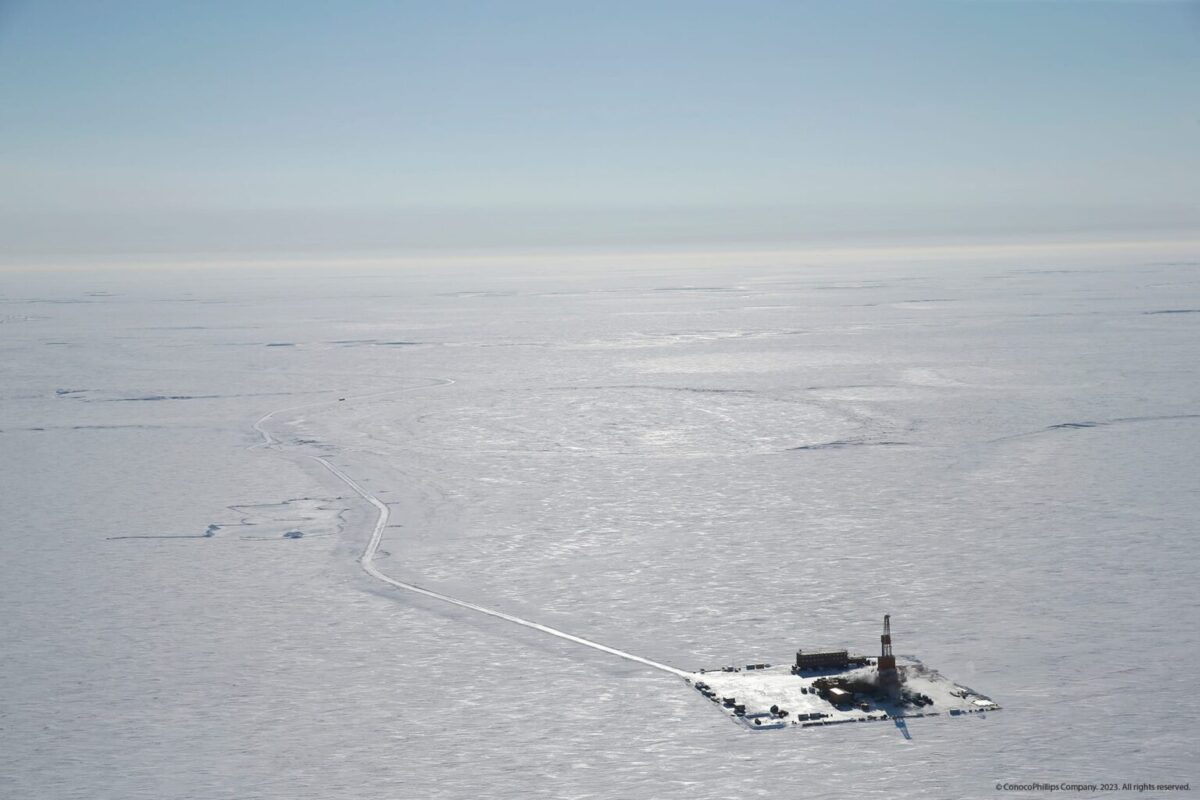
The vast National Petroleum Reserve-Alaska extends west of ConocoPhillips’ massive Willow oil project. (ConocoPhillips)
Global energy leaders have convened here this week, spiffed up in dark suits and polished shoes, to discuss the industry’s most pressing issues: war in the Middle East, Venezuela, artificial intelligence.
But behind the scenes at this annual conference of industry executives — known formally as CERAWeek by S&P Global but nicknamed the “Super Bowl of energy” — a big story about Alaska oil is unfolding.
It involves a massive lease sale in the Arctic, a remarkable show of interest from global oil giants that had faded from Alaska’s frontlines and an emerging race to find deposits potentially worth billions of dollars. Industry proponents say a flood of crude from the largely undeveloped western Arctic, if companies can locate and produce it, could open a new era for the state’s industry.
In what was by far the highest-value federal lease sale in the vast National Petroleum Reserve–Alaska in more than two decades, oil companies last week snatched up more than 1 million acres across the western Arctic.
The scale of interest, with 11 companies participating and a record $163 million spent on bids, was itself notable. But so were the identities of some of the bidders. Two, in particular, surprised even industry insiders: ExxonMobil and Shell.
Both supermajors have a history in Alaska.
ExxonMobil still owns shares of existing Arctic oil fields and the trans-Alaska pipeline. But Shell no longer operates in the state and hasn’t drilled a well in Alaska since its failed offshore exploration campaign more than a decade ago. And ExxonMobil hadn’t bid on leases in years.
Energy historian Dan Yergin, left, speaks with Wael Sawan, chief executive of Shell, at the CERAWeek oil industry conference in Houston this week. (Grant Miller Photography/CERAWeek by S&P Global)
Their renewed interest — along with continued investment from established players like ConocoPhillips and Colorado-based wildcatter Bill Armstrong — accelerates an industry revival that was already playing out on the North Slope.
Just a few years ago, new production and investment in the region lagged as some companies struggled to raise money and even pulled out of Alaska amid successful advocacy campaigns against Arctic drilling.
But major geologic discoveries by Armstrong — and a pair of big new oil fields now under construction — have made the North Slope a more attractive investment. And the industry also has political tailwinds coming from a Trump administration keen to boost resource extraction in Alaska.
“This sale absolutely shows the world the potential for Alaska,” Armstrong, one of the primary bidders, said in an interview at CERAWeek. “This could be a game-changer for the state.”
Bill Armstrong (Max Graham/Northern Journal)
The region still faces obstacles to development, like high costs and competition from other basins where drilling is cheaper.
And the lease sale is just a preliminary step, far from an assurance of future production: No new wells have been drilled yet, and companies often spend years doing exploratory work before deciding whether to start pumping oil.
Conservation groups, meanwhile, continue to fight the industry’s expansion in the reserve — where, they note, federal law instructs policymakers to not only to oversee oil development but also to protect the environment and cultural values. Multiplelawsuits are challenging the Trump administration’s oil-friendly policies in the Arctic, and advocates have asked a judge to invalidate leases set to be awarded after last week’s sale.
Four small lakes sit on the northwestern side of Teshekpuk Lake, a key wildlife habitat within the National Petroleum Reserve – Alaska that’s also seen interest from oil companies. (Craig McCaa/U.S. Bureau of Land Management)
“What we saw last week were companies pushing into some of the most sensitive areas of the reserve,” said Suzanne Bostrom, an attorney with a conservation-focused Anchorage law firm, Trustees for Alaska, that represents some of the organizations suing the administration. “We and the groups that we work with are going to continue to fight for this area, and fight for the protections that it deserves,” Bostrom added.
But even amid the pending legal questions, the sale’s results are still a step toward new development; further investment and competition in the petroleum reserve are likely to follow, conference participants told Northern Journal in Houston this week.
A surprising sale
Leading up to the sale, there were signs that oil companies could show up in force.
It was the first auction in NPR-A in seven years, and more acreage was up for grabs than in many previous sales. The offerings included large swaths of tundra and wetlands that Democratic administrations had designated off-limits to drilling.
And after years of comparatively tepid industry interest, recent oil discoveries have expanded the known resources on the North Slope, said Bob Fryklund, a top oil and gas analyst at S&P Global Energy, a research firm.
“It’s kind of been a sleeper basin,” he said.
This map of Alaska’s North Slope shows the National Petroleum Reserve – Alaska and the Arctic National Wildlife Refuge. Two oil companies are building large developments near the reserve’s eastern edge, and a major lease sale recently auctioned off land deeper into the reserve. Prudhoe Bay is the hub of existing North Slope development.
A decade ago, the petroleum reserve was beyond the western edge of the North Slope’s oil infrastructure, making it more expensive to bring in equipment and drill.
But the industry has been moving in its direction: Construction is now underway at two big new oil fields in the area — ConocoPhillips’ Willow project and Santos’ Pikka project. Both will tap into a long-overlooked oil-rich geologic formation, known as the Nanushuk, that Armstrong initially discovered near the reserve’s eastern boundary.
It was no surprise, then, that ConocoPhillips, Santos and Armstrong all showed up at the recent auction, analysts said.
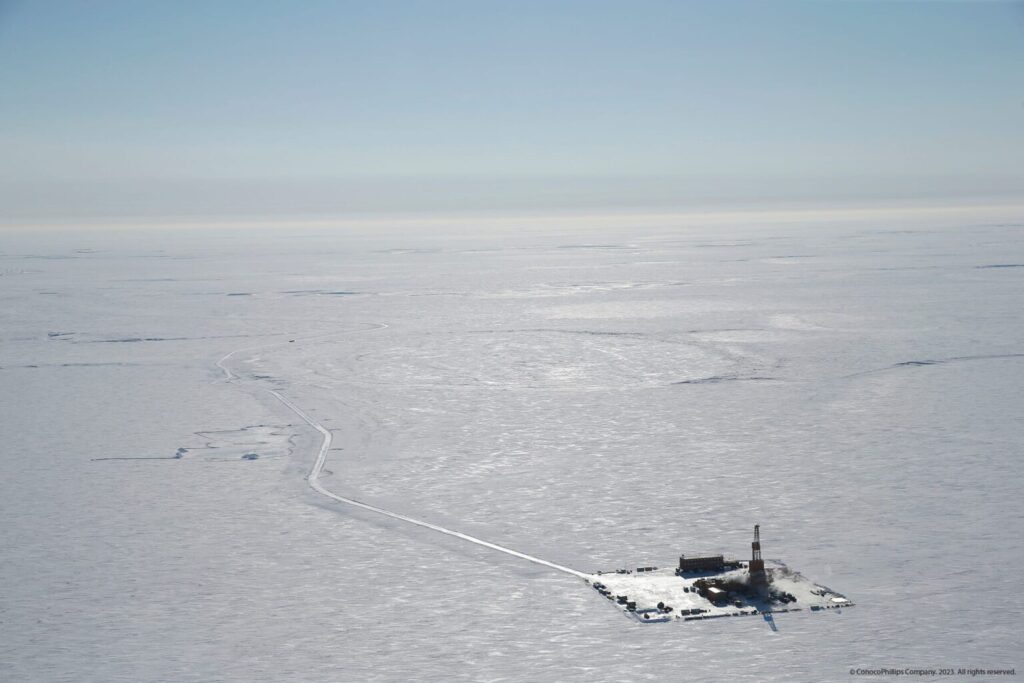
An exploration rig drills for oil at ConocoPhillips’ Willow prospect in the National Petroleum Reserve – Alaska. (ConocoPhillips)
Few people, however, predicted that so many other companies would put in bids, or that major corporations like ExxonMobil and Shell would participate.
ExxonMobil, committing more than $7 million on some 138,000 acres, came as a particularly big surprise.
That company, headquartered in Houston, owns shares in the existing Point Thomson and Prudhoe Bay oil fields on the North Slope. But it doesn’t manage either field, and the company has not been active in exploration and new development in the state: Until last week, ExxonMobil had not bid on a federal or state oil and gas lease in Alaska in more than a decade, according to data provided by Welligence, an industry research firm.
Meanwhile, Shell, in a partnership with a Spanish company, Repsol, submitted some of the highest bids. The two companies offered more than $2 million on many individual tracts, and committed more than $90 million in total.
A map produced by the U.S. Bureau of Land Management shows winning bids from last week’s lease sale.
Experts said the return of those players was likely influenced by the ongoing development in the area.
Although neither the Willow nor Pikka project is producing yet, the multibillion-dollar investments by ConocoPhillips and Santos may have given other companies more faith in the surrounding geology and the ability to pump oil in the area, analysts said.
“What you saw Shell do, and even Exxon, was validation of the work done by other players on the North Slope in recent years,” an oil company executive said in Houston, speaking on the condition of anonymity because he was not authorized to speak publicly.
Industry headwinds subside
Shell’s interest represents a reversal from its announcement a decade ago that it was pulling out of Alaska. The company had spent some $7 billion on its failed effort to drill for oil offshore in the Chukchi Sea, citing Obama administration policies and high costs when it departed the state.
In 2020, another major, BP, also pulled out of Alaska, selling its assets to Hilcorp, a privately owned Texas business.
Those decisions both seemed like signals of the industry’s decline in the state, as the daily flow through the trans-Alaska pipeline shrank to 500,000 barrels from a high of 2 million decades earlier. An era of oil giants spending freely on big new projects was giving way to one of smaller companies wringing the last drops of crude out of aging fields.
An oil and gas rig drills at a Hilcorp development in the Cook Inlet basin in Southcentral Alaska. (Nathaniel Herz/Northern Journal)
At the time, companies were contending not only with the usual impediments to drilling in Alaska, like high costs and opposition from environmental groups, but also with growing political pressure from climate-minded shareholders and activists opposed to expanding fossil fuel production. Even oil executives acknowledged that advocacy against the oil industry, which is a major driver of climate change, was deterring investment in Alaska.
But even as the burning of fossil fuels continues to warm the planet, global demand for oil remains high — and industry confidence in the North Slope’s potential appears only to be growing.
The newly discovered oil deposits there “have proven that Alaska is not over,” Fryklund said.
ConocoPhillips, ExxonMobil and Santos declined to make officials available for on-record interviews. Shell did not respond to a request for comment.
“This marks an important step in our continued commitment to responsible energy development in Alaska and the U.S.,” an Exxon spokesperson said in an emailed statement.
Once the company’s leases are finalized, ExxonMobil will work with the state and local communities as it evaluates “potential next steps for the area,” the statement said.
“I wish I were 30 years younger”
For those who work in the oil industry, the central plank of Alaska’s economy, the sale stirred excitement, and some relief: New activity in the federal reserve could bring more gigs for contractors that have long wondered if there would be enough development on the North Slope to sustain their businesses.
“We’ve all had this little worry of, ‘Well, what’s next?’” said Greg Miller, vice president of operations at Cruz Construction, a Palmer-based company with oil-related contracts on the Slope. “Now, there’s a little bit of reason to be a little bit more hopeful and positive about the next 10, 20 years.”
The sale won’t lead to immediate growth for Miller’s business, he said. But new exploration activity, if and when it happens, will create jobs: A single project can provide a year’s worth of wages for as many as 100 employees at Cruz, Miller added.
For the president of another Alaska oil services company, Kevin Durling, the hype around the petroleum reserve is reminiscent of the boom days when oil started flowing through the trans-Alaska pipeline, in the 1970s and 1980s.
The trans-Alaska oil pipeline pumps some 500,000 barrels a day. (Nathaniel Herz/Northern Journal)
“I wish I was 30 years younger,” he said.
The state’s conservation community, meanwhile, has reacted with disappointment, and concern for the western Arctic ecosystem.
The vast, largely undeveloped region contains important habitat for migratory birds, and it sustains tens of thousands of caribou, some of which calve around Teshekpuk Lake, a major water body in the northern part of the petroleum reserve.
“I’ve had better weeks at work. No question about that,” said Andy Moderow, senior policy director at Alaska Wilderness League, one of the environmental groups suing the Trump administration. But, he added: “The war is still well in front of us.”
One potential hurdle for development is a legally disputed conservation area around Teshekpuk Lake. The protections, across about 1 million acres, were set aside by the Biden administration for the nearby Iñupiaq village of Nuiqsut, where many people still depend on caribou and other wildlife for food.
The Trump administration canceled the protections late last year, touting the area’s oil and gas potential and aiming to authorize leasing there. Nuiqsut’s leaders then sued, saying the move violated a prior agreement and threatened the village’s subsistence traditions.
Two days before the lease sale results were announced, a federal judge restored the Teshekpuk protections while the lawsuit played out.
But the area still attracted bids from a few companies — including ExxonMobil.
The administration has not said whether it plans to award leases in the disputed area to high bidders — or how, exactly, it intends to navigate the apparent conflict between the sale results and the court ruling.
Nathaniel Herz contributed reporting from Anchorage.
Northern Journal contributor Max Graham can be reached at max@northernjournal.com. He’s interested in any and all mining related stories, as well as introductory meetings with people in and around the industry.
This article was originally published in Northern Journal, a newsletter from Nathaniel Herz. Subscribe at this link.
Members of the Alaska House’s all-Republican minority caucus pose for photographs on Tuesday, Jan. 20, 2026, the first day of the second session of the 34th Alaska State Legislature. (Photo by James Brooks/Alaska Beacon)
At the Alaska Beacon, we’re constantly trying to figure out where we should put our attention. There’s always more news than there are people to report it.
Every Thursday, the Alaska Legislature publishes its committee schedule for the coming week. Public notices alert us to meetings and events. The governor’s office occasionally lets us know ahead of time that something’s coming down the pike, too.
Here’s what we know about for the coming week. If you know of something that’s coming up that you should think we should pay attention to, email us at info@alaskabeacon.com.
We can’t cover everything on this list, but we’re interested in them and we think you should know about them in case you’re interested in them, too.
This list is ripped from our notebooks, and it is likely to change over the course of the week. We’ll update it when we can.
Are you trying to keep track of when to testify on a bill? The Legislature has a website for that.
Monday, March 30
House/Senate floor sessions in the morning
8 a.m. – The House and Senate Education Committees hold a joint session on the state of pre-K – 12 education in Alaska with invited testimony from the Alaska Council of School Administrators
9 a.m. – Senate Finance Committee hears a bill related to the practice of naturopathy
1 p.m. – House Judiciary hears a resolution on voter privacy, and expressing concern at the state sharing confidential voter data with the federal government
1 p.m. – House Resources hears a bill related to fish and game wildlife refuges
1:30 p.m. House Finance continues work on next year’s operating budget, and begins hearing proposed amendments
3:30 p.m. – Senate Resources hears the governor’s bill related to tax breaks for the AK LNG gas line
5:30 p.m. – Fairbanks Fish & Game Advisory Committee – Game and Trapping Subcommittee Meeting, see event info here.
Tuesday, March 31
Filing deadline to apply for the Alaska Permanent Fund dividend is 11:59 p.m. on Mar. 31
Paper applications can be mailed and must be postmarked by Mar. 31.
Paper applications can be delivered to PFD office locations in Anchorage, Fairbanks or Juneau by Mar. 31 during office hours of 10:00 AM – 4:00 PM.
8 a.m. – House Community and Regional Affairs Committee hears a bill related to costs for public records
9 a.m. – Senate Finance considers the governor’s appointee John Crowther as commissioner of the Alaska Department of Natural Resources
10:15 a.m. – House Military and Veterans Affairs Committee hears a bill to update the focus and structure of the Joint Armed Services Committee
11 a.m. – Joint session of the House and Senate gathers to hear the annual address by U.S. Sen. Lisa Murkowski
1 p.m. – House Energy Committee hears a presentation on the Chugach Hydroelectric Program
1 p.m. – House Transportation hears a presentation on trails and local access from the Alaska Department of Transportation and Public Facilities
1:30 p.m. – Senate Natural Resources hears a presentation on the Division of Forestry and Fire Protection
1:30 p.m. – House Finance continues working on the operating budget
1:30 p.m. – Senate transportation hears a presentation on the Port of Seward
3:15 p.m. – House Health and Social Services hears a bill to prioritize keeping siblings together in foster care; and a bill to establish an opioid litigation settlement fund
3:30 p.m. – Senate Health and Social Services Committee related to medical compacts for grants allocated by the federal Rural Health Transformation Program
6:30 p.m. – Middle Nenana River Fish & Game Advisory Committee Meeting in Healy, see event info here.
6:30 p.m. – Alaska Common Ground, a non-profit, non-partisan public policy organization, hosts ‘Just what is the Permanent Fund, and who’s in charge? see event info here.
7 p.m. Upper Tanana Fortymile Fish & Game Advisory Committee Meeting in Tok, see event info here.
Wednesday, April 1
House/Senate Floor sessions in the morning
8 a.m. – House Education continues hearing bills related to increasing education funding, residential school funding, and civics education
9 a.m. – House Finance continues work on next year’s operating budget and hears proposed amendments
9 a.m. – Senate Finance hears a bill on mental health education in public schools
12 p.m. – Lunch & Learn presentation on outmigration of limited entry fishing permits
1 p.m. – House Judiciary Committee considers a bill related to social media use of minors, and bill to establish safe devices for surrendering infants
1 p.m. – House Resources Committee continues hearing the governor’s tax break proposal for the Alaska LNG gas line project
3:30 p.m. – Senate Education Committee hears a presentation from the University of Alaska Fairbanks chancellor on the Alaska Native Language Center
3:30 p.m. – Senate Resources Committee will hear a resolution urging support for the proposed Alaska LNG gas line project, with public testimony invited
5 p.m. – House Finance continues to hear proposed amendments on next year’s operating budget
Thursday, April 2
8 a.m. – House Community and Regional Affairs hears a bill related to ensuring the right to repair digital; a bill related to emergency first responders; a bill related to birth certificates and identification for unhoused young adults; and a bill related to autonomous vehicles
8 a.m. – House Tribal Affairs Committee hears a presentation on the Council of Alaska Native Language
9 a.m. – House Finance Committee hears a bill related to marijuana taxes and retail stores
10:15 a.m. – House Military and Veterans Affairs Committee hears a bill to update the focus and structure of the Joint Armed Services Committee
1:30 p.m. – House Finance Committee hears an update on the University of Alaska and deferred maintenance needs
3:30 p.m. – House Health and Social Services hears a bill to to prioritize keeping siblings together in foster care; a bill to expand early intervention services; and a bill related to regulating the sale of weight-loss and muscle-building supplements
3:30 p.m. – House State Affairs hears a bill related to establishing a welcome office in Alaska; and a bill related to regulating PFAS chemicals, remediation and water testing
Friday, April 3
All committee meetings cancelled ahead of the Easter holiday