The Dimond Courthouse building, home to the Juneau offices of the Alaska Department of Law, is seen across the street from the Alaska State Capitol on Friday, May 27, 2022. (Photo by Lisa Phu/Alaska Beacon)
Reporter James Brooks regularly requests public information under the Freedom of Information Act and uses public documents, including those available through Alaska’s Court system, to do his job. As we observe Sunshine Week, an annual event that highlights the importance of open records and transparency in government, he shares a few thoughts.
These are big cases with major national implications.
They’re also going to be difficult to follow.
The Alaska Court System does an excellent job of listing new cases — it publishes lists of new civil and criminal cases daily — but when it comes to automatically notifying people about ongoing civil proceedings, there’s room for improvement.
There’s no way to be automatically notified when there are updates to civil cases, such as when someone files a motion, makes a written argument or schedules oral arguments.
That might seem like a niche problem, but it’s one that has implications across the state.
An individual Alaskan might be able to keep track of a case they care about by checking Courtview on a daily or weekly basis, but that process is physically impossible for a reporter who might want to follow dozens or hundreds at a time.
If a reporter doesn’t know about something, they can’t report on it. While court rules set specific timelines for some filings, it’s impossible to predict the unexpected, and a reporter can’t ask for a file if they don’t know it exists.
In a perfect world, there would be enough reporters to make regular checks on all cases of interest. We don’t live in that perfect world.
Alaskans filed 2,569 civil cases in Alaska superior courts during the last fiscal year. There were more than 7,500 civil cases in district courts during the same period.
The Alaska court system has a useful system, TrueFile, for following criminal cases. There isn’t a similar system for civil cases, and there’s a reason for that: Civil courts deal with things like divorces and similar actions that are normally kept confidential.
Alaska has a constitutional right to privacy, after all.
But what about issues of public concern? Without a notification system, it’s impossible to stay abreast of what’s happening.
We know the court system is working on this problem — at the Beacon, we’ve certainly pestered them enough — but because it’s Sunshine Week, we thought we should shed a little light on a problem we’ve been dealing with for a long time.
The court system has been doing a good job of improving access. When we asked for a list of newly filed cases, they added it to their website.
At courthouses, there are now public terminals where reporters and members of the public can examine documents immediately, in any case, without cost. That lets us easily keep an eye on things across the state.
But for all those improvements, there’s still room for things to be better.
The lack of automatic notification is a problem for accused and accuser alike. If a business is accused of violating Alaska’s law requiring good faith and fair dealing, it’s easy for a reporter to know about and report on the accusation.
But under the current system, it’s much harder to know if that accusation is dismissed or withdrawn, which makes it less likely to be reported upon.
Reporters can ask the court to add a case to a list of most requested case files, but it’s a manual process that requires a lot of work by court staff.
The court system’s goal is to provide equal access to justice, but we note that equal access isn’t possible without information.
If the court system is reluctant to create an automatic notification system because of privacy concerns, an alternative would be to allow reporters and members of the public to ask to be added to existing email distribution lists for individual cases.
Judges might be reluctant to do this, so instead of asking for voluntary compliance, it would be better to enact a court rule change and require them to comply.
Attorneys involved in cases are already notified automatically by email about filings in cases that they are involved in.
If members of the public and reporters can be added to those distribution lists, it would fix the issue and lead to better reporting.
That’s in the interest of all Alaskans, not just those of us here at the Beacon.
Now, we have video that seems to corroborate Dakota Mortensen’s version of events.
In case you missed it, Paul was arrested in February of 2023 after Mortensen alleged that she kicked and punched him while heavily intoxicated.
Taylor Frankie Paul attends Hulu’s Get Real House at Casa Lago on April 22, 2025 in Los Angeles, California. (Photo by Monica Schipper/Getty Images)
He also claimed that Taylor threw several chairs at him, one of which struck her daughter from a previous relationship (Paul and Mortensen have a 2-year-old son together).
And indeed, the footage obtained by TMZ shows Taylor physically assaulting Dakota — at one point putting him in a headlock and pulling his hair — and hurling multiple metal stools in his direction.
It doesn’t appear as though he was hit by the chairs, but at one point, he shouts, “Your daughter is sitting right there.”
Said daughter begins crying as Taylor’s assault continues. It’s not entirely clear from the footage, but TMZ reports that the 5-year-old was struck by one of the flying stools.
According to a police report obtained by the outlet, the girl was hit and later had a “goose egg on her head” as a result.
Taylor Frankie Paul attends the Los Angeles Premiere and FYC Event of Hulu’s “The Secret Lives Of Mormon Wives” Season 2 at Paramount Studios on May 09, 2025 in Los Angeles, California. (Photo by Araya Doheny/Getty Images)
After a neighbor called police, Dakota reportedly showed the footage to the officers who responded, leading to Taylor’s arrest.
The video was then used by prosecutors while they were making a case against her.
While some of the more serious charges were dropped as part of a plea deal, Taylor pled guilty to an aggravated assault charge, and she was sentenced to probation.
Taylor Paul attends the 98th Oscars at Dolby Theatre on March 15, 2026 in Hollywood, California. (Photo by Mike Coppola/Getty Images)
The video is damning, to say the least, but Paul’s PR team is sticking to their guns.
“It’s sad to see the latest installment of his never-ending, desperate, attention-seeking, destructive campaign to harm Taylor without any regard for the consequences for their child,” a rep for Taylor said in a statement issued today (via TMZ).
“Releasing an old and selectively edited video on their son’s birthday is a reprehensible attempt to distract from his own behavior.”
It’s worth noting that we don’t know what happened before Dakota began filming, and Taylor shouts “you threw me” several times in the video.
She later accused him of throwing her to the ground.
Still, it might be hard to convince audiences that they should root for Taylor to find the man of her dreams after she threw a chair that struck a 5-year-old in the head.
Revelers dance during Whitehorse band Speed Control’s set at Beerfest, Saturday May 24, 2025. (Will Steinfeld/Chilkat Valley News)
At least one Canadian brewery, Yukon Brewing, is skipping this year’s Great Alaska Craft Beer and Home Brew Festival.
Yukon Brewing marketing coordinator Kateryna Osypova said the reason was simple: “We are not sure if we can guarantee the safety of our employees,” Osypova said, pointing out the ongoing tension between the U.S. and Canada. Brewer Paul Wheeler and local Chilkat Valley residents say it’s a sign of declining Canadian tourism numbers at local events that they expect to see continue for a second year.
Wheeler, who owns Haines Brewing, said in previous years three Whitehorse breweries – Yukon Brewing, Woodcutter’s Blanket and Winterlong Brewing – would typically come to Brew Fest.
Woodcutter’s Blanket co-founder Scott Shailer said that the brewery was still planning to attend the festival. Winterlong Brewing staff were traveling and could not be reached by press time.
Wheeler said he has noticed a decline in visitors to the Haines brewery last year.
“We were 30 percent down here at the brewery,” he said. “Our friendly neighbor won’t come to visit us.”
In previous years, registration and ticket sales for local events has been a metric for measuring local tourism numbers.
However, this year Southeast Alaska State Fair director Jessie Sanders refused to share how many tickets have been sold for Brewfest events so far and would not provide details about how many breweries had registered. He said he did not want to share numbers for fear that they would be “interpreted by some audiences as a direct response to the current political climate.”
According to Haines tourism director Rebecca Hylton, Brew Fest typically sells around 1,700 general admission tickets. She said that attendance at both Brew Fest and the Kluane to Chilkat International Bike Relay were down approximately 20 percent in 2025 compared to previous years.
However, registration has also opened for the fifth annual Chilkat Challenge Triathlon, which is scheduled for the morning of May 23, before Brewfest festivities are set to begin. Steering committee member Gershon Cohen said that, so far, 35 people have registered. Last year’s triathlon had 60-65 participants.
“We would have had more, but we had more than 20 people cancel registrations who were from Canada, because of all the political craziness,” Cohen said.
There are currently seven Canadians signed up for the event, which is fewer than in previous years when Cohen said a third or even half of race participants were from Whitehorse or Haines Junction.
Most of the people who have registered thus far are from around Alaska, including Fairbanks and Sitka.
“There are still, obviously some tensions between our country and theirs, which it’s unfortunate that it spills over into something like this,” Cohen said.
Wheeler echoed Cohen, saying “It’s just going to be less people coming to town, supporting… any of the events Haines puts on.”
He said he hopes the Canadian breweries return; it might just take a little while.
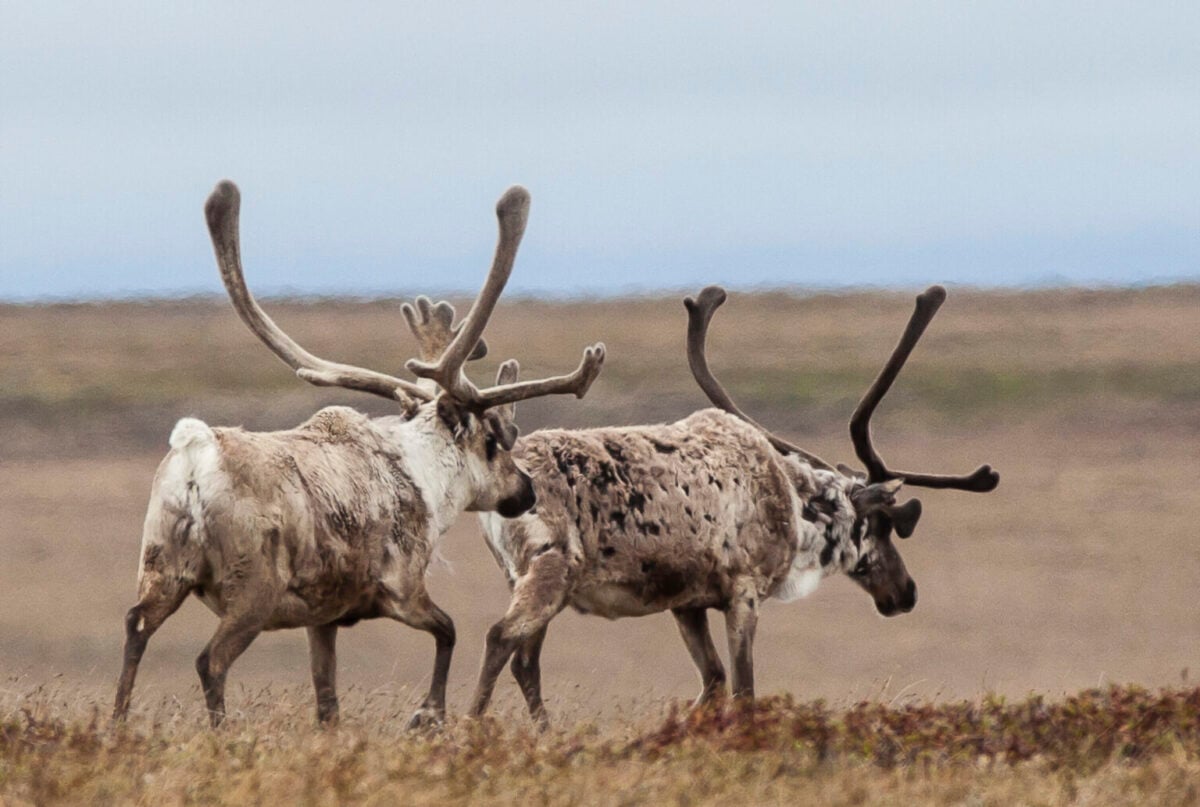
Two animals in the Teshekpuk Caribou Herd are seen on June 27, 2014, in the National Petroleum Reserve in Alaska. A right-of-way agreement reinstated through a federal court order protects the Teshekpuk Lake area and the habitat used by the caribou herd named for the lake. But in an oil and gas lease sale, the Trump administration auctioned off tracts in that right-of-way area nonetheless. (Photo by Bob Wick/U.S. Bureau of Land Management)
A controversial oil and gas federal lease sale in the National Petroleum Reserve in Alaska generated a new bidding record, according to results released on Wednesday. It was the first auction held in that Arctic Alaska territory since 2019.
The lease sale produced $163 million in high bids, beating the $104 million mark set during the first competitive oil and gas lease sale in the Indiana-sized reserve, which was held in 1999 during the Clinton administration.
Eleven companies submitted bids for more than 1.3 million acres of the nearly 5.5 million acres offered in the auction.
Kevin Pendergast, Alaska state director for the U.S. Bureau of Land Management, called the results “historic.”
“This is the strongest sale we have ever had in the National Petroleum Reserve in Alaska by nearly every measure. It makes clear that for the NPR-A, despite all the successes to date, the best days are still ahead,” Pendergast said at the conclusion of the bid opening, which lasted about two hours.
In statements issued after the bid reading, federal and state officials hailed the results.
“Today’s lease sale underscores the National Petroleum Reserve in Alaska’s vital role in strengthening America’s energy security while fueling economic growth across Alaska,” Secretary of the Interior Doug Burgum said in a statement. “The Reserve was created to support our nation’s energy needs, and this successful sale demonstrates what’s possible when we align responsible development with that original purpose.”
Gov. Mike Dunleavy celebrated the results in a Facebook post that thanked President Donald Trump “for believing in the great State of Alaska.”
“Today’s record setting NPR-A lease sale is a major win for our state and our country. It reinforces Alaska’s role as a reliable energy producer, supports high-paying jobs for our families, generates additional revenue for the state, and strengthens American energy security at a time when energy security is more important than ever,” he said in the post. “Alaskans have demonstrated that we know how to unlock our vast resources while protecting the land for future generations. This is exactly the kind of balanced, commonsense progress Alaskans have been calling for.”
The lease sale was one of five mandated in the reserve over the next 10 years by the sweeping budget and tax bill called the “One Big Beautiful Bill Act.” That mandate calls for lease sales to be conducted under a Trump administration management plan that opened 82% of the reserve to oil development. Previously, the Obama administration held annual lease sales in the petroleum reserve, but that administration’s management plan protected about half of the land through the designation of “special areas” considered important to wildlife and to Native cultural practices.
Prominent bidders were energy giants ConocoPhillips and Repsol, which are already active in the area. ConocoPhillips is developing a huge project within the reserve, the Willow Ppoject, that is expected to produce up to 180,000 barrels a day after its expected startup in late 2029. Repsol is a partner in another huge oil field, Pikka, which is on state land bordering the reserve and is set to start production this year.
Late-afternoon sunlight bathes the ConocoPhillips building in downtown Anchorage on March 10, 2026. ConocoPhillips, long active in the National Petroleum Reserve in Alaska, was a major bidder in the lease sale held Wednesday. (Photo by Yereth Rosen/Alaska Beacon)
The petroleum reserve and adjacent state and Native-owned lands along its eastern border are considered highly prospective for new oil finds because of a geological feature called the Nanushuk Formation that underlies it.
Federal officials auctioned tracts of protected land
Much of the bidding in Wednesday’s sale was for territory that was previously off-limits to oil development under protections that date as far back as the Reagan administration.
The inclusion of long-protected land in the sale, predominantly the area around ecologically sensitive Teshekpuk Lake, made the lease sale contentious. It is the subject of two lawsuits filed by Native and environmental groups.
Bids were accepted even for tracts within an area encircling Teshekpuk Lake, the North Slope’s largest lake, despite a federal court order issued Monday that reinstated development prohibitions there.
U.S. District Court Judge Sharon Gleason on Monday issued an injunction reinstating a right-of-way agreement with Nuiqsut Trilateral Inc., a partnership of Nuiqsut’s city and tribal governments and Kuukpik Corp., the village for-profit Native corporation.
Nuiqsut, an Inupiat village of about 500, is the community closest to oil development occurring in the reserve, including the Willow project. Under the agreement, oil development is banned within the right-of-way territory, though the Nuiqsut Trilateral Inc. has the right to waive that ban.
The court ruling was not mentioned Wednesday when BLM officials in Alaska opened the bids.
But in a statement issued later in the day, the U.S. Department of the Interior acknowledged that BLM did sell tracts that lie within the Nuiqsut right of way and that legal issues concerning those tracts remain.
“We can confirm that lease offerings within the right of way are included in today’s sale. Any lease issuance for tracts within the right of way will be consistent with the court’s order,” the statement said.
DOI officials did not elaborate on how they would follow the court order.
Criticism of expanded lease offerings, but praise as well
The Trump administration’s decision to auction off long-protected land, and especially its decision to press forward with leasing of tracts within the Nuiqsut right of way, dismayed critics.
A map shows the tracts within the National Petroleum Reserve in Alaska that are at issue in two lawsuits targeting the Trump administration’s management of the land unit. The orange tracts are in previously protected areas that were off-limits to leasing. Some tracts are within the Nuisuit Trialateral Inc. right of way and the subject of that organization’s lawsuit. A lawsuit filed by the Native organization Grandmothers Growing Goodness and The Wilderness Society is seeking to prevent development in all of the tracts colored orange. (Map provided by Layla Hughes, one of the plaintiff attorneys)
Among them was Rosemary Ahtuangaruak, leader of one of the plaintiff groups suing the Department of the Interior over its management of the petroleum reserve. She criticized the Trump administration for abandoning protections deemed important for several generations of Indigenous North Slope residents.
She cited in particular a narrow corridor of land northeast of the lake that is important to migration of the Teshekpuk Caribou Herd. The BLM accepted a $2 million bid from a company called Epoch Oil and Gas LLC for a large block within that migration corridor.
“It’s very concerning that they’re not putting a better foot forward in protecting what’s important about this area,” said Ahtuangaruak, a resident of Nuiqsut and leader of the group Grandmothers Growing Goodness. “For me, it’s really important that we push back on the activities that are encroaching around us.”
She said it was hard for her to watch the latest lease sale unfold because it added to a pattern of development encroaching on the village and resulting problems like air pollution and the January accident that overturned a huge drill rig intended for ConocoPhillips work in the area.
“It’s painful every time I watch these because these are important traditional land use areas. And the further they get into the Teshekpuk Lake area, the more traditional land use areas are going to be impacted,” Ahtuangaruak said.
The Trump administration’s decision to press ahead with auctioning land within the area protected by the Nuiqsut Trilateral right-of-way agreement drew particular ire from critics.
A plain reading of the right-of-way agreement shows that leasing in that area is not allowed without a waiver from the Nuiqsut group, said Andy Moderow of the Alaska Wilderness League.
“For the administration to not even acknowledge that is absurd,” he said.
In contrast, a different organization representing Indigenous people of the North Slope, Voice of the Arctic Iñupiat, praised the Trump administration’s management of the lease sale and celebrated its results.
“Today’s lease sale proves what we have been saying for years: when there is meaningful policy in place supporting responsible onshore development, industry interest will follow,” Nagruk Harcharek, Voice of the Arctic Iñupiat’s president and chief executive, said in a statement. “Over the past year, we have supported the Trump-Vance administration and Congress’s efforts to build more durable policies affecting our homelands. This successful NPR-A lease sale is a gratifying reminder (of) our work that will strengthen our self-determination for generations to come.”
Half of the royalties derived from oil production in the National Petroleum Reserve are designated for North Slope communities through a grant program established in federal law.
A competitive auction
Lease sale bidding was competitive, with some tracts receiving as many as six different offers. ConocoPhillips focused much of its bidding on tracts near the eastern border of the lease sale area and closest to its Willow project.
A pair of tundra swans swim on a lake on June 25, 2014, in the northeastern part of the National Petroleum Reserve in Alaska. The northeastern part of the reserve is highly prospective for oil, But it also has wetlands, including Teshekpuk Lake and various smaller lakes, that are important to birds that migrate from as far away as Antarctica. (Photo by Bob Wick/U.S. Bureau of Land Management)
ConocoPhillips did not bid for any tracts within the Nuiqsut Trilateral right of way, however,
Exxon Mobil was among the companies that bid for tracts within the right-of-way area, emerging as the apparent winner of tracts along the southern shore of the lake.
The lease sale marks a return to Alaska of sorts for Exxon.
While it maintains part ownership of the Prudhoe Bay field and the trans-Alaska oil pipeline, Exxon pared down its Alaska presence in recent years. In 2021, it transferred the operator position at the Point Thomson field to Hilcorp. Earlier that year, the company dropped its longtime corporate sponsorship of the Iditarod Trail Sled Dog Race.
Also returning to Alaska through the lease sale is Royal Dutch Shell. The bids submitted by Repsol were in partnership with Shell Frontier Oil and Gas Inc., a company subsidiary. Several of those Repsol-Shell winning bids were for over $2 million per tract.
Shell engaged in an expensive Arctic offshore exploration program in past years that turned out to be a failure. After spending at least $7 billion and wrecking a drill ship, Shell in 2015 abandoned its Arctic offshore program and eventually dropped its leases in the Chukchi and Beaufort Seas. The company in 2024 relinquished leases in state offshore territory.
Another active bidder was North Slope Exploration LLC, which is a unit of Denver-based Armstrong Oil and Gas. The company was the high bidder on over 70 tracts, according to preliminary results, adding to acreage in the reserve acquired during the 2019 lease sale.
The debate continues
While there is excitement among development supporters about the big sale, legal questions about the lease sale and the management plan under which it was conducted persist.
While Gleason on Monday issued the preliminary injunction reinstating the Nuiqsut Trilateral right of way, thus erecting a roadblock to any oil development in that approximately 1-million-acre area, on Wednesday she rejected the request from Ahtuangaruak’s group for a broader injunction that would have barred leasing in a wider region around Teshekpuk Lake.
Gleason, in her Wednesday ruling, said the Grandmothers Growing Goodness-Wilderness Society plaintiffs could try for another injunction should the BLM authorize any surface-disturbing activities in the formerly protected area.
That lawsuit remains active, as does the lawsuit filed by Nuiqsut Trilateral Inc., which is seeking a permanent reinstatement of the right-of-way agreement.
Until a few months ago, Stefanie Pieper was a consummate professional makeup artist and influencer.
When she didn’t show up for a shoot, colleagues knew that something was wrong.
A burned-out car and an interrogation of her ex-boyfriend led police to her body.
She was buried in a suitcase in the woods. The medical examiner isn’t sure if she died before or after.
As a makeup artist and influencer, Stefanie Pieper knew how to strike a pose in her videos. (Image Credit: YouTube)
When someone is dependable, them not showing up sets off alarms
On November 23 — though some early reporting suggested that it may have been the 24th — Pieper did not show up to a scheduled photoshoot.
Colleagues reported the 31-year-old influencer as missing, prompting the Styrian Police Department to check on her welfare.
In her home, they found her dog — alone — and her boyfriend (or ex-boyfriend) who said that he had her key to take care of her dog.
When police went to find him to search his car, they found that his vehicle had been burned. Additionally, it appeared that he had tried to flee from Austria to his native Slovenia.
Slovenian authorities extradited him, and police questioned him — leading to an alleged confession.
According to police, Pieper’s 31-year-old ex-boyfriend told police where they could find her.
Investigators searched a wooded area, where they found a suitcase buried in the forest.
Within the suitcase was Pieper’s body.
Two of the ex-boyfriend’s relatives were apparently arrested in connection to Pieper’s disappearance, but released following his confession.
It is unclear if the confession merely shed light upon their involvement or lack thereof, or if their arrests were leverage.
This press release shares some early details in the horrific death of influencer Stefanie Pieper. (Image Credit: Graz Press Release)
It appears that she was strangled
A spokesperson for the Graz Public Prosecutor’s Office spoke to Peopleabout Pieper’s autopsy.
The medical examiner determined that she “had been subjected to violence” prior to her death.
Among other things, she was “strangled” before her death. But some aspects of the examination were inconclusive.
“The autopsy could not definitively determine when the young woman died,” a spokesperson has since admitted.
“It is entirely possible that she was still alive when she was placed in the suitcase,” the office acknowledged. “However, it is equally possible that she was killed by strangulation beforehand.”
Stefanie Pieper often invited fans to “accompany” her during the course of her day, recording herself as she ran errands. (Image Credit: YouTube)
That uncertainty at least seems to indicate that there were not tell-tale signs of her having been buried alive.
Scratches on the interior of the suitcase, for example, with appropriate damage to the nails would be one indicator.
It seems more likely that the medical examiner believes that she was unconscious — if she was alive at all — when she was buried.
Many people naturally recoil in horror at the story of a woman potentially buried alive.
But there is no good way to be allegedly murdered by someone you once loved. And yet, so many women’s lives end in this same way.
Police in Tontitown, Arkansas made the arrest after Joseph’s alleged victim, now 14, “participated in a forensic interview” in which she described his abuse in detail.
Joseph has been charged with lewd and lascivious behavior involving a victim younger than the age of 12 and lewd and lascivious behavior toward a victim aged 18, and he is currently being held without bail.
Joseph Duggar has been arrested for the alleged molestation of a 9-year-old girl. (Washington County Sheriff’s Office)
This, of course, is not the first time that the Duggars have been embroiled in a scandal involving the sexual abuse of children.
In 2021, Josh Duggar was arrested on charges of possessing and distributing child sexual abuse materials.
The eldest son of Jim Bob and Michelle Duggar — who gained fame on their reality show 19 Kids and Counting before working as a Washington lobbyist — is now serving time in prison.
He’s not scheduled for release until 2032.
Prior to the crimes that landed him behind bars, Josh was exposed as a child molester in 2015, when In Touch Weekly published a police report detailing allegations that he had abused his sisters.
Josh Duggar poses for a booking photo after his arrest April 29, 2021 in Fayetteville, Arkansas. (Photo by Washington County Sheriff’s Office via Getty Images)
TLC canceled 19 Kids in the wake of the scandal, but they soon brought the Duggars back for a spinoff titled Counting On. In one episode, Joseph shared his thoughts about his brother’s crimes.
“Whenever somebody you respect the most is willing to get up and proclaim what we believe as Christians, about being true to your wife, you’d never think that that’s the person who’s involved in it,” Joseph said in 2015.
He went on to say he was shocked to learn that Josh “was living such a secret life.”
“It broke my heart,” Joseph added.
Many have noted that Joseph did not speak out against his brother during the 2022 trial that led to his conviction.
Joseph Duggar and wife Kendra Caldwell pose on a boat during a family vacation. (TLC)
Now, Joseph is behind bars following allegations that are distressingly similar to those that led to Josh’s downfall.
According to a police report, he allegedly “repeatedly asked [the victim] to sit on his lap” during a family vacation to Panama City Beach, Florida.
On another occasion, he asked the accuser to sit next to him on a couch. He then allegedly placed a blanket over both of their laps and proceeded to molest her.
Joseph reportedly remains behind bars, and authorities have not yet determined if he will be granted bail.
Joseph married Kendra Caldwell in 2017, and the couple has welcomed three children: Garrett, 7, Addison, 6, and Broolyn Praise, 5.
No one from the Duggar family has spoken publicly about the arrest. Page Six reports that a family spokesperson stated that the Duggars have no comment at this time.
We will have further updates on this developing story as new information becomes available.