Categories
Headline News

Former Premier League referee avoids jail sentence over sexual video of schoolboy

Former Premier League referee David Coote has avoided jail as he was sentenced over a sexual video of a schoolboy found on his laptop.The Latest News from the UK and Around the World | Sky News

Categories
Headline News

Woman shot dead by US immigration officer

A woman has been shot dead by an Immigration and Customs Enforcement (ICE) agent in Minneapolis.The Latest News from the UK and Around the World | Sky News

Categories
Uncategorized

Congress takes up health care again − and impatient voters shouldn’t hold their breath for a cure

Congress has long been unable to come to an agreement on how to help constituents pay for health care. iStock/Getty Images Plus

As the bell struck midnight on Jan. 1, 2026, time ran out on Obamacare subsidies for over 24 million Americans. These subsidies, propped up through various legislative packages over the years, lowered the health insurance costs for Americans on the Obamacare exchange.

Following the expiration of these subsidies, health insurance premiums are skyrocketing for around 90% of Americans who use health insurance from the exchange. For many Americans, the new year means a choice between paying exorbitant costs or taking the risk of no health insurance at all.

But unlike other policy challenges that Congress may face in 2026, the expiration of health insurance subsidies was not unexpected.

The extension of health care subsidies was the pivotal disagreement that ultimately led to the longest government shutdown in U.S. history in the fall of 2025. Democratic members, in support of extending the subsidies, faced off against the majority party in Congress: Republicans who wanted a short-term legislative fix that did not fund subsidies.

Republicans ultimately won the shutdown battle. And while Democrats attempted a last-gasp vote in December to reform and extend health care subsidies, the health care debate was yet again punted into the next year.

Congress has reconvened, and Democratic members – joined by four Republican members – used the best possible procedural tool at the minority party’s disposal, the discharge petition, to force congressional leaders to allow votes on an extension of Obamacare subsidies during its first week back in session. But overcoming congressional leadership is an immense challenge: Even if the House is successful, Senate Republican leadership has made clear that there is no future for the legislation in that chamber.

The challenge of passing meaningful solutions to rising health care costs is not unique to this year or to this Congress. It has been a decades-long argument among lawmakers that shows no sign of being resolved.

Why is it so hard for Congress to lower the cost of health care for the people who sent them to Washington?

Like many policy problems, partisanship is partly to blame. But the sprawling complexities of the American health care system pose a particular challenge to members of Congress. As my own research finds, the outsized power and resources of congressional leaders means that for Congress’ most intricate issues, rank-and-file members do not have the time, resources or, frankly, the interest to dedicate to meaningful problem-solving.

The failure of two health care proposals in December 2025, one from Democrats and one from Republicans, meant certain Obamacare enrollees face huge premium increases.

Government ‘dips its toe’

Americans face some of the highest health care costs in the world. Lawmakers on both sides of the aisle have long campaigned on addressing exorbitant costs and equitable access.

Progressive politicians proposed the idea of national health insurance as early as the 1900s, but efforts were limited to women and children, and any policy successes were moderate and temporary.

Following the Great Depression and the advent of Social Security in the 1940s, Congress had warmed to the idea of the federal government providing social services. But attempts at widespread health care coverage failed to gain traction.

During the 1950s, as Americans began to expect more services from their tax dollars, formal coalitions formed in support of, and in opposition to, government-supported health care. Workers and unions, bolstered by Congress and the Supreme Court, used the power of collective bargaining to push for employee benefits such as health insurance. Doctors and medical providers, enjoying their current – and profitable – position, coordinated campaigns against national health insurance proposals.

The tension held until 1956, when the government dipped its toe into federally funded health care, enacting the first “Medicare” government-funded program for dependents of the armed forces.

In the private sector, employee demands and employer tax incentives led to a convoluted web of employer-based insurance programs. But for many Americans, particularly the retired and elderly and those with low-paying jobs, there remained few, if any, insurance options available.

Enter: Medicare and Medicaid

In the 1960s, under Democratic President Lyndon Johnson’s vision for a “Great Society,” and with a bipartisan vote in Congress, the federal government took the greatest step forward in providing federal health assistance for Americans: Medicare and Medicaid. The programs helped with the cost of health care via federal health insurance for those who were elderly and low-income, and they ushered in a new era of federal health policy.

This was a watershed moment for policymakers. With health care coverage now under the umbrella of the federal government, domestic policymaking responsibility expanded to match. For lawmakers, this meant not only new debates but also new federal agencies, new congressional committees, new lobbying firms and new interest group coalitions.

An older woman pats the cheek of a much taller middle-aged man.
An elderly woman shows her gratitude to President Lyndon B. Johnson for his signing of the Medicare health care bill in April 1965.
Corbis via Getty Images

In the decades that followed, Congress’ responsibility for health care policy continued to expand: Coverage amounts and eligibility requirements were tweaked, programs were expanded to include prescription drugs and vaccines, health savings accounts were introduced, and more.

Yet still, the web of private and federal health insurance programs left millions of Americans uninsured. It wasn’t until 2010, under President Barack Obama, that the Democratic-controlled House and Senate passed the Patient Protection and Affordable Care Act, known as “Obamacare,” to close that gap. But as evident from the 2025 government shutdown, this solution was far from perfect – and quite expensive.

Why, despite centuries of attention, does health care coverage remain one of – if not the most – perplexing and challenging domestic issues that Congress faces?

Consensus becomes more difficult

Part of this is a uniquely American problem: Like many services, the American health care system is based on economic incentives, and the foundational ideal of American liberalism means the government is inclined to let capitalism thrive.

As a former congressional staffer and now a scholar of Congress, I know that nowhere is the tension of societal support and personal freedom more apparent than the debate over health care access.

But the issue is also immensely complex, and today’s Congress does not have the resources to meet the challenge, particularly in the face of a sprawling executive branch.

Over time, as policies were adopted by the federal government, the scope of potential solutions expanded. To put it another way, as more cooks enter the policymaking kitchen, consensus became more difficult. The history of American health care is populated by private industries, powerful interest groups, federal officials and concerned citizens.

And the web of federal funding and private insurance companies across 50 states has resulted in a policy landscape that is easier to tweak, rather than whole-scale reform.

This is further stymied by the limited resources and expertise of the modern Congress. My research has shown that rank-and-file members are increasingly reliant on party leaders to take the lead on policymaking and problem-solving. Negotiating across coalitions and parties is unpleasant, and communicating policy changes on such a complex issue is difficult.

The result? Tepid policy tweaks made for partisan messaging.

And as ideological divisions on government support and personal autonomy become crystallized by the two parties in Congress, partisan policy solutions diverge even further. Collaboration becomes harder every year.

The continuing resolution passed late in 2025 funded the government only until Jan. 30, 2026, which means Congress is facing a Groundhog Day rather than a clean slate for the new year. With millions of Americans facing exploding health care costs, the question becomes who will Congress follow: party leadership or concerned constituents?

The Conversation

SoRelle Wyckoff Gaynor does not work for, consult, own shares in or receive funding from any company or organization that would benefit from this article, and has disclosed no relevant affiliations beyond their academic appointment.

​Politics + Society – The Conversation
Categories
Hip Hop

Teyana Taylor Shares Live Videos On Her @Cartunezzzz Platform

Teyana Taylor Escape Room

Teyana Taylor has shared a number of live video versions of tracks from her Grammy nominated 2025 album Escape Room via her media brand @Cartunezzzz. Taylor has shared live renditions of “Bed of Roses,” “Final Destination,” “Pum Pum Jump,” and “All Your Heart.”

The @Cartunezzzz app from Taylor is inspired by childhood weekend mornings spent watching cartoons and eating cereal. The nostalgic-leaning series allows musicians to embrace some of the more surreal elements of their artistry.

The nearly 20-minute video features Taylor and a live band moving through her Escape Room hits while she croons from a red couch. The cartoon themes are accented by the illustrated backdrop that frames the entire set.

YouTube Video
Click to load video

Back in August, Taylor released the first visual component of her Escape Room project. The short film visual album premiered alongside the LP, peaked at No.1 on iTunes R&B, No.2 on Apple Music R&B, and entered the Top 10 on Apple Music Top Albums chart.

About Escape Room, Teyana shared, “Escape Room isn’t just a film or an album, it’s a world I built to live in, bleed in, and heal in. I poured my heart into every layer, from the story to the sound, to capture that journey we all take through the shadows of heartbreak, whether that’s love lost, friendships broken, dreams deferred and guide you toward the lightness of healing. It’s the visual representation of my scars, the picture of my healing, and a mirror for anyone ready to face their own truth. This is more than a story… it’s a place to break free.”

Taylor wrote, directed, and produced the Escape Room film alongside her all-female production company The Aunties, the same team that helmed the new live videos released via @Cartunezzzz.

Buy Teyana Taylor’s Escape Room on vinyl here.

​Discover more about the world’s greatest R&B artists | uDiscover Music

Categories
Uncategorized

Today Venezuela, tomorrow Iran: can the Islamic Republic survive a second Trump presidency?

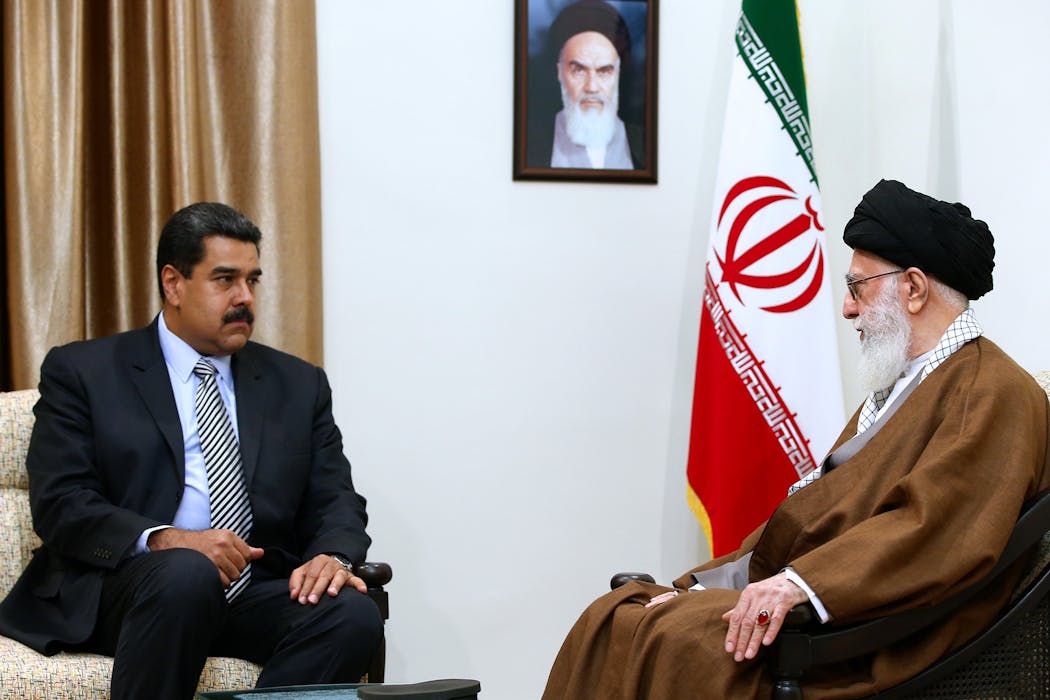
Better days: Venezuelan President Nicolas Maduro, left, met the supreme leader of Iran, Ali Khamenei, in Tehran on Oct. 22, 2016. Pool/Supreme Leader Press Office/Anadolu Agency/Getty Images

Perhaps no one outside of Venezuela or Cuba should care more about the U.S. capture of nominal President Nicolás Maduro than the Islamic Republic of Iran’s supreme leader, Ali Khamenei.

Khamenei and his regime are in trouble, and it’s not clear how they would survive should the Trump administration decide to support the millions who want a new government system without Khamenei and his ilk.

Iran has no state allies that would be willing to intervene militarily on its behalf. Further, its once-powerful network of partner and proxy militias – Lebanese Hezbollah, the Houthi rebels in Yemen, and other members of the Axis of Resistance – has been rendered incapable or reluctant to get involved. And Iran’s economy is in shambles in the midst of an ongoing water crisis with no relief in sight.

Further, the Iranian people have again taken to the streets to air their grievances against harsh economic conditions as well as government corruption, mismanagement and hypocrisy, echoing similar conditions to Venezuela in recent years.

Lastly, President Donald Trump has returned his attention to Iran. On Jan. 2, Trump warned Khamenei that if his forces violently suppress protesters, Iran would be “hit very hard” by the U.S.

Trump’s warning and show of solidarity will likely embolden protesters, which will almost certainly cause Iran’s internal security to crack down harder, as has happened in the past. Such U.S. intervention could lead to the overthrowing of the ayatollah, intended or not. Furthermore, Maduro’s fate demonstrates that the Trump administration is willing to use military force for that purpose if deemed necessary.

As an analyst of Middle East affairs focusing on Iran, I believe that these conditions place Khamenei’s regime under greater threat today than perhaps any other time in its 46-year history.

Protesters and security forces clash in Tehran’s Grand Bazaar in a video released on Jan. 6, 2026.

Growing threats, internal and external

If Khamenei hopes to survive politically or mortally, I believe he has three options.

First, he could capitulate to U.S. demands to halt Iran’s nuclear enrichment program. Second, Iran could sprint toward a nuclear bomb. Lastly, he could flee.

In hopes of restoring deterrence, Khamenei could also continue rebuilding his country’s military capabilities, which were significantly degraded during the June 2025 12-day war in which Israel and the U.S. aimed to destroy Iran’s nuclear capability.

Israel is eager to stifle Iran’s reconstitution plans, protests are spreading and growing more intense, and Trump – through hostile rhetoric and offensive military action – has put Khamenei on notice.

Khameini’s problems aren’t his alone. The revolutionary theocratic system of government that he leads is in danger of falling. And his military and internal security apparatus may not have the time or ability to address its growing and interrelated internal and external threats simultaneously.

There are two fundamental factors analysts like me consider when assessing enemy threats: offensive capability to inflict damage and hostile intentions to use these capabilities to harm enemies.

Determining offensive capability involves evaluating the quality of a country or organization’s complete arsenal – air, ground, maritime, cyber and space capabilities – and how trained, disciplined, integrated and lethal their forces might be. Determining intentions involves evaluating if, when and under what conditions offensive capabilities will be used to achieve their goals.

If states hope to survive when they come under such pressure, their defense strategy should account for differences between their own military capability and the enemy’s, especially if enemies intend to attack. Or states need to convince enemies to be less hostile, if possible.

Maduro’s mistake was his inability to defend against a far superior U.S. military capability while believing that U.S. leaders would not remove him from office. Maduro gambled and lost.

Bad choices

Iran’s supreme leader faces a similar conundrum: First, there is no foreseeable path that allows Tehran to produce or acquire the military capabilities necessary to deter Israel or defeat the United States, unless Iran develops a nuclear weapon.

And decades of mutual hostility, the memory of Iran’s once-clandestine nuclear weaponization program and recent Iranian lawmaker calls to develop nuclear bombs minimizes the prospect that U.S. leaders view Khamenei’s intentions as anything but hostile.

But as the clear weaker party, it is in Tehran’s interest to change Trump’s mind about Tehran’s hostile intent. The way to do that would be by abandoning nuclear enrichment.

In terms of threat analysis, the regime’s oft-repeated chants of “Death to America” and “Death to Israel” perhaps have sent an easily misinterpreted message: that Iran’s hostile leaders intend to destroy the U.S. and Israel. But they simply lack the capability, for now.

President Theodore Roosevelt famously said “speak softly and carry a big stick; you will go far.” Today, he might say that Khamenei is unwise for speaking with such vitriol considering the size of Iran’s stick. The United States and Israel possess military capabilities far superior to Iran’s – as demonstrated by the 12-day war – but they did not then share the same intent. Though both Israel and the U.S. operations shared the objective of neutralizing Iran’s nuclear capability, Israel’s objectives were more broad and included targeting senior Iranian leaders and destabilizing the regime.

To Khamenei’s momentary personal and institutional fortune, Trump immediately called for a ceasefire following U.S. B-2 strikes on Iranian nuclear facilities, delineating the United States’ narrower objectives that at the time did not include regime change in Iran.

But that was before U.S. forces removed Maduro from Caracas and before the outbreak of protests in Iran, both of which coincide with Israel’s signaling preparations for Round 2 against Iran.

A fighter jet taxiing behind a person holding lights.
Israel is telegraphing its ambitions for another attack on Iran; fighter jets like this taxiing F-16I would likely be part of Israel’s next campaign.
Israel Defense Forces (IDF) / Handout/Anadolu via Getty Images)

Iran without Khamenei?

During Trump’s Dec. 29 press conference at Mar-a-Lago with Israeli Prime Minister Benjamin Netanyahu, he warned that the U.S. could “knock the hell” out of Iran if the country reconstitutes its nuclear facilities.

This is separate from the ominuous warning that the U.S. could intervene on behalf of Iranian protesters; it would almost certainly differ in scale.

Nevertheless, a potential U.S. intervention could embolden protesters and further undermine and destabilize the Islamic Republic regime. Khamenei has predictably scoffed at and dismissed Trump’s warning.

I believe this is a serious mistake.

Secretary of State Marco Rubio warned on Jan. 3, 2025, that Khameini should not “play games” as Maduro did. Khamenei, Rubio said, should take Trump’s warnings seriously. I agree.

If Iran refrains from violent crackdowns on protesters, there is a chance that anti-government protestors overthrow the government. But the supreme leader’s chances of surviving a popular uprising are probably greater than surviving an unbridled U.S. or Israeli military intent on ushering in a new – post-Islamic Republic – Iran.

Otherwise, Khamenei has to address superior U.S. and Israeli military capability, quickly. But Iran is broke, and even if sanctions were not continuously strangling Iran economically, the country could probably never purchase its way to military parity with the U.S. or Israel.

Alternatively, Iran could determine that it must move quickly to develop a nuclear weapon to mitigate U.S. and Israeli military capabilities and deter future aggression. However, it is extremely unlikely Iran could do this without U.S. and Israeli intelligence discovering the project, which would immediately trigger an overwhelming military campaign that would likely expedite regime change in Iran.

And like Maduro, the supreme leader is utterly alone. None of Maduro’s closest partners – China, Russia, Cuba and even Iran – were willing to fight in his defense, despite weeks of forewarning and U.S. military buildup near Venezuela.

Under these circumstances, it may be impossible for Khamenei to address overwhelming U.S. and Israeli military capabilities. He could, however, reduce the threat by doing what is necessary to ensure the United States’ objectives for Iran remain narrow and focused on the nuclear program, which may also keep Israel at bay.

However, Khamenei would have to demonstrate unprecedented restraint from cracking down violently on protesters and a willingness to give up nuclear enrichment. Due to historical animosity and distrust toward the U.S., both are unlikely, increasing, I believe, the probability of a forthcoming Iran without Khamenei.

The Conversation

Dr. Aaron Pilkington is a U.S. Air Force Senior Analyst of Middle East affairs and a Fellow at the University of Denver’s Center for Middle East Studies. The views expressed are those of the author and do not reflect the official position of the Department of War, the Department of the Air Force, or any other organizational affiliation.

​Politics + Society – The Conversation

Categories
Health

Jimmy Kimmel Takes The Cognitive Test Donald Trump ‘Aced’ And The Results Spur More Health Questions

After the U.S. president shared the results of his third cognitive exam, Kimmel took the same test and aced it easily. What does this say about Trump’s health?

​Health Digest – Health News, Wellness, Expert Insights

Categories
Politics

House Majority PAC raises record sum ahead of midterms

House Democrats’ biggest outside allies have set a new fundraising record for the organizations that will help boost the party ahead of the 2026 midterms.

House Majority PAC, House Democrats’ main super PAC, and its associated nonprofit raised a combined $121 million in 2025, more than they have in any previous non-election year dating back to HMP’s 2011 founding.

The pair of groups raised a combined $81 million in the final six months of 2025, doubling its haul during the first six months of the year — a sign of donors’ growing optimism for the party tied to its overperformance in a slate of off-year elections. The numbers were first shared with POLITICO.

“As Democrats continue to expand the map and build momentum for the 2026 midterms, we could not be more excited to announce our record-breaking fundraising in 2025,” said House Majority PAC President Mike Smith. “We look forward to taking back the House in 2026.”

For comparison, House Majority PAC raised $72 million for the entire 2018 election cycle. The group didn’t launch its affiliated nonprofit until 2019. In 2023, the groups raised a combined $76 million.

House Majority PAC, closely aligned with House Democratic leadership, is often the biggest outside spender on the left in House races. Raising cash can help fuel candidates across the congressional map, but it’s not the only decisive factor in a cycle reshaped by aggressive redistricting across the country. Nonetheless, Democrats are increasingly bullish about their chances, pointing to their recent double-digit victories in last fall’s off-year elections.

It’s also not clear if Democrats will hold a cash advantage in outside spending. Congressional Leadership Fund, the super PAC affiliated with Republican House leadership, has not yet released its fundraising totals. CLF and its affiliated nonprofit, American Action Network, outraised its Democratic counterparts over the first six months of 2025, $60 million to $40 million.

House Majority PAC did not release its cash on hand totals, so it’s not clear how much they have in the bank to spend on campaigns in 2026. The super PAC will file its next disclosure on Jan. 31, but its nonprofit will not file until late 2026.

​Politics

Categories
Featured Juneau News Juneau Local Ketchikan Local News Feeds Sitka Local

Landslide bill puts new focus on atmospheric rivers like those that triggered deadly Alaska events

By: Yereth Rosen, Alaska Beacon

The deadly landslide that crashed through the outskirts of Wrangell on the night of Nov. 20, 2023, is seen from the air on the following day. The landslide killed six people and blocked a major road, the Zimovia Highway. The slide was triggered by heavy rain carried north by an atmospheric river. (Photo provided by Alaska Department of Transportation and Public Facilities)

Future assessments of U.S. landslide hazards could include the study of risks posed by atmospheric rivers, which caused extreme precipitation that was linked to recent deadly slides in Southeast Alaska.

The added focus on atmospheric rivers is one of the main updates in a bill that would reauthorize the National Landslide Preparedness Act. The bill, sponsored by U.S. Sen. Lisa Murkowski, R-Alaska, passed the U.S. Senate on Monday and is now to be considered by the U.S. House.

The initial National Landslide Preparedness Act was signed into law five years ago. That bill broadened the National Landslide Hazards Program led by the U.S. Geological Survey and established a multiagency system to coordinate landslide preparedness and response.

Atmospheric rivers are long and transitory bands of moisture and heat, likened to rivers in the sky. They carry that moisture northward from more southern latitudes, and they can dump vast amounts of rain for several hours or even days.

“You can very rapidly saturate soils in the right conditions,” said Rick Thoman, a scientist with the Alaska Center for Climate Assessment and Preparedness at the University of Alaska Fairbanks.

When such large amounts of warm southern moisture hit the steep mountainous regions of Southeast Alaska, they can cause sudden downhill flows, Thoman said.

“It’s really that intense amount of rain that atmospheric rivers deliver that’s the link to landslides,” he said.

Numerous landslides in the United States have been triggered by atmospheric rivers’ extreme precipitation. Those events include the 2023 slide in Wrangell that killed six people, the 2020 slide in Haines that killed two people and the 2015 slide in Sitka that killed three people.

The National Landslide Preparedness Act Reauthorization Act passed the Senate by unanimous consent. It is co-sponsored by U.S. Sen. Maria Cantwell, D-Washington, whose state was the site of the 2014 Oso landslide that killed 43 people.

Extreme precipitation events from atmospheric rivers are tied to shallow-seated landslides such as the deadly events that struck Southeast Alaska in recent years. Other types of Alaska landslides are caused by more deep-seated slope failures triggered by glacial retreat, permafrost thaw or a combination of those forces.

Also passed on Monday by unanimous consent in the Senate was another Murkowski-sponsored and disaster-focused bill, the National Earthquake Hazards Reduction Program Reauthorization Act. That bill, co-sponsored by U.S. Sen. Alex Padilla, D-California, supports the federal program that maintains earthquake measurement resources and equipment and equipment and early warning systems.

“Earthquakes and landslides are active threats that have taken lives and damaged property across Alaska in recent years,” Murkowski said in a statement issued Tuesday. “Our passage of these bills puts us on track to ensure that federal agencies have the resources they need to help keep communities safe both back home and around the country. I thank my colleagues for working cooperatively to pass these measures and urge the House to take them up and send them to the President as soon as possible.”

Categories
Politics

Colorado faces a funding crisis for child care − local communities hope to fill the gaps

A 2024 Colorado report found that 40,000 parents either quit a job, turned down a job or significantly changed a job due to child care problems. Michael M. Santiago/Getty Images

Colorado is the sixth-least affordable state for child care in the nation. Costs for center-based care average 14% of a two-parent household’s median income and 45% of a single parent’s median income. The federal affordability benchmark is just 7%.

Colorado also faces significant shortages in access to slots in licensed child care programs. In 2023, more than 40,000 Colorado parents reported quitting a job, turning down a job or significantly changing a job because of problems with child care.

Recently, several Colorado counties passed measures to subsidize child care through local taxes. Despite these advancements, Colorado’s child care system is facing a fiscal crisis that is likely to affect families and children for years to come.

Child care disruptions for families with infants and toddlers are estimated to cost the state more than US$2.7 billion in lost economic productivity and revenue. Ensuring access to affordable child care supports workforce participation and enhances the well-being of children and families.

I study early care and education policies and programs that promote children’s cognitive, behavioral and social-emotional learning. My research lab at Colorado State University has been investigating the consequences of a lack of access to high-quality, affordable child care on child and family outcomes.

Colorado’s Child Care Assistance Program

Since the late 1990s, the Colorado Child Care Assistance Program has subsidized the cost of child care for parents and caregivers with lower incomes who are working, searching for work or pursuing education. My research shows these subsidies are a critical lifeline that help lower-income families access child care.

Subsidies allow families to prioritize factors other than cost, such as location, in their search for child care. From 2023 to 2024, the Colorado subsidy program served more than 30,000 children in the state. That’s about 10% of those who qualified, which is typical for most states.

A federal March 2024 rule from the Administration for Children and Families caps family co-payments at no more than 7% of household income. It also requires reimbursement rates to reflect the full cost of care, whereas previously subsidy payments were based on what families could afford to pay.

Although intended to improve affordability for families and adequately compensate child care programs, the rule included no additional federal funding. In Colorado, meeting these new requirements is projected to cost the subsidy system approximately $43 million more per year.

These changes, combined with the expiration of COVID-19 relief funding that provided Colorado an additional $465 million to stabilize and expand child care assistance, has created growing financial instability for the subsidy system.

Approximately one-third of Colorado counties are experiencing an enrollment freeze for their child care subsidies. This means new applicants cannot access subsidized care until the freeze is lifted. There is no set timeline for when that will occur.

Without additional funding that would allow the freeze to be lifted, enrollment in Colorado’s Child Care Assistance Program is estimated to decline by 64%, falling from about 30,000 to just 10,000 enrollees. As children age out or families no longer qualify, spots that would normally open up for new enrollees will remain unfilled during the freeze.

Zooming in on Larimer County

I have been studying the impacts of the enrollment freeze in my hometown of Larimer County, Colorado. It’s a geographically diverse region that includes urban centers such as Fort Collins and Loveland, mountain destinations such as Estes Park, and rural agricultural communities. Like elsewhere in the state, child care costs pose a significant financial strain on local families.

A household in Larimer County with a median income of $64,919 and two children under the age of 5 spends approximately 37% of its income on child care. Due to budget constraints, Larimer County has had an enrollment freeze in the Colorado Child Care Assistance Program since February of 2024. The county has effectively paused the intake of new applicants for subsidies.

The outside of a building that says KinderCare Learning Center.
In Larimer County, Colorado, a household with two children under the age of 5 and an income of just under $65,000 spends about 37% of its income on child care.
UCG/GettyImages

Recently, we administered surveys to 88 families in Larimer County. Approximately half of those surveyed were currently receiving a subsidy and half had applied but were unable to access it because of the freeze. We compared families using advanced statistical modeling that controlled for any differences between groups, allowing us to isolate the effects of the subsidy freeze on family outcomes.

In unpublished research that is being prepared for peer review, we found families affected by the freeze used fewer paid child care hours, faced higher costs, expressed greater concerns about costs, and reported more difficulty paying for care. They also had less reliable and stable arrangements, were less satisfied with their care, experienced higher child care-related stress and displayed greater risk of depression.

But that’s not all. Families without a subsidy reported missing twice as many workdays. When extrapolated across the 425 families in Larimer County affected by the freeze, this translated to over $2.2 million in lost annual earnings.

Local initiatives driving solutions

Recognizing the gaps in affordable child care, counties across Colorado introduced ballot measures to fund local solutions through tax revenue.

These measures come after the state established a universal preschool program in 2022. The following year, the program provided up to 15 hours per week of tuition-free, high-quality preschool for more than 85,000 children.

Measures in Larimer, San Miguel, Garfield, Pitkin and southwest Eagle counties will directly fund child care through sales or property taxes. Measures in Gilpin, Hinsdale, Ouray and Eagle counties will generate funds through lodging taxes.

In Larimer, voters passed a measure that established an additional countywide sales tax of 0.25%, or 25 cents per 100 dollars. The measure is expected to generate $28 million annually for child care assistance and workforce compensation.

A CBS News report on Larimer County’s measure to increase taxes to support child care.

In San Miguel, voters passed an existing property tax of 75 cents for every 1,000 dollars of assessed property value, allowing the county to collect and use all the revenue it generates instead of being limited by a new state cap. This will allow the county to retain nearly $1 million annually to support local child care affordability.

In Eagle County, voters passed a measure approving a lodging tax increase from 2% to 4% on hotel stays and short-term rentals that will raise approximately $4.5 million annually to lower child care costs.

Revenue from these initiatives will provide child care tuition to families, expand child care slots, support quality improvement and raise wages for child care workers.

These local investments cannot by themselves resolve Colorado’s statewide child care funding deficit, but they have the potential to transform access and quality within communities where they are implemented.

Colorado is not alone in these issues. Many other states are facing subsidy enrollment freezes and are exploring regional solutions to stabilize funding.

For example, ballot measures in Cincinnati, Ohio, and Seattle, Washington, also recently passed, providing reliable funding for child care assistance, preschool quality and workforce compensation.

With the uncertainty of the state and federal funding landscape, municipalities across the country may look to Colorado as a model for locally driven strategies that address community needs.

Read more of our stories about Colorado.

The Conversation

Jenn Finders has received funding from the National Science Foundation, Indiana Family and Social Services Administration, and North Central Regional Center for Rural Development.

​Politics + Society – The Conversation

Categories
Politics

2026 begins with an increasingly autocratic United States rising on the global stage

Explosions are seen at Fort Tiuna, Venezuela’s largest military complex, Jan. 3, 2026. Luis Jaimes/AFP via Getty Images

The U.S. military operation in Venezuela and capture of President Nicolás Maduro on Jan. 3, 2026, topped off months of military buildup and targeted strikes in the Caribbean Sea. It fulfills President Donald Trump’s claim to assert authoritative control over the Western Hemisphere, articulated in his administration’s 2025 National Security Strategy.

Some national security experts say U.S. military action in Venezuela – taken without U.S. congressional approval or U.N. Security Council authorization – is unlawful. It may violate domestic and international law.

The Venezuela attack represents the clearest example during Trump’s second presidency of the shift from traditional American values of democratic freedom and the rules-based international order to an America exerting unilateral power based purely on perceived economic interests and military might. Autocratic leaders are unconstrained by law and balance of power, using force to impose their will on others.

So, what does this transition from a liberal America in the world to an autocratic U.S. look like? After decades of working internationally on democracy and peace-building, I see three interrelated areas of long-standing U.S. foreign policy engagement being unraveled.

1. Peace and conflict prevention

The Trump administration’s actions in Venezuela reflect its “peace through strength” approach to international relations, which emphasizes military power. The actions also follow the emphasis the administration places on economic pressure and wins as a deterrent to war and a cudgel for peace.

This approach contrasts with decades of diplomatic efforts to build peace processes that last.

Foreign policy experts point out that the Trump administration’s emphasis on business deal-making in its conduct of foreign relations, focused on bargaining between positions, misses the point of peacemaking, which is to address underlying interests shared by parties and build the trust required to tackle the drivers of conflict.

Trump’s focus on deal-making also counters the world’s traditional reliance on the U.S. as an honest broker and a reliable economic partner that supports free trade. Trump made it clear that U.S. interest in oil is a key rationale for the Venezuela attack.

A video still shows an oil tanker.
This image from video posted on Attorney General Pam Bondi’s X account shows an oil tanker being seized by U.S. forces off the coast of Venezuela on Dec. 10, 2025.
U.S. Attorney General’s Office/X via AP

Before Venezuela, the limits of the Trump administration’s approach were already showing in the global conflicts Trump claims to have halted. That’s evident in ongoing violence between Thailand and Cambodia and in ceasefire violations in the Democratic Republic of Congo.

Moreover, U.S. expertise and resources for sustainable peacemaking and preventing conflict are gone.

The entire Bureau of Conflict Stabilization Operations in the U.S. Department of State was dismantled in May 2025, while funding for conflict prevention and key peace programs like Women, Peace and Security was cut.

Trump’s unilateral military action against Venezuela belie an authentic commitment to sustainable peace.

While it’s too soon to predict Venezuela’s future under U.S. control, the Trump administration’s approach is likely to drive more global conflict and violence in 2026, as major powers begin to understand the different rules and learn to play the new game.

2. Democracy and human rights

Since the 1980s, U.S. national security strategies have incorporated aspects of democracy promotion and human rights as U.S. values.

Trump has not highlighted human rights and democracy as rationales for capturing Maduro. And, so far, the administration has rejected claims to the Venezuelan leadership by opposition leader María Corina Machado and Edmundo González, widely considered the legitimate winner of the 2024 presidential election.

Much of the U.S. foreign policy to build democracy globally and promote human rights was delivered through foreign assistance, worth over US$3 billion in 2024. The Trump administration cut that by nearly 75% in 2025.

These funds sought to promote fair elections, supporting civil societies and free media globally. They were also meant to help enable independent and corruption-free judiciaries in many countries, including Venezuela.

Since 1998, for example, the U.S. has funded 85% of the annual $10 million budget of the U.N Voluntary Fund for Victims of Torture. The fund, now imperiled, helps survivors recover from torture in the U.S. and around the world.

The congressionally mandated annual Human Rights Report issued by the State Department in August signaled the Trump administration’s intent to undermine key human rights obligations of foreign governments.

However, the White House has used tariffs, sanctions and military strikes to punish countries on purported human rights-related grounds, such as in Brazil, Nigeria and South Africa. Equally concerning to democracy defenders is its rhetoric chastising European democracies and apparent willingness to elevate political parties in Europe that reject human rights.

3. International cooperation

A major aim of U.S. foreign policy has traditionally been to counter threats to America’s security that require cooperation with other governments.

But the Trump administration is ignoring or denying many transnational threats. They include terrorism, nuclear proliferation, pandemics, new technologies and climate change.

Moreover, the tools that America helped build to tackle shared global threats, like international law and multilateral organizations such as the United Nations, have been disparaged and undermined.

Even before the U.S. attack on Venezuela, scholars were warning of the collapse of the international norm, embedded in the U.N. Charter, that prohibits the use of force by one sovereign country against another, except in specific cases of self-defense.

Early in 2025, Trump signaled an end to much of U.S. multilateral engagement, pulling the country out of many international bodies, agendas and treaties.

A man rips an American flag in half.
Venezuelans rip an American flag in half during a protest in Caracas on Jan. 3, 2026.
AP Photo/Ariana Cubillos

The administration proposed eliminating its contributions to U.N. agencies like the fund for children. It is also allocating only $300 million this year to the U.N., which is about one-fifth of the membership dues it owes the organization by law. A looming budgetary crisis has now consumed this sole worldwide deliberation body.

Meanwhile, the Trump administration says migration and drug trafficking, including from Venezuela, pose the greatest security threats. Its solutions – continuing U.S. economic and military might in the Americas – ignore shared challenges like corruption and human trafficking that drive these threats and also undermine U.S. economic security.

There is also evidence that the Trump administration is not only disregarding international law and retreating from America’s long-standing respect for international cooperation, but it’s also seeking to reshape policy in its own image and punish those it disagrees with.

For example, its call to reframe global refugee protections – to undermine the principle that prohibits a return of people to a country where they could be persecuted – would alter decades-old international and U.S. domestic law. The Trump administration has already dismantled much of the U.S. refugee program, lowering the cap for 2025 to historic levels.

Even for those who work in international institutions, there could also be a price to pay for an illiberal America. For instance, the Trump administration has economically sanctioned many judges and prosecutors of the International Criminal Court for their work.

And the administration has threatened more sanctions unless the court promises not to prosecute Trump – a more salient challenge now with the apparent U.S. aggression against Venezuela, which is a party to the International Criminal Court.

Some democracy experts worry that the U.S. military action in Venezuela not only undermines international law, but it may also serve to reinforce Trump’s project to undo the rule of law and democracy at home.

The Conversation

Until July 1, 2025, Shelley Inglis served in the Bureau for Democracy, Human Rights, and Governance at the United States Agency for International Development (U.S.A.I.D).

​Politics + Society – The Conversation