A weekend of protests and counter-protests outside hotels housing asylum seekers began last night, with dozens expected today.The Latest News from the UK and Around the World | Sky News

AP- Alaska medical professionals who provide gender-affirming care could risk disciplinary action under a proposal set for review by the state medical board on Friday.
The proposal would deem any professional who uses hormonal and surgical treatments for minors “as being grossly negligent” and subject to sanctions by the board, according to the board’s minutes from a June meeting.
The type and extent of disciplinary actions were not spelled out, and board member Matt Heilala, an Anchorage podiatrist who was helping write the proposed regulations, declined to discuss the details Thursday with The Associated Press ahead of the meeting.
The move comes after the board in March sent a letter to state lawmakers expressing opposition to hormonal or surgical gender-affirming care for minors and urging legislators to enact limits on treatments. The Legislature — controlled by bipartisan majorities in both the House and Senate — didn’t take up the issue before adjourning in May.
Critics worry the board is overstepping its authority in pursuing regulations that could leave medical providers open to possible disciplinary actions. Instead of allowing the legislative process to play out, “they are now becoming the legislators themselves, which is inappropriate,” said state Sen. Löki Tobin, a Democrat who has been outspoken in support of the LGBTQ+ community.
The medical board at a June meeting designated member Heilala to help draft a statement for consideration that would pertain to declaring those providing the care “as being grossly negligent and therefore subject to disciplinary sanctions,” according to the minutes of that meeting.
Heilala declined to discuss the specific language stemming from that directive that the board would consider Friday but told the AP that the proposed rules would go through a deliberate and transparent process for the public. Such processes can take months, he said.
Gender-affirming care includes a range of medical and mental health services to support a person’s gender identity, including when it’s different from the sex they were assigned at birth. It encompasses counseling, medications that block puberty and hormone therapy to produce physical changes as well as surgeries to transform chests and genitals, though those are extremely rare for minors.
Most major medical groups say access to the treatment is important for those with gender dysphoria and see gender as existing along a spectrum. While there’s wide, if not universal, medical consensus, the political situation is contentious.
In Texas, Republican Gov. Greg Abbott had issued an order allowing the state to investigate parents of transgender youth for child abuse. But a Texas judge in 2022 blocked the state from investigating families of transgender youths who have received such care and members of the LGBTQ advocacy group PFLAG Inc. over such medical care.
Tom Pittman, executive director of Identity Inc., an Anchorage-based advocacy and health care organization for the LGBTQ+ community, said about 500 Alaska medical professionals have signed an open letter opposing the changes being considered by the board.
The letter campaign organized by Pittman’s group said gender-affirming care for adolescents, when provided in partnership with families, is evidence-based medicine.
“Labeling it ‘negligence’ is not a medical conclusion. It is a political act with devastating consequences: punishing clinicians, undermining parents, and denying young people lifesaving treatment,” the letter states.
Fewer than 100 youth are receiving such gender-affirming care, Pittman said.
Pittman called Heilala’s actions politically motivated, saying he “has co-opted Alaska’s medical board and institution to launch a bid for governorship, and he’s using scapegoating and discrimination against what is a very small vulnerable population of Alaskans to create a bully pulpit for himself.”
Heilala is one of at least eight Republicans to announce plans to run for governor next year. But he said this is an issue the board has been working on for some time and “has nothing to do with my running at all.”
By: James Brooks, Alaska Beacon

The Alaska Bar Association has voted to recommend that former U.S. District Court Judge Joshua Kindred be disbarred in Alaska.
Kindred, appointed by President Donald Trump to serve as a federal judge here, resigned last year from the federal bench after investigators found that he had a “sexualized relationship” with a clerk who became a prosecutor and lied about it to a senior judge and investigators, and maintained a hostile workplace for law clerks.
Since that investigation, additional improprieties connected to the U.S. attorney’s office have come to light.
On Thursday, the bar association’s board of governors voted without dissent to recommend that Kindred be disbarred, forbidden from practicing law in the state. The bar association regulates attorneys across Alaska.
The board’s recommendation will go to the Alaska Supreme Court, which must make the final determination. No date has been set for when the court will consider the issue.
Kindred, whose law license is “inactive” according to the bar association’s database, did not participate in the investigation that preceded Thursday’s hearing, said Rebecca Patterson, president of the bar association’s board.
Louise Driscoll, assistant counsel for the bar association, said the association received “lots of calls” when the investigation into Kindred was revealed to the public.
Typically, she said, the association prefers to act when a grievance is filed by someone other than the association’s own counsel, but in this case, the association’s counsel filed the grievance itself in November.
The subsequent investigation, she said, was slowed by the fact that Kindred didn’t respond to requests for a response to the grievance. He no longer lived at his address on file. He had left the federal court. Former acquaintances didn’t know where he was.
Eventually, Driscoll said, a process server found Kindred sitting on the couch at his mother’s house.
“It was Mr. Kindred’s mother who answered the door and accepted service, but you could see Mr. Kindred on the sofa, so he was on notice,” she said.
Even then, Kindred didn’t respond, and in June, a committee recommended that Kindred be disbarred.
Driscoll said the committee considered it “very serious” that Kindred had lied to federal investigators about his activities.
“Lawyers are expected to be honest, and the members of the public have a reason to consider that they will be dealing with honest counsel,” she said.
Kindred’s actions, she added, have caused real harm — there are dozens of cases whose outcomes are now in doubt because Kindred failed to disclose conflicts of interest.
In addition, Kindred’s resignation has left only one active judge on Alaska’s district court bench.
“There’s been grievous harm,” Driscoll said of Kindred’s actions.
In a footnote to the disbarment recommendation, the committee said, “We enter our decision not with any joy. It is our collective hope Mr. Kindred can recover emotionally, financially and physically notwithstanding the hardships Mr. Kindred confronts.”
On Thursday, after Driscoll’s suggestion, the board of governors deleted that footnote.
Kindred, they concluded, should receive no more special courtesy than any other attorney facing the same accusations.

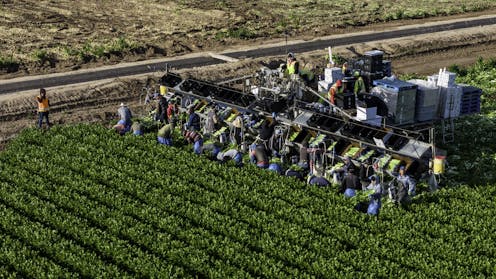
The Trump administration’s mass deportation campaign has not spared the U.S. agricultural industry, with agents from Immigration and Customs Enforcement frequently raiding farms across the country in search of undocumented workers.
Now, farmers are facing a crisis the administration has helped create: not enough people to pick crops.
On a recent call to CNBC, President Donald Trump said, “We can’t let our farmers not have anybody.” To assure farmers that he had their back despite the immigration raids, he sought to distinguish immigrants he called “criminals” and “murderers” from nonthreatening farm laborers who have been picking crops for years.
To do so, Trump used an old stereotype for farmworkers: “These people do it naturally, naturally.” Trump recounted asking a farmer: “What happens if they get a bad back? He said, ‘They don’t get a bad back, sir, because if they get a bad back, they die.’”
“In many ways, they’re very, very special people,” said Trump, referring to undocumented farmworkers.
Trump is labeling some of the people his administration has targeted for deportation as naturals.
As a historian of American agriculture and labor, I think the Trump administration’s contradictions on farmworkers are part of a long history of idealizing farming in America. It’s a history in which race, nature, exploitation and the very identity of America itself have all been involved.
Thomas Jefferson, most famous for writing the Declaration of Independence, also declared, “Those who labour in the earth are the chosen people of God.”
Jefferson thought America’s true calling was to be an agrarian nation, for virtuous and independent farmers would also be perfect citizens. But Jefferson didn’t actually get his own hands dirty. He told John Quincy Adams that he “knew nothing” about farming.
The Founding Father Alexander Hamilton, in the musical “Hamilton,” crystallized the critiques against what came to be called “Jeffersonian agrarianism,” which praises agricultural life and the virtues of farmers, but fails to acknowledge it was not the planters who did the backbreaking work: “‘We plant seeds in the South. We create.’ Yeah, keep ranting: We know who’s really doing the planting.”
The image of America built up by white farmers contrasted with a reality that “those who labour in the earth” were often enslaved people. As the cotton empire expanded, so did slavery.
Apologists for this system of inequality argued that the “natural station” of Black people was to be enslaved. Black people were portrayed as natural manual laborers – and by extension, the institution of slavery itself was defended as natural, rather than an abrogation of the “natural rights” promised to all men in the Declaration of Independence.
American agricultural leaders in the early 20th century, as I document in my book “Orange Empire,” adapted these forms of “naturalization” – the process, as developed by cultural theorists, through which man-made things such as racial hierarchies are made to appear natural.

In this naturalizing mode, the Los Angeles Chamber of Commerce argued in 1929 that “much of California’s agricultural labor requirements consist of those tasks to which the oriental and Mexican due to their crouching and bending habits are fully adapted, while the white is physically unable to adapt himself to them.”
As I describe in my book, the president of the citrus growers cooperative Sunkist insisted in 1944 that Mexicans “are naturally adapted to agricultural work, particularly in the handling of fruits and vegetables.”
Through this naturalization, racism appeared to be made in nature. Everything in farming – all of the food grown in what author Carey McWilliams called “factories in the field” in his 1939 exposé – was carefully constructed by farmers, their lobbyists and their advertisers to appear natural. That includes the racism and labor exploitation at the heart of it.
While naturalizing workers as evolutionarily adapted to stoop labor, this system all but denied undocumented farmworkers legal access to the other kind of naturalization: becoming full citizens.
So when anti-immigrant ideology sparks ICE raids and deportations, the nation’s farms end up losing the labor they have long relied on.
On X, the U.S. Department of Homeland Security has been presenting itself as if it’s on a mission to secure a white homeland. It has posted videos of white people enjoying America’s natural wonders to the tune of Woody Guthrie’s “This Land is Your Land” and paintings that propagandize manifest destiny, the idea that the U.S. is destined to extend its dominion across North America.
Homeland Security recently posted John Gast’s 1872 painting “American Progress” as a “Heritage to be proud of.” It depicts a luminous white goddess flying west over the American landscape, with white farmers plowing the soil beneath, while petrified Native Americans, shrouded in darkness, are being chased from their homelands.
As I and others have pointed out, Homeland Security is using coded messages to affirm white supremacists’ vision of turning America into a white homeland.
On the ground in America today, nonwhite immigrants are fleeing from immigration agents, as if the Gast painting is coming to life. The United Farm Workers union, referring to “videos of agents chasing farm workers thru the field,” says that “workers are terrorized.” One worker said they are “being hunted like animals.”
Trump told CNBC that he does not believe that “inner city” people can come to the rescue of farmers, whose source of labor has been decimated.
As Politico reports, Trump is now floating the idea of expanding an existing visa program for temporary agricultural workers and creating a new program that requires them to leave the U.S. before reentering legally. If so, he would essentially be reinventing the Bracero Program – the U.S. guest worker program with Mexico created at the behest of California growers during World War II that lasted until the 1960s.

Ian Chandler is an Oregon farmer whose cherries are rotting on the trees because he’s lost the farmworkers who normally pick them. He recently told CNN that these people “are part of our community, just like my arm is connected to my body, they are part of us. So it’s not just a matter of like cutting them off … if we lose them we lose part of who we are as well.”
The Spanish word bracero roughly translates to someone who works with their arms, but the earlier guest worker program didn’t have the same inclusive meaning Chandler intends. Instead, it racialized Mexicans as natural farmworkers, as mere brawn extracted from human beings who were otherwise excluded from the community.
As historian S. Deborah Kang notes, “Sumner Welles, former under secretary of state to President Franklin Delano Roosevelt, excoriated the ‘poisoning discriminations’ faced by bracero workers and equated their experiences with the ‘Juan Crow’ racism.”
Over the course of its history, many Americans have held out hope that the U.S. would create a farming nation that lives up to the original promise of an organic democracy – the democracy Jefferson mythologized and one where all Americans are included – built from the ground up.
As historians Camille Guerin-Gonzales and Lori Flores have shown, farmworkers, whatever their official status, have worked hard to find “grounds for dreaming” in America.
Making that American dream a reality involves seeing farmworkers for who they are, I believe: vital members of the body politic who reconnect all Americans to nature through the foods they eat.
![]()
Doug Sackman does not work for, consult, own shares in or receive funding from any company or organization that would benefit from this article, and has disclosed no relevant affiliations beyond their academic appointment.
Politics + Society – The Conversation
Congressional redistricting – the process of drawing electoral districts to account for population changes – was conceived by the Founding Fathers as a once-per-decade redrawing of district lines following the decennial U.S. census. Today it has devolved into a near-constant feature of American politics – often in response to litigation, and frequently with the intent of maintaining or gaining partisan advantage.
Polls show widespread public disapproval of manipulating political boundaries to favor certain groups, a process known as gerrymandering. However, we currently see little hope of preventing a race to the bottom, where numerous states redraw their maps to benefit one party in response to other states drawing their maps to benefit another party.
The most recent round of tit-for-tat gerrymandering began in Texas. After drawing their post-census congressional maps in 2021, Republicans in the Texas Legislature, at President Donald Trump’s behest, are advancing a new set of maps designed to increase the number of Republican congressional seats in their state. The goal is to help Republicans retain control of the U.S. House of Representatives in the 2026 midterm elections by converting five Democratic seats to ones that will likely result in a Republican victory.
In response, California Democratic Gov. Gavin Newsom is pushing to redraw his state’s map. Under Newsom’s plan, Democrats could gain five House seats in California, offsetting Republican gains in Texas. The California Legislature approved the new maps on Aug. 21 and Gov. Newsom signed the bills that day. Next, the maps will be presented to California voters on the November 2025 ballot for approval.
Newsom vows that he isn’t trying to disband the independent redistricting process that California enacted in 2021. Rather, he proposes to shift to these partisan gerrymandered maps temporarily, then return to independent, nonpartisan redistricting in 2031.
Democrats in Illinois and New York, and Republicans in Indiana, Missouri and South Carolina, have signaled that they may follow Texas and California’s leads. Based on our research on politics and elections, we don’t expect that the wave will stop there.
Redistricting has always been an inherently political process. But the advent of widespread, easily accessible computer technology, increasingly predictable voting patterns and tight partisan margins in Congress have turbocharged the process.
There are ways to tweak this gerrymandering run amok and perhaps block a bad map or two. But none of these approaches are likely to stop partisan actors entirely from drawing maps to benefit themselves and their parties.
The most obvious strategy would be to create guardrails for the legislators and commissions who draw the maps. Such guidelines often specify the types of data that could be used to draw the maps – for example, limiting partisan data.
Anti-gerrymandering rules could also limit the number of political boundaries, such as city or county lines, that would be split by new districts. And they could prioritize compactness, rather than allowing bizarrely-shaped districts that link far-flung communities.
These proposals certainly won’t do any harm, and might even move the process in a more positive direction, but they are unlikely to end gerrymandering.
For example, North Carolina had an explicit limitation on using partisan data in its 2021 mapmaking process, as well as a requirement that lawmakers could only draw maps in the North Carolina State Legislative Building. It was later revealed that a legislator had used “concept maps” drawn by an aide outside of the normal mapmaking process.
In a world where anyone with an internet connection can log onto free websites like Dave’s Redistricting to draw maps using partisan data, it’s hard to prevent states from incorporating nonofficial proposals into their maps.
A second way to police gerrymandering is to use the courts aggressively to combat unfair or discriminatory maps. Some courts, particularly at the state level, have reined in egregious gerrymanders like Pennsylvania’s 2011 map, which was overturned in 2018.
At the national level, however, the U.S. Supreme Court ruled in Rucho v. Common Cause in 2019 that partisan gerrymandering claims presented “political questions beyond the reach of the federal courts” and ultimately were better suited to state courts. There are still likely to be claims in federal courts about racial dilution and other Voting Rights Act violations in gerrymanders, but the door to the federal courthouse for partisanship claims appears to be closed for the time being.
A third option is for states to hand map-drawing power to an independent body. Recent studies show that independent redistricting commissions produce maps that are more competitive and fairer. For example, a nonpartisan scholarly review of the 2021-2022 congressional and state legislative maps found that commissions “generally produce less biased and more competitive plans than when one party controls the process.”
Commissions are popular with the public. In a 2024 study with political scientists Seth McKee and Scott Huffmon, we found that both Democrats and Republicans in South Carolina preferred to assign redistricting to an independent commission rather than the state Legislature, which has been in Republican control since 2000.
Studies using national polling data have also found evidence that redistricting commissions are popular, and that people who live in states that use commissions view the redistricting process more positively than residents of states where legislators draw congressional lines.
While redistricting commissions are popular and effective in states that have adopted them, current actions in California show that this strategy can fail if it is embraced by some states but not others.
Unfortunately, there is no simple solution for tit-for-tat gerrymandering. Litigation can help at the margins, and independent redistricting can make a difference, but even the best intentions can fail under political pressure.
The only wholesale solution is national reform. But even here, we are not optimistic.
A proportional representation system, in which seats are divided by the portion of the vote that goes to each party, could solve the problem. However, removing single-member districts and successfully implementing proportional representation in the United States is about as likely as finding a hockey puck on Mars.
A national ban on gerrymandering might be more politically palatable. Even here, though, the odds of success are fairly low. After all, the people who benefit from the current system would have to vote to change it, and the filibuster rule in the Senate requires not just majority but supermajority support.
So, brace for what’s about to come. As James Madison famously observed, forming factions – groups of people united by a common interest that threatens the rights of others – is “sown in the nature of man.”
Gerrymandering helps factions acquire and retain power. If U.S. leaders aren’t willing to consider a national solution, it won’t disappear anytime soon.
![]()
The authors do not work for, consult, own shares in or receive funding from any company or organization that would benefit from this article, and have disclosed no relevant affiliations beyond their academic appointment.
Politics + Society – The Conversation
Reading Time: 5 minutes
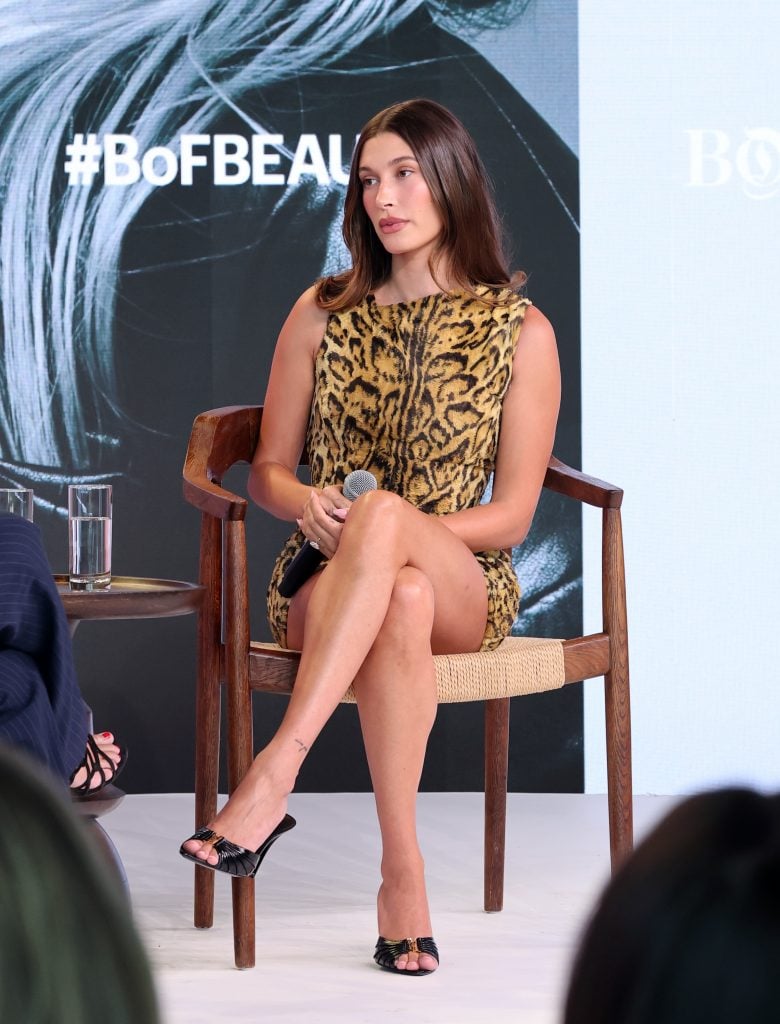
Hailey Bieber is the target of a bizarre form of harassment called “transvestigation.”
This week, as we reported on the state of the Bieber marriage, we of course took a look at recent social media posts.
A glaring and alarming detail stuck out: a large number of comments claiming or implying that Hailey is transgender.
This sounds like a bigoted attack against the transgender community and a personal attack against Hailey. What’s going on?

Sadly, transvestigator is not a term for a nonbinary noir detective. It really should be.
Rather, there are people who believe that many or even all celebrities and public figures are secretly transgender.
Targets include but are not limited to people saying this about politicians, the British royal family (yes, including Charles and Elizabeth), pop stars, and more.

If it sounds QAnon-adjacent, it’s because it is. There’s considerable overlap.
As you can see from the numerous — yet far from exhaustive — list of examples that we have included, there are some people who are transvestigating Hailey Bieber.
To be clear, that does not mean that they are combing over evidence like a person would during an actual investigation.
“Transvestigators” use absurd and often manufactured-on-the-spot definitions of sex-related physical features to determine which public figures they believe to be transgender.
Something as simple as long legs or thick eyebrows can be sufficient.
These folks will take family photos of public figures and scribble over them to claim that skull measurements and limb lengths “prove” their point.
It’s all nonsense, but that doesn’t mean that it isn’t harmful.

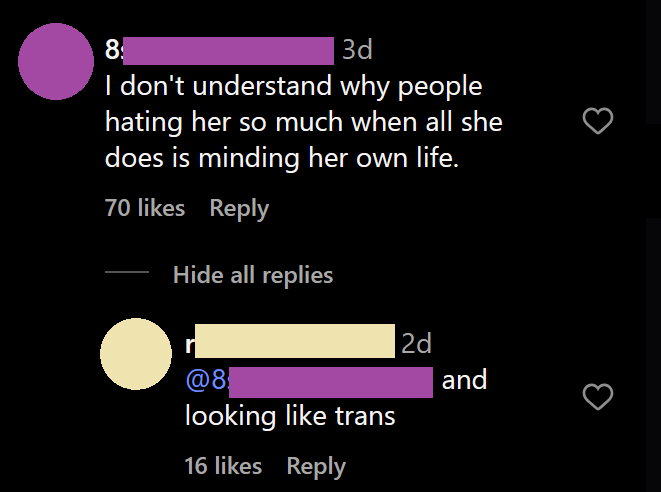
Specifically, Hailey Bieber is getting bombarded with comments under multiple Instagram posts.
THG‘s initial look into these harassing comments finds that they go back weeks. It is likely that this began some time ago.
The harassment takes two principal forms: explicit transphobia and thinly veiled transphobia.

Some messages couple the “accusation” with explicit transphobia, with claims that Hailey looks like a “man.”
They might name a specific man (like her father, the infamous Stephen Baldwin, or like reviled politician Vladimir Putin).
Others simply write “man.”
Obviously, this would be a bigoted statement when aimed at a trans woman or at a cis woman. Hailey, however, is cis.

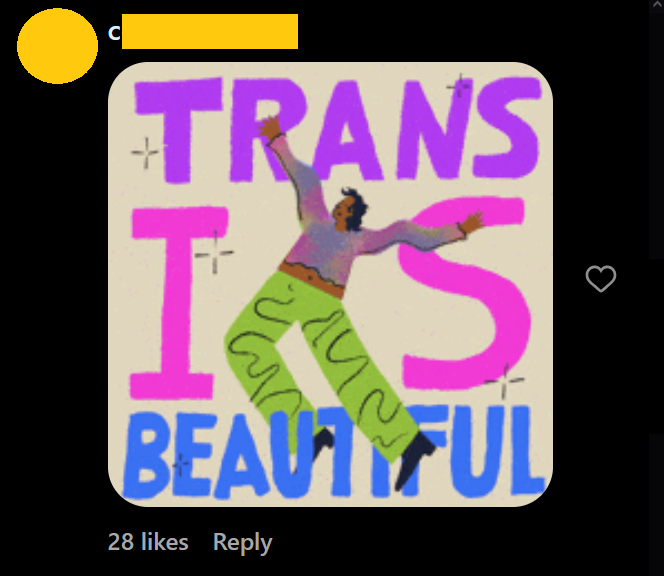
The second form that this can take is thinly veiled transphobia.
These posters are likely not transvestigators themselves, but simply jumping on the bandwagon in order to personally “attack” Hailey Bieber.
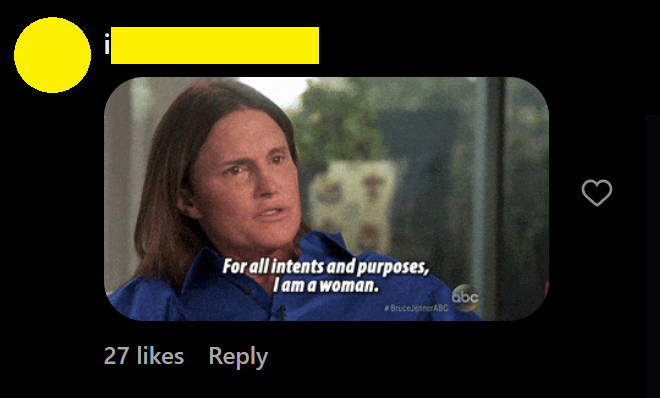
In their comments, we see posts seeming to celebrate the transgender community or highlighting famous trans figures, like Caitlyn Jenner.
But the comments do not celebrate trans people — they insult them and Hailey all at once.

It is, of course, not reasonable to believe that Hailey is transgender. And not only because she has been in the public eye since she was a child.
To believe this is to believe that it remained a secret throughout her career and marriage to Justin Bieber.
This would also mean fake maternity photos and a shroud of lies surrounding the birth of Jack Blues one year ago.
As much as we would love to live in a world where someone could be transgender without comment, that is not the reality.

In 2023, a violent hate campaign against a beer brand sent shockwaves through society because a trans woman took a sip from a drink on TikTok.
Hailey is cisgender. If she were trans, certain people would be pitching a fit every time that she advertises a product, let alone when she married Justin Bieber.
Most of the people bombarding her with these hateful messages are not true believers who have clearly lost touch with reality, however. So what’s going on.

The truth may be a combination of two things: jealous people who love her husband and genocide enthusiasts who hate any public figure who doesn’t love it when children are massacred.
Another hot topic in Hailey’s comments seems to be her ongoing support for the Palestinian people as the IDF continues to slaughter and starve the population.
Some people are of course there to thank her. Others are not.
One has to wonder if the people hopping onto the harassment bandwagon against Hailey are merely saying cruel and bigoted things because of her humanitarian concerns.

Sometimes, the smartest thing to do is to get ahead of a story. You take ownership of a conversation and quash a rumor before it spreads.
But nothing — not a birthing video, not “accidentally” full frontal flashing the world — can deter someone who has lost touch with reality.
Because this is not a story, it’s a conspiracy theory and a miniature harassment campaign.
Unfortunately, the best thing for Hailey to do in this moment is probably to publicly ignore the trolls in her comments. Also? We’d recommend that she not look at what haters have to say.
Hailey Bieber Targeted by ‘Transvestigators’ For Some Reason was originally published on The Hollywood Gossip.
The Hollywood Gossip
Reading Time: 3 minutes
Sydney Sweeney sees the criticism.
She knows what people have been saying.
How celebrities respond to marketing backlash can define their public image for years to come.
In Sweeney’s case, she’s noticed that there seems to be a double standard from her critics. Is she right?

This week, The Wall Street Journal‘s interview with Sydney Sweeney delved into a marketing controversy.
No, not the “good jeans” pun that certain political influencers have tried to use as a distraction from the Epstein scandal.
Instead, there was another product that had much more to do with the actress herself.

Late this spring, Sweeney partnered with the bath products company, Dr. Squatch, to offer a limited-edition soap.
The soap, aimed at men, advertised that it was infused with her “bathwater.”
This capitalized upon an existing trend that began with enterprising Twitch streamers and sex workers before making its way to celebrity products.
Many people are simply incapable of being normal about Sweeney.
As you can imagine, Sydney’s Bathwater Bliss sold out within seconds back in early June.

In her WSJ interview, Sydney Sweeney addressed the notable backlash that she received.
Because yes, she is aware of it.
“It’s important to have a finger on the pulse of what people are saying,” she reasoned.
Sweeney explained that this is “because everything is a conversation with the audience.”

As for her detractors, Sydney could not help but observe that “it was mainly the girls making comments about it, which I thought was really interesting.”
She pointed out: “They all loved the idea of Jacob Elordi’s bathwater.”
While she may be generalizing about her critics a little, Sweeney’s not entirely wrong.
Often, and as other actresses have pointed out, women receive more backlash for behavior identical to men.

To be fair, the Jacob Elordi bathwater candle was a specific reference to a memorable scene from Saltburn. Not that it matters! It doesn’t. Mostly.
We also have to point out that social media backlash, just like social media praise, is likely to be very gendered on many topics.
Because society socializes people differently based largely upon the genders assigned to them at birth.
It’s probably very true that Sydney Sweeney gets more criticism from women.
We would also suspect that praise for her acting that does not mention her anatomy is more likely to come from women. That is a double-edged sword.
If she’s keeping a finger on the pulse, she likely knows how people are reacting to the American Eagle controversy. How will she respond when the time comes? It’s looking like she won’t at all.
Sydney Sweeney Says Her Critics Are ‘Mainly Girls’ In First Interview Since … was originally published on The Hollywood Gossip.
The Hollywood Gossip
Reading Time: 3 minutes
Tammy Slaton is not done with her makeover.
During an appearance on the August 19 episode of the Creative Chaos podcast, the veteran 1000-Lb Sisters star flashed a brand new smile for the camera, revealing a set of false teeth.
Those who have followed the TLC personality over the years are aware that she’s had a sizable gap toward the front of her mouth.
But not anymore! See for yourself via this screen grab:

“They’re temporary still,” the 39-year old said on air. “But they had to cement them in because the glue wasn’t holding — well, my body was rejecting it. But they had to pull teeth.”
Slaton went on to explain that the procedure she had done involved getting a bridge… which is a false tooth that’s anchored to adjacent natural teeth so as to “bridge the gap” in an individual’s smile.
“I’m still getting more done with it,” she added. “It’s a process.”
Look. You can compare the before with the after down below:

Tammy, of course, is familiar with processes. Specifically, the process of losing just a TON of weight.
For a long time now, Slaton has kept followers apprised of her journey, which has entailed the reality star dropping from someone who weighed over 700 pounds to someone down below 300.
No, those aren’t typos. She’s a brand new woman.
Yes, this is partly due to skin removal surgery.
But it’s also due to dedication and hard work and exercise and a much better diet. Slaton seriously focused on these things after falling into a coma in late 2021 as a result of her dangerous habits and excessive body weight.

Fast forward to this latest update to her appearance (partly inspired by critics, “haters make me famous,” she quipped on the podcast) and it’s clear Slaton is focused on a much different future than the past she has left behind.
“With all due respect, I wish people like you would stop commenting crap like this,” Slaton said in a January 2024 TikTok video, addressing haters.
“It’s not helping my confidence. I was trying to keep my confidence boosted and seeing comments about my chin or my teeth doesn’t help.”
She continued back then:
“I’m trying to better my life and better myself. We should be lifting up people. It doesn’t matter if I’m missing teeth.”

Slaton, meanwhile, is also engaged to a woman named Andrea Dalton.
On the season 7 premiere of 1000-Lb. Sisters in April, the lead cast member offered up glimpses of her burgeoning romance with Dalton, including the pair’s first public date at a bowling alley.
In a confessional, Tammy said that while she has “feelings” for Dalton, they were “taking things slow, day by day.”
She waited a “couple of months” to tell her loved ones about her relationship because she was unsure how they’d “react” to her dating a woman because they have a lot of “opinions.”
Indeed, Slaton revealed her preference for women late last year.
“Lately I’ve been feeling like it’s time for me to start moving on and to start seeking love again, but this time I’m thinking of seeing a female,” she told viewers back then, referring to the tragic loss of her husband the year before and stating:
“As it stands right now, I don’t want to be with another man. It just doesn’t feel right. I don’t even have those feelings for a guy anymore after Caleb passed.”
Tammy Slaton: Look, Everyone! I Got New Teeth! was originally published on The Hollywood Gossip.
The Hollywood Gossip
Reading Time: 3 minutes
Well, that didn’t take very long!
Just two days after Jace Evans called out Jenelle Evans on social media, mother and son are no longer living together.
In fact, they’re living a couple thousand miles apart, as Jenelle has reportedly shipped Jace back to his home state of North Carolina.

In case you missed it, Jace recently took to social media to share screenshots of text messages he’d received from Jenelle.
And if you know anything about Jenelle’s past, then you probably won’t be surprised to learn that her communications with her son were not exactly heartwarming.
Jenelle swore at the teen and hurled wild accusations at him, and now, TMZ is reporting that their Las Vegas experiment has come to an end.
The elder Evans brought all three of her kids with her when she moved out West, and now, as far as we can tell, only one of them is still living with her.

Jenelle sent her youngest son, Kaiser, back to North Carolina to live with his grandmother back in October of 2024.
Now, Jace has also made the long trek back to the Tarheel State, but his living arrangement is unclear.
Jace spent the early years of his life living with his grandmother, Barbara Evans, and many have speculated that he’s once again under Babs’ roof.
But that’s just unconfirmed speculation. At 16, Jace is not yet old enough to live on his own, but he might be living with a different relative.

“I am finally putting out how my mother really is,” Jace captioned one of his screenshots on Instagram earlier this week.
“I need to go back to NC. She is just r[ea]lly unstable,” he wrote alongside another.
“I don’t need you, you don’t need me and I don’t understand why ur doing this just because I’m telling the truth,” Jace wrote to his mom in one text. “Ur crazy.”
“Your[e] the one saying you’re going to have my custody taken. F–K YOU,” Jenelle allegedly replied.

From there, Jenelle accused Jace of lying when he claimed he’d been strangled by former stepfather David Eason in 2023.
“Just like the way you lied about David strangling you,” Jenelle allegedly wrote to Jace. “You make things worse on yourself.”
“I never lied,” Jace replied. “He tried to do [that s–t].”
“I was standing right there and have the Ring camera videos,” Jenelle allegedly wrote back.

“OK nice yea u were standing there yelling in my face cussing me out just watching things happen,” Jace replied.
Jenelle later took to Instagram to claim that Jace was just lashing out after being “rightfully punished.”
“While it hurts to see those moments shared publicly, I know it comes from a place of struggle,” she wrote.
“Navigating Jace’s different medical diagnoses has not been easy but I have never stopped fighting to make sure he has the resources, love and support he needs.”
News of Jace’s departure comes just hours after new reports that Jenelle has been reported to CPS for her negligent parenting and constant partying.
We’ll have further updates on this developing story as new information becomes available.
Jace Evans Has Moved Back to North Carolina After Exposing Jenelle Evans’ Abusive … was originally published on The Hollywood Gossip.
The Hollywood Gossip
Reading Time: 4 minutes
Denise Richards at last has something to say.
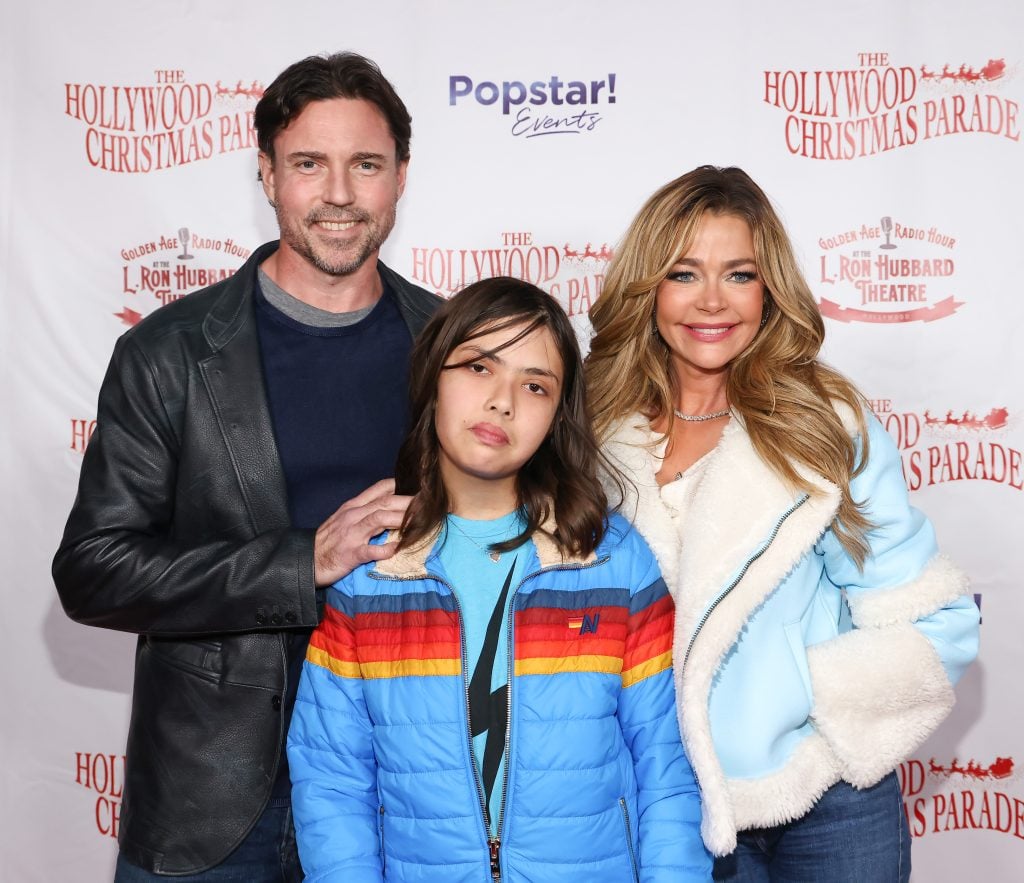
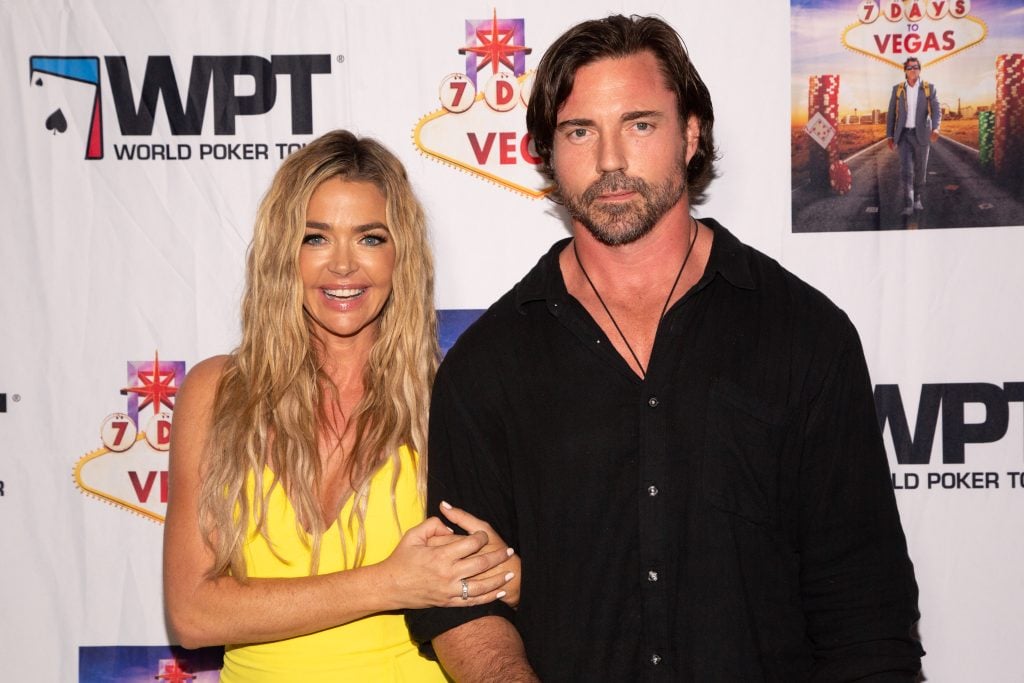
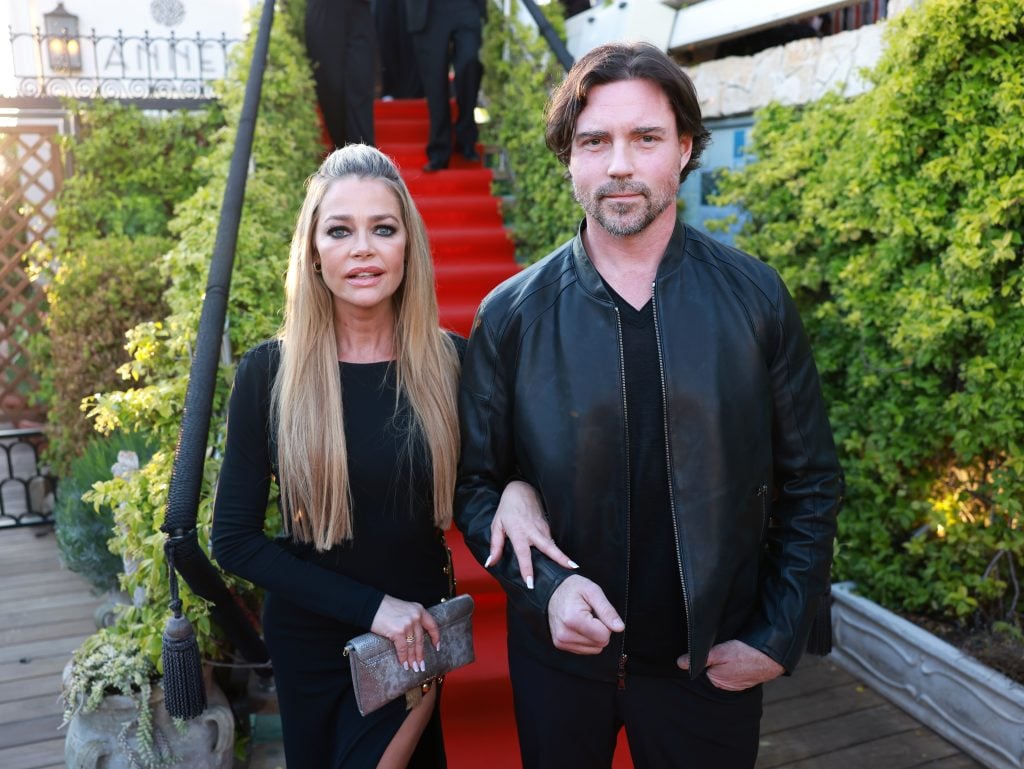
Late on August 21, The Real Housewives of Beverly Hills alum opened up for the first time in public about her divorce from Aaron Phypers.
“I was just checking in to see how your summer’s been going,” she began via Instagram.
“Mine’s been wonderful. It’s actually been s—–, but I’m going to pretend like it’s all good. I’ve actually been posting on Instagram like nothing is going on in my life, and I can’t do that anymore because there’s something obviously going on.”

This much we know at this point.
Back in July, as mentioned above, Richards filed for divorce. We learned at the time — through her official documents — that her estranged husband spent over $100,000 PER MONTH of his wife’s money.
Richards then asked for a restraining order and accused Phypers of abuse, allegations which has quickly denied.
“Let me be unequivocally clear: I have never physically or emotionally abused Denise — or anyone. These accusations are completely false and deeply hurtful,” he said in response.
“Denise and I, like many couples, have faced our share of challenges, but any suggestion of abuse is categorically untrue.I have always tried to approach our marriage with love, patience, and respect.”

For his part, Phypers accused Richards of cheating on him with another man at the beginning of the year and also claimed Richards hit him, scratched him and smashed his phone.
Phypers has alleged the reality star was addicted to Vicodin… while police were called to his house just two weeks ago in response to some kind of disturbance.
Insiders told TMZ that Richards went to her ex’s home in order to retrieve and dog and then started “screaming at [Aaron’s] parents” and demanding that they get out of the house.
Sources say Richards then turned on Aaron’s brother and began “swinging” at him and throwing items of mail in his direction.

This all brings us back to the actress’ lengthy statement on Thursday.
“I see all of your messages, I can’t comment because it’ll be taken out and put in the press, but I just wanted to, in all seriousness, say that this has been a very, very, very difficult time,” she said. “It’s so hard to go through a divorce.”
Richards then referenced her 2006 divorce from Charlie Sheen and continued:
“I really just wanted to say thank you so much for all of your supportive, kind, thoughtful, encouraging messages because this has been a very difficult time.
Richards emphasized that “circumstances around my divorce that are difficult to talk about — which one day I will talk about it when the timing is right.”

This is how Richards concluded:
During this time, some of you may know because it was put out there that I was having reconstructive surgery. I was open and honest about having reconstructive surgery for a TV show that I did.
And then I had another surgery and I do want to post about that but I didn’t want to post about it during this and look inappropriate and have it seem insensitive to what I’m dealing with, but I also want to live my life and share my life, so that’s what I’m going to do and continue doing.
I just wanted to say thank you so much. It makes me want to cry seeing your messages because this is a very difficult time and you guys are all helping me through it. Thank you. Lots of love.
Denise Richards Breaks Silence, Says Divorce “Makes Me Want to Cry” was originally published on The Hollywood Gossip.
The Hollywood Gossip