Two men have been charged after a car crashed into a care home in Sunderland during a police chase.The Latest News from the UK and Around the World | Sky News









Two men have been charged after a car crashed into a care home in Sunderland during a police chase.The Latest News from the UK and Around the World | Sky News

Taped doors and quiet rooms tell a story about what happened at Heshi Peixin kindergarten.The Latest News from the UK and Around the World | Sky News
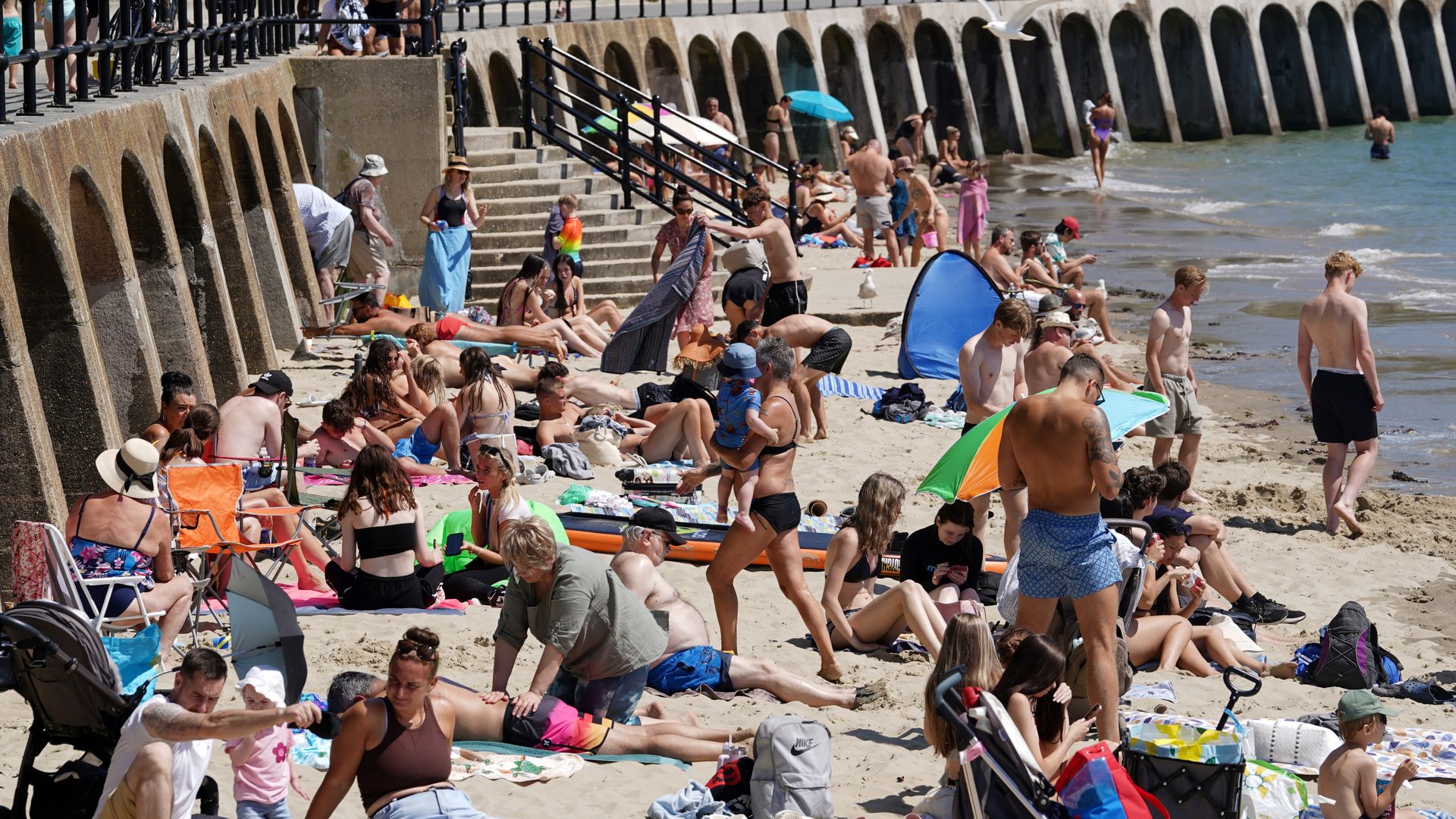
The third heatwave to hit the UK this summer is set to peak on Saturday, forecasters have said, with highs of more than 34C possible in some areas.The Latest News from the UK and Around the World | Sky News

Fuel to the engines of the Air India plane that crashed last month appears to have cut off shortly after take-off, a preliminary report has found.The Latest News from the UK and Around the World | Sky News
A care worker who reported the alleged abuse of an elderly care home resident, which triggered a criminal investigation, is facing destitution and potential removal from Britain after speaking up.The Latest News from the UK and Around the World | Sky News
With the summer heat rising and water levels climbing in Suicide Basin, emergency officials, city officials and the National Weather Service are closely monitoring the threat of another glacial lake outburst flood (GLOF) in the Mendenhall River Valley. This threat follows a record flood event on August 6, 2024, which swept through neighborhoods, damaged property, and reshaped how Juneau prepares for these recurring flooding events.
Suicide Basin, located above the Mendenhall Glacier, has released floodwaters nearly every year since 2011. These events occur when meltwater trapped behind the glacier breaks through ice dams, sending torrents into Mendenhall Lake and River below.
As of Monday, July 7, the U.S. Geological Survey (USGS) reports that the basin’s laser-monitored water elevation is approximately 1,224 feet, well below the 1,247 feet recorded on the same date last year, and more than 100 feet below 2023 levels. The current elevation is about 147 feet below the overflow channel, which begins spilling at 1,371 feet.
If the rate of rise in the basin remains around 4 feet per/day, this would result in a full basin in 37 days, though the rate of the rise could change.
These differences in water levels from 2024 and 2023 to current levels are due to the cold spring/early summer time temperatures. Freezing levels remained 3000 to 4000 feet through the spring and early summer time but are now around 7000 feet, meaning rapid melt could accelerate water accumulation.
Monitoring equipment, including two daily cameras and a USGS laser sensor, remains active. Officials caution that water level data may show occasional jumps or drops due to icebergs disrupting sensor readings.
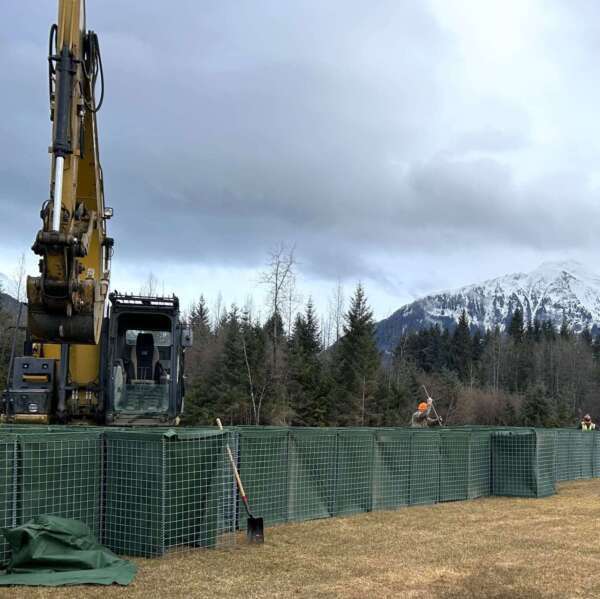
City and Borough of Juneau (CBJ) officials, in partnership with state, federal, and tribal agencies, have implemented Phase 1 and Phase 1A of a near-term flood mitigation strategy. With guidance from the U.S. Army Corps of Engineers, CBJ has installed HESCO barriers along vulnerable stretches of the Mendenhall River. These modular barriers are designed to protect against floodwaters as high as 18 feet.
Given the growing threat and lack of a permanent solution, officials urge Juneau residents, especially those in the Mendenhall Valley, to take stay informed and prepared.
By: James Brooks, Alaska Beacon
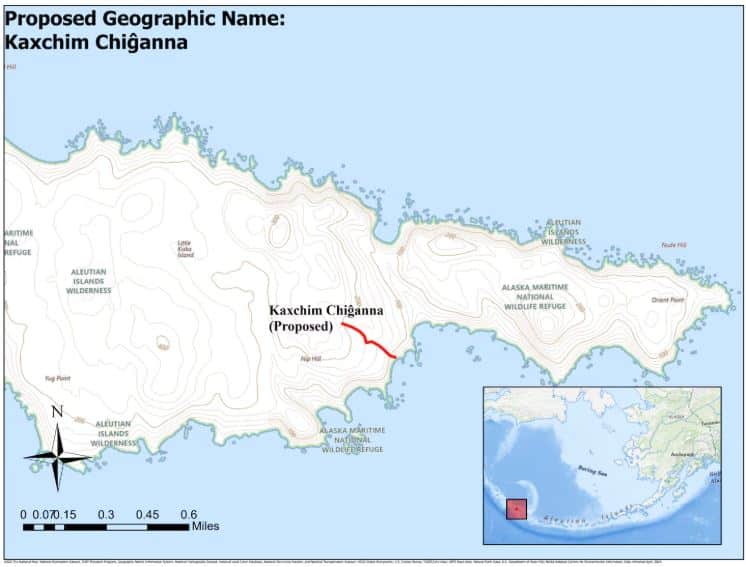
A small creek on Alaska’s Little Kiska Island has been renamed, more than 80 years after it was named after Germany’s Nazi Party by World War II soldiers fighting in the Aleutians.
Nazi Creek was the last landmark in the United States to bear the Nazi name. Its new name is “Kaxchim Chiĝanaa,” meaning either “gizzard creek” or “creek or river belonging to gizzard island” in Unangam Tunuu, the language of the Indigenous Unangax̂ people.
On Thursday, the Domestic Names Committee of the U.S. Board on Geographic Names voted 17-0 to approve the new name, without discussion.
The board’s decision allows the federal government to officially change the creek’s name in federal databases that are the official repository of geographic names. That repository is used by federal agencies and commercial companies that provide maps to the general public.
The board also approved the renaming of nearby “Nip Hill,” named by soldiers using a derogatory term for Japanese people. That hill was renamed “Kaxchim Qayaa,” or “gizzard hill,” again using the traditional name for Little Kiska Island, which is not far from Kiska Island, site of a World War II battle.
Michael Livingston, an employee of the Aleutian Pribilof Islands Association, has been working for almost two years to have the names changed. Moses Dirks, an expert on Unangam Tunuu, recommended the new names.
“I think that’s pretty awesome. I think elders … and others are happy about it. It really should have never been there in the first place,” Livingston said of Thursday’s vote.
“Like one of my teachers … used to say, if you know something that can make our community better, our villages better, be brave and stand up and say something about it, do something about it,” Livingston said.
The new names were previously recommended by the Alaska Historical Commission, which considered them in April. The changes were endorsed by local Native tribes and Native corporations, the Museum of the Aleutians, the manager of the Alaska Maritime National Wildlife Refuge, Congregation Beth Sholom of Anchorage, and the Alaska Chapter of the Japanese American Citizens League, among others.
Kiska Island is located 242 miles west of Adak, at the far end of the Aleutian Islands. The area has been mostly uninhabited since World War II, when invading Japanese forces took 42 people on Attu Island prisoner. More than half died in Japanese internment camps.
The United States forcibly relocated almost 900 Unangax̂ residents of the Aleutian Islands, housing them in unsuitable internment camps in Southeast Alaska and elsewhere. Many became sick and died from the conditions imposed by the government.
Aleutian Islands residents subsequently received reparations from the federal government under legislation that also paid reparations to Japanese Americans also interned during the war.
Livingston’s work isn’t yet complete. He’s also seeking to rename Quisling Cove, a small body of water named after the Norwegian Nazi collaborator Vidkun Quisling. That name change remains pending.
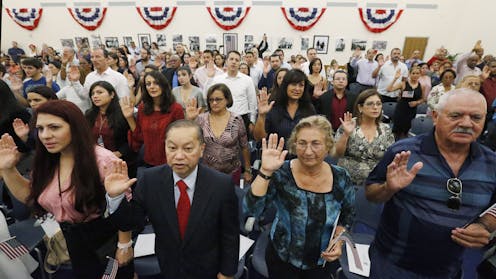
The Trump administration wants to take away citizenship from naturalized Americans on a massive scale.
While a recent Justice Department memo prioritizes national security cases, it directs the department to “maximally pursue denaturalization proceedings in all cases permitted by law and supported by the evidence” across 10 broad priority categories.
Denaturalization is different from deportation, which removes noncitizens from the country. With civil denaturalization, the government files a lawsuit to strip people’s U.S. citizenship after they have become citizens, turning them back into noncitizens who can then be deported.
The government can only do this in specific situations. It must prove someone “illegally procured” citizenship by not meeting the requirements, or that they lied or hid important facts during the citizenship process.
The Trump administration’s “maximal enforcement” approach means pursuing any case where evidence might support taking away citizenship, regardless of priority level or strength of evidence. As our earlier research documented, this has already led to cases like that of Baljinder Singh, whose citizenship was revoked based on a name discrepancy that could easily have resulted from a translator’s error rather than intentional fraud.
For most of American history, taking away citizenship has been rare. But it increased dramatically during the 1940s and 1950s during the Red Scare period characterized by intense suspicion of communism. The United States government targeted people it thought were communists or Nazi supporters. Between 1907 and 1967, over 22,000 Americans lost their citizenship this way.
Everything changed in 1967 when the Supreme Court decided Afroyim v. Rusk. The court said the government usually cannot take away citizenship without the person’s consent. It left open only cases involving fraud during the citizenship process.
After this decision, denaturalization became extremely rare. From 1968 to 2013, fewer than 150 people lost their citizenship, mostly war criminals who had hidden their past.

In criminal lawsuits, defendants get free lawyers if they can’t afford one. They get jury trials. The government must prove guilt “beyond a reasonable doubt” – the highest standard of proof.
But in most denaturalization cases, the government files a civil suit, where none of these protections exist.
People facing denaturalization get no free lawyer, meaning poor defendants often face the government alone. There’s no jury trial – just a judge deciding whether someone deserves to remain American. The burden of proof is lower – “clear and convincing evidence” instead of “beyond a reasonable doubt.” Most important, there’s no time limit, so the government can go back decades to build cases.
As law professors who study citizenship, we believe this system violates basic constitutional rights.
The Supreme Court has called citizenship a fundamental right. Chief Justice Earl Warren in 1958 described it as the “right to have rights.”
In our reading of the law, taking away such a fundamental right through civil procedures that lack basic constitutional protection – no right to counsel for those who can’t afford it, no jury trial, and a lower burden of proof – seems to violate the due process of law required by the Constitution when the government seeks to deprive someone of their rights.
The bigger problem is what citizenship-stripping policy does to democracy.
When the government can strip citizenship from naturalized Americans for decades-old conduct through civil procedures with minimal due process protection – pursuing cases based on evidence that might not meet criminal standards – it undermines the security and permanence that citizenship is supposed to provide. This creates a system where naturalized citizens face ongoing vulnerability that can last their entire lives, potentially chilling their full participation in American democracy.
The Justice Department memo establishes 10 priority categories for denaturalization cases. They range from national security threats and war crimes to various forms of fraud, financial crimes and, most importantly, any other cases it deems “sufficiently important to pursue.” This “maximal enforcement” approach means pursuing not just clear cases of fraud, but also any case where evidence might support taking away citizenship, no matter how weak or old the evidence is.
This creates fear throughout immigrant communities.
About 20 million naturalized Americans now must worry that any mistake in their decades-old immigration paperwork could cost them their citizenship.
This policy effectively creates two different types of American citizens. Native-born Americans never have to worry about losing their citizenship, no matter what they do. But naturalized Americans face ongoing vulnerability that can last their entire lives.
This has already happened. A woman who became a naturalized citizen in 2007 helped her boss with paperwork that was later used in fraud. She cooperated with the FBI investigation, was characterized by prosecutors as only a “minimal participant,” completed her sentence, and still faced losing her citizenship decades later because she didn’t report the crime on her citizenship application – even though she hadn’t been charged at the time.

The Justice Department’s directive to “maximally pursue” cases across 10 broad categories – combined with the first Trump administration’s efforts to review over 700,000 naturalization files – represents an unprecedented expansion of denaturalization efforts.
The policy will almost certainly face legal challenges on constitutional grounds, but the damage may already be done. When naturalized citizens fear their status could be revoked, it undermines the security and permanence that citizenship is supposed to provide.
The Supreme Court, in Afroyim v. Rusk, was focused on protecting existing citizens from losing their citizenship. The constitutional principle behind that decision – that citizenship is a fundamental right which can’t be arbitrarily taken away by whoever happens to be in power – applies equally to how the government handles denaturalization cases today.
The Trump administration’s directive, combined with court procedures that lack basic constitutional protections, risks creating a system that the Afroyim v. Rusk decision sought to prevent – one where, as the Supreme Court said, “A group of citizens temporarily in office can deprive another group of citizens of their citizenship.”

The authors do not work for, consult, own shares in or receive funding from any company or organization that would benefit from this article, and have disclosed no relevant affiliations beyond their academic appointment.
Politics + Society – The Conversation

Reading Time: 4 minutes
If you were one of the many Vanderpump Rules viewers who had a bad feeling about Brock Davies from the very beginning, it turns out your instincts were spot-on.
In her upcoming memoir, My Good Side, Scheana reveals that Brock has not always been a perfect partner. Far from it.
In fact, it seems the recovering deadbeat dad cheated on Scheana while she was pregnant with the couple’s first child.
“I remained in a state of paralyzed shock as he confessed that he’d cheated on me two years prior, when we were living in San Diego during the pandemic, while I was pregnant with Summer,” Scheana writes in an excerpt published by Glamour.
“As I sat there, feeling completely sick to my stomach, he admitted that — at the time — he was scared about being a father again, specifically about whether he even deserved to be, and he chose to deal with it by sleeping with someone else,” she continued.
“I use the word ‘chose’ because it was very much a conscious decision. No one twisted his arm or dragged him into bed.”

Yeah, it’s a pretty corny excuse from a guy who already has multiple kids (whom he allegedly abandoned after assaulting their mother), but we guess it worked, as Scheana eventually forgave the guy.
Thankfully, she rightly flipped out on him first.
Shay recalls that she was “unable to contain [her] rage” that Davies had a “brief affair” with a woman at his gym in 2021.
“I slapped him and threw a Rubik’s cube in his direction, which he dodged,” she wrote.
“To this day, every time I see a Rubik’s cube it triggers me, pulling me right back to this incredibly dark moment in my life. Same goes for any mention of an F45 gym,” Scheana continued, adding:

“That same night, Brock gave me a letter that he’d written a year after the affair ended. He wrote the letter, which included more specifics than I ever wanted, such as how many times they’d slept together, where they’d done it, and where they hadn’t (our house).
“He also pointed out that it was purely physical, never emotional, and he always used protection. Gee, thanks! He definitely wasn’t sober when he put pen to paper, so the spelling errors were rampant.
“I can’t explain why, but that really irritated me. Maybe because it felt like another sign of his carelessness.”
Well, we guess not banging in the house and always wrapping it up is courteous as one can be while having an affair.
Scheana went on to explain that Brock added insult to injury by refusing to have sex with her while she was pregnant.

“The letter made me remember the weeks leading up to my second trimester when, like many pregnant women, I was sexually stimulated. I’ll never forget how, during that time, Brock was ‘afraid’ to have sex with me (or he simply didn’t want to),” she wrote, adding:
“That did a number on my anxiety, and it killed my confidence in a way I can’t even describe. His behavior now made so much more sense.
“Once I’d read it, that was more than enough. I told him to immediately toss it into the fire. I never wanted to set eyes on those words again.”
Scheana and Brock tied the knot in 2022. Their daughter Summer is now four.
According to Us Weekly, he’s been “making payments” to resolve his child support debt, but has not seen his eldest two children in several years.
Scheana’s memoir — which sounds like a doozy! — is set to hit stores July 22.
Scheana Shay Says Husband Brock Davies Cheated While She Was Pregnant was originally published on The Hollywood Gossip.
The Hollywood Gossip

Reading Time: 4 minutes
Gia Giudice is apologizing for shooting her shot.
This spring, Todd and Julie Chrisley received a get-out-of-jail-free card (so to speak) from Donald Trump.
Recently, Gia took to Instagram in hopes that her father, Joe, could also receive a pardon — and maybe even come home one day.
Some admire Gia for the effort, or at least understand. Others are condemning her for trying to ingratiate herself with Trump, no matter the motive.
This year’s Fourth of July was a somber one for millions.
For Gia Giudice, it was also the day for her to take a chance.
Taking to Instagram, the daughter of Teresa Giudice shared a video of her handwriting and mailing letters.
The audio of the video included the content of her letters: a plea for Donald Trump to pardon her father, Joe.
“My dad was deported over four years ago,” Gia wrote. Joe served time in federal prison on fraud charges, and was then deported in 2019 — sent to Italy, a country that he had never known.
“Since then, our family has lived in an emotional limbo,” she characterized.
“No matter how strong we try to be in the absence of a father, of a parent,” Gia described, “it’s something that never stops hurting.”

Gia Giudice wrote about how much Joe meant to her and to her younger sisters: Gabriella, Milania, and Adriana.
“He was our provider. Our protector,” she wrote, really laying it on.
“And he still is, just now from thousands of miles away.”
Gia wrote that seeing the Chrisley family receive their pardon “inspired” her to try. “It showed me that people can be forgiven, that families could be restored, and that sometimes the justice system has room for grace.”

“That gave me hope,” Gia wrote of the infamous Chrisleys’ pardon.
“Hope that maybe my dad could come home too.”
She emphasized: “A pardon would mean more than just legal forgiveness. It would mean healing for my sisters, for my mom, for my family, and for me.”
Gia added: “This isn’t just about one man. It’s about a family who deserves to be whole again.”

Some replied to praise Gia Giudice. Savannah Chrisley wrote “I’m so proud of you” with a red heart emoji.
Others vocally condemned this.
Many noted that Joe both received a conviction of actual crimes and is currently safe and well.
The majority of the victims of the Trump regime’s deportation program cannot say the same — as they have no criminal histories and are either detained inhumanely, deported to countries unknown, or simply vanish.

Gia has now apologized for posting her plea on the Fourth of July.
“I did not intend to post it on the 4th of July. That was just not my intention at all,” she shared on her “Casual Chaos” podcast Wednesday (per Page Six). “I have so much respect for my country, and I was not trying to show any privilege or entitlement.”
“I was making the video for him on Thursday night, and I wrote out what I was going to say,” she explained.
“So, Friday morning before the craziness of the weekend, I just finished the video, and I posted it. Then I realized, ‘Oh, my God.’ But at that point, the video had gotten a lot of traction,” Gia said.
“I woke up and knew I had to do something for my dad. That was the only thing on my mind, was my dad,”

Truth be told … one can understand Gia’s desperation. Right now, pardons are essentially for sale, and one of the currencies is appealing to Trump.
Gia is 24, pretty, and white, and therefore stands a better chance than most of rectifying an impossible situation for her family.
She can’t save the communities that Trump’s ICE goons are terrorizing.
But if there’s the slightest chance that she can bring her father home, appealing to America’s mad king’s ego seems like a small price to pay.
Gia Giudice Apologizes for Begging Donald Trump to Pardon Dad Joe was originally published on The Hollywood Gossip.
The Hollywood Gossip