Categories
Uncategorized

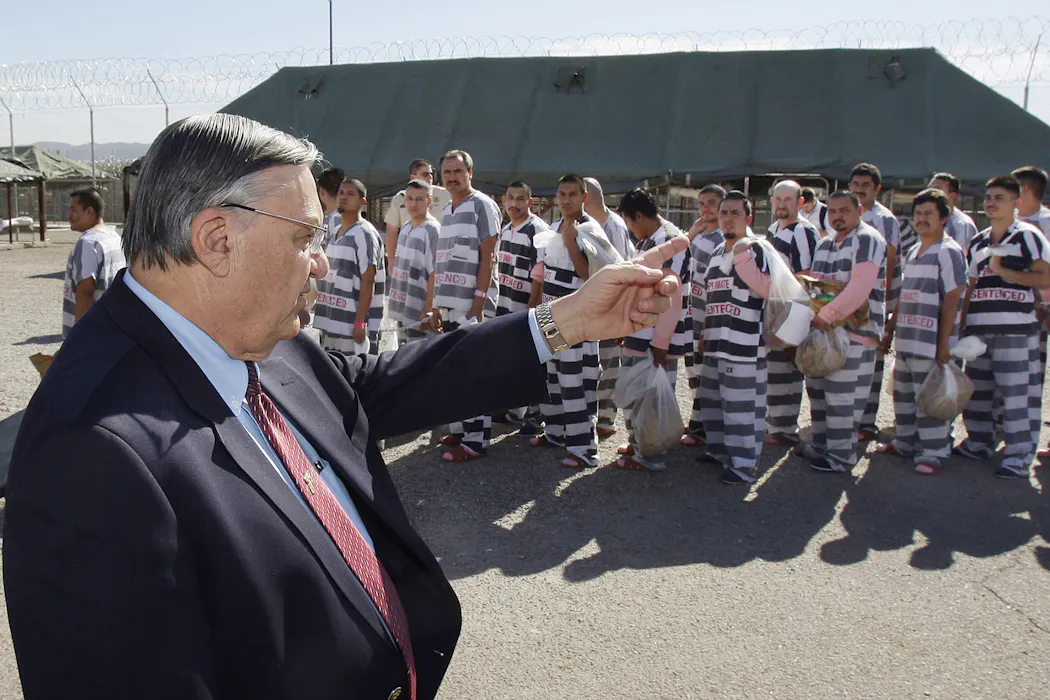
ICE’s heavy-handed immigration enforcement was tried once before – by Arizona’s notorious sheriff Joe Arpaio in the early 2000s

Maricopa County Sheriff Joe Arpaio orders undocumented immigrants handcuffed together and moved into a separate area of Tent City in Phoenix on Feb. 4, 2009. AP Photo/Ross D. Franklin, File

For the past 13 years, Maricopa County in Arizona has attempted to reform its sheriff’s department after Joe Arpaio made it into a national flash point for extreme immigration tactics. After a legal immigrant sued Arpaio and the county Sheriff’s Office, a federal district court ruled in 2015 that Arpaio and his deputies relied on racial profiling to target Latinos.

Arpaio was at the center of that suit. From 2006 to 2017, he implemented his own immigration detention program, instructing deputies to detain anyone who did not carry a valid identification and did not speak English. One U.S. Department of Justice attorney characterized Arpaio as overseeing “the worst pattern of racial profiling by a law enforcement agency in U.S. history.”

Federal oversight has since aimed to reform the sheriff’s department and improve trust with the county’s Latino residents, which had been destroyed under Arpaio’s tenure.

As a historian of U.S. immigration, I believe Arpaio’s immigration detention methods are clearly echoed in the hardline immigration policies devised by presidential aide Stephen Miller. That’s evident in actions by immigration agents with Immigration and Customs Enforcement and Customs and Border Protection that have been described as inhumane by some lawmakers and civil rights groups.

A blueprint for ICE facilities

From his election to sheriff in 1993 until 2017, Arpaio made constant headlines for his creation of a tent jail and his heavy-handed immigration enforcement tactics.

Using surplus army tents from the Korean War to house up to 1,700 inmates, Arpaio built Tent City in August 1993 to address overcrowding in Phoenix jails. By the time the jail closed in 2017, Sheriff Paul Penzone estimated that running Tent City cost taxpayers US$8.5 million annually.

Tent City was initially used for detaining criminals, but after 2009, Arpaio used the facility for housing detained immigrants.

News reports said Arpaio forced inmates to wear pink underwear and often fed them expired food and undrinkable water. The tents did little to shield inmates from the Arizona desert, where temperatures rose to 130 degrees Fahrenheit, (54 degrees celsius) at times. Tent City stirred a national uproar.

Several inmates form a line under the sun.
Immigrant inmates line up at the Maricopa County Tent City jail in Phoenix on March 11, 2013.
John Moore/Getty Images

Starting in 2006, Arpaio and Maricopa County sheriffs engaged in a pattern of “unlawful discriminatory police conduct directed at Hispanic persons,” according to Deputy Assistant Attorney General Mark Kappelhoff. During these operations, he directed deputies to detain people suspected as being undocumented immigrants without legal immigration authorization.

Arpaio’s deputies explicitly targeted Latino drivers in their traffic stops. A Department of Justice investigation concluded that Arpaio used race as a criteria for stopping and detaining Latino drivers. Legal U.S. residents and U.S. citizens were occasionally arrested in these sweeps.

Phoenix News-Times journalist Stephen Lemons in January 2009 noted that, during operations, some Maricopa County sheriff’s deputies wore ski masks and carried assault rifles while conducting immigration sweeps.

Camp East Montana

Tent City appears to be an early version of the detention facilities used by ICE today, where detainees have complained of squalid conditions and poor food.

ICE currently detains some 70,000 people in 224 detention centers nationwide. Of those, two camps, Camp East Montana near El Paso, Texas, and Alligator Alcatraz in Florida, are eerily similar to Tent City.

Camp East Montana is the most recent of these new facilities. Opened in August 2025, the 60-acre detention center has become one of the largest ICE facilities in the U.S., holding 5,000 detainees.

Several tents are seen at an outdoor prison.
Hardened tents are seen at the Camp East Montana immigrant detention center near El Paso, Texas, on Feb. 13, 2026.
AP Photo/Morgan Lee

Like Tent City, Camp East Montana was constructed using tents that do little to shield inmates from the elements. The Washington Post reported in September that the facility’s poor food, shoddy living quarters and exposure to the desert sun violated 60 federal regulations.

The cost of inhumane policies

During Arpaio’s tenure, his office faced 6,000 federal lawsuits.

Those included a $9 million payout to the parents of Charles Agster III, after a federal jury found Arpaio and jailhouse nurses negligent in his death. And they included a $2 million payout to the parents of Brian Crenshaw after the disabled man died following an altercation with a sheriff’s detention officer.

The most costly, though, was the 2013 ruling in Melendres v. Arpaio. U.S. District Judge Murray Snow found Arpaio guilty of racial profiling. The ruling placed Arpaio’s office under federal monitoring with orders to overhaul the department. As a result, Maricopa County residents have paid $323 million to reform the department.

Arpaio left office in January 2017. Months later, Tent City closed. After a failed attempt to run for U.S. Senate in 2018, Arpaio retired from politics.

But I believe that the resemblance between Arpaio’s fixation on immigration and Trump’s deportation campaign remains.

Since Trump’s second election, ICE and CBP agents have followed Arpaio’s playbook. Along with erecting tent jails for detaining immigrants, agents have used racial profiling during immigration raids. Consequently, hundreds of U.S. citizens have been detained during raids and protests.

On April 2, 2026, Judge Jennifer Thurston ruled that CBP agents violated court orders and “again detained people without reasonable suspicion” – tactics similar to those used by Arpaio.

Arpaio’s policies foreshadowed Trump’s deportation policy: one that uses racial profiling and shows little regard for human rights.

As U.S. Supreme Court Justice Sonia Sotomayor noted in her dissent in Noem v. Vazquez-Perdomo in 2025, many Latinos now carry proof of citizenship out of fear of racial profiling.

In July 2017, a federal court found Arpaio guilty of criminal contempt for violating a 2011 federal order to stop detaining people solely on suspicion of illegal immigration status.

A month later, before Arpaio’s sentencing, Trump pardoned Arpaio. He described the sheriff as a “great American patriot” who had “done a lot in the fight against illegal immigration.”

The Conversation

Jonathan van Harmelen does not work for, consult, own shares in or receive funding from any company or organization that would benefit from this article, and has disclosed no relevant affiliations beyond their academic appointment.

​Politics + Society – The Conversation

Categories
Uncategorized

Why the future of marijuana legalization remains hazy despite high public support

Cannabis plants are seen at Harborside Oakland Dispensary on Aug. 11, 2025, in Oakland, Calif. Justin Sullivan/Getty Images

Thousands of Americans will soon gather to celebrate April 20 – or “4/20” – the most important day of the year for cannabis enthusiasts.

But this year, a cloud of uncertainty will hang over these celebrations. After years of success, the movement to legalize recreational and medical cannabis has stalled.

It’s a moment unlike any that I have seen in the 12 years that I’ve been researching cannabis legalization as part of my broader interest in U.S. drug policy.

Not so long ago, the movement had so much momentum that nationwide cannabis legalization felt virtually inevitable. That momentum is now gone.

The strategy to legalize cannabis through ballot initiatives is no longer working. The coalition of supporters that made this strategy work has frayed, and new research is raising concerns about the health impact of regular cannabis use. All of this constitutes the most significant challenge to the movement since it went mainstream in the 21st century.

Years of success

As a social movement, cannabis legalization has been extremely successful. Since 2012, 24 states and Washington have legalized recreational cannabis use. Forty-nine states and Washington have legalized medical cannabis use, though programs vary from state to state.

While cannabis remains illegal at the federal level, changes have happened there, too.

The 2018 Farm Bill, for instance, legalized hemp, a non-psychoactive derivative of the cannabis plant used to make textiles, rope and other consumer goods. While it wasn’t lawmakers’ intent, entrepreneurs figured out how to make products from hemp that contain enough of the chemical compound tetrahydrocannabinol, or THC, to be psychoactive. This fueled growth of the hemp market, which in 2023 was valued at US$1.63 billion.

Additionally, the Biden administration in 2024 began the process of rescheduling cannabis under the Controlled Substances Act. It’s a course that has continued under the second Trump administration.

The scheduling system classifies substances based on accepted medical use and potential for abuse. Federal rescheduling would not legalize cannabis, but it would move it from the most restrictive Schedule I – which includes substances like heroin and LSD – to Schedule III, with substances like anabolic steroids, ketamine and codeine. It would recognize cannabis as having medical use.

A man in a cannabis store attends to a customer.
A budtender helps customers purchase marijuana at California Street Cannabis Company on Aug. 11, 2025, in San Francisco.
Justin Sullivan/Getty Images

Challenges emerge

With rescheduling still underway, it may seem odd to say that the legalization movement has stalled. But a closer look reveals significant challenges.

The biggest challenge can be found at the ballot box. The 2024 election was the legalization movement’s worst showing in years.

All three recreational legalization ballot measures failed. Only Nebraska’s medical legalization measures passed, but it has yet to be fully implemented due to ongoing political and legal challenges.

Then there’s the 2025 tax and spending package approved by Congress. When its new provisions go into effect later this year, they will dramatically alter the hemp market.

Many hemp products currently on shelves, like THC-infused beverages and gummies, will become illegal. Many businesses currently selling these products will be forced to close.

Some of this is already happening, as states like Tennessee and Iowa rush to pass restrictions on hemp products.

For instance, the dispensary closest to my university in Iowa has just closed. Once a growing business that employed 30 people, it was forced to shut down after new state laws significantly limited what they could sell. This crackdown on the hemp market is particularly significant in states like Iowa that have no legal market for recreational marijuana use and only a limited medical marijuana market.

No single reason for current slump

Several factors are driving these changes.

One is politics. While the vast majority of Americans support marijuana legalization, the approval is much higher among Democrats and independents than it is among Republicans.

Of the 26 states where recreational marijuana has not been legalized, 20 of them have state governments that are under total Republican control. Another four have Republican-controlled legislatures. Pennsylvania’s legislature is split between Republicans and Democrats. Only Hawaii has a Democrat-controlled state government that has not legalized recreational cannabis.

A man sitting at a desk is surrounded by people wearing white medical coats.
President Donald Trump speaks in the Oval Office on Dec. 18, 2025, before signing an executive order easing restrictions on marijuana.
Brendan Smialowski/AFP via Getty Images

Then there is the health issue. A growing body of evidence is raising concerns about the negative impact of regular cannabis use that includes the risk of cannabis addiction, psychosis, anxiety and depression.

Researchers are also questioning cannabis’ efficacy as medicine. Several recent reviews have concluded that there is insufficient scientific evidence to support the therapeutic use of cannabis for most of the conditions for which it is consumed, such as insomnia and acute pain. A review of cannabis’s use for treating mental health conditions came to a similar conclusion.

Citing such evidence, The New York Times editorial board recently recanted some of its earlier support for legalization. The newspaper wrote, “The unfortunate truth is that the loosening of marijuana policies … has led to worse outcomes than many Americans expected,” adding, “It is time to acknowledge reality and change course.”

The coalition of supporters frays

Still another issue is conflict within the legalization movement itself, particularly between the business and activist wings.

The tension between these groups is long-standing, with activists often accusing members of industry of being more focused on money than justice. And as the cannabis industry has grown, these tensions have become more acute.

In 2022, for example, the pro-cannabis organization True Social Equity in Cannabis sued three Illinois cannabis companies for engaging in coordinated anticompetitive practices and violating federal antitrust laws. In court documents, they called the three companies the “Chicago cartel,” before voluntarily dismissing the case.

Florida Gov. Ron DeSantis used a similar strategy in 2024 in his successful campaign against the legalization of marijuana for recreational use in the state. He consistently criticized “corporate cannabis,” a catchall phrase often used by critics to describe the large cannabis companies that increasingly dominate state markets. He warned voters that the law would create a “weed cartel.”

Prominent cannabis activists like former Massachusetts regulator Shaleen Title have also called out corporate cannabis in their accounts of what’s wrong with the legalization movement.

In many ways, these challenges are the result of the movement’s earlier success. Making marijuana legal has meant more people trying it, more people studying it and more people making money from it.

The insights from the past 12 years could help inform whatever comes next. The fact that public support for legalization remains high suggests that a return to the days of blanket prohibition is unlikely.

Still, as the history of cannabis law and policy has shown, there are no guarantees.

The Conversation

William Garriott’s work has been supported by the Wenner-Gren Foundation for Anthropological Research.

​Politics + Society – The Conversation

Categories
Uncategorized

Trump sidelined Congress’ authority over war on Iran – and lawmakers allowed it, extending a 75-year trend

Congress has not used its constitutionally granted power to influence the war in Iran. Bloomberg Creative via Getty Images

Lawmakers in the U.S. House of Representatives set April 21, 2026, as the date to hear from and question top Pentagon officials Adm. Brad Cooper, the head of U.S. Central Command, and Gen. Dagvin R.M. Anderson, head of U.S. Africa Command, about the war in Iran. But Republican legislators put off the hearing for a month, giving up – for now – the opportunity to exercise oversight of the war.

Adam Smith, the top Democratic member of the House Armed Services Committee, told The New York Times, “We are six weeks into this conflict. And we still haven’t gotten a public briefing from anyone in the administration about the war.”

President Donald Trump’s military campaign against the Iranian regime is currently in a ceasefire. Despite the low approval rating of the war, the president has not drawn the conflict to a close, and the result of the operation is so far unclear.

The postponed hearing was only one example of how Congress has been noticeably meek about the war, with most Republicans killing the many Democratic efforts to exercise constitutionally granted power over engaging in such military conflicts. For the fourth time, the Senate on April 16, 2026, rejected a war powers resolution.

As scholars who research war powers and have a book coming out about President Barack Obama’s decision-making about the Afghan war, we know that the reluctance of Congress to assert its power is, in fact, history repeating itself, as is the president’s unilateral action.

A man standing at a lectern flanked by flags, pointing into the audience of raised hands.
President Donald Trump and Defense Secretary Pete Hegseth conduct a news conference in the White House briefing room about the war in Iran on April 6, 2026.
Tom Williams/CQ-Roll Call, Inc via Getty Images

Historically meek Congress

Article 1 of the U.S. Constitution gives Congress the power to declare war, not the president. But most modern presidents and their legal counsel have asserted that Article 2 of the Constitution allows the president to use the military in certain situations without prior congressional approval – and have acted on that, sending troops into conflicts from Panama to Libya with no regard for Congress’ will.

Based on the 1973 War Powers Resolution – passed over President Richard Nixon’s veto – the president has an obligation to inform Congress about his actions within 48 hours of initiating military action and requires him to seek legislative authorization if the military operation will last over 60 days.

Since its passage, presidents have dutifully informed Congress within the 48-hour window when they unilaterally initiate military operations. Typically, they use the following language: “Pursuant to” their power as commander in chief and chief executive, they are initiating an operation.

Yet presidents since Nixon have never formally acknowledged the constitutionality of the War Powers Resolution. They have, however, mentioned it in their letters to Congress about their actions, and for the most part they have abided by its restrictions. So language is crucial and presidents tend to use the phrase “consistent with” the War Powers Resolution when they inform Congress about military operations.

The second Trump administration has broken with that standard. In Trump’s message to Congress about the Iran war, sent on March 2 2026, he did not acknowledge the War Powers Resolution or the Constitution, let alone pay lip service to either.

Instead, Trump has sidestepped the traditional use of the War Powers Resolution – and avoided the congressional oversight that comes with it – by relying on executive orders to convey his intent to use military power against the Iranian regime. That move, whether legal or not, has provided the president with a great deal of freedom to decide what the military can do, what tools they can use to do it and how long they can do it. His decision to send another carrier group and the addition of thousands of U.S. troops to the region is just the latest example.

Congress has proved incapable or unwilling to check this presidential unilateralism. Shortly after the start of the military campaign against Iran, Democratic Sen. Chris Murphy introduced war powers legislation to constrain Trump that failed to pass the Senate. In the House on March 5, members narrowly rejected a resolution to impede a broader or longer operation.

To a meaningful extent, we are watching history repeat itself: Over the past seven decades during times of war, members of Congress have not wanted to act, and presidents have not wanted to ask permission.

From alacrity to deference

Presidents Woodrow Wilson and Franklin D. Roosevelt made their case for war and obtained a formal declaration from Congress within three days in 1917 and within the same afternoon in 1941, respectively.

Since the start of the Korean War, however, members of Congress have demonstrated more deference and less assertiveness.

In Korea, President Truman did not get congressional authorization for the war.

Following North Korea’s invasion of the South in June 1950, Truman bypassed Congress, making his case for war to the United Nations Security Council. In July 1950, United Nations Security Council Resolution 84 “authorized the United States to establish and lead a unified command comprised of all military forces from UN member states, and authorized that command to operate under the UN flag.”

A soldier with a gun ordering soldiers on the ground to do something.
U.S. soldiers in 1951 order Chinese prisoners to the ground outside Seoul, South Korea, before U.S. and U.N. troops took the city.
AFP via Getty Images

Truman’s rhetoric about American combat operations on the Korean peninsula being part of a U.N. “police action” became increasingly tenuous, but he managed to avoid seeking congressional permission. In doing so, Truman created a precedent in which a congressional declaration of war was no longer necessary for the American military to carry out combat operations. Sen. Robert Taft, a Republican, opposed this lack of congressional deliberation, declaring that Truman’s actions represented a “usurpation” of the war powers authority.“ But Congress did nothing to stop the war as the tactical and strategic picture in Korea stalemated.

In Vietnam, in the aftermath of the 1964 Gulf of Tonkin incident – a purported attack by the North Vietnamese on American naval vessels that did not, in fact, occur – President Lyndon Johnson used the alleged crisis to push for congressional authorization for the escalation of force in Southeast Asia.

Johnson presented the Gulf of Tonkin Resolution to Congress, which quickly passed it. The resolution allowed Johnson to freely escalate American military involvement in Southeast Asia with a vague authorization to engage militarily as he saw fit, in contrast to the very clear declarations of war that came before it for previous wars.

Col. Harry G. Summers, who wrote an influential strategic analysis of the Vietnam War, points to the Gulf of Tonkin Resolution as evidence that the relevant actors – the executive, Congress and the military – failed to foresee the scale of the course of action they were embarking on.

The resolution significantly increased the president’s freedom of action – and freedom from oversight – and marked a major step toward the Americanization and escalation of the war in July 1965. Despite the deeply troubled engagement in South Vietnam and the passage of the War Powers Resolution, we still see presidents acting alone, without consulting members of Congress, let alone getting authorization.

Refusing responsibility

In Summers’ Vietnam postmortem, he relates a telling anecdote of a professor at West Point. The professor, an Army officer, remarked, “When people ask me why I went to Vietnam I say, ‘I thought you knew. You sent me,’” a comment indicative of “the civilian sector’s growing refusal to take responsibility for the kind of army it needs.”

In the case of Trump’s decision-making concerning hostilities with Iran, Americans will one day need answers to the questions: Why did the United States engage in this war with unclear political objectives? And why did Congress allow it to continue?

This story contains material from an article published on March 6, 2026.

The Conversation

The authors do not work for, consult, own shares in or receive funding from any company or organization that would benefit from this article, and have disclosed no relevant affiliations beyond their academic appointment.

​Politics + Society – The Conversation
Categories
Uncategorized

Trump’s coercive tactics in Latin America evoke era of gunboat diplomacy – and the rise of anti-imperialism it helped spur

One of scores of murals Diego Rivera painted in the interwar period that sits above the Secretariat of Public Education in Mexico City, Mexico. Apolline Guillerot-Malick/SOPA Images/LightRocket via Getty Images

In Latin America, as in other parts of the world, the second Trump administration has adopted an increasingly aggressive policy.

From drone strikes on purported drug traffickers to increased tariffs on imports, and from the blockade on fuel shipments and threats of invasion in Cuba to the Jan. 3 military incursion into Venezuela, the U.S.’s more coercive approach to its hemispheric neighbors evokes an earlier period of U.S. foreign policy.

Many commentators have found echoes of the 1989 capture of Panamanian leader Manuel Noriega in the kidnapping of Venezuelan president Nicolás Maduro. Others highlighted the longer history of U.S. interventions in Latin America stretching back through the Cold War. That includes the Nixon administration’s support for the 1973 coup against Salvador Allende in Chile or the CIA-sponsored removal of Guatemala’s elected president, Jacobo Arbenz, in 1954.

Yet as a historian of early 20th-century Latin America, I believe the Trump administration’s approach to Latin America more closely resembles an older pattern of U.S. policy. Between 1900 and the mid-1930s, U.S. forces intervened in one Latin American country after another. This practice was often justified by the Roosevelt Corollary, President Theodore Roosevelt’s addition to the Monroe Doctrine. In cases of “chronic wrongdoing,” Roosevelt said in 1904, the U.S would find itself compelled to exercise an “international police power” in defense of U.S. interests.

But crucially, how Latin Americans responded to the U.S. exerting its dominance in the early 20th century may hold some lessons for the present day. One of the major side effects of the U.S.’s so-called gunboat diplomacy was an upsurge of resistance and anti-imperialist thinking in the region’s political life.

The roots of anti-imperialism

In the 30 years after Roosevelt asserted the U.S.’s right to intervene across the hemisphere, U.S. forces occupied Cuba three times – in 1906-09, 1912 and 1917-21. They also occupied Haiti from 1915 to 1934 and the Dominican Republic from 1916 to 1924. In Nicaragua, the U.S. deployed the Marines from 1912 to 1925 and then again from 1926 to 1933, waging a counterinsurgency in which it used aerial bombardment for the first time.

Across much of the region, then, this was a time when the U.S. was quick to resort to force, unburdened by any concerns for Latin American countries’ sovereignty.

Yet this era of external intervention also coincided with a period of remarkable political ferment, which I describe in my recently published book, “Radical Sovereignty.”

In one place after another, from Buenos Aires to Mexico City and from Havana to Lima, movements sprang up that put forward sharp critiques of U.S power. Many of them grew out of student organizations in the late 1910s, while others drew on the rising strength of labor unions and newly formed leftist political parties.

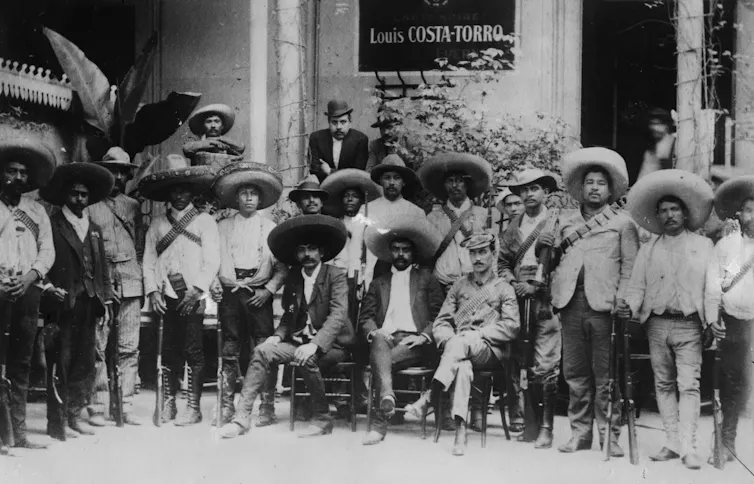
Emiliano Zapata, a primary leader of the Mexican Revolution, is shown with his fellow soldiers in an undated photo.
HUM Images/Universal Images Group via Getty Images

In 1923, rural workers in the Mexican state of Veracruz formed a Peasant League. From the outset, they saw local issues as closely interwoven with international ones, and they argued that there was a compelling reason for this. As the league put it, “Our internationalism is not the child of a crazed enthusiasm for empty phrases … but of the need to take preventive measures, to bolster ourselves against the enemy,” which they identified as “the imperialism of North America.”

Many of Latin America’s radical movements at this time were inspired by the recent example of the Mexican Revolution. The new Mexican Constitution of 1917 had nationalized the country’s land and natural resources, putting it on a collision course with U.S. companies and landowners.

Others still were energized by the global repercussions of the Russian Revolution. This, of course, included several brand-new communist parties across the region. But at the time, many others in Latin America saw the Bolsheviks as part of a global anti-colonial wave.

Mexico City as activist hub

My book explores the key role Mexico City played as a gathering point for these different political tendencies.

They included groups ranging from Mexican peasant leagues to the American Popular Revolutionary Alliance, an anti-imperialist movement formed by Peruvian exiles. Many of these organizations converged under the umbrella of the Anti-Imperialist League of the Americas. Founded in Mexico City in 1925, it soon had chapters in a dozen more countries across the region.

Between them, these movements brought into focus the novel features of U.S. power. As the Cuban student leader and communist Julio Antonio Mella saw it in 1925 – at a time when his native country was highly dependent on the U.S. but formally sovereign – the U.S. was distinct. Unlike European empires, it largely refrained from direct control of territories, though it had pressed the Cubans to include in their 1901 constitution a provision allowing it to intervene in the island at will.

In Mella’s view, the U.S. was clearly an empire, one that mainly exercised its dominance through commercial or financial pressures. For him, the dollar and Wall Street were as central to U.S. power as the halls of government in Washington, D.C.

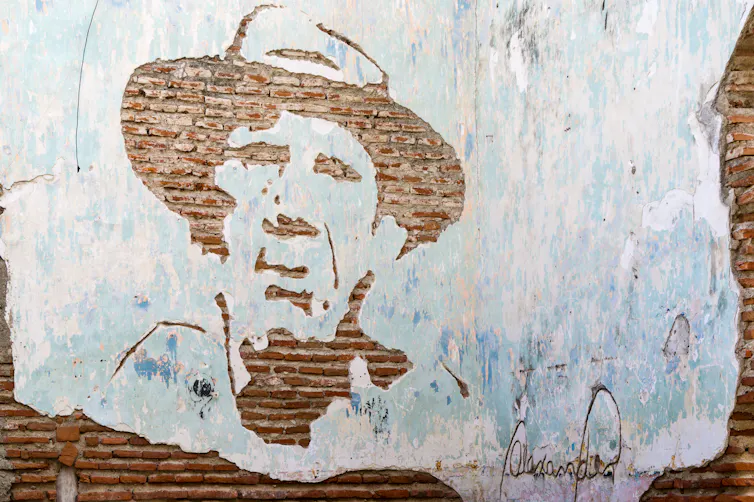
A portrait of a man chiseled from a brick wall.
A portrait of Julio Antonio Mella is seen chiseled from a brick wall in Camaguey, Cuba.
Roberto Machado Noa/LightRocket via Getty Images

For Ricardo Paredes, an Ecuadorean doctor who founded the country’s Socialist Party in 1926, a new term was required to capture Latin American countries’ contradictory position. Formally sovereign, they were not colonies as such. Yet they were economically and politically subordinated to Washington and Wall Street – “dependent countries,” as he phrased it in 1928.

For the Peruvian poet Magda Portal, a leading member of the anti-imperialist American Popular Revolutionary Alliance, U.S. dominance played out differently in different parts of Latin America.

In a series of lectures she gave in Puerto Rico and the Dominican Republic in 1929, Portal divided the region into zones. While countries such as Argentina or Brazil were mainly sites for U.S. investment, Mexico and the Caribbean were regularly subjected to U.S. military force. Or, as Portal put it, “Here imperialism wears no disguise.”

Portal concluded her lectures with a phrase that combined her analysis of U.S. dominance with a resonant appeal for unity: “We have a single and great enemy; let us form a single and great union.”

United states of resistance?

Yet while there was much Latin American anti-imperialist thinkers could agree on, there were also profound divergences between them. This included questions of strategy as well as issues of principle. What role should different classes play in their movement? How radical a transformation of society were they pushing for? And what kind of state should emerge from it?

Two men listen to a speech in an old photograph.
Cuban Premier Fidel Castro and his foreign minister Raul Roa listen to U.S. President Dwight Eisenhower speak to the United Nations General Assembly on Sept. 22, 1960.
AP Photo

Over time, these differences turned into deep rifts that pitted revolutionaries against democratic reformists, internationalists against nationalists, and pro-Soviets against anti-communists. These disagreements played an important role in Latin American politics over the rest of the century.

While many of these rifts became especially prominent during the Cold War, they developed out of earlier divisions over how best to counter U.S. dominance.

The anti-imperialist upsurge of the 1920s and ’30s was formative for a generation of Latin American radicals. Several of those who entered political life during these years went on to play key roles in major events of the 20th century. Raúl Roa, for example, who served as foreign secretary for Cuba’s revolutionary government from 1959 to 1976, was first politicized in the island’s anti-imperialist movement of the 1920s.

The men and women whose political visions were formed in the interwar period carried those ideals forward into the Cold War era. In important ways, the 1920s and 1930s laid vital groundwork for later and better-known radical movements.

Past is, of course, not always prologue. It is impossible to predict what the long-term consequences of current U.S. policy in Latin America will be, especially given the rightward tilt that is currently unfolding across the region.

But looking at the region’s anti-imperialist traditions does point to one possible outcome: The U.S.’s newly aggressive stance will, sooner rather than later, fuel a resurgence of anti-imperialist sentiment as the organizing principle for a new generation of activists.

The Conversation

Tony Wood does not work for, consult, own shares in or receive funding from any company or organization that would benefit from this article, and has disclosed no relevant affiliations beyond their academic appointment.

​Politics + Society – The Conversation

Categories
Uncategorized

How Trump’s repeated efforts to fire Federal Reserve Chair Powell harm the economy – and make battling inflation harder

President Donald Trump has repeatedly threatened to fire Fed Chair Jerome Powell. AP Photo/Julia Demaree Nikhinson

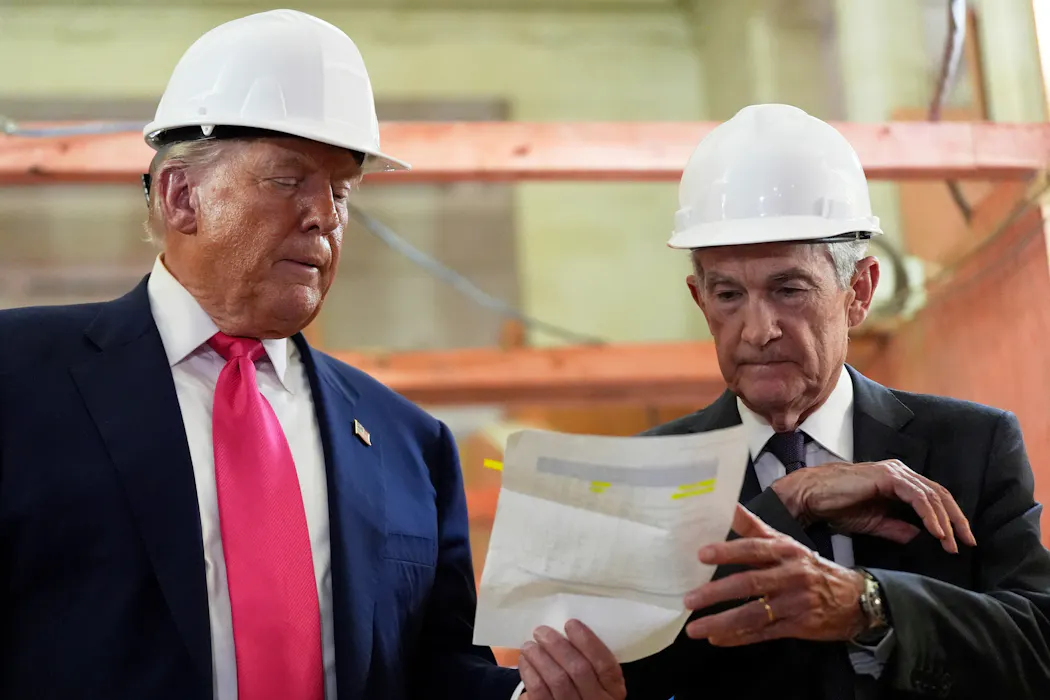
President Donald Trump has again threatened to oust Federal Reserve Chair Jerome Powell, putting at risk a keystone of good economic policy and inflation management: central bank independence.

The president said on April 15, 2026, that he would fire Powell if the Fed chair stayed on in that role after his term officially ends on May 15. Powell has said he intends to remain at the helm after that if his replacement has not yet been confirmed by the Senate. Legally, Powell is allowed to do this.

Trump has promised to fire Powell a number of times, and his Department of Justice has launched a criminal investigation into renovations at the Fed building. Trump has also tried to oust another Fed governor, Lisa Cook, over allegations of mortgage fraud. In an unprecedented video response to the investigation, Powell called it and other actions “pretexts” for Trump’s ultimate goal of getting the Fed to lower interest rates.

While Trump’s actions are seen as particularly aggressive, as political economists, we are not surprised to see politicians try to exert influence on central banks. For one thing, central banks remain part of the government bureaucracy, and independence granted to them can always be reversed – either by changing laws or backtracking on established practices.

An economic power struggle

At the heart of threats to Powell and Cook – and other moves to undermine the Fed by the Trump administration – is a power struggle.

Central banks, which are public institutions that manage a country’s currency and its monetary policy, have an extraordinary amount of power. By controlling the flow of money and credit in a country, they can affect economic growth, inflation, employment and financial stability.

These are powers that many politicians would like to control or at least manipulate. That’s because monetary policy can provide governments with economic boosts at key times, such as around elections or during periods of falling popularity.

The problem is that short-lived, politically motivated moves may be detrimental to the long-term economic well-being of a nation. They may, in other words, saddle the economy with problems further down the line.

That is why central banks across the globe tend to receive significant leeway to set interest rates independently and free from the electoral wishes of politicians.

In fact, monetary policymaking that is data-driven and technocratic, rather than politically motivated, has been seen as the gold standard of governance of national finances since the early 1990s and has largely achieved its main purpose of keeping inflation relatively low and stable.

But despite independence being seen to work, central banks over the past decade have come under increased pressure from politicians.

Trump is one recent example. In his first term as president, he criticized his own choice to head the Federal Reserve and demanded lower interest rates.

Attacks on the Fed have accelerated in Trump’s second administration. In April 2025, Trump lashed out at Powell in an online post, accusing him of being “TOO LATE AND WRONG” on interest rate cuts, while suggesting that the central banker’s “termination cannot come fast enough!” And in August, Trump took the unprecedented step of firing Cook, which a court later blocked. The Supreme Court is expected to issue a ruling in the case this year.

Moreover, the reason politicians may want to interfere in monetary policy is that low interest rates remain a potent, quick method to boost an economy. And while politicians know that there are costs to besieging an independent central bank – financial markets may react negatively, or inflation may flare up – short-term control of a powerful policy tool can prove irresistible.

a white man and a Black woman sit at chairs at a table
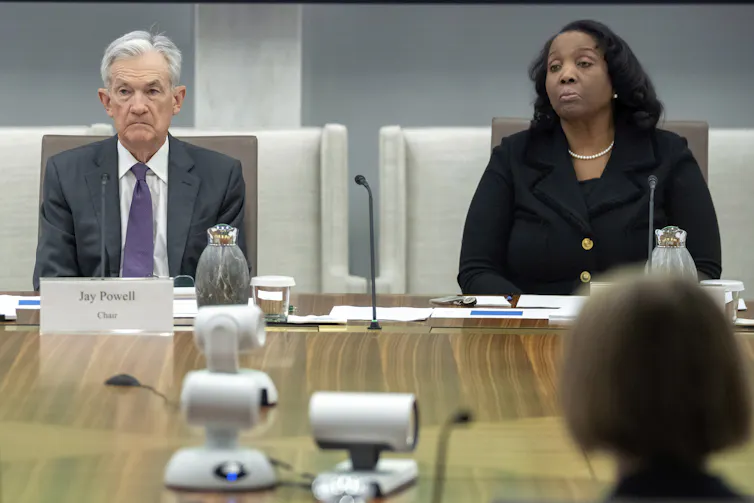
Fed Governors Jerome Powell and Lisa Cook have both been on the receiving end of Trump’s attacks.
AP Photo/Mark Schiefelbein

Legislating independence

If monetary policy is such a coveted policy tool, how have central banks held off politicians and stayed independent? And is this independence being eroded?

Broadly, central banks are protected by laws that offer long tenures to their leadership, allow them to focus policy primarily on inflation, and severely limit lending to the government.

Of course, such legislation cannot anticipate all future contingencies, which may open the door for political interference or for practices that break the law. And sometimes, central bankers are unceremoniously fired.

However, laws do keep politicians in line. For example, even in authoritarian countries, laws protecting central banks from political interference have helped reduce inflation and restricted central bank lending to the government.

In our own research, we have detailed the ways that laws have insulated central banks from the rest of the government, but also the recent trend of eroding this legal independence.

Politicizing appointees

Around the world, appointments to central bank leadership are political – elected politicians select candidates based on career credentials, political affiliation and, importantly, their dislike or tolerance of inflation.

But lawmakers in different countries exercise different degrees of political control.

A 2025 study shows that the large majority of central bank leaders – about 70% – are appointed by the head of government alone or with the intervention of other members of the executive branch. This ensures that the preferences of the central bank are closer to the government’s, which can boost the central bank’s legitimacy in democratic countries, but at the risk of permeability to political influence.

Alternatively, appointments can involve the legislative power or even the central bank’s own board. In the U.S., while the president nominates members of the Federal Reserve Board, the Senate can and has rejected unconventional or incompetent candidates.

Moreover, even if appointments are political, many central bankers stay in office long after the people who appointed them have been voted out. At the end of 2023, the most common length of the governors’ appointment was five years, and in 41 countries, the legal mandate was six years or longer.

And the Fed chair position has traditionally been protected by law, as Powell himself acknowledged in November 2024: “We’re not removable except for cause. We serve very long terms, seemingly endless terms. So we’re protected into law. Congress could change that law, but I don’t think there’s any danger of that.”

In the 2000s, several countries shortened the tenure of their central banks’ governors to four or five years. Sometimes, this was part of broader restrictions in central bank independence, as was the case in Iceland in 2001, Ghana in 2002 and Romania in 2004.

fruits on sale at a market
One of a central bank’s most important duties is to keep consumer prices in check, which becomes harder when its independence is questioned.
AP Photo/Matt Rourke

The low inflation objective

As of 2023, all but six central banks globally had low inflation as their main goal. Yet many central banks are required by law to try to achieve additional and sometimes conflicting goals, such as financial stability, full employment or support for the government’s policies.

This is the case for 38 central banks that either have the explicit dual mandate of price stability and employment or more complex goals. In Argentina, for example, the central bank’s mandate is to provide “employment and economic development with social equity.”

Conflicting objectives can open central banks to politicization. In the U.S., the Federal Reserve has a dual mandate of stable prices and maximum sustainable employment. These goals are often complementary, and economists have argued that low inflation is a prerequisite for sustainable high levels of employment.

But in times of overlapping high inflation and high unemployment, such as in the late 1970s or when the COVID-19 crisis was winding down in 2022, the Fed’s dual mandate has become active territory for political wrangling.

Since 2000, at least 23 countries have expanded the focus of their central banks beyond just inflation.

Limits on government lending

The first central banks were created to help secure finance for governments fighting wars. But today, limiting lending to governments is at the core of protecting price stability from unsustainable fiscal spending.

History is dotted with the consequences of not doing so. In the 1960s and 1970s, for example, central banks in Latin America printed money to support their governments’ spending goals. But it resulted in massive inflation while not securing growth or political stability.

Today, limits on lending are strongly associated with lower inflation in the developing world. And central banks with high levels of independence can reject a government’s financing requests or dictate the terms of loans.

Yet over the past two decades, almost 40 countries have made their central banks less able to limit central government funding. In the more extreme examples – such as in Belarus, Ecuador or even New Zealand – they have turned the central bank into a potential financier for the government.

Scapegoating central bankers

In recent years, governments have tried to influence central banks by pushing for lower interest rates, making statements criticizing bank policy or calling for meetings with central bank leadership.

At the same time, politicians have blamed the same central bankers for a number of perceived failings: not anticipating economic shocks such as the 2007-09 financial crisis; exceeding their authority with quantitative easing; or creating massive inequality or instability while trying to save the financial sector.

And since mid-2021, major central banks have struggled to keep inflation low, raising questions from populist and antidemocratic politicians about the merits of an arm’s-length relationship.

But chipping away at central bank independence, particularly in the name of lowering interest rates to boost the economy, as Trump appears to be doing by threatening to fire the Fed chair and his attempted removal of a member of the bank’s Board of Governors, is a historically sure way to high inflation.

This is an updated version of an article that was originally published on June 14, 2024.

The Conversation

The authors do not work for, consult, own shares in or receive funding from any company or organization that would benefit from this article, and have disclosed no relevant affiliations beyond their academic appointment.

​Politics + Society – The Conversation

Categories
Uncategorized

Iran’s military forces combine state-of-the-art drones and hackers with out-of-date conventional weapons

Revolutionary Guard personnel stand under an Iranian-made unmanned aerial vehicle, the Shahed-136, while participating in a military rally in Tehran, Iran, on Jan. 10, 2025. Morteza Nikoubazl/NurPhoto via Getty Images

Six weeks of U.S. and Israeli bombardment have served to degrade Iran’s nuclear facilities and cripple parts of its military.

But the Islamic Republic’s offensive capabilities have been built up over nearly 50 years, during which Iran has been either at war or under the threat of conflict.

As an expert in military history and theory, I believe that to understand what may come next in Operation Epic Fury, it’s valuable to grasp the development of Iran’s modern military structure, capabilities and international activities.

Iranian military technology

Prior to the establishment of the Islamic Republic of Iran in 1979, Iran’s military was largely supplied by Western powers, particularly the United States.

It entered the Iran-Iraq war in 1980 with a substantial amount of then-modern equipment. That included nearly 80 F-14 fighter aircraft, over 200 F-4 and F-5 aircraft and thousands of tanks.

But Iran’s military was exhausted when the war ended in 1988. And the government had by then become a world pariah, making resupply all but impossible.

Although Iran imported some military equipment from the Soviet Union and China in 1990, its economy could not support substantial military spending.

Ironically, the arms embargoes that Iran faced during and after its war with Iraq made the regime self-reliant on its weapons stockpiles. And that triggered the development of a substantial domestic arms industry.

Most modern Iranian military equipment consists of reverse-engineered American and Soviet equipment, much of it obsolete. Since 1990, however, Iranian missile technology has substantially improved. That’s due to domestic production and importing expertise from other marginalized states, such as North Korea.

Smoke rises from a warehouse in an open field.
Smoke rises from an oil warehouse on the outskirts of Erbil, the capital of Iraq’s Kurdistan region, following a suspected drone strike on April 1, 2026.
Gailan Haji/Middle East Images/AFP via Getty Images

Starting in the 1990s, Iran also innovated a series of one-way attack drones, a relatively inexpensive way to attack distant targets.

The modern Iranian military

The Iranian military is split into the regular military, or “Artesh,” and the Islamic Revolutionary Guard Corps. The Artesh plays a domestic defense role akin to a militia, while the Revolutionary Guard serves as the more professional military force.

The Revolutionary Guard projects regional power. During the 2003 U.S.-Iraq war, for instance, it provided improvised explosive devices to insurgents targeting American forces.

The Revolutionary Guard tends to receive the bulk of Iranian military resources, including the best personnel and equipment. Quds Force, the unconventional warfare wing of the Revolutionary Guard, has long played a role in exporting the revolutionary beliefs of the Iranian rulers. The Quds Force provides arms and guidance to proxies throughout the Middle East, primarily by fomenting insurrections against Arab Sunni governments.

Iran has long been the patron of Hezbollah, based in Lebanon, whose primary goal is the eradication of Israel. More recently, Iran has also engaged in substantial support of Hamas in Gaza, despite the fact that Hamas is a Sunni organization, while the rulers of Iran are members of the Shiite branch of Islam.

Iran has constantly sought means of exerting military influence beyond its borders, without risking external attack. It has embraced the use of cyber warfare, a method of attack with a relatively low cost for participation and a potentially outsized influence on the world stage.

Iranian hackers have attacked Western military and government networks, including a hack of FBI Director Kash Patel’s personal emails. Iranian-backed hackers have also launched attacks on infrastructure and cultural institutions, including U.S. wastewater treatment plants and electrical grids.

Missile traces are seen in the sky.
Missile traces are seen over Damascus, Syria, during Iran’s missile attacks against Israel on June 14, 2025.
Hummam Sheikh Ali/Xinhua via Getty Images

Iran’s pursuit of atomic weaponry

Iran’s government has relentlessly pursued nuclear weapons since at least the 1980s.

The Iranian government has always maintained that its nuclear program is to provide power for the developing nation, rather than weaponry. But definitive evidence of uranium enrichment far beyond the requirements of power generation have caused Western states to demand an end to the Iranian nuclear program.

In 2010, cybersecurity researcher Sergey Ulasen discovered an incredibly complex malware program, dubbed Stuxnet, that was created to undermine the Iranian nuclear program by disrupting the function of enrichment centrifuges. No nation has ever taken responsibility for the attack, which set back Iranian uranium enrichment efforts by years.

In 2015, after negotiations with the five permanent members of the U.N. Security Council and Germany, Iran agreed to halt its uranium enrichment program in exchange for relief from economic sanctions and the release of frozen Iranian assets. The negotiations resulted in the Joint Comprehensive Plan of Action, or JCPOA.

Although the Trump administration withdrew the U.S. from the JCPOA in 2018, the agreement continued to function, and Iran seemed poised to reenter the global economy.

A machine produces a yellow substance.
Machines use yellow cakes to produce uranium hexafluoride at the uranium conversion facilities in Isfahan, Iran, on Feb. 3, 2007.
Behrouz Mehri/AFP via Getty Images

However, in 2020 the Iranians restarted their nuclear program. They also ramped up production of ballistic missiles and one-way attack drones.

In June 2025, the United States and Israel launched a massive aerial attack on Iranian nuclear facilities, an effort that Trump characterized as having destroyed Iran’s nuclear facilities.

Iran responded by launching a wave of ballistic missiles and drones toward Israel, most of which were intercepted before entering Israeli airspace.

The missile and interceptor war

Prior to Operation Epic Fury, analysts estimated that Iran possessed 3,000 ballistic missiles and tens of thousands of one-way attack drones. They also concluded that Iran had a substantial production capacity to increase its stockpiles.

In the first six weeks of the current conflict, Iran expended at least 650 missiles in attacks on Israel and hundreds more against other targets in the region.

The U.S. has placed a heavy emphasis on attacking missile production and storage facilities. But it’s difficult to ascertain how many missiles and drones the Iranian military might still possess.

Iranian production and transportation has almost certainly sustained substantial losses in capacity. And U.S. and Israeli aircraft prowl the skies over Iran seeking signs of mobile launchers or attempts to transport missiles to firing locations.

The rate of Iranian missile fire has substantially declined since the first days of the conflict, but it has never dropped to zero. That has led some analysts to suspect that Iran maintains a significant cache of long-range weaponry in reserve, while U.S. Secretary of Defense Pete Hegseth argues that it has lost the capacity to launch major barrages.

The Conversation

Paul J. Springer is a Senior Fellow of the Foreign Policy Research Institute. His comments represent his own opinion and do not reflect the official policy of the United States Government, the U.S. Department of Defense, or the U.S. Air Force.

​Politics + Society – The Conversation

Categories
Uncategorized

Why Pete Hegseth’s Pentagon prayer services challenge traditional notions of separation of church and state – but might be blessed by the Roberts Supreme Court

The wall between church and state appears increasingly thin. hayesphotography/iStock Getty Images Plus

Secretary of Defense Pete Hegseth is engaging in “a proselytizing Christian campaign” in his job, according to The Washington Post.

Hegseth hosts prayer services at the Pentagon and virtually crusades as a Christian, praying at the Pentagon for U.S. troops to inflict “overwhelming violence of action against those who deserve no mercy in Iran.” Politics editor Naomi Schalit spoke with Dickinson College President John E. Jones III about the legal implications of Hegseth’s actions.

Jones was a longtime federal judge, and his most famous decision, Kitzmiller v. Dover, was a case in which a district school board ordered the teaching of so-called intelligent design – claimed by advocates to be an alternative to the theory of evolution. Jones’ 139-page decision concluded that it was “abundantly clear” that the board’s policy violated the establishment clause of the Constitution, which forbids the government from creating an official religion or favoring one religion over another.

Schalit: What issues do Hegseth’s behavior and statements raise for you, if any?

Jones: From afar, it looks as if he is flirting with a violation of the establishment clause as contained within the First Amendment. The establishment clause mandates that there can’t be a national religion, nor can the government favor one religion over another.

What appears to be happening at the Pentagon are services that basically recognize only a particular religious tradition. And it’s very notable that Americans United for Separation of Church and State filed suit against both the Defense Department and the Labor Department because there are similar activities that are taking place there.

Defense Secretary Pete Hegseth asked God to “let every round find its mark against the enemies of righteousness and our great nation” during a monthly Christian service at the Pentagon on March 25, 2026.

What they’re seeking under the Freedom of Information Act are certain records, because they likely can’t attend these sessions. Any information they receive could support a separate lawsuit that, in effect, says the government – via the departments of Labor and Defense – is violating the establishment clause.

From my perspective, it sure looks like they are in violation. These activities are hosted on government property. They’re potentially coercive and appear to promote one particular religious viewpoint above others. While they may say they’re not requiring people to attend, you don’t know whether there may be some incentivizing or negative consequence if somebody doesn’t come.

Let me be the casual bystander and say, “Gosh, it’s just really nice. He’s a God-fearing man, and you know, he’s saying things that show his belief, which is a good thing to have.” Why did the authors of the Bill of Rights have a problem with the government establishing a state religion?

They were people of their time. They knew England had the Church of England and thus a national religion that was intertwined with the state. It ultimately caused untoward problems. They wanted everyone to have the freedom to worship, or not, as a personal choice and felt very passionately about that.

What has been long debated is the concept of a wall of separation between church and state. That phrase is not in the Constitution, but it is something that appears in cases, or is at least implied. And I’ve often said that wall is somewhat porous because there are circumstances where courts have allowed a little bit of seepage of religion under certain circumstances into the so-called public square.

What is really interesting is the tilt of the current Supreme Court court towards relaxing what have been generations of jurisprudence holding that the establishment clause should be more strictly enforced.

The Kennedy v. Bremerton School District case of 2022 involved a high school football coach assembling his players for prayer after games. It was pretty remarkable in the fact that the Supreme Court ultimately decided that that was not a violation of the establishment clause.

Some of the reasons were that it was after the game and that it was not a required activity for the players. Those who opposed it claimed that it was a violation of the establishment clause and that it was inherently coercive.

These current activities by the government – assuming that Americans United for Separation of Church and State files a lawsuit, not just an information request – are very likely to get to the Supreme Court.

The other thing the Supreme Court has done is it abandoned the so-called Lemon test, which courts utilized to determine whether a law or practice violated the establishment clause. Particularly in Kitzmiller v. Dover, I found the Lemon test to be a really helpful vehicle to use in measuring whether the policy in that case, which involved a school board mandating the teaching of the so-called alternative to evolution – intelligent design – violated the establishment clause.

President John F. Kennedy says people unhappy with a 1962 Supreme Court decision banning prayers in public schools can “pray a good deal more at home.”

How did the Lemon test work?

The Lemon test says that a judge should first measure the purpose of the government’s action, and then the effect on a reasonable person. You can then go to a third point, which is whether it represents an excessive entanglement with religion.

It doesn’t fit every case, but it worked in most establishment clause challenges.

But the Supreme Court, first in Kennedy v. Bremerton School District, pronounced it dead.

They in effect said to judges, “You have to look at historical antecedents and traditions and so forth.” That’s great writing at the Supreme Court level, but it leaves district judges completely unmoored. So whomever the poor judge is who gets this case is likely going to have a difficult time trying to read the tea leaves to determine whether it is, in fact, a violation. And I guarantee you, there won’t be unanimity among jurists and lawyers on that point.

So you’ve got a case where in the old days there was legal scripture that said, “OK, apply these tests and you can tell whether the government has stepped over the line into endorsing religion.” But now the Supreme Court has made it unclear where that line is?

Yes, and the very fact that Americans United for Separation of Church and State is trying to get information under the Freedom of Information Act means that they know that you have to come armed with a lot of salient surrounding facts in order to have this declared unconstitutional.

If this had been 10 or 20 years ago, they probably wouldn’t have filed that action under the Freedom of Information Act. They would have directly challenged the law and in effect said, “Look, it speaks for itself. You have services favoring one religion over others within the Pentagon and Labor departments. It’s inherently unconstitutional and a violation of the establishment clause.”

But we’re in a post-Lemon world today where there is a relaxation of the previously recognized constraints of the establishment clause.

Where does that get the country?

I fear where it goes if the progression continues. The proponents of this kind of behavior ask, “What’s wrong with a little of that good old-time religion in the public square?”

They never appear to contemplate the fact that in generations hence, America could, for example, be a predominately Muslim population. Suppose that became the favored religion in a country, or any religion that may be embraced by some but be disfavored by others became the favored religion. The establishment clause is meant to protect everyone, including, by the way, nonbelievers and atheists.

There’s nothing in the establishment clause that says that you can’t worship – or not – as you see fit. And that’s the beauty of this country. The founders knew that if there was a move towards a favored or national religion in the eyes of the government, that could replicate what took place in Great Britain, where religion and politics mixed with occasionally terrible results.

Failure to adhere to the dictates of the church could render you a second-class citizen, or worse. My hope is that judges will be very, very careful about a systemic creep that totally eviscerates the purpose and intent of the establishment clause.

The Conversation

John E. Jones III does not work for, consult, own shares in or receive funding from any company or organization that would benefit from this article, and has disclosed no relevant affiliations beyond their academic appointment.

​Politics + Society – The Conversation

Categories
Uncategorized

A justice department opinion arguing the Presidential Records Act is unconstitutional could revert the nation to a time when presidents freely burned their papers

At least one past president burned his papers. Stephen Hyun/Getty Images

Prior to 1978, U.S. presidents could do what they pleased with the records from their time in office. They owned them.

But in 1978, the Presidential Records Act established new rules for the official records of a president. Passed in the wake of Watergate, when President Richard Nixon tried to keep incriminating materials from being made public, the law changed who legally owned the papers: It was now the American public.

Under the act’s terms, “all records must be furnished to the White House Archivist and ultimately made subject to public disclosure … and the President may not discard or destroy records without the express agreement of the Archivist.”

When he signed the act, President Jimmy Carter heralded it as a way to “make the Presidency a more open institution” and ensure “that our Government … merits the trust of the people from whom a President and his Government derive their power.”

But now the Trump administration wants to undo the reform that put presidential papers in the hands of the public.

On April 1, 2026, the Justice Department’s Office of Legal Counsel, known as the OLC, released an opinion claiming that the Presidential Records Act is unconstitutional. Its opinion says that Congress lacks authority to regulate what happens to documents maintained in the executive branch and, as a result, the Presidential Records Act violates the separation of powers.

Public interest groups and some historians responded to the OLC memo with alarm. The watchdog group American Oversight called the Presidential Records Act a bulwark against the possibility that presidents will “hide evidence of corruption, abuse of power, and misconduct from the public …” On April 6, 2026, the group filed a lawsuit seeking to prevent the president from acting on the OLC memo.

Whether the Trump administration or American Oversight is right about the Presidential Records Act is likely to be determined by a judge. In the meantime, the significance of the OLC’s opinion cannot be overstated.

That’s because the Office of Legal Counsel is “the Executive Branch’s preeminent legal advisor,” wrote federal judge Florence Pan in 2025. “Executive Branch agencies treat OLC’s legal conclusions as binding.”

I’ve written about secrecy in government, and the argument about the Presidential Records Act has a familiar ring. It is the latest version of an ongoing conflict about how much transparency is necessary and desirable in American government.

A man at a desk with two men standing behind him as he signs a piece of paper.
President Jimmy Carter, seen here at his Oval Office desk, signed legislation in 1978 that he said would ‘ensure that Presidential papers remain public property after the expiration of a President’s term.’
Corbis/Getty Images

Neglected, burned, sold, vanished

Throughout most of U.S. history, presidential records have been treated as the president’s personal property. They could dispose of them as they wished.

The Indiana University library’s Guide to Presidential Papers, Congressional Papers, and Classified Materials says, “Sometimes the Library of Congress purchased a president’s papers from his heirs, as in the case of George Washington. Sometimes the president’s heirs sold off or donated various parts of the collection to different collectors and organizations.”

Some presidential materials were neglected and vanished. And one president, Martin Van Buren, burned some of his papers.

The idea that presidential papers had some public value began to emerge in the 20th century. In 1934, Congress passed legislation establishing the National Archives. It charged the new agency with preserving the official records of the federal government.

However, that legislation did not require that the president turn over his records to the archives. So in 1955, Congress passed the Presidential Libraries Act.

That law was designed to encourage presidents to turn over their records to the federal government. It also provided funding for presidential libraries to provide places to keep presidential records and make them available to the public. But here again, there were no teeth: The law did not require a departing president to give anything to the government, nor to build a library to house his papers.

All that changed in the wake of the Watergate scandal. That’s when it became clear that, but for the intervention of the U.S. Supreme Court in the 1974 United States v. Nixon case, Nixon intended to cover up what had happened and would have gotten rid of his incriminating White House tapes.

The passage in 1978 of the Presidential Records Act was a response to the Nixon scandal. Yet as attorney Sara Worth writes in a blog post for Yale Law School’s Media Freedom and Information Access Clinic, Congress “declined to include an enforcement mechanism to ensure compliance,” instead envisioning “future Presidents’ good-faith cooperation with the statutory mandate.”

DOJ: It’s a negotiation

After the FBI raid on his Mar-a-Lago residence in 2022 uncovered a trove of classified documents that had been removed from government premises, then former-President Trump argued that the Presidential Records Act didn’t apply to what he had done. He said he was actually complying with the act by refusing to relinquish presidential records.

In March 2023, Trump told Fox News that the law is “very specific”: “It says you are going to discuss the documents. You discuss everything – not only docu– everything – about what’s going in NARA, et cetera, et cetera. You’re gonna discuss it. You will talk, talk, talk. And if you can’t come to an agreement, you’re gonna continue to talk.”

A man in white shirt, red tie, blue jacket holds up a folded piece of paper.
President Donald Trump says the ultimate disposition of presidential papers should be a negotiation.
Jim Watson/AFP via Getty Images

Trump apparently meant that there would be negotiation over what constituted a presidential document that could be kept by the former president and what didn’t. That view is hard to reconcile with one of the Presidential Records Act’s unambiguous provisions: “Presidential records automatically transfer into the legal custody of the Archivist as soon as the President leaves office.”

Now, the Office of Legal Counsel is telling Trump that he can ignore that provision.

In addition, in its consideration of the Presidential Records Act, the OLC embraced Trump’s expansive view of presidential power. It argued that the Presidential Records Act is “unconstitutional for two independent but interlocking reasons: It exceeds Congress’s enumerated and implied powers, and it aggrandizes the Legislative Branch at the expense of the constitutional independence and autonomy of the Executive.”

The Justice Department’s lawyers appealed to history and tradition to buttress their conclusion: “Over the first two centuries of the American experiment in self-government, Presidents owned and controlled presidential papers, and Congress obtained such papers through political negotiation and interbranch accommodation, rather than as a matter of right. That historical practice was interrupted by the Presidential Recordings and Materials Preservation Act.”

‘Let the people know the facts’

The idea that citizens have a right to access information of the kind made possible by the Presidential Records Act can be traced back to the Enlightenment. American revolutionary Patrick Henry observed in 1788, “The liberties of people never were, nor ever will be, secure, when the transactions of their rulers may be concealed from them.”

Seven decades later, Abraham Lincoln echoed Henry when he said, “Let the people know the facts, and the country will be safe.”

In our era, that is what laws like the Presidential Records Act make possible. The Presidential Records Act plays an important role in preserving the liberty and security that Henry and Lincoln spoke about.

The Conversation

Austin Sarat does not work for, consult, own shares in or receive funding from any company or organization that would benefit from this article, and has disclosed no relevant affiliations beyond their academic appointment.

​Politics + Society – The Conversation
Categories
Uncategorized

4 ways the war in Iran has weakened the United States in the great power game

China and Russia view the U.S. grand strategy as increasingly out of focus. AP Photo/Julia Demaree Nikhinson

“Never interrupt your enemy when he is making a mistake.”

Napoleon Bonaparte’s maxim may well have been in the minds of policymakers in Moscow and Beijing these past weeks, as the U.S. war in Iran dragged on. And now that a 14-day ceasefire between Tehran and Washington is in effect – with both sides claiming “victory” – Russian and Chinese leaders still have an opportunity to profit from what many see as America’s latest folly in the Middle East.

Throughout the weekslong conflict, China and Russia struck a delicate balance. Both declined to give Iran – seen to a varying degree as an ally of both nations – their full-throated support or sink any real costs into the conflict.

Instead, they opted for limited assistance in the form of small-scale intelligence and diplomatic support.

As a scholar of international security and great power politics I believe that is for good reason. Beijing and Moscow were fully aware that Iran could not “win” against the combined military might of the United States and Israel. Rather, Iran just needed to survive to serve the interests of Washington’s main geopolitical rivals.

Below are four ways in which the U.S. war in Iran has damaged Washington’s position in the great power rivalries of the 21st century.

1. Losing the influence war in the Middle East

As I explore in my book “Defending Frenemies,” the U.S. has long struggled to balance competing objectives in the Middle East. During the Cold War, this meant limiting the Soviet Union’s influence in the region, while contending with the development of nuclear weapons by two troublesome allies, Israel and Pakistan.

By the 2020s, the priorities in Washington were aimed at restricting the influence of the U.S.’s great power rivals – China and to a lesser degree Russia – in the Middle East.

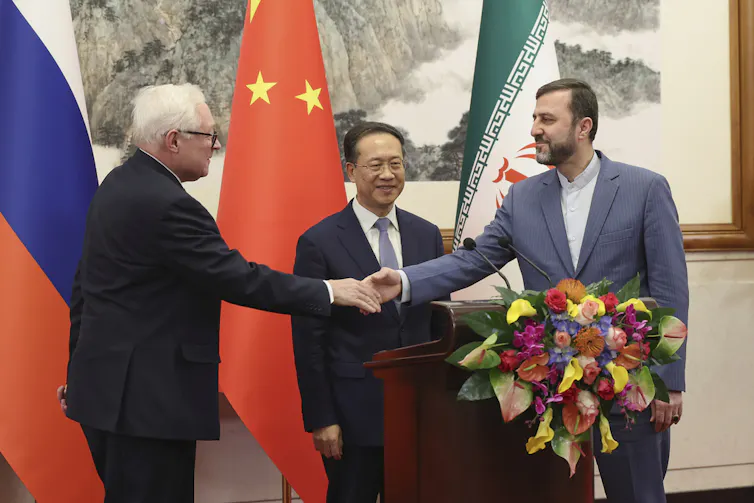
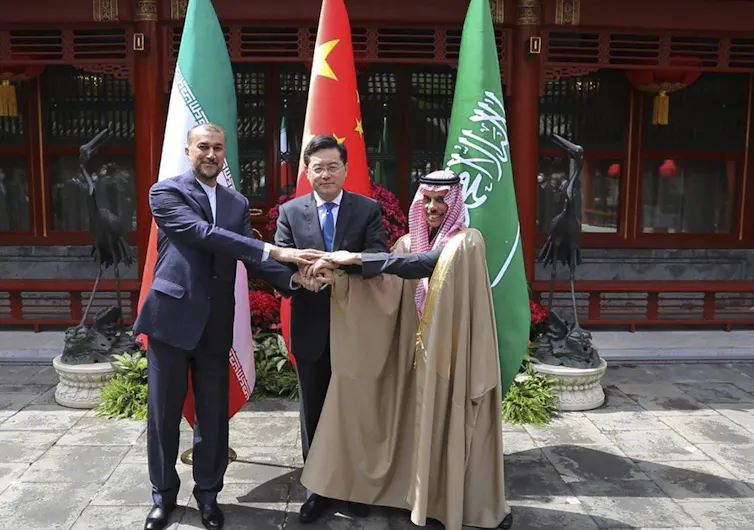
Three meet greet each other in diplomatic setting.
Russian, Chinese and Iranian diplomats have a confab in 2025 in Beijing.
Lintao Zhang/Pool Photo via AP

Yet under Presidents Xi Jinping and Vladimir Putin, China and Russia have sought to increase their footprint in the region through a variety of formal alliances and informal measures.

For Russia, this took the form of aligning with Iran, while also partnering with Tehran to prop up the now-ousted regime of President Bashar Assad during the Syrian civil war. Meanwhile, China increased its diplomatic profile in the Middle East, notably by acting as a mediator as Saudi Arabia and Iran restored diplomatic ties in 2023.

The irony of the latest Iran war is that it follows a period in which circumstances were unfavorable to Russian and Chinese aims of increasing their influence in the Middle East.

The fall of Assad in December 2024 deprived Russia of its one reliable ally in the region. And Trump’s May 2025 tour of the Gulf states, in which he secured major technology and economic deals with Saudi Arabia, the United Arab Emirates, Qatar and Bahrain, was aimed at countering China’s growing economic and diplomatic influence in those countries.

With Washington perceived as an increasingly unreliable protector, the Gulf states may seek greater security and economic cooperation elsewhere.

2. Taking US eyes off other strategic goals

In expanding military, diplomatic and economic ties in the Middle East, Russia and China over the past two decades were exploiting a desire by Washington to move its assets and attention away from the region following two costly wars in Iraq and Afghanistan.

Trump’s decision to wage war against Iran directly contradicts the national security strategy his administration released in November 2025. According to the strategy, the administration would prioritize the Western Hemisphere and the Indo-Pacific, while the Middle East’s importance “will recede.”

In co-launching a war in Tehran with Israel, without any prior consultation with Washington’s other allies, Trump has shown a complete disregard for their strategic and economic concerns. NATO, already riven by Trump’s repeated threats to the alliance and designs on Greenland, has now shown further signs of internal divisions.

That offers benefits for China and Russia, which have long sought to capitalize on cracks between America and its allies.

The irony, again, is that the war in Iran came as Trump’s vision of the U.S. as the hegemonic power in the Western Hemisphere was making advances. International law and legitimacy concerns aside, Washington had ousted a thorn in its side with Nicolás Maduro in Venezuela and replaced him with a more compliant leader.

3. Disproportionate economic fallout

Iran’s closure of the Strait of Hormuz, where some 20% of the world’s oil passes, was as predictable as it was destructive for U.S. interests.

But for Russia, this meant higher oil prices that boosted its war economy. It also led to the temporary but ongoing easing of U.S. sanctions, which has provided Moscow an indispensable lifeline after years of economic pressure over the war in Ukraine.

While a prolonged closure and extensive damage to oil and natural gas infrastructure in Iran and the Gulf states no doubt hurts China’s energy security and economy, these were risks Xi appears willing to accept, at least for a time.

And by building up a domestic oil reserve and diversifying energy sources to include solar, electric batteries and coal, China is far better positioned to weather a prolonged global energy crisis than the U.S. Indeed, Beijing has made strides in recent year to encourage domestic consumption as a source of economic growth, rather than be so reliant on global trade. That may have given China some protection during the global economic shock caused by the Iran war, as well as push the economy further down its own track.

The more the U.S. loses control over events in the strait, the more it loses influence in the region – especially as Iran appears to be placing restrictions on ships from unfriendly nations.

Three men greet during a diplomatic meeting.
China’s former foreign minister looks on as Iranian and Saudi diplomats shake hands during Beijing-mediated talks in 2023.
Iranian Foreign Ministry via AP

4. Loss of global leadership

Trump’s willingness to abandon talks to go to war, and the contradictory rhetoric he has employed throughout the Iran conflict, has weakened the perception of the U.S. as an honest broker.

That provides a massive soft power boost for Beijing. It was China that pressed Iran to accept the 14-day ceasefire proposal brokered by Pakistan. Indeed, China has slowly chipped away at America’s longtime status as global mediator of first resort.

Beijing has successfully mediated in the past between Iran and Saudi Arabia, and it attempted to do the same with Russia and Ukraine and Israel and the Palestinians.

In general, the Iran war adds weight to Beijing’s worldview that the U.S.-led liberal international order is over. Even if China benefited at some level from the war continuing, its decision to help broker the ceasefire shows that China is increasingly taking on the mantle of global leadership that the U.S. used to own.

And for Russia, the Iran war and the rupture between Trump and America’s NATO allies over their lack of support for it, shift world attention and U.S. involvement from the war in Ukraine.

The Conversation

Jeffrey Taliaferro does not work for, consult, own shares in or receive funding from any company or organization that would benefit from this article, and has disclosed no relevant affiliations beyond their academic appointment.

​Politics + Society – The Conversation
Categories
Uncategorized

US ceasefire with Iran: What’s next? A former diplomat explains 3 possible scenarios

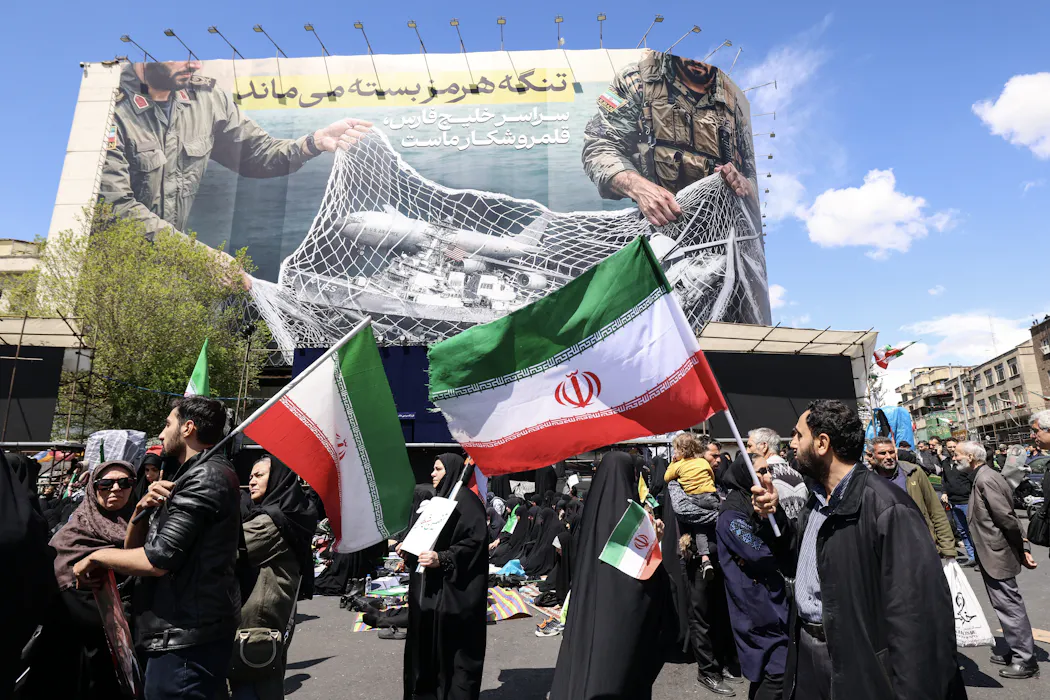
Iranians hold national flags in Tehran’s Revolution Square on April 8, 2026, after the United States and Iran agreed to a two-week ceasefire. Atta Kenare/AFP via Getty Images

President Donald Trump on April 7, 2026, announced a ceasefire between the United States and Iran, after more than a month of war marked by U.S. and Israeli strikes against Iranian military leadership, Iranian retaliation against regional oil infrastructure and a global energy crisis.

As a former U.S. diplomat, I have found there are three ways that warring parties arrive at a ceasefire.

The first scenario happens when one party tires of war and asks for peace, as Hamas, the militant Palestinian organization, did when it pushed for a ceasefire with Israel in late 2023 and early 2024. But this strategy reveals weakness to the other side and thus seldom works. Israel ignored Hamas and continued the war in Gaza until October 2025.

Warring nations also reach ceasefires when a powerful third country insists the two parties stop fighting due to risks to world peace and regional stability. In the modern era, the U.S. has done this several times in the Mideast when it has leveraged influence over key players, such as Israel and Egypt. But with the Iran war, there is no country in a good position to do this.

The current U.S.-Iran ceasefire is a good example of the third way that agreements to stop fighting can happen. Both countries were tired of the costs and the ongoing risks of the war, and they sent signals to that effect.

Pakistan, which deserves praise for stepping in, picked up on this and offered to serve as an intermediary. For at least two weeks, assuming the ceasefire holds, the U.S., Iran and Israel can lick their wounds and consider their next moves, as they work out whether the conflict between Israel and Hezbollah is covered by the ceasefire.

US and Israel’s war with Iran

Why were the United States and Iran ready for a ceasefire?

For the U.S. and Israel, the war didn’t go as planned. There was no true regime change in Iran and no uprising of its people.

Iran closed the Strait of Hormuz, a key maritime channel between the Persian Gulf and the Gulf of Oman, and maintained its ability to shoot down warplanes and attack its neighbors, including Israel, Saudi Arabia, the United Arab Emirates and Kuwait.

For Iran, the war has cost the lives of thousands of its citizens and dozens of its leaders. It has also ruined key infrastructure, and it had the potential to get much worse.

A large ship passes through a strait.
A vessel passes through the Strait of Hormuz following the announcement of a two-week ceasefire between the United States and Iran.
Shady Alassar/Anadolu via Getty Images

Key ceasefire demands

That’s how we got here. Now, where could the war go next?

One possibility is that the ceasefire lasts only two weeks, is shaky throughout – as seen with Israel’s bombing of Lebanon after the ceasefire was declared – and war resumes.

The world already knows what that looks like, with its impact on the global economy and the soaring financial costs to the U.S. military.

Another scenario is that the ceasefire is extended, either clearly or just de facto, with zero to minimal U.S. attacks or Iranian missile or drone launches. This is quite possible.

The third and best outcome would be if the two parties are able to use these two weeks, plus some extensions, to hammer out the key points of a peace deal.

What could this involve?

The two key U.S.-Israel demands are that Iran give up its nuclear weapons development and stop backing Hamas and Hezbollah, the Shiite militia with extensive influence in Lebanon.

At this point, I believe the Iranians should realize that nuclear weapons are not their best deterrence, and that their attempts to obtain them have led only to their isolation. Their true deterrence is their ability to close the Strait of Hormuz and choke off 20% of the world’s energy supply. For that, they need only drones and small speed boats.

Iran’s support of Hezbollah, which has contributed to the ruin of a once prosperous and democratic Lebanon since it launched military operations inside the country in 1982, is a liability to them as well.

Smoke rises from a city center.
Smoke billows from Beirut’s southern suburb, a stronghold of pro-Iranian Hezbollah, after a wave of airstrikes by Israel on April 8, 2026.
Marwan Naamani/picture alliance via Getty Images

Iran’s missile attacks during this war have made it clear that they would be able to deliver nuclear weapons if they had them. And their drone and missile strikes on their Muslim neighbors, including Qatar and Saudi Arabia, are only creating new enemies.

But what would the Iranians want in return?

First and foremost, an end to attacks by other countries attempting to topple their regime. Second, and just as important, a permanent lifting of sanctions so long as they end their support for terrorist groups and surrender their uranium. Unfortunately, such an agreement would do nothing for pro-human rights groups in Iran.

A lack of trust

All parties would need to be committed to working out the many details for a ceasefire to last. Pakistan would need to stay the course as an honest broker and not get discouraged. The governments involved would need to be able to persuade their people that such a deal is acceptable.

Sound impossible? It’s been done many times in history. Think of how intractable the conflicts in Northern Ireland or between Israel and Egypt once seemed. The key element is for both sides to fear a resumption of war more than they do the consequences of a compromise peace.

A major problem is the lack of trust on both sides. The U.S. has seen Iran go back on promises before. Israel was traumatized by Hamas attacks in 2023. And Iran can’t keep up with Trump’s constantly changing signals and his bombing Iran while negotiating with the government there.

But if the ceasefire holds and negotiations are successful, the world could see an Iran that, at least, is no longer a menace to its neighbors. And Iran would see itself being readmitted to the world economy, which it desperately needs.

If it doesn’t work, and we go back to how things were before the ceasefire, we’ll be back to the U.S. and Israel raining down hard-to-replace munitions on Iran, and Iran lashing out with drones and missile attacks against a dozen countries, with the world economy taking a beating.

The Conversation

Donald Heflin does not work for, consult, own shares in or receive funding from any company or organization that would benefit from this article, and has disclosed no relevant affiliations beyond their academic appointment.

​Politics + Society – The Conversation