Categories
Uncategorized

Citizenship voting requirement in SAVE America Act has no basis in the Constitution – and ignores precedent that only states decide who gets to vote

The House has passed a new version of an election security bill, but it faces an uphill climb in the Senate. Getty Images/Apu Gomes

The Republican-led House of Representatives voted Feb. 11, 2026 to approve the Safeguard American Voter Eligibility Act – or SAVE America Act. The bill would require individuals to provide proof of citizenship when they register to vote and present photo identification when they do vote in federal elections.

This marks the third year in a row that the House has passed similar legislation. Passage in the Senate, which would require Democratic votes, continues to appear unlikely. But Republicans from President Donald Trump on down are clearly interested in finding ways to enhance election security – although critics contend the SAVE America Act would unfairly disenfranchise millions of citizens.

The SAVE America Act would require anyone registering to vote in federal elections to first “provide documentary proof of U.S. citizenship” in person, such as a passport or birth certificate. The new version goes further than its predecessor by requiring many individuals voting in federal elections to present photo identification at the polls indicating proof of U.S. citizenship.

Voting rights experts and advocacy organizations have detailed how the legislation could suppress voting. In part, they say it would particularly create barriers in low-income and minority communities. People in such communities often lack the forms of ID acceptable under the SAVE America Act for a variety of reasons, including socioeconomic factors.

As of now, at least 9% of voting-age American citizens – approximately 21 million people – do not even have driver’s licenses, let alone proof of citizenship. In spite of this, many legislators support the bill as a means of eliminating noncitizen voting in elections.

As a legal scholar who studies, among other things, foreign interference in elections, I find considerations about the potential effects of the SAVE America Act important, especially given how rare it is that a noncitizen actually votes in federal elections.

Yet, it is equally crucial to consider a more fundamental question: Is the SAVE America Act even constitutional?

How the SAVE America Act could change voting requirements

The SAVE America Act would forbid state election officials from registering an individual to vote in federal elections unless this person “provides documentary proof of United States citizenship.” Furthermore, it would forbid individuals from voting unless they bring such proof to the polls each time they vote, unless their state agrees to submit voter registration lists to the U.S. Department of Homeland Security on a quarterly basis.

Acceptable forms of proof for voter registration would include a REAL ID that demonstrates U.S. citizenship – most of which do not – as well as a U.S. passport or a U.S. military identification card.

Two people stand behind large white voting machines that say 'Mecklenburg County Board of Elections' on them.
Voters cast their ballots in Charlotte, N.C., on Nov. 5, 2024.
Peter Zay/Anadolu via Getty Images

So – should the SAVE America Act become law – if a person turns 18 or moves between states and wishes to register to vote in federal elections in their new home, they would likely be turned away if they do not have any such documents readily available. At best, they could still fill out a registration form, but they would need to mail in acceptable proof of citizenship.

For married people with changed last names, among others, questions remain about whether birth certificates could even count as acceptable proof of citizenship for them.

The Constitution says little about voting rights

Despite the national conversation the SAVE America Act has sparked, it is unclear whether Congress even has the power to enact it. This is the key constitutional question.

The U.S. Constitution imposes no citizenship requirement when it comes to voting. The original text of the Constitution, in fact, said very little about the right to vote. It was not until legislators passed subsequent amendments, starting after the Civil War up through the 1970s, that the Constitution even explicitly prohibited voting laws that discriminate on account of race, sex or age.

Aside from these amendments, the Constitution is largely silent about who gets to vote.

Who, then, gets to decide whether someone is qualified to vote? No matter the election, the answer is always the same – the states.

Indeed, by constitutional design, the states are tasked with setting voter-eligibility requirements – a product of our federalist system. For state and local elections, the 10th Amendment grants states the power to regulate their internal elections as they see fit.

States also get to decide who may vote in federal elections, which include presidential and congressional elections.

When it comes to presidential elections, for instance, states have – as I have previously written – exclusive power under the Constitution’s electors clause to decide how to conduct presidential elections within their borders, including who gets to vote in them.

The states wield similar authority for congressional elections. Namely, according to Article 1 of the Constitution and the Constitution’s 17th Amendment, if someone can vote in their state’s legislative elections, they are entitled to vote in its congressional elections, too.

Conversely, the Constitution provides Congress zero authority to govern voter-eligibility requirements in federal elections. Indeed, in the U.S. Supreme Court’s 2013 ruling on the Arizona v. Inter Tribal Council case, the court asserted that nothing in the Constitution “lends itself to the view that voting qualifications in federal elections are to be set by Congress.”

Is the SAVE America Act constitutional?

The SAVE America Act presents a constitutional dilemma. By requiring individuals to show documentary proof of U.S. citizenship to vote, the SAVE America Act is implicitly saying that someone must be a U.S. citizen to vote in federal elections.

In other words, Congress would be instituting a qualification to vote, a power that the Constitution leaves exclusively to the states.

Indeed, while all states currently limit voting rights to citizens, legal noncitizen voting is not without precedent. As multiple scholars have noted, at least 19 states extended voting rights to free male “inhabitants,” including noncitizens, starting from our country’s founding up to and throughout the 19th century.

Today, over 20 municipalities across the country, as well as the District of Columbia, allow permanent noncitizen residents to vote in local elections.

Any state these days could similarly extend the right to vote in state and federal elections to permanent noncitizen residents. This is within their constitutional prerogative. And if this were to happen, there could be a conflict between that state’s voter-eligibility laws and the SAVE America Act.

Normally, when state and federal laws conflict, the Constitution’s supremacy clause mandates that federal law prevails.

Yet, in this instance, where Congress has no actual authority to implement voter qualifications, the SAVE America Act would seem to have no constitutional leg on which to stand.

Reconciling the SAVE America Act with the Constitution

So, why have 108 U.S. representatives sponsored a bill that likely exceeds Congress’ powers?

Politics, of course, plays some role here. Namely, noncitizen voting is a major concern among Republican politicians and voters. Every SAVE America Act co-sponsor is Republican, as were all but four of the 220 U.S. representatives who voted to pass the SAVE Act in April 2025.

When it comes to the constitutionality of the SAVE America Act, though, proponents simply assert that Congress is acting within its purview.

Specifically, many proponents have cited the Constitution’s elections clause, which gives Congress the power to regulate the “Times, Places and Manner” of congressional elections, as support for that assertion. Utah Sen. Mike Lee, for example, explicitly referenced the elections clause when defending the SAVE Act earlier in 2025.

But the elections clause only grants Congress authority to regulate election procedures, not voter qualifications. The Supreme Court explicitly stated this in the Inter Tribal Council ruling.

Congress can, for instance, require states to adopt a uniform federal voter registration form and even include a citizenship question on said form. What it cannot do, however, is implement a nonnegotiable mandate that effectively tells the states they can never allow any noncitizen to vote in a federal election.

For now, the SAVE America Act is simply legislation. Should the Senate pass it, Trump will almost assuredly sign it into law, given, among other factors, his recent call for Republicans to nationalize elections. If and when that happens, the courts would have to reckon with the SAVE America Act’s legitimacy within the country’s constitutional design.

This is an update of an article originally published on April 22, 2025.

The Conversation

John J. Martin does not work for, consult, own shares in or receive funding from any company or organization that would benefit from this article, and has disclosed no relevant affiliations beyond their academic appointment.

​Politics + Society – The Conversation

Categories
Uncategorized

How the 9/11 terrorist attacks shaped ICE’s immigration strategy

Tear gas fills the air in south Minneapolis on Jan. 24, 2026, after federal agents fatally shot Alex Pretti. Aaron Lavinsky/The Minnesota Star Tribune

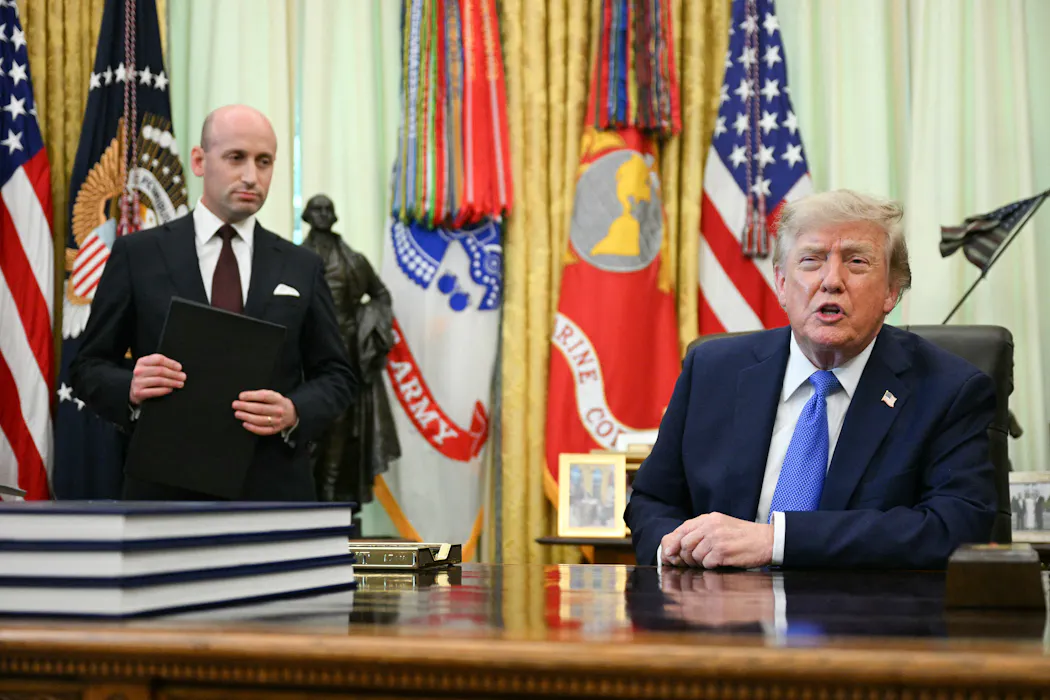
Stephen Miller’s January 2026 announcement to Immigration and Customs Enforcement officers – telling them that they have “immunity to perform your duties” and that no “illegal alien, no leftist agitator or domestic insurrectionist” can stop them – may seem like an extreme statement outside the political mainstream.

And when ICE agents use facial recognition software to monitor immigrants and protesters, that might seem like an unacceptable invasion of people’s privacy.

While extreme, these cases are not too unexpected. Both Miller’s statements and ICE’s monitoring extend from the framework of immigration enforcement that grew from the Sept. 11, 2001, terrorist attacks.

Immigration enforcement was reorganized and reframed after 9/11, particularly through the creation of ICE and the Department of Homeland Security.

As a scholar of immigration in the U.S., I find that the growth of extreme immigration enforcement, both at the border and across the country, results from this change 25 years ago.

From criminality to terrorism

In November 2002, the Homeland Security Act created DHS. The founding of ICE followed a few months later. As the agency notes, it was part of “the single-largest government reorganization since the creation of the Department of Defense.” Immigration enforcement was folded into a national security priority whose primary purpose was to defend “homeland security.”

The notion of immigrants as potential criminals was widespread well before the creation DHS.

In 1996, for example, President Bill Clinton signed the Illegal Immigration Reform and Immigration Responsibility Act. That law expanded the number of offenses that could result in automatic deportation, including of legal residents. The act also limited judicial review of deportation cases, while the very title of the law framed people in the U.S. without legal status as lawbreaking criminals.

But after 9/11, the connection between immigration and law enforcement intensified and took on a new dimension: counterterrorism. Immigration was no longer treated as a civil issue in which immigrants were deported if found through a civil court to have violated the law.

Instead, immigrants were evaluated as possible threats to the country.

Demonstrators walk as they hold signs.
Demonstrators protest the National Security Entry-Exit Registration System program in Washington, D.C., on Dec. 12, 2016.
Samuel Corum/Anadolu Agency via Getty Images

Immigration trials, such as for overstaying visas, increasingly took place in closed hearings, with the government’s secret evidence not shared with the accused. Those arrested for crossing the border illegally were imprisoned and faced [criminal prosecutions]. Expedited deportations took place at the border and across the country, even for immigrants who had been in the U.S. for years.

Further federal government practices connected immigrants to terrorism. The National Security Entry-Exit Registration System or NSEERS, introduced in 2002, required immigrant men from 25 countries – almost entirely in the Middle East, South Asia and North Africa – to register with the federal government after already residing in the country. It was framed as an effort to defend homeland security, and hundreds of people who had overstayed their visas for less than a month were detained.

United Nations human rights experts later criticized NSEERS for racial and religious profiling. Of the approximately 80,000 people registered, not a single terrorism prosecution resulted. About 14,000 were placed in deportation proceedings for visa irregularities, none for terrorism-related activity.

DHS suspended NSEERS in 2011, and it was terminated in 2016.

Lessons learned from 9/11

If the purpose of NSEERS was to identify terrorists, it failed.

But it succeeded in treating immigrants as potential terrorists. That connection has intensified since.

Federal government investment in facial recognition technology grew substantially after 9/11 with bipartisan support. The goal was to identify possible terrorists in American airports and cities.

Men dressed in military gear and holding rifles are surrounded by tear gas at night.
Federal agents deploy tear gas in Minneapolis, Minn., on Jan. 14, 2026.
Madison Thorn/Anadolu via Getty Images

Today, facial recognition has become a common tactic used by ICE officers to identify not just immigrants for potential detention but also citizen observers.

Additionally, privately owned detention centers grew in response to the mass arrests of immigrants. Treatment of immigrants at these centers, according to human rights advocates, has included “abuse, solitary confinement, and medical neglect.” For years, ICE detention centers have been criticized for similar conditions.

Programs like NSEERS produced fear and led to what policymakers have called self-deportation, where immigrants voluntarily leave the U.S. Today, self-deportation has become a government-endorsed program.

Research also shows that heightened immigration enforcement after 9/11 led many immigrants, even those with legal status, to withdraw from public life, avoiding schools, hospitals and work. ICE today produces the same kinds of fear.

Going beyond technical reforms

The immigration enforcement response to 9/11 set the stage on which Miller’s language and the collection of everyday Americans’ data become viable.

Under this way of thinking, if the homeland is under threat, then those who challenge immigration enforcement are “domestic terrorists.” Investigations into ICE officers are muted, for the officers are protecting the homeland against existential danger. Severe tactics to detain immigrants and condemn protesters become not only permissible but also advisable, according to advocates.

Perhaps technical reforms, such as requiring ICE agents to use body cameras or requiring ICE agents to have judicial warrants before entering homes, may limit some abuses.

But these measures do not address the underlying premise since 9/11 that immigration has become primarily viewed as a national security threat.

The Conversation

Pawan Dhingra does not work for, consult, own shares in or receive funding from any company or organization that would benefit from this article, and has disclosed no relevant affiliations beyond their academic appointment.

​Politics + Society – The Conversation

Categories
Uncategorized

Swarms of AI bots can sway people’s beliefs – threatening democracy

Crowds of AI bots posing as humans can influence crowds of real people on social media. J Studios/DigitalVision via Getty Images

In mid-2023, around the time Elon Musk rebranded Twitter as X but before he discontinued free academic access to the platform’s data, my colleagues and I looked for signs of social bot accounts posting content generated by artificial intelligence. Social bots are AI software that produce content and interact with people on social media. We uncovered a network of over a thousand bots involved in crypto scams. We dubbed this the “fox8” botnet after one of the fake news websites it was designed to amplify.

We were able to identify these accounts because the coders were a bit sloppy: They did not catch occasional posts with self-revealing text generated by ChatGPT, such as when the AI model refused to comply with prompts that violated its terms. The most common self-revealing response was “I’m sorry, but I cannot comply with this request as it violates OpenAI’s Content Policy on generating harmful or inappropriate content. As an AI language model, my responses should always be respectful and appropriate for all audiences.”

We believe fox8 was only the tip of the iceberg because better coders can filter out self-revealing posts or use open-source AI models fine-tuned to remove ethical guardrails.

The fox8 bots created fake engagement with each other and with human accounts through realistic back-and-forth discussions and retweets. In this way, they tricked X’s recommendation algorithm into amplifying exposure to their posts and accumulated significant numbers of followers and influence.

Such a level of coordination among inauthentic online agents was unprecedented – AI models had been weaponized to give rise to a new generation of social agents, much more sophisticated than earlier social bots. Machine-learning tools to detect social bots, like our own Botometer, were unable to discriminate between these AI agents and human accounts in the wild. Even AI models trained to detect AI-generated content failed.

Bots in the era of generative AI

Fast-forward a few years: Today, people and organizations with malicious intent have access to more powerful AI language models – including open-source ones – while social media platforms have relaxed or eliminated moderation efforts. They even provide financial incentives for engaging content, irrespective of whether it’s real or AI-generated. This is a perfect storm for foreign and domestic influence operations targeting democratic elections. For example, an AI-controlled bot swarm could create the false impression of widespread, bipartisan opposition to a political candidate.

The current U.S. administration has dismantled federal programs that combat such hostile campaigns and defunded research efforts to study them. Researchers no longer have access to the platform data that would make it possible to detect and monitor these kinds of online manipulation.

I am part of an interdisciplinary team of computer science, AI, cybersecurity, psychology, social science, journalism and policy researchers who have sounded the alarm about the threat of malicious AI swarms. We believe that current AI technology allows organizations with malicious intent to deploy large numbers of autonomous, adaptive, coordinated agents to multiple social media platforms. These agents enable influence operations that are far more scalable, sophisticated and adaptive than simple scripted misinformation campaigns.

Rather than generating identical posts or obvious spam, AI agents can generate varied, credible content at a large scale. The swarms can send people messages tailored to their individual preferences and to the context of their online conversations. The swarms can tailor tone, style and content to respond dynamically to human interaction and platform signals such as numbers of likes or views.

Synthetic consensus

In a study my colleagues and I conducted last year, we used a social media model to simulate swarms of inauthentic social media accounts using different tactics to influence a target online community. One tactic was by far the most effective: infiltration. Once an online group is infiltrated, malicious AI swarms can create the illusion of broad public agreement around the narratives they are programmed to promote. This exploits a psychological phenomenon known as social proof: Humans are naturally inclined to believe something if they perceive that “everyone is saying it.”

A diagram showing clusters of gray and yellow dots with lines connecting many of them.
This diagram shows the influence network of an AI swarm on Twitter (now X) in 2023. The yellow dots represent a swarm of social bots controlled by an AI model. Gray dots represent legitimate accounts who follow the AI agents.
Filippo Menczer and Kai-Cheng Yang, CC BY-NC-ND

Such social media astroturf tactics have been around for many years, but malicious AI swarms can effectively create believable interactions with targeted human users at a large scale, and get those users to follow the inauthentic accounts. For example, agents can talk about the latest game to a sports fan and about current events to a news junkie. They can generate language that resonates with the interests and opinions of their targets.

Even if individual claims are debunked, the persistent chorus of independent-sounding voices can make radical ideas seem mainstream and amplify negative feelings toward “others.” Manufactured synthetic consensus is a very real threat to the public sphere, the mechanisms democratic societies use to form shared beliefs, make decisions and trust public discourse. If citizens cannot reliably distinguish between genuine public opinion and algorithmically generated simulation of unanimity, democratic decision-making could be severely compromised.

Mitigating the risks

Unfortunately, there is not a single fix. Regulation granting researchers access to platform data would be a first step. Understanding how swarms behave collectively would be essential to anticipate risks. Detecting coordinated behavior is a key challenge. Unlike simple copy-and-paste bots, malicious swarms produce varied output that resembles normal human interaction, making detection much more difficult.

In our lab, we design methods to detect patterns of coordinated behavior that deviate from normal human interaction. Even if agents look different from each other, their underlying objectives often reveal patterns in timing, network movement and narrative trajectory that are unlikely to occur naturally.

Social media platforms could use such methods. I believe that AI and social media platforms should also more aggressively adopt standards to apply watermarks to AI-generated content and recognize and label such content. Finally, restricting the monetization of inauthentic engagement would reduce the financial incentives for influence operations and other malicious groups to use synthetic consensus.

The threat is real

While these measures might mitigate the systemic risks of malicious AI swarms before they become entrenched in political and social systems worldwide, the current political landscape in the U.S. seems to be moving in the opposite direction. The Trump administration has aimed to reduce AI and social media regulation and is instead favoring rapid deployment of AI models over safety.

The threat of malicious AI swarms is no longer theoretical: Our evidence suggests these tactics are already being deployed. I believe that policymakers and technologists should increase the cost, risk and visibility of such manipulation.

The Conversation

Filippo Menczer receives funding from Knight Foundation, National Science Foundation, Swiss National Science Foundation, and Air Force Office of Scientific Research.

​Politics + Society – The Conversation

Categories
Uncategorized

Trump administration losing credibility with judges and grand juries – a former federal judge explains why this is “remarkable and unprecedented”

Turns out, grand juries − usually rubber stamps for prosecutors − might not indict a ham sandwich. ilbusca/iStock Getty Images Plus

The word “unprecedented” is getting a workout after a grand jury in Washington on Feb. 10, 2026, rebuffed an attempt by federal prosecutors to get an indictment against perceived enemies of President Donald Trump.

It began with an unprecedented video in November 2025 featuring six Democratic lawmakers alerting military and intelligence community members that they had the duty to disobey illegal orders. That enraged Trump, who in an unprecedented move said the lawmakers were guilty of sedition, which is punishable by death. The U.S. attorney for the District of Columbia, Jeanine Pirro, made the unprecedented attempt to indict the lawmakers. The final element in this drama – the federal grand jury’s rejection of Pirro’s request – wasn’t itself unprecedented. That’s because it’s only the latest in an unprecedented string of losses for the Trump administration before grand juries.

Dickinson College President John E. Jones III, a former federal judge, spoke with The Conversation politics editor Naomi Schalit about the role of grand juries, why a grand jury would not indict someone – and how all of this is a reflection of the administration’s remarkable loss of credibility with judges and the citizens who make up grand juries.

Six Democratic lawmakers advising the military and intelligence community that they do not need to obey illegal orders.

How does the grand jury process work?

The grand jury really dates back to before the Bill of Rights, but for our purposes it’s memorialized in the Fifth Amendment within the Bill of Rights. It is meant to be a mechanism that screens cases brought by prosecutors.

Ordinary citizens, not fewer than 16 or more than 23, have the facts presented to them by a United States attorney or assistant United States attorney. They must make a determination as to whether or not there is probable cause to believe that a crime has been committed. It is not the purview of grand jurors to determine guilt or innocence, but merely to determine whether there is probable cause sufficient to indict.

So that means that a prosecutor will come to a grand jury and present them with the facts that they have chosen to present them with. There’s no defense at that point, and the grand jury then, relatively routinely, says OK, “Indict that person,” or “Indict those people”?

That’s correct. It’s a very one-sided process. There are no defense attorneys present. There’s a court reporter, the grand jury, the United States attorney, and such witnesses as the United States attorney decides to call. While the target of a grand jury can endeavor to present witnesses, including themselves, that generally never happens because of the danger of self-incrimination. The grand jurors can ask questions of the witnesses, but the United States attorney can choose the evidence that it wants to present to the grand jury, and typically they present only such evidence as is necessary in order to establish probable cause that a crime has been committed.

Does the public know what is presented in a grand jury room by the prosecutor?

The grand jury proceedings are absolutely secret and they remain that way, unless a federal judge authorizes that they be unsealed. So in the case involving the six lawmakers, we don’t know what the prosecutor presented to the grand jury. We just know that the grand jury refused to return an indictment. As far as I know, we don’t even know what crimes were put before the grand jury, let alone what testimony was presented. What we do know is that in all six cases, the grand jury refused to vote in favor of the indictment that was requested by the United States attorney.

Why would a grand jury refuse to give the prosecutor what they want?

It’s unprecedented, although we now see a wave of grand juries pushing back against the government. I don’t recall a single instance, during the almost 20 years I served as a U.S. District judge, when a grand jury refused to return a true bill, an indictment. It just is completely aberrational. The grand jury would have to totally reject the whole premise of the case that’s being presented to them by the United States attorney because, remember, there are typically no witnesses appearing before the grand jury to dispute the facts. The grand jury is clearly saying, “Even accepting the facts you’re putting before us as true, we don’t think under these circumstances this case is worthy of a federal indictment.”

Can a prosecutor just try again?

They can return to the well, so to speak, and they did that in Virginia in the case of Letitia James. But it’s pretty perilous because, bluntly, it’s a way that a prosecutor can get their head handed to them twice.

Originally, as set out in the Fifth Amendment to the Constitution, the grand jury was supposed to be a vigorous and robust check against prosecutors simply charging people with crimes. But over time, it’s become far less than that. And there is the famous quote by Judge Sol Wachtler in New York that a grand jury can be made to “indict a ham sandwich.”

So to see a grand jury fail to return true bills multiple times over the past couple of months is remarkable and unprecedented. It occurs to me that what is happening here is kind of parallel to what’s taking place with the administration and federal judges. I think we now have entered a world where the Department of Justice has lost its credibility with the judiciary.

We’re seeing that time and again in appearances in court where judges simply don’t believe what U.S. attorneys are telling them, based on past demonstrable falsehoods that have been stated in open court. And now we see grand juries that are also doubting the credibility of federal prosecutors. And these grand jurors are not blind to what is taking place in the world around them.

I think that this is further polluted by the fact that the president of the United States, for example, in the case of the six defendants from Congress and the Senate, said that they had committed seditious acts – which is punishable by death.

Obviously, this tilts the scales and is fundamentally unfair because it is destroying the concept of due process of law. People notice what the president says, and I am happy to see that the average citizen serving on a grand jury has retained what I think is a fundamental sense of fairness, even in the face of a pretty stacked deck.

A screenshot of a social media post by President Trump, which says 'SEDITIOUS BEHAVIOR, punishable by DEATH!'
President Donald Trump’s social media post of Nov. 20, 2025, responding to the lawmakers’ video.
Truth Social

What does it mean if you have a court system, judges and the grand juries who do not have faith in the administration and its legal claims?

It’s a complete drag on our system of justice. For all of the time that I sat on the federal bench, I had great respect for the Department of Justice, and the department had tremendous credibility. They were straight shooters. The prosecutors who appeared in front of me were professionals. I didn’t always agree with their arguments, of course, nor did I agree with a few of their charging decisions, but I can tell you that not once did I see a federal prosecution in front of me that I felt strongly should never have been brought at its inception.

But we now have a system where, because of the whims of the president, the Department of Justice has become utterly weaponized against his perceived enemies, and that’s a gross misuse of our prosecutorial power at the federal level.

Also, if, for example, these members of Congress had been indicted, they’d have to lawyer up, they’d have to fight their way out. That would take a lot of resources.

So, yes, the judiciary can be a bulwark against improvident prosecutions. But that comes at a cost to the defendant, and it’s been said that the process itself is the punishment. I suspect that’s what the president wants; it’s the trauma that you put somebody through that can be almost as bad as being convicted. And, of course, there’s the reputational harm as well.

The Conversation

John E. Jones III is affiliated with Keep Our Republic’s Article Three Coalition.

​Politics + Society – The Conversation

Categories
Uncategorized

Martha Washington’s enslaved maid Ona Judge made a daring escape to freedom – but the National Park Service has erased her story from Philadelphia exhibit

The National Park Service removed an exhibit on slavery at the President’s House site in Philadelphia on Jan. 22, 2026. The city of Philadelphia has sued the Trump administration in response. AP Photo/Matt Rourke

On the evening of May 21, 1796, Ona Judge made the daring decision to free herself.

Considering the prominence of her owner, the laws of the time and the dangerous trek to New Hampshire, a place where she could discreetly live freely, the act carried remarkable risk. Nevertheless, she slipped out of the President’s House undetected while the first family dined.

The house, then located at the intersection of 6th and Market streets in Philadelphia, served as the first executive mansion. It stood mere feet from Independence Hall, where the nation adopted its lofty language regarding freedom.

Panels with pictures and text affixed to the exterior of a building
The slavery exhibition at Independence Hall opened in December 2010. It was the first slavery memorial on federal land in U.S. history.
Michael Yanow/NurPhoto via Getty Images

Years later, Judge described her narrow escape to Rev. Benjamin Chase in an interview for the abolitionist newspaper The Liberator. Judge told Chase, “I had friends among the colored people of Philadelphia, had my things carried there beforehand, and left Washington’s house while they were eating dinner.”

Prior to her escape, Judge served as a chambermaid in the President’s House. She spent years tending to Martha Washington’s every need: bathing and dressing her, grooming her hair, laundering her clothes, organizing her personal belongings, and even periodically caring for her children and grandchildren.

Being a chambermaid also included grueling daily tasks such as maintaining fires, emptying chamber pots and scrubbing floors.

Even though she engaged in this arduous labor as property of the Washingtons, living in Philadelphia provided Judge a glimpse of what freedom could eventually look like for her. Historians estimate that 5% to 9% of the city’s population at the time were free Black people. Prior to her escape, Judge befriended several of them.

Dark, moody painting depicting Black woman taking care of children by a fireplace
An oil painting titled ‘Mt. Vernon Kitchen’ by Eastman Johnson, 1864.
Mount Vernon Ladies’ Association

In the spring of 1796, the Washingtons prepared to return to Virginia to resume private life. President Washington issued his farewell address in the fall of 1796, but he told family and close confidants of his plans earlier in the year.

During that time, Martha Washington made arrangements for their pending return to Mount Vernon. Her plans included bequeathing Ona Judge to her granddaughter, Elizabeth Parke Custis, as a wedding gift. Upon learning this, Judge made plans of her own.

In her interview with Chase she explained, “Whilst they were packing up to go to Virginia, I was packing to go, I didn’t know where; for I knew that if I went back to Virginia, I should never get my liberty.”

As a civil rights lawyer and professor in the Africology and African American Studies department at Temple University in Philadelphia, I study the intersection of race, racism and the law in the United States. I believe Judge’s story is vital to the telling of America’s history.

Dismantling history

Erica Armstrong Dunbar, a professor of African American Studies at Emory University, tells Judge’s fascinating story in her book “Never Caught: The Washingtons’ Relentless Pursuit of their Runaway Slave Ona Judge.”

Before January 2026, those who wished to learn about Judge could literally stand on the same walkway in Philadelphia where Judge once stood when she chose to flee. Several footprints, shaped like a woman’s shoes and embedded into the pathway outside of where the President’s House once stood, memorialize the beginning of Judge’s journey. These footprints composed part of an exhibit examining the paradox between slavery, freedom and the nation’s founding.

The exhibit, “Freedom and Slavery in the Making of a New Nation,” also included 34 explanatory panels bolted onto brick walls along that sidewalk. They provided biographical details about the nine people the Washingtons owned while living in the presidential mansion. The exhibit presented the sobering reality that our nation’s first president enslaved people while he held the nation’s highest office.

Colorful illustration on a panel on wall of brick building
These and other panels discussing the founders’ owning of slaves were removed in late January 2026, after an executive order issued by President Donald Trump in March 2025 called to eliminate materials deemed disparaging to the Founding Fathers or the legacy of the United States.
Matthew Hatcher/Getty Images

This changed in late January when the National Park Service dismantled the slavery exhibit at Philadelphia Independence National Historic Park. The removal sparked intense, immediate outrage from people across the country dismayed by the attempt to suppress unfavorable aspects of American history.

Philadelphia Mayor Cherelle Parker responded swiftly. “Let me affirm, for the residents of the city of Philadelphia, that there is a cooperative agreement between the city and the federal government that dates back to 2006,” she said in a public statement. “That agreement requires parties to meet and confer if there are to be any changes made to an exhibit.”

The city of Philadelphia later sued Interior Secretary Doug Burgum and National Park Service acting Director Jessica Bowron. Pennsylvania subsequently filed an amicus brief in support of the city’s lawsuit.

After an inspection of the exhibit’s panels, U.S. District Judge Cynthia Rufe, who is overseeing the case, ruled that the government must mitigate any potential damage to them while they are stored.

Civil rights activist and Philadelphia-based attorney Michael Coard recently had an opportunity to visit and examine the exhibits in storage. Coard has led the fight to create and preserve the exhibit and now is at the center of the fight to restore it.

Man in overcoat and sunglasses holds up phone, with brick walls around him
Philadelphia-based attorney Michael Coard, who helped lead the effort to create the exhibition, visited the site after its removal.
AP Photo/Matt Rourke

Limiting discussion of race

While the court deliberates the future of the exhibits, critics continue to raise key concerns regarding the exhibit’s removal. Many argue the National Park Service’s dismantling of the exhibit is an attempt to “whitewash history” and erase stories like Ona Judge’s.

This is particularly the case considering the Trump administration has restored and reinstalled two Confederate monuments of Albert Pike in Washington, D.C., and Arlington National Cemetery, while removing the slavery exhibit in Philadelphia.

Moreover, during the first week of his second term, Trump signed multiple executive orders to eliminate
diversity, equity and inclusion policies.

Similarly, during the first Trump administration, the federal government engaged in various efforts to counterbalance the 1619 Project, a project spearheaded by Pulitzer-winning journalist Nikole Hannah-Jones that discussed the 400th anniversary of slavery’s beginnings in America. The 1619 Project spawned yearslong backlash. This included the 1776 Commission, created during the first Trump administration, which tried to discredit the conclusions of the 1619 project.

It is all part of a broader pattern across the country to limit how public institutions broach topics pertaining to race and racism.

This pattern has intensified as the United States prepares to celebrate the 250th anniversary of the framers signing the Declaration of Independence. As the nation celebrates its history, it must decide how much of it to explore.

Read more of our stories about Philadelphia and Pennsylvania, or sign up for our Philadelphia newsletter on Substack.

The Conversation

Timothy Welbeck has colleagues and affiliates who are members of Avenging the Ancestors Coalition, an organization which is mentioned in this article.

​Politics + Society – The Conversation

Categories
Uncategorized

‘Proportional representation’ could reduce polarization in Congress and help more people feel like their voices are being heard

There is growing support for electoral reform in the U.S. PeterSnow/Getty Images

In the face of widespread pessimism about the political fate of the United States and growing political polarization, scholars and citizens across the country are reimagining how American democracy could better serve the needs of the whole population.

In an October 2025 poll, a slight majority said that radical change is needed to make life better in America, compared to 32% who answered only small change is needed.

Reimagining a political system’s future effectively begins with the system’s foundation: how the populace chooses the people who will represent them and make collective decisions.

The U.S. Constitution mandates elected representatives in Congress to decide important questions, such as how to tax the population and spend that collective revenue. And they determine whether to go to war or to defend allies if they are invaded.

These representatives are chosen in a winner-take-all system that research shows favors those with money to spend on the race. It also feeds stark polarization, helps restrict choice to two major parties and leaves out the voices of many voters.

What would it take to make that electoral system become more responsive to citizens’ needs? How could it be fairer and more accurate in representing the entire electorate?

One answer is found in proportional representation, an electoral system used in most of the rest of the world’s established democracies. These systems elect multiple representatives in a district in proportion to the number of people who vote for them.

A recent report from the Academy of Arts and Sciences that I participated in analyzed the pros and cons of moving to such a system.

It examined evidence from other countries and concluded that proportional representation could provide more fair and accurate representation and more choice. Proportional representation could also help with the deep political polarization engulfing the United States.

How proportional representation works

This proposal would change the way Americans elect representatives to the U.S. House of Representatives and potentially to state legislatures.

Currently, the winner-take-all system in the U.S. works like this: States are divided into districts based on population and elect one representative to the House of Representatives per district. The winner is the person who gets the most votes. Most states also use this single-member district system to elect members of their state legislatures.

A proportional representation system has larger, multimember districts. Candidates are elected according to the share of votes they or their parties receive.

Different versions of proportional list systems exist. In one version called open list proportional representation, voters choose a candidate from party lists of nominated candidates or from lists of independent candidates.

So if the Good People Party, for example, wins 40% of the vote in a district with 10 members, it will get four seats. And the top four vote-winners on their list will be elected. If the Serious People Party wins 20% of the vote, it will get two seats, with the top two vote-getters on their list elected.

This method simultaneously serves the purpose of a primary election, allowing voters to choose among nominees from a party.

Another version of proportional representation also has multimember districts but uses ranked-choice voting to select the members, where voters rank candidates in order of preference. New Zealand and Australia changed to this system for some of their representative bodies in 1993 and 1948, respectively.

Voters line up to vote in a gym.
A September 2024 poll found that over half of Americans think the U.S. should change the way representatives are elected to the House of Representatives.
SDI Productions

The advantages of proportional representation include outcomes where many more voters would live in a district with at least one of the elected officials representing their choice. That differs from the winner-take-all system where those on the losing side feel unrepresented, especially when the district is split 51% to 49%, for example.

Proportional representation opens the door to more choice because it becomes possible for a smaller party to win one seat out of five, for example. It would begin to break up the two-party system that currently forces some voters to choose the “lesser of two evils,” or to vote strategically against their most disliked party rather than for someone they want.

Proportional representation also eliminates gerrymandering because voters would not be split into small, easily manipulated district boundaries. Proportional representation, additionally, has been shown to give more equal representation to minorities and women.

How the US could get there

To be sure, proportional representation can lead to difficulty in forming a majority coalition. This happened in Belgium in 2010. It can also lead to situations where small, extremist parties can demand major concessions to join a larger party in forming a majority coalition, which Israel recently experienced.

Israel is often cited as a negative example of proportional representation. But the country remains unusual in that its extreme electoral system includes the entire country as one large district with 120 seats, so that many small parties can be elected.

Research indicates that districts with three to eight members are ideal to provide more accurate representation without overly fragmenting the party system.

In the U.S. it’s more likely that proportional representation would allow for different factions of the existing parties to be represented. Imagine a five-seat district that elects one MAGA Republican, one traditional Republican, one progressive Democrat, one centrist Democrat and one third-party or independent candidate. This would begin to break down the polarization and allow for different coalitions to form across different issues.

Changing the system to elect House members does not require a constitutional amendment. The Constitution allows states to determine the manner of elections.

But Congress would need to repeal a 1967 law that mandates single-member districts, written to help implement the Voting Rights Act of 1965 in Southern states that had used a bloc system to disenfranchise Black voters.

In a bloc system, voters get as many votes as there are seats in that district. So in a five-seat district, each voter gets five votes instead of only one vote in a proportional system. A majority group, say whites, could thus choose to vote for only white candidates and win across the board, locking out any minority candidate from winning. The repeal could include a prohibition on returning to that bloc system.

Proportional representation would require that lawmakers who hold their seats under the current system agree to change the 1967 law. And they may be reluctant to change to a system that would give voters more choice.

But interviews with retiring lawmakers show their frustration with the dysfunction and toxicity of the current Congress. And some lawmakers are pushing for a committee to study how changes to the electoral system could create a better-functioning Congress.

Additionally, there is growing support for electoral reform in the U.S. A September 2024 poll found that over half of Americans think the U.S. should change the way we elect representatives to Congress. And 63% believe the country would be better off with more than two competitive parties.

One U.S. city – Portland, Oregon – recently moved to proportional representation. The Portland City Council that took office in 2025 has greater gender, minority and neighborhood representation than in the past, even if it experienced some initial difficulty in forming a majority coalition. And Cambridge, Massachusetts, has used proportional representation since 1941, where 95% of voters see one of their top three choices elected.

States and municipalities could thus become laboratories of innovation, experimenting with different versions of proportional representation and providing models and momentum for a national-level change. And the country could begin not only to reimagine but to experience a different democracy that serves all.

The Conversation

Jennifer Lynn McCoy receives funding from the Carnegie Corporation for an Andrew Carnegie fellowship on depolarization as well as the Institute for Humane Studies.. She is Regent’s Professor of Political Science at Georgia State University and a nonresident scholar at the Carnegie Endowment for International Peace.

​Politics + Society – The Conversation

Categories
Uncategorized

How a 22-year-old George Washington learned how to lead, from a series of mistakes in the Pennsylvania wilderness

A young George Washington was thrust into the dense, contested wilderness of the Ohio River Valley as a land surveyor for real estate development companies in Virginia. Henry Hintermeister/Public domain via Wikimedia Commons

This Presidents Day, I’ve been thinking about George Washington − not at his finest hour, but possibly at his worst.

In 1754, a 22-year-old Washington marched into the wilderness surrounding Pittsburgh with more ambition than sense. He volunteered to travel to the Ohio Valley on a mission to deliver a letter from Robert Dinwiddie, governor of Virginia, to the commander of French troops in the Ohio territory. This military mission sparked an international war, cost him his first command and taught him lessons that would shape the American Revolution.

As a professor of early American history who has written two books on the American Revolution, I’ve learned that Washington’s time spent in the Fort Duquesne area taught him valuable lessons about frontier warfare, international diplomacy and personal resilience.

The mission to expel the French

In 1753, Dinwiddie decided to expel French fur trappers and military forces from the strategic confluence of three mighty waterways that crisscrossed the interior of the continent: the Allegheny, Monongahela and Ohio rivers. This confluence is where downtown Pittsburgh now stands, but at the time it was wilderness.

King George II authorized Dinwiddie to use force, if necessary, to secure lands that Virginia was claiming as its own.

As a major in the Virginia provincial militia, Washington wanted the assignment to deliver Dinwiddie’s demand that the French retreat. He believe the assignment would secure him a British army commission.

Washington received his marching orders on Oct. 31, 1753. He traveled to Fort Le Boeuf in northwestern Pennsylvania and returned a month later with a polite but firm “no” from the French.

A close-up portrait of a young, brunette George Washington.
George Washington held an honorary commission as a major in the British army prior to the French and Indian War.
Dea/M. Seemuller/De Agostini collection/Getty Images

Dinwiddie promoted Washington from major to lieutenant colonel and ordered him to return to the Ohio River Valley in April 1754 with 160 men. Washington quickly learned that French forces of about 500 men had already constructed the formidable Fort Duquesne at the forks of the Ohio. It was at this point that he faced his first major test as a military leader. Instead of falling back to gather more substantial reinforcements, he pushed forward. This decision reflected an aggressive, perhaps naive, brand of leadership characterized by a desire for action over caution.

Washington’s initial confidence was high. He famously wrote to his brother that there was “something charming” in the sound of whistling bullets.

The Jumonville affair and an international crisis

Perhaps the most controversial moment of Washington’s early leadership occurred on May 28, 1754, about 40 miles south of Fort Duquesne. Guided by the Seneca leader Tanacharison – known as the “Half King” – and 12 Seneca warriors, Washington and his detachment of 40 militiamen ambushed a party of 35 French Canadian militiamen led by Ensign Joseph Coulon de Jumonville. The Jumonville affair lasted only 15 minutes, but its repercussions were global.

A color illustration showing battle between soldiers in red and blue coats.
The Jumonville affair became the opening battle of the French and Indian War.
Interim Archives/Archive Collection/Getty Images

Ten of the French, including Jumonville, were killed. Washington’s inability to control his Native American allies – the Seneca warriors executed Jumonville – exposed a critical gap in his early leadership. He lacked the ability to manage the volatile intercultural alliances necessary for frontier warfare.

Washington also allowed one enemy soldier to escape to warn Fort Duquesne. This skirmish effectively ignited the French and Indian War, and Washington found himself at the center of a burgeoning international crisis.

Defeat at Fort Necessity

Washington then made the fateful decision to dig in and call for reinforcements instead of retreating in the face of inevitable French retaliation. Reinforcements arrived: 200 Virginia militiamen and 100 British regulars. They brought news from Dinwiddie: congratulations on Washington’s victory and his promotion to colonel.

His inexperience showed in his design of Fort Necessity. He positioned the small, circular palisade in a meadow depression, where surrounding wooded high ground allowed enemy marksmen to fire down with impunity. Worse still, Tanacharison, disillusioned with Washington’s leadership and the British failure to follow through with promised support, had already departed with his warriors weeks earlier. When the French and their Native American allies finally attacked on July 3, heavy rains flooded the shallow trenches, soaking gunpowder and leaving Washington’s men vulnerable inside their poorly designed fortification.

A black and white illustration showing George Washington signing a document.
Washington was outnumbered and outmaneuvered at Fort Necessity.
Interim Archives/Archive Collection/Getty Images

The battle of Fort Necessity was a grueling, daylong engagement in the mud and rain. Approximately 700 French and Native American allies surrounded the combined force of 460 Virginian militiamen and British regulars. Despite being outnumbered and outmaneuvered, Washington maintained order among his demoralized troops. When French commander Louis Coulon de Villiers – Jumonville’s brother – offered a truce, Washington faced the most humbling moment of his young life: the necessity of surrender. His decision to capitulate was a pragmatic act of leadership that prioritized the survival of his men over personal honor.

The surrender also included a stinging lesson in the nuances of diplomacy. Because Washington could not read French, he signed a document that used the word “l’assassinat,” which translates to “assassination,” to describe Jumonville’s death. This inadvertent admission that he had ordered the assassination of a French diplomat became propaganda for the French, teaching Washington the vital importance of optics in international relations.

A current photograph of the logs used to construct Fort Necessity as it stands today along the battlefield in Pennsylvania.
A log cabin used to protect the perishable supplies still stands at Fort Necessity today.
MyLoupe/Universal Images Group/Getty Images

Lessons that forged a leader

The 1754 campaign ended in a full retreat to Virginia, and Washington resigned his commission shortly thereafter. Yet, this period was essential in transforming Washington from a man seeking personal glory into one who understood the weight of responsibility.

He learned that leadership required more than courage – it demanded understanding of terrain, cultural awareness of allies and enemies, and political acumen. The strategic importance of the Ohio River Valley, a gateway to the continental interior and vast fur-trading networks, made these lessons all the more significant.

Ultimately, the hard lessons Washington learned at the threshold of Fort Duquesne in 1754 provided the foundational experience for his later role as commander in chief of the Continental Army. The decisions he made in Pennsylvania and the Ohio wilderness, including the impulsive attack, the poor choice of defensive ground and the diplomatic oversight, were the very errors he would spend the rest of his military career correcting.

Though he did not capture Fort Duquesne in 1754, the young George Washington left the woods of Pennsylvania with a far more valuable prize: the tempered, resilient spirit of a leader who had learned from his mistakes.

The Conversation

Christopher Magra does not work for, consult, own shares in or receive funding from any company or organization that would benefit from this article, and has disclosed no relevant affiliations beyond their academic appointment.

​Politics + Society – The Conversation

Categories
Uncategorized

Local governments provide proof that polarization is not inevitable

Local officials get to participate in events such as ribbon cuttings, celebrating projects they may have helped make happen. NHLI/Eliot J. Schechter via Getty Images

When it comes to national politics, Americans are fiercely divided across a range of issues, including gun control, election security and vaccines. It’s not new for Republicans and Democrats to be at odds over issues, but things have reached a point where even the idea of compromising appears to be anathema, making it more difficult to solve thorny problems.

But things are much less heated at the local level. A survey of more than 1,400 local officials by the Carnegie Corporation and CivicPulse found that local governments are “largely insulated from the harshest effects of polarization.” Communities with fewer than 50,000 residents proved especially resilient to partisan dysfunction.

Why this difference? As a political scientist, I believe that lessons from the local level not only open a window onto how polarization works but also the dynamics and tools that can help reduce it.

Problems are more concrete

Local governments deal with concrete issues – sometimes literally, when it comes to paving roads and fixing potholes. In general, cities and counties handle day-to-day functions, such as garbage pickup, running schools and enforcing zoning rules. Addressing tangible needs keeps local leaders’ attention fixed on specific problems that call out for specific solutions, not lengthy ideological debates.

By contrast, a lot of national political conflict in the U.S. involves symbolic issues, such as debates about identity and values on topics such as race, abortion and transgender rights. These battles are often divisive, even more so than purely ideological disagreements, because they can activate tribal differences and prove more resistant to compromise.

Three men site in chairs on a dais in front of a banner reading
When mayors come together, they often find they face common problems in their cities. Gathered here, from left, are Jerry Dyer of Fresno, Calif., John Ewing Jr. of Omaha, Neb., and David Holt of Oklahoma City.
AP Photo/Kevin Wolf

Such arguments at the national level, or on social media, can lead to wildly inaccurate stereotypes about people with opposing views. Today’s partisans often perceive their opponents as far more extreme than they actually are, or they may stereotype them – imagining that all Republicans are wealthy, evangelical culture warriors, for instance, or conversely being convinced that all Democrats are radical urban activists. In terms of ideology, the median members of both parties, in fact, look similar.

These kinds of misperceptions can fuel hostility.

Local officials, however, live among the human beings they represent, whose complexity defies caricature. Living and interacting in the same communities leads to greater recognition of shared interests and values, according to the Carnegie/CivicPulse survey.

Meaningful interaction with others, including partisans of the opposing party, reduces prejudice about them. Local government provides a natural space where identities overlap.

People are complicated

In national U.S. politics today, large groups of individuals are divided not only by party but a variety of other factors, including race, religion, geography and social networks. When these differences align with ideology, political disagreement can feel like an existential threat.

Such differences are not always as pronounced at the local level. A neighbor who disagrees about property taxes could be the coach of your child’s soccer team. Your fellow school board member might share your concerns about curriculum but vote differently in presidential elections.

A large group of reporters surround Minneapolis Mayor Jacob Frey.
Mayors can find themselves caught up in national debates, as did Minneapolis Mayor Jacob Frey over the Trump administration’s immigration enforcement policies in his city.
AP Photo/Kevin Wolf

These cross-cutting connections remind us that political opponents are not a monolithic enemy but complex individuals. When people discover they have commonalities outside of politics with others holding opposing views, polarization can decrease significantly.

Finally, most local elections are technically nonpartisan. Keeping party labels off ballots allows voters to judge candidates as individuals and not merely as Republicans or Democrats.

National implications

None of this means local politics are utopian.

Like water, polarization tends to run downhill, from the national level to local contests, particularly in major cities where candidates for mayor and other office are more likely to run as partisans. Local governments also see culture war debates, notably in the area of public school instruction.

Nevertheless, the relative partisan calm of local governance suggests that polarization is not inevitable. It emerges from specific conditions that can be altered.

Polarization might be reduced by creating more opportunities for cross-partisan collaboration around concrete problems. Philanthropists and even states might invest in local journalism that covers pragmatic governance rather than partisan conflict. More cities and counties could adopt changes in election law that would de-emphasize party labels where they add little information for voters.

Aside from structural changes, individual Americans can strive to recognize that their neighbors are not the cardboard cutouts they might imagine when thinking about “the other side.” Instead, Americans can recognize that even political opponents are navigating similar landscapes of community, personal challenges and time constraints, with often similar desires to see their roads paved and their children well educated.

The conditions shaping our interactions matter enormously. If conditions change, perhaps less partisan rancor will be the result.

The Conversation

Lauren Hall is a Distinguished Fellow for the Study of Liberalism and a Free Society with the Institute for Humane Studies. She was previously a Pluralism Fellow with the Mercatus Center.

​Politics + Society – The Conversation

Categories
Uncategorized

How the law can add to child sex trafficking victims’ existing trauma

Most U.S. states retain the right to arrest and prosecute children for prostitution. Douglas Sacha/Getty Images

The January 2026 release of additional files related to the Justice Department’s investigation of convicted sex offenders Jeffrey Epstein and Ghislaine Maxwell has brought renewed attention to the late financier’s connections to the world’s rich and powerful.

However, the failure to redact identifying victim information and explicit photos has also brought unwanted attention to survivors. The lack of consideration for their welfare illustrates how legal proceedings can add to child sex trafficking victims’ existing trauma and burden instead of offering a stable path forward.

Some states have passed laws in recent years to protect child victims of sex trafficking. But at the same time, most states have passed laws that allow those same children to be arrested or prosecuted for prostitution. It’s a tug of war between advocates, law enforcement and policymakers to determine the best approach for keeping vulnerable children safe from pimps, predators and dangerous family members.

Often these intentions to “keep kids safe” end up harming the very children the laws are supposed to protect. This is done by identifying them as criminals and not victims.

As a sociologist and scholar who researches the commercial sexual exploitation of children, I believe Americans have to look at the many different ways states treat sexually exploited minors to fully understand this issue and the harm that is being done.

Retraumatizing victims

When approved in 2000, the federal Trafficking Victims Protection Act established that children under 18 who experience commercial sexual exploitation are sex trafficking victims.

Criminally charging a child with prostitution, as most states allow, asserts they are willfully participating in the commercial sex trade, while identifying a minor as a sex trafficking victim recognizes they are not in this situation by choice.

Some states require minors to prove a third party forced, deceived or coerced them into prostitution to be considered a child sex trafficking victim. Their innocence, despite their age, is not automatically assumed. This approach risks retraumatizing victims by labeling and stigmatizing them as criminal, as voluntary participants in the commercial sex trade.

Examining these state statutes is important because these minors are more likely to interact with local law enforcement than federal agents. That’s because in the U.S. federalist system, states have more power than the national government to set rules regarding crime.

Arresting and prosecuting minors for prostitution

As of 2025, 15 states do not arrest and prosecute children for prostitution, while seven states allow a minor to be arrested but not prosecuted for this charge, according to my unpublished research. As a result, sexually exploited minors can be criminalized in 35 states for their maltreatment because they can be charged or prosecuted for prostitution.

These laws determine how courts identify commercially sexually exploited minors, as victims or criminals.

Safe harbor laws have been adopted by 31 states as a legal strategy to divert sex trafficked minors from the criminal legal system. These measures connect them to specialized services, including trauma-informed health care and safe housing. But safe harbor statutes do not guarantee that children will be protected from arrest or prosecution for prostitution.

For example, New York’s 2008 safe harbor law requires a child charged with prostitution to admit they participated in this crime. The child also has to explain why they shouldn’t be held liable for the charge.

Another common strategy adopted by some states, including Rhode Island, requires a minor to fulfill a specific “child sex trafficking victim” definition – such as proving force, fraud or coercion by a third party – to avoid being criminalized for prostitution. Yet mandating sexually exploited minors to meet such requirements places the burden of proof on the child.

Conversely, Massachusetts’ safe harbor law does not afford any protections to minors, allowing a child to be arrested and prosecuted for prostitution. State and local police collaborate with child protective services and are trained not to arrest sexually exploited minors. But some officials argue law enforcement needs the threat of criminal charges to pressure minors they see as “noncompliant” to accept services or leave trafficking situations.

This approach blurs the line between criminal legal mechanisms and social work. It positions police as “helpers” who expect trafficked youth to accept support or risk criminal punishment.

In sum, unlike federal law, which recognizes all sexually exploited minors as victims, some state authorities present minors with a choice: comply with law enforcement or prove their innocence.

The adultification of child victims

These demands that shift legal burdens to sexually exploited minors signal that law enforcement and legislators expect them to have the capacity to make mature and rational choices. Yet, neuroscience research indicates juveniles don’t have the same decision-making capacity as adults until their early to mid-20s.

Further, sexually exploited minors with trauma may appear as uncooperative in stressful situations. Those include being detained or arrested for prostitution.

By blaming sex trafficked minors for “making bad choices,” the criminal legal system treats commercial sexual exploitation victims as complicit. And this may lead to prostitution charges instead of support. Furthermore, focusing on a child’s “choices” does not address the financial, familial and traumatic adversities that make victims vulnerable to sexual violence and exploitation in the first place.

Commercial sexual exploitation risk factors include complex post-traumatic stress disorder, low socioeconomic status, limited educational access and child sexual abuse prior to this exploitation. That includes exploitation from fraught family living situations where a parent, relative or caregiver sexually exploits a child.

Racial inequality in prostitution charges

Similarly, racial bias has deeply influenced trafficking legislation.

In 1910, Congress passed The Mann Act, also known as the White-Slave Traffic Act. This measure framed commercial sexual exploitation as a problem affecting only white women and girls, erasing the exploitation of people of color.

This pattern continues today. Black and brown children in the U.S. are more likely to be arrested and detained for prostitution than all other racial groups. Children who live in states with higher levels of structural economic inequality, which affects children of color at higher rates that white children, are at higher risk of being arrested and prosecuted for prostitution.

My research with Keith Bentele indicates that states with higher levels of structural economic inequality are less likely to adopt legislation protecting children from arrest and prosecution for prostitution.

Increasing compassion for victims

Without addressing these structural inequalities and the lack of a social safety net, sex trafficked children, particularly children of color and LGBTQ+ youth, are at risk of facing further marginalization and criminalization for prostitution.

One state has risen above the rest in recognizing and addressing these systemic barriers. Minnesota’s “No Wrong Door” framework utilizes a public health approach and is regarded as the gold standard of state-level commercial sexual exploitation legislation.

Protecting youth up to age 24 from prostitution charges, Minnesota offers housing and medical services to victims instead of criminal punishment. It also coordinates trauma-informed training for professionals, such as police and social workers.

An evaluation of this model indicates that it has successfully increased compassion for youth victims in the community, particularly among law enforcement.

Mallika Sunder, a student at Wellesley College and intern in its Wellesley Centers for Women, co-authored this article.

The Conversation

Kate Price does not work for, consult, own shares in or receive funding from any company or organization that would benefit from this article, and has disclosed no relevant affiliations beyond their academic appointment.

​Politics + Society – The Conversation

Categories
Uncategorized

Journalism may be too slow to remain credible once events are filtered through social media

House Speaker Mike Johnson updates reporters about budget talks on Capitol Hill. AFP/Roberto Schmitt via Getty Images

In the first weeks after Russia’s invasion of Ukraine in 2022, a strange pattern emerged in Western media coverage. Headlines oscillated between confidence and confusion. Kyiv would fall within days, one story would claim, then another would argue that Ukraine was winning. Russian forces were described as incompetent, then as a terrifying existential threat to NATO.

Analysts spoke with certainty about strategy, morale and endgames, but often reversed themselves within weeks. To many news consumers, this felt like bias – either pro-Ukraine framing or anti-Russia narratives. Some commentators accused Western media outlets of cheerleading or propaganda.

But I’d argue that something more subtle was happening. The problem was not that journalists were biased. It was that journalism could not keep pace with the war’s informational structure. What looked like ideological bias was, more often, temporal lag.

I serve in the Navy as a war gamer. The most critical part of my job is identifying institutional failures. Trust is one of the most critical and, in this sense, the media is losing ground.

The gap between what people experience in real time and what journalism can responsibly publish has widened. This gap is partly where trust erodes. Social media collapses the distance between event, exposure and interpretation. Claims circulate before journalists can evaluate them.

This matters in my world because the modern battlefield is not just physical. Drone footage circulates instantly. Social media channels release claims in real time. Intelligence leaks surface before diplomats can respond.

These dynamics also matter for the public at large, which encounters fragments of reality, often through social media, long before any institution can responsibly absorb and respond to them.

Journalism, by contrast, is built for a slower world.

Slow journalism

At the core of their work, journalists observe events, filter signal from noise, and translate complexity into narrative. Their professional norms – editorial gatekeeping, standards for sourcing, verification of facts – are not bureaucratic relics. They are the mechanisms that produce coherence rather than chaos.

But these mechanisms evolved when information arrived more slowly and events unfolded sequentially. Verification could reasonably precede publication. Under those conditions, journalism excelled as a trusted intermediary between raw events and public understanding.

These conditions no longer exist.

A Ukrainian medic treats a soldier for leg injuries.
As in other conflicts, early reports out of battles in Ukraine sometimes ended up being inaccurate.
AP Photo/Leo Correa

Information now arrives continuously, often without clear provenance. Social media platforms amplify fragments of reality in real time, while verification remains necessarily slow. The key constraint is no longer access; it is tempo.

Granted, reporters often present accounts as events are occurring, whether on live broadcasts or through their own social media posts. Still, in this environment, journalism’s traditional strengths become sources of lag.

Caution delays response. Narrative coherence hardens fast. Corrections then feel like reversals rather than refinements.

Covering real-time events

The war in Ukraine has made this failure mode unusually visible. Modern warfare generates data faster than any institution can metabolize. Battlefield video and real-time casualty claims flood the system continuously.

For their part, journalists are forced to operate from an impossible position: expected to interpret events at the same speed they are livestreamed. And so journalists are forced sometimes to improvise.

Early coverage of the war leaned on simplified frames, including Russian incompetence, imminent victory and decisive turning points. They provided provisional stories generated to satisfy intense public demand for clarity.

As the war evolved, however, those stories collapsed.

A woman wearing a yellow jacket holds her phone to record ICE agents in one hand and her dog's leash in the other.
Citizen journalists can often record and upload images or video of events faster than traditional news outlets will produce a story.
SOPA Images via Getty Images

This did not mean the original reporting was malicious. It meant the narrative update cycle lagged behind the underlying reality. What analysts experienced as iterative learning, audiences experienced as contradiction.

The acceleration trap

This forces journalism into a reactive posture. Verification trails amplification, meaning accurate reports often arrive after the audience has already formed a first impression.

This inverts journalism’s historical role. Audiences encounter raw claims first and journalism second. When the two diverge, journalism appears disconnected from reality as people experienced it.

Over time, this produces a structural shift in trust. Journalism is no longer perceived as the primary interpreter of events, but as one voice among many, arriving late. Speed becomes a proxy for relevance. Interpretation without immediacy is discounted.

Although partisan bias certainly exists, it is insufficient to explain the systemic incoherence Americans are witnessing.

Can journalism adapt?

Institutions optimized for one tempo rarely adapt cleanly to another. Journalism is now confronting the risk that its interpretive cycle no longer matches the speed of the world it is trying to explain.

Its future credibility will depend less on accusations of bias or even error than the question of whether it can reconcile rigor with speed, perhaps by trading the illusion of early certainty for the transparency of real-time doubt.

If it cannot, trust will continue to drain. An institution that evolved to help society see is falling behind what society is already watching.

The opinions and views expressed are those of the author alone and do not necessarily represent those of the Department of the Navy or the U.S. Naval War College.

The Conversation

Charles Edward Gehrke does not work for, consult, own shares in or receive funding from any company or organization that would benefit from this article, and has disclosed no relevant affiliations beyond their academic appointment.

​Politics + Society – The Conversation