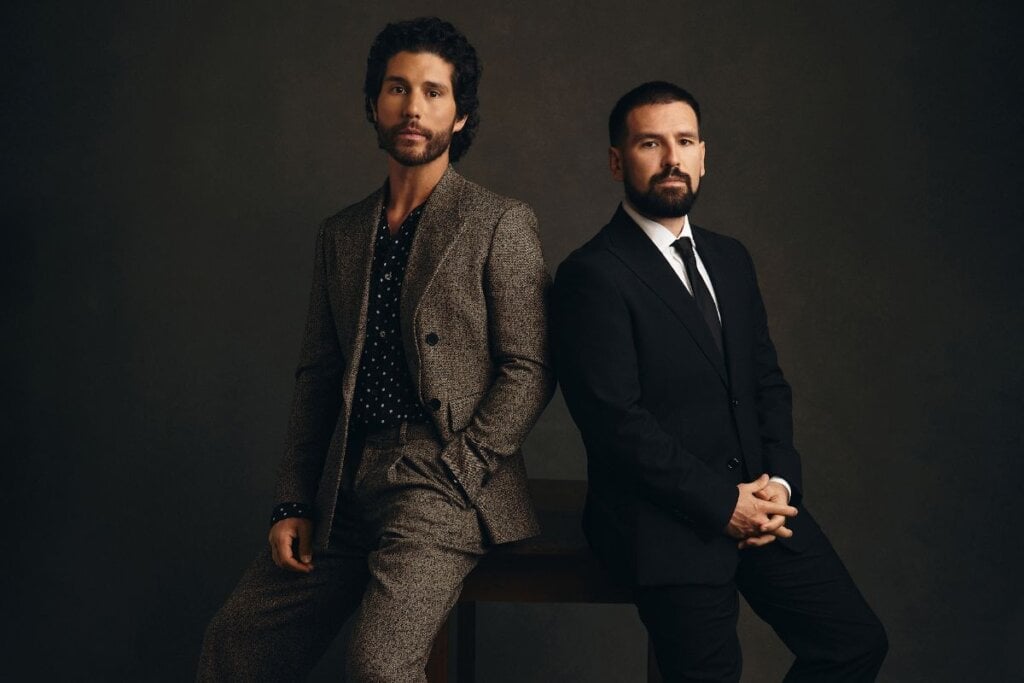
Last month, Dan + Shay returned to social media to announce the release of their powerful track, “Say So.” But it turns out that they have even more new music in store because the duo just revealed their sixth studio album, Young, will be arriving August 21.
They dropped the news this morning on the TODAY show, sharing that the project will find both halves of the duo, Dan Smyers and Shay Mooney, reflecting on family, faith, and the journey of chasing their dreams during one of the most creative chapters of their 13-year career.
Co-produced by Smyers alongside longtime collaborator Scott Hendricks, the project explores the everyday highs and lows that come with life and is being dubbed their “most personal album yet.” Following “Say So,” fans will get another peak into the album with the title track, “Young,” dropping Friday, May 15.
Dan + Shay; Photo by Robby Klein
“This is by far our most personal album yet, and gives a real-time snapshot of exactly where we are in our lives,” the duo shared on Instagram.
They ended the post with a heartfelt message of gratitude for all the fans who have stuck by them even though the moments where they had to step away in order to focus on their personal lives so that they could come back together stronger than ever.
“From the bottom of our hearts, thank you so much for your patience and support while we made YOUNG. We’ve never been more proud of a batch of songs, and hope they mean as much to you as they do to us.”
Dan + Shay; Young
Dan + Shay also teased that fans should “stay tuned for more exciting announcements in the next few days.”
A limited quality of signed vinyls and CDs are currently available for fans to pre-order.
This album will follow the 3x GRAMMY® Award-Winning global act’s critically acclaimed fifth studio album, Bigger Houses, which spawned the GRAMMY-nominated hit single “Bigger Houses.”
Meanwhile, the duo continues to gain momentum with “Say So,” which recently earned a spot in the Top 30 and is still climbing at country radio. Its powerful message surrounding mental health kickstarted the next chapter of their career in a big way. Together, their voices deliver a reminder that it’s okay to not be okay and offer an invitation to reach out for help when times get dark.
“If your light burns out and you’re in the dark/ If you can’t pick up the pieces/ If the world you trusted falls apart/ If your heart’s run out of reasons/ I’ll be there every time you call/ Pick you up every time you fall/ If you’re going through hell, you’re not alone/ If you need somebody, say so,” they sing.
Dan + Shay are headed to Las Vegas this weekend to perform at the 61st ACM Awards, where they are also nominated once again for Duo of the Year.
Alaska Attorney General Stephen Cox, with Goov. Mike Dunleavy, speaks at a Feb. 12, 2026, news conference in Anchorage about drug enforcement. (Photo by Yereth Rosen/Alaska Beacon)
In a historic vote, Alaska lawmakers rejected Stephen Cox as the state’s new attorney general by a 29-31 vote that saw Cox become just the second cabinet appointment in state history to fail confirmation.
Thirty-one votes were needed for confirmation as the 40-person state House and 20-person state Senate met jointly Thursday to vote on 75 nominations for state boards, commissions and the governor’s cabinet.
Speaking in the Capitol on Thursday, opponents said they viewed Cox as a Republican ideologue who favored party-supported policies at the expense of Alaskans. In particular, opponents pointed to Cox’s support for a lawsuit that could end birthright citizenship and his failure to support the state’s absentee voting program.
The Legislature’s rejection is likely to have limited long-term effects. Immediately after the vote, Dunleavy announced he had named Cox as “Counsel to the Governor,” a position he will take immediately.
“Stephen Cox has a strong understanding of Alaska law and the challenges facing our state,” Dunleavy said in a written statement. “His experience, professionalism, and commitment to public service make him a valuable asset as Counsel to the Governor. I look forward to working with Stephen as we continue advancing policies that strengthen Alaska’s economy, uphold the rule of law, and serve the people of our state.”
Rep. Andrew Gray, D-Anchorage and chair of the House Judiciary Committee, opposed Cox as attorney general but supports the new role.
“I think it makes perfect sense,” Gray said. “I think that’s actually a perfect fit. I think Stephen Cox would make an excellent attorney to the governor because they have a lot of alignment and similar priorities.”
The new position was created specifically for Cox within the Office of the Governor.
“The governor has those choices,” said Sen. Matt Claman, D-Anchorage and chair of the Senate Judiciary Committee. “That’s within his power.”
Dunleavy also named Deputy Attorney General Cori Mills as the acting head of the Department of Law.
Dunleavy may designate a permanent replacement who can serve until he is replaced by a new governor in December.
State law prohibits the governor from reappointing Cox as attorney general.
The governor’s other cabinet appointees, including officials in charge of natural resources, the environment and the treasury, received wide support and were confirmed by near-unanimous votes.
Legislators have not rejected a cabinet appointment since 2009, when the Legislature failed to confirm then-Gov. Sarah Palin’s choice of Wayne Anthony Ross to become attorney general.
Speaking Thursday, Rep. Andrew Gray, D-Anchorage, criticized Cox’s decision to hire an out-of-state attorney with no experience in Alaska as the state’s first Solicitor General.
Following that hire, Cox led the Department of Law in joining Alaska in more than 100 friend-of-the-court briefs on national cases. In some of those cases, Gray said, the briefs were contrary to Alaska law and Alaskans’ interests.
“I believe that Stephen Cox would make probably a good attorney general in a state, just not in our state. He is not the right choice for Alaska,” said Rep. Andrew Gray, D-Anchorage and chair of the House Judiciary Committee.
Sen. Loki Tobin, D-Anchorage, speaks Thursday, May 14, 2026, during a joint session of the Alaska Legislature. (James Brooks photo/Alaska Beacon)
Sen. Lӧki Tobin, D-Anchorage, was particularly critical of Cox’s signature on a letter supporting President Donald Trump’s attempt to eliminate birthright citizenship in the United States.
“That stance threatens my rights. It threatens your rights,” she said, speaking to Senate President Gary Stevens, R-Kodiak. “It threatens every Alaskan’s rights.”
Rep. Kevin McCabe, R-Big Lake, appeared to offer a rebuttal to that argument, noting that in general, “attorneys are mercenaries.”
“Somebody’s their boss, whether you’re paying them or whether the governor or the executive hires them. So I suspect that a lot of what we are talking about here is not some rogue attorney general off on his own. I think that he’s had directions that have been provided to him. He’s doing a certain number of things that his boss is telling him to do,” he said.
Rep. Steve St. Clair, R-Wasilla, speaks on the House floor Thursday, May 14, 2026. (James Brooks photo/Alaska Beacon)
Sen. Forrest Dunbar, D-Anchorage, responded to that argument. He said the case against birthright citizenship isn’t just wrong on a moral basis, it’s wrong on a factual basis, and it was unethical for the state to back it.
“We should not have signed on to it, and a qualified attorney should not have signed on to it. I don’t know if the governor pressured the Attorney General to sign on to it, or if he did it voluntarily. It actually doesn’t matter to an ethical attorney,” Dunbar said. “An attorney being asked to make those spurious arguments and sign on to an amicus brief that would repeal birthright citizenship should have resigned rather than go forward with that argument.”
Legislators rejected only two other appointments.
Hannah Mielke was turned down for a public seat on the Alaska State Medical Board.
Opponents said she was unqualified to supervise the state’s doctors and medical professionals. Supporters noted she would be the only female member of the board and significantly younger than other members.
“Frankly, I think a fresh perspective would be good,” said Rep. Mike Prax, R-North Pole. “It really doesn’t matter if you’re 20 or 69, soon to be 70.”
Rep. Sarah Vance, R-Homer, said a large number of young women are skeptical of the medical industry, and Mielke’s perspective could be useful.
Mielke’s nomination failed 13-47.
Lawmakers also turned down Crystal Herring for a seat on the State Board of Professional Counselors. Tobin, speaking in opposition, said her appointment may not follow state law, which requires the appointment go to someone involved in mental health treatment. Herring just provides transportation, she said.
Members of the Alaska Senate watch the voting board as Stephen Cox fails to be confirmed as Alaska’s attorney general on Thursday, May 14, 2026. (James Brooks photo/Alaska Beacon)
Yes, Dylan Sprouse and wife Barbara Palvin are expecting their first child together!
The longtime couple is preparing to become parents, with TMZ reporting that the baby is due sometime around August or September.
Barbara Palvin and Dylan Sprouse attend the “Histoires Parallèles (Parallel Tales)” screening during the 79th annual Cannes Film Festival at Palais des Festivals on May 14, 2026 in Cannes, France. (Photo by Kate Green/Getty Images)
The couple appeared to quietly confirm the happy news while attending the 2026 Cannes Film Festival, where Palvin debuted what appeared to be a baby bump on the red carpet.
The model wore a light blue gown and posed alongside Sprouse, who looked every bit the proud husband during the outing.
For fans who have followed their relationship, the update likely comes as no surprise.
Sprouse and Palvin first started dating in 2018 after initially connecting the year before. Their romance steadily grew away from the usual celebrity circus, with the pair establishing themselves as one of Hollywood’s more low-key couples.
They got engaged in 2022 before tying the knot in Palvin’s native Hungary in 2023.
Barbara Palvin and Dylan Sprouse attend Universal Fan Fest Nights at Universal Studios Hollywood on April 25, 2025 in Universal City, California. (Photo by Maya Dehlin Spach/Getty Images)
The baby news also arrives just weeks after a frightening incident at the couple’s Los Angeles home.
Back in April, a trespasser allegedly entered the property they share, prompting a police response after Palvin reportedly called authorities.
Multiple outlets reported that Sprouse confronted the alleged intruder before officers arrived. Thankfully, neither Sprouse nor Palvin was harmed.
Rather than letting the scary ordeal overwhelm them, the couple later revealed they were coping with humor.
“It’s dealing with the trauma with jokes and fun,” Palvin said while discussing the incident.
Sprouse echoed that approach, adding: “We’re laughing about things the moment they happen. You got to have levity in life.”
Now, thankfully, the headlines surrounding the pair are considerably happier.
For our readers of a certain age, it might feel like just yesterday that Dylan was starring on The Suite Life of Zack & Cody. Now he’s about to enter a very different kind of sweet life: parenthood.
Dylan and Barbara have always been pretty low-profile (by celebrity couple standards), so it comes as no surprise that their announcement consisted of nothing more than a bump debut during a stylish Cannes appearance.
Vincent Mason continues to rack up the milestones one day at a time. This week, he notched yet another major moment in his career when he made his late-night TV debut on The Tonight Show Starring Jimmy Fallon.
The rising country act took to the stage to perform his breakout hit, “Damned If I Do,” off his debut album, There I Go. After being introduced by Fallon, Mason emerged in a smokey setting with just his silhouette illuminated by the array of bright lights. He eventually made his way to the mic, guitar in hand, and delivered the heartbreak-fueled track.
Vincent Mason on The Tonight Show; Photo by Todd Owyoung/NBC
Co-written by the Georgia native alongside Jacob Hackworth and Lauren Hungate, “Damned If I Do” finds Mason stripping things back emotionally, leaning into a more vulnerable side as he unpacks the aftermath of heartbreak. His smooth, commanding vocals capture the inner conflict of trying to move forward while still being pulled back into memories he can’t quite let go of
“Damn right I’m a damn mess/ In the same damn spot as the night you left/ Hall of fame heartbreaker/ Damned if you ain’t the best/ Ripped the damn thing right out my chest/ Don’t know how I’m supposed to cut you loose/ Don’t know how I’m gonna let you go/ Damned if I do, damned if I don’t/ Get over you, so I guess I won’t,” Mason sings, laying it all out on the raw and unfiltered chorus.
The powerful performance ended in a roar of applause and some serious hype from Jimmy Fallon.
Prior to stepping in front of the audience, Vincent Mason was surprised with a plaque commemorating the recent RIAA Gold certification of “Damned If I Do.” This celebratory moment took place backstage surrounded by members of his family and team. On Top of earning the certification, the track also made its debut on the Billboard Hot 100 chart this week.
As the track continues to heat up, fans have also gotten their hands on Mason’s latest single, “Don’t Ask Me,” a mid-tempo track that once again dives into the emotions that come from a heavy breakup. He paints a picture of a man navigating the pain by replaying what he could’ve done differently and wondering if anything might’ve changed the outcome.
Vincent Mason’s emotional storytelling emerges on a completely different level throughout his live performances. He is currently gearing up to close out his headlining There I Go Tour this weekend, with his final shows taking place on May 14 in New York, NY and in Boston, MA on May 15.
Alongside his own headline dates, Mason is also touring with Morgan Wallen, Parker McCollum, and Thomas Rhett throughout the year.
Indianapolis Motor Speedway (Speedway, Ind.) — Pato O’Ward has famously found himself in contention to win the Indianapolis 500. He’s led during the last lap. But not at the finish line. O’Ward has led 95 laps in his six Indy 500 starts, and the Arrow McLaren No. 5 driver has nine career victories in the series. But none have come in the Indy 500. So what makes the Indy 500 so hard to win? “It goes greater than just driving the race car,” O’Ward told me and other reporters this week. “It goes through seven pit stops. It goes through an ever-changing strategy. It goes through the timing [of moves], the timing that I still have to get right. “And there’s so many things that are out of your control that can throw it upside down. But at the end of the day, it is up to us inside of the race cars to try and just get ourselves into that opportunity to make it happen.” An opportunity. That’s what the drivers seek at Indianapolis. And then they hope, in some ways, a little bit of racing luck falls their way. From driver to driver, they talk about how this race is different than any other. And it isn’t just the fact that more than 300,000 people will be at the track for the sold-out race on May 24 (12:30 p.m. ET on FOX). For the last few years, drivers have not raced on an oval 1.5 miles or bigger. That makes the 2.5-mile IMS oval much larger than any other race they run all year. They don’t run 500 miles anywhere else, meaning more pit stops. So what they learn one year, they can’t apply to any other track, meaning it takes a year to learn. It took Josef Newgarden 12 starts in the race to win it — his 27th career victory in the series. The Team Penske No. 2 driver then won again in his 13th and appeared to be in position to win in his 14th last year before a mechanical issue ended his day. “If we get an opportunity like we did last year, I think we’ll be in a good spot,” Newgarden told me and other reporters this week. “Every year is different, though. There’s maybe not been as many changes year over year, but I think you’ve just got to be open to the possibility to that what worked last year might not work this year.” Alexander Rossi won as a rookie in 2016. He’s been trying to earn that second victory since then. [WHO TO ROOT FOR? Guide To Choosing Your Favorite INDYCAR Driver] What makes this race so hard to win? “You should ask Scott [Dixon] that,” Rossi told me and other reporters last month. “He’s one of the best drivers of our generation, and he only has one as well. There’s just so many variables and things out of your control and it’s a very particular race.” Scott Dixon has won the pole three times since his 2008 victory, which came in his sixth start. The Chip Ganassi Racing No. 9 driver will make his 18th start this year in looking for that second win. Oh, and Dixon — the six-time INDYCAR champion — also has led more laps (677) than any other driver in race history. “Even if you have a perfect day, it only gives you a chance,” Dixon told me and other reporters. “It’s a longer race. Everybody’s pushing everything to the limit, whether that’s the driver or on the mechanical side, or on the engineering side, strategy side. “And then, like anything on ovals, it can be a, a late-race caution that could flip everything on its head as well. So some things are in your control and some things are out of your control. As far as you look at a three-hour, one-day event, it’s probably the hardest one.” Ovals. For drivers who grew up in the European formula system and move to INDYCAR, they don’t have much experience racing ovals. There are five oval tracks on this year’s schedule — Phoenix, WWTR Gateway (St. Louis), Nashville, Milwaukee and Indy. Christian Lundgaard won the race Saturday on the IMS road course. But the Arrow McLaren No. 7 driver isn’t considered a favorite this weekend because he is rarely a contender on ovals. Lundgaard told me and other reporters that his competitors have told him once it clicks for him on an oval, he will run better. “Phoenix was a big disappointment in many ways,” Lundgaard said about the March race. “The test [in February] was never really the same for me as the race was. “There’s no time out there where I’m uncomfortable. … It is just that feel of you need to be comfortable in the uncomfortable and just put the car in different positions and different places to really figure out what it’s doing. And I think some people are happier to do that than others.” [POWER RANKINGS: Christian Lundgaard Leaps After Sonsio Grand Prix Win] Helio Castroneves is more than happy to do that. He has won four Indianapolis 500s. He won his first two and then needed seven more races to earn a third and then 12 more to win a fourth. Driving an extra entry for Meyer Shank Racing, Castroneves looks to capture a victory on the sport’s biggest stage (by the way, he’s used to big other stages as a Dancing With The Stars winner in 2007). “I refuse to hear people say that you can’t do it, and I’m just going to work extremely hard and put all the little details together,” Castroneves told me and other reporters as he talked about what makes this race hard as he goes for a record fifth. “And I think that’s where I’m good at it.” Every driver says the issue is they can put all those little details together and still not win. Will Power won in his 11th start in 2018. This will be his eighth attempt at earning another and his first start for the Andretti Global No. 26 driver. “It’s so complicated with how much goes into it,” Power told me and other reporters last month. “You could name 10 different reasons why you didn’t win the past 10 races here. “It’s unpredictable. You never know what’s going to happen on race day. I think the lesson would be, is to be there at the end in that front group. That’s, if I was to tell myself something over the last 10 times I’ve done this, is you’ve got to get to the end and be at the front.” That’s exactly where four-time INDYCAR Series champion Alex Palou found himself last year. “You need to have a fast car, but only having a fast car doesn’t mean anything,” Palou told me and other reporters. “You need to have great pits, but only having that doesn’t mean anything. … It’s such a long race with so many pit stops and things that continue to change that you need to be able to react wherever you are.” Palou is used to winning by leading most of the laps in his Chip Ganassi Racing No. 10 car. At Indianapolis, in a 200-lap, 500-mile race, there will be times when a driver ends up outside the top-10. “It’s not like a straightforward race where you’re top-three and you do a good pit stop and you win,” Palou said. “It’s more of like, ‘Hey, you might be leading, but then you’re 15th four-wide on the outside, and you need to survive that. “There’s so many things that can go wrong, and as soon as one of those don’t go right, you cannot win.” Marcus Ericsson knows that. He won in his fourth Indy 500 start. But he has been close to winning two of the last three. His failure to win hasn’t come from a lack of effort. “There are so many things that you have to get right, and even when you do get everything right, it’s still not over until it’s over,” Ericsson told me and other reporters here at Indianapolis. “So it’s a tough race to win. “And it’s the race you work all year-round, or at least I do, to try and figure out how I can be better here, how I can execute better, how I can minimize mistakes — how I can just get back to Victory Lane, basically. So it’s what drives me, and I think many others.” Which brings us back to O’Ward, who, as the commercials have shown, has had his heart ripped out here at Indy. A driver can find himself in position and then must do everything right in the final laps. “[You must choose] when to make a pass, when you choose to back up to [someone] — and a yellow can come out because some other guy decided to put it in the wall,” O’Ward said. “Or you do [that move] too early, and they get you back. “I feel like I’ve had it all happen to me.”Latest Sports News from FOX Sports
MANILA, PHILIPPINES – MARCH 10: The USAID logo is seen on a machine that processes recycled plastic into construction blocks at the Pasig Eco Hub, a project impacted by the Trump administration’s freeze on foreign aid, on March 10, 2025 in Pasig, Metro Manila, Philippines. The recent suspension of USAID funding by the Trump administration has resulted in the loss of at least $69.7 million (approximately PHP 4.06 billion) in aid programs across the Philippines, affecting 39 ongoing projects spanning environmental conservation, health initiatives, disaster response, and education—some of which were set to continue until 2029. Among the impacted projects is the Pasig Eco Hub, a USAID-funded waste management facility, which shut down due to financial constraints, with USAID funding cuts further disrupting its recycling and sustainability programs. (Photo by Ezra Acayan/Getty Images)
The Trump administration’s so-called “America First Global Health Strategy” turns one of the most effective and humane tools of U.S. foreign policy into an instrument of coercion. We now condition lifesaving health aid on concessions from vulnerable countries and replace partnership with exploitation, thus undermining both American values and long-term national interests.
Throughout the 20th and into the 21st century, American resources were deployed to provide relief to countless millions throughout the world. Think Herbert Hoover in the aftermath of World War I, the Marshall Plan after World War II and the later formation of the United States Agency for International Development (USAID). These initiatives were driven by both genuine concern for the wellbeing of others, but also enlightened self-interest. Stable and healthy nations were less likely to wage war. American aid benefited the American economy that produced the tools and the agricultural products that were the foundation for this aid.
For decades, U.S. foreign assistance has represented a tiny share of federal spending — about one percent of the budget — but has delivered outsized benefits. It has helped contain infectious diseases before they reach our shores, stabilized fragile regions and built goodwill that strengthens diplomatic relationships while saving millions of lives at relatively low cost.
Trump has abandoned any pretense of foreign aid altruism, replacing it with a sullied quid pro quo. The new approach abandons that framework. It was previewed in his dealings with Ukraine when he conditioned continued military assistance to that country on mineral concessions before simply insisting that other NATO members buy American weaponry and transfer these to Ukraine. Trump now applies this sinister transactional approach to medical aid to some of the poorest countries in the world.
According to reporting in The New York Times and the Associated Press and analysis by Public Citizen, the administration has pressed some 30 countries in Africa and Latin America to sign agreements granting the United States access to sensitive health data and valuable natural resources as a condition for receiving even minimal health assistance. These are not routine bilateral arrangements negotiated on equal footing. They are ultimatums delivered to countries facing urgent public health crises.
Consider Zambia, where the administration has reportedly weighed a $2 billion deal withholding, among other things, HIV treatment support affecting over one million people unless the country expands U.S. access to its mineral resources. In short, it is leveraging human lives for economic gain. In other cases, countries are being asked to provide viral samples and health data without assurances that resulting vaccines or treatments will be shared equitably. This raises profound ethical concerns and threatens to erode global cooperation in disease surveillance — cooperation that is essential to preventing the next pandemic. Not surprisingly, certain governments, among them Ghana, Zimbabwe and Kenya, have rejected the overtures, having concluded that the trade-offs are too high a price.
The moral problem is obvious. Conditioning lifesaving aid on unrelated concessions exploits desperation. It echoes a discredited era when powerful nations extracted wealth from poorer ones under the guise of assistance. The United States should not revive that model, particularly in the realm of global health, where trust and transparency are indispensable.
The strategic costs are just as serious. The perception that U.S. aid is transactional and predatory will diminish cooperation on data sharing, early warning systems, and joint research. That makes Americans less safe, not more. Furthermore, foreign policy conducted through secret deals that trade public health for private advantage invites abuse and evades democratic accountability. Congress cannot exercise meaningful oversight if it is kept in the dark, and the public cannot assess policies whose consequences include preventable illness and death.
Proponents may argue that tying aid to economic or strategic benefits simply reflects realism. But realism properly understood recognizes that power is not only measured in transactions. It is also measured in credibility, alliances, and the willingness of others to cooperate in times of crisis. A policy that saves pennies while sacrificing trust is not pragmatic; it is shortsighted.
The United States can pursue its interests without abandoning its principles. That means maintaining robust global health programs that are transparent, evidence-based, and grounded in mutual benefit. It means supporting equitable access to the fruits of medical research. And it means rejecting the premise that the lives of people in poorer countries can be used as bargaining chips. When the U.S. conditions lifesaving care on extractive concessions, it diminishes the nation’s moral standing, weakens its strategic position, and endangers global health. Congress should demand full disclosure of these agreements, prohibit coercive conditions on humanitarian aid, and reaffirm a simple proposition: that American leadership is strongest when it aligns power with principle.