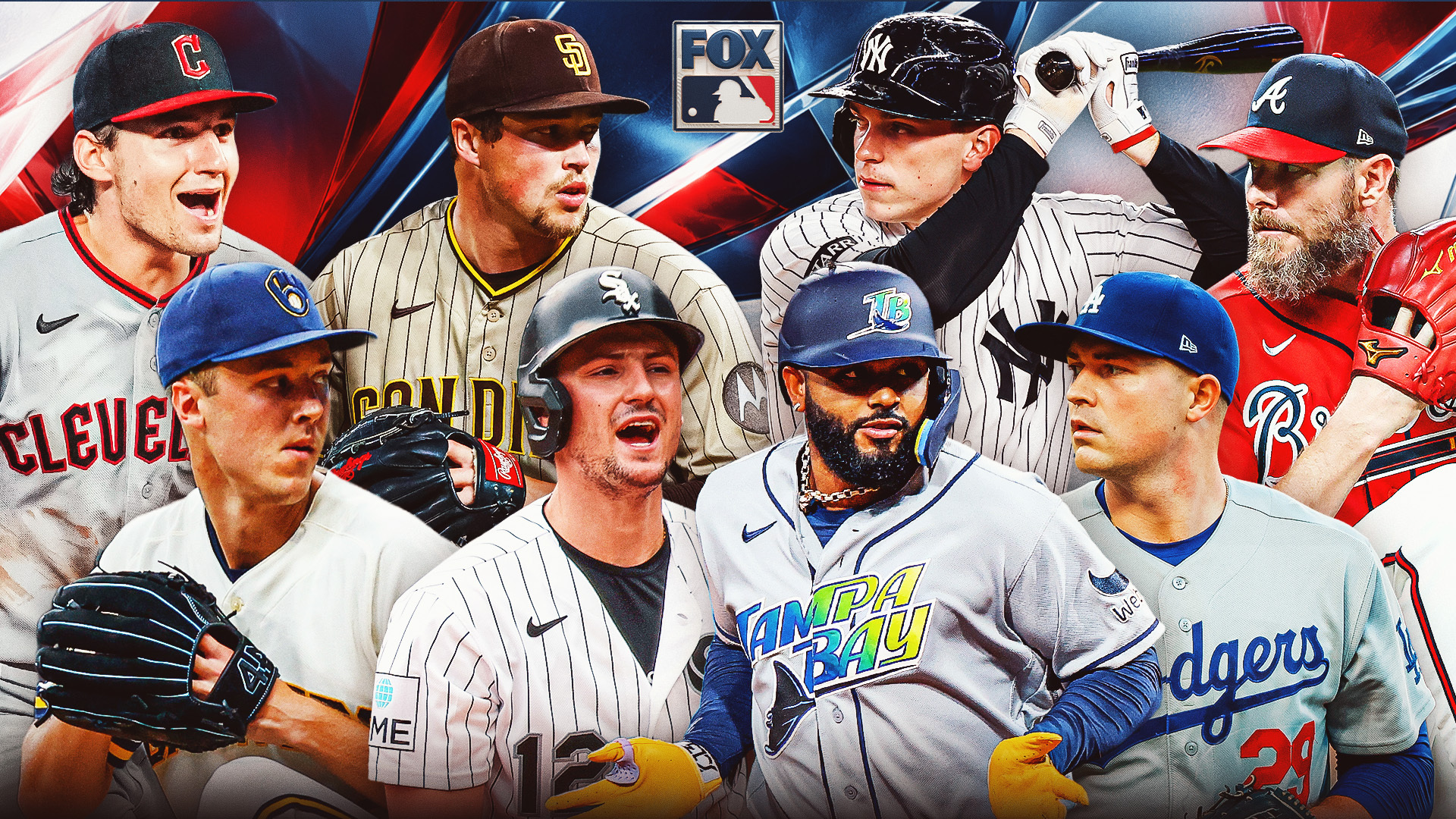
If your team has reached this stage of the MLB postseason, there’s a good chance you’re also thinking: Could this be the year we finally win the World Series? Or, if you’re a Dodgers fan – could we really make it three in a row? Each of the eight teams left has its own strengths and weaknesses, some more than others. It’s now time to see if these World Series hopefuls can capitalize on what got them to this stage, or whether their pitfalls will send them home. Let’s break them down, starting with the National League teams before diving into the American League contenders. NATIONAL LEAGUE 2026 Record: 94-68, 1st in NL EastWorld Series Odds: +1600 (bet $10 to win $170 total) NLDS Opponent: Los Angeles Dodgers Why They Will Win The World Series: Their combination of star power, elite performance against .500 teams and resilience in the face of significant injury challenges makes this Braves team a true World Series contender. Atlanta was dominant against the Dodgers this season, going 5-1 against the reigning back-to-back champions. They’ve been solid in one-run games and in extra innings, pointing to their battle-tested mentality entering October. Plus, this is one of the best bullpens the Braves have taken into the playoffs in recent years. Closer Raisel Iglesias and high-leverage relievers Dylan Lee, Didier Fuentes, and Dylan Dodd have all had excellent seasons, and Robert Suarez is back from injury, making an already dominant group even stronger. Why They Won’t Win The World Series: The Braves’ offense is a little too inconsistent and struggling in important areas, weakening the club’s chances of a deep postseason run. It’s less than ideal that the Braves had the third-worst walk rate in MLB during the regular season, which makes them too prone to chasing pitches outside the zone, and that can be exploited all too easily by dominant pitching staffs in a short playoff series. The offense has been sporadic at times, and the lineup is lacking a top-30 hitter in the majors, unlike other serious World Series contenders. He sets the tone every time he takes the hill, whether it’s from the bullpen to close out a do-or-die game as he did on Thursday against the Phillies to clinch an NLDS spot, or it’s for a start against the almighty Dodgers. Keep an eye on Sale’s career 5.83 postseason ERA. 2026 Record: 100-62 (1st in NL West; 2nd in NL)World Series Odds: +200 (bet $10 to win $30 total) NLDS Opponent: Atlanta Braves Why They Will Win The World Series: Is there any pitcher in baseball you trust more in October than Yoshinobu Yamamoto? Behind him, the Dodgers will have two multiple Cy Young Award winners in Tarik Skubal and Blake Snell. Shohei Ohtani is back to lead the offense, and Freddie Freeman has already demonstrated his ability to take his game to another level in October even when he’s not 100%. Perhaps most encouraging is the recent play of Mookie Betts, Kyle Tucker and Teoscar Hernández. After struggling offensively all year, all three are finding their rhythm at the right time. The Dodgers’ starting pitching advantage can mask any other issues with their roster (as their starters demonstrated last year), and they’ll be able to bump Roki Sasaki, Justin Wrobleski and Emmet Sheehan into relief roles in October. This group is battle-tested, flipping a switch in September again and will be the favorites to three-peat for a reason. Why They Won’t Win The World Series: The age of the Dodgers’ roster was evident throughout the second half. Ohtani, the engine that makes this machine go, won’t be 100% this year and hasn’t looked like himself offensively since July. Freeman’s knee is acting up and has sapped his power in recent months. Fellow All-Star Andy Pages is coming off a fractured hand, and who knows how long it will take for him to look like himself again? They beat up mostly on bad teams in September, but they have a losing record against teams at .500 or above this year and looked unimpressive for months. And as much as they would like to lean on their unbelievable rotation, a late-season groin issue for Snell and some September shakiness from Tyler Glasnow threaten to cause problems for their greatest October advantage. Considering their bullpen also looks unstable again, and they may not have a set closer in the postseason, any of those concerns could end their hopes of a three-peat. After looking like the MVP favorite again in the season’s first half, injuries to Ohtani’s left knee and right biceps forced him to stop pitching after July 3 and turned him into a mere mortal at the plate after the break. The Dodgers are hopeful his September injured list stint, plus the break after a first-round bye, will have him looking like himself again at the plate. If he’s not, that could spell trouble. 2026 Record: 103-59 (Best in MLB)World Series Odds: +500 (bet $10 to win $60 total) NLDS Opponent: San Diego Padres Why They Will Win The World Series: They’re the best team in baseball. At some point, that has to mean something, right? The Brewers do all the little things well. Their offense gets on base, hits for average and consistently produces with its scoring opportunities. Outfielder Jackson Chourio, second baseman Brice Turang and first baseman Jake Bauers are more impactful hitters this year than any of their top bats were last season, and catcher William Contreras looks like a completely different force offensively over the last month. Milwaukee gets a first-round bye, and then it has the most unhittable starting pitcher in baseball ready to go for Game 1 in Jacob Misiorowski, who’s a different beast than he was last season as a rookie. For Game 2, they’ll have another strong arm in Logan Henderson, who has a 2.22 ERA in 11 second-half starts. The Brewers pitching staff has the lowest ERA in the National League, and they can shift some of their rotation depth arms into relief. It’s a complete unit and Milwaukee’s best chance to return to the World Series for the first time since 1982. Why They Won’t Win The World Series: Have we already seen this movie before? The Brewers have now won the division four straight years, but that hasn’t translated to October success. They didn’t spend big on another impact bat who could help an offense that looked overmatched against the Dodgers in last year’s NLCS, and they’ve hit the fewest home runs in the National League. That’s not typically a recipe for postseason success. Each of the last six World Series winners ranked in the top five in MLB in home runs, and each of the last 10 World Series winners ranked at least in the top half of baseball in the category. Remember: The Brewers swept the regular-season series against the Dodgers last year. We know what happened next. In addition, with Kyle Harrison’s struggles of late, the depth of the starting rotation behind Misiorowski and Henderson is suddenly a major question. You want pitchers who can miss bats in October. No starter in the sport does that better than Misiorowski, who surrendered the lowest opponent batting average (.157) and the second-highest strikeout rate (37.9%) ever for a qualified MLB starter over the course of a full season. 2026 Record: 91-71 (2nd in NL West; 4th in NL)World Series Odds: +1100 (bet $10 to win $120 total) NLDS Opponent: Milwaukee Brewers Why They Will Win The World Series: Sometimes it’s just about getting hot at the right time. While steamrolling the Cubs in the wild-card series, they showcased everything that makes them a title contender. After a slow start to the season, right fielder Fernando Tatis Jr. and center fielder Jackson Merrill look like superstars again. First baseman Ty France has been a steady force all season in a career year, and late-season upticks from third baseman Manny Machado and shortstop Xander Bogaerts provide more reasons for encouragement with the offense, which was at its best in September. As a team, the Padres are playing their best ball at the right time. And if they get a lead in the middle innings come October, the game should be over. The Padres have one of the most intimidating bullpens in the game, led by All-Star closer Mason Miller, who has been the best reliever in the sport. Why They Won’t Win The World Series: They might have the worst rotation in the playoff field. The additions of starters Casey Mize and Robbie Ray were supposed to fix the problem, but both additions have ERAs over 5.00 since joining the Padres. And as good as the offense has looked lately, this is a group that ranked dead last in OPS before the All-Star break and did nothing at the deadline to fix the offensive depth concerns. You can almost directly tie the team’s turnaround to Tatis’ turnaround. In the season’s first half, he had five home runs and the Padres were 48-48. After the break, he had 20 home runs and the Padres went 43-23. They’ll go as he goes. AMERICAN LEAGUE 2026 Record: 84-78 (2nd in AL Central; 5th in AL)World Series Odds: +1100 (bet $10 to win $120 total) ALDS Opponent: Cleveland Guardians Why They Will Win The World Series: Beware a young team with nothing to lose. No one expected the White Sox to be in this position, just a year after losing 100 games. Now, they’re playing with house money. Home runs win in October, and the White Sox have a number of hitters who can change a game with one swing. First baseman Munetaka Murakami, third baseman Miguel Vargas and right fielder Colson Montgomery all hit at least 30 home runs during the regular season, while outfielder Sam Antonacci and second baseman Chase Meidroth give the team two more above-average bats in the lineup. Rookie lefty Hagen Smith has been a revelation in the bullpen, and manager Will Venable has a number of options to go multiple innings, which can mask some of the team’s starting pitching deficiencies. But it’s the offense, which scored the most runs in the American League, that gives this youthful club a chance to shock the world. They also might have divine intervention. Why They Won’t Win The World Series: They don’t have enough starting pitching, and the all-or-nothing offense — the White Sox ranked fifth in MLB in both homers and strikeouts — was trending the wrong way toward season’s end. They stopped slugging or hitting much at all in September, but it’s their pitching that’s the more glaring October problem. Chicago’s starters have been among the least productive in baseball, and things only got worse in the rotation after the All-Star break. The deadline addition of Luis Castillo did nothing to help, and the bullpen arms started to look tired down the stretch after throwing more innings than any team in MLB by a wide margin. They found their energy again in the wild-card series in Houston, but a magic summer on the South Side could turn into an ominous autumn if their arms get gassed in a longer series. The fact that the White Sox stormed through Houston without Vargas recording a hit in the wild-card series is a testament to the depth of their lineup. But they’ll need the All-Star third baseman, who led the team in runs, RBI and OPS this year, to get going if they want to continue further. 2026 Record: 85-77 (1st in AL Central; 4th in AL)World Series Odds: +1100 (bet $10 to win $120 total) ALDS Opponent: Chicago White Sox Why They Will Win The World Series: Death, taxes and the Guardians making a late-season push. The rookies are here to play. Outfielder Chase DeLauter and second baseman Travis Bazzana provided a jolt to the lineup, and lefty Parker Messick is already one of the best starting pitchers in the American League. The offense looked more potent after adding Jo Adell and Nathaniel Lowe at the deadline, and outfielder Steven Kwan seemed like himself again following the All-Star break. There might be just enough offense here to envision a deep run, given the arms they have at their disposal. Their bullpen is again one of the most dominant in baseball, leading MLB in strikeout rate and WHIP, and is led by one of the best closers in the sport in Cade Smith, who looked untouchable down the stretch. Why They Won’t Win The World Series: Another year, same story for Cleveland’s weak offense. The Guardians’ lineup is again one of the least potent in the sport, and this time even third baseman José Ramírez is a below-league-average hitter. The seven-time All-Star hasn’t looked like himself all season, and a June hamate fracture certainly didn’t help matters. If he can’t find his superstar form, it’s hard to envision this offense having enough firepower to make any serious noise in October. There’s a lot on the shoulders of rookies DeLauter and Bazzana, and the offensive deadline additions don’t change the fact that this remains one of the least intimidating lineups in the postseason field. One year ago, DeLauter’s first big-league experience came in a do-or-die postseason game. Now, he has established himself as one of the best hitters in a Cleveland lineup that ranked 26th in OPS and needs his pop at the plate, especially after a down year from star Jose Ramirez. 2026 Record: 93-68 (2nd in AL East; 2nd in AL)World Series Odds: +500 (bet $10 to win $60 total) ALDS Opponent: Tampa Bay Rays Why They Will Win The World Series: They have the best starting pitcher in the American League, and a starting pitching staff whose biggest concern right now is former Cy Young winner Gerrit Cole. In other words, if Cole is the rotation’s only worry going into the ALDS, the Yankees are in excellent shape. Schlittler is all but a lock to win the AL Cy Young award after he lowered his season ERA to 1.95 in his final outing of the year. Schlittler has been so good for the Yankees that he’s receiving serious MVP consideration. And even outside of Schlittler, the combination of Max Fried, Carlos Rodon, Will Warren, Ryan Weathers and Cole has recorded the top rotation ERA (3.24) in the major leagues this season. If the Yankees make a deep run and end their 17-year championship drought, it will be because of their outstanding rotation. Why They Won’t Win The World Series: The unknown factors surrounding Judge’s second trip to the injured list and a bullpen that is overworked and lacking depth. Judge potentially missing the postseason with a calf strain isn’t the same as when the 2021 Braves won a championship without Ronald Acuńa Jr., who was injured from July for the rest of the season that year. Atlanta’s offense still ranked top 10 in most offensive categories without Acuña. The Yankees plunged to the bottom of the league this summer in most hitting stats without Judge. Judge is too important to these Yankees, who instantly play better when he’s in the lineup. Even though the Yankees picked up more slug at the trade deadline by acquiring a pair of power hitters in second baseman Luis Garcia Jr. and outfielder Heliot Ramos, they don’t make up for the loss of Judge, one of the most prolific hitters of all time. The offense was terrific against an inconsistent Red Sox team in the wild card series, but they need any help they can get against a flawless Rays team. Anything the Yankees get from their three-time MVP will be an added bonus. Presuming the rest of the lineup continues to produce as it did against the Red Sox in the Wild Card series, all eyes will be on Judge to step up in high-leverage moments to put the Yankees over the edge. Keep an eye out for when he will be activated from the injured list (calf strain). 2026 Record: 98-64 (1st in AL East; Best in AL)World Series Odds: +800 (bet $10 to win $90 total) ALDS Opponent: New York Yankees Why They Will Win The World Series: The Rays are on the verge of locking up home-field advantage throughout the postseason, and they’re also nearly impossible to beat at Tropicana Field. Tampa Bay owns a remarkable 55-26 record at home this season, good enough for a .679 winning percentage that’s the best in baseball. Plus, the Rays are Ray-ing again. They’ve sustained excellent fundamentals, run prevention, small-ball, defense and heads-up baserunning throughout the season, which are all major reasons they spent the majority of the year in first place. Third baseman Junior Caminero is enjoying an MVP-caliber season, and he can be a true weapon for the Rays’ offense in October. As usual, Tampa Bay has the pitching depth to make a deep run. And if they win the division, which looks likely, that first-round bye will only help them reset and start the postseason stronger. Why They Won’t Win The World Series: They could’ve used another bat at the trade deadline. As impressive as Caminero, first baseman Jonathan Aranda and designated hitter Yandy Diaz have been for the top of Tampa Bay’s lineup, the bottom of the order has been a disappointment. A weak lower third of the lineup has burned the Rays before, in the 2023 wild-card series against the Rangers, where they were swept by Texas. This year, the Rays’ 7-8-9 hitters own an 84 wRC+ (17th in MLB) and a .345 slugging percentage (27th in MLB), and it’s far too easy to envision that dropoff in production becoming their playoff bugaboo. He started all 162 games at third base for the Rays, and his durability is a major reason Tampa Bay’s offense never took a step back this year. He wrapped his second straight season with at least 40 home runs (42 this year after belting 45 in 2025).Latest Sports News from FOX Sports