“Here we go,” is what borough manager Alekka Fullerton told assembly members at a meeting Tuesday, marking the start of budget deliberations.
The manager’s budget released at the start of this month, proposes holding the borough’s spending plan roughly in line with last year, with a decrease to property tax rates largely made-up for by a projected increase in sales tax revenue from the new seasonal sales tax rate.
War in Iran, however far away from the realm of municipal government, could throw a wrench in the works: the town is bracing for skyrocketing fuel prices and higher shipping costs for goods across the board, and over 500 residents have signed a petition asking the borough to cut taxes in response to the cost-of-living increase.
That discussion will play out at a town-hall Wednesday, scheduled for just after press time this week, and at the next few assembly meetings.
Simultaneously, the borough assembly is starting their process of editing the manager’s plan, including looking for potential spending cuts, many assembly members have said.
Early deliberation is broken down by different sections of the budget, like Tuesday’s meeting, which covered the areawide general fund.
What does it mean for the budget to be broken down into funds?
Borough services are largely split up and paid for by the populations they serve. The general fund encompasses services that are meant to benefit everyone living within the borough’s boundaries — services like the school, which any student in the borough may attend.
With the broadest benefits, the general fund is paid into by broad funding sources that don’t come from just one specific area in the borough. For instance, roughly 43% of the general fund is expected to be paid for by property tax this year. That’s specifically the portion of the property tax paid equally by all borough land-owners — 5.74 mills in the manager’s proposed budget, or 0.574% of a home’s value.
It’s slightly confusing, given that residents in the townsite do pay a higher property total property tax rate, proposed by the manager at 10.09 mills for the upcoming year. That extra chunk of property tax, however, pays into the townsite service area — meant to encompass services specifically benefitting townsite residents.
Those services include the police department. If there’s an emergency — “basically if there’s a life threatening situation,” Fullerton said this week — the police may operate out Lutak, Mud Bay, or out the highway north of the Airport. Those out-of-townsite residents do contribute to police costs when they pay sales-tax on purchases in-town. Sales-tax revenue is split between multiple funds. But otherwise, the police department’s main duties are in town, funded by taxpayers in town.
Other services in the townsite service area fund include townsite road-maintenance and borough public works.
In terms of specific changes to these funds this year, Tuesday’s meeting outlined a picture of persistently creeping costs across the board. For instance, the borough server software, VMWare, has become a subscription service, adding an additional $11,000 to borough technology costs for the upcoming year.
The assembly will hold a committee-of-the-whole meeting to discuss the townsite service area on Tuesday.
The Haines School will host the Region V Art Festival this weekend, welcoming in roughly 70 students from across Southeast.
Students will attend two instructional workshops a day from Friday through Monday. The sessions will be taught by art teachers from the visiting Region V schools, as well as local artists Tassja Letchworth, Kelleen Adams, John Svenson and Skweit Jessie Morgan.
The annual art festival began in 1998, first in Wrangell by teacher Kirk Garbisch with the help of a Kake art instructor and carver Rick Mills.
Its purpose for the last 30 years has been to encourage the exchange of art and instruction among high school students. It rotates among Southeast communities.
This year’s festival offers a range of workshops, including glassblowing, creating a formline longboard, beading, photography, halibut-hook carving and still-life painting. Each student chooses two options and spends an average of 15 hours in each workshop over four days.
The art fest will conclude with an awards show and exhibition of student work open to the public Monday, 6:30 – 7:30, in the Haines High School Gym.
Sue Bahelda of the Wrangell Sentinel contributed reporting to this story.
A proposed new gold mine north of Juneau expects to create 277 jobs and a pre-tax net present value of nearly $1 billion during an initial seven-year production cycle, a representative of the company developing the project told Juneau business leaders Thursday.
The New Amalga Gold Project, located near Herbert Glacier about 20 miles north of downtown Juneau, is intended to be a low-impact site where employees will commute to work daily from Juneau and ore will be shipped elsewhere for processing, said Graham Neale, director of corporate and external communications at Grande Portage Resources Ltd., during a presentation to the Greater Juneau Chamber of Commerce.
The tentative plan is to drive truckloads of ore to a terminal at Cascade Point, about 10 miles further north, about once an hour, with a ship picking up and transporting stockpiles weekly, he said. Plans for the mine, which doesn’t yet have an opening target date, have been in the works for more than a decade.
“They’ve really been exploring it for the last 12 years or so, intentionally keeping a low profile, just because that’s what you do in exploration,” Neale said. “You want to make sure that you have something to talk about before you start talking about it.”
Attention to the mine — and controversy about it — have grown during the past year due to the Dunleavy administration’s strong advocacy for putting a state ferry terminal at Cascade Point that has been strongly opposed by travelers and regional officials. The administration has already approved contracts spending nearly $30 million for infrastructure, including a road the mine could also use, prompting critics to assert that aiding the company is a primary purpose of the state’s involvement.
Neale acknowledged the questions raised about the mine’s role at Cascade Point. He said the ferry terminal and ore shipping facilities are separate projects, although his company does need a road to the site regardless of the state’s plans. State officials announced last month the first stage of work, which was scheduled this summer, is being postponed beyond this year due to permitting issues raised by the U.S. Army Corps of Engineers.
“Ultimately, if the Department of Transportation and Public Facilities doesn’t build a road, Grande Portage would look at doing it themselves,” he said.
Access to a site for shipping ore is key to what Grande Portage’s website calls “a low-footprint, low-initial-capital scenario” for the Amalga mine.
“When you look at the actual footprint of what would be required on surface or would be needed to support this it’s roughly 50% of what you would see at a conventional underground mine site like you would see at Kensington, Greens Creek or somewhere down in Nevada,” Neale said. “That’s simply because there’s not going to be any processing facilities, there not going to be a need for tailings storage, the need for waste rock storage. We don’t plan on building a camp. So everybody’s that’s going to work at this mine, we’re going to get them home at the end of every shift. That’s the plan right now.”
A preliminary economic assessment published April 15 by Grande Portage states containers of ore will be “loaded onto barges for transport to deepwater port facilities in British Columbia, where the containers would be emptied and the material loaded onto trans-oceanic bulk vessels for overseas processing. Empty containers would be returned to the minesite on the back-haul for reuse.”
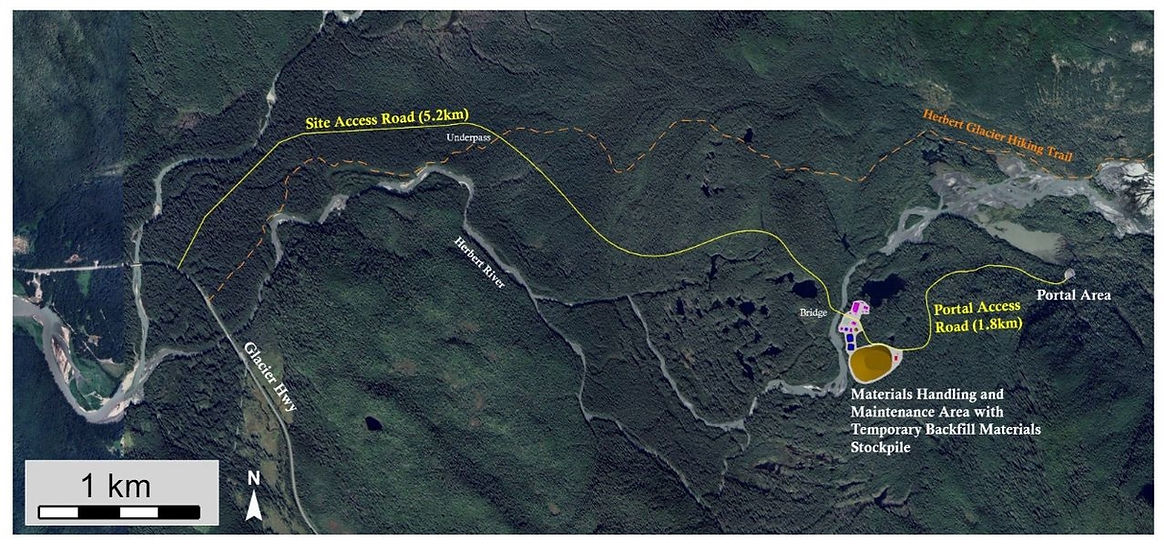
A map shows the planned road and infrastructure layout for the New Amalga Gold Project at the midpoint of a design review process. (Grande Portage Resources Ltd.)
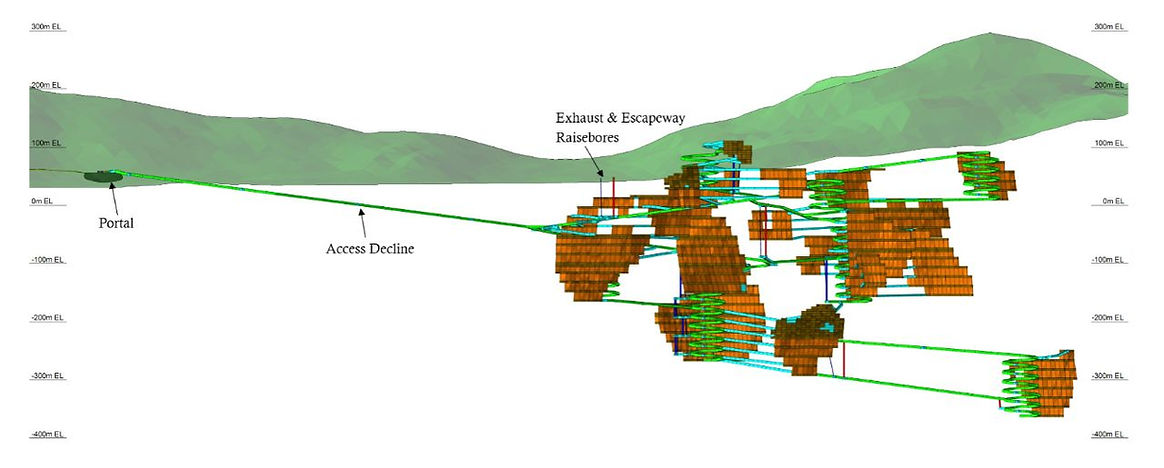
A map presented Thursday shows the company is planning for a 3.25-mile access road from Glacier Highway to a maintenance and materials storage area, with another road extending about a mile to the portal area accessing the underground mine. The mine as currently designed features a network of extraction areas and tunnels extending up to 1,200 feet beneath the surface.
• About 4,300 meters of diamond drilling from up to 14 drillholes to conduct surface mapping and trench sampling, which “will characterize the geotechnical and hydrogeological aspects of the deposit rock mass in order (to) gather data necessary for the environmental review and permitting process as well as to inform mine development plans.”
• Construction of environmental monitoring infrastructure, including meteorological stations and stream monitoring equipment.
• Preparations for initial work on a site access road, pending state approval.
• Conducting baseline studies necessary for the environmental review and permitting process, “including wildlife and avian surveys, wetlands surveys, ongoing surface water sampling, cultural and archeological surveys, geochemical studies, socioeconomic studies, and more.”
As of now the Amalga mine appears comparable in size and mineral grade to the Kensington mine about 20 miles further north that began production in 2010, Neale said. The Kensington mine surpassed 1 million ounces of gold produced in 2019 and in 2025 produced more than 106,000 ounces, according to owner Coeur Alaska Inc.
Grande Portage’s preliminary economic assessment projects shipping 1.05 million ounces of gold during the initial seven-year production cycle. The company’s webpage for the project, citing a mineral resource estimate from June of 2024, states there is an “indicated resource” of about 2 million ounces of gold and nearly 1.4 million ounces of silver.
The company expects to spend more than $500 million for capital projects, including $254.8 million prior to beginning production, and to make a profit quickly by recovering its capital costs slightly more than a year after operations begin, according to Neale’s presentation.
Other mines in the area are seeing their operational years extended, with Coeur Alaska last year announcing a five-year extension until 2029 and the Hecla Greens Creek Mine getting approval in 2024 for an expansion that could extend its life 18 years. Neale said that is a possibility with the Amalga project, but it’s not known how likely or how long an extension might be.
“Greens Creek started in 1989 with a nine-year mine life and Kensington started in 2011 with a 10-year mine life, and they’re both still going,” he said. “So that’s just the type of deposits that these are. It’s like driving in the dark. You just keep going until the resources tell you you can’t.”
An illustration shows a network of excavation areas and tunnels for the proposed New Amalga Gold Project. (Grande Portage Resources Ltd.)
Grande Portage projects it will pay about $340 million in federal, state and local taxes, plus $134 million in royalties during the initial seven-year operating window, according to Neale’s presentation.
The company also expects a $979 million pre-tax net present value ($721 million post-tax) on a base gold price of $3,200 an ounce, but those predictions based on production and price have a significant degree of uncertainty. The pre-tax value could exceed $2.1 billion at the recent average spot price of $5,000 an ounce, and have a negative value at $1,600 an ounce.
Among the questions Neale was asked during his presentation to the chamber is the impact the mine road and surface infrastructure will have on recreational use of the area. Much of a planned mine access road follows a roughly parallel path to the Herbert Glacier Trail, for instance, and questions about the mine’s presence were raised when the U.S. Forest Service announced earlier this year a recreational cabin planned in the area is being put on hold.
He said the design of the mine site, which as of now is at about a 50% level of confidence, attempts to use natural features to shield much of the infrastructure from areas where recreational users will be such as the trail.
“That location has been initially assessed for the amount of flat land that is available, minimizing wetlands disturbance, and also the greatest viewshed that we can get from the Herbert river trail, and the viewpoint and the glacier itself,” he said. “So again, this is a preliminary assessment. This may not be the final, may not even be close to the final, but this is where if you look at the project right now from a 50% level this is what makes the most sense.”
The U.S. Capitol, pictured on Oct. 8, 2025. (Photo by Jennifer Shutt/States Newsroom)
Candidates Matt Schultz, Bill Hill and their supporters agree on one thing: Republican U.S. Rep. Nick Begich III has failed to stand up for everyday Alaskans and needs to be replaced.
What they don’t agree on is who has the best chance of replacing him.
Is it Schultz, a Democrat and firebrand Anchorage pastor who’s stood up for transgender rights, attended No Kings protests, and blasted Donald Trump and ICE on social media?
Or is it Hill, an independent from rural Alaska who commercial fishes for salmon, worked construction jobs and in schools, and has more guns than he can count?
That debate is heating up among those seeking to unseat Begich, a freshman representative who’s largely endorsed the Trump administration’s major policy initiatives.
Supporters of both Hill and Schultz acknowledge that Begich will be more vulnerable if either Hill or Schultz drops out and unifies, rather than splits, the anti-incumbent movement.
But for now, there’s no consensus about which one should do it, and whether such a decision should be made before or after Alaska’s open primary in August — even with Hill pulling in union endorsements and posting strong fundraising numbers in recent weeks.
“There’s no smoke filled room, and there’s no real power for the party to dictate that,” said Eric Croft, chair of the Alaska Democratic Party. But at a certain point before the general election, Croft added, in a reference to a classic 1986 fantasy film: “In the words of The Highlander: There can only be one.”
‘How come no one is protecting us?’
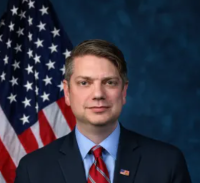
Nick Begich III is a technology entrepreneur and a member of a longtime Alaska political family that has sent other members to the U.S. House, U.S. Senate and state Senate. His uncle Tom Begich is currently running for Alaska governor as a Democrat.
U.S. Rep. Nick Begich III
Begich was first elected to the U.S. House in 2024, after losing in 2022 to Democrat Mary Peltola. In his first year in office, he voted for Trump’s One Big Beautiful Bill Act, which expanded opportunities for oil and other development in Alaska but also sharply cut spending on food stamps and Medicaid, the health-care program for low-income Americans.
The bill could cause some 13,000 Alaskans to lose their Medicaid coverage due to new work requirements, according to a February 2026 analysis published by the state health department. The legislation also placed another 5,000 Alaskans at risk of losing access to food stamps, according to projections by advocacy groups.
Schultz was the first well-funded candidate to announce a challenge to Begich, saying in an October launch video that Alaskans had been “forgotten by those in power.”
Matt Schultz poses for a photo in Midtown Anchorage. (Nathaniel Herz/Northern Journal)
The 53-year-old Presbyterian pastor grew up in New York state and first came to Alaska in 1997 before going back to the East Coast for graduate school and returning to Alaska in 2013.
From the pulpit at Anchorage’s First Presbyterian Church, and on social media, Schultz has spent years advocating for a range of Alaskans: homeless and queer people, women seeking abortions, participants in the Black Lives Matter movement.
“So many people in my congregation and my family came up to me after the most recent presidential election, literally in tears, saying, ‘How come no one is protecting us?’” Schultz said in an interview. “As a pastor and as a parent, that’s when you raise your hand and say, ‘I will.’”
Since entering the race, Schultz has taken steps to appeal to centrist voters — toning down his social media presence and saying he’s not campaigning against Trump.
But in spite of an early pledge to travel widely across the state, his campaign — and his financial support base — has stayed largely within the more urban areas of the state. Schultz has not yet visited any small rural communities since his launch, and more than half of his individual donations were from Anchorage in his most recent campaign finance disclosure.
And while Schultz says he respects Second Amendment rights of “lawful gun owners,” he also owns no firearms himself in a state where some two-thirds of homes have at least one.
“There’s lots of things I support people’s freedom to do or to have,” he said. “That doesn’t mean I do or have them all.”
A Bush upbringing
Three months after Schultz announced his campaign, Hill entered the race, with a launch video that depicts him hunting for ptarmigan on the tundra and jumpstarting a neighbor’s car in his off-road-system hometown of Naknek, in the salmon-rich Bristol Bay region.
Hill, 57, is a member of another large family with deep roots in Alaska: His paternal grandmother, Katie Trefon Hill Wilson, was a respected Indigenous Dena’ina elder whose own mother trapped wolverine, lynx, muskrats, foxes and beavers and used moss for medicinal purposes.
Bill Hill’s parents were teachers, and he spent his first years in the Bristol Bay village of Kokhanok, where, he said, he grew up with no TV, no radio or telephone, “not even electricity for a good part of early life.” His parents raised dog teams; he started commercial fishing at eight years old and still runs a boat today.
After leaving Bristol Bay for college, Hill lived in Fairbanks, Anchorage and Juneau before returning to his home region, where he ultimately became superintendent of the local school district. Along the way, he worked construction jobs and also as a teacher and principal.
Bill Hill poses for a photo near downtown Anchorage. (Nathaniel Herz/Northern Journal)
A couple years into retirement from education, Hill said, he was “just really pissed off about what I’m seeing, and just really worried about my kids and grandkids having the opportunity to work hard and build good lives here in Alaska.” He described the One Big Beautiful Bill Act and Begich’s vote against a three-year extension of Obamacare health care subsidies as particularly disturbing.
“Nick Begich voted against health care,” Hill said in an interview.
The benefits from the One Big Beautiful Bill Act, he added, “just flow directly to billionaires and corporations through tax cuts.”
Asked for his opinion on Trump, Hill responded without naming him, saying: “If, whoever the administration is, they’re doing good things for Alaska, then yeah, you can support that. But if the administration is doing things that are negative for Alaska, or illegal, then you’ve got to stand up against that.”
Hill has hired Anchorage’s Ship Creek Group, a centrist political consulting firm, which helped him tap into a national donor network. In the first quarter of 2026, Hill raised nearly $800,000, almost triple Schultz’s haul.
Hill’s reliance on that national donor base, though, complicates his anti-oligarch platform: His contributors include multiple left-leaning billionaires and their offspring, like New York investors Dirk Ziff and Michael Novogratz, and some three-fourths of Hill’s itemized donations came from outside the state, according to federal data.
Asked about the billionaires on his donor list, Hill said he had “no idea,” though he acknowledged that he’s “called a lot of people.”
“You’re not going to bring a knife to a gunfight,” he said. “You know that Alaska can support a certain amount of fundraising. And the people I come from, they don’t have a lot of money to give.”
Who wins swing voters?
Supporters of both Hill and Schultz agree that the odds of beating Begich would be significantly better with only one of them in the race.
And Schultz and his allies say that Hill’s supporters have been pressuring the pastor to drop out even before the August primary election.
“They have decided that whoever has the most money is the important thing,” said Jim Lottsfeldt, a centrist political consultant who’s backing Schultz.
Lottsfeldt said Schultz feels “called” to run against Begich, and joked that there are just two people who can convince him to drop out. One is Schultz’s wife, Elizabeth, “and the other is named Jesus,” he said.
“This is him following his faith,” Lottsfeldt said.
Hill’s supporters haven’t publicly called for Schultz to step out of the race. But they do say they think Hill, an independent, is uniquely qualified to bring together the different groups of voters needed to unseat a Republican incumbent in Alaska.
Staff with Ship Creek Group, the consulting firm working with Hill, say their data analysis shows that some 45% of Alaska voters are conservative and 40% are progressive. The remaining 15%, they add, are a sort of swing bloc that non-Trump-aligned candidates have to win to be competitive statewide.
Those voters tend to be clustered in rural communities like Alaska Native villages and coastal fishing towns, and within organized labor. Hill already claims endorsements from five different unions, while Schultz has none.
“When I think of who’s going to win over a truck driver in Fairbanks, a fisherman in Ketchikan, a small business owner in Kotzebue, it feels pretty clear to me,” said Ira Slomski-Pritz, one of Ship Creek Group’s owners. “I can’t imagine someone who’s better positioned to build this coalition than Bill.”
Lottsfeldt, the consultant who supports Schultz, rejected that argument, saying that “we live in a time where being a little bit forceful and a little bit idealistic is exactly what we need.” Hill’s boosters, Lottsfeldt added, think that “the only way to win is to have someone who doesn’t have a party, and has a real manly-man vibe to them that can appeal to Republicans.”
Schultz’s supporters say the best test of the candidates’ cross-partisan appeal will come in the August primary — and that the next four months of campaigning will provide a clearer indication of how each one will perform.
For decades, said Croft, the Democratic Party chair, political insiders “anointed” the candidate that would challenge Alaska’s longtime Republican U.S. House member, Don Young, rather than fostering a competitive primary to see which hopefuls would rise to the top.
Then, after Young died in office in 2022, a chaotic special election saw nearly 50 candidates vie for the seat in an “open” primary under Alaska’s new election system. An underdog Democrat, Mary Peltola, advanced to the general election and ultimately won a full two-year term.
Competition, said Croft, “is a good thing.”
Referring to Hill and Schultz, he added: “Let’s let these horses run for a while, and see how they do.”
Nathaniel Herz welcomes tips at natherz@gmail.com or (907) 793-0312. This article was originally published in Northern Journal, a newsletter from Herz. Subscribe at this link.
Anchorage skyline seen on Dec. 19, 2025. (Photo by Yereth Rosen/Alaska Beacon)
Alaskans take care of each other. It’s part of what defines life here. People look out for their neighbors, step up in hard moments and take pride in contributing to something bigger than themselves.
That same spirit has long defined Alaska’s labor community. Unions helped build this state and continue to keep it running today, grounded in hard work, fairness and a shared commitment to the communities that make up the Last Frontier.
We know this firsthand as members of the American Federation of Government Employees, the union representing federal workers, and as former public servants at the Environmental Protection Agency and Department of Veterans Affairs.
The work of the EPA and VA may look different day to day, but it is rooted in the same purpose: taking care of Alaskan communities. At the VA, that means providing care, support and dignity to those who served our country. At the EPA, it means protecting the fundamentals that keep people healthy, like clean air and safe drinking water, and ensuring an environment where Alaskans can thrive. Together, that is what care for Alaska looks like.
But right now, decisions coming out of Washington are making it harder – and in some cases impossible – for Alaska’s federal workers to do their jobs. And it’s Alaskan communities who are paying the price.
The workers being targeted aren’t faceless bureaucrats. They are your neighbors. They live and work in the communities they protect. They are the nurse helping a veteran manage chronic pain, the technician ensuring a rural water system is safe to drink from and the scientist monitoring pollution that could threaten our fish stocks. We’re speaking out on their behalf because many of them simply cannot, out of fear of discipline.
In Alaska, federal workers are especially essential. We have thehighest percentage of veterans in the country, and our communities are deeply connected to the health of our land and water. When the federal workforce is dismantled, the consequences are immediate and severe. And we are already beginning to see what happens when they are weakened.
The EPA has canceled roughly$280 million in grants that were funding water infrastructure, energy and resilience projects across Alaska. With funding gone, many of these projects that keep communities and the local economy healthy are now delayed or abandoned altogether.
That doesn’t just put public health at risk. It also costs good jobs that Alaskan workers rely on. Local engineers, construction workers and skilled tradespeople — many of them union members — depend on this work to put food on the table. When funding disappears, so do job opportunities and the paychecks that come with them.
At the same time, the VA in Alaska is facing staffing shortages and hiring freezes, with over 20% of staff lost during 2025. Fewer providers mean longer wait times, delayed care and gaps in services that veterans rely on.
Across both agencies, we are seeing a pattern: workforce cuts, funding reductions and political decisions that undermine the ability of public servants to do their jobs. As we’ve seen time and again, weakening this workforce is not just an attack on federal employees; it is a direct threat to Alaska’s public health and safety.
Alaskans expect and deserve better from our elected leaders. We expect our representatives in Washington to stand up for our state’s interests and reflect its values, and what it means to take care of one another — not just in words, but in action.
But Senator Dan Sullivan and Congressman Nick Begich have instead stood on the sidelines as the funding we need is taken away, and the federal workforce we rely on is hollowed out.
We have seen zero urgency to stand up for Alaska’s federal workforce who keep our water safe, care for our veterans and support our communities. The midterm elections are approaching and Alaska voters will have a chance to decide if we have leadership that actually cares.
This isn’t about partisan politics. It’s about priorities. Our representatives should be leaders willing to stand up for the people who make Alaska work. Sen. Sullivan and Congressman Begich have failed to be leaders, and instead have chosen to stand by while critical services are hollowed out and communities are left behind.
Alaska deserves leadership that will not sit quietly while decisions in Washington put our communities at risk. It deserves leaders who understand that investing in federal workers is not optional, but essential.
Because in Alaska, taking care of each other isn’t a slogan. It’s a responsibility. And it’s one we all share.
An Alaska State Trooper conducts a traffic stop outside Wasilla in early 2024. (Photo courtesy of Alaska State Troopers)
A governor’s nominee for the Alaska Police Standards Council who served on the board for eight months has resigned following legislative confirmation hearings.
The resignation comes after legislative hearings where Veronica Lambertsen was questioned about her eligibility for a rural seat on the board and social media and defended conspiracy theories.
A spokesperson for Gov. Mike Dunleavy’s office confirmed Friday morning that Lambertsen had resigned from the council, but did not provide a reason for the resignation.
Lambertsen was nominated for a three-year term on the 13-member Alaska Police Standards Council, which oversees law enforcement standards statewide. She had begun her term on the council representing a public seat last August after her nomination, and was up for confirmation before the Legislature this session.
Lambertsen did not respond to a request for comment on the reason for her resignation on Friday.
In a confirmation hearing Wednesday, members of the Senate Judiciary Committee put questions to Lambertsen about social media posts going several years back, where she defended views related to a variety of conspiracy theories questioning the Holocaust, the Jan. 6 insurrection and others.
Lawmakers also questioned her eligibility for the seat, one of two public seats reserved to represent rural communities with a population of 2,500 or less, and suggested Wednesday she was not eligible for the position.
Lambertsen is the owner of a motel in Bird Creek, a small neighborhood in Turnagain Arm that is part of the municipality of Anchorage.
Sen. Click Bishop, R-Fairbanks, speaks on the floor of the Alaska House of Representatives during a joint session of the Alaska Legislature on Wednesday, May 4, 2022 at the Alaska State Capitol in Juneau, Alaska. (James Brooks / Alaska Beacon)
One of the nearly 20 candidates in the race for Alaska’s governorship is getting a significant boost from the state’s organized labor movement.
Four union officials are helping to lead a newly formed political group that will boost the candidacy of Republican Click Bishop, a former state senator from Fairbanks with a long background in the labor movement.
The group will have a six-figure budget to spend on Bishop and running mate Greta Schuerch as campaigning gears up for the mid-August primary, according to Joelle Hall, president of the Alaska AFL-CIO.
Hall is one of the deputy treasurers of the pro-Bishop independent expenditure group — Alaska’s state-level equivalent to the big-spending super PACs that participate in federal elections.
In a twist on the state’s popular “Pick.Click.Give” program, which allows Alaskans to divert a share of their annual oil checks to charities, the new group is called “Pick Click and Greta for Alaska.” It was registered Monday.
The group’s efforts could prove crucial for Bishop, as the dozen Republicans in the field seek to distinguish themselves and vie for a finite amount of financial support.
Hall’s labor group, the AFL-CIO, is an umbrella organization and hasn’t issued a formal endorsement in the race. But many AFL-CIO members are eager to support Bishop, she added, and officials from two unions — representing carpenters and heavy equipment operators — are also registered as deputy treasurers of the pro-Bishop group.
Hall said there are several other candidates in the field who “really care about working people.”
But, she added, “Click’s just not a politician to us. He is us.”
Bishop has been a member of the International Union of Operating Engineers 302 and worked on construction of the trans-Alaska pipeline when; he’s also been a state labor commissioner.
A campaign spokesperson said Bishop was not immediately available for comment.
Nathaniel Herz welcomes tips at natherz@gmail.com or (907) 793-0312. This article was originally published in Northern Journal, a newsletter from Herz. Subscribe at this link.
After more than a year Haines and Skagway have a sport fishing area management biologist again.
John Whitinger, is a biologist and Alaskan who says he is most drawn to looking at the entire ecosystem when considering the health of individual fish stocks.
He was born in Kodiak but described a childhood commercial fishing throughout Southeast Alaska. The 32-year-old is Aleut and has family on Prince of Wales, in Ketchikan and Sitka. “Everywhere I go, I have family,” he said.
He described power trolling for salmon from a 100-year-old wooden tug with his grandfather.
“He’d always try to keep me into the school year because that’s when the kings are running,” Whitinger said.
He moved to Anchorage and after he graduated he said he mostly thought about sports, football specifically.
“I was defensive line, linebacker, full back,” he said. “I played one year in Tacoma, Washington at the University of Puget Sound. It was a great place for school but we had the longest losing streak in football history and we lost every single game.”
He walked on at Adams State in Colorado and said he played one more year, then got a concussion and two shoulder injuries and realized that he probably needed to focus on studying fish before he destroyed his body.
After graduating with a degree in organismal biology, Whitinger taught high school science for a year, cultivating a passion for education that he said he’d like to continue in the Chilkat Valley.
Then he became a masters student at Northern Michigan University and worked on a project in Little Bay de Noc, which is known as a world class walleye fishery at the upper end of Lake Michigan. He and his professor documented how the fishery had changed over 30 years due to changing conditions in the lake and agricultural run-off that caused fish that used to be in the northern end of the lake to follow food and nutrients to the south.
“Now, after 10 years of this being the world’s best walleye fishing hole, it has completely flip-flopped and now Wisconsin pulls all of the larger fish from that fishery,” he said.
It was a chance to do the kind of work Whitinger said he is most interested in, looking at the entire ecosystem and how a fish population fits into it.
He moved back to Alaska two years ago and said he’s been applying to work for the state ever since, weathering hiring freezes at the state and federal levels. Then, he said, he got exactly what he was looking for.
“The first time I got offered a position, it was not only in Southeast, where I want to be, but it’s in a part of Southeast that [I’m not] super familiar with. So I’m super excited about that,” he said.
At the top of his to-do list right now is getting boats and a Ski-doo that haven’t been used in more than a year back up and running.
While he is new to the community, Whitinger said he brings a lot of experience with different kinds of fisheries with him.
“I’ve worked in the Great Lakes, all freshwater systems with a lot of artificial habitat, a lot of disruption. I’ve also worked in the Gulf [of Mexico],” he said. “I think that seeing this really wide array of what fisheries can look like and how it works in other places is .. something that makes me unique in this position.”
Just a few days into the job and Whitinger said he’s hearing from a lot of locals, which is how he’d like to spend his first year.
“I’ve already met several people who said ‘hey, I want to show you the river.’ I’ve had people invite me out on their boats, which has been awesome. If anybody wants me to go out fishing with them and I can do it, I will,” he said.
That’s how he’ll figure out what people would most like to see addressed in the Upper Lynn Canal fisheries they are using. Also on his priority list is checking in with the Chilkoot Indian Association and Chilkat Indian Village about what they’ve been working on, their goals and local priorities.
So far the thing most people ask him about first has been king salmon, he said.
Haines’ king salmon sport fishery has been shut down for nearly a decade. As currently written, this year’s plan is to open it back up again beginning June 14 to both resident and non-resident anglers.
“Everyone is on edge about how things are going to go because it has been so long and it’s very tense,” Whitinger said.
Some fisherman have questioned the decision to reopen the fishery and worry that it will put too much pressure on a recovering population. He said everyone he has talked to seems to be the most concerned that the fishery be healthy and managed sustainably.
“I’ve been talking with regional managers in the last four days… I’ve been on so many calls about this specific subject,” he said. “We’re working incredibly hard to provide fair and equitable access to king salmon this year to all user groups.”
Looking ahead to managing this season, Whitinger said he was going to rely a lot on the knowledge and experience of other people in the local Fish and Game office.
“I’m leaning heavily on theirs because I don’t have the background,” he said. “The types of things that you can’t get from showing up here and reading the reg book.”
The “golden orb” retrieved from the Gulf of Alaska seafloor during a 2023 Seascape Alaska research cruise is seen in the lab of the Smithsonian Institution. The orb has now been idenfied as a lump of dead cells left by a sea anemone. It is now part of the Smithsonian’s collection, along with other biological samples collected during by expeditions aboard NOAA Ship Okeanos Explorer. (Photo provided by National Oceanic and Atmospheric Administration Fisheries Service)
When a National Oceanic and Atmospheric Administration research project discovered a mysterious object more than two miles underwater in the Gulf of Alaska, scientists were puzzled.
Three years later, NOAA officials can now reveal what the object is: the dead cells that formed the base of a big sea anemone.
Scientists found the orb in deep water west of Prince of Wales Island during an ongoing research program called Seascape Alaska. The program began in 2021 and remains ongoing; it is being carried out to fulfil a national ocean-mapping strategy issued in 2020.
There is a pressing need for such research, according to NOAA. Even today, 61% of the U.S. waters off Alaska remain unmapped, according to the agency.
Accurate mapping is also needed to delineate ocean territorial claims, according to NOAA. Work done through the Seascape Alaska program was used by the U.S. State Department in its 2023 claim to extended continental shelf territory in the High Arctic and Bering Sea.
The puzzling golden orb, which was stuck to a rock, was retrieved by a remotely operated vehicle launched from the NOAA Ship Okeanos Explorer, the primary vessel being used in the Seascape Alaska program.
At the time, scientists speculated that it might be an egg case or a dead marine sponge.
The process of identifying it turned out to be prolonged, and it involved scientists from NOAA Fisheries and the Smithsonian National Museum of Natural History.
The site where the mysterious “golden orb” was discovered in 2023 is shown on this map. It was found on the seafloor about two miles beneath the water’s surface. (Map provided by National Oceanic and Atmospheric Administration)
“We work on hundreds of different samples and I suspected that our routine processes would clarify the mystery,” Allen Collins, a zoologist and director ofNOAA Fisheries’ National Systematics Laboratory, said in a statement released by NOAA. “But this turned into a special case that required focused efforts and expertise of several different individuals. This was a complex mystery that required morphological, genetic, deep-sea and bioinformatics expertise to solve.”
The size and fate of the sea anemone that left the orb is yet unknown, said Emily Crum, a spokesperson for NOAA Ocean Exploration.
The orb is about 4 inches wide, she said by email. The sea anemone species associated with it can grow to large sizes, with tentacles stretching up to 7 feet, she said.
The golden orb was not the only unusual discovery made on the seafloor off Alaska.
In 2024, scientists working aboard the U.S. Coast Guard icebreaking cutter Healy discovered a gas-emitting volcano-like structure rising 500 meters from the seafloor in the Arctic Ocean.
That discovery was also part of the Seascape Alaska program, Crum said.
As the program continues, scientists expect to find more unusual items.
“So often in deep ocean exploration, we find these captivating mysteries, like the ‘golden orb’. With advanced techniques like DNA sequencing, we are able to solve more and more of them,” Capt. William Mowitt, acting director of NOAA Ocean Exploration, said in the NOAA statement. “This is why we keep exploring — to unlock the secrets of the deep and better understand how the ocean and its resources can drive economic growth, strengthen our national security, and sustain our planet.”
Sen. Bill Wielechowski, D-Anchorage, speaks Tuesday, April 15, 2025, on the floor of the Alaska Senate. (Photo by James Brooks/Alaska Beacon)
The Alaska Senate advanced a bill Wednesday to establish a savings program for employees whose workplaces do not offer a retirement program.
The Alaska Work and Save Program is what Sen. Bill Wielechowski, D-Anchorage and the bill’s sponsor, called a solution to a retirement savings problem in Alaska. According to a survey by the AARP, nearly half of private-sector employees in Alaska lack a retirement plan.
“This program will help Alaskan businesses offer a competitive benefit at no cost,” he said.
Wielechowski told legislators that social security payments do not cover the high cost of living for seniors in Alaska, increasing their reliance on SNAP and Medicaid, and small businesses cannot always afford to sponsor a retirement program for their employees. Wielechowski proposed establishing the Alaska Work and Save Program for tax advantaged and portable retirement accounts.
The bill passed with 15 yes votes. Sens. Jesse Bjorkman, R-Nikiski, Robert Myers, R-North Pole, George Rauscher, R-Sutton, and Cathy Tilton, R-Wasilla, voted against it.
Sen. Robert Myers, R-North Pole, said that he was conflicted about the bill because it was unclear to him how businesses would help administer the program.
Senate Bill 21 would develop a retirement program called the Alaska Work and Save Program for employees who are not offered a retirement plan by their employer. Applicants would be able to contribute some or all of their Permanent Fund Dividend and additional contributions through payroll deduction to the individual retirement account. Eligible employees would be automatically enrolled and would be able to opt out of the program.
“It fixes a problem in a way that doesn’t overreach, that helps the business community, that helps workers and is good for our state,” Wielechowski said. “Passing this bill is an important step forward towards genuinely improving the lives of Alaskans by helping them save for a rewarding retirement.”
If the bill becomes law, Alaska would join 15 other states that have automatic savings programs, according to Pew, a nonprofit that oversees the nonpartisan Pew Research Center.
Small businesses owners across Alaska wrote in letters of support that a lack of retirement benefits makes it difficult for small businesses to compete with larger companies, and the proposed retirement system would be beneficial for small businesses.
Forbidden Peak Brewery Co-Owner Skye Stekoll supported the bill and wrote that “easy access to a public retirement program would make both starting the process of investing and making continued regular investments far more attainable for our employees, and also make it conceivable for employers to contribute in prorated ways based on hours worked, longevity, etc., regardless of the industry.”
Rachael Miller, chief advocacy officer for the Food Bank of Alaska, wrote to legislators that the bill could increase food security for Alaskan seniors.
“By creating a pathway for workers to save for retirement through automatic payroll deductions, the Alaska Work and Save Program will help workers, particularly in fishing, tourism, and gig-based jobs, prepare for retirement and reduce future reliance on emergency food assistance,” she stated in a letter.
The Department of Revenue would administer the Alaska Work and Save Program. According to a fiscal note, the program will cost $808,000 in 2027 and approximately $524,000-$589,000 annually.