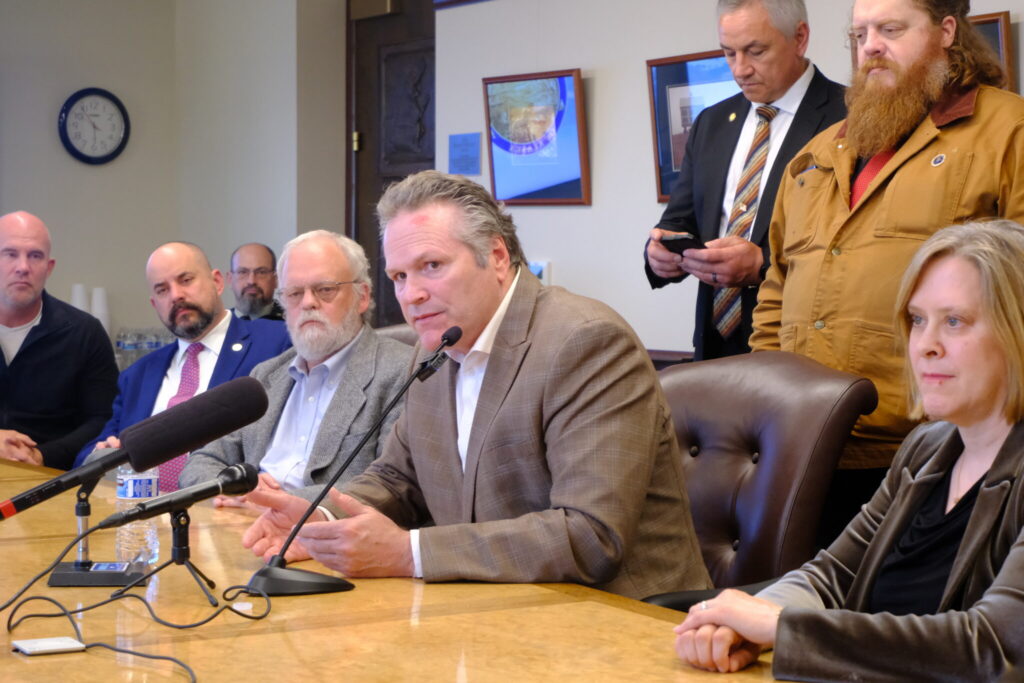
Sen. Robert Yundt, R-Wasilla, is seen Thursday, May 14, 2026, during a joint session of the Alaska Legislature. (James Brooks photo/Alaska Beacon)
Alaska’s smallest towns and villages would be allowed to shrink their city councils under a bill that neared final passage Friday in the Alaska Legislature.
Senate Bill 143 decreases the minimum city council size to three members for second-class cities with 1,000 or fewer residents.
It also allows local governments to lengthen or shorten the terms of school board members. Currently, state law requires school board members to serve three-year terms.
Another section, added by a floor amendment from Rep. Julie Coulombe, R-Anchorage, mandates the state Department of Education and Early Development provide budget and ethics training to all new school board members statewide.
The state House approved SB 143 in a unanimous 40-0 vote on Friday, an act that sends the bill back to the Senate, which approved a prior version by a similarly unanimous 20-0 vote in April.
The Senate is expected to approve the House’s changes to the bill and send it to Gov. Mike Dunleavy for final enactment or veto.
Sen. Robert Yundt, R-Wasilla, wrote the original version of SB 143 after several years on the Matanuska-Susitna Borough Assembly.
That local government shifted its elections to November several years ago and lengthened the terms of its mayor and assembly members from three years to four so local elections would correspond with state and federal ones.
Because state law requires three-year school board terms, he couldn’t do the same with school board elections, and as a result, off-year elections now see much lower turnout, he said Friday.
If school board elections take place at the same time as other votes, he said the election results will be more representative of the will of the community.
At the request of the Alaska Municipal League, legislators amended SB 143 earlier this year to allow three-person city councils in small second-class cities that have had trouble filling their rosters.
Current state law requires five-member or seven-member councils. SB 143 would allow them to choose three, five or seven members.
“Think about all the communities in Alaska that are 200, 300, 400 people — do they really need to have five or seven city council members?” Yundt asked.
When the bill reached the House floor, Coulombe suggested amending it to require mandatory training for school board members. That suggestion followed several significant budget errors in Juneau, Ketchikan and other school districts.
Coulombe’s amendment passed unanimously, 40-0. Another amendment, which would have given the state’s education commissioner authority over local school district budgets, failed to be adopted.
Mary Peltola addresses a crowd of supporters for her run for the U.S. Senate at a campaign event in Juneau on May 14, 2026. (Photo by Corinne Smith/Alaska Beacon)
Democratic candidate Mary Peltola called for congressional term limits and for strengthening campaign finance laws at a rally in front of the Alaska State Capitol in Juneau on Thursday evening. Peltola is running for the U.S. Senate against Republican incumbent Dan Sullivan.
Mary Peltola speaks at a campaign event in Juneau on May 14, 2026. (Photo by Corinne Smith/Alaska Beacon)
Peltola kept her comments to about five minutes in the pouring rain. She transitioned from her affordability message earlier this week to focus on another part of her platform aimed at accountability for elected officials — she calls it “fixing the rigged system.”
“We’ve got to enact term limits. We’ve got to stop insider trading. We’ve got to stop the ability for people to line their own pockets. Congress is half millionaires and billionaires. It was not designed for that. It was designed to reflect everyone here, the working people of Alaska, the working people of our beautiful country,” she said.
Peltola called for Alaska to lead by example and enact term limits for its own federal delegation. Her opponent, Sullivan, has served in the U.S. Senate since 2015. Alaska’s senior U.S. Sen. Lisa Murkowski has served since 2002.
“I would love it if Alaska took the lead on really implementing term limits in our own state, saying for those members who are going to Washington, D.C. to be part of our federal delegation, 12 years in the House, 12 years in the Senate. If you can’t get it done in that amount of time, go home!” she said, to cheers from the crowd.
Peltola pointed to former Alaska Republican Congressman Don Young as an example of a politician who worked for Alaskans. He is the longest-serving Republican in the U.S. House with 49 years of service.
Peltola was elected to the U.S. House seat in a special election after Don Young died in 2022, and was the first Alaska Native representative in Congress. She recalled to the crowd her time as a legislator in the Alaska House representing Western Alaska from 1999 to 2009.
“When I worked in this building, among other things, I was the chair of the Bush Caucus, and I worked with everyone and anyone. I worked with people from every corner of this state, both parties working across party lines,” she said.
Supporters rally at the Alaska State Capitol in Juneau for Mary Peltola for U.S. Senate on May 14, 2026. (Photo by Corinne Smith/Alaska Beacon)
“We need that back. We need people who are willing to set aside their own personal interests, their own personal ambition, their own personal stock portfolio, and work for the people, work for Alaskans.”
Peltola called for similar federal campaign finance rules as Alaska, which restricts corporations and unions from contributing directly to candidates, and caps political action committees to $1,000 per year for gubernatorial and legislative candidates.
“We can continue to show our leadership in Alaska. Other states want this too. Other people across America want term limits. We don’t want people in there making a career out of quadrupling their personal wealth, just as a slight example,” she said, to laughs from the crowd. “But we can’t do it alone. We need all of you.”
Peltola told reporters after the event she supports Congress limiting the Iran war and would support a war powers resolution, and said her campaign is pushing for broader checks on the Trump administration.
“Our system was designed for a balance of powers,” she said. “Clearly, there is not a balance of power right now. Clearly this administration has an outsized role in the direction, whether it’s tariffs or wars. We have got to have a Congress that doesn’t just cede all of their power. We’ve got to have a Supreme Court that stands up for Americans, for citizens, and it just seems like both of those branches are laying down on the job.”
Earlier this week, Peltola unveiled an “affordability” campaign as part of her platform, in part proposing policies to decrease costs to energy, freight, childcare and housing, as well as eliminating federal income tax for Alaskans earning less than $92,000 per year, the state’s median household income.
“There is a rigged system in Washington, DC,” she said. “I saw it firsthand the two years that I worked there. I was shocked. It is not a system where bills are before you and you’re working for people, it’s a system where attack ads are created with your tax dollars.”
Several Juneau residents in attendance told the Alaska Beacon they wanted to see Peltola unseat Sullivan.
Juneau resident Lynn Hershey stands with a sign at a rally in support of Mary Peltola for U.S. Senate on May 14, 2026. (Photo by Corinne Smith/Alaska Beacon)
“He’s a Donald Trump sycophant,” said Juneau resident Lynn Hirschi, standing holding a protest sign. “And whatever Donald Trump says, and most of what he says is an absolute lie, and Mr. Sullivan just perpetuates that.”
Hershey said she’d like to see Peltola join the Senate and all of Congress to stand up to the Trump administration to protect civil rights and voting rights, as well as curtail the immigration crackdown and proliferation of immigration detention centers. “Concentration camps. You can color in any way you want, but that’s what it is in my eyes,” she said.
“Because silence is complicity,” she added. “And we have to stand up because everything has changed in the completely wrong direction. It is no longer a democracy. We need all the voices, we need all the people to stand up.”
Juneau artist Inari Kylänen said she is concerned about the Trump administration’s militaristic actions abroad, particularly airstrikes on vessels in the Caribbean Sea, as well as its failure to take action to reduce the impacts of climate change.
“I hope that she would take stronger stances against some things that the Trump administration is doing, and really sort of bring a little bit more positive vision, like not just being like, ‘Hey, I’m against Trump,’ but what is going to happen if we flip the Senate? What could be done that would make things more just and equal for everybody?”
Greg Roth, a Juneau resident and retired correctional officer and suicide prevention advocate, said he sees Peltola as having a united, positive message and connecting with her constituents, pointing to Sullivan’s reluctance to host town halls.
“Dan Sullivan comes here, and he doesn’t hold a rally, he’s afraid to talk to us,” Roth said. “I mean, if you’re afraid to talk to people that you’re supposed to represent, there’s something wrong.”
Alaska’s primary elections will be held on August 18, and the general election is November 3.
Supporters of Mary Peltola for U.S. Senate gather at a campaign event in Juneau on May 14, 2026. (Photo by Corinne Smith/Alaska Beacon)
Mary Peltola is seen at a campaign event in Juneau on May 14, 2026. (Photo by Corinne Smith/Alaska Beacon)
Supporters cheer Mary Peltola at a campaign event in Juneau on May 14, 2026. (Photo by Corinne Smith/Alaska Beacon)
House lawmakers watch the voting board Friday, May 15, 2026, on the floor of the Alaska House of Representatives as they vote for the state’s capital budget. (James Brooks photo/Alaska Beacon)
Five days before the end of their regular legislative session, the Alaska Legislature has almost finalized the state’s annual capital budget, one of four regular budget bills that pass through the Capitol annually.
Passed by the state House in a 24-16 vote on Friday, the capital budget contains $2.5 billion in spending, including $323 million for drinking water projects, $148.3 million for K-12 public school repairs and construction and $42.5 million for the University of Alaska.
Various federal programs are expected to pay for the bulk of the bill — $1.8 billion in total. State accounts would be used to pay for the remainder.
Even with the increase, spending remains short of what’s needed to cover deferred maintenance. Two years ago, the statewide deferred maintenance backlog was estimated at $2.4 billion, with $180 million per year needed to keep that figure from increasing.
The part of this year’s budget devoted to deferred maintenance is near that amount — it does not significantly reduce the backlog.
The capital budget covers spending in fiscal year 2027, which starts July 1. If oil prices are higher than predicted during the first half of that year, the state would earn millions of dollars in extra revenue, and the bill calls for diverting that money to a variety of maintenance and construction projects statewide.
Rep. Calvin Schrage, I-Anchorage and co-chair of the House Finance Committee, speaks Friday, May 15, 2026, on the floor of the Alaska House of Representatives. (James Brooks photo/Alaska Beacon)
“This capital budget, to be honest, is in some ways a huge step forward over last year,” said Rep. Calvin Schrage, I-Anchorage and co-chair of the House Finance Committee in charge of the capital budget.
“We see a much larger investment in being able to address some of our key areas in the state, but it also, I will recognize, does not go far enough, given the levels of deferred maintenance and other needs throughout our state,” he said.
Before the final vote, House lawmakers spent two days considering possible amendments to the bill but adopted only two. The most substantial restored some federal funding for the West Susitna Access Project, a proposal to build a road into the western Matanuska-Susitna Borough in order to support mining projects.
Rep. Kevin McCabe, R-Big Lake and a booster of the project, thanked his colleagues for restoring that money but said he couldn’t vote for the bill because it didn’t contain full funding for the access project.
Even then, “It’s a decent bill. It’s got things in there for just about everybody,” McCabe said.
Before that vote, House and Senate leaders negotiated an agreement that would allow the House to add no more than $100 million in projects funded by general-purpose state dollars to the capital budget.
The House-passed version abides by that agreement, and Senate aides familiar with both the budget and the agreement said they do not expect senators to object to the House’s additions.
House and Senate lawmakers are negotiating a compromise operating budget and a compromise mental health budget; those are expected to pass from the Capitol on Wednesday, the last day of the regular session. Legislators and Dunleavy previously approved the supplemental budget, the first of the four regular budget bills.
After being transmitted to the governor, all budget bills are subject to his line-item veto powers. Dunleavy may eliminate or reduce specific items in the budget but cannot add any or increase their amounts.
A.J. Dimond High School in Anchorage seen on Feb. 23, 2025. (Photo by Yereth Rosen/Alaska Beacon)
The Alaska Legislature passed a bill requiring the state to develop guidelines for mental health instruction in Alaska school districts. The aim is to place mental health education for K-12 students on par with physical education.
House lawmakers passed Senate Bill 41 by a 27 to 13 vote late Thursday night, and the bill now heads to Gov. Mike Dunleavy’s desk for consideration.
The bill instructs the Alaska Department of Education and Early Development to develop guidelines for schools to offer developmentally appropriate mental health curriculum in partnership with the Alaska Departments of Health and Family and Community Services, along with regional tribal health organizations and representatives of state and national mental health organizations.
Sen. Elvi Gray-Jackson, D-Anchorage, speaks in support of her bill that would add mental health instruction to public school curriculum on the Senate Floor on March 6, 2024. (Photo by James Brooks/Alaska Beacon)
Sen. Elvi-Gray Jackson, D-Anchorage, sponsored the bill and said the initiative helps to address mental health needs of students. “This bill recognizes the importance of mental health education as an essential component of a comprehensive K-12 curriculum,” she said in a statement introducing the bill. “And (it) aims to create a balanced approach to health instruction by placing mental health education on par with physical health education.”
The bill also would require school districts to give parents and guardians at least two weeks’ notice of upcoming mental health classes, and allow families to opt students out.
Alaska students and school officials testified to lawmakers in February about the need for lawmakers to address what they said is a growing crisis of student mental health challenges and a lack of counselors, resources and support services.
Several testifiers spoke about the devastating impact of student suicides on schools and communities. Alaska has the highest rates of suicide of any state in the nation — a pervasive trend for decades — with the highest rates among youth ages 15 to 24.
Kay Andrews, a school board member from the Southwest Region School District, which includes eight schools spanning across the Bristol Bay region, described the impact to lawmakers in February.
“Our region recently experienced another suicide, which deeply affected our students and our only regional counselor,” Andrews said. “Schools are more than our classrooms. They are community centers. They are safe places for our children, yet, schools are being asked to do more with less.”
House legislators debated the bill and the proposed mental health education in schools over several days on the floor this week. Proponents said the new guidelines and curriculums would provide support not only for students, but also much-needed support and training for teachers and staff already engaging with students struggling with mental health. Opponents said a new curriculum would further burden schools, and mental health support and conversations should take place with parents and in family settings.
Rep. Justin Ruffridge, R-Soldotna, spoke on the House floor Thursday night and said he was unsure about the effectiveness of a new curriculum, but acknowledged that two students of Soldotna High School had died by suicide this year.
“I’m torn. I agree with many of the members that say I’m not certain that this bill is going to do enough. I don’t think this bill is going to change much,” he said.
“But we’re losing too many of our kids, and for a whole host of reasons, our communities are struggling. We’re losing access to things that used to bring people together in a healthy way. We got to start addressing some of those things. I hope the curriculum addresses that.”
Rep. Nellie Jimmie, D-Toksook Bay, acknowledged the students from her district who traveled to the Capitol in March to advocate for legislation to fund the 988 crisis line and behavioral health services.
Brothers Johnny Nicolai and Jacob Nicolai of Toksook Bay speak at a news conference with advocates at the Alaska State Capitol to raise awareness around suicide and urge state support for the 988 crisis line on Mar. 19, 2026. (Photo by Corinne Smith/Alaska Beacon)
“In my district, there are no therapists down the road, no crisis counselors in every school. When something breaks in a child in rural Alaska, it usually breaks quietly, and we always see how that ends up — we always find out too late. We are losing kids,” she said. “This bill puts mental health alongside physical health in every K-12 classroom in this state, developed with tribal health organizations at the table, so rural Alaska is not written as a footnote. The kids already did their part, they showed up, they spoke up. Now we do our part.”
If approved by the governor, it would take some time before mental health curriculums are implemented and students participate in new mental health classes. The bill would allow two years for the state Department of Education to develop the guidelines and submit a report to the Legislature on the process used to develop them.
Lawmakers also debated and approved an amendment that says the mental health curriculum guidelines may not include “any political, ideological, or advocacy-oriented content that is unrelated to student mental health.”
But several members of the all-Republican Minority caucus opposed the bill, including Rep. Sarah Vance, R-Homer, who said mental health should be addressed by parents.
“Parents just don’t want this in the classroom, they want the classroom to focus on academics and leave all of this that has to do with the well-being of their child to them, and not exempt the other parents from that same responsibility,” she said.
Ketchikan Republican Jeremy Bynum urged support for the bill, amid widespread efforts to combat stigmas around mental health nationwide — particularly among veterans — and address ongoing needs of students.
“Imagine being a kid, not knowing who to go talk to, not knowing what to do. This provides teachers an opportunity — with parental approval — to think about these things,” he said. “If this helps one kid in my school district, if this would have helped one kid in my school district… it’s worth doing.”
The bill is now before Dunleavy to approve, veto or allow it to become law without his signature.
Maynard Mountain, to the right, looms over sun-dappled Whittier Harbor on July 17, 2025. (Photo by Yereth Rosen/Alaska Beacon)
A small but crowded coastal Alaska town has gotten the state legislature’s blessing to spread its wings a little.
The state Senate on Friday gave final approval to a measure, House Bill 216, that allows the Prince William Sound port town of Whittier to buy land from the state-owned Alaska Railroad.
The bill will return to the House for a final procedural vote before going to Gov. Mike Dunleavy for enactment or veto.
The city and railroad have struck a deal for the sale of three parcels, all located in the central part of town, and they are close to agreeing on a sale for two more parcels, both located closer to a new cruise ship terminal that had its first full operating season last year.
But under state law, any sale of railroad land must be approved by the legislature.
That is where HB 216 comes in. It gives explicit permission for the railroad to sell the land, including the two parcels for which deals have not yet been completed. The city may offer cash or other land to the railroad in exchange.
The parcels amount to about 85 acres in total, said Rep. Ky Holland, I-Anchorage, the bill’s prime sponsor. They do not cover much space, but the spots are strategic, he said.
The land is currently being used for things like parking or boat storage. Ownership by the railroad precludes any kind of building on that land, but city ownership would open up options for new business or housing or other opportunities yet to be explored, said Holland, whose South Anchorage district extends to Whittier.
The bill does not specify any particular use for the land once it is sold. “What they do with the land is not my deal,” he said.
Whittier, home to about 275 people, has long been famous for its tight living quarters. Nearly all the residents reside under a single roof, in the high-rise Begich Towers that also houses several businesses and public offices.
Originally built in World War II as a military site, Whittier is now a transportation hub, served by the railroad, numerous cargo shippers, the Alaska Marine Highway system and the single-lane Anton Anderson Memorial Tunnel, which is North America’s longest combined rail-auto tunnel. It is a recreation, fishing and tourism hub as well, with much of that activity crammed into a tight space between the mountains and the shore.
The town gets about 700,000 visitors a year, City Manager Jackie Wilde said at a Feb. 10 legislative hearing.
“While Whittier is very small, it is very mighty,” she told the House Community and Regional Affairs Committee.
To accommodate all those people, the city and the Alaska Department of Transportation and Public Facilities have been working on a transportation master plan called “Whittier Moves.” The city is also working on a long-term waterfront and economic development plan.
Whittier is likely to get busier in the future, Holland said.
Coming to town this fall will be a celebratory commissioning of the USS Ted Stevens, a U.S. Navy warship named for Alaska’s late U.S. senator.
Reporter James Brooks contributed to this article.
Alaska’s economic development agency owns federal oil and gas leases on the coastal plain of the Arctic National Wildlife Refuge — an area that’s long been the subject of fierce national debate. (U.S. Geological Survey)
The board of Alaska’s economic development agency on Wednesday approved spending up to $190 million to advance contentious plans for oil exploration and leasing in the Arctic National Wildlife Refuge.
The budget, proposed by staff, includes up to $175 million for a type of preliminary exploration called seismic testing, which employs sound waves to identify oil and gas deposits deep underground.
Board members also authorized the agency to spend up to $15 million to bid on new areas of the refuge’s coastal plain — a swath of tundra along its northern edge — in an ongoing federal lease sale.
The board of the Alaska Industrial Development and Export Authority, or AIDEA, voted 6-1 in favor of the proposal, marking a step toward development in the refuge.
“We have studied this for a long time, and the time for studying is over,” said board member Albert Fogle. “It’s time for development.”
Board member Andrew Guy, president of the Indigenous-owned Calista Corp. in Western Alaska, was the sole vote against the proposal, citing a lack of detail.
Currently no oil is produced in the refuge, a South Carolina-sized federal wildlife area in Alaska’s northeastern corner.
Opening it to drilling has long been a goal of Alaska politicians and local Iñupiaq leaders, including in the only village located within the refuge, Kaktovik.
“Development is not theoretical for Kaktovik. It’s a pathway to self-determination and local jobs, and long-term stability,” Charles Lampe, chief executive of Kaktovik Iñupiat Corporation, said in a presentation at Wednesday’s meeting.
But proposed oil development also has generated intense opposition from conservation groups and Gwich’in leaders in the state’s Interior, who say that drilling would threaten wildlife and the refuge’s wilderness character.
The Trump administration held the first ever lease sale in the refuge in 2021, garnering minimal interest from oil companies. AIDEA was the top bidder, purchasing leases across 365,000 acres of the coastal plain.
The Trump administration is currently taking sealed bids on another 700,000 acres. Results will be announced June 5.
Prior to Wednesday’s decision, AIDEA had been studying existing data on the area’s geology, according to the authority’s director, Randy Ruaro.
It commissioned a report last year that noted significant new oil and gas discoveries on state lands nearby and described the coastal plain as the “most prospective” unexplored area onshore in North America.
But critics, including several who testified at Wednesday’s meeting, question whether officials should spend public funds on new leases and exploration — which comes with no guarantee of future profits or finding economic deposits of oil.
“We should be looking at other more sustainable, renewable ways to invest our money,” said Tonya Garnett, who is Gwich’in from Arctic Village, a community near the southern edge of the refuge. “This is not a smart decision to go in there and ruin an ecosystem that provides resources for thousands of years.”
The resolution that passed Wednesday authorizes AIDEA to spend money on “permitting and regulatory work” and “the acquisition, processing and interpretation” of advanced seismic data. It does not authorize “drilling or well execution” — though one board member, at the meeting, urged AIDEA’s staff to start looking for a drilling rig.
Fogle said he expects AIDEA staff to put together “a more detailed plan” for its exploration program by the agency’s next board meeting, in June.
“I want to see that in a relatively short amount of time,” he said. “We have wasted two years of not moving quick enough.”
Northern Journal contributor Max Graham can be reached at max@northernjournal.com. He’s interested in any and all mining related stories, as well as introductory meetings with people in and around the industry.
This article was originally published in Northern Journal, a newsletter from Nathaniel Herz. Subscribe at this link.
Melissa Lewis holds her three-month-old baby Twyla at a screening and event in support of Alaska infant learning programs at the Gold Town Theater in Juneau on Apr 29, 2025. She said while her baby is not showing signs of delays or needing intervention services, they attended the event to support the cause and more state funding and support for early childhood programs. (Photo by Corinne Smith/Alaska Beacon)
The Alaska Senate approved a bill that would expand eligibility and services provided by early intervention programs for children experiencing developmental delays or disabilities.
The Senate Health and Social Services committee sponsored the legislation, saying the state’s eligibility requirements for services are restrictive compared to the rest of the nation. “Under Alaska’s current restrictive eligibility structure, many healthcare providers hesitate to refer children for services because they are unsure if the child will meet the state’s stringent developmental delay requirements,” lawmakers wrote in a statement introducing the bill.
Senators unanimously passed Senate Bill 178 on Wednesday, and it now advances to the Alaska House for consideration.
Alaska parents and advocates have spotlighted Alaska’s growing need for early intervention services for families and children from infancy to age three. Infant learning programs that provide intervention services can include screening and assessments, targeted speech, movement and play therapies, as well as education and counseling for parents in child development. Research shows targeted interventions provide a wide variety of benefits for young children in their growth and development, and can reduce challenges and the need for special education services later in life.
Under current Alaska law, children must demonstrate a 50% delay in order to be eligible for early intervention services. If passed, the legislation would reduce the requirement to a 25% delay, thus expanding eligibility for these types of services and interventions.
An estimated 1,800 Alaska families are served each year by 17 infant learning programs across the state, funded by the state of Alaska and federal Medicaid, at no cost to families.
Sen. Löki Tobin, D-Anchorage, said Wednesday on the Senate floor the underlying goal of the bill is to expand access. “We know that early interventions will reduce the need for intensive interventions later in life,” she said, and urged lawmakers to consider the proposal a compounding investment.
Sen. Loki Tobin, D-Anchorage, speaks Thursday, May 14, 2026, during a joint session of the Alaska Legislature. (James Brooks photo/Alaska Beacon)
“We know that 46% of children who exit an infant learning program at age three do not require special education services when they reach kindergarten. That equates to an average of $229,071 of potential savings over the course of that child’s K-12 education,” she said.
Tobin said the estimated potential cost savings to the state is $38.9 million annually.
“But the most important piece of this is helping support children and families,” she added.
Additionally, the legislation would expand services that are eligible for Medicaid funding. The bill would also require the Alaska Department of Health to review the conditions that qualify as a disability and make recommendations to the Legislature on updating those conditions.
According to a state fiscal analysis, the legislation is estimated to cost the Department of Health over $450,000 to implement the changes in policy, including two new full time positions to manage expanded eligibility, billing, and statewide staff training.
Last year, the Legislature approved a significant boost in funding for existing early intervention services statewide, but Gov. Mike Dunleavy vetoed the $5.7 million increase.
This year, the House and Senate have advanced draft budgets which provide a moderate increase in funding — by roughly $2.7 million next year.
In addition, both bodies proposed additional funding in their draft budgets if Senate Bill 178 is passed and expands eligibility and services. The House draft version would add $3 million, and the Senate version would add nearly $3.2 million.
A conference committee of six legislators from the House and Senate are currently in negotiations and compiling the budget proposals in the next few days, ahead of the legislative session’s end on May 20.
Assembly members held a public hearing on next year’s budget and, while they did vote to add $1,000 to support volunteer recruitment and retention by the Haines Volunteer Fire Department, the majority of the discussion was centered on a proposal to potentially cut staff.
“The Mayor and I have had some discussion. I don’t think things are going to change or get better, he does. I think that these are real structural problems and if we spend all of our rainy day fund when we get the big rainy day – that we haven’t really seen I think – we’ll be in trouble,” he said.
Sargent said he wanted to consider both ways to generate more revenue and also cuts to the current budget. He suggested a tax on alcohol which borough manager Alekka Fullerton told him would have to be ratified by the voters. two
Sargent said he thought it could be time to revisit the issue again. “I think if we put a big revenue package in front of the voters and the voters say no, then next year we need to come back and start making the cuts. We’ve had a number of changes that have reduced our revenue and we haven’t really cut our spending.”
To that end, Sargent said he had looked at possible cuts and while he first supported the idea of cutting a fifth police officer position, data from finance officer Jila Stuart convinced him that the borough needs at least five officers.
“This is, across all departments, the questions we want to have,” he said.
He proposed a “standby officer,” or someone in the community who has police training but could be on-call and available to work part time if the department needs them, also reducing the amount of standby pay going to current officers who are covering a staff shortfall.
He also suggested asking the borough manager to model what a $200,000 reduction in payroll would look like.
“How would we handle that at the borough? Because I just don’t see how we handle this gap and I don’t want to personally cherry-pick people’s jobs, but I don’t know how to close this gap,” he said. “If people don’t like the level of service they get with less staff then they should give us some more money to play with.”
In response, borough finance director Jila Stuart told assembly members that the budget errs on the side of under-projecting revenue and over-projecting spending. Stuart also pointed out that the amount of money the current budget proposal would draw from a savings account is about 2% of the total amount in that account. Fullerton noted that the borough is projected to have $5 million in fund balance – or savings – after this budget season.
“So if the expenses come in a little low, which they probably will, or if the revenues come in a little high, we’ll be just about right,” Stuart said.
She said the borough’s savings give it the luxury of budgeting to use some of it.
“I’m not alarmed by the amount of funding that the manager has proposed using to provide services,” she said. “But I appreciate that you guys are being fiscally conservative and you’re careful with the people’s money and you don’t want to spend recklessly.”
Fullerton also pushed back against the idea that she should be tasked with identifying staff to cut. “With all due respect, my job is to bring you guys a budget and then I need to defend my budget choices that I made. If you guys want to cut staff, I think that’s your job to do,” she said.
Sargent countered that the reason management jobs are highly paid is to deal specifically with these kinds of issues. “I would like to take this to the people of Haines and say, reduce your government or fund your government,” he said.
In the end, Sargent’s proposal was voted down 3-2 with Sargent and Loomis voting in favor of the idea.
AMG Lutak boat tour permit
A new type of tour will be joining others that take visitors to the Chilkoot Corridor to see bears and other wildlife.
Alaska Mountain Guides applied to run boat tours in the Lutak Inlet, which has faced opposition from some residents who said they were concerned about everything from boat noise, to crowding, to poor behavior by AMG guides, the prospect of a new tour adding pressure to an already stressed population of bears in the area, and the potential for environmental contamination.
The company’s proposal is for a 44-foot vessel that will take up to 26 passengers at a time on a maximum of two tours a day. The company also proposed a number of restrictions on the boat’s movement including that it would remain “mid-channel,” at least 1,000 feet from shore and go a maximum speed of 7 knots in the Lutak Inlet.
But members of the public pointed out that the wildlife in the Chilkoot River area are already stressed by the volume of people who travel there to see them.
“The tourism impacts at Lutak and Chilkoot are already too high,” said Ann Myren. “At what point will our community say ‘enough is enough’ and protect the wildlife and the sense of the Lutak area as well as protect the safety of visitors and the quality of life of the residents along the end of Lutak Road and Lutak Spur road. Please keep the inlet tour-free, so at least one area is not impacted by tourism.”
Some commenters, like resident Cori Stennett, asked that if the assembly chose to disregard their concerns that it identify an obvious ‘do not pass’ boundary for the boat. Stennet also asked that there be a clear pathway for reporting violations of the permit.
Others, like Barb Nettleton and Haynes Tormey, said they supported the permit and asked that the assembly prioritize economic development.
“I take issue with using wildlife to prevent commerce or commercial activity,” said Nettleton.
Cindy Jones, who also supported the tour, said she didn’t understand the complaints of residents who said they were concerned about the potential noise of boat tours.
“Never once did I hear [about] the subsistence fishing rodeo that goes on during the fishing season up at Lutak. I guess tour boats are louder than fishing boats? Or do they go closer to the shore than fishing boats? I don’t know, it seems like they wouldn’t,” she said.
Assembly member Craig Loomis said he was concerned that giving AMG the permit would spark interest from other operators looking to move into the area.
“We’re going to end up with the same problems with cars in Chilkoot without any regulations. There has got to be a set standard or we’re going to end up with another fiasco like on the beach,” he said.
Gaffney, who up until recently chaired a working group trying to find solutions for the hotly contested and congested Chilkoot Corridor area, said he agreed with Loomis that there should be set standards. But he said he thought that was a different conversation than the one the assembly was having on his single tour-permit application.
“I think it’s one that we should look over. We dance around it all the time with the Chilkoot specifically but it’s increasingly a concern and we should make it a different level of conversation,” he said.
Assembly members mulled over a number of restrictions, but ultimately settled on keeping the boat a half-mile from the mean low tide mark at the mouth of the Chilkoot River, mandating that the company keep its GPS coordinate data for each trip for a year and make it available to the borough by request. The body also voted to require that the permit come back to the assembly for consideration in two years.
A motion by Craig Loomis to keep the tours from starting until May 20 to protect the eulachon run failed with Forster, Stickler, and Thomas voting against it.
The tour permit was approved by a 5-0 vote.
A cop on call
Police chief Jimmy Yoakum was in the room for most of the meeting. Before public comment began on Tuesday night, Mayor Tom Morphet said he asked Yoakum to attend after obscenity and disruptive behavior interrupted the last assembly meeting.
“I ask folks to be civil and to keep their comments positive and helpful but if we lose decorum I’m going to ask police chief Jimmy Yoakum to remove disruptive people from the assembled group,” Morphet said. “We’re going to try to keep a tighter meeting.”
The incident Morphet was referring to happened during the April 28 assembly meeting when Fred Gray was giving public testimony on the Lutak Dock. Gray said “bull****” as he was wrapping up his comment and Morphet gaveled him down.
But as Gray was leaving the podium and returning to his seat, Gray ignored that gavel and continued talking.
Gray said Wednesday that when he continued talking after being gaveled, he was calling out Morphet for having used obscene language in the past and the hypocrisy of gaveling him down for doing it. “He has no grounds to say anything about my behavior,” Gray said.
But he also said he doesn’t think he’s a threat and he was not intending to be threatening with his profanity.
Both Morphet and Gray said they couldn’t recall a recent time when a mayor called in the police to keep order during a meeting. But Gray said he did remember a time when it happened in the past.
“That was years and years ago,” he said. “We had people threaten people at the borough assembly. There was a direct threat.”
When asked if he felt Gray’s actions were threatening, Morphet said once someone is ignoring the gavel, they don’t have respect for control of the room.
He said his decision to call in a police officer to keep the meeting civil is supported in code.
“I think it’s important for people to remember that they don’t necessarily have to respect the mayor or the assembly members but they do have to respect the forum,” he said in an interview on Wednesday. “No one owns that forum, it belongs to the community and when you step beyond the rules of the meeting, then we have an issue.”
He also pointed out that people don’t have absolute free speech in the assembly chambers. “You can’t get in there and yell f***, f***, f***, f***,” he said. “You can do that on the street corner.”
Morphet said he doesn’t necessarily think the police will have to remove anyone, but that people tend to behave better when an officer is present.
“Once I can’t gavel order in the room, I’m out of options, other than me jumping over the dais and grabbing the person. I’d rather Jimmy (Yoakum) do that because he’s trained.”
A new direction in the Tongass management plangathered more than 300 comments from Southeast Alaskans, who asked the U.S. Forest Service to manage timber and mining, along with recreation, in the forest they call home.
The Coeur Alaska Kensington Mine said the revised plan should recognize the Tongass National Forest as a mining district, not solely as a timber or conservation reserve.
“The revised Forest Plan should affirm that responsible mineral exploration and development are fully compatible with ecological stewardship, subsistence values, and multiple use when properly planned and regulated,” wrote Steve Ball, general manager of the mine.
He also wrote Forest Service’s Roadless Area Conservation Rule prohibitions should not be applied to mining operations.
Others criticized the Trump administration and made a plea to protect old-growth forests and the wildlife that live there.
Some criticized the Forest Service itself for a rushed process.
“The rushed plan timeline threatens all other uses and important worthy and cherished treasures, especially every creature on the Tongass, including humans,” wrote James Clare. “Please provide more time for plan development, as done in the past.”
Barb Miranda, deputy forest supervisor for the Tongass National Forest, said the Forest Service is being open under a quick timeline to receive “as much public input as we can.”
“This is the Tongass,” she said. “It is our backyards. It is also a national treasure. So there’s national interest in the outcomes here. So I think the public feedback periods are really important, and we want everybody to engage in them.”
Barb Miranda, deputy forest supervisor for the Tongass National Forest, presents at the Juneau District Ranger Office on Wednesday, April 15, 2026. (Jasz Garrett / Juneau Independent)
What is the forest plan and its timeline?
Forest plans set the overall management direction and guidance for national forests. During a presentation at a Juneau community workshop in April, Miranda compared it to a city zoning plan. She said the forest plan “helps guide future land use in the same way a city designates where and how future residential or commercial development is allowed.”
She said forest plans do not make site-specific decisions, such as where to put a recreation trail; rather, they aim to guide future uses of the forest by creating standards for projects and activities.
Only desired conditions and goals have been identified by the Forest Service, Miranda said, and they are not set in stone. In the past 45 days, the agency sought feedback on how to refine them. Spruce Root and the Juneau Economic Development Council assisted the Forest Service in public engagement.
Miranda said the last time public engagement took place was in April 2024, when input was gathered from 20 communities for the assessment. The assessment was developed over the course of the last two years and showed a community emphasis on recreation, protecting functioning ecosystems and sustainable timber management. The 1997 forest plan is the basis for planning documents.
“But we are in a new world with an economy where the biggest employer is tourism, and the biggest impact to communities and how we develop communities is tourism,” Miranda told workshop attendees.
“While we don’t control the cruise ships arriving or the numbers of the people on the cruise ships, we do special use permitting for the activities that occur on the Tongass off of those cruise ships,” she said.
During the assessment process, more collaboration with state, local and tribal governments, and encouragement to consider subsistence and Indigenous knowledge was also identified, according to the notice of intent.
“There might be other things that need to change, and you are welcome to share those with us too,” Miranda said.
“This is not your one and only time to provide input on the Tongass plan,” she added.
Public comments were accepted following the publication of the notice of intent in the Federal Register. The comment period for the preliminary draft plan is closed, but the Forest Service is seeking input during all phases of the forest plan, which is set to be finalized in 2028. The most recent feedback period also focused on the proposed species of conservation concern list.
A 90-day comment period will follow the publication of the draft plan and environmental impact statement this fall, according to the Forest Service. A full timeline of the revision is available here. It states the draft environmental impact statement is estimated to be published in the Federal Register this August.
The 45-day comment period for the preliminary draft plan included a series of community workshops held across Southeast Alaska.
Lindsey McCulloch participates in a feedback activity during the Tongass Forest Plan Revision public hearing at the Juneau Ranger District building on Wednesday, April 15, 2026. (Jasz Garrett / Juneau Independent)
Perspectives from Juneau’s workshop and online comments
More than 60 people attended the Juneau community workshop last month at the Juneau District Ranger Office.
April’s workshop attendees could engage in three activities: a survey on preliminary directions, maps identifying potential management areas and 14 “feedback frames,” which provided a range of alternatives for the plan.
The 2016 plan amendmentincludes 19 management areas, which the Forest Service is trying to narrow down, Miranda said.
“It’s very complicated and difficult to implement,” she said, adding part of the reason why the current forest plan has complexities is because of its multiple revisions.
Miranda said the new plan will provide standards for the entirety of the Tongass, but management plans may have their own specific standards and guidelines. She called the new plan “less prescriptive,” saying it allows rangers more discretion to determine paths forward for projects.
“We’ll have standards and guidelines and a vision for the entire forest that we’ll have to follow forestwide, but then areas that need to be managed differently, because they are different,” she said in an interview. “What needs to be managed differently and special? Right now, we have the old-growth areas and the watershed areas pulled out as protective areas.”
Potential management areas for the north Juneau Ranger District. Key: Pink, community use, green, old-growth, orange, high commercial recreation use; yellow, low commercial recreation use, blue, key fisheries watersheds. Maps are subject to change. (U.S. Forest Service)
Jordynn Fulmer is a cultural ambassador at the Mendenhall Glacier with the Central Council of the Tlingit and Haida Indian Tribes of Alaska. She said she came to Juneau’s workshop “to stand strongly against clearcutting.”
“Once we take the environment away and our lands, we have nothing to depend on,” she said. “We have nothing to harvest from. We have no sources left that have been protecting us for thousands of years and multiple generations throughout.”
She added that old-growth is vital for protecting salmon streams.
In Tlingit and Haida’s online comment, the tribe wrote “a significant concern is inconsistent definitions of old growth across the plan.”
It states tribes define old growth as “as integrated cultural-ecological systems characterized by multi-century development (450–700+ years) and structural complexities overlain with layers of relationship-based tribal, clan, and family relationships,” while the Forest Service “utilized definitions based on timber-based age classifications (~150-250-year-old trees).”
The Alaska Forest Association asked the Forest Service to ensure the document is accessible to the public, and stated that old-growth forests do not need additional acres of protection. The organization added if old-growth management areas are included, they should be used to manage the timber in the Tongass “more effectively.”
“The existing industry requires durable sources of OG, and OG selections should be made in areas of the Tongass where economically viable stands exist,” wrote Tessa Axelson, AFA’s executive director. “Further, The Plan should outline how such stands can be harvested to provide sufficient timber volume to meet the demand from the forest.”
AFA also asked that all proposed alternatives “that culminate with the timber industry being dependent on YG timber should be excluded from consideration due to the NO ACTION alternative,” adding there is an insufficient volume of mature young-growth to support the industry.
Other public comments asked that the plan focus on second-growth, a shift made in the 2016 amendment, which AFA called an “error.”
In the notice of intent, the Forest Service stated it won’t “substantially alter” the old-growth conservation strategy, which was developed with scientific information in 1997. Likewise, key fishery watersheds identified in 2016 are also protected in the management area proposals.
“That’s a no change from what we’re currently doing,” Miranda said.
She added she thinks the community priorities of protecting ecosystems and managing timber production sustainably can be compatible. She said the Forest Service conducts active forest management activities to create wildlife habitat.
“By thinning young growth stands, we can create better forage for deer and better habitat for wildlife species,” Miranda said. “Whenever we’re doing a timber sale, we look at opportunities for restoring aquatic organism passages, old culverts. So I think that there is some compatibility with our active management timber production and habitat restoration and protection programs.”
An online comment submitted by Kathy Hansen, executive director of the Southeast Alaska Fishermen’s Alliance, said the plan does not adequately address protections.
“The preliminary draft plan does not adequately elevate the protection of fishery resources and habitat for consideration, instead it appears to be more managing the people’s access to the resource,” Hansen wrote. “The Tongass National Forest Service should not be managing or allocating the fishery and wildlife resources, that is the job of the State of Alaska, Board of Fish and Fishery Subsistence Board.”
Steven Grunstein worked for Wrangell Forest Products as a mechanic from 1987 to 1989. In an interview at the workshop, he said he was not a logger, but did tree thinning for three years as an independent contractor across Southeast.
“I agree that we need to protect a lot of the old growth and not put roads into it,” he said. “But at the same time, I also think that we can manage the second growth harvest responsibly.”
Grunstein said “we can do smaller mills and still not equal what we had in the past and it would give the forest a chance to recover between areas to be logged for third harvest.”
He said it’s possible by making sure mills are big enough to run and support themselves, but not so large that they have “unfillable supply.”
Nate Arrants, executive director of Haines Huts and Trails, attended forest workshops in Haines, Skagway and Juneau. He said he thought it was unhelpful the Haines and Skagway workshops only included maps for those management areas of the Tongass.
Potential management areas for the south Juneau Ranger District. The green indicates old growth. Maps are subject to change. (U.S. Forest Service)
At Juneau’s workshop, maps were provided for the northern and southern Juneau Ranger District and Admiralty Island National Monument.
“I think in general, people in Southeast like Haines, care about the whole Tongass, and so they weren’t able to see on the big maps and provide feedback on those things, which was a huge issue,” Arrants said.
The map of all 19 management areas was available online, but Arrants said it would have been beneficial to have more thorough, well-explained maps in person. The Southeast Alaska Conservation Council requested the same full maps in its online comment.
Arrants added participants were generally confused by the statements posed on the feedback frames, which made it more difficult to engage. Attendees were prompted to drop chips for “agree” or “disagree” in response to the provided statement, and also had the choice to leave an additional comment.
A feedback frame activity shows comments calling the plan’s statement confusing on Wednesday, April 15, 2026. (Jasz Garrett / Juneau Independent)
“I think the biggest feedback is just hoping that they really are able to put a lot of time into the zoning of it,” Arrants said. “The forest is far, far larger than most of the other forests around the U.S. in such a vast, complicated landscape, so it’s something that should be taken very seriously if the plan’s going to have a lifetime of 30 years. I hope they put a lot of time into it and it seems like everyone’s been thinking the rush is pretty rushed at this point.”
He said he felt like people didn’t have enough information to help the Forest Service develop its draft plan and was concerned about missed perspectives.
Residents at the workshop and in online comments said they felt the community use areas and high-use recreation area zones didn’t accurately reflect what Southeast Alaskans want. James Taggart expressed his objection to the preliminary draft plan online.
“The area is [sic] around Barnoff Island, and Krusoff Island are designated as commercial use. These are public lands and should not have such a designation,” Taggart wrote.
The next step is for the planning team to compile responses and provide a range of alternatives for the draft environmental impact statement.
“One of the things we’ll find out from this outreach is, do these make sense?” said Michael Downs, Juneau District Forest Ranger, pointing at the zones on the map. “It may be that we didn’t come up with the best management areas. It may be that through the input, the high rec and low rec isn’t something we should do. That’s why we’re doing this, but you have to have a starting point.”
Southeast Alaska residents were encouraged to sign up for emailed updates from Erin Matthews, the plan’s coordinator at Erin.Mathews@usda.gov, and to keep checking the Tongass Plan Revision website. Other opportunities for public engagement are listed here.
U.S. Senator Lisa Murkowski breaks a bottle of champagne on the bow of the F/V Mirage Friday at the Gary Paxton Industrial Park deep water dock as Sitkans Jeff Turner and Linda Behnken look on. Tradesmen worked at the industrial park over the past year to install an electric hybrid propulsion system on the Mirage, completing the first phase of a federally-funded Alaska Longline Fishermen’s Association initiative to fit three boats with battery-electric motors. (Courtesy/James Poulson, Daily Sitka Sentinel)
Growing up in the Chilkat Valley, there was always talk about energy challenges, Chandler Kemp said. Talk of fuel prices going up, debate about Haines and Skagway’s joint hydropower system, disagreement over a proposed hydropower plant at Connelly Lake.
For a kid who had “always been interested in science and engineering,” those were natural topics to gravitate toward, the 2008 Haines High graduate said last week. Now, he’s a professor at the University of Alaska Fairbanks, an engineer working on sustainable energy.
“I love Haines and I always wanted to find a way back to Alaska. It’s felt like a way to do something that felt meaningful but was in that discipline,” Kemp said in an interview last week.
Kemp is now back in the news, right alongside those longstanding questions of how to power Southeast, its residents, and its economy, newly relevant following skyrocketing fuel prices.
Earlier this year, Kemp was one of the main science brains on a team that overhauled the F/V Mirage, a longtime Sitka-based longliner, with a hybrid electric-diesel propulsion system.
The pilot program, an initiative of the Alaska Longline Fishermen’s Association, has the Mirage able to haul pots or slowly cruise on battery power, switching back to a standard combustion engine for longer motoring legs.
That kind of hybrid boat propulsion isn’t groundbreaking in and of itself, particularly over the last decade, as battery technology has improved rapidly; for instance, the state’s ferry system plans to begin shifting a large portion of the ferry fleet over to hybrid systems, including a planned shuttle ferry that could run between Haines and Skagway.
The technology, however, is novel for this application: Kemp believes the Mirage is the first boat in the country fishing commercially with that sort of hybrid propulsion.
Fisheries like Sitka’s longline fleet or the Lynn Canal’s gillnetters pose unique challenges for hybrid propulsion, Kemp said.
For one, unlike a ferry or a tugboat, commercial fishermen don’t necessarily dock every night, making battery recharging more difficult. On top of that, the boats are mostly their own, one-boat floating small businesses. That makes it a harder proposition for owners to take risks on new, unproven systems.
News of Kemp’s work seems to have not yet made its way up Southeast. Members of the Lynn Canal fishing fleet this week largely said they hadn’t heard about the work in Sitka.
Some expressed skepticism, like Karl Johnson, who pointed to the high initial costs of converting to hybrid technology, though he said he didn’t know the details of the work.
“I really can’t see it being economical here for what we do,” he said.
Some were more open to hybrid technology, like Brian O’Riley, who said that given current fuel prices, “an electric boat sounds better and better.”
“I wonder if one can get long-term (horsepower) out of such a system,” O’Riley added. “Trollers operate at slow speeds and we gillnetters need access to more HP at times.”
Gillnetter Jeff Klanott said that if the Sitka fleet was open to the new technology it “might be worth looking into.”
Kemp emphasizes that he welcomes and agrees with much of the skepticism.
He’s an academic working on solutions, not someone selling a product, and skepticism is healthy for any new technology, he said.
“These pilot projects, we hope to show you can have an electric-powered boat and you can save some fuel, but I don’t think we’re at the point of saying this is the solution that everyone should be adopting.”
For one thing, he agrees with Johnson that the technology needs to become cheaper before it can be more widely adopted. It also needs to be more reliable: for now, he and his team members continue to be in touch with F/V Mirage captain Jeff Turner to troubleshoot problems in the system as they pop up.
Those are all challenges to tackle now that the proof of concept is floating and catching fish.
“I think there’s often an expectation that some projects are going to solve all these problems at once, and that’s not the case here,” Kemp said.
“But now that we’re getting on the water, we can think about if people want to do this and what needs to be done to make it practical without support in the future.”